




Abstract
With the increase in master’s degree enrollment in China, ensuring the realization of value-added research skills of master’s degree students with limited educational resources has become an urgent problem. We developed hypotheses and tested the mediating effect of academic passion (AP) in the role of training environment satisfaction (TES) on research skill increment (RSI) and the moderating role of academic self-efficacy (ASE) using the perspective of Research Training Environment Theory (RTE). We used a structured questionnaire to collect responses from 911 master’s students from universities in central China, including 458 males (50.27%) and 453 females (49.73%), and 66.41% of the subjects were between the ages of 23 and 26. Our findings indicate that TES significantly impacts RSI and can influence RSI via a partially mediated effect of AP. In addition, we determined the moderating effect of ASE between the effects of the three variables. Based on RTE theory, we introduced the concept of value-add assessment and combined the two to realize the expansion of RTE theory. This study has implications for administrators and individuals in graduate education. It can help administrators make changes to the management model or methods of graduate education, as well as provide some inspiration for developing and improving master’s students’ research skills.
Introduction
With China’s rapid economic development, the demand for high-quality talent has increased, resulting in adequate postgraduate education development. China now has the world’s largest higher education system, with graduate education coming in second. According to the relevant policy paper report (Ministry of Education of the People’s Republic of China [MOE of PRC], 2022a), the number of master’s degree students enrolled in China in 2022 increased by 78.14% over 2016. As a result of the growing graduate student population, there has also been more discussion about how to raise the standard of graduate education (Hua, 2022; Y. M. Wang & Ye, 2020), and the Chinese government has implemented numerous measures in response (MOE of PRC, 2020; Chinese State Council, 2020b). Promoting the connotative development of higher education will be a crucial step to improve the higher education system in the future because postgraduate education primarily focuses on developing innovative talents, and its education quality improvement is an essential factor for national development (MOE of PRC, 2022b).
Graduate student training is required not only to provide the necessary talents for the development of the economy and society but also to reserve the necessary talents for the development of academic research. Thus, when evaluating graduate students, most scholars regard research skills as a variable representing the quality of graduate training (Olehnovica et al., 2015; H. W. Zhu, 2022). As the most visible manifestation of the value of graduate students, research skill is undoubtedly the best representation of their core literacy and a critical indicator of evaluating their interests in education-related subjects (Baptista et al., 2015).
The creation of the training environment has gradually gained attention among studies on the factors influencing the quality of graduate training. For example, some researchers have examined the significance of the training environment on doctoral students and the consequences of its influence based on data from the 2019 Nature Global Survey of Doctoral Students (Fan & Wu, 2021; C. Y. Wang & Wang, 2020).
According to RTE theory, the external environment and personal traits constitute the research training environment in which graduate students find themselves. Previous research has concentrated on the external environment’s impact on graduate students, such as academic activities (J. Xie et al., 2022), financial support, a good research location, and hardware and software conditions (Y. J. Gao et al., 2021). These studies emphasize physical infrastructure as a requirement for improving educational quality, such as adequate computer facilities and concepts or intelligent devices (Bentaib et al., 2014).
These studies, however, ignore the impact of individual characteristics. Highly motivated graduate students are more likely to be enthusiastic about scientific research, generate new ideas, and actively implement them, all of which significantly impact their academic performance (Komşu, 2021). As a result, graduate students must rely more on academic self-efficacy to meet their stated research objectives (Hadi & Muhammad, 2019).
Furthermore, most previous research has focused solely on the doctoral student population, widely regarded as the driving force behind academic research. However, it has long been noted that the number of high-level papers published by master’s students accounts for 13.0% of all papers published (Yuan et al., 2015). The master’s degree’s goal is to cultivate “reserve talents” for teaching and research as an “incubation base” for supplying research talents (Y. Gao et al., 2022). As a result, the research skills of master students will directly determine the success of subsequent study phases.
In summary, while the initial development of research skills in master’s education, as the fundamental link to academic research, is equally vital for the succeeding educational stages, most previous discussions on the postgraduate training environment center on the doctoral level. There has not been much research on the interaction of external and internal factors to improve the quality of training. Even though the training environment may play a significant role as an external influence, the utility of an individual’s endogenous factors can counteract or enhance the influence of external factors. This study will focus on the impact of master’s students’ satisfaction with their training environment and the endogenous factors of individuals on their research skills to investigate and try to uncover the mechanism of the role of internal and external factors on the research skill of master’s students to further the existing research and the construction of high-quality development of graduate education in China.
This study is significant in three ways. First, the study assists graduate education administrators in thinking proactively and comprehensively about the interaction between individual traits and the external environment when developing relevant educational policies rather than focusing solely on a single external or internal factor. Second, most current research on graduate education in China focuses on the doctoral level, with little attention paid to master’s education. This research can assist higher education institutions in shifting their educational focus to the master’s level, allowing for higher-quality graduate education in China. Finally, this research can help individual master’s students promote their research skills and thus improve their core competencies.
Literature Review and Research Hypotheses
Training Environmental Satisfaction and Increment of Research Skill
In social cognitive theory, Bandura (1989) advocates a triadic reciprocal perspective of subject factors, behavior, and environment to explain human behavior and functioning. Bandura (1978) emphasizes the subject factor, claiming that human behavior is a product of the interaction between the self and the external environment rather than being driven solely by the external environment or internal drives. Gelso et al. (2013) introduced personal traits such as academic self-efficacy into the RTE theory, considering that the RTE can influence graduate students’ academic interests via the mediating role of academic self-efficacy (Kuang & Li, 2020). This study’s theoretical model framework is based on RTE theory.
According to RTE theory, the graduate student’s environment includes all external factors in the graduate training program (including the department and school) that reflect attitudes toward research and science (Gelso, 1993), which may include faculty, students, and support staff. It is also emphasized that the RTE’s overall tone is formed by these components, which influence students’ attitudes toward research and productivity. The training environment for graduate students influences graduate students’ attitudes and investments in research, and this influence directly impacts graduate students’ academic or non-academic career choices (Gelso et al., 1996). Because education at the master’s level is in its early stages, it is essential to investigate the creation of an environment for the training of master’s students.
The idea of a training environment continuously evolves in Chinese education as educational thinking evolves. In the early days of training environment research, China was amid reform and opening up. To counteract the impact of negative social phenomena on education (L. Yu, 1993), the training environment focused primarily on students’ ideological and political construction (Bian, 1994). Related studies have also concentrated on optimizing the institutional environment to change the traditional concept of graduate training (Z. Y. Liu, 2000; Y. Zhang & Ding, 1999). The development of Internet information technology with the millennium has shifted the emphasis of study on training environments to the construction of networked environments (X. Z. Li & Sui, 2000; M. Y. Zhu et al., 2000). The current training environment study is divided into three categories: physical environment, resource environment, and institutional environment. The physical environment in the training unit primarily refers to building physical environments such as laboratories (Z. F. Wang & Guo, 2022), libraries (Sun & Liu, 2018), dormitories, and other embodied places. The resource environment primarily refers to the atmosphere and technological means that assist graduate students with their studies or daily lives, such as digital resources (Lu & Xu, 2022), mentoring relationships (W. Y. Chen & Ruan, 2023), peer influence (Guo, 2023), and other actors or resource configurations. Exit mechanisms (J. X. Zeng & Zhang, 2023), dissertation management (Sui & Mao, 2022), award systems (Xu et al., 2019), and other normative measures are examples of institutional norms established in the process of relational interaction.
Of course, the idea of a training environment differs slightly across graduate training models. A professional master’s degree training environment, for example, may include curriculum and teaching, faculty and mentoring, and systems and facilities (Shi & Wang, 2021). The doctoral-level training setting can include various subjects such as reward systems, mentoring, assessment and evaluation, and scholarly communication (Xu et al., 2019). Based on earlier research, this study divides the training environment of master’s students into four categories: physical living environment, spiritual cultivation environment, management services, and research funding (Xiao et al., 2021).
In actual research, evaluating research skills is often challenging to quantify comprehensively. Based on different theoretical foundations and real-life scenarios, the research skill indicators condensed by previous studies also differ somewhat. They can be broadly divided into two mainstream views: the product view and the value-added view. The product perspective views education as a productive endeavor and considers research competencies as students’ academic research skills when they “leave the factory” (Shen, 2009). The product view perspective suggests that indicators to measure graduate students’ research skills should be based on their research performance, including elements such as research publications (H. W. Zhu, 2022), subject knowledge and methodological skills (L. Huang, 2022), and innovation ability (Tian et al., 2022), focusing on the examination of specific performance of graduate students.
However, as scholars’ understanding of the nature of graduate education has evolved, and the concept of value-added evaluation of education has been introduced (Astin, 1970), the product view, which emphasizes only outcome outputs while ignoring processes, has gradually been challenged (Hu & Xu, 2022). Scholars are increasingly recognizing that focusing solely on outputs is insufficient (Wen & Luo, 2023) and that graduate students should acquire a variety of skills, qualities, and methods during their education (Zhou et al., 2021), with an emphasis on skill transferability (Peng, 2020). The value-added perspective is an application of the value-added evaluation of the education concept for measuring the degree of improvement in graduate students’ research skills over time (C. F. Li, 2021; Xu, 2022). In general, research skill is evaluated in capability and results. The term “results” usually refers to papers or patents published by graduate students, but in recent years, Chinese universities have gradually removed the requirement that graduate students publish papers. As a result, relying solely on the results to reflect the reality of graduate education in China is inapplicable. Subject knowledge and methodological skills, scientific thinking, and academic character are all measures of scientific competence (Y. G. Li & Wang, 2019). The Chinese State Council (2020a) stated, “improving outcome evaluation, strengthening process evaluation, exploring value-added evaluation, and improving comprehensive evaluation,” emphasizing the importance of value-added evaluation in education.
This study argues that value-added assessment was born out of the innovation of the traditional outcome-oriented assessment model. Traditional assessment models tend to focus only on static outcomes, which is not conducive to developing a “student development-centered” educational philosophy. On the other hand, value-added assessment is an innovation of the traditional educational evaluation model, and its core idea is to establish a developmental evaluation approach. Therefore, in examining research skills, this study focuses on the value-added impact of graduate education on individual graduate students, including the ability to apply what they have learned to solve problems, the ability to use research methods and tools, the ability to innovate in research, the ability to conduct research independently, and the ability to write academic papers (C. F. Li, 2021).
Academic Passion
Passion is an individual’s willingness to invest time and energy in activities they enjoy or consider important (Vallerand et al., 2003). Passions are classified as obsessive or harmonious, with obsessive passions refer to internal pressures that arise when individuals are subjected to external influences, which motivate them to engage in related activities (Kong & Ho, 2018), and harmonious passions referring to individuals’ autonomously guided choices to engage in activities they enjoy (Burke et al., 2015). When passions are placed in an academic context, they are classified as harmonious or obsessive academic passions (Ruiz-Alfonso & León, 2016), which is more likely to result in negative emotions than harmonious academic passions.
Vocational choice theory suggests that individuals can develop effectively in environments consistent with their personality type (Holland, 1973). Based on this theoretical logic, person-environment fit affects students’ learning gains while significantly related to their personality type. This also means that the training environment impacts the value-added research skills while being influenced by a combination of factors internal to the individual. Thus, academic passion, as the tendency of individuals to approach academia with willingness and enthusiasm to engage in it, may be influenced by external circumstances, especially obsessive academic passion that stems from external demands (Yan & Min, 2020).
However, few studies have investigated the interaction mechanism between academic passion and training environment in-depth, and only a few have addressed some of these similar variables. For example, there are commonalities and differences in the training environment required by individuals with different motivations for learning. It is critical to tailor education to each individual’s “aspirations” to develop high-quality talent effectively (X. Xie et al., 2021), implying that a good training environment must also be combined with individual characteristics to improve individual research skills. It has been demonstrated that higher-level institutions of higher education tend to have a better training environment, resulting in graduate students’ academic passion being significantly higher than that of ordinary institutions of higher education (Lin et al., 2019). Furthermore, factors such as teaching and learning styles (Q. Y. Liu & Su, 2018) and disciplines (H. D. Wang, 2018a) can influence students’ levels of academic passion. Based on previous research, this study concluded that students’ satisfaction with their training environment can influence an individual’s academic passion.
The ancient Confucian Analects adage, “Those who know are better than those who are good, and those who are good are better than those who are joyful,” can also characterize academic passion. Those who are highly enthusiastic about what they do and can sustain their interest and enthusiasm for it for a long time, according to experience, perform better at work. Non-cognitive factors, such as personal academic passion, have been shown in some empirical studies to significantly influence the development of research talent (H. D. Wang, 2018b). According to a further examination of the degree to which various academic passions influence research skills using the binary model of passions, some academics discovered that both academic passions positively influence graduate students’ research skills, with harmonious academic passions playing a more prominent role than obsessive academic passions (B. S. Zhang et al., 2021). However, many studies have not linked academic passion to improved research skills and training environment satisfaction.
Academic Self-Efficacy
Self-efficacy is a concept drawn from the social cognitive theory that refers to an individual’s assessment of his or her ability to accomplish a task (Bandura, 1977). Self-efficacy varies across contexts, and this variation varies depending on the domain of action and the individual (Hayat et al., 2020). Academic self-efficacy is a subset of self-efficacy applied in an educational setting and refers to a student’s beliefs and attitudes about his or her ability to succeed academically (Alyami et al., 2017). According to social cognitive theory’s triadic reciprocal determinism, the environment, intrinsic human factors, and behavior interact and affect each other, forming a system (Bandura, 1999). This study considers academic self-efficacy as an intrinsic factor and attempts to find the mechanism of its involvement in the relationship between the training environment and research skills.
Differences in academic self-efficacy growth might also emerge in various training environments (Hollingsworth & Fassinger, 2002). Increased academic self-efficacy frequently leads to increased academic efficiency (Szymanski et al., 2007), which boosts research output (Gelso et al., 2013). The training environment provided by the training unit influences an individual’s passion for academics based on real-life situational factors (W. T. Huang & Wang, 2020). On the other hand, self-efficacy is defined as an individual’s level of trust in his or her talents. People who have higher self-efficacy are more likely to achieve specified goals. When graduate students receive a sense of accomplishment through academic research activities, it reawakens their passion for academic activities and promotes the development of their research skills.
Based on previous findings and literature, this study has developed the following hypotheses:
H1: Satisfaction with the training environment can significantly and positively predict the increment of master’s students’ research skills.
H2: Satisfaction with the training environment significantly and positively predicts academic passion among master’s students.
H3: Academic passion significantly and positively predicts the increment of research skills of master’s students.
H4: Academic passion mediates the relationship between satisfaction with the training environment and increment of research skills.
H5a: Academic self-efficacy can moderate the direct path of the mediation model.
H5b: Academic self-efficacy can moderate the path of training environmental satisfaction and harmonious academic passion.
H5c: Academic self-efficacy can moderate the path of training environmental satisfaction and obsessive academic passion.
H5d: Academic self-efficacy can moderate the path of harmonious academic passion and increment of research skills.
H5e: Academic self-efficacy can moderate the path of obsessive academic passion and increment of research skills.
The existing research suggests that academic self-efficacy, academic passion, and satisfaction with the training environment may all affect the increment of graduate students’ scientific research skills. However, few studies link these four factors to examine their relationship. Based on the findings of other investigations, this study created the research hypothesis model depicted in Figure 1 to elucidate further how these four influence one another. This work aims to investigate the mechanism of the effect of training environment satisfaction on the increment of research skill, taking academic passion and academic self-efficacy as individual components and training environment contentment as an external factor.

Research hypothesis model diagram.
Methodology
Study Design and Sample
The following are the grounds for selecting master’s degree students from universities in central China as respondents for this study. First, education construction in central China lacks the geographical advantage of coastal areas and the significant national policy and financial assistance provided to western regions (L. Wang et al., 2021), reflecting the methodological idea of intensity sampling in this study. Second, with only 18 double-class universities, the regional competitiveness of graduate education in the central region is only in the middle of the national ranking (the total number of double-class universities in China is 147). Exploring the research skills of master’s students in the central region not only helps to reveal existing problems and promotes the overall education level of master’s students in the central region, but it also provides some reference roles for provinces and regions with lower levels of graduate education, reflecting the concept of homogeneous sampling. Finally, this study used a snowball sampling method to ask participants to recommend respondents who they felt were very relevant to the topic of this study. It could provide more insightful material for this study.
Wu (2010) considered the following formula for sample size sampling for a finite overall population.

n = suitable sample size
N = sample size of the overall population
α = level of significance
k = normal distribution level for 95% confidence
P = probability of questionnaire response (minimum threshold of 50%)
According to the statistics published by the MOE of PRC (2023), the current number of enrolled master’s students in China is 3,097,500 (i.e., N = 3,097,500). By calculation, the suitable sample size n should be greater than or equal to 384.
To assure the credibility of the research investigation, a structured questionnaire prepared by local Chinese experts was used in this study. Many researchers in relevant fields used and successfully tested the selected questionnaires, which have a high citation rate and have been published in high-quality Chinese journals. As a result, in this study, the structured questionnaire is seen as more mature and reliable. The questionnaire comprised 38 questions, six demographic questions, and a structured questionnaire with 32 items.
Control efforts for COVID-19 were rigorous in the central region during the study period (October–December 2022), making field surveys impossible. As a result, surveys were collected and distributed using the online questionnaire platform “Questionnaire Star” by university administrators, professors, and students.
The WeChat platform was used to distribute the questionnaire for this study. The participant is first given an Internet connection. After clicking on the login button, the purpose of the study as well as the ethical and moral explanation of the study, are displayed. Second, this study limits the number of responses per participant through Internet protocols (only one response per device and IP address) to ensure the data’s validity. Finally, the study included random interference issues in the questionnaire to test the seriousness of the participants’ responses (P. G. Curran, 2016) (e.g., “Please choose option B directly for this question” or simple mathematical calculation questions).
This study was conducted with the help of SPSS V26 and Amos V28 software from IBM for data analysis. SPSS software is used for descriptive statistical analysis, reliability testing, and correlation analysis due to its easy operation in simple data analysis. In testing the data for mediation and moderating effects, this study was conducted with the help of the PROCESS V3.5 plug-in developed by Hayes. The advantages of using this plug-in are as follows. First, the PROCESS plug-in dramatically simplifies the steps of mediated effects analysis by automatically handling Bootstrap and Sobel tests for mediated effects. Second, the plug-in can automatically process the data (e.g., centralization, calculating the product term) before conducting the mediating effects analysis. In addition, the plug-in can handle mediated or moderated effect models with control variables, enabling more convenient handling of mediated models with moderations (A. F. Hayes et al., 2017). In performing confirmatory factor analysis and common method bias test on the questionnaire, this study was implemented with the help of Amos software. Confirmatory factor analysis using Amos can estimate the fit coefficients of the model and determine the questionnaire’s fitness. Also, in this study, considering the low test power of Harman’s single-factor test, the Amos software was used to implement a control for the effects of an unmeasured latent methods factor method to test for common method bias (Tang & Wen, 2020).
A total of 1,120 questionnaires were distributed in this study. Participants with “simple linear” and “wavy” replies, as well as inaccurate answers to interference questions, were eliminated from the study to ensure the reliability of the questionnaires. 911 valid questionnaires were obtained for this study, with an 81.34% return rate. The number of questionnaires distributed exceeded the minimal sample size advised by Wu (2010), and the questionnaire return rate exceeded the 50% threshold suggested (Scott et al., 2023).
Structured Questionnaires
Training Environment Satisfaction Scale
Xiao et al. (2021) designed a structured questionnaire for satisfaction with the training environment based on Chinese educational scenarios applicable to a local survey in China. This structured questionnaire, which starts from the physical and spiritual needs of graduate students, contains 11 questions, including four first-level indicators, namely material living environment, spiritual training environment, management service, and scientific research funding, which has been cited by several scholars in related fields (X. D. Chen & Chen, 2021; Lan & Luo, 2022). Higher scores indicate stronger agreement with the dimension. Scoring was done on a Likert 5-point scale, with options ranging from 1 to 5. Based on the survey results, the scale’s Cronbach’s Alpha coefficient was .927, and a satisfactory fit was found in the confirmatory factor analysis data: χ2/df = 2.907, CFI = 0.987, TLI = 0.981, RMSEA = 0.046.
Academic Passion Scale
This study draws on the passion rating scale compiled by Vallerand et al. (2003). H. D. Wang (2018a) adapted and revised it to make it more in line with the actual situation of graduate education in China and tested it on a group of Chinese graduate students, which has been cited by several scholars in related fields (Tian et al., 2022; J. W. Zhang et al., 2022). The questionnaire included two dimensions of harmonious academic passion (six questions) and obsessive academic passion (four questions), with 10 questions. Higher scores indicate stronger agreement with the dimension. Scoring was done on a Likert 5-point scale, with options ranging from 1 to 5. Based on the survey results, the scale’s Cronbach’s Alpha coefficient was .916, and a satisfactory fit was found in the confirmatory factor analysis data: χ2/df = 2.234, CFI = 0.960, TLI = 0.947, RMSEA = 0.080.
Academic Self-Efficacy Scale
The academic self-efficacy questionnaire developed by Kuang and Li (2020) was selected for this study. The revised questionnaire was more suitable for the investigation of the self-efficacy of Chinese graduate students. The questionnaire has six questions and has been cited by many scholars in the related research field of self-efficacy (D. Wang et al., 2022; G. Zeng et al., 2022). Higher ratings of participants indicated a higher sense of academic self-efficacy. Scoring was done on a Likert 5-point scale, with options ranging from 1 to 5. Based on the survey results, the scale’s Cronbach’s Alpha coefficient was .890, and a satisfactory fit was found in the confirmatory factor analysis data: χ2/df = 2.871, CFI = 0.974, TLI = 0.957, RMSEA = 0.085.
Research Skill Increment Scale
This study draws on a structured questionnaire for research skills increment developed by C. F. Li (2021). The scale was derived from the 2017 Chinese Doctoral Graduates Survey and is very applicable to the survey of Chinese graduate students. The study has been referenced by several scholars in China (Y. Gao, 2022; T. Z. Yu & Gu, 2022). The increment of research skill refers to the improvement of the scientific research ability of graduate students in a certain period, including five observation items. The Likert 5-point scale was used for scoring, with options ranging from 1 = no improvement to 5 = significant improvement. The higher the score, the more the graduate student’s research skill increment. Based on the survey results, the scale’s Cronbach’s Alpha coefficient was .859, and a satisfactory fit was found in the confirmatory factor analysis data: χ2/df = 2.373, CFI = 0.991, TLI = 0.982, RMSEA = 0.064.
Results
In this section, this study first performs a common method bias test on the valid data. Further, this study analyzes the data descriptively based on the assurance that the data do not have serious common method bias problems. Second, this study examines the correlation between the variables because correlations among variables with each other are a prerequisite for subsequent mediating or moderating effects analysis. Finally, this study further examines the mediating effect of academic passion. After academic passion successfully passed the mediating effect test, academic self-efficacy was added to the mediating model as a moderating variable to test whether the mediating model with a moderating effect holds. Also, this study further analyzed the differential performance of each variable in terms of demographic information.
Common Method Bias Test
Based on the recommendations of Tang and Wen (2020), this study performed a common method bias test on the data by controlling for the effects of an unmeasured latent methods factor (ULMC) and conducting a confirmatory factor analysis on all scale questions involved in the hypothesis testing.
First, we build the M1 model with only trait factors. The results show that the model fitting validity is close to ideal. The model’s main fitting index is χ2/df = 3.259, CFI = 0.947, TLI = 0.939, and RMSEA = 0.050, indicating that the questionnaire design is structurally valid. Second, a two-factor model M2 including the method factor was constructed, and the two models were compared to obtain the following differences in fit indices: Δχ2/df = 0.438, ΔCFI = 0.013, ΔTLI = 0.012, and ΔRMSEA = 0.005. The change in each fit index was less than 0.02, indicating that adding the common method factor did not significantly improve the model. Thus, this measurement had no significant common method bias in this measurement (Lian et al., 2018).
Analysis of Descriptive Statistics and Correlation Coefficients
The demographics of this study showed (Table 1) that the gender distribution of master’s students participating in this study was more balanced, including 458 males (50.27%) and 453 females (49.73%). Also, the participants were more balanced regarding the household type, with 430 (47.20%) in rural households and 481 (52.80%) in urban households. Regarding age, 66.41% of the respondents were in the age group of 23 to 26 years old. This study argues that this phenomenon is justified because China’s education policy requires children to enter compulsory education only after age 6. Based on the years of education at all levels in China (9 years of compulsory education, 3 years of high school education, and 4 years of undergraduate education, for a total of 16 years), the situation that most master’s degree students are between 23 and 26 years of age is therefore in line with the reality of Chinese education.
Study’s Respondent Demographic Profile.

Descriptive statistics and correlation analysis of relevant variables are shown in Table 2. Table 2 shows that satisfaction with the training environment, dual academic passion, and academic self-efficacy was significantly and positively correlated with the increment of research skills (r = .531, .648, .505, .620, p < .001). These correlations provide necessary data support for subsequent tests of the mediating effect of academic passion and the moderating effect of academic self-efficacy.
Descriptive statistics and results of correlation analysis.

Note. N = 911; M = mean; SD = standard deviation; TES = training environment satisfaction; HAP = harmonious academic passion; OAP = obsessive academic passion; ASE = academic self-efficacy; RSI = research skill increment, the same below.
p < .001.
The Mediating Role of Academic Passion
Gender, age and registered residence were used as control variables and all data were standardized. The bias-corrected non-parametric percentile Bootstrap method was used, with repeated sampling 5,000 times and a confidence interval of 95%. Model 4 (a simple mediation model) in the PROCESS plug-in compiled by Hayes was used to test the mediating effect of academic passion between the satisfaction of the training environment and the increment of research skills.
Table 3 shows that the satisfaction of the training environment has a significant positive predictive effect on the increment of research skill (β = .473, p < .001). Hypothesis H1 has been verified. When binary academic passion was added as a mediating variable, the positive correlation between training environment satisfaction and increment of research skill was still significant (β = .177, p < .001). Training environment satisfaction significantly positively predicted harmonious and obsessive academic passion (β = .542, .492, p < .001), and harmonious and obsessive academic passion significantly positively predicted the increment of research skill (β = .416, .144, p < .001). Hypothesis H2 and H3 were verified.
Mediation Model Testing of Binary Academic Passion.
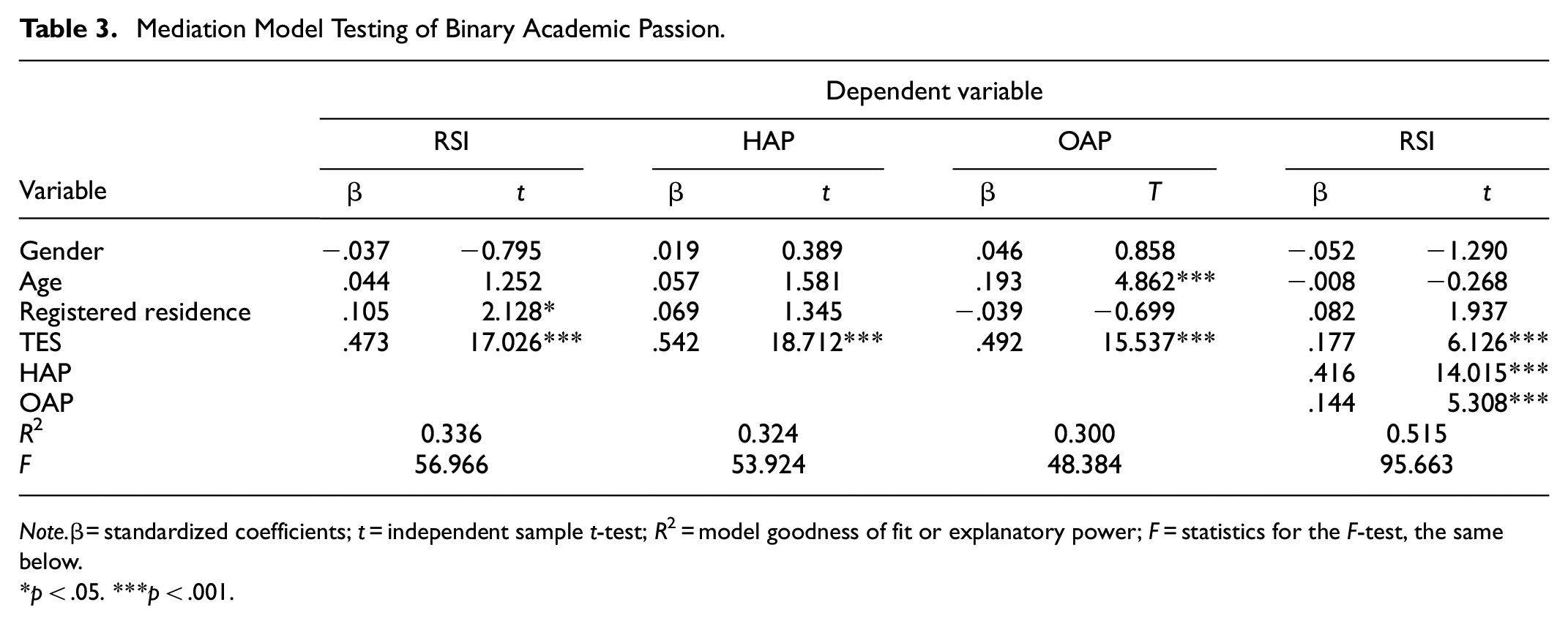
Note.β = standardized coefficients; t = independent sample t-test; R2 = model goodness of fit or explanatory power; F = statistics for the F-test, the same below.
p < .05. ***p < .001.
We further conducted Bootstrap analysis on the test of the mediating effect of academic passion, as shown in Table 4. The direct effect of training environment satisfaction and the mediating effect of harmonious and obsessive academic passion did not contain 0 at the upper and lower limits of the 95% confidence interval [0.108, 0.248], [0.185, 0.267], [0.042, 0.103], respectively. The partial mediating effect of binary academic passion was verified, with the direct and mediating effects accounting for 37.39%, 47.64%, and 14.97% of the total effect, respectively Hypothesis H4 was verified.
Mediation Effect Test Analysis.

Note. BootSE = standard error of bootstrap output; BootLLCI = the lowest value of the confidence interval output by the bootstrap method; BootULCI = the highest value of the confidence interval output by the bootstrap method.
The Moderating Role of Academic Self-Efficacy
Gender, age and registered residence were used as control variables. Model 59 in the PROCESS plug-in (Model 59 assumed that all paths of the mediation model were moderated, which was consistent with the assumed model of this study) was selected for the moderated mediation model test. The specific results are shown in Table 5. When academic self-efficacy was added into the model as a moderating variable, in the direct effect of the hypothesis model and the first half of the path, the interaction term between training environment satisfaction and academic self-efficacy had a significant predictive effect on the increment of research skill (β = .131, p < .001). Moreover, the predictive effect of the interaction term on harmonious academic passion and obsessive academic passion was also significant (β = .043, p < .05) and (β = .087, p < .001), indicating that academic self-efficacy could significantly enhance the effect of training environment satisfaction on harmonious academic passion, obsessive academic passion, and increment of research skill.
Moderated Mediation Model Testing.

p < .05. ***p < .001.
In the second half of the hypothesis model, the interaction between harmonious academic passion and academic self-efficacy was also significant in predicting the increment of research skills (β = −.057, p < .05). However, the interaction between obsessive academic passion and academic self-efficacy had no significant predictive effect on the increment of research skills (β = −.038, p > .05), indicating that academic self-efficacy could weaken the predictive effect of harmonious academic passion on the increment of research skill, but did not play a moderating role in the path of obsessive academic passion and increment of research skill. Therefore, hypothesis H5e does not hold.
To further analyze the effect trend of different degrees of academic self-efficacy, the moderated effects of all paths were tested except the path of obsessive academic passion × academic self-efficacy → increment of research skill, and the results are shown in Table 6. Table 6 shows that when academic self-efficacy is at a low level, the increment of research skills is not significantly affected by the satisfaction of the training environment. The upper and lower limits of the 95% confidence interval include 0, [−0.023, 0.110]. When academic self-efficacy was high, the improvement of training environment satisfaction on the increment of research skills became significant. The upper and lower limits of the 95% confidence interval did not include 0, [0.221, 0.392], indicating that with the improvement of individual academic self-efficacy, the prediction effect of training environment satisfaction on the increment of research skill was gradually significant. The other three paths also did not include zero at the upper and lower limits of the 95% confidence intervals. At the same time, the 95% confidence intervals of the moderated mediation effects of the above four paths were [0.001, 0.086], [0.041, 0.145], [0.069, 0.192], [−0.120, −0.005], respectively, and none of them included 0. Therefore, we concluded that H5a, H5b, H5c, and H5d hold.
The Moderated Mediation Effect Test Results.

Demographic Differences
In this study, to explore in depth the factors affecting the incremental research skills of master’s students, the respondents’ demographic data were analyzed to see if there were differences between the groups (see Table 7). Due to the space limitation, only the more significant variance analysis results are presented in this study. The results of the independent sample t-test showed significant differences in the incremental research skills of the respondents in terms of an only child or not, registered residence, admission method, and fresh graduate or not. These differences were specifically: the only child was better than the non-only child (t = 5.745, p < .001), rural household registration was weaker than urban household registration (t = −4.806, p < .001), open recruitment was better than exam-free recommendation (t = 7.224, p < .001), and fresh graduates were better than former graduates (t = 3.312, p < .001).
Variance Analysis of Research Skill Increments.

p < .001.
This study further analyzed the data to explore differences in the demographics of the respondents in terms of satisfaction with the training environment, academic passion, and academic self-efficacy. The data analysis showed significant differences in satisfaction with the training environment, academic passion, and academic self-efficacy between the only child or not, registered residence, and fresh graduate or not. This result is similar to the incremental research skills, with only children, urban residents, and fresh graduates performing significantly better than other types. Admission methods differed significantly only on the dimension of academic self-efficacy, as evidenced by open recruitment being significantly better than exam-free recommendation (t = 5.162, p < .001).
Discussion and Recommendations
The policies “Several Opinions on Strictly Regulating the Quality Management of Degree and Postgraduate Education” and “Opinions on Accelerating the Reform and Development of Postgraduate Education in the New Era” have prompted Chinese academic researchers to conduct extensive research on postgraduate education quality. However, a review of the literature for this study reveals that most current research has concentrated on the doctoral level, with little exploration of the master’s level. Meanwhile, most related studies have focused on the single impact of environmental or individual variables. This study examined and analyzed the effects of training environment satisfaction, academic passion, and academic self-efficacy on the incremental research skills of master’s students in central China to supplement existing research. This section discusses and explains the data analysis findings, examines how this study compares to earlier research, highlights its limits, and offers recommendations for graduate students’ practice-based learning.
Interpretation of Findings
The structured questionnaire used in this study was developed by Chinese scholars specifically for local graduate education. China’s educational system and social and economic development stage differ significantly from other regions. Therefore, a locally developed questionnaire is more appropriate for surveying master’s students in China. It is also more likely to generate different insights than graduate education research in other regions. In recent years, the emphasis on graduate education in China has led to a rapid expansion in the size of master’s degree programs, which has produced some educational pitfalls (Y. M. Wang & Ye, 2020). Current graduate education in China must focus on solving problems in education to ensure that the quality of graduate education does not weaken with the expansion of scale (Hou, 2020).
The relevant conclusions of this study can give some advice to the stakeholders of the graduate students. To achieve the expected results of postgraduate education, it is necessary to start building a solid belief in academics for students from the beginning of higher education. For students of different characters, the focus should also be on fostering different academic passions (J. Lee & Durksen, 2017). The external influences that postgraduate students need to face are rather complex. With age, more factors require careful consideration and are likely to interfere with learning (Roslan et al., 2017). When faced with this phenomenon, the guidance role of schools and mentors is crucial (Demirören et al., 2020).
The Predictive Effect of Training Environment Satisfaction on the Increment of Research Skill
Based on the data analysis findings from this study, it is proven that the training environment’s satisfaction would favor the increment of research skills and the arousal of academic passion (Gong et al., 2014; S. Y. Wang & Cai, 2022). The concept of the training environment is rather broad and difficult to measure thoroughly, so only existing research and experience can be combined to generalize external factors that may influence incremental research skills (Kuang & Li, 2019).
Hsun-Tzu’s adage, “If pigweed grows up amid hemp, it will stand up straight without propping. If white sand is mixed with mud, it too will turn black.” refers to how the environment affects how talent develops. From birth, people are immersed in various environmental systems, the three most significant of which are the family environment, the educational environment, and the social environment (Bronfenbrenner, 1992). Childhood is a crucial time for character development, significantly influenced by the family environment (Shubert et al., 2022). Furthermore, school plays a significant role in helping people set their life orientation and comprehensively understand their surroundings as they advance their education (Birhan et al., 2021; Wagner & Ruch, 2022). The motivation to advance in the educational process comes from exceptional peers (Reitz et al., 2014), visionary teachers (Saidovna, 2021), and ample school learning resources (Murillo & Román, 2011), among other aspects. Since individuals are social creatures, they engage in resource exchange behaviors in interaction with their environment. An excellent training environment includes a higher level of development platform and many intangible resources. When an individual is in an excellent training environment, the resources obtained from the exchange with the environment will be relatively excellent (Lindblom-Ylänne & Lonka, 1998). If index data is used to assess the quality of the training environment, it is not very objective. The satisfaction survey based on the training environment can more objectively reflect the individual’s level of satisfaction with the environment.
In previous studies, many scholars have explored the external environmental factors affecting graduate student development by drawing on the ideas of triadic reciprocal determinism or educational ecology theory. The physical environment of the training unit is a prerequisite to guarantee the research activities of graduate students (S. Y. Wang & Cai, 2022). Although some scholars point out that the conditions of school buildings and libraries in the cultivation environment do not have a significant impact on the quality of graduate student training (X. M. Wang & Wang, 2008), the large scale of graduate student expansion in recent years may lead to changes in the situation, and the improvement of physical conditions may also contribute to the quality of training (N. N. Wang & Li, 2016).
Although this study confirms the role of training environment satisfaction in incrementing research skills, in training for Master students, we cannot blindly pursue the excellence of the training environment construction but match the most appropriate resources according to the student’s different individual abilities. If the students are weak in relative capacity, universities or teachers should strengthen the primary resource supply, gradually increase, and then moderate training. If students have a relatively solid capacity, they should be provided with abundant educational resources to play their learning autonomy and cultivate them into innovative talents with the ability to think independently. If students with lower abilities are placed in a higher-intensity learning environment, not only will their level of competence not be improved, but they may also have a psychological impact on the individual, causing them to feel frightened about learning (J. Hayes & Allinson, 1996). At the same time, it is also necessary to take into account the requirements of the individual’s intrinsic factors for the development of the environment, such as the ability to cope with difficulties and the level of independent learning, which is also the reason why this study explores the mechanism of the internal factors in the environment and ability.
The Mediating Role of Academic Passion
The mediating effect of academic passion between satisfaction with the training environment and increment of research skill was proven based on the data analysis results of this study, which was also supported by previous studies (Bélanger & Ratelle, 2021; Schellenberg & Bailis, 2017). The training environment is an external aspect that can influence academic passion somehow. There is a strong positive association between harmonious academic passion and obsessive academic passion. As a result, the two cannot be easily separated in the analysis of binary academic passion (Mudło-Głagolska, 2022). At the same time, in the test of academic passion’s mediating effect, the effect value of harmonious academic passion is greater than that of obsessive academic passion, which is consistent with previous research findings (Tian et al., 2022). The two dimensions of academic passion are essential predictors of scientific research skill improvement. Obsessive academic passion has a slightly stronger emotional color than harmonious academic passion. As passion is generated by external pressure or demand (Carpentier et al., 2012), its effect is slightly inferior to the individual’s internal spontaneity (Forest et al., 2011).
The concept of academic passion has been increasingly used in the graduate sector in recent years, and it is obvious that scholars understand that individual graduate students’ views about academics are vitally crucial to their conduct and performance. The dualistic model of passion informs the concept of academic passion. Existing studies, on the other hand, tend to investigate just the processes of academic passion action and do not examine harmonious academic passion and obsessive academic passion in depth (Schellenberg & Bailis, 2015) or only discuss harmonious academic passion and obsessive academic passion individually (Yang et al., 2022). In specific settings, the two variables in the passion model are interconvertible (Schellenberg et al., 2019). Harmonious academic passions, for example, may be perceived as obsessive academic interests in various individuals, and hence the individual’s features cannot be overlooked in the study.
While examining the relationship between environment and ability, it is essential to consider how internal factors might affect ability development to varying degrees (Aliyev et al., 2021). Academic passion is the source and motivation the overcome academic difficulties, and the process of academic study is one of ongoing self-consciousness and comprehension (Schellenberg & Bailis, 2015). The only way to truly inspire graduate students’ love for learning is to assist them in developing their own self-drive and sense of accomplishment (Rahimi & Vallerand, 2021).
The construction of a training environment includes not only physical aspects, but also factors concerning educators. It is the responsibility of every educator not to abandon any student who wishes to improve his or her abilities (Georgiou et al., 2002). It is up to the educator to take appropriate measures for students with different plans (Felder & Brent, 2005). Educators need to encourage students interested in pursuing academic research to use the entire learning process to develop their inner passions, talents, and values, and this will enhance their intrinsic passion for pursuing an academic path, further enhancing their research skills. Moreover, in response to the situation where students are overwhelmed by academics and even less interested in pursuing an academic path, educators should also ensure that they learn the basic theoretical knowledge that will make them at least qualified graduates of a master’s degree. They should also focus on developing the logical ability to think through problems and the competencies required for employment.
The Moderating Role of Academic Self-Efficacy
The moderating effect of academic self-efficacy in the course of the anticipated mediation model was confirmed based on the results of the data analysis in this article. Previous studies have also confirmed this result (W. Lee et al., 2014; Zhao et al., 2021). Except for the path of obsessive academic passion and increment of research skill, where the moderating effect was insignificant, all paths had greater significance. Although the coefficient of the main effect and the moderating variable is positive when academic self-efficacy moderates the relationship between harmonious academic passion and increment of research skill, the coefficient of the interaction term between academic self-efficacy and harmonious academic passion is negative, indicating that academic self-efficacy and harmonious academic passion have a significant substitution relationship in influencing. In other words, academic self-efficacy weakens the positive effect of harmonious academic passion on the increment of research skills. The positive effect of harmonious academic passion is evident when the level of academic self-efficacy is low (effect value of 0.091). However, the positive effect of harmonious academic passion decreases as the level of academic self-efficacy increases (effect value of 0.083), indicating a significant substitution relationship between the two.
Similar to some of the topics covered in harmonious academic passion, academic self-efficacy measures a person’s level of self-confidence in the face of academic research labor. This confidence in one’s talents predicts the amount of effort a person will put out to achieve goals (Elias & MacDonald, 2007). Numerous studies have examined the impact of academic self-efficacy on variables like research aptitude or academic success (Dogan, 2015; Honicke & Broadbent, 2016; Zysberg & Schwabsky, 2021), and this study confirms the positive impact of self-efficacy. Notably, academic self-efficacy does not moderate the relationship between obsessive academic passion and incremental research skills. This study argues that a harmonious academic passion would enable graduate students to make scientific research their hobby and thus make them enjoy the research process, which is an ideal state (Tian et al., 2022). Obsessive academic passion, on the other hand, refers to those passions that are passively generated by individuals, which is the opposite of what academic self-efficacy connotes and is not spontaneously developed by individuals, but often arises from external pressures. Obsessive passion is often used to predict more undesirable outcomes, such as higher levels of burnout and work-life conflict (T. Curran et al., 2015). And some students may also believe that high levels of obsessive academic passion can lead to poorer academic experiences, such as lower satisfaction and resilience (Schellenberg & Bailis, 2017). This also illustrates the mutual offset of environmental and personal influences (Bonneville-Roussy et al., 2013), that is, when individuals with higher autonomous motivation encounter pressure from the external environment, it may have an impact on their attitudes. This also fits with the idea of triadic reciprocal determinism, that is, the environment and the individual can influence each other, which in turn leads to changes in individual behavior.
Academic self-efficacy is one of the critical factors influencing the value-added of master’s students’ research skills as a group, and strengthening the intervention of academic self-efficacy on individuals’ intrinsic motivation is an effective way to improve master’s students’ research skills. Setting reasonable goal orientations, developing one’s own “areas of satisfaction,” and maintaining positive thoughts to stimulate positive emotions can help boost academic self-efficacy (Capron Puozzo & Audrin, 2021), and this also demonstrates that intra-individual factors can have varying degrees of influence on ability improvement. Academic research is a continuous process of self-knowledge and understanding, and academic passion is the source and motivation for awareness of academic problems. Only by assisting graduate students in developing their self-drive (Hayat et al., 2020) and reaping a sense of accomplishment can students be inspired to have a genuine passion for academics.
Limitations of Study
This study also has limitations regarding sample group size, variable selection, and research methodology. First, the inadequate sample size reduces the external validity of the study results. The graduate student population in China is enormous, and this study only investigates a small portion of it; follow-up studies can further expand the sample size. Second, this study was conducted only in the central part of China. Given the differences in cultural backgrounds, the results of this study may only apply to some regions. Therefore, follow-up studies may consider comparative studies of similar developing or developed countries. Also, this study did not provide a more comprehensive classification of the sample group (e.g., marital status, grade level), and future researchers could provide a more comprehensive classification of the sample group to validate the findings of this study. Again, this study used only the questionnaire method for data collection. Richer survey methods, such as the interview and follow-up study methods, could improve the study’s internal validity. Finally, the selection of relevant variables was relatively homogeneous due to the limitations of the initial thinking of the study. Subsequent studies can continue to explore the occurrence and development process of high-level research skills in master’s graduate student groups from a more extensive scope and closely related internal and external factors and provide broader ideas for improving the quality of graduate education.
Conclusion
This study constructed a moderated mediation model to explore the relationship between TES and RSI. It examined the effects of training environment satisfaction, academic passion, and academic self-efficacy on incremental research skills of master’s students in central China through correlation, mediating, moderating, and analysis of variance. Regarding the intrinsic mechanism of action of critical factors, we found that all variables showed significant correlations with each other through correlation analysis with mediating and moderating effects analysis. Specifically, TES can positively affect RSI and can influence RSI through a partially mediated effect of AP, that is, the more satisfied and academically passionate master’s students are about their training environment, the more excellent their research skills will be. We also found a positive moderating effect of ASE between the other three variables and a substitution relationship between ASE and HAP regarding their effects on RSI. In addition, in the analysis of variance, we found differences in respondents’ demographic information on TES, AP, ASE, and RSI. Specifically: only-child, urban household registration, open recruitment, and fresh graduates are significantly better than the non-only child, rural household registration, exam-free recommendation, and former graduates.
These findings provide deeper insights into RSI, achieve complementarity and interpretation of current research, and also provide some actionable suggestions for enhancing the research skills of master’s students. This study also points out where its limitations lie and encourages further exploration by subsequent scholars.
Footnotes
Acknowledgements
We thank Henan University for providing financial support for this study.
Declaration of Conflicting Interests
The author(s) declared no potential conflicts of interest with respect to the research, authorship, and/or publication of this article.
Funding
The author(s) disclosed receipt of the following financial support for the research, authorship, and/or publication of this article: This work was supported by the Graduate Education Reform Project of Henan Province [Grant Number 2023SJGLX011Y]; the Graduate Education and Teaching Reform Research and Practice Project of Henan University [Grant Number YJSJG2023XJ001]; and the Graduate Training Innovation and Quality Improvement Action Plan Project of Henan University [Grant Number SYLYC2022004].
Ethical Approval
This study did not conduct any animal or human studies and therefore no ethical statement was applicable.

Data Availability Statement
Data relevant to this study is available upon reasonable request.