




Abstract
The study aims to uncover the influence of positive personality traits among Turkish language teacher candidates on their effective communication self-efficacy and academic self-efficacy. Furthermore, it seeks to identify the mediating variable effect of effective communication self-efficacy. To achieve these objectives, the research employed the relational survey model. The sample comprised 345 students enrolled in the Turkish Language Teaching Department at various universities in Türkiye at the undergraduate level. Structural equation modeling was utilized for the analysis. The research findings indicate that possessing positive personality traits positively impacts the academic self-efficacy levels of pre-service teachers. Additionally, having positive personality traits contributes to an increase in their effective communication self-efficacy levels. The study demonstrates that as pre-service teachers’ effective communication self-efficacy levels rise, so do their academic self-efficacy levels. In conclusion, the research unveils that the effective communication self-efficacy levels of pre-service teachers mediate the relationship between positive personality traits and academic self-efficacy, and effective communication self-efficacy determines the strength of the connection between these two variables.
Keywords
Introduction
Although individuals may share certain similarities, their thought structures, behavioral patterns, physical characteristics, genetically accompanied abilities, beliefs, and values acquired from the society they belong to, their ways of perceiving events, or their reactions to these events are different. These differences are considered the most significant evidence that the personality of each individual is distinct from others (Atkinson et al., 2010, p. 423). When considering the concept of personality, it is evident that various definitions have been proposed. Sullivan (1953) defines personality as a pattern of interpersonal situations, Cloninger (2004) as the sources behind a person’s distinctive behaviors and experiences, and Eysenck (1997) as an almost stable and permanent organization of character, temperament, intelligence, and physical characteristics—the biological structure components that determine an individual’s adaptation to the environment. Personality serves as the framework distinguishing one individual from another; each person possesses their world, abilities, and possibilities. Additionally, personality is closely related to the cultural context and its impact on upbringing, how an individual defines and meets their needs, how they express their reactions, how they relate to others, and how they distinguish right from wrong (Abood et al., 2020). Despite the various definitions, the literature emphasizes distinctiveness and consistency as the foundation of the concept of personality. For personality to develop, distinctiveness—the feature that sets the individual apart—and consistency—the forms of behavior frequently shown in a particular situation—must be ensured (Cüceloğlu, 2019). The diversity in people’s reactions to the same events is rooted in the personalities they have constructed. Even among people who grow up in a similar environment, undergo the same education, or are shaped in the same cultural context, differences are observed. In this context, personal characteristics play a crucial role in triggering individuals’ relations with the environment and directing their behaviors and the entirety of their spiritual life (Pervin & Cervone, 2010). The significance of personality traits lies in their role in shaping individuals’ thoughts, emotions, perspectives, and behavior. Understanding an individual’s personality traits can offer numerous advantages (Mawalim et al., 2019). Personality traits exert influence across various aspects of human life, extending from academic experiences to professional endeavors. Specifically, in the realm of education, individuals engaged in the study or teaching of a subject are influenced by their personality traits, impacting their skills and competencies within the educational domain.
It is seen that personality traits, defined as a set of consistent and permanent behaviors that distinguish individuals from others (West & Graziano, 1989), are subject to more than one theory in the literature. Among these theories, the distinctive trait personality approach stands out. According to the trait theory, which focuses on describing personality and predicting behaviors rather than the causes of people’s behaviors, traits are the building blocks of personality and are defined as universal structures that influence and shape individuals’ behaviors (Goldberg, 1993; McCrae & Costa, 1997). This approach was first developed by Gordon Allport in 1921 and was further developed by Henry Murray and Raymond B. Cattel (Burger, 2006). This theory, also known as the “Big Five Factors,”“Big Five,” or “Five Factor Model” has been tested by researchers in many different cultures and has been tested for its consistency and validity across diverse cultures, both Eastern and Western (Burger, 2006; Costa & McCrae, 1992; Digman, 1990; Goldberg, 1990; Noller et al., 1987). This tested five-factor model consists of self-control (conscientiousness), agreeableness, extraversion, neuroticism, and openness to experience. Another notable theory is Jungian archetypes. In this theory, he aimed to identify similar characteristics as a specific archetype for each personality type. Jung divided personality into two main types: introversion and extroversion. An introvert is not social and prefers isolation; conversely, extroverts like socializing with others (Crow, 1968, p. 164).
People’s personality traits are associated with certain affective processes. For instance, when considering and analyzing the self-control dimension, traits such as having high self-control, taking precautions against events and situations, and carefully thinking before taking action come to the forefront. Individuals with strong self-control personality traits are hardworking, sensitive, meticulous, responsible, reliable, and possess a strong will to accomplish tasks (Arthur & Graziano, 1996; Costa & McCrae, 1992).
While personal characteristics are relatively unconditional behavioral tendencies that manifest in various functional domains (Costa & McCrae, 1999), self-efficacy beliefs are cognitive structures that reveal individuals’ unique ability to self-reflect and make inferences from experience. According to social cognitive theory, self-efficacy pertains to individuals’ beliefs and judgments about their ability to accomplish or fulfill specific activities or tasks (Bandura, 1997). Self-efficacy, a crucial component of self-belief, plays a determinant role in academic success (Huang, 2012). In educational settings, self-efficacy empowers students to be well-prepared for critical thinking and to exhibit confidence when taking initiative (Bandura, 1986).
When examining the concept of academic self-efficacy, it is defined as the belief that individuals can overcome academic tasks, separate from their belief in their behavior and abilities. Academic self-efficacy has a positive impact on individuals’ goal-setting, effort exertion, and the sustainability of that effort (Pajares, 2009). Moreover, research indicates that individuals’ academic self-efficacy is linked to the acquisition of fundamental cognitive skills, mastery of subjects, and performance in standardized achievement tests (Multon et al., 1991). It also demonstrates a positive correlation with academic motivation, encompassing persistence, memory performance, and overall academic achievement (Dorman, 2001). In this context, it is evident that academic self-efficacy contributes to academic success, and successful academic experiences enhance academic self-efficacy (Millburg, 2009).
Bandura (1997) asserts that academic self-efficacy enhances academic adjustment, fosters positive optimism, promotes success, and facilitates adaptability in coping with challenges. According to him, individuals with low academic self-efficacy tend to have lower aspirations and are less committed to achieving necessary goals. It is observed that individuals with strong academic self-efficacy explore various strategies to overcome challenges. In contrast, individuals with low academic self-efficacy perceive success as challenging and may abandon the search for solutions (Bandura, 1997). These attitudes that individuals adopt in the face of challenges also play a crucial role in determining personal characteristics such as assertiveness or passivity, prominence or background presence, diligence, or ineffectiveness, directly influencing the social interactions individuals establish in their lives.
Communication, an innate human desire, serves the purpose of transferring information from a source to an audience. However, effective communication goes beyond mere transmission; it requires that the receiver comprehends the message in the intended manner (Fashiku, 2017). Establishing an effective communication environment involves systematically analyzing and interpreting messages by the target that are organized by the source. These processes are influenced by individuals’ experiences, characteristics, the education they receive from their families or school environment, and the sociocultural attributes they acquire. The key to navigating these differences lies in possessing effective communication skills. Environments lacking effective communication often lead to misunderstandings, accusations, or resentments, significantly impacting individuals and reducing their overall quality of life. Therefore, individuals’ belief in or perception of their competence in effective communication skills contributes significantly to their social and learning environments.
Individuals with high effective communication self-efficacy are observed to foster mutual respect and cooperation (Ontario Principals’ Council, 2011). They build trust and gain value not through grand gestures but through daily interactions that demonstrate active listening and care (Brown, 2018; Tyler, 2016). In this regard, effective communication self-efficacy plays a pivotal role in shaping individuals’ characteristics and holds sway in their academic lives.
The diverse personality traits of individuals, coupled with their proficiency in effective communication and academic self-efficacy, influence their behavior within the educational system. Understanding the effects of task and personal variables, typically influential in academic self-efficacy, and deciphering their intricate relationships have practical implications for the educational system (Bong, 1999). Analyzing personality traits, effective communication, and academic self-efficacy behind individuals’ behaviors is crucial to comprehending their actions in the education system and predicting potential reactions (Robbins & Judge, 2012). Enhancing efficiency in this context and fostering a positive school culture depend on assigning tasks to individuals based on their personality traits. Within the school environment, it is crucial for the effectiveness and efficiency of the education and training process that teachers possess personality traits aligned with the requirements of the teaching profession, are academically equipped, and actively employ effective communication skills.
The outcome of the teaching profession differs from other professions in that it is not product or output-oriented. The teacher’s role involves shaping character; individuals and generations are the fruits of their labor (Topçu, 2017). The teacher’s ability to reflect their personality in the classroom setting hinges on integrating their academic knowledge with interaction and communication processes. Consequently, it is crucial to elucidate the connection between personality traits, effective communication skills, and academic self-efficacy. This understanding is deemed highly significant in enhancing teachers’ effectiveness and efficiency in the classroom, leading to substantial advancements in the learning processes through their positive contributions.
In a comprehensive review of the relevant literature, it becomes evident that personality traits play a crucial role in directly and indirectly influencing various aspects such as effective communication (Bozkurt et al., 2023; Dhillon & Kaur, 2023; Mawalim et al., 2019), academic achievement (Richardson et al., 2012; Van Daal et al., 2014), and academic self-efficacy (Ahmadi et al., 2023; Hong et al., 2023) across different professions and student groups. Studies examining personality traits and communication competence, as well as communication skills and effectiveness, have revealed significant insights. Mawalim et al. (2019) identified five distinct personality traits that impact communication skills. Dhillon and Kaur (2023) highlighted the influence of personality traits on communication effectiveness and styles, emphasizing that teachers’ communication styles mediate overall communication effectiveness. Similarly, Bozkurt et al. (2023) reported a positive impact of positive personality traits on communication competencies. Turning to research exploring the connection between personality traits, academic self-efficacy, and academic achievement, Ahmadi et al. (2023) demonstrated that personality traits significantly affect academic self-efficacy and motivation. Their findings indicated that positive personality traits positively predicted self-efficacy and motivation, whereas negative traits had a negative predictive effect.
While existing literature establishes a relationship between personality traits, communication skills, and academic competencies, there is a notable gap in understanding how individuals’ personality traits manifest in effective communication and how the competence of effective communication directly or indirectly influences academic competencies. This study seeks to address this gap by investigating the impact of pre-service teachers’ personality types on their communication and academic competencies, with a focus on the mediating role of effective communication competence.
Research Model and Hypotheses
In this research, a structural model was created to reveal the level of the reflection of Turkish teacher candidates’ positive personality traits on their effective communication self-efficacy and academic self-efficacy.
In the context of the research model presented in Figure 1, the aim was to examine the impact of positive personality traits in Turkish teacher candidates on their effective communication self-efficacy and academic self-efficacy, as well as the direction in which these variables predict each other (positively or negatively) and the mediating effect.
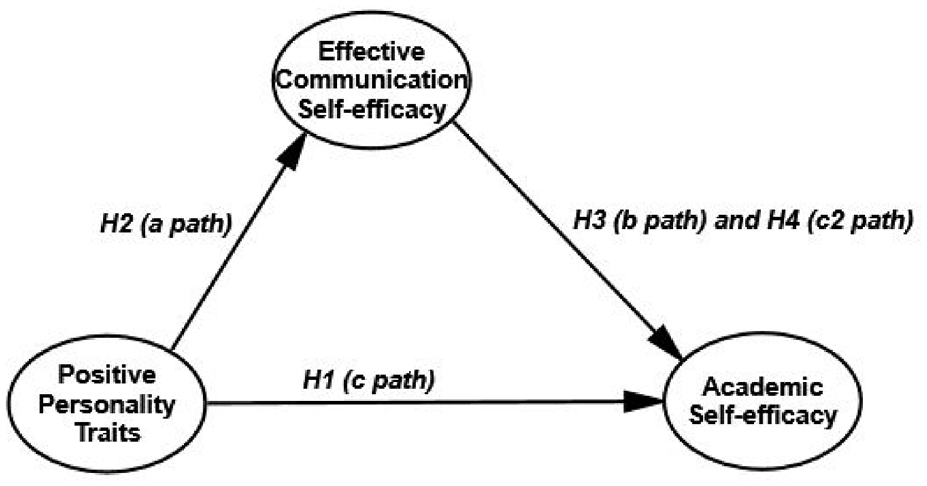
Research model.
In line with these objectives, the hypotheses of the research were formulated as follows:
H1: Participants’ positive personality traits positively affect their academic self-efficacy.
There is supporting research for hypothesis H1 in the literature. Abood et al. (2020) investigated the effect of personality traits on the academic self-efficacy of university students, highlighting a relationship between academic self-efficacy and personality traits based on the five-factor theory (extraversion, openness to experience, neuroticism, agreeableness, and conscientiousness). Parmaksız (2022) explored the relationship between personality types of university students and their academic self-efficacy and digital addiction. Şenler (2011) also examined the relationship between pre-service teachers’ personalities and their teaching self-efficacy and academic self-regulation.
H2: Participants’ positive personality traits positively affect effective communication self-efficacy.
Several studies attempt to demonstrate a relationship between personality traits and communication self-efficacy, encompassing communication competence, effective communication, and communication strategies. Rivers and Ross (2020) explored the relationship between communication self-efficacy beliefs and personality types of Japanese university students. Additionally, Rivers (2020) investigated the impact of national identity and personality on foreign language communication and attitude.
H3: Participants’ effective communication self-efficacy positively affects their academic self-efficacy.
Competence in communication skills and enhanced self-expression skills also influence individuals’ academic competence. In the literature, various studies examine the effect of communication skills or communication competencies on academic self-efficacy or their interrelationship (Babaei Parsheh & Mosadeghi Nik, 2022; Cho et al., 2019; Çiftçi & Taşkaya, 2010; Rubin et al., 1993; Yüce, 2023).
H4: Participants’ effective communication self-efficacy mediates the relationship between positive personality traits and academic self-efficacy
Numerous studies have consistently demonstrated that personality traits significantly impact academic performance and self-efficacy perceptions (Ahmadi et al., 2023; Hong et al., 2023). Additionally, effective communication self-efficacy is related to an individual’s proficiency in utilizing communication skills masterfully. If personality traits influence an individual’s ability to effectively employ these communication skills (Bozkurt et al., 2023; Dhillon & Kaur, 2023; Mawalim et al., 2019), it suggests that effective communication competence may have an indirect effect on academic self-efficacy.
Method
Research Design
In this study, which aims to investigate the impact of positive personality traits on the effective communication self-efficacy and academic self-efficacy of Turkish teacher candidates, the relational survey model, a subtype of survey models, was employed. This model is designed to assess the level of change or influence between two or more variables within a group (L. Cohen et al., 2000; Karasar, 2000). The study was conceptualized to reveal the personality traits, communication self-efficacy, and academic competencies of participants undergoing training for mother tongue teaching.
The survey design offers a quantitative portrayal of the tendencies, attitudes, or opinions of a population through studies conducted on a sample selected from that population (Creswell, 2013). In this context, data for this study, aiming to unveil the relationship between personality traits, communication self-efficacy, and academic competence in L1 teacher candidates at the undergraduate level in Türkiye, were collected from diverse universities to ensure representation of the population. Structural Equation Modeling (SEM) was employed to test the hypotheses proposed in line with the study’s objectives and to discern the relationships between the variables. SEM is not a term denoting a singular statistical technique but rather a set of related procedures (Kline, 2015).
Participants and Sampling
In the study, 345 students in Turkish language teaching departments at different universities in Türkiye at the undergraduate level participated. The research population consists of Turkish language teacher candidates studying at state and foundation universities in Türkiye. The snowball sampling method, which aims to represent the subgroups in the population in the sample, was used in the study. The snowball method is a sampling method in which the sample group grows like a rolling snowball. This method is used when other methods cannot be applied, or optimal research conditions are not available, and when used carefully, it provides various advantages and benefits to researchers (N. Cohen & Arieli, 2011). This method, one of the best-known types of non-probability sampling, is particularly suitable for situations where the population of interest is difficult to reach, and compiling a list of the population poses challenges for researchers (Etikan et al., 2015). The virtual snowball sampling method, on the other hand, not only facilitates access to the “hard-to-reach” population but also can expand the sample size and scope of the study and reduce costs and time (Benfield & Szlemko, 2006). In this context, for my samples to represent the population in the study, firstly, we tried to reach the students studying in the Turkish language teaching department at Aksaray University, where we work. Then we reached the students studying in the same department at different universities in Türkiye. The demographic characteristics of the participants are as follows:
Table 1 shows the number of people and percentages for each category in the same column. According to these data, the number of people in the “Female” category is 254, representing 73.6% of the total number of people. Similarly, the number of people in the “20-22 years old” category is 165, representing 47.8% of the total number of people; the number of people in the “1st-grade” category is 115, representing 33.4% of the total number of people; and the number of people in the “province” category is 117, representing 34.0% of the total number of people. The percentages in the table show the ratio of people in the given category to the total number of people.
Demographic Information of the Participants.

Data Collection
The data were collected through the Personality Scale (Bacanlı et al., 2009), the Effective Communication Self-Efficacy Scale (Yahşi & Aydın, 2020), and the Academic Self-Efficacy Scale (Ekici, 2012). An online questionnaire with the scales mentioned in Google Forms was created, and an attempt was made to reach the participants via WhatsApp Messenger. The questionnaire-filling process was based on volunteerism.
Data Collection Tools
Personality Traits Scale
The scale, developed by Bacanlı et al. (2009) based on the theory of the five-factor personality traits, comprises five dimensions: extraversion, agreeableness, conscientiousness, emotional balance, and openness to experience, with a total of forty items. The extraversion dimension encompasses personality traits such as “sociable, aggressive, crazy, cheerful, enthusiastic,” while the agreeableness dimension reflects traits like “forgiving, helpful, compassionate, cooperative, humble.” The conscientiousness dimension assesses traits such as “organized, responsible, ambitious, disciplined, careful,” while the emotional balance dimension focuses on traits like “patient, calm, relaxed, consistent, optimistic.” The openness to experience dimension includes traits such as “interested in art, imaginative, open to new relationships, curious.”
In the validity analysis of the scale, the factor loadings of the items ranged between .36 and .86, and the item correlation coefficients ranged between .26 and .79. In the reliability analysis, the Cronbach’s Alpha reliability coefficients are as follows: Extraversion dimension, .89; agreeableness dimension, .87; conscientiousness dimension, .88; emotional balance dimension, .73, and openness to experience dimension, .80.
As a result of the reliability analysis conducted for this study, the Cronbach’s Alpha reliability coefficients are as follows: Extraversion dimension, .86; agreeableness dimension, .76; conscientiousness dimension, .75; emotional balance dimension, .70, and openness to experience dimension, .72.
Effective Communication Self-Efficacy Scale
The Effective Communication Self-Efficacy Scale, developed by Yahşi and Aydın (2020), comprises three subscales: “cognitive self-efficacy (a),”“affective self-efficacy (b),” and “psychomotor self-efficacy (c),” with a Likert-type scoring system ranging from 1 to 5, totaling 41 items. The construct validity study’s Kaiser-Meyer-Olkin (KMO) results were a = 0.94, b = 0.94, c = 0.94 for the three dimensions, and Barlett’s test results were a = 4369.69 (p < .00), b = 5311.78 (p < .00), and c = 2693.31 (p < .00) for the three dimensions, respectively. Confirmatory factor analysis indicated that the values demonstrated an excellent fit. In terms of reliability, the inter-subdimension correlation analysis showed a correlation coefficient of r = .86 between cognitive and affective sub-dimensions, r = .87 between cognitive and psychomotor sub-dimensions, and r = .85 between psychomotor and affective sub-dimensions. The reliability analysis revealed that Cronbach’s Alpha reliability coefficient for the scale and its sub-dimensions ranged between .96 and .83.
As a result of the reliability analysis conducted for this study, Cronbach’s Alpha reliability coefficient was calculated as .94 for the total scale, .86 for the cognitive self-efficacy sub-dimension, .88 for the affective self-efficacy sub-dimension, and .90 for the psychomotor sub-dimension. These results affirm the reliability of the scale.
Academic Self-Efficacy Scale
Owen and Froman (1988) developed the academic self-efficacy scale, and it was adapted to Turkish by Ekici (2012), who conducted a validity and reliability study. The construct validity study yielded a Kaiser-Meyer-Olkin (KMO) value of 0.86, and Barlett’s test result was 4,376.13 (p < .00). Subsequently, exploratory factor analysis was performed, item loadings were calculated, and the final scale was structured into three sub-dimensions with 33 items. The scale’s sub-dimensions are identified as “social status, cognitive practices, and technical skills.” In the reliability study, the overall scale demonstrated a Cronbach Alpha value of .86. The sub-dimension values were determined as .88 for the social status sub-dimension, .82 for the cognitive practices sub-dimension, and .90 for the technical skills sub-dimension (Ekici, 2012, p. 174).
As a result of the reliability analysis conducted for this study, Cronbach’s Alpha reliability coefficient was calculated as .93 for the total scale, .83 for the social status dimension, .90 for the cognitive practices dimension, and .70 for the technical skills dimension. These results affirm the reliability of the scale.
Data Analysis
The research data were analyzed using SPSS 26 and AMOS 24 statistical programs. Initially, the data obtained from the participants were subjected to descriptive analysis. Subsequently, the data were imported into the AMOS 24 program and analyzed through structural equation modeling (SEM). Structural equation modeling is a widely utilized method in social and educational sciences for testing instrument validity and examining causal relationships between variables. The analyses involved two stages: confirmatory factor analysis and structural or path analysis (Gürbüz, 2021; Kline, 2015).
In this study, given that validity and reliability tests were conducted beforehand, the analysis considered Cronbach’s Alpha reliability results and the sub-dimensions of the scales. In the second step, a structural model was established, and the relationships between latent and observed variables were examined, incorporating direct, indirect, and mediating effects. The study specifically investigated the direct effect of positive personality traits on academic self-efficacy and the indirect effect of effective communication self-efficacy as a mediating variable.
Sample size and normality were tested for SEM analysis. In this context, it is seen that it is sufficient for the sample to be between 100 and 150 (Kline, 2015), and the sample size in this study (N = 345) is sufficient. In normality values, skewness and kurtosis values of each variable were calculated, and it was observed that the data were normally distributed. Due to the normal distribution of the data, the model’s compatibility with the data set was examined. Then, path analysis was created in line with the hypotheses, and the predictions and relationships of the variables were revealed. While making predictions in this process, the covariance matrix was created using the Maximum Likelihood calculation method. As a result of the path analysis, χ2/df, CFI, GFI, IFI, NFI, and SRMR fit indices were used for model fit (Gürbüz, 2021; Hu & Bentler, 1998; Kline, 2015). The model fit values of the fit indices are shown in Table 2 (Gürbüz, 2021).
Structural Equation Models Fit Indices.

Findings
The findings obtained from this study were analyzed through various analyses and tabulated as follows.
Convergent and Discriminant Validity of the Measurement Model
To assess the convergent and discriminant validity of the structures, composite reliability (CR) values and average variance extracted (AVE) for each sub-factor of each scale were calculated. The requirement that the AVE value for each factor should be greater than the squared correlation coefficients with every other factor is an indication of the scales having discriminant validity (Compeau & Higgins, 1995; Fornell & Larcker, 1981). In this context, Table 3 presents the values illustrating convergent and discriminant validity for each scale used in the study.
Convergent and Discriminant Validity Results of the Structures.
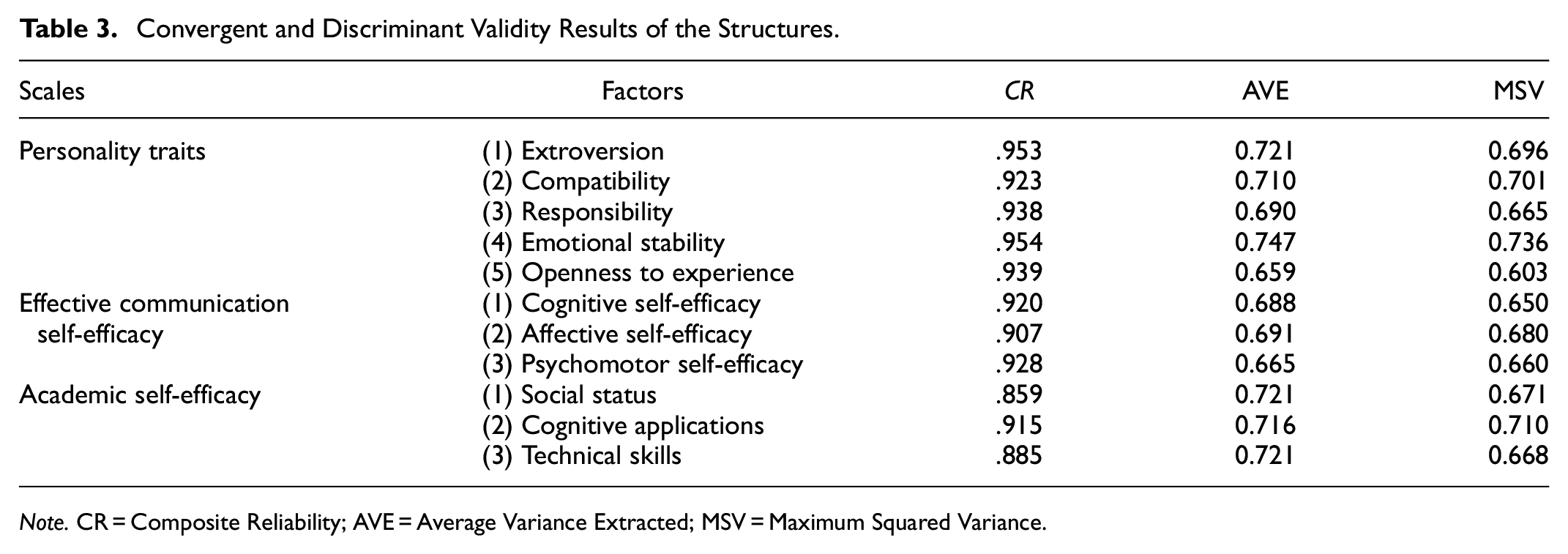
Note. CR = Composite Reliability; AVE = Average Variance Extracted; MSV = Maximum Squared Variance.
According to the results presented in Table 3, each scale demonstrates high reliability, as indicated by the values of all factors (CR > 0.70). Simultaneously, the fact that AVE values for the factors are lower than CR values, and AVE values are above 0.5, signifies convergent validity for the factors. Additionally, the AVE values for the factors being higher than the MSV (Maximum Shared Variance) values indicate discriminant validity.
Correlations Among the Variables
According to the results in Table 4, the absolute value of skewness ranges from −.617 to .518, and that of kurtosis ranges from −.214 to .590. Since both skewness and kurtosis fall below 3 and 10, respectively, all normalization standards are met, indicating that the available data satisfies the assumption of multivariate normal distribution (Kline, 2015). When examining the correlation analysis results for each variable, it is observed that the majority of variables have statistically significant correlations with each other at the .01 significance level. However, there is no significant relationship between the extroversion variable and the social status, cognitive applications, and technical skills variables. Similarly, there is no significant relationship between the emotional stability variable and the technical skills variable (p > .01).
Pearson’s Product-Moment Correlations Among the Variables.

Note. 1 Extroversion, 2 Compatibility, 3 Responsibility 4 Emotional Stability, 5 Openness to Experience, 6 Cognitive Self-efficacy, 7 Affective Self-efficacy, 8 Psychomotor Self-efficacy, 9 Social Status, 10 Cognitive Applications, 11 Technical Skills.
p < .01.
Assessing the Structural Model
After the measurement model was validated, the hypotheses of the latent variable structural model were tested. The results of the analysis are shown in Table 5. The hypotheses of the study were tested using the IBM AMOS 24 program. Since the data were normally distributed, the covariance matrix was created using the Maximum Likelihood calculation method. As a result of the analysis, the modification index (MI) has been utilized to bring the goodness-of-fit values of the tested model within acceptable threshold levels, specifically between the compatibility and emotional stability sub-scales of personality traits. The MI recommended by the YEM programs provides insights to researchers about potential improvements that can be made to the model (Gürbüz, 2021). First, the measurement model of positive personality traits, effective communication self-efficacy, and academic self-efficacy variables was tested. The goodness of fit values obtained as a result of the analysis showed that the measurement model was confirmed (χ2 [26, N = 345] = 196.496, (p < .01), χ2/sd = 4.912; GFI = .90; CFI = .91; IFI = 0.92; NFI = 0.90; SRMR = .056). After validating the measurement model, the hypotheses were tested through the mediated structural model, and the analysis results are presented in Table 5. In addition, the results showing that the hypotheses were confirmed are shown in Figures 2 and 3.
Results of Structural Model Analysis.
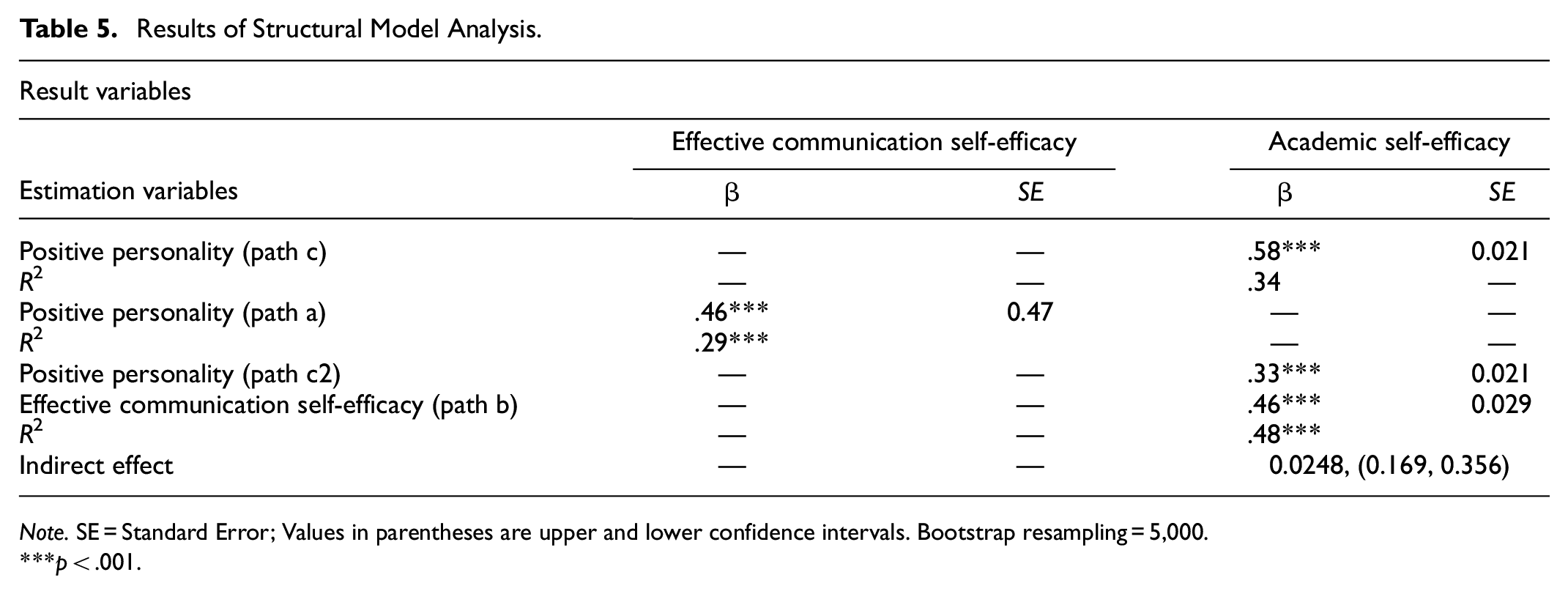
Note. SE = Standard Error; Values in parentheses are upper and lower confidence intervals. Bootstrap resampling = 5,000.
p < .001.

Diagram for path c.

Standardized path diagram for the moderated structural model.
Firstly, to test hypothesis H1 (positive personality trait- academic self-efficacy), the latent variable structural model in which positive personality trait is exogenous and academic self-efficacy is an endogenous variable was tested. According to the results of the analysis, it was seen that the positive personality trait of prospective Turkish teachers positively predicted academic self-efficacy (path c; β = .58, p < .01). This result supports hypothesis H1.
To test the remaining hypotheses of the study, a distinct model was constructed, introducing effective communication self-efficacy as the mediating variable (Figure 3). According to the outcomes of the mediated structural model analysis, participants’ positive personality traits significantly and positively predicted their effective communication self-efficacy (path a; β = .54, p < .01), supporting hypothesis H2. Furthermore, the mediating variable, effective communication self-efficacy, positively predicted academic self-efficacy (path b; β = .46, p < .01), supporting hypothesis H3. In this context, it can be inferred that the effective communication self-efficacy of pre-service teachers, serving as the mediating variable, positively influences academic self-efficacy. Additionally, effective communication self-efficacy accounted for 49% of the variance in positive personality traits and academic self-efficacy. The analysis results are detailed in Table 5.
Path analysis was performed using the Bootstrap method to ascertain the mediating role of the effective communication self-efficacy variable in the connection between positive personality traits and academic self-efficacy. As per Hayes (2017), the Bootstrap method yields more reliable outcomes than the Sobel test, a traditional method in Baron and Kenny’s approach. In this analysis, 5,000 resampling options were utilized. In mediation effect analyses conducted with the Bootstrap technique, the 95% confidence interval values of the analysis result obtained to verify the hypotheses should not encompass zero values (Gürbüz, 2021).
According to the results of the analysis, the indirect effect of positive personality traits on academic self-efficacy (c2 path) was found to be significant (β = .0248, 95% CI [0.169, 0.356]). In the Bootstrap analysis, lower and upper confidence interval values obtained with the percentile method did not include 0 (zero) values. These findings indicate that effective communication self-efficacy mediates the relationship between pre-service teachers’ positive personality traits and academic self-efficacy, thus supporting hypothesis H4.
In Table 6, standardized and unstandardized regression weights for the measurement model and structural model are presented.
Parameter Estimation Values for Regression Weights (N = 345).
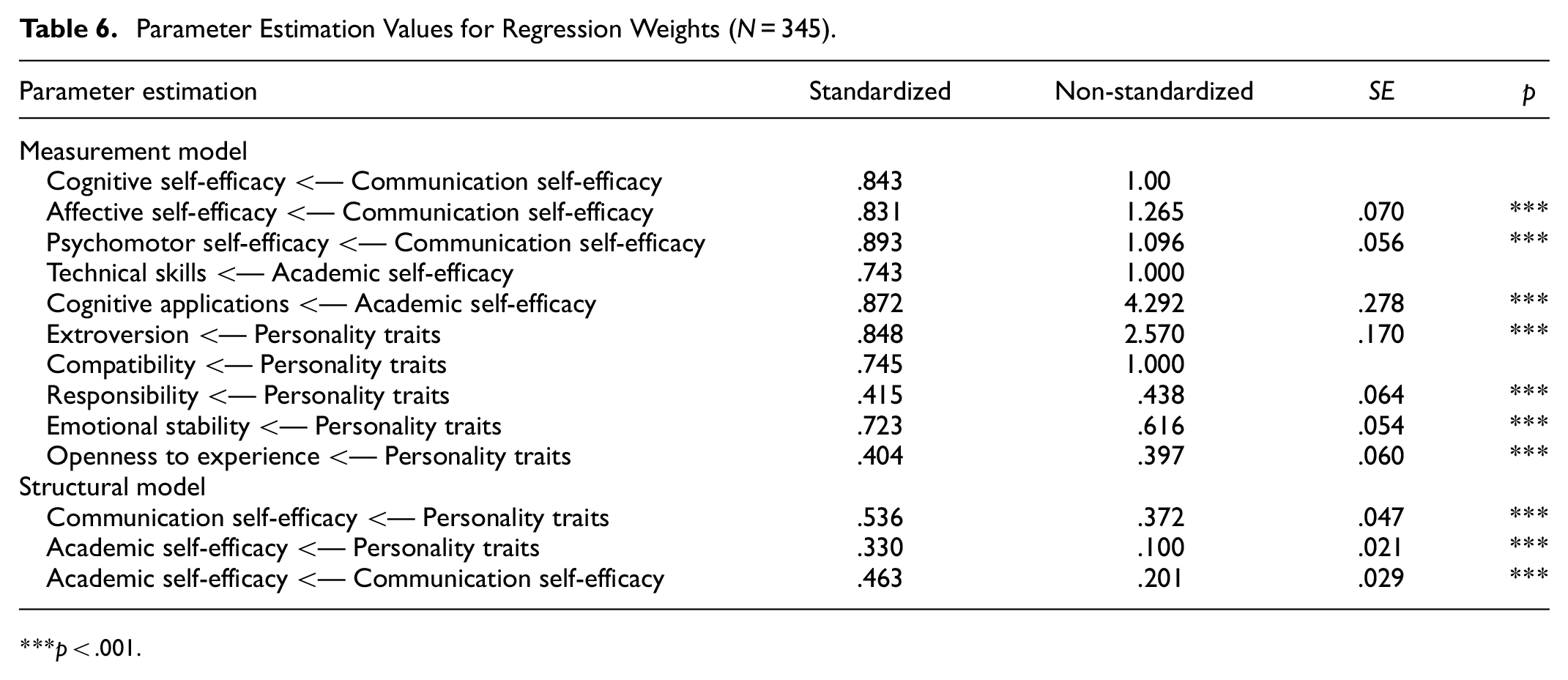
p < .001.
Discussion
In this research conducted with prospective Turkish teachers, various hypotheses were tested. The discussion of the research findings concerning hypothesis H1 (positive personality trait—academic self-efficacy) reveals that the latent variable structural model, with positive personality traits as exogenous and academic self-efficacy as an endogenous variable, was tested. According to the analysis results, it was observed that the positive personality traits of Turkish teacher candidates positively predicted academic self-efficacy. This aligns with previous studies that have found a positive bidirectional relationship between personality traits and academic self-efficacy (Abood et al., 2020; Kappe & Van der Flier, 2012; Lin et al., 2014; Parmaksız, 2022; Rivers, 2020).
Parmaksız (2022) investigated the relationship between personality traits and academic self-efficacy, establishing a positive correlation between these two variables. Judge et al. (2007) explored the correlation between self-efficacy and personality traits, finding that openness, extraversion, conscientiousness, and agreeableness were positively associated with self-efficacy, while neuroticism exhibited a negative correlation. Lin et al. (2014) focused on proactive personality traits and their relationship with academic self-efficacy, concluding that proactive personality traits predicted academic self-efficacy.
Eaton and Dembo (1997) examined the personal characteristics and academic self-efficacy perceptions of individuals from diverse ethnic backgrounds. They observed that Asian and Asian American students expressed lower academic self-efficacy beliefs and more fear of academic failure than non-Asian students. In Şenler’s (2011) study, extraversion, openness, agreeableness, and conscientiousness were predicted to be positively related to the sense of efficacy of pre-service science teachers regarding the relationship between pre-service teachers’ personalities and their teaching self-efficacy. These findings collectively emphasize the significant and positive interplay between positive personality traits and academic self-efficacy.
Manolika et al. (2021) highlighted that individuals’ self-efficacy in various situations serves as a mediator between their personality traits and technology use. They suggested the existence of both direct and indirect relationships between personality traits (extraversion, openness to experience, neuroticism, agreeableness, conscientiousness) and self-efficacy. Kappe and Van der Flier’s (2012) study concluded that conscientious individuals tended to perform better due to their perseverance and organizational skills compared to their counterparts. In two meta-analyses conducted by Poropat (2009, 2014) on the relationship between personality and academic achievement, it was consistently found that traits such as competence, organization, a sense of mission, striving to achieve, self-discipline, and reflection were linked to achievement across various educational levels. Carvalho (2016) emphasized that personal characteristics are among the most prominent non-intellectual dimensions explaining the variance in academic achievement, potentially more influential than intelligence. The results of the present study align with this assertion, providing additional support for the idea that personality traits, including positive ones, play a significant role in shaping academic self-efficacy and, consequently, academic achievement.
In the study conducted by Hong et al. (2023), it was concluded that neuroticism negatively influences academic self-efficacy, while extraversion has a positive effect. In our study, we attempted to determine how the cumulative impact of five different personality traits affects academic self-efficacy. The personality trait of neuroticism was reverse-coded as emotional stability. Consequently, a total of five different personality traits were found to positively influence academic self-efficacy. Ahmadi et al. (2023) similarly found in their study that positive personality traits positively impact academic motivation and self-efficacy, whereas neuroticism has a negative effect. These findings support the likelihood that the personality types presented in our study may positively influence both academic competence and communication proficiency.
To assess hypotheses H2 and H3, a distinct model was formulated with effective communication self-efficacy as the mediating variable. The results from the analysis of the mediated structural model indicated that the positive personality traits of participants significantly and positively predicted their effective communication self-efficacy. The findings align with several studies in the literature exploring the impact of personality traits on communication skills and self-efficacy.
Rivers and Ross (2020) reported that five-factor personality traits positively predicted communication self-efficacy. Rivers (2020) emphasized the positive influence of extroversion, agreeableness, and openness, particularly in the context of foreign language communication competence. Ünsal and İhtiyaroğlu (2022) investigated the connection between teachers’ personality traits and effective communication skills, highlighting strong associations between extraversion and empathy, openness to experience and self-knowledge/self-disclosure, and mildness and the use of “I” language. Lee et al. (2008) suggested a direct relationship between students’ personality types and their communication skills, emphasizing the importance of considering personality types when designing communication skills courses. Other studies have also pointed to the relevance of personality types in influencing communication strategies, particularly noting that extroverted personalities tend to effectively employ communication strategies (Ding et al., 2022; Ehrman & Oxford, 1990; Tarone, 1977). Tarone (1977) highlighted the impact of students’ and teachers’ personality traits on communication strategies, while Ding et al. (2022) affirmed a positive relationship between personality types and communication strategies.
Pre-service teachers’ pre-professional personality traits affect their communication with students. Additionally, teachers’ teaching activities and styles during instruction are influenced by personality traits (Safarie & Tarlani-aliabadi, 2014). In this context, the teaching activities of pre-service teachers are likely to be influenced by their personality traits. The communication styles and competencies of teachers and teacher candidates are also affected by personality traits (Dhillon & Kaur, 2023; Ding et al., 2022; Rivers & Ross, 2020). In our study, extraversion, responsibility, and openness to experience were identified as significant predictors that enhance communication self-efficacy. Dhillon and Kaur (2023) stated in their study that personality traits such as extraversion, conscientiousness, and agreeableness positively influence communication effectiveness. Numerous studies have highlighted that individuals with extraverted personality traits excel in communication ability (Lee et al., 2008; Rivers, 2020; Ünsal & İhtiyaroğlu, 2022). These findings support the results obtained in our study.
To acquire knowledge, skills, and experience, individuals engage in communication with others, utilizing various tools in their personal and social lives. Effective communication skills enhance academic self-efficacy by facilitating the acquisition of additional knowledge, skills, and experience. The research findings indicate a positive correlation, with effective communication self-efficacy positively predicting academic self-efficacy. A review of the literature reveals limited studies exploring the reciprocal impact of these two variables (Babaei Parsheh & Mosadeghi Nik, 2022; Cho et al., 2019; Çiftçi & Taşkaya, 2010; Yüce, 2023). In this context, Babaei Parsheh and Mosadeghi Nik (2022) identified a positive relationship between teachers’ communication skills and academic self-efficacy in their study. Similarly, Cho et al. (2019) reported a positive association between communication competence and academic self-efficacy. Yüce (2023) noted a positive relationship between language learners’ communication competence and academic self-efficacy. Koç et al. (2020) concluded that pre-service teachers’ communication skills significantly impact their general competencies. Rubin et al. (1993) asserted that self-efficacy, both directly and indirectly, influences interpersonal communication outcomes. The studies collectively indicate that effective communication contributes to an increase in academic self-efficacy, particularly among pre-professional individuals.
Dhillon and Kaur (2023) emphasize in their studies that teachers’ communication styles play an intermediary role in the relationship between personality types and communication effectiveness. In our study, the assumption that communication self-efficacy takes on an intermediary role can be grounded in this context. Indeed, individuals with communication competence are believed to possess positive personality traits and academic competence. The findings of the study also support this hypothesis.
These results show positive personality traits positively affect academic self-efficacy and effective communication. In addition, it is seen that individuals with effective communication competence have high self-efficacy.
Conclusion
The hypotheses of the research were tested with path analysis. As a result of these analyses, the research shows that pre-service teachers’ positive personality traits positively affect their academic self-efficacy levels; again, their positive personality traits increase their effective communication self-efficacy levels. The study reveals that as pre-service teachers’ effective communication self-efficacy levels increase, their academic self-efficacy levels also increase. In addition, it was also tested to what extent the variable of effective communication self-efficacy mediates the change between positive personality traits and academic self-efficacy. According to this hypothesis, effective communication self-efficacy levels of pre-service teachers mediate the relationship between positive personality traits and academic self-efficacy. In other words, effective communication self-efficacy determines the strength of the relationship between these two variables.
In conclusion, our research indicates that personality traits have the power to influence both communication self-efficacy and academic self-efficacy. Additionally, it has been observed that communication self-efficacy plays an intermediary role between these two variables. Therefore, this study provides an opportunity for future research to use communication self-efficacy as a robust mediating variable, while also demonstrating that personality traits have the power to influence different cognitive and affective competencies.
Limitations
This study has various limitations and implications for future research. Firstly, the research is limited to Turkish language teacher candidates studying in the Turkish Language Teaching Department in Türkiye. This limitation can be expanded to include teacher candidates from different departments. Secondly, the sample size of the research is relatively small, focusing on teacher candidates in a specific field. To determine the generalizability of the findings, a larger sample, and further research are needed. Thirdly, this research adopts only a quantitative approach. While the structural method used is commonly preferred, it may be sensitive to response bias (Virtanen & Nevgi, 2010). This limitation restricts the multidimensional assessment of the impact of teacher candidates’ personality traits on academic and effective communication self-efficacy. Therefore, qualitative findings such as interviews and observations with teacher candidates would enrich the research in depth and scope.
Recommendations
Based on the conclusion that the effective communication self-efficacy levels of pre-service teachers mediate the relationship between their positive personality traits and academic self-efficacy, and effective communication self-efficacy determines the strength of the relationship between these two variables, the following recommendations can be made:
Provide pre-service teachers with an educational environment that enables them to both reveal their positive personality traits and develop effective communication skills.
Organize activities or seminars to help prospective teachers become aware of their characteristics and get to know themselves better.
Offer necessary information to ensure that candidates realize the relationship between effective communication self-efficacy levels, personality traits, and academic self-efficacy.
Provide individuals with experiences integrated with theory to develop positive personality traits such as extraversion, openness to experience, and responsibility.
To generalize the current results, it is recommended to conduct a study with more pre-service teachers from diverse cultures and beliefs.
Footnotes
Acknowledgements
I want to thank the pre-service teachers for participating in the study.
Declaration of Conflicting Interests
The author declared no potential conflicts of interest with respect to the research, authorship, and/or publication of this article.
Funding
The author received no financial support for the research, authorship, and/or publication of this article.
Ethical Approval
Ethical permission for the research was obtained with the decision of Aksaray University’s Human Research Ethics Committee numbered E-34183927-000-00000826411.

Data Availability Statement
Data sharing not applicable to this article as no datasets were generated or analyzed during the current study.