




Abstract
Based on panel data from 36 cities in Northeast China spanning the years 2012 to 2021, this study employs the dual dimensions of “commonality” and “prosperity” to holistically assess the level of common prosperity. By developing a bidirectional panel fixed-effect model, this research conducts an empirical examination of the positive influence exerted by the expansion of higher education in Northeast China on achieving common prosperity. The findings indicate that the expansion of higher education in the region significantly contributes to the attainment of the common prosperity goal. In cities characterized by a high level of economic development and significant growth in higher education, this expansion markedly fosters common prosperity. Moreover, the quality of higher education and the level of scientific and technological innovation play a substantial positive moderating role in the process of advancing common prosperity through the expansion of higher education in Northeast China. Consequently, this study proposes several recommendations. Firstly, the expansion of higher education in Northeast China should shift from a focus on “quantitative growth” to one of “integration and quality enhancement.” Secondly, it is imperative to focus on the regions where higher education development is lagging and implement relevant strategies to optimize the layout of higher education in Northeast China. Thirdly, the quality of higher education should be improved to promote the realization of common prosperity through high-quality education. Lastly, the impact of higher education expansion on promoting common prosperity can be enhanced by optimizing the discipline structure, introducing new emerging disciplines, and deepening scientific and technological innovation.
Plain language summary
Research Background: This study focuses on the expansion of higher education scale in the Northeast region of China, exploring its relationship with the goal of achieving common prosperity. Panel data from 36 cities in the Northeast region of China from 2012 to 2021 are used to assess how the expansion of higher education impacts the process of achieving common prosperity. Research Purpose: The purpose is to examine the impact of the expansion of higher education in the Northeast region on the realization of common prosperity and to analyze the role of technological innovation and educational quality in this process. Research Method: The study employs a two-way panel fixed-effect model, comprehensively assessing the level of common prosperity by considering the two dimensions of “commonality” and “prosperity.” Research Conclusion: The study finds that the expansion of higher education in the Northeast region significantly promotes the realization of common prosperity. In cities with higher levels of economic development and rapid growth in higher education, this expansion has a particularly significant role in promoting common prosperity. At the same time, the quality of higher education and the level of scientific and technological innovation play a significant positive moderating role in the relationship between the expansion of higher education and common prosperity. Research Recommendations: 1. The development of higher education in the Northeast region should shift from quantitative expansion to the enhancement of quality and connotation. 2. Pay heed to the regions where the development of higher education is weak and optimize the layout of higher. 3. Improve the quality of education to drive the realization of common prosperity through high-quality education. 4. Enhance the contribution of higher education to promoting common prosperity by optimizing the disciplinary structure, introducing emerging disciplines, and deepening scientific.
Keywords
Introduction
Common prosperity, serving as a fundamental principle of socialism with Chinese characteristics, represents a lengthy and intricate process of societal advancement (Qu, 2023). Since the 1990s, the Northeastern region of China has played a pivotal role in the country’s economic and social evolution, making substantial contributions to the development of the new China. However, with the evolution of the market economy system, the region now confronts the challenge of decelerating economic growth, which has led to a widening disparity with coastal areas—a phenomenon known as the “Northeast Phenomenon” (G. R. Liu, 2021). This issue not only poses a serious impediment to the sustained and healthy economic development of the Northeast but also constitutes a significant barrier to the achievement of the goal of common prosperity. In response to this formidable challenge, the economic development of the Northeastern region has encountered an unprecedented bottleneck.
However, as the saying goes, “Crisis and opportunity coexist,” challenges often herald new opportunities. Under the high attention and strategic deployment of the Party Central Committee, the northeastern region has embraced a new round of comprehensive revitalization opportunities. At this historical turning point, talent is regarded as the core element of revitalizing Northeast China, and the development of higher education is positioned as a crucial cornerstone supporting this revitalization. In October 2023, the Political Bureau of the CPC Central Committee deliberated on the “Opinions on Several Policy Measures for Further Achieving New Breakthroughs in the Comprehensive Revitalization of Northeast China in the New Era,” explicitly proposing to enhance support for higher education in Northeast China, improve the overall quality of the population, and promote high-quality population development, thereby driving the comprehensive revitalization of Northeast China through high-quality population development (China Youth Daily, 2023). This major decision further underscores the central and pivotal role of higher education in promoting regional economic development and achieving common prosperity.
Pursuing higher education not only facilitates the improvement of income levels but also aids in expanding the proportion of middle-income groups, thereby significantly promoting common prosperity (J. Zhang & Qian, 2023). As one of the central elements in the process of realizing common prosperity, higher education has had a profound impact on the realization of common prosperity, either directly or indirectly. Consequently, in the pursuit of revitalizing Northeast China and realizing the strategic aim of common prosperity, it is imperative to inquire about the role that the expansion of higher education has played. Specifically, has it led to an increase in total household income and a narrowing of regional or urban-rural income disparities? Furthermore, what moderating factors are involved in this process? These inquiries merit thorough exploration and analysis.
Literature Review and Analysis Framework
Common Prosperity
Throughout various stages of social development in our country, the definition and essence of common prosperity have evolved. The contemporary pursuit of “common prosperity” encompasses a vision where all individuals actively engage in and benefit from, achieving both spiritual and material well-being (X. F. Wang & Zhang, 2022). Scholars such as Fan, Wang, and their colleagues argue that common prosperity, as a multifaceted concept, encompasses both “overall prosperity” in economic life and the “collective enjoyment” of social development outcomes (Z. F. Fan et al., 2022; X. F. Wang & Zhang, 2022). In essence, the core of common prosperity lies in bridging the urban-rural divide, which is fundamental to achieving “collective enjoyment.” The disparity between urban and rural areas manifests in aspects such as spiritual life, ecological environment, social environment, and public services, with the income gap being the most pronounced. Narrowing the urban-rural income gap is imperative for advancing the goal of common prosperity (Kong & Xie, 2022). Therefore, this study conceptualizes common prosperity as the growth of residents’ disposable income and the reduction of the disparity between urban and rural residents’ disposable income.
The Expansion of Higher Education
The expansion of higher education is measured by Martin Trow using the gross enrollment rate, categorizing the development stages of higher education. When enrollment exceeds 15%, higher education transitions from the elite to the mass stage, and surpassing 50% marks the entry into the universal stage (Trow, 1974). This paper adopts Trow’s theory as the theoretical basis for analyzing higher education expansion, which is categorized into absolute and relative scales. The absolute scale represents the overall capacity, indicated by the number of college students, while the relative scale is measured by the number of college students per 10,000 people (Shen, 2003). The expansion of higher education typically refers to increased enrollment and growth in educational institutions (Klemenčič, 2019). Based on this analysis, the expansion encompasses both relative and absolute scales. In the empirical research, the relative scale is used as a proxy for expansion, while the absolute scale tests the robustness of the expansion, considering geographical variations.
The Relationship Between Expansion of Higher Education and Common Prosperity
In exploring the relationship between the expansion of higher education and common prosperity, human capital theory and the theory of social mobility in education constitute the two foundational theoretical pillars within academic discourse. These two theories provide crucial analytical perspectives for gaining a deep understanding of the mechanisms through which higher education influences income distribution patterns and social mobility.
On the one hand, numerous studies grounded in human capital theory have confirmed that the expansion of higher education can foster common prosperity. Human capital theory emphasizes that education serves as a significant investment, enhancing individuals’ skills and knowledge, which are viewed as forms of human capital leading to higher productivity and income (Schultz, 1964). Jawaid et al. (2016), utilizing income inequality data from Pakistan (1973–2012), demonstrate that higher education development can reduce income distribution inequality and is a crucial policy choice for controlling income inequality. Y. Wang and Liu (2016) analyzed education data from 55 countries to assess the impact of education human capital on economic growth, finding that higher education human capital, in particular, has a significant positive effect on economic growth. Bloome et al. (2018), using longitudinal survey data of American youth, found that higher education expansion increases the income of children from low-income families, alleviates intergenerational income inequality, narrows the income gap, and promotes common prosperity. Kan et al. (2022) investigated the impact of urban education level on the income gap of urban residents in Central China and found that although higher education initially expands the income gap, its further development eventually narrows this gap.
Furthermore, the theory of education and social mobility offers another perspective on how higher education contributes to common prosperity. This theory asserts that education serves as a crucial pathway to social mobility, enabling individuals to secure better employment opportunities and chances for social advancement through higher education (Blau & Duncan, 1967; Parsons, 1971). L. Han and Zhang (2022) examined the impact of higher education expansion on the urban-rural income gap using provincial data from China (2004–2018), finding that it increased human capital accumulation in rural areas, improved employment opportunities, and significantly narrowed the urban-rural income gap, thereby facilitating the early realization of common prosperity. Hussaini (2020) explored the relationship between economic growth and higher education coverage in South Asian countries, finding a long-term positive causal relationship between economic growth and the gross enrollment rate of higher education. This development aids South Asian countries in achieving economic prosperity and narrowing the economic gap with other Asian countries. Y. Liu and Ning (2022) explore in depth the theoretical mechanisms underlying the relationship between educational expansion and income inequality in China. The expansion of higher education provided more opportunities for upward mobility for low-income groups, which effectively contributed to narrowing the income gap between high- and low-income groups, thereby promoting common prosperity.
However, on the contrary, several studies grounded in the aforementioned theories present a contrasting perspective, contending that the expansion of higher education has failed to contribute to common prosperity. Blanden and Machin (2004), in their study of British higher education, found that its expansion benefited children from wealthier families and widened the wealth gap, with college degree wage returns increasingly concentrated among affluent families, thereby exacerbating income distribution inequality. Using data from the China Household Finance Survey, Huang et al. (2022) found that the expansion of colleges and universities (1999–2008) brought higher returns to residents with urban “hukou” (i.e., urban resident status classified under China’s government-administered household registration system based on registration location), resulting in a general increase in urban residents’ income. However, due to the distinction made by the “hukou” system between rural and urban areas, which leads to unequal educational opportunities between the two, residents with rural “hukou” typically do not benefit from the expansion of higher education in the short term. This further exacerbates income disparities and illustrates how the “hukou” system limits social mobility and exacerbates social inequality, as it plays a pivotal role in determining eligibility for state-provided social services, including education and healthcare. Luo and Hu (2023) conducted a study that directly examined the impact of human capital on the urban-rural income gap, finding that while the expansion of higher education has increased college enrollment among rural groups, it has also further widened the urban-rural income gap. This finding aligns with the arguments made by Mok (2016) and Mok and Jiang (2017), who assert that the massification of tertiary education does not necessarily lead to increased career opportunities or upward social mobility for young individuals, but rather may exacerbate educational inequality, widen the income disparity among university students from different socio-economic backgrounds, and hinder the progress toward the goal of common prosperity.
The Influence Mechanism of the Expansion of Higher Education to Promote Common Prosperity
The moderating effect of higher education quality on the relationship between expansion of higher education and common prosperity. Higher education quality is a crucial factor in measuring the level of higher education and determining its influence on individuals. Higher education expansion may influence the realization of common prosperity through its transmission mechanism. Zhong (2011) investigated the impact of university quality on the rate of return of higher education in China, finding that it varies with school quality, with a significant positive correlation between income and school quality, and that university quality also influences the income levels of different groups. Bing (2023) asserts that the expansion of higher education in China, particularly in terms of quality, enhances labor skills, contributes to economic growth, and fosters wealth accumulation for common prosperity. Haveman and Smeeding (2006) argue that higher education quality impacts residents’ income levels, and that inequality in higher education quality widens the income gap among students.
The moderating effect of the level of scientific and technological innovation on the relationship between expansion of higher education and common prosperity. The advancement of science and technology is both the source and the driving force behind the development of higher education. As science and technology advance, the demand for diverse talents increases, promoting the continuous expansion of higher education enrollment to better meet the needs of economic and social development (Deng, 2018). As a pivotal pillar in the field of science and technology, artificial intelligence (AI) exerts a profound influence on the development of higher education. With the rapid advancement of AI technology, the landscape of higher education is undergoing profound transformations. AI is reshaping our teaching, learning, and research paradigms, exemplified by the widespread adoption of online learning platforms and mobile learning applications, which enable students to engage in learning anytime and anywhere, thereby enriching learning modalities and expanding the reach of education (Bate, 2025). In this context, the level of technological innovation demonstrates a significant moderating effect on the relationship between higher education expansion and common prosperity. Wu and Liu (2021) assert that higher education not only fosters scientific and technological innovation but also promotes human capital accumulation, providing high-level and high-quality talents for social and economic development, thereby invigorating economic growth and increasing overall social wealth. G. Zhou and Luo (2018) argue that higher education expansion requires increased investment, as investing in higher education enhances talent quality, boosts human capital accumulation, and promotes technological innovation, which in turn fosters economic growth and increases overall social wealth.
In summary, existing literature has explored the impact of higher education expansion on common prosperity, yet there are notable gaps. First, most studies focus on the impact of higher education expansion on singular aspects such as income increase or distribution, with a lack of comprehensive analysis on common prosperity. Second, while many studies examine the impact at national and provincial levels, there is a scarcity of empirical research on Northeast China. Third, research often concentrates on the impact in the eastern, central, and western regions, neglecting the influence of higher education scale and economic development on common prosperity. Fourth, the quality of higher education and the level of scientific and technological innovation are crucial factors for harnessing the economic benefits of higher education and achieving common prosperity, yet existing research does not adequately address these aspects in studying the impact mechanism of higher education expansion on common prosperity. The main contributions of this study are: First, constructing a bidirectional fixed panel model to examine the impact of higher education expansion in Northeast China on common prosperity, an area that has received limited scholarly attention; Second, exploring whether the impact of higher education expansion on common prosperity varies across cities with different levels of higher education scale and economic development; Third, determining whether the quality of higher education and the level of scientific and technological innovation play a moderating role in the process of higher education expansion promoting common prosperity. Thus, the empirical exploration and answers to these questions hold significant practical importance for defining the strategic deployment of higher education in Northeast China, advancing the region’s revitalization, and realizing common prosperity.
Research Design
Model Construction
Benchmark Regression Model
When using panel data for regression analysis, it is necessary to select a suitable model for parameter estimation. The p-value of the Hausman test is .000, indicating that the fixed effects model is more applicable than the random effects model (Hausman, 1978). Based on the aforementioned tests, the fixed effects model is selected for regression. To address the autocorrelation and heteroscedasticity issues, all models adopt the robust standard error clustering to cities. The model in this study is as follows:

In model (1), i represents the region and t represents the year; CPit stands for Common Prosperity Index; eduit represents the expansion index of higher education; controlit represents a set of control variables; vi and ut represent regional fixed effect and time fixed effect; εit represents the random error term; β0 is the intercept term, β1 and β2 are the coefficients to be estimated.
Mechanism Analysis Model
In order to analyze the function mechanism of higher education quality and scientific and technological innovation level in the process of promoting the realization of common prosperity through the expansion of higher education scale in Northeast China, the research of Wen et al. (2005) was used for reference to construct the moderating effects models:


In model (2) and (3), β2eduit*Qit is the cross term between the expansion of higher education and the higher education quality, β2eduit*TIit is the cross term between the scale expansion of higher education and the scientific and technological innovation level, and β2 is the interaction coefficient of the cross term. If β2 is significant, it indicates that the higher education quality and the scientific and technological innovation level have a moderating effect in the process of the expansion of higher education to promote the realization of common prosperity; if not, it indicates that there is no moderating effect. The research model, as illustrated in Figure 1, provides an intuitive overview of the relationships among the variables and the adopted analytical framework.

Research model.
Variable Settings
Explained Variable
Drawing on the practices of Wan and Chen (2023) and Wan and Chen (2021), two dimensions, “prosperity” and “common,” are used to comprehensively characterize the level of common prosperity. On one hand, based on the practice of Y. Z. Hu and Yao (2023), the “prosperity” dimension is measured by the per capita disposable income of residents. On the other hand, based on the practice of Y. M. Hu and Xue (2022), the ratio of disposable income between urban and rural residents is used to measure the “common” dimension. The ratio of disposable income between urban and rural residents is a negative indicator; the smaller the index value, the smaller the income gap between urban and rural areas, and the higher the degree of commonality.
In the current stage of new development, we pursue the organic unity of prosperity and common, which are equally important to our country. The setting of the same weight not only takes into account China’s current development situation, but also reflects the people-centered development concept, thereby highlighting the Chinese characteristics of common prosperity (Wan & Chen, 2021). Therefore, based on the practice of Lan (2023), positive and negative direction adjustment and standardization were carried out for the index (Xi) of “prosperity” and “common” dimension to eliminate the dimensional differences of each indicator, and the common prosperity index (CPit) was constructed by using the equal weight method, as shown in Equation 4.

In Equation 4, CPit is the comprehensive score of the common prosperity of a certain region, and its value is distributed within the interval [0,1]. The larger the value, the higher the common prosperity level of a certain region.
Explanatory Variable
The expansion of higher education encompasses various statistical dimensions: firstly, the number of students in ordinary colleges and universities (X. T. Fan et al., 2020), and secondly, the number of students in colleges and universities per 10,000 people. Based on the approach of Fang and Liu (2019), the relative scale of higher education, namely, the number of college students per 10,000 people, is adopted as the proxy variable for the expansion of higher education. Furthermore, considering the geographical differences across regions, the absolute scale of higher education, namely, the number of students in ordinary universities, is used as a substitute variable to conduct a robustness test (X. T. Fan et al., 2020).
Control Variables
To accurately evaluate the relationship between the expansion of higher education and common prosperity, the experiences of Y. Z. Hu and Yao (2023), Lan (2023), and X. T. Fan et al. (2020) are used for reference. Control variables are selected from seven perspectives: economic development level, urbanization level, financial development level, quality of basic education, basic public service level, industrial upgrading level, and population size. The economic development level is measured by GDP. The urbanization level is measured by the proportion of the urban population to the total population. The financial development level is measured by the ratio of loans outstanding by financial institutions to GDP. The quality of basic education is reflected by the teacher-student ratio in primary and secondary schools. The basic public service level is measured by the number of beds in medical institutions per 10,000 people. The industrial upgrading level is measured by the proportion of the tertiary industry to the secondary industry. Population size is measured by the birth rate. To make the data more stable and eliminate the influence of heteroscedasticity, the natural logarithms of economic development level, financial development level, quality of basic education, and basic public service level were taken.
Moderator Variables
Based on the aforementioned analysis, the quality of higher education and the level of scientific and technological innovation are selected as moderating variables. Drawing on the approach of Tian and Li (2023), the student-teacher ratio in universities is used to measure the quality of higher education. Referring to the approach of H. Y. Wang et al. (2019), the level of scientific and technological innovation is represented by the input of science and technology. To reduce the influence of heteroscedasticity on the results, the natural logarithm of the level of scientific and technological innovation is taken.
Data Source
The data in this study are mainly sourced from the Statistical Yearbooks of Liaoning Province, Jilin Province, and Heilongjiang Province, as well as the national economic and social development communiques of each province for the years 2013 to 2022. Among these, a linear interpolation method is employed to fill in some missing data, resulting in a total of 360 panel data points for 36 cities in Northeast China covering the period from 2012 to 2021. The descriptive statistical results of the variables, obtained using Stata16, are presented in Table 1.
Descriptive Statistics of Variables.

Empirical Test and Result Analysis
Benchmark Regression Analysis
To accurately assess the impact of the expansion of higher education in Northeast China on common prosperity, this paper adopts a bidirectional fixed-effect panel model for regression analysis, and presents the regression outcomes in Table 2. Column 1 in Table 2 presents the findings without any control variables, while Columns 2 and 3 detail the regression outcomes illustrating the relationship between the expansion of higher education and common prosperity in Northeast China, with Column 2 controlling for only regional fixed effects and Column 3 for both regional and time fixed effects in a bidirectional manner. These findings indicate that the regression coefficients for explanatory variables per 10,000 college students are 0.066, 0.194, and 0.068, which are statistically significant at the 5%, 1%, and 5% levels, respectively. This suggests a strong positive correlation between the expansion of higher education in Northeast China and common prosperity, implying that this expansion is beneficial for promoting economic growth, improving income distribution, and enhancing common prosperity in both its dimensions.
Results of Benchmark Regression Analysis.

Note. Robust Standard errors in parentheses; *p < .1, **p < .05, ***p < .01.
Robustness Test
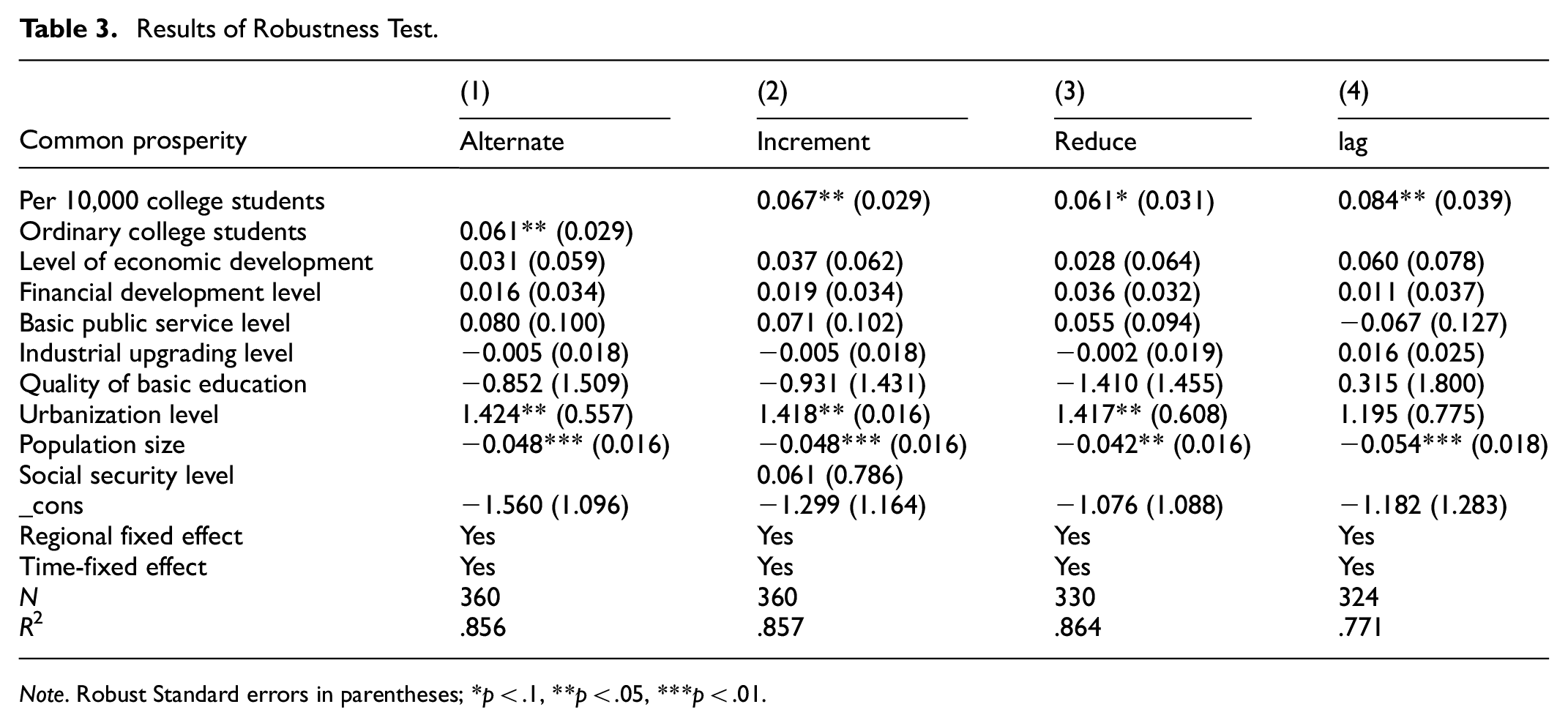
This paper aims to enhance the reliability of the empirical results by testing the model’s robustness in four ways. First, the explanatory variables will be replaced with those pertaining to students in ordinary universities. Second, the control variable of social security level will be increased. Third, the scope of the city will be reduced. Fourth, the explained variable will be lagged by one stage.
Alternate Explanatory Variable
Theoretically, the expansion of higher education’s scale often corresponds to an increase in college students. Therefore, regressing the two as explanatory variables can lead to similar conclusions. This study uses regular college students to gauge the scale expansion level of higher education, and the regression results are presented in Table 3. Column (1) in Table 3 presents the regression results after replacing the explanatory variables. The results indicate that an increase in students at regular colleges and universities significantly enhances the level of common prosperity. For every 1% increase in students at regular colleges and universities, the common prosperity index increases by 0.061%. This finding aligns with the conclusion drawn when using per 10,000 enrolled students as the explanatory variable. It is also consistent with the theoretical expectations of this paper, demonstrating the relatively robust nature of the empirical results.
Results of Robustness Test.
Note. Robust Standard errors in parentheses; *p < .1, **p < .05, ***p < .01.
Increment Control Variable
Control for the social security level. Following the methodology of Cui et al. (2023), the social security level is measured using the proportion of social security expenditure in GDP. To mitigate the influence of heteroscedasticity on the results, the natural logarithm of the social security level is employed. The social security level plays a crucial role in achieving common prosperity. Improving the social security system not only adjust income distribution among social groups but also alleviates widening gap between the rich and the poor, thereby maintaining social stability and promoting social development (S. Li, 2019). Thus, the increase in common prosperity over the sample period is more likely to be driven by the rise in the social security level than by the expansion of higher education. Consequently, the social security level was included as a control variable, and the regression results are presented in Table 3. In column (2) of Table 3, even after controlling for the influence of the social security level, the scale expansion of higher education continues to have a significant positive effect on common prosperity. This finding confirms the reliability of the benchmark regression results mentioned earlier.
Reduce the Scope of the City
Considering the unique status of provincial capital cities in politics, economy, culture, and education, there is a significant distinction between provincial capitals and other cities. Thus, the results of the re-estimation, excluding provincial capitals, are more generalizable (Zeng et al., 2022). In column (3) of Table 3, after excluding provincial capitals, the explanatory variables significantly contribute to the achievement of common prosperity at a 10% significance level per 10,000 college students, consistent with the benchmark regression results mentioned earlier. This demonstrates that even without considering the high concentration of higher education resources in provincial capitals, the expansion of higher education can still significantly enhance income distribution in these cities and contribute to achieving common prosperity in non-provincial capitals in Northeast China.
Delayed One-Phase Processing
Recognizing the potential lag effect of the expansion of higher education on achieving common prosperity, this study adopts the approach of Ma et al. (2023) and introduces a one-stage lag for the current explained variable, common prosperity, in the benchmark regression model. The results of one period of lag are presented in column (4) of Table 3. The regression results indicate that even after introducing a one-period lag to the explained variables, the coefficient for the number of college students remains significantly positive and statistically significant at 5%, consistent with the benchmark regression results mentioned earlier. Despite the lag in the regression process, the expansion of higher education in Northeast China continues to significantly contribute to the achievement of common prosperity. These findings demonstrate that the expansion of higher education in Northeast China contributes to achieving common prosperity, further supporting the research conclusions of this paper.
Heterogeneity Analysis
The high-level group of cities with significant expansion of higher education comprises nine cities: Changchun, Jilin, Harbin, Mudanjiang, Daqing, Shenyang, Dalian, Jinzhou, and Fuxin. The high-level economic development group comprises seven cities: Changchun, Jilin, Harbin, Daqing, Shenyang, Dalian, and Anshan.
Heterogeneity of the Expansion of Higher Education
The sample cities are divided based on the number of college students per 10,000, using the mean value as the threshold. Regions with values higher than the mean are classified as having a high level of expansion of higher education scale, while those with values lower than the mean are classified as having a low level of expansion. The regression results are presented in columns (1) and (2) of Table 4. The regression results indicate that in the group with a low level of expansion of higher education scale, the coefficient of the explanatory variable (number of college students per 10,000) is not significant. However, in the group with a high level of expansion, the coefficient is positive and significant at the 5% level, suggesting that the expansion of higher education can significantly enhance the level of common prosperity. This situation can be attributed to the scarcity of educational resources, lower educational attainment among residents, and limited accumulation of human capital in regions with a low level of expansion of higher education, which hinder the ability of higher education to promote common prosperity. In contrast, regions with a high level of expansion of higher education have ample educational resources and a significant accumulation of human capital, allowing higher education to effectively promote common prosperity. This finding aligns with the research of Y. Z. Hu and Yao (2023), which demonstrates that higher education expansion leads to an increase in per capita disposable income by enhancing human capital accumulation, thus contributing to the achievement of common prosperity.
Results of Heterogeneity Analysis.

Note. Robust Standard errors in parentheses; *p < .1, **p < .05, ***p < .01.
Heterogeneity of Economic Development Level
The sample cities are divided based on the mean economic development level, with those above the mean classified as having a high level of economic development and those below classified as having a low level. The regression results are presented in columns (3) and (4) of Table 4. The results indicate that the expansion of higher education significantly contributes to achieving common prosperity in areas with high economic development, but its effect is not significant in areas with low economic development. These results can be attributed to the fact that the level of regional economic development is a fundamental factor influencing the development of higher education in a country or region. In regions with higher economic development and public service levels, higher education can more effectively integrate with industry, promote economic development (Du & Wang, 2022), enhance the social public service system, and further contribute to achieving common prosperity. This finding is consistent with the research conclusions of X. T. Fan et al. (2020). The impact of college enrollment expansion on reducing the income distribution gap depends on the level of enrollment expansion and economic development. Moreover, improving the economic development level can significantly enhance the impact of college enrollment expansion on narrowing the income distribution gap.
Influence Mechanism Analysis
To further investigate the pathways through which the expansion of higher education influences common prosperity, this study conducts mechanism tests focusing on two key channels: scientific and technological innovation level, and higher education quality, as identified in the theoretical analysis.
Analysis on the Moderating Effect of the Scientific and Technological Innovation Level
This study investigates the role of scientific and technological innovation in promoting common prosperity through the expansion of higher education in Northeast China. The analysis incorporates the interaction between the expansion of higher education and the level of scientific and technological innovation in the benchmark regression model. The regression results, presented in column (1) of Table 5, reveal a statistically significant coefficient (0.020) for this interaction term at the 10% significance level. This finding indicates that the expansion of higher education in Northeast China is influenced by the level of scientific and technological innovation, suggesting that improving innovation levels can facilitate the role of higher education expansion in promoting common prosperity. This conclusion aligns well with numerous viewpoints in existing literature, particularly those emphasizing the pivotal role of technological innovation in economic growth and social progress (Kasongo & Makamu, 2024; Mormina, 2019; X. Zhou et al., 2021). These studies consistently recognize technological innovation as a powerful catalyst for economic and social advancement, significantly boosting production efficiency and fostering new avenues for economic growth and value creation. In the context of Northeast China, the results of this study further underscore the moderating influence of technological innovation levels on the relationship between the expansion of higher education scale and the pursuit of common prosperity. Specifically, as the scale of higher education expands, a growing pool of highly skilled individuals is infused into the socio-economic fabric, laying a robust foundation for technological innovation. Furthermore, advancements in technological innovation further refine economic structures, accelerate industrial upgrading and transformation, and spawn additional employment opportunities and revenue streams for Northeast China. Furthermore, the enhancement of technological innovation levels promotes the spread and application of knowledge and technology via the technology spillover effect, significantly raising labor productivity and augmenting the social impact, and contribution of higher education, thereby infusing fresh vigor into the sustainable development of the economy in Northeast China and even the entire China.
Results of Moderating Effect Analysis.

Note. Robust Standard errors in parentheses; *p < .1, **p < .05, ***p < .01.
Analysis of the Moderating Effect of Higher Education Quality
This study aims to elucidate the role of higher education quality in promoting common prosperity through the expansion of higher education in Northeast China. The analysis incorporates the interaction term between the expansion of higher education scale and the quality of higher education in the benchmark regression model. The regression results, presented in column (2) of Table 5, reveal a statistically significant coefficient (0.005) for this interaction term at the 1% significance level. This finding demonstrates that higher education quality plays a significant positive moderating role in promoting common prosperity through the expansion of higher education scale in Northeast China. This finding echoes the conclusions of numerous studies in the literature on the relationship between higher education quality and economic development (Lee & Lee, 2024; J. Li et al., 2024). These studies generally concur that high-quality educational resources are pivotal in enhancing individual human capital, employment competitiveness, and innovation, and provide a solid foundation for sustainable socio-economic development. The results of this study further reinforce this perspective, highlighting that improving the quality of higher education has a significant positive moderating effect on the expansion of higher education in Northeast China to facilitate the realization of common prosperity. Specifically, high-quality educational resources can cultivate more high-quality talents, who serve as the backbone of economic and social development. Additionally, the enhancement of education quality can optimize resource allocation and provide society with fairer and higher-quality education services, thereby effectively promoting educational equity and social mobility. This injects new vitality into the economic and social development of the northeastern region and advances the steady realization of the goal of common prosperity.
Conclusions
First, the expansion of higher education in Northeast China significantly promotes the goal of common prosperity. Whether measured per 10,000 college students or among ordinary college students, the expansion of higher education in this region has notably advanced common prosperity. This underscores higher education’s pivotal role in increasing residents’ income, narrowing urban-rural income gaps, and promoting common prosperity.
Second, from a perspective of heterogeneity, cities with high levels of higher education expansion and economic development experience significant effects on promoting common prosperity, while cities with low levels of higher education expansion and economic development do not show such effects. This research highlights the unequal distribution of higher education resources across regions in our country, which not only undermines educational equity but also impedes the realization of the common prosperity goal.
Third, regarding the influence mechanism, higher education quality and scientific and technological innovation levels have a significant positive regulatory effect on promoting common prosperity through the expansion of higher education in Northeast China. These factors are key in realizing common prosperity through the expansion of higher education. In other words, the expansion of higher education in Northeast China facilitates common prosperity by enhancing higher education quality and scientific and technological innovation levels.
Enlightenment and Suggestion
To advance higher education in Northeast China from mere “quantitative expansion” to a focus on “convergence and quality,” several changes are needed. Higher education plays a crucial role in personnel training, scientific research, and societal service. It serves as a key force in national economic and social development, significantly impacting a country’s level of economic and social advancement (Jaeger & Kopper, 2014). In promoting common prosperity through expanding higher education in Northeast China, it is imperative to consider individual demands for higher education, changes in social demographics and economies, and national competitive demands. This approach is essential instead of merely pursuing quantitative expansion. In the face of increasingly prominent characteristics such as a declining birth rate, aging population, and negative population growth in China, the new situation regarding the population scale of higher education in Northeast China cannot be ignored, and the crisis of student enrollment may become one of the challenges faced in the future. If the blind expansion of scale continues, it may not only lead to excessive waste and inefficient utilization of educational resources but also adversely affect the quality and equity of education. In response, this paper proposes that the future expansion of higher education scale in Northeast China needs to shift toward a new development direction. Firstly, precise forecasting and rational allocation of educational resources are required. By combining regional economic development characteristics with demographic changes, especially the trend of a declining birth rate, a dynamic forecasting model for the population scale of higher education should be established to provide strong support for the scientific allocation of educational resources. Secondly, the educational structure needs to be adjusted to meet diversified demands. In response to the aging population, the educational layout should be optimized, and educational courses suitable for the elderly should be developed to meet their lifelong learning needs. At the same time, based on future economic trends, professional settings and course contents should be adjusted to cultivate more professionals who can meet the development needs of emerging industries such as elderly care and health management. Thirdly, the construction of colleges and universities must be people-centered, with the student at the core of the educational process. In accordance with the principle of promoting moral integrity as the gold standard for measuring the effectiveness of work, the reform of higher education teaching should be deepened along the path of convergence and quality enhancement. This will improve the quality of education in all aspects through measures such as innovating the teaching and management mode and optimizing the talent cultivation mode, thus meeting the learning needs of different students and promoting personalized development.
Pay heed to the regions where the development of higher education is weak and optimize the layout of higher education in Northeast China. The scientific and rational optimization of the higher education layout aims to promote fair and efficient resource allocation, alleviate the employment burden in major cities, enhance the attractiveness of small- and medium-sized cities for talents, and thus balance regional economic development (J. Zhou & Li, 2022). To achieve this, the higher education layout in Northeast China needs to follow the following principles and strategies: Firstly, the government should play a leading role in improving the support mechanism for higher education and increasing support for higher education in economically underdeveloped regions. It is necessary to issue special support policies for regions with inadequate higher education resources, adopt graded and differentiated funding approaches based on regional economic development and the actual needs of different types of universities, and formulate corresponding incentive measures to avoid a “one-size-fits-all” support model. Meanwhile, the evaluation mechanism for policy implementation should be improved to regularly assess policy execution, provide timely feedback to address issues arising during implementation, and hold accountable relevant units and individuals who fail to complete tasks on time. Secondly, innovative regional cooperation mechanisms in higher education should be established to inject more quality resources into underdeveloped regions. Northeast China should fully leverage the advantages of high-level universities by implementing measures such as paired support, teacher exchanges and placements, joint school-running, or establishing branch campuses to actively assist lower-level universities and promote the development of higher education in underdeveloped regions. At the same time, it is necessary to transcend administrative boundaries with an open and cooperative mindset, adhering to the principle of complementary differences, to facilitate the sharing and integration of higher education resources among neighboring provinces or regions, thereby improving resource utilization efficiency and comprehensively enhancing the overall strength of regional higher education. Finally, advance diversified development concurrently with character cultivation to address the imbalanced normality of higher education development. To achieve a relative equilibrium in development, the government of Northeast China ought to stimulate higher education throughout the region to be driven by both quality and characteristics, highlighting differentiation strategies and quality improvement. Universities should make full use of the industrial advantages and cultural traditions of the regions in which they are located, define their own positioning and characteristics, and pursue diversification in the types of education, training modes, and service orientation. By avoiding homogeneous competition, the competitiveness of colleges and universities will be strengthened, and a higher education ecology with complementary advantages and synergetic development will be established.
Improving the quality of higher education is essential to promote common prosperity through high-quality higher education. Research indicates that enhancing the quality of higher education is crucial for expanding higher education and realizing common prosperity. Higher education quality is closely linked to local industrial structures, technological progress, economic development, and talent levels (J. J. Han & Jia, 2023). High-quality higher education can provide robust intellectual support for rapid and sustainable regional economic development and better meet the needs of the digital industry (Bing, 2023). Given China’s vast territory and varying regional natural resource endowments, economic and social development conditions, there are significant differences in the quality of higher education across different regions of the country. Therefore, it is recommended that local governments, first, increase financial support for higher education in lower-level cities during the economic development and expansion of higher education scale in Northeast China. This includes ensuring standardized construction of school facilities, increasing education funds per student, and providing basic funding support for colleges and universities. Secondly, universities should be granted more autonomy to broaden their talent selection horizons, attracting high-level experts, scholars, and teams from both domestic and international sources without being constrained by conventional norms. Simultaneously, universities should strengthen the selection and cultivation of high-level talent within their ranks, aiming to forge a teaching staff that is both professionally proficient and morally upright. In the field of teacher education and professional development, it is essential to keep abreast of the times by incorporating AI technology into teachers’ instructional practices, which involves the application of personalized learning platforms, the utilization of intelligent assessment tools, and the experimentation with innovative teaching approaches. By establishing high-level teaching teams and innovating talent cultivation models, the comprehensive qualities of students can be enhanced to better align with the job market, thereby further improving the quality of youth talent cultivation. Thirdly, attention should be given to the internationalization of higher education, with encouragement and support provided for universities to engage in extensive exchanges and cooperation with renowned foreign universities and research institutions. Actively introducing and integrating advanced foreign educational concepts, AI technology, teaching methods, and scientific research achievements can broaden students’ international horizons, laying a solid foundation for cultivating high-quality talent with international competitiveness, and contribute to enhancing China’s leading position in the global arena of AI education and research. Lastly, a comprehensive evaluation and feedback mechanism for higher education quality should be established, utilizing AI technology to regularly assess the teaching quality, research capabilities, and social service contributions of universities. The assessment results should serve as an important basis for allocating higher education resources and adjusting policies, ensuring that higher education resources are fully and effectively utilized, thereby continuously promoting the enhancement of higher education quality.
To enhance the impact of higher education expansion on promoting common prosperity, several strategies can be implemented. Firstly, optimizing the discipline structure, adding new disciplines, and deepening scientific and technological innovation are essential. Scientific and technological innovation can drive high-quality economic development, upgrade the industrial structure, improve the employment environment, and elevate national income, thereby promoting common prosperity (T. Zhang et al., 2023). Moreover, improving the scientific and technological innovation level is crucial for stimulating market vitality, creating wealth, and enabling backward cities to achieve leapfrog development. This improvement can also enhance competitiveness, narrow development gaps between cities, and contribute to the common prosperity of cities (Ni et al., 2020). To achieve these goals, local governments should prioritize the role of scientific and technological innovation. They should focus on two key areas. First, they should concentrate on revitalizing Northeast China and meeting the development needs of local colleges and universities. In the face of the challenges and opportunities presented by AI, universities should be encouraged to optimize their discipline structures, deepen scientific and technological innovation, and launch courses and programs related to AI and associated technologies, so as to cultivate students’ ability to meet the demands of the future job market and ensure that digital development serves humanity rather than undermines it (Díaz de la Cruz et al., 2025; Ho & Hoang, 2025). Additionally, it involves promoting the construction of major discipline platforms in colleges and universities, increasing financial investment in scientific and technological innovation, and providing robust financial support for the development of scientific and technological innovation services to promote common prosperity. Second, strengthening cooperation between enterprises, universities, and research institutes is essential. Creating a platform for collaboration between enterprises and universities can improve regional productivity and enhance creativity (Andersson et al., 2009). Universities and enterprises should collaborate on research and development in major, core, and key technologies. They should also focus on enhancing the transformation and application of scientific and technological achievements. By expanding and strengthening the production, university, and research platform, becoming leaders in key scientific and technological fields, pioneering in emerging and comprehensive fields, and enhancing the contribution of scientific and technological innovation to common prosperity, they can provide strong scientific and technological support for economic and social development and ensure livelihood security.
Footnotes

Ethical Considerations
This article employs a panel data analysis and does not include any human participants, so informed consent is not necessary.
Funding
The authors disclosed receipt of the following financial support for the research, authorship, and/or publication of this article: This work was funded by the 2023 China Ministry of Education’s Humanities and Social Sciences Youth Project, “Construction and Measurement of Teacher Collaboration Competence Indicators in the Digital Age” (23YJC880005), and by the General Project of Scientific Research, Department of Education of Liaoning Province, “Construction and Application of Evaluation Index System of Organized Scientific Research in Local Universities of Liaoning Province” (LJ112410165030).
Declaration of Conflicting Interests
The authors declared no potential conflicts of interest with respect to the research, authorship, and/or publication of this article.
Data Availability Statement
The data that support the findings of this study are available from the corresponding author upon request due to privacy restrictions.