




Abstract
Drawing on sentiment analysis, this study explores public opinions on the higher education expansion policy that was specifically implemented by China’s government to navigate graduate employment difficulties against the impact of COVID-19. The results indicated that the overall degree of acceptance of the expansion plan was highly positive, but some people expressed negative opinions and concerns about over-education and deferral of employment pressure. The results also suggested that the government is expected to deal with the balance between higher education expansion and graduate employment difficulties by prioritizing domestic graduate employment rather than opening up permanent resident applications for foreigners, allocating a regionally balanced expansion quota, covering social science disciplines, and creating more employment opportunities. The findings provide important suggestions for policymakers to improve policy practice and offer a referable sample for other countries in their management of graduate employment issues influenced by COVID-19.
Introduction
The lack of employment opportunities for graduates has been an increasingly serious issue in the global labor market for some time (L. Yang, 2018b). Unfortunately, with the global spread of COVID-19, these employment difficulties have been further exacerbated. In China, all public activities involving large groups have been postponed or permanently canceled, including graduate internship, employment recruitment, and even semester enrollment. This indicates that graduates may miss important employment opportunities in the recruitment season. Similarly, Gary Cohn, former U.S. National Economic Council director, emphasized that America will very soon suffer from massive unemployment (Pei, 2020). A reasonable prediction is that the graduate employment situation around the globe will become much more severe this year.
As an immediate response to decrease the impacts of COVID-19 on graduate employment, the Ministry of Education in China (MoE) has implemented a series of specific policies to ameliorate the pressure on graduates, including the essential policy of higher education (HE) expansion and supplementary policy of rewarding firms that recruit graduates and encourage self-employment. Following the announcement, social media was rife with heated discussions and comments on the effectiveness of these motivated policies and their influence on employment in the future.
Given that Chinese HE had been successful over the past decades in managing the expansion of a skilled workforce and promoting graduate employment (Tang, 2020) and that public opinion can play a positive role in policy making and implementation (Burstein, 2003; Smith, 2000), it is worthwhile to conduct a case study on public opinion on this matter. Such a study would not only enrich the literature on graduate employment in public health emergencies but would also provide insights into China’s governmental practice of capturing public representation and improving policy, as well as for other countries seeking adequate initiatives to tackle the graduate employment issues affected by COVID-19 in the future. The research questions that inspired this study are as follows:
Next, we introduce the context of China’s HE expansion in the public health emergency, followed by a literature review in section “Literature Review.” Section “Methods and Materials” elaborates the data and methodology adopted to analyze public opinions on the expansionary policy. We then report the findings in detail in section “Results” and discuss them in section “Discussion.” Finally, a brief conclusion is given, which discusses the research limitations and further work.
Experiences of China’s HE Expansion in Public Health Emergencies
Historically, China has successfully implemented two waves of HE expansion policy specifically executed to relieve employment difficulties and promote economic development in public health emergencies. The first such policy, implemented in 2003 to alleviate the impact of the severe acute respiratory syndrome (SARS), mainly included (a) an extension of postgraduate enrollment by 30% compared with the previous year; (b) the recruitment of approximately 6,000 graduates to participate in volunteer services in the poverty-stricken rural areas in the fields of education, health, agricultural technology, poverty reduction, youth development, and local management (W. Ding, 2005); (c) encouraging graduates to consider self-employment or entrepreneurship; (d) attracting graduates to small businesses and private companies; and (e) reducing the taxes of businesses that employed graduates. These efforts were extremely effective and, as expected, had motivated the economy and promoted employment. The unemployment rate declined to 4.2% in 2004, 4.0% in 2007, and 3.6% in 2019. Meanwhile, the annual increase in the gross domestic product (GDP) rose from 10.04% in 2003 to 14.23% in 2007, gradually dropping to around 6.5% in 2019.
The second enhanced round of HE expansion was specifically implemented on February 23, 2020, to fight against the negative impact of COVID-19. The initiatives included two main aspects. First, the initiative will expand the scale of master’s students and undergraduates who upgraded from vocational college to university. The population of the former will increase by a quota of 189,000, which would be allocated to professional degrees in clinical medicine, public health, integrated circuits, and artificial intelligence; the increased quota of the latter would reach 322,000 in the disciplines of preventive medicine, emergency management, old-age service management, and electronic commerce. The expanding quota was prioritized for the universities in the midwest and northeast areas (Weng, 2020).
Second, the initiative will create more employment opportunities for graduates, including (a) providing more job positions in the field of primary education, grassroots medical, community service, national major projects, and remoted service; (b) encouraging more graduates to enroll in the army; (c) reducing taxes for small and micro-businesses that employ university graduates and allocating allowances for organizations that provide internship positions to university graduates; (d) holding more flexible online recruitment activities; and (e) encouraging graduates to choose self-employment or entrepreneurship (You, 2020).
Currently, China is the world’s second largest economy force, manifesting in the country’s economic resilience and anti-risk ability to perform better than in 2003. Based on the historical experiences and empirical effectiveness of HE expansion in China, it can be reasonably predicted that these stimulated employment policies will substantially motivate the demand in the labor market and promote the graduate employment rate. Therefore, this study will argue for China’s solutions as an example for other countries to tackle graduate employment difficulties in the face of the impact of COVID-19.
Literature Review
Impact of HE Expansion on Graduate Employment
The effect of HE expansion on graduate employment can be discussed from two contradictory perspectives. On one hand, expanding HE was widely regarded as an effective strategic resolution for ameliorating employment pressure and promoting economic development by governments around the globe (X. Wang, 2012). Aamodt and Arnesen (1995) investigated the relationship between educational expansion and the labor market in Norway, concluding that the policy of HE expansion as a buffer contributed to relieving unemployment of the younger generation and to promoting reform of the HE system. Cabus and Somers (2018) also examined the extent to which the expansion of HE over the past 20 years in the Netherlands contributed to education-work matches in the labor market, concluding that companies benefited from the increased supply of highly skilled tertiary graduates. Moreover, drawing on 15 years of empirical data, Kyui (2016) analyzed the effects of HE expansion on the labor market in Russia, identifying that the effect of HE expansion on graduate employment and salaries was significantly positive. Similarly, using various survey data from 1998 to 2014, such as the Chinese General Social Survey and the China Health and Nutrition Survey, Chinese researchers coincidently found that the HE expansion policy positively affected the wage level of graduates, especially for postgraduates (H. Gao & Smyth, 2015; Xia et al., 2016; C. Zhang, 2017).
Conversely, some researchers argued that HE expansion has accelerated graduate unemployment and reduced wage premiums, creating a mismatch between education and the workforces and increasingly unequal competition among graduates (e.g., Brown et al., 2010; Figueiredo et al., 2015; Schomburg & Teichler, 2007). Mok and Jiang (2018) identified that HE expansion was the most important determinant for the labor market’s highly competitive nature, leading to over-education or “over-qualification” (Mok & Wu, 2016). Graduates have been forced to accept jobs requiring a lower degree level (Figueiredo et al., 2015; Wronowska, 2017). According to data released by the Office for National Statistics in 2019, close to 31% of graduates were performing sub-graduate work (ONS, 2019). Furthermore, the expansion of HE was doubted as a deferral of employment (Nesvisky, 2012). Graduates who pursued further study indeed faced the reality when entering the labor market in the future that the employment situation was even more severe than at the time of their first graduation (Mok et al., 2016; Walker et al., 2007; L. Yang, 2018b).
In summary, the HE expansion policy seems to be a double-edged sword and should be evaluated and implemented more carefully, especially in a country like China that has been continually implementing this expansionist policy for a dozen years. Such a policy may solve short-term problem, but may also create long-term difficulty for tomorrow’s graduates (Aamodt & Arnesen, 1995).
Impact of Online Public Opinion on Public Policy
As McLuhan (1994) highlighted, with the movement toward an increase in information, politics will gradually deviate from a voter basis toward immediate public involvement in central decision-making behaviors. Recent studies have emphasized the importance of the public attitude toward governmental policies on social media. Singh et al. (2018) argued that the expression of public feeling toward governmental policy, including both anguish and pleasure, can be seen as a measure of acceptance or rejection of certain ordinances. Similarly, Syaifudin and Puspitasari (2017) asserted that the government should take cognizance of social media responses to policies before and after their implementation, to improve their effectiveness; Ceron and Negri (2015) confirmed that social media users’ comments could be used to support the action of policymakers across all the stages of a policy cycle. Moreover, Rana and Cheah (2016) pointed out that the opinions and emotions of social media users could help policymakers judge the impact of policy. G. Li and Liu (2010) also concluded that comments on policy could be used to help politicians clarify their political strategy and that even critiques could offer insights into reflecting on their activities.
As a country with an internet population of 0.905 billion, the largest in the world (CNNIC, 2020), China has unprecedented opportunities for netizens to capture a diverse range of information and represent their opinions on public matters (Qiang, 2007). However, researchers in China have paid little attention to public comments on governmental policies, instead exploring comments on movies (Qan & Yang, 2017), social incidents (S. Li, 2017; F. Yang, 2018a), life, communication, and science (Chu, 2019), which are less sensitive than politics. In fact, whenever inspired policies are announced, people take to the internet to discuss the positive effects and the negative influence they might have in the future. These heated discussions provide high-value materials for research on internet public opinions of public policy, especially for educational policy.
Sentiment Analysis
Sentiment analysis (SA) is an ongoing method for extracting the opinions, sentiments, and subjectivity of a given text (Medhat et al., 2014). SA is often used to analyze “people’s evaluations, appraisals, attitudes, and emotions towards entities such as products, services, organizations, individuals, issues, events, topics, and their attributes”(B. Liu, 2012). There are three main classification levels in SA: document level, sentence level, and aspect level (Medhat et al., 2014). The first level attempts to separate an opinionated document as positive or negative in a whole unit; the second level attempts to categorize sentiment expression in each sentence; and the last level attempts to classify the sentiment in relation to different facets of the same entity.
Along with advancements in computer science and information technology, there has been a growing importance and prevalence of SA in the field of study on social media such as Facebook, Twitter, blogs, micro-blogs, and social networks. For example, Bakshi et al. (2016), Bouazizi and Ohtsuki (2019), and Nagamanjula and Pethalakshmi (2020), as well as the studies mentioned above, depicted well-worked sentiment algorithms to analyze positive, negative, and neutral Twitter data. Besides, many scholars have investigated the gender differences in internet sentiment expression. For example, Hoy and Milne (2010) investigated the gender differences of Facebook users in view of social network advertising. Moreover, Shi (2011) employed the social language theory to measure gender differences in the style of internet language, reporting that both women and men were equally keen to examine the topic of education, but women were more agreeable with less nonaggressive narratives than men. Conversely, W. Gao et al. (2015) utilized the ARIMA (Autoregressive Integrated Moving Average) model to explore the public sentiment and predict emotional changes of different genders toward hot Weibo (similar to Twitter) events, asserting that women more frequently used negative and extreme sentiment vocabularies such as “so sad,” “will to die,” and “broken.”
This study is based on these previous works and advanced applications of SA algorithms and simultaneously takes into account the complicated correlation between HE expansion and graduate employment and the oversight of public opinions toward governmental policies. It explores the public’s internet attitude toward the HE expansion policy that was specifically implemented by China’s government to overcome graduate employment barriers in the face of major emergencies such as COVID-19. The intention is to introduce China’s specific initiatives, evaluate the degree of public acceptance, and predict the practical effectiveness of the HE policy as a mirror for other countries to deal with probable graduate employment difficulties in the near future.
Methods and Materials
Data Resource
Social media has significantly attracted young people across the world. Among these social media platforms, microblogs are ideal for investigating online public attitudes and opinions on policies and social events. In China, the most popular microblog is Sina Weibo, which is often regarded as a Chinese Twitter and provides an ideal venue for open political speech and expression of public views (Yu et al., 2017). Therefore, we investigated the public’s dynamic opinions and sentiment toward the HE expansion policy for overcoming graduate employment difficulties aggravated by COVID-19. The Sina Weibo platform incorporated with web crawler technology and a text mining method was used (X. Liu & Hu, 2019).
Web Crawler Technology
Web crawler technology is an automated technology that systematically searches and reads required information from all retrieved webpages in a way that simulates a browser (Kausar et al., 2013). In this study, we utilized a mature application package of a web crawler, Octopus v7.1, to crawl users’ comments on the research topic.
In total, we crawled 21.3 thousand Sina Weibo comments from February 25 to February 29, 2020, including contexts, data, locations, institutions, forwarding, following, and others. As Sina Weibo constantly implements restrictions for users’ privacy protection, no interface was provided to obtain users’ identity and educational background. In addition, some users did not provide their real birthdays or years of birth. However, according to Sina Weibo’s user development report in 2018, 75% of users were between 18 and 30 years old (Weibo, 2019b); of those users, 87% were university students (Weibo, 2019a). Given that the research topic specifically pertains to HE expansion, it can be asserted that most of the users who cared about and commented on the topic were university students or other stakeholders, such as educators.
Text Mining Method
We used the SA technique to perform text mining investigating public attitude and opinions on the HE expansion policy. The text mining processing steps were as follows:
Data cleaning. Employing part-of-speech, syntactic parsing, and manual work, we removed dirty data with disordered formats, blank content, repetitive information, punctuation marks, stop words, and irrelevant information about advertisements, communication, and special symbols to precisely conduct word feature extraction.
Word cutting. We used the cut-word application of Python Jieba, the most effective Chinese text segmentation tool, primarily to split each comment into word segmentations.
High-frequency word screening and co-occurrence matrix building. We first used the improved Apriori algorithm with association rule learning (Al-Maolegi & Arkok, 2014; Jiao, 2013) to determine the frequency of words in the comments set. Next, words were sorted by frequency in a descending order with the support parameter value greater than 0.1, and a high-frequency word cloud was generated. We then constructed the co-occurrence matrix of pairs of high-frequency words to describe the degree of correlation between sets made up of two words. Finally, we imported the co-occurrence matrix of high-frequency words into SPSS to establish a similarity matrix.
Co-word cluster analysis and multidimensional scale (MDS) analysis. In this study, we deployed co-word cluster analysis to unveil major subtopics in public opinions (Zhu et al., 2014). We first transferred the similarity matrix into a dissimilarity matrix in SPSS processing. Subsequently, a cluster tree diagram of high-frequency words was generated to investigate the number of clusters that high-frequency words can be grouped in. Finally, we used an MDS analysis with the Euclidean distance model to explore public representative opinion toward the research topic.
Sentiment feature extracting. We used term frequency–inverse document frequency (TF-IDF) to extract the key sentiment feature word. TF-IDF is commonly used as a weighting factor for information retrieval and text mining to reflect the importance of a word to a document in a collection or corpus (Rajaraman & Ullman, 2011). To avoid a bias toward long documents, we used the double normalization 0.5 weight scheme (Wu et al., 2008) to calculate the TF value of a word. The formula of TF-IDF was as follows:

Sentiment analysis. We used the latent Dirichlet allocation (LDA) (Blei et al., 2003) model to implement sentiment classification. We first imported the major word matrix established from TF-IDF as the training sample to extract the key sentiment feature, which was combined into the sentiment vector space. Subsequently, the ML algorithm was used to classify the sentiment polarity of the comments (W. Wang et al., 2017). Consequently, we produced 20 sentiment categories, each of which contained 15 key words, and grouped them into positive and negative categories. Finally, six representative sentiment categories, including three positives and three negatives, were chosen for sentiment orientation analysis and sentiment focus analysis.
The framework of this study is presented in Figure 1.

Framework of this study.
Results
Geographical Distribution of Users
There was a total of 14.69 thousand Weibo users participating in the discussion of HE expansion (Table 1). Regarding regional distribution, the majority of users labeled their location in mainland China, accounting for 95.32%. Interestingly, the population of overseas users (3.84%) who were concerned about the HE expansion policy was proportionately larger than that of users from Hong Kong, Macau, and Taiwan (0.84%). Concerning the gender of participants, this topic attracted the attention of 8,142 females, accounting for 55.43%, compared with the 6,548 males, with a percentage of 44.57%. The similarity of sample size prevented statistical errors and provided the validity for word frequency and cluster analysis. Therefore, we did not consider gender differences in the next analysis procedure, except for the SA.
Geographical Information of Users.

High-Frequency Words
We extracted 7,600 words using the Apriori algorithm with the association rule, learning after denoising. Among the word pool, the word “expansion” occurred the highest, with a frequency of 1,226. There were 5,100 words that occurred a single time. We obtained the lowest cutoff for word frequency at 100 times using Zipf’s law for word frequencies (Donohue, 1973) and subsequently generated a word cloud (Figure 2). Unexpectedly, words highly related to the topic of HE expansion such as “expansion,” “postgraduate,” and “examination” were frequently involved in users’ comments. Words representing positive emotions such as “appreciate,” “happy,” and “fighting” were prevalent, along with words representing negative emotions such as “sad” and “pressure.” These results implied that public opinion on the expansion policies was complicated. Some users were excited by the fact that additional opportunities could be gained for pursuing further study, whereas others were worried about the aggregated employment competition that they might confront in the future.
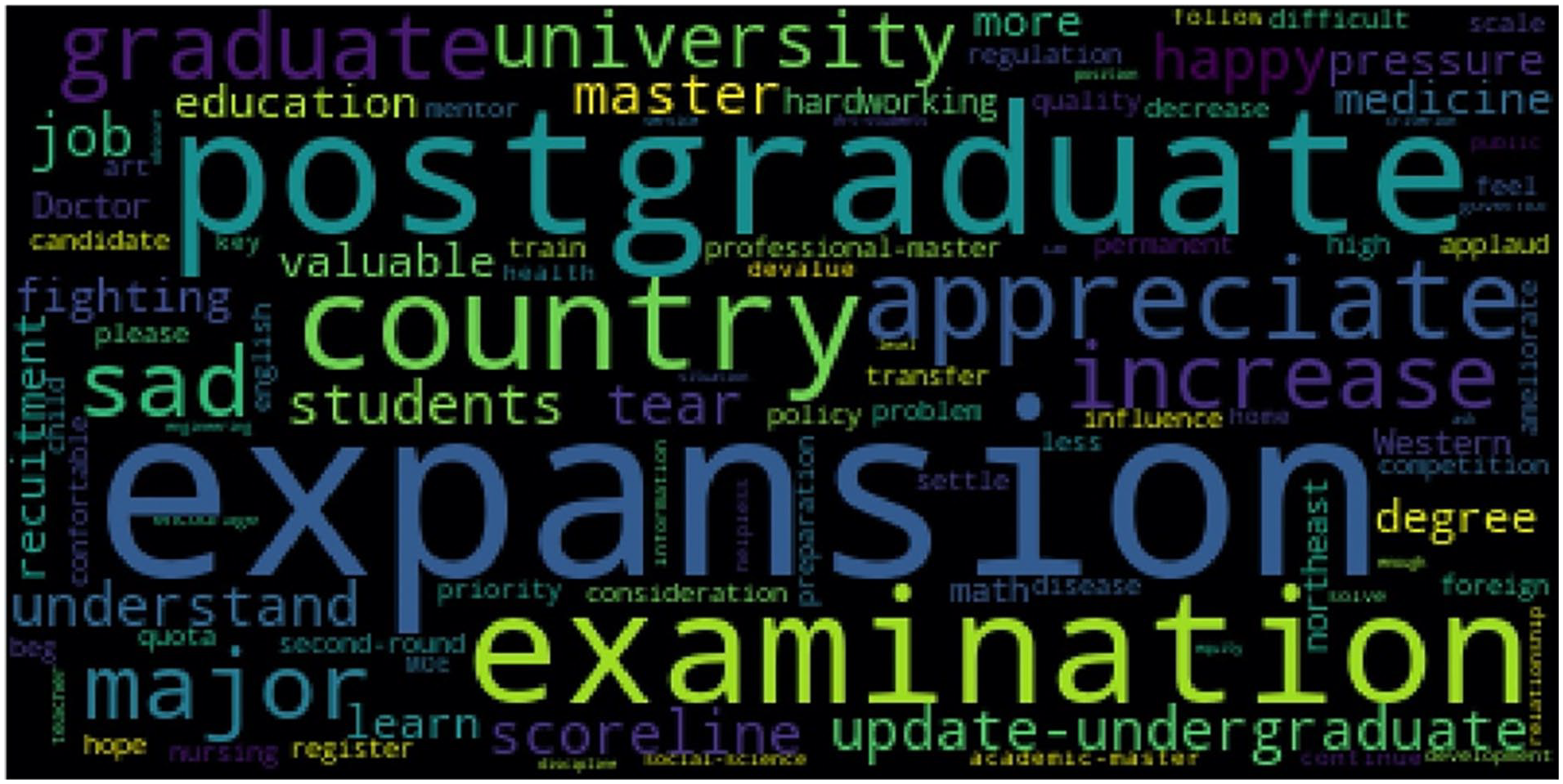
High-frequency word cloud.
In addition, to explore the co-occurrence relation of pairs of words, we constructed a co-word matrix of 100 high-frequency words (Table 2). The data across the columns and rows presented the frequency of pairs of words in co-occurrence, and the data of the diagonal line indicated the frequency of the appearance of a word. Afterward, based on the co-word matrix of high-frequency words, the similarity matrix and dissimilarity matrix were sequentially constructed in SPSS as the proof of co-word cluster analysis.
Parts of Co-Word Matrix of the High-Frequency Word.

Co-Word Cluster Analysis and MDS Analysis
Through the hierarchical cluster method, we constructed a cluster pedigree (Figure 3).

Clustering pedigree.
To verify the validity of the cluster pedigree, we used principal component analysis (PCA) to extract high-frequency word clusters so that the feature value of each word was greater than 1 and the cumulative variance contribution rate was greater than 60%. Thus, four factors were obtained, and the high-frequency words were grouped into four clusters. The contribution rate of the accumulative total variance of the four factors was 80.97% (Table 3). This result was highly consistent with the cluster analysis.
Total Variance Explained.

Extraction method: Principal Component Analysis.
Ultimately, combined with the results of cluster analysis and PCA, we used nonmetric individual difference MDS analysis (Takane et al., 1977) to categorize the high-frequency words. The four clusters were generated, including (a) expansion, enhance, second-round, candidate, more and more, worthy, problem, and pressure; (b) devalue, major, study, facilitate, decline, and scale; (c) northern, northeast, happy, solve, health, key, and drop; and (d) foreign, settle, permanent, rule, and drop (Figure 4). Among these, the nodes in Cluster 1, such as enhance, quality, and tear, were the densest and closest to the center point.

Public representative opinions.
Sentiment Orientation and Sentiment Focus
As shown in Table 4, the 20 typical topics extracted encompassed 300 sentiment words, of which more than 63% were positive and approximately 14% were neutral. In addition, the sum of the topics with proportionately more positive sentiment words exceeded 73%. Therefore, it can be asserted that the sentiment polarity was relatively positive.
Results of Sentiment Words of 20 Topics.

Moreover, Table 5 displayed sentiment word frequencies by gender. The frequency with which males expressed positive, negative, and neutral sentiments was much higher than that of females (161 vs. 139), especially for positive words (100 vs. 88). However, there were no differences found between genders among public sentiments toward the HE expansion policy (p = .96 > .05, seen in Table 6).
Sentiment Frequencies in Gender.

Chi-Square Tests for the Gender Difference in Sentiment Polarity.

0 cells (0.0%) have expected count less than 5. The minimum expected count is 19.92.
Finally, according to the rule of LDA, we chose six topics—three positives and three negatives—that were meaningful and easy to explain among the 20 topic models for sentiment orientation analysis. Five terms strongly representing the six topic models were screened for sentiment focus analysis combined with the results of high-frequency cluster analysis and MDS analysis (Table 7).
Distribution of Words With High Probabilistic Value.

Discussion
Public Attention on HE Expansion
Users who were concerned about the expansion of HE were located all around the globe but were still primarily located in the mainland. Due to substantial differences in the HE system, few students from Hong Kong, Taiwan, and Macau choose to further their studies in mainland China; graduates from Hong Kong, for example, prefer to pursue a master’s or PhD degree in England, the United States, Australia, Canada, or locally (Lawley & Perry, 2015). Although universities in the mainland have always been actively recruiting students from Hong Kong, Taiwan, and Macau, the expansion plan mainly recruited mainland graduates. Therefore, it is unsurprising that users from Hong Kong, Taiwan, and Macau have paid little attention to the policy.
The policy received more attention from overseas compared with users from Hong Kong, Taiwan, and Macau perhaps because more than 72% of the graduates who studied abroad have returned to China for employment after graduation since 1979 (MoE, 2019). Hence, students who plan to return to China have paid close attention to domestic events during their study abroad. Moreover, graduates from local elite Chinese universities are viewed as highly competitive equals to graduates with overseas degrees, and even more adaptive to the local labor market (Hao & Welch, 2012). In this regard, the HE expansion plan has a certain impact on their expatriation for employment. Overall, China’s government needs to constantly enhance the national identity and ethnic recognition of people in Hong Kong, Taiwan, and Macau; attract more students to study in the mainland by involving them in the expansion schedule; and promote returnees’ employment with the intention of increasing public enthusiasm regarding national affairs.
Public Sentiment Orientation Toward HE Expansion
The 20 topic models indicate that the overall sentiment of people toward HE expansion was relatively positive, consistent with the results of previous studies conducted by Singh et al. (2018), Maclennan et al. (2012), and Singleton (2008) who concluded that people in India, New Zealand, and the United States were happy with governmental policies related to banknotes, alcohol, and tobacco, respectively. As mentioned before, although HE expansion can lead to economic inequality (Marginson, 2018) and an unemployment crisis (L. Ding, 2007; D. Wang et al., 2012), the benefit of the transformation of HE from “elitism” to “popularization” in enhancing productivity (Yao, 2019), individuals’ education levels, and subjective wellbeing (Hu, 2015) is far greater than the problems it may cause. In this vein, there are reasonable grounds to believe that the HE expansion plan was highly accepted among users who can directly or indirectly benefit from this policy, such as undergraduates and educational examination trainers, especially for those who initially enrolled in the disciplines of medicine, nursing, and artificial intelligence. It can also be evidenced that the optimistic attitude displayed by terms such as “appreciate,” “happy,” “hope,” and “applaud” was mainly related to the three typical positive topics, as well as to the distribution of high-frequency words.
Despite the generally positive response, negative emotions were unavoidably expressed in the comments. It is unsurprising that whenever a new government policy is launched, it receives some negative reaction, especially from ordinary citizens (Singh et al., 2018). People’s concerns were mainly focused on the quality of HE, “over-qualification” (Lex & Andries, 2000), and “crowding-out” (Battu & Sloane, 2000), which are likely to result in high unemployment rates and precarious work situations (Mok & Jiang, 2018). Among the three representative negative topics, pessimistic emotional words such as “unhappy,” “worry,” “worse,” and especially “sad” were screened out for sentiment value calculation. Some users even thought that implementing the HE expansion plan at this age of massification of HE was just like “drinking poisonous wine when thirsty.” These reasonable concerns warned policymakers that the government should humbly adopt the public opinion, cautiously assess the effect, and proactively resolve the adverse reactions.
Moreover, there were no gender differences among public sentiment toward the HE expansion policy. This finding provided marginal support for the study conducted by Shi (2011), which reported that both women and men on the internet were equally keen on the education examination topic; however, this finding is distinguished from Shi’s conclusion that women were more inclined to non-aggressive narratives than men, as well as the converse findings of H. Gao et al. (2015) who asserted that women more frequently used vocabularies of negative and extreme sentiments, such as “so sad,” “will to die,” and “broken” in comments on popular Weibo events. The consistency between women and men in sentiment polarity regarding the HE expansion policy suggested that people were equally likely to hierarchize emotional expression based on what was significantly related to their benefit. Therefore, policymakers should focus more on how individuals’ psychological health might be affected by policies, especially in cases of extreme sentiment vocabularies, such as “rubbish,” which indicate the channeling of emotions and should be considered to improve policies.
Public Representative Opinions Toward HE Expansion
Based on the cluster-based sentiment focus analysis, public opinions toward the HE expansion policy can be divided into four aspects.
The first representative opinion, which was far distant from the center and totally negative, mainly focused on the impact of the regulation of permanent foreigner settlement in China on the domestic employment market. Many people thought that it was not the time to discuss the issue of permanent foreign residents in the face of disease, and less strict criteria for foreigners to apply for Chinese permanent residency would lead to more severe domestic employment competition. It was worthwhile to pay attention to these concerns. According to a survey on the status of foreigner employment in China, more than 60% of foreigners were employed in high-salary management positions, which had a negative impact on the engagement of Chinese senior management and technical talents (Zhao, 2009). Moreover, due to their advantage of knowing another language, most foreigners were teaching language courses in local universities and training institutes where more than 4% of graduates worked, and even the illegal employment of foreigners occurred (J. Zhang, 2005). However, in fact, many foreigners who accepted teaching positions lacked professional knowledge and relevant experience (Y. Li, 2003). Therefore, this suggests that the government should reinforce the supervision of foreigners’ employment in China and increase the standard of China’s permanent resident applications to protect local graduates’ employment opportunities and promote fair employment competition.
The second major topic was the priority given to universities located in the midwest and northeast areas for the allocation of an increased quota of high education expansion. Historically, the midwest and northeast have always been underdeveloped areas, and it was difficult for industries to attract high-quality human resources to work there. Although the government had launched a myriad of promotion strategies since 2000 to promote regionally balanced development in manufacturing, agriculture, services, transportation, information technology, and education, such as the Northeast Revitalization Plan, the Western Development Strategy, and the Central Rise Plan, the effects were not significant. Conversely, the midwest and northeast areas were sites of severe brain drain. Therefore, the positive opinions expressed strongly agreed that the priority policy could offer a solution to the shortage of well-educated talent in the midwest and northeast areas, whereas the negative opinions were related to the unsolved employment difficulties in the eastern and southern areas where the majority of graduates prefer to seek aspirational jobs. Therefore, the government should take into consideration balanced regional development through the equitable distribution of education resources (Xiang et al., 2020).
The third opinion concerned the focus on specific disciplines. Affected by the outbreak of COVID-19, the majors involved in the HE expansion plan were clearly limited to the disciplines significantly related to the national development strategy and urgent infrastructure requirements, especially medicine, public health, artificial intelligence, and integrated circuits. The positive online opinions suggested that the initiatives would remarkably enhance China’s medical standards and high-tech innovation ability. The negative opinions claimed that excluding social sciences such as commerce, literacy, and art, in which passing postgraduate entrance examinations were much more difficult than in natural sciences and engineering, meant that graduate employment difficulties would remain unsolved. The economic rationale for an additional increase in graduates always attributes the increase to the demand for HE expansion (Keep & Mayhew, 1996). Historically, the strategies for HE in China considerably relied on setting up humanities and social science disciplines, such as literacy and management, rather than the disciplines of natural science, such as medicine and engineering (Luo, 2007). In the 21st century, the growth models of the global economy have undergone a major shift toward the technology frontier area, which includes artificial intelligence, life science, and intelligent manufacturing (Gomułka, 2018). Therefore, the practical-utilitarian disciplines are likely to be prioritized to undertake an uneven expansion (Välimaa, 2019).
The fourth topic emphasized the positive and negative impacts of the HE expansion on graduate employment. Some people wrote that the expansion was beneficial for those who planned for further studies and obtained a cutoff, meaning that they have been given a potential opportunity to enter the second round of examinations. Others argued that the expansion of recruitment would result in a range of problems, including a decline in academic standards, the devaluation of qualifications, and the deferral of employment pressures, and some even perceived the expansion as overhasty. To resolve these “output” problems influenced by the “input” of HE expansion, the Chinese government released a line of supplementary policies to facilitate graduate employment that is expected to ameliorate people’s negative opinions on the expansion. Furthermore, considering the number of registrations for postgraduate examinations in 2020, the percentage of enrollments was still low, at less than 0.2 million out of the total of 3.4 million. That is, a modest expansion will not necessarily lead to a rapid depreciation of academic qualifications. Along with China’s rapid development, there is an urgent need for highly educated graduates with advanced qualifications, which suggests that the HE expansion will also be prevalent in other countries because the global shortage of jobs and high unemployment rates are expected to continue in the near future (Gomis et al., 2020).
Conclusion
Conclusion and Suggestion
Using a social media analysis method, this study aimed to explore the public sentiment toward the current HE expansion initiatives that China’s government implemented to overcome the graduate employment difficulties exacerbated by COVID-19. The results indicated that the majority of people were positively satisfied with the expansion plan, but some demonstrated their dissatisfaction and concerns about over-education and delayed employment stress. The results also revealed that the government was expected to adopt more balanced expansion strategies to navigate graduate employment difficulties, including protecting domestic graduate employment, balancing regional expansion allocation, extending humanity and social sciences, and providing more employment options. This study contributes to the recent literature on employment by investigating the effects of HE expansion during a public health emergency and provides helpful suggestions for China’s government to promote its policy practice based on public feedback. It also offers an informative sample for other countries with graduate employment issues in the post-COVID-19 era.
Limitations and Further Research
Despite the benefits mentioned above, the study has the following potential limitations. First, as web users are mostly young people, the conclusion may not fully represent the views of different age groups. Therefore, further research should enlarge the age sample range and incorporate qualitative materials into data pools from those who are knowledgeable and insightful on this topic but not active on the internet. Second, as the data were gathered in a period of 5 days, we did not consider the timeline tendency analysis. Therefore, further research should extend the data collection period and conduct a time frame analysis to explore the changing trends of public opinions toward the expansion policy.
Footnotes
Declaration of Conflicting Interests
The author(s) declared no potential conflicts of interest with respect to the research, authorship, and/or publication of this article.
Funding
The author(s) disclosed receipt of the following financial support for the research, authorship, and/or publication of this article: This research was funded by the National Education Science Planning Program, grant number 20JYS48.
