




Abstract
In 1999, the Chinese government implemented a higher education enrollment expansion policy to improve education equality. Now, its positive impact on educational equality is contested. This study attempts to identify the link between city administrative level and tertiary attainment in the context of the policy. Our empirical findings indicate that after implementation of the policy, inequality increased. Students from political and economic centers had more opportunities for tertiary education attainment. This policy has a greater impact on disparities in access to undergraduate education for individuals living in different administrative hierarchies than it does on specialist education.
Introduction
“Deepening the comprehensive reforms in the area of education” was raised in the Decisions of the Central Committee of the CPC on Several Major Issues Concerning Comprehensively Deepening Reform in the Third Plenary Session of the 18th Central Committee of the CPC. Particularly emphasized was the need “to promote fairness in education.” In the report made by Chinese President Xi Jinping to the 19th National Congress of CPC, “giving priority to developing education” and “bringing out the full potential of higher education” were proposed, and the importance of access to good education was emphasized. Educational equality and quality are the focus of the Chinese government.
Since 1949, the Chinese government has been continuously making efforts to improve the accessibility of education. The most influential policy has been the Action Plan for Promoting Education for the 21st Century. On January 13, 1999, the State Council approved the policy which had been created by the Ministry of Education. This policy requires the central government to increase the number of students enrolled in higher education by 230,000 in 1999(1.08 million in 1998). On June 16, 1999, the former National Development and Planning Committee and the Ministry of Education jointly made an urgent announcement that they would be expanding higher education enrollment by another 337,000 people.
China’s higher education system has developed steadily and slowly since the resumption of the national college entrance examination (Gaokao) and economic reform in 1977.In 1978, the gross enrollment rate of higher education was only 1.6%. In 1999, the gross enrollment rate had reached 10.5%. By 2017, the gross enrollment rate in higher education had reached 45.7% (Figure 1). As the rate was not targeted at specific industries or special areas, the exogeneity of the policy greatly enhanced the reliability. It also offered an opportunity to carry out the regression analysis in this study.

The number of students in universities and colleges and the gross enrollment rate (%).
Although the policy did expand the scale of higher education and increase educational opportunities, it remains doubtful whether such an expansion truly promoted educational equality. There are big differences between different levels of cities in education resources. (Figure 2).In terms of the number of universities and colleges, there were 91 in Beijing, 64 in Shanghai, and 55 in Tianjin in 2017. The top 10 cities of the year were: Beijing, Wuhan, Guangzhou, Jinan, Chongqing, Shanghai, Xi’an, Chengdu, Zhengzhou, and Tianjin. It can be seen that in China, the number of universities and colleges in prefecture-level cities has been much lower than that in provincial capitals and major cities such as Beijing, Tianjin, and Shanghai in 2017. This raises the question of whether higher educational resources are various among cities with different administrative levels.
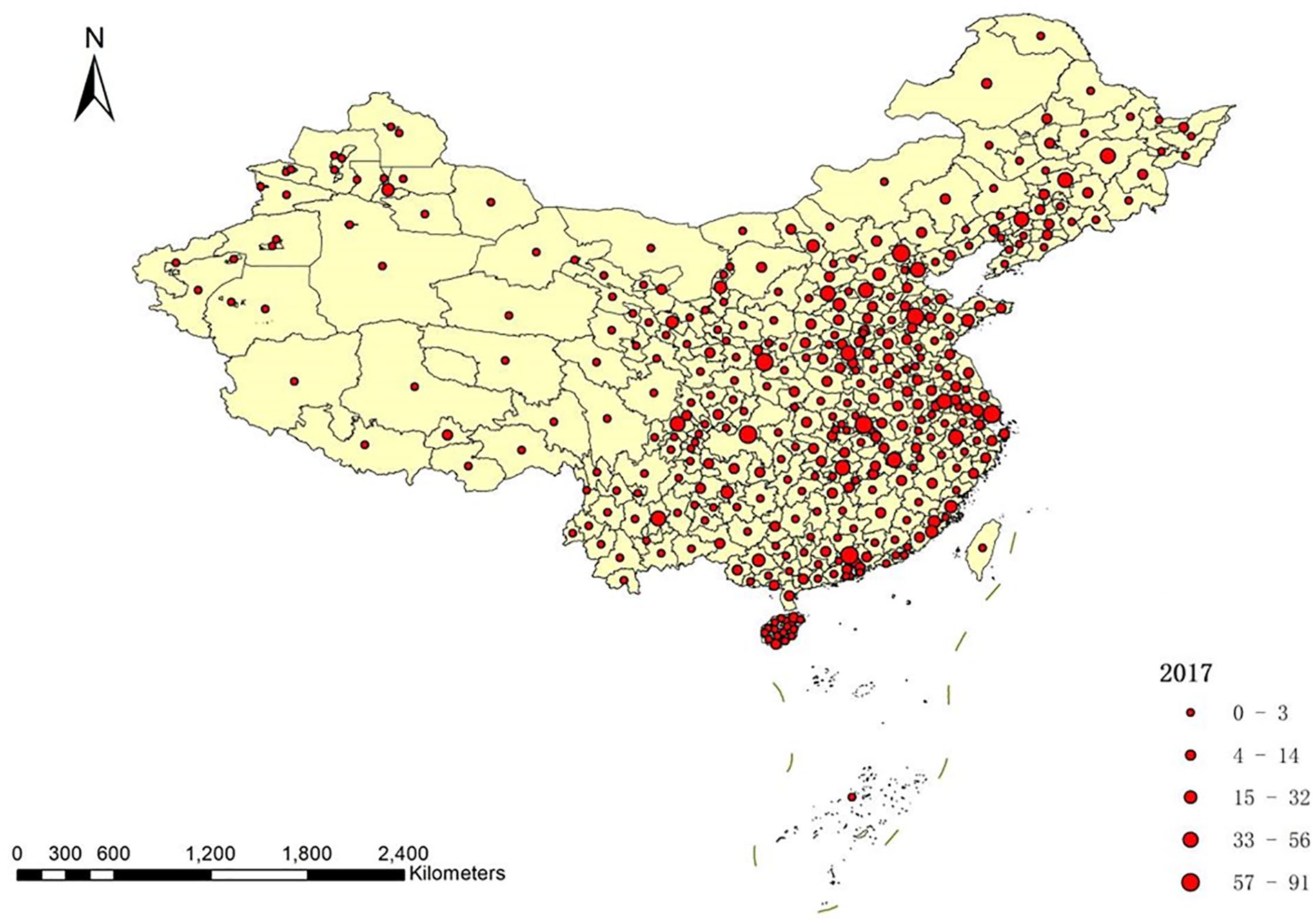
The number of universities and colleges from different cities in China in 2017.
Equality of educational opportunities has received much attention in the field of education. Most research focuses on two aspects. The first is that parents’ education level and occupation has an influence on their children’s educational opportunities (Bourdieu, 1973; Li, 2003, 2006; Whyte, 1975). The other is shown that the inequality of educational opportunities at the high school and university levels is significant in the urban-rural division (Li, 2014). The urban-rural gap in higher education opportunities is due mainly to the vast structural disparities in socioeconomic landscapes between urban and rural settings. This is mainly reflected in the serious inequalities in the distribution of educational resources and opportunities in families and schools.
With increasing inequality of educational opportunities, governments around the world have taken measures to alleviate this situation mainly through expanding the scale of enrollment. The policy effect of higher education expansion has been widely concerned. This issue is of critical importance: If advantaged groups benefit more from China’s higher education expansion policy, the inequality of higher education opportunities in China will likely increase in the long run, and intergenerational social mobility could remain limited. However, scholars hold different opinions on whether higher education expansion has promoted or aggravated the inequality of educational opportunities. Based on analyses of conditions in their own countries, some scholars have concluded that enrollment expansion has made educational opportunities more equal (Ballarino et al., 2009; Bauer, 2006; Breen et al., 2009; De Graaf et al., 2000; Yang & Wang, 2011; Zhang & Chen, 2013). In contrast, the MMI hypothesis (Raftery & Hout, 1993) and the EMI hypothesis (Lucas, 2001) suggest that inequalities in educational opportunities have deepened in the context of education expansion. Research on family background has highlighted the impact of higher education opportunities’ differences in family finances, parental education, and parental occupations (Akitaa & Miyata, 2008; Blanden & Macmillan, 2016; Chesters & Watson, 2013; Liu, 2006; Shavit & Blossfeld, 1993; Wu, 2010, 2013; Ye & Ding, 2015). In addition, some scholars have analyzed the equality of educational opportunities from the perspective of the urban-rural division and have concluded that inequalities have increased in the context of education expansion in China (Ma & Yang, 2015; Meng et al., 2017; Yang & Lin, 2014). Li (2010) analyzed elements of socioeconomic status and concluded that in the context of university enrollment expansion, class, ethnic group, and gender have little impact on the equality of educational opportunities, although educational inequality between urban and rural areas has increased significantly.
The aim of this higher education expansion policy proposed by the state is to provide more opportunities to the individuals. And as previously discussed, there is abundant research on the issue of equal educational opportunities from the perspectives of family influence and the urban-rural structure. However, in China, not only it is a certain gap between urban and rural areas, but the gap is also wider among different levels of cities as preferential government policy and superior quality educational resources are concentrated in metropolis area because of the government’s “favoritism.” Therefore, expect the urban-rural distinction on the high education access, the difference in getting the added education chance by this expansion policy between various city levels is very meaningful as well. Our study fills a gap in the literature of higher education expansion policy and the equality of educational opportunities in different administrative levels of cities. We want to know, if the implementation of the education expansion policy has an impact on individuals who live in different administrative city levels in terms of access to higher education. Did this policy widen or narrow the gap in access to higher education between individuals from cities of different administrative levels? Therefore, we attempt to analyze the equality of higher educational opportunities in cities of different administrative levels in the context of higher education expansion, using the government’s “favoritism” theory (Wang & Nian, 2015), based on the CGSS2008 data.
The remainder of this paper proceeds as follows. Section 2 introduces the theoretical basis for this study and the hypotheses. Section 3 explains the data source, the research methods, and introduces the results of the analysis. Section 4 provides an analysis of the factors influencing the enrollment of higher education in the context of higher education expansion in detail. Section 5 concludes and provides policy recommendations.
Theoretical Background and Hypotheses
MMI, EMI Hypothesis, and the Rational Choice in Education
In 1993, Raftery & Hout proposed the MMI hypothesis, which held that although differences in socioeconomic classes may decrease after education expansion, barriers between classes would remain. Limited expansion does not lead to an equal distribution of educational opportunities. Rather, it is only when the educational needs of the upper class are fully met that expanded education will bring opportunities to others.
Lucas (2001) amended the MMI hypothesis. He argued that it focused on quantitative differences in whether education is attained or not and that there also may be qualitative differences in the education. Students from advantaged socioeconomic backgrounds are much more likely than their peers from disadvantaged backgrounds to attend prestigious schools—an idea referred to as the EMI hypothesis.
The quantity and quality of inequalities in the availability of educational opportunities is different. For example, in China, undergraduate education is valued over specialized education. After the expansion of higher education, the upper class would prefer the undergraduate education with higher quality, only when their needs are full will the expansion benefit children from less privileged backgrounds. The unequal promotion of opportunities for higher education across the entire society may mean that lower-income students have more opportunities for specialized education and less for undergraduate education. This inequality means that the quality of education across the whole of society remains unchanged.
The MMI hypothesis and EMI hypothesis mainly focus on higher education expansion at the macro level. The rational selection principle proposed by Becker (2003) and the rational selection model proposed by Goldthorpe and Breen (1997) seek to explain the expansion of higher education at the micro level. They argue that personal education decisions are affected by four factors: the cost of education, the profits of undertaking higher education, the risk of failure, and the promotion of status.
In China, one of the principles for higher education expansion is cost-sharing. It means that the government, universities, and students share the cost of higher education. The reform of higher education charges under the cost-sharing principle would increase tuition and fees, reduce loan assistance, and increase the direct cost of students’ education. All of this leads the short-term profits of higher education to decline (Ou & Hou, 2019). Regarding the postgraduate employment of college students, the signal screening theory suggests that the expansion of higher education will reduce the differentiation of higher education (Spence, 1972). When education only plays the role of signal and screening, for competitors, their social status is not determined by the absolute education level, but by the relative education level. Therefore, the expansion of education will reduce the higher education discrimination when enlarging the number of recipients of higher education. This will reduce individuals signal function, which is the depreciation of the diploma. However, the labor market will reward individuals based on their relative education level, as the education level of the whole society improves, individuals will face the risk of declining profits.
After the expansion of higher education in 1999, China joined the World Trade Organization and its manufacturing industry developed rapidly. This increased job opportunities in secondary industry, and in some regions, labor shortages occurred. At the same time, the lagging development of the service sector has caused serious graduate unemployment and a decline in initial salary levels.
In terms of the risk of failure, lower-income families need more certainty of success, so they face a higher risk of education investment. As the stratification between national, provincial, and municipal schools within the Chinese education system continues to increase and the examination screening systems, such as the middle school entrance examination and the college entrance examination, become more stringent. Children from low-income families who have not received a better education, resulting in low personal competence and difficulty in coping with increasingly rigorous examinations. So they will face higher educational risks. In terms of status promotion, according to the mechanism of relative risk aversion, higher-income families will have a greater desire to maintain inter-generational stability of their socioeconomic status. Education is one means for avoiding failure in the transmission of status. For lower-income families, a lack of higher education opportunities does not necessarily cause a great change to their socioeconomic status, so the driving force for continuing education is not as strong (Holm & Breen, 2016).
Based on these theories, we propose:
H1: The implementation of the higher education expansion policy has expanded the scale of higher education.
H2: After the expansion of higher education, the gap between individuals in accessing undergraduate education is larger than that of specialized education.
(Higher education here refers to specialized education, undergraduate education, and graduate education.)
City Administrative Levels and Higher Educational Opportunities
In most countries, population centers are designated as cities and citizens are allowed autonomy (Wang, 2013). In contrast, China has primarily adopted a model in which cities are classified into different levels of administrative divisions, such that subordinate municipalities must obey the orders of superior municipalities. The central government concentrates more resources on the capital, municipalities, and planned municipalities, while the provincial and district governments allocate more resources to the provincial capitals. In terms of politics, economy, and culture, China shows a hierarchical gap between Beijing-Tianjin-Shanghai, provincial capital cities, and general prefecture-level cities.
Due to this hierarchy, large gaps in political status, resources, rights, and even development opportunities exist between Chinese cities. The uneven allocation of resources under such administrative divisions results in broad social inequality (Wei, 2014b). Davis & Henderson (2003) referred to such unequal distribution of central governmental power with preferential policies as government “favoritism.” Adopting this explanation, the government “favoritism” in China is reflected in the administrative level of each city.
Black & Henderson (2003) indicate that from the perspectives of resource allocation and administrative level, cities where the seat of governments are located often possess more resources such as educational institutions, healthcare facilities, sanitation facilities, and infrastructure. Cai and Du (2003) find a positive relationship between a city’s resources and its administrative level. More recently, Wei (2014a) proposed the concept of an “administrative center preference,” pointing out that in terms of power, resource allocation, and institutional arrangement, governments prefer to give priority to administrative centers, especially those with higher administrative levels. This allocation preference based on administrative level results in unfair competition among cities and restricts the market’s resource-allocation function, preventing coordinated development across cities. Wang & Nian (2015) also believe that government “favoritism” means cities with higher administrative levels are allocated more resources, including educational and medical resources.
In China, there is a gap in public finance among cities with different administrative levels. Education, medical care, health, transportation and infrastructure are involved in China’s public finances (Li & Chen, 2014; Toutkoushian & Hillman, 2012; Zhang & Chen, 2019). As one of the important contributors of public finance, the educational financial system plays an important restrictive role in balancing the educational development across different cities. Under the guidance of different educational financial systems and the restriction of different economic foundation, each municipal government has different educational investment, which limits the offering of educational opportunities (Fang & Liu, 2019; Zhang et al., 2011). As cities with higher administrative levels have greater investment in education, they will also have larger educational scale and more educational opportunities, which will lower the educational access threshold and is beneficial for individuals to gain educational opportunities.
There exists a”preference”phenomenon in the Chinese government. Cities with high administrative levels, such as the capital, municipalities, and municipalities with independent planning status, can enjoy certain policy preferences from the central government. Provincial governments also devote more resources to provincial capitals (Chen et al., 2017). For example, favorable education policies can provide relatively complete educational supporting mechanisms, such as government subsidies, tax reductions, and credit concessions. Government subsidies and scholarships can reduce the individual cost of education and increase personal educational opportunities. Some cities will adopt certain policies to maintain the job market, which can reduce the education investment risks of individuals (He & Song, 2020; Luo & Wu, 2010).
On the other hand, cities with lower administrative levels are ignored in terms of resource allocation. Cities with high administrative levels are often the residences of governments at all levels, enjoying the priority of various resources and occupying more public resources, including education, medical care, health, transportation, and infrastructure, so as to attract the concentration of population and promote the development of the city. Therefore, there is a big gap in educational resources between cities of different administrative levels. Due to long-term unequal investment of educational resources a phenomenon of uneven quality of education has occurred (Cheng, 2019; He & Song, 2019). Education quality is directly associated with personal scores. The higher one’s personal scores, the better one’s ability to cope with the increasingly rigorous screening mechanisms of the exam. In addition, the higher score the individuals get, the better university they can enter, and the higher the educational returns will be. Therefore, the government’s resource preference will increase the expectations of personal education (Liu, 2020).
Moreover, unlike most other nations, China’s entrance examination system for colleges and universities is closely related to its household registration policy (Liu & Wu, 2006). Candidates must sign up for the exam and apply for admission at the place of their residential registration (Chu, 2015). Therefore, it is one of the biggest contributing factors to inequality in accessing higher education in China. The college entrance examination’s household registration system restricts people from moving to areas with rich educational resources (Chan & Zhang, 1999). In addition, since most employers in Beijing, Tianjin, and Shanghai, as well as the provincial capital cities, prefer people who have received a quality education locally, students in cities with a high administrative hierarchy are more likely to get better jobs. Therefore, in order to increase the employment rate of graduates, universities tend to favor students from cities with higher administrative ranks in the admission process (Wu & Zheng, 2018). Based on the above, we construct a theoretical framework of this paper (Figure 3).

The theoretical framework of this paper.
Therefore, in terms of higher education, is it easier for citizens of higher-level cities to access educational opportunities? After implementing the higher education expansion policy, did the gap in such opportunities increase among cities? Does the policy of university enrollment expansion have more impact on the quality of education than on the quantity of education? To answer these questions, we propose the following two hypotheses:
H3: In the context of higher education expansion, if a city’s administrative level is high, it is easier to access higher education opportunities within that city.
H4: The policy of higher education expansion influences the disparity in educational opportunities in cities of different administrative levels. This influence affects undergraduate education more than specialist education.
Data and Methodology
Sources of Data
The data used in this analysis comes from the CGSS collected by Renmin University of China. The CGSS project provides a wealth of empirical information for this paper by examining in detail the backgrounds of individual respondents and family members over the age of 18, including educational experience, household status, work status, etc. CGSS2008 includes about 6,000 families which cover most provinces, cities, and autonomous regions in China, except Tibet, Taiwan, Hong Kong, and Macau. CGSS2008 particularly suits the analytical needs of this study because it includes the place of residence in different administrative levels of cities as well as basic socioeconomic and demographic characteristics. We excluded responses from people who are not living in cities and instead selected the individuals who graduated from high school for inclusion in this study in order to analyze the probability of their access to higher education. The final sample used in our paper includes 1,055 individuals in CGSS2008.
Variables
Based on the four hypotheses we propose, this study utilizes three dependent variables. The first variable is whether respondents are admitted to a higher education program. Higher education here includes specialized education, as well as undergraduate and postgraduate education. This variable is used to measure the quantity of higher education attainment. The second variable is whether respondents are admitted to an undergraduate education program, and the third is whether respondents are admitted to a specialized education program. Since the quality gap between undergraduate and specialist education in China is mentioned in the EMI hypothesis, so we used the second and third variables to measure the quality of higher education.
The independent variables of this study were set as follows. The first is based on an individual’s high school graduation, whether the decision to pursue higher education was made before or after expansion, which we determined using the respondents’ birth year. The second variable is the city administrative level because the higher the administrative level of the city, the greater the economic and social resources enjoyed by the residents. Given the particularity of China’s administrative divisions, we classified Beijing, Tianjin, and Shanghai into one category, the provincial capital cities (such as Chongqing) into another, and the prefecture-level cities into a third category to discuss whether differences exist in access to higher education. In the regression model, the prefecture-level city was set as the control group. Family background variables were included in the study, which included the parents’ years of education and the parents’ occupation. Parental occupations were coded in ISCO in the CGSS and then translated into the form of the ISEI. Those with 23 points and below are farmers, 24 to 38 are industrial workers, 39 to 53 are employees, 54 to 69 are technicians, and above 70 are managers. A higher score means a higher socioeconomic status. In this paper, the maximum of parental years of education and occupational scores are chosen as family variables.
Considering that gender inequality is an important part of the study on education stratification, we controlled the respondents’ gender. In addition, because almost all minorities in China live in remote areas with a less advanced economies and education systems, we controlled the factor of ethnicity. It can be seen that in this sample, females account for 48.53% and males for 51.47%. The ratio of men to women is relatively equal. As for the ethnicity, the Han ethnicity accounts for 95.64% and other ethnicities account for 4.36%. Data seems unbalanced, while it is in line with the actual population of the Hans and the other ethnic groups in China.
Table 1 reports the description of all variables mentioned above in this paper, based on a dataset consisting of 1,055 individuals based on the CGSS2008.
Summary Statistics.

Method
Since the dependent variable in this paper is a binary variable rather than an interval variable, if we had used the traditional OLS to fit the data, hypotheses such as homoscedasticity required by this method would be violated and, correspondingly, the results would no longer fit the best linear-biased estimator. However, when a logit link function is given between the dependent variable and the independent variable, the dependent variable can be converted into a linear combination of independent variables. The binary logit model is as follows:

The logit model uses the maximum likelihood estimation method to estimate the data, where pi represents the probability that the ith person will go to college or university, xi is the independent variable, and bi is the regression coefficient of the independent variable, which indicates the degree of influence that the independent variable xi has on the dependent variable under the control of other independent variables. We used Stata15.1 to estimate these models.
The dependent variables in Models 1, 2, and 3 are all set as whether respondents are admitted to higher education programs in order to study the abundance of higher educational opportunities. In Model 1, we examined the situation of individuals from different city administrative levels and family backgrounds in acquiring higher education without considering the higher education expansion policy. In Model 2, we added the higher education expansion policy as an independent variable to study the impact of each variable on acquiring higher education. In Model 3, we added the interactions between the higher education expansion policy and city administrative level and the interactions between the policy and family background to study the impact that the independent variables have on the acquisition of higher education. The dependent variables of Model 4, 5, 6, and 7 were whether respondents are admitted to undergraduate education and whether respondents are admitted to specialized education to examine the differences in the quality of higher educational opportunities.
Results of Regression Analysis
The results of regression analysis can be seen at Tables 2 and 3. Table 2 includes Models 1, 2, and 3 which shows the situation of individuals from different city administrative levels and family backgrounds in acquiring higher education based on the higher education expansion policy. Table 3 focuses on the differences of respondents admitted to undergraduate education and specialized education based on Models 4, 5, 6, and 7.
Regression Analysis of “Access to higher education or not.”

Note. Standard errors in parentheses.
In China, metropolitan cities such as Beijing, Tianjin, and Shanghai are referred to as “Jingjinhu.”
p < .1. **p < .05. ***p < .01.
Regression Analysis of Undergraduate Education and Specialist Education.

Note. Standard errors in parentheses.
p < .1. **p < .05. ***p < .01.
Discussion
Higher Education: Expansion and Opportunity
Model 1 shows the factors of higher opportunity acquisition without regard to the higher education expansion policy. Given the large scale of China, the localities have obvious gaps in getting all kinds of resource including education chance. It can be seen that for people who lived in Beijing, Tianjin, and Shanghai before the age of 14, their access to higher education is 47.5% higher than those in prefecture-level cities, while the difference between provincial capital cities and prefecture-level cities was not statistically significant. For each additional year of a family’s education, the probability of his children’s access to higher education rises by 18.5%. For every unit increase in a family’s occupation, the probability of their children enrolling in higher education increases by 0.8%. The respondents’ gender and ethnicity do not appear to influence the acquisition of higher educational opportunities. However, this may be due to sample size limitations.
It can be seen from Model 2 that after the implementation of the higher education expansion policy in cities, the probability an individual would enroll in a higher education program was 182% higher. The higher education expansion policy around the world leads to an increase in individual higher education opportunities. After the Second World War, many countries introduced education expansion policies to reduce the restrictions imposed by external factors such as socio-economic conditions, and to expand the influence of other factors, such as individual efforts in accessing higher education. The data here shows that the Chinese education expansion policy is also conducive to cities’ overall higher education attainment, which confirms H1. The accessibility of higher education opportunities for individuals living in Beijing, Tianjin, and Shanghai is 49.8% higher than those living in prefecture-level cities. However, the difference is not statistically significant between provincial capital cities and prefecture-level cities. Beijing, Tianjin, and Shanghai enjoy a great advantage over other cities in terms of the number of higher education institutions and the admission rate. This conclusion of higher education disparity in “jingjinhu” and prefecture-level cities is drawn from the data is in accordance with the public perception of Chinese higher education. For each additional year of a family’s educational experience, the probability of his children’s access to higher education rises by 14.4%. Bourdieu points out that families with more cultural capital will give their children better cultural resources and environments, and have higher expectations for further study (Bourdieu & Passeron, 1977). As discussed in the Coleman Report, “Children’s social background has a greater impact on academic performance than the quality of school.” Parents with higher education can improve their children’s academic performance through higher educational expectations, good cultural atmosphere and study guidance, thus affecting their children’s educational opportunities. For every unit increase in a family’s occupation, the probability of their children enrolling in higher education increases by 1%. Because of the resource conversion model—that is, the transformation of families’ socio-economic capital to children’s educational resources—parents’ occupations and social status have a positive effect on children’s access to higher education. There are two types of restriction in the transformation process that result in social inequality. The first one refers to families’ ability to invest in educational resources, and the second is the consideration of the educational input-output ratio. The higher the fathers’ social status, the more families will invest in children’s education and the easier it becomes to ignore the investment risks, such that the children are more likely to have access to higher education (Li, 2006).
In considering the interaction items, it can be seen from Model 3 that after implementation of the higher education expansion policy, there were 350% more opportunities for individuals living in Beijing, Tianjin, and Shanghai than in prefecture-level cities. There were 364% more opportunities for individuals living in capital cities than in prefecture-level cities, which confirms H3. Following the implementation of the policy, the gap among “Jingjinhu,” provincial capital cities, and prefecture-level cities in terms of the acquisition of higher educational resources appears to have widened.The empirical results proved that the government “favoritism” can increase the gap among different administrative levels of cities during the policy of higher education expansion. The government “favoritism” imply that the individuals who lived in the higher level of cities will reduce the cost and risk of education simultaneously improve the educational returns through the preference of policy and resource allocation, thus improving the possibility of accessing higher education. Due to this phenomenon, we conclude that individuals living in cities with higher administrative levels enjoy more educational privileges after the implement of higher education expansion policy. This finding is consistent with a number of studies in China—that is, with the expansion of the scale of education, it becomes easier for the upper class to obtain higher educational resources, which increases the gap between upper and lower socioeconomic classes (Li, 2006; Liu, 2006).
Higher Education Expansion and Opportunities for Undergraduate and Specialized Education
Models 4 and 6 show that in cities, the probability an individual would have access to undergraduate education is 164% higher after the implementation of the higher education expansion policy, and the probability an individual would have access to specialist colleges is 137% higher. As such, this policy has a greater impact on undergraduate universities than on specialized colleges, which indicates that H2 is confirmed. In the Chinese higher education system, undergraduate education is considered more prestigious and selective than specialized education. This, combined with the fact that the upper class has more opportunities in accessing higher education, means that while implementation of the expansion policy seems to have given lower-income students more educational opportunities, these opportunities were mostly in specialized education, which does not require high qualifications. With more students enrolled in higher education institutions, the general value of academic qualification declines, and employers are more inclined to recruit individuals with undergraduate university diplomas. Moreover, as the society develops, an increase in higher education opportunities results in a large number of college graduates, and employers inevitably develop a tendency to prefer graduates from more prestigious universities. Thus, the inequitable situation in education remains.
From Models 5 and 7, we can see that after implementation of the policy, the undergraduate educational opportunities for individuals living in Beijing, Tianjin, and Shanghai are 343% more than those in prefecture-level cities. For those living in provincial capital cities, the undergraduate educational opportunities are 525% more than those of prefecture-level cities. The policy’s effect on individuals from the different levels of cities to achieve the specialized education is not statistically significant. The comparison of individual access to undergraduate and specialist education shows that after the implementation of the higher education expansion policy, the disparity of undergraduate education is greater than that of specialist education. This verifies H4.
Undergraduate education requires the higher quality of education received by individuals than specialist education. Individuals in cities with higher administrative levels, due to the government’s “favoritism” theory, can improve the quality of education they receive through the resources preference, which can improve the possibility to access more prestigious universities (Cheng, 2019; He & Song, 2019). These higher educational returns will also increase the expectations of personal education (Liu, 2020). Therefore, we believe that the reason why the gap in undergraduate education opportunities among different administrative levels of cities has increased more significantly than that of specialist education after the implementation of the higher education expansion policy lies in the theory of government’s “favoritism” .
Conclusion
This paper used a logit model to study the impact of higher education expansion, administrative city levels, and family background on individuals’ access to higher education based on the MMI hypothesis, the EMI hypothesis, the rational choice model in education, and the government’s “favoritism” theory. The study of city administrative levels is a continuation of our previous study of the urban-rural dual structure, and thus further refines the differences in resource acquisition between different administrative levels of cities (Li, 2019; Li et al., 2015; Wu, 2010).
First, we confirmed that the higher education expansion policy increased higher educational opportunities in general, which is consistent with the policy’s original intention. Second, in the context of higher education expansion, we found inequalities in educational opportunities among different administrative levels of cities would be widened. After the policy of higher education expansion, individuals living in Beijing, Tianjin, and Shanghai enjoy more opportunities for higher education than those in provincial capital cities. Individuals living in provincial capital cities are more likely to have access to higher education than those in prefecture-level cities. This phenomenon had certain connections with government “favoritism.” Our results also show that while generally improving educational opportunities is a worthwhile goal, the equality of higher education between cities should be taken into consideration due to the unique political, economic, and social status structures present in China. This could be an objective for governments when formulating preferential policies and allocating resources.
Finally, considering the quality of higher education, we divided higher education into undergraduate education and specialized education. After the implementation of the expansion policy, we found that in the comparison between different levels of cities, the impact the policy had on acquiring undergraduate education was greater than that of specialized education. This result shifted our focus from the difference in the quantity of opportunities to a difference in the quality of opportunities. For the improvement of educational equality, it is necessary not only to focus on the quantity equality of educational opportunities, but also on continuously striving for quality equality in higher education opportunities.
A limitation of our paper is that we only use the differences between undergraduate education and specialized education to denote the quality of education in China because of the limited data. In future research, we can adopt rich methods to measure the quality of education, so as to adapt to the complex level of education in the real situation.
Footnotes
Declaration of Conflicting Interests
The author(s) declared no potential conflicts of interest with respect to the research, authorship, and/or publication of this article.
Funding
The author(s) disclosed receipt of the following financial support for the research, authorship, and/or publication of this article: This work was supported by the National Nature and Science Foundation at China (grant number 71403067) and the National Key R&D Program of China (grant number 2017YFC1601903).
