




Abstract
Probation is a judicial practice aimed at completing the integration process of individuals who meet the appropriate conditions into society in a controlled manner. Various educational activities and projects are organised by the relevant institutions of the Ministry of Justice during the probation process. This study examines how the activities organised for probationers during the probation process were evaluated by those who received education, and to what extent the social adaptation status of probationers changed with lifelong education. The quantitative data of this study, which was designed with an exploratory sequential design, were collected through the lifelong learning scale and social adjustment self-assessment scales, and qualitative data were collected through interviews. The research sample consisted of 122 probationers (21 of whom were interviewed) selected through convenience sampling. The results showed that the probationers were highly motivated for lifelong learning and felt socially compatible with society. The participants stated that they were not sufficiently exposed to vocational and social training during their enforcement period. They were satisfied with the projects they were involved in during the probation process but thought that planning such projects in a way that would not affect their daily lives would increase their social adaptation. The participants believed that the vocational training dimension of the training should be more intensive. It is recommended that the training given to the probationers during the probation process should be within a specific programme aimed at acquiring vocational and social skills.
Plain language summary
Since 2004, Türkiye has implemented a system called probation, which helps inmates reintegrate into society through supervision and support. The study examined how good educational programs implemented during the probationary period help these individuals to socially adapt and continue learning throughout their lives. The study uses a combination of surveys and interviews to collect information from 122 inmates. You can use it as soon as possible if you want to know what to do. The results show that these individuals are willing to learn and integrate well into society after these programs. However, they believe that the education they receive in prison is inadequate, especially in terms of vocational and social skills. They appreciated the programs offered during probation, but suggested that these could be better planned to fit into their daily lives and not cause disruptions. They also expressed the need for vocational training in camps to help them find jobs in the future. The study suggests that future probation programs should include well-structured training that focuses on both vocational skills and social integration. This approach can make the parole process more effective and help ex-offenders reintegrate more successfully into society.
Introduction
Education provides a stable cognitive framework and clear rules of conduct that enable individuals to act in ways that support social order and, when well-structured, promote orderly behaviour, which is the foundation of a stable society. By setting clear expectations and reinforcing positive behaviours, structured education helps control and reduce actions that disrupt or harm social order (Bahlgerdi et al., 2021; Spencer, 1974). Educated individuals are better equipped to contribute to the economy, enhance family well-being, cope with difficult situations, and collectively strengthen social order (Schultz, 1964). Vocational and academic training for individuals incarcerated for a specific period due to their inability to adapt to the social order is crucial for ensuring this adaptation (Ellison et al., 2017; Stickle & Schuster, 2023).
One of the most important characteristics of education is that it is not limited to a specific period and continues throughout one’s life. In this context, the OECD (2001) defines lifelong education as all learning activities undertaken throughout life to improve knowledge, skills, and competencies within a personal, civic, social, or employment-related perspective (Larsen & Istance, 2001). People who have been punished for crimes committed during part of their adulthood are also included in the lifelong education system and are subjected to various training. Effective prison education programmes support a smoother transition into society by addressing academic and vocational skills, social skills, emotional regulation, and reintegration knowledge (Flynn & Higdon, 2022; Kunts, 2023; Vacca, 2004). In this way, individuals can adjust to social changes and challenges, crucial for maintaining mental health and social cohesion (World Health Organisation, 2019). Therefore, social cohesion and lifelong learning are intertwined according to the OECD (2019). Social adaptation refers to the process by which individuals develop the skills and competencies necessary to navigate and thrive in changing social environments, thereby enhancing their employability and social participation.
Probation, currently the most common form of criminal control, was designed as a rehabilitative alternative to incarceration, adopting a system of adjustment that supervises and supports individuals in the community rather than confining them to prison (Mitchell, 2021; Phelps, 2013; Phelps & Ruhland, 2022). While probation offers a rehabilitation option and a less punitive alternative for individuals who meet the requirements, it also places a psychological burden on individuals due to their lack of financial freedom, time constraints, and the pressure of potentially returning to prison at any time. Additionally, probation can widen the net of criminal control, sometimes increasing rather than decreasing incarceration rates (Huebner & Shannon, 2022; Mitchell, 2021).
In the Turkish penal system, practices similar to probation have been in place for approximately 150 years to encourage the reintegration of criminals into society and reduce prison overcrowding (Sevinçli, 2021). However, it is a relatively new method of sentence in the modern sense, introduced in 2005 (Demez et al., 2017). Various training programmes are offered to convicts within the scope of probation. These programmes focus on vocational training, social skills, and personal development (Sevinçli, 2021). Even in regular prisons, convicts and detainees can continue their education through open education, middle school, high school, and an open education faculty. They have access to vocational education, religious education, social and cultural activities, and library resources (En, 2016). In their comprehensive study, Ertan and Demez (2018) concluded that probation is regarded as a form of partial freedom, but individuals are willing to undergo education for self-improvement and social adaptation.
Factors such as the social environment, social networks, and the quality of relationships are critical in the social adaptation processes of probationers. Various social and psychological factors shape social adaptation. The social environment plays a crucial role in reducing the risk of probationers reoffending. The size, heterogeneity, and reference characteristics of social networks are determining factors in the social adaptation processes of probationers. In addition, social support and levels of interaction directly affect convicts’ social adaptation (Zlokazov, 2022). The social environment can facilitate the adaptation processes of convicts by providing material and social resources, as well as educational and psychological support. However, inmates may face difficulties in their social adaptation process due to factors such as low education levels, lack of professional qualifications, and addiction issues. This situation may be influenced by criminal history, age, and changes in inmates’ social functioning (e.g., risk-taking behaviour, social adaptation, and hostility; Hiller et al., 2006). Meeting probationers’ social and psychological needs is necessary for successful adaptation and reintegration into society. Therefore, developing individual preventive work and systematically organising social adaptation programmes is essential (Zlokazov, 2023).
This study examines the lifelong learning motivations and self-assessments of social adaptation of male probationers in Türkiye within the context of the transformative nature of lifelong education. To achieve this, it examines how the lifelong learning motivations and self-assessments of social adaptation among probationers vary based on variables such as age, the last school attended, marital status, and the number of children. Furthermore, the individuals’ educational experiences, self-assessments of social relationships, and beliefs regarding the transformative nature of education are analysed in depth through interviews.
Literature Review
Integrating educational programmes into the probation system is crucial for developing a sense of normalcy and self-worth among inmates (Phillips, 2008). Despite the challenges of shrinking budgets and large caseloads, investing in educational initiatives for inmates provides long-term societal benefits (Phillips, 2008). The type of educational programmes implemented is important for reintegrating probationers into society. For example, HIV education programmes increase inmates’ knowledge about HIV but have limited effects on behavioural changes (Belenko et al., 2004; Lurigio et al., 1992). Forest education programmes positively affect young inmates’ psychological and emotional states, increase their resilience, and help them develop positive attitudes towards the forest. For educational programmes to be effective, expert collaboration and continuous monitoring are required (Jang et al., 2017). Adult basic education programmes reduce inmates’ recidivism rate and crime intensity (Walsh, 1985). Community acceptance and support are important for successfully reintegrating individuals on probation. Positive relationships with community members can strengthen their ability to cope. When probationers encounter difficulties finding employment, this can hinder their reintegration efforts. However, a positive mindset can help probationers overcome these difficulties. Community education and support programmes can further help change public perceptions and create a supportive environment for individuals on probation (Malig-on et al., 2023). The combination of specialised supervision, psychological support, and community acceptance is essential for individuals on probation to cope and adapt to their environment successfully.
Education of probationers in Türkiye is a critical component of the correctional system that aims to facilitate the resocialisation and rehabilitation of prisoners. The status of correctional education in Türkiye encompasses a range of programmes, including introductory literacy courses, vocational training, and religious education. Despite these efforts, participation rates in education programmes remain low, especially among illiterate prisoners and those without a primary school diploma. Integrating vocational training into prison environments is noteworthy in that it provides prisoners with practical skills to assist them in their post-release employment. However, challenges persist, such as the difficulty former prisoners find in employment after their release, highlighting the need for more comprehensive support systems (Akin, 2021). The COVID-19 pandemic has highlighted the need to include technology-enhanced educational programmes in correctional facilities. Distance education has emerged as a viable solution to continue educational activities while ensuring the safety of both prisoners and educators. The Turkish prison system could benefit from adopting international best practices and improving the quality and accessibility of education for inmates by amending national legislation. Providing additional incentives, such as paid leave for exams, could further motivate inmates to pursue educational opportunities voluntarily (Sikun, 2021).
Although the sources of criminal motivation are debatable, the role of the social environment is undeniable. Social Learning Theory (SLT) suggests that criminal behaviour is acquired through interaction with others, especially when individuals associate with people involved in criminal activities and observe criminal models (Akers & Jennings, 2019; Akers & Sellers, 2011; Ward & Brown, 2015). Prison education programmes often incorporate SLT principles to rehabilitate offenders by changing their learned behaviours and associations. These programmes aim to provide positive role models and strengthen prosocial behaviours, reducing recidivism (Akers & Sellers, 2011; Jensen, 2017; Ward & Brown, 2015). The programmes focus on changing inmates’ behaviours through positive reinforcement and modelling prosocial behaviours (Dvoskin, 2012; Guy, 2009). Encouraging active social and political participation helps inmates reintegrate into society and reduce their likelihood of committing crimes (Galeshi & Bolin, 2022).
Labelling theory, which aims to explain how social labels affect individuals’ self-identities and behaviours, offers important contributions in the context of education for probationers. This theory suggests that official sanctions and social labels can contribute to negative self-perceptions and reinforce deviant behaviours, especially among youth and marginalised groups (Hirschfield, 2008; Rist, 2017). Labelling theory indicates that being labelled as a criminal can lead to the internalisation of this identity, which can hinder rehabilitation efforts. For example, ex-prisoners often report that social stigma is a significant obstacle to their desistance from crime (Maruna, 2013). This stigma can lower their status and reinforce a deviant self-identity, making it difficult for them to reintegrate into society (Crank, 2018). Strategies that reduce stigma should be implemented to support rehabilitation. This includes environments where prisoners can explore and adopt new, positive identities through daily interactions and educational opportunities (Skatvedt & Schou, 2010). Such delabelling practices can help prisoners construct new narratives of self-worth and facilitate their reintegration into society.
Effective prison education and rehabilitation programmes should also consider inmates’ cultural context. This requires not only the adaptation of the content and delivery of interventions, but also the involvement of the target audience in the development process to ensure relevance and acceptance (Perry et al., 2023). Cultural adaptation theory focuses on how individuals adapt to new cultural environments and the psychological and behavioural changes in this process. Education in prisons is a crucial element for the rehabilitation and reintegration of inmates into society. It is necessary to provide self-identity and self-esteem for successful reintegration into society (Chloupis & Kontompasi, 2025; Tønseth et al., 2019; Zúñiga Correa & Madrid Zan, 2024). Empowering prisoners through meaningful and relevant educational programmes aligned with their post-release employment needs increases their motivation to participate in society (Kakupa & Mulenga, 2021). This is achieved through programmes that consider individual and environmental cultural factors (Stojkovska Stefanovska, 2020; van der Laan & Eichelsheim, 2013).
Methods
The research was designed using a mixed-methods and exploratory sequential approach. An exploratory sequential mixed methods design is a research strategy that begins with qualitative data collection and analysis, followed by quantitative data collection and analysis, ultimately integrating both data types. This method enables researchers to obtain an in-depth, context-specific understanding before quantitative testing (Gogo & Musonda, 2022; Munce et al., 2021; Vinevala et al., 2024). This approach was employed in this research because it helps develop a deeper understanding of a research problem and subsequently tests or validates the findings with a larger sample. The application of this method in this study is justified by its capability to enhance the understanding and detailed analysis of lifelong learning motivations and self-assessment of social cohesion during the probation period, a relatively new and underexplored topic in Türkiye. Furthermore, the quantitative measurements conducted in the second stage of this method allowed for the generalisation of qualitative findings to a larger sample by comparing qualitative and quantitative data.
Study Group
The study group for the research consists of probationers under the responsibility of the Directorate of Probation in a province in Türkiye. Firstly, qualitative interviews were conducted, and 21 probationers who agreed to participate in the study were interviewed. Then, quantitative data collection was conducted with a sample group of 121 participants, including those mentioned above. Probationers are required to report regularly to the probation directorate. Within the scope of this study, 210 individuals who visited the institute for routine check-ins participated; 146 people were involved in the study, but only the 122 participants who completed the scales fully and answered the control question correctly were included. Written informed consent was obtained from all participants. The aim was to achieve maximum diversity in education, marital status, and age variables. While 97 participants stated they did not wish to change their professions when the research data was collected, 25 indicated they were considering changing their professions. Additional information about these probationers is provided in Table 1.
Sample of the Study.

Twenty-one prisoners in the above sample group participated in the interview phase, where the qualitative data of the research were collected. Information about the participants is provided in Table 2.
Demographic Information About the Interviewed Probationers.

Data Collection
The quantitative data of the study were collected using two different scales. The first scale was the Lifelong Learning Scale (LLS) developed by Wielkiewicz and Meuwissen (2014) and adapted to Turkish culture by Boztepe and Demirtaş (2016). The LLS consists of 13 items and has a single-factor structure. The reliability value of the Turkish form was found to be 0.85. As a result of the confirmatory factor analysis, the single-factor structure was preserved in this study (χ2 = 0.50, RMSEA = 0.14, NFI = 0.92, NNFI = 0.93, CFI = 0.74, IFI = 0.94, SRMR = 0.088). In the reliability analysis, the reliability value of the Lifelong Learning Scale was 83.
The second questionnaire was the Social Adaptation Self-Evaluation Scale (SASE), developed by Bosc et al. (1997) and adapted to Turkish culture by Akkaya et al. (2008). The single-factor Likert-type scale has 21 items. The SASE’s reliability value was found to be 0.82. As a result of the confirmatory factor analysis, the single-factor structure was preserved in this study (χ2/df = 2.52, SRMR = 0.10, RMSEA = 0.11, CFI = 0.60, IFI = 0.90).
The qualitative data were collected using a semi-structured interview form developed by the researchers. While preparing the interview form, expert opinions were sought from psychologists and social workers to ensure that the questions were thoroughly understood.
The research data were collected from April to June 2024 after obtaining ethical permission from the Manisa Celal Bayar University Social Sciences Ethical Committee University Social and Human Sciences Ethics Committee and implementation permission from the Ministry of Justice of the Republic of Türkiye. Interviews were conducted voluntarily with participants at the Manisa Probation Office for photography seminars. It was stated that the participants’ anonymity would be protected during the interviews. The qualitatively collected data underwent simultaneous analysis, and the qualitative data collection process concluded when recurring themes and similar findings emerged in the interviews. Data saturation was reached, as it was determined that no new information had been produced.
Data Analysis
The researchers coded the 421-min interview transcript using the MAXQDA programme at two different times in the qualitative aspect of the study. The agreement between these two codings was found to be 75%. The formula IRR = TA/(TR*R)*100 was used to calculate the inter-coder agreement. In the third coding session, the incompatibility between the codings was eliminated. As a result of the content analysis, the data were categorised into four basic themes, aligning with the scales. These themes were listed as “Past educational experiences of probationers,”“Social relations and adaptations of probationers in terms of hobbies and friendships,”“Probationers’ Views on Lifelong Learning,” and “Training received by probationers during the sentence.”
In the study’s quantitative data analysis, outliers were removed, and Shapiro-Wilk analysis was performed to determine whether the data met the assumption of normal distribution on a variable basis. Afterwards, a t-test and one-way ANOVA were conducted on normally distributed data. At the same time, the Mann-Whitney U and Kruskal-Wallis H tests were performed in instances where the normality assumption was not satisfied. Additionally, Pearson correlation analysis was conducted to examine the relationship between variables, and multiple linear regression analysis was performed to investigate potential causal relationships. The data were analysed using the Jamovi statistical programme.
Findings
Educational Backgrounds and Learning Methods of Probationers
Most of the participants in the quantitative and qualitative dimensions of the research received an education of 8 years (Secondary School) or less. Only 2 of the 21 participants interviewed face-to-face stated that their education reached the highest level they could get, higher education (vocational school). Eleven people completed a level of education and then did not continue their education. Eight participants continued their education to a higher level but ended it for various reasons. Financial difficulties (Participant 1), repeating a grade due to absenteeism and failure (Participant 7 and 15), the need to adapt and reintegrate into society prosperous during school age (Participant 13, 17 and 20), their families ending their education (Participant 19) and thinking that the education they received would not benefit them (Participant, 21) are seen as the reasons given. Eight participants did not return to education or have such a plan.
Today’s world requires keeping pace with changing knowledge. In this information age, where technology plays an increasingly important role, individuals who spend a specific time in prison may remain away from current developments. The interviewed participants required new information to enhance their professional skills and advance their hobbies. When asked how they learned new information professionally, they mostly adopted the master-apprentice relationship learning style. P19 said that he learned by watching, so he specialised in the electrician profession. In support of this, P15 said he would also apply social learning when progressing in hobbies: I get information from my friends who have worked before. I learn by looking at them and by following them. Hobbies are the same way; whatever you are curious about in a hobby, you are with the person who does that job, and you try to learn. That is how I learned butchery later. I learned by watching. Participants 5, 8, 11, and 18 also stated that they prefer to learn new information from someone else. Regarding the research variable, the only common characteristic of these participants is that they are primary and secondary school graduates.
On the other hand, participants 1, 3, 10, 13, 14, and 16 said the Internet is the primary source. However, for more information, someone who knows is needed. P16 stated that he preferred to go to another master’s only when the internet was insufficient. “Now that technology has advanced, I look it up online. If that is not enough, I go to the master. I ask and go to a master’s I know with my question. I went to a master’s the other day; he learned everything from the Internet. P1 and P3 among these participants had a high school education or above. Participant 4 mentioned another way and explained the process of acquiring new knowledge through trial and error: “We learned it ourselves, we learned the trade by buying and selling.”
Probationers were not motivated to participate in lifelong education unless it was mandatory. There was a widespread perception that they were too late for education. Participant 17 stated that everything is learned when a person is young and “cuts someone’s teeth on.” Participant 1 said new knowledge cannot be learned in one’s 40s. Participant 2 took issue with being the oldest in a course he attended. “For example, I play bağlama (a Turkish musical instrument). I went to a course for a week. I was the oldest and had grown a beard, but the people were younger. I was embarrassed, so I did not go after that. Later, I improved myself. I also painted planet names and galaxy pictures on cards with spray paint.” The activity of learning and attending a course is associated with age, which prevents lifelong learning from taking place in a community. However, it is important to recognise that individual learning is achieved through intrinsic motivation.
Participant 4, who spent the longest time in prison among the interviewed participants, said that it is now challenging for him to learn something new.
Sometimes, some information or something comes up on the phone. I do not even know what it means. For example, I am so backwards. We did not read, for example, that they turn around. I ask someone something, and if they do not know, they immediately look it up on the internet. I do not even know what to look for (P4)
While Participant 4 required adaptation training after prison, Participant 3, who served a shorter prison term and had a higher educational level than Participant 4, stated that the internet was sufficient for obtaining information. The interviews revealed that the other participants saw the internet as a source of information. “Now, information is easy. If you type everything into Google, it comes up. For example, I got a forklift driver’s license, the smallest example. Even when getting a forklift driver’s license, they write it on YouTube. They explain everything from A to Z on YouTube.”(P7). Missing up-to-date information at a specific period of life causes difficulties when adapting to society again. Factors such as the crime’s duration, education level, and age make it easier to catch this transformation.
Social Relations and Adaptations of Probationers in Terms of Hobbies and Friendships
The second theme identified in the study was social relations and friendships. All the interviewees stated that their friends were important to them, but some said they had made mistakes in choosing friends.
“Of course it happened, for example, when I was working in casinos, all the people around me were wrong, and I do not have any contact with any of them now, because there was an alcohol environment that started in the morning, and this could last for days. I have distanced myself from all of them now. We have inventions where I got dragged into many crimes and was involved in incidents. I had friends like that, but they were all for nothing. So it was not worth it” (P13).
The primary source of friends was the neighbourhood or region where they spent their childhood. When the criteria that the participants paid attention to when choosing friends were examined, they said that they made friends with people with whom they could share their ideas (P12), who would respect them (P1), and with whom they could trust (P2).
It was also important for the participants to consider how their friends would describe them. They generally described themselves as friends with positive adjectives. They used the following adjectives for themselves: helpful, tolerant, and well-intentioned (P1), always putting their friends first (P2), not wanting to harm anyone (P6), reliable (P7), brave and trustworthy (P8), honest (P10, P13), harmonious (P11), whose opinions are valued (P12), hardworking (P14), compassionate (P15), and helpful (P19). Each attribute defines individuals who are more useful to their friends than to themselves.
Having a leisure activity or hobby is an effective way to socialise. Fourteen participants stated that they had a hobby. The common characteristic of the hobbies mentioned by the participants in this study is that they are typically solitary pursuits that do not require intense social interaction (painting, hunting, fishing, falconry, travelling alone). Although they preferred solitude as a hobby, participants stated that friendship and socialisation are necessary. P13 said that he has no time for “empty-headed” people but would prefer to spend time with people he can do business with, while P2 described his interaction with a friend who passed away: “A friend is, of course, necessary; you need a friend. Think about a person for conversation, for example, I sometimes stand alone in my farmhouse. I have a late friend, but I used to drink beer with him. We used to drink fruit juice with him. I want to breaktwoeggs with him. For example, I feel empty right now. I have friends, but there is no one like him.” P2 stated that he did not have a friend with whom he could share this way at the time of the interview.
Nine out of 21 participants answered positively to the question of whether a social circle could be created through the courses attended during the post-prison probation application process.
P10. Of course, what wouldn’t the situation be? For example, I just came across my friends who came here, and I had a conversation downstairs. How are you, what are you doing, am I okay? We talked like this and did things like that to them. We talked, so Researcher: Will it be permanent? P10. Of course it is; friendship is everywhere. For example, it does not matter where a person’s friend is. In other words, it cannot be short-term or temporary. In other words, if you like a person, if they warm up to you, you can be friends for a long time; that is how it is.
Participant 9 said that establishing friendship in a course environment takes longer. Participant 7 added since the educational setting they must attend is not sincere, permanent friendships cannot emerge from such an environment: “It does not seem sincere to me. We come from the obligation to attend. We would say hello like that if we saw each other on the street. The thing I would like to do most is to hit them. He emphasised that friendship should develop naturally.”
Probationers’ Views on Lifelong Learning
Participants who did not have a productive formal education were asked questions about lifelong education and post-school learning. First, they were asked what benefits lifelong education has for people. It was observed that probationers generally thought education was important and would benefit the individual. Even if they did not attend a lifelong education course, acquiring a new profession and changing their social environment was important. P8 said that education changes the people in people’s social environment and in a way “elevates them to higher levels.” P1 summarised different benefits of lifelong education, “With education, people gain experience, have hobbies, and can give them a reason to spend their days to the fullest in the future. For example, how will the photography seminar we are currently taking contribute to me? They are now giving state-supported incentives and such. It will take a lot of my time to deal with it now, but it can be a job for me in the future.” These statements imply that lifelong education also directly affects life satisfaction.
Contrary to the above statements, P13 said that lifelong education received during adulthood after formal education will not benefit the individual.
If education can be given to people in primary school, it does not matter if it is for an hour or an hour a week. It would be great, but our system is like this. You cannot give anything to a person after the age of 20, that is, you cannot teach a person anything about anything, even about school, after the age of 20, there is a perception today that a person will finish high school, go to the military, come and you will give him new information, there is no such thing (P13)
When asked about the role of education in preventing crime, the participants had two different views. P2, one of the participants in the first group, said that education can prevent crime because it helps people control themselves. “I mean, I do not know what the education he received is based on; it will distract him, and maybe he will release his anger there. If I got angry with you, and I received an education from this friend, perhaps the education I received from this friend would prevent me from getting angry with you. Maybe it will put up a wall for some things.”(P2). Here, the academic and vocational aspects of education were emphasised, as well as the personal development aspect. P3 also emphasised this multifaceted nature of education and said that if individuals gained a profession through lifelong education, they would be prevented from repeating the crime due to desperation. The man serves his sentence, which is typically 3 or 5 years, spends his youth in prison, has no profession, and goes to factories for work, only to see them close their doors. He does not have any money to continue his career, of course, these can be useful, but they happen. They can be useful in terms of a profession. (P3)
For most participants, education is not seen as an effective factor in preventing crime alone. According to P17, everyone is urged to commit a crime. The man is educated, university educated, married, walks around with a tie, and is a respectable person in people, but he cannot do anything without using drugs. In other words, he has a bad habit. In other words, it is in people. Moreover, it is in almost everyone. P16 supported this belief by saying, “A good man does not deteriorate in a tavern, a bad man does not improve in a mosque.”
According to participants’ views, the role of family and friends in keeping individuals away from criminal environments is more important. “I think it has nothing to do with education; people must be in it. Now they go to private schools. Parents pay much money for education, but teachers in private schools cannot educate children like that. First, they need to be educated by their parents. They need to understand right from wrong.”(P7). P10 talked about the importance of good friends “It has nothing to do with education. If a person has a thought inside them. They can always be directed; it has nothing to do with education. Okay, education is something that develops people. Education is a very good thing. I support education … but whatever I do is useless if someone is in it. When the environment is dirty, I do not know. The circle of friends should be good, but it can drag you away. If you have that thing in you, you go.”(P 10)
Training received by probationers during the sentence
All participants except P21 said they participated in training activities during their sentence. All these training activities were compulsory, and Participants were not given any options. The training activities were carried out once and without following a specific programme, except for the “literacy course” attended by P17. Another participant said that he received a one-time gardening training. Participant 15 said that conferences were organised on different subjects, and theatre teams came, and Participant 17 said that training on hygiene was given. From the participants “points of view, this kind of training was not practical. The reason for this was given as an example of communication established by educators. Participant 2 said that religious officials” one-sided lectures were dysfunctional, while Participant 6 criticised the communication language used by educators regarding religious education. “For example, an Imam comes, explains the Friday prayer, explains the prayer, then tells us that you cannot use the prayer, you are not free, you are not free. He ends it there anyway. The psychological pressure that the imam gives is very different.” Religious education, especially in this way, did not achieve its purpose.
Like P6, who thinks education should be helpful to the individual, P21 also says that the education given is very far from their realities.
“He tells people who are up to their necks in crime about the harms of drugs. It is very wrong. The man has already experienced and seen everything. He will explain these steps, and so on, and they can say better things. It makes more sense if they say that you can find a job if you do this. The man has 20 criminal files. You say that this man has harmful cannabis. Doesn’t this man know? As if cannabis is harmful. They are holding weird seminars; for example, now there are seminars all the time, and now there are people who find jobs, but the men cannot get permission to come.” (P21)
Other participants also mentioned that seminars conducted during probation, especially during supervised release, create challenges in their working lives, making it difficult for individuals to participate. Only P10 stated that the photography seminar he attended during his probation period would benefit him. “Even if this training is not beneficial now, it may be in the future. I can start a business based on it, maybe even taking normal photos, which changes a person’s perspective. You know, you can take better photos and have them for yourself, or I can make friends.” Additionally, unlike the other participants, P10 was the only participant who expressed openness to learning and receiving new information. “Information is always information anyway, I mean, I am always an open person. I did not just do it as much as possible; I left, but was open. For example, I want to take it, and I mean I do it.”
When the participants were asked about the form, content, and qualifications of the training in prison and during the probation period, they said the training should be more practice-oriented and vocational. Participant 11 says that trainers should be more interested in the process. “More emphasis should be placed on the content. I do not think they should think like, “I do not know, it is about interest, let us wait a little longer and then leave.”I mean, it would be better if they tried to teach people something a little more. They should not see it as an ordinary job.” There was a widespread view that trainers do not take their job seriously and are not qualified. P14 said that trainers’ behaviour towards probationers should be impartial and within the student-teacher relationship. Otherwise, it creates discomfort. “Everyone I have met is good. They behaved very well when we came to one-on-one meetings. I mean, they do not look down on you, they behaved well… Our biggest expectation from teachers is that they are not enemies of criminals, treat probationers well, and do not look down on people.”(P14)
Probationers’ Lifelong Learning Motivation and Social Adaptation Self-Assessment Perceptions
A paired comparison test was conducted to see whether the responses of the participants in the sample group to the lifelong learning motivation (LLM) differed according to their marital status. After it was seen that the data were not normally distributed (W = 0.97; p < .05) but were homogeneously distributed (F = 1.12; p > .05), the Mann-Whitney U test was applied. The participants’ marital status was observed not to affect the LLM (U = 1,474, p > .05). The results are given in Table 3.
Mann-Whitney-U Test Results Regarding Participants’ Motivation for Lifelong Learning (LLM) According to Marital Status.

Comparing the participants’ marital status and social status self-assessment scores using a pairwise t-test revealed a significant difference in the scale scores of married individuals (
T-Test Results Regarding Social Adjustment Self-Evaluation (SASE) Scores According to Marital Status.

There was no significant difference in the Mann-Whitney U test conducted to examine the LLM results according to the participants’ desire to change their profession (U = 1,029, p > .05). Similarly, there was no significant difference in the SASE scale scores (U = 1,055, p > .05; Table 5).
Mann-Whitney U Test Results for Lifelong Learning (LLM) and Social Adaptation Self-Evaluation (SASE) Results According to the Intention to Change Profession at the End of the Sentence.

When the lifelong learning motivations of the research participants were examined according to their education levels, a significant difference was observed between the groups (p < .05; Table 6).
One-Way ANOVA Results Showing the Change in Lifelong Learning Motivation (LLM) According to the Last Graduated School.

There was a significant difference in favour of university graduates between the participants who are university graduates (
Tukey Post-Hoc Test Results of the LLM Scale According to the Last Graduated School.
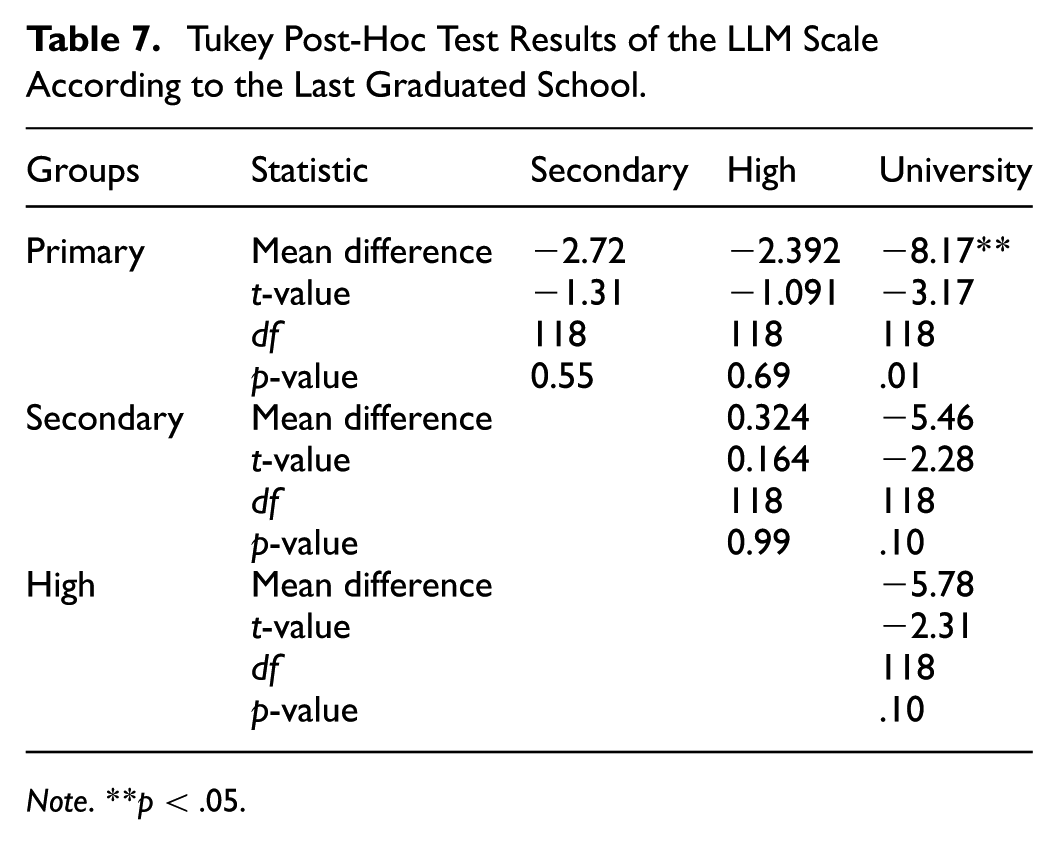
Note. **p < .05.
The analysis of the participants’ responses to the Social Adaptation Self-Evaluation (SASE) scale revealed that the scale scores did not change significantly according to their educational status (Table 8).
One-Way ANOVA Results Showing the Change in Social Adaptation Self-Evaluation Scale (SASE) According to the Last Graduated School.
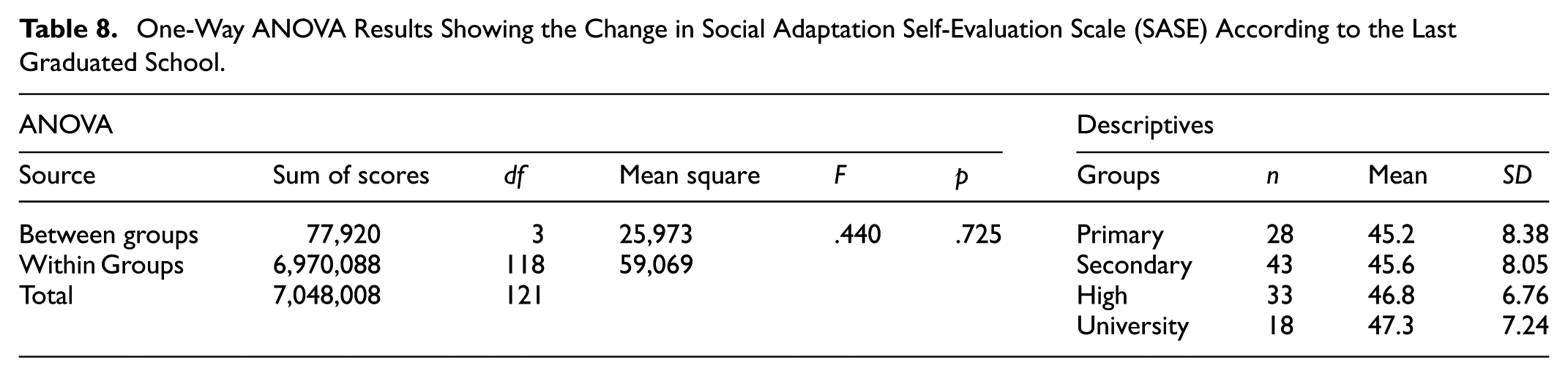
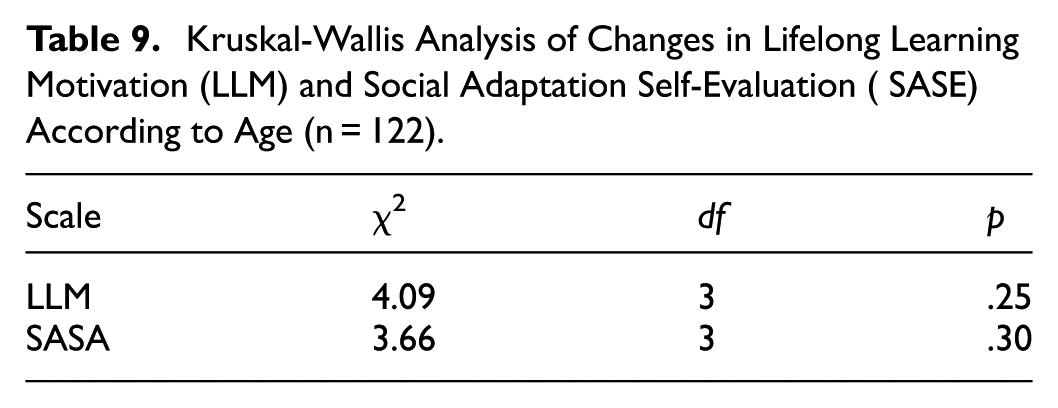
Examining whether the participants’ lifelong learning motivations changed according to their ages, no significant difference was found (χ2 = 4.09; p > .05). The Social Adaptation Self-Assessment Scale responses also did not differ significantly in terms of age (χ2 = 3.66; p > .05; Table 9).
Kruskal-Wallis Analysis of Changes in Lifelong Learning Motivation (LLM) and Social Adaptation Self-Evaluation ( SASE) According to Age (n = 122).
As a result of the correlation analysis conducted to determine whether there was a relationship between lifelong learning motivations, social adaptation self-assessment scores, and level of education, a moderately significant positive relationship was found between lifelong learning motivation and social adaptation self-assessment scale scores (r = .32, p < .05). Additionally, a positive, moderately significant relationship was observed between education status and lifelong learning motivations (r = .24, p < .05). However, no relationship was found between social adaptation self-assessment scores and level of education (Table 10).
Pearson Correlation Analysis regarding LLM, SASE and Last School Graduated.
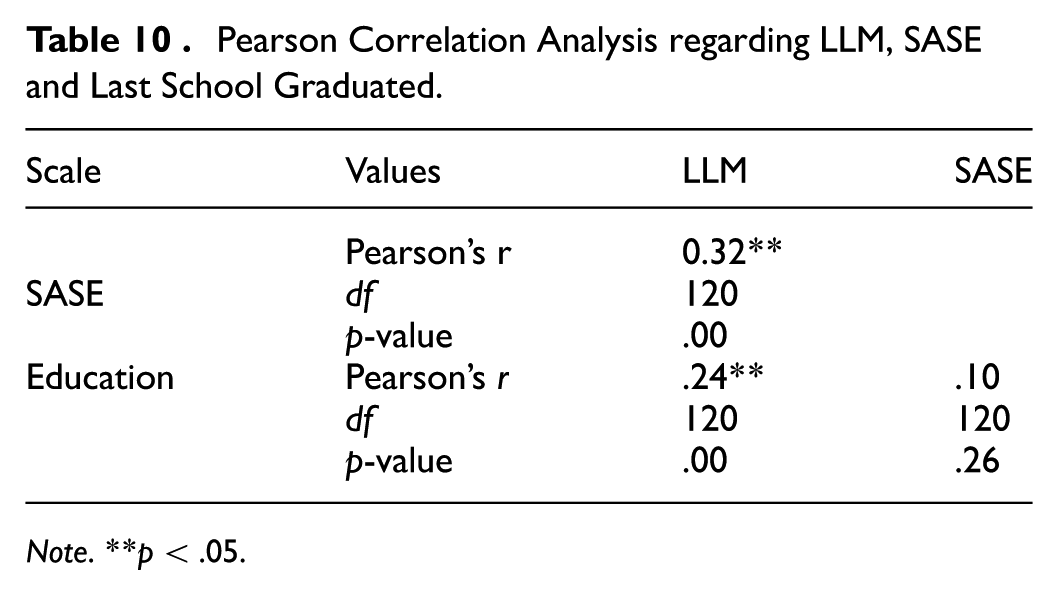
Note. **p < .05.
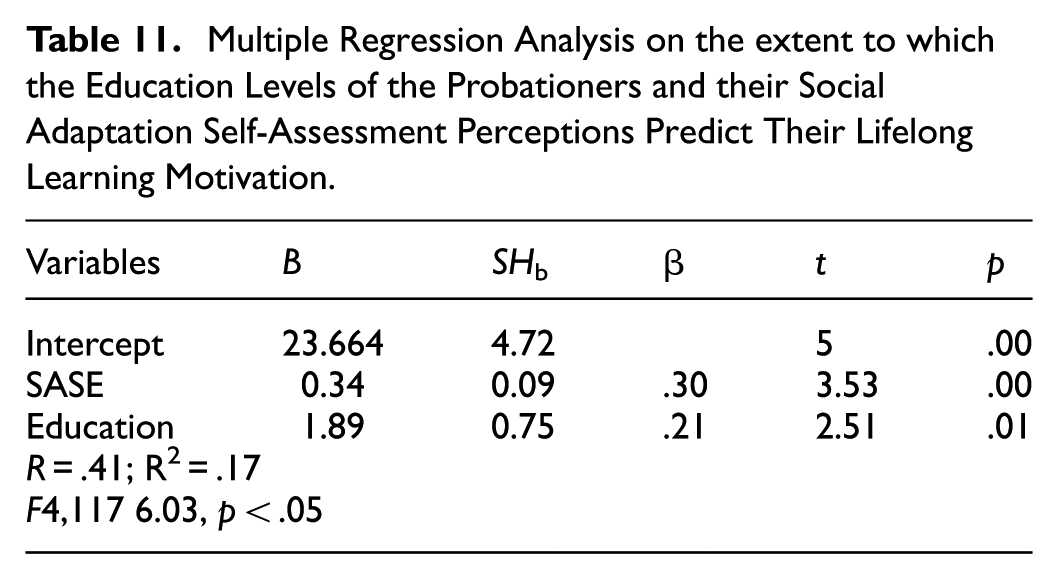
The regression analysis on how the increase in participants’ education levels and their responses to the Social Adaptation Self-Assessment Scale predict lifelong learning motivation found the model significant (Table 11).
Multiple Regression Analysis on the extent to which the Education Levels of the Probationers and their Social Adaptation Self-Assessment Perceptions Predict Their Lifelong Learning Motivation.
Discussion
This study aimed to determine the lifelong learning motivations, social adaptation perceptions, and evaluations of the education processes of probationers in Türkiye. The findings supported the importance of the education provided within the scope of probation practices for reintegrating probationers into society. Studies have also shown that educational activities organised during the probation process improve individuals’ decision-making skills and help keep them away from crime by allowing them to think about the consequences of their actions in a multidimensional way (Koblicska, 2023). Prison education before probation also reduces the likelihood of recidivism (Bozick et al., 2018; Crabbe, 2016; Ellison et al., 2017; Stickle & Schuster, 2023; Vacca, 2004). The fact that such education aims not only at personal rehabilitation but also at providing individuals with a new perspective regarding social, moral, and legal aspects has an effective reintegration-supporting and recidivism-reducing effect (Dixon, 2023).
The study found that the education levels of the probationers were low, yet their motivation for lifelong learning was higher. Research indicates that offenders, including probationers, often have lower educational attainment, which correlates with recidivism (Desir & Whitehead, 2010). This scenario suggests that individuals should engage in educational programmes during their sentences. However, such programmes for probationers should offer new opportunities and foster their capacity to ignite and maintain their motivation (Sia et al., 2000). According to Konstantinos (2004), this motivation is already present in probationers. They typically display heightened motivation for lifelong education due to aspirations for personal development, improved employment prospects, and social reintegration. This study also bolsters these findings. A positive moderate relationship was identified between education levels and motivations for lifelong learning. The motivation levels of participants who were university graduates were significantly higher than those of participants who were primary school graduates. This observation also aligns with studies that found that higher levels of education enhance individuals’ motivation and interest in learning processes (Davis et al., 2013; Galeshi & Bolin, 2022; Tyler & Kling, 2006; Zlokazov, 2022).
During the interviews, it was observed that although the participants acknowledged the importance of lifelong education, they felt they were too old for it. Probationers may be hindered from participating in lifelong education activities due to their disadvantaged societal position. Research shows that stigma, lack of human and social capital, and difficulties in accessing stable employment are the main obstacles to the reintegration of probationers into society (Sykes et al., 2022; Tuschick et al., 2024). Education beyond vocational training is not among the priorities of probationers. Such education, which they do not consider necessary, may also be viewed as an obstacle in this process. Despite the goal of probation to support reintegration, mandatory practices can inadvertently obstruct the process, particularly when they concentrate on control rather than support and relationship building (Khan, 2023; Todd-Kvam, 2022).
The sample group participating in the study indicated that their training and activities during their probation processes were mandatory and organised narrowly. The quality of the training, the teaching methods employed, and the scope of the training directly influenced the participants’ satisfaction levels. In this context, the participants reported that vocational training activities and practical training practices were more effective, whereas the seminars and general presentations provided did not contribute significantly. This finding underscores the necessity for the training programmes to be primarily organised according to the participants’ needs (Bozick et al., 2018; Davis et al., 2013; Walsh, 1985). All these studies demonstrate how tailoring the training given to probationers to individual needs and emphasising practical programmes can enhance their lifelong learning motivation and social adaptation processes.
The findings showed a positive relationship between the probationers’ perception of their societal adaptation and lifelong learning motivation. The social support and environment provided to individuals are important factors in their re-adaptation to society. However, their low education and social skills complicate this adaptation process. These findings also align with studies indicating that social support and the quality of the environment hinder probationers’ ability to adapt to society (Fontaine et al., 2016; Santhosh & Mathew, 2021; Visher & Travis, 2003). Within the study’s findings, various views were presented regarding the idea that education could reduce their tendency to commit crimes. Some participants stated that the education they received would eliminate their feelings of helplessness and decrease their chances of reoffending, as it provided them with vocational skills. However, they noted that education alone was not a sufficient solution, and that factors such as family, friends, and individual circumstances could also contribute to their involvement in crime. Various studies support these statements, emphasising that education can be effective when combined with a comprehensive support system (Bell et al., 2018; Lochner & Moretti, 2004). These studies demonstrate that education effectively reduces individuals’ tendency to commit crimes, contingent upon developing social, emotional, and vocational skills.
The research emphasises that the training provided to probationers should maintain an impartial, supportive, and communication-oriented attitude and approach. The notion that the trainers involved in these trainings should treat everyone equally within the framework of the “teacher-learner” relationship is highlighted to facilitate the achievement of the expected goals in the trainings. Additionally, the participants’ expectations for a vocational training-based programme tailored to their needs regarding real-life skills are noted. Considering all these findings, it can be concluded that the differences between the participants should also be addressed during rehabilitation. Literature reviews support these findings (Brunelli et al., 2016; Jolley, 2018). Osment (2018) stated in his thesis study that they expect vocational training to be implemented according to the needs of the probationers by taking their differences into account. Ricciardelli and Perry (2016) concluded in their study that equal and fair attitudes of prison officers accelerate the rehabilitation process of probationers. These studies demonstrate that instructors involved in the education of probationers should adopt a supportive and communication-oriented approach.
In the context of lifelong education in Türkiye, the number of studies related to prison and probation is quite limited. One reason for this is the restricted opportunity for data collection. The main limitation of this study is that it was conducted with a non-random sample. Especially when answering the scale items, the desired confirmatory factor analysis scores could not be achieved due to the low number of voluntary participants and the removal of randomly answered scales. This issue was addressed through participant interviews. Although probationers who graduated from various levels of education, belonged to different age groups, and received different sentences were interviewed, generalisations were avoided because the findings of this study pertain to research conducted during a specific period and in a province in western Türkiye.
Conclusion and Suggestions
This study examined the social adaptation levels and perceptions of probationers in Türkiye regarding lifelong education. The research revealed that participants approach lifelong learning processes with high motivation and that education plays a crucial role in social integration. Education programmes offered during the probation process helped them gain vocational skills and develop their social skills. However, it is understood that these programmes need to be organised more systematically and in a more needs-oriented manner for prisoners to benefit fully from the education programmes. Increasing the qualifications of educators, enriching the programme content, and strengthening social support mechanisms are expected to enhance the success of this process.
According to the participants, training programmes should focus on providing practical and vocational skills to help them secure employment during probation. The planned continuation of such training can facilitate the reintegration of probationers into society. Developing customised training programmes based on the individual needs and interests of the participants can positively affect their motivation and enhance their social adaptation. Continuous monitoring and evaluation of the effectiveness of educational programmes are crucial for improving them and better addressing probationers’ needs. Social support and acceptance should be emphasised during probationers’ reintegration into society. Raising awareness in society about the importance of accepting and supporting prisoners can have a positive influence on this process. It is recommended that educators involved in educational programmes receive specialised training on effective communication with probationers and on how to support them. Educators should be encouraged to maintain an unbiased and supportive attitude towards probationers. Integrating digital learning tools and resources should enhance educational programmes for probationers, allowing them to access up-to-date information and continue their personal development. Psychological counselling and social support services should be strengthened to assist prisoners in their social adaptation and rehabilitation processes. These services can help individuals cope with the challenges of adjusting to society.
Footnotes
Acknowledgements
The authors thank the Ministry of Justice of the Republic of Türkiye, Manisa Probation Directorate, for their cooperation and assistance.

Ethical Considerations
The study was conducted in accordance with the ethical standards of the institutional and/or national research committee and with the 1964 Helsinki declaration and its later amendments. Ethical approval was obtained from the Turkish Ministry of Justice (Approval No: 114857).
Consent to Participate
Informed consent was obtained from all individual participants included in the study. Participants were provided with detailed information regarding the study’s purpose, procedures, risks, and benefits, and they could ask questions before consenting to participate.
Consent for Publication
Consent for publication was obtained from all participants. They were informed that their anonymized data would be used for research and publication purposes and agreed to the publication of the study findings.
Funding
The authors received no financial support for the research, authorship, and/or publication of this article.
Declaration of Conflicting Interests
The authors declared no potential conflicts of interest with respect to the research, authorship, and/or publication of this article.
Data Availability Statement
The datasets generated and/or analysed during the current study are not publicly available due to privacy concerns and proprietary data, but are available from the corresponding author upon reasonable request.