



Abstract
Many adults choose community college courses for continued learning to enrich themselves and satisfy their leisure needs, despite having completed formal education. We explored the relationship between learning motivation, learning satisfaction, leisure satisfaction, and learning performance among community college students attending classes in Taipei City. A total of 1,011 participants were recruited. Structural equation modeling was used to examine the validity of the questionnaires and test our hypotheses. Furthermore, we determined whether the two types of satisfaction acted as mediators by testing a dual mediation paths model. Learning motivation, learning satisfaction, leisure satisfaction, and learning performance were significantly and positively correlated. Additionally, learning and leisure satisfaction had complete mediating effects, with the indirect effect of learning satisfaction being relatively stronger than that of leisure satisfaction.
Keywords
Introduction
Social progress has led to vigorous development of the community. In recent years, the lives of Taiwanese citizens have gradually diversified in terms of development. Phelps et al. (2007) noted that currently, life patterns are transitioning away from the traditional linear life plan to a life cycle plan or a blended life plan. In these changing times, establishing a learning society—that is, a society centered on lifelong learning—has become a prevalent trend in mainstream educational reform in Taiwan (Tu, 2007). This trend has driven extensive changes in education and learning, including generation of important educational concepts such as lifelong learning needs, democratized learning, learning to protect humanity, holistic learning objectives, open learning systems, learning resource integration, and personalized learning styles, as well as promoting educational privatization, globalization of information exchange, and diversification of learning achievements (Merriam & Kee, 2014). All these concepts highlight the importance of lifelong learning.
Lifelong education is an extension of the field of education that applies concepts formulated in the context of formal education system to education throughout the life span. Its emergence is leading to a gradual transition away from the traditional perspective that “the end of education is the beginning of work” toward “continuous education throughout lifespan.” From the perspective of lifelong education, work and life both benefit from a sustainable education. Lifelong education, also called sustainable or recurrent education, highlights the functions and roles of modern education and has received widespread approval and recognition (Carneiro, 2011). Based on this model of education, people must have access to a variety of different styles, channels, levels, and content outside of formal educational settings in order for their modern educational needs to be met (Agudo-Peregrina et al., 2014).
Leisure can be defined as a feeling of freedom. It is considered an essential element of human life. In this age of lifelong learning, non-formal educational courses offer people with diverse choices of advance learning activities to occupy their leisure time (Johnson, 2016). Among the 12 districts in the capital city of Taiwan, Taipei, there is 12 community colleges. The curriculum at community college encompasses a variety of courses. They can be academic courses, such as mathematics and literacy. However, more courses emphasize real-life applications, such as flower arrangement, make-up and style, cooking, and karaoke, as well as spiritual growth, such as meditation, yoga, and tai-chi. These courses do not only serve to entertain to learners but also help them obtain greater knowledge of their topic of interest, enabling them to fully leverage the synergy between learning and leisure (Edwards et al., 1996). In this way, community colleges have become channels of self-improvement as well as relaxation in our complex modern environment (Beville et al., 2014).
Past academic research has helped us understand the relationship between learning satisfaction and learning performance (Navimipour & Zareie, 2015); however, lifelong learning can also be considered a kind of leisure activity, which suggests that leisure satisfaction also relates to learning performance. In this study, we explored the roles of learning and leisure satisfaction in the relationship between learning motivation and performance. We suggest that these two types of satisfaction act as dual mediators: while students at Taipei City community colleges may be participating in classes based on their own learning motivation, this motivation might only promote their learning performance if they are sufficiently satisfied with their learning and leisure.
We constructed a theoretical model explaining the associations between learning motivation, learning and leisure satisfaction, and learning performance among community college students in Taipei City. The model was subsequently tested via a questionnaire survey to gather data, followed by structural equation modeling.
Literature Review and Hypothesis Inference
Community Colleges
Lifelong education begins with the individual. It actively engages in systemic and holistic links in a community’s sociocultural context and has the ultimate goal of establishing a “new society” and a “new humanity.” Community colleges might be considered as a response to this ethos, as they clearly put the underlying philosophy of lifelong education into practice. These institutions, which have proliferated in the United States and other developed countries since 1960, can be said to be a vital force in the educational system. The term “community college” combines the meanings of its constituent words (“community” and “college”)—in a nutshell, it is a community-based adult education institution (Chang, 2013). Among North American countries, the United States was the first to develop a community college system, and its system was later adopted by Canada (Gomez et al., 2015). In the United Kingdom, community colleges are referred to as further education colleges, institutes/colleges of adult education, or community education centers (Chang, 2000). Community colleges in Taiwan are also based on the US system.
Learning Motivation
Any learning activity includes some degree of learning motivation. Huang et al. (2016) argued that motivation is caused by and maintains individuals’ activities, as well as promotes their journey toward a certain goal. More broadly, motivation refers to any factor that causes an individual to begin to perform an activity, continue it, and decide how it is done (Huang et al., 2017). In the context of adult learning, learning motivation is caused by adults’ involvement in learning activities, and it maintains those activities as well as promotes continued pursuit of learning goals. There are different types of learning motivation, and its magnitude, related goals, and direction vary according to the situation. Busse and Walter (2013) defined motivation as “dynamic behavioral energy,” which drives individuals toward correcting imbalances and triggering actions. When this energy is directed toward learning, it can guide individuals in deciding when to participate in learning and continue to learn until they have achieved a balance with the external environment or have achieved their goals.
In addition to guiding individuals to achieve their goals, motivation conceals inner psychological processes; as such, it can be used to explain complex human behavior (Yamaki et al., 2017). In summary, learning motivation not only stimulates learning behavior but also maintains and strengthens learning activities. It can be considered an internal motivation that promotes learning.
Learning Satisfaction
The psychological definition of learning is the process through which individuals gain knowledge or change their behavior through experience (Jaber, 2016). Alternatively, it can be defined as behavior through which knowledge is gained (or corrected); it can also be the process of obtaining insight or revising original conceptions from learning behavior or learned knowledge (Duit, 1996). According to this definition, a basic element of achieving quality teaching is to enable students to achieve their learning goals.
Satisfaction, on the other hand, is based on individuals’ personal, subjective feelings. As a highly abstract (and rather vague) term, it has a variety of different meanings according to the purposes and subjects to which it has been applied. In the context of learning, satisfaction refers to the feelings or attitudes of students about their participation in learning activities—specifically, it is their degree of enjoyment of the learning activities or the degree to which their desires are met and goals are achieved (Shen et al., 2013).
Leisure Satisfaction
Beard and Ragheb (1980) defined leisure satisfaction as the positive perception or feeling stimulated by a leisure activity; more specifically, it is the degree to which an individual is satisfied by an ongoing leisure experience and setting. This feeling of satisfaction derives from individuals’ own perceptions or when an unconscious need is satisfied. In short, leisure satisfaction is the degree to which an individual satisfies his or her needs through leisure experiences. Shin and You (2013) similarly noted that leisure activities are purpose-oriented behaviors—they are centered on satisfying a particular purpose or individual need. Leisure satisfaction is a subjective comparison against a relative standard that might be based on previous experience, one’s own expectations, achievements derived from the experience, or the feelings of satisfaction experienced when engaging in leisure activities (Agyar, 2014; Buswell et al., 2012).
Learning Performance
Bruce and Flynn (2013) defined learning performance as the degree to which a learner actually acquires certain knowledge, skills, or affections through participating in learning or training in a certain field for a certain period of time. In his study, Tam (2001) argued that learner development caused by educational programs can also be called “growth” or “impact.” That is, education brings positive changes in learners in both cognitive and non-cognitive dimensions. The changes may take the form of a test score or an observable change in behavior. Shieh and Yu (2016) further specified learning performance by dividing it into two concepts: learning achievement and learning retention. While learning achievement focuses on learning outcome in general learning processes, learning retention is to retain memories after learning. The stored knowledge or skills can be further applied in life. In other words, learning achievement refers to the changes in knowledge, affection, skills, and attitudes of learners after instructions; learning retention refers to a persistent and long-term response and effect produced by learners after learning.
Hypotheses
Shin and Kang (2015) defined learning satisfaction as students’ feelings of happiness or positive attitudes toward learning activities. Costley et al. (2017) added that learning satisfaction is based on whether individuals’ own desires and needs related to the learning have been satisfied. Xu et al. (2017) pointed out that learning satisfaction refers to the feelings and attitudes of students toward learning or what they feel after learning. Feelings of happiness or positive behaviors are manifestations of satisfaction, while sad feelings or negative behaviors are manifestations of dissatisfaction. According to Cheok and Wong (2015), revising course content in response to student dissatisfaction and negative feedback is an important step in curriculum evaluation and development. Furthermore, by using student satisfaction ratings, institutions can further refine their admissions tests and exclude students who might not be suitable for a given course in order to reduce the failure rate for that course. Studying learning satisfaction can help determine shortfalls in courses and identify areas for improvement; in other words, it can help in better satisfying the interests of learners and guide curriculum development.
Learning motivation refers to the intrinsic tendency of individuals to pursue learning and their learning goals. It is known to promote more satisfactory learning outcomes. Hung (2015) demonstrated that learning motivation is a positive predictor of learning satisfaction. This has been found by several other studies as well (Rubin et al., 2018). Accordingly, learning satisfaction not only can serve as a suitable method of evaluating the results of learning activities, but also could act as a primary indicator of individuals’ learning motivation. This too would be of use for developing curriculums.
In continuing education (e.g., community colleges), there is a strong emphasis on autonomous learning. This means that learners are free to enroll in courses and participate in various activities that they might be interested in, thereby enhancing their motivation to learn, and, by extension, their learning satisfaction. Based on this expectation, we devised the first research hypothesis as follows:
H1: The learning motivation of community college learners is significantly and positively correlated with learning satisfaction.
Leisure satisfaction is defined here as the positive perception or feeling that an individual derives from engaging in leisure activities that satisfy their perceived or unconscious needs (Beard & Ragheb, 1980; Liu & Yu, 2015). On the other hand, motivation derives from the interrelationship between variables such as job outcomes, value, instrumental intensity, and expectations, and it represents to the effort people put into obtaining what they desire. Therefore, motivation refers to the various internal states and processes that guide individuals in acting toward a specific purpose and maintain this behavior over a certain period (Abeysekera & Dawson, 2015). In summary, motivation has many sources, the representations of which can take many forms.
For many learners, participation in community college courses is a way of spending their leisure time. Any activity undertaken in one’s free time can be described as a leisure activity. Existing study has indicated that people’s motivation to participate and persist in a process or activity impacts the satisfaction of the experience. For instance, Beggs and Elkins (2010) suggested that students who were highly motivated by competence/mastery factors perceived high levels of satisfaction in the relaxation and psychological dimensions of satisfaction. In other words, learners with stronger learning motivation might experience greater leisure satisfaction. This leads us to our second hypothesis:
H2: The learning motivation of community college learners is significantly and positively correlated with leisure satisfaction.
Learning performance refers to the concrete manifestation of learning outcomes—that is, the changes in the knowledge, skills, and attitudes of learners upon their conclusion of learning activities (De Neve et al., 2015; Singh & Sarkar, 2015). Ho et al. (2016) similarly suggested that learning performance is the change in behavior or behavioral patterns, as well as knowledge, skills, and reasoning skills gains, after a period of learning. It is also the ability to apply this knowledge, skills, and reasoning to solve problems, improve work abilities, and improve life. Goddard et al. (2015) divided student learning performance into cognitive and affective outcomes, while Kim et al. (2015) defined learning performance as students’ self-perceived overall learning outcome and how they compare with their external environment. The description and presentation of learning performance must be evaluated based on learning outcomes in a concrete manner.
Behaviors facilitated by learning motivation are necessarily the result of personal expectations. The quality of learning is often dependent on the degree of motivation and initiative—when an individual is highly motivated, they tend to produce good outcomes. This is likely the case among community college students as well: individuals tend to enroll in community college courses based on their own learning motivation, and expect that the knowledge and skills they obtain from that course will improve their knowledge of various domains of life. Accordingly, we devised the third research hypothesis, as follows:
H3: The learning motivation of community college learners is significantly and positively correlated with learning performance.
Ho et al. (2016) pointed out that learning performance is the knowledge, skills and cognitive ability acquired after a period of learning, which changes the behavior or behavior pattern, and can use the acquired knowledge, skills and cognitive ability to solve problems, enhance work ability or improve quality of life. A number of different factors influences performances of learning. For example. Lo (2010) concluded that satisfaction factors related to the roles of student, instructor, and policy are shown to be associated with higher rates of perceived learning, measured via students’ expectations of academic success. In addition, based on Kirkpatrick’s (1996) widely adopted evaluation model for instructions, the success of instructional can be analyzed through four levels, including reaction (How did participants feel about the training program? Did they like it?), learning (What knowledge/skills were actually learned from the training program?), behavioral change (Are participants applying their learned behaviors in the real world?), and results (What are the resulting benefits). The four levels present the internal process of learning through completion of an instruction. The logic of the four levels also implies satisfaction comes before any learning performance takes place.
The connotations of leisure satisfaction and learning satisfaction are different, but can both be used to help individuals improve learning performance. In the context of non-formal education, learning performance is not necessarily test scores, but could instead be boosts to life skills, self-fulfillment, and self-efficacy. Therefore, the learning and leisure satisfaction of individuals participating in community college courses could help enhance their learning performance. The fourth and fifth research hypotheses were as follows:
H4: The learning satisfaction of community college learners is significantly and positively correlated with learning performance.
H5: The leisure satisfaction of community college learners is significantly and positively correlated with learning performance.
The hypothesized model of the relationships between the independent and dependent variables is shown in Figure 1.

Research framework.
Methods
Participants and Procedure
This is a survey research. The participants were students from 12 community colleges in Taipei City between 2018 and 2019. In order to differentiate the mediating effect of learning satisfaction and leisure satisfaction, the selected participants were students enrolled in three major categories of community college courses. The categories were life applications, such as flower arrangement, make-up and style, cooking, and karaoke, dance lessons, such as line dance and belly dance, and spiritual growth, such as meditation, yoga, and tai-chi.
Questionnaires were distributed with the help of acquaintances of the researchers via the snowball method over 4 months, from February 2020 to May 2020. The learning motivation questionnaire was distributed at the beginning of courses (February 2020). The learning and leisure satisfaction questionnaires were distributed during the mid-term week. The learning performance questionnaire was given at the end of the courses (May 2020). A total of 1,112 responses were collected, and after screening and excluding seriously invalid responses, there were a total of 1,011 valid questionnaires, giving an effective recovery rate of 90.9%. Based on the principle of having a sample size of at least five times the number of parameters, as proposed by Bentler and Chou (1987), and that the estimated parameter is approximately twice the number of items in the questionnaire, we needed only 140 participants for this study because there were 14 items on the questionnaire. Therefore, the 1,011 valid responses met these requirements.
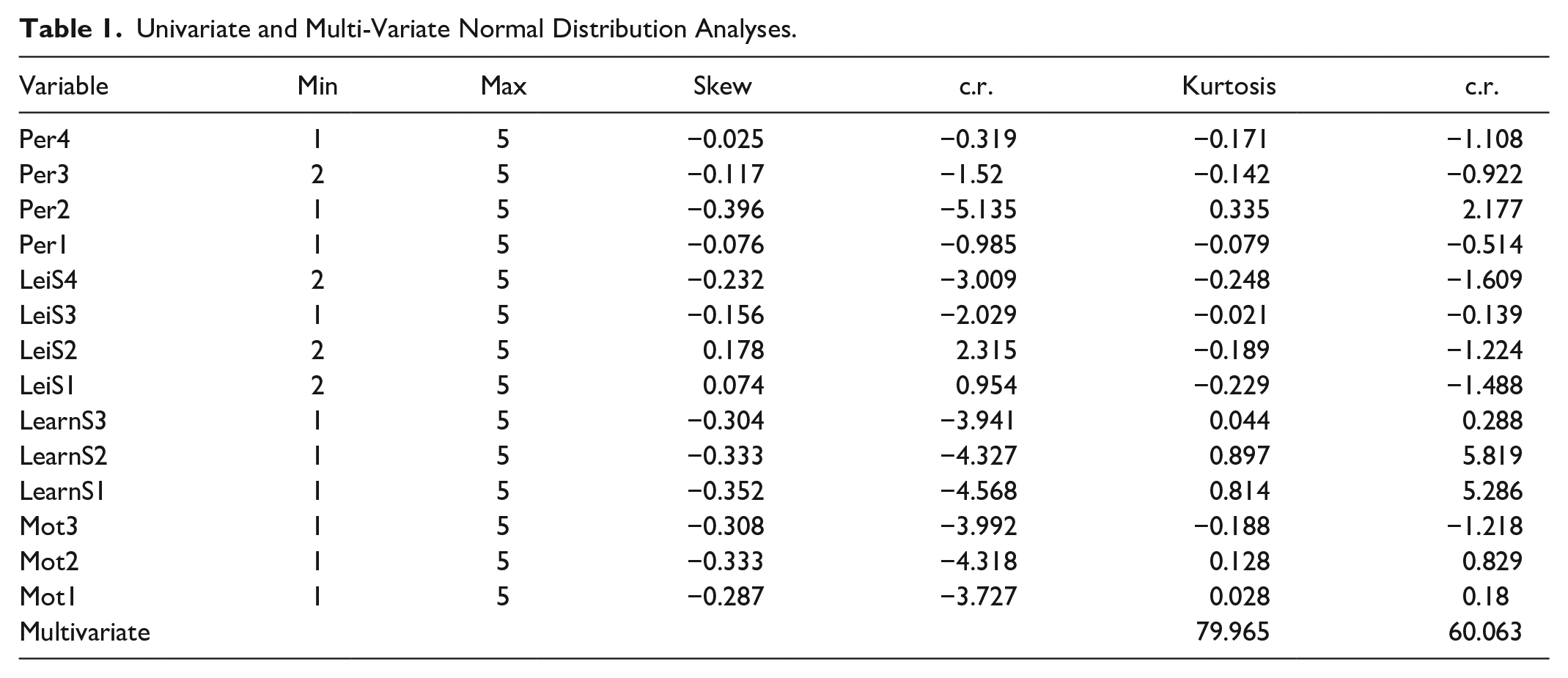
In order to confirm the collected sample is the normal distribution, skew and kurtosis were tested for all observed variables. Since the absolute value of skewness is less than 3, and the absolute value of kurtosis is less than 10, collected samples can be regarded as normal distribution (Kline, 2015). Therefore, the sample data of this study conforms to the univariate normal distribution. In addition, Mardia coefficient was used to determine whether all samples meet the assumption of multivariate normal distribution. Table 1 shows that the Mardia coefficient is 60.063, which is less than 224 (p*(p + 2), p = the number of observed variables which is 14). Therefore, although the sample distribution in this study is not multivariate normal distribution, it can still be estimated using the Maximum likelihood method of structural equation model (Bollen, 1989).
Univariate and Multi-Variate Normal Distribution Analyses.
Measures
Four scales were employed for our analysis. Learning motivation was measured using the three-item scale by Hsieh (2014). Learning satisfaction was measured using the scale of Kong and Yan (2014), which measures three observed variables. Leisure satisfaction was measured using the scale of Beard and Ragheb (1980), which consists of four items. Finally, learning performance was measured using the scale by McGill and Klobas (2009), which also contains four items. All items are answered based on subjects’ self-reported subjective cognitions; we used these subjective measures because objective ones could not effectively capture the variables in this study. In addition, the self-report methods can obtain relatively accurate information. Given that we used the same answer method for all variables, the items were spread throughout the questionnaire to avoid confusing participants (Hinkin, 1998).
Results
Preliminary Analyses
We analyzed the data using descriptive statistics and structural equation modeling (SPSS Statistics 21.0 and AMOS 20.0). The basic characteristics of the valid sample were as follows: They were mostly female (71%), with fewer females (29%); their age distribution was concentrated around 51 to 60 years old (61%) and 41 to 50 years old (27%); and 404 (39%) respondents were college graduates while 242 respondents (24%) had high school degrees. Table 2 shows that different gender, age, and education groups did not have significant impact on learning motivation, learning and leisure satisfaction and learning performance.
The Effect of Personal Factors on Dimensions.

Confirmatory Factor Analyses
After the analysis of confirmatory factor analysis (CFA), the standardized factors loading were greater than .5, and the square multiple correlation was also greater than .25, indicating good model fit. The composite reliability (CR) and average variance extracted (AVE) were greater than .6 and .5 respectively. As shown in Table 3, it indicates good convergent validity.
Confirmatory Factor Analysis Convergent Validity.

p < .001.
Besides the convergent validity, we examined the discriminant validity by comparing the square roots of the average variance extracted with the correlations of the latent variables; if the square root of the AVE is greater than each correlation coefficient, then the latent variables are considered to explain the variance of their own indicators more than the variance in the indicators of other variables. The square roots of all AVEs in this study were greater than the correlation coefficients, indicating good discriminant validity (Farrell, 2010), as shown in Table 4.
Correlation Coefficient and Discriminant Validity.

Note. The diagonal value is the AVE square root of each facet.
Structural Model and Hypothesis Testing
The structural model of the hypotheses was tested. The verification results are shown in Figure 2. The model fit was generally good: χ2(72) = 617.626, normed χ2 = 8.578, goodness of fit index (GFI) = .920, adjusted goodness of fitness (AGFI) = .883, comparative fit index (CFI) = .917, non-normed fit index (NNFI) = .896, incremental fit index (IFI) = .918, root mean square error of approximation (RMSEA) = .087, and standardized root mean square residual (SRMR) = .069. The large sample size of this study likely expanded the chi-square value. Furthermore, even if the AGFI does not meet the common standard of .9, according to Doll et al. (1994), this indicator can still be accepted if its value is above .8. In addition, Kline (2015) noted that an RMSEA’s failure to meet the standard criterion is only serious when the value is greater than .1. Therefore, all the indicators comply with the standards stipulated for SEM (Jackson et al., 2009). The structural model of this study thus shows a good fit.
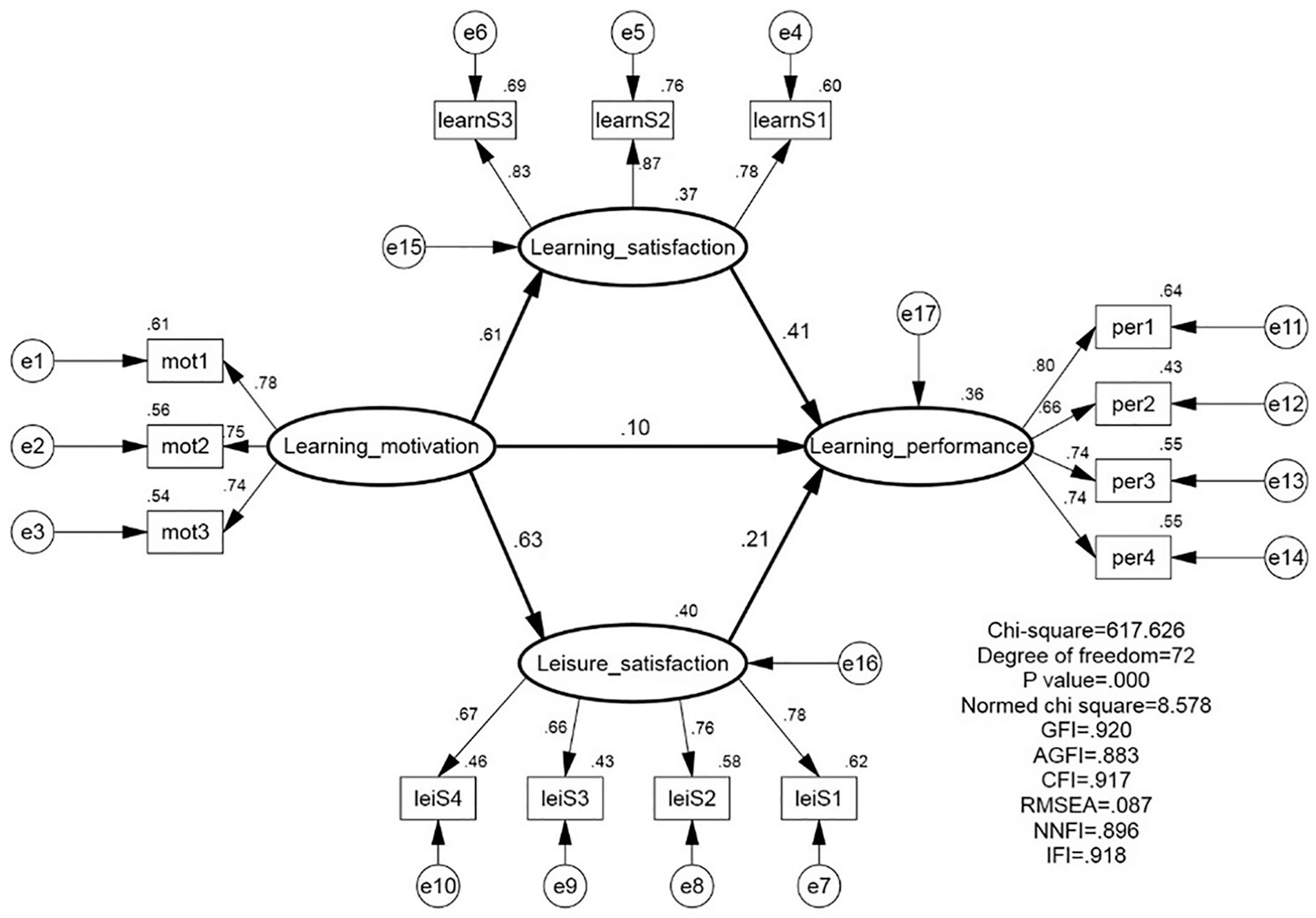
Standardized structural model.
Starting from the assumptions proposed in this study, we used the bootstrapping method to analyze the paths between variables. The standardized path coefficients were nearly all significant. Learning motivation had a positive and significant relationship with learning satisfaction (standardized path coefficient = .61), explaining 37% of the variance. Learning motivation was also positively and significantly related with leisure satisfaction (standardized path coefficient = .63; 40% variance explained). Learning motivation, learning satisfaction, and leisure satisfaction all had positive effects on learning performance; only the path between learning motivation and learning effectiveness was not significant (standardized path coefficients = .10, .41, and .21 respectively; 36% of variance explained). Therefore, besides H3, all hypotheses in this study were verified. The standardized regression coefficients and significance are shown in Table 5.
Standardized Regression Coefficients and Significance.

In order to examine and differentiate the mediating effects of learning satisfaction and leisure satisfaction on the relationship between learning motivation and learning performance, we used the bootstrapping method to compile a Visual Basic program to calculate the confidence intervals for the direct and indirect effects (Hayes, 2009). As shown in Table 6, the confidence interval of the direct effect of learning motivation on learning performance included zero, indicating that there was no direct effect. In contrast, for the mediating effect of leisure satisfaction (path b), the confidence interval does not include zero, indicating a significant indirect effect. Similarly, learning satisfaction has a mediating effect (path a). Given that there was no direct effect, the model can be considered complete mediation. When we compared the two indirect effects with each other (path c), the difference between the two was significant, indicating that the effects of the two mediation variables were not the same. Specifically, the indirect effect of learning satisfaction was stronger (Table 6). In sum, four out of the five hypotheses were supported. Table 7 presents the results of hypotheses testing.
Double Mediation Model Test and Comparative Analysis.

Results of Hypotheses Testing.

Conclusions and Limitations
The main purposes of this study were to explore the relationship between learning motivation, learning satisfaction, leisure satisfaction, and learning performance among community college students in Taipei City. Firstly, we found that learning motivation had a significant positive correlation with learning and leisure satisfaction. This finding indicates that the learning motivation of students in various community colleges in Taipei City is associated with greater learning and leisure satisfaction, which agrees with existing understanding that learning experience (satisfaction) are affected by levels of motivation (Ning & Downing, 2012; Vansteenkiste et al., 2009). This finding has important implications for the administration and curriculum administrators of community colleges. At the start of classes, teachers must understand the needs of students in order to sufficiently capture their attention. When students are more motivated, it not only can make the learning feel more useful, but also serves as a source of entertainment and enrichment of their lives.
Secondly, we found that both learning and leisure satisfaction had positive and significant effects on learning performance. This finding suggests that teachers in continuing education courses should pay attention to whether the students can understand the lessons and take note of the frequency of interaction and the degree of difficulty of the content. It further suggests that they must ensure that learning activities are accompanied by understanding and interactions between students, not only allowing students to obtain the requisite knowledge but also make friends and improve their friendships in community colleges. This is extremely helpful for learning outcomes.
However, it is worth mentioning that the study found learning satisfaction and leisure satisfaction were complete mediators of the relationship between learning motivation and learning effectiveness. This is an entirely novel finding. In past academic studies, learning satisfaction and leisure satisfaction were never tested as mediating variables at the same time—this study is the first. This indicates that students at Taipei City community colleges might participate in courses because of their learning motivation. However, whether students achieve good learning outcomes appears to be dependent on whether they are satisfied with their learning and leisure life. This is worthy of note for supervisors, administrative support staff, and teacher-trainers of major community colleges in Taipei.
Finally, another notable finding was our comparison of the strength of the indirect effects of learning satisfaction and leisure satisfaction. Due to the nature of courses offered at community of colleges in Taipei, this study wanted to learn which is the more important predictor of learning performance- leaning or leisure satisfaction. This analysis helped to show that learning satisfaction has a slightly stronger mediating effect on the path between learning motivation and performance, and suggests that community colleges, as lifelong learning institutions, must continue to pay attention to the nature of education. In other words, non-formal education can be more flexible, which means it can have the same effect as leisure activities, but should still be geared toward helping learners achieve their learning outcomes. Therefore, the curriculum structure and content of community colleges can be designed according to the nature of continuing education and lifelong learning, while being conducted in a casual manner. We believe that these efforts might help create a new image for Taipei City community colleges.
Even though the empirical results of this study largely support the proposed research model, at least three limitations should be carefully considered. First, since individual informants provide the empirical data, possible biases or preferences (e.g., learning styles, interests, hobbies) may exist due to different personal experiences. Secondly, a power analysis result shows that our sample size is 443 short. Even though our current sample size (N = 1,011) is more enough according to Bentler and Chou (1987), it should be noted that the statistical power in this study is restrained. Finally, due to the nature of courses in the community colleges in Taiwan, this study only aims to examine and compare the mediating effect of learning satisfaction and leisure satisfaction. Therefore the proposed SEM model is a context model for which data were collected following a chronologically procedure. Consequently, we did not test alternative models when conducting SEM analyses. This can be a future study of competing models.
Footnotes
Acknowledgements
Special thanks to Dr. Hui-Chuan Shih of 100-Translation Academic Consulting Firm for the professional language editing service.
Declaration of Conflicting Interests
The author(s) declared no potential conflicts of interest with respect to the research, authorship, and/or publication of this article.
Funding
The author(s) received no financial support for the research, authorship, and/or publication of this article.
Ethics
Informed consent was obtained from participants included in the study. All surveys collected were numbered and remain anonymous. Should participants wish to withdrawal from the study, they could contact the authors during or after the study, their data would be removed from the data analysis. The procedures used in this study adhere to the tenets of the Declaration of Research Ethics Committee Office in Taiwan. All procedures performed in studies involving human participants were in accordance with the ethical standards of the institutional.
