




Abstract
Examining gender differences in learning is of critical importance in terms of revealing any potential inequalities. Although gender differences in lifelong learning tendencies are often examined in individual studies in the literature, the relevant findings are found to be inconsistent. In this study, a meta-analysis was carried out to consolidate exact inferences by evaluating the subject from a broad perspective, as well as from recent quantitative studies on lifelong learning tendencies that were published between 2012 and 2021, in the context of Turkey. They were particularly investigated in terms of gender differences. A total of 51 studies were included in the meta-analysis, and it was found that gender differences in lifelong learning tendencies were significant, positively correlated, and in favor of females (g = +0.27, 95% CI [0.18, 0.36]). When the potential moderators that could contribute to the heterogeneity of the findings were considered, gender differences were much more prevalent among teachers for the sample group, and across referenced literature works. In addition, as a result of the meta-regression analysis performed according to the random effects model, it was seen that the year of publication have a significant effect in terms of gender differences.
Introduction
Lifelong learning, which is one of the most significant goals of education and employment, is often at the center of the current policy discourses (Lavrijsen & Nicaise, 2017). The basic premise of lifelong learning is that, it is not feasible to equip individuals with all the necessary knowledge and skills required for their development at school (London, 2011), and that learning continues throughout life, outside of the formal education institutions, as well.
Learning is influenced by the variables which exist in the socio-historical environment of a student, such as schooling and other cultural practices, besides interpersonal relationships, cultural tools, worldviews, and traditions. These factors are also likely to influence each other in a dynamic trajectory in time (Crick et al., 2004). Accordingly, one of the factors that which has an influence on learning is undoubtedly gender, and social reflections of this gender. However, academic literature on learning presents a complicated and uncertain result with regards to gender (Chłoń-Domińczak & Lis, 2013). Similarly, it is seen that gender issues are neglected in most of the current literature on lifelong learning. Most of the analysis on the subject tends to emphasize individual learning as opposed to the social nature of lifelong learning, and tends to concentrate on the structure of individual learning, rather than gender stereotypes. Yet, there are many more social elements in lifelong learning, and these elements need to be investigated and discussed (Rogers, 2012).
A meta-analysis study which examined the findings of lifelong learning tendencies within the context of gender, sought to clarify the gaps in the literature and to fill the deficiencies with an analytical perspective which had not been studied from a Turkish context. It is possible that the gender differences that may arise in the research results cause inequalities among individuals. Therefore, the results of the research are important in terms of providing data to education policymakers in Turkey.
Theoretical Framework
Lifelong Learning and Lifelong Learning Tendency
Although it is used in a wide variety of contexts in education, administration, and society have an extensive validity, clarity, and is consistent in terms of definitions regarding lifelong learning, which have not been introduced before (Aspin & Chapman, 2007). In previous literature, it is likely that one will come across definitions such as the combination of learning processes, that constantly change cognitively, affectively, and socially, throughout the life of an individual, and are integrated into the life of the individual (Jarvis, 2007), or the intentional learning which individuals follow throughout their lives, in order to enhance the quality of their lives (Dunlap & Grabinger, 2003).
Lifelong learning, which is used to describe all learning activities from birth to death, both in formal and informal settings, is much more associated with postsecondary education (Leathwood & Francis, 2006). However, lifelong learning is much more than an adult’s education path. Lifelong learning is a personal process managed according to capacity, areas of interest, current situation, desire, and consciousness. Therefore, it does not depend on a single learning institute, or in a period of time (Billett, 2010).
The information age involves learning, teaching, and education-oriented thinking, by including students of all ages in the process within the context of distinctive individual problems (Fischer, 2001). In this sense, the United Nation’s Educational, Scientific and Cultural Organization (UNESCO), adopted the concept of lifelong learning as a guiding principle for education all over the world, and regarded the provision of opportunities to learn from birth to old age, accompanied by the realization of human potential as a necessary means for upholding human rights and democracy (Kirby et al., 2010). In a similar vein, the European Commission (2002) also stated that lifelong learning is not only an aspect of education and training, but it is also required to act as a guiding principle for participation in all contexts of learning.
Lifelong learners are able to learn and adapt what they learn simultaneously, and try to go beyond what they know. This situation requires love of learning, and the willingness to learn, that is, a tendency toward lifelong learning. This tendency involves characteristics such as taking risks, persevering, and considering learning a continual process. It also includes certain skills such as self-regulated learning capacity, which is supported by a metacognitive awareness (Dunlap & Grabinger, 2003). In addition, lifelong learners are characterized as curious, flexible, motivated, and mindful (Knapper & Cropley, 2000).
Learning tendencies are personal in nature, and are autogenic. On one hand, the learning tendency reflects one’s identity, personality, background, and desires. On the other hand, it can generate a scaffold for knowledge and skills required for individuals to become effective learners. Many tendencies that can be listed from specific to general are related to lifelong learning tendency, and in fact, while lifelong learning tendency focuses on the self-directed learning tendency of the individual, it includes the abilities, intentions, and sense of achievement of lifelong learning communities in the context of real life (Crick & Yu, 2008).
Coşkun and Demirel (2012), underline the sub-dimensions of lifelong learning tendencies, such as motivation, perseverance, curiosity, and regulation of learning. Motivation is a form of “energy” that directs one’s capacity to learn, adapt, and change (Crick et al., 2004). It is important to have more knowledge on motivational factors that influence the decisions to access these learning opportunities, in order to promote adult learning (Gorges & Kandler, 2012). Without motivation, it is quite difficult to have curiosity and desire for lifelong learning, which is often a long journey of learning, as well as one’s ability to maintain this desire, and to make the necessary arrangements to pursue it. Another characteristic of an individual with a lifelong learning tendency is perseverance. Thus, maintaining lifelong learning in a determined and stable manner, and regarding learning as a continuous process, is highly important (Dunlap & Grabinger, 2003). Another feature that enables lifelong learning is curiosity. Recent studies have thrown light on the role of curiosity in motivating learners to pursue both formal and informal learning pathways. Curiosity, which is defined as the desire for knowledge and to know, helps to trigger exploratory behavior, for example, observing, consulting, and thinking (Reio, 2004). Another feature associated with lifelong learning is to regulate learning. Self-regulated learners set goals for their own learning, monitor it, and control their own cognition, motivation, and behavior in an active and constructive process (Pintrich, 2000). From this point of view, there is a positive and significant relationship with that of self-regulated learning, which contributes to individual learning skills, and lifelong learning (Öz & Şen, 2021).
Gender and Lifelong Learning Tendency
The level of participation in lifelong learning within a country varies across several factors, such as socio-economic, demographic, and regional factors. It has revealed structural inadequacies with regards to access to education. Rare or low participation by some groups indicated structural inequalities in society, and painted the fact that access to lifelong learning was not equal. Gender, geographical position, age, and socio-economic status, play an important role in the participation of lifelong learning (UNESCO, 2009). This study focuses on the gender variable.
Gender refers to the learned behavior and attitudes that are acquired as a result of social experience (Galambos, 2004). Individual differences based on gender, or gender roles, have often been studied, and research studies have shown that one’s cognitive performance does not solely depend on one’s ability, but on situational factors such as the role of one’s gender role (Moè, 2012). Every individual, regardless of one’s gender role, must be given an equal opportunity to enhance his or her personal skills, and to make choices without being hindered by any limitations, or traditional stereotypes (March et al., 2005). In this sense, Silberstang (2011) examined the effects of gender role stereotypes on women, in terms of their lifelong learning, their earnings, and their career advancement opportunities. The author suggested that revealing the role of gender in learning is a critical component in lifelong learning. Based on this literature review, Silberstang (2011) concluded that gender role stereotypes tend to raise difficulties for women all over the world, in terms of accessing education, choosing the subject they want to study, and their career choices. In this respect, investigating gender issue in terms of lifelong learning tendencies is highly important in order to participate in lifelong learning means.
Worldwide research studies on participation in lifelong learning revealed that men were more likely to participate in trainings provided in vocational training and technical training courses, and women were more likely to attend trainings in the fields of community education and care. While these patterns are globally evident, there are certainly many differences among the countries (Leathwood & Francis, 2006). Thus, to obtain data on the relevant issue on a country-to-country basis, it is important to increase participation in lifelong learning, and decrease differentiation. Boeren (2011) stated that men and women have equal rates of participation in lifelong learning, on average, 59.0% versus 55.4%, respectively. But, the participation differs according to the type of learning activity. The participation of men is typically higher in formal or non-compulsory learning activities and vocational trainings, while women mostly show a tendency to participate in compulsory activities. This situation is likely to arise due to the difficulties that women experience in integrating family life, as well as other areas of life. Indeed, women are still expected to take on basic duties and responsibilities at home, such as cleaning, looking after children, and so on, in general (Daniels, 2010; Gouthro, 2009). Studies need to investigate and eliminate the factors leading to such situations, which will positively affect and contribute to women’s participation in lifelong learning activities.
Gender equality in accessing to education and schooling was achieved to a large extent in Turkey over the last decade, through the initiatives within the scope of objectives of the Education for All initiative (Erçetin & Arifoğlu, 2016). However, geographical and regional differences, fields of education, types of schools which female students were more interested in, the effect of leaving school early, and the fact that there were relatively fewer females in higher education, showed that there were still considerable gaps to be covered in the field of education (Women in Turkey, 2021). This case of inequality has made lifelong learning a necessity for women. Women place more emphasis on lifelong learning activities with the intention of meeting the deficit arising from the inequalities they have experienced over the course of their educational life (Jenkins, 2004; Kilpi-Jakonen et al., 2014). Such inequalities are also encountered in the field of employment. It is a well-known fact that a women’s skills in the workplace are still considered less valuable than a man’s skills in today’s world, and that there is a social bias against women during recruitment. The probability of being employed in shorter-term jobs with lower wages is higher for women than men, and male administrators have a strong social stigma, such that they feel that female employees tend to experience tougher conflicts between business life and family life, leading to the number of female administrators being considerably fewer than the number of male administrators (Ballarino et al., 2009; Hoobler et al., 2009; Jørgensen & Lindvig, 2011; Leathwood & Francis, 2006; Ngo et al., 2003). Issues such as inequalities, negative judgments and perceptions, and exerting more efforts in employment drives, may be the primary source of motivation for women to show more tendencies to lifelong learning activities, partially, or necessarily.
Gender differences in lifelong learning tendencies in Turkey have been revealed across many studies. However, these differences have been stated as significant or insignificant, and show inconsistencies. While many studies reported that women showed significantly more tendencies in lifelong learning compared to men (e.g., Elaldı, 2017; Solmaz & Aydın, 2017), there were studies which presented opposite findings (e.g., Bahadır, 2019; Ekşioğlu et al., 2017) or stated that there were no significant gender differences (e.g., Karahan, 2017; Taş, 2020). The present meta-analysis study was prompted on the grounds that data related to variables which may affect this diversity in individual studies are necessary and important for providing a social analysis by understanding gender differences, and evaluating these differences from a holistic view. In this regard, this study aims to introduce a meta-analysis that reveals the gender differences in lifelong learning tendencies, in Turkey. Answers to the following research questions are sought:
Are gender differences a factor in lifelong learning tendencies in Turkey?
Do the moderator variables (type of publication, year of publication, and sample group) have an effect on the gender differences in lifelong learning tendencies?
The Present Meta-Analysis
Method
Meta-analysis was used to determine the gender differences in lifelong learning tendencies. The research procedure was recommended by Card (2012), and was employed in the meta-analysis process.
Searching the literature
As a first step, the sampling framework was established for the meta-analysis, and then the inclusion/exclusion criteria were determined. Relevant studies included in the determined databases were filtered according to the inclusion and exclusion criteria in Table 1.
Inclusion and Exclusion Criteria.

One of the most important problems related to lifelong learning tendencies is the availability of tools to measure it (Kirby et al., 2010). The number of such scales is quite limited in Turkey. The most frequently used scale is the one developed by Coşkun and Demirel (2012), and consists of the sub-dimensions of motivation, perseverance, regulation of learning, and curiosity (based on the Google Scholar database, January 2021). The frequency of use in Turkey enables prevent the resulting differences from the scale in the studies from being included in the analysis. As such, it has led to the use of this one scale, as an inclusion criterion in the meta-analysis.
In line with the criteria determined for the selection of studies to be included in the meta-analysis, the first search for the literature was carried out in January of 2021, across several databases, such as Google Academic, Google Scholar, Education Resources Information Center (ERIC), and the National Academic Network and Information Center (ULAKBİM). The reason for choosing these databases was that they included the relevant studies to a larger extent, and they met the accessibility criterion. The keywords used in the literature search were lifelong learning, lifelong learning + gender, lifelong learning tendency, lifelong learning tendency + gender, lifelong learning tendency scale, lifelong learning tendency scale + gender, and lifelong learning tendency scale + Coşkun + Demirel. A second search was carried out in March of 2021, using the same databases and keywords, in order to include recently published research studies on the subject. From the resulting search, the titles and abstracts of the studies were examined by categories, and the studies which did not comply with the predetermined criteria were excluded from the list. In addition. The quality of studies included in the meta-analysis had to be evaluated. While assessing the quality of studies in this meta-analysis, the recommendation to exclude low-quality studies proposed by Lipsey and Wilson (2001) and Valentine (2009) was adopted. Accordingly, studies with a very small sample size but a large standard error were not included in the meta-analysis. The steps for searching the literature through the procedure recommended by Card (2012) is presented in Figure 1. Two field experts were consulted for their opinion for the draft list, as well as the list of studies to be included in the research, which were in line with the suggestions and repeated searches which were then finalized, so as to include a total of 51 research studies (Figure 2).

Basic steps of searching the literature.

Flowchart of the search and screening process.
Coding study characteristics
In addition to the results of the effect of sizes in the meta-analysis studies, it was also important to examine the relationships between the effects of research, and the study characteristics related to it simple mentation. Therefore, besides the effect of coding size, several other categories of variables needed to be examined (Lipsey & Wilson, 2001). For this reason, the necessary information was collected using a publication coding form. This publication coding form included general information about the studies in the meta-analysis related to the research (author information, publication year, and publication type), sample information (number of participants and sample group), and the resulting research results. The publication types of the study were coded as articles and thesis, sample groups as pre-service teachers, undergraduate students, teachers, and high school students.
Coding of the research studies to be included in the meta-analysis should be done by at least two coders, in order to ensure the reliability of the coding (Wilson, 2009). The coding form was individually filled by the experts, and the results were then compared. The initial agreement ratio on the coding between the coders was found to be high, and disagreements were resolved through consensus.
Statistical analysis
There were a few standardized mean differences which indexed the relationships between the binary “group” variables, and the continuous variables. Hedges’ g, is one of the most common of these indices, which is used in the present study (Borenstein et al., 2011). Hedges’ g is a variation of Cohen’s d that corrects for biases due to small sample sizes (Hedge and Olkin, 1985), and is specifically convenient for the meta-analysis of studies with varying sample sizes (Korpershoek et al., 2016). The Hedges’ g value is interpreted as small (g > 0.3), medium (g > 0.5), and large (g > 0.8).
In the process of decision making regarding model selection in data analysis, certain criteria and prerequisites for the scope of research should be considered (Borenstein et al., 2011; Cooper et al., 2019; Hedges & Olkin, 2014; Littell et al., 2008). The random effects model assumes that there is a “true” size effect for each study, which is included in the meta-analysis, and this is the opposite of the fixed effects model, which assumes that their standard deviations are equal to zero, since the population size of the studies are identical (Lipsey & Wilson, 2001). In addition, as a result of the test for Heterogeneity, if the size effect does not exhibit a heterogeneous distribution, it is recommended to use a fixed effects model, and if the size effect exhibits a heterogeneous distribution, then, the random effects model is recommended (Ellis, 2010). Due to the fact that each study included in the meta-analysis has a potentially different “true” size effect, as well as heterogeneity in size effect, the random effects model was ultimately selected in this study, and the average “true” effect magnitude of the distribution of “true” size effect was correspondingly calculated (Card, 2012).
The test of significance used Cochrane’s Q in order to assess the heterogeneity of the effect sizes and I2 value, to help quantify the degree of heterogeneity (Borenstein et al., 2011). An I2 of 25% can be regarded as low heterogeneity, 50% as moderate, and 75% as high heterogeneity. This also indicated the presence of potential moderators (Higgins et al., 2003). Additionally, subgroup analyses were conducted in the present study in order to examine if the observed size effects differed significantly between the publication year, publication type, and different sample groups. All analyses were conducted using the Comprehensive Meta-analysis Version 3 (CMA Version 3; Borenstein et al., 2013), a statistical analysis software, which is widely known, and commonly used for meta-analysis.
Analog to the ANOVA and meta-regression analyzes can be performed to examine the effect of moderator variables on the effect size in the meta-analysis. Which of these methods will be used is related to the nature of the variables determined as the moderator. While the effect of a single categorical moderator variable can be examined with the Analog to the ANOVA method, categorical or continuous moderator variables can be analyzed in meta-regression analysis. In this study, publication type and sample group are moderator variables coded categorically. Whether these moderator variables cause variability in the effect sizes was analyzed with the Analog to the ANOVA method based on the Q statistics. On the other hand, meta-regression analysis can be used to determine the possible effect of continuous variables on effect sizes (Borenstein et al., 2011). In this study, the other moderator variable, the year of publication, was coded as a continuous variable, and meta-regression analyzes were performed to examine the effect of these variables on effect sizes.
Presenting research syntheses with both visual and narrative interpretations, explaining complex results in a more informative and accessible manner are important considerations for meta-analysis (Borman & Grigg, 2009; Rosenthal & DiMatteo, 2001). In order to display the size effect, the forest plot (Figure 5), and funnel plot (Figure 3), as well as the stem-and-leaf plot (Figure 4) and histograms (Figure 4), were used in this study. The general data on the publication bias and analysis were reported in the tables, in terms of the number of samples (k), Hedges’ g, with a 95% confidence interval for the value of g, which was accompanied by heterogeneity statistics (QT).
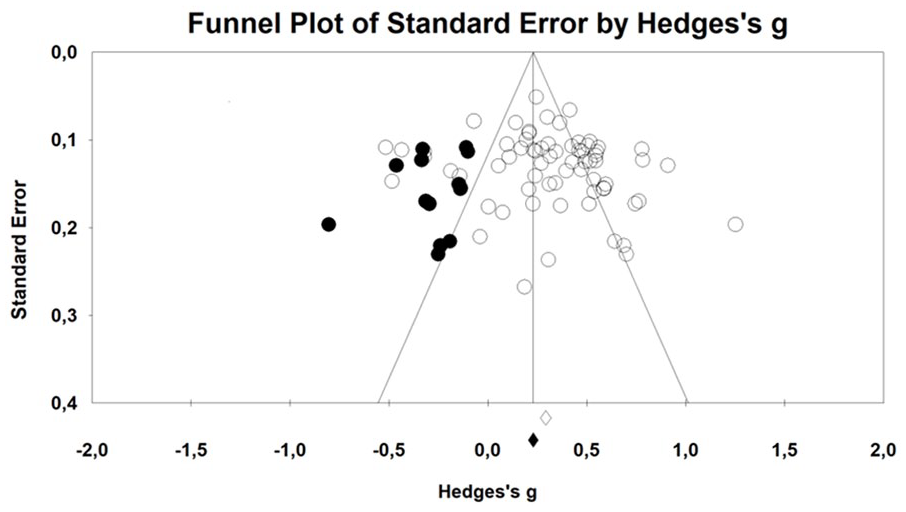
Funnel plots of the overall effect sizes.

Histogram and stem-and-leaf plot of the size effects.
Publication biases arise when studies detecting insignificant/negative findings, or small size effects are not included in the meta-analyses (Borenstein et al., 2011), and the results in reporting the overall size effect is mistaken as being larger than its true value (Card, 2012). As there is no formal statistical test to determine the presence and effect of publication biases, it is recommended to combine several analyses (Banks et al., 2012; Borenstein et al., 2011). In the present study, the trim-and-fill analyses (Duval & Tweedie, 2000), with a funnel plot (Light & Pillemer, 1984) was initially utilized to control the publication biases for the overall effect. The asymmetry of the emergent funnel plot was tested using Egger’s linear regression test (Egger et al., 1997). In addition, the Classic Fail safe-N value as also examined (Rothstein et al., 2006).
A funnel plot resembles a symmetrical inverted funnel if there is no publication bias (Egger et al., 1997). Conversely, when there is a publication bias, a funnel plot is generally asymmetrical and skewed. The visual examination of figures was performed using the trim-and-fill method for publication biases. The open circles on the funnel plot of standard error from the Hedges’ g suggested that there was a weak evidence for publication biases. The black dots created by the trim-and-fill method estimated the possible number of missing studies. Together with this graph, and in order to reduce the overall size effect, the Classic Fail-Safe N (Rosenthal, 1979) test value was calculated to determine how many studies with the size effect of 0 were needed. According to this value, the required number of studies were determined so that the average size effect was determined as a result of the meta-analysis in the research, which could approximately reach the zero effect level. The number of studies were required to be greater than the number found, that is, 5k + 10 (k = number of studies included in the meta-analysis; Rosenthal, 1979).
Begg and Mazumdar’s test for the rank correlation was based on the assumption that studies with larger sample sizes were published more frequently, and studies with equal sample sizes were published less frequently when the size effect was smaller (Begg & Mazumdar, 1994). Therefore, in the case of publication biases, there was a negative relationship between the standardized size effect and the standard errors of these effects. This correlation was tested with Kendall’s tau. A significant value indicates possible publication biases. Since publication biases are expected to reduce the average size effect, the test of significance was one-tailed. In Egger’s test, the standard normal deviate is regressed based on precision, which is defined as the inverse of the standard error (Borenstein, 2005). The intercept in this regression corresponds to the slope in a weighted regression for the size effect size of the standard error (Cuijpers et al., 2010). A p-value greater than the alpha level (p > .05) indicates no publication bias. The intercept, with a 95% confidence interval, and a corresponding p-value, was reported in the ensuing results.
Findings
Publication Bias
Before proceeding to the main analysis, the likelihood of publication biases were evaluated. As stated in the Method section, if there was no publication bias, a funnel plot resembling a symmetrically inverted funnel will be depicted in the results (Egger et al., 1997). On the contrary, in the case of publication biases, a funnel plot is usually asymmetrical, and skewed. The visual examination of Figure 3 was carried out using the trim-and-fill method. Accordingly, the funnel plot of the standard error using Hedges’ g indicated the detection of a weak publication bias (the open circles on the funnel plot in Figure 3), and the trim-and-fill method estimated that there were eight possible missing studies (the black dots in Figure 3).
The Classic fail-safe N, Begg’s test, and Egger’s test were the other methods used to investigate the publication biases across the selected studies. The relevant data are summarized in Table 2. The Classic fail-safe N test determined that a total of 3,196 studies with zero effect would be needed to nullify the overall size effect. This number was higher than the number of missing studies suggested according to Rosenthal’s (1979) formula, which is stated as 265 [5k + 10 = 5(51) + 10)]. This finding was also confirmed with the results of Begg’s and Egger’s test. The calculation of the overall size effect using Begg and Mazumdar’s rank correlation test (Kendall’s tau with continuity correction) was .072 (p = .225), and the Egger’s regression intercept was .882 [(95% GA = −1,456 to 3,100), p = .23].
Publication Bias Assessment.

The Overall Size Effect
The present meta-analysis initially aimed to determine if there were differences between males and females pertaining to lifelong learning tendencies. In line with this effort, the analysis was initiated with 52 size effects. However, one study with a mean over 2 SD was excluded from the analysis, in order to prevent the disproportionate impact of an extreme magnitude effect (Lipsey & Wilson, 2001; Tabachnick & Fidell, 2007).The analysis was completed with 51 size effects. The details of the meta-analysis results are presented in Table 3.
Findings for the Effect of Sizes for the Studies Included in the Meta-Analysis.

Table 3 shows that an overall significant positive size effect was found in the lifelong learning tendencies, which were in favor of the females (fixed effects model ES = 0.255, 95% CI [0.224, 0.286], p < .001; random effects model ES = 0.275, 95% CI [0.188, 0.362], p < .001). In other words, females showed a slightly higher tendency toward lifelong learning than males. When the between-study heterogeneity was considered, the Q-statistic and I2 value (Q = 355,780 I2 = 84,946%, p < .001) indicated that there was a distribution of the size effects across the studies, which was significantly heterogeneous (Borenstein et al., 2011). This confirmed that the random effects model was more suitable in terms of estimating the summary of the size effect on the genders, pertaining to lifelong learning tendencies. The histogram, stem-and-leaf plot, and the forest plot for the analysis are presented in Figures 4 and 5.

Meta-analysis data and forest plot.
The digits to the left of the vertical line (stems) on the stem-and-leaf plot are read as the units corresponding to place and tenths of each size effect. The digits to the right of the vertical line (leaves) are in the hundredths for each size effect (Abramowitz et al., 2005). Multiple leaves indicate that there are more than one size effect within the same stem. The stem-and-leaf plot presented in Figure 4 displays the effect of the size clusters, which are around 0.3 and 0.5. Similarly, in the histogram plot, it is seen that the frequency was large between the same values. This indicated that the gender variable had little effect on the lifelong learning tendencies (Hedges & Olkin, 1985).
The Forest plot represents a graphical display of the size effect estimates, and the corresponding confidence intervals for each individual study, along with the overall size effect of all studies, included (Lewis & Clarke, 2001). In the Forest plot in Figure 5, the studies were indicated by the name of the first author and the publication year, the size effect, the standard error, and the corresponding confidence intervals.
The Size Effect of Moderator Variables
According to Card (2012), the moderator is related to the magnitude of the effect. Based on the results from previous research works, three potential moderators which may affect the sizes were identified as publication type, publication year, and sample group. These separate moderators were systematically examined to determine if they created significant relationships between the group heterogeneity (for the categorical variables). Findings for these individual analyses are presented in Table 4.
Results of the Moderator Analysis for Lifelong Learning Tendencies.

Publication type
The influence of the publication type being included in the meta-analysis studies, and if it created a difference on the size effect was examined (Table 4). The size effect of the articles (ES = 0.25, SE = 0.05, CI [0.14, 0.36], p < .05) were smaller than the unpublished theses (ES = 0.33, SE = 0.06, CI [0.20, 0.46], p < .05). In addition, the QB value did not reach the statistical significance level of .05 (QB = 0.899, df = 1, p < .001), which showed that the size effect did not differ significantly between the different publication types.
Sample group
The size effect of the gender variables were examined in terms of lifelong learning tendencies across different sample groups. Regarding the effect of gender on the lifelong learning tendencies, Table 4 showed clearly, that the size effect obtained from undergraduate student (ES = 0.27, SE = 0.07, CI [0.12, 0.41], p < .05), and from pre-service teachers (ES = 0.22, SE = 0.07, CI [0.07, 0.38], p < .05), were quite close. A remarkable observation was that the size effect among the teachers was much larger when compared to the other groups (ES = 0.33, SE = 0.06, CI [0.20, 0.45], p < .05). The participant groups, stated as high school students, did not have an adequate measured result (<10; Hedges & Olkin, 1985).Therefore, the results related to the variables were excluded. As a result, the weighted size effect across all participant groups were positive. However, the mean size effect did not differ significantly among the sample group categories, since the QB did not satisfy the required statistical significance level of .05 (QB = 1,844, df = 3, p = .60).
Publication year
Gender differences in lifelong learning tendencies may change across time, according to the ongoing sociological changes over the years. Therefore, an examination to understand if there was a relationship between the publication year and the size effect in the studies were included in the meta-analysis, and was examined with meta-regression. Bonett’s transformed reliability values were used as the dependent variable in the analyses. Table 5 shows that, the coefficient is statistically significant predictor variable of the effect of gender on the lifelong learning tendencies
The Results of Continuous Moderator (Meta-Regression).

Discussion
Gender differences in lifelong learning tendencies were examined in this study. In this context, a statistical meta-analysis based on 51 studies that focused on lifelong learning tendencies, was conducted. In addition, moderators such as publication type, publication year, and sample group, contributed to the variances, which were explained in the tested analysis.
The present meta-analysis quantitatively summarized the studies, based on gender differences in terms of lifelong learning tendencies in Turkey, between 2012 and 2021. Although there was no a meta-analysis study examining the differences of lifelong learning tendencies by gender, the individual studies attained similar results with that in previous literature works (e.g., Aslıtürk, 2019; Bayram & Ekşioğlu, 2020; Bilici & Bağcı, 2020; Chang et al., 2012; İzci & Koç, 2012; Meerah et al., 2011; Wielkiewicz & Meuwissen, 2014). On the other hand, there were also studies which concluded that males had a higher lifelong learning tendency (Beytekin & Kadı, 2014; Seyhan & Kadı, 2015), as well as studies which also concluded that there was no significant difference between genders (Boztepe & Demirtaş, 2018; B. Demirel & Döş, 2020). The size effect in the meta-analyses was expressed as ratings. According to Cohen’s (1988) criteria, the size effect size revealed in the present study is regarded as small. However, the effect of gender difference varies from one society to another, and the results can still be found to be significant. For this reason, it would be useful to evaluate the findings on a societal basis.
According to the results for the sample group, the score for the pre-service teachers and undergraduate students in other departments were close to one another, with the gender differences being much higher across teachers than among university students. In other words, the gender differences in lifelong learning tendencies also increased with age and seniority, as shown in the present meta-analysis. Based on this, it can be said that female teachers showed a tendency for lifelong learning much more in their professional lives than in their undergraduate education. This may result from gender inequalities in the process related to their career, as stated previously. According to the July 2020 Turkish Ministry of National Education Strategy Development Presidency report within the MONE (the Ministry of National Education), a total of 3 (2.70%) out of 81 Provincial Directors in the National Education, and 14 (1.66%) out of 844 District Directors in the National Education, were women. The administrators for the educational institutions consisted of 2.937 out of 30.757 school principals, 155 out of 1.506 chief vice-principals, and 13.344 out of 53.141 vice-principals, being women (Women in Turkey, 2021). When the studies included in the meta-analysis were examined in terms of the publication year, it was seen that gender differences in lifelong learning tendencies increased in favor of females, from year to year. On the other hand, within the scope of the international reports prepared over the last decade, it was declared that the period of education had increased, and that the index of gender inequality had decreased for the women in Turkey (United Nations Development Programme, 2020). The decrease in gender inequality was parallel with the increase in lifelong learning tendencies of women, which is in itself quite a remarkable finding. In this regard, supporting quantitative data on gender differences in lifelong learning which in corporate social and cultural studies, may reveal important social consequences.
Based on the data corresponding to the publication type, the theses was within the scope of lifelong learning tendencies which were investigated, of which, more gender differences were noted to be in favor of females, compared to previous literature works on the same subject. This may have resulted from the greater number of participants in the theses work. Although it is stated that the size effect of the articles is usually larger than that of the theses (Borenstein et al., 2013), the findings from the present meta-analysis did not support this statement. The implementation of further analysis techniques will provide much more clear results.
Limitations
This study has its limitations. Firstly, the studies used the “Lifelong Learning Tendency Scale” developed by Coşkun and Demirel (2012), which was included in the meta-analysis. In addition, this meta-analysis was conducted a supplementary analysis of the overall effect and a meta-regression with only studies that used specific measures (Mean, standard deviation, etc.). Therefore, the findings of the meta-analysis may not be valid for other scales developed in Turkey.
Secondly, a majority of the participants who were included in the meta-analysis were students or graduates, at the higher education level. Future research should investigate lifelong learning tendencies among graduates at other education levels. Such information can be very useful in formulating supportive policies and opportunities that target women in the optimal age range, in order to promote participation in lifelong learning, and can encourage them to think much more actively in order to become lifelong learners. Thirdly, this study focused on gender differences in lifelong learning tendencies in Turkey. Comparative studies need to be conducted with the data from other countries, in similar geographical areas which will form a much more precise inference.
Conclusions
The present meta-analysis study summarized the studies pertaining to lifelong learning tendencies, which were carried out in Turkey, over the last two decades, within the context of gender differences. A few findings were prominent. Firstly, females in the sample group showed more positive tendencies pertaining to lifelong learning, than males. When the potential moderators which may contribute to the heterogeneity of the findings were considered, it was seen that gender differences increased year upon year, in favor of females. In addition, gender differences were observed much more in theses, according to the publication type, and among the teachers. It is thought that the results will be useful for taking necessary measures to increase participation in lifelong learning and to eliminate gender inequalities in Turkey.
Footnotes
Author Contribution
Eda Öz carried out all process.
Declaration of Conflicting Interests
The author declared no potential conflicts of interest with respect to the research, authorship, and/or publication of this article.
Funding
The author received no financial support for the research, authorship, and/or publication of this article.
