




Abstract
The present research investigates the intricate dynamics of sadism and organizational cynicism in the hotel industry, specifically focusing on the mediating role of psychological contract breach (PCB) and the potential moderating impact of leader-member exchange (LMX). A quantitative approach was adopted, deploying a three-time points survey to collect data from 350 employees in the hotel sector in China. It was observed that sadism positively predicted cognitive, affective, and behavioral cynicism, all mediated by PCB. Notably, LMX was identified as a key moderator in the relationship between PCB and the three dimensions of organizational cynicism. These findings augment our understanding of the interplay between sadism, organizational cynicism, PCB, and LMX, particularly among hotel employees in China. This research also offers clarity on the multifaceted notion of organizational cynicism.
Plain language summary
This study looks at how certain negative traits in leaders, specifically sadism, affect employee attitudes in the hotel industry in China. It explores how feelings of betrayal (called psychological contract breach) might explain the relationship between sadistic leadership and negative attitudes like cynicism (a sense of distrust and disillusionment about the organization). The study also examines how the quality of the relationship between employees and their leaders (called leader-member exchange, or LMX) can influence this process. Data collected from 350 hotel employees over three periods show that sadistic leaders tend to cause more cynicism, partly because of the feelings of betrayal employees experience. Additionally, the quality of relationships between leaders and employees can either strengthen or weaken these effects. This research provides new insights into how negative leadership styles and employee attitudes interact in the hotel industry, particularly in China.
Keywords
Introduction
The service industry has become an increasingly important component of the global economy, especially in emerging markets (Yang et al., 2020). In China, the hotel sector plays a key role within the broader service industry and has experienced rapid growth in tandem with the expansion of domestic tourism (Law et al., 2014). According to the Ministry of Culture and Tourism of China, the country received approximately 4.8 billion domestic tourists in 2023, generating 4.91 trillion yuan in revenue (Ministry of Culture and Tourism of the People’s Republic of China, 2024). Despite this substantial growth, persistent challenges remain in the Chinese hotel human resource management. Due to the ample labor supply and fierce industry competition, many hotel organizations face pressure to control costs and maintain efficiency, often at the expense of improving working conditions and providing adequate organizational support (Zopiatis et al., 2014). As a result, employees are more likely to experience frustration, disappointment, and a lack of trust in their organizations (Yang et al., 2020). This issue is especially salient in the hospitality sector, where employees are expected to maintain a high level of emotional labor and engage in frequent interpersonal interactions with guests (Amissah et al., 2022). These demands can heighten stress and emotional exhaustion, thereby increasing the risk of developing cynical attitudes.
Organizational cynicism refers to employees’ persistent negative attitudes toward their organization’s integrity, commitment, and values (Dean et al., 1998). Prior research has shown that organizational cynicism can seriously affect individuals and organizations. For instance, it has been associated with lower job performance (Arslan, 2018), reduced organizational commitment (Lapointe et al., 2022), and increased turnover intention (Naus et al., 2007). Moreover, cynicism spreads within organizations, making it difficult to contain once it takes root and potentially damaging the overall organizational climate and performance (Pfrombeck et al., 2020; Wilkerson et al., 2008). These risks highlight the importance of better understanding the underlying mechanisms that give rise to organizational cynicism from a theoretical and practical management perspective.
Previous studies have shown that personality traits play an important role in shaping employees’ work attitudes and behavioral responses, including the development of organizational cynicism (Skimina et al., 2021; Soomro et al., 2022). In line with individual difference theory, these traits help explain why individuals may respond differently to similar organizational environments (Le, 2023). Personality traits refer to individuals’ stable psychological tendencies and behavioral patterns across different situations, influencing how they perceive the work environment and respond emotionally and behaviorally (Anglim et al., 2019). In recent years, sadism has emerged as a significant focus within the broader category of dark personality traits. Individuals with higher levels of sadism tend to derive enjoyment from causing or observing harm to others, particularly in interpersonal contexts (Hodson et al., 2018; Paulhus & Dutton, 2016). Empirical studies have linked sadism to a range of negative outcomes, such as aggression, cheating, counterproductive work behaviors, and antisocial tendencies (Bonfá-Araujo et al., 2022; Thomas & Egan, 2022). However, despite increasing interest in its harmful effects, the extent to which sadistic tendencies may contribute to broader negative attitudes toward organizations, such as organizational cynicism, remains unknown in the literature.
In addition to their direct influence on employee attitudes, personality traits may also exert indirect effects through contextual organizational factors (Mahmood et al., 2021). According to trait activation theory, such contextual variables can trigger the expression of underlying personality traits in specific work-related outcomes (Tett & Burnett, 2003). Previous research also has suggested that the organizational environment can shape how personality traits are expressed in attitudes and behaviors (Tett & Burnett, 2003). Within this environment, the psychological contract is viewed as an unwritten understanding between employees and the organization, built on mutual expectations, trust, and perceived obligations (Gazit et al., 2021). Employees who feel the organization has failed to meet these expectations may perceive a psychological contract breach (PCB; Morrison & Robinson, 1997). Such a breach can trigger disappointment and emotional responses, which may, in turn, influence employee attitudes and behaviors (Thomas & Egan, 2022). While some studies have explored the mediating role of PCB between dark personality traits and negative workplace outcomes, limited research has examined whether PCB mediates the relationship between sadism and organizational cynicism.
Within organizations, the quality of interactions between employees and their supervisors is called leader-member exchange (LMX). This relationship reflects employees’ perceptions of supervisory support, mutual trust, and resource access (Graen & Uhl-Bien, 1995). Prior research has shown that LMX quality significantly influences how employees interpret organizational events and shapes their emotional and behavioral responses (Dulebohn et al., 2012). This aligns with social exchange theory (Blau, 1964), which posits that perceived support and reciprocity in leader member relationships shape employees’ attitudes toward the organization. In situations involving PCB, a high-quality LMX relationship may help employees feel more supported and understood, which can reduce negative interpretations and emotional reactions. Therefore, LMX may play a moderating role in the relationship between PCB and employee attitudes. However, research on how LMX moderates the influence of PCB on different dimensions of organizational cynicism remains limited.
This study examines how sadism, a dark personality trait, affects organizational cynicism among hotel employees in China, with particular attention to the mediating role of PCB and the moderating effect of LMX. The research further investigates how PCB influences cognitive, affective, and behavioral forms of cynicism and how the quality of LMX relationships may moderate these effects.
This research makes the following contributions Theoretically, this research investigated the consequence of sadism on organizational cynicism and provided new insights into the occurrence of organizational cynicism. Despite its importance, as Chiaburu et al. (2013) mentioned, few studies have investigated the factors leading to organizational cynicism, particularly in the hotel sector. Secondly, the results of this research highlight the significance of situational factors in exploring personality and its impact. To this point, the role of PCB as a situational mediator in influencing the relationship between Sadism and organizational cynicism has not been fully understood. Finally, this research investigates the moderating effect of LMX quality on the relationship between PCB and the three dimensions of organizational cynicism: cognitive, affective, and behavioral. Distinguishing the moderating influences across cognitive, affective, and behavioral dimensions can offer insights into the conflicting findings regarding how social exchange relationships influence PCB (Pfrombeck et al., 2020). From a practical standpoint, this research offers valuable insights into how sadism influences organizational cynicism, especially among Chinese hotel employees. As suggested by Lee et al. (2024), managers should pay due attention to employees’ personality traits, as these traits play a significant role within organizations. Furthermore, the findings emphasize the key role of LMX quality in building employees’ perceptions and attitudes. Recognizing the importance of this dynamic can guide organizational leaders in fostering more positive and mutually profitable connections with employees, eventually contributing to healthy work circumstances (Lee et al., 2024). These contributions help bridge theoretical gaps and offer actionable strategies for improving employee management in the hospitality industry.
Theoretical Background and Hypothesis Development
Theoretical Background
This research is established on individual difference theory, trait activation theory, and social exchange theory and constructs a multi-level framework for explaining organizational cynicism. Individual difference theory highlights individual characteristics and behaviors (Le, 2023) and has been widely employed to clarify personality disparities’ influence on employee attitudes (Anglim et al., 2019). However, the effect of personality traits on employees’ attitudes is complex, and trait activation theory provides a crucial perspective, emphasizing how individual traits are activated and affect behavior in specific situations (Tett & Burnett, 2003). In the PCB context, the activation of sadism may exacerbate the individual’s distrustful attitude toward the organization, leading to more pronounced expressions of cynicism. In addition, social exchange theory (Blau, 1964) emphasizes that employees want to seek a fair and equal exchange relationship with the organization. It is crucial to explore the mechanism of psychological contract (Zagenczyk et al., 2013). This theory provides a framework for this study at the organizational behavior level and explains how PCB affects employees’ cynical attitudes, mainly when LMX mediates the effect. When employees perceive PCB, social exchange theory points out that employees will match the trust and dependence relationship with the organization, thus triggering the negative emotions of organizational cynicism. However, in high-quality LMX, the support and reliability provided by the leader can enhance employee trust (Griep et al., 2016), which means that even when experiencing PCB, employees are likely to maintain a positive view of the organization due to their trust in the leader, reducing the incidence of organizational cynicism.
Sadism and Organizational Cynicism
Cynicism can be traced back to ancient Greek philosophy, where it was associated with critical thought and skepticism. In contemporary organizational research, cynicism has been adapted to describe employees’ negative attitudes toward their organizations. Organizational cynicism is a negative attitude directed at one’s employing organization and is generally understood to comprise three dimensions (Dean et al., 1998). Cognitive cynicism refers to doubts about the organization’s fairness and integrity. Affective cynicism captures emotional reactions such as anger, frustration, or anxiety. Behavioral cynicism involves overt expressions of negativity, such as sarcasm or passive resistance. Importantly, organizational cynicism is conceptually distinct from trait cynicism, which reflects a generalized distrust of human nature (Costa et al., 1986; Pfrombeck et al., 2020). Unlike trait cynicism, organizational cynicism is more context-dependent and typically emerges from employees’ negative experiences at work, such as perceived injustice or unmet expectations (Andersson, 1996; Dean et al., 1998).
In addition to situational factors, employees’ personality traits also appear to influence the development of organizational cynicism. Personality traits affect how individuals interpret organizational events and shape their emotional and behavioral responses (Anglim et al., 2019). According to individual difference theory, internal characteristics such as personality, emotion, and motivation play a significant role in determining how individuals react to work-related experiences (Wanberg et al., 2000). Following this perspective, employees’ perceptions and interpretations of negative organizational experiences, including perceived injustice or unmet expectations, are often shaped by their personality traits (Chiaburu et al., 2013). Previous studies have shown that Big Five traits, such as agreeableness, conscientiousness, and openness, are negatively associated with organizational cynicism, while neuroticism is a significant positive predictor (Acaray & Yildirim, 2017). Furthermore, employees with different personality profiles may react differently to situations where expectations are not fulfilled, such as being denied promotions or salary increases (Chiaburu et al., 2013). Although prior research has primarily focused on conventional personality traits, there is still limited understanding of how darker traits influence employee attitudes. In particular, the potential role of sadistic tendencies in shaping negative organizational attitudes has not been systematically examined.
Sadism, as one dimension of the dark personality traits, is characterized by individuals deriving pleasure from inflicting pain or exerting control over others. This trait is often accompanied by emotional coldness, hostility, and a lack of empathy (Hodson et al., 2018; Paulhus & Dutton, 2016). Empirical studies have shown that sadistic tendencies are significantly associated with aggressive behavior, antisocial attitudes, and counterproductive work behavior across various settings (Bonfá-Araujo et al., 2022; Li et al., 2020; Thomas & Egan, 2022). Forsyth et al. (2021) also found a significant positive relationship between sadism and lying, which can severely erode organizational trust. According to individual difference theory, personality traits can influence how individuals perceive and interpret workplace experiences, affecting their attitudinal responses (Wanberg et al., 2000). Employees with sadistic tendencies are often emotionally detached, self-centered, and prone to hostile attribution (Li et al., 2020). These individuals are more likely to interpret organizational actions as insincere or unjust, leading to skeptical and distrusting beliefs about the organization, which are central to cognitive cynicism. In addition, when confronted with frustration or pressure at work, they are more likely to attribute negative outcomes to external sources, such as the organization itself, and respond with hostile emotional reactions (Thomas & Egan, 2022). Their lack of empathy and need for control may further diminish their willingness to interpret others’ intentions positively, increasing their experience of negative affect such as anger and resentment (Bonfá-Araujo et al., 2022), which aligns with the emotional responses of affective cynicism. At the behavioral level, individuals high in sadism are more inclined to express dissatisfaction through overt hostile actions. These may include using sarcastic language, openly challenging authority, or resisting organizational rules through passive defiance (Li et al., 2020; Thomas & Egan, 2022). Such behaviors are consistent with behavioral cynicism, which refers to persistent negative expressions directed at the organization and its leaders (Pfrombeck et al., 2020). Based on these arguments, the following hypotheses are proposed:
PCB and Organizational Cynicism
A PCB is a negative experience widely concerned in numerous organizations (Chiaburu et al., 2013). Social exchange theory (Blau, 1964) emphasizes the importance of responsibility and obligation in interpersonal and organizational exchange and believes that individuals depend on each other’s commitment and fairness in the exchange process. PCB occurs when an employee perceives that an organization is not meeting its commitments or breach a previously agreed agreement (Robinson & Wolfe Morrison, 2000), which affects employee attitudes and behavior. Employees will respond negatively to the organization and achieve an alternative counterbalance for any perceived deceptions (Andersson, 1996). Several academicians demonstrated that employees’ reactions were not entirely vindictive but could also be motivated by self-defense (Bankins, 2015). Self-defense behaviors would be exhibited after employees experienced PCB, such as organizational cynicism (Byrne & Hochwarter, 2008). Empirical studies revealed a significant correlation between PCB and organizational cynicism (Chiaburu et al., 2013). Nonetheless, most researchers overlooked the complexity of organizational cynicism, especially in China. As several dimensions of organizational cynicism exist, the differences between each dimension should be highlighted when studying the impact of PCB on organizational cynicism (Pfrombeck et al., 2020).
As an attitudinal response, organizational cynicism consists of cognitive, affective, and behavioral dimensions, each of which may be influenced by PCB through different mechanisms (Breckler, 1984). At the cognitive level, when employees perceive that the organization has failed to fulfill its commitments, they often experience uncertainty and a sense of betrayal. These perceptions may lead to doubts about the organization’s fairness, honesty, and values, which are the core components of cognitive cynicism (Dean et al., 1998; Robinson, 1996). At the affected level, PCB tends to trigger strong negative emotions such as anger and anxiety. If these emotional responses remain unresolved, they may develop into enduring hostility toward the organization, manifesting as affective cynicism (Robinson & Wolfe Morrison, 2000; Tomprou et al., 2015). At the behavioral level, employees may respond by withdrawing from active participation or engaging in subtle resistance, such as sarcastic remarks or passive non-compliance. These behaviors reflect a breakdown in the perceived exchange relationship and can be interpreted as attempts to restore psychological balance (Doden et al., 2018; Griep et al., 2016). The present study postulated several corresponding hypotheses:
Mediating Role of the PCB
Previous research suggests that personality traits are important in how individuals perceive and evaluate psychological contracts (Lee et al., 2024). Employees with different personality profiles may interpret the same organizational behaviors differently, influencing their perception of whether obligations have been fulfilled (Anglim et al., 2019; Hassan et al., 2021). In particular, individuals high in sadism tend to exhibit hostile attribution styles, emotional detachment, and a strong desire for control. These tendencies make them more likely to perceive organizational actions as deceptive, unfair, or untrustworthy, which contributes to the experience of PCB (Li et al., 2020; Meere & Egan, 2017). In other words, such individuals are predisposed to interpret even neutral managerial actions as violations of implicit expectations, fostering a sense of betrayal at the core of PCB.
However, the influence of sadistic personality traits does not always manifest directly (Mahmood et al., 2021). Instead, it often depends on specific contextual triggers. PCB can serve as a strong activating condition in organizational settings. PCB typically involves employee perceptions of betrayal, injustice, or neglect by the organization, which creates a psychologically charged environment that justifies and amplifies underlying personality tendencies (Robinson & Wolfe Morrison, 2000). According to trait activation theory, personality traits are more likely to influence attitudes and behaviors when activated by relevant situational cues (Tett & Guterman, 2000). For individuals high in sadism, these cues may include perceived loss of control, perceived disrespect, or violations of fairness. Such individuals are already inclined toward hostile attribution, emotional detachment, and a desire for dominance. When they perceive that the organization has breached psychological obligations, they are more likely to interpret this experience as a personal offense. This interpretation can trigger negative cognitive evaluations (e.g., perceiving the organization as dishonest), intense emotional reactions (e.g., anger or resentment), and antagonistic behaviors (e.g., sarcasm or resistance). Over time, these reactions may evolve into cognitive, affective, and behavioral forms of organizational cynicism (Mahmood et al., 2021; Ying & Cohen, 2018). Therefore, PCB reflects a breakdown in organizational trust and may also function as a critical mechanism that activates negative personality traits and translates them into cynical workplace attitudes. These mechanisms are particularly relevant in the hospitality industry, where high turnover, persistent employee dissatisfaction, and emotionally demanding service roles create fertile ground for organizational cynicism (Yang et al., 2020). Understanding how sadism interacts with workplace experiences like PCB is essential to addressing attitude-related challenges threatening employee well-being and organizational performance in this sector. Base on this, this study postulated several relevant hypotheses:
LMX as a Moderator
Social exchange theory (Blau, 1964) emphasizes that interdependent relationships with others affect employees’ organizational behavior. In line with this theory, employees’ attitudes toward the organization are influenced by the interactions between leaders and subordinate and the organization’s fulfillment of its responsibilities. For example, Li et al. (2018) suggested that employees are more engaged and positive toward the organization if the leader shows care and support.
LMX emphasizes the dualistic exchange relationship between leaders and subordinates: in-group and out-group (Graen & Uhl-Bien, 1995). In-group refers to employees who have developed high-quality relationships with their leaders, while out-group refers to employees who are more distant from their leaders. Recent studies on the LMX theory have proliferated, as the theory significantly contributed to leadership research (Li et al., 2018). Specifically, higher LMX quality would lead to more favorable employee attitudes and behaviors. For example, high LMX quality would increase employee satisfaction and the corresponding sense of inner fulfilment (Loi et al., 2014). Furthermore, LMX quality also affects the perception of psychological contract fulfilment (Henderson et al., 2008).
Previous studies have shown that the quality of LMX significantly influences how employees interpret organizational events, particularly in response to adverse experiences. High-quality LMX relationships provide employees with greater trust, emotional support, and social resources that help buffer the psychological impact of such events (Griep et al., 2016; Ng et al., 2014). From the perspective of social exchange theory (Blau, 1964), employees are likely to evaluate organizational behavior based on the organization’s actions and through the lens of their exchange relationship with direct supervisors. Therefore, when employees perceive a PCB, those who have strong and supportive relationships with their leaders are more likely to engage in positive attributions and reinterpret the breach in less threatening terms (Li et al., 2018; Griep et al., 2016). It suggests that LMX may function as a buffering mechanism that mitigates the negative influence of PCB on employees’ cynical attitudes. Specifically, at the cognitive level, high-quality LMX relationships enhance employees’ tendency to make constructive attributions about organizational behavior. With stronger interpersonal trust and perceived fairness, employees are more likely to interpret a PCB as temporary or unintentional. It helps mitigate doubts about the organization’s integrity and values, key elements of cognitive cynicism (Schriesheim et al., 1999). At the affected level, LMX provides trust, respect, and emotional support that help buffer negative feelings such as frustration, anxiety, or disappointment triggered by PCB. Employees with strong LMX may experience greater emotional resilience, which reduces the likelihood of developing affective cynicism (Wang et al., 2005). At the behavioral level, close relationships with supervisors foster a sense of loyalty and responsibility, which motivates employees to maintain group stability even after perceiving a breach. As a result, they are more likely to respond through restraint and communication rather than sarcasm or resistance, thus suppressing behavioral expressions of cynicism (Griep et al., 2016). Thus, the study presents the following hypotheses:
Figure 1 exhibits the research framework.

The research model.
Methodology
Data Collection Procedures
This study collects data from Chinese hotel employees in a self-completed manner. To avoid the cognitive bias that can arise from differences in organizational size and structure, the researchers selected 30 hotels in China, ranging from non-star to five-star, and then contacted human resource managers to obtain consent to participate in the survey. This stratified selection of hotels, from non-star to five-star levels, ensured the inclusion of a broad range of organizational types and employee roles. Covering hotels at different levels provides insights into the root causes of organizational cynicism in different organizational environments of the hotel industry. To ensure a sufficient response rate, this study adopted drop-off and pick-up methods (Lovelock et al., 1976). The questionnaire involves different departments and positions. Moreover, the questionnaire cover contained the study purpose, study significance, and information about the researchers. Before the survey commenced, participants were told that their answers would be anonymous and that they would be used exclusively for academic research. The adopted scale in this survey was also translated by bilingual professional translators using the back-translation technique.
The selected respondents could complete the questionnaire at personal convenience within a fortnight before returning the completed questionnaire. In addition, this study was designed with a time lag to better understand the relationship between personality traits and organizational cynicism. The research employed questionnaires distributed at three different time points over 2 months (from Jan 2024 to Mar 2024) to mitigate common method bias. This time-lagged, multi-wave design helps reduce common method bias by temporally separating the measurement of independent, mediating, and dependent variables, as recommended by Podsakoff et al. (2003). During Time-1, demographic information and sadism were surveyed. At Time-2, employees provided their perceptions of PCB and evaluated the quality of LMX. Finally, Organizational Cynicism was surveyed at Time-3. A total of 450 questionnaires were issued, with 350 (77.8%) valid questionnaires collected. Based on the demographic information (see Table 1), the participants in this study encompass various departments and positions. Although the proportion of general managers is relatively small, this is expected given that the number of high-level hotel managers is inherently limited. Therefore, despite some employees not responding during the survey distribution process, it can still be asserted that the sample possesses a certain level of representativeness.
Demographic Information.

Measures
A five-point Likert scale, running from 1 to 5, with 1 being “strongly disagree” and 5 being “strongly agree,” was adopted for all study constructs.
Sadism
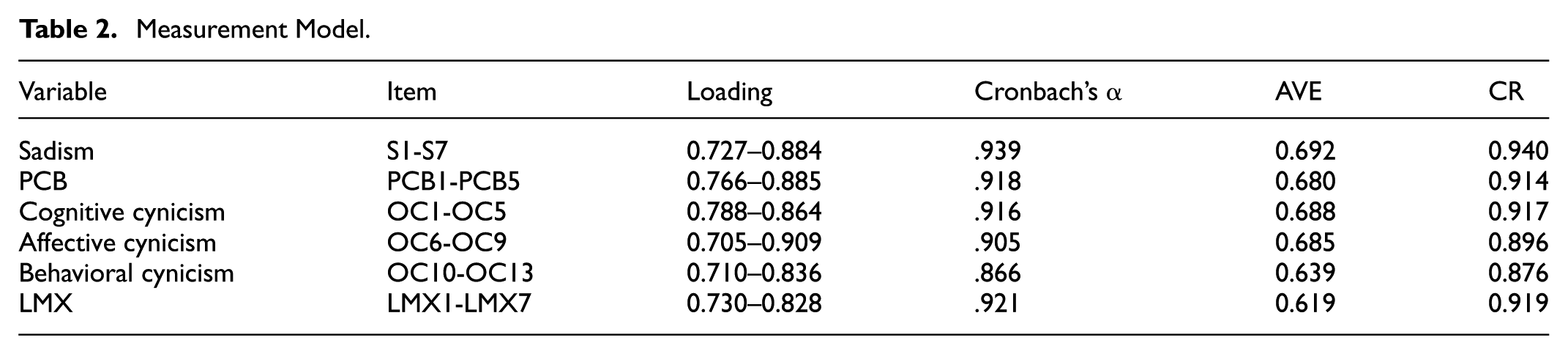
The current study employed the scale of sadism in the workplace, which was developed by Thibault and Kelloway (2020). The scale contains six items, such as “I love to watch my boss yelling at my coworkers.” As the respondents in this study were from China, one item in the sadism scale, developed in the Chinese context by Meng et al. (2022), was selected as a supplement: “I know how to hurt someone with words alone.” Using scales developed in different scenarios can improve predictability when measuring personality traits (Holtrop et al., 2014). Therefore, this study used seven items to measure sadism, as demonstrated by Cronbach’s alpha value of .939 (see Table 2).
Measurement Model.
Psychological Contract Breach
A five-item scale developed by Robinson and Wolfe Morrison (2000) was adopted to test the PCB variable in this study. A sample item is “I have not received everything promised to me in exchange for my contributions.” The scale possessed a Cronbach’s alpha value of .918, thus indicating high reliability (see Table 2).
Organizational Cynicism
The three dimensions of organizational cynicism were investigated by a 13-item scale developed by Dean et al. (1998) was used in the study. The scale comprises 5 items to measure cognitive cynicism, 4 items measuring affective cynicism, and 4 items measuring behavioral cynicism. An example of cognitive cynicism is “I believe that my organization says one thing and does another.” The cognitive cynicism sub-scale achieved a Cronbach’s alpha value of .916, which suggested high reliability. Meanwhile, an instance of affective cynicism is “When I think about my organization, I feel aggravation.” The sub-scale achieved a Cronbach’s alpha value of .905, which posited high reliability. A sample item of behavioral cynicism is “I often talk to others about how things are run at my organization,” with high reliability from Cronbach’s alpha value of .866. The reliability level of each scale is portrayed in Table 2.
Leader-member Exchange Quality
The present study adopted the seven-item scale developed by Graen and Uhl-Bien (1995). The scale has been extensively employed by scholars. A sample item is “My leader understands my job problems and needs.” The scale achieved a Cronbach’s alpha value of .919, which postulated high reliability (see Table 2).
Control Variables
Gender (1 = male, 2 = female), age (1 = 18–25, 2 = 26–35, 3 = 36–45, 4 = 46 and above), and organizational tenure (1 = ≤2 years, 2 = 3–6 years, 3 = 7–10 years, 4 = ≥11 years) were controlled in this study.
Data Normality
In behavioral and psychological studies, skewness and kurtosis are frequently employed to determine the data normality levels. Kline (2023) argued that the data demonstrate a normal distribution when the absolute skewness value is under 3 and the absolute kurtosis value is under 8. In this study, the absolute value range of kurtosis was between 0.045 and 1.370, and the absolute value range of kurtosis was between 1.842 and 0.001, which contained the cut-off values signifying the fulfilment of data normality. Therefore, the collected data were applied to further multivariate modeling.
Results
Measurement Model
The confirmatory factor analysis (CFA) findings demonstrated that the proposed model possessed a good fit with the data (χ2 = 691.750, df = 437, χ2/df = 1.583, TLI = 0.967, CFI = 0.971, SRMR = 0.039, RMSEA = 0.041). All standardized item loadings exceeded 0.7 (see Table 2) and were significant (p > .001). Moreover, this study compared alternative models (see Table 3) with the current theoretical framework. The proposed model achieved the highest model fit level in distinguishing sadism, PCB, LMX quality, and three dimensions of organizational cynicism. As suggested by Hair et al. (2017), larger TFI and CFI values with a lower RMSEA value and statistically significant Chi-square (Δχ2) changes indicated that the proposed model achieved a higher model fit and parsimony degree. Table 2 illustrates all CR values as above 0.7, which propounds that the CR values are satisfactory and that the data contain high internal consistency. Table 2 also depicts that all AVEs exceed 0.5, which posits high validity. The square root of AVEs was also discovered to be greater than the correlation values between variables (see Table 4), which suggested satisfactory discriminant validity. Therefore, the six-factor model proposed in this study achieved relatively high convergence and discriminant validity
The Results of CFA.

Note. Proposed Modela 6-factor model; Proposed Modelb 6-factor model + unmeasured latent methods; 5-Factor Model combine sadism and PCB; 4-Factor Model combine sadism, PCB, and cognitive cynicism; 3-Factor Model combine sadism, PCB, cognitive cynicism, and affective cynicism; 2-Factor Model combine all factor expect LMX; 1-Factor Model combine all factor.
p < .05 level. ***p < .001 level.
Correlations, Means, Standard Deviations, and AVE Square Roots.

Note. N = 350; Pearson’s correlation coefficients are shown below the diagonal; Square roots of the AVE for each variable are reported on the diagonal.
p < .05 level. **p < .01 level.
Common Method Bias
This study created an unmeasured latent method factor to check for common method bias. The specific approach was to load all measurement items onto the unmeasured latent method factor and their corresponding substantive variables while ensuring zero correlation between the new factor and the study variables (Podsakoff et al., 2003). Table 3 illustrates the fit indices of the unmeasured latent method factor. According to Bagozzi and Yi’s (1990) suggestion, no common method bias existed in this study.
Correlations
Table 4 depicts the descriptive statistics, AVE square roots, and correlations between variables. Pearson correlation analysis discovered that sadism was positively correlated to the PCB (r = .581, p < .01), cognitive cynicism (r = .646, p < .01), affective cynicism (r = .676, p < .01), and behavioral cynicism (r = .573, p < .01). The PCB was also positively correlated to cognitive cynicism (r = .723, p < .01), affective cynicism (r = .616, p < .01), and behavioral cynicism (r = .542, p < .01). Meanwhile, LMX quality was negatively correlated to cognitive cynicism (r = −.157, p < .01), affective cynicism (r = −.228, p < .01), and behavioral cynicism (r = −.206, p < .01). As the correlation between each variable was under .85, multicollinearity was not an issue in this study (Awang, 2015).
Hypothesis Testing
To test these hypotheses, the model was calculated using AMOS 24.0, which examined both mediation and moderation effects in an integrated structural equation framework. AMOS was chosen because the study follows a theory-driven model and the data meet normality assumptions, making covariance-based SEM appropriate. AMOS also provides comprehensive model fit indices, which aid in evaluating the overall model adequacy. In contrast, SmartPLS is more suitable for exploratory or small-sample studies (Imran et al., 2025). It is worth noting that, in the process of constructing interaction terms, this study adopted a centralized strategy. This strategy helps eliminate multicollinearity issues arising from the range differences of the independent variables, thereby improving the stability and interpretability of the model (Wu et al., 2011). Table 5 reports the results of measurement model. Significant and positive relationships between sadism and cognitive cynicism (β = .317, p < .001), affective cynicism (β = .426, p < .001), and behavioral cynicism (β = .349, p < .001) were demonstrated, thus supporting H1a, H1b, and H1c. Furthermore, significant and positive associations between the PCB and cognitive cynicism (β = .560, p < .001), affective cynicism (β = .367, p < .001), and behavioral cynicism (β = .312, p < .001) were revealed. Hence, H2a, H2b, and H2c were supported.
Results of Measurement Model.

Note. N = 350.
p < .05 level. **p < .01 level. ***p < .001 level.
In addition, the study investigated PCB’s mediating role using a 5,000-sample bootstrapping method with 95% bias-corrected confidence intervals (CIs). Direct and indirect effects were estimated using AMOS’s “user-defined estimates” function, with the results displayed in Table 6. Hypothesis H3a indicated that the PCB positively mediated the sadism effect on cognitive cynicism. The results demonstrated that both direct (β = .317, p < .001, 95% CI [0.187, 0.438]) and indirect effects (β = .168, p < .001, 95% CI [0.107, 0.241]) were significant. Resultantly, the sadism effect on cognitive cynicism was partially mediated by the PCB. Hypothesis H3b predicted that the PCB positively mediated the sadism effect on affective cynicism. The findings revealed that the direct effect (β = .426, p < .001, 95% CI [0.279, 0.559]) and indirect effects (β = .226, p < .001, 95% CI [0.146, 0.325]) were significant. Therefore, the sadism effect on affective cynicism was partially mediated by the PCB. Similarly, hypothesis H3b predicted that the PCB positively mediated the sadism effect on behavioral cynicism. The results revealed that the direct (β = .349, p < .001, 95% CI [0.206, 0.493]) and indirect effects (β = .187, p < .001, 95% CI [0.112, 0.207]) were significant. Hence, the sadism effect on behavioral cynicism was partially mediated by the PCB. To sum up, the PCB significantly partially mediated the relationships between sadism and cognitive cynicism, affective cynicism, and behavioral cynicism. Therefore, H3a, H3b, and H3c were supported.
Mediation Test Results.
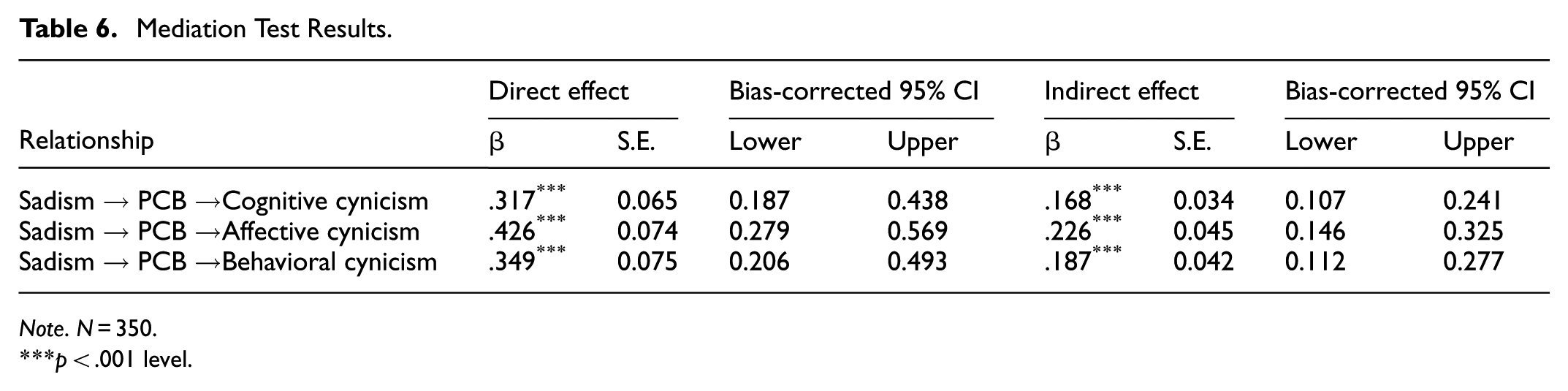
Note. N = 350.
p < .001 level.
The present study examined the moderating effect of LMX quality by adopting a centralized strategy to construct interaction terms (Cohen et al., 2013). The interaction term between the PCB and LMX quality was significant for cognitive cynicism (β = −.070, p < .05), affective cynicism (β = −.094, p < .001), and behavioral cynicism (β = −.104, p < .01; see Table 5). The findings suggested that LMX quality significantly moderated the three dimensions of organizational cynicism. To further illustrate the moderating effect, this study appraised the simple slope (±1 SD) at low and high LMX quality levels. In terms of cognitive cynicism (see Figure 2), the slope of low LMX quality (β = .630, p < .001, 95% CI [0.508, 0.749]) was higher than that of high LMX quality (β = .491, p < .001, 95% CI [0.334, 0.630]). The graph postulated that high LMX quality buffered the negative effect of PCB on cognitive cynicism. Thus, H4a was supported. In terms of affective cynicism (see Figure 3), the slope of low LMX quality (β = .461, p < .001, 95% CI [0.313, 0.595]) was higher than that of high LMX quality (β = .273, p < .01, 95% CI [0.097, 0.432]). The result posited that high LMX quality buffered the detrimental effect of PCB on affective cynicism. Thus, H4b was supported. In terms of behavioral cynicism (see Figure 4), the slope of low LMX quality (β = .416, p < .001, 95% CI [0.256, 0.565]) was higher than that of high LMX quality (β = .207, p < .05, 95% CI [0.008, 0.400]). The finding propounded that high LMX quality buffered the negative effect of PCB on behavioral cynicism. Therefore, H4c was supported.

LMX as a moderator in the relationship between PCB and cognitive cynicism.

LMX as a moderator in the relationship between PCB and affective cynicism.

LMX as a moderator in the relationship between PCB and behavioral cynicism.
In addition to these moderation effects, the explanatory strength of the overall model was also evaluated. In the structural equation modeling results, the proposed model demonstrated strong explanatory power across all three dimensions of organizational cynicism. Specifically, the R-squared for cognitive cynicism is 0.710, meaning that the combination of sadism, psychological contract breach, and LMX quality explains 71% of the variation in employees’ beliefs about organizational honesty and fairness. The R-squared values for affective cynicism (0.675) and behavioral cynicism (0.545) also indicate that the model performs well in capturing emotional and behavioral aspects of cynicism. These results suggest that the selected variables are not only statistically significant but also practically meaningful in understanding how cynicism develops across different dimensions in the hospitality setting.
Discussions
Consistent with Hypotheses H1a to H1c, the findings indicate that sadism significantly and positively predicts all three dimensions of organizational cynicism. It aligns with previous research suggesting that individuals high in sadistic tendencies derive pleasure from devaluing and harming others (Paulhus & Dutton, 2016; Thomas & Egan, 2022). However, unlike prior studies that primarily focused on behavioral aggression or counterproductive work behaviors, the present study extends this line of research by linking sadism to organizational-level attitudes, particularly within the high-contact service context of the hotel industry.
In support of Hypotheses H2a to H2c, PCB was found to exert a significant positive effect on all dimensions of organizational cynicism. This finding is consistent with prior findings that PCB undermines employee trust and contributes to negative attitudes toward the organization (Chiaburu et al., 2013; Pfrombeck et al., 2020). The current study further emphasizes that these negative reactions are multidimensional, reinforcing the conceptualization of organizational cynicism as a construct encompassing cognitive, emotional, and behavioral responses.
Supporting Hypotheses H3a to H3c, the results reveal that PCB mediates the relationship between sadism and the three dimensions of organizational cynicism. This finding echoes previous research showing that the effects of dark personality traits may unfold through organizational mechanisms such as contract perceptions (Li et al., 2020). Notably, this study is among the first to empirically examine this mediation pathway, offering new insight into how sadism translates into negative workplace attitudes.
Finally, consistent with Hypotheses H4a to H4c, LMX quality moderates the relationship between PCB and organizational cynicism across all three dimensions. It supports prior research suggesting that high-quality LMX can buffer the psychological strain caused by perceived breaches by fostering more favorable interpretations of organizational behavior (Griep et al., 2016; Li et al., 2018). Moreover, the findings indicate that the strength of this buffering effect may vary across cognitive, affective, and behavioral dimensions, offering a more nuanced understanding of how leader–subordinate relationships shape employee responses to workplace stressors.
Theoretical Implications
The current research provided four significant theoretical contributions to the current literature. Firstly, as limited studies focused on the influence of sadism on organizational cynicism, the results filled the gap by revealing the positive relationship between sadism and organizational cynicism. As some researchers explicated that personalities significantly impact individuals’ attitudes (e.g., Anglim et al., 2019; Skimina et al., 2021; Soomro et al., 2022). The results of this study also further reveal the influence of personality and attitude; that is, sadism is positively correlated with organizational cynicism. This finding further illustrates the harmful effects of the dark side of personality and complements existing literature.
Secondly, prior studies have suggested that the relationship between personality traits and outcomes may not always be direct, but often mediated through organizational experiences (Baloch et al., 2017; Mahmood et al., 2021). For example, Ying and Cohen (2018) emphasized the importance of situational factors when exploring personality-outcome linkages. Trait activation theory (Tett & Guterman, 2000) similarly proposes that personality traits only manifest behaviorally when activated by relevant contextual cues. Traditionally, this theory has been applied to positive traits such as conscientiousness or extraversion to explain beneficial work behaviors (Tett & Burnett, 2003). This study, however, extends the scope of trait activation theory by applying it to sadism and demonstrating that its influence on organizational cynicism becomes pronounced in the presence of PCB. By demonstrating that PCB can activate underlying sadistic traits, this study provides new insight into how adverse organizational experiences contribute to the development of employee cynicism, thereby offering a novel extension of trait activation theory.
Thirdly, this study also analyzed the moderating effect of LMX quality on PCB in the Chinese context. Although current studies have found that LMX can moderate the influence of PCB on organizational cynicism, it has not been verified in the Chinese scenario. Given the global relevance of service work and the increasing role of China’s hotel industry in international tourism (Tsang & Hsu, 2011), it is important to further examine how LMX quality moderates the relationship between PCB and organizational cynicism within the Chinese context. It is particularly relevant because cultural and structural factors specific to China may shape employee perceptions and responses in ways that differ from those in Western contexts (Ying & Cohen, 2018). Specifically, the current findings demonstrated that LMX quality significantly buffered the negative impact of the PCB. This finding also suggested the need for such a study in the Chinese context. It is because the results of this study are contrary to previous studies. According to a study conducted by Pfrombeck et al. (2020) in Switzerland, it was found that the quality of LMX may strengthen the relationship between PCB and cognitive and behavioral cynicism.
Finally, the study clarified the definition of organizational cynicism. Although previous research corroborated the association between PCB and organizational cynicism, the studies solely concentrated on certain dimensions (Aboramadan et al., 2021; Sabir et al., 2020) or global organizational cynicism (Yang et al., 2020). The concept of organizational cynicism is convoluted, in which employing holistic or single-dimensional measurements could not reflect the entire construct. Therefore, this study separately examined different dimensions of organizational cynicism. Corresponding with prior studies (Johnson & O’Leary-Kelly, 2003; Pfrombeck et al., 2020), cognitive cynicism (β = .593) achieved the strongest correlation with the PCB. This result is theoretically expected because PCB involves perceived violations of trust and obligations, which employees primarily process through cognitive evaluations of fairness and organizational integrity (Morrison & Robinson, 1997). Affective cynicism is formed through disappointment with the perceived breach (Pfrombeck et al., 2020). This dimension reflects the emotional cost of PCB, including feelings of anger, betrayal, or frustration, which typically follow cognitive evaluations. Nonetheless, the intention to retaliate would only emerge after a specific accumulation of disappointments (Rigotti, 2009). As behavioral cynicism encompasses retaliatory elements (Pfrombeck et al., 2020), the PCB achieved the weakest correlation with behavioral cynicism (β = .312), likely because not all employees choose to express their dissatisfaction behaviorally. Moreover, sadism refers to deriving pleasure from others’ suffering (Paulhus & Dutton, 2016). As sadistic individuals are more emotionally and behaviorally reactive than cognitively reflective, the correlation coefficients of affective (β = .426) and behavioral (β = .349) cynicism were larger than those of cognitive cynicism (β = .317). Specifically, a sadist possesses inherently negative affective and behavioral tendencies toward organizations, which makes them more likely to express cynicism through emotional outbursts or disruptive behavior rather than cognitive skepticism alone.
Practical Implications
The study findings practically contributed to hotel organizational. Firstly, hotel managers should recognize the potential impact of employee personality traits on organizational cynicism. The findings indicate that individuals with high levels of sadistic tendencies are more likely to develop negative attitudes, which can lead to the spread of cynicism. In contrast, employees who are positive, enthusiastic, and cooperative tend to foster a healthier organizational culture. Therefore, it is recommended that hotel recruitment processes incorporate structured personality assessments, with particular attention to identifying dark personality traits such as sadism. In addition, structured or behavioral interviews should be used to evaluate candidates’ emotional regulation and team orientation. These measures can help minimize the risk of hiring individuals prone to interpersonal conflict and distrust, thereby supporting the development of a more constructive and cohesive work environment.
Secondly, the findings suggest that employees with sadistic tendencies are more likely to develop organizational cynicism through perceptions of PCB. Therefore, hotel managers should proactively build and maintain a healthy psychological contract to reduce the negative effects of sadism on organizational dynamics. To address this, hotel managers might consider several practical approaches. For instance, establishing accessible channels for feedback or grievances, such as anonymous suggestion boxes, can also give employees a safe space to voice concerns. Additionally, conducting informal team discussions or brief satisfaction surveys every few months may help managers stay informed about how employees perceive the organization’s commitment. These small but consistent efforts can go a long way in preventing PCB. In addition, managers are encouraged to implement regular training programs focused on organizational values and professional ethics, using real-world case discussions to foster employee identification and normative behavior, particularly among those who may exhibit hostile tendencies (Thomas & Egan, 2022). When signs of PCB do emerge, prompt managerial responses such as clear explanations, apologies, or appropriate compensation can help mitigate employee frustration and restore trust (DiFonzo et al., 2020). Furthermore, managers should exhibit positive emotional cues and supportive behaviors in daily interactions, such as smiling, using affirming gestures, and expressing encouragement, as these behaviors promote emotional contagion and help stabilize employees’ psychological expectations (Liu et al., 2017).
Finally, LMX quality could also weaken the detrimental influence of PCB on organizational cynicism. This result has important implications for hotel management because high-quality LMX can help employees adopt mild coping strategies after PCB. Therefore, managers should establish a positive exchange connection with subordinates. For instance, trusting and supporting subordinates would elevate personal potential and assist in resolving job challenges. To be specific, when employees perceive PCB, managers can learn their needs and expectations through communication and feedback in a timely manner, provide them with more support and resources, and help them rebuild trust and participation in the organization (Li et al., 2018). Furthermore, managers need to focus on building organizational culture and enhancing the cohesion and sense of belonging among employees through clear values and common goals to improve the quality of LMX. To further support high-quality LMX, hotels might consider offering leadership training that helps managers improve their emotional intelligence, listening skills, and ability to resolve conflicts. Rather than focusing solely on performance metrics, these programs should also emphasize interpersonal skills that foster mutual respect and trust.
Limitations and Future Research Directions
The current research contains some limitations. Firstly, this study was conducted in the context of the Chinese hotel industry, using a sample of 350 employees to examine the mechanism by which sadistic personality traits influence organizational cynicism. Although this context-specific design may limit the generalizability of the findings, it allows for a deeper understanding of organizational behavior within a particular cultural and industry setting, especially regarding employees’ psychological responses in high-contact service environments. Future research could build on this study by expanding the sample to include employees from different countries and industries, thereby testing the applicability and potential variations of the proposed model in cross-cultural or multinational organizational contexts. Secondly, the negative effects of sadism should be interpreted with caution. Some scholars suggested that sadism be added to Dark Triad to make it a Dark Tetrad (e.g., Meere & Egan, 2017; Meng et al., 2022; Thibault & Kelloway, 2020). However, some dissenting voices argue that sadism may not be included in the Dark Triad and extension to the Dark Tetrad (Blötner & Mokros, 2023). The scope of the study is somewhat narrow because it only looked at sadism. Future studies could further discuss whether sadism should be included in the Dark Triad and verify its influence on the various subdimensions of organizational cynicism. Thirdly, this study’s finding that high-quality LMX buffers organizational cynicism in psychological contracts conflicts with previous research (Pfrombeck et al., 2020). However, the results of this study cannot shed any light on the causes of the conflict. A reasonable assumption is that there are cultural differences that need to be verified in future studies. Thus, further investigation is required to resolve the issue. Lastly, as the study of sadism in organizational cynicism remains in its infancy, coming research could further verify the mediating role of other situational factors.
Conclusion
The current study aimed to empirically examine whether sadism significantly predicted organizational cynicism, the PCB significantly mediated the sadism impact on organizational cynicism, and LMX significantly moderated the effect of PCB on organizational cynicism. The findings supported the three hypotheses, which complemented the social exchange and trait activation theories. Moreover, high LMX buffered the consequence of PCB on the three dimensions of organizational cynicism.
Footnotes
Acknowledgements
We thank the editor and anonymous reviewers for their helpful comments and suggestions.

Ethical Considerations
All procedures performed in studies involving human participants were in accordance with the ethical standards of the institutional and/or national research committee and with the 1964 Helsinki declaration and its later amendments or comparable ethical standards
Funding
The authors received no financial support for the research, authorship, and/or publication of this article.
Declaration of Conflicting Interests
The authors declared no potential conflicts of interest with respect to the research, authorship, and/or publication of this article.
Data Availability Statement
The datasets generated during and/or analyzed during the current study are available from the corresponding author on reasonable request.