




Abstract
Although many scholars have investigated the influence of emotional exhaustion on an organization, there has been relatively minimal research regarding emotional exhaustion’s impacts on organizational cynicism as well as the underlying mechanisms of it. Considering the research gaps, we attempt to find underlying mechanisms that drive the relationship between emotional exhaustion and organizational cynicism in the present research. In particular, we propose a sequential mediation model that investigates the relationship between emotional exhaustion and the sub-dimensions of organizational cynicism with the sequential mediating of organizational identification and trust in the organization. In order to empirically test these links, we utilized two waves lagged study design with 465 employees working in different sectors in Turkey. Our results provide empirical support that organizational identification and trust in an organization sequentially mediate the relationship between emotional exhaustion and cognitive cynicism with affective cynicism. However, the indirect effect of emotional exhaustion on behavioral cynicism through sequential mediators was not statistically significant. This study theoretically and empirically contributes to the emotional exhaustion literature by revealing the sequential mechanisms through which employees’ perceptions of emotional exhaustion affect their cynical attitudes in organizations and offers practical implications by stressing the importance of employees’ perceptions of emotional exhaustion. Theoretical and managerial implications are discussed, along with limitations and future research directions.
Keywords
Introduction
Today, emotional exhaustion (EE) is a severe problem for organizations. EE is associated with various issues for affected employees and the organizations. While happy and engaged employees are more productive (Reijseger et al., 2017; Shuck & Reio, 2014), those lacking energy or other resources experience performance declines and are less likely to engage in prosocial behaviors (Demerouti et al., 2005; Prentice & Thaicon, 2019). EE is a psychological syndrome caused by chronic emotional and interpersonal stress at work (Lahana et al., 2017). According to Maslach and Johnson (1981), EE is a psychological syndrome involving chronic emotional and interpersonal stress experienced by an employee in an organization. EE is defined as the organization’s excessive emotional demands on the employee during interpersonal interaction that the employee cannot cope with, resulting in a depletion of emotional resources (Liu et al., 2020; Schaufeli & Buunk, 2003).
Existing organizational behavior literature (Cox et al., 2017) classifies EE as psychological and physical stress. Emotional exhaustion can be a symptom of many problems since EE is at the core of burnout (Kristensen et al., 2005; Mukherjee et al., 2020). Individuals who describe themselves as “burnout victims” usually refer to EE experiences (Maslach et al., 2001). When it relates to job-related consequences like absenteeism and counter-productive work behavior, EE has a more significant relationship than the other two parts of burnout, that is, depersonalization and reduced personal accomplishment (Lee & Ashforth, 1996; Ugwu et al., 2017). EE has attracted great attention from practitioners and scholars because of its adverse effects on the physical and psychological well-being of employees and as well as on the performance of organizations (Cropanzano et al., 2003; Jeon et al., 2018; Maslach & Johnson, 1981). Given the importance of EE for organizations and their employees, many scholars have focused their attention on the consequences of EE. To date, existing literature has identified a variety of consequences of emotional exhaustion, including job satisfaction (Lewig & Dollard, 2003; Skaalvik & Skaalvik, 2017), organizational commitment (Akdemir, 2019; Leiter & Maslach, 1988), intention to leave (Aquino et al., 2018; Ducharme et al., 2007), organizational citizenship behavior (Cropanzano et al., 2003; Khan et al., 2018), and counter-productive work behavior (Chen et al., 2020). However, little is known about whether EE can influence organizational cynicism (OC) behavior, and the potential mechanisms underlying this relationship have not yet been underdeveloped. Therefore, we attempt to close these research gaps by proposing a sequential mediation model.
Based on the existing literature on EE and OC, we first expect that emotional exhaustion is associated with higher levels of OC as employees who are frustrated, depressed, overwhelmed, and perceive excessive workload tend to experience a higher level of pessimism, isolation, criticism, and disparage their organizations (Akhigbe & Gail, 2017; Johnson & O’Leary-Kelly, 2003). The second purpose of this study is to examine the mediating roles of organizational identification (OI) and trust in an organization (TO) in the EE-OC linkage. In this regard, we expect a negative relationship between EE and OI at the first step of serial mediation. According to social exchange (Blau, 1964), social identity (Tajfel & Turner, 1979), and psychological contract theories (Rousseau, 1989), positive exchanges strengthen one’s tendency to reciprocate effort as well as increase one’s self-worth, hence enhancing one’s identity with the organization (Graen & Uhl-Bien, 1995; Islam et al., 2017; Rigotti, 2009). In light of this explanation, it can be stated that organizations need to provide satisfactory working conditions for their employees. If not, psychological contract breaching may occur, which is one of the most important antecedents of EE (Topa et al., 2018), then employees are less inclined to identify themselves with their organizations (Epitropaki, 2013; Park, 2019). At the second step of serial mediation, we expect a positive relationship between OI and TO. According to social exchange and social identity theories, employees that perceive their organization’s objectives and successes as their own will have a long-term and trust-based relationship with the organization (Ogeugbe & Edosomwan, 2021). On the other hand, employees who do not consider their values and aims congruent with those of the organization may not trust them (Ogeugbe & Edosomwan, 2021). Therefore, at the second step of serial mediation, it can be said that decreased OI because of the existence of EE has a negative impact on TO. At the third and last step of serial mediation, we hypothesized that OI is negatively related to OC. Employees experience a high level of OC when they perceive that their organization lacks integrity (Akar, 2019). This alleged lack of integrity could result from perceived violations of fundamental values such as justice, sincerity, and honesty (Johnson & O’Leary-Kelly, 2003). These values are necessary for healthy social exchange between organizations and their employees. Therefore, OC can exist in the absence of trust in an organization, and an increase in the level of distrust in an organization is regarded as a sign of cynicism. Thus, it can be stated that a lack of trust in the organization due to the existence of EE and lack of identification with the organization results in OC in the workplace. In other words, EE will affect employees’ OC behavior through OI and TO (sequential mediation).
We aim to make two theoretical contributions through this study. First, while there are numerous critical contextual factors (e.g., perceived organizational support, justice, organizational politics, job satisfaction, and organizational commitment; Al-Abrrow, 2018; Chabiru et al., 2013; Erdogdu, 2018) that influence OC, very few studies have been conducted on the influence of EE on OC (Bedük et al., 2015; Vieira-dos Santos & Gonçalves, 2018; Yaşar & Özdemir, 2016). Besides, the outcomes of EE are essential to be studied because EE can very easily spread in the organization (Li et al., 2020) and affect employees’ OI levels (Johnson & O’Leary-Kelly, 2003) and their cynical attitudes and behaviors in the workplace (Akhigbe & Gail, 2017). Second, by investigating the sequential mediating role of OI and TO in the EE-OC link, this study contributes to unlocking the “hidden box” of the link between EE and OC and extends our understanding of the underlying mechanisms between this link. A multi-theoretical approach is used in this paper to understand the hypothesized relationships. Therefore, we used the theories of social exchange (Blau, 1964), social identity (Tajfel & Turner, 1979), conservation of resources (Hobfoll, 1989), and psychological contract (Rousseau, 1989) in the research context and believe that a multi-theoretical approach provides the current research more explanatory power.
Literature Review and Hypothesis Development
The Effect of Emotional Exhaustion on Organizational Cynicism
EE can be defined as a person’s inability to find the energy to work and depletion of motivating resources (Han et al., 2021). The word “resources” refers to the objects, personal characteristics, and conditions an individual values and their efforts to achieve them (Bakker &Demerouti, 2007; Barello et al., 2021; Hobfoll, 1989). In other words, EE is a state of physical, emotional, and mental exhaustion that occurs when employees work in complex and emotionally demanding jobs (Lee, 2018; Schaufeli & Greenglass, 2001).
EE can be considered the core part of burnout (Jackson et al., 1986; Maslach, 1982; Mukherjee et al., 2020). EE is strongly associated with negative consequences such as helplessness, depression, a reduced sense of self-worth, weakened social skills, and decreased productivity and performance quality in an organizational environment (Alarcon, 2011; Chen et al., 2020; Rahmani et al., 2018; Teuchmann et al., 1999; Xu et al., 2020). EE can also be associated with anxiety and psychosomatic complaints resulting from intense emotional stimulation and work stress (Demerouti et al., 2001; Santa Maria et al., 2018). EE is damaging for the individual and the organization because of its association with reduced organizational commitment, worsened organizational citizenship behavior, and intention to leave (Alharbi et al., 2020; Kasekende et al., 2020; Li et al., 2020; Piccoli & Witte, 2015). In cases where EE occurs, a person’s cognitive and physical abilities—such as attention and memory—are reduced, leading to an inability to meet the necessary work demands (Jahanzeb & Fatima, 2018; Schaufeli, 2017a, 2017b). Failure to perform their job can increase an employee’s level of EE (Welp et al., 2015).
OC is one of the main symptoms of EE. OC is defined as (i) a negative attitude that employees have toward their organization; (ii) a belief that the organization lacks integrity, and (iii) behavioral tendencies that are disparaging and critical of the organization (Chiaburu et al., 2013 Dean et al., 1998; Naus et al., 2007). In other words, OC refers to attitudes characterized by anger at people or groups that develop in an organization that lacks fairness, honesty, and trust due to a violation of the organization’s “psychological contract” (Alev & Bozbayindir, 2021; Wilkerson et al., 2008).
Cynicism shares characteristics with skepticism, distrust, pessimism, disbelief, and negativity (Erdost et al., 2007; Ryu & Jun, 2019). Cynicism is a condition characterized by refusal to accept the values of a particular group and loss of respect (Głębocka & Lisowska, 2007). The negative attitudes displayed by cynics undermine trust, honesty, and motivation (Dean et al., 1998; Erdogdu, 2018). Cynicism is a pessimistic, disillusioned attitude toward explaining events and others’ goals and leads to a tendency toward self-interest (Tokgöz & Yilmaz, 2008). According to Andersson (1996), cynicism is frustration caused by the inability of some institutions to meet today’s high expectations in a competitive work environment. Cynicism arises in individuals as a response and defense mechanism to frustration created by organizations or management (Alsubaie et al., 2021; Naus et al., 2007; Simha et al., 2014). The concept of OC emerged to describe cynical behaviors exhibited within an organization. OC arises from processes attributed to organizational selfishness and the exploitation of employees (Thomas & Gupta, 2018). OC refers to a low belief that change in the organization will bring success (Choi, 2011).
Cognitive, affective, and behavioral cynicism are the three components of OC (Dean et al., 1998). Cognitive cynicism (CC) is a belief that an organization lacks honesty and intends to exploit its employees (Pfrombeck et al., 2020). Cynics accept that deprivation and unethical actions of their organizations are typical (Naus et al., 2007). Cynics commonly believe that employees will not get the share they deserve (Guastello et al., 1992; Hussain & Shahzad, 2022). They are also suspicious of the adequacy of organizational principles and indifferent to the organization (Dean et al., 1998). Affective cynicism (AC) includes reacting to the organization emotionally and shows that cynicism is felt not only intellectually (Nafei, 2013). Cynics may feel a combination of the following emotions: (a) nervousness, (b) distress/anguish, (c) anger/rage, (d) disgust, (e) mocking, (f) fear, and (g) shame (Cicek et al., 2021; Naseer et al., 2020). For instance, cynics may feel angry about their organizations’ unfair practices and consequently experience distress, disgust, or shame. Individuals also reflect their cynicism in their behavior (behavioral cynicism [BC]). In this dimension, individuals have lost faith in the integrity of their organization and criticize it with sarcastic humor (Dean et al., 1998; Sungur et al., 2019). Negative speech about the organization; insincere smiles, sarcastic looks, and other body languages; and pessimistic predictions for their organization can be seen as attitudes encountered in BC (Rehan et al., 2017).
It is possible to consider conservation of resources (COR) as a theoretical perspective, which suggests that EE is a cause of cognitive, affective, and behavioral cynicism. According to the COR theory, resource depletion is a critical component of stress, and it is vital to preventing further resource depletion (Simha, 2014; Westman et al., 2004). According to COR theory, OC serves as a self-defensive mechanism for preventing or limiting further resource depletion in the event of increased EE (Abraham, 2000; Al-Abrrow, 2018). In other words, emotionally exhausted employees exhibit cynical attitudes and behaviors in the workplace that protect them from further emotional exhaustion (Simha, 2014). As a result, when employees are emotionally exhausted, they tend to have negative attitudes toward their organizations and behave disparagingly toward others. Based on the COR theory, a cynical employee will essentially avoid further resource depletion in the form of increased EE.
The Effect of Emotional Exhaustion on Organizational Identification
Prior research on the behavior of individuals within an organization has examined how individuals identify with their organization through their professional interactions (Abbasi et al., 2021; Ashforth & Mael, 1989; Dutton et al., 1994; Elsbach, 1999). Social identity is part of the concept of self, which derives its origin from the individual’s knowledge of their social groups or group membership, and the emotional importance attributed to that membership (Bochatay et al., 2019; Tajfel & Turner, 1979). Social identity should be distinguished from group belonging or membership.
Identification is a psychological condition in which individuals perceive themselves as part of a larger whole (Rousseau, 1998; Steffens et al., 2021). In the light of social identity theory, OI can be defined as the perception of unity within an organization or belonging within an organization (Ashforth & Mael, 1989; Teng et al., 2020). Social identity theory has contributed to understanding OI and its adaptation to the behavioral field. Social identity theory is based on the view that an individual achieves a social identity through belonging to a group and thus achieves a self-image (Miao et al., 2019; Tajfel & Turner, 1979). Two main assumptions support this view: The first is that individuals are motivated to increase their self-esteem (Reade, 2001). The second is that individuals categorize and compare to create their environment and determine their place in it (Belavadi & Hogg, 2019).
OI refers to the process in which the goals of an individual and an organization are mutually achieved, producing a more homogeneous and integrated structure (Besharov, 2014; Cornwell et al., 2018; Hall et al., 1970). OI occurs when individuals’ beliefs about their organization become self-expressive or self-defining, that is, integrating one’s beliefs about their organization with their own identity (Chen et al., 2019; Pratt, 1998). The degree to which individuals share similar characteristics with their organization defines their organizational identification (Ravishankar & Pan, 2008).
Definitions for OI often describe organizations’ central, permanent, and distinctive features (Ashforth & Mael, 1989; De Roeck & Farooq, 2018; De Roeck et al., 2016). Based on the social identity theory, OI can be defined as related phenomena: (a) cooperation with the organization, (b) supporting the organization attitudinally and behaviorally, and (c) characteristics that are perceived to be shared jointly with other members of the organization (Ashforth & Mael, 1989; Scheepers &Ellemers, 2019). As a result of definitions from these different perspectives, it can be said that identification is related to the employee’s self-concept, such as feeling like a part of an organization, being proud of the organization, or internalizing organizational values (Riketta, 2005; Suifan et al., 2020).
The conservation of resource theory (COR) and the psychological contract breach theory can explain the relationship between EE and OI. COR theory assumes that individuals seek to acquire and maintain values that they consider essential (Hobfoll, 1989). In addition, individuals often strive to obtain excess resources and avoid resource loss. When their valuable resources are either lost or threatened with loss, or when they fail to gain sufficient returns on their investment in resources, they will experience EE (Bolton et al., 2012; Hobfoll, 2001; Jin et al., 2018). The significance of resources for individuals is derived from their symbolic value: they are loaded with instrumental value for achieving the goals meaning of the individuals for whom they are intended (Hobfoll, 2011). Individuals actively seek additional resources until they are exposed to stress, invest resources and accumulate excess resources for future stressors (Fatima et al., 2018; Hobfoll, 2001). However, in cases of resources lost, resource-depleted individuals attempt to minimize further resource loss or depletion (Zhao & Guo, 2019). As a result, employees who experience a depletion of emotional resources become motivated to reduce the negative effect of stressors on their work. Individuals frequently choose a defensive posture rather than active coping strategies to isolate themselves from stressors and conserve their remaining resources (Hobfoll, 2001; Hobfoll & Shirom,1993; Zhao & Guo, 2019). They do not risk further resource depletion by attempting to change the organization’s current state or improve existing working conditions (Ng & Feldman, 2012). Instead, they tend to “decrease their morale, identification with the organization, and performance efforts” to conserve their remaining resources (Wright & Hobfoll, 2004). When an individual’s emotional resources are depleted, psychological/emotional withdrawal increase significantly (Bolton et al., 2012; Lee & Suh, 2020).
When the relationship between EE and OI is considered in the context of psychological contract breach theory, any threat to valued resources results in psychological distress and stress for individuals in workplaces (He et al., 2018). As a result, the employees lose faith that their contribution will be rewarded and believe that the organization will not meet their needs. In this regard, their desire to contribute to the organization decreases, and their awareness of being a member of the organization may also lose meaning and value. This causes a severe decline in their sense of belonging and makes them less likely to identify with their organization (Epitropaki, 2013; Park, 2019). Many studies have found a negative relationship between emotional exhaustion and organizational identification (He et al., 2018; Kemp et al., 2013; Lammers, 2013; Wegge et al., 2012). Based on these explanations, we proposed the following:
The Effect of Organizational Identification on Trust in Organization
Trust is an abstract but essential concept that people feel and guides their behavior. Events, experiences, expectations, attitudes, and social relationships provide the background for developing a sense of trust (Asunakutlu, 2002; Kong et al., 2014; Olekalns & Smith, 2009; Yu et al., 2018). Trust is the “willingness to take risks under uncertainty” (Luhmann, 2018), and the level of trust is “an indication of the amount of risk one is willing to take” (Schoorman et al., 2007). Chow and Holden (1997) defined trust as the degree of certainty in the accuracy and honesty of a person or anything that takes time to build.
A person’s trust defines the concept of trust in an organization, their feelings of support, and their belief that organization’s commitments will be fulfilled (Brown et al., 2014; Cropanzano et al., 2017; Crossley et al., 2013; Dirks & Ferrin, 2002). In organizational settings, a trust includes a person’s superiors and colleagues, management, working groups, or the organization as a whole (Gustafsson et al., 2021; Schoorman et al., 2007; Weibel et al., 2015). Trust in the organization is the trust employees have in the organization’s competence, vision, technology, procedures, management, and justice (Krot & Lewicka, 2012). Employees believe that the organizational rules will be fair, and their reliance and vulnerability will not be exploited in risky situations (Pucetaite et al., 2010). Therefore, trust is a collective or system that includes multiple actors rather than a single individual or a specific group (Verburg et al., 2018).
The relationship between OI and TO can be considered within the framework of the social exchange theory. It is widely accepted that developing strong exchange relationships is necessary to be effective in organizations (Gersick et al., 2000). Positive relational resources are essential for employees to build trust in organizations (Bulińska-Stangrecka & Bagieńska, 2018; Colquitt & Rodell, 2011; Roberts et al., 2005). Employees who perceive identification with their organization have a stronger orientation toward building emotional bonds and trust with the organization (Hameed et al., 2013). OI is an essential socialization outcome since it is an employee’s psychological bond to organizations (Ashforth &Mael, 1989; Salvatore et al., 2018). Through OI, individuals psychologically experience a sense of partnership with their organization (Cornwell et al., 2018; Mael & Ashforth, 1992). OI concerns the reduction of uncertainty, the desire for order, and the trust of the individual (Afsar et al., 2018; Ashforth et al., 2008; Hogg, 2000). Employees have a strong identification with their organization and tend to continue working for it and do their best to benefit it (Daley & Vasu, 1998). Therefore, an employee with a solid organizational identity perceives the organization as trustworthy. In this regard, the H3 hypothesis is expressed as:
The Effect of Trust in Organization on Organizational Cynicism
Organizations demand more from their employees, yet what they grant them does not increase proportionately with each passing day. Studies revealed that cynicism exists in the workplace, and its presence causes serious problems (Kanter & Mirvis, 1989; Mirvis & Kanter, 1991; Peter & Chima, 2018; Reichers et al., 1997); and cynicism in organizations gradually increases (Cartwright & Holmes, 2006; Durrah et al., 2019). Employees appeared to be becoming more cynical, especially in workplaces afflicted by mistrust, scandals, and opportunism (Abubakar & Arasli, 2016; Kroll & Pasha, 2021; Twenge et al., 2004). Cynicism among employees has been linked to several adverse outcomes, including decreased organizational commitment (İkinci et al., 2020), job satisfaction (Kökalan, 2019), and performance (Zeidan, Prentince, et al., 2022), as well as increased intention to quit (Abugre & Acquaah, 2022).
Cynicism is a broad term that includes an attitude of disrespect for others and an unwillingness to rely on them (Brandes et al., 2008). It also contains “negative and insecure attitudes toward others” (Bateman et al., 1992). On the other hand, cynicism is not limited to a particular attitude associated with frustration, hopelessness, and disappointment but also includes negative feelings and distrust of an individual, a group, an ideology, social norms, and organizations (Andersson, 1996; Margelytė-Pleskienė & Vveinhardt, 2018). In this context, organizational cynicism (OC) is a negative attitude toward individuals within the organization as a whole that develops as a result of a perceived agent or organization malfeasance (Dobbs & Do, 2019; Reichers et al., 1997; Silva & Esparza, 2021). According to Bedeian (2007), OC is defined as “an attitude resulting from a critical appraisal of the motives, actions, and values, of one’s employing organization.” OC can be examined in three forms. The cognitive dimension of cynicism indicates that an organization lacks honesty and organizational relations are determined by self-interest. Therefore, organizations are perceived as inconsistent and unreliable (Brandes et al., 1999; Thomas & Gupta, 2018). In the affective (emotional) dimension of cynicism, the employee feels anger, disrespect, embarrassment, and resentment toward the organization because of past experiences of dishonesty (Cicek et al., 2021; Dean et al., 1998). In the behavioral dimension of cynicism, an employee may make pessimistic predictions about organizational practices. Employees make sarcastic humor, ridicule the organization’s aim, and humiliate others (Dean et al., 1998; Durrah et al., 2019).
It is possible to explain the influence of TO on OC using the psychological contract theory (Johnson & O’Leary-Kelly, 2003). Psychological contracts are one of the forms of social exchange that occurs between organizations and their employees (Caldwell & Peters, 2018; Johnson & O’Leary-Kelly, 2003). The psychological contract theory identifies the components of an employee’s contract and the effects of contract fulfillment or non-fulfillment by organizations (Estreder et al., 2021; Jones & Griep, 2018; Rousseau, 2001). The psychological contract is described as the individual’s beliefs and expectations about the obligations between an organization and an employee (Rajalakshmi & Naresh, 2018; Rousseau, 1995; Ruchika & Prasad, 2019). In other words, the psychological contract is a concept that refers to an employee’s individual beliefs about the terms of a reciprocal exchange between the employee and the organization (Richard et al., 2009; Rousseau et al., 2018). Under the reciprocity norm, employees adjust their contributions how the organization fulfills its obligations. The psychological contract’s contents involve employees’ perceptions of the contributions they promised to provide to the organization and what they believe the organization has promised them in return (Koh & Yer, 2000; Maia et al., 2019). The psychological contract includes trust, honesty, values, principles, fairness, respect, recognition, security, and equity. These are the forms of perceived promises (Herriot & Pemberton, 1996; Morrison & Robinson, 1997; Van Wyk et al., 2019). It is common for promises to be made without being explicit; instead, they can be inferred from organizational or individual actions (Rousseau, 2001; Soares & Mosquera, 2019).
If employees believe that their organizations fulfill their obligations, they develop trust in them and think that they will fulfill their future obligations. However, a psychological contract breach occurs when an employee perceives an organization’s failure to comply with implicit and explicit promises (Robinson & Rosseau, 1994; Scheetz & Fogarty, 2020). OC develops due to this environment when employees believe their organization lacks trust and integrity. In particular, alleged violations of fundamental standards such as sincerity, fairness, and honesty can result in a lack of these values (Dobbs & Do, 2019; Johnson & O’Leary-Kelly, 2003). These elements are required for a successful relationship in social exchanges between organizations and employees. In cases where an organization can create a sense of trust and employees perceive less risk when developing trust-based relationships, OC and psychological contract breach (Johnson & O’Leary-Kelly, 2003; Sischka et al., 2021) may not occur. Organizational trust will not prevail in a cynical work environment since cynicism is more likely to emerge in cases of repeated breaches or violations of the psychological contract (Johnson & O’Leary-Kelly, 2003). In this regard, H4a, H4b, and H4c hypotheses are stated as follows:
The Sequential Mediation Role of Organizational Identification and Trust in Organization Between Emotional Exhaustion and Organizational Cynicism
We anticipate integrating all the hypotheses mentioned above that OI and TO can mediate the relationship between EE and OC (a serial mediation). Prior research has shown EE is associated with decreased OI (Kemp et al., 2013). According to the conservation of resources and social identity theories, the main reason for the negative relationship between EE and OI is that when employees’ emotional resources are depleted, psychological/emotional withdrawal increases dramatically (Lee & Suh, 2020) because they tend to conserve their emotional resources for further depletion by withdrawing (Halbesleben & Bowler, 2007). If employees are emotionally exhausted, their desire to contribute to the organization decreases (Tourigny et al., 2013). Their consciousness of being a member of the organization may also lose meaning and value (Epitropaki, 2012). This negative feeling, in other words, a decreased identification with the organization, leads to reduced trust in the organization. Employees cognitively experience a sense of oneness with their organization when they identify with it (Cornwell et al., 2018; Mael & Ashforth, 1992). OI has focused on eliminating ambiguity, the need for order, and the employee’s trust (Hogg, 2000). However, an employee with a poor organizational identity perceives the organization unfavorably and distrusts it. Finally, based on the psychological contract breach theory, employees who feel a lack of trust in the organization will perceive and display more cynical attitudes and actions (Johnson & O’Leary-Kelly, 2003; Serrano Archimi et al., 2018). In summary, we suggest that EE decreases the level of OI of employees, which will reduce trust in organizations and ultimately trigger cynicism in the organization. As a result, the selected theories, assumptions, and hypotheses mentioned above indicate a sequential mediation model connecting EE and OC link.
Methodology
In the research model, EE was considered as an exogenous variable. Further, cognitive, affective, and behavioral cynicism, which are OC’s sub-dimensions, were considered endogenous variables. Additionally, OI and TO are examined as sequential mediating variables in the relationship between EE and the sub-dimensions of OC. The proposed model is shown in Figure 1.

The proposed model.
Research Sample and Population
The data collection period coincided with the COVID-19 global epidemic. Due to the global pandemic of COVID-19, we could not reach employees of numerous institutions. Due to legal restrictions and organizational policies, many institutions were either completely closed or operated with a limited number of employees during this period. Therefore, we did not have access to the entire target population for a representative sample. We used convenience and snowball sampling methods within these constraints. Convenience and snowball sampling are the types of nonprobability sampling that members of the target population meet some practical criteria, such as easy accessibility or geographical proximity (Dörnyei, 2007). These sampling methods allow for rapid sampling and provide a complete picture of the population (Speak et al., 2018).
The study was carried out in five cities in Turkey. These cities are İstanbul, Ankara, İzmir, Trabzon and Hatay. We could reach 25 institutions operating in the education, finance, and food sector to carry out the study. The population of the study consists of 2,861 people. Data was obtained electronically during this period to avoid endangering the researchers’ and participants’ health. Within these constraints and possibilities, we received 511 responses through the representatives of contacted institutions. These representatives sent the online survey to the participants’ e-mail addresses. We excluded 56 responses because participants filled the questionnaire incompletely or inaccurately. Finally, we used data from a total of 465 employees for analysis.
Table 1 is related to the demographic statistics, and it reveals that 52.9% of the participants were female and 47.1% were male. The 26 to 35 age group has the highest number of people in the survey, making up 58.3% of the total participants. About 37% of the participants work in the education sector. Most of the participants (40.9%) have more than one but less than 5 years of work experience. Also, the minimum wage (TL)—3,500 TL income group has the highest number of people, making up 23.0% of the total participants. Details of participant statistics are presented in Table 1.
Demographic Statistics.

Data Collection Methods and Tools
In order to avoid methodological biases, a two-wave study design was used (Podsakoff et al., 2012). Data for independent, mediators, and the dependent variable were collected at two different points in time from the same respondents who provided data at Time 1 (T1). Respondents filled out EE, OI, and OT questionnaries at Time 1 (T1). One month later; respondents provided their demographic information with their cynics attitudes (cognitive, emotional, and behavioral) in organizations at Time 2 (T2). T1 data was obtained between 19.07.2020 and 15.10.2020, and T2 data was obtained between 18.11.2020 and 01.02.2021. We used the 5-point Likert scale, and it is ranked as “strongly disagree, disagree, undecided, agree, and strongly agree,” in ascending order. The measurement scales used in this study are shown in Table 2.
Measurement Scales.

In testing the hypothesis, we controlled for gender, age (in years), work experience (in years), sector, and salary (monthly) because they were found to affect the levels of employees’ emotional exhaustion (Balducci et al., 2021), organizational identification (Teng et al., 2020), trust in organization (Yu et al., 2018), and organizational cynicism (Biswas & Kapil, 2017).
Data Analysis and Findings
We used the SPSS 25.0 program for the mean of variables, outlier detection, normality, reliability and correlation test, detection of multicollinearity problem, and exploratory factor analysis. We used the AMOS 23.0 program for confirmatory factor analysis and testing hypotheses. We used maximum likelihood estimation method in structural equation modeling was used to estimate parameters between variables (Hair et al., 2010). We followed prior researchers’ approaches for conducting data analysis (e.g., Fast et al., 2014), whereby data were analyzed in a step-by-step manner.
Before conducting exploratory and confirmatory factor analyses, the research findings should meet basic statistical assumptions. We examined the skewness and kurtosis values to determine whether the research data fit the normal distribution. Skewness and kurtosis values should be between ±1.5 for a normal distribution (Tabachnick & Fidell, 2013). The normality test indicated that the skewness values ranged from −0.216 to 0.922, and the kurtosis values ranged from −1.069 to 0.256. Additionally, outlier detection was conducted based on the z-value to detect the data that prevented the normal distribution. The z-value should be between ±3; otherwise, the data include outliers (Tabachnick & Fidell, 2007). The analysis indicates that the z-values ranged between −1.70 and 2.69. According to these findings, the data fit the normal distribution and do not contain outliers. The correlations between the variables were analyzed to test the presence of a multicollinearity problem, the variance inflation factor (VIF), and the tolerance values. The correlation coefficients, the VIF, and tolerance scores between variables are listed in Table 3.
Means and Pearson Correlation Coefficients.

Note. VIF scores: 1.103–2.125; Tolerance: 0.470–0.869.
EE = emotional exhaustion; OI = organizational identification; TO = trust in organization; CC = cognitive cynicism; AC = affective cynicism; BC = behavioral cynicism; SD = standard deviation; VIF = variance inflation factor.
p ≤ .01. ***p ≤ .001.
According to Table 3, no problem of multicollinearity between the variables was found since the tolerance values of the variables were greater than .1, the VIF values were less than 10, and the correlation values did not exceed .90. Based on the findings, the data is convenient to perform exploratory and confirmatory factor analysis and the reliability of the measurement tools used in the study.
As shown in Table 4, the KMO values of the measuring scales were greater than 0.70. As a result, the data set is convenient for factor analysis (Leech et al., 2005). Since the χ2 value is significant (p = .00), the data set fits a multivariate normal distribution (Çokluk et al., 2012). Factor loadings of variables are greater than 0.32, and explained variance values are greater than 60%. Based on these findings, the variables examined in this study have a structure similar to that of the original scales (Büyüköztürk, 2002; Çokluk et al., 2012; Hair et al., 2010). No item was found to lower the internal consistency value or correlation between items in any other variable except one item on trust in an organization. Because the Cronbach’s Alpha scores are above .90, their internal consistency is considered excellent (Hair et al., 2010). We decided that the item coded as TO6 in the trust in organization scale should be removed since the total item correlation of that item was .12. The item-total correlation of the items in the scales should be at least .20 (Kalkan & Kaya, 2007). Therefore, we removed this item from the scale. As a measure of construct validity, AVE values should be greater than .5, and the CR values should be greater than .7. Besides, the CR value of each variable should be greater than the AVE value (Hair et al., 2010). As shown in Table 4, all of these criteria are met for confirmatory factor analysis.
Reliability, Factor, and Structure Validity Analysis of Measurement Tools.

Note. CR = composite reliability; AVE = average variance extracted. Kaiser-Meier-Olkin Test and Barlett’s Test of Sphericity KMO = 0.944; χ2 = 14.532,034; df = 561; p = .000. Total variance explained = 76,394%.
Confirmatory Factor Analyis (CFA)
After extracting the constructs we conducted through exploratory factor analysis, we tested the measurement model for each construct through confirmatory factor analysis to examine the factorial structure and the adequacy of the measurement model using IBM AMOS 24.0. Before testing the study’s hypotheses through structural equation model (SEM), the psychometric properties of constructs in the hypothesized model were assessed by performing a confirmatory factor analysis of the item covariance matrix using the maximum likelihood estimation technique. Figure 2 illustrates the factor loadings for each item, and each factor is permitted to correlate with others. As shown in Figure 2, factor loadings are greater than 0.6 in all paths. That is, each variable’s components can adequately measure the respective variable, thereby confirming the proposed model’s construct validity.

The results of the confirmatory factor analysis.
We used multiple indices in CFA (see Table 5) to assess the model fit (Hair et al., 2010). A 6-factor model including EE, OI, TO, cognitive cynicism, affective cynicism, and behavioral cynicism was regarded as the baseline model. In order to examine the distinctiveness of the key constructs in the proposed model, we compared the baseline model with three alternative models. As shown in Table 5, the 6-factor model exhibited adequate fit to the data: χ2/df = 2.14, p < .05, GFI = 0.89, AGFI = 0.86, RMSEA = 0.05, CFI = 0.85, NFI = 0.93, TLI = 0.96. More importantly, there was a significant difference in multiple indices between the baseline and alternative models, demonstrating that respondents could differentiate the six constructs very well. Thus, the six constructs in the current study had good convergent and discriminant validity.
Model Fit Indices of the Scales for Confirmatory Factor Analysis.
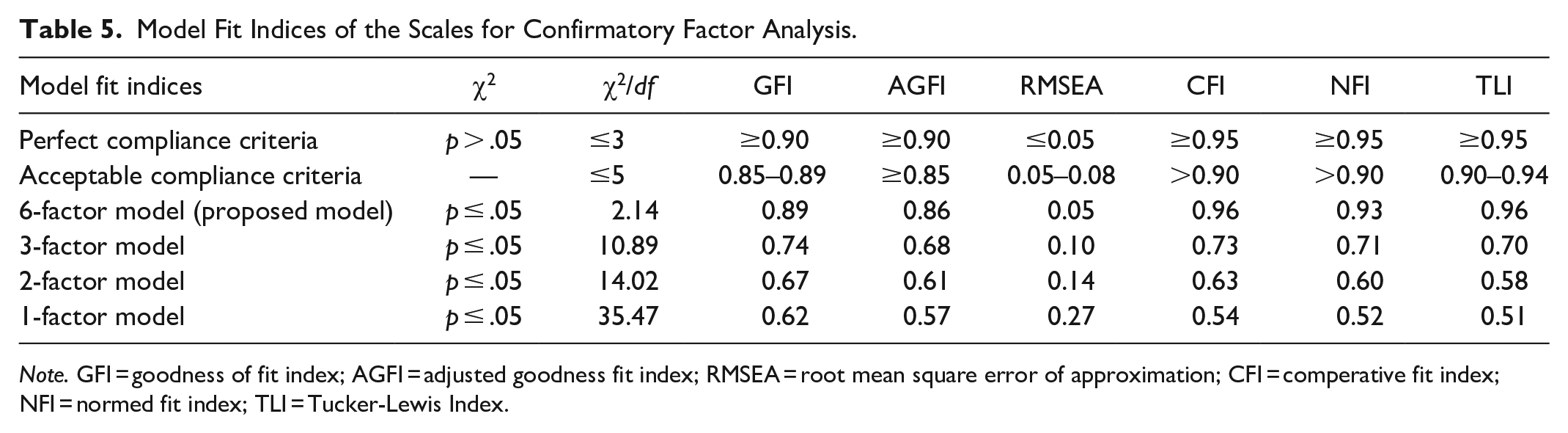
Note. GFI = goodness of fit index; AGFI = adjusted goodness fit index; RMSEA = root mean square error of approximation; CFI = comperative fit index; NFI = normed fit index; TLI = Tucker-Lewis Index.
Common Method Variance (CMV)
Most researchers agree that common method variance (CMV) is a potentially major source of bias in behavioral research, particularly when using single-informative surveys (Podsakoff et al., 2003). Although the current study collected data at two different time points to control CMV, single-informative surveys could cause CMV. As a result, we used the “controlling for the effects of a single unmeasured latent method component” method to investigate the degree of CMV (Podsakoff et al., 2003). We established a new measurement model comprising a common method factor and six local variables. The fit indices exhibited a worse fit for the one-factor model to our measurement model (χ2/df = 11.38, p < .05, GFI = 0.72, AGFI = 0.66, RMSEA = 0.13, CFI = 0.70, NFI = 0.68, TLI = 0.66). We thus consider that there was non-problematic in the case of the dataset. In this regard, developed hypotheses can be tested.
Hypotheses Testing
Bivariate and internal correlations between variables were performed (see Table 3). The Pearson’s correlation indicated a negative and significant association among some of the study variables in our model, that is, EE with OI (r = −.16, p ≤ .01), EE with TO (r = −.30, p ≤ .001), OI with CC (r = −.28, p ≤ .001), OI with AC (r = −.26, p ≤ .001), OI with BC (r = −.10, p ≤ .01), TO with CC (r = −.45, p ≤ .001), TO with AC (r = −.43, p ≤ .001), TO with BC (r = −.19, p ≤ .001). In addition, there is a positive association between EE and CC (r = .57, p ≤ .001), EE with AC (r = .62, p ≤ .001), EE with BC (r = .52, p ≤ .001), and OI with TO (r = .70, p ≤ .001). This initial correlation analysis suggests that EE at the workplace leads to decreased OI and therefore reduces the level of trust in the organization of employees, ultimately leading to OC among those employees.
To test the proposed model and all direct and indirect paths, we used Hayes’ PROCESS (Hayes, 2012), which, according to Field (2013), is “by far the best way to tackle double mediation.” Using Hayes’ process, we tested our hypothesized model on a sample of 465 with parameter estimates based on 5,000 bootstrap samples. The bias-corrected and 95% confidence intervals were then examined. We conducted SEM analysis for the proposed model. The results showed that the proposed model fits the data well (χ2/df = 2.21, p < .05, GFI = 0.88, AGFI = 0.85, RMSEA = 0.05, CFI = 0.96, NFI = 0.93, TLI = 0.95). However, the standardized path coefficients from TO to BC (β = −.03, p > .05). Therefore, Hypothesis 4c was rejected (Table 6).
Direct Effect of Emotional Exhaustion on Cognitive, Affective, and Behavioral Cynicism for Revised Model.

Note. EE = emotional exhaustion; OI = organizational identification; TO = trust in organization; CC = cognitive cynicism; AC = affective cynicism; BC = behavioral cynicism; DV = dependent variable; SE = standard error; CI = confidence interval; R2 = R-squared.
p ≤ .01. ***p ≤ .001.
Further, we modified the proposed model by deleting insignificant one path, and then the modified model was retested, which showed that the revised model fits the data well (χ2/df = 2.19, p < .05, GFI = 0.88, AGFI = 0.86, RMSEA = 0.05, CFI = 0.96, NFI = 0.94, TLI = 0.95). After modifying the process, we found that the standardized path coefficient between EE and CC was .50 (p < .001), supporting Hypothesis 1a; the standardized path coefficient between EE and AC was .55 (p < .001), supporting Hypothesis 1b; and the standardized path coefficient between EE and BC was 0.62 (p < .001), supporting Hypothesis 1c. Further, the results of the regressing OI with EE were found to be significant (β = −.16, p < .01), which means, Hypothesis 2 was supported. Furthermore, the result of regressing TO with OI is significant (β = .69, p < .001), supporting Hypothesis 3. Then, we found that the standardized path coefficient between TO and CC was −.34 (p < .001), supporting Hypothesis 4a, and the standardized path coefficient between TO and AC was −.28 (p < .001), supporting Hypothesis 4b (Table 7).
Model Fit Indices of Proposed and Revised Model.
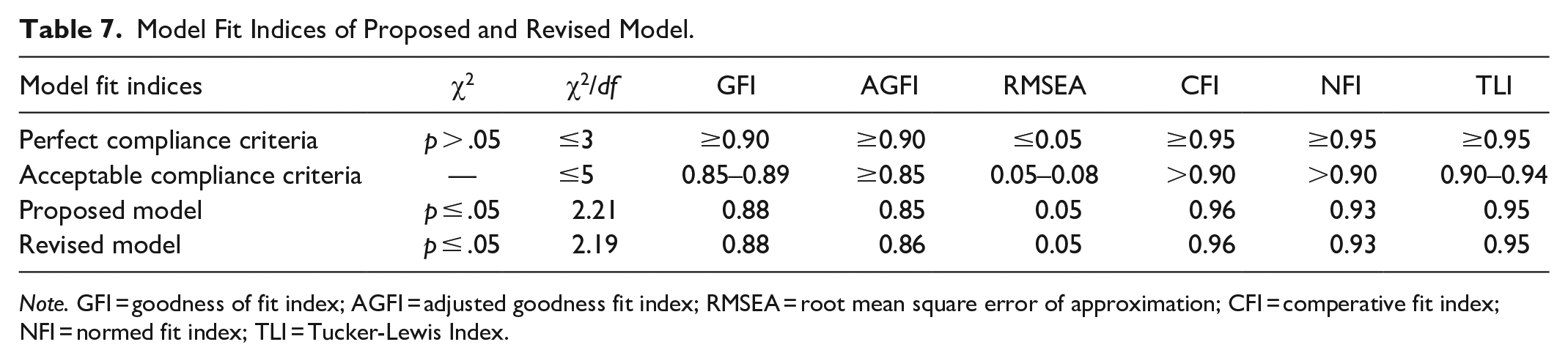
Note. GFI = goodness of fit index; AGFI = adjusted goodness fit index; RMSEA = root mean square error of approximation; CFI = comperative fit index; NFI = normed fit index; TLI = Tucker-Lewis Index.
Sequential mediation analyses for emotional exhaustion and organizational cynicism
Finally, we performed bootstrapping procedures (5,000 draws) with bias-corrected confidence intervals to evaluate the revised model’s indirect effect and significance. This mediation approach directly tests the indirect effect between the independent and dependent variables through seral mediators. Respectively, Hypotheses 5a, 5b, and 5c stated that OI and TO would sequentially mediate the relationship between EE and cognitive, affective, and behavioral cynicism (Table 8).
Indirect and Total Effect of EE on Cognitive, Affective, and Behavioral Cynicism.
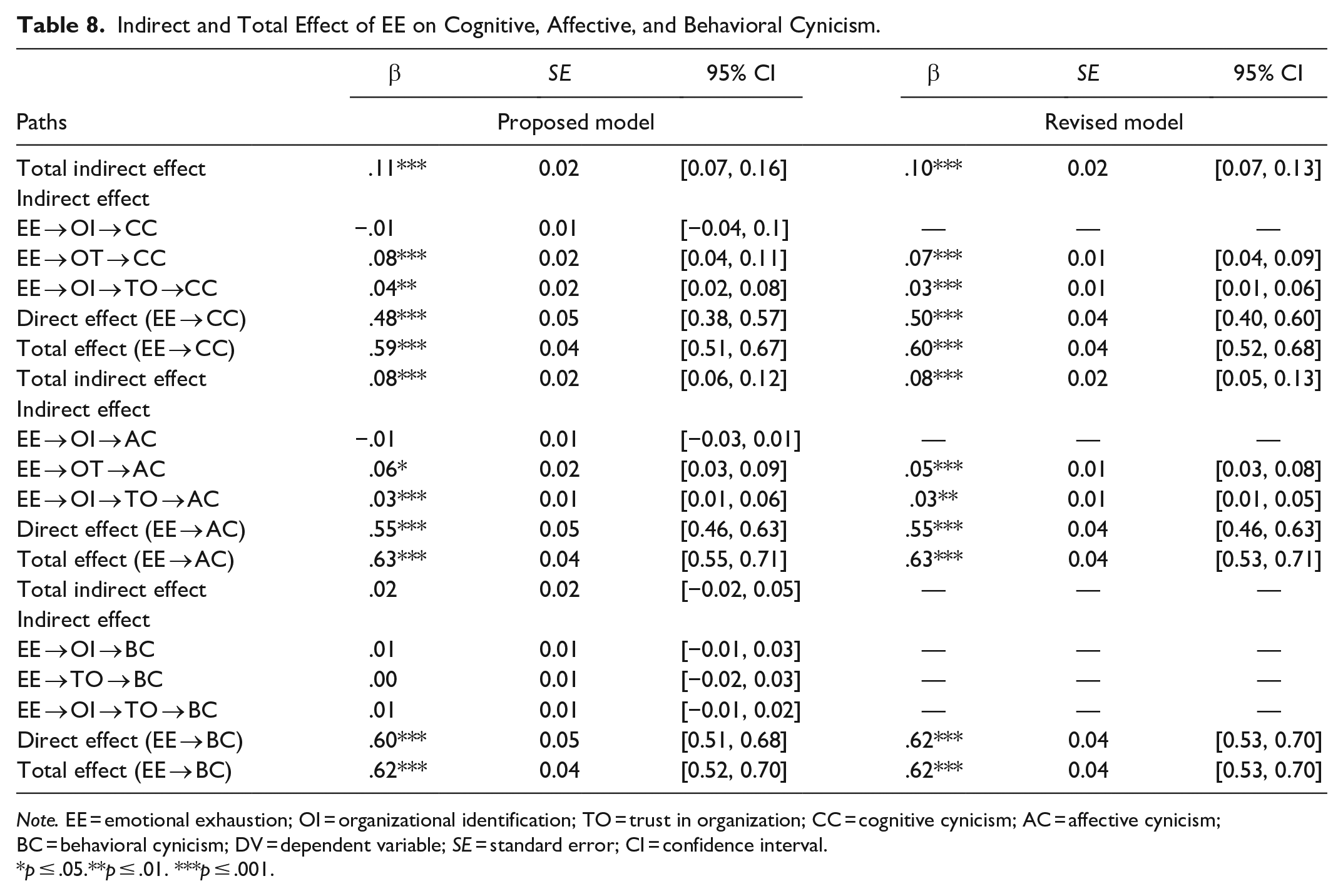
Note. EE = emotional exhaustion; OI = organizational identification; TO = trust in organization; CC = cognitive cynicism; AC = affective cynicism; BC = behavioral cynicism; DV = dependent variable; SE = standard error; CI = confidence interval.
p ≤ . 05.**p ≤ .01. ***p ≤ .001.
We find that the specific indirect effects of EE on CC and AC through OI and TO (sequential mediation) were significant, which was supportive of Hypothesis 5a (β = .03, p < .001) and Hypothesis 5b (β = .03, p < .001). Furthermore, there is a significant direct relationship between EE and CC (β = .55 p = .001) and AC (β = .55 p < .001). In sum, we confirmed that OI and TO sequentially mediated the positive relationship between EE and CC with AC. Lastly, we find that the indirect effect of EE on BC (β = .00, p > .00) through OI and TO was not significant, which was a rejection of Hypothesis 5c. In this regard, the results of SEM for the modified model can be seen in Figure 3.

Results of SEM for the modified model.
Discussion and Conclusion
Grounded on the multi-theoretical approach, the present study investigates the influence of overall EE perception on employees’ OC through sequential mediation of OI and TO, using a two-wave survey of 465 employees from diverse sectors in Turkey. This study first examined the specific links between EE, OI, TO, and OC and investigated a sequential mediation chain by fully integrating these links. The study results offered strong support for the relationship between EE and all the sub-dimension of OC and a negative association with OI. In addition, we found that OI is positively related to TO. Besides, our results demonstrated that TO is negatively associated with cognitive and affective cynicism. There is no significant relationship between TO and BC in the study. We also found that EE is the foremost and vital antecedent of cognitive, affective, and behavioral cynicism. Finally, our research findings demonstrate that EE was indirectly and positively associated with cognitive and affective cynicism, and sequentially mediated by first OI and then TO. These findings have several theoretical and managerial implications, which are discussed below.
Theoretical Contributions and Managerial Implications
Scholars have identified many determinants of OC (Chiaburu et al., 2013; Erkutlu & Chafra, 2017). There is, however, still a paucity of literature on the link between EE and OC. In this regard, based on the social exchange, social identity, conservation of resources, and psychological contract breach theories, the present study makes two main theoretical contributions to OC literature. First, by investigating the relationship between EE and OC, our study enriches the literature on antecedents OC. EE is considered to be associated with a variety of work-related consequences, both behavioral and attitudinal (Aronsson et al., 2017; Lee et al., 2011) and is found to be an essential negative underlying motive that has a direct effect on the psychological condition of employees (Wright & Cropanzano, 1998). Therefore, employees will exhibit more cynical attitudes and behaviors in the case of increasing EE in organizations. Because of the excessive demands from organizations, employees’ physical, emotional, and mental resources will deplete; in turn, they will get emotionally exhausted. In their study, Simha et al. (2014) found a positive relationship between EE and OC, and stated that emotionally exhausted employees will guard themselves by using OC as a self-defensive mechanism (criticizing, disparaging, etc.) to prevent further resource loss. In line with past literature (Al-Abrrow, 2018; Lee et al., 2020; Simha et al., 2014) and conformity with our presumptions, we found that EE is positively related to cognitive, affective, and behavioral cynicism and plays a vital role in triggering cynicism in the workplace.
The study also supports the evidence presented in the literature regarding a negative relationship between EE and OI, which was rarely studied (Kemp et al., 2013). EE arises due to the cumulative impact of job demands and job-related stressors if employees have insufficient job resources (Bakker & Demerouti, 2007; Barello et al., 2021). In the absence or lower level of EE in organizations, constructive relationships between employees and organizations develop, and positive experiences increase the intensity and quality of the relationship (Schaufeli, 2006). Additionally, employees “save” and “collect” emotional resources if they experience constructive relationships in the organizations (Bakker & Demerouti, 2007). However, if the employees experience EE, the social exchange relationship between the employees and the organizations suffers (Schaufeli, 2006). In this case, organizations cannot fulfill their commitments and employees’ well-being decrease (Lapointe et al., 2020). In this regard, employees may experience EE due to an increase in sources of stress. They use their emotional resources to prevent emotional exhaustion (Bakker & Demerouti, 2007). Finally, employees limit their socio-psychological bonds and keep low-level relationships with the organization not to lose their further emotional resources (Hobfoll, 1989; Westman et al., 2004). In such an environment, EE has a negative impact on OI. Consequently, as in the previous study (Kemp et al., 2013), increasing job demands and a consistent depletion of energy can be conductive to EE, and EE plays a critical role in reducing the level of OI of employees.
Most studies found that TO positively impacts OI (Kaya et al., 2017; Prasanthi, Geevarghese, et al., 2021; Schaubroeck et al., 2013; Tseng et al., 2005). However, there is little attention on the impact of TO on OI (Hameed et al., 2013). The findings of the study reveal that TO significantly and positively affects OI. According to social identity and social exchange theory, employees who identify themselves with their organizations have short and long-term socio-psychological interactions (Grice et al., 2006). Social exchange relationships can be sustained as long as the parties’ mutual expectations are fulfilled (Köksal, 2012). Employees who identify themselves with their organizations adopt the organizations’ values, goals, norms, and procedures. Therefore, employees perceive the organization as a part of their identity and consider it a social identity for those who do not work there (Ashforth & Mael, 1989). If organizations meet employees’ belonging needs, employees are more likely to adopt organizations’ aims, values, and contribute directly to the organizations’ success (Riketta & Van Dick, 2005). From this perspective, mutual relationships between the employees and the organizations improve. Positive interactions between the employee and the organization develop the employee’s trust in the organization. In this light of explanation, we expect OI has a positive impact on TO. Past studies suggested that OI can be viewed as the antecedent of TO (Hameed et al., 2013), as OI will induce employees’ cooperation and engagement at work, need for belonging, and reduce uncertainty (Tüzün & Çağlar, 2008). Therefore, positive mutual relationships strengthen the employees’ trust in the organization.
The study found a negative relationship between TO and employees’ cognitive and affective cynicism. This research result was consistent with past studies regarding OC (Akar, 2018; Chiaburu et al., 2013). Based on the psychological contract theory, employees become cynical toward organizations if organizations lack integrity, consistency, and competency (Johnson & O’Leary-Kelly, 2003; McDermott et al.,2013). Kim et al. (2009) implied that OC is influenced by employees’ untrustworthiness toward organizations and indicates that if top management’s credibility (trustworthiness and competence) decreases, employees become cynical toward organizations. James (2005) pointed out that unfavorably experiences in the past regarding trust in organizations may lead to the development of OC. Additionally, Akar (2018) mentioned that a lack of trust in organizations increases the level of OC. However, there is no relationship between TO and BC in the study. Therefore, the study finding indicates that employees may be aware of a lack of trust in the organization and develop negative feelings and opinions toward organizations but do not display their reactions on the behavioral level. Organizational silence may be the possible contextual factor of hiding these reactions on a behavioral level since employees believe that the reactions will not be taken into consideration by organizations (Goldberg et al., 2011).
Furthermore, this study found that OI and TO served as a tandem mediating effect on the relationship between EE and cognitive and AC (except BC), which contributes to our understanding of deeply potential mechanisms behind the EE-OC link. Prior research revealed that EE is positively related to OC (Gkorezis et al., 2015; Kranabetter & Niessen, 2017; Sak, 2018; Simbula & Guglielmi, 2010; Simha et al., 2014). However, to the best of our knowledge, no prior has investigated the underlying mechanisms of emotional exhaustion’s effects from the perspective of OI and TO. It is apparent from the results and our proposed model that employees’ EE perceptions first influence their identification level with the organization. When employees in organizations experience EE, they prefer to withdraw emotionally from the organization to conserve their emotional resources for further depletion (Halbesleben & Bowler, 2007). If employees do not identify themselves with their organization, their beliefs and goals do not align with the organization, which may decrease their trust in organizations (Epitropaki, 2012). At the final step of serial mediation, reduced trust in an organization ultimately triggers cynicism in organizations (Chiaburu et al., 2013). The result unravels a more complex process mechanism underlying the relationship between EE and OC, which contributes to deepening our understanding of the EE-OC relationship.
The current study has several important implications for organizations. First, this study found that EE has a positive impact on the sub-variables of OC. Therefore, to decrease employees’ OC levels, organizations should handle employees’ problems related to EE in organizations. We can see some essential leverage points that practitioners may use to reduce employees’ EE levels. For instance, by lowering some job demands such as unreasonable workload, work pressure, and role ambiguity, employees meet the demands of the job (Grokrezis et al., 2015). By reducing the level of EE, employees feel a lower level of cynicism toward their organization. Second, we found that EE is negatively related to OI. Based on this finding and previous research (Kemp et al.,2013), organizations should eliminate excessive work demands and increase work resources (coaching, autonomy, peer support, team cohesion, socialization, feedback, rewards, etc.) to increase the identification level of their employees. Third, the current study showed that TO has a negative impact on cognitive and affective cynicism. In this regard, organizations need to create, strengthen, and maintain an atmosphere of trust to reduce cynicism in the workplace by implementing fair practices and having consistency and accountability (Akin, 2015; Polat, 2013). In addition, organizations should support organizational communication and an open-door policy that allows employees’ issues to be brought to their supervisors without hesitation to increase trust at the workplace (Chiaburu et al., 2013). Finally, the current study showed that OI and TO play a significant sequential mediating role in the relationship between EE and CC with AC, which signifies that supporting the employees, increasing their job resources, and eliminating excessive workload are quite crucial for “killing” cynicism in organizations (Simha et al., 2014). Therefore, employees are more likely to feel comfortable with their organization.
Limitations and Directions for Future Research
Despite the implications mentioned above, this study has some limitations that should be considered in future research. First, since our data comes from a single country, Turkey, it is difficult to generalize our findings to other cultures beyond Turkey. Although EE is a global phonenoma regardless of Western or Eastern society (Schaufeli et al., 2009), there can be cultural differences in the perception of emotional exhaustion (Schaufeli, 2017a, 2017b). National culture influences organizations’ social interactions, norms, and expectations, and therefore, may affect EE, which affects OI, TO, and OC. Thus, future studies could identify the cultural differences in the hypothesized relationship. Second, since the sample was drawn from only white-collar participants and over-represented by the 26 to 35 age group, the results should be very cautiously generalized beyond this study. Therefore, future research should be designed to include more proportionally representative samples. Third, this study used self-reported scales for the constructs. While we applied procedural and statistical methods to minimize concerns about common method bias (Podsakoff et al., 2012), the relationship between antecedents and consequences can still be inflated due to the limitations of self-reported data. As a result, future research is expected to avoid the common method bias problem by utilizing longitudinal designs or focusing on quasi-experimental research designs. Fourth, we used quantitative data to analyze the hypothesized model and its relationships in the study. Qualitative data sources may be considered in future research to explain why or why not such types of relationships prevail and to validate the study results. Finally, future research can also test the actual mediation model with different mediating variables that may affect the exogenous variables or be affected by endogenous variable(s), such as job satisfaction, organizational commitment, and organizational justice that may affect OC or affected by EE. Despite these limitations, our research contributes to emotional exhaustion literature by suggesting theoretical and empirical implications pertinent to the dynamics of organizational cynicism.
Footnotes
Appendix
Declaration of Conflicting Interests
The author(s) declared no potential conflicts of interest with respect to the research, authorship, and/or publication of this article.
Funding
The author(s) received no financial support for the research, authorship, and/or publication of this article.
Ethical Approval
Before participants volunteered to participate in the survey, the authors briefed them about the research and obtained their informed consent.
