




Abstract
Unethical pro-supervisor behaviors (UPSB) are unethical acts that employees engage in to benefit their supervisors. Although Unethical pro-organizational behaviors (UPB) have received great attention from scholars in the field of organizational behavior, the literature has paid insufficient attention to the impact of leader-member exchange (LMX) on UPSB and the underlying mechanisms of this association. This study has examined the relationship between LMX, supervisor identification, and UPSB. Drawing on social exchange theory and social identity theory, we argue that LMX affects employees’ UPSB via the mediation of supervisor identification. Using two-wave time-lagged data from 185 employees in South Korea, we found that LMX was significantly and positively related to supervisor identification, and supervisor identification was significantly and positively related to UPSB. In addition, the indirect effect of LMX on UPSB via supervisor identification was significant and positive. LMX is associated with many positive outcomes, but our findings show that high LMX may also increase employees’ unethical behaviors to benefit their supervisors via high supervisor identification. These results contribute to the literature on LMX, UPSB by identifying the path between them.
Keywords
Introduction
Unethical behaviors are rampant within businesses around the world. We can easily find examples of ethical management failures in companies of various industries over the world. It is easy to find cases in which subordinates participate in unethical behaviors that are not permitted in the community for the benefit of their supervisors (S. Li et al., 2022; Johnson & Umphress, 2019; Lee & Kwon, 2018). Johnson and Umphress (2019) have introduced the concept of unethical pro-supervisor behavior (UPSB) to explain these unethical behaviors that occur in organizations by extending the existing concept of unethical pro-organizational behavior (UPB). They have extended the beneficiary of unethical behavior from collective organizations to individual supervisors. UPSBs can negatively affect employees’ individual emotions, attitudes, and behaviors and damage the organizational performances. Employees who have engaged in UPSBs experience cognitive dissonance, psychological discomfort and try to solve this problem by quitting their jobs (Mesdaghinia et al., 2019). And employees’ turnover can harm the employees themselves, the organizations they belong to and the stakeholders who have invested in the organizations (Koys, 2001). In addition, customers are unwilling to purchase products/services offered by unethical companies (Creyer, 1997) and great talents are reluctant to submit their job applications to unethical companies (Turban & Greening, 1997).
Considering that UPSBs are pervasive phenomena in companies around the world and that UPSBs can harm individuals, organizations and stakeholders, the research to discover the causes of UPSBs are essential. We can find out that many researchers have approached from various perspectives and have discovered many different variables that directly/indirectly affect unethical pro-organizational behavior (Lee, 2017). For examples, Umphress et al. (2010) have found that organizational identification could affect unethical pro-organizational behavior with the social identity perspective. Bryant and Merritt (2021) have verified that leader-member exchange (LMX) would mediate the association of interpersonal justice with unethical pro-organizational behavior from the social exchange perspective. Effelsberg et al. (2014) have confirmed that transformational leadership could influence on unethical pro-organizational behavior with the social learning perspective. Recently, Inam et al. (2021) have found that responsible leadership is negatively related to UPB based on the self-regulatory function of the social learning theory. Like the research on unethical pro-organizational behavior, it can be expected that many researchers will approach and study UPSB from various social perspectives. For instance, Johnson and Umphress (2019) have demonstrated that employees’ identification (with their organization or supervisor) may result in the likelihood of engaging in UPSB from the social identity perspective. S. Li et al. (2022) have investigated employees’ perceived supervisor support can lead to UPSB through their feelings of reciprocity directed toward the supervisor drawing upon the social exchange perspective. However, if we look at the empirical studies on UPSB conducted so far, we can find out that research on UPSB has only begun and much remains to be explored about why and how it occurs.
The first purpose of this study is to find out whether LMX affects supervisor identification. The second is to investigate whether supervisor identification leads to UPSB. Third, we want to verify whether supervisor identification plays a mediating role in the relationship between LMX and UPSB. That is to find out the mechanism by which LMX influences UPSB.
Theory and Hypotheses
LMX and Supervisor Identification
LMX is a leadership theory that deals with the quality of exchange relations between leader and subordinates based on social exchange theory (Dienesch & Liden, 1986; Sparrowe & Liden, 1997). Unlike the trait theories of leadership that emphasize the leader’s personal characteristics, the behavioral theories of leadership that propose the leader’s specific behaviors, and the contingency theories of leadership that focus on the leader’s style and interaction with the situation (Robbins & Judge, 2013), LMX emphasizes the importance of the bilateral relationship between leader and subordinates (Martin et al., 2010). Leaders cannot give equal attention, support to all subordinates due to the constraints of resources (e.g., time, effort). At this time, a high level of LMX relationship is formed with a small number of subordinates (in-group members) who have been given relatively much support, and a low level of LMX relationship is formed with most of subordinates (out-group members) that do not (Graen & Uhl-Bien, 1995).
Through numerous empirical studies, it has been shown that LMX influences the perceptions, attitudes, and behaviors of subordinates. Specifically, it was found that LMX produced positive perceptions of procedural/distributive justice, formed positive attitudes such as affective/normative commitment and job/supervisor satisfaction, increased job performance and organizational citizenship behavior, and reduced turnover (Dulebohn et al., 2012). The differential treatment of a leader’s subordinates results in distinctly contrasting reaction behaviors of his/her subordinates. Subordinates who experience a high level of LMX are more satisfied with their job, achieve better job performances (Harris et al., 2009), trust the organization more (Kim et al., 2004), more affectively committed to the organization (Eisenberger et al., 2010), and engage more in organizational citizenship behaviors (Truckenbrodt, 2000). And they experience less burnouts (Graham & van Witteloostuijn, 2010) and have lower turnover intentions (Harris et al., 2009). On the other hand, positive attitudes, behaviors, and performances cannot be expected from the subordinates who experience a low level of LMX.
Drawing on the group engagement model (an extension of social identity theory within the group context), we could figure out in detail the process of LMX leading to supervisor identification. Group engagement model has postulates that the causes of employees’ identification would be their need for respect and pride (Tyler & Blader, 2003). And Zhao et al. (2019) have argued that LMX could make employees feel respected. Therefore, we argue that LMX makes employees feel respected, which could promote their identification with their supervisor.
The target similarity model (based on the theory of social exchange) has further suggested that employees’ perceptions of a high level of LMX can directly evoke employees’ supervisor identifications (Lavelle et al., 2007). They have argued that employees differentiate between perceptions, relationships, and behaviors in a multifaceted way and that there are three targets such as organizations, supervisors, and coworkers. To put it simply, they have asserted that the perception of fairness about a target (e.g., supervisor) would predict social exchange with the target (e.g., supervisor identification), which would in turn predict citizenship behavior directed at that target (e.g., citizenship toward supervisor). J. Li et al. (2018) have demonstrated that LMX have a positive effect on supervisor identification through structural equation model analysis with data from leader-supervisor dyads in numerous Chinese organizations.
The LMX literatures (Huang et al., 2014; Stinglhamber & Vandenberghe, 2003) have argued that when one’s supervisor demonstrates concern, support for an employee, the employee will feel an obligation to reciprocate via commitment to and identification with the supervisor. Indeed, there already exists empirical support for this argument. For example, J. Li et al. (2018) have found an empirical link between LMX and supervisor identification using 395 supervisor-follower paired data from numerous Chinses organizations. Based on the arguments presented above, we propose the following (see Figure 1):

Framework of the research model.
Supervisor Identification and UPSB
Supervisor identification can be defined “the perceived oneness with one’s supervisor” (Johnson & Umphress, 2019) by specifying the object of one’s identification as the supervisor in the definition of personal identification (Ashforth et al., 2016). Unlike organizational identification, supervisor identification involves defining oneself in terms of the attributes of the supervisor, shifting one’s focus on one’s gains for the supervisor and experiencing a high level of connection with the supervisor (Zhu et al., 2013). Supervisor identifications occur when subordinates want to change their self-concepts to become like the supervisor’s values and beliefs as well as when they share values with their supervisors (Pratt, 1998). And it has been shown that supervisor identifications influence subordinates’ positive behaviors for their organization/supervisor in previous empirical studies. Specifically, it was found that subordinates who experience a high level of supervisor identification achieve better job performances (Walumbwa & Hartnell, 2011), engage more in organizational citizenship behaviors (Zhang & Chen, 2013). And Zhu et al. (2013) have found that supervisor identification was significantly associated with followers’ innovativeness, affective organizational commitments, and turnover intentions using 318 supervisor-follower paired data from a Chinese garment manufacturing firm.
UPSB is an extension of unethical pro-organization behavior (UPB) (Johnson & Umphress, 2019; Mesdaghinia et al., 2019). The UPSB can be defined as “actions that intended to promote the effective functioning of one’s supervisor and violate core societal values, mores, laws, or standards of proper conduct” from the definition of UPB (Umphress & Bingham, 2011) by changing the beneficiary of the behavior from one’s organization to one’s supervisor. The UPSB has two definitional components, ethicality of the behavior and intent of the behavior, like the UPB (Lee & Jeon, 2019). Lee and Jeon (2019) have argued that UPSB could be conceptually distinguished from other similar concepts based on these two dimensions (see Table 1). And they have verified that UPSB was discriminated against similar concepts by collecting and analyzing (confirmative factor analysis and χ2 difference test) data from Korean office workers.
The UPSB and Similar Concepts.

Researchers have approached UPSB from a variety of perspectives based on the various theories of sociology and have tried to identify the causes of UPSB. For example, Mesdaghinia et al. (2019) have viewed UPSB from the perspective of social learning and have showed that the characteristics of the leader could lead to the subordinates’ UPSBs through empirical research. Wang et al. (2019) have viewed UPB from the social identity perspective and have revealed that employees who perceive strong social exchange relationship with their employers are more likely to engage in UPBs by surveying employees and their supervisors working at various companies in China and analyzing the data.
We have approached UPSB from the perspective of social identity, emphasized in an integrated model for UPB by Umphress and Bingham (2011). This is because some UPSB researchers (Johnson & Umphress, 2019; Lee, 2020) have approached UPSB from the perspective of social identity and have founded various causes that can cause UPSB. Johnson and Umphress (2019) have viewed UPSB from a social identity perspective and have argued that when employees experienced strong identifications with their supervisors, employees would define their self-concepts with the attributes of their supervisors, internalize their supervisors’ goals and participate in unethical behaviors to help their supervisors. Indeed, there already exists empirical support for this argument. They have found an empirical link between supervisor identification and UPSB using the data of 208 full-time employees from the USA. Based on the arguments presented above, we propose the following (see Figure 1):
The Mediating Role of Supervisor Identification
Previously, we have developed the hypothesis that LMX could have a positive effect on supervisor identification by applying social exchange theory to organizational context (Dienesch & Liden, 1986; Sparrowe & Liden, 1997). Specifically, subordinates who perceive that they have received relatively much attention and support from the leader(supervisor) form a positive exchange relationship with their supervisors (Graen & Uhl-Bien, 1995) and want to reciprocate to their supervisors (Huang et al., 2014; Stinglhamber & Vandenberghe, 2003) by defining their identities with the attributes of their supervisors (Lavelle et al., 2007). Group engagement model argues that LMX can trigger employees’ supervisor identification through employees’ perceived respect by applying social identity theory within the group/organization context (Tyler & Blader, 2003; Zhao et al., 2019). And we have developed the hypothesis that supervisor identification can have a positive effect on UPSB by applying social identity theory to organizational context (Johnson & Umphress, 2019; Lee, 2020). In other words, subordinates who experience a high level of identifications with their supervisors not only define themselves with the attributes of their supervisors (Zhu et al., 2013), but also internalize the values and beliefs of their supervisors (Pratt, 1998), focus on the goals of their supervisors (Zhu et al., 2013), and engage in unethical behaviors for the benefit of their supervisors (Johnson & Umphress, 2019).
Through previous studies, we can find that supervisor identification plays a mediating role between subordinates’ leadership perceptions and subordinates’ extra-role behaviors outside their explicit job descriptions. For example, Zhang and Chen (2013) have found that supervisor identification would mediate the relationship between developmental leadership and organizational citizenship behavior (OCB) using 469 supervisor-follower paired data from two Chinese telecom organizations. J. Li et al. (2018) have verified that supervisor identification could play a mediating role between LMX and prosocial behavior such as taking charge. Shaw and Liao (2021) have found an empirical link between benevolent leadership, supervisor identification and UPB using 257 full-time employees of several companies in China. Based on the arguments presented above, we propose the following (see Figure 1):
Research Method
Sample and Procedure
Using an online survey method, data for this study were collected from currently working employees in South Korea. One of the largest online study communities in South Korea (i.e., comprising more than 1,000 members from various types of organizations) helped to conduct the survey. Using membership information (ID, email, cellphone etc.), we randomly selected survey participants to reduce the possibility of sampling bias. A total of 500 questionnaires were distributed to the employees. The questionnaires were distributed through Google online survey system. To minimize consent bias (Spector, 2006), we explained to the participants that their individual information will be kept and collective response will be used for analyses.
Since the data were collected using a questionnaire from a single source, we also could not be free from the potential for common method bias (Podsakoff & Organ, 1986). To reduce the problem of casual confusion and common method bias (Podsakoff et al., 2003), we separated the time point at which the predictor variable and the outcome variable included in the research model were measured. We collected 272 questionnaires in the first survey, where we measured LMX, supervisor identification, and social desirability. We collected 191 questionnaires in the second survey (4 weeks later), which were sent to the first survey respondents to measure followers’ UPSB. After excluding six incomplete surveys, 185 responses to both surveys were used (68.0% response rate).
Among the respondents, 59.5% were male, and 64.3% were college graduates. Those in their 30s and 40s were 82.7% and those who worked for more than 3 years, and less than 10 years were 46.5%. In terms of the organization demographics, 33.5% of the respondents were engaged in the information and communication industry and the manufacturing industry.
Measures
LMX
The LMX scale (11 items) developed and validated by Liden and Maslyn (1998) was used. Respondents were asked to rate their agreements with each item using a 5-point Likert-type scale (where 1 = strongly disagree and 5 = strongly agree). Sample items included “I like my supervisor very much as a person” and “My supervisor defends my work actions to a superior, even without complete knowledge of the issue in question.” The Cronbach alpha for this scale was .933.
Supervisor Identification
The organizational identification scale (5 items) developed and validated by F. A. Mael and Ashforth (1995) was used. We have followed empirical studies that used this scale to measure supervisor identification (Johnson & Umphress, 2019). Johnson and Umphress (2019) have adapted F. Mael and Ashforth (1992) by directly modifying the object from the organization to the supervisor. Respondents were asked to rate the extent to which they identified with their immediate supervisor using a 5-point Likert-type scale (where 1 = strongly disagree and 5 = strongly agree). Sample items included “When someone criticizes my supervisor, it feels like a personal insult” and “My supervisor’s success is my success.” The Cronbach alpha for this scale was .864.
UPSB
The UPSB scale (6 items) developed and validated by Johnson and Umphress (2019) was used. Respondents were asked to rate the extent to which they engaged in UPSBs using a 5-point Likert-type scale (where 1 = strongly disagree and 5 = strongly agree). Sample items included “Because it was needed, I have concealed information from others that could be damaging to my supervisor” and “Because it benefited my supervisor, I have withheld negative information about my supervisor’s performance from others.” The Cronbach alpha for this scale was .819.
Control Variables
As prior research has shown that demographic characteristics may influence the extent to which individuals engage in unethical behaviors (Mesdaghinia et al., 2019), we controlled for the effects of demographic characteristics such as respondents’ gender, age, education, and organizational tenure. In addition, we controlled individual social desirability response by using the scale (8 items) developed and validated by Stöber (2001) because researchers have suggested the impression management bias may occur when answering sensitive items (Johnson & Umphress, 2019; Umphress & Bingham, 2011). Respondents were asked to rate the extent to which they engaged in social desirability response using a 5-point Likert-type scale (where 1 = strongly disagree and 5 = strongly agree). Sample items included “I occasionally speak badly of others behind their back.” The Cronbach alpha for this scale was .722.
Results
Checking Common Method Bias
We have checked for possible common method bias with Harman’s single-factor test (Podsakoff & Organ, 1986) before conducting further data analysis. All independent variables included in this research model (excluding demographic variables) were entered in the exploratory factor analysis model. Harman’s single-factor test indicates that common method bias is present if a single factor accounts for more than 50% of the covariance in the exploratory factor analysis model (Podsakoff & Organ, 1986). The first factor only accounted for 31.5% of the total variance in our exploratory factor analysis model. The result of this analysis supported that common method bias was not present in this study.
Reliability and Validity
We have measured composite reliability (CR) and Cronbach’s alpha (α) to test constructs’ consistency reliability of the measurement model. CR values should be greater than 0.700 (Hair et al., 2014). The social desirability response was excluded from the measurement model because the CR value was 0.672 (less than 0.700). Table 2 shows that CR values of all items are higher than the threshold level of 0.700. Cronbach’s alpha values should also be greater than .700 (Hair et al., 2014). Cronbach’s alpha values of all items are higher than the threshold level of .700 as presented in Table 2. Hence, Table 2 demonstrates that the measurement model is statistically reliable.
The Reliability of Measurement Model.

Note. All values are significant at .05 level (two-tailed). LV = loading values; CR = composite reliability; α = Cronbach’s alpha; AVE = average variance extracted; LMX = leader-member exchange; UPSB = unethical pro-supervisor behavior.
We have tested the convergent and discriminant validities among LMX, supervisor identification and UPSB with the confirmatory factor analysis. To measure the convergent validity of our measurement model, the average variance extracted (AVE) is calculated as the mean variance extracted for the items loading on a construct. AVE values should be greater than 0.5 (Hair et al., 2014). Table 2 shows that AVE values of all constructs are higher than the threshold level of 0.5. Discriminant validity explains the extent to which a construct is distinct from other constructs (Hair et al., 2014). Fornell-Larcker criterion is used to test discriminant validity of the measurement model. As per rules, the variance extracted values for any two constructs should be greater than the square of the correlation estimates between these two constructs (Fornell & Larcker, 1981; Hair et al., 2014). Table 3 shows that all AVE values are higher than the other square of the correlation values. Therefore, Tables 2 and 3 demonstrates that the measurement model is statistically valid.
The Validity of Measurement Model.

Note. AVE = average variance extracted; r = correlation; LMX = leader-member exchange; SID = supervisor identification; UPSB = unethical pro-supervisor behavior.
Model Fitness
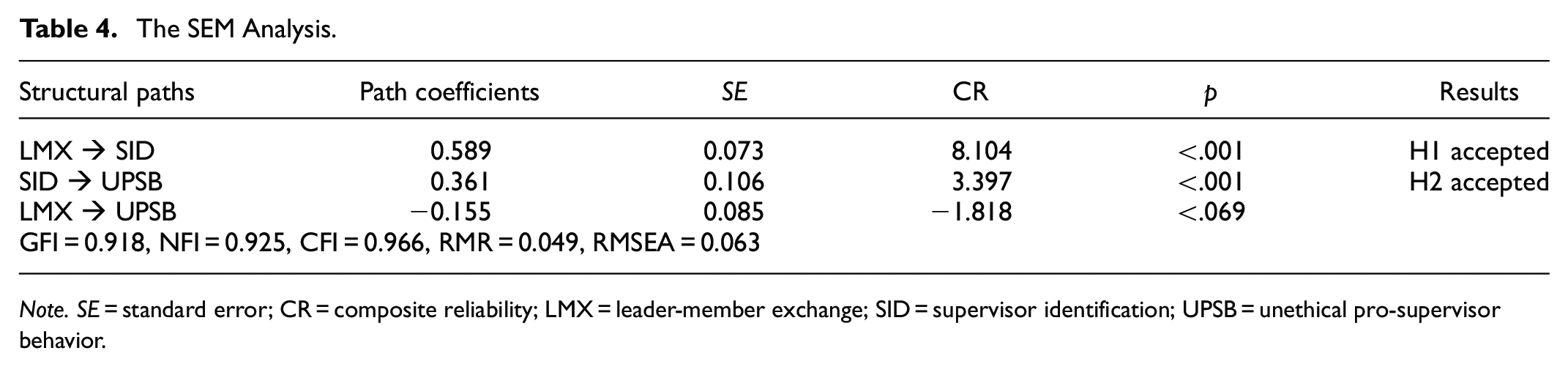
To evaluate the adequacy of the SEM model fit, we have considered several goodness-of-fit indices including the root mean residual (RMR), the goodness of fit index (GFI), normed fit index (NFI), the comparative fit index (CFI), and the root mean square error of approximation (RMSEA). As per rule, the values of GFI, NFI, and CFI should be higher than 0.9 and the values of RMR, RMSEA should be lower than 0.050, 0.080 respectively (Hair et al., 2014). Table 4 shows that all goodness-of-fit indices meet the criterion, which indicates that the SEM model fit is adequate to continue to test the hypotheses.
The SEM Analysis.
Note. SE = standard error; CR = composite reliability; LMX = leader-member exchange; SID = supervisor identification; UPSB = unethical pro-supervisor behavior.
Hypothesis Verification (Direct Relationship)
We have verified Hypothesis 1 and 2 utilizing the SEM analysis with IBM AMOS 20.0. Hypothesis 1 predicted that LMX would be positively related to supervisor identification. As the results in Table 4 show, LMX would be positively related to supervisor identification (path coefficient = 0.589, CR = 8.104, p < .001), therefore supporting Hypothesis 1 (see Figure 2).

Standardized estimate values of the final model.
Hypothesis 2 predicted that supervisor identification would be positively related to UPSB. As the results in Table 4 show, supervisor identification was positively related to UPSB (path coefficient = 0.361, CR = 3.397, p < .01), therefore supporting Hypothesis 2 (see Figure 2).
Hypothesis Verification (Indirect Effect)
Hypothesis 3 predicted stated that supervisor identification would mediate the relationship between LMX and UPSB. We used Sobel test to test the mediating effect of supervisor identification between LMX and UPSB. Table 5 show that Sobel test statistic is higher than the threshold level of 1.96, which indicates that the indirect effect of LMX on UPSB via supervisor identification was significant (Baron & Kenny, 1986). As the results in Table 4 show, the structural path of LMX on UPSB was not significant and the other structural paths was significant. Thus, these results supported that supervisor identification fully mediated the relationship between LMX and UPSB.
Indirect Effect Analysis.

Note. LMX = leader-member exchange; SID = supervisor identification; UPSB = unethical pro-supervisor behavior
Discussion
It was demonstrated that individuals’ perceptions of LMX and supervisor identifications had influenced the occurrence of UPSBs by collecting and analyzing data from employees who perform different jobs in various types of organizations in various industries. It was confirmed that three hypotheses developed with the field study were supported. First, it was found that LMX had a statistically significant positive (+) effect on supervisor identification. In other words, Subordinates who perceive that they are forming and maintaining positive exchange relationships with their supervisors are going to strongly identify with their supervisors. This supports the results of previous studies (J. Li et al., 2018; Huang et al., 2014) demonstrating a positive relationship between LMX and supervisor identification. Second, it was found that supervisor identification had a statistically significant positive (+) effect on UPSB. That is, Subordinates who strongly identify themselves with their supervisors are willing to perform unethical behaviors for the benefits of their own supervisors that are prohibited by their social community. This is consistent with the results of previous studies (Johnson & Umphress, 2019) that have proved the relationship between supervisor identification and UPSB. Third, it has been newly revealed that supervisor identifications play a mediating role in the relationship between LMX and UPSB. In other words, even if subordinates perceive that they have a good exchange relationship with their supervisors, they do not engage in unethical behaviors if they do not experience the process of strongly identifying with their supervisors. In conclusion, it can be said that LMX indirectly affects UPSB. This finding expands on the results of previous studies (Bryant & Merritt, 2021) that have found that LMX affects UPOB.
Implication for Research
This study gives some academic contributions. First, this study has showed the possibility of identifying various causal variables by approaching UPSB from the perspective of social exchange. Several scholars have extended the concept of unethical pro-organizational behavior to UPSB (Johnson & Umphress, 2019; Mesdaghinia et al., 2019). And they have identified the causes of UPSB through some empirical studies. Although Umphress and Bingham (2011) have emphasized the social exchange perspective along with the social identity perspective in the theoretical model of UPB, there have been no studies to identify causes of UPSB from the social exchange perspective. In this study, LMX variable has been newly dealt with and it was revealed that LMX could indirectly affect UPSB by approaching from the perspective of social exchange.
Second, this study has contributed academically to empirical studies on LMX by demonstrating negative effects that can be caused by LMX. Up to now, LMX has been known to have a beneficial effect on variables of various levels (individual, group, organization) that are positively evaluated in the field of organizational behavior. For example, LMX has been confirmed to have positive effects on the job satisfaction, the job performance (Harris et al., 2009), the organizational trust, the organizational commitment (Eisenberger et al., 2010), and the organizational citizenship behavior (Truckenbrodt, 2000). However, with this study, it has been revealed that LMX can be a cause of UPSB that affects the intention to turn over (Mesdaghinia et al., 2019). Therefore, this study has provided the evidence that attention should be paid to negative effects as well as the positive effects in studies dealing with the LMX.
Third, it has contributed to studies of UPSB by identifying the variable that plays a mediating role in the relationship between LMX and UPSB. This study has shown that subordinates who perceive they have established positive social exchanges with their supervisors can engage in unethical behaviors for the benefits of their own supervisors that are prohibited by their social community and that these negative consequences can be occurred only when subordinates experience the process of strong identification with their own supervisors by approaching from the perspectives of social exchange and social identity. These findings suggest that UPSB can be prohibited if the process of strong identification with their own supervisor is not created among subordinates who have a good exchange relationship with their supervisors. We can find academic contributions in that we have found the mechanism by which LMX affects UPSB.
Practical Implications
This study gives some practical implications. First, organizational executives (CEO, CHRO) and managers should pay attention and make every effort to prevent the occurrence of employees’ UPSBs by accurately diagnosing the levels of employees’ LMX perceptions and maintaining appropriate levels of them. Due to the rapid development of IT technology, unethical behaviors within the organization can be easily exposed and spread far and wide through Internet, SNS, etc. And if unethical behaviors of the organization are known outside, organizations face many difficulties (Lee, 2017). Specifically, modern customers who reveal their values through consumptions do not actively consume products and services of unethical companies (Starr, 2009). And employees working in unethical companies experience internal conflicts of values, a low level of job involvement and organizational commitment, decreased satisfaction with job and organization, and eventually want to leave their organizations (Schwepker, 2001). Moreover, talented people who are essential to the survival and prosperity of a company turn away from these unethical companies (Coldwell et al., 2008). In addition, many investors are hesitant to invest in unethical companies (Hofmann et al., 2007). Therefore, organizational executives and managers should diagnose the levels of employees’ LMX perceptions on a regular or irregular basis and respond based on these diagnostic results. Through organizational communications and trainings, the risk of negative effects that can be caused by a high level of employees’ LMX perceptions should be communicated to and shared with employees in the organizations.
Second, organizational executives (CEO, CHRO) and managers should also pay attention to the levels of supervisor identifications perceived by their employees. In this study, it was found that employees’ high levels of supervisor identification can fully mediate the relationship between LMX and UPSB. In other words, if employees who have positive exchange relationships with their own supervisors do not experience the process of strong identification with their supervisors, they will not act against ethical norms of their societies for the benefit of their supervisors. Therefore, organizational executives and managers should diagnose the levels of employees’ supervisor identifications and take appropriate actions to remove the middle link connecting LMX and UPSB. For example, we can find employees who are experiencing excessively a high level of supervisor identifications by conducting a survey of employees who have good relationships with their own supervisors and warn them the risk of their engaging in the UPSBs.
Limitations and Suggestions for Future Research
We have taken several steps to reduce the common method bias while measuring unethical pro-organizational behavior in this study. That is, the independent and dependent variables were measured separately at time intervals. We have provided an environment where respondents could honestly respond by using an online questionnaire. We have controlled the effect of social desirability on unethical pro-organizational behavior by measuring impression management. However, there is an issue of reliability of self-report survey itself. In other words, it is not entirely reliable whether respondents candidly answered sensitive questions such as those measuring unethical pro-organizational behavior. In future research, it is necessary to objectively measure unethical pro-organizational behavior from different response sources. For example, we can count the number of employees’ unethical pro-organizational behaviors that have occurred in the organization with the help of the human resources department.
We have focused on the mechanism by which LMX indirectly affects UPSB in this study, and we have not found any situational conditions moderating the effect of LMX on UPSB. In future research, it is necessary to approach this research from the perspective of person-situation interaction and to identify variables that moderate the relationship between LMX and UPSB. For example, we could include personal characteristics such as ethical ideology and organizational contexts such as corporate ethical values, individualism, and collectivism in our future research model.
We have only dealt with UPSB in this study. Although UPSB is a concept distinct from unethical pro-organizational behavior, there is no need to deal with these two separately in real organizations. In future research, it is necessary to include UPSB and unethical pro-organizational behavior in one research model when referring to the development of research on organizational citizenship behavior (Hofmann et al., 2007). For example, we could include perceived organizational support, perceived supervisor support, unethical pro-organizational behavior, and UPSB together in our integrated research model.
Literature review results have showed that almost all studies on UPSB focused on its antecedents (S. Li et al., 2022; Johnson & Umphress, 2019; Lee, 2020; Mesdaghinia et al., 2019; Song et al., 2019). For example, empirical studies have demonstrated that personal characteristics (such as leader bottom-line mentality, supervisor identification, organizational identification), leadership (abusive supervision) and situational conditions (such as employability) can engender individual’s UPSB under some circumstances. Although some previous studies found out the negative effects of UPSB such as turnover intention (Mesdaghinia et al., 2019), limited attentions have been given to the consequences of UPSB. Therefore, it is necessary to investigate the positive or negative effects of UPSB in future research. For example, taking an idea from the study of Zhan and Liu (2022), we could include performance evaluation rated by supervisor as a dependent variable of UPSB in our future research model.
Conclusion
The purpose of this study was to find out the LMX–UPSB link by delving into intermediating process of the association. To empirically test the hypotheses, this study has utilized two-wave time-lagged data from employees in organizations in South Korea. By conducting a mediation model analysis with an SEM technique, this study has shown that levels of supervisor identification in employees function as a mediator in the association between LMX and UPSB.
Although this paper has some limitations, this study stands to positively contribute to existing literature in LMX by demonstrating the intermediating process between LMX and UPSB. The findings suggest that employees’ levels of supervisor identification function as a mediator in the LMX-UPSB link. The results show that LMX increase the likelihood of occurrence of UPSB by positively affecting employee perceptions (i.e., supervisor identification). In other words, this paper has revealed the pathway from LMX to follower UPSB and positively contributes to existing research in LMX.
Footnotes
Declaration of Conflicting Interests
The author(s) declared no potential conflicts of interest with respect to the research, authorship, and/or publication of this article.
Funding
The author(s) received no financial support for the research, authorship, and/or publication of this article.
