




Abstract
Human resources are frequently emphasized as being critical to the school social system’s survival. This study examined the effects of teachers’ negative attitudes toward the organization for which they work at the level of school effectiveness. The study sought to determine how negative attitudes of secondary school teachers toward their schools harmed school effectiveness in one of Turkey’s eastern provinces. The analyses revealed that organizational cynicism may reduce perceived school effectiveness by reducing teachers’ participation in school decision-making. In terms of understanding how the negative effects of organizational cynicism on school effectiveness occur, the findings of this study had a wide range of implications in research, practice, and policy.
Keywords
Introduction
“The human is the fundamental element or subject of the educational system.” Sisman (2015). Capacity development in education is primarily dependent on the development of human resource capacity, followed by the development of managerial and organizational capacity based on human capacity. Schools, which are regarded as an essential learning field in our time, are expected to provide qualified and effective instruction. Schools that fail to meet this expectation lose their status and confidence, putting their organization’s existence at risk (Sisman, 2015, 2020). Quality learning takes place in effective schools. Organizational cynicism (OC), on the other hand, has recently received attention as a variable that can negatively affect the effectiveness of schools and also emerge itself in the form of negative employee attitudes. As a result, it is critical to investigate cynicism-related behaviors that may emerge in the school social system in terms of both their consequences (effects) and their antecedents.
Examining the literature from the last 5 years reveals that studies revealing the outputs of OC are rare. Some of these studies investigated the effect of OC on employee performance (Arslan, 2018; Arslan & Roudaki, 2019; Khalid, 2020). Some investigated the impact of OC on factors such as organizational pride (Durrah et al., 2019), organizational synergy (Akpolat & Oguz, 2021), and intention to leave (Pelit & Soyabal, 2021). OC has been shown in several studies to have a mediating and regulating influence. It has been discovered, for example, that OC mediates the links between psychological contract breach and counterproductive work behaviors of employees, as well as between workplace incivility and unproductive work behavior (Butt & Yazdani, 2021; Li & Chen, 2018). It has been established that OC has a moderating function in the negative effect of concealment on psychological stability as well as the beneficial association between ethical leadership and organizational citizenship (Jiang et al., 2019; Nemr & Liu, 2021). Despite these findings, studies concentrating on the outputs of OC have received less attention than studies focused on its predecessors (Erdogdu, 2018; Gokyer & Turkoglu, 2018; Gulbahar, 2020; Mousa, 2018; Mumcu & Ozyer, 2021; Polatci & Mulayim, 2021; Rastegar et al., 2019; Zan & Altuntas, 2019). In terms of educational institutions, this result is clearer.
Existing research is far from showing the effects of OC on school social system results. On the other hand, there is only one congress paper (Ozgan et al., 2011) that discusses the association between OC and perceived school effectiveness (PSE). This study lacks a theoretical foundation to demonstrate how OC impacts PSE. Further research is needed to back up its findings. When the literature was searched, no study that indicated the effects of OC on PSE based on a theoretical framework was found. This makes it difficult for researchers, practitioners, and policymakers to understand the influence of OC on PSE. This restriction was attempted to be solved in this study by utilizing the adaptation mechanism of the school social system as a system element that explains the influence of OC on PSE. The school social system’s adaptation mechanism works in two ways: symbolic adaptation and behavioral adaptation. These are mostly connected to the engagement of instructors in decision-making (IDM). The purpose of this study was to determine whether the engagement of teachers, who play a key role in the operation of the school social system’s adaptation mechanism, plays a mediating role in the possible influence of OC on PSE.
Theoretical Framework
According to the system model, an organization’s efficiency is determined by its ability to obtain the necessary resources from its environment and compete, maintain internal consistency, use resources efficiently, and achieve adaptability mechanisms (Balci, 2011; Basaran, 2004). The system approach is based on Bertalanffy’s “General System Theory,” which was one of the first to apply this methodology in psychology and sociology. According to this theory, the system is described as a whole in which the elements inside it interact in complex ways with one another and with the environment (Bertalanffy & Sutherland, 1969). School organization, which possesses the characteristics of an open (social) system, is not only influenced by environmental systems but also can influence them (Acikalin, 1998). People’s understanding, state of affairs, ideas, motivations, habits, and expectations form the foundation of social systems, which are primarily human-made (Katz & Kahn, 1977). A school, according to the system approach, should construct a whole with its sub-systems to achieve a structure that can achieve its goals. As an organization, the school can survive as long as it achieves its justification for existing. When this approach is adopted, the social system model can be used as a theoretical tool to reveal the effectiveness of schools, which are open systems (Başaran, 1996; Eren, 2006; W. K. Hoy & Miskel, 2012).
School and education efficacy can be analyzed in terms of the school’s inputs, programs, and the external environment in which it is located, and evaluations of the school’s effectiveness are made in terms of the relationships between these factors (Sisman, 2020). In the system approach, the ability of organizations to deal with internal and external difficulties is critical. Coping with intra-organizational conflict and tension, unit coordination, resource distribution, flexibility, and adaptation are all elements that have been consistently highlighted in this approach (Miner, 1988). The systems approach emphasizes the degree of success in the evaluation of effectiveness, in coping with the problems arising from the organization itself and its environment, which is a part of the external world (Strasser et al., 1981). According to Mott (1972), based on the open system approach, effective organizations have more and more quality product output than similar organizations. Effective organizations adapt by solving internal and external problems more effectively. The most important determinants of an organization’s effectiveness are the quantity and quality of the product produced, efficiency, adaptability, and flexibility. Based on the stated criteria, Mott (1972) first developed a scale to measure the effectiveness of hospitals. Later, this scale was adapted to schools first by Miskel et al. (1979), then by W. K. Hoy and Ferguson (1985), W. K. Hoy and Miskel (1996), and W. K. Hoy et al. (1991). The scale adapted to schools was used in this study to reveal perceived school effectiveness. Figure 1 depicts the key elements or subsystems of the school social system.

System internal components
According to the model in Figure 1, all elements of the system interact with one another. The organizational cynicism (OC) variable, one of the variables examined within the scope of the research, was evaluated within the scope of cognition and motivation related to the individual system in the input and transformation process of the system. Attitudes are individual as they express tendencies regarding a brief evaluation of a psychological object (Ajzen, 2001). According to some studies, cynicism is a personality trait, emotion, belief, or attitude (Andersson, 1996; Dean et al., 1998). The common feature of all definitions is that cynicism is an individual trait. For this reason, OC was placed in the model in the school system as an individual system element. İnvolvement in the decision-making process (IDM) is included in the model within the scope of the structural system (bureaucratic expectations) and cultural system (shared orientations), and perceived school effectiveness (PSE) is included in the model as the school output (survival level of the system). In the stated context, it is predicted that the variables covered in the research interact with each other as the internal elements and output of the system. The conceptual diagram of the established model is presented in Figure 2

Conceptual diagram for the model.
Literature Review
Organizational Cynicism and Perceived School Effectiveness
In this study, OC is defined as a belief that an organization lacks integrity, unfavorable attitudes toward the organization, and embarrassing and critical behaviors (Dean et al., 1998). OC occurs in schools for both human and organizational reasons, according to Bob Bayindir and Kayabasi (2014). Demirtas et al. (2016) discovered that school bureaucracy and organizational quiet are major predictors of OC. Uzun and Ayik (2016) discovered a somewhat unfavorable association between the communication abilities of school administrators and OC. Ozaslan’s (2018) study found that structural strengthening, which entails sharing organizational leadership with subordinates, is crucial for reducing OC. According to Gedik and Ustuner (2019), the collaborative management style was the most significant predictor of OC when compared to separate management styles. According to Akar’s (2019) meta-analysis study, organizational justice, organizational trust, organizational support perception of education employees, and ethical leadership behaviors of managers diminish OC. Cynicism and exposure to mobbing and organizational silence are associated in the same way. The OC serves as a bridge between organizational justice and job satisfaction, organizational citizenship, and anti-production behavior (Mousavi Ghahfarrokhi et al., 2020). While these studies with the OC as the dependent variable are being investigated, it can be stated that, in addition to the unilateral policies and practices of the school administration, the lack of positive human relations in schools and a school culture based on confidence and support may be signs of the OC.
In the literature, some studies examine OC as a variable influencing other aspects of the school social system (as an independent variable). Ozgan et al. (2011), for example, revealed a moderately unfavorable relationship between OC and school effectiveness. According to Arslan (2018), all three categories of OC (cognitive, emotional, and behavioral) have negative associations with employee performance, and employee commitment acts as a mediator in this interaction. In a meta-analysis study (Akar, 2019), it was seen that the increase in the OC levels of education workers positively affected work alienation. In the same study, it was determined that OC negatively affects job satisfaction, organizational citizenship behaviors, job performance, organizational commitment, and identity. Another meta-analysis study discovered that teachers’ opinions of organizational fairness have a significant impact on their likelihood of developing cynicism (Akar & Celik, 2019). According to Özgenel and Çetin’s (2020) study, OC has a positive effect on information inertia and a negative effect on professional commitment and organizational opposition. Kim (2021) found that OC affects organizational effectiveness through organizational climate. Empirical studies, the findings of which are expressed, show that OC, as an element of the individual subsystem in the open school social system, can be a significant predictor of PSE, which is the final output of the system. The findings of these recent researches confirm the primary hypothesis of the study (H1).
The Relationship Between Organizational Cynicism and Involvement in the Decision-Making Process
The first hypothesis of the study suggested that OC may negatively affect PSE. However, this effect needs to be explained theoretically. How will this theoretical relationship be defined in the probability of OC predicting PSE? Do the belief that the organization lacks integrity, negative feelings toward the organization, and humiliating and critical behaviors affect the PSE directly or through other elements in the open school system?
The answer to this question is sought in “adaptability,” one of the effectiveness criteria in the open system approach. According to Mott (1972), open system organizations exhibit two types of adaptability: symbolic and behavioral adaptation. Symbolic harmony means foreseeing the problems in the organization, developing timely and satisfactory solutions to these problems and closely following new methods and technologies applicable to organizational activities. In behavioral adaptation, the speed and prevalence of acceptance of solutions to organizational problems gain importance. In this context, it is thought that both adaptation forms are related to the IDM of teachers working in schools as an open system. Teachers who have a negative attitude toward the school organization for which they work are likely to neglect difficulties in the school and hence be hesitant to produce timely and adequate solutions to these problems. These people may not readily embrace the solutions developed, and as a result, they may create a barrier to the solution’s spread. Furthermore, it is assumed that teachers with high OC will be unwilling to learn and adopt new methods and technology that can be used in school activities.
According to Abraham (2000), even the most genuine proactive organizational actions, such as efforts to improve organizational quality, community participation, and employee empowerment, are regularly questioned by employees with high cynicism levels. Employees with a high level of cynicism in the organization express pessimism that these actions will achieve their goals. For this reason, it has been predicted that a high OC level may negatively affect the IDM of teachers regarding school management and the education process. Although individuals in executive positions in any organization have the ability and responsibility to execute choices, IDM may be defined as deciding the actions in the organization with the participation of the individuals who will be influenced by the decision (Taymaz, 2003). The participatory management approach is fundamentally based on the assumption that increasing employees’ autonomy and level of control over their work, as well as their participation in decisions that affect them, will motivate them to stay with the organization, improve their job satisfaction, and make them more effective (Robbins & Judge, 2017). IDM depends on opportunities for employees to have a say in decisions that affect them. Employees have a higher chance of implementing the decisions they have a say in (Baloğlu, 2014).
The OC is expected to have an impact on IDM, which is seen as a structural and cultural subsystem of the social school system in this study. Teachers who believe their school lacks integrity, have unfavorable attitudes about their institution, and engage in critical and humiliating behaviors are regarded to have a detrimental impact on the IDM culture, which plays a vital role in school development. Karada et al. (2014) discovered that OC influences school culture and academic success. According to the findings of the study by Bozbayindir and Kayabaş (2014), OC has a detrimental impact on the educational process in schools and several school characteristics within the scope of organizational behavior. Yildirim et al. (2019) discovered a moderately negative correlation between OC and IDM. Many variables within the scope of organizational behavior have relationships with OC, including organizational trust, organizational commitment, democratic leadership, organizational justice, talent management, job satisfaction, organizational identification, organizational citizenship, and solution-oriented leadership (Akin, 2015; Ayik et al., 2016; Boylu & Yildirim, 2018; Ching, 2015; Derin, 2016; Ertosun et al., 2016; Hussain & Shahzad, 2021; Nemr & Liu, 2021; Okcu et al., 2018; Ozdem & Sezer, 2019; Özgenel & Çetin, 2021; Tatli & Üstün, 2018). This attitude of teachers who consider that the organization for which they work lacks integrity may have a detrimental impact on the organizational climate regarding IDM. According to Appelbaum et al. (2013), employee trust in management is an important determinant of their willingness to attend IDM. The low IDM in schools may explain a negative effect on school effectiveness by preventing healthy decisions to be taken. The outcomes of these new investigations, as well as theoretical interpretations, support the study’s second hypothesis (H2).
The Relationship Between Involvement in the Decision-Making Process and Perceived School Effectiveness
In schools, limited IDM may inhibit sound judgments and have a detrimental impact on school effectiveness. According to Aydın (2005), IDM can help organizations make better decisions by allowing for the discussion of possibilities and potential outcomes. Given that the decision-making process lies at the heart of administration (Simon, 1968), healthy decisions have an impact on school administration and the achievement of the school’s goals. Teachers, as qualified worker resources, play an important role in establishing the credentials of school outputs. Teachers can influence school outcomes by being involved in a variety of instructional and managerial decisions, as well as teaching activities. In various studies conducted in Latin America, it has been observed that parental involvement remains a critical factor in school effectiveness (Sisman, 2020).
The self-realization of employees increases their performance depending on their taking responsibility (Kumar et al., 2020). Cristofano (2017) reported in a study that initiatives with multiple stakeholders manage the decision stage more successfully than initiatives with fewer participants. Teachers’ engagement is a necessary quality of excellent schools (Levine & Lezotte, 1990). Since management processes are essentially decision processes, the decision is the essence of management (Bursalioğlu, 2011; Simon, 1968) and in most cases, the decisions at school are presented by the administrators, and teachers are included in the decision-making process in meetings (Gordon, 2007; Wadesango, 2012b). Teachers’ IDM is crucial because it enables them to contribute to policy development and positively improves their professional satisfaction. The perceived quality of decisions by teachers, or the degree of acceptability, is an important measure of decision success (W. K. Hoy & Miskel, 2012). In a study by Wadesango (2012a), student performance is higher in schools where teachers are actively involved in the decision-making process, and there is a goal-oriented school climate. Sarafidou and Chatziioannidis (2013) found that teachers’ IDM regarding teacher problems is the strongest predictor of both their feelings of effectiveness and job satisfaction. Koylu and Gunduz (2019) found that the organizational commitment of teachers participating in the decision-making process increased. According to the findings of studies conducted in recent years, IDM affects performance positively (Tenha & Mapolisa, 2018; Torlak et al., 2021). When viewed from this point of view, the hypothesis that IDM, one of the variables examined in the study, may affect the PSE variable is supported (H3).
The Mediation Effect of Participation in the Decision-Making Process on the Relationship Between Organizational Cynicism and Perceived School Effectiveness
According to Yadav and Rangnekar (2015), IDM plays a fully mediating role between supervisory support and organizational citizenship, whereas ethical leadership plays a regulating role in the influence of teacher duty and professional learning communities (Liu & Yin, 2020). Saraf et al. (2022) discovered that IDM plays a fully mediating role in the link between supportive culture and organizational work engagement. Da’as (2020) discovered in his longitudinal study that IDM leads to emotional trust over time. The same study discovered that IDM mediated the association between principals’ interpersonal skills and emotional trust. The results of these studies support the hypothesis that OC may have a negative effect on PSE through IDM. According to the study’s final hypothesis, teachers’ unfavorable attitudes (OC) toward the school where they work will have a detrimental impact on PSE through diminishing symbolic and behavioral adaptation (IDM), which are two types of organizational adaptability. In other words, the negative effect of OC on PSE is assumed to occur indirectly via IDM (H4).
Despite its importance, it has been noted that studies on the influence of OC on PSE and IDM are quite rare. In addition to explaining the effects of OC on IDM, this work will make significant additions to the associated literature on how the potential negative effect of OC on PSE occurs. If the presented hypotheses are accepted, crucial information on the negative effects of OC on IDM and the explanation of the effect of OC on PSE will be obtained. The findings will be useful in developing policies and practices that decrease the effect of OC on IDM as a factor that reduces PSE. The effect of OC on PSE through IDM may contribute to the development of the theory by opening the door for testing new hypotheses based on the school social system, and opening new horizons for researchers. This study, concerning the importance highlighted above, is aimed to reveal whether IDM has a mediating effect on the potential effect of OC on PSE.
Method
Research Approach and Design
The quantitative technique was designed in a relational design according to the positivist research tradition. The use of relational design reveals potential links between two or more variables. The relationship between several variables, the degree of this relationship, and the status of one of the variables predicting the other variable are measured and revealed using the statistical process of correlation analysis in the relational design (Creswell, 2012; Tekbiyik, 2019).
Sample and Procedures
The study’s accessible environment consists of secondary school teachers working in the central districts of Erzurum, Yakutiye, and Palandöken during the 2019 to 2020 academic year. According to the Ministry of National Education’s 2018/2019 Academic Year Formal Training Statistics, Erzurum Province employs 3,108 secondary school teachers (Ministry of National Education [MEB], 2020). Palandöken has 770 secondary school teachers, according to the 2017/2018 Palandöken District Directorate (PMEM, 2020), while Yakutiye has 797 secondary school teachers, according to 2013/2014 Yakutiye District Directorate of National Education (YEMEN, 2020). Both districts employ a total of 1,567 secondary school teachers. The research sample, on the other hand, consists of 370 teachers working in 26 selected schools, where the schools were randomly selected until the necessary answers were obtained with the simple random sampling method.
Among the teachers included in the sample, 158 (42.7%) are male and 212 (57.3%) are women. About 1 (0.3%) of the teachers possessed an associate degree, 311 (84.1%) had a bachelor’s degree, 57 (15.4) had a master’s degree, and 1 (0.3%) had a doctorate. A total of 69 of the teachers (18.6%) have experience of 1 to 5 years, while 119 (32.2%) have experience of 6 to 10 years. Also, 83 (22.4%) of the teachers have experienced between 11 and 15 years, and 55 (14.9%) of teachers have experienced between 16 and 20 years. Finally, 44 (11.9%) teachers have 20 years or more professional seniority.
Data Collection Tools
The study uses PSE Scale (SE Index), developed by Mott (1972) to measure school effectiveness, adapted to the schools primarily by Miskel et al. (1979), and then W. K. Hoy and Ferguson (1985), W. K. Hoy and Miskel (1996), and W. K. Hoy et al. (1991). This scale was determined because the school social system was established on its theoretical basis and it reveals the effectiveness of the school organization as a social system. The final version of the scale, which was developed as a result of various applications, is available on the website of W. H. Hoy (2020). The PSE Scale, which was prepared in the form of an equally spaced scale, is in the 6-point Likert type. The “PSE Scale” adapted into Turkish by Yildirim (2015) consists of a particular dimension with 8 items that explain 52.44% of the total variance.
OC Scale was preferred because it reveals the level of OC in organizations as a variable that can negatively affect the decision-making process as an element of the individual system in the school social system. The OC Scale, developed by Brandes et al. (1999) and adapted to Turkish by Kalagan (2009), consists of 3 dimensions and 13 items by the original. The scale explains 78% of the total variance.
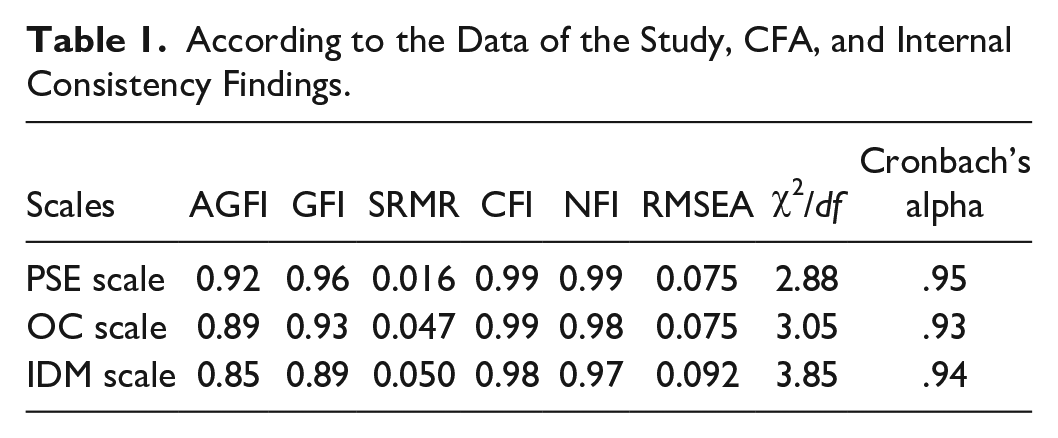
IDM Scale, which was developed by Yıldırım et al. (2019) to reveal the level of IDM in the schools where teachers work, consists of 14 items in total, 4 for individual attitude and 10 for an organizational environment. The scale was chosen because it reveals the IDM degree of teachers as an element of the cultural and structural system in the school social system. The scale explains 68.52% of the variance. The findings of the CFA and internal consistency analysis applied to the scales with the data of this study are presented in Table 1.
According to the Data of the Study, CFA, and Internal Consistency Findings.
Data Collection Process
During the pandemic, data was collected electronically. The researcher interviewed the school administrations where the procedure was carried out, and the link prepared for the collection of study data was shared with the instructors via the school teachers’ social network. The participants were given written explanations about the purpose of the study, their voluntary involvement, and that the data would only be used for scientific purposes. The teachers who consented to participate finished the procedure by filling out the data collection instrument in an electronic environment in a way that did not reveal their identities. The participation percentage of teachers in the study was determined to be 65%.
Data Analysis
Structural Equation Modelling traditional methods (Baron & Kenny, 1986) and modern approaches (Preacher et al., 2007), which are widely used in the analysis of mediation models, were used together. According to Tabachnick and Fidel (2015), since the error is estimated and eliminated in the analysis using SEM, only the common variance remains, and the relationship examined is free from measurement error. Furthermore, SEM is the sole approach that allows for the simultaneous investigation of multiple complex interactions. In this study, covariance-based SEM was utilized since it determines the direction of the relationship between variables based on a theoretical foundation in the research model. The importance of acknowledging the indirect effect using the bootstrap procedure, which is said to generate more effective and valid results than the Sobel test, is emphasized in the current approach. Statistical calculations are performed with different and huge observation sets obtained by repeating the observations in the original data set in this technique. Another benefit of this method is that it makes it possible to achieve more reliable results by adjusting the bias and distortions related to the distribution (Gurbuz, 2019; Hayes, 2018; Preacher et al., 2007; Zhao et al., 2010). Since the direction of the effect (positive or negative) was specified, one-tailed hypothesis testing was applied to test the hypotheses.
When entering the data into the SPSS program, scales that were completely unfilled were removed from the data set. The data entered into the SPSS program were analyzed in terms of missing data, and minimum and maximum values, the detected gaps were examined by revising the appropriate scales, and the errors arising from the data entered into the program were corrected. Total score distributions of all variables were controlled for normality. Skewness and Kurtosis values of the variables to be included in the analysis were respectively −0.763, 0.323 for School Effectiveness; −1.080, 0.659 for Involvement in Decision Making; 1.429, 1.971 for the OC. By examining Mahalanobis’ distance values and scatter diagram matrices (Matrix Scatter) of the variables, it was comprehended that they were close to multivariate normality. The multivariate kurtosis critical value of the data was examined, and it was concluded that there was no serious problem with multivariate normality since this value did not exceed 20 (Kline, 2019). There was no correlation of .80 or more between variables. In the analysis conducted for each model, it was considered that the tolerance value (1 − R2) was higher than .20, the variance inflation factor (VIF) was lower than 10, and the state index (CI) was lower than 30 (Buyukozturk, 2011). It is comprehended from the obtained findings that there is no multicollinearity problem between independent variables.
Findings
In this section, descriptive statistics are provided, and bootstrap analysis has been performed to reveal the compatibility of the designed model with the data set. With the SPSS Statistic 22 program, the correlations between variables and the PROCESS v3.3 extension of this program were strived to disclose whether the mediation relationships were significant in the sample group consisting of 5,000 people, and the findings of the model were presented. In the first stage, descriptive statistics regarding the variables included in the model are presented in Table 2.
Descriptive Statistics Regarding Research Variables.

When Table 2 is reviewed, it is determined that OC is between 1 and 5 points, its arithmetic mean is x̄ = 1.86 and its standard deviation value is .84; IDM is between 1 and 5 points, the arithmetic mean is x̄ = 4.26 and the standard deviation value is .73; PSE is between 1 and 6 points, the arithmetic mean is x̄ = 4.44 and its standard deviation value is 1.06. The arithmetic averages of the variables examined in the study were relatively close to each other in Yakutiye and Palandöken districts. To unveil the relationships between variables, Pearson Product Moment Correlation Analysis was implemented, and the obtained findings are presented in Table 3.
Findings Obtained From Pearson Product-Moment Correlation Analysis.

p < .01.
In the first stage, it was understood that OC had a moderate, negative, statistically significant effect (β = −.581, t = −10.698, p < .01) on PSE. In the second stage, it was observed that OC had a moderate, negative, statistically significant effect (β = −.579, t = −3.108, p < .01) on IDM. At the same time, it was understood that IDM had a moderate, positive, statistically significant effect (β = .783, t = 7.562, p < .01) on PSE. After these three relationships are revealed, the mediation model in which all relationships are defined is tested (Figure 3).

Mediation role of IDM variable (*p < .05 and **p < .01).
Before the model was run, the effect level of OC on PSE was β = −.581 (t = −10.698, p < .01) after running the model, it decreased to β = −.280 (t = −2.45, p < .05). This decrease in the effective coefficient of OC on PSE shows that IDM mediates the effect of OC on PSE. OC explains 58 % of the variance in IDM. OC and IDM explain 48% of the variance on PSE.
The fit indices of the measurement model, research model, and alternative models are given in Table 4.
The Fit Indices of the Measurement Model, Research Model, and Alternative Models.

It is seen that the fit indices of all models are within the limits of acceptable values. On the other hand, there is a similarity between the model used in the research and the alternative model in terms of fit indices.
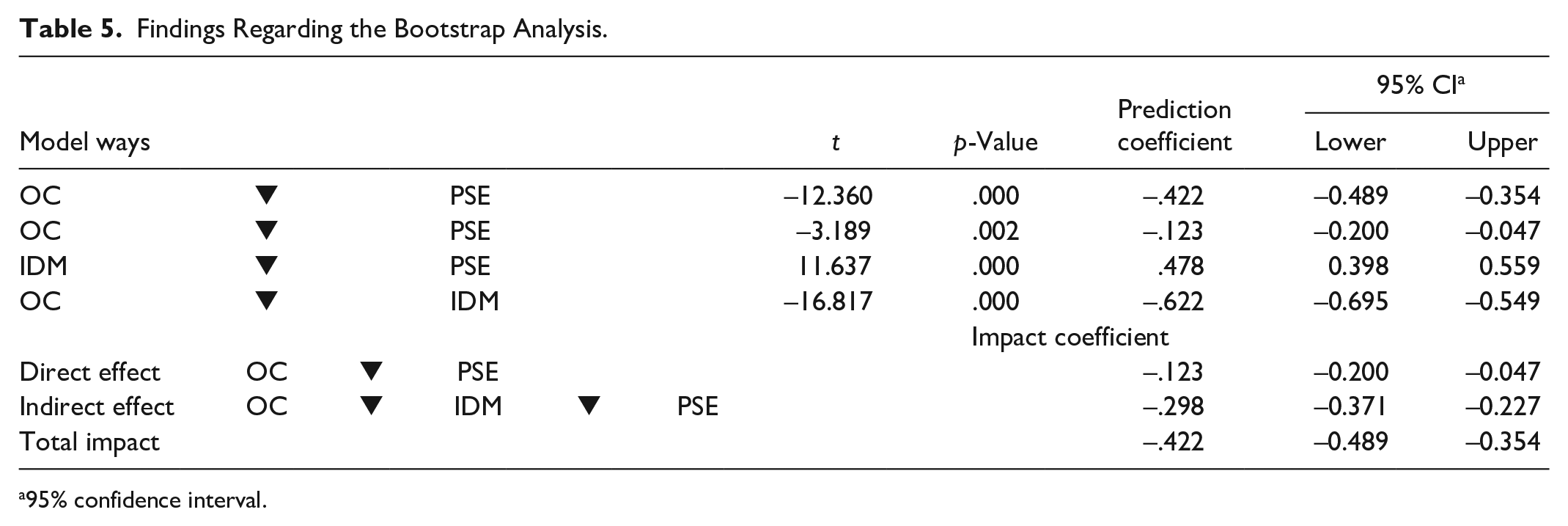
Bootstrap analysis was performed using the Process v3.3 extension of the SPSS statistics program to test the mediation relationship in a sample of 5,000 people and reveal the direct and indirect effect levels of OC on PSE. (Preacher & Hayes, 2008). The achieved values and confidence intervals (G.A.) are presented in Table 5.
Findings Regarding the Bootstrap Analysis.
95% confidence interval.
When the table is examined, the coefficient of OC alone predicting PSE is −.422, statistically significant (95% CI [−0.489, <−0.354]), and when OC and IDM are included in the analysis together, there is a significant decrease in this coefficient (−.123). It is understood that it does not lose its statistical significance (95% CI [−0.200, <−0.047]). This decrease in the predictive coefficient of OC to PSE shows that the mediating effect of IDM in the relationship between OC and PSE was proven in the multiplied sample group of 5,000 people. When the table is examined, the direct effect coefficient of OC on PSE is −.123 (95% CI [−0.200, <−0.047]) and the indirect effect coefficient is −.298 (95% CI [−0.371, <−0.227]) is statistically significant. The total effect coefficient of OC on PSE is −.422, it is statistically significant (95% CI [−0.489, <−0.354]).
Discussion
This study discusses the relationships between the OC, which is considered within the scope of the individual system, IDM as an element of the structural and cultural system, and PSE, which indicates the survival of the organization as the final output of the system.
From the findings of the study, it was comprehended that an increase in OC reflected adversely on PSE indirectly through IDM. In other words, it was understood that OC indirectly affects PSE through IDM. It has been noted that the organizational environment will be more favorable in IDM in schools where the OC is low, and this will positively affect PSE through IDM. In the research, four hypotheses put forward according to the systems approach were also accepted.
First of all, it has been remarked that OC, which is evaluated within the scope of the individual sub-system in the school social system, has a significant effect on PSE. Although it is perceived that Ozgan et al. (2011) reached parallel findings, more empirical evidence is needed. The findings of this study are limited due to the inadequacy of previous empirical studies to support the relationship between OC and PSE. On the other hand, it is acknowledged that OC affects many variables (employee performance, job satisfaction, organizational commitment, organizational trust, school culture, and academic success) related to school effectiveness (Akin, 2015; Arslan, 2018; Chiaburu et al., 2013; Eaton, 2000; Karadag et al., 2014; Wanous et al., 1994). Relationships of OC with these variables within the scope of organizational behavior can be viewed as arguments that support the findings of the study to eliminate this limitation.
The effect of OC, as an element of the individual subsystem, on IDM and PSE (school outcomes) was sought in the effectiveness criteria developed by Mott (1972) based on social system theory. According to him, effectiveness is “the ability of an organization to mobilize its centres of power for action-production and adaptation.” Teachers, on the other hand, are one of the most important power centers that have an impact on adaptation and production in schools. What kind of a way do teachers with high negative attitudes toward the school they work in follow in order not to reflect their energies on school outcomes? The answer to this question has been sought in the relationship between OC and IDM, which is regarded as an element of the structural and cultural sub-system, as one of the internal elements of the school social system.
According to Mott (1972), efficient organizations boost productivity by dealing with internal and external problems more effectively, utilizing flexibility, and delivering high-quantity, high-quality outputs. These are the criteria necessary for organizing the power center of the organization. Teachers who have a negative attitude toward the school they work for and believe that the school lacks integrity are less likely to anticipate school-related problems within the context of symbolic fit. For this reason, their willingness to develop satisfactory solutions to problems will probably be low. Symbolic harmony begins when members of the organization are aware of the problems. People are relatively adaptable if they recognize problems before they seriously affect the organization. But such awareness may not always develop (Mott, 1972). Because these instructors have a negative attitude toward the organization, they may choose to stay passive in the decision-making process at school, even if they have some views about the problems and their remedies. Teachers, who are one of the most important power centers of the organization, may not consciously participate in the decision-making processes at school and may spend their energies on humiliating and critical evaluations of the organization. In addition, it will be at a lower level for these teachers to closely follow new methods and technologies applicable to organizational activities, which is another element evaluated within the scope of symbolic harmony, and to bring them to their schools. Because the teachers’ negative attitudes and ideas about the organization likely cast doubt on the effectiveness of their efforts. This will hurt instructors’ IDM, lessening the symbolic harmony, which is crucial for organizational performance, and thus lowering the quality and quantity of outputs. Smith (2016) discovered a link between teachers’ IDM and their sense of ownership, and that this sense of ownership is vital in education. Much research has emphasized the favorable impact of instructors’ IDM on teacher and school effectiveness (Sarafidou & Chatziioannidis, 2013; Tenha & Mapolisa, 2018).
Katz and Kahn (1977) declared that even though there is no document binding them in the organization, the employees who willingly take vital actions for the survival of the organization are priceless to the organization. Although having fantastic ideas for the organization and offering them to management is not a frequent employee activity, these recommendations can make creative contributions to the development of the organization’s goods and services production. This is because employees are more likely than others to identify constructive solutions to work-related difficulties. If system members follow job descriptions and organizational records word for word, things will quickly fall apart. For the system to thrive, voluntary cooperative acts and many of the expectations of organizational purpose are required. On the contrary, a performance that does not meet expectations can negatively affect organizational effectiveness by developing anti-productive behaviors (Kumar et al., 2021).
More elevated OC rates in schools may decrease school effectiveness by decreasing voluntary cooperation actions (preventing IDM). As a matter of fact, according to Abraham (2000), even the most genuine proactive organizational actions that will contribute to organizational development are frequently questioned by employees with a high level of cynicism, and pessimism is displayed regarding the realization of these actions. In this case, it can be declared that OC can adversely affect the work motivation of other employees as well as individuals with high cynicism levels. OC adversely affects organizational identification (Ayik et al., 2016).
As well as symbolic adaptation, OC can have negative effects on behavioral adaptation, which is another form of adaptation. Behavioral adaptation is related to the speed and prevalence of the acceptance of solutions to the problems that emerge in the organization by the members of the organization (Mott, 1972). It can be predicted that in schools where OC is high, teachers may be reluctant to accept and implement the decisions taken because their IDM will be low. This means that OC also negatively affects behavioral adaptation through symbolic adaptation. In other words, it can be said that IDM (symbolic compliance) decreases in organizations with high OC, and decreasing symbolic harmony will also decrease behavioral adaptation. The decrease in symbolic and behavioral adaptation adversely reflects on the quantity and quality of the products, decreasing the effectiveness of the school. Kim (2021) found that organizational climate has a mediating effect on the relationship between OC and organizational effectiveness. Yildirim et al. (2019) announced a moderate relationship between IDM and OC. According to Smylie (1992), teachers who consider their relationships with school administrators as open, collaborative, facilitating, and supportive (probably in an environment with low OC) are more willing in terms of IDM. Working relationships between teachers and norms influencing these relationships are similarly influential factors in teachers’ willingness to participate in different decision-making areas. In the study administered by Reichers et al. (1997) in an organization, two-thirds of the employees were willing to have a high level of IDM, while only 28% of those classified as cynical showed a high level of willingness to do. When the findings of the study are explained in the light of former studies, it is comprehended that teachers who have a negative attitude toward the school organization they work in, have low efforts to enhance the organizational functioning. The judgmental perspectives of these teachers, who doubt the integrity of the institution, may also be a factor in doubting their competence. Their critical approach and humiliating behavior can undermine their self-confidence, self-esteem, and sense of competence. As the OC levels increase with the effect of negative experiences in the organization, their confident feelings about themselves are likely to decrease. This can be perceived as a factor that adversely affects the organizational environment regarding IDM. Individuals with a high level of OC, which adversely influences the IDM environment, may avoid contributing to the survival of the system, as one of the most significant power centers of the organization. In conclusion, it can be assumed that the increasing OC level in schools prevents teachers from contributing to the development of the school. The negative effect of OC on the effectiveness of the school is demonstrated by the fact that these teachers stay away from IDM in the school, and they do not support any initiative other than job descriptions in matters that will increase the effectiveness of the school. Although it is concluded that the effect of OC on PSE is mediated by IDM, the findings of this study need to be supported by further studies. The lack of similar studies in the literature establishes a limitation in terms of supporting the findings with empirical evidence. The fact that similar studies have not been carried out before, emphasizes the strength of the research in terms of the originality of the findings and results while revealing the weak side of the findings in terms of not being adequately supported by other studies on the same subject. In the literature, some effective school studies are criticized for their weak theoretical foundation. Since this study is structured on the theoretical basis of the school social system, it makes significant contributions to the literature. In addition, the fact that the results guide researchers, practitioners, and policymakers shows the strength of the research. On the other hand, the findings of this study cannot be generalized to cover all cities in Turkey, since it is limited to the central districts of Erzurum, Yakutiye, and Palandöken. In addition, the fact that more than half of the participants of this study are women, and that teachers with 6 to 10 years of professional experience constitute the largest (32%) group are issues that should be taken into account in the interpretation of the findings.
Conclusion
In this study, it was understood that negative attitudes toward the school would reduce the participation of teachers in the decision-making process at school. It was concluded that the low level of participation in the decision-making process prevented the teachers from producing solutions to the problems arising from the internal and external environment of the school, the speed of acceptance of the solutions produced and their spread. It has been understood that in schools where organizational cynicism is in question, all teachers’ existing talents and creativity are not sufficiently utilized for the development of schools. On the other hand, not making use of the capacity of teachers decreased the perceived effectiveness of the school.
Recommendations
Secondary school administrators, who have a critical role in affecting the structural and cultural system in the school social system, should know the negative effect of OC on IDM and the indirect effect of IDM on reaching the purposes of the school. School administrators who strive to produce a suitable environment for middle school teachers’ IDM should not forget they need regulations and practice that will decrease the perception of cynicism in teachers. Consequently, it can be recommended that middle school administrators be notified about the attitudes and behaviors that will be effective in the development of OC. Keeping the OC at a low level in secondary schools will allow the organizational environment to become more suitable for IDM, and teachers to use their energy and qualities for the effectiveness of the school. School administrators can support teachers to recognize the difficulties they encounter in school on time and produce solutions by making efforts to create a school culture and organizational structure that will prevent the development of OC. In schools with low OC, teachers can notice the difficulties more promptly. Teachers (symbolic adaptation) who produce suitable solutions to these rapidly noticed problems can contribute to the effectiveness of the organization by involving in decision-making processes. The speed of teachers participating in the decision-making process to accept solutions to school problems and their contribution to the spread of this solution will increase (behavioral adaptation), which will contribute to organizational effectiveness.
Researchers should review whether the symbolic adaptation has a mediating role in the relationship between IDM and behavioral adaptation, which is one of the criteria of school effectiveness. Due to the powerful negative relationship between them, it should be examined whether OC can be used as a determinant alongside other variables in revealing school effectiveness. By repeating the study on various scales and samples (high school and primary school), the findings can be discussed, acknowledging the findings and results of this study. In line with the findings, more extensive generalizations can be performed or the limits of the research findings can be narrowed. On the other hand, some procedures can be generated by politicians to prevent the precursors and effects of OC in schools. Hence, more proper conditions will be provided for the practitioners to achieve the desired results.
Footnotes
Declaration of Conflicting Interests
The author declared no potential conflicts of interest with respect to the research, authorship, and/or publication of this article.
Funding
The author received no financial support for the research, authorship, and/or publication of this article.
