




Abstract
This study investigates the role of employee cynicism and perceived organizational politics in deceptive knowledge-hiding behaviors (evasive hiding and playing dumb). Besides, this work aims to measure the mediating role of psychological distress between employee cynicism, perceived organizational politics, and deceptive knowledge-hiding behaviors. Using a time lag strategy, the data were collected in three waves from 478 employees working in research and development institutions in Pakistan. A structured questionnaire and PLS-SEM technique were employed for data collection and analyses. The results indicate that employee cynicism and perceived organizational politics significantly promote playing dumb behavior in employees. Employee cynicism has no significant association with evasive hiding. However, perceived organizational politics promotes evasive hiding. Psychological distress as a mediator supports employee cynicism and perceived organizational politics to develop deceptive knowledge-hiding behaviors. The outcomes of this research have significant implications for organizations, especially for research and development departments. Putting down the cynicism level among employees and controlling the organizational politics can motivate the employees to share knowledge and avoid deceptive knowledge hiding. Managers with positive signals can rebuild trust with subordinates and encourage them to be involved in knowledge-sharing activities. The findings of this study could also serve the theory and practice by showing how employees act psychologically when they are cynical and think their company is playing politics.
Plain Language Summary
This study investigates the relationship between employees’ cynicism, POP, and DKH (playing dumb and evasive hiding) behaviors. Further, this study measures the mediating role of psychological distress between employees’ cynicism and POP and DKH behaviors. This research considers public sector research and development (R&D) institutes in Pakistan for data collection to analyze the projected relationships. The findings show a significant correlation between employee cynicism, POP, and playing dumb. Employee cynicism has no substantial association with evasive hiding. However, POP has a significant connection with evasive hiding. Besides, psychological distress significantly mediates between employee cynicism and POP and DKH behaviors. The current investigation suggests that firms should establish a climate where decisions are rendered without prejudice or favoritism. Moreover, organizations should encourage a culture of information sharing at the organizational level by strengthening the internal communication system inside the company. Further, the findings recommend encouraging employees to share knowledge and avoid DKH behaviors by lowering employee cynicism and managing organizational politics.
Keywords
Introduction
Human capital is an important strategic asset of organizations and plays a significant role in the organization’s success (Okunade et al., 2022). Employees’ knowledge-sharing behavior helps sustain their organizations’ competitive advantage. Organizations know the significant role that their physical and intangible assets assume in sustainability (King & Grace, 2010). Scholars further noticed that companies strive to identify advantageous strategies for outperforming rivals and prioritizing the needs and preferences of customers (Alsharif et al., 2023; Alsharif, Md Salleh, & Khraiwish, 2022; Alsharif, Salleh, et al., 2022). Organizations use human capital (i.e., skills and knowledge) as a strategic tool to secure their share in the markets. However, a weak knowledge-sharing culture and the existence of knowledge-hiding behaviors can promote a negative workplace environment and decrease organizational performance. Organizations put their efforts into strengthening internal communication systems for effective knowledge dissemination at the workplace (Erkmen, 2018). The exchange of knowledge and expertise at work may improve team and individual performance and constitute the foundation of a company’s intellectual wealth (Ahmed et al., 2022). Duan et al. (2022) observed that although organizations’ efforts of knowledge sharing ripen over time, how to deal with employees’ deceptive knowledge-hiding (DKH) behavior is still a big question mark. DKH is the extent to which employees intentionally hide or conceal the knowledge requested from their colleagues at the workplace (Connelly et al., 2012; Duan et al., 2022). Connelly et al. (2012) categorized employees’ knowledge-hiding behaviors into evasive hiding, playing dumb, and rationalized hiding. However, Venz and Nesher Shoshan (2022) acknowledged that evasive hiding and playing dumb are two forms of DKH, while rationalized concealment may not be considered an ethically unacceptable kind of cheating (He et al., 2023). Zhao et al. (2023) further shed light on DKH behavior and said that evasive hiding and playing dumb are morally wrong ways to hide information because they go against moral rules.
DKH may develop in employees as an outcome of different determinants at the individual and team levels (Siachou et al., 2021). For instance, employees may withhold knowledge due to a breach of their trust by the organization (Aljawarneh & Atan, 2018). A frequent violation of trust by the employer makes the employees cynical. An employee’s negative or passive behavior toward his employer is denoted as employee cynicism (Chiaburu et al., 2013). Zeidan et al. (2022) explained that employees’ job commitment and satisfaction decrease when they feel cynical about their employer. Consequently, cynic employees may adopt different counterproductive behaviors such as DKH. According to Aljawarneh and Atan (2018), employee cynicism can promote DKH behaviors in employees. Similarly, a negative perception of employees regarding organizational politics also persuades them to adopt negative behavior like knowledge hiding (Malik et al., 2019). Perceived organizational politics (POP) can be a precursor of employees’ DKH behaviors (Malik et al., 2019). There are three reasons for DKH after perceiving organizational politics at the workplace (Aljawarneh & Atan, 2018; Malik et al., 2019; Webster et al., 2008). First, employees may want to protect their self-interest by engaging in DKH. Second, employees may want to gain a political advantage by engaging in DKH. Third, employees may adopt DKH behavior as a defensive behavior to retaliate against organizational politics. Aljawarneh and Atan (2018) and Malik et al. (2019) explain POP and employee cynicism as a motivator to adopt DKH behaviors by the employees.
Employees’ psychological health and creative abilities may be affected due to cynicism and POP (Hussain & Shahzad, 2022). Therefore, Jindo et al. (2020) explain that employees may experience psychological distress at the workplace when they feel cynicism and POP. Psychological distress refers to unpleasant emotional experiences due to psychological instability or mental health disorders (Duong, 2022). Psychological distress in employees is an alarming situation for the organization as it severely impacts employees’ creative abilities and productivity (Ridner, 2004). Psychological distress may also develop negative intentions in employees toward employers and colleagues, such as DKH behavior. Hence, psychological distress may yield the impact of cynicism and POP and pass it on to DKH behaviors.
This study has picked the coin of DKH tossed by Venz and Nesher Shoshan (2022) and tried to verify employee cynicism and POP as two critical determinants of DKH proposed by Aljawarneh and Atan (2018) and Malik et al. (2019), respectively. Besides, this study has also investigated the mediating role of psychological distress, as Jindo et al. (2020) pointed out that the ignored employees (cynics) and POP victims experience psychological distress, leading to DKH behaviors. Drawing on social exchange theory (SET) (Blau, 1964) and conservation of resources (COR) theory (Hobfoll, 1989), this study proposes that negative experiences (Cynicism and POP) of employees persuade them to respond negatively by saving their assets or resources such as DKH behaviors. Besides, psychological distress (mediator) as an outcome of cynicism and POP enhance the DKH behaviors of employees.
Previous studies have used the knowledge-hiding phenomenon collectively or all three dimensions simultaneously while determining its precursors and consequences (Akhlaghimofrad & Farmanesh, 2021; Anand et al., 2023). However, the current study serves the literature by exclusively focusing on employees’ deceptive behaviors of knowledge hiding. The current work is also serving the literature by investigating the impact of employee cynicism and POP on DKH behavior. According to the authors’ knowledge, this is the first study that deals with the employees’ deceptive nature of knowledge hiding due to cynicism and POP. The objectives of this study are threefold. First, we need to understand the concept of DKH behavior and differentiate this concept from the term knowledge hiding in general. Second, to understand the association between employees’ cynicism and POP and DKH. Third, to determine the mediating role of psychological distress between employees’ cynicism and POP and DKH behaviors. This paper has the following research questions to seek the above-mentioned objectives. First, what is DKH behavior, and how does it differ from the term knowledge hiding? Second, how do employees’ cynicism and POP impact DKH behaviors? Third, how psychological distress mediates the association between employees’ cynicism and POP and DKH. This study analyzed the data collected from Pakistan’s public sector research and development (R&D) institutes for empirical investigation. The rationale behind the selection of R&D institutes was the existence of employees’ cynical behaviors and POP (Aslam et al., 2015; Bakari et al., 2018; Sajid et al., 2011) and the involvement of employees in knowledge creation and innovative activities while working in R&D institutes.
Literature Review and Hypotheses Development
Deceptive Knowledge Hiding
Islam et al. (2021) noticed that knowledge sharing is continually promoted at all levels in this knowledge-intensive era; however, knowledge-concealing behavior is also rising. Organizations believe that knowledge-sharing behavior among employees helps to manage organizational activities more efficiently and smoothly (Nguyen et al., 2022). Organizations provide resources and undertake initiatives to incentivize staff to engage in knowledge-sharing activities (Issac & Baral, 2018). However, organizations cannot force employees for knowledge sharing (Connelly et al., 2019). Therefore, employees may hide their knowledge as a reactionary measure against the organization or coworkers. Intentional concealment of knowledge is denoted as knowledge hiding (Siachou et al., 2021). Recent studies have shown that most companies fail to meet their objectives due to their workers’ tendency to conceal information (Chaudhary et al., 2023; Fauzi, 2023; Islam et al., 2022). Knowledge hiding has three dimensions: rationalized hiding, evasive hiding, and playing dumb (Connelly et al., 2012). Rationalized hiding is reason-based hiding, not deceptive-based hiding. On the contrary, evasive hiding involves partial knowledge hiding or making a fake promise to provide information in the future, which is a deception. Similarly, in playing dumb, the knowledge holder ignores the request and avoids sharing knowledge. Venz and Nesher Shoshan (2022) treated evasive hiding and playing dumb as DKH and considered more damaging forms of hiding than rationalized hiding.
Nguyen et al. (2022) referred to several reasons behind KHB. For example, employees may conceal knowledge to get an advantage in their careers, perform well compared to their peers, receive favorable evaluations, and their market value, etc. (Nguyen et al., 2022; Siachou et al., 2021). The workers may also be involved in DKH as a reaction against mistreatment, injustice, or ostracism-based behaviors of their coworkers/management (Fatima et al., 2024). Employees may also adopt DKH in response to specific interpersonal conflicts faced in the workplace (Venz & Nesher Shoshan, 2022). The DKH has adverse outcomes such as decreased creativity, work effectiveness, and innovative performance (Hilliard et al., 2022; Yang et al., 2023). Siachou et al. (2021) explained that DKH affects both employees (emotional exhaustion, deviant work behaviors, and limited innovative abilities) and organizations (decrease in effectiveness, quality of work, productivity, and damaging operations).
Employee Cynicism and Deceptive Knowledge Hiding
Hussain and Shahzad (2022) described employee cynicism as an unfavorable emotional reaction, a persistent feeling of mistrust, dissatisfaction, and irritation in a person’s personality toward other employees and employers. Cognitive, affective, and behavioral cynicism are the three basic dimensions of cynicism (Murad et al., 2021). The signs of cognitive cynicism include employees’ lack of commitment, trustworthiness, and faith in the firm. Affective cynicism includes trouble, shame, anger, and disrespect toward others, and signs are stress and worry. Behavioral cynicism means employees’ responses against the result of a negative experience at the workplace (Alsubaie & Nasaani, 2021). Qian and Daniels (2008) presented two components of cynicism, namely personal attributes (personality traits) and situational attributes (associated with society, institutions, and occupations). According to Quratulain and Al-Hawari (2021), cynicism is a persistent characteristic that responds consistently to many environmental stressors and expresses a pessimistic view of human nature. Zeidan et al. (2022) shed further light and said that a cynical perspective of human nature is defined by mistrust, disappointment, and an indifferent and selfish approach toward the social environment. Additionally, people naturally develop cynical ideas due to their own life experiences and through the socialization process in a particular domain. The intensity of each person’s cynicism varies because of the variety of life events and sociocultural situations they are exposed to (Rubin et al., 2009).
Ugwu et al. (2023) noticed that when an employee is cynical, they think their company is usually not telling the truth. Employees typically establish a psychological contract that describes what they expect from their job and company (Bashir et al., 2021). Moreover, employees can act cynically when the organization gives up on mutual agreement to achieve its self-serving goals. Cynical employees feel exhausted and become the victims of chronic stress. Aljawarneh and Atan (2018) explained that cynical workers tend to be frustrated and distrust their management and colleagues through counterproductive behaviors such as DKH. Chiaburu et al. (2013) discussed that psychological contract violation, organizational politics, psychological stress, and negative behaviors of peers develop cynicism in employees’ behavior. Cynic employees may behave unethically in their workplace and refuse to cooperate with others (Nguyen et al., 2022). Cynicism may result in undesirable consequences and destructive emotions, including dissatisfaction with their jobs and coworkers. Cynic employees develop a sense of negativity and counterproductive work behavior toward their firms and colleagues (Aljawarneh & Atan, 2018). Nguyen et al. (2022) point out that employees’ cynicism leads to developing a negative attitude toward work, and in reaction, they start to deceive coworkers.
Employees with high cynicism are likelier to engage in DKH (Jiang et al., 2019). The employees with a high level of cynicism perceive that organizations and their supervisors don’t bother about their issues and problems at the workplace. Aljawarneh and Atan (2018) concluded that cynical workers are more inclined to participate in DKH. This study uses COR theory to explain the association between employee cynicism and DKH. Quratulain and Al-Hawari (2021) acknowledged that according to COR theory, people spend their valuable resources (knowledge and expertise) to acquire new resources or replace lost ones. Cynic employees attempt to hide their valued resources (knowledge and expertise) in retaliation for negative behavior they experienced at the workplace. Interpersonal conflicts, job uncertainty, and cynicism are a few examples of the risks of knowledge-hiding behaviors. Drawing on the COR theory, employees are motivated to hide knowledge when they want to defend their valued resources at the workplace (Nguyen et al., 2022). Based on the above discussion, this study hypothesized that
H1: Employee cynicism has a positive association with evasive hiding
H2: Employee cynicism has a positive association with playing dumb
Perceived Organizational Politics and Deceptive Knowledge Hiding
Malik et al. (2019) defined POP as a subjective assessment of an individual regarding the self-serving behavior of his peers and managers at the workplace with other colleagues. Reciprocally, POP affects a person’s work attitude and behavior (Jeong & Kim, 2021). A high level of POP fosters interpersonal conflict and mistrust among employees (Karim et al., 2021). The employees feel that their organizations are prejudiced and discriminating when they experience a highly politicized workplace environment. Atta and Khan (2016) divided the term POP into three dimensions: general political behavior, go along to go ahead, pay, and promotion. General political behavior refers to self-serving actions by organizational members to achieve desired results. The go along to go ahead relates to individuals’ passive and inactive behavior to attain one’s aims. The pay and promotion indicate one’s perception of injustice about the organization’s compensation and incentive policies (Karim et al., 2021).
O’connor and Morrison (2001) presented different situational and dispositional determinants that deeply affect individuals’ perceptions regarding organizational politics. The hierarchical level, job autonomy, and formalization are essential situational factors that might influence whether an employee thinks his or her organization is political. Additionally, gender, locus of control, and Machiavellianism are significant examples of dispositional determinants. These factors interact with other organismic and psychological aspects to affect the individuals’ perception of organizational politics (Sultan et al., 2015). It is tough to maintain a positive reciprocal relationship between an employer and employees after the development of the political perception of the organization in employees (Kiewitz et al., 2009).
The employees apply POP as a criterion while measuring the organization’s behavior with them. Harris et al. (2007) explained that employees’ perception of the workplace shapes the behaviors of the employees at the workplace. Therefore, when employees experience a high degree of POP, they feel a high level of ambiguity, tension, and confusion since they are uncertain about what behaviors will be rewarded or recognized. Malik et al. (2019) discovered that workers might get dissatisfied and exhausted in deep-routed political environments; as a reaction, they may adopt silence and avoid sharing knowledge with their colleagues and the organization. According to Karim et al. (2021), employees in a highly politicized environment are mostly involved in self-serving activities and disregard the interests of others, which promotes interpersonal conflict and distrust among employees. Employees’ social interactions weaken with their peers in a political environment, and they develop counterproductive work behaviors such as DKH.
According to SET, social bonds between people rely on mutually beneficial social assistance (Blau, 1964). Based on the SET, this study assumes that when workers believe they are being treated appropriately by a firm without prejudice, they want to return the favor. On the other hand, employees will respond by intensifying negative or reducing positive feelings toward the firm if they feel that their organizations are unfavorably treating them (Atta & Khan, 2016). Karim et al. (2021) noticed that when individuals are exposed to a highly politicized work environment inside organizations, their social connections with colleagues tend to diminish, resulting in the emergence of DKH. Additionally, employees tend to hide their knowledge and expertise when they perceive that their organizations treat workers on a political basis rather than a performance basis. Based on the arguments of previous studies, this study considers that POP is a crucial determinant of DKH. Hence, this study hypothesized that.
H3: POP has a positive association with evasive hiding
H4: POP has a positive association with playing dumb
Mediating Role of Psychological Distress
Ridner (2004) clarified that psychological distress differs from similar terms like stress, strain, and distress. Psychological distress is a particularly uncomfortable emotional state that a person goes through temporarily or for a long term. Duong (2022) describes psychological distress as an undesirable emotional state with various antecedents, including worry, panic, and psychological instability. Psychological distress, such as anxiety, melancholy, anger, self-consciousness, and emotional vulnerability, negatively impacts physical illness and life expectancies (Winefield et al., 2012). Islam and Chaudhary (2024) point out that emotionally drained people are more prone to act out their negative feelings by participating in aggressive and abnormal behaviors in the workplace, such as knowledge concealment. Psychological distress has five significant characteristics (Ridner, 2004). First, psychological distress is an individual’s perception of failure in which they perceive that a stressful situation cannot be handled. Second, psychological distress is a variation in emotional status. When people are under psychological distress, their emotional state may shift from stable to anxiety, sadness, demotivation, restlessness, and aggression. Third, psychological distress is a state of misery individuals experience when dealing with psychological distress (Montgomery & McCrone, 2010). Fourth, psychological distress is also called communication of discomfort. People may express their discomfort in various ways depending on the mental or physical changes brought on by psychological distress. Fifth, psychological distress is also known as harm. Anasori et al. (2021) stated that when individuals experience psychological discomfort, they may experience damage in the form of disrupted social relationships, lower self-esteem, and reliance.
Psychological distress, burnout, and depression are the three most prevalent mental health concerns that emerge in the workplace (Anasori et al., 2021). However, Mubarak et al. (2022) revealed that psychological distress is more critical as it drains individuals’ cognitive resources. Psychological distress harms employees’ cognitive resources, impairing productivity and workplace performance. Duong (2022) noticed that psychological distress impacts workers’ ability to perform essential tasks. Moreover, employees with psychological damage suffered in their personal and professional lives (Ridner, 2004). According to Jindo et al. (2020), when employees are treated disrespectfully and cynically at the workplace, they may experience psychological distress. Individuals with prolonged exposure to work pressures often show cynic behavior in the workplace (Emerson et al., 2023). Additionally, employees feel psychological distress, and their level of self-efficacy declines due to cynical behavior in the workplace.
Workers often experience unpleasant mental states that could be termed psychological distress when confronted with cynicism at work (Guo et al., 2020). Tu et al. (2021) also argued that cynic individuals often experience psychological distress, which has a detrimental impact on their level of productivity. Furthermore, psychologically distressed workers may conceal information and show DKH behavior to save their limited resources. In line with COR theory, people who are threatened with or experience a loss of resources feel psychological pressure to defend and hold onto their valued resources (Guo et al., 2020). Following this line of reasoning, this study contends that employee cynicism can deplete employees’ highly valued resources and lead to negative psychological effects in the form of psychological distress, which will then lead individuals to take DKH behavior as a preventive measure. On the basis of the above discussion, the current study hypothesized that.
H5: Psychological distress mediates the relationship between employee cynicism and evasive hiding
H6: Psychological distress mediates the relationship between employee cynicism and playing dumb
Karim et al. (2021) acknowledged that the politicized work environment damages employees’ psychological and emotional health. Additionally, POP is a root cause of several unfavorable employment outcomes, for example, interpersonal conflicts, intentions for quitting, victim silence, and counterproductive work behaviors. Notably, a higher level of POP encourages emotional exhaustion and psychological distress (Chen et al., 2022). In addition, Malik et al. (2019) noticed that employees who experience a higher level of POP show counterproductive work behavior in the form of DKH. Under the SET, POP often fosters a feeling of injustice and negatively impacts employee performance, which is expected to deteriorate the exchange relationship. In a weak social exchange connection, employees feel isolated from one another because they are more prone to regard themselves as inferior or unproductive social exchange partners. The current study seeks help from SET to explain the phenomena of POP. The idea of reciprocity is the foundation of SET (Blau, 1964). The equivalent exchange of favorable or unfavorable commitments between the parties is called the principle of reciprocity. When employees experience psychological distress because of colleagues’/organizations’ politicized workplace behavior, they get motivated to protect their resources by adopting negative behaviors such as DKH. Hence, this study builds hypotheses as follows, and the research framework for the study appears in Figure 1.
H7: Psychological distress mediates the relationship between POP and evasive hiding
H8: Psychological distress mediates the relationship between POP and playing dumb

Study model.
Methodology
Sample and Data Collection Procedure
This study collected sample data from employees working in R&D institutions in Pakistan. This study focused on R&D institutions because this industry is thought to be a hub for innovation and knowledge production. According to Xiong et al. (2021), knowledge-hiding phenomena often occur in R&D institutions where team members may harbor mistrust or purposely avoid collaborating on projects. Therefore, R&D institutions were quite suitable to evaluate the phenomena of DKH behavior. Currently, more than 100 R&D institutions in different domains are working in Pakistan (Akhter, 2018). Authors approached these R&D institutes in Pakistan; however, only 12 institutes involved in various R&D activities in different industries agreed to participate. This study collected data from the employees working in these 12 institutes at different positions using a convenience sampling technique. It was ensured that every respondent should be involved in knowledge sharing, creation, transfer, or innovative activities. A structured questionnaire was used to collect the data. Before conducting the survey, permission was taken from the focal persons of the respective institutes. Therefore, only those employees who participated in this study survey whose institutes allowed them to participate. The School of Management and Economics, Beijing Institute of Technology, reviewed and approved this study. After getting the implied consent from each respondent, the questionnaire was sent to them via email and in person with the information mentioned in the cover letter. First, there is no right or wrong answer, and it’s just your perception regarding the phenomenon. Therefore, answer the questions rationally. Second, all responses will be collected anonymously, and collected data will be used for analyses and reporting. Third, as a consideration, it was promised that the results of this study would be shared with them at their respective supervisors’ request. These precautionary measures assisted in minimizing social desirability (Spector, 2006). The participants were contacted through emails/physical visits and got a generous response from 700 employees.
The data were gathered using a time lag method to control the problem of common method bias (Ahmed & Islam, 2022). The questionnaire was divided into three waves. In wave 1 (W-1), the link of the questionnaire on independent variables (employee cynicism, POP) and demographics was sent to 700 workers. However, only 591 respondents completed the survey. In the second wave (W-2), with a gap of 45 days, the link of the questionnaire on dependent variables (evasive hiding, playing dumb) was distributed among 591 respondents and received 550 responses. In the third wave (W-3), with a gap of 45 days, the link of the mediating variable (psychological distress) questionnaire was shared with 550 respondents, and 478 complete responses were received. The attrition rate in three waves (W-1, W-2, W-3) is mentioned in Table 1.
Respondents’ Attrition Rate.

Harman’s single-factor test using the software SPSS-22 is applied to test the data’s common method variance (CMV). The analysis of the Harman single factor is a post hoc strategy for examining whether a single factor is a reason for DKH in the data set (Podsakoff et al., 2003). The result sheet (Principal Component Analysis and extraction Method) described 34 different components. Only 40.03% of the data set’s variation was accounted for by the first unrotated component (see Appendix 1). As per the criteria, the two expectations were not fulfilled. First, the first factor only partially explained the variation. Second, no single factor developed from the data set of this study. Hence, CMV is not a problem; the data set is fine for analyses (Bari et al., 2020).
Measurements
The responses to this study were put together using a 5-point Likert scale, with 5 being the strongest agreement and 1 being the strongest disagreement for DKH (evasive hiding and playing dumb), employee cynicism, and POP. While the psychological distress scale ranges from 1 (none of the time) to 5 (all of the time). Complete study instruments are provided in Appendix 3.
Deceptive Knowledge Hiding
DKH (evasive hiding and playing dumb) was measured by adopting the scale developed by Demirkasimoglu (2016). The DKH includes evasive hiding and playing dumb (Venz & Nesher Shoshan, 2022).
Evasive hiding: The four items were used to measure evasive hiding. For instance, “when someone asked for some information, I offered him/her some other information instead of what he/she wanted.” The alpha value is .905.
Playing dumb: Playing dumb was measured by using four items. For example, “when someone asked for some information, I pretended that I did not know, even though I did.” The alpha value is .827.
Employee Cynicism
An 8-item scale developed by Kuo et al. (2015) was used to gauge employee cynicism. The components of employee cynicism are scored on a 5-point Likert scale, with 5 being the strongest agreement and 1 being the strongest disagreement. A sample item is “In the place/company I work for, some colleagues deliberately criticize or sneer at others.” The alpha value is .897.
Perceived Organizational Politics
POP was measured using a 12-item scale developed by Kacmar and Carlson (1997). For instance, “Favoritism, rather than merit, determines who gets good raises and promotions around here.” The alpha score is .931.
Psychological Distress
A 6-item scale developed by Dadfar et al. (2016) was used to evaluate psychological distress. For example, “During the last 30 days, how often did you feel nervous.” The alpha value is .917.
Application of Statistical Tool
The variance-based partial least squares structural equation modeling (PLS-SEM) method was employed in the current study to analyze the data. The PLS-SEM is a widely used technique for examining the intricate interactions between observable and latent variables (Sarstedt et al., 2022). Additionally, PLS is a composite-based method for SEM that emphasizes foresight when estimating complicated models with structures intended to give causal justifications (Hair, Sarstedt, & Ringle, 2019). The PLS-SEM approach provides researchers with significant model specification freedom, such as when evaluating conditional process models (Sarstedt et al., 2022). Both confirmatory and exploratory investigations could be successfully conducted using the PLS-SEM (Hair et al., 2012). The PLS-SEM analyzed the data in two different parts: the first, the measurement model, and the second, structural model evaluation. The rationale behind choosing PLS-SEM for this study is its equal appropriateness for the complicated and multi-order-based model (Hair, Risher, et al., 2019). PLS-SEM smoothly and effectively performs small data analyses (Hair, Sarstedt, & Ringle, 2019). Moreover, in data analysis, PLS-SEM measures all loadings and path coefficients of data. This study analyzed the data through the Smart PLS 3 software.
Results and Analysis
Respondents’ Detail
The demographic information of 478 respondents is described in the table (see Appendix 2). This information included age, gender, education, and respondents’ experience.
Model Measurement
The details of the model measurement are presented in Table 2. This study model comprises five variables and 34 items. At the measurement stage, model composite reliability (CR), average variance extract (AVE), and convergent validity are measured. Cronbach’s alpha approach is used to measure the reliability of the model. Hair et al. (2016) state that Cronbach’s alpha values of .7 or higher are considered reliable. The CR, AVE, and factor loadings techniques are used to assess the convergent validity of the current study mode (Hair, Sarstedt, & Ringle, 2019). As per scholars’ recommendations, the values of the CR and AVE constructs should be higher than 0.7 and 0.5, respectively (Hair et al., 2016). Table 2 demonstrates that all CR and AVE values meet the required standards. The factor loading values of all items are higher than 0.7 as per criterion except for one item, EC7 (0.699).
Model Measurement.

The study used the Fornell–Larcker criterion and the heterotrait–monotrait (HTMT) ratio to assess the discriminant validity of the model. According to Fornell and Larcker’s (1981) criterion, the values of AVE after taking the square root of each construct should be placed in a way that the top value of each column must be higher than the other values from the same column (Hair, Sarstedt, & Ringle, 2019). Fornell Larcker criterion confirms the discriminant validity of the model as the top value of each column is the highest of the remaining ones (Table 3). Experts believe that the values of HTMT ratios should be less than 0.85. The results should be less than 0.85; however, values up to 0.90 are acceptable (Hair et al., 2016). Table 3 depicts that the values of HTMT ratios are within the recommended criteria.
Discriminant Validity.
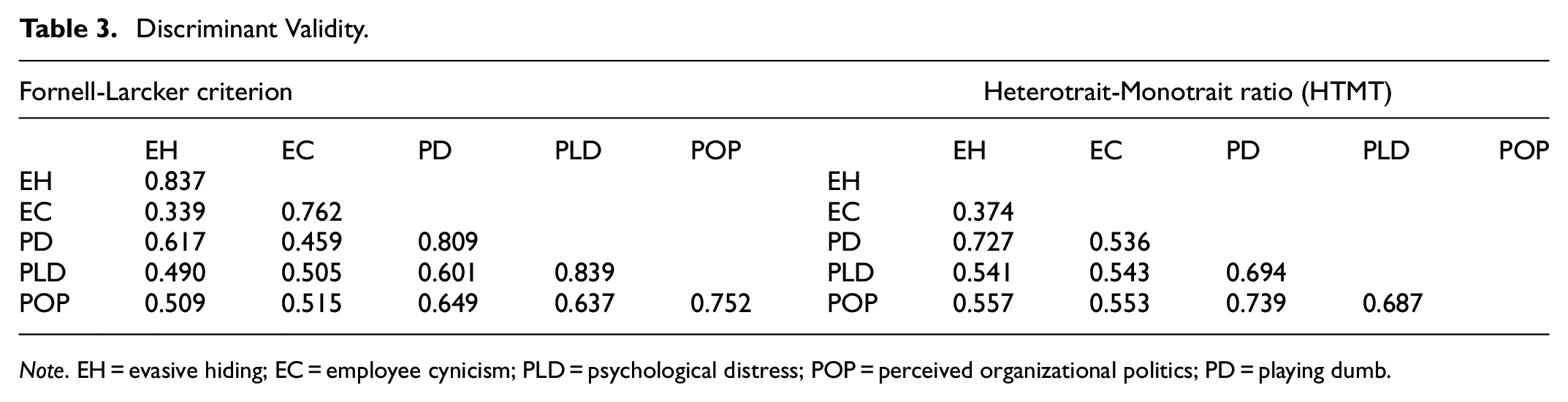
Note. EH = evasive hiding; EC = employee cynicism; PLD = psychological distress; POP = perceived organizational politics; PD = playing dumb.
The variance inflation factor (VIF) values were employed in the current study to assess the model robustness and collinearity problems. According to experts, VIF values are considered satisfactory if the values are less than 5 (Hair, Sarstedt, & Ringle, 2019; Bari et al., 2023). The current investigation results show that constructions’ inner VIF values range from 1.341 to 3.204, indicating no collinearity problems with the data. The F2 (effect size) values were used to verify inclusive information of the degree of variance in the endogenous and exogenous factors in the SEM model. The present study’s constructs have medium to high F2 values, demonstrating the model’s robustness (Hair, Sarstedt, & Ringle, 2019). The R2 values above 5 indicate a substantial model, specifically in primary data (Bari et al., 2020). In Figure 2, the values of R2 of all exogenous variables are near .5, which is a positive indicator for a good model (Hair et al., 2016). Additionally, each latent variable has a Q2 (cross-validated redundancy) value greater than zero, strongly indicating the model’s usefulness (Hair et al., 2011).

Structural model.
For the confirmation of hypotheses and significant level between variables, a bootstrapping approach was applied in the current study, comprising 5,000 random samples with replacement (Hair et al., 2012). Table 4 explains that there is no significant link between employee cynicism and evasive hiding (β = .040, p = .448). Therefore, H1 is unsupported as it does not satisfy the significance level (p < .05). On the other hand, the findings indicate a considerable link between employee cynicism and playing dumb (β = .102, p = 0.031), which means H2 is accepted as it achieves the required criterion (p < .05). Similarly, Table 4 depicts a significant association between POP and evasive hiding (β = .318, p = .000) and between POP and playing dumb (β = .414, p = .000). Therefore, H3 and H4 are accepted as they fulfill the required criterion (p < .05).
Direct Relationship.

Note. EH = evasive hiding; EC = employee cynicism; POP = perceived organizational politics; PD = playing dumb.
The present investigation used the VAF (variance accounted for) approach to check the mediating level of psychological distress between employee cynicism, POP, and deceptive knowledge hiding (evasive hiding and playing dumb). According to the VAF approach, values more than 80% indicate full mediation, equal to or higher than 20% indicate partial mediation, and less than 20% indicate no mediation. Table 5 shows that psychological distress partially mediates the association between employee cynicism, POP, and deceptive knowledge hiding (evasive hiding, playing dumb). Therefore, H5, H6, H7, and H8 are accepted; however, it is interesting to note that psychological distress has created the highest mediating effect between employees’ cynicism and evasive hiding, while they have no significant direct association (Table 4).
Indirect Relationship.

Note. EH = evasive hiding; EC = employee cynicism; PLD = psychological distress; POP = perceived organizational politics; PD = playing dumb.
Discussion
Human capital is essential for firms to differentiate themselves in the market (Okunade et al., 2022). Organizations acknowledge the importance of employees’ unique skills, knowledge, and energies to create a healthy knowledge-sharing culture at the workplace. Duan et al. (2022) observed that although organizations’ efforts for a knowledge-sharing culture ripen over time, dealing with employees’ deceptive knowledge-hiding (DKH) behavior remains a complex query. Therefore, the present research is an effort to address this gap. Drawing on social exchange theory (SET), this study examined the association between employee cynicism, perceived organizational politics (POP), and DKH behaviors in organizations. For empirical investigation, this study hypothesizes that employees’ cynicism and POP have positive associations with DKH (evasive hiding and playing dumb). Secondly, this paper determines the mediating role of psychological distress in the relationship between employee cynicism, POP, and DKH (evasive hiding and playing dumb) behaviors. The impact of employee cynicism and POP on DKH and including psychological distress as a mediating element are the main contributions of this study that set it apart from previous research. This approach contributes to theoretical knowledge of workplace dynamics and offers valuable insights for businesses looking for specific methods to promote a safer, more open, and employee-focused workplace.
The outcomes of this study reveal that the first hypothesis is not accepted, which means employee cynicism is not directly associated with evasive hiding. However, these findings contradict previous studies (Akhlaghimofrad & Farmanesh, 2021; Aljawarneh & Atan, 2018; Nguyen et al., 2022). The reason behind this inconsistency may be the employees’ intellectual level. Cynicism develops when employees perform their duties effectively, or sometimes they go the extra mile for their employers, but reciprocally, employers do not compensate accordingly. This study’s participants (data providers) are the employees involved in R&D-related activities, indicating their high intellectual capabilities. Therefore, such cynical employees are not quickly involved in DKH. Previous studies acknowledged that a higher level of intelligence makes employees less inclined to engage in negative activities. On the other side, it allows them to channel their resentment and turn it into something positive (Akhlaghimofrad & Farmanesh, 2021; Wong & Law, 2017). Employees with high levels of intellect avoid acting deceptively as they can control their negative emotions and feelings against their colleagues and the organization.
Contrarily, the findings revealed that employee cynicism positively correlates with the second type of DKH (playing dumb). When employees continuously live in cynical positions of mind, they become exhausted and burned out. A high level of resentment imbalances the employees’ emotional intelligence, and they adopt an open denial behavior toward other employees and the organization (Akhlaghimofrad & Farmanesh, 2021). According to Aljawarneh and Atan (2018), several cynical employees refrain from sharing knowledge and skills with others. Cynical employees avoid their peers and leaders because, with cynical minds, they dislike sharing their knowledge and expertise. Nguyen et al. (2022) also agree that consistent employee cynicism develops the intention of playing dumb. Cynical employees are inclined to participate in knowledge concealment as they want to save their resources (Hobfoll, 1989) and sustain their competitive advantage.
According to the study results, POP positively correlates with evasive hiding and playing dumb, which means H3 and H4 are accepted. These findings are consistent with prior research (Cui et al., 2016; Malik et al., 2019). Generally, the basic reasons for political activities are scarce resources, social and structural injustice, and individual motivations (Cui et al., 2016). Employees are more inclined to hide knowledge when they experience a high political environment in the workplace. In a politicized atmosphere of organizations, employees worry that sharing knowledge and expertise with others can lose them personally.
The empirical investigation of the employees working in R&D institutions revealed that psychological distress positively mediates the relationship between employee cynicism and DKH (evasive hiding, playing dumb), confirming the acceptance of H5 and H6. Similarly, the results also confirmed that psychological distress positively mediates the link between POP and DKH (evasive hiding and playing dumb). Therefore, H7 and H8 of this study are also accepted. Karim et al. (2021) emphasize that workers’ psychological and emotional well-being are influenced when they experience a politicized work environment. Employees who experience psychological problems related to their professions struggle personally and professionally (Ridner, 2004). Zhao and Jiang (2021) point out that workplace stress lessens workers’ psychological ownership of their organizations by lowering their passion and sense of ownership. The employees’ DKH strengthens when they experience a high-stress level at the workplace. Guo et al. (2020) agreed that individuals often keep their skills and information private when they are under psychological stress at the workplace.
Theoretical Contribution
The model of this study is drawn on SET and COR theory. According to SET, individuals’ social ties depend on reciprocal social and professional support at the workplace. Employees’ social interactions weaken with their peers and leadership when cynicism and POP prevail in the workplace. Individuals with a cynic and POP state of mind may prefer to reserve their resources. Therefore, drawing on COR theory, employees may take a protective stance and adopt DKH behaviors. It is also interesting to note that cynic employees significantly adopt playing dumb (open deception) behavior but not evasive hiding (diplomatic deception). It indicates that cynic individuals’ behaviors are more straightforward, blunt, and against organizational policies. On the contrary, the victims of POP adopt not only open deception (playing dumb) behavior but also diplomatic deception (evasive hiding) in the workplace. Similarly, on the same theoretical frame, psychological distress in the workers develops after experiencing cynicism and a politicized work environment. Thus, stressed employees hide their valued resources, such as knowledge and skills.
This study strengthens SET and COR theories by explaining the phenomena of cynicism, POP, DKH, and psychological distress as underlying mechanisms. However, applying SET to the relationship between employees’ cynicism and evasive hiding was not proven. The reason for this insignificant relationship may be the intellectual capabilities and professional ethics of the participants who avoid cheating diplomatically with their colleagues/leadership at the workplace. Instead, these knowledge workers prefer to deny straightforwardly (playing dumb). On the other side, when these participants experience psychological distress because of cynicism and POP, they also adopt evasive hiding behavior. Learning political skills at the workplace can be a reason behind the changing behavior of the employees. Overall, the study results signify that the unjustified behavior of an organization with its employees can develop cynicism and POP in employees, and in reaction (SET), they reserve (COR) their resources.
In brief, the theoretical significance of this framework resides in its dual exploration of the influence of negative employee attitudes and POP on distinct workplace behaviors, with the innovative inclusion of psychological distress as a mediating variable. The paradigm provides a more comprehensive understanding of the intricate dynamics at work inside companies by including the mediating function of psychological distress and broadening our knowledge of how negative perceptions might transfer into observable behaviors. This comprehensive method helps to understand what might happen when employees are cynical and there is politics in the workplace, but it also adds to the body of theory by looking at how people’s minds might affect these relationships.
Managerial Implications
Employees with a negative state of mind, such as cynicism and POP, can adopt different types and levels of counterproductive work behaviors. These counterproductive work behaviors may be in a hard form, such as personal clashes, conflicts, bullying, underperformance, or soft form, such as knowledge hiding and knowledge holding behaviors. Based on the results of this study, the following implications may be helpful to managers for positive management in the workplace. First, although knowledge hiding is a dangerous workplace practice, DKH behaviors have more severe consequences. Therefore, managers should prioritize cultivating a healthy company culture, facilitating open discussion, and handling perceived political behaviors to mitigate employee cynicism and its possible adverse outcomes. Second, organizations should recognize the influence of political views on employee behaviors and develop ways to improve transparency, communication, and fairness inside the business. These techniques may be crucial in effectively addressing the underlying factors contributing to such behaviors. Moreover, companies should create a working environment where decisions are made based on justice instead of favoritism. Third, employees show negative behaviors when they experience a politicized and cynical work environment, and in reaction, they also adopt negative behaviors such as DKH. Thus, organizations should put effort into creating a politics-free work environment for employees to share their knowledge and expertise freely. Organizations should also provide political skills to their employees.
Fourth, organizations should care about employees’ emotional health and well-being and design the proper coping strategies to deal with the psychological and emotional issues of employees. From this perspective, organizations can employ psychiatrists and arrange sessions to deal with employees’ psychological problems. Fifth, organizations can strengthen their internal communication systems to promote an open, social, and knowledge-sharing culture in the workplace. Knowledge-sharing activities may assist the firms in controlling employees’ DKH behaviors. Sixth, scholars have recommended six strategies (namely, the reasonable chain of command, informal interaction, effective incentive policy, easy appraisal, higher interdependency, and open space working environment) (Bari et al., 2024) to mitigate knowledge-hiding behaviors. Managers can also consider and practice the strategies to overcome cynicism, POP, and DKH.
Limitations and Directions for Future Research
Similar to other research in the field of social sciences, this particular study also exhibits a few limitations. First, this study investigated the impact of employee cynicism and POP on two dimensions of knowledge hiding (evasive hiding and playing dumb). Therefore, it is unclear what the impact of employee cynicism and POP on rationalized hiding will be. In the future, scholars may empirically investigate the relationship between employee cynicism and POP and three factors of knowledge hiding (evasive hiding, playing dumb, and rationalized hiding). Second, this study applied a time lag approach for data collection, which may limit the results’ generalizability. Therefore, a longitudinal study can be conducted in the future for better generalizability of the results. Third, this study was conducted on employees of R&D institutions in Pakistan. Learning behaviors and organizational structures can differ from those in other industries and cultures. Thus, it is recommended that in the future, a study with the same model can be conducted in different countries and industries. Fourth, this paper used psychological distress as an underlying mechanism between employee cynicism and POP and DKH. In the future, other constructs, such as psychological contracts and employee silence, can be used as mediating variables. Finally, this paper did not operationalize any variable as a moderator. Therefore, future studies may introduce some moderating variables to broaden the findings of current research, for example, emotional intelligence.
Conclusion
This study investigates the relationship between employees’ cynicism, POP, and DKH (playing dumb and evasive hiding) behaviors. Further, this study measures the mediating role of psychological distress between employees’ cynicism and POP and DKH behaviors. This research considers public sector research and development (R&D) institutes in Pakistan for data collection to analyze the projected relationships. The findings show a significant correlation between employee cynicism, POP, and playing dumb. Employee cynicism has no substantial association with evasive hiding. However, POP has a significant connection with evasive hiding. Besides, psychological distress significantly mediates between employee cynicism and POP and DKH behaviors. The current investigation suggests that firms should establish a climate where decisions are rendered without prejudice or favoritism. Moreover, organizations should encourage a culture of information sharing at the organizational level by strengthening the internal communication system inside the company. Further, the findings recommend encouraging employees to share knowledge and avoid DKH behaviors by lowering employee cynicism and managing organizational politics.
Footnotes
Appendix
Measurement Items.

| Study constructs | Source | Items |
|---|---|---|
| Deceptive knowledge hiding | Demirkasimoglu (2016) | Evasive hiding 1. I agree to help him/her but never really intend to. 2. I agree to help him/her but instead, give him/her information different from what s/he wanted. 3. I tell him/her that I would help him/her out later but stall as much as possible 4. I offer him/her some other information instead of what he/she really wants Playing dumb 1. I pretend that I do not know the information 2. I say that I do not know. even though I do 3. I pretend I do not know what s/he was talking about 4. I say that I am not very knowledgeable about the topic |
| Psychological distress | Dadfar et al. (2016) | 1. During the last 30 days, about how often did you feel nervous. 2. During the last 30 days, about how often did you feel hopeless. 3. During the last 30 days, about how often did you feel restless or fidgety. 4. During the last 30 days, about how often did you feel so sad that nothing could cheer you up. 5. During the last 30 days, about how often did you feel that everything was an effort. 6. During the last 30 days, about how often did you feel worthless. |
| Perceived organizational politics | Kacmar and Carlson (1997) | 1. When it comes to paying raises and promotion decisions, policies are irrelevant. 2. Agreeing with powerful others is the best alternative in this organization. 3. Promotions around here are not valued much because how they are determined is so political. 4. I have seen changes made here that only serve the purposes of a few individuals not the whole work unit or department. 5. Favoritism, rather than merit, determines who gets good raises and promotions around here. 6. Telling others what they want to hear is sometimes better than telling the truth. 7. It is safer to think what you are told than to make up your own mind. 8. Inconsistent with organizational policies, promotions in this organization generally, do not go to top performers. 9. None of the raises I have received are consistent with the policies on how raises should be determined. 10. This organization is not known for its fair pay and promotion policies. 11. Rewards such as pay raises and promotions do not go to those who work hard. 12. The stated pay and promotion policies have nothing to do with how pay raises and promotions are determined. |
| Employee cynicism | Kuo et al. (2015) | In the place/company, I work for…. 1. some colleagues are suspicious of other people’s opinions and behaviors; 2. some colleagues only look after their own business and interests; 3. some colleagues deliberately let you make mistakes without telling you what’s going wrong; 4. some colleagues look down on others due to their seniority or authority; 5. some colleagues resent when being oppressed by the organization; 6. I disdain people when they play games against my performance; 7. some colleagues deliberately criticize and/or sneer at others; and 8. some colleagues adopt a muddle-along approach to deal with unreasonable demands. |
Author Contributions
HB: idea development, drafting, and analysis. MF: idea development, drafting, and support in data collection. MWB: analysis, drafting, and editing. All authors contributed to the article and approved the submitted version.
Declaration of Conflicting Interests
The author(s) declared no potential conflicts of interest with respect to the research, authorship, and/or publication of this article.
Funding
The author(s) disclosed receipt of the following financial support for the research, authorship, and/or publication of this article: This study is supported by NSFC (Project No. 71972013).

Data Availability Statement
The raw data supporting the conclusions of this article will be made available by the authors without undue reservation.