




Abstract
This study explores the relationship between supervisors’ negative leadership behaviors, subordinates perceived organizational justice, and subordinates’ workplace deviant behaviors and the moderated mediation effect of subordinate loyalty to supervisors. The research contributes to the need for more research on subordinates’ loyalty to supervisors regarding supervisors’ negative leadership behaviors. We focus on the dark or destructive side of leadership. The results of this study show that abusive supervision reduces subordinates’ perception of organizational justice and increases subordinates’ workplace deviant behaviors. This study used a cross-sectional design and administered the questionnaire by collecting self-reports and non-self-reports separately; a multi-group questionnaire method (time/field isolation method) was adopted to avoid the exact origin of data. Supervisors and subordinates were divided into groups to collect sources to reduce the negative impact of common method variance. Supervisors’ communication and coordination methods with subordinates should show respect and consideration of individual needs so that subordinates can reduce their perceptions of unfair treatment due to perceived interaction justice and avoid deviant behaviors. The more subordinates perceive organizational justice, the less workplace deviant behavior they will demonstrate. This research model includes negative leader behaviors’ antecedents (abusive supervision), mediators (perceived organizational justice), moderators (loyalty to supervisors) of negative leadership, and the consequences of subordinates’ workplace deviant behaviors.
Keywords
Introduction
Contemporary scholars have sought to understand the impact of leadership on organizations and performance. For instance, Fernandez (2004) highlighted that leadership significantly affects organizational outcomes by shaping employee motivation, clarifying goals, and facilitating administrative effectiveness. However, when leadership assumes negative manifestations, it can precipitate diminished job satisfaction, attenuated organizational commitment, and heightened workplace deviance (Martinko et al., 2013; Tepper, 2007). It is challenging to collect data about harmful activities for research. For example, abusive supervision is a low base rate phenomenon (i.e., is rarely reported; Fischer et al., 2021). In negative research surveys, subordinates are often reluctant to openly discuss or admit that they have experienced negative leader behaviors, fearing that it will affect their job rights or perceived loyalty to the organization. Meanwhile, leaders may need to acknowledge or realize the negative impact of their actions. However, the harm that negative leadership behavior can do to an organization, or its subordinates, should not be underestimated. Negative leadership behaviors may result in the subordinate refusing to provide support, resources, or contributions to the leader (Patel & Hamlin, 2017). Such behaviors may also cause good employees to leave the organization (Caldwell & Canuto-Carranco, 2010; Pfeffer, 1998). Abusive supervision, a more specific form of negative leadership behavior, is characterized by the anxiety and heavy work stress employees experience due to a supervisor’s verbally and nonverbally abusive behaviors, such as public humiliation, ridicule, insults, threats, and belittlement of subordinates, and leads to poor performance (Fischer et al., 2021; Tepper, 2000).
Workplace deviant behavior (WDB; Robinson & Bennett, 1995), or counterproductive work behavior (CWB; Spector & Fox, 2002), refers to employees’ behaviors that will cause harm to the organization or its members. Examples include theft, absenteeism, withdrawal, and aggressive behavior (Penny & Spector, 2005). Workplace deviant behavior significantly impacts society and poses severe economic threats to organizations (Bennett & Robinson, 2000; Lambert & Newman, 2023), including reduced productivity, increased costs, loss of employer property, high staff turnover, reduced employee satisfaction, and increased work pressure. Baron and Neuman (1996) and LeBlanc and Kelloway (2002) highlighted how workplace deviance can lead to decreased productivity and increased safety risks. Vigoda (2002) examined the adverse psychological and behavioral consequences of workplace politics, particularly the link between job-related stress and aggressive behavior. C. H. Wang and Chen (2020) explored how workplace incivility undermines employee engagement and job performance, particularly in the hospitality and tourism sector. Additionally, P. Singh et al. (2022) demonstrated that digital stress in remote work environments contributes to technology exhaustion and reduced subjective well-being.
Previous researchers have pointed out that perceived organizational justice is positively related to extra-role behavior, meaning that employees with higher perceived organizational justice are likely to show extra-role behavior and perform positively (Masterson et al., 2000). In contrast, when employees perceive injustice in an organization, it can hurt their performance, resulting in defiant and disruptive behaviors. Previous studies have subjected two main perspectives on workplace deviant behavior in organizational justice to personal deviation and workplace deviation. Some researchers have proposed that a supervisor’s deviant behavior should be considered (Mitchell & Ambrose, 2007) to get a complete picture of workplace deviant behavior. However, when perceiving organizational injustice, subordinates may reduce their deviant behavior due to their sense of loyalty to their supervisors. Workplace deviant behavior is moderated by loyalty to supervisors because subordinates hold beliefs related to obedience, loyalty, and respect for authority (Farh et al., 1997).
Furthermore, in previous meta-analysis research on negative leadership behaviors involving abusive supervision, subordinates’ characteristics and behaviors did not include factors related to supervisor loyalty (Fischer et al., 2021). Therefore, based on organizational justice theory, this study explores the relationship among supervisors’ negative leadership behavior, subordinates’ perceived organizational justice, and subordinates’ workplace deviant behaviors to analyze the moderated mediation effect of subordinates’ loyalty to supervisors. We focus on the dark or destructive side of leadership to explore whether subordinate loyalty to supervisors has a moderated mediation effect. The research helps fill the gap in the research on subordinates’ loyalty to supervisors regarding supervisors’ negative leadership behaviors.
Literature Review and Hypotheses
Negative Leader Behaviors Are Related to Workplace Deviant Behavior
Negative leader behaviors are a broader concept encompassing various harmful actions by leaders toward their subordinates (Patel & Hamlin, 2017). Abusive supervision is a more specific form of negative leadership behavior. Although inappropriate supervisory behavior by supervisors may not be familiar or obvious, it may cause significant harm to both subordinates and the organization (Mackey et al., 2021). Negative leadership behaviors of abusive supervisors include ridiculing subordinates, telling subordinates that their ideas are stupid, deliberately ignoring subordinates, belittling subordinates in front of others, invading subordinates’ privacy, reminding subordinates of past mistakes and failures, disagreeing with others that subordinates have put in a lot of hard work, blaming subordinates to avoid embarrassment for the supervisor, breaking promises made by supervisors, expressing anger to subordinates for other reasons, making negative comments about subordinates to others, being rude to subordinates, not allowing subordinates to interact with other colleagues, telling subordinates that they are incompetent, and lying to subordinates (Fischer et al., 2021). Some researchers call this behavior “ineffective leader behaviors” (Gauglitz et al., 2023; Harvey et al., 2006; Johnson & Huwe, 2002).
According to Tepper (2000), abusive supervision is defined as subordinates’ perception of their supervisor’s constant verbal and non-verbal acts of hostility toward them, which is exclusive of body insults. Previous research has suggested that, when supervisors behave in an unfriendly or hostile manner, it leads to low performance and high work pressure due to subordinates’ physical and mental suffering. Negative leadership thus elicits workplace deviant behavior. Mitchell and Ambrose (2007) found that abusive supervision increases deviant behavior, especially among subordinates with strong negative reciprocity beliefs. Tepper et al. (2008) further showed that such supervision triggers organizational deviance through social exchange mechanisms. Lian et al. (2012) revealed that abusive supervision, when combined with low-quality leader-member exchange, exacerbates employees’ unmet needs and deviant behaviors. Li et al. (2016) emphasized the emotional contagion effect, showing that leaders’ distress due to abusive behavior crosses over to subordinates, affecting their psychological state and performance. Michel et al. (2016) identified subordinate aggressiveness and negative affect as key mechanisms linking abusive supervision to deviance.
Therefore, abusive supervision disadvantages subordinates and organizations, deviant behavior results in increased turnover, decreased performance, and retaliatory acts (Tepper, 2007). Martinko et al. (2013) extended this work by integrating attribution theory to explain how subordinates cognitively process abusive experiences. Park et al. (2019) demonstrated that perceptions of injustice under abusive supervision fuel workplace deviance. Tariq et al. (2021) further revealed that high performers are especially vulnerable, experiencing greater psychological strain and reduced motivation under abusive supervisors.
Research has shown that abusive supervision undermines subordinates’ mental health by increasing emotional exhaustion (Harvey et al., 2007), transmitting psychological distress within teams (Li et al., 2016), and elevating mental and physical health risks in specific cultural and occupational contexts (Peltokorpi & Ramaswami, 2021). It also depletes employees’ psychological capital, thereby reducing their resilience to stress and impairing their ability to cope effectively with workplace pressure (Thau & Mitchell, 2010).
When faced with abusive supervision, subordinates try to avoid interacting with their supervisors to limit such behavior, which lowers their distress in their workplace (Yagil et al., 2011). Even worse, they may directly retaliate against their supervisors or coworkers. Thau and Mitchell (2010) showed that when employees perceive distributive injustice, they are more likely to reciprocate with deviant acts toward their supervisors. Mitchell and Ambrose (2012) examine both individual and situational factors that influence retaliatory behaviors. Mawritz et al. (2014) further argued that excessive performance demands imposed by supervisors can elevate stress, anger, and anxiety among employees, which in turn may lead to retaliatory deviance.
When employees are mistreated, they will seek psychological balance by reducing their efforts or retaliating against the aggressor. If they cannot reach a psychological balance, such as in the case of failed retaliation or worries about further persecution, they may resort to other deviant behaviors. Employees’ evaluations of abusive supervision are also positively correlated with undesirable outcomes, such as deviant behavior (Mitchell & Ambrose, 2007).
When subordinates are exposed to abusive supervision in the workplace, they will try to reach a psychological balance, potentially through retaliation and some workplace deviant behavior. Mitchell and Ambrose (2007) show that subordinates with strong negative reciprocity beliefs are more likely to respond to abusive supervision with deviance. Liu et al. (2010) extend this by demonstrating that revenge cognitions mediate the relationship between abusive supervision and supervisor-directed deviance, especially among individuals with low traditional values. Mackey et al. (2017) provides meta-analytic evidence that abusive supervision is consistently linked to deviant behavior as a form of coping. Kim et al. (2019) further explain that employees’ attribution of supervisors’ motives can shape whether abusive supervision leads to deviant or retaliatory reactions. We therefore hypothesize:
H1: Abusive supervision is positively related to workplace deviant behavior.
Abusive Supervision and Perceived Organizational Justice Are Related to Workplace Deviant Behavior
The concern for justice is universal and serves the evolutionary function of promoting long-term cooperation, which is critical to the survival of the human species (Brosnan & de Waal, 2003). This issue is the core of early theories of distributive and procedural justice because people are concerned about the fair distribution of resources and the fair process of procedures (Leventhal, 1980; Thibaut & Walker, 1975). People infer their social standing in a group from the treatment they receive. Fair treatment conveys positive social identity-relevant information for individuals and signifies that they are valued group members. Lind and Tyler (1988) introduced the foundational theory of procedural justice, highlighting how fair treatment signals respect and group value. Tyler and Blader (2003) extended this by proposing the group engagement model, showing that fair treatment reinforces individuals’ social identity and promotes cooperative behavior. Liang et al. (2018) provided empirical evidence that perceived injustice can lead to symbolic retaliation as a means of restoring identity-related justice.
Greenberg (1990) proposed organizational justice theory, stating that employees’ perceptions of fairness in the workplace are determined by two factors: (1) how decisions affecting employees are made and (2) the outcomes of those decisions. In other words, employees make judgments about the organization’s behavior, which affects the employees’ resulting attitude and behavior. According to previous studies, organizational justice is divided into three types. The first type is distribution justice; Adams’s (1965) equity theory refers to the perception of fairness by employees, which involves comparing the input and output and assessing whether they are perceived to be equitable (Z. Jiang et al., 2017). Second, procedural justice refers to employees’ assessment of whether the standard or assessment method based on the organization’s decision-making process conforms to the principle of fairness (Greenberg, 1990). Third, interactional justice refers to whether employees are treated fairly before the organization completes its decision-making, including whether the organization communicates with employees, considers employees’ opinions, and considers employees’ positions (Gelens et al., 2013; Greenberg, 1990). Recent studies have consistently found that higher levels of perceived organizational justice are associated with more positive employee reactions, such as increased extra-role behavior and enhanced job performance (Colquitt et al., 2023; Masterson et al., 2000; O’Connor & Crowley-Henry, 2019). Conversely, when employees feel a sense of injustice, this may result in a change in their attitude and a drop in productivity, with the employee possibly even retaliating against the organization (Cropanzano & Mitchell, 2005). In other words, based on the reciprocity principle, perceived organizational justice reflects subordinates’ internal feelings and affective reactions toward their supervisors and further predicts their performance. Niehoff and Moorman (1993) demonstrated that organizational justice mediates the relationship between supervisory practices and citizenship behaviors. Shoss et al. (2013) demonstrate that perceptions of injustice can trigger emotional and behavioral reactions directed at the organization, especially when supervisors are viewed as organizational agents. S. K. Singh and Singh (2019) showed that perceived justice fosters psychological empowerment and job satisfaction, promoting positive work outcomes. Y. Zhang et al. (2019) highlighted justice perceptions as key mechanisms explaining why abusive supervision can lead to both organizational citizenship and counterproductive work behaviors.
In contrast, when employees perceive organizational justice as unfair, to balance their negative emotions or because they cannot retaliate against their supervisors, they transfer the target of revenge and will sacrifice the interests of colleagues or the organization to defend their rights. W. Wang et al. (2012) empirically demonstrate that when interactional justice is low, employees are more likely to engage in workplace deviance as a displaced form of retaliation. Lian et al. (2012) show that abusive supervision leads to unmet needs, which can foster deviance toward the broader organization rather than the supervisor. Shoss et al. (2013) argue that subordinates who perceive their supervisor as an embodiment of the organization will displace blame onto the organization, increasing retaliatory deviance. Y. Zhang and Liao (2015) confirmed through meta-analysis that abusive supervision is linked to various deviant behaviors, including displaced aggression. Y. Zhang et al. (2019) further confirms via meta-analysis that deviance toward third parties often arises from indirect retaliation when direct confrontation is not feasible. We thus formulate the following hypotheses:
H2: Abusive supervision is negatively related to perceived organizational justice.
H3: Perceived organizational justice is negatively related to workplace deviant behavior.
H4: Perceived organizational justice mediates the relationship between abusive supervision and workplace deviant behavior.
Loyalty to Supervisors, Perceived Organizational Justice, and Deviant Behavior
Loyalty is very important for organizational management (Huangfu et al., 2013; Tomic et al., 2018), and it can be distinguished into loyalty to organizations and supervisors (Chen et al., 2002; H. Zhang et al., 2022). D. Y. Jiang et al. (2007) defined loyalty to supervisors as a kind of psychological attachment to the supervisor and a willingness to make extra efforts to please the supervisor. Supervisors perceive loyal subordinates as those who will obtain a better appraisal, sources, and support (H. Hu et al., 2004). Several studies focusing on the perspective of subordinates also pointed out that loyalty significantly influences organizations (Chen et al., 2002; Jauhari & Singh, 2013; L. Zhang et al., 2014). Loyalty to supervisors is conceptualized as identification with the supervisor, value internalization, business assistance, sacrifice and dedication, and initiative cooperation (D. Y. Jiang et al., 2007). Previous studies have shown that subordinates’ beliefs, such as obedience, loyalty, and respect for authority, can influence workplace deviant behaviors; employees endorsing high traditional values tend to demonstrate less deviant behavior. Farh et al. (1997) demonstrate that traditional Confucian values, such as respect for hierarchy and loyalty, inhibit deviant workplace behaviors and promote prosocial citizenship behaviors in Chinese contexts. Liu et al. (2010) empirically show that employees with strong traditional values are less likely to engage in supervisor-directed deviance, as these values buffer revenge cognitions under abusive supervision. Shao et al. (2013) provides cross-cultural meta-analytic evidence that individual cultural values moderate justice perceptions and behavioral responses, reinforcing that value orientation (e.g., traditionalism) reduces deviance. Mackey et al. (2017) confirm through meta-analysis that not all subordinates react to abuse with deviance, and that personal dispositions (e.g., value orientations) moderate such responses.
Abusive supervision will enhance subordinates’ perception of interpersonal injustice, thereby prompting subordinates to engage in more interpersonal and organizational aggression (Burton & Hoobler, 2011; Klaussner, 2014).
Subordinates differ in their power distance orientation, which influences their responses to abusive supervision. Lin et al. (2013) show that subordinates with high power distance orientation tolerate abusive supervision more and experience less emotional distress. Y. Zhang and Liao (2015) provide meta-analytic evidence that power distance moderates the relationship between supervision and outcomes. Hussain and Sia (2017) confirm that high power distance buffers the negative effects of abusive leadership on workplace deviance. Cheng et al. (2022) highlights how group loyalty and hierarchical perception influence truth-telling, particularly in high power distance cultures. H. Zhang et al. (2022) demonstrate that power distance affects whether employees’ direct loyalty toward supervisors or organizations.
Subordinates’ perceptions of interactional justice also play a critical role in shaping behavioral responses to supervision. Tepper (2007) reviews how interactional justice mediates the link between abusive supervision and deviant outcomes. Shao et al. (2013) provide cross-cultural meta-analytic evidence showing the robustness of interactional justice effects. Klaussner (2014) conceptualizes abusive supervision as an interactional process, highlighting fairness in supervisor–subordinate dynamics. Y. Zhang et al. (2019) confirm interactional justice as a key mediating mechanism between abusive supervision and employee behaviors. Mackey et al. (2021) synthesize destructive leadership research and identify interactional justice as a recurring mechanism in subordinate reactions (Figure 1). Thus, we formulate the following hypothesis:
H5: Loyalty to supervisors moderates the indirect effect of abusive supervision on workplace deviant behavior.

Research architecture diagram.
Methodology
To explore the proposed hypotheses, the sample included supervisors and employees of private enterprises as well as public sector supervisors and employees. The research objectives did not limit the industry or job attributes. For this study, questionnaires were distributed via mail. Each packet included a questionnaire description letter, a formal questionnaire, a return envelope, and a form for responding to the questionnaire. The questionnaire was administered in an anonymous manner. Measures were both self-reported (subordinate) and other-reported (supervisor). The questionnaire adopted the matching method, and the subordinates and supervisors used the matching method to complete the answers (Hung et al., 2023; Lee et al., 2022); the color and code were matched in advance.
Based on the assumption that one direct supervisor was responsible for one to four subordinates, we issued 200 sets of supervisor and subordinate matching questionnaires. The questionnaire was divided into the supervisor questionnaire (other-reported) and subordinate questionnaires (self-reported). Supervisors and subordinates were asked to provide basic personal information. The supervisors provided information on the workplace deviant behavior of the subordinates (other-reported); the subordinates answered questions about the Positive and Negative Affect Schedule (PANAS), abusive supervision, loyalty to supervisors, perceived organizational justice, and workplace deviant behavior (self-reported).
This study used five scales. To measure the independent variable of abusive supervision, we used Tepper’s (2000) abusive supervision scale. To measure the mediator variable of perceived organizational justice, we used Moorman’s (1991) and Niehoff and Moorman’s (1993) perceived organizational justice scale. To measure the moderator variable of loyalty to supervisor, we used the loyalty to supervisor’s scale developed by D. Y. Jiang et al. (2007). To measure the dependent variable of workplace deviant behavior, we used the workplace deviant behavior scale developed by Aquino et al. (1999), Mitchell and Ambrose (2007), and Bennett and Robinson (2000). Finally, the control variables used the PANAS scale (Waston et al., 1988), including gender, age, education level, seniority, tenure, and time working with the current supervisor.
After collecting the questionnaire responses, data sorting, coding, and file creation were carried out. Statistical software, including LISREL 8.7, SPSS 22, and PROCESS 3.3, was used for the data analysis. Structural equation modeling (SEM) with LISREL 8.7 was used for a confirmatory factor analysis (CFA), followed by SPSS 22 for descriptive statistics and a correlation analysis. Finally, PROCESS 3.3 was used to analyze the moderated mediation effects. According to Hinkin (1998), to avoid the common method variance (CMV) problem, it is necessary to answer all measurement questions in the scale using multiple sources of subjects.
Data Analysis and Results
Description of the Sample
A total of 224 supervisor questionnaires (other-reported) and 240 subordinate questionnaires (self-reported) were distributed, and 43 supervisor questionnaires (other-reported) and 165 subordinate questionnaires (self-reported) were collected. After checking the sample data, invalid questionnaires (including those with overly consistent answers or serious missing answers and those that cannot be matched effectively) were excluded. The remaining data included 42 supervisor questionnaires (other-reported) and 156 subordinate questionnaires (self-reported). Employees who completed the questionnaire included 67 males (42.9%) and 89 females (57.1%). Regarding age distribution, 75 employees were 31 to 40 years old (48%). In terms of the level of education, 81 (51.9%) employees had a college degree, indicating that they valued education. A total of 64 (41%) employees had majored in technology. Regarding employees’ tenure, 52 employees had 1 to 3 years of experience (33%) while 64 employees had 1 to 3 years of working with supervisors (41%).
Descriptive Statistics and Correlations
Correlational analyses were conducted to measure the strength of the relationships among variables and confirm the common variance relationship for each pair of variables (Table 1). Abusive supervision showed a significant positive correlation with self-reported workplace deviant behavior (r = .24, p < .01) and with other-reported workplace deviant behavior (r = .24, p < .01). Abusive supervision was positively related to workplace deviant behavior. Abusive supervision had a significant negative correlation with perceived organizational justice (r = −.61, p < .01). Perceived organizational justice had a significant negative correlation with self-reported workplace deviant behavior (r = −.17, p < .05) and with other-reported workplace deviant behavior (r = −.26, p < .01). Abusive supervision demonstrated a significant negative correlation with loyalty to supervisors (r = −.47, p < .01). Loyalty to supervisors had a significant positive correlation with perceived organizational justice (r = .82, p < .01). Loyalty to supervisors had a significant negative correlation with self-reported workplace deviant behavior (r = −.19, p < .05) and with other-reported workplace deviant behavior (r = −.19, p < .05).
Mean, Standard deviation, and Correlations.

Note. SR = self-reported; OR = other-reported.
p < .05; **p < .01.
Confirmatory Factor Analysis
In the current study, most of the measures used had already been well established, and their internal consistency, convergent validity, and discriminant validity were tested. Adequate model fit and discriminant validity among the variables were revealed by model fit indices, with χ2/df = 2.89, NNFI = 0.916, IFI = 0.918, CFI = 0.918, SRMR = 0.103, and RMSEA = 0.110. Although the fit indices failed to reach the recommended levels (L. Hu & Bentler, 1999), we referred to other criteria regarding model fit, which indicated an acceptably fitting model.
Hierarchical Regression Analysis
Hierarchical regression analyses were performed to test our mediation effect. As Tables 2 and 3 indicate, abusive supervision had significant interpretability on self-reported workplace deviant behavior (F = 3.789, p < .01) and other-reported workplace deviant behavior (F = 8.861, p < .01); meanwhile, significantly abusive supervision was positively related to self-reported workplace deviant behavior (β = .25, p < .05) and other-reported workplace deviant behavior (β = .23, p < .05). The results support Hypothesis 1. For the mediation effect test, the independent variable (abusive supervision) was significantly related to the dependent variable (workplace deviant behavior) in the first stage (Baron & Kenny, 1986).
Abusive Supervision and Workplace Deviant Behavior (SR).

Note. N = 156. SR = self-reported; ABS = abusive supervision; WDB = workplace deviant behavior.
p < .05, **p < .01.
Abusive Supervision and Workplace Deviant Behavior (OR).
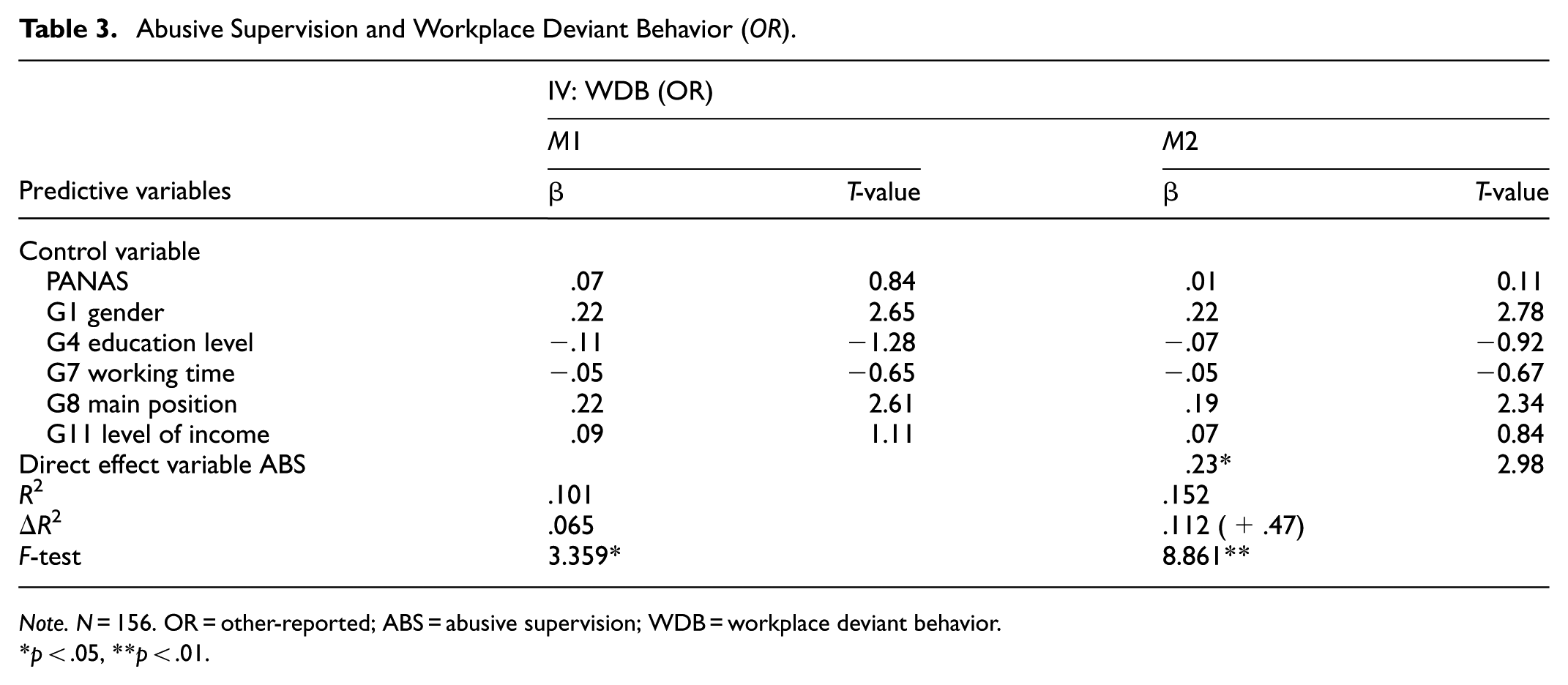
Note. N = 156. OR = other-reported; ABS = abusive supervision; WDB = workplace deviant behavior.
p < .05, **p < .01.
As shown in Table 4, abusive supervision was significantly negatively related to perceived organizational justice (β = −.64, p < .001); these results support Hypothesis 2. For the mediation effect test, the independent variable (abusive supervision) was significantly related to the dependent variable in the second stage (Baron & Kenny, 1986). The hierarchical regression analyses in Tables 5 and 6 indicate that perceived organizational justice demonstrated significant interpretability on self-reported workplace deviant behavior (F = 2.863, p < .01) and other-reported workplace deviant behavior (F = 3.796, p < .001); meanwhile, significantly perceived organization was negatively related to self-reported workplace deviant behavior (β = −.16, p < .01) and other-reported workplace deviant behavior (-β = .16, p < .01). The results support Hypothesis 3. For the mediation effect test, the mediator (perceived organizational justice) was significantly related to the dependent variable in the third stage (Baron & Kenny, 1986).
Abusive Supervision and Perceived Organizational Justice.

Note. N = 156. IV = independent variable; ABS = abusive supervision; POJ = perceived organizational justice.
p < .001.
Perceived Organizational Justice and Workplace Deviant Behavior (SR).

Note. N = 156. IV = independent variable; WDB = workplace deviant behavior; POJ = perceived organizational justice.
p < .05, **p < .01.
Perceived Organizational Justice and Workplace Deviant Behavior (OR).

Note. N = 156. IV = independent variable; WDB = workplace deviant behavior; POJ = perceived organizational justice.
p < .05, **p < .01, ***p < .001.
We further tested the mediation effect, as shown in Tables 7 and 8. Compared to Model 2, Model 3 indicates that abusive supervision was positively related to self-reported workplace deviant behavior in our study, reaching significance (β = .24, p < .5), although the β value fell from 0.25 to 0.24; meanwhile, the mediator perceived organizational justice did not reach significance (β = −.01), and the β value fell from −0.16 (p < .5) to −0.01, becoming nonsignificant. Thus, perceived organizational justice only partially mediated between abusive supervision and workplace deviant behavior. Compared to Model 1, Model 3 indicates that abusive supervision was positively related to other-reported workplace deviant behavior but did reach significance (β = .14). As for other-reported workplace deviant behavior, the β value fell from 0.23 (p < .05) to 0.14, showing no significance. Consequently, perceived organizational justice was included in the analysis; the effect of the independent variable (i.e., abusive supervision) in predicting the dependent variable workplace deviant behavior decreased, which also decreased the effect of the mediator perceived organizational justice in predicting the dependent variable workplace deviant behavior. These results only partially support the mediation effect (i.e., Hypothesis 4).
Effect Test of Mediator-Perceived Organizational Justice -1.
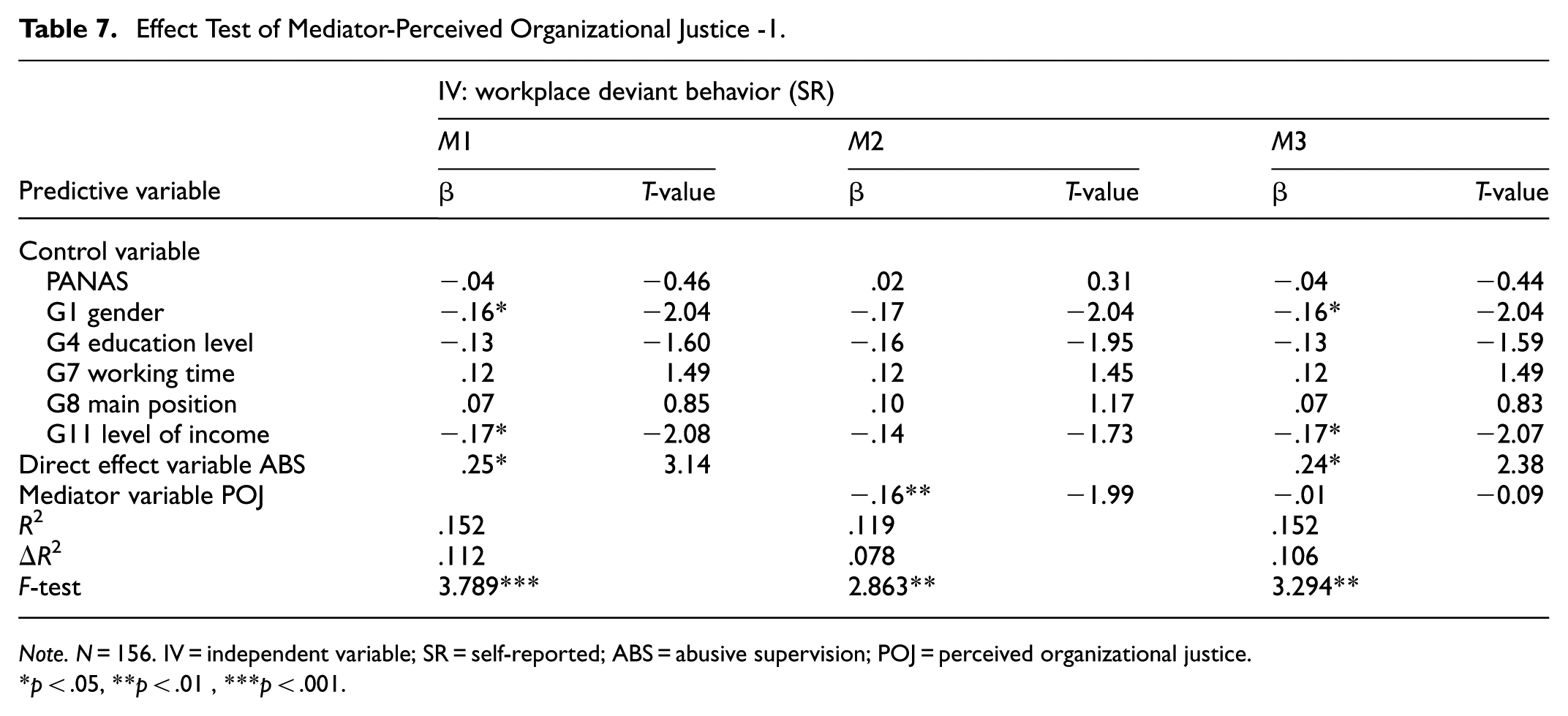
Note. N = 156. IV = independent variable; SR = self-reported; ABS = abusive supervision; POJ = perceived organizational justice.
p < .05, **p < .01, ***p < .001.
Effect Test of Mediator-Perceived Organizational Justice-2.

Note. N = 156. IV = independent variable; OR = other-reported; ABS = abusive supervision; POJ = perceived organizational justice.
p < .01, ***p < .001.
Based on the suggestion of a previous study examining moderated mediation analytic strategies (Muller & Judd, 2005), we present our results from our moderated mediation effect examination in Table 9. In Model 4, abusive supervision (X) was not significantly positively related to self-reported workplace deviant behavior (Y; β = −.30), meaning that β41 did not reach significance. In addition, abusive supervision interacted with the effect of loyalty to supervisor (Mo) on self-reported deviant behavior but did not reach significance (β = .47), meaning that β43XMo was not significant. These results suggested the possibility of moderated mediation. Therefore, we needed to examine if β51X and β65MeMo reached significance. According to Model 5, abusive supervision was not significantly negatively related to perceived organizational justice (Me; β = −.39), meaning that β51X did not reach significance. In addition, Model 6 indicated that perceived organizational justice interacted with the effect of loyalty to supervisor on self-reported deviant behavior but did not reach significance (β = −.03), meaning that β65MeMo was not significant. The following step examined if β53XMo and β64Me reached significance. In Model 5, abusive supervision interacted with the effect of loyalty on perceived organizational justice but did not reach significance (β = .01), meaning β53XMo was not significant. Model 6 also indicated that perceived organizational justice was not significantly negatively related to self-reported deviance behavior (β = −.011), meaning that β64Me did not reach significance. Although the examining conditions might have been satisfied, loyalty to supervisor was significantly positively related to perceived organizational justice(β = 0.65, p < .001), yet moderated mediation still could not be proved.
Hierarchical Regression Analysis for Moderated Mediation Effect of Loyalty to Supervisors (SR).

Note. N = 156. SR = self-reported; DV = dependent variable; IV = independent variable; WV = moderator variable; MV = mediator variable; POJ = perceived organizational justice; ABS = abusive supervision; LS = loyalty to supervisors.
p < .01, ***p < .001.
As shown in Table 10, Model 4 indicates that abusive supervision (X) was significantly positively related to other-reported workplace deviant behavior (Y; β = .85, p < .01), meaning that β41 reached significance. However, abusive supervision’s interaction with the effect of loyalty (Mo) to supervisor on other-reported deviant behavior did not reach significance (β = −.59), meaning that β43XMo was not significant. As this result might suggest moderated mediation, we needed to examine whether β51X and β65MeMo reached significance. Model 5 indicated that abusive supervision was not significantly negatively related to perceived organizational justice (Me; β = −.39), meaning that β51X did not reach significance. In addition, Model 6 indicated that perceived organizational justice interacted with the effect of loyalty to supervisor on other-reported deviant behavior but did not reach significance (β = .01), meaning that β65MeMo was not significant. The examining conditions for moderated mediation were not satisfied. The following step examined whether β53 and β64 reached significance. In Model 5, abusive supervision interacted with the effect of loyalty on perceived organizational justice but did not reach significance (β = .01), meaning β53XMo was not significant. Furthermore, Model 6 indicated that perceived organizational justice was not significantly negatively related to other-reported deviance behavior (β = −.015), meaning that β64Me did not reach significance. Although loyalty to supervisors was significantly positively related to perceived organizational justice (β = .65, p < .001), moderated mediation still could not be proved. Therefore, these results do not support Hypothesis 5.
Hierarchical Regression Analysis for Moderated Mediation Effect of Loyalty to Supervisors (OR).

Note. N = 156. OR = other-reported; DV = dependent variable; IV = independent variable; WV = moderator variable; MV = mediator variable; POJ = perceived organizational justice; ABS = abusive supervision; LS = loyalty to supervisors.
p < .05, ***p < .001.
Conclusion, Discussion, and Future Studies
Discussion
Contemporary scholars have needed help understanding the impact of leadership on organizations and performance (Fernandez, 2004), focusing in particular on leadership’s positive and constructive aspects while avoiding its dark side. Kellerman (2004) identified various forms of bad leadership and their detrimental organizational consequences. Bryman (2007) noted that leadership studies in higher education have focused primarily on effectiveness, with limited exploration of destructive leadership. Recent research has begun to address this gap by developing frameworks for understanding negative leadership behaviors (Patel & Hamlin, 2017). However, prior meta-analyses on abusive supervision have largely neglected subordinate characteristics such as loyalty to supervisors (Fischer et al., 2021). Therefore, we focused our research on the dark or destructive side of leadership to explore the relationship among supervisors’ negative leader behavior, subordinates’ perceived organizational justice, and subordinates’ workplace deviant behaviors as well as whether subordinates’ loyalty to supervisors moderates the indirect effect of abusive supervision on workplace deviant behavior.
First, this study contributes to the literature by addressing a gap concerning subordinates’ loyalty to supervisors in the context of negative leadership behaviors. While previous studies (Farh et al., 1997; Li et al., 2016; Mackey et al., 2017; Shao et al., 2013). have found that loyalty to supervisors moderates the relationship between leadership behaviors and workplace deviance, our findings did not support this moderating effect. One possible explanation lies in methodological differences. For instance, many prior studies used single-source self-report measures and convenience samples. In contrast, our study adopted paired-sample questionnaires, in which each direct supervisor was matched with 1 to 4 subordinates. This dyadic design helped reduce common method variance and allowed for a more objective assessment of the supervisor–subordinate relationship, thereby enhancing the internal validity of the findings. Additionally, our sample was drawn from diverse service-sector organizations, which increases generalizability but may also introduce greater heterogeneity in cultural or contextual factors that dilute the moderated mediation effect of loyalty to supervisors.
Second, despite the non-significant moderated mediation effect found, our results are consistent with organizational justice theory (Greenberg, 1990; Masterson et al., 2000; O’Connor & Crowley-Henry, 2019), supporting the idea that perceived justice plays a more direct role in predicting workplace deviance. Third, this research results show that abusive supervision reduces subordinates’ perception of organizational justice and increases workplace deviant behaviors. We suggest that supervisors avoid negative leadership behaviors in order to improve subordinates’ perception of organizational justice and reduce workplace deviant behaviors.
Theoretical Implications
This study makes several significant theoretical contributions to academia. First, it confirms a positive causal relationship between negative leader behaviors (abusive supervision) and workplace deviance. Second, it confirms a negative causal relationship between negative leader behaviors (abusive supervision) and perceived organizational justice as well as a negative relationship between perceived organizational justice and workplace deviance. Third, it confirms that perceived organizational justice mediates the relationship between negative leader behaviors (abusive supervision) and workplace deviance. The findings clarify that, the more subordinates perceive organizational justice, the less they engage in deviant workplace behaviors.
Practical Implications
This study also offers three managerial implications. First, the more subordinates perceive organizational justice, the less deviant workplace behavior they demonstrate. Organizations should enhance subordinates perceived organizational justice in order to reduce workplace deviant behavior. Second, supervisors’ communication and coordination methods with subordinates should show respect and be considerate of individual needs so that subordinates can reduce their unfair feelings due to perceived interaction justice and avoid deviant behaviors. Third, supervisors should avoid inappropriate harmful treatment methods, such as abuse, ridicule, obstruction, and neglect of subordinates’ feelings, and instead use encouragement, respect, trust, and support to shape the teamwork atmosphere, which can effectively reduce employees’ frustrations and negative emotions.
Limitations
Although this study has many important implications, its limitations should also be emphasized. First, shared method variation (e.g., CMV) in research is a problem. All sample data in this study were collected simultaneously using a cross-sectional design. The questionnaire was administered by collecting self-reports and non-self-reports separately, and a multi-group questionnaire method (time/field isolation method) was adopted to avoid the exact origin of data. Supervisors and subordinates were divided into groups to collect sources to reduce the negative impact of common method variance. Second, cross-sectional research design limits the ability to draw robust causal inferences.
Third, Regarding the CFA results, such as the standardized root means square residual (SRMR = 0.103), and the root mean square error of approximation (RMSEA = 0.110) did not reach the ideal critical values, and the main reason may be the relatively small sample size. Fourth, another limitation of the current study lies in its exclusive reliance on quantitative survey data, which, while useful for hypothesis testing, may not fully capture the subjective and lived experiences of subordinates under abusive supervision. The absence of qualitative data limits our ability to uncover context-specific meanings, emotional nuances, and interpretive processes that might shape employee perceptions and responses (Tracy, 2010).
Fifth, loyalty to supervisors moderated the mediation in the relationship between negative leader behaviors (abusive supervision) and workplace deviant behavior but was not supported as many confounding factors are related to loyalty to supervisors. Indeed, the measure of loyalty to supervisors includes six dimensions: identification with the supervisor, value internalization, business assistance, sacrifice, dedication, and initiative cooperation (D. Y. Jiang et al., 2007). These dimensions may have a moderated mediation effect on perceived organizational justice. Furthermore, Erkutlu (2011) found that organizational culture plays a critical role in shaping employees’ perceptions of justice and their behavioral responses. If the organizational culture in our sample does not place a strong emphasis on loyalty or interpersonal relationships, this may have weakened the moderating role of loyalty. Similarly, Schilpzand et al. (2013) showed that employees’ cultural value orientations, such as power distance and collectivism, can lead to inconsistent or non-significant moderation effects, particularly when there is high cultural heterogeneity within the sample. Additionally, Erdogan and Liden (2006) noted that in high-collectivism cultures, employees may respond to perceived injustice through implicit means (e.g., ingratiation) rather than overt expressions of dissatisfaction. Such cultural tendencies may also obscure the moderate effect of loyalty in the justice-behavior relationship. Taken together, these findings may help explain why our study did not support Hypothesis 5, which may serve as a reference for subsequent research.
Conclusion
This study investigated how supervisors’ negative leadership behaviors, particularly abusive supervision influence subordinates’ workplace deviant behaviors through the mediating role of perceived organizational justice, and whether subordinates’ loyalty to supervisors moderates this relationship. The findings confirmed that abusive supervision undermines organizational justice perceptions and increases deviant behaviors, supporting the framework of organizational justice theory.
Although the moderated mediation effect of loyalty to supervisors was not supported, this result offers important insights into the complexity of loyalty as a contextual variable. Cultural and organizational factors may weaken or obscure this moderating effect, indicating a need for more nuanced investigation in future research.
Overall, this study contributes to the literature on destructive leadership by presenting an integrated model that links antecedents (abusive supervision), mediators (perceived justice), and behavioral outcomes (workplace deviance). It also highlights practical implications, urging leaders to avoid abusive behaviors and promote fairness to reduce negative employee outcomes.
Future Study
Several recommendations for future research are offered. First, future research is needed to understand whether loyalty to supervisors moderates the relationship between abusive supervision and subordinate workplace deviant behavior. Second, different organizational cultures have varying values and expectations regarding loyalty. Future studies could explore how subordinates’ loyalty to their supervisors influences organizational effectiveness and employee engagement in different cultural contexts. Third, loyalty is typically seen as a positive behavior toward an organization or supervisor, but in some situations, excessive loyalty may cause subordinates to engage in or tolerate unethical behavior. Loyalty to supervisors is considered a critical factor in career success, yet excessive loyalty may lead subordinates to experience increased stress, especially when they feel compelled to cater to their supervisors’ needs. Research could investigate how loyalty impacts subordinates’ stress, anxiety, or workplace burnout, exploring the contexts in which loyalty might have negative consequences.
Fourth, future research should employ longitudinal designs and incorporate behavioral metrics to strengthen causal inference and reduce method bias. Fifth, future research should involve more diverse and larger samples particularly across different organizational contexts and cultures varying in power distance to enhance the statistical power and generalizability of the findings. Sixth, future studies are encouraged to incorporate qualitative or mixed methods approaches to gain deeper insight into how abusive supervision is experienced across diverse organizational and cultural contexts. Such approaches would complement existing quantitative findings and contribute to a more holistic understanding of abusive supervisory dynamics.
Footnotes

Ethical Considerations
This study was reviewed and determined to be exempt from formal ethics approval by the Ethics Committee of National Changhua University of Education. The research involved minimal risk and used anonymous, self-administered questionnaires, consistent with Section 8.05 of the APA Ethical Principles of Psychologists and Code of Conduct (2023), institutional guidelines, and the Declaration of Helsinki. The use of anonymous survey data ensured that participants could not be identified, thereby protecting their privacy and reducing any potential psychological or social risk.
The corresponding author, Shih-Liang Lee, has completed the research ethics training program offered by the Center for Taiwan Academic Research Ethics Education (Certificate No. S106059055).
Compliance with Ethical Standards
The study received ethical approval from the Ethics Committee of National Changhua University of Education, Taiwan. Purposive sampling was employed to recruit participants. Informed consent was obtained from all participants prior to data collection.
Consent to Participate
Informed consent was obtained from all participants prior to data collection. Participants were thoroughly informed about the purpose of the study, their rights, and the voluntary nature of participation. The use of anonymous survey data not only minimizes risks to participants but also enhances the reliability of the data collected, as individuals may feel more comfortable expressing their opinions without the fear of being identified. This anonymity allows for a more honest and authentic representation of participant views, which is particularly important in sensitive research areas. Furthermore, the ethical considerations surrounding the study extend beyond mere compliance with guidelines. The implications of ethical research practices resonate with broader societal values. The balance between the pursuit of knowledge and the protection of individual rights remains a fundamental concern in academic research. In summation, the ethical framework of this study not only adheres to institutional and international guidelines but also reflects a commitment to nurturing an ethical research culture. This, in turn, enhances the credibility and generalizability of the findings, contributing meaningfully to the body of literature and informing future research endeavors.
Funding
The authors received no financial support for the research, authorship, and/or publication of this article.
Declaration of Conflicting Interests
The authors declared no potential conflicts of interest with respect to the research, authorship, and/or publication of this article.
Data Availability Statement
The datasets generated during and/or analyzed during the current study are available from the corresponding author upon reasonable request.