




Abstract
This study investigated the relationship between abusive supervision and subordinates’ citizenship behavior, as well as subordinates’ whistleblowing intention as a reactionary outcome of supervisory abuse. Data was collected from 180 Nigerian healthcare assistants using a structured questionnaire. Additionally, 20 semi-structured interviews were conducted. The study found a negative relationship between abusive supervision and subordinates’ citizenship behavior. Also, the relationship between abusive supervision and subordinates’ whistleblowing intention was not significant. Theoretical and practical implications are discussed in the light of contextual peculiarities. Recommendations advocate the urgency of cultural re-engineering to mitigate the vicious cycle of supervisory abuse and encourage the emergence of abusive supervisors from the toxic dark side into the light of inspirational leadership.
Keywords
Introduction
There is growing consensus in the leadership and management literature that abusive supervision is a central, costly, and complex phenomenon (e.g., Lopes et al., 2018; Mackey et al., 2017; Martinko et al., 2013; Ogunfowora, 2013; Onyishi, 2012; Schat et al., 2006; Tepper, 2007; Zhang et al., 2019). Tepper (2000) famously defines the concept as “subordinates’ perceptions of the extent to which supervisors engage in the sustained display of hostile verbal and nonverbal behaviors, excluding physical contact (p. 178).” Tepper (2007) states that “abusive supervision involves continuing exposure to hierarchical mistreatment, a boss who has a bad day and takes it out on his or her subordinates by exploding at them would not be considered an abusive supervisor unless such behavior became a regular feature of his or her repertoire (p.39).” It is necessary to highlight the subjectivity of the concept and the willful non-physical, persistent pattern of hostility that qualifies it as abusive (Kermond & Schaubroeck, 2015; Tepper, 2007). Abusive supervision can be differentiated from other forms of workplace mistreatment (Tepper, 2007), that is, petty tyranny (Ashforth, 1994), workplace bullying (Aquino, 2000), supervisor undermining (Duffy et al., 2002), and supervisor aggression (Schat et al., 2006). Examples of behavior that fit the abusive supervision description include, invading subordinates’ privacy, ridiculing, manipulation, intimidation, making negative comments about subordinates to others, rudeness, angry outbursts, social isolation, labeling subordinates as incompetent and constant reminders of past mistakes (Tepper, 2000; Zellars et al., 2002).
Perhaps one of the most central areas of the abusive supervision research is the study of its antecedents and consequences. Although Tepper et al. (2011) describe the study of antecedents as budding, some predictors have been identified. Hoobler and Brass (2006) associated the violation of supervisors’ psychological contract (Rousseau, 1995) with abusive supervision. The experience of breached psychological contract is likely to cause negative emotions and aggressive behavior on weaker targets (Tepper et al., 2006). Also, Byrne et al. (2014) propose that psychological depletion of resources; depression and anxiety are antecedents of abusive supervision. Supervisors with poor psychological health are less likely to be relational and more likely to exhibit abusive behaviors toward their subordinates (Tepper, 2007). The antecedent factors of abusive supervision occur primarily through the processes of social learning, identity threat, and regulation impairment (Tepper et al., 2017).
A few studies have found correlations between abusive supervision and positive organizational outcomes such as subordinates’ innovative behavior through increased challenge-related stress (Zhu & Zhang, 2019), higher levels of performance (Marcinko, 1997), and employees’ constructive resistance (Tepper et al., 2001). However, a myriad of empirical evidence document the far-reaching consequences of abusive supervision. It has been associated with subordinate problem drinking (Bamberger & Bacharach, 2006), higher levels of insomnia (Rafferty & Restubog, 2010), paranoia (Lopes et al., 2018), work-family conflict (Ju et al., 2015), workplace deviance and unethical behaviors (Mitchell & Ambrose, 2007), psychological distress (Restubog et al., 2011), job burnout and poor affective wellbeing (Kernan et al., 2011), low job satisfaction and reduced organizational citizenship behaviors (Mathieu et al., 2014; Zellars et al., 2002), and other adverse implications (see, e.g., Mackey et al., 2017; Tepper, 2007). Martinko et al. (2013) have criticized the persistent investigation of the deleterious effects of abusive supervision, stating that “research demonstrating the negative consequences of abusive supervision has reached a saturation point (p. 756).” In our opinion, the injustice that abusive supervision represents is proof that there is every reason to remain vocal about it.
A gamut of management theories has been used to describe the relationship between supervisors’ abusive behavior and the reciprocal behavior of subordinates (Tepper, 2007). The justice theory, which originated from the fairness theory (Folger & Cropanzano, 2001) and closely related to Blau’s (1964) social exchange theory and Adam’s (1965) equity theory, remains foundational. Justice theory generally refers to individual and group perceptions about the extent to which they are valued, treated with dignity, sensitivity, and respect by their organization. Abusive supervision stems from the injustices that characterize the social exchange processes between supervisors and their subordinates. This is why the justice theory is of particular significance in understanding the consequences of abusive supervision. Cultural values may often influence justice perceptions, applications, and outcomes.
The abusive supervision research has featured several international samples, but findings from an African sample remain sparse, in spite of the imperative for more studies that explain cross-cultural differences (Tepper et al., 2017). As Tepper (2007) noted, abusive supervision does not elicit the same response in all subordinates, and by extension, will not provoke the same reaction across contexts (Vogel et al.,2015). As such, for the first objective, we take a cue from Zellars et al. (2002) to investigate the relationship between abusive supervision and organizational citizenship behavior using an African/Nigerian sample of healthcare assistants. We believe this is a worthwhile research venture because it has implications not just for the healthcare sector but others sub-sectors. A major motivation for this is to explain the possibility that subordinates from this cultural context may respond to supervisors’ abuse by refraining from performing specific behaviors that will be advantageous to their organization. Second, we explore whistleblowing intention as a reactionary outcome of supervisory abuse. Our review of extant literature indicates a gap in the study of this potential outcome, as it has received little attention. Importantly, we follow this research direction because of the distinctive cultural socialization and other contextual dynamics of our sample. The third objective, which was birthed in the course of the study, was to ascertain the factors accountable for the result of the second objective. In the rest of the paper, we provide a theoretical framework alongside the development of hypotheses; this is followed by a description of the research context, study design, and methods. The results and findings are presented and discussed in the light of their significance to management practice.
Theory and Hypotheses Development
Abusive Supervision and Organizational Citizenship Behavior (OCB)
Organ’s (1988) definition of organizational citizenship behavior states that it is “individual behavior that is discretionary, not directly or explicitly recognized by the formal reward system and that in the aggregate promotes effective functioning of the organization (p. 4).” A main feature of this definition is the term discretionary, which implies that the omission of OCBs is not subject to punitive measures. However, the discretionary nature of OCBs and the non-existence of formal reward system is no indication that they are unnoticed by mid/top management and might not attract some sort of reward, preferential treatment, or extra perks. This view is corroborated by Podsakoff et al.’s (2009) meta-analysis, which established positive associations between OCB and performance ratings, alongside rewards and promotions. Organ’s (1988) definition implies that OCB is a product of (or reaction to) social exchange processes and motivation-based systems in the work environment. Interpersonal relations that are perceived to be unjust, such as abusive supervision can negatively affect employees’ self-esteem and social image culminating in declined job and life satisfaction (Tepper, 2000). Positive employee attitudes are negatively related to supervisory abuse because employees experiencing such are less committed, less engaged, less creative, have turnover intentions, and less probable to be involved in extra-role OCBs (e.g., Kermond & Schaubroeck, 2015; Oyewunmi et al., 2018).
Just as Hoobler and Brass (2006) attributed supervisors’ acts of abuse to the breach of their psychological contract, subordinates may also perceive acts of abuse as a violation of psychological contract and resort to negative workplace attitudes (Restubog et al., 2011). Blau’s (1964) social exchange theory reinforces the reciprocity theme and the need for organizations to maintain the multiple layers of relationships to avoid negative reciprocity. Zellars et al. (2002) state that withholding OCBs might be a way for abused employees to react and get back at abusive supervisors or organizations. However, there might be situations where abused employees might refrain from withholding OCBs because doing so could be noticed by superiors and may induce further adverse outcomes.
Hypothesis 1: Abusive supervision will be negatively related to subordinates’ organizational citizenship behavior.
Abusive Supervision and Whistleblowing Intention
Whistleblowing is the “disclosure by organization members of illegal, immoral, or illegitimate practices under the control of their employer, to person, or organizations who may be able to effect action (Near & Miceli, 1985, p. 4).” It is reporting actions deemed immoral or illegal to persons or parties that can take punitive and corrective actions. Whistleblowing is a voluntary action that is different from whistleblowing intention (Mesmer-Magnus & Viswesvaran, 2005). The theory of planned behavior affirms that behavioral intention is predicated on subjective probability and personal judgment that a course of action will be taken (Ajzen, 2012). It is often the case that a person’s intention to blow the whistle is an immediate antecedent of actual whistleblowing. Rather than investigating whistleblowing, researchers have typically explored whistleblowing intention because of the difficulty of gaining access to actual whistleblowers (Vadera et al., 2009). In this paper, whistleblowing intention is conceptualized as the probability that employees within an organization will report actions considered as illegal, immoral, or unethical to persons or parties that are both willing and able to effect necessary measures. Abusive supervision and whistleblowing intention are both ethical issues. While the former is the unethical and immoral treatment of employees, the latter aims to expose such behavior.
When employees decide not to blow the whistle either because they are being silent or being silenced, it leads to the normalization and helpless acceptance of unethical behavior, as well as the initiation of other employees in unethical patterns through social learning (Bandura, 1986; Tepper et al., 2017). Although there are several reasons why employees might not report supervisory abuse (see Mesmer-Magnus & Viswesvaran, 2005), the fear of retaliation and lack of organization support are foremost (Restubog et al., 2011). Employees’ inclination to express concerns about work-related issues is determined by the perceived receptiveness of their superiors. This perceived disposition is significantly culturally dependent. In cultures that are characterized by social class and high power distance, the likelihood that victims will blow the whistle is low (Tavakoli et al., 2003). This is because cultural values form the foundation for the construction of thought and behavior; and as Tietjen and Myers (1998) state, “the values or worldview a worker carries into the job forms the foundation by which attitudes (to that job) develop (p. 230).” Organizational culture may also impact on the intention to blow the whistle; norms related to social exchange processes, aggression, hierarchy, deference, and conformity have implications for both intention and behavior (Tavakoli et al., 2003). The victim precipitation theory (VPT; Lasky, 2020; Wolfgang, 1957) suggests that certain personality types are more vulnerable than others to supervisory abuse (Bowling et al., 2010). Passive or docile victims are perceived as being unaggressive, disinclined, and unable to defend themselves or challenge supervisory abuse by nursing or acting on whistleblowing intention (Henle & Gross, 2013). Hallberg and Strandmark (2006) report that mistreatment from a supervisor may damage the self-esteem of subordinates, leading to feelings of shame and self-blame, two toxic and immobilizing emotions that may mitigate whistleblowing intention.
Hypothesis 2: Abusive supervision will be positively related to subordinates’ whistleblowing intention.
Methods
Overview of Research Context
Nigeria is a sub-Sahara African country located on the western coast with a population of over 185 million (World Bank, 2018), diverse ethnicities and over 400 languages (Boyes, 2013). Like in many African countries, cultural values in Nigeria emphasize respect for old age and authority, community, and collectivism, value for the sacred and religion (Oyewunmi et al., 2021). To a large extent, daily existence and interactions are guided by these values. According to Hofstede (2001), Nigeria has a high degree of power distance (80) and a low score in the individualism dimension (30), indicating a collectivist leaning. While the scores for masculinity (60) and indulgence (84) are high, long-term orientation is low (13), and uncertainty avoidance at a medium score of 55 (https://www.hofstede-insights.com/country/nigeria/). Like in most high power distance and collectivist cultures, conformity and non-expression of opinions are embedded. This is because it is widely believed that whether high or low, everyone has a place in the social hierarchy. Therefore, the acceptance of existential inequalities amongst individuals is often characteristic. A common belief is that the boss is always right and can do no wrong. In glaring cases of the boss being wrong, speaking up to correct, or offer perspective may be deemed as being disrespectful, questioning, or embarrassing authority (Umar & Hassan, 2013). Also, in a developing country such as Nigeria, the widening socio-economic gap may engender silence as a survival strategy.
Sample and Procedure
Studies have shown a high incidence of abusive supervision amongst healthcare workers (Ariza-Montes et al., 2013; Estes, 2013; Llewellyn et al., 2018; Norton et al., 2017). We tested the hypotheses using data collected from healthcare assistants (HCAs) in a public psychiatric hospital in Southwest, Nigeria. Typically, the duties of HCAs (also referred to as auxiliary nurses, support workers/staff) include assisting with patients’ movement, personal hygiene, feeding, housekeeping, errands, and providing psycho-social support (Spilsbury & Meyer, 2004). The nature of HCAs’ roles, their limited training and low professional standing has sometimes led to the perception of inferior treatment by other members of the health team (Bach et al., 2007). This is against the backdrop of numerous operational and internal governance issues in Nigeria’s public healthcare (Oyewunmi & Oyewunmi, 2014). In this study, the mixed-methods approach was adopted in sequence and for complementary purposes. The initial approach was quantitative; however the findings using the quantitative approach raised questions that necessitated the qualitative approach through semi-structured interviews to illuminate contextual variables.
For the survey, the sample size for the study was 180. Females constituted 56.1%, while 43.9% were males. For age distribution, 45.6% of the sample was between the ages 21 and 30 years, 35.6% were between the ages 31 and 40 years, 10.0% in the 41 to 50 age bracket, and 8.9% were 51 years old and above. About 50.6% of the sample indicated their marital status as single, 42.2% were married, 4.4% were separated, and 2.8% were widowed. In terms of educational qualification, 38.3% had high school certificates, 32.8% had no formal education, 23.9% had a diploma, and 5.0% had a higher diploma. About 43.3% had spent between 6 and 10 years with the hospital, 40.6%had spent less than 5 years, 13.3% had spent 11 to 15 years, and 2.8% had spent 16 to 20 years in service.
Measures
Abusive supervision was assessed using Tepper’s (2000) 15-item scale measured on a 5-point Likert scale, ranging from SA (Strongly Agree) to SD (Strongly Disagree). Examples of items asked if respondent’s supervisor . . .makes negative comments about me to others; . . .ridicules me; . . .invades my privacy and . . .expresses anger at me when he or she is mad for another reason (α = .853). We adopted an abbreviated 15-item scale version (Kumar & Shah, 2015) of Podsakoff’s et al. (1990) original 24-item scale. Subordinates’ citizenship behavior was measured on a 5-point Likert scale, ranging from Strongly Agree (SA) to Strongly Disagree (SD). Examples of items include; I always avoid creating, I obey organization rules when no one is watching and I willingly help fellow workers when they have work-related problems (α = .324). We attribute the rather low reliability to the difficulties of conceptualizing and measuring OCB which is prevalent in the literature (Kwantes et al., 2008). To assess whistleblowing intention, a vignette was adopted. A vignette is a “short description of a person or social situation which contain precise reference to what are thought to be the most important factors in the decision-making or judgment making process of respondents” (Alexander & Becker, 1978, p. 94). Respondents were instructed to read the vignette and consider the likelihood of blowing the whistle in a hypothetical situation. Two items were used to measure whistleblowing intention on a 5-point Likert scale ranging from Definitely Would (DW) to Definitely Would Not (DWN). Example of an item is, “giving the hypothetical situation that your supervisor abuses you on several occasions or over a period of time, indicate your likelihood to report the behavior to a higher authority.”
Control Variables
From literature (Restubog et al., 2011; Zellars et al., 2002; Zhu & Zhang, 2019), demographic variables may co-vary with the independent and dependent variables. In this study, the following variables were controlled for: Gender (Male = 1, Female = 2), Age (21–30 years = 1; 31–40 years = 2; 41–50 years = 3; and 51 and above = 4), Marital Status (Single = 1, Married = 2, Separated = 3, and Widowed = 4), Highest Educational Qualification (No Education = 1, High School Certificate = 2, Diploma = 3, and Higher Diploma/Degree = 4), Length of service (<5 years = 1, 6–10 years = 2, 11–15 years = 3, and 16–20 years = 4). These variables were held constant in the analysis to avoid their effect on the relationship being measured.
Results
Table 1 shows the descriptive analysis of the variables under consideration. From the correlation coefficients shown in the table, there is a significant relationship between age of respondents and perceived level of abusive supervision, this indicates that age (not gender) significantly influence abusive supervision (at .05 level of significance), the −.218 correlation coefficient shows that the relationship is inverse (i.e., as age increases, perceived abusive supervision reduces). A positive relationship was observed between age and organizational citizenship behavior, the coefficient is .156, indicating that as age increases, the display of organizational citizenship behavior also increases. From the table, educational qualification and organizational citizenship behavior correlates with .175 coefficients, indicating that educational qualification also increases organizational citizenship behavior. Finally, length of service significantly correlates with abusive supervision, and the relationship is positive (.187). The correlation analysis shows that age and length of service affect abusive supervision. The internal consistency reliability coefficient for abusive relationship, organizational citizenship behavior, and whistleblowing intentions are reported along the diagonals.
Descriptive Analysis of Constructs.
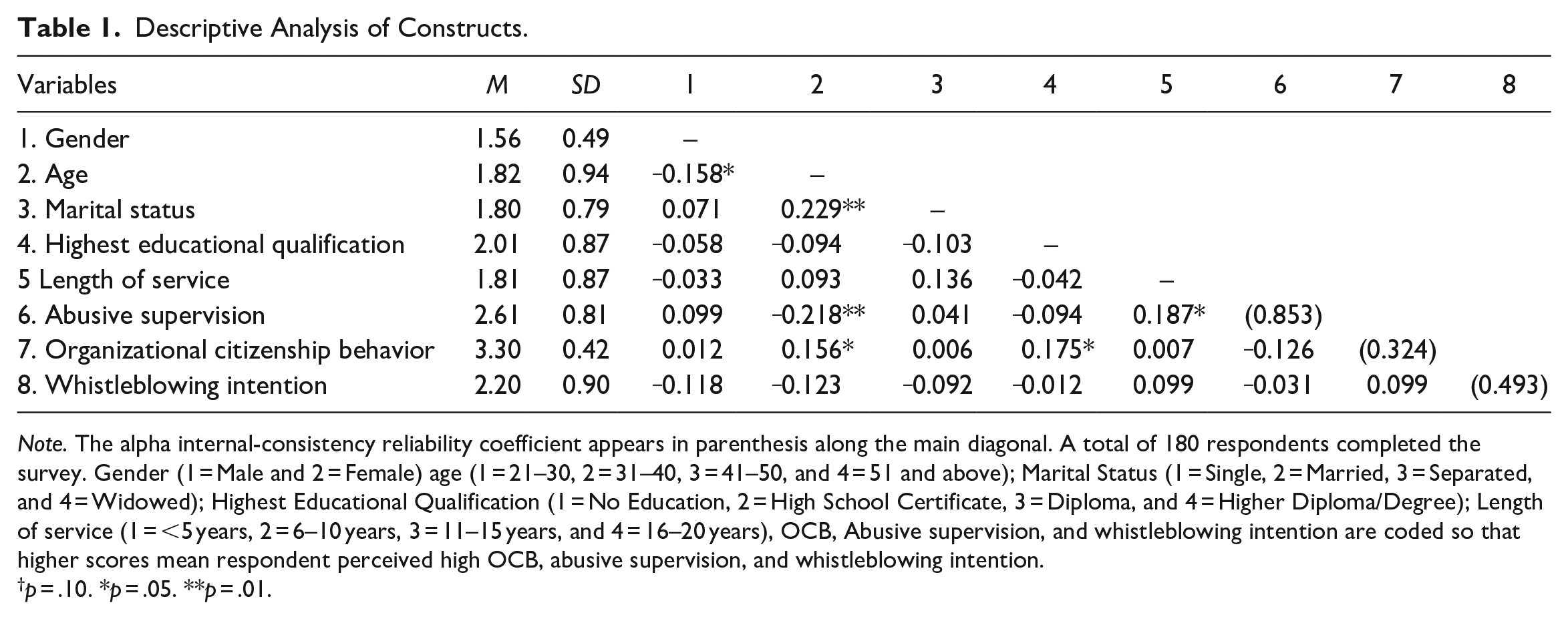
Note. The alpha internal-consistency reliability coefficient appears in parenthesis along the main diagonal. A total of 180 respondents completed the survey. Gender (1 = Male and 2 = Female) age (1 = 21–30, 2 = 31–40, 3 = 41–50, and 4 = 51 and above); Marital Status (1 = Single, 2 = Married, 3 = Separated, and 4 = Widowed); Highest Educational Qualification (1 = No Education, 2 = High School Certificate, 3 = Diploma, and 4 = Higher Diploma/Degree); Length of service (1 = <5 years, 2 = 6–10 years, 3 = 11–15 years, and 4 = 16–20 years), OCB, Abusive supervision, and whistleblowing intention are coded so that higher scores mean respondent perceived high OCB, abusive supervision, and whistleblowing intention.
p = .10. *p = .05. **p = .01.
For Hypothesis 1, A 6-step hierarchical regression analysis is reported in Table 2 above; steps 1 to 5 shows the variables (demographics) that were controlled for in the analysis while step 6 shows the effect of abusive relationship on the dependent variable, that is, organizational citizenship behavior, the influence of the relationship is negative as hypothesized but was not significant, having a coefficient of −.078 (p = .892).
Regression Analysis for Hypothesis 1.

The 6-step hierarchical regression analysis shown in Table 3 shows the analysis for hypothesis 2. The first five steps of the regression show the demographic variables that were controlled for in the analysis, and it was observed that none of the control variable significantly affected subordinates’ whistleblowing intention. Step 6 shows the influence of abusive supervision on the dependent variable (whistleblowing intention); the influence was not significant with a coefficient of −.087 (p = .268).
Regression Analysis for Hypothesis 2.

Discussion of Findings
For hypothesis 1, the result showed a negative and insignificant relationship between abusive supervision and subordinates’ organizational citizenship behavior. This negative relationship is consistent with the findings of earlier studies (e.g., Kim et al., 2020; Zellars et al., 2002). Although abused subordinates are likely to demonstrate fewer OCBs, others might continue to perform OCBs due to individual and social constructions of justice. The applicability of the justice theory is undoubted as it underpins the regularization of social interactions (Primeaux et al., 2003). However, perceptions of justice are often governed by the subjectivity of individual, contextual, and cultural characteristics which shape mindset and behavior. We believe that the negative but insignificant relationship for hypothesis 1 may also be attributable to culture-related variations in the definition of OCB as either in-role or extra-role. Individuals from collectivist cultures, typified by our sample, are more like likely to demonstrate higher levels of OCBs than persons from individualistic cultures (Moorman & Blakely, 1995). This is because collectivist cultures emphasize group identity and conformity. Hence, engagement in high levels of OCBs is based on the perception that those behaviors are in-role and the expectation within such organizational setting is that employees should be particularly motivated to behave in ways that strengthen their relationship with their employer. Contrary to the assumption for hypothesis 2, the relationship between abusive supervision and subordinates’ whistleblowing intention was not significant. Extant studies have associated whistleblowing intention with several personal, situational, and cultural factors (Dungan et al., 2015; Sims & Keenan, 1999; Tavakoli et al., 2003).
From the findings, it became essential to investigate the deviation of results from the assumption that abusive supervision would negatively relate to organizational citizenship behavior while positively leading to whistleblowing intention. To achieve this, the study collated the average opinion (by rounding up the average score) of respondents, so that the general perception of the sample on abusive supervision, organizational citizenship behavior, and whistleblowing intention can be measured. The frequency distribution showed that 47.2% of the sample agreed that they had experienced abusive supervision, 15% stated their supervisors were not abusive, while the remaining 37.8% were indifferent in their perception of abusive supervision. In terms of OCB, only 1.7% did not exhibit OCB, 35% exhibited OCB, and the remaining 63.3% were neutral in their views. We assume that this high percentage of neutrality is partly due to culture-related variations in the definition of organizational citizenship behavior as in-role or extra role. The distributions of abusive supervision and OCB also show that there could be possible factors affecting the relationship between the independent and dependent variables. The frequency distribution of whistleblowing intention showed that 61.7% of the sample reported that they were unlikely to engage in whistleblowing; only 17.3% stated that they were likely to report cases of abusive supervision, the remaining 21.1% of the sample were not sure whether they would report. This shows that although the proportion of respondents that have experienced abusive supervision is high, there is yet a higher proportion of the sample that would not engage in whistleblowing. A rather substantial 61.7% of the sample reported that they were unlikely to engage in whistleblowing, an important pro-social mechanism that is necessary for ensuring organizational justice, fairness, and transparency. This raised further questions on the factors that could prevent respondents from reporting the cases of abusive supervision that they experience. We decided to garner more insights using semi-structured interviews.
Qualitative Data
The qualitative approach was adopted because it has proved practical in explaining social realities, behaviors, and attitudes of participants (Levitt et al., 2017). We found this approach useful for experiential engagement, understanding the framework within which the participants interpreted their views and the dominant contextual variables. We deployed semi-structured interviews as they offer much-needed flexibility in the exploration of issues. There is no agreement in the extant literature on the appropriate sample size in qualitative research (Boddy, 2016). Nonetheless, the researchers were confident that a sample of 20 HCAs would supply representative data needed on the factors preventing whistleblowing intention in cases of abusive supervision. A total of 20 interviews were randomly sought, and 6 of the requests were declined. The snowball approach was adopted to make up the sample size of 20 (n = 20) by asking some of the participants to recommend to the researchers other HCAs who could articulate their views on the subject matter.
Participants were interviewed in-person on three occasions over 2 weeks for 35 to 40 minutes. Although interviews were conducted in the English Language, there were a few instances that necessitated Pidgin/Broken English to assist respondents’ understanding of the issues. Also, the researcher carefully explained the concepts of abusive supervision and OCB to participants to ensure that they fully comprehend the nature and purpose of the study. Informed consent was gained, and all participants were assured of anonymity and confidentiality. Data gathering was conducted conversationally to encourage candor. The interview questions were open-ended to provide opportunities for follow-up questions. Examples of the questions are, in your view, what reasons hinder your colleagues from blowing the whistle on abusive supervision? Why do you think victims of abusive supervision still engage in OCB? All responses were recorded digitally with the permission of the respondents and subsequently transcribed verbatim. Field notes were useful for recording observational data, particular incidents that the respondents recalled, as well as points of convergence and divergence in responses.
Standard content analysis framework of the transcript revealed a consistent pattern of themes in respondents’ quotes (Guest et al., 2012) on the factors that mitigate whistleblowing intention amongst HCAs. The data generated three category headings which were verified for accuracy by the researchers and subjected to a few modifications after discussions. These factors are presented in the section below with some excerpts to accentuate the discussion.
Cultural Orientation: Power Distance and Collectivism
Culture is closely related to ethical perceptions and behaviors across contexts (Tavakoli et al., 2003). Participants alluded to two of Hofstede’s cultural orientation dimensions as factors that attenuate whistleblowing intention. The most recurring of these dimensions was power distance. This was not surprising as researchers have stated the role of power distance in the reactionary attitudes of employees to supervisory practices (e.g., Daniels & Greguras, 2014; Tepper, 2007; Vogel et al., 2015). A number of participants stated that abusive supervision was a common occurrence in their interactions with their supervisors and high power distance was a major reason for the lack of whistleblowing intention. They viewed their roles as HCAs to be of low status and believed that their voices did not count. This perception of their role implied that they “are less attuned to unfairness committed by authority figures because they perceive these actions as part of their role-defined privilege” (Li & Cropanzano, 2009, p. 793). Moreover, they were generally uncomfortable with questioning the authority of persons in the positions of supervisor or management. Most responses depicted an acceptance of power differentials, a view that supervisors where somewhat superior and a tendency for deference rather than reciprocity with regards to their behavior. One respondent stated that:
Abuse by supervisors happens all the time. I have had many experiences. It is part of the job. If I report, it is more trouble for me. . .it is better to just leave them . . .you know. . .someone that has more power than you, can destroy you. (HCA 6)
This perception engenders the suppression of whistleblowing intention and reinforces supervisory abuse. It echoes the finding of Grandey et al. (2010) who argued that the suppression of emotions such as being angry with higher status individuals (e.g., supervisors) is characteristic of high power distance cultures. Beugre (1998) also noted that supervisory abuse is often expected in such contexts and victims are unlikely to respond negatively for fear of the power wielders. In high power distance cultures or contexts, internal reporting of ethical infractions perpetrated by superiors is doubtful. This is because such an action is perceived as an affront to authority figures, who are more likely to be protected by the organization rather than disciplined (MacNab et al., 2007; Miceli & Near, 1992).
A collectivist orientation implies that individuality is embedded in group identity. It highlights the importance of social relationships, conformity, maintaining the status quo, “we” consciousness, loyalty, and group interest (Hofstede, 2011). From the findings, the interplay of high power distance and high collectivism makes for a fluid perpetration of supervisory abuse and the continued fanning of its flames. In Nigeria, religion and ethnicity play dominant roles in shaping individual and collective experience by influencing thought patterns and social exchange processes. Specifically, an overbearing sense of belongingness shared by victims and perpetrators who are affiliated to the same (or similar) religious or ethnic groups may contribute to the stifling of whistleblowing intention. A significant number of participants were more attuned to maintaining the status quo and avoiding conflict.
Someone who hurts you today may make you happy tomorrow. (HCA 2)
The implication of the quote above is that social relationships are considered to be a cocktail of negatives and positives, concessions and compromises, which should not impede the continuity of such relations. This collectivist point of view is reflective of the South African Ubuntu philosophy, a worldview that is also popular in other parts of Africa. Its central themes are humaneness, group solidarity, and harmony (Metz, 2007). Whilst conflict avoidance and reconciliation are encouraged; dissent and retribution are discouraged. Consequently, a victim of abusive supervision with an intention to blow the whistle may be viewed by social group members as being non-conformist to the prevailing social philosophy (Uys, 2010).
Another concern expressed by participants was that the intention and act of whistleblowing are deemed as a breach of loyalty to members of the (HCA) group because it may attract a backlash of negative attention from supervisors and other members of management.
Some time ago, a new HCA reported to management that she was mistreated by her supervisor. Management and supervisors, are they not the same? That period was terrible for us. . .no peace of mind at all. (HCA 9)
Whistleblowing intention is often perceived as an affront on both collective loyalty (Miceli et al., 2008) and the sense of mutual dependence. As Gorodnichenko and Roland (2012, p. 222) observed, behavior is subject to the “different social context and the perception of others’ reaction to one’s behavior, as well as from the perceived effect of one’s own actions on others.” The potential whistleblower is faced with the dilemma of morality of loyalty versus morality of principle (Uys & Senekal, 2008), given that a decision has to be made between loyalty to in-group relationships or acting based on ethical standards of behavior. Our sample tended toward the former option rather than the latter because of the strong member-attachment to an “identity constituting group” (Tajfel & Turner, 1986).
Fear of Retaliation and Stigma
Findings indicate that the fear of retaliation and stigma were major factors that impacted on whistleblowing intention. A consequence of whistleblowing is that,
. . .social status and the reputation of the whistleblower are often impugned. For example, whistleblowers are sometimes depicted as snitches, moles, spies or tattletales and may be categorized as paranoid, disloyal or disgruntled by leadership. Rarely are whistleblowers labeled protectors, patriots or heroes. . . (Garrick, 2017, p. 39)
Retaliation is “taking an undesirable action against an employee or not taking a desirable action because the employee disclosed information about a serious problem” (Keenan, 2002, p. 82). Work-related retaliation refers to undesirable actions that are formal, tangible, and documented, while social retaliatory behaviors are informal, antisocial, and undocumented (Cortina & Magley, 2003). Participants stated instances of work-related and social retaliation that include non-inclusion in career advancement or training opportunities, poor performance appraisal, issuance of unwarranted queries, involuntary transfers, snide remarks, silent treatment, exclusion from social gatherings, and harassment. A few participants expressed fear that social retaliation may take a more sinister dimension, as blowing the whistle may result in them being cursed by the abusive supervisor.
Once you blow the whistle, you become a target all over again. Imagine coming to work and you are afraid and anxious. For me, I see no point in blowing any whistle. . .it’s a big risk. (HCA 1) I mentioned to one of the supervisors that my immediate supervisor had a habit of disrespecting and embarrassing me. Not long after, I noticed that I was consistently excluded from training opportunities. . . I was excluded from the annual pay increase due to poor performance appraisal. My supervisor would not speak to me. Even my co-workers who were aware of my supervisor’s abusive behaviour distanced themselves from me. Everyone was acting as if I did not exist. Eventually, I just had to go and plead with my supervisor. (HCA 5)
The occurrence of these acts of retaliation following a whistleblowing situation will impact the likelihood that observers will blow the whistle thereafter. To elaborate, employees will take behavior cues from vicarious punishment (Bandura, 1986). Retaliation as a result of whistleblowing may arouse negative emotional reactions in the observer who will subsequently associate whistleblowing with negative consequences and therefore refrain from such behavior. Our sample belonged to the low wage/earning cadre of the healthcare sector. The harsh socio-economic climate and the reality of high unemployment engender a situation of vulnerability. Retaliation may sometimes be in the forms of demotion, pay cut, or termination of employment, which are high costs when there are dependants on a potential whistleblower’s pay and when unemployment is rife. Also, the stigmatizing reaction from co-workers and contentious nature of the whistleblowing process is likely to have severe implications on the physical and psycho-social wellbeing of the abused-whistleblower-subordinate. This situation makes silence a realistic option for many abused subordinates in this context.
Perceptions of Organizational Trust and Support
The concept of trust is fundamental to social exchange processes (Blau, 1964). Organizational trust implies “one party’s willingness to be vulnerable to another party based on the belief that the latter party is competent, open, concerned, reliable” (Mishra, 1996, p. 265). Over time, employees acquire a repertoire of observations and interpretations about their organization that shape their perceptions. Organizational trust necessitates positive emotional exchange between organizations and employees. Central to positive emotional exchange is the impression that organizational justice is satisfactory. Considerations about the characteristics of the organization’s actions and the situational factors of such actions may inform the unwillingness of the employee to report unethical practices to the distrusted organization (Guo et al., 2015). This was the case for a significant number of our sample, who had trust issues with their organization.
Management won’t do anything about abuse by supervisors. They do not care about things like that. As long as everyone is performing their jobs. . .that’s what matters to them. (HCA 8) Nothing was done about the cases reported in the past. There were no disciplinary actions against the abusive supervisors. Infact, I believe they became more powerful after they were reported. (HCA 14)
Whistleblowing intention is stifled by distrust, particularly in mechanistic organizations where there is considerable emphasis on authority and hierarchy. This is because the social exchange ideology is often weak, spontaneity in interactions is limited and psychological safety is lacking (Edmondson, 2004). A critical observation is the interplay between organizational trust and the perception of organizational support. When employees perceive that their organization adequately supports them, it elicits a sense of obligation that is catalytic to the trust-building process. Extant studies suggest that support from supervisor and top management is a predictor of whistleblowing intention (Keenan, 2000, 2002). In concert, employees’ perceptions of organizational trust and support are consequential for whistleblowing intention in cases of supervisory abuse (Eisenberger et al., 1986).
Implications for Theory and Practice
Our study makes crucial theoretical and practical contributions to the literature on abusive supervision, OCB and whistleblowing intention. This is notable given the sparse empirical evidence on the nature of the relationships amongst these variables using a Nigerian sample. It is important to state that the findings of this study are relevant to other sectors aside healthcare because contextual variables play a vital role in supervisor-subordinate exchange. First, our research demonstrates that organizational behavior theories are subject to the context within which they are applied and in simplistic terms, “no behavior is context-free” (Kwantes et al., 2008). Therefore, the application of these theories must be governed by the knowledge and receptiveness to the influence of context-related variables. The environment within which subordinates subsist influences (Baez et al., 2018; Hogg & Smith, 2007; Mackey et al., 2017) their perceptions of justice, the nature of social exchange, reactions to supervisory abuse, intention to blow the whistle and the entirety of their workplace attitudes. Indeed, we concur with Vogel et al. (2015) that abusive supervision cannot be generalized across cultures. Although our findings indicated a high incidence of abusive supervision, there was a negative but insignificant relationship between abusive supervision and OCB, and an insignificant relationship between abusive supervision and whistleblowing intention. We believe a major reason for this is the culture and context in which our sample is embedded and derives their identity.
A theoretical trajectory related to the primacy of context is the dynamics of social learning, which suggest that behavioral appropriateness is often deduced from either positive or negative models in an environment. This presupposes that increased observation of the display of abusive behavior by persons in supervisory roles may potentially lead to the imitation of such behaviors by subordinates. By the time such subordinates assume supervisory positions, they would have fully internalized abuse as normative supervisory behavior. In the long run, these individuals get into top management positions and continue to exhibit abusive patterns. The support of such dysfunctional behavior through the complicity or laissez-faire style of senior management expedites and normalizes the reproductions of dominance and excessive power imbalance. Subordinates’ silence and lack of whistleblowing intention are motivated in part by dependence on supervisors for the achievement of career goals such as exceptional performance appraisals, recommendations, promotions and training and development opportunities (Tepper et al., 2007). Supervisors are aware of the powers they wield in the determination of subordinates’ career goals, and some take advantage of their positions. Subordinates in this type of power equation are vulnerable to a work environment that rejects dissent and dissenters, trampling their self-esteem, stifling their sense of personal freedom, and creating a siege consciousness that often compels them to speak silence.
We cannot over-emphasize the urgency for organizations to wholly commit to the re-engineering of their culture and the re-structuring of their attitudes toward employee-related issues such as abusive supervision. In our opinion, this is the first step toward mitigating supervisory abuse and the vicious cycle that reproduces abusive supervisors. Organizational trust is weakened by the scripted lukewarm attitude and inconsistent behavior of top management. Since trust and support are closely associated, organizations will benefit from periodically appraising employees’ levels of trust through anonymous surveys and transparently communicating the results. Next is ensuring the protection of employees from abusive supervision by initiating or reinitiating ethical codes of conduct, zero-tolerance policies, and the implementation of investigative and disciplinary processes without reserve. A high level of organizational trust is predicated on the core values of credibility, respect for all, fair treatment transparency and inclusion (Hitch, 2012; Oyewunmi, 2018; Oyewunmi et al., 2021). These will fortify the trust-building process, encourage whistleblowing, improve the perceptions of justice, foster psychological safety, and facilitate healthy social exchange on many levels. Other essential interventionist strategies to curb abusive supervision and encourage whistleblowing intention include anonymous reporting mechanisms, employee assistance programs, introduction of whistleblowing champions, specialized training on constructive voice behaviors, and conflict resolution. Also, the deployment of leadership development programs that will stimulate an organic process of learning, unlearning, and relearning is vital to changing the mindset of abusive supervisors. It is fundamental to their emergence from the dark side of toxic leadership into the light of inspirational leadership.
Organizations do not exist in vacuity; therefore, the external socio-legal environment must be considered. The broad civil law delineation avails a regulatory appreciation of workplace abuse, as well as remedial considerations for primal interests. This approach reinforces the importance of parties in an employment relationship to adhere to the principle of reciprocity that underscores the acceptance of statutory interventions that are integral to protecting the sanctity of workplace interactions. However, in many developing national contexts, the statutory posture and regulatory vigor to mitigate workplace mistreatment are lacking. Such a subduing regulatory climate is a major disincentive for whistleblowers (Gibbs, 2020). The findings of this study motivate us to propose that abusive supervision and other forms of workplace mistreatment require the implementation of specific statutory measures owing to their frequency, diversity, intensity, and dire consequences.
Limitations and Directions for Future Research
This study has some limitations which may guide future research. A potential design limitation is our adoption of snowball sampling in the qualitative enquiry. Participants who were asked to refer others may have invited persons who share similar perspectives with them, and this may have given some latitude for bias. Also, the low reliability of the OCB scale is a weakness that must be mentioned. Future studies must consider definitional components and dimensionality in measuring OCB (Kwantes et al., 2008). The sample was limited to HCAs in Nigeria’s public healthcare sector. The sample, sector, and broader context are characterized by peculiarities that make us refrain from making sweeping generalizations about the nature of abusive supervision in diverse organizations across Nigeria and Africa. Therefore, we suggest that future studies adopt broader samples, longitudinal, multi-sectoral, cross-cultural, and comparative designs. More studies are needed in Africa to explore the processes and perceptions of abusive supervision, the nature of retaliatory behavior, the roles of culture, as well as the existence and effectiveness of whistleblowing mechanisms within organizations and external institutions. Besides, more studies could investigate the dispositional predictors of the organizational phenomena explored in this research. Given the uneven power dynamics in some contexts, future studies could explore the functionality of humble leadership. Morris et al. (2005, p. 1342) argue that “leaders with high levels of humility are more likely to encourage employee participation and involvement rather than their counterparts.” This style of leadership could encourage equitable and constructive interactions between supervisors and subordinates in a high power distance context.
Footnotes
Acknowledgements
The authors thank the editorial team and anonymous reviewers for their insightful comments on the earlier version of this paper.
Declaration of Conflicting Interests
The author(s) declared no potential conflicts of interest with respect to the research, authorship, and/or publication of this article.
Funding
The author(s) received no financial support for the research, authorship, and/or publication of this article.
