




Abstract
In this study, the concept of perceived organizational obstruction was discussed and the results of the perception of obstruction were determined with reference to social exchange theory perspective. In this context, we tested a moderated mediation model that examines organizational identification as the mediator and interactional justice as the moderator in the relationship between perceived organizational obstruction and job satisfaction. Research data were obtained through the survey technique from 293 employees of a hospital in Turkey. In the findings of the analysis, it was observed that organizational identification has a mediating effect on the relationship between perceived organizational obstruction and job satisfaction. In addition, it was determined that interactional justice has a moderator effect on the relationship between perceived organizational obstruction and organizational identification. Furthermore, results supported the moderated mediation model and showed that the indirect effect of perceived organizational obstruction on job satisfaction through organizational identification was stronger under low interactional justice than under high interactional justice. Theoretical and practical implications are discussed.
Keywords
Introduction
The experiences of employees in an organization determine their attitudes and behaviors to a great extent. These experiences can lead to positive outcomes such as the perception of organizational support (Eder & Eisenberger, 2008) and job satisfaction (Igbaria & Guimaraes, 1993), as well as negative reactions such as cynicism (James, 2005) and job stress (Bemana et al., 2013). Regardless of being positive or negative, it is possible to address and explain these attitudes and behaviors via the theory of social exchange. The theory of social exchange suggests that the relationship between the organization and the employee is mutual (Eisenberger et al., 1990), therefore, a situation experienced and considered to be useful in an organization will produce positive or useful responses, and an opposite case will result in a negative attitude or behavior. The theory, based on the assumption that human behavior is rational, assumes that individuals will respond to people or organizations that harm them by counter-harming (Gibney et al., 2009). When employees consider the organization as the source of negative situations (i.e., when they perceive the organization as the opposite side of the negative social exchange relationship), they feel obliged to respond to the organization with negative behaviors in retaliation (Eisenberger et al., 2004). A negative situation resulting from experience in an organization is the perception of organizational obstruction (POO) that is also discussed in the context of the theory of social exchange (Gibney et al., 2009). The organizational obstruction is the belief of an employee that his/her organization prevents him/her from achieving his/her goals, harming his/her health. From the perspective of social exchange, employees who perceive the organization as a source of harm and obstruction feel obliged to harm the organization in retaliation, as stated above, and expose this through their attitudes and behaviors. The employee’s perception of obstruction, for example, may lead to retaliatory behaviors such as negligence (Lee, 2016), as well as inducing reactions such as corroborating the intention to quit (Koçak, 2019), and reducing organizational citizenship behavior (Mackey et al., 2018). Therefore, the POO can be considered as a negative outcome and cannot be completely eliminated, but can be minimized. There may be two main reasons behind the fact that this perception cannot be completely eliminated. The first reason is that the obstruction against the personal or professional goals of the employee may be related to the procedures of the management rather than his/her own unit, in other words, it may be related to the institutional practices. The second reason is that the concept is perceptive; therefore, even if there is no real obstruction, it can be perceived by the employee as such. For these reasons, considering the fact that the POO is possible and it brings along negative consequences for the organizations, this research attempts to find an answer to the following question: “Why and how perceived organizational occupation causes negative results?”
This research, which seeks to find answers to the question mentioned above, is expected to contribute to the literature in several ways. First of all, the research discussed the organizational obstruction subject which has been addressed in quite limited number of studies in the literature (Gibney et al., 2011; Lee, 2016; Mackey et al., 2018), and attempted to determine the possible consequences of the concept. In this context, it was examined whether the POO directly or indirectly affects the level of identification and satisfaction. It was observed that there is only one study (Gibney et al., 2011) in the literature suggesting that the POO can reveal the disidentification, and there is no study addressing its relationship with job satisfaction. Therefore, job satisfaction was considered as the dependent variable. The reason to handle the job satisfaction as the dependent variable and to examine job satisfaction in the health sector is the fact that job satisfaction improves the patient satisfaction level (Mahmoud and Reisel, 2014), enhances patient care quality (Boamah et al., 2016), increases the job performance (Karem et al., 2019), and plays an important role in decreasing the occupational accidents (Salminen, 2017). Therefore, in the research, it was attempted to determine how the POO, which is likely to be seen in manufacturing/service or in every large/small organization, affects the organizational identification and job satisfaction. Secondly, this research is the first study addressing the POO in relation to some other variables (interactional justice, organizational identification, and job satisfaction) and empirically testing the relationship on a sample from the health sector. Third, the relationship between the POO, interactional justice, organizational identification, and job satisfaction variables is discussed through a complex model. Accordingly, it was attempted to determine whether the POO affects job satisfaction through organizational identification; whether the negative effect of the on identification varies depending on the high/low level of interactional justice; and lastly, whether the indirect effect of the POO on job satisfaction varies depending on the high/low level of interactional justice. There are several reasons why interactional justice, rather than distributive and procedural justice, is considered as a moderator in the study. Primarily, while interactional justice is related to the relationships of managers with employees and how they treat them (Cohen-Charash and Spector, 2001), distributive and procedural justice is related to practices based on organizational policies and procedures (He et al., 2017). However, perceived injustice in organizations generally arises in relation to interactional justice rather than distributive and procedural justice (Mikula et al., 1990). Therefore, interactional justice is likely to emerge independently of distributive and procedural justice, and is far more important (Cheung, 2013). Based on abovementioned grounds, this research discussed the relationship between concepts at three different levels: mediator, moderator, and moderated mediation, and in this respect, evaluated the concepts through a holistic perspective.
Perceived Organizational Obstruction (POO)
The organizational obstruction is a concept developed by Gibney (2007) based on the theory of social exchange (Blau, 1964). Social exchange is a widely used theory in the description of the organization-employee relationship. This theory suggests that, in exchange for the benefits provided by the organization for the employees, they display useful behaviors toward the organization (or vice versa), and therefore, an exchange of mutual benefits occurs (Kerse, 2019). According to the theory, the organization and the employee have mutual expectations from each other, and the organization-employee relationship continues as long as these expectations are met (Kocak, 2019). Therefore, social exchange is an approach suggesting that relations between the organization and the employee will continue from the perspective of “give and take.”
The organizational obstruction refers to the belief of employee that the organization makes it difficult, hinders, or prevents the employee to achieve his/her goals, and harms his/her well-being (Gibney et al., 2009; Mackey et al., 2018). This belief is the result of the experience of the employee in the organization. However, not all experiences in the organization reveal this perception of obstruction. In order to reveal the perception of obstruction, events that hinder and harm well-being should be attributed to the organization itself rather than other employees and representatives of the organization (Gibney et al., 2011). For example, an employee’s discussion with a colleague on any subject will not be perceived by the employee as an organizational obstruction if it is not due to organizational practices (Koçak, 2019). At the heart of employee perceptions of organizational obstructions is the belief that organizational policies and procedures prevent them from achieving their goals (Gibney et al., 2009). Mackey et al. (2018) claimed that abusive management was perceived by employees as an organizational obstruction. The motive behind this is the negative social change perceptions of the employees emerging from the negative relationship of social change between employees and their managers that is attributed to the organization—because employees see their managers as the representatives of the organization (Eisenberger et al., 2010).
The organizational obstruction is based on the perceptions of employees rather than their implementations about their relationship within the organization (Gibney et al., 2009). Therefore, it arises with the belief of the employees that the treatment, which they believe stems from their organization, is negative. Therefore, it addresses the negative aspects of the organization-employee relationship. Because the perception of this situation can cause retaliatory behaviors such as negligence and counter-behavior (Gibney et al., 2011). In addition, when the employee perceives the organizational obstruction, it strengthens his/her intention to leave the job (Kocak, 2019) and reduces citizenship behavior toward the organization (Mackey et al., 2018). In this regard, the POO reduces employee loyalty, increasing negligence and exit behaviors (Lee, 2016).
The concept of organizational obstruction can be mistaken for the psychological contract breach because it expresses the negative belief of the employee toward his/her organization. Psychological contract breach is the failure of the organization or its representatives to fulfill their obligations in exchange for the contributions of the employee (Rousseau, 1989). Although this situation is determined through the perception of the employee since it is not a written obligation (Kocak et al., 2018), it is not synonymous with the organizational obstruction (Gibney et al., 2009). Psychological contract breach is limited to the beliefs of the employee about violation of the obligations by the organization toward the employee (Sharma et al., 2019). Therefore, in order for this breach to take place, the organization must not fulfill its obligations toward the employee. At this point, the organizational obstruction differs from the psychological contract breach. In the POO, the employee only takes into account whether the organization prevents him/her from achieving his/her goals regardless of whether the organization has any obligation in this issue or whether it fulfills this obligation (Gibney, 2007). Therefore, the perception of obstruction emerges as a result of a general assessment made by the employee about whether the organization has prevented him/her from achieving his/her goals.
The Relationship Between POO and Organizational Identification
The concept of identification, which was introduced into the literature by Tolman (1943) and studied empirically for the first time by Brown (1969), could only earn its current meaning through the research studies conducted after the 1970s. The concept was first treated as a component of commitment (Buchanan 1974) and it was suggested to be a psychological commitment type resulting from the fact that employees identified themselves with the same expressions that they described the organization (Dutton et al., 1994). The most widely accepted definition of identification with the organization today was made by Ashforth and Mael (1989). The researchers described organizational identification as the sense of belonging in the employees toward the organization they are a member of, and as personally claiming responsibility for success or failure of their organization (Ashforth & Mael, 1989; Kong & Weng, 2019). Therefore, it was suggested that identification involves the ability to adopt and commit to the organization to which the employee is a member (Kerse & Karabey, 2019).
What lies behind the organizational identification is the theory of social identity that is widely used to discern the relationship between the employee and the organization (Ashforth et al., 2008; Ashforth & Mael, 1989; Ciampa et al., 2019). Social identity is a theory that assumes that individuals identify themselves based on social group memberships (Chevalier et al., 2019). According to this theory, individuals categorize themselves according to different social categories such as age, race, gender, and political orientation (Hogg et al., 1995) and define themselves according to this social category. For example, many women belong to the social groups of the family and to the mother, therefore, they identify themselves with these groups in social environments (Edelman et al., 2018). Similarly, an individual who feels belonging to “KM University” classifies and identifies oneself as a university member. Thus, he/she is now identified with the other members of “KM University.”
The higher the level of identification of the individual with the organization, the more he/she thinks about the organization and views events from the perspective of the organization (Chevalier et al., 2019; Dutton et al., 1994). Additionally, the strong organizational identification ensures a stronger engagement to work (Buil et al., 2019; Kerse & Karabey, 2019), strengthens the loyalty to the organization (Chevalier et al., 2019; Islam et al., 2018), and allows increased citizenship behavior (Buil et al., 2019). The employee identified with his/her organization has low-levels of political behavior perceptions (Kerse & Karabey, 2019), counterproductive work behaviors against the organization (Jampa et al., 2019), and intention to quit (Li et al., 2016), while he/she has high levels of creativity (Hussain & Shahzad, 2019) and job performance (Miao et al., 2019).
It is possible to address the relationship between POO and organizational identification in the context of the theory of social exchange. As previously stated, the theory of social exchange suggests that the relations between the organization and the employee are mutual, and in this context, there is an exchange of benefits (Kerse, 2019). Within the scope of this theory, it is possible to say that there will be a low level of identification in the employee, who believes that his/her organization makes it difficult and hinders achieving his/her personal goals and harms his/her well-being. Organizational identification is shaped by the social identities of individuals. Social identity is revealed by inferences about the quality of behaviors experienced during interactions with others (Tyler, 1999). Therefore, in case of an experience that the organization harms the well-being of the employee, an identity threat is likely to arise, and therefore the level of identification probably decreases (Gibney et al., 2011). In other words, from a social exchange perspective (Blau, 1964), an employee who perceives an identity threat in the organization is likely to respond with disidentification (Elsbach & Bhattacharya, 2001). Therefore, the low level of identification will be the possible response to the perception that achieving one’s personal goals is prevented and his/her well-being is harmed (the reciprocity norm). Indeed, in the literature, findings supporting this relationship were obtained in the study conducted by Gibney et al. (2011). In the study, it was concluded that POO increases disidentification in employees. Based on this explanation and finding, we propose the following hypothesis:
Hypothesis 1: POO has a negative effect on organizational identification.
The Relationship Between the Organizational Identification and Job Satisfaction
Satisfaction at work is a result of the employee’s assessment of his/her work and conditions in the workplace, and ultimately perception of compliance. This situation, which is allegedly (Junru & Huang, 2019) belongs to Hoppock (1935), refers to the level of affection of employees for the work (Ward, 2019) and emerges as a result of any combination of psychological, physiological, and environmental conditions (Dar & Najar, 2017). On the other hand, the concept is addressed and defined by some researchers as a “general feeling” (Ward, 2019) and by some others as a “general attitude” (Spector, 1997). Additionally, some researchers interpreted the concept with an integrative approach, defining it as the combination of certain attitudes and moods that emerge from the employee’s work evaluation in various ways (Kerse, 2019).
Job satisfaction, which emerges from a general evaluation by the employee in various ways concerning his/her work (Junru & Huang, 2019), strengthens the job embeddedness (Dugan et al., 2019), and work engagement (Garg et al., 2018), as well as improving citizenship behavior (Junru & Huang, 2019) and business performance (Inuwa, 2016). In case of dissatisfaction, both intention for quitting the job (Chhabra, 2018; Li et al., 2018; Rode et al., 2007) and actual job-leavings increase (Dalluay et al., 2017). Therefore, satisfaction is one of the most important factors of business and organizational success (Hedayat et al., 2018; Rodríguez et al., 2013).
Organizational identification means that the employee can embrace his/her organization and establish a psychological connection with the organization. This connection established between the employee and his/her organization leads to more positive attitudes toward the organization, internalization of organizational objectives and hardworking to achieve these goals (Kerse & Karabey, 2019). In addition, the employee, who perceives that he/she is identified with his/her organization, considers his/her job positive, thinking that the membership to the organization is a part of himself/herself (Loi et al., 2014; van Dick et al., 2004). In other words, the employee, who has a strong organizational identity (being identified), perceives the neutral or negative working conditions less damaging, expressing that he/she is satisfied with his/her work (van Dick et al., 2004). Accordingly, previous research studies (Karanika-Murray et al., 2015; Kwon et al., 2010; Lu et al., 2015) suggested that employees with organizational identification have high levels of job satisfaction. For example, in studies conducted on manufacturing workers, Basar and Basim (2015), and Loi et al. (2014) determined that organizational identification positively affects the job satisfaction levels of the employees. In previous studies conducted on banking sector by van Dick et al. (2004, 2008) and on service sector by Wei and Hai (2007), it was determined that organizational identification increases job satisfaction. It is also possible to see similar findings in studies conducted by Kwon et al. (2010), Lu et al. (2015), and Karanika-Murray et al. (2015). Based on these relationships between organizational identification and job satisfaction and mentioned research findings, we propose the following hypothesis:
Hypothesis 2: Organizational identification has a positive effect on job satisfaction.
The Mediating Role of Organizational Identification
In this study, it is expected that there is a relationship between the POO-job satisfaction, and this relationship can be mediated by organizational identification. For this expectation, it is necessary to explain the relationships between POO-job satisfaction, POO-organizational identification, and organizational identification-job satisfaction, respectively. When the literature was examined, it was determined that there was no previous research study addressing the relationship between POO and job satisfaction. However, it is possible to discuss and explain the relationship between concepts from the perspective of the theory of social exchange (Blau, 1964). This theory, which is highly important in explaining and understanding employee behaviors in organizations (Organ, 1990), suggests that employees who perceive the organization as the source of negative conditions and behaviors toward them tend to react to the organization with adverse behaviors (Gibney et al., 2009). The literature involves studies supporting this case, that is, organizational obstacles that express negative perceptions within the organization diminish the positive outcomes of employees such as emotional organizational commitment and job performance (Çekmecelioğlu & Pelenk, 2015). This very relationship can also be employed in order to explain the POO-job satisfaction relationship. More precisely, within the scope of this theory, the affection levels of the employees for their job (job satisfaction) will decrease in case they think that achieving their goals are prevented and their well-being is damaged due to the organization. In the opposite case (when no obstruction is perceived), it will be more likely that the employee will positively evaluate (will be satisfied with) the work and conditions in the workplace (Heimerl et al., 2020). In fact, although there are no studies directly addressing the POO-job satisfaction relationship, studies suggesting that POO affects the EVLN (exit, voice, loyalty, and neglect) stemming from employee dissatisfaction (Gibney et al., 2009) supports such relationship between the notions.
It is also possible to explain the relationship between POO and job satisfaction depending on the relationship among POO, organizational citizenship behavior, and the intention to stay at work. When the employee perceives an obstruction in the organization, it reduces the citizenship behavior toward the organization (Mackey et al., 2018) and his/her intention to stay at work (Kocak, 2019). Therefore, there is a negative relationship between the variables. Given that there is a positive relationship among job satisfaction and organizational citizenship behavior (Foote & Tang, 2008) and the intention to stay at work (AbuAlRub et al., 2016), it is possible to talk about a negative relationship between POO and job satisfaction. In other words, it can be said that the level of satisfaction at work will decrease as the employee perceives an organizational obstruction.
We explained the relationship between POO-organizational identification and organizational identification-job satisfaction through both theoretical reasons and empirical findings. In line with the theory of social exchange, as stated above, perceiving organizational obstruction by the employee decreases the feeling of belonging or togetherness with the organization, in other words, the level of organizational identification is reduced (Gibney et al., 2011). On the other hand, job satisfaction level of the employee with organizational identification increases (Lu et al., 2015; van Dick et al., 2004, 2008; Wei & Hai, 2007). Holistically evaluating all these findings between POO-organizational identification-job satisfaction, it is possible that perceiving organizational obstruction will reduce the job satisfaction level (through identification), both directly and indirectly. To make it clear, in case the employee perceives that his/her personal goals in the organization are prevented and his well-being is damaged (POO), it will reduce the sense of belonging and togetherness (organizational identification); this reducing sense will lead to less affection (job satisfaction). Therefore, the POO will affect job satisfaction through organizational identification. Accordingly, the following hypothesis will be tested in the research.
Hypothesis 3: POO has a negative indirect effect on job satisfaction through organizational identification.
The Moderating Role of Interactional Justice
Organizational justice is the case, in which employees perceive fair practices and behaviors in the work environment (Moorman, 1991), think that there is a fair rewarding system for each contribution to the organization, and that the rewarding processes and interpersonal behaviors are just (Greenberg, 1990). This definition indicates that justice may be associated to “distribution, procedure, and interaction” (Colquitt et al., 2001). The justice concerning distribution represents the perception of justice regarding the outcomes/conclusions; the justice about the procedure indicates the perception of justice concerning how the outcomes are determined, that is, concerning the process (Ahmad 2018; Cohen-Charash & Spector, 2001). The final form of the perception of justice in the organization is related to interaction. The interactional justice, an extension of the procedural justice, is the type of justice focusing on the human aspect of organizational practices, in other words, addressing the administration’s behavior toward employees (Cohen-Charash & Spector, 2001).
Interactional justice is a situation in which employees perceive that the way the outcomes and procedures are reflected to them is fair (Bies & Moag, 1986; Charoensap et al., 2019). This perceptual situation occurs through the evaluation of the employee behavior and communication. Therefore, interactional justice includes two perceptions: social sensitivity (displaying interest and respect for employees) and adequacy of information (providing information about decision-making processes; Colquitt, 2001; Khan et al., 2018). The first of these perceptions is called interpersonal justice (Cropanzano et al., 2007) and is defined as the kind, respectful, and honorable treatment of managers toward the employees (Charoensap et al., 2019; Lee & Chui, 2019). The second perception is called informational justice (Cropanzano et al., 2007). This type of justice related to the evaluation of the information conveyed to the subordinate employees by the managers in terms of time and content. Therefore, it is defined as the perception of employees that they are timely and accurately informed about decision-making and resource distribution processes (Colquitt et al., 2001; Lee & Chui, 2019).
The perception of interactional justice emerges with the perception of employees that the decision makers treat to them and their colleagues fairly (Bies & Moag, 1986) and this creates many positive outcomes for work and organization. The perception of interactional justice increases employees’ allegiance to the commitment (Khan et al., 2018), their loyalty to the managers (Wang et al., 2017), and their citizenship behavior (Khan et al., 2018; Wang & Jiang, 2015a; Farid et al., 2019). Employees who perceive this justice become more engaged in their work (work engagement; Farid et al., 2019). Prosocial voice and silence behaviors (Wang & Jiang, 2015b) as well as knowledge sharing behaviors become common (Li et al., 2017). In addition, the perception of this justice decreases certain negative attitudes and behaviors such as workplace deviance (Liu & Ding, 2012), counter-productivity behaviors (Roy et al., 2012), and burnout (Liljegren & Ekberg, 2009); on the other hand, it increases the performance levels of employees (Ashraf et al., 2018; Wu et al., 2011).
Another positive outcome of the perception of interactional justice is that it strengthens the organizational identification (Choi et al., 2014). In line with the group engagement model, with the perception of the employees that the managers treat fairly in interpersonal behaviors during the implementation of the procedures (i.e., with their perception of interactional justice), their self-respect needs are met; this, in return, allows them to have organizational identification (Wang & Jiang, 2015a). Indeed, previous research studies, though limited in number (Choi et al., 2014; Li, 2012; Wang & Jiang, 2015a) support this situation. In previous studies on employees of high-tech service businesses conducted by Li (2012), and on different sector employees conducted by Choi et al. (2014), it was found that there was a positive relationship between the interactional justice and organizational identification. In another research on civil servants, Wang and Jiang (2015a) argued that interactional justice strengthens organizational identification.
Based on the abovementioned findings that interactional justice is the determinant of many positive outcomes within the organization, including the organizational identification, it is expected in this research that interactional justice will play a mediator role between the organizational identification and the POO. Although there has been no research on this expectation in the literature, there are research studies suggesting that interactional justice is a moderator in the relationship between different variables (Cappetta & Magni, 2015; Zhao et al., 2014). As previously stated, the disidentification emerges when an organizational obstruction is perceived (Gibney et al., 2011). The interactional justice, on the contrary, enables the employee to embrace the organization and personally assume the success and failure of the organization, in other words, leads the employee to have organizational identification (Choi et al., 2014). Therefore, in case of POO, the decreasing level of identification can be partially achieved or strengthened by the perception of interactional justice. In other words, in a situation where interactional justice is high, the POO in the organization may reduce the organizational identification but cannot completely eliminate it. Despite the existence of POO, the employee’s perception of interactional justice can ensure the continuation of organizational identification. In other words, in a situation with a low level of interactional justice perception, the relationship between the POO and organizational identification is stronger, in the opposite case, in a situation where the perception of interactional justice is high, the relationship between the POO and organizational identification may be weaker. Based on these explanations and findings, we propose the following hypothesis:
Hypothesis 4: Interactional justice moderates the negative relationship between POO and organizational identification, such that this relationship is stronger under conditions of lower interactional justice (vs. higher interactional justice).
Based on the abovementioned hypothesis (H3), in the research, the interactional justice is expected to play a moderator role in the indirect effect of POO on the job satisfaction. In other words, in a situation where the perception of interactional justice in employees is high, the effect of POO on job satisfaction through organizational identification may decrease. In a situation where interactional justice is low, the POO can weaken the level of job satisfaction, decreasing the organizational identification. In other words, interactional justice can prevent a negative outcome by moderating the job satisfaction which is indirectly reduced by the POO. Therefore, based on the findings of the study that both H3 and interactional justice are an important determinant of job satisfaction (Arab & Atan, 2018; Kim & Chung, 2019; Mashi, 2017; Wedya & Gede, 2018), we propose the following hypothesis (Figure 1):
Hypothesis 5: The negative indirect relationship between POO and job satisfaction, through organizational identification, is stronger when interactional justice is lower versus higher.
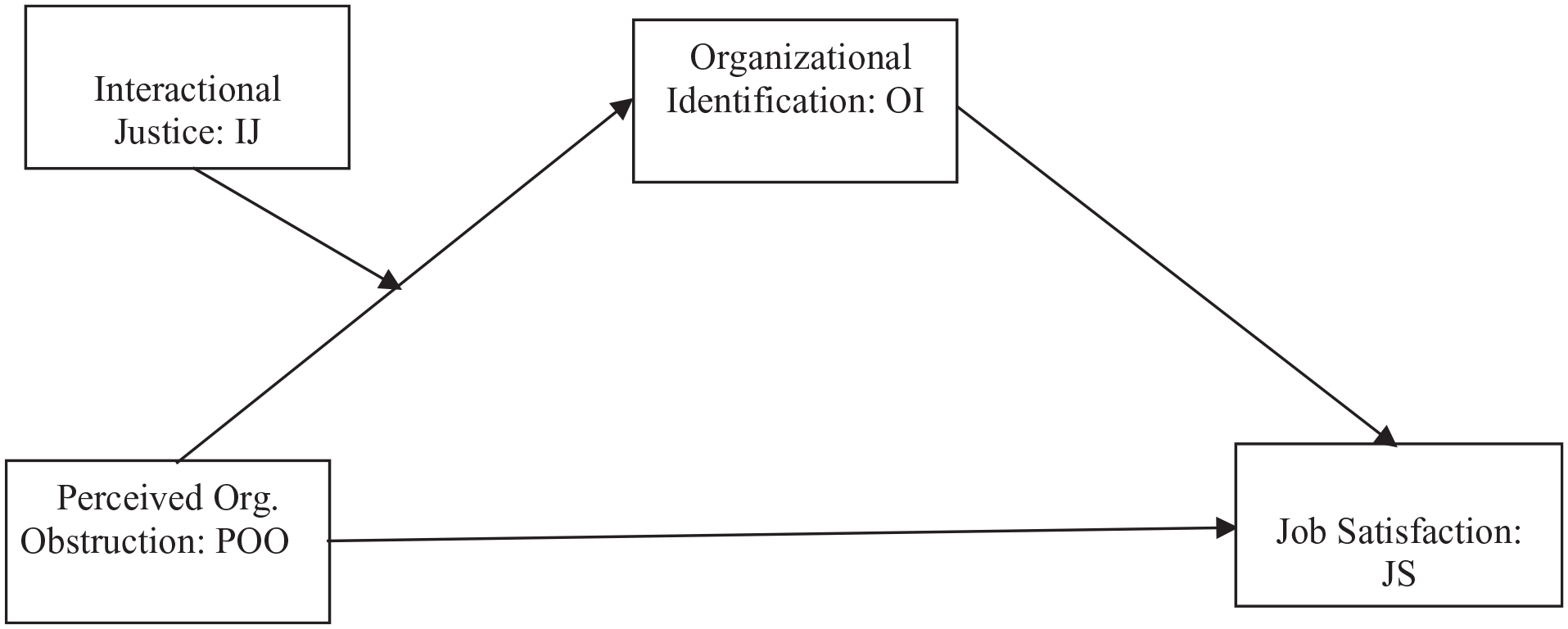
Research model.
Method
Sample and Procedure
The population of the study was comprised of 1,115 employees of a public hospital operating in a provincial center in Turkey. There are several notable reasons for preferring hospital (i.e., the health sector) employees in the study. First of them is the fact that, job satisfaction, which is considered as an output variable, significantly affects the relationships with the patient (Lu et al., 2016) and the attitudes and behaviors of healthcare professionals (Lu et al., 2016; Ng et al., 2019), and it is therefore particularly important in the health sector. Because an increase in the level of job satisfaction leads to an increase in the quality of patient care (Chang et al., 2009) and the level of patient satisfaction (Mahmoud & Reisel, 2014), as well as leading to a decrease in occupational accidents (Salminen, 2017) and injuries (Barling et al., 2003). Second, previous studies (e.g., Erşan et al., 2013; Kuzulugil, 2012) revealed that job satisfaction of healthcare professionals in Turkey is low in general terms. Determining the factors affecting job satisfaction of health sector employees—particularly the organization-related factors (high organizational obstruction and low perception of justice)—is important since job satisfaction is of utmost significance in meeting customer (patient) expectations (Birtch et al., 2015). Based on these grounds, surveys were distributed to 400 employees, who were selected through the simple random sampling from among the population, through their managers and 301 accurately filled surveys were returned (Babbie, 2001). Since each scale in the surveys was originally written in English, they were translated and retranslated (Brislin et al., 1973) allowing the participants to answer in Turkish. As a result of the review, eight of the survey forms were not included in the evaluation due to incomplete or incorrect fillings. As a result of the analyses, it was determined that the majority of participants were male (52.5%), married (65%), in the 26 to 35 age group (36.5%), and with graduate degrees (44.5%) according to the gender, marital status, age, and educational status variables, respectively.
Measures
Perceived organizational obstruction scale
In the study, the 5-item “Perceived Organizational Obstruction Scale” was used (α = .95) which was developed by Gibney et al. (2009) in order to determine POO levels of employees. In the scale, there are certain statements such as “My organization obstructs the realization of my professional goals” and “My organization is a detriment to my well-being.” Each item is rated through the Likert type scale in a range of 1 to 5 (1—absolutely disagree and 5—absolutely agree).
Interactional justice scale
In the study, a 9-item scale was used that was developed by Niehoff and Moorman (1993) to measure interactional justice levels of employees (α = 0.90). The scale includes statements such as “When decisions are made about my job, the manager treats me with kindness and consideration” and “When decisions are made about my job, the manager is sensitive to my personal needs.” Each item is rated through a Likert-type scale in a range of 1 to 5 (1—absolutely disagree and 5—absolutely agree).
Organizational identification scale
“Organizational Identification Scale” which was developed by Mael and Ashforth (1992), was used to measure the identification levels of employees (α = .94). There are certain questions in the scale such as “When someone criticizes this firm, I feel like a personal insult” and “When I talk about this firm I usually say ‘we’ rather than ‘they’.” Each item is rated with a 5-point Likert type scale (1—absolutely disagree and 5—absolutely agree).
Job satisfaction scale
Developed by Way et al. (2010) in order to determine the job satisfaction levels of employees, the “Job Satisfaction Scale” (α = .87) was another scale used in this study. There are certain statements in the scale such as “All in all, I am satisfied with my job” and “In general, I like my job.” Participants were asked to respond to items on the scale according to the 5-Likert type (1—absolutely disagree and 5—absolutely agree).
Control variables
In the study, by taking previous research (e.g., Birtch et al., 2015; Rizany et al., 2019) as reference, the possible effects of gender, marital status, age, and educational level on job satisfaction was taken under control. Previous research (Taith et al., 1989) revealed that men compared to women, married individuals compared to single (Saner & Eyüpoğlu, 2013), older individuals compared to young (Lee & Wilbur, 1985), and those with higher level of education compared to low (Gürbüz, 2007) had higher job satisfaction. Therefore, these particular demographic variables were included in the analysis as control variables.
Hypotheses Testing
In the study, four variables related to demographic information (gender, marital status, age, and educational level) were determined as control variables, so they were controlled in models in the hypothesis tests. Research hypotheses were tested in two steps. The first step examined a simple mediator model (Hypothesis 1–3). In the second step, adding the moderator variable (interactional justice) to the model of the first step, the moderator effect (Hypothesis 4a) and the conditional indirect effect (Hypothesis 4b) were examined. Before implementing the analyses, the moderator variable was mean-centered (Aiken & West, 1991). Thus, the multicollinearity problem between these variables in the analysis was reduced (Aiken & West, 1991; Edwards & Lambert, 2007; Frazier et al., 2004). The Process Macro program developed by Preacher and Hayes (2004) was used to test the research hypotheses. This program is useful since it provides the significance of the mediating variable and moderated mediation (through bootstrap confidence intervals), and also provides the change in the moderated mediation based on the different levels of the moderator variable.
Analysis of the mediator effect
In order to determine the indirect effect through the organizational identification in the relationship between the POO and job satisfaction, a model was developed in the research (in order to test Hypotheses 1, 2, and 3). The validity of the data obtained from the analysis of the mediator effect was evaluated according to the conditions set by Baron and Kenny (1986), and the significance of the data was examined through the bootstrap (Edwards & Lambert, 2007; Preacher & Hayes, 2004) and Sobel tests.
Analysis of the conditional indirect effect
In the research, the effect of the moderator variable was tested in single model (Hypotheses 4a and 4b). The first hypothesis is about that the interactional justice has a moderator effect in the relationship between POO and organizational identification (Hypothesis 4a). The second hypothesis is about that the level of the indirect effect through the organizational identification in the relationship between the POO and job satisfaction varies depending on the level of the interactional justice (Hypothesis 4b).
Findings
Mean, standard deviation, and correlations among the variables are given in Table 1. Examining the correlation values, it is observed that there is a negative relationship between the POO and organizational identification (r = −0.56, p < 0.01), and there is a positive relationship between the organizational identification and job satisfaction (r = 0.28, p < 0.01).
Means, Standard Deviations, and Intercorrelations for Variables.

Note. N = 293; **p < .01. Cronbach’s alphas (α) are shown in parentheses.
Studies should determine whether there is a common method bias problem before testing hypotheses (Lindell & Whitney, 2001; Malhotra et al., 2006; Podsakoff et al., 2003, 2012). The common method bias can result in an unhealthy relationship among variables due to the common method used in the collection of data (Podsakoff et al., 2003). The most common method used by researchers in detecting common method bias is Harman’s single factor test (Podsakoff et al., 2003). In this technique, all factors are subjected to exploratory factor analysis at the same time. The basic assumption of this technique is that, in order to mention that there is a common method bias problem, (a) all variables must be collected in one factor as a result of factor analysis or (b) a single one of the factors should account for the majority of the variances in variables (Malhotra et al., 2006; Podsakoff et al., 2003). As a result of the factor analysis, four factors were determined whose eigenvalues were higher than one. The first of these factors accounted for 40.2% of the total variance, the second one accounted for 14.9%, the third one for 9.5%, and the fourth one accounted for 6.7% of the total variance. Based on these results, it can be said that there is no common method bias problem (Chang et al. 2010; Lindell & Whitney 2001). The researchers suggested that the confirmatory factor analysis could be used in combination with Harman’s single factor test to determine whether there is a common method bias problem (Malhotra et al. 2006; Podsakoff et al., 2003). For this reason, confirmatory factor analysis was performed to test the construct validity of the research variables. Whether the default structures of the scales were supported by the obtained data was tested through the alternative models strategy. The projected four-factor measurement model (perceived organizational obstruction [POO], interactional justice, organizational identification, and job satisfaction) was compared with five alternative models using χ2 difference tests. Thus, a four-factor measurement model containing all structures was tested and compared with alternative models, and it was examined whether there were problems with the convergent and discriminant validity of the scales (Gurbuz, 2019). The goodness of fit values of the measurement model and five different alternative models that were developed are given in Table 2.
Comparison of Measurement Models.

Note. n = 293; All models are significant at p < .05; χ2, chi-square discrepancy; df, degrees of freedom; RMSEA, root mean square error of approximation; CFI, comparative fit index; SRMR, standardized root mean square residual;
Three-factor model = POO and Interactional Justice combined into a single factor.
Three-factor model = POO and Organizational Identification combined into a single factor.
Three-factor model = Interactional Justice and Organizational Identification combined into a single factor.
Two-factor model = POO, Interactional Justice and Organizational Identification combined into a single factor.
Harman’s single-factor model, all variables combined into a single factor.
Examining the values in the table, it is observed that the goodness of fit values of the measurement model were better compared to the alternative models (χ2(239) = 352.51, RMSEA = 0.06, CFI = 0.97, SRMR = 0.07). In line with these results, it can be mentioned that the scales used in the study had the discriminant validity. Thus, the four-factor measurement model was used in testing the structural relationship between the variables.
Test of Mediation
Two separate models developed in the testing of research hypotheses. The first model was developed to determine the effect of POO on the organizational identification (Hypothesis 1), similarly the effect of organizational identification on job satisfaction (Hypothesis 2), and the mediating effect (Hypothesis 3) of organizational identification in the relationship between POO and job satisfaction. When the results of the first model (Table 3) are examined, it is observed that there is a negative and significant relationship between the organizational identification and POO (B = −0.55, t = −9.74, p < 0.01). This result means that Hypothesis 1 is supported. Examining the results of the Hypothesis 2, which is about that organizational identification has a positive effect on the job satisfaction, it is observed that there are outcomes supporting this hypothesis (B = 0.29, t = 2.76, p < 0.01). Examining the results of Hypothesis 3, which is about that organizational identification has a mediating effect in the relationship between POO and job satisfaction, it can be said that this hypothesis is supported. In other words, it can be said that there is a mediating effect, since there is an indirect effect (−0.16) through the organizational identification on the relationship between the POO and job satisfaction. In order to say that Hypothesis 3 is fully supported, the significance of the mediating effect must be tested (Edwards & Lambert, 2007; MacKinnon et al., 2002; Sobel, 1982). Different measurement tools can be used to test the significance of the mediating effect. The most common of these measurement tools is the Sobel test (Sobel, 1982). As a result of the Sobel test, the indirect effect was found to be significant (Sobel z = −2.76, p < 0.01). Similarly, the confidence interval values obtained as a result of Bootstarp supported the results of the Sobel test (LLCI = −0.28, ULCI = −0.04). Based on these results, we can say that Hypothesis 3 was verified.
Regression Results for Mediation Effect.

Note. N = 293; Bootstrap sample size = 5.000. LL = lower limit; CI = confidence interval; UL = upper limit. POO = Perceived organizational obstruction; JS = job satisfaction; OI = organizational identification.
Test of Moderated Mediation
At this stage of the study, two hypotheses (Hypothesis 4a and Hypothesis 4b) were tested according to the moderator variable effect and the results were given in Table 4. Initially, it was tested whether the relationship between the POO and organizational identification varied depending on the different levels of interactional justice (Hypothesis 4a). According to the Hypothesis 4a, the negative relationship between the POO and organizational identification is weak when the interactional justice is high, and it is strong when interactional justice is low. In order for the moderator effect to exist, the interaction between the independent variable and moderator variable should be significant (Baron & Kenny, 1986; Edwards & Lambert, 2007). According to the obtained results, the effect of the interaction between POO and interactional justice (POO x IJ) is significant (B = 0.15, t = 2.69, p < 0.01). For hypothesis 4a to be fully supported, the structure of this interaction should accord with the hypothesized model (Edwards & Lambert, 2007; Frazier et al., 2004; Fairchild & MacKinnon, 2009; Muller et al., 2005). The slope test was applied (Aiken & West, 1991) for analyzing the relationship between POO and organizational identification that varied depending on the low, medium, and high levels of interactional justice, and the changes in relationship are given in Figure 2 for analysis of the relationship between POO and organizational identification, which are perceived according to low, moderate, and high levels of interactional justice.
Regression Results for Conditional Indirect Effect.

Note. SD = Standard deviation; SE = Standard error. Bootstrap sample size = 5.000. LL = lower limit; CI = confidence interval; UL = upper limit.

Interactional justice moderating the relationship between POO and organizational identification.
Since the interactional justice was centralized in the Figure 2, the low value represents the value that is “− 1” standard deviation away from the center, while the high value denotes the value that is “+1” standard deviation away from the center, and medium value represents a value close to the center. When the results were examined, it was determined that the negative relationship between POO and organizational identification was significant depending on the low, medium, and high levels of the interactional justice. According to the results, it was determined that the negative relationship between POO and organizational identification was strong when the interactional justice was low (B = −0.55, t = −8.28, p < 0.01), and it was weak (B = −0.27, t = −2.74, p < 0.01) when the interactional justice was high. In line with these results, it can be said that Hypothesis 4a was supported.
Hypothesis 4b, which was about that the indirect effect is dependent on moderator variable, was analyzed in the study according to the results given in Table 4. The significance of the indirect effect (according to the low, medium, and high levels of interactional justice) through the organizational identification in the relationship between POO and job satisfaction was determined with the confidence intervals that were specified by means of the bootstrap method. According to the results, it was determined that the indirect effect of POO on job satisfaction through organizational identification is stronger in case the interactional justice is low compared to the case the interactional justice is high. In other words, the indirect effect, which is through the organizational identification in the relationship between the POO and job satisfaction, is strong when the interactional justice is low (B = −0.16, 95%, bootstrap CI −0.28 to −0.05), and it is weak when the interactional justice is high (B = 0.08, 95%, bootstrap CI −0.15 to −0.02). In order to be able to say that Hypothesis 4b has been fully verified, the values of the conditional mediation (conditional indirect effect) index must be significant (Edwards & Lambert, 2007; Preacher et al., 2007). As the result of the review, it can be said that these values are significant since the bootstrap confidence intervals do not include zero (bootstrap CI 0.01 to 0.09). As the conclusion, it can be mentioned that Hypothesis 4b was supported.
Discussion
Different from previous studies, this research discussed the POO (e.g., Gibney et al., 2009, 2011; Kocak, 2019; Lee, 2016; Mackey et al., 2018) with a complex model. In the research, initially, it was foreseen that organizational identification for employees has a mediation role in the relationship between their POO and job satisfaction levels. Subsequently, it was sought whether this indirect effect varied depending on the changing levels of interactional justice perception of the employees. The findings of the research supported the hypothesis foreseeing that the level of the indirect effect varied depending on the interactional justice perception levels of employees. In other words, as the conclusion of the research, it was determined that the indirect effect of the POO on the relationship between the organizational identification and job satisfaction was weak when the interactional justice level was high, and it was strong when the interactional justice level was low. The theoretical and practical implications of the research are discussed in the next part.
Theoretical Implications
In this study, the indirect effect of organizational identification on the effect of the POO (Gibney et al., 2009) on the job satisfaction levels of employees was examined, and additionally, it was investigated whether this effect varied depending on the level of the interactional justice they perceived. The findings are significant since they both support previous findings in the literature and widen the models discussed in other studies (Gibney et al., 2009, 2011; Lee, 2016; Mackey et al., 2018). As a result of the literature review, it was observed that there are only a few previous studies examining the results of POO (Gibney et al., 2009; Kocak, 2019; Mackey et al., 2018); moreover, the variables discussed within the scope of this study were not examined together in the literature. Therefore, the results ensured a better understanding of the effects of POO and made the following contributions to the literature.
When the literature was examined, it was observed that the relationship between POO and job satisfaction was ignored. Therefore, the relationship between POO and job satisfaction was examined in this study, and it was determined that the POO was an important determinant of satisfaction. According to Saari and Judge (2004), the employee has many attitudes within the organization and the most important of them is job satisfaction. Considering the facts that employee attitudes are closely related to perceptions (Pickens, 2005) and that employees develop negative attitudes by not perceiving support in the organization or by perceiving obstruction (Gibney et al., 2009), it can be mentioned that the finding emphasizing that “POO levels of employees negatively affect their job satisfaction attitudes” is rational.
Another contribution of the research to the literature is that the relationship between POO and job satisfaction was examined through organizational identification. Edwards (2005) noted that organizational identification is an important variable in reducing the effects of negativity in organizations. Therefore, the concept of organizational identification was also discussed in this study, and based on the theory of social exchange (Blau, 1964), a hypothesis was developed that organizational identification may be a mediating variable in the relationship between POO and job satisfaction. As a result of the analyses, the social exchange theory perspective was supported; in other words, the POO weakened the organizational identification, ultimately leading to a decrease in job satisfaction. Therefore, it can be suggested that the research findings are significant with respect to supporting the assumption that POO leads to disidentification (Gibney et al., 2011), and revealing that POO reduces the level of job satisfaction through organizational identification. In other words, it can be stated that the findings of this research make significant contributions not only to the assumptions about the relationship between POO and the organizational identification/disidentification (Gibney et al., 2011), but also to the assumptions about the relationship between organizational identification and job satisfaction (Karanika-Murray et al., 2015; Kwon et al., 2010; Lu et al., 2015). Additionally, the findings of this study supported the assumptions that the employees who identified themselves with their organizations can ignore the negativity to an extent (Jones & Volpe, 2010).
Another contribution of our research to the literature is that it discussed the relationship between POO and job satisfaction through the conditional indirect effect (moderated mediation) model and provided a better understanding of this relationship. In other words, research is significant since it is the first study to address the effect of POO on job satisfaction through organizational identification and through the moderation of interactional justice. The findings obtained in the analyses supported the hypothesis (Hypothesis 5) that the power of the indirect effect varied according to the level of the moderator variable. In other words, the negative indirect effect of POO on job satisfaction (through organizational identification) was determined to be stronger in employees with low perception of interactional justice compared to the employees with high perception of interactional justice. Therefore, the research supported that the negative perceptions of employees against the organization have a negative effect on their organizational identification (Akar, 2019; Gibney et al., 2009, 2011; Ismail et al., 2016). On the other hand, this research took the findings of these studies a step further since it revealed that this negative effect will decrease as the interactional justice perceptions of the employees in the organization increased, thus, contributed to the literature.
In addition to the mentioned contributions, it can be stated that the findings obtained in the study reflect the perspectives of social exchange theory (Balu, 1964) and the negative reciprocity norm (Gouldner, 1960). Because our findings support the assumptions reported by Gibney et al. (2009) claiming that there is a theoretical gap in the theory of social exchange. Additionally, it also contributed to Gouldner’s (1960) theory of reciprocity, which is based on the theory of social exchange. Gouldner (1960) claimed that individuals tend to do a favor for individuals who helped them, while on the other hand, they tend to harm those who harm them. If the research findings obtained in this study are evaluated under Gouldner’s (1960) negative reciprocity norm, as the harmful POO levels of employees increase and beneficial interactional perceptions levels decrease, as a response, the level of organizational identification and job satisfaction of the employees decrease that are important for them to contribute positively to organizational output.
Practical Implications
Bad experiences of employees in organizations are more long-lasting than their good experiences (Baumeister et al., 2001; Eby et al., 2010). Employees direct the social exchange relationship with the organization in accordance with their experiences with the organization (Mackey et al., 2018). Accordingly, employees cognitively move away from the organization if they perceive that opportunities to improve themselves are prevented by the organization (Gibney et al., 2011). Similarly, the results of this study demonstrated that the POO in the employees causes a negative social exchange relationship (Newsom et al., 2005), resulting in decreased organizational identification and lower job satisfaction.
Considering that job satisfaction is important for organizational performance (Doghan et al., 2019; Muthukumaran, 2018), we can make some implications in line with the results we have achieved. The first of these implications can be explained by the Job Characteristics Model developed by Hackman and Oldham (1976). According to this model, a job has five motivating features. These features include: task identity, task significance, skill variety, autonomy, and feedback. If these characteristics, which determine the control or impact of employees on their work, are designed by the organization to please the employee, the employee is more likely to be satisfied with his/her work (Djastuti, 2010). As a result of the research conducted by Judge and Klinger (2008), it was determined that the job satisfaction of the employees depends on the characteristics of the work. On the other hand, the perception of the organizational obstruction in the employees may be due to the fact that these characteristics of the work they do are against the employee. For example, it becomes difficult for an employee, who has no autonomy over his/her work and who cannot get feedback, to achieve his/her goals in his/her career (Callister et al., 1999), and thus, the level of his/her well-being is decreased (De Jonge & Schaufeli, 1998). As a result, this situation causes the employee to perceive that there are obstructions preventing him/her from achieving his/her goals and harming his/her well-being, and ultimately resulting in job dissatisfaction. Therefore, managers, who want to increase the job satisfaction levels of their employees, should take steps to make the necessary improvements by reviewing the practices that employees perceive as obstruction (see, e.g., Gibney et al., 2011). Organizations can provide managers with training to improve their ability to respond when organizational obstruction perceptions arise.
Another practical contribution of the research results is the emphasis on the importance of reducing the POO, increasing the organizational identification and interactional justice in order to increase the job satisfaction levels of employees. The findings of this study suggest that despite the POO, the employees can be satisfied with their work if they have a high level of organizational identification and a high perception of interactional justice. To this end, organizations can increase their level of organizational identification by incorporating employees into decisions, providing them with the resources they need, and contributing to their goals and well-being (Edwards, 2005; Van Knippenberg & Sleebos, 2006). Rhoades and Eisenberger (2002) suggested that when the employees perceive organizational support in achieving their goals, it will contribute to their organizational identification. As a result of the study conducted by Gibney et al. (2009), it was found that employees could distinguish the negative social change relationships (POO) and supportive or neutral social change relationships. Since the indirect effect of POO on the job satisfaction through organizational identification is strong when the interactional justice is low and it’s weak when the interactional justice is high, the managers should increase the interactional justice (i.e., knowledge share) and organizational identification in employees in order to decrease the negative effects of POO.
The research has also contributed to the field by addressing the job satisfaction variable within the health sector. Job satisfaction is a significant attitude since it not only decreases the employee’s burnout level (Tavakoli et al., 2018) and counter-productivity behaviors (Bowling et al., 2010), but also increases the behaviors of employees to act beyond their task definitions (Bowling et al., 2010), improves patient satisfaction (Mahmoud & Reisel, 2014), and enhances quality of patient care (Boamah et al., 2017). For this reason, it is important to identify variables that increase or decrease job satisfaction of health workers. In this study, it was determined that the variable determining (actually decreasing) the jobs satisfaction of health workers is the POO, and it was also determined how the negative effect of the POO on job satisfaction can be decreased. Therefore, it was determined how health workers, who perceived an obstacle (which is inevitable), could maintain their job satisfaction levels, and it was observed that health managers could maintain the levels of job satisfaction by strengthening identification and allowing them to perceive interactional justice.
When the findings are evaluated in general, it can be stated that the research produced findings that deliver solution to the question: “Why and how the POO causes negative outcomes in organizations?” The organizational obstruction, which is asserted to be perceptual (Gibney et al., 2009) and which results in negative consequences (Lee, 2016; Mackey et al., 2018) is unlikely to be completely eliminated in organizations. Therefore, although there are activities in organizations that facilitate achieving goals for the employees and increase their well-being, the employee’s failure to perceive this situation will lead to the feeling of obstruction in the organization. In this context, since such a perception is always possible, it would be more rational to minimize negative consequences of obstruction perception instead of trying to completely eliminate it. At his point, this research determines how to minimize these negative consequences of obstruction perception. In the study, it was found that the perception of organizational obstruction decreases the employee’s organizational identification, and as a result of this situation, he/she is less satisfied with his/her work. Accordingly, two important negative consequences of POO (decrease in organizational identification and job satisfaction) were determined. In addition, the research also produced certain findings about how to overcome these negative results. The findings suggest that this negative situation can be eliminated by perception of interactional justice; in other words, in a situation where interactional justice is perceived, despite the existence of POO, it does not decrease the organizational identification, and since the organizational identification is not decreased, the level of job satisfaction remains the same.
Limitations and Recommendations
Although our research has important results mentioned above, it also has a number of limitations. The first limitation is that causal relationships cannot be adequately revealed due to the fact that the research is a cross-sectional study (Levin, 2006). Cross-sectional data is the data collected from the participants at once. In a cross-sectional research design, time is not considered as a variable of the study (Lavrakas, 2008). If further studies collect the data by extending over a period of time, they can adequately demonstrate causal relationships concerning the research results. The second limitation of the research is that the results cannot be generalized due to the fact that the research data were obtained from the employees of a public hospital in Turkey. The cases, which are perceived as obstruction by the employees in public institutions, may be due to bureaucratic practices that prevent managers from making changes (Brower & Abolafia, 1995). While healthcare professionals, who work in a sector where job satisfaction is of utmost importance, are appropriate participants for this genre of research, caution should be exercised in generalizing the findings to other types of jobs or industries. For example, the healthcare industry is a sector with greater environmental uncertainty (e.g., diversity in patient care) and a higher rate of change as compared to industries comprising routine practices (e.g., the manufacturing sector; Birtch et al., 2015). While our findings can be generalized to certain sectors that are similar to the health sector (e.g., education, aviation), generalization to different sectors demands caution. Therefore, additional research is needed in order to fully generalize the results. Another limitation is that the POO is one-dimensional (Gibney et al., 2009). Organizational obstructions that employees perceive in organizations may depend on different reasons (i.e., management, organization, colleagues, and personal factors). Therefore, in order to obtain more comprehensive and valid results, further studies need to address the POO by developing its multidimensional structure. Finally, given the possible moderator variables, it can be said that our research model is not sufficient. In this study, we only included interactional justice in the model. But organizational justice has different dimensions as well, such as distribution and procedure (Niehoff & Moorman, 1993). These dimensions can be taken into account in further research studies. In addition to the model we proposed in this study, interesting results can be obtained by including the moderator variable into the effect of organizational identification on the job satisfaction.
Footnotes
Author’s Note
Gökhan Kerse is now affiliated is Kafkas University, Kars, Turkey.
Declaration of Conflicting Interests
The author(s) declared no potential conflicts of interest with respect to the research, authorship, and/or publication of this article.
Funding
The author(s) received no financial support for the research, authorship, and/or publication of this article.
