




Abstract
Collaborative professional development among teachers is the endogenous driving force for accelerating the evolution across interdisciplinary fields and for producing high-quality scientific research outcomes. Grounded in fairness heuristic theory, a moderated mediation model was proposed and tested on teachers’ knowledge-sharing willingness, perceptions of organizational justice, research stress, and teamwork behavior in Shandong universities in China. An online survey was conducted using convenience sampling and data were analyzed using descriptive statistics, correlation analysis, and hierarchical regression analysis with AMOS and Process software. The findings from 648 valid responses indicate that research stress significantly and positively influences teamwork behavior. The knowledge-sharing willingness partially mediates the relationship between research stress and teamwork behavior. Additionally, perceived organizational justice play a moderating role in the relationships between research stress and teamwork behavior, research stress and the knowledge-sharing willingness, and knowledge-sharing willingness and teamwork behavior. By enhancing teachers’ perceptions of organizational justice, universities can effectively mitigate research stress, foster knowledge sharing and teamwork, ultimately leading to improved interdisciplinary research efficiency and innovation capabilities.
Plain Language Summary
Teachers’ collaborative professional development drives interdisciplinary progress and high-quality research. This study, based on fairness heuristic theory, explored the links between Shandong university teachers’ research stress, teamwork behavior, willingness to share knowledge, and perceived organizational justice. Using online surveys and statistical analyses, 648 valid responses revealed that research stress positively predicted teamwork behavior, with knowledge-sharing willingness partially mediating this relationship. Perceived organizational justice moderated these three key links: research stress and teamwork behavior, research stress and knowledge-sharing willingness, and knowledge-sharing willingness and teamwork behavior. In summary, enhancing teachers’ perceived organizational justice can reduce research stress, promote knowledge sharing and teamwork, thereby improving the efficiency and innovation of interdisciplinary research.
Keywords
Introduction
Teacher development is the main engine of educational change and is attracting ever-greater attention. Yet in todays’“publish-or-perish” climate, many academics discover that solo effort is no longer enough. The real accelerator is collaborative professional development, now a central theme that advances through teacher teamwork (UNESCO, 2022). As universities increasingly support interdisciplinary initiatives, such teamwork fuels professional growth, sparks innovation, produces high-impact research, and expands academic influence and resources (Lattuca, 2001). The rise of interdisciplinary teamwork also mirrors the changing nature of knowledge production. The knowledge system of a single discipline has become insufficient to address complex real-world problems and has been unable to meet students’ curiosity, administrators’ standards, or society’s demands (García-Martínez et al., 2021; Wawak et al., 2024). Consequently, forming collaborative teacher teams has become an urgent institutional priority.
Research work is inherently accompanied by various stressors, such as scarce time resources and fierce academic competition, which have become common occupational environmental characteristics faced by university teachers grappling with teaching-research conflict (Feng et al., 2025; Wieczorek & Mitręga, 2017). Research stress can exert a series of adverse effects on researchers, such as physical and psychological ailments, diminished sense of well-being, and impaired academic passion (Wolniak & Szromek, 2020). However, moderate research stress is not a negative factor, it can drive teachers to actively participate in knowledge sharing and team collaboration (Chuang et al., 2016). Especially in the tertiary context, the challenging environment constructed by research stress will make teachers realize the limitations of their individual abilities, thereby generating an internal need to enhance team contribution by demonstrating a more positive attitude toward knowledge sharing and taking the initiative to participate in teamwork to jointly address various challenges brought about by research stress (Feng et al., 2025; MacIntyre et al., 2020). This logical chain indicates that there is a potential correlation mechanism between research stress and teamwork behavior, along with the possibility of transforming research stress into a positive impetus through teamwork collaboration.
As a core component of effective teamwork behavior, knowledge sharing refers to the voluntary provision and exchange of both tacit and explicit knowledge among team members (Hu & Noor, 2024). As higher education institutions take knowledge generation and dissemination as their core mission, knowledge sharing emerges as a pivotal antecedent of teamwork behavior (Alves & Pinheiro, 2022). Knowledge-sharing willingness reflects teachers’ professional ethics and their strategic response to the external research environment, and serves as the prerequisite for actual knowledge-sharing action (Bock & Kim, 2002; Hu & Noor, 2024). Its predictive role in teamwork behavior has been well-documented in existing literature (Liu & Fang, 2010; Shamout et al., 2025); however, its buffering effect in mitigating research stress has received scant attention.
Despite the influence of individual factors on teachers’ teamwork behavior, contexual factors, such as organizational climate and managerial support, shape teachers’ perceptions of the work environment and further affect their willingness to invest personal resources in team collaboration (Lind et al., 2001). Among various organizational contextual factors, perceived organizational justice, defined as teachers’ subjective perception of the fairness of organizational resource allocation, decision-making procedures, and interpersonal interactions (Colquitt et al., 2001), emerges as a pivotal construct. When individuals perceive that they are treated fairly by the organization, they drop their burdens and work hard to maximize the interests of the organization (Lind, 2001; Van den Bos & Lind, 2004). In prior research, perceived organizational justice has predominantly been conceptualized as either an independent variable or a mediating variable (e.g. Hussain & Shahzad, 2022; Shen et al., 2022). However, the moderating role of perceived organizational justice, which strengthens or weakens the pathways between variables, has received scant attention in existing literature.
To sum up, there remains a notable research gap in the literature regarding the mechanism through which research stress influences teamwork behavior among university teachers in China. Therefore, this study adopts a quantitative approach to explore the causal relationships between research stress and teamwork behavior, as well as to examine the mediating role of knowledge-sharing willingness and the moderating role of perceived organizational justice in this mediating path. It is intended to provide a theoretical basis for clarifying the antecedent and developmental mechanisms of teamwork behavior, as well as practical references for alleviating teachers’ research stress and formulating evidence-based management strategies.
Literature Review
Theoretical Foundation
Fairness Heuristic Theory posits that when evaluating equity, individuals tend to employ simple heuristics to assess the fairness of an organization; once a fairness judgment is formed, it serves as a heuristic cue for subsequent behaviors, guiding how individuals respond to organizational events (Lind et al., 2001). Notably, individuals’ perceptions of organizational justice can be divided into two distinct phases: the judgment phase and the usage phase (Lind, 2001). This theory can be applied to explain how justice perceptions emerge and exert an impact on subsequent behaviors. During the judgment phase, university teachers assess organizational justice based on their personal experiences and subjective perceptions. If teachers perceive a high level of organizational justice, they will exhibit greater motivation and willingness to share knowledge and engage in team collaboration. In the second phase, after a stable cognitive framework of organizational justice has been established, university teachers will utilize their overall perception of organizational justice as a heuristic cue to guide and interpret their subsequent attitudes, emotions, and behaviors (Colquitt et al., 2001; Lind, 2001). Once teachers believe they are treated fairly by the organization, they will shed psychological burdens and commit themselves fully to maximizing organizational interests (Van den Bos & Lind, 2004). Even under considerable research stress, teachers will maintain a strong willingness to share knowledge and participate in team collaboration when they perceive that their efforts and contributions are fairly recognized and rewarded by the organization. This reasoning provides robust theoretical justification for examining perceived organizational justice as a moderator that shapes the strength and direction of the proposed mediating paths.
Research Stress and Teamwork Behavior
The research stress on university teachers refers to the various pressures and challenges faced by teachers when engaging in scientific research activities, including the publication of papers, promotion in professional titles, transformation of achievements, and interdisciplinary challenges (Wieczorek & Mitręga, 2017). In the new era of Chinese teacher evaluation systems, there is an emphasis on “breaking the five onlys,” which means “to resolutely overcome the stubborn problems of only scores, only promotions, only diplomas, only papers, and only titles, and fundamentally solve the issue of the educational evaluation command stick.” The original intention was not to cancel the research tasks of Chinese teachers but to require teachers to produce high-quality and high-level scientific research outcomes; therefore, research pressure on university teachers still exists (H. Lu & Zhang, 2024). Faced with complex research problems, the cross-integration of diverse disciplinary perspectives and methodologies is more conducive to the generation of innovative outcomes, which in turn alleviates research stress (MacIntyre et al., 2020; Wawak et al., 2024). Therefore, to mitigate the research stress perceived by Chinese individual teachers, leveraging teamwork to achieve research progress and breakthroughs appears to be an inevitable pathway (Lattuca, 2001; Xu & Gong, 2024). Existing literature has also confirmed that moderate research stress can stimulate teachers’ need for collaboration, enabling them to complement each other’s strengths and enhance research efficiency through teamwork (Feng et al., 2025). Thus, the following hypothesis was proposed in this study:
The Mediating Role of the Knowledge-Sharing Willingness
Knowledge-sharing willingness refers to the degree to which an individual believes in and is willing to engage in knowledge-sharing behaviors (Bock & Kim, 2002). Existing research has confirmed that knowledge-sharing willingness exerts a significant impact on teamwork behavior (Liu & Fang, 2010). When teachers possess a high level of knowledge-sharing willingness, they are more likely to engage in open communication, collaborate effectively, and contribute to the collective intelligence of the team (Bock & Kim, 2002). Particularly when confronting complex problems that cannot be solved by a single discipline, teachers tend to adopt a more proactive attitude toward knowledge sharing to acquire insights and methodologies from other disciplines within the team (García-Martínez et al., 2021). Furthermore, knowledge-sharing willingness not only facilitates teamwork behavior but also plays a crucial role in mitigating the negative effects of research stress (Nooteboom et al., 1997). Research stress motivates teachers to seek opportunities for collaborative learning and resource sharing, enabling them to benefit from the team’s collective wisdom and improve their research status (Meydani, 2023). This is because research achievements attained through teamwork typically possess substantial scientific value and influence (P. Banerjee et al., 2017), which in turn enhances teachers’ academic influence and recognition (Sekreter, 2019) and thereby alleviates their individual stress (Corbacho et al., 2021; Riebe et al., 2016). Additionally, as teachers encounter various stressors in their research endeavors, knowledge sharing can serve as an effective coping mechanism. By discussing challenges, seeking advice, and receiving peer support, teachers can alleviate feelings of isolation and overwhelm, thereby reducing the psychological burden associated with research stress (Serpa et al., 2020). This aligns with the theoretical propositions of the fairness heuristic theory, which posits that when individuals face stress-induced uncertainty, they use early fairness cues as anchors to decide whether to share knowledge, and ultimately drivie or inhibit team collaboration effectiveness (Lind et al., 2001). Thus, the following hypothesis is proposed.
The Moderating Role of the Perceived Organizational Justice
Environmental factors create a supportive or hindering backdrop for knowledge sharing and teamwork behavior (Hu & Noor, 2024). The fairness heuristic theory posits that individuals’ evaluations of and responses to stressors depend not only on the stressors themselves and their own psychological characteristics, but also on contextual environmental factors (Lind et al., 2001). For example, organizational justice shapes attitudes, behaviors, and decisions across diverse social contexts, and plays a pivotal role in determining how individuals respond to organizational outcomes, procedures, and decision-making processes (Lind, 2001). In the context of high perceived organizational justice, teachers tend to frame research stress as challenge stressors based on fairness cues, which motivates them to actively share knowledge to cope with stress collectively (Wolniak & Szromek, 2020). In contrast, perceptions of organizational injustice may exacerbate the negative impact of research stress, with such stress being framed as hindrance stressors and thereby leading to reduced willingness to engage in knowledge sharing and team collaboration. Additionally, a stable perception of organizational justice helps teachers establish positive expectations that their knowledge-sharing and teamwork behaviors will be fairly recognized and rewarded (Cropanzano et al., 2011). Under such expectations, high levels of knowledge-sharing willingness are more likely to be translated into actual collaborative behaviors. In turn, this collaborative approach enhances their perceptions of organizational justice by fostering a sense of belonging and solidarity within the team (Lind et al., 2001).
Previous studies on university faculty have indicated that evaluations of justice and reward mechanisms can significantly motivate teachers to share knowledge and experience more willingly and engage proactively in teamwork (Podsakoff et al., 2000; Tan, 2016). Similarly, an organizational climate characterized by fairness, recognition, and openness can enhance individuals’ willingness to share their knowledge (Cai & Shi, 2022). When university teachers perceive fairness in resource allocation, procedural arrangements, and interpersonal interactions (Hussain & Shahzad, 2022; O’Meara et al., 2019), they tend to feel respected and trusted. This, in turn, encourages them to support one another, communicate effectively, collaborate under stress, and demonstrate greater motivation to engage in knowledge sharing and teamwork (Al-Kurdi et al., 2020; Chuang et al., 2016). Conversely, if team members perceive an absence of organizational justice in relation to teamwork behaviors, it can reduce or even inhibit knowledge sharing and exert a negative impact on teamwork performance (Hameed et al., 2019). Existing research has also confirmed that organizational justice serves as a moderating variable that influences knowledge-sharing willingness and teamwork behavior (Manafi & Subramaniam, 2015). Consequently, we propose the following hypotheses.
Methods
Research Framework
Drawing on the fairness heuristic theory, a four-variable model was constructed to explore the mediating mechanism of knowledge-sharing willingness and the moderating effect of perceived organizational justice on each path within this mediating framework (as shown in Figure 1).

Research framework.
Participants
Convenience sampling was used in this study, and teachers from public and private universities in Shandong Province were selected as participants. The China Statistical Yearbook 2023 indicates that Shandong Province, the hometown of Confucius and Mencius and a key center for higher education, ranks third in terms of the number of university teachers (N = 182,200) and second in terms of the number of universities (N = 70), thus rendering the sample somewhat representative. Building on a pre-test involving 230 questionnaires, an additional 900 questionnaires were distributed online via Wenjuanxing, a professional online survey platform widely used in China. Two screening questions were incorporated upfront to filter eligible respondents: “Do you have a fixed research team?” and “Does your research team have an interdisciplinary attribute?” Data from respondents who failed to meet both criteria were excluded. After excluding 252 questionnaires from respondents without fixed research teams or interdisciplinary research experience, 648 valid questionnaires were retained, which satisfies the criterion that the ratio of sample size to the number of measurement items should exceed 10:1 (Hair et al., 2010). Among the valid samples, there were 386 males (29.6%) and 262 females (40.4%), with ages ranging from 25 to 60 years. Specifically, 36 respondents were teaching assistants, 460 were lecturers, and 152 were associate professors or higher-ranking academic staff. This study was conducted in strict accordance with the requirements of the institute’s Ethics Committee. Participants were informed in detail about the purpose of this study before answering the questionnaire and signing an informed consent form. All participants were informed that the data would be used only for this study and not for any other purposes, and that the privacy of each participant was guaranteed. Further, participants were informed of their right to withdraw their data at any stage of the study.
Research Instruments
Given that the participants were Chinese university teachers, whose research stress may differ from that of their Western counterparts, we adopted a Chinese version of the research stress scale. This scale has been downloaded and cited more than 3,000 times on CNKI (China National Knowledge Infrastructure). Specifically, the research stress scale was adapted from Zhang et al. (2013), which is unidimensional and consists of three items. The scale employs a 5-point Likert rating format, with a representative item being “I feel deeply anxious about how to accomplish my research tasks.” The original scale demonstrated an overall Cronbach’s α coefficient of .870, while the pre-test questionnaire yielded a Cronbach’s α coefficient of .806, and the factor loadings of items in the formal questionnaire ranged from 0.752 to 0.810. The SMC values were between 0.566 and 0.656, and the reliability was .828. The CR value was .829, and the AVE value was 0.617.
The knowledge-sharing willingness scale adopted in this study was originally developed by Bock and Kim (2002). This scale has been cited more than 1,000 times in existing literature and exhibits good cross-context generalizability. It is a unidimensional scale consisting of five items, with responses rated on a 5-point Likert scale. A representative item is “I will share my knowledge with more organizational members.” The original scale had an overall Cronbach’s α coefficient of .888, while the pre-test questionnaire yielded a Cronbach’s α coefficient of .865. The formal questionnaire factor loadings ranged from 0.767 to 0.806. The SMC values were between 0.589 and 0.650 with a reliability of .890. The CR value was .890, and the AVE value was 0.618.
The perceived organizational justice scale, originally developed by Niehoff and Moorman (1993), has been cited more than 5,000 times in the literature and comprises three dimensions (interactive justice, procedural justice, and distributive justice) with 14 items in total. Responses were rated on a 5-point Likert scale, with a representative item being “I feel that my job responsibilities are fair.” The original scale demonstrated Cronbach’s α coefficients of .820, .889, and .806 for the three dimensions respectively, while the pre-test questionnaire yielded an overall Cronbach’s α coefficient of .952. The factor loads of the formal questionnaire ranged from 0.772 to 0.814. The SMC values ranged between 0.596 and 0.660, and with a reliability of .960. The CR value was .960, and the AVE value was 0.633.
A 7-item teamwork behavior scale, originally developed by L. Lu et al. (2006), was adopted to assess the teamwork dimension of knowledge-sharing behaviors. Responses were rated on a 5-point Likert scale, with a representative item being “I work with colleagues in the form of a team.” The original scale demonstrated an overall Cronbach’s α coefficient of .900, while the pre-test questionnaire yielded a Cronbach’s α coefficient of .913. The formal questionnaire factor loads ranged from 0.777 to 0.820. The SMC values ranged between 0.604 and 0.673, with a reliability of .926. The CR value was .926, and the AVE value was .641.
Data Analysis
SPSS version 29.0 was used for the statistical analysis. Descriptive statistics were produced for all variables, while the PROCESS macro for SPSS (Model 4) was applied to examine the mediating effect of knowledge-sharing willingness. The PROCESS macro for SPSS (Model 59) was used to examine the moderated effect of perceived organizational justice on the direct path and the mediating path (Hayes, 2013).
Results
Common Method Bias Test
Common method bias was examined by comparing the model fit of a multifactor model confirmatory factor analysis (CFA) and a single-factor model CFA. The results indicate that the multifactor model (χ2 = 438.369, df = 371) was significantly lower than the single-factor model (△χ2 = 12,944.458, △df = 37, p < .001), showing a significant difference between the two models. This suggests that the data were not significantly affected by the common method bias (Richardson et al., 2009).
Reliability and Validity Test
Based on an analysis of the degree of information on each scale, a CFA model was constructed using four variables. The fit indices were as follows: χ2/df = 1.182, SRMR = 0.022, RMSEA = 0.017; TLI = 0.994, CFI = 0.995; PNFI = 0.884, PCFI = 0.909, and the HOELTER value was 646. All the indices were within the acceptable range, indicating a good model fit (Hair et al., 1998; Schumacker & Lomax, 2004). The correlation coefficients ranged from .453 to .502 (Figure 2).

CFA model.
Regression Analysis
PROCESS Model 4 was employed to test the mediating effect, with the sample size set to 2,000 for bootstrap resampling. A bias-corrected percentile bootstrap method was adopted for the analysis, with a 95% confidence interval specified. The mediating effect of knowledge-sharing willingness between research stress and teamwork behavior was examined, and the results are presented in Table 1; the total effect (0.410, p < .001) was significant, confirming H1, which posits that research pressure significantly and positively predicts team cooperation behavior. After incorporating the willingness to share knowledge, the total effect of research pressure on team cooperation behavior decreased from 0.410 (p < .001) to 0.294 (p < .001), with the bootstrap 95% confidence interval not including zero. This supports H2, indicating that knowledge-sharing willingness has a partial mediating effect between research stress and teamwork behavior.
Mediating Regression Analysis.
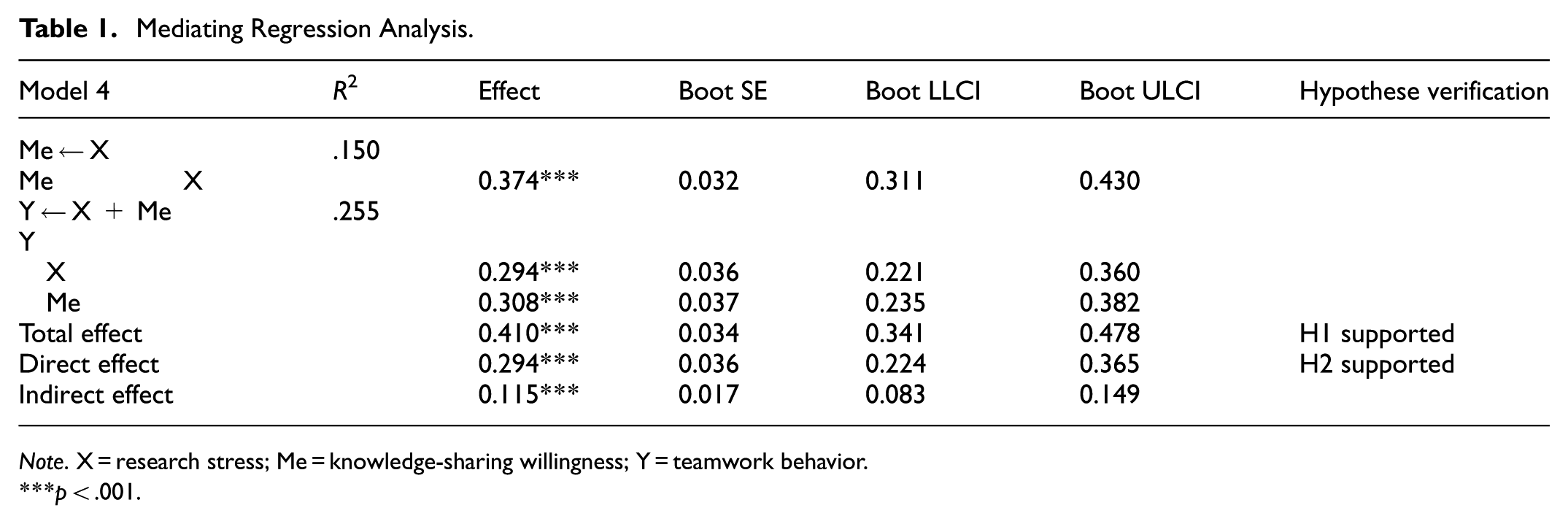
Note. X = research stress; Me = knowledge-sharing willingness; Y = teamwork behavior.
p < .001.
Using Model 59 to examine the moderating effect of perceived organizational justice on the various paths of mediation, and following the approach of Edwards and Lambert (2007) to test the moderated mediation, the results are shown in Table 2. The moderating effect on the direct path was significant (XMo = 0.079, p < .05); the moderating effect on the first half of the mediating path was significant (XMo = 0.161, p < .001); and the moderating effect on the second half of the path was significant (XMo = 0.136, p < .001). The moderated mediation effect was calculated as (0.216 + 0.161)(0.176 + 0.136) = 0.117 (Muller et al., 2005). Further examination of the mediating effect using the Sobel test yielded a z-value of 3.284 (p < .001), indicating a significant mediating effect of willingness to share knowledge. H3 is supported: Organizational fairness perception moderates the mediation model, in which knowledge-sharing willingness is the mediator, with research stress as the independent variable and team cooperation behavior as the dependent variable.
Moderated Mediation Regression Analysis.
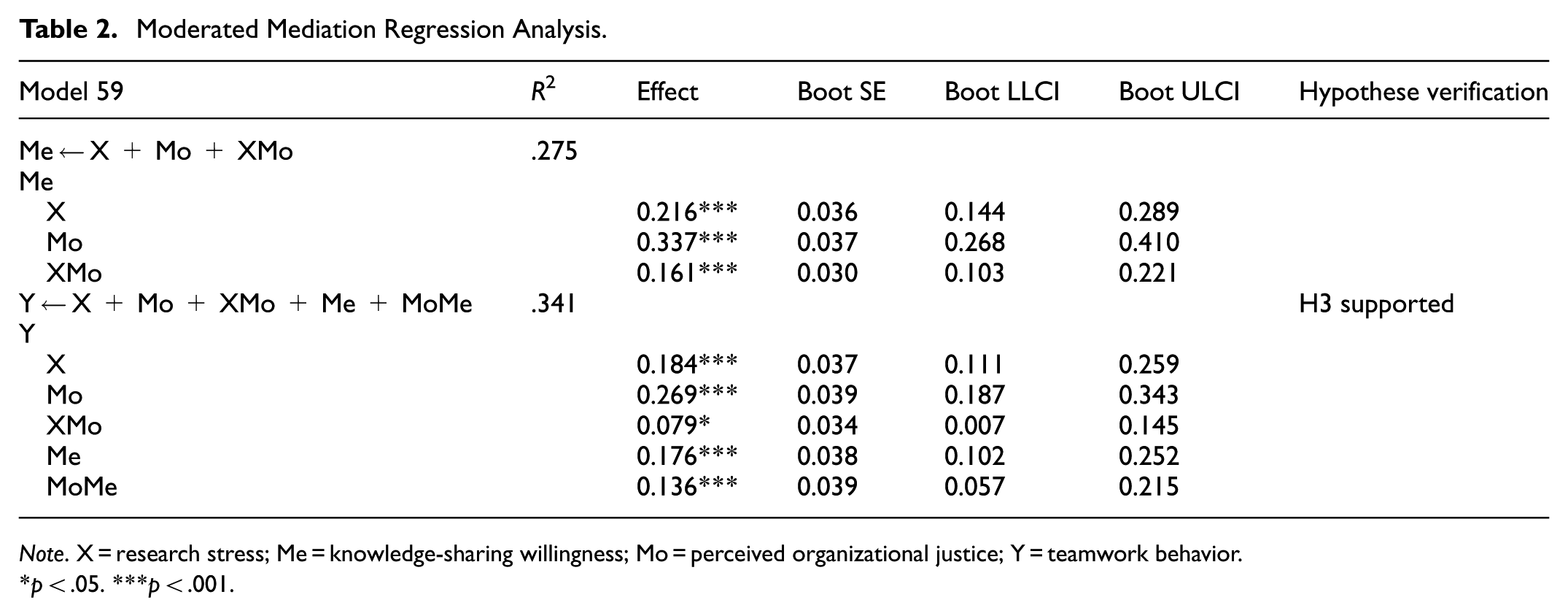
Note. X = research stress; Me = knowledge-sharing willingness; Mo = perceived organizational justice; Y = teamwork behavior.
p < .05. ***p < .001.
Discussion
Research Stress Positively Affects Teamwork Behavior
In today’s knowledge economy era, the research stress on university teachers has increased. This stress may come from the external environment, such as the national and societal demand for high-level research outcomes, or from the universities’ assessment mechanisms and promotion standards (Wieczorek & Mitręga, 2017). Previous studies have suggested that university teachers’ research stress may reduce their job performance (S. Banerjee & Mehta, 2016) and trigger occupational burnout (Teles et al., 2020). However, according to the findings of this study, research stress is not entirely negative. Against the backdrop of the interdisciplinary development trend for university teachers in the new era, the findings of this study indicate that a moderate level of research stress exerts a positive effect on promoting teachers’ teamwork behaviors. The possible reasons could be that moderate research stress compels teachers to break through the limitations of individual research and seek interdisciplinary collaboration to tackle complex academic tasks(Chuang et al., 2016), and the current emphasis on interdisciplinary research in China provides a favorable institutional and resource environment for teachers to translate stress-driven collaborative intentions into actual teamwork behaviors (Yu et al.,2022). Teamwork in turn plays a positive role in alleviating individual research stress, as the support from team members and research achievements provide teachers with both psychological comfort and external recognition (Wawak et al., 2024).
The Partial Mediating Role of Knowledge-Sharing Willingness Between Research Stress and Teamwork Behavior
The findings of the present study confirm that research stress exerts a direct positive impact on teamwork behavior and indirectly promotes such behavior by enhancing teachers’ willingness to share knowledge. This result is inconsistent with previous research by Wieczorek and Mitręga (2017), who noted that high research stress can inhibit knowledge sharing among teachers because they might worry about competition and knowledge theft. In contrast, the current study demonstrates that research stress exerts a positive effect on both knowledge sharing and teamwork behavior. A plausible explanation for this discrepancy lies in the fact that research stress prompts teachers to recognize that it is difficult to efficiently complete research tasks relying solely on individual efforts. This perception resonates with the ingrained collectivist values and helpful cultural traits of Chinese scholars. Such cultural genes make scholars more inclined to overcome difficulties through collective collaboration rather than working alone when facing research stress (Cao et al., 2025). Specifically, when confronting complex research problems and pressures related to time constraints and output requirements, teachers engaged in interdisciplinary research recognize that knowledge sharing can improve overall research efficiency, thereby alleviating stress (Corbacho et al., 2021). This finding further verifies the fairness heuristic theory. Teachers perceive that proactive knowledge sharing will yield reciprocal knowledge feedback and collaborative support, and this fairness heuristic significantly enhances their willingness to share knowledge, which in turn promotes the generation of teamwork behavior. Therefore, research stress can enhance the motivation for cooperation among team members under certain circumstances (Sekreter, 2019). Particularly in interdisciplinary university teams, teachers from diverse academic backgrounds can complement each other’s knowledge and skills through cooperation, thereby coping with research stress more effectively (Riebe et al., 2016). In turn, teamwork behaviors can alleviate individual research stress and improve the quality and innovation of research outcomes by facilitating knowledge and resource sharing (P. Banerjee et al., 2017).
The Moderating Role of Perceived Organizational Justice in the Mediation Model
The perceived organizational justice plays a moderating role between research stress and teamwork behavior, between research stress and knowledge-sharing willingness, and between knowledge-sharing willingness and teamwork behavior. Specifically, when teachers perceive high organizational justice, the positive link between research stress and knowledge sharing willingness is strengthened, and the positive impact of the knowledge-sharing willingness on teamwork behavior becomes more pronounced, too. The findings align with the fairness heuristic theory (FHT). On the one hand, high perceived organizational justice can buffer teachers against the negative emotions induced by research stress, reduce their defensive psychology and risk concerns regarding collaboration, and transform such pressure into positive motivation (Tan, 2016). On the other hand, under conditions of high organizational justice, teachers believe that their proactive knowledge sharing and teamwork behaviors will be fairly recognized and rewarded, which enhances the reliability of the fairness heuristic derived from research stress (Chuang et al., 2016; Van den Bos & Lind, 2004). This moderating effect also aligns with the collectivist cultural characteristics of Chinese scholars. In a context of high organizational justice, the collective-oriented values of Chinese scholars are more likely to be activated, as they perceive the organization as a fair collective platform that safeguards the interests of collaborators (Cao et al., 2025).Consistent with this reasoning, previous studies have also supported the view that perceived organizational justice can facilitate positive employee behaviors, including knowledge sharing and team cooperative behaviors (Cropanzano et al., 2011; Manafi & Subramaniam, 2015; Podsakoff et al., 2000). Therefore, this moderating effect reveals the importance of organizational justice in motivating knowledge sharing, which can improve the coordination and effectiveness of teamwork (Al-Kurdi et al., 2020). It is worth noting that the participants in this study are university teachers engaged in interdisciplinary research, for whom perceived organizational justice is more likely to serve as a core benchmark for their participation in interdisciplinary collaborative research. If such justice perception is absent, the uncertainties inherent in interdisciplinary collaboration will exacerbate the defensive mentality triggered by stress and inhibit knowledge-sharing and teamwork behaviors.
Conclusion and Implications
The findings suggest that research stress significantly and positively influenced teamwork behavior. Knowledge-sharing willingness partially mediated the relationship between research stress and teamwork behavior. Additionally, perceived organizational justice moderated the relationships between research stress and teamwork behavior, research stress and the willingness to share knowledge, and the willingness to share knowledge and teamwork behavior. This study makes contributions to the verification and expansion of the fairness heuristic theory. It also provide university administrators and teachers with novel strategies and perspectives to better support teachers’ interdisciplinary collaboration and professional development
The theoretical contributions of this study are reflected in several aspects. First, it verifies and expands the applicability of the fairness heuristic theory in the context of university scientific research, proving that perceived organizational justice can act as a core heuristic cue to help teachers transform research stress into positive motivation for knowledge sharing and teamwork. Second, it reveals the mediating role of knowledge-sharing willingness and the moderating role of perceived organizational justice in the relationship between research stress and teamwork behavior, breaking the previous one-sided understanding of the negative impact of stress and improving the theoretical model of stress-behavior interaction in academic groups. Third, it highlights the strengthening effect of collectivist cultural traits and interdisciplinary teacher attributes on the theoretical mechanism, enriching the research on cross-cultural organizational behavior and providing a differentiated theoretical perspective for academic team management.
This study also provides several practical implications for teacher management and professional development in universities. First, universities need to create a research environment with appropriate competitiveness rather than overly stringent requirements by setting achievable research objectives and reasonable assessment standards for teachers. Driven by such research stress, university teachers will be motivated to work closely with team members to address challenges collectively (Riebe et al., 2016). Moderate research stress can direct teachers’ focus more toward achieving team research goals rather than merely individual objectives (Nooteboom et al., 1997). Particularly in interdisciplinary research, knowledge and resource sharing among teachers from different disciplines can harness collective wisdom to tackle complex research problems effectively. Second, universities should foster a fair and collaborative organizational culture by encouraging and facilitating interdisciplinary cooperation. Concrete measures can include launching cross-departmental research projects, implementing joint appointment systems, and setting shared research goals. Additionally, during the process of educational innovation, universities ought to establish mechanisms to promote teacher interaction and resource sharing, formulate fair policies and procedures, provide transparent information, build effective feedback mechanisms, encourage teachers to participate in decision-making processes, and establish equitable job opportunity and reward systems. These initiatives can effectively enhance teachers’ willingness to share knowledge and stimulate teamwork behaviors (Liu & Fang, 2010). Such active communication, consultation, and mutual learning among teachers not only promote the transformation of research pressure into positive motivation but also facilitate the improvement of individual professional capabilities and research outcomes.
Limitations
Several limitations of this study need to be acknowledged to guide future research. First, the participants were restricted to university teachers in Shandong Province, which may constrain the generalizability of the findings. University teachers in other regions are shaped by distinct cultural norms, educational backgrounds, and institutional contexts. Therefore, future studies should further verify these results using samples of university teachers from other domestic regions and overseas countries. Second, other factors, such as an individual’s hierarchical status within the team, task division clarity, and leadership styles, may also exert a significant influence on teachers’ teamwork behaviors, yet these variables were not examined in the present study. Future research could incorporate these individual and organizational factors into the analytical framework to develop a more comprehensive understanding of teamwork behaviors among interdisciplinary university teachers. Additionally, this study explored research stress and perceived organizational justice in a relatively generalized manner, without distinguishing their specific dimensions. Future research should conduct an in-depth analysis of the heterogeneous nature of these constructs: for research stress, it could differentiate between challenge stressors and hindrance stressors; for organizational justice, it could dissect its three core dimensions of distributive justice, procedural justice, and interactional justice.
Footnotes
Acknowledgements
We are grateful to the teachers who helped with circulating the questionnaire and the teachers who carefully completed the questionnaire in this study.

Ethical Considerations
The study received the approval of the Hunan Institute of Technology Ethics Committee (Approval Number: HNGXY-23-25).
Consent to Participate
Prior to the distribution of online questionnaires, all potential participants were provided with a clear and concise informed consent statement.
Author Contributions
CX: Writing—Original draft, Software, Methodology, Data curation, Formal analysis; ZD: Writing—review & editing, Investigation; WG: Writing—Review & editing, Conceptualization, Project administration.
Funding
The authors received no financial support for the research, authorship, and/or publication of this article.
Declaration of Conflicting Interests
The authors declared no potential conflicts of interest with respect to the research, authorship, and/or publication of this article.
Data Availability Statement
The raw data supporting the conclusions of this article will be made available from the corresponding author, without undue reservation.