



Abstract
In the evolving landscape of 21st-century education, inquiry-based learning (IBL) has emerged as a leading pedagogical framework to foster critical thinking, problem-solving, and conceptual understanding in students. However, the effective integration of IBL in primary school mathematics education remains a complex challenge, particularly in the Ghanaian context. This study investigates the readiness and self-efficacy beliefs of primary school teachers in Ghana regarding the implementation of IBL in mathematics instruction. Data were collected from 166 primary school teachers in the Sekyere Kumawu district using structured questionnaires measuring teachers’ self-efficacy beliefs and readiness for IBL. The findings revealed that teachers exhibit positive self-efficacy beliefs (M = 3.63, SD = 1.07) and high readiness (M = 4.08, SD = .84) for implementing IBL. Moreover, a moderate positive correlation (rho = .547, p < .05) was found between teachers’ self-efficacy beliefs and their readiness to implement IBL. However, there were insignificant variations in self-efficacy beliefs among individuals with different levels of education. The study underlines the need for sustained professional development to address these variables and further investigates the factors influencing the effective implementation of IBL in primary schools in Ghana.
Keywords
Introduction
In the rapidly evolving landscape of 21st-century education, there is an increasing emphasis on pedagogical approaches such as inquiry-based learning (IBL) since empirical evidence links it with positive student learning outcomes (Areepattamannil, 2012; Khasawneh et al., 2023; Nazziwa et al., 2022). In this regard, inquiry-based approach has also found its way into mathematics curricula documents in Ghana. The newly endorsed standard-based curriculum for primary school stated in the teaching philosophy section that effective mathematics teaching needed for sustainable development should be inquiry-based (National Council for Curriculum and Assessment [NaCCA], 2020). This suggests that primary school teachers are expected to use IBL as their instructional method. Because inquiry-based learning can potentially enhance students’ motivation for and appreciation of mathematics as a field of activity and a tool for understanding the world (Blomhøj et al., 2022). Importantly, IBL places students at the center of the learning experiences, allowing them to construct meanings and new knowledge with the guidance of the teacher, who acts as a facilitator in the learning process (Baroudi & Rodjan Helder, 2021). Students develop the capacity to identify challenges, devise potential solutions, and implement strategies effectively. In these ways, they can apply and relate concepts learned to real-life problems that go beyond rote memorization of facts (Arsal, 2017). Nzomo et al. (2023) noted that students reported high self-efficacy, with positive correlations between their attitudes, which are predictors of good academic performance and test scores, when teachers use inquiry-based pedagogy. Similarly, Gómez-Chacón et al. (2023) found that inquiry-based mathematics instruction improved students’ perceptions of mathematics’ usefulness and mathematical self-concept. Accordingly, Pedersen and Haavold (2023) remarked that students whose teachers frequently use IBL see the value of mathematics and describe it as creative, engaging, and relevant to their futures.
Empirical evidence revealed that using inquiry-based learning as an instructional tool enhances students’ critical thinking, problem-solving, and conceptual understanding (Caswell & LaBrie, 2017; Styawan & Arty, 2021). Problem-solving is an active process in which students work to comprehend the problem, devise a plan, select or develop appropriate methods, and use these approaches to reach a solution (Pascual & San Pedro, 2018). Conceptual understanding allows students to think generatively within that content area, enabling them to select appropriate procedures for each step when solving new problems, make predictions about the structure of solutions, and construct new understandings and problem-solving strategies (Richland et al., 2012). Critical thinking involves students’ ability to clearly define problems, gather and interpret relevant information, draw reasoned conclusions, consider alternative perspectives, and communicate effectively with others in solving complex issues (Elder & Paul, 2010). Critical thinnking it includes three main processes: First, critical thinking begins with a problem-solving process. Second, it continues a reasoning process, and it results in many inferences through induction, deduction, and value judgment. Finally, the critical thinking process ends in a decision about what to do or believe (Arsal, 2017).
However, despite the growing attention, its effective implementation in primary school settings remains a complex challenge, among teachers often tasked with navigating a multifaceted curriculum (Howell & Maddox, 2022; Koutsianou & Emvalotis, 2021). A critical factor that influences the successful integration of IBL in primary school mathematics education is teachers’ readiness and self-efficacy beliefs (Aydeniz et al., 2021; Chichekian & Shore, 2016; Voet & De Wever, 2019). Teachers’ beliefs and attitudes toward innovative pedagogical approaches significantly shape their instructional practices, decision-making, and classroom dynamics (Correia & Harrison, 2020; Mohammed, 2022). Furthermore, teachers’ confidence in their abilities to implement IBL, their perceptions of its relevance and applicability in their classrooms play a pivotal role in determining the outcomes of this instructional approach (Bandura, 1978; Tschannen-Moran & Hoy, 2001). From a cross-national perspective, within the Ark of Inquiry project, Silm et al. (2017) sampled 497 teachers from 10 European countries. In the project, the teachers acted as students, thinkers, and reflective practitioners to enhance their sense of efficacy toward IBL adoption. The findings indicate that teachers with high self-efficacy were more inclined to IBL adoption. This set of teachers also saw lower challenges with IBL, rather as a motivational tool to enhance students’ knowledge and not a knowledge-dependent activity. Kaya et al. (2021) affirmed that teachers with high self-efficacy tends to be more ready to implement all five elements of IBL effectively and more consistently as outlined by the National Research Council (2000), namely asking scientifically oriented questions, prioritizing evidence, formulating explanations, linking explanations to scientific knowledge, and communicating and justifying explanations.
Despite the interest and advocacy for IBL in mathematics education, there is a noticeable gap in empirical research examining primary school teachers’ levels of readiness and self-efficacy beliefs concerning the integration of IBL as instructional practices. A significant number of studies have been conducted on inquiry-based learning in industrialized and industrializing countries. For instance, Huang et al. (2021) examined IBL practices in China and the Netherlands and found that students in both countries experienced inquiry tasks that positively influenced their learning preferences and engagement. In another study, Aditomo et al. (2013) investigated the implementation of IBL across Australian universities, reporting improvements in students’ research skills, critical thinking, and course engagement when they were engaged in inquiry-based learning activities. However, there is scarce evidence regarding such research in the context of Ghana (Mohammed et al., 2020). The study by Mohammed et al. (2020), which examined the extent of inquiry-based learning implementation in Ghanaian schools, revealed a rare implementation of IBL, despite its recognition in several policy and curriculum documents in the country (e.g., Curriculum Research and Development Division [CRDD], 2007, 2012; NaCCA, 2020). Nguyen et al. (2023) argue that transitioning from teacher-centered teaching to inquiry-based teaching is not merely a matter of policy-making; it also needs a fundamental shift in teachers’ mindset as a critical prerequisite for effectively advancing inquiry-based education (Nguyen et al., 2023).
This means that understanding the teachers’ readiness and the self-efficacy belief in adopting IBL can provide significant insights into the teachers’ challenges associated with the implementation of this pedagogical approach, thereby informing professional development initiatives, curriculum design, and educational policy (Bakker et al., 2021; Maass et al., 2017). Therefore, the current study investigates the readiness and self-efficacy beliefs of primary teachers to implement inquiry-based learning. The study also examined the link between teacher self-efficacy and their readiness to enact IBL. By addressing the research questions, the study aims to contribute to the existing body of knowledge on inquiry-based learning (IBL), professional development for educators, and mathematics education in general.
Purpose of the Study
This study aimed to examine the readiness and self-efficacy beliefs concerning the implementation of inquiry-based mathematics in primary schools in Ghana. The following research questions were investigated:
What are the levels of readiness and self-efficacy beliefs among public primary school teachers regarding the integration of Inquiry-Based Learning (IBL) into mathematics education?
How do teachers’ self-efficacy belief systems influence their readiness towards the implementation of IBL in the context of public primary school mathematics education?
Is there a statistically significant difference in self-efficacy levels among teachers with different academic qualifications?
Theoretical Framework and Related Literature Review
Theoretical Framework
The theoretical framework for this study is grounded in the self-efficacy belief of Bandura’s (1997) Social Cognitive Theory, which posits that individuals’ beliefs about their capabilities significantly affect their actions, motivation, and perseverance in challenging tasks.
Self-Efficacy
Self-efficacy refers to individuals’ beliefs about their ability to achieve a specific level of performance that shapes the events in their lives (Bandura, 1978). When it comes to teaching, teacher efficacy belief involves the judgment and confidence teachers have in their capacity to achieve desired outcomes in student engagement and learning, even in the face of challenging or unmotivated students (Bandura, 1978). Further, teachers’ efficacy beliefs influence their classroom behavior, including the effort they invest in teaching, the goals they set, and their overall level of ambition. According to Bandura (1997) self-efficacy consists of two distinct dimensions: (1) personal inquiry-based teaching efficacy beliefs, which relate to individual’s abilities to execute actions required to achieve desired goals, and (2) inquiry-based teaching outcome expectancy, which relates to individuals’ judgment of the anticipated results their performances may produce. Guskey and Passaro (1994) argued that both dimensions of teacher self-efficacy are highly significant in primary school classrooms. Both personal and outcome expectancy beliefs are needed for primary school teachers to succeed in their inquiry-based classrooms (Menon, 2020). Teacher self-efficacy is a motivational factor to implement innovative pedagogy such as inquiry-based learning (Burić & Kim, 2020). Moreover, teachers’ efficacy beliefs influence their classroom behavior, including the effort they invest in teaching, the goals they set, and their overall level of ambition. Teachers with a high sense of efficacy are more likely to demonstrate higher levels of planning and organization. They are also more receptive to new ideas and more willing to experiment with innovative methods to better meet their students’ needs. Teacher self-efficacy affects the choice of instructional practice, classroom management, and students’ engagement, which are elements of good instruction (Burić & Kim, 2020).
IBL Implementation
The constructivist philosophy is considered crucial in ongoing curriculum reforms. It emphasizes the use of inquiry-based learning methods (Baroudi & Rodjan Helder, 2021). Inquiry-based learning (IBL) is a student-centered approach that can be traced back to the work of John Dewey. It can be loosely defined as a teaching method that encourages students to work in a similar way to mathematicians and scientists (Artigue & Blomhøj, 2013). Specifically, IBL is an instructional approach in which students explore content by asking, investigating, and answering questions (Caswell & LaBrie, 2017). It is the method that teachers use to engage students in challenging subjects like mathematics (Baroudi & Rodjan Helder, 2021). Inquiry-based learning enables students to develop a deep understanding of mathematical processes, thereby impacting human civilization (Assuah et al., 2022). To ensure students benefit fully from IBL, teachers should decrease their autonomy and view themselves as facilitators and guide in the IBL classroom (Baroudi & Rodjan Helder, 2021). Their task is to engage and motivate students to solve problems based on real-life situations. This approach allows students to construct new knowledge based on their prior experiences. Each student can generate unique ideas, which is often considered a personal journey. Teachers can create opportunities for students to explore new ideas and concepts on their own while assisting in finding the correct solutions. Facilitating curiosity and enthusiasm in inquiry lessons is a crucial responsibility for teachers (Assuah et al., 2022). Throughout the IBL process, students experience multiple levels of inquiry, highlighting the focus on students with teachers as facilitators. Banchi and Bell (2008) outlined four levels of inquiry: confirmation, structured, guided, and open. At the confirmation inquiry level, teachers present scientific questions to students, guiding them through the process of conducting investigations and acquiring basic scientific skills, such as data collection and analysis. Moving to the structured inquiry level, teachers pose scientific questions to students, who then interpret the data they gather. In the guided inquiry level, teachers provide students with the research question and allow them to independently design the research process, including the methodology, results, discussion, and conclusion, under the teacher’s guidance. Finally, at the open inquiry level, students take on the role of scientists, formulating their research questions, collecting and analyzing data, and communicating their findings. Engaging in open inquiry enhances students’ scientific reasoning skills and cognitive strategies. By the conclusion of the open inquiry process, students can achieve a deeper level of scientific thinking. Tang et al. (2020) examined the factors that predict IBL use across eight (Chile, Mainland China, Czech Republic, Chinese Taipei, Dominican Republic, Korea, Macao, and United Arab Emirates) One Belt One Road (OBOR) economies. Using data from the Program for International Assessment (PISA, 2015) at the student level (N = 1,385) and the teacher level (N = 8,603). The finding revealed teacher efficacy beliefs as a predictor of IBL use. This positive result adds to the discoveries of the self-efficacy theory of Bandura (1997). Surprisingly, the authors discovered that resource availability was not consistent with IBL use in many of the countries. It therefore suggests that IBL can be used in less developed contexts.
Teachers’ Readiness to Implement Inquiry-Based Learning Instructions
Readiness refers to the state in which school teachers are fully prepared and equipped to actively engage in improvement agendas (Lynch & Smith, 2016). The readiness of teachers is linked to the performance of students. When teachers have high levels of readiness, it leads to effective teaching and ultimately improves student outcomes (Lynch et al., 2017). Teacher readiness refers to a teacher’s preparedness and eagerness to effectively conduct teaching in the classroom (Endot et al., 2021). In the literature, teacher readiness has been studied in terms of the availability of resources, teachers’ self-efficacy, and their perceptions of readiness (Al Malihi, 2015; Ekwueme & Meremikwu, 2013; Silm et al., 2017). For instance, Ekwueme and Meremikwu (2013) investigated the readiness and awareness of mathematics teachers in Nigeria regarding the implementation of the new mathematics curriculum for Universal Basic Education (UBE) goals. The study found that both public and private school teachers have a low level of readiness. Similarly, Al Malihi (2015) found that many English as Foreign Language (EFL) teachers in their study were not adequately prepared for curriculum changes. These studies highlight the importance of providing more support, resources, and training to ensure successful curriculum implementation. Furthermore, a study conducted by Xaba and Sondlo (2022) in South Africa posed the question, “To what extent are science teachers ready to use inquiry-based learning in their classrooms after participating in a training program?” The findings indicated that teachers who participated in the training programs experienced a positive change in their attitudes towards implementing inquiry-based learning. This suggests that training programs targeted at specific areas have the potential to greatly enhance teacher readiness. In a quantitative study of 368 teachers, Endot et al. (2021) asserted that teacher readiness to implement a pedagogical in Malaysia’s primary school curriculum was influenced by their self-efficacy. Teachers who had higher self-efficacy beliefs about their teaching abilities were more prepared to carry out the curriculum reforms effectively. These findings put together suggest that while self-efficacy is a predictor of teacher readiness, it must be nurtured through targeted training, practical experience, and supportive school environments. This underscores the importance of teachers being ready, which is a crucial factor for successfully implementing new curricula. It emphasizes the necessity of investing in resources, training, and support. The current study aims to assess teacher readiness by evaluating teachers’ beliefs in their ability to effectively teach through active teaching competencies and their confidence in implementing inquiry-based learning instruction. Since assessing teachers’ direct ability was not possible, the research focused on their ability to teach with inquiry-based learning. The researcher defines teacher readiness to teach with inquiry-based learning as the state of teacher willingness to give up their autonomy in the classroom.
Teacher Self-Efficacy Belief and Inquiry-Based Learning
Efficacy beliefs shape teachers’ persistence in the face of adversity and their ability to bounce back from setbacks. Teachers with a greater sense of efficacy exhibit more readiness for teaching. Teacher efficacy has also been found to have a positive association with teachers’ disposition and teaching practice, such as fostering higher student motivation, implementing more positive and effective classroom management strategies, and allocating more time for academic instruction (Tschannen-Moran & Hoy, 2001). However, in Ghana, Mohammed and Luguterah (2024) explored the science teaching efficacy of 308 instructors using personal science teaching and science teaching outcome efficacy scales. Results showed that instructors outside of the professional development context had low science teaching self-efficacy. One discovery was that the instructors had low personal science teaching efficacy (PSTE) and science teaching outcome expectancy (STOE) of inquiry-based pedagogy, but high personal science teaching efficacy and science teaching outcome expectancy of traditional pedagogy. The findings of this affirms Bandura’s (1978) self-efficacy theory which posits that teachers with high efficacy belief are likely to adopt inquiry-based instructions. Another important aspect of teacher quality and effectiveness is teachers’ sense of readiness, or how prepared they feel to meet the demands of the teaching profession (Brown et al., 2015). While it is evident that teaching self-efficacy is a crucial motivational construct that influences teacher quality and ultimately classroom effectiveness, there is still much to be discovered about its impact on teacher readiness. Beliefs have a significant impact, particularly in the domain of teaching methodologies, such as inquiry-based learning, as they shape how teachers conceptualize and approach their instruction. When a teacher’s underlying beliefs do not align with the principles of IBL, it can create challenges when attempting to implement inquiry as a teaching method in their classrooms (Brown et al., 2015). Essentially, teachers’ instructional choices are closely linked to their beliefs. The task of creating learning environments that support the development of cognitive skills relies on the self-efficacy of teachers. Those with a high sense of efficacy are more likely to employ inquiry- and student-centered teaching strategies that effectively motivate students.
Mathematics Teachers’ Beliefs About Inquiry-Based Learning (IBL)
Mathematics teaching efficacy refers to an individual’s belief in their ability to teach mathematics effectively. Importantly, a study revealed that mathematics teachers hold different beliefs about Inquiry-Based Learning (IBL), which can be categorized into three types: peripheral activities primarily used to motivate students, collections of pedagogical practices designed to promote students’ critical thinking and reasoning, and combinations of activities and pedagogies aimed at cultivating students’ ability to engage in scientific processes and acquire scientific knowledge (Maass et al., 2017). Teacher beliefs also influence their instructional practices in the mathematics classroom (Polly et al., 2013).
Beliefs of mathematics teachers regarding inquiry-based learning (IBL) may vary in different contexts. For instance, Dutch teachers prioritize students taking responsibility in IBL, while Chinese teachers emphasize teacher guidance, student discussion, and collaboration (Huang et al., 2021). In the United States, elementary teachers believe that inquiry-based mathematics involves problem-solving, working collaboratively, and asking questions (Nunnally, 2019). Greek teachers acknowledge the value of an inquiry-based approach and express high self-efficacy beliefs when using the explorations and investigations presented in textbooks. However, they have lower self-efficacy in creating their own mathematical investigations and managing challenges related to children’s misconceptions and time allocation during fieldwork (Panaoura, 2018). In Qatar, teachers and students hold different perspectives on stress factors and goal orientations related to IBL (Murphy et al., 2021). In Ghana, a study by Yarkwah (2020) reveals that Ghanaian junior high school mathematics teachers have highly positive beliefs about mathematics teaching and learning. According to Ali et al. (2007), teachers’ beliefs about mathematics are influenced by their past mathematical experiences, interactions with colleagues and educators, and their immediate environment. The authors identify two distinct patterns in teachers’ mathematical beliefs and teaching practices. One pattern involves teachers with absolutist beliefs about the nature of mathematics, who align with a technical focus in curriculum development. This leads to more traditional, teacher-centered classroom practices that are hierarchical and disempowering. In contrast, teachers with fallibilist views of mathematics tend to embrace a more humanizing and problem-posing pedagogy. This approach allows students to freely express themselves, fostering a more collaborative and empowering learning environment. Despite the importance of inquiry-based learning, research on it is scarce in Africa, where there are serious challenges in implementing inquiry curricula (Mohammed et al., 2020), and the few studies that exist have mainly focused on science curricula. Furthermore, these studies have produced mixed findings. For instance, in South Africa, Ramnarain and Hlatswayo (2018) reported on the interaction between grade 10 physical sciences teachers’ beliefs about IBL and their actual practice of IBL in the classroom. The report revealed that teachers had positive beliefs about IBL teaching and believed that inquiry-based learning could help motivate students. Similarly, Xaba and Sondlo (2022) investigated the beliefs of physical science teachers regarding the implementation of IBL in their classrooms. The study found that participating teachers had positive beliefs about IBL, which positively influenced their attitudes towards using inquiry-based learning when teaching physical sciences. However, in Ghana, Mohammed (2022) examined whether teachers’ beliefs indicate positive or negative attitudes toward inquiry-based science teaching. The results showed that teachers expressed negative beliefs about inquiry-based learning, which indicates a reluctance to incorporate IBL in their classrooms. This may explain why teachers are hesitant to adopt inquiry-based learning in their lessons. They cite challenges such as lack of resources, teaching materials, time constraints, and large class sizes as reasons for their reluctance. For instance, a study by Mohammed et al. (2020) examined the extent of IBL implementation in the Ghanaian context and found that its implementation in schools was rare, despite several calls, recognition, and its presence in policy and curriculum documents. These contradictory results in the literature call for further investigation into teachers’ self-efficacy beliefs and readiness for implementing IBL.
Method
Research Design
The study employed the positivist research paradigm. A quantitative approach was used in this study to investigate primary school teachers’ readiness and self-efficacy beliefs regarding inquiry-based learning implementation in their mathematics classrooms. This study adopted a cross-sectional survey approach (Creswell, 2014). The research used a structured questionnaire to gather numerical data from primary school mathematics teachers on their readiness and self-efficacy beliefs to use inquiry-based learning at a single point in time (Creswell, 2014).
Participants
The study involved 169 primary school teachers in the public basic school in the Sekyere Kumawu district of Ghana. The sample size was determined using Miller and Brewer’s (2003) approach for calculating sample size. The formula is as follows:

where, N = population (292), n = sample size, and α = significant level (.05). This approach considers a 95% confidence level and a 5% margin of error since the study focused on human participants.

One hundred and sixty-six teachers were used for the analyses. Ninety (54.2%) were female, and 76 (45.8%) were male. The educational qualification of the participants consists of teachers who hold a Diploma in Basic Education (DBE), a Bachelor’s degree (BEd or BSc), and post graduate degree (MEd). Seventy-seven (46.4%) were diploma holders, 85 (51.2%) were Bachelor degree holders, and 4 (2.4%) were postgraduate certificate holders. Thirty-three (19.9%) teachers had 1 to 5 years teaching experience, 68 (41.0%) had 6 to 10 years, 46 (27.7%) had 11 to 15 years, 6 (3.6%) year, 7 (2.27%) had 16 to 20 years of teaching experiences and thirteen (7.8%) had more than 20 years teaching experience.
Research Instruments
In this study, we employed two main instruments to gather quantitative data from primary school teachers on their readiness and self-efficacy beliefs regarding inquiry-based learning (IBL) implementation in their mathematics classrooms:
Teacher Self-Efficacy Belief Scale (TSE-S)
The teacher self-efficacy survey was adapted from (Ramnarain & Hlatswayo, 2018). The original version of the instrument was developed for the Promoting Inquiry-based learning in Mathematics and Science Education (PRIMAS) survey instrument that was developed for a large survey on inquiry-based learning and teaching (IBL) across 12 European partner countries (PRIMAS, 2011). The questionnaire was adopted into the African context by Ramnarain and Hlatswayo (2018). The PRIMAS item statements for the constructs, teachers’ beliefs and attitudes about IBL, teachers’ difficulty in the enactment of IBL, and teachers’ current beliefs were measured on a 4-point scale with an Alpha level over .70. For this study, six items of the teacher’s beliefs and attitude construct were adapted. The modified scale had 6 positively worded items rated on a 5-point Likert scale as follows: 5 = Strongly Agree, 4 = Agree, 3 = Not Sure, 2 = Disagree, and 1 = Strongly Disagree. A score of 1 to 2.4 would be regarded as low self-efficacy, 2.5 to 3.4 would be neutral, and 3.5 to 5.0 would be regarded as high self-efficacy. In this study, a neutral point was added to provide respondents who genuinely do not have a choice (Taherdoost, 2019). This is because a 5-point scales have higher predictive validity than a 4-point scale, and the same is true for 7-point scales. However, using larger point scales can cause respondent fatigue (Sonmark et al., 2017).
The Inquiry-Based Learning Readiness Scale (IBL-RS)
The teacher inquiry-based learning readiness scale (IBL-RS) was used to assess sampled teachers’ readiness regarding IBL implementation. The IBL-RS instrument was developed by the researchers based on the 5E instructional model after an extensive review of relevant literature, incorporating insights from the works of Silm et al. (2017) and Ramli et al. (2020). The instrument consists of 25 items, 5 items for each subscale (Engage, Explore, Explain, Elaborate, and Evaluate), for example Engage, (e.g., I have the ability to attract students’ interest), Explore (e.g., I have the ability to plan exploration mathematics activities), Explain (e.g., I have ability to correct students’ misconception), Elaborate (e.g., I have the ability to formulate questions on different level of thinking), Evaluate (e.g., I have the ability to assess students’ understanding and progress). The teachers rated their agreement on a 5-point Likert scale, ranging from (strongly disagree = 1, to strongly agree = 5).
Validity and Reliability
To ensure the quality and appropriateness of the data-gathering instruments, a rigorous content validation process was conducted. The instruments were reviewed by three experts in mathematics education, each with more than 10 years’ experience in instructional design and inquiry-based learning. Their evaluations focused on assessing the relevance, clarity, and alignment of the items with the study’s objectives. Based on their feedback, minor revisions were made to enhance the precision and contextual fit of the items. All items were deemed valid in terms of face and content validity, confirming their suitability for measuring teachers’ readiness and self-efficacy in implementing inquiry-based learning.
To ensure the reliability, the instruments were pilot-tested with a sample of 12 primary school teachers who were not part of the main study population. The purpose of the pilot test was to assess the internal consistency and reliability of the measurement scales. Cronbach’s alpha was computed for each of the subscales: the teacher readiness scale yielded an alpha of .82, while the self-efficacy scale produced an alpha of .70, indicating acceptable to high internal consistency (Jackson, 2009). These results confirm that the instruments reliably measure the intended constructs and are appropriate for use in the full study.
Data Collection Procedure
Before data collection, we obtained ethical approval from the university’s Research and Ethics Committee. Formal permission was also obtained from the district education directorate to conduct the study in the schools. Before administering the questionnaires, the researchers conducted a preliminary visit to participating schools to seek consent and cooperation from headteachers and teachers. During these visits, the study’s purpose, duration, and potential benefits were explained in detail to ensure informed consent. Additionally, logistical arrangements, including the scheduling of questionnaire administration, were discussed. The minimum qualification for inclusion in the sample was a Diploma in Basic Education (DBE), which was the most commonly held qualification among participating teachers. The data collection was conducted over 2 weeks by the first author and involved the administration of structured questionnaires to primary school teachers across multiple schools and classrooms within the district. To maintain participants’ anonymity and confidentiality, no identifying information, such as names, was recorded on the instruments. A total of 169 teachers from Basic School (BS) 1 to Basic School (BS) 6 were invited to participate. Of these, 166 completed and returned the questionnaires, yielding a high response rate of 98.2% [(166/169) * 100].
Data Analysis
In this study, an initial inspection of the data was performed to identify and remove outliers and cases with missing values. Recoding was performed to reverse the negatively worded items. The data was checked to ensure its suitability to answer the research questions.
The first research question aimed to investigate the levels of readiness and self-efficacy beliefs among public primary school teachers regarding the integration of Inquiry-Based Learning (IBL) into mathematics education. In the study, mean and standard deviation scores were calculated to understand teachers’ beliefs and readiness regarding Inquiry-Based Learning (IBL) in mathematics education. Table 1 presents the mean and standard deviation scores for teachers’ self-efficacy beliefs, while Table 2 displays the scores for teachers’ readiness in implementing IBL.
Mean and Standard Deviation Scores of Primary School Mathematics Teachers’ Self-Efficacy Belief.
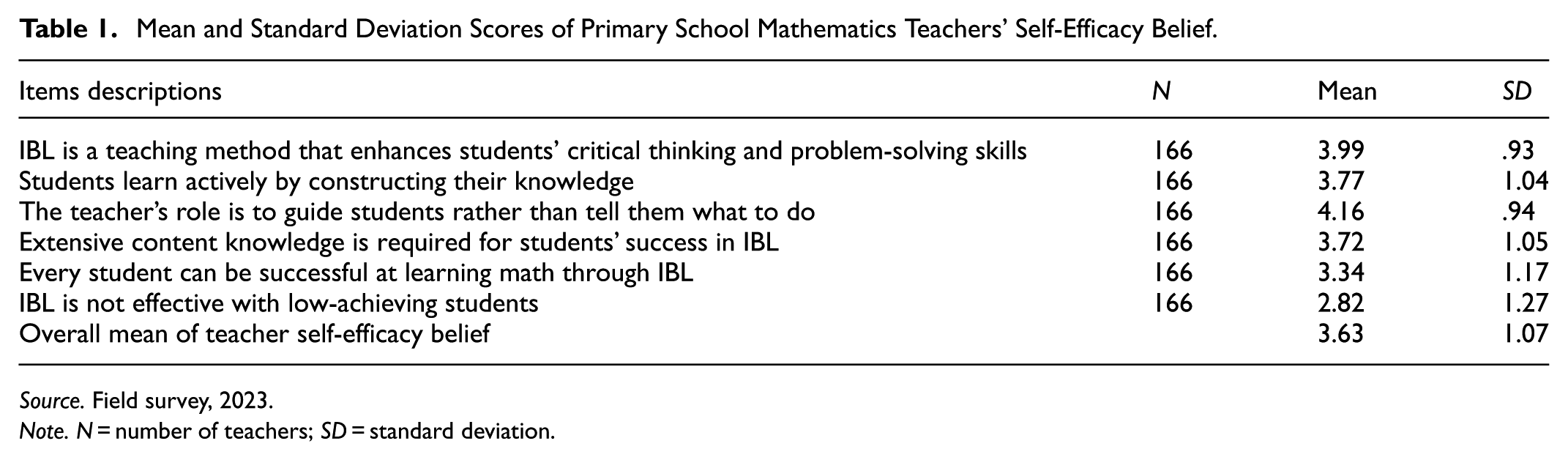
Source. Field survey, 2023.
Note. N = number of teachers; SD = standard deviation.
Mean and Standard Deviation Scores on the Level of Readiness of Primary School Mathematics Teachers.

Source. Field survey, 2023.
Note. N = number of teachers; SD = standard deviation.
In the second research question, Q-Q plots were used to visually determine whether the distributions of data were approximately normal, and this was not the case for self-efficacy beliefs and their readiness, so the Spearman correlation coefficient was used to analyze the relationship between teachers’ self-efficacy beliefs and their readiness for IBL implementation, presented in Table 3. This analysis aimed to examine the degree to which self-efficacy beliefs influenced teachers’ readiness to adopt IBL practices.
Correlation Analysis Between Teacher Self-Efficacy (SE) and Teacher Readiness (TR).

Correlation is significant at .05 (2-tailed); N = 166 (primary school teachers).
Research question 3 involves establishing the relationship between teacher self-efficacy level and their academic qualification using the Kruskal–Wallis H test. All data analysis was performed with the aid of Statistical Package for Social Sciences (SPSS version 27), employing a series of both descriptive and inferential methods.
Results
The levels of readiness and self-efficacy beliefs among public primary school teachers regarding the integration of inquiry-based learning (IBL) into mathematics education. The six items on TES-s were subject to descriptive analysis. The results were analyzed using mean and standard deviation as presented below. A score of 1 to 2.4 is regarded as low self-efficacy, 2.5 to 3.4 is neutral, and 3.5 to 5.0 is regarded as high self-efficacy, presented in Table 1.
Table 1 indicates that IBL is a teaching method that enhances students’ critical thinking and problem-solving skills (M = 3.99, SD = .93), which mean that the majority of the respondents strongly agree with the statement. Students learn actively by constructing their knowledge (M = 3.77, SD = 1.04), it can be inferred that teachers express strong agreement with the statements, teachers’ role is to guide students rather than telling them what to do (M = 4.16, SD = .94) and the respondents strongly agree that the role of teachers in IBL is to guide students, indicating a positive self-efficacy belief in the teacher’s facilitative role. Extensive content knowledge is required for students’ success in IBL (M = 3.72, 1.05). For this statement, the sampled teachers generally agree that the successful implementation of IBL demands a certain level of content knowledge from students. Every student can be successful at learning mathematics through IBL (M = 3.34, SD = 1.17). The respondents express a moderate level of agreement that every student can be successful in learning mathematics through IBL, though there is a wider range of responses. IBL is not effective with low-achieving students (M = 2.82, SD = 1.27). The respondents generally disagree that IBL is ineffective with low-achieving students. In summary, the overall average item mean (M = 3.63, SD = 1.07) ratings of respondents demonstrate that the teacher have strong self-efficacy belief to implement IBL as a teaching method.
The 25 items on the IBLR-s were subject to descriptive analysis. The results were analyzed as mean and standard deviation, as presented below. A score of 1 to 2.4 is regarded as a low level of readiness, 2.5 to 3.4 is neutral, and 3.5 to 5.0 is regarded as a high level of readiness. This is presented in Table 2.
Table 2 indicates that primary school mathematics teachers exhibit a high level of readiness for implementing Inquiry-Based Learning (M = 4.08, SD = .84). It can be inferred from the data that teachers express strong readiness across various domains essential for IBL implementation. Specifically, teachers’ responses to the items such as “ability to attract students’ interest (M = 4.19, SD = .74),”“ability to spark students’ curiosity (M = 3.95, SD = 0.77),”“ability to assess students’ prior knowledge (M = 4.04, SD = .82),” and “ability to connect students’ prior knowledge with lesson objective (M = 4.07, SD = .86)” suggest a high level of confidence and preparedness in foundational teaching strategies aligned with IBL. Furthermore, teachers also demonstrate readiness in planning and preparation, as evidenced by the high mean scores in “ability to search relevant information before a lesson (M = 4.17, SD = .91),”“ability to plan integrated exploration mathematics activities (M = 3.90, SD = .86),” and “ability to prepare basic material for the exploration activities (M = 4.14, SD = .89).” These scores highlight the teachers’ capabilities in designing and organizing effective IBL activities. Additionally, the high mean scores in areas related to assessment and support, such as “ability to give improvement suggestions (M = 4.18, SD = .74),”“ability to assess students’ understanding and progress (M = 4.24, SD = .64),” and “ability to identify areas of difficulty and provide remediation (M = 4.33, SD = .68),” further reinforce the teachers’ proficiency in assessment practices and student support strategies within the IBL framework. However, some areas scored slightly below the overall mean, including “ability to promote community involvement in mathematics problem solving (M = 3.64, SD = 1.09)” and “I have standardized evaluation tools (M = 3.57, SD = 1.04).” In summary, the data from the descriptive statistics indicate that primary school mathematics teachers possess a high level of readiness and confidence in implementing IBL with overall item mean ratings (M=4.08, SD = 0.84).
Research question 2: How do teachers’ self-efficacy belief systems influence their readiness toward the implementation of IBL in the context of public primary school mathematics education? A Spearman correlation analysis was performed to examine whether there is a relationship between teacher self-efficacy belief and their level of readiness to implement inquiry-based learning instructions presented in Table 3.
Table 3 Presents Spearman correlation analysis between the variables Self-Efficacy (SE) and teacher readiness (TR). The correlation analysis reveals a statistically significant positive correlation between self-efficacy belief and teacher readiness (rho = .547, p < .05). This indicates that as self-efficacy belief increases, teacher readiness to implement inquiry-based learning also tends to increase. The correlation coefficient of .547 suggests a moderate to strong positive relationship between the two variables. The coefficient of determination (rho = .547) explains that only 54.7% variance is shared between the two variables. This means that primary school teachers’ self-efficacy explains only 54.7% of the variance in responses to the items for their readiness. This may suggest that teachers who have strong positive self-efficacy beliefs are likely to feel prepared and confident in their ability to effectively implement inquiry-based learning strategies in the classroom.
Research question 3: Is there a statistically significant difference in self-efficacy levels among teachers with different academic qualifications? In an attempt to provide an answer to this question, the results on teacher self-efficacy were further grouped based on the teachers’ academic qualifications to delve deeper into their self-efficacy beliefs about inquiry-based learning (IBL). This grouping aimed to determine whether academic qualifications had any influence on primary school teachers’ self-efficacy beliefs regarding the implementation of IBL in their teaching practices. Table 4 displays the ranks of educational qualification and the test statistics. This investigation was deemed essential due to the recent shift in minimum entry qualifications for teaching at the primary school level (where a bachelor’s degree has replaced the previous diploma requirement since October 2018).
Kruskal–Wallis H-Statistics Between Teacher Self-Efficacy and Educational Qualification.

Kruskal–Wallis test.
Grouping variable: educational qualification.
Table 4 presents the Kruskal–Wallis test was used to examine the difference in self-efficacy belief scores across the educational qualifications among the participating primary school teachers. The test revealed insignificant differences (p = .59) in the qualifications (Diploma, n = 77; Bachelor’s degree, n = 85; and other, n = 4). In summary, based on this Kruskal–Wallis test, there is no evidence to suggest that self-efficacy belief varies significantly across different educational qualifications.
Discussion and Conclusion
Discussion
The study aimed to determine the readiness and self-efficacy of primary school teachers in implementing inquiry-based learning in their mathematics classrooms. The findings indicate that the sampled primary school teachers from the Sekyere Kumawu district had a positive efficacy belief in their ability to employ inquiry-based learning (M = 3.63, SD = 1.07). This positive belief affirms the proficiency of math teachers in delivering comprehensible content, their expertise in knowledge, and their dedication to fostering higher-order mathematics learning and achievement through IBL in the Ghanaian context. This finding is significant because the standards-based curriculum promotes the integration of inquiry-based learning in schools. The finding that teachers espoused high efficacy beliefs is consistent with the research conducted (Ramnarain & Hlatswayo, 2018; Silm et al., 2017), which found that teachers in a rural district in South Africa held a positive and strong belief in IBL for teaching and learning physical science. However, this finding differs from the findings of Mohammed et al. (2020) in the Ghanaian context, where Ghanaian teachers hold a negative belief about inquiry-based learning but a positive belief about the traditional teacher-centered approach. The teachers in this study recognize the principles and significance of promoting IBL in their classrooms as it has the potential to enhance conceptual understanding, critical thinking, and problem-solving skills. The positive teacher efficacy and high readiness are in support of Bandura’s (1997) self-efficacy theory.
The results also indicated a high level of readiness for implementing inquiry-based learning (IBL; M = 4.08, SD = .84). Based on the data, it can be inferred that teachers exhibit strong readiness across various domains crucial for IBL implementation in their mathematics classrooms. This high level of teachers’ readiness indicates that teachers in the sampled district have confidence in their ability or capability to implement inquiry-based learning effectively, which is consistent with (Endot et al., 2021). This finding also aligns with the findings of Xaba and Sondlo (2022), who reported a similar trend among in-service teachers in their study, where teachers experienced a shift in their attitudes toward readiness for utilizing inquiry-based learning methods when teaching Sciences. The findings contradict that of Al Malihi (2015), who reported that most of the EFL teachers were not fully ready to teach at this level since more than half of them did not receive enough pre-service or in-service training concerning young learners’ teaching.
Furthermore, the results revealed a moderate positive correlation (r = .547) between teachers’ self-efficacy belief and their readiness to implement inquiry-based learning in their mathematics classrooms. This may explain why the participating teachers in this study exhibit a strong positive readiness (M = 4.08, SD = 1.07) to implement inquiry-based learning in their mathematics classrooms. The finding is the same as Endot et al. (2021), whose study found that self-efficacy and intrinsic motivation of teacher positively correlated with their readiness to implement a new curriculum. However, despite this positive belief in inquiry-based learning, Xaba and Sondlo (2022) found that teachers are hesitant to implement IBL in their lessons due to challenges such as resource availability, teaching materials, time constraints due to the curriculum, and large class sizes, which create apprehension in their willingness to implement it.
One notable finding shows a non-statistically significant relationship between teachers’ academic qualifications and their self-efficacy level. In contrast, the findings from Mohammed et al. (2020) present a different picture. Mohammed found a significant academic qualification difference in teachers’ beliefs about IBL teaching. Specifically, graduate teachers held stronger self-efficacy beliefs in implementing inquiry-based learning compared to certificate teachers. This suggests that certificate teachers hold stronger traditional beliefs, which is a negative indicator of inquiry-based science teaching, than graduate teachers’ beliefs. The findings of this study mean that academic qualification alone is not enough to predict teachers’ self-efficacy beliefs or readiness to implement IBL instructions.
Implications of the Study
These findings carry several important implications for teacher education, professional development, and educational policy. First, the absence of significant differences in self-efficacy beliefs across qualification levels suggests that academic credentials alone may not predict pedagogical readiness for IBL. Thus, teacher education programs and in-service training should prioritize the development of practical competencies in IBL, emphasizing experiential approaches such as lesson modeling, collaborative planning, and the use of the 5E instructional model. Second, the strong correlation between self-efficacy and readiness highlights the importance of confidence-building strategies as part of any implementation effort. Interventions aimed at enhancing either construct are likely to reinforce the other, thereby facilitating more effective integration of IBL. Third, despite systemic challenges such as large class sizes and limited resources, the growing positive disposition toward IBL among teachers in this Ghanaian context indicates a pedagogical shift that educational leaders and curriculum developers should actively support. Policymakers must complement curricular mandates with logistical and infrastructural supports to ensure that teachers can implement IBL in practice. Finally, the findings suggest a need to re-evaluate qualification-based assumptions in teacher deployment and training design; readiness for innovative pedagogy should be assessed based on observable competencies rather than credentials alone.
This study extends self-efficacy theory to mathematics education in the primary school context, giving voice to Ghanaian teachers’ perspectives. The findings affirm the interplay between teacher self-efficacy and their readiness to implement innovative pedagogies such as inquiry-based learning. Based on these findings, it is recommended that these variables be taken into account when designing continuous professional development programs, intervention initiatives, and teacher education courses aimed at supporting IBL in Ghanaian schools. Further research is needed to examine actual instructional practices in the classroom and to explore the external factors that influence the implementation of inquiry-based mathematics teaching in local contexts.
Conclusion
The current study investigated the readiness and self-efficacy beliefs of primary school mathematics in the Sekyere Kumawu district of Ghana. The findings of the study suggest that primary school teachers in the study district hold positive self-efficacy and demonstrate a strong readiness to implement inquiry-based learning (IBL) in their mathematics classrooms. This is a promising indication for the implementation of inquiry-based learning as prescribed by the new standards-based curriculum. The study also revealed that teachers’ beliefs regarding inquiry-based mathematics teaching do not significantly differ based on their academic qualifications. However, it is worth noting that teachers with higher self-efficacy beliefs are more likely to implement inquiry-based learning. Therefore, these findings call for professional development that focuses on teacher self-efficacy to enable teachers to shape their readiness to adopt inquiry-based learning as their instructional pedagogy. This study has a few limitations to consider when interpreting the findings. First, it focused solely on primary school teachers in a single district of Ghana. Therefore, the generalizability of the findings to other regions or educational contexts may be limited. Additionally, the study relied on self-reported data from teachers, which could be influenced by response bias. It is possible that teachers provided socially desirable responses instead of expressing their true beliefs and readiness to implement inquiry-based learning. Furthermore, the study did not explore the specific challenges and barriers that teachers encounter when implementing inquiry-based learning in their classrooms. Future research should delve deeper into these challenges to gain a more comprehensive understanding of the factors that affect the effective implementation of IBL. Lastly, the study’s cross-sectional design only provides a snapshot of teachers’ beliefs and readiness at a single point in time. Conducting longitudinal studies would offer a more dynamic perspective on how these beliefs and readiness evolve over time and in response to professional development interventions.
Footnotes
Acknowledgements
The authors thank all the teachers who voluntarily participated in this study.

Authors Contribution
All authors have contributed sufficiently to the study and agreed with the results and conclusions.
Funding
The authors received no financial support for the research, authorship, and/or publication of this article.
Declaration of Conflicting Interests
The authors declared no potential conflicts of interest with respect to the research, authorship, and/or publication of this article.
Data Availability Statement
The dataset is avialable on request form the corresponding author.