




Abstract
This paper investigates the potential benefits of integrating 21st-century skills into specifically designed novel activities in an ear training course. Drawing initial inspiration from the National Council for Social Studies’ 4Cs framework, the study explores the synergies between collaboration, critical chinking, creativity, and systematic thinking, as well as the role of technology in enhancing ear training in music studies. The research design follows an action research model, conducting a thorough examination of four specifically-designed novel activities in an ear training course: (1) strategic group games (2) Sing & See (3) dictation with different instrument sounds; and (4) creating stories for musical passages. Each activity aligns with at least two specific 21st-century skills, encompassing (I) Critical thinking, (II) Collaboration, (III) Problem-solving, (IV) Creativity, and (V) Technological literacy; the researchers aimed to determine if these activities have the potential to enhance (a) musical hearing, (b) solfège (c) listening. Data collection employed a multi-faceted approach, incorporating expert opinions, student self-assessment forms, and researcher diaries. Data analysis involved narrative synthesis, extracting and then compiling recurring themes from expert, student, and researcher evaluations. Findings reveal positive outcomes in terms of improved student engagement, adaptability and potential exposure to critical thinking, problem solving, and collaboration. Additionally, technology emerges as a valuable tool for interactive learning experiences, enriching creativity, critical thinking, and collaboration. This research contributes to the evolving landscape of music education by proposing an integrative approach that prepares students for the challenges of the 21st century.
Introduction
In the dynamic landscape of our current century, the realm of education is ever evolving with new tools and curricula. In the United States, National Council for Social Studies (NCSS) has defined four core elements within the framework of 21st century education, designated as 4Cs, which are: 1-Collaboration, 2-Critical thinking, 3-Creativity, and 4-Communication (Thornhill-Miller et al., 2023). According to H. Arndt (2006), traditional education involves the instruction of objective facts that are fragmented into separate disciplines, instead of being linked into a cohesive whole; seldom the relationship between the taught material and the solutions of complex problems are explained; such knowledge is bound to remain isolated and not so usable (Collins et al., 1989). Recognizing these challenges, educators are constantly seeking for novel methods that incorporate the 4Cs, or similarly fashioned core elements into various fields within education.
This study aims to evaluate the potential benefits of integrating specially designed activities that emphasize elements of 21st century skills into a music ear training course. Ear training is an essential component of Western Music education; it has deeply embedded roots in Western Classical music that stretch back centuries, from Guido d’ Arezzo (11th century) to tertiary music education of 19th century. Despite recent advancements in pedagogical theory and technology, foundational principals of teaching ear training have remained largely unchanged (Andrianopoulou, 2018). This is where this particular study seeks to initiate transformative change.
The 4Cs in Detail
In an age of heightened interconnectivity, people are able to explain their thought processes, beliefs, and expectations by mastering communication and collaborative skills (Nganga, 2019). These two particular skills play a paramount role in creating the ideal workplace in an age where elements of the dynamic world are influenced by globalization, with people from different cultures and backgrounds constantly interacting with one another.
Critical thinking is an essential part of 21st century education. It equips learners with essential problem-solving skills (Hager & Kaye, 1992). The key concept here involves the skill to determine the authenticity, accuracy and the worth of knowledge in order to be able to make sound inferences and decisions (Kay & Greenhill, 2011).
According to R. A. Beghetto (2010), from creativity new perspectives emerge through the generation of novel and meaningful ideas aimed at the solving of ill-defined problems. Beghetto further claims that through creativity, learners are befitted with the freedom to make mistakes while thinking freely and at times, divergently; supporting the idea that permits the students to construct their own meanings, paving the way for new knowledge. The creation of new knowledge does not emerge through a traditional approach but through what Kay and Greenhill (2011) describe as an unconventional mindset; which as they assert, lies at the core of creativity.
In line with our literature review, with Gilbert (2016) being the focal point, we chose to incorporate two additional core elements of 21st century skills into our own study: systematic thinking and technology. The 4 Cs are much enhanced by technology; through the growth of the internet, knowledge, in whatever form, is more accessible than ever. Pink (2005) and Jerald (2009) assert that students of out time are vastly different from students of the past due to their incessant involvement in technologies such as YouTube, video games…etc. Because of this, they require a more novel teaching approach that is congruent to their already existing involvement in technologies. McCoog (2008) suggests that teachers engage their students with the content instead of delivering it directly; this approach requires a faster pace of information delivery, as well as the creation of auxiliary online activities that accompany face to face education.
As the educational arena becomes increasingly intertwined with technology, systematic thinking takes on an elevated role, guiding students to navigate and harness digital tools judiciously. Moreover, in an era that prizes adaptability, systematic thinking nurtures a flexible and open-minded mindset, enabling students to seamlessly assimilate new information and navigate the ever-shifting landscapes of knowledge. Systematic thinking in education refers to a structured and analytical approach to problem-solving and decision-making. It involves using a step-by-step process to identify, analyze, and evaluate information, and then making informed decisions based on that analysis. Systematic thinking helps individuals to break down complex problems into smaller, more manageable parts, and to consider all relevant factors before making a decision (H. Arndt, 2006).
The 4Cs and the two additional core elements serve as the basis of the current study, which, as previously mentioned, sought answers whether novel methods that emphasize the above-mentioned 21st century skills in a music ear training course can be deemed as potentially more credible replacements/enhancements of established conservative methods.
Application of 21st Century Skills in Music Education
Gilbert (2016) claims that the intrinsic nature of the music classroom already fits well with the 21st century learning skills as described by P21 and the NCSS.
Music inherently relies on both collaboration and communication, whether in ensemble performance or collective composition. Zairi (2021) underscore the importance of collaborative skills developed through serious game design in educational contexts. This study extends that concept to music education, where collaborative activities are designed to enhance communication and teamwork, reflecting the interconnected nature of the musical and professional worlds.
Critical thinking in music education extends beyond technical proficiency as it also encompasses a deeper understanding of musical structures and contexts. Thornhill-Miller et al. (2023) discuss the assessment and certification of critical thinking, suggesting that music education can benefit from such evaluative frameworks to foster a reflective and analytical mindset in students.
“At the heart of music education lies creativity, which not only encourages artistic expression but also drives innovative problem-solving. Engaging in music studies presents distinct chances for fostering creative development, as students delve into improvisation, composition, and interpretation (León-Garrido et al., 2022).”
Systematic thinking is essential for grasping the intricacies of music theory and practice. It entails recognizing patterns, structures, and the intricate interplay among musical elements. By nurturing systematic thinking, music educators empower students to adeptly organize, categorize, and manipulate musical concepts (Wu, 2019).
Technology’s impact on music education is diverse, providing tools for creation, analysis, and widespread dissemination. Yoo (2022) presents practical methodologies for integrating technology into the broader music curriculum, stressing its significance in augmenting 21st-century skills like creativity, critical thinking, and collaboration. This research exploits technology to extend beyond the conventional bounds of ear training, integrating digital tools to facilitate interactive and immersive learning experiences (Yoo, 2022). León-Garrido et al. (2022) underscore the pivotal role of educational technology in enriching creativity, proposing that technology-mediated music education can foster more engaging and inventive learning journeys.
The fusion of 21st-century skills into music education embodies a comprehensive approach to teaching and learning. It recognizes music’s multifaceted role in personal and societal development, emphasizing the necessity of an educational framework that equips students for a future where adaptability, innovation, and interconnectedness reign supreme. This study seeks to contribute to this integrative approach, exploring the synergies between music education and 21st century competencies in an ear training course.
Karpinski (2000) mentions that aural skills have generally been divided in two broad categories: ear-training and sight singing. Sight-singing lies beyond the scope of this paper, which focusses solely on the ear training aspect. Within the realm of ear training, Kaprinski places a distinction between the comprehension of sound (interval, melody chord, chord progression…etc) and its execution (performance/solfege). To address both of these aspects we drew upon musical passages from the Lavignac Book 2a. These passages were selected for their comprehensive incorporation of many of the essential elements such as intervals, melodies, phrases, chords, and chord progressions. By employing these passages, our aim was to facilitate students’ progress in being able to comprehend the sounds presented (musical hearing) and then subsequently confirming this through vocalization (solfège). For Karpinski (2000), listening skills are essential because they involve the interpretation of simultaneously-occurring music dimensions in real time, as opposed to isolated elements like intervals and chords. It is therefore essential to cultivate students’ perception of sound in a multifaceted manner, encompassing components like quality, timbre, nuance, and more.
Drawing upon Kapriski’s categorizations as framework, we divided the whole ear training course into three sub-dimensions: (a) musical hearing, (b) solfège, and (c) listening. For these sub-dimensions novel classroom activities were designed: (1) strategic group games, (2) Sing & See, (3) dictation with different instrument sounds, and (4) creating stories for musical passages. Each activity is crafted to incorporate at least two of the five 21st century learning skills, which we have designated previously as: (I) Collaboration/Communication, (II) Critical thinking, (III) Creativity, (IV) Systematic thinking, and (V) Technology. Refer to Table 1.
21st Century Skills in Music Classrooms.
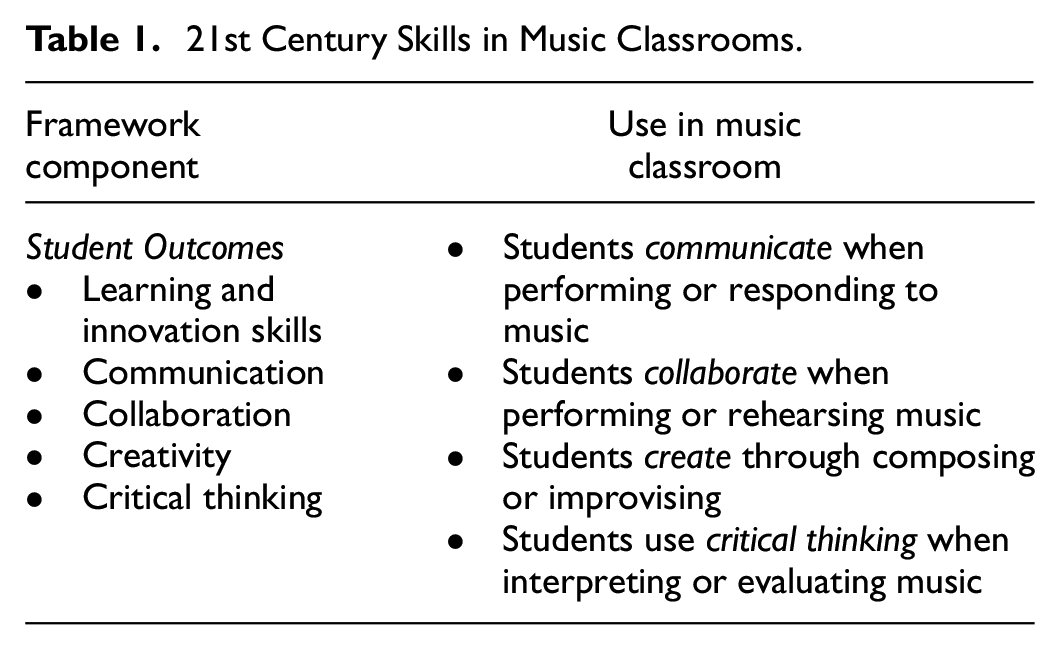
Our central inquiry is as follows: Do the novel classroom activities, designed in alignment with 21st-century learning skills, demonstrate potential to contribute to students’ development in musical hearing, solfège, and listening. We assess such potential by means of receiving feedback from all of the parties involved in the study:
1- Expert opinions
2- Student self-assessment forms
3- Researcher’s diaries
It is important to note that, because the current study has preliminary/pilot characteristics, the main objective is not so much aligned with the measurement of improvement (through testing of performance/grading), but rather with examining how the integration of critical thinking, technology, and collaboration can potentially enhance ear training by equipping students with essential 21st-century skills that may lead to more effective learning outcomes.
Method
This section provides explanations regarding the research model, study group, data collection tools, how data will be collected, data analysis and interpretation, and the study plan.
Research Model
In this study, we employed a methodological framework aimed to investigate the potential contribution of novel classroom activities on the progress of students during a full 5-month semester of an ear training course. The researcher herself administered the novel activities to the students in a classroom setting, establishing the current study as an action research model. The Action Research model is a participatory and iterative approach to research, which is particularly suited to educational settings where the goal is to effect change, improve practice, and enhance older established methods.
In order to assess the potential benefits of the novel activities, we implemented a multifaceted approach to data collection and analysis. Expert opinions were sought to gather information on valuable insights, external perspectives and feedback on the potential benefits of the aforementioned activities. Additionally, student self-assessment forms were used to capture the learners’ subjective perceptions of the novel activities themselves. Furthermore, the researcher maintained detailed diaries, documenting observations, reflections, and any unexpected findings throughout the implementation process; these were more aimed at observing students’ adaptability and perceived progress and the skills potentially cultivated through the activities, giving the current study its exclusively qualitative attribute.
Design of Activities
As mentioned before, each novel classroom activity has been designed so as to incorporate at least two of the items listed in our 21st century learning skills list (Table 2).
The Design of Activities.

Activity I: Strategic Group Games
This activity involves strategic games that divide complex passages into simple, easily handled components. When students sing a particular melody in the traditional way, many parameters are at play all at once; rhythm, note names, pitch, timbre, dynamics are all executed simultaneously. Strategic games in this particular program are designed to eliminate certain parameters while highlighting others, easing the burden on the students.
Singing just the rhythm with note names
Students altogether vocalize just note names of a passage while clapping the rhythm
Students take turns vocalizing the name of each note in a passage while altogether clapping the rhythm (one student per note)
Singing just the pitches
Students altogether sing the melody of a passage in straight quarter notes without rhythmical complications.
Students take turns singing each note in a passage in straight quarter notes without rhythmical complications (one student per note).
Starting with a single pitch and progressively adding more notes to the musical fragment
Students altogether start with just one pitch and gradually add more notes in straight quarter notes.
Students take turns starting with just one pitch and gradually adding more notes in straight quarter notes.
Practicing intervallic leaps using stepwise fill-ins
One group of students sing the initial note, the other group fills in the notes in stepwise fashion, then the initial group sing the final note.
Freezing on a note to adjust the intonation (especially for large leaps)
In a musical fragment that contains a large intervallic leap, one group of students sustain the initial note while the other group sings the note that is leapt to and freezes, adjusting the intonation over the sustained note. A few seconds is given before the leap, while other students maintain the previous pitch.
These games intrinsically foster critical thinking by prompting students to tackle a challenging passage by means of making it simpler. Systematic thinking is also encouraged as the students themselves select the most suitable game in order to overcome challenges a given musical passage, especially when they are on their own. In a similar vein, problem solving is encouraged. Since all of the activities are done in group settings, collaboration is encouraged.
Activity 2: Sing & See
Using the Sing & See computer program, students continuously monitor their intonation with accuracy through a graph that displays frequency fluctuations in real time. During the utilization of the Sing & See software, each student takes turns singing a piece without adhering to a specific rhythm. They sustain a specific pitch and then either slide into (glissando) the next pitch gradually or release the sustained pitch, pause briefly and then sing/adjust the next pitch. The focus is placed on sustaining notes for an extended duration while meticulously honing the calibration of pitch intonation. The students closely observe and adjust their pitch in response to frequency fluctuations displayed on the computer screen. Using this novel technological tool breaks away from the traditional approach of correcting intonation by means of playing a note over and over on the piano, which can at times be futile.
This activity is in line with critical thinking and problem solving because the student is able to visualize the precise moment inaccuracies come about and along with their magnitude. This enables the student to see his/her level of inaccuracy and gradually shift back to accurate intonation.
Activity 3: Dictation With Different Instrument Sounds
A traditional class setting involves the practice of writing dictations with the usage of a piano, which encompasses a limited timbre in the world of musical instruments. In this activity, a computer program (Kontakt 5) generates the melody to be dictated with realistic instrument sounds other than the piano. These computer generated sounds meticulously crafted articulations, dynamics, extreme registers, and nuaces. This allows students to familiarize their listening to a more all-encompassing world of timbres. Since instruments possess unique timbral qualities when different articulations, dynamic levels and nuances are applied, students have the opportunity to listen critically to those essential elements. It is important to note that this particular activity started out simple and gradually became more challenging; in the beginning the activity only consisted of different instrument sounds without musical expressions, gradually more and more expressive marks were added to make the passages more challenging.
Dictating a melody with an instrument other than the piano requires critical thinking from the student’s perspective as it necessitates thoughtful consideration of the unique characteristics and limitations of the chosen instrument.
Activity 4: Creating Stories for Musical Passages
In this activity, students engage in crafting a narrative inspired by a musical passage. Initially, students receive a musical piece, which they listen to repeatedly, focusing on elements like mood, tempo, dynamics, and notable transitions within the music. They proceed by pinpointing essential elements such as the primary theme, variations, climax, and resolution. Through discussions about the emotions evoked and the mental imagery invoked by the music, they brainstorm story concepts aligning with the mood and musical developments. Subsequently, students develop a basic storyline structure, outlining the beginning, middle, and end. The aim is to synchronize the narrative flow with that of the music. Engaging in a storytelling exercise rooted in a musical passage proves advantageous for enhancing ear training skills, prompting students to actively listen, identify musical components, and establish connections between emotions and auditory experiences. By analyzing the mood, dynamics, and changes in the music, students develop a heightened sense of hearing and pattern recognition. Creating a narrative based on the music enhances their ability to anticipate musical developments and express interpretations creatively, fostering a deeper understanding. Additionally, the integration of visual elements in the activity provides a multisensory approach, strengthening the connection between auditory and visual senses. Overall, this activity cultivates a well-rounded ear, essential for musicians in honing their analytical and creative abilities.
Study Group
The main body of the study group for this research consists of nine (n = 9) second-year music education students enrolled at Near East University during the 2022 to 2023 academic year. Students selected for the study were chosen with the consideration that they had completed the foundational stages of music education, having previously been enrolled in a prior music ear-training course. Their inclusion in the research was based on their specific level of proficiency in musical listening, reading and writing skills. In addition, 15 field experts participated in the study to evaluate potential benefits of novel activities by examining a selection of recorded videos.
Structuring of Class Time
Each class session occurred once a week, spanning two and a half hours in total. The first hour and a half was allocated for theory and sight singing, which, albeit also employing non-traditional approaches, are not included in this paper. The remaining hour was divided into four segments, with each novel activity allotted 15 min.
Data Collection Tools
Readiness Knowledge Test
In this study, prior to the implementation of the actual course, second-year undergraduate students in the 2022 to 2023 academic year were subjected to a “Readiness Knowledge Test” which involved sub-dimensions of this particular study.
Musical hearing: Students were tested for their perception of notes, intervals, chords, chord progressions, and sequential hearing.
Solfege: Students were evaluated based on their performance of a selection of solfege pieces (e.g., Lavignac 2A) with the right intonation, accuracy of rhythm, correct phrasing, and nuances Students were then assessed through to their performance of rhythm reading studies (e.g., Fontaine).
Dictation: Students were tested with respect to their ability to take dictations on monophonic dictations with up to two sharps and flats, their readiness was assessed by taking into account the ability to find and write down accidentals accurately, determining the number of beats in a measure, writing note durations correctly, and writing notes neatly.
Field Expert Evaluation Form for Class Activities
Before the initiation of the course, activities designed for the course were presented to 15 field experts for their evaluation, and based on their feedback, they were subsequently refined and finalized.
Student Self-Assessment Form
Student self-assessment forms were formulated for students to assess their own subjective experiences with the activities (complaints, frustrations, eagerness…etc.), their adaptability to them, as well as perceived contributions. Self-assessment forms were created for each class session. The use of self-assessment and analytical scoring can be an effective approach in educational research. Herayati (2020) discuss the implementation of these techniques in teaching writing, noting that they can lead to improvements in students’ skills. This approach also aligns with the action research model, where self-reflection and evaluation are integral to the research process (Herayati, 2020).
Student Diary
Students provided daily records containing observations, feelings, reactions, and explanations related to the prepared activity plans.
Student Evaluation Form
The student evaluation form was formulated to allow the teacher to monitor each student with respect to their individual engagements with the activities, it incorporated their experiences, adaptabilities, performances in the activities throughout the semester, frustrations, complaints, and their relative eagerness to participate.
Field Expert Student Evaluation Form
The instructor recorded every classroom lesson via video, which were then forwarded to field experts categorized as “Beginning, Progress and Completion” videos. The experts were tasked with assessing students’ advancements using the “Student Evaluation Form.”
Validity and Reliability of the Study
All data collection tools were initially prepared by the researcher and later modified through the feedback of five field experts. Whittemore et al. (2001) mention four primary criteria for the validation in qualitative research: Credibility, authenticity, criticality and integrity.
To enhance credibility, this study employed triangulation, with data interpreted independently by four researchers at different times and then subsequently compared and analyzed collaboratively. This method ensures that the findings are trustworthy and well-substantiated.
For authenticity, the data collection tools were designed to capture diverse perspectives, including those of field experts, students, and the researcher. This inclusive approach helps to accurately represent the study’s context and participants’ experiences.
Before the actual intervention phase, a shorter, pilot version of it was implemented with a different group of students; taking into account both student and expert criticism, the procedural elements were upgraded.
During the intervention phase, and later, data collection and the analysis phases, researchers met collaboratively on a regular basis in order to evaluate the entirety of the research process, which the ensures integrity of the research.
Data Analysis
In this study, the authors implemented a narrative synthesis to integrate and generalize expert and student opinions, in order to construct a comprehensive layout of the potential benefits of the novel activities. Initially, each researcher meticulously examined expert evaluations, student self-assessments, student evaluation forms and researcher diaries, identifying recurring themes within these sources for each activity. These common themes were then synthesized into a cohesive narrative in prose.
The data analysis involved several steps. Data extracted from expert evaluation forms were compiled to represent expert opinions and similarly, data from student self-assessment forms were synthesized into student opinions. Additionally, insights from student evaluation forms and researcher diaries were consolidated to reflect the researchers’ perspectives. By merging these distinct viewpoints, the narrative synthesis provided a nuanced and holistic description of the activities’ potential.
This approach ensured that the synthesis captured the complexity and richness of the data, allowing for a more profound interpretation of the potential benefits and effectiveness of the novel activities. The triangulation of expert, student, and researcher perspectives enriched the analysis, providing a multi-faceted understanding of the findings.
Findings
Expert Opinions on Activity I, Strategic Group Games
Reading a Section of the Piece With Just Rhythm (Without Pitches)
According to the experts, this particular activity effectively highlighted the importance of concentrating only on the parameter of rhythm. However, concerns about differing rhythm perception levels among students were raised, suggesting the need for an approach that would encompass every individual participating in the course. Some experts recommended dedicating more time to working with students individually, particularly during the initial part of the course. Continuous drawbacks were noticed by most experts when students took turns in vocalizing the rhythm, as one mistake lead to a chain of others and then the re-starting of the activity. Some experts suggested that a slower pace could well be the solution to that problem.
Reading Notes Without Rhythm
The experts praised this activity as potentially effective for tackling pitch accuracy, without burdening the student with other parameters, such as rhythm, fast tempi, dynamics…etc.. According to them, notable progress, especially between the initial and subsequent videos, indicated improved adaptation to the activity. However, like in the previous activity, drawbacks were observed during group sessions as sometimes mistakes led to other mistakes, negatively effecting the flow of the activity; perhaps for this reason, some of the experts mentioned the need for even a slower pace for more challenging passages, giving students more time to perceive the pitch before actually singing it. One expert suggested that before a student sings the next pitch, a short time of silence should be allocated for the student to think the pitch before singing it.
Working on Difficult Passages by Sequentially Adding Notes
The experts noted that during the initial phases of the course, students seemed to want to move on with the musical passage in question, instead of concentrating on the sequence of notes selected for the exercise. However, in later videos, they showed better adaptation and restraint, willingly staying focused on the selected notes. Most experts noted that later segments of the sequences received lesser emphasis; some suggested dividing the passage into even smaller chunks for more equal distribution practice. Like in previous activities, some experts suggested a slower pace. Some experts suggested the infusion of more music theory, as it may induce a particular form of pattern recognition with respect to the overall sound (as in the kind of a scale or a chord being formed). Overall, the activity was deemed to be potentially beneficial, especially for better intonation and better comprehension of leaped intervals.
Singing Intervallic Leaps With Stepwise Fill-Ins
Experts noted that this activity may well have potential in aiding students vocalize varying pitch degrees and enhancing scale degree recognition. Adaptability to the particularities of this activity seemed to have been more challenging than any of the activities within the strategic group games portion of the course. Some suggested more dynamic variety (accents) in order to better distinguish the fill-ins notes from target ones. In line with dynamic variety, two of the experts suggested that silent singing of the fill-in notes while actually singing the target notes may have the potential to also positively affect the inner hearing (audiation) of the participants.
Freezing on a Note
Experts mentioned that this activity could play a potential role in helping students break free from the notorious negative habit of singing with incorrect intonation over and over again, especially when they encounter a large leap. Some experts noted that because a moment of thought is allowed before freezing/adjusting a note, students adapted to this activity better than other activities in which responses had to be more or less immediate, further suggesting that perhaps this particular feature of the activity should be integrated to other ones. The moment of thought before singing the leaped note, according to some, may well help in aiding in the development of being able to audiate (hearing without singing). Furthermore, they suggested that the sustained note that guides the leap should sometimes be omitted to introduce more variety within the activity.
Student Opinions on Activity I, Strategic Group Games
Initial student opinions on strategic group games were mixed; most expressed doubts about their usefulness, with some even defending conventional methods. However, as time went on, an increasing number of students reported greater adaptability and a willingness to engage with the new activities. In the final stages of the course some students mentioned that when tackling a challenging musical passage, implementing a combination of the games was highly effective and resulted in a speedy learning of the passage. By the end of the course, most students found strategic group games particularly effective outside the classroom, as they helped sharpen their ability to select the right game tailored to the specific challenges of a given passage. Students in general also noted that all of the activities encouraged teamwork and increased communication among each other both in and out of classroom. Students in general agreed that through these activities they had an increase in their concentration and grasped the musical material; some mentioned that they would continue to make use of them after the completion of the course.
Researcher’s Opinions on Activity I, Strategic Group Games
In the beginning, no student in the group had any prior experience with such activities; they constantly questioned their credibility and remained inclined to continue with more traditional methods of constant repetition and memorization. Throughout the course, they seemed to appreciate the elements within the activities more and more. Thus adaptation has generally been in a positive direction. Despite the sheer quantity of activities, the attention of the study group remained constant and they worked together in activities that required collaboration. Toward the latter stages of the course, they actively and eagerly participated in all of the activities, without shunning away from collaborating with their peers. As the course progressed, students seemed more adept at selecting the most appropriate group game activity for the particular challenges of a musical passage and then implementing it.
Expert Opinions on Activity 2, Sing & See
Experts have been in general agreement that the Sing & See program has the potential to be extremely beneficial and recommend its regular use. Regarding the initial videos, one major drawback, raised by almost all of the experts, was the issue of having to sustain notes for extended periods of time, which quickly led to student fatigue. On evaluating the later videos, experts noted that it became a less of an issue as students controlled their breathing by taking a small break after sustaining and before singing the next note.
The program’s ability to provide instant feedback was seen as a significant advantage for enabling students working with precision and accuracy. One of the key positive aspects reported about this activity was its instantaneous visual feedback, helping students to correct their pitch by showing the precise magnitude of deviation from the pitch they were supposed to be singing. The general evaluation of the experts was that the participants typically struggled to find the correct pitch during their initial dabbling with the program, which lead to uneven transitions and vocal intensity. However, by the final video, according to some, both transitions and correction of inaccuracies in intonation were handled more effectively. Experts generally agreed that Sing & See could be something that students can use on their own for guided self-learning and easy acquisition of correct vocal usage. Thus in general, the utilization of the Sing & See program and its integration as a technological tool in a classroom setting was considered to be potentially beneficial. One expert suggested that this activity should also be accompanied by a piano or another instrument to ensure more aid to the student.
Student Opinions on Activity 2, Sing & See
Most students mentioned experiencing initial anxiety due to unfamiliarity with the program. Some complained that they were out of breath and fatigued within the first minute as they struggled to sustain notes through extended periods of time. However, most noted that this initial sentiment gradually shifted to confidence as they became more adept at managing their pacing. Some mentioned that they overcame this issue by learning to release the sustained note, taking a brief pause to rest and reflecting before singing the next note, following their instructor’s guidance. Students noted significant advantages in autonomous learning and self-assessment, emphasizing the program’s role in enabling them to independently evaluate and refine their intonation. They mentioned that this self-reliant approach, facilitated by the program, allowed them to identify and rectify errors regarding pitch accuracy without external aid. Almost all students stated that they would continue to incorporate the program in their daily musical practices after the completion of the course.
The Researcher’s Opinions on Activity 2, Sing & See
Initial drawbacks ranged from unfamiliarity with the program’s interface and inability to control breath. Once these two main issues were overcome, students displayed better adaptability to the activity throughout the course. Like in strategic group games, diving a passage into smaller chunks and working on different portions one at a time seemed to be a more effective usage of time in terms of handling challenging passages. By doing so, students were able to exploit the passage in question by making use of both gradual sliding (glissando) into the next note and also taking a break before singing it, all the while receiving instantaneous intonation feedback from the program.
Expert Opinions on Activity 3, Dictations With Different Instrument Sounds
According to a few experts, before each session of this particular activity, operational mechanics and timbral specifications of the instrument should have been explained more thoroughly to the students. One expert further suggested deep dive into the timbral characteristics of the instrument with respect to each of its range regions, as well as how its sound changes through different dynamics. Some experts encouraged the inclusion of live players occasionally, rather then relying only on realistic computer-generated sounds, so that students can have an early exposure to the actual physicality of the instrument in real time. Experts describe this study as original and potentially useful in helping students recognize different instrument sounds and colors.
Student Opinions on Activity 3, Dictations With Different Instrument Sounds
The integration of different instrument sounds in dictation writing exercises has provided insightful feedback from students, reflecting a range of experiences and learning outcomes. Initially, students mentioned facing challenges and nervousness when transitioning from familiar piano sounds to unfamiliar instrument sounds in dictation exercises. Some of them mentioned that the different instrument sound came across as a distracting factor when attempting to discern pitches. However, through the latter stages of the course, students mentioned that this initial discomfort lessened as they began to realize their capability to adapt to different timbres.
Students in general perceived this activity as challenging due to having difficulty distinguishing sounds from diverse instruments, especially when the range and dynamic levels were awkward enough to obscure the typical timbre of the instrument. Despite these obstacles, students reported enhancements in their general ability to adapt to different timbres. Toward the end of the course, students reported that the unfamiliar timbre aspect became less of a hindrance in detecting the correct pitch, albeit occasional discomfort still remained.
Researcher’s Diary on Activity 3, Dictations With Different Instrument Sounds
Initially, a sense of challenge and nervousness was observed among students when confronted with the shift from familiar piano sounds to the unexplored territory of unfamiliar instruments. This discomfort, however, did not linger as a hindrance; instead, it evolved into a motivator. It was remarkable to witness the transformation from initial anxiety to growing confidence as students not only adapted to the activity but also began doing better in dictation exercises.
Some students initially reported frustrations in discerning sounds from various instruments, especially if the dynamic level, articulation, or the register in which the instrument played was unusual. It is intriguing to note that while the activity posed auditory challenges, it simultaneously seemed to inject an element of excitement and curiosity, which I believe is crucial for sustaining interest and enthusiasm in the learning process. Students expressed feeling more prepared for dictation writing and, more importantly, found the process to be progressively easier and more enjoyable in time.
Expert Opinions on Activity 4, Creating Stories for Musical Passages
According to the experts, participants exhibited improvement in their capacity to craft more consistent and coherent narratives intertwined with the music over time. Although the activity seemed to foster reflective thinking regarding the purpose of music and art, its impact on development seemed to vary due to the subjective nature of human experiences and environments.
Some experts observed that initial student descriptions were clumsy and forced, however, over time, these descriptions became more nuanced and intricate, signifying an improved ability to articulate musical experiences and a deeper comprehension of the musical compositions. According to them, this particular activity has the potential to aid students in perceiving music as a reflection of emotions and thoughts, varying according to the individual character or cognitive structure of music.
Experts praised the activity’s originality and creativity, and deemed it as an opportunity for students to the deepen their understanding of music beyond its mere mechanics. Experts observed that toward the end of the course, students began to share increasingly heartfelt and personal descriptions.
Most experts stated that this activity could be beneficial in helping students translate abstract aspects of music into concrete definitions, in turn enhancing their understanding of musical phrases, modes, tonality, harmony, and musical time.
Student Opinions on Activity 4, Creating Stories for Musical Passages
At the outset of the course, almost all students displayed hesitation in participating in this particular activity. Some regarded it as potentially futile, while others found it entirely alien and unfamiliar. In later stages, they deemed it fun and entertaining.
One student mentioned the idea of using creative writing to articulate challenges within different parameters of music. He mentioned that by creating such stories he found it easier to immerse himself in the the melodic contours, rhythms, tonal intricacies, and nuances of the music.
A couple of students mentioned appreciating the synergy between descriptive writing and music, drawing parallels with their own life experiences. They went on saying that by superimposing their own daily experiences and emotions onto the music, they were able to connect more deeply with musical ideas, expressing themselves with more enthusiasm.
Researcher’s Opinions on Activity 4, Creating Stories for Musical Passages
At the beginning of the activity, it was observed that students were participating hesitantly. Some questioned how stepping outside the realm of musical activities and utilizing their imagination would contribute to their understanding of the musical passages. In order to make the activity more convincing, students were explained the ways they could follow to write a story to a particular melody. First, musical elements that can serve as inspirational reference points (tonality, tempo, rhythmic structure) were explained. The first story was then collaboratively created, through a consensus that took into account everyone’s ideas. By the end of the course, students, having become accustomed to the approach, began creating their own stories. In the early stages, some students were hesitant probably due to shyness. However, as the sessions progressed, students not only grew eager to create stories but also began actively engaging with one another’s stories, contributing with their own critiques and feedback.
Discussion
Strategic Group Games
The strategic group game activities evaluated in this study have demonstrated potential to enhance students’ musical development according to the experts, students themselves and the researchers. The activity that comprised singing notes without rhythm is potentially powerful. This is consistent with the research by Guetl and Parncutt (2008), who developed a tool for training and testing musical auditory skills, emphasizing the importance of first recognizing pitch intervals and structures in Western tonal music, before tackling higher levels such as interpretation. In evaluating the activity that consisted of reading a section of the piece with just rhythm, some experts mentioned how different levels of rhythm perception among students could be a problem. This issue needs to be assessed more accurately by the instructor; leading to the selection of musical passages that lay within the reach of all students, such perspectives could be drawn from a more rigorous readiness tests.
The stepwise fill-in exercise was also deemed potentially effective, though more dynamic variation, accents and even silent singing of the filled-in notes were recommended. Findings align with the broader literature on music education; the success observed in students’ ability leap accurately to pitches by vocalizing different notes in between the pitches resonates with the findings of P. Fine et al. (2006), who highlighted the importance of first attaining a stepwise comprehension of scale degrees in sight-singing. The gradual addition of notes in working on challenging passages, which showed a positive impact on interval thinking, reflects the cognitive framework for pitch determination in sight-singing as discussed by P. Fine et al. (2006).
The activity that involved the sequential addition of notes was criticized due to the latter segments of a melody not getting enough attention; in such an instance, attention should be given by the instructor so as to have equal emphasis on all parts of a melody, not just the beginning few notes by perhaps reversing the note order, or as was previously suggested, dividing the segment into smaller parts, distributing equal emphasis on all notes.
Some students mentioned that they found the activities boring and less effective compared to traditional approaches. This might be an indication of how prevalent and well-established traditional methods, as well as the emphasis on pure memorization, still are and that time, and persistence, from instructors are needed for novel methods to become more accepted among students and teachers.
The strategic group game activities assessed in this study are not only potentially beneficial for specific skills like musical hearing and solfège, but also contribute to the broader cognitive and behavioral development of students. The main purpose in the implementation of these activities has been to equip the student, through each strategic game, with the thinking mechanism that simplifies a complex musical passage through critical and systematic thinking. Such cognitive development is to become ever more apparent when students reach such a level as to be able choose and implement the appropriate method (or their combination) that best applies to a particular problem at hand.
Sing & See
Despite initial resistance from students due to unfamiliarity with the program and frequent breathing difficulties, both experts and students observed that with increased adaptation, the potential for further development through this activity became evident as the course progressed. The unfamiliarity with the program may suggest that technology is not yet as integral a component in music courses as it should be. It highlights the need for greater awareness among both students and teachers regarding the usability and effectiveness of such tools in enhancing the learning experience. This realization also reinforces the notion that pushing students out of their comfort zones has the potential to elevate their musical competencies. A clearer procedural guide was needed earlier for managing the pacing of breath by means of implementing the appropriate order of events: “release the sustain-think-sing” or “slide-sing-release,” particularly when students were required to sustain notes for extended periods
Experts concurred that students using the program were able to attain immediate feedback and correct themselves; they also mentioned how this could lead to autonomous learning and a self-reliant approach. The Sing & See program exemplifies the synergy between technology and pedagogy in music education. As Shi (2021) notes, the use of mobile internet platforms and applications in vocal training is essential for developing vocal mastery in a modern digital environment. The program’s real-time, accurate visual feedback aids in the correction of pitch and intonation, filling a gap in traditional music training methods (Pérez-Gil et al., 2016). This technological advancement is crucial in an era where digital literacy and proficiency are integral to education. Furthermore, the software has significant potential to enhance accurate intonation development and student engagement with technology in music education (Guetl & Parncutt, 2008). Its instant feedback mechanism can be an effective tool for students to produce more accurate pitches. The program also supports autonomous learning and self-assessment, fostering a self-reliant approach crucial for musical development (Cameron et al., 2014). This aspect aligns with current educational trends that prioritize student-centered learning and the development of metacognitive skills.
In conclusion, the Sing & See activity holds the potential to improve intonation and pitch accuracy in alignment with musical hearing and solfège skills, as well as to promote critical thinking through engagement with technology.
Dictation With Different Instrument Sounds
The students and the researcher, albeit noting only slight improvement in student performance throughout the semester, praised the potential contribution of this activity to the development of timbral recognition, an indispensable element of listening skills. Students mentioned becoming more motivated after attaining some level of proficiency in discerning instrument sounds less familiar to them. However, the real challenge, according to both students and the researcher, stemmed from the timbral elements acting as a distraction to pitch recognition. This issue was particularly pronounced when as instrument played in awkward pitch registers and dynamics, obscuring its default timbre, making it even harder for students to accurately identify pitches. Occasional deep dives into the particularities of instruments and how they sound in different contexts should have been integrated into this particular activity.
Incorporating a range of instrument sounds into musical dictation exercises can be an invaluable method for ear training, enhancing the capacity to discern and differentiate pitches timbres and expressive elements. Fletcher et al. (2019) delve into the utilization of virtual reality for ear training, mentioning that spatialized audio in a 3D setting enhances user performance and experience. This technological approach aligns with the use of various instrument sounds to offer a more immersive and diverse auditory training environment. Palazhenko et al. (2023) discuss the nurturing of musical perception among musicians, stressing the necessity of continual and meticulous auditory self-monitoring. Exposure to a wide array of sounds, including those from diverse instruments, proves critical for refining musical listening abilities. Demirbatır et al. (2017) explored the impacts of different instrument sources and tuning systems on modal dictation performances. Their findings correspond with the notion that exposure to a variety of instruments and tuning systems can enhance dictation skills, albeit with an initial learning curve. This parallels students’ experiences of initial difficulty followed by adaptation to various instrument sounds. Su (2023) underscores the intricacy of distinguishing between instrument sounds, echoing the challenges students encounter in identifying various instrument sounds during dictation. Training involving diverse instrument sounds can notably enhance auditory discrimination abilities. McAdams et al. (2017) delved into the emotional qualities of musical instrument sounds, highlighting the emotional impact of different instruments’ timbres and pitches. This aligns with students’ descriptions of excitement and engagement when exposed to diverse instrument sounds, underscoring the significance of emotional involvement in music education. This was a particular challenge in this study as students really had to work on their auditory discrimination skills, and in time, such ability to differentiate different timbres was fostered.
In conclusion, integrating a diverse array of instrument sounds into musical dictation exercises has the potential to enhance the listening skills of students through a more immersive approach. This particular activity also carries with itself the importance of taking the students out of their comfort zones to increase musical competencies. In this case, the challenge of recognizing pitches while simultaneously navigating the parameter of timbre has the potential to trigger critical thinking and problem solving.
Creating Stories for Musical Passages
Although initially hesitant, students gradually became more involved and enthusiastic about creating narratives for musical passages throughout the latter parts of the course. According to expert opinions, this transformation may have been facilitated by setting up reference points for students such as phrases, direction, tempo, rhythm and color to guide the creative process. In time, students were not only eager to create their own stories but also to provide feedback on their peers’ stories as well. Through these, students were able to articulate a link between creativity, musical expression and collaboration.
Teachers throughout the world recognized the unique and transformative impact of integrating storytelling with musical interpretation. Putecheva (2019) discusses the phenomenon of “Theater of sound” in modern music, emphasizing the importance of each sound in a musical work as a semantically significant unit. This aligns with the observed enhancement in students’ analytical skills and their ability to create consistent and coherent stories in relation to music. The activity’s focus on reflective thinking about music and art resonates with the evolving perception of sound and its role in music education. Giacomelli (2012) on improvisation as a form of critical pedagogy in music education further supports the idea that such creative activities foster critical thinking, listening, and performance skills. This is perceptible in the students’ active engagement with the activity, showcasing an enhanced capacity to articulate musical encounters and view music as a mirror reflecting emotions and thoughts.
Crafting stories for musical passages can be an innovative approach in music education, enhancing not only students’ analytical and expressive abilities but also fostering a deeper appreciation of music as an art form and a means of communication. This approach aligns with contemporary perspectives in music education, emphasizing the importance of creativity, critical thinking, collaboration, and emotional engagement in the learning process.
Limitations and Implications
This study can be viewed as a preliminary investigation in several respects. Firstly, this study, while reflecting the efforts of 27 individuals, (9 students, 15 field experts, 3 researchers) consisted of a relatively small focus group, consisting of only 9 students whose skills were the target of enhancement. Although efforts were made to include more students and therefore a more diverse population, the rivalry and anti-collaborative stance between institutions in the Northern part of Cyprus has been a hindrance in attaining a larger, more diversified study group. Overcoming these hurdles here or elsewhere in the world, future research should be conducted with larger and more diverse groups for a more robust study.
Secondly, the course duration was relatively short, consisting of only 9 weeks of engagement with relatively new concepts. Although each activity displayed promising potential, a longer course, with more comprehensive activities, taking into account feedback from studies like the current one, can yield more valuable insights.
Student readiness has also been an issue; although the students in this study were chosen for their proficiency in various musical skills, valuable time was still spent in acclimating them to new concepts and methods. In such a situation, addressing a similar issue may entail implementing a preparatory course focused on 21st-century learning skills and technology to promote readiness among students.
Lastly, the study, despite being thorough and exhaustive in a qualitative respect, was limited by the absence of quantitative data. Further research should include a control group, exposed to a more traditional curriculum; administering pretests and posttests to both experimental and control groups would facilitate a more comprehensive assessment of the activities under investigation. This would also pave the way for a more compelling argument on the questionability of traditional methods versus the potential benefits of novel approaches in ear training.
Conclusion
We believe that the activities in our study have the potential to conjure up a rich and multifaceted music education experience. The key here has been to equip the student with the necessary thinking mechanism that ensures the progress is ongoing when the students are on their own. Traditional methods, as discussed previously, because of their memory-based elements, are not geared toward the progress of students when they are left on their own. As experts and students alike recognize their unique and potentially transformative impact, it becomes evident that these activities may extend beyond the realm of traditional music training; they have the potential to shape students into well-rounded individuals equipped with the necessary skills for a dynamic and evolving musical landscape. The integration of critical thinking, problem-solving, creativity, collaboration, and technology in these activities have the potential to not only enhance musical proficiency but also to prepare students for the diverse challenges and opportunities of the 21st century. Despite some challenges, limitations and varying perspectives, these activities have potent potential in the pursuit of a comprehensive and innovative music education.
Footnotes
Declaration of Conflicting Interests
The author(s) declared no potential conflicts of interest with respect to the research, authorship, and/or publication of this article.
Funding
The author(s) received no financial support for the research, authorship, and/or publication of this article.

Data Availability Statement
Data sharing not applicable to this article as no datasets were generated or analyzed during the current study.