




Abstract
In Bangladesh’s increasingly complex rural schools in Sirajganj district, there is a heightened focus on instructional leadership as a strategy for enhancing teachers’ instructional practices. This study employs Hallinger’s educational management and leadership framework to investigate the influence of principals’ instructional leadership on teachers’ instructional practices in rural Sirajganj District, Bangladesh. Hallinger’s framework emphasizes the principal’s responsibility in fostering collaboration with teachers to improve educational outcomes. The study adopted a descriptive quantitative design, utilizing two standardized survey instruments: the NETSA (National Educational Technology Standards for Administrators) survey for principals and the TAILS (Teaching and Learning International Survey) questionnaire for teachers. Fourteen principals and 175 teachers from 15 randomly selected rural schools in Sirajganj participated in the study. The research applied a range of statistical analyses using SPSS version 29.0, including ANOVA, independent-sample t-tests, correlation analysis, and descriptive statistics. These analyses assessed the association between principals’ instructional leadership and teachers’ instructional practices. Results indicated a significant positive relationship on teachers, as demonstrated by improvement in classroom management, assessment techniques, time allocation for instruction, and feedback provision. These findings extend prior research by offering a comprehensive perspective on the way principals’ instructional leadership shapes teachers’ psychological processes, instructional methods, and job satisfaction. However, the study is subject to certain limitations, including its sample size and the generalizability of the findings to other regions. To address this limitation, the study could suggest that future work replicate this study using mixed-methods or longitudinal approaches in other regions of Bangladesh.
Plain Language Summary
This study investigates how the instructional leadership of school principals can improve teachers’ instructional practices in rural areas of Bangladesh, with a specific focus on schools in the Sirajganj district. The research surveyed 14 principals and 175 teachers from 15 government schools in this rural area. Principals responded to questions regarding how they guide teaching and learning within their schools. Teachers, on the other hand, answered questions about their classroom practices, including time management, student assessment, and feedback provision. The results clearly indicated a positive connection between strong instructional leadership by principals and improved teaching practices. When principals regularly visit classrooms, establish clear expectations, provide constructive feedback, and collaborate closely with teachers, the teachers tend to plan their lessons more carefully, manage their classrooms more effectively, use diverse assessment methods, and deliver valuable feedback to their students. These leadership practices also boost teachers’ confidence, motivation, and job satisfaction. The findings are significant for policymakers and educational leaders in Bangladesh and similar contexts. Investing in the training of principals, particularly in practical leadership skills focused on teaching and learning, can be a low-cost yet powerful strategy to enhance classroom practices and improve student outcomes in hard-to-reach rural schools. Further, strengthening school leadership can lead to better utilization of existing resources, rather than relying solely on new buildings or equipment. However, this study was limited as it focused on only a small number of schools in one district at a single point in time. Future research in other regions, utilizing more in-depth methods such as interviews, school visits, and classroom observations, would help confirm and expand upon these findings, providing a more comprehensive understanding of how principals
Introduction
Principal leadership is a contemporary concept that has only recently gained prominence in academic discussions (Cruz-González et al., 2021). In Bangladesh, this idea is still in its infancy. While people generally comprehend political leadership, there is a notable lack of understanding regarding organizational leadership, particularly principal leadership, in Bangladesh (Islam et al., 2024). Moreover, educational administration in Bangladesh tends to diverge significantly from the principles of principal leadership. Nevertheless, principals possess a form of leadership inherited from their experiences and the practices of their more experienced colleagues (Hossain, 2019). The instructional leadership of principals and teachers’ teaching practices is vital in primary schools, which play a significant role in students’ long-term development and contribute to nations’ overall growth (Shaleh, 2018). For instructional practices to be effective in primary education, it is necessary to blend teacher commitment and expertise, active involvement from parents, support from the governing council, and a structured approach that incorporates open access to educational resources (Neilly, 2016). However, the government of Bangladesh faces significant challenges in ensuring and improving teachers’ instructional practices (Bangladesh Government Ministry of Information [MoIB], 2022). Bangladesh has experienced uncertainty and disappointment regarding the roles and conduct of principals in overseeing teaching, engagement, and training. It remains unclear whether they provide adequate instruction for students, which has led to a loss of trust in the Ministry of Education and Employment of Bangladesh (2010) concerning effective teaching practices in government primary schools. A study by Ajayi (1997) emphasizes that principals’ leadership style significantly influences the efficiency and effectiveness of schools. At the same time, it impacts various interconnected factors, including employees’ psychological and social development in the workplace and their primary goals.
The implementation of principals’ leadership faces several anticipated challenges. These include a lack of experienced teachers, limited professional development opportunities, insufficient research facilities and information centers, inadequate funding, and deficient leadership and advisory practices (Sims & Fletcher-Wood, 2021). Additionally, Mpaata and Mpaata (2018) observed that the teacher attendance rate in rural schools is currently 45%, while the attendance rate for principals in rural primary schools is only 20%. The report suggests that a significant amount of funding is lost yearly due to teacher absenteeism. Furthermore, it suggests that the nation’s education system cannot progress until school administrators take on a leadership role in their schools. As demonstrated by enduring competencies, the primary focus remains on student accomplishment (Salam, 2015). This study seeks to identify the factors contributing to principals’ instructional leadership success. An increased year of education represents increased intellectual resources, boosting economic prosperity and reducing poverty. However, Vaillant’s (2015) reports showed the critical position that the principals’ leadership plays in ensuring the execution of the education agenda as a priority. There are various types of research done on principals as the key foundations and leading transporter inside the institute leadership cycle during the community, residential, middle, public elementary, or kindergarten government primary school (Berkovich & Benoliel, 2021; Dignath et al., 2008; OECD, 2011, 2013). Early Research by the OECD (2024) strongly agrees that instructing leaders is important in optimizing education performance by shaping teachers’ incentives and abilities, as well as the classroom atmosphere and culture.
Principal-endorsed leadership styles boost morale, efficiency, and school effectiveness (OECD, 2011). Thus, primary leadership is crucial to implementing new rules. However, if the principal neglects their duties, all teachers might avoid work. Principals are adopting more central and local education strategies (Hernández-Torrano et al., 2022). However, the OECD (2024) presents measures based on guidelines, institution atmosphere, inclusive instruction, multilingual education, categorization, preparation, outfit, and skill for collecting. Fejoh and Faniran (2016) research found that a plan could be implemented since principals’ leadership rejects it, and their performance enables them to promote and act on it. Principals enforce government laws and concentrate on classroom curriculum and outcomes. It also defines school behaviors and directions (Curran & Finch, 2021; Sutcliffe, 2013). Principals need bravery, enthusiasm, persuasion, and discernment to attempt new things (Sutcliffe, 2013). This research suggests that primary school learning goes quickly if the classroom environment promotes instructional practice and understanding. This study aims to examine principals’ instructional leadership in primary schools in the Sirajganj region of Bangladesh, identify factors that facilitate effective leadership, and assess existing gaps in leadership implementation regarding teachers’ instructional practices, which seeks to identify the specific strengths and gaps in principals’ leadership behaviors and to determine the degree of the relationship this leadership has on classroom teachers teaching effectiveness. In recent years, “Teachers” instructional practice, “especially in elementary education, has received special attention nationwide. Principals” instructional practice and teacher teaching style are more important in Bangladesh and internationally (Korpershoek et al., 2014). Primary education is vital to child development, and principals’ impact depends on their instructional approach (Ali, 2011).
Literature Review
School leadership involves positive accomplishments and supportive management stakeholder initiatives by leaders (Bush & Jackson, 2002). Bangladeshi primary school principals employ organization suggestions to provide the developed world with a bold new path (Salahuddin, 2012). Principals’ and teachers’ leadership positions improve transparency and education (Ferrandino, 2001). However, Salahuddin (2012) mentioned that Bangladesh’s government and non-government organizations offer professional development in principal leadership and teacher education. They also found that school heads took over the most prominent institutions and created traditional leadership positions. Principals motivate teachers and students to attain school goals.
Principal’s Instructional Leadership
In the early modern era, instructional leadership (school instruction) was introduced. Strategic and operational organizational transformation is another part of instructional leadership (Hallinger et al., 2020). However, school leaders promoted hard effort and highlighted instructional, delegated, life-changing, attendant, and process leadership (Kenneth et al., 2006). Educational instructional leadership theory emerged in America in the early 1980s. Hallinger et al. (2020) noted that instructional leadership encompasses both program and teaching components. School administrators, such as the head or principal, were seen as the primary leaders, while teachers and staff worked under their leadership guidelines within schools. Hallinger and Murphy (1985) identified three key components of principal instructional leadership where defining the mission focuses on supporting the educational curriculum and fostering a positive school environment through effective teaching, supervision, and teamwork. To grasp the factors influencing a principal’s instructional leadership, we must examine their daily experiences and challenges in rural primary schools. The principal should foster a supportive school environment by promoting teacher career development, offering incentives, and upholding academic standards (Masoom, 2021). However, Hallinger’s educational management and leadership theory (2018) is critical and compatible with earlier representations, providing a valuable theory for this study. This theory emphasizes that effective teaching necessitates a comprehensive approach to instruction and effective leadership from school principals. Such leadership is essential to support a comprehensive approach to the organization’s structure. On the other hand, Weber (1987) and Hoy et al. (2004) also describe the five areas as defining school missions, managing curriculum and instruction, promoting a positive learning climate, observing and improving instruction, and assessing the instructional program. These components encompass all aspects of school leadership. As a result, these five areas are integral to instructional leadership theory, effectively clarifying and expanding on the roles of school principals in teachers’ instructional practices.
Teachers’ Instructional Practice
Teachers’ instructional practice experiences are essential for school reform, as they provide firsthand involvement in instructional leadership rather than relying on detached directives (Spillane, 2012). In the past, Marks and Printy (2003) presented this example of change within the context of teaching and learning as communal instructional leadership, where school principals and teachers collaborate to enhance student learning. At the same time, the progress of teacher teaching skills has a beneficial influence on learner success; direct supervision of teaching instruction has a positive effect (Lee et al., 2012). However, Eggen and Kauchak (2007) identified three categories in which an analysis of teachers’ subject awareness can be conducted. Instructional leadership in rural areas is a concept derived from various works by Neumerski (2013), which show how leadership practices impact schools, administrators, and their environment, promising to promote change and increase the range of teachers’ instructional practices (Hallinger et al., 2018; Thoonen et al., 2011).
The OECD’s TALIS (2024) report emphasizes that teachers’ instructional practices involve various factors that significantly influence students’ academic performance through classroom management, clarity of instruction, feedback, cognitive activation, and assessment strategies for lesson time spent on teaching and learning (Ainley & Carstens, 2018; Isac et al., 2015; Jerrim et al., 2025; Kasalak & Dagyar, 2020; O’Dwyer et al., 2015; Soncin et al., 2025). However, Marsh et al. (2012) and Wagner et al. (2016) noted that these instructional practices are key indicators of educational consistency and are often assessed through teacher self-reports, under the guidance of school principals, via classroom observation. Understanding these factors through the TALIS framework, teachers’ self-reported data showed that they were influenced by school principals’ and students’ academic performance, as well as feedback provided by them (Ahn et al., 2025; Ainley & Carstens, 2018; Van de Vijver & He, 2014). However, Teachers must possess a deep understanding of content and communicate it effectively to enhance student comprehension (Eggen & Kauchak, 2007). Instructional clarity, enthusiasm, and organization greatly influence student motivation and learning outcomes (Freiberg, 2005). Ultimately, instruction is a continuous professional development process that shapes teachers’ pedagogical identities and effectiveness (Mahler et al., 2018). Therefore, fostering instructional clarity and implementing teachers’ instructional practices are essential for enhancing student achievement and ensuring educational consistency that shows a direct relationship between teachers’ instructional leadership and principals’ instructional practices.
Principal Leadership and Teachers’ Instructional Practice Connecting in Research Context
Enhancing the quality of teacher instructional practices and fortifying principal leadership abilities are essential concerns for improving education in rural Bangladesh. The relationship between principal leadership and teachers’ instructional practice is indirect but substantial. Hallinger et al. (2018) argue that leadership affects teaching not through direct intervention but through the cultivation of structures, cultures, and expectations that motivate teachers to engage in improved instructional activities. Recent studies (e.g., Ali, 2011; Haque, 2018; Quddus, 2007; Rahaman, 2017) indicate that Bangladesh is focusing on enhancing teachers’ instructional practices with significant input from principal leadership and improved compensation to attract and retain skilled teachers. To apply Hallinger’s Educational Management and Leadership Theory to this study to explore the relationship between school principals’ leadership and teachers’ practices in Sirajganj District, this includes both rural and urban areas, and has previously contributed to such initiatives. The efficacy of instructional leadership is affected by social, economic, and cultural aspects (Hallinger et al., 2018). Principals’ instructional practice by establishing shared goals, fostering collaboration, promoting trust, and creating environments that support reflective teaching and continuous professional development (He et al., 2024; Rahaman, 2017). Research consistently shows that when principals adopt strong instructional leadership practices, the consistency of their subordinate teachers’ engagement improves, and students demonstrate higher academic outcomes (Berkovich & Benoliel, 2021; Ferrandino, 2001; Hallinger & Lu, 2014). Nonetheless, while leadership promotes favorable results via suitable practices, principals’ instructional leadership has an indirect rather than direct influence on teachers’ instructional practices. Instead, its impact is facilitated by teachers, educational frameworks, and the school environment (Hallinger et al., 2018). Principals play a crucial role in shaping instructional practices by fostering collaboration, trust, and teacher engagement. Effective leadership involves teamwork and aligning staff with the school’s mission (Kipasika, 2024). While teachers partially shape leadership approaches, strong instructional leadership is associated with enhanced student learning (Berkovich et al., 2021; Ferrandino, 2001). Research also highlights the need for an instructional leadership model that bridges the gap between administrative directives and practical classroom application (Hallinger & Heck, 2010; Spillane, 2012). However, Barakat et al. (2016) mention in their study that the Education and Sustainable Development Goals for 2030 in Bangladesh have reinforced its direction by advocating for a modern school system and highlighting teachers’ instructional practices, rights, and self-efficacy, which could be an ideal suggestion for policymakers.
Research Gap
Although instructional leadership has gained increasing global attention, the concept of principal instructional leadership in Bangladesh, particularly in Sirajganj district at the primary level, remains under-theorized and empirically underexplored. The existing literature review indicates that principal leadership has a significant relationship with school effectiveness, teacher instructional practices, and students’ academic outcomes (Ajayi, 1997; Berkovich & Benoliel, 2021; Hallinger & Lu, 2014; OECD, 2011, 2013, 2024). However, much of this work is situated in Western or high-income contexts, where the socio-economic, cultural, and institutional conditions differ markedly from those in rural Bangladeshi primary schools in Sirajganj district (Hallinger et al., 2018; Neumerski, 2013). While studies in Bangladesh acknowledge the importance of leadership and teacher instructional practices (Ali, 2011; Haque, 2018; Rahaman, 2017; Salahuddin, 2012), they tend to address these issues at a policy or system level, with limited fine-grained analysis of how principals’ instructional leadership behaviors influence classroom teaching practices in Sirajganj district. However, there is a noticeable gap in integrating established instructional leadership frameworks such as those of Hallinger (2018), Murphy and Hallinger (1985), and Weber (1987) with contemporary empirical understandings of teachers’ instructional practices operationalized through the TALIS framework (Ainley & Carstens, 2018; Jerrim et al., 2025; Soncin et al., 2025) which is suggests that principals affect teaching indirectly by shaping school culture, structures, and expectations rather than through direct classroom intervention (Hallinger et al., 2018; Hallinger & Heck, 2010; Spillane, 2012). However, there is limited empirical work in Bangladesh that explicitly examines this indirect pathway by linking specific dimensions of principal instructional leadership (e.g., defining the mission, managing curriculum, promoting a positive learning climate) to concrete aspects of teachers’ instructional practices such as classroom management, cognitive activation, feedback, and assessment (Eggen & Kauchak, 2007; Marsh et al., 2012; Wagner et al., 2016). There is a gap in understanding how leadership influences instructional practices in Bangladeshi primary schools, particularly in the Sirajganj district. Many studies treat principal leadership and teachers’ practices as separate, instead of exploring their interrelationship within a cohesive theoretical framework (Ali, 2011; Hallinger, 2018; Rahaman, 2017). There is a lack of studies that simultaneously assess principals’ instructional leadership using a structured framework derived from Hallinger’s Educational Management and Leadership Theory and related models (Hallinger, 2018; Hoy et al., 2004; Murphy & Hallinger, 1985), and measure teachers’ instructional practices using validated dimensions informed by OECD’s TALIS framework (Ainley & Carstens, 2018; OECD, 2024).
Research Questions
Based on the literature review and identified research gaps, the following research questions have been formulated for this study
What is the principal’s instructional leadership in rural primary schools in Sirajganj District, Bangladesh?
What are the teacher’s instructional practices in rural primary schools in Sirajganj District, Bangladesh?
What is the relationship between principals’ instructional leadership and teachers’ instructional practices in rural primary schools in Sirajganj District, Bangladesh?
Research Designs
The study employed a quantitative approach to descriptive survey research, utilizing the NETSA (National Educational Technology Standards for Administrators) survey, which comprises 23 items selected for the study context. It is structured across five core dimensions of instructional leadership: defining the school mission, managing curriculum and instruction, promoting a positive learning climate, observing and improving instruction, and assessing the instructional program. Similarly, the TAILS (Teaching and Learning International Survey) survey questionnaire comprises 33 items that assess teachers’ instructional practices influenced by principal instructional leadership into five domains: classroom management, clarity of instruction, feedback, cognitive activation, and assessment strategies & lesson time spent on teaching and learning. Both surveys used a 5-point Likert scale, ranging from “Almost Always to Almost never.” Both instruments were selected for the strong theoretical alignment with Hallinger’s instructional leadership framework and the demonstrated utility in studies investigating instruction relationships from the literature review. According to Creswell (2020), descriptive surveys aim to collect data systematically to describe the characteristics, features, and facts of a given population without manipulation. The study population consists of principals and teachers who served in government primary schools for at least 5 years. To ensure accessibility in sampling, government schools in selected areas of the Sirajganj district, Bangladesh, were prioritized for inclusion. However, McMillan (1996) defined a sample as a subset derived from a larger population. Cohen (1988) stated that selecting a research sample involves dividing the population into homogeneous groups, each with participants with similar characteristics. Public primary schools in the Sirajganj district were categorized based on rural areas to ensure equal representation. Fifteen schools were randomly selected from the rural side of this district. All principals of the selected schools were included in the sampling process. Moreover, six teachers from each sampled school were evaluated using simple random sampling. Thus, the sample included 15 school principals and 180 teachers from public primary schools in the Sirajganj district. Table 1 indicates that the return rate of the survey questionnaire was 195, with 189 completed questionnaires, for a total response rate of 96.92%.
Questionnaires Response Rate.

The number of participant responses was considered adequate, sufficient, and satisfactory for the study. Holtom et al. (2022) noted that a response rate of 70% is typically satisfactory for representing the total population and allows for the generalization of the study’s findings. However, 50% is sufficient, 60% is good, and 70% or higher is excellent for analysis and statistical reporting (Creswell, 2020). However, from Creswell (2020) it is noted that the information examination is the procedure for delivering, arranging, and importing in the direction of the unprocessed data collected.
Data Analysis
The conceptual framework presented in Figure 1 was analyzed using SPSS with the Principal Instructional Management Rating Scale (PIMRS) model (Hallinger, 2012). PIMRS helps clarify the relationship between independent and dependent variables by examining Level 1 variables while allowing for variances at Level 2 (Hallinger, 2018). A more comprehensive description of all the variables is provided in Table 2.

Conceptual framework showing the relationship between principals’ instructional leadership and teachers’.
Demographical Data Summary.

For
Results
The results are organized into two primary sections. First, we provide descriptive statistics for the study variables. Then, we analyze the significant findings related to the main research questions.
Descriptive Statistics
From Table 2 shows that most principals (57.1%) were male, while a significant portion (42.9%) were female. This data highlights the potential for gender diversity in leadership, which could significantly impact the school environment. Most teachers (50.9%) were female, and the rest (49.1%) were male, indicating a balanced gender representation among the teaching staff. This research gives us ideas concerning gender inequity in the selection for leadership positions, signifying that public primary school leadership is male conquered in rural areas. However, the female teaching section is more significant than for male teachers. It could also be recommended that males are the particular precedence during an appointment for school head or principal posts suitable for insensitive compelling circumstances in rural primary schools in Sirajganj district Bangladesh. As a result, men are more involved in rural primary school leadership than their female counterparts, making them supplementary proficient during leadership difficulties in rural areas of public primary schools. These findings agreed with (Nakola, 2011) assertion that gender diversity exists in institutional leadership apprehension. According to Nsubuga (2008), female principals and female teachers utilize more participative leadership approaches, such as advising and coaching teachers and students, than male principals and teachers. Table 2 also showed that principals and teachers had different educational qualifications, such as principals (71.4%) had a university Graduate degree, and (21.4%) of respondents had an undergraduate level as their highest academic standing.
Most principals are qualified to play instructional leadership in a primary school based on their educational qualifications. On the other side, the majority of teachers (32.6%) had a Higher secondary certificate, (32%) had a university undergraduate degree, and (31.4%) of respondents had a graduate level as their highest academic qualification, which allowed them to play instructional practices in a primary school. Principals with strong educational qualifications are more likely to take on instructional leadership, which helps teachers in their instructional practices (Day et al., 2016). Teachers in rural areas appeared academically qualified, indicating that the respondents had appropriate training and instruction as teachers (Tran & Smith, 2020). The reliability coefficients for two variables, Cronbach’s alpha result from Table 2, were all in the acceptable range (.70 or above), while alphas for one of the subscales were outstanding (.90 or higher; McMillian & Schumacher, 1993, 2004). The reliability coefficients varied from a high of 0.93 (observing and improving instruction) to some lows of 0.74 in both tables (classroom management and cognitive activation).
Research Question 1: What is the Principal’s Instructional Leadership in Rural Primary Schools, in Sirajganj District Bangladesh?
Based on Table 3, insights from 14 school principals revealed five key areas of instructional leadership. These areas, which include defining the school mission, managing the curriculum, promoting a positive learning environment, observing and improving instruction, and assessing the school’s instructional program, as measured by the Instructional Leadership Evaluation Scale (Hallinger, 2018) from the NETSA survey had significant implications for the field of education. The highest average score among these leadership practices was defining the school mission (M = 2.47, SD = 0.83). This finding underscores the crucial role of principals in setting goals and vision for their schools, empowering them to make a significant impact. Conversely, the area with the lowest emphasis was fostering a positive school environment (M = 2.18, SD = 0.85). This score was similar to the score for observing and improving instruction (M = 2.14, SD = 0.77). These lower scores suggest that promoting a positive learning climate and monitoring instruction are not high priorities for instructional leadership within rural primary schools in Sirajganj District, Bangladesh. This finding highlights the urgent need for a shift in focus and resources to these neglected areas of instructional leadership.
Descriptive Statistics of Principal’s Instructional Leadership in Rural Primary Schools.

Note. Average for Principals 2.28 0.79.
Research Question 2: What Are the Teacher’s Instructional Practices in Rural Primary Schools, in Sirajganj District Bangladesh?
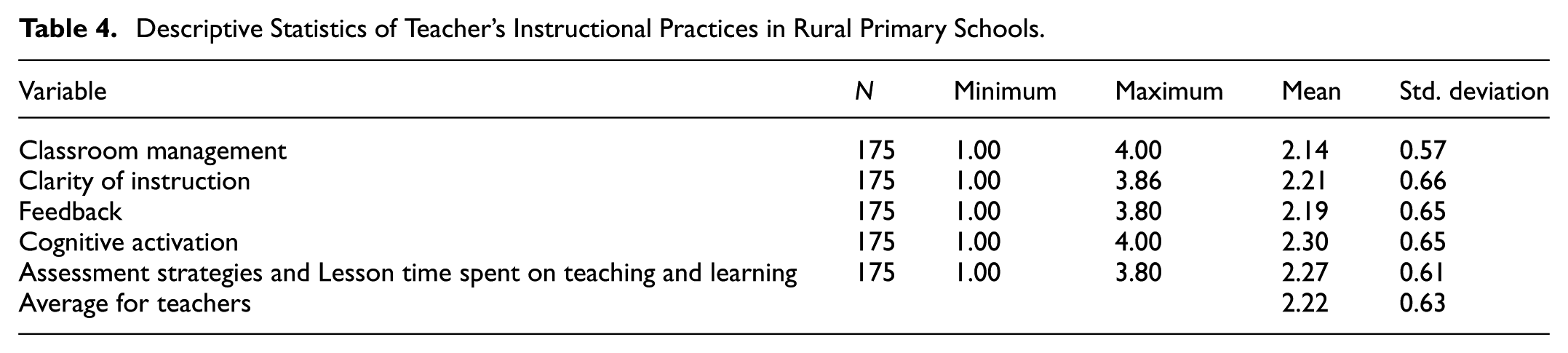
This study found that the responses of 175 school teachers revealed insights into classroom management, clarity of instruction, feedback, cognitive activation, and assessment strategies. The (OECD) TAILS evaluation scale (OECD, 2024) was used to measure teachers’ instructional practices. The highest-rated dimension, Cognitive Activation (M = 2.30, SD = 0.65), indicates that teachers are putting significant effort into engaging students in higher-order thinking. The lowest-rated variable, Classroom Management (M = 2.14, SD = 0.57), suggests that some teachers may face challenges maintaining order and structure in their classrooms. While clarity of instruction (M = 2.21, SD = 0.66) and feedback (M = 2.19, SD = 0.65) are also moderate, they indicate a clear potential for improving lessons more transparent and providing effective student feedback. These findings point to a promising future for enhancing instructional practices.
However, from Table 3, principals rated “Defining School Mission” highest (M = 2.47), while teachers’ highest rating was for Cognitive Activation (M = 2.30). These findings suggest that there might be a disconnect between the priorities of teachers and principals, which could impact the school’s overall effectiveness. Table 4 suggests that principals emphasize vision-setting while teachers focus more on engaging students cognitively. This disparity in focus could be a potential area for collaboration and alignment. Teachers’ lowest-rated area is classroom management (M = 2.14). In contrast, principals’ lowest-rated area is observing and improving Instruction (M = 2.14), indicating that principals are not intensely involved in classroom observation, which might contribute to weaker classroom management among teachers. This finding underscores the urgency of active leadership in supporting and improving instructional practices where a direct positive impact had.
Descriptive Statistics of Teacher’s Instructional Practices in Rural Primary Schools.
Research Question 3: What is the Relationship Between Principals’ Instructional Leadership and Teachers’ Instructional Practices in Rural Primary Schools in Sirajganj District, Bangladesh?
This study examined the relationship between principals’ instructional leadership and teachers’ instructional practices in rural primary schools in Sirajganj District, considering differences based on school performance as assessed by the education board (Bangladesh Population Census, 2022). Besides, this study employed Kendall’s Tau (Kendall Rank Correlation Coefficient) analysis to evaluate the relationship between instructional leadership and instructional practices. Due to the small sample size and exploratory nature of the analysis, a correction would reduce this risk and provide more rigorous inference. Subsequently, this study also conducted a one-way ANOVA test to assess whether principals and teachers rated instructional leadership and practices differently in higher-performing schools. McMillan (1996) and van der Voet et al. (2015) noted that small or low connections must have correlations between 0.10 and 0.30. Table 5 demonstrates that defining a school mission has a positive significant relationship with classroom management (φ = 0.20, p < .05) assessment strategies for lesson time spent on teaching and learning (φ = 0.503, p < .05). However, defining school mission has no significant relationship with the teachers’ instructional practice of clarity of instruction (φ = 0.07, p = .23), feedback (φ = 0.22, p < .34), and cognitive activation (φ = −0.05, p = .54). Likewise, managing curriculum plus instructional of school principals do not have a significant relationship with classroom management (φ = −0.19, p = .51), clarity of instruction (φ = −0.21, p = .21), cognitive activation (φ = −0.08, p = .98). On the other hand, managing curriculum plus instructional of school principals significantly determines teachers’ feedback (φ = 0.62, p = .01) and assessment strategies and lesson time spent on teaching and learning practice (φ = 0.21, p < .05). Moreover, the correlation result indicates that promoting a positive learning climate does not predict any relationship on teachers’ classroom management (φ = −.16, p = .62), clarity of instruction (φ = −.28, p = .06), feedback (φ = −.05, p = .21), cognitive activation (φ = −.34, p = .81), assessment strategies and lesson time spent on teaching and learning (φ = .06, p = .62). Similarly, the result of the correlation analysis shows that principals’ instructional practice of observing and improving instruction has no significant relationship on teachers’ classroom management (φ = −.04, p = .12), clarity of instruction, (φ = −.14, p = .08), feedback (φ = −.10, p = .07), cognitive activation (φ = −.29, p = .81), assessment strategies and lesson time spent on teaching and learning (φ = −.11, p = .32). Although school principals’ assessing the instructional program does not have relationship with teachers’ classroom management (φ = −0.10, p = .12), clarity of instruction (φ = −0.23, p = .08), feedback (φ = 0.08, p = .07), cognitive activation (φ = −0.18, p = .29); it has a considerable positive relationship with assessment strategies and lesson time spent on teaching and learning (φ = 0.21, p < .05). While some aspects of instructional leadership showed a relationship structured teaching practices, others have limited relationship on teachers’ instructional practices.
Correlations Coefficient for Studied Variables.

p < .05. * p < .01.
A more precise understanding of the relationship between principals’ instructional leadership and teachers’ instructional practices could be achieved by grouping and analyzing teachers according to the instructional leadership levels of their principals, so this study conducted an ANOVA test to examine the relationship between principals’ instructional leadership and teachers’ instructional practices based on school levels. According to the Bangladesh Population Census (2022) for the district of Sirajganj, national data indicated that schools exhibited varying levels of leadership practices, such as high, medium, and low performance. While we attempted to categorize school principals based on their leadership levels, we focused on comparing teachers’ instructional practices. Table 6 presents descriptive information regarding teachers’ instructional practices and the school principals’ instructional leadership level. For principals exhibiting higher levels of instructional leadership, the mean evaluations of teachers’ instructional practices ranged from (M = 2.41) for cognitive activation to (M = 2.23) for classroom management. In contrast, the highest mean evaluations for those with medium-level instructional leadership were (M = 2.33) for cognitive activation and (M = 2.16) for classroom management. Meanwhile, teachers under principals with low-level instructional leadership had their instructional practices rated between (M = 2.11) for cognitive activation and (M = 1.97) for classroom management.
Descriptive Statistics for Teachers’ Instructional Practice Across the Level of School Principals’ Instructional Leadership.

The one-way ANOVA result demonstrates that the level of school principals’ instructional leadership has a positive and significant impact on the quality of teachers’ instructional leadership, with η2 values ranging from .03 to .06, indicating small to medium effects according to Cohen’s (1988) guidelines in “classroom management” [F(2, 172) = 3.14, p < .05, η2 = .035], clarity of instruction [F(2, 172) = 5.03, p < .01, η2 = .055], Feedback [F(2, 172) = 3.047, p < .05, η2 = .034], and assessment strategies and lesson time spent on teaching and learning [F(2, 172) = 5.28, p < .05, η2 = .058]. Although the four parameters of teachers’ instructional practice (classroom management, clarity of instruction, feedback, and assessment strategies and lesson time spent on teaching and learning) are determined by the quality of school principals’ instructional leadership teachers possess or experience, cognitive activation of teachers’ instructional practice is substantially related with the level of school principals’ instructional leadership [F(2, 172) = 2.99, p = .05, η2 = .034] which are summer to assess the positive relationship between school principals’ instructional leadership on teachers’ instructional practice see Table 7.
One-Way Analysis of Variance of Teachers’ Instructional Practice Across the Level of School Principals’ Instructional Leadership.

p < .05. * p < .01. ** p < .001.
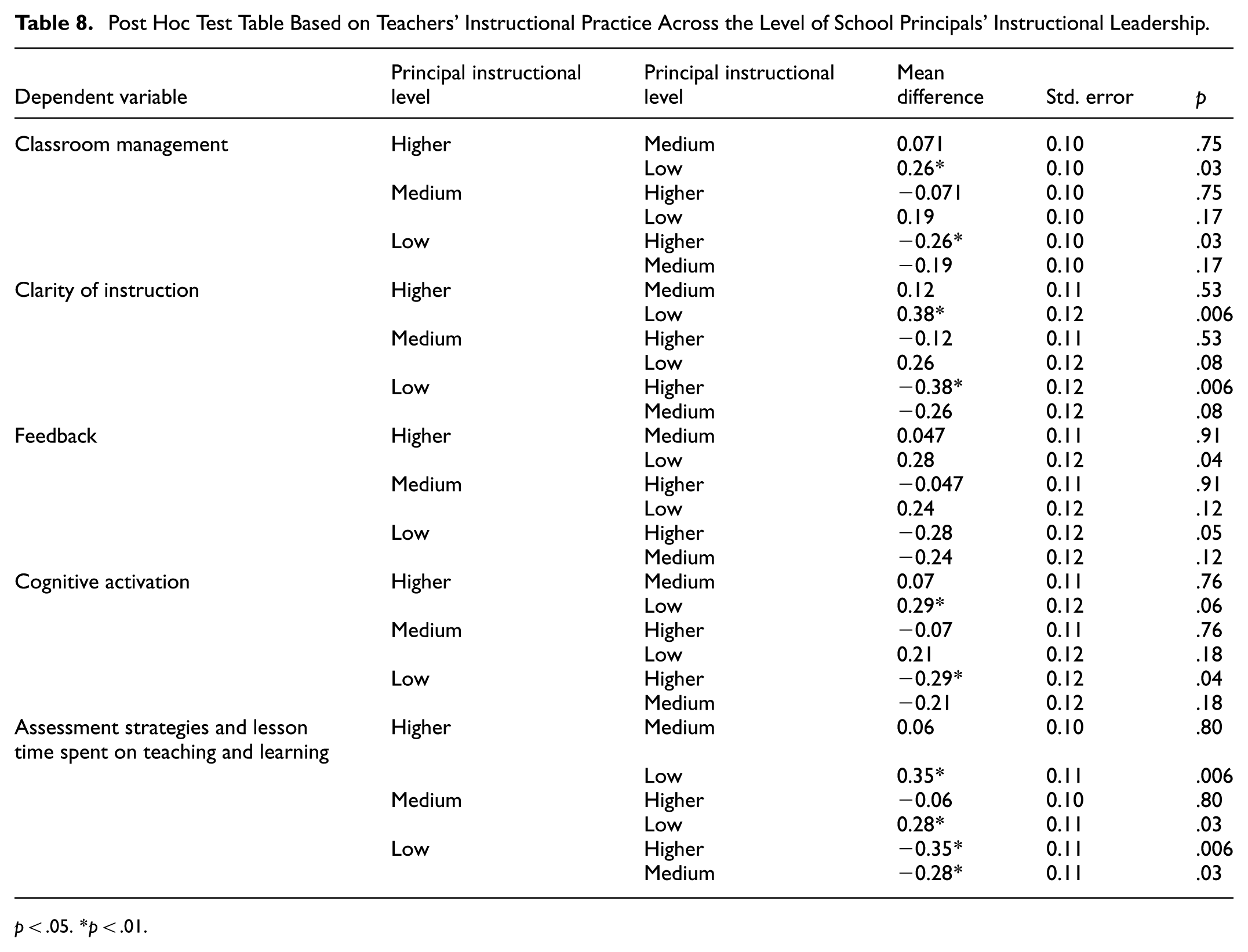
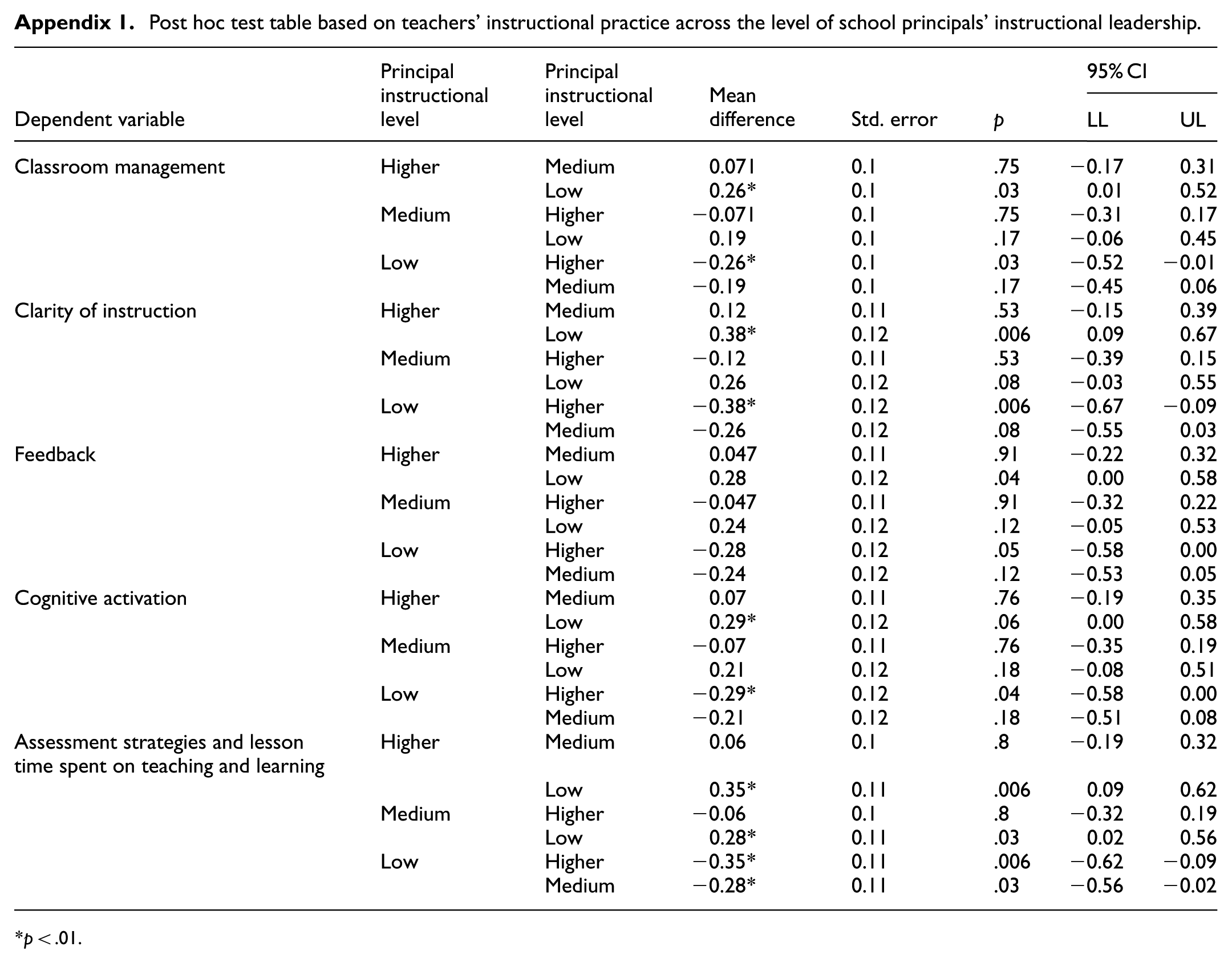
After conducting an ANOVA, due to the small sample size of principals (n = 14) and the division of teachers into groups for the ANOVA (e.g., high/medium/low leadership levels), verifying these assumptions is crucial. Violations of normality or homogeneity could increase the risk of Type I or Type II errors, potentially compromising the validity of the reported significant findings, so this study performed a post-hoc test to examine the mean differences among groups and determine if there were significant differences in teachers’ classroom management based on the instructional leadership levels of their principals see the full table see the first appendix. As Table 8 shows, the results indicated a significant mean difference in classroom management between teachers from schools with high and low levels of principal instructional leadership Mean Difference (MD = 0.65, p < .05). Similarly, there is a significant mean difference in teachers’ ratings regarding the clarity of instruction between those at high and low levels of principal instructional leadership (MD = 0.38, p < .01). Also, there was a significant mean difference in teachers’ ratings of feedback based on principal leadership levels (MD = 0.29, p < .05), the same as a significant mean difference in teachers’ ratings of assessment strategies and the time spent on teaching and learning between high- and low-level school leadership (MD = 0.35, p < .01), on the other hand, no significant mean difference in teachers’ scores on cognitive activation between high- and low-level school leadership (MD = 0.12, p = .66) also see Appendix 1.
Post Hoc Test Table Based on Teachers’ Instructional Practice Across the Level of School Principals’ Instructional Leadership.
p < .05. * p < .01.
Discussion
This study indicates that the relationship between school principals’ instructional leadership and teachers’ instructional practices is more complex than previously understood. Teachers, especially in developing countries like Bangladesh, particularly in the Sirajganj region, need to be more aware of their principals’ instructional leadership within their schools. This study outlines the implications of its findings, provides recommendations and suggestions, and discusses the study’s limitations based on the results.
Principal’s Instructional Leadership
Instructional leadership has evolved significantly, transitioning from early modern instructional guidance to a strategic and operational transformation model (Hallinger et al., 2020). Previous studies (Hallinger, 2018; Hallinger et al., 2020; Hossain, 2019; Islam et al., 2024; Kirkpatrick, 2010) support the conclusion that instructional leadership is positively and significantly related to teacher-instructional practices, which in turn ensures effective teaching and learning processes in rural primary schools in the Sirajganj District of Bangladesh. The findings from the NETSA survey contribute valuable insights to our study of how principals engage with various dimensions of leadership, as outlined by Hallinger (2018). Among the five areas of instructional leadership, defining the school mission emerged as the highest-scoring aspect (M = 2.47, SD = 0.83). This underscores the principal’s significant role in setting a clear vision and direction for the school, which aligns with Hallinger and Murphy’s (1985) emphasis on mission-driven leadership. However, two areas fostering a positive learning climate (M = 2.18, SD = 0.85) and observing and improving instruction (M = 2.14, SD = 0.77) received lower scores. These findings indicate a pressing need for greater attention to creating a conducive learning environment and systematically enhancing instructional quality. The ability of principals to influence instructional leadership in rural settings is further impacted by contextual challenges such as limited resources, teacher motivation, and administrative workload (Jarvis & Judge, 2024). Effective instructional leadership in these environments requires a commitment to promoting professional development for teachers, offering incentives, and maintaining academic standards to achieve sustainable improvements in student outcomes. However, Hallinger’s (2018) educational management and leadership theory emphasizes the necessity of a comprehensive approach to instructional leadership. It involves actively engaging teachers in instructional practices and developing their capacities, especially when given leadership opportunities and encouraged to step beyond their comfort zones (Ghamrawi et al., 2024; Liu & Watson, 2023; Tomlinson & Imbeau, 2023). While principals in rural primary schools in Sirajganj defining their school’s mission, there is an urgent need to prioritize creating a positive learning climate and enhancing monitoring. Addressing these gaps requires strategic interventions, training, resource allocation, and policy reforms.
Teacher’s Instructional Practices
Teachers’ instructional practices in rural primary schools in the Sirajganj District of Bangladesh involve a complex interaction of instructional leadership, pedagogical knowledge, and classroom strategies that impact student learning outcomes. By understanding how these factors work together, school principals can better develop strategies to enhance teachers’ instruction and design targeted interventions at the individual, team, or leadership levels (Billingsley et al., 2020; Sharp et al., 2020; Zulfqar et al., 2021). According to Spillane (2012), effective instructional practices require school reforms incorporating teachers’ experiences and instructional leadership instead of relying solely on external directives. However, findings from the analysis of 175 school teachers in Sirajganj, measured using the OECD’s TALIS framework (OECD, 2024), highlight key dimensions of instructional practice: cognitive activation, classroom management, clarity of instruction, feedback, and assessment strategies. Among these, cognitive activation (M = 2.30, SD = 0.65) emerged as the highest-rated dimension, suggesting that teachers actively engage students in higher-order thinking. However, the lowest-rated dimension, classroom management (M = 2.14, SD = 0.57), indicates that many teachers struggle with maintaining order and structure in their classrooms. On the other hand, Eggen and Kauchak (2007) argue that effective teaching relies on teachers’ material awareness, pedagogical content knowledge, and general instructional awareness. The moderate ratings for clarity of instruction (M = 2.21, SD = 0.66) and feedback (M = 2.19, SD = 0.65) indicate that teachers improved by making lessons more transparent and providing effective feedback. It echoes the work of Ainley and Carstens (2018) and Ahn et al. (2025), who emphasize that instructional clarity, enthusiasm, and organization are crucial for student motivation and comprehension. Notably, there is a disparity between teachers’ and principals’ instructional priorities. While teachers rated cognitive activation the highest, principals emphasized defining the school mission (M = 2.47), suggesting a potential misalignment in focus. Moreover, principals rated “observing and improving instruction” the lowest (M = 2.14), coinciding with teachers’ classroom management challenges, which is lack of direct instructional oversight could explain weaker classroom discipline, reinforcing the importance of active instructional leadership in supporting teachers (Hallinger et al., 2018; Thoonen et al., 2011). The results indicate a promising direction for improving instructional practices by aligning teacher and principal priorities, reinforcing classroom management, and enhancing pedagogical strategies to ensure consistent educational outcomes.
The Impact on Principals’ Leadership and Teachers’ Instructional Practice
The impact of principals’ instructional leadership on teachers’ instructional practices is essential for improving the quality of education. Educational Management and Leadership theory highlights the complex relationship between school leadership and instructional practices, stressing the importance of connecting administrative directives with classroom implementation (Hallinger & Heck, 2010; Spillane, 2012). However, Principals play a crucial role in shaping instructional practices by promoting collaboration, trust, and professional development among teachers (He et al., 2024; Rahaman, 2017). On the other side, Hallinger (2018) suggest that the impact of instructional leadership is indirect and mediated by school culture, educational frameworks, and teachers’ engagement, where effective instructional leadership improves student learning outcomes when aligned with shared goals and sustained professional development (Ferrandino, 2001). The findings reveal that certain aspects of instructional leadership, such as defining the school mission, have a positive correlation with classroom management (φ = .20, p < .05) and the assessment strategies applied to lesson time used for teaching and learning (φ = .50, p < .05). However, no significant relationship existed between defining the school mission and the clarity of instruction, feedback, or cognitive activation. Likewise, school principals’ management of curriculum and instruction had no substantial association with most instructional practices except for assessment strategies and lesson time spent on teaching and learning (φ = 0.21, p < .05). Moreover, the study found that efforts to promote a positive learning climate and to observe and improve instruction had minimal influence on teachers’ classroom management, clarity of instruction, feedback, cognitive activation, and assessment strategies. Despite these findings, the ANOVA results indicate that the level of school principals’ instructional leadership has a significant impact on teachers’ instructional practices, with η2 values ranging from 0.03 to 0.06, indicating small to medium effects according to Cohen’s (1988) guidelines in classroom management [F(2, 172) = 3.149, p < 0.05, η2 = .035], clarity of instruction [F(2, 172) = 5.028, p < .01, η2 = .055], feedback [F(2, 172) = 3.047, p < 0.05, η2 = .034], and assessment strategies and lesson time spent on teaching and learning [F(2, 172) = 5.282, p < .05, η2 = .058]. Notably, cognitive activation was not significantly related to the level of school principals’ instructional leadership [F(2, 172) = 2.994, p = .053, η2 = .034].
Further post-hoc analysis revealed significant mean differences in teachers’ instructional practices based on the principals’ instructional leadership level. Teachers in schools with high instructional leadership reported significantly better classroom management (MD = 0.65, p < .05), clarity of instruction (MD = 0.38, p < .01), feedback (MD = 0.29, p < .05), and assessment strategies (MD = 0.35, p < .01) compared to those in schools with low instructional leadership. However, no significant difference was found in cognitive activation between these groups (MD = 0.12, p = .66). While leadership influences structured teaching elements, specific practices, such as cognitive activation, may require additional strategies beyond principal intervention. However, Hallinger’s instructional leadership model (Hallinger, 2018; Hallinger & Murphy, 1985) reveals a distinct pattern of strengths and critical gaps in the leadership practices of principals not only globally but also in rural Bangladeshi primary schools. According to the conceptual framework of this study, which defines the school mission, manages the instructional program, and promotes a positive school learning climate, these elements help establish a relationship between principals’ leadership and teachers’ instructional practices. Moreover, defining the school mission emerged as the strongest leadership practice (M = 2.47, SD = 0.83), indicating that principals perceive themselves as actively engaged in setting a clear academic direction and goals for their institutions, which is significant in relation to the dimensions of Hallinger’s theory (Hallinger & Murphy, 1985). At the same time, clear correlations emerged between leadership and instructional practice, with defining the school mission having a significant relationship with improved classroom management (φ = 0.20, p < .05) and a more effective use of assessment strategies and instructional time (φ = 0.50, p < .05). Similarly, managing curriculum plus instruction revealed significant leadership practices (M = 2.27, SD = 0.71), and the correlations emerged between managing curriculum plus instruction, which was significantly related to feedback (φ = 0.62, p = .01) and assessment strategies and lesson time spent on teaching and learning practice (φ = 0.21, p < .05).
Likewise, the ANOVA and post-hoc results further confirm that teachers under principals those principals practice managing curriculum and instruction leadership exhibit higher-quality feedback and instructional practices for teachers. Furthermore, observing and improving instruction was the lowest-rated leadership practice overall (M = 2.14, SD = 0.77), and the correlational analysis confirmed that this lack of oversight of instructional practices had no statistically significant influence on any of the measured teachers’ instructional practices. The absence of a significant relationship between observing and improving instruction and teacher clarity of instruction represents a major impediment to instructional quality, as it leaves teachers without the expert guidance necessary to refine their teaching practices (Mincu, 2022).Nevertheless, promoting a positive learning climate was another area of notable neglect (M = 2.18, SD = 0.85), and the correlational analysis confirmed that this lack of oversight of principals’ instructional practices had no statistically significant influence on any of the measured teachers’ instructional practices. A favorable climate is theorized to enhance teacher motivation, commitment, and risk-taking factors that are essential for the adoption of improved instructional strategies (Thoonen et al., 2011). However, the ANOVA and post-hoc results further confirm that the four parameters of teachers’ instructional practice (classroom management, clarity of instruction, feedback, and assessment strategies and lesson time spent on teaching and learning) are determined by the quality of school principals’ instructional leadership on teachers teaching possess experience, cognitive activation of teachers’ instructional practice is substantially related with the level of school principals’ instructional leadership which supports the conceptual framework.
Recommendations and Suggestion
Several key recommendations could significantly enhance instructional leadership and improve teachers’ practices in rural primary schools in Sirajganj District, Bangladesh. First, implementing professional development programs for school principals is essential for fostering a positive learning climate and improving instructional monitoring (Hallinger et al., 2020). These training initiatives should prioritize active engagement with teachers, curriculum management, and data-driven decision-making to elevate instructional quality (Ghamrawi et al., 2024). Another valuable recommendation is establishing structured mentoring and coaching programs to strengthen classroom management and assessment strategies among teachers (Sharp et al., 2020). The discrepancies between principals’ and teachers’ instructional priorities, it would be beneficial to encourage collaborative goal-setting sessions to align leadership strategies with teaching practices (Thoonen et al., 2011). Furthermore, policymakers should allocate resources to enhance school infrastructure, provide instructional materials, and alleviate administrative burdens, allowing principals to concentrate on instructional leadership (Islam et al., 2024). Lastly, integrating sustainable professional development models in line with the Sustainable Development Goals (SDGs) can ensure long-term improvements in instructional leadership and student learning outcomes (Barakat et al., 2016). A holistic approach combining leadership training, policy reforms, and teacher support mechanisms will strengthen instructional effectiveness in rural educational contexts.
Implication for Practice
This study examines instructional leadership and its implications for principals and teachers in their instructional practices. Most of the implications for principalship relate to school improvement. Teachers are known for their commitment to lifelong learning, and as experts in education, they must continually enhance their knowledge. To maintain full certification, teachers must meet recertification criteria. Similarly, principals must continuously acquire new skills to fulfill their professional responsibilities effectively. The study identified several opportunities for principals to develop as instructional leaders. Notably, principals rated the subscale of “observing and improving instruction” among the lowest categories. Additionally, “feedback” activities received low mean ratings regarding teachers’ teaching strategies. It is highly recommended that principals actively observe and adjust instruction to address these shortcomings in their instructional leadership roles by implementing effective feedback techniques. According to Good (2008), it is crucial for principals to enhance their instructional leadership skills prior to being appointed to the position, as it is not advisable to wait until they have already taken on the role. For those who are next in line for principalship and wish to advance, gaining expertise in instructional leadership is in their best interest. Strong instructional leadership is essential because principals positively impact teachers, improving student success. However, In rural educational settings with limited resources, these results indicate that principals’ leadership is currently strongest in setting direction (mission) and managing formal aspects of the instructional program, while day-to-day pedagogical guidance and climate-building remain underdeveloped. In such contexts in the Sirajganj District even modest improvements in observation, feedback, and classroom support can be meaningful, particularly when teachers report difficulties in classroom management and experience only moderate levels of instructional clarity and feedback. Hossain (2019) also emphasize that involving principals in the instructional leadership framework could lead to higher student achievement. Ultimately, the most compelling reason to develop instructional leadership skills is to benefit students.
Limitation
While this study provides valuable insights into the relationship between principals’ instructional leadership and teachers’ instructional practices in rural primary schools in Bangladesh, it is essential to acknowledge several limitations. First, the data were collected from rural primary schools within a single district (Sirajganj), which limits the generalizability of the results and may not apply to urban settings, secondary education, or other socio-cultural contexts. Second, the cross-sectional design restricts the ability to draw causal inferences about the relationship between dimensions of instructional leadership and teachers’ instructional practices. Longitudinal studies would be better suited to capture how leadership influences instructional change over time. Third, the use of adapted instruments (such as the NETSA survey and TALIS-based measures) may present concerns regarding cultural and contextual validity, as not all constructs may be perceived or expressed in the same way in Bangladeshi rural schools. Participants may have overestimated or underestimated their instructional behaviors, which could limit the accuracy of the measured constructs. As such, while this study identifies correlations, it does not provide causal inferences; further research should incorporate classroom observations or interviews, which could enrich the understanding by triangulating quantitative data with qualitative evidence. Finally, the small to medium effect sizes (η2) indicate that a considerable portion of the variance in teachers’ instructional practices remains unexplained, suggesting that other influential factors, such as teacher education, socioeconomic conditions, or parental involvement, were not considered in this research.
Footnotes
Appendix
Post hoc test table based on teachers' instructional practice across the level of school principals' instructional leadership.
| Dependent variable | Principal instructional level | Principal instructional level | Mean difference | Std. error | p | 95% CI | |
|---|---|---|---|---|---|---|---|
| LL | UL | ||||||
| Classroom management | Higher | Medium | 0.071 | 0.1 | .75 | −0.17 | 0.31 |
| Low | 0.26* | 0.1 | .03 | 0.01 | 0.52 | ||
| Medium | Higher | −0.071 | 0.1 | .75 | −0.31 | 0.17 | |
| Low | 0.19 | 0.1 | .17 | −0.06 | 0.45 | ||
| Low | Higher | −0.26* | 0.1 | .03 | −0.52 | −0.01 | |
| Medium | −0.19 | 0.1 | .17 | −0.45 | 0.06 | ||
| Clarity of instruction | Higher | Medium | 0.12 | 0.11 | .53 | −0.15 | 0.39 |
| Low | 0.38* | 0.12 | .006 | 0.09 | 0.67 | ||
| Medium | Higher | −0.12 | 0.11 | .53 | −0.39 | 0.15 | |
| Low | 0.26 | 0.12 | .08 | −0.03 | 0.55 | ||
| Low | Higher | −0.38* | 0.12 | .006 | −0.67 | −0.09 | |
| Medium | −0.26 | 0.12 | .08 | −0.55 | 0.03 | ||
| Feedback | Higher | Medium | 0.047 | 0.11 | .91 | −0.22 | 0.32 |
| Low | 0.28 | 0.12 | .04 | 0.00 | 0.58 | ||
| Medium | Higher | −0.047 | 0.11 | .91 | −0.32 | 0.22 | |
| Low | 0.24 | 0.12 | .12 | −0.05 | 0.53 | ||
| Low | Higher | −0.28 | 0.12 | .05 | −0.58 | 0.00 | |
| Medium | −0.24 | 0.12 | .12 | −0.53 | 0.05 | ||
| Cognitive activation | Higher | Medium | 0.07 | 0.11 | .76 | −0.19 | 0.35 |
| Low | 0.29* | 0.12 | .06 | 0.00 | 0.58 | ||
| Medium | Higher | −0.07 | 0.11 | .76 | −0.35 | 0.19 | |
| Low | 0.21 | 0.12 | .18 | −0.08 | 0.51 | ||
| Low | Higher | −0.29* | 0.12 | .04 | −0.58 | 0.00 | |
| Medium | −0.21 | 0.12 | .18 | −0.51 | 0.08 | ||
| Assessment strategies and lesson time spent on teaching and learning | Higher | Medium | 0.06 | 0.1 | .8 | −0.19 | 0.32 |
| Low | 0.35* | 0.11 | .006 | 0.09 | 0.62 | ||
| Medium | Higher | −0.06 | 0.1 | .8 | −0.32 | 0.19 | |
| Low | 0.28* | 0.11 | .03 | 0.02 | 0.56 | ||
| Low | Higher | −0.35* | 0.11 | .006 | −0.62 | −0.09 | |
| Medium | −0.28* | 0.11 | .03 | −0.56 | −0.02 | ||
p < .01.

Ethical Considerations
This study’s research methods and procedures were conducted according to human subject’s guidelines and approved by the corresponding author’s master thesis Ethical Approval of Research Project Committee, FOE, SWU approved on 28 September 2022 (Ref. no. 2019-2022-0000122). Data were available on request from the corresponding author. No parent’s information is identified in the study, and all attention to ethical parameters is safeguarded. During the research design, data collection, and analysis processes, this study strictly adhered to guidelines and regulations related to research involving human participants, including but not limited to the Declaration of Helsinki and its subsequent amendments, to ensure the complete protection of all participants’ rights.
Consent to Participate
Informed consent was obtained from all participants in the study. Acknowledgments: All authors agree with the submission and agree with the authorship.
Author Contributions
This work was carried out by MRS. Author MRS Drafted the initial manuscript and collected data, wrote the protocol, and wrote the manuscript draft. All authors read and approved the final manuscript.
Funding
The author received no financial support for the research, authorship, and/or publication of this article.
Declaration of Conflicting Interests
The author declared no potential conflicts of interest with respect to the research, authorship, and/or publication of this article.
Data Availability Statement
The data and material (data transparency) Code availability (software application) is also available by request.*