




Abstract
The aim of this study was to examine teaching and technology status of physical education (PE) teachers under the ongoing influence of COVID-19. A total of 1,005 in-service PE teachers completed the Physical Education Teaching Efficacy Scale (PETES) and Educator Technology Self-Efficacy Survey (ETS-ES) electronically to measure current teaching efficacy and perceived technology self-efficacy. The findings revealed that the teachers’ overall PE teaching efficacy level was high (8.08 ± 1.27) whereas, technological self-efficacy was at a moderate level (3.45 ± 0.44). Meanwhile, Efficacy for Using Technology significantly and positively predicted Technology Self-Efficacy (p < .001). In conclusion, Chinese in-service PE teachers in primary and secondary schools exhibited a high level of competence in PE teaching. However, their proficiency in utilizing technology for educational purposes needed improvement. While these educators possessed fundamental online teaching skills, they often encountered challenges in adapting to technology-enhanced teaching methods. Education and training institutions should improve their existing curriculum, and schools need to continue to develop and train in-service teachers.
Plain Language Summary
The inclusion of technology in physical education was usually based on traditional face-to-face lessons, such as using hardware (e.g., accelerometers, heart rate monitors, etc.) or software programs to assist in PE lessons in a gym or outdoor settings. However, due to the Covid-19 pandemic, teaching and learning, including physical education, had to be conducted online. The experience of teaching PE in an outdoor environment may not come in handy when students are alone in a home environment, facing the camera online for a PE lesson. This study provided information of teaching efficacy of physical education (PE) teachers on the use of technology during the of COVID-19 pandemic. A total of 1,005 in-service PE teachers completed the Physical Education Teaching Efficacy Scale (PETES) and Educator Technology Self-Efficacy Survey (ETS-ES) electronically to measure current teaching efficacy and perceived technology self-efficacy. The findings revealed that the teachers’ overall PE teaching efficacy level was high whereas, technological self-efficacy was at a moderate level. PE teachers in China are basically capable of teaching PE via online mode, although they may face some difficulties in the teaching process. The specific areas that can be improved are discussed.
Introduction
It is almost 3 years since the COVID-19 pandemic broke out and there are still no effective means to eradicate the virus. Many countries have taken measures such as closing schools and banning public gatherings in order to control the spread of the virus (Hale et al., 2023), and these measures have caused significant disruption to education systems (Pokhrel & Chhetri, 2021). To mitigate the effects of widespread school closures, China’s Ministry of Education adopted the “School’s Out, But Class’s On” approach on February 12, 2020, requiring every local school to take a local approach in supporting and helping students learn. During the postponed opening of the academic year, online platforms and TV over-the-air classes were launched, offering each region free access to these learning resources of their own choice. Through the combination of teachers’ online guidance and students’ independent learning at home, the approach helped students to learn, and promoted their overall development, including their physical and mental health (Ministry of Education of the People’s Republic of China, 2020a). This approach was implemented continuously for approximately 5 months, beginning from February 12, 2020, when the document was issued, until the end of early July 2020. Due to the improvement of the epidemic, the Ministry of Education notified in August 2020 that normal teaching and learning would resume in full from the new autumn 2020 term (Ministry of Education of the People’s Republic of China, 2020b) and students began to return to traditional classes. However, in the following period, some regions and provinces were repeatedly hit by the epidemic (Li et al., 2021), and local education departments had to close schools once again and the regular educational process was seriously disrupted.
Teachers and students were unprepared for the urgent launch of large-scale online teaching (Aboagye et al., 2020; Trust & Whalen, 2020). In addition, online teaching was not mainstream in China and many teachers lacked experience in online teaching (W. Zhang et al., 2020), so the initial virtual delivery mode posed a great challenge to teachers. Of all subjects, physical education (PE) was more difficult to teach than other subjects because it involved physical contact and interaction (Varea et al., 2022), which was difficult to achieve through online courses. Due to the environment, equipment and other factors, PE courses had to be rethought and redesigned when moving online (Daum et al., 2021; Paramitha et al., 2021) and it was also affected by policy implications (Gobbi et al., 2020). In such a complex environment, the capacity of PE teachers to deliver high quality lessons, via virtual mode, was a crucial test of their pedagogical skills and educational technology.
Several review papers on online education have been published in recent years. In the subject of education in general, it was argued that online teaching methods and platforms had to be further explored to support teaching and learning (Carrillo & Flores, 2020; Pokhrel & Chhetri, 2021; L. Zhou & Li, 2020), and that the continued use of online tools should be encouraged after normalcy was restored (Pokhrel & Chhetri, 2021). In addition, L. Zhou and Li (2020) suggested that research should be focused on resource selection, and the organization, delivery and evaluation of teaching and learning. Furthermore, Cramarenco et al. (2023) argued, based on their review of student perceptions of online education during the pandemic, that future research should also explore teacher perceptions in this context. In the context of online education in China, Cen et al.’s (2020) concluded that online education was an effective way to make up for the lack of classroom teaching during the pandemic, although attention needs to be paid to the online environment, hardware equipment, and the quality of education and student experience. Supporting the efficacy of online education, through a review of China’s online education policies, Jiang et al. (2023) concluded that the future of online education in China held promise with the support of relevant policies. In the subject of PE in particular, Killian et al. (2019) conducted a study on online and blended PE studies and concluded that with the expansion of online instruction, there was a need for systematic research on the design, adoption, and implementation of online instruction in PE. T. Zhou (2023) conducted a literature review on online education in sports over the past 20 years, finding a rapid increase in the use of keywords such as COVID-19, children, and online teaching, and concluded that future research in the field was expected to continue expanding. Currently, online education still needs to be improved and refined, and in this process it can be achieved with the help of artificial intelligence and machine learning technology. Existing researches indicated that this technology can be useful both in improving online education (Villegas-Ch et al., 2020) and in predicting COVID-19 cases (Zivkovic et al., 2021).
When using technology for instruction, it is necessary to mention the TPACK (Technological, Pedagogical, and Content Knowledge) model. This framework was proposed by Mishra and Koehler (2006). According to the authors, at the heart of good teaching with technology are three core components: content, pedagogy and technology, plus the relationships among and between them. To effectively integrate technology, teachers should first have a deep understanding of the content knowledge and pedagogical knowledge of the profession as technological knowledge alone does not do the job well (Koehler & Mishra, 2008). This model suggested that content knowledge and pedagogical knowledge were linked to PE teaching efficacy, while technological knowledge was associated with technology self-efficacy. To discuss online teaching effectively, it was necessary to consider the connection between teaching efficacy and technology self-efficacy. Furthermore, according to self-efficacy theory, people’s judgments of their capabilities to organize and execute courses of action helped them to attain designated types of performances. Individuals build their own self-efficacy beliefs that influence their choices and behaviors (Bandura, 1977). Here it could be interpreted that teachers’ beliefs about their own teaching determine whether they could perform well or not. Therefore, in order for PE teachers to carry out online courses well, they should first have a high level of PE teaching efficacy, and followed by a certain level of technology efficacy.
Current research on the efficacy of PE teaching can be divided into two categories, one investigating pre-service teachers and the other for in-service teachers. In studies of pre-service PE teachers, it was argued that pre-service PE teachers’ efficacy can be improved through learning and that both the physical literacy they possess and their specific training can influence teaching efficacy (Choi et al., 2021; Ünlü & Erbas, 2019; Zach et al., 2012). Furthermore, active mastery of experience through early exposure and experience of the teaching environment can have a positive effect on pre-service physical education teachers’ teaching efficacy (Iaochite & Costa Filho, 2016), with high performing teachers giving more positive feedback to students than low performing teachers (Chase et al., 2003). Specifically in the efficacy measurement study, the level of teaching efficacy for Turkish PE teacher candidates was found to be intermediate (Erbas et al., 2014), with females being higher than males (Erbaş, 2021).
Studies in Asia found that pre-service PE teachers “probably can do it” in terms of teaching efficacy (Choi et al., 2021). Comparatively, in studies of in-service PE teachers, new PE teachers were found to be highly dynamic in their effectiveness (Ensign et al., 2020) and PE teachers’ efficacy increased significantly after relevant training and learning, regardless of experience (Martin et al., 2009), and there were some differences in efficacy between generalist and specialist teachers when teaching PE lessons, such as analysis of skills, preparation, communication (Truelove et al., 2021). Teacher self-efficacy has a positive impact on teaching practices in health and PE courses (Pan et al., 2013), and higher self-efficacy is associated with effective classroom management, and innovative teaching strategies (Whittle et al., 2017), in addition, PE teacher efficacy has been correlated with teaching commitment, marginalization, and isolation (Ulaş & Şenel, 2020).
Although there are many studies on PE teachers’ teaching efficacy carried out in various countries such as Turkey (Erbas et al., 2014; Erbaş, 2021), Australia (Whittle et al., 2017), Brazil (Iaochite & Costa Filho, 2016) and United States (Ensign et al., 2020), there are none involving mainland Chinese teachers. As such, the current level of teaching efficacy of in-service PE teachers in Chinese primary and secondary schools are not known.
Research on technology self-efficacy in education can similarly be divided into two categories: pre-service and in-service. In general education studies, it was found that the majority of pre-service primary school teachers were confident in their capacity to educate others about technology (Kent & Giles, 2017) and that there was a significant positive change in technology self-efficacy after engaging in a specific course of study (Menon et al., 2017), although there were differences in technology and actions across teachers (Lemon & Garvis, 2016). Correspondingly, in research involving in-service primary school teachers, it was concluded that teachers showed a significant increase in technology self-efficacy after their learning (Boland, 2019), that the relationship between each criterion of technology self-efficacy was moderately strong to very strong (Sassone, 2020), and that the correlation between digital leadership of primary school principals and teachers’ technology self-efficacy was weak (Domeny, 2017). A survey of k-12 teachers found that teachers had comparable, but not high, levels of confidence in using and integrating technology (Gomez et al., 2022), although those in leadership positions had higher levels of technology self-efficacy (Al-Harthi, 2017). Allowing middle school teachers to experience and master technology and access to experts can gradually build their technology self-efficacy (Tilton & Hartnett, 2016). On specific measures of technology self-efficacy, teachers were found to score lowest on lifelong learning and professional growth factors and highest on digital citizenship-related scores (Edwards, 2018). University faculty scored moderately on technology efficacy overall and were generally confident in their ability to integrate technology (O’Neil & Krause, 2019).
The inclusion of technology in PE education was usually based on traditional face-to-face lessons, such as using hardware (e.g., accelerometers, heart rate monitors, etc.) or software programs to assist in PE lessons in a gym or outdoor settings. Teacher education programs use these environments as a basis for infusing technology when preparing teachers for the real world (Juniu, 2011). Hence, experience of teaching PE in an outdoor environment may not come in handy when students are alone in a home environment, facing the camera on line for a PE lesson. PE teachers face the same issues as other subjects when teaching online lessons, in addition to the limitations of space, equipment and physical interaction (Jeong & So, 2020; Varea et al., 2022).
Previous studies measuring the teaching efficacy of primary and secondary school PE teachers in China have found high levels of teaching efficacy (Wu, 2022), whereby the level of each sub-dimension was relatively balanced (Z. H. Zhang, 2017) and had a positive correlation with teaching effects and teaching performance (Jin, 2021). However, research on measuring teachers’ technology efficacy was rare. Currently, it is not known whether PE teachers are capable of delivering high quality online courses and what difficulties they encounter in their teaching. Only with a clear understanding of the online teaching of primary and secondary PE teachers in mainland China, can precise solutions to improve teachers’ online teaching abilities be provided. Thus, the question that arose from this study was: what was the status of PE teachers’ teaching efficacy in the post-COVID pandemic?
Therefore, the present study set out to investigate the level of teaching efficacy of primary and secondary PE teachers in mainland China and their self-efficacy in education technology. Besides, the study also explored the relationship between PE teaching efficacy and technology self-efficacy among in-service PE teachers. It was hypothesized that one or more subscales of PE teaching efficacy would positively predict technology self-efficacy among PE teachers. After obtaining the status of PE teachers, education and training institutions can adjust their teaching content to improve the current content of pre-service PE teachers so that they can easily cope with online teaching in the future. For in-service PE teachers, provide targeted training content to make up for the skills they lack. Of course, the most important thing is to benefit students by improving the quality of PE teaching.
Materials and Methods
This section describes the methods used in this study. It is divided into three parts: (i) details of the population and how the data was collected; (ii) explanation on the two questionnaires used, including the reliability and validity of the Chinese scale; (iii) description of the tools and methods used in analyzing the data.
Participants
A total of 1,005 primary and secondary school teachers (379 females, 626 males) from mainland China participated in the study. The participants’ ages ranged from 21 to 60 years old, and they were from 11 different districts in China. Geographically, these districts represented locations in the north, south, east and west of China. These districts were: Beijing, Hebei, Shanxi, Inner Mongolia, Henan, Shandong, Xinjiang, Shaanxi, Sichuan, Guangdong, and Guangxi. The inclusion criteria were that teachers had at least 1 year teaching experience, were full-time teachers (contract or permanent) and employed in a public school. Part-time teachers and trainee teachers were excluded from the study. The survey was delivered as an electronic link and was open-ended, using convenience sampling and recruiting participants via WeChat. The questionnaire was distributed and collected between 1 and 31 March 2022, and participants had volunteered and needed to signify their consent before the start of the study. All questions of the survey were shown on an electronic page where participants could view and change their answers before clicking on the submit button. Only one submission were allowed for each electronic device and WeChat account and the survey could be submitted only after all questions had been answered. The study was conducted in accordance with the ethical guidelines of the Universiti Malaya Research Ethics Committee (UM.TNC2/UMREC_1681).
Measures
Physical Education Teaching Efficacy Scale. The PETES developed by Humphries et al. (2012) was used to measure teachers’ levels of effectiveness in teaching PE. The questionnaire contained 35 questions, using a 10-point scale anchored by (1) “Disagree/Cannot do,” and (10) “ Agree/Highly certain I can do,” with a midpoint of (5) “Neutral/Moderately certain I can do.” The questions were divided into seven themes: Content Knowledge; Applying Scientific Knowledge in Teaching; Accommodating Skill Differences; Teaching Students with Special Needs; Instruction; Using Technology; and Using Assessment. The scores for each theme was calculated separately. The internal consistency of each factor of the scale ranged from 0.77 to 0.91 and test-retest reliability values ranged from 0.63 to 0.88 (Humphries et al., 2012). The back translation method was used, whereby three bilingual individuals were involved in the process of translating the PETES from English to Chinese, and back to English. After checking the accuracy of the content, four experienced PE experts were invited to confirm the content validity and the Content Validity Index (CVI) of all items were 1.00, meeting the adequate criterion (Tilden et al., 1990). Reliability was measured using internal consistency with a Cronbach’s alpha of .931, which is considered reliable and acceptable (Salkind, 2010).
Educator Technology Self-Efficacy Survey. The ETS-ES developed by Gentry et al. (2014), was designed to measure teachers’ levels of self-efficacy in using digital tools for teaching and learning. The scale contained 50 questions with five options for each question, namely strongly agree, agree, neutral, disagree, and strongly disagree. The questions were divided into five themes: Facilitate and inspire student learning and creativity; Design and develop digital age learning experiences and assessments; Model digital age work and learning; Promote and model digital citizenship and responsibility; Engage in professional growth and leadership. Each theme had 10 items, five were positively framed and the other five were negatively framed. For the 25 positive items (PIs), the scoring values ranged from a scale of 1 to 5 while the inverse for the 25 negative items (NIs) ranged from 5 to 1: Strongly disagree (PI = 1/NI = 5), Disagree (PI = 2/NI = 4), Neutral (PI = 3/NI = 3), Agree (PI = 4/NI = 2), and Strongly agree (PI = 5/NI = 1). The negative items were recoded using SPSS. Positive and recoded negatives were summed to yield a range from low to high, with scores between 50 and 250. The original scale has been shown to be highly valid and reliable and the Cronbach’s alpha of the survey was .958 (Gentry et al., 2014). A Chinese version of the scale, showed strong internal consistency, and the Cronbach’s alpha scores measured pre- and post-test were .93 and .91 respectively (Boland, 2019).
Data Analyses
All survey responses were recoded and transferred to SPSS 26 for data analysis. Descriptive statistical analysis, including means and SDs, were performed on the demographic data (gender, teaching age, job title, teaching grade) and both measurement scales (PETES and ETS-ES). The score was calculated by categorizing each question into different subscales, followed by calculating the score for each subscale, and then determining the total score for both scales separately. Subsequently, multiple linear regression was conducted to measure the relationship between teaching efficacy of the PE teachers and their technology self-efficacy. In SPSS 26, we selected the total scores of ETS-ES and the scores of seven PETES subscales for calculation. Significant values were set at p < .05.
Results
In this section, the results of the data analysis are provided. Firstly, the breakdown of the demographic information of participants, including gender and teaching experience, are given. Next, the total scores of the two scales, in addition to their subscales scores are reported. Finally, the results of the correlation between the two scales are presented.
Demographic Information
From Table 1 and Figure 1, of all the participants, 62.3% were male and 37.7% were female. Approximately 15.9% had 1 to 3 years of teaching experience, 16% had 4 to 6 years of teaching experience, 15.3% had 7 to 10 years of teaching experience and 52.7% had more than 10 years of teaching experience. In terms of job title, 45.5% were level II (bachelor’s degree or above and at least 1 year of work experience, this is only one of the application requirements, as follows), 36.8% were level I (bachelor’s degree and at least 4 years of teaching in the level II position. if a master’s degree or higher, at least 2 years), 17.5% were senior (bachelor’s or master’s degree and have taught for at least 5 years in the level I position, or 2 years in the case of a PhD degree) and 0.2% were professorate senior (bachelor’s degree or above, teaching for at least 5 years in the senior position). In terms of the participants’ teaching grade, 38.2% were primary school teachers, 45.3% were junior high school teachers and 16.5% were senior high school teachers.
Demographic Information of In-service PE Teachers.
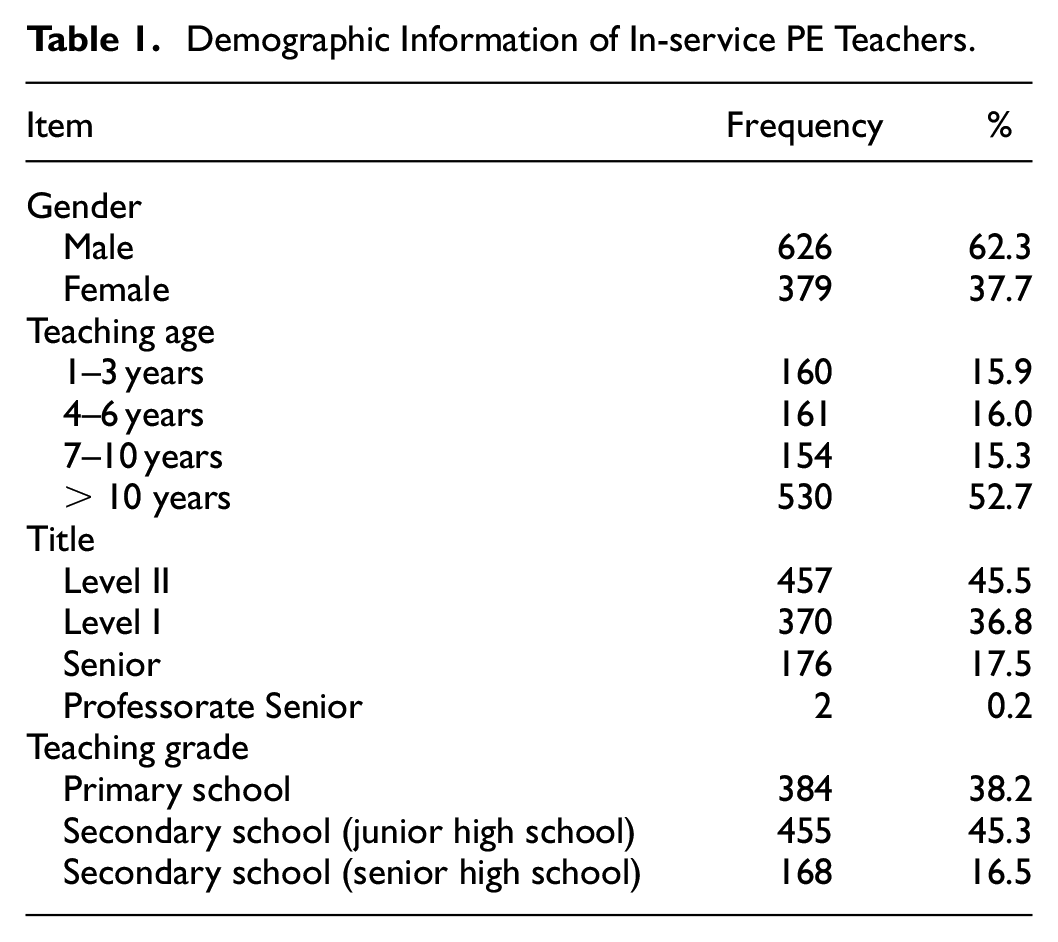

Demographic information of in-service PE teachers.
Physical Education Teaching Efficacy Scale (PETES) Score
In Table 2 and Figure 2, the overall mean score for all participants on the PETES scale on a 10-point Likert scale was 8.08 (SD = 1.27), indicating an overall high level of PE teaching efficacy. Of the seven subscales, the highest score was Efficacy about Instruction (M = 8.71, SD = 1.29). This was followed by Efficacy about Accommodating Skill Level Differences (M = 8.53, SD = 1.38), Efficacy for Using Assessment (M = 8.52, SD = 1.34) and Efficacy for Using Technology (M = 8.23, SD = 1.47). Meanwhile, the subscales with the three lowest scores were Efficacy about Applying Scientific Knowledge in Teaching PE (M = 8.16, SD = 1.46), Efficacy about Teaching Students with Special Needs (M = 7.61, SD = 1.77) and Efficacy about PE Content Knowledge (M = 6.94 SD = 1.77).
Overall and Subscales Means and Standard Deviations for PETES.


Overall and subscales means for PETES.
Educator Technology Self-Efficacy Survey (ETS-ES) Scores
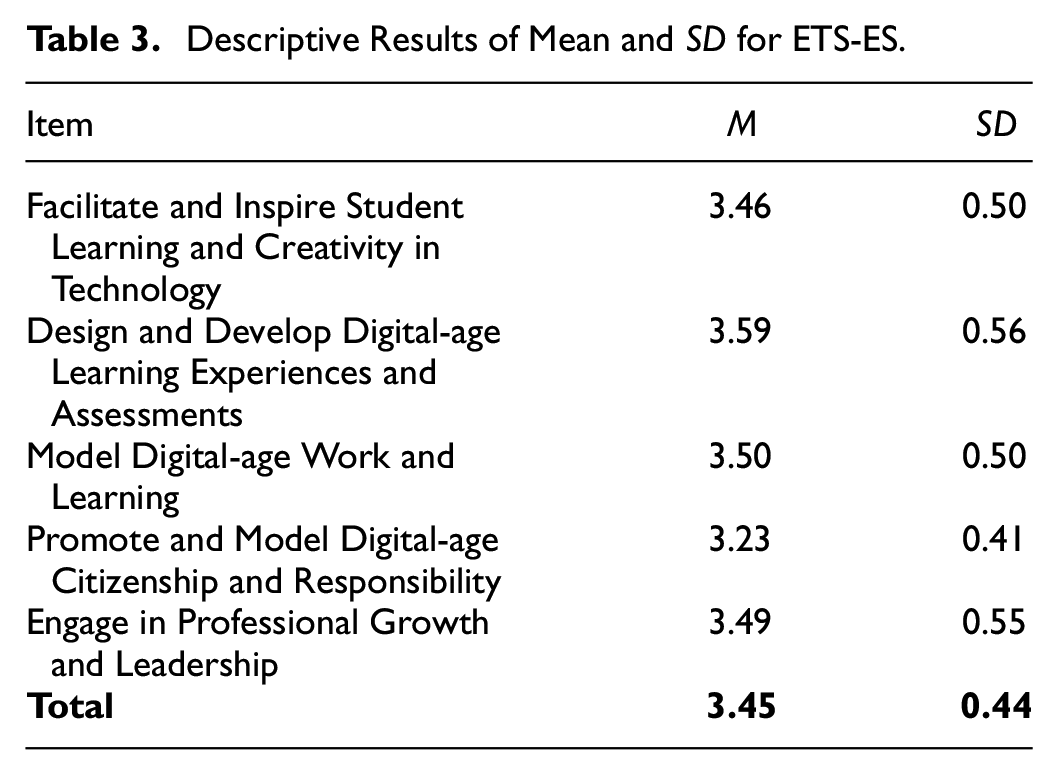
As shown in Table 3 and Figure 3, the overall mean score for all participants on the ETS-ES scale was 3.45 (5-point Likert scale; SD = 0.44), indicating an overall moderate level of technology self-efficacy. The highest score was for Design and Develop Digital-age Learning Experiences and Assessment (M = 3.59 SD = 0.56), this was followed by Model Digital-age Work and Learning (M = 3.50; SD = 0.50) and Engage in Professional Growth and Leadership (M = 3.49; SD = 0.55). Meanwhile the lowest scores were Facilitate and Inspire Student Learning and Creativity in Technology (M = 3.46; SD = 0.50) and Promote and Model Digital-age Citizenship and Responsibility (M = 3.23; SD = 0.41).
Descriptive Results of Mean and SD for ETS-ES.

Overall and subscales means for ETS-ES.
The Relationship Between Teaching Efficacy of PE Teachers and Their Technology Self-Efficacy
According to Table 4, multiple linear regression analysis was conducted using the subscales of teaching efficacy as independent variables and total technology self-efficacy as dependent variables. According to the results of multiple linear regression analysis, the regression equation was significant, F = 37.523 p < .001. One of the PE teaching efficacy subscales, Efficacy for Using Technology (β = .015, p < .001), significantly and positively predicted Technology Self-Efficacy, other six subscales of PE teaching efficacy did not predict Technology Self-Efficacy (p > .05). These variables together explained 20.3% of the variance in Technology Self-Efficacy.
Multiple Linear Regression Analysis of Teaching Efficacy Subscales and Overall Technology Self-efficacy.

Discussion
This study examined PE teachers’ teaching efficacy and self-efficacy in using educational technology to support teaching. Participants were investigated using the PETES (Humphries et al., 2012) and ETS-ES (Gentry et al., 2014) survey instruments. From the PETES, the results showed that overall, the PE teachers had a high level of teaching efficacy, similar to other studies conducted amongst pre-service teachers from 11 universities in Turkey (Erbaş, 2021), and from three universities in Taiwan and Hong Kong (Choi et al., 2021). Comparatively, this study involved in-service teachers who had been working for many years and had more practical teaching experience than pre-service teachers, whereby more than 84.1% of teachers of this study had more than 4 years teaching experience, Previously, it was reported that teachers with more teaching experience meant that teachers would have a higher self-efficacy in terms of teaching strategies and classroom management (Gale et al., 2021). Furthermore, it was suggested that teachers’ effectiveness rises sharply in the first few years of working and then continues to rise into the second or even third decade of teaching (Podolsky et al., 2019). With a large percentage of teachers of this study having more than 4 years teaching experience, it was not surprising that the teachers reported high levels of self-efficacy for teaching PE.
Of all the PETES subscales, Efficacy about Instruction and Efficacy about Accommodating Skill Level Differences had the highest scores. It appeared that Chinese PE teachers were confident of their abilities to control and manage the classroom. Additionally, they were able to critically evaluate the performance and techniques of the students, detect errors and provide feedback to aid error correction. This finding is similar to an Asian research (Choi et al., 2021) but different from studies in Europe and America (Erbas et al., 2014; Erbaş, 2021; Humphries et al., 2012; Ünlü & Erbas, 2019). It appeared that the order and sequence of which subscales were the highest were affected by regional and cultural differences, as reported in a study by Lee and Witruk (2016) who had reported that teachers’ teaching efficacy varied when comparing different countries and cultures. Because teachers in some parts of Asia are more influenced by Confucian culture, they can be more modest than European and American teachers, and modesty is closely associated with teacher self-efficacy (Vieluf et al., 2013). Another possible reason for this is the variation in teachers’ professional responsibility, as according to Ho and Hau (2004), the professional responsibility of teachers may differ depending on the context, thus influencing teacher efficacy. As for the lowest scores, the two subscales, Efficacy about PE Content Knowledge and Efficacy for Teaching Students with Special Needs, both scored below the overall mean. In this study, PE teacher’s Efficacy about PE Content Knowledge was the poorest among all subscales, and it is possible that the teachers had stopped receiving knowledge beyond their formal education and Ward et al. (2018) had suggested that specialized pedagogical knowledge could not be easily acquired through experience. If specialized knowledge could not be acquired through experience, then it is necessary for PE teachers to acquire new or updated content knowledge through further studies and training. As for Efficacy for Teaching Students with Special Needs, similar to this study, a survey of Indonesian teachers had also found that teachers’ lacked self-efficacy in this domain (Shoviana, 2019). This finding could be related to the teacher’s limited knowledge and training in adapted physical education, thus leading to their low level of self-efficacy with special needs students. Previously, other studies had reported that teachers lacked professional knowledge in dealing with special needs students (Kurniawati et al., 2014; Qi & Ching Ha, 2012). To address the lack of professional knowledge and skills among PE teachers in handling the special needs of students, it was recommended that the education sector organized training programs and learning opportunities in these two areas. This helped fill the gaps in teachers’ expertise.
As for the ETS-ES, the results of this study showed that overall, technology self-efficacy was at a moderate level, similar to the studies of in-service PE teachers in an American university (O’Neil & Krause, 2019) and a Chinese international primary school (Boland, 2019). This less than optimum finding may be related to lack of access to technology, administrative support and appropriate training provided to teachers. In particular, a study by Baek et al. (2018) highlighted that the barriers of PE teachers to use technology were divided into two types, external barriers such as lack of access to technology and budget and training, and internal barriers such as pedagogical beliefs and attitudes, and self-efficacy. However, there are still opportunities for improvements in technology self-efficacy as some researchers had concluded that teaching experience could increase teachers’ technology self-efficacy (Krause, 2017; Werner, 2020). To sum up, to enhance teachers’ proficiency in utilizing technology for instructional purposes, it was imperative not only to provide them with the necessary training but also to offer support, such as access to equipment and funding. This support served to incentivize teachers to incorporate technology into their teaching practices, thereby bolstering their technological pedagogical skills.
Further analysis of the ETS-ES scores revealed that the scores for the five subscales were relatively similar, with Design and Develop Digital-age Learning Experiences and Assessment scoring relatively higher than the other subscales. As the Covid-19 pandemic hit, teachers had some experience in digital teaching practices after 2 years of large-scale online teaching. Therefore, they were more effective in this area compared to the other subscales. Teaching of PE continued for all PE teachers, and they had to equip themselves with the knowledge to conduct online PE lessons, and design and develop the course content and assessments suitable and appropriate for online delivery. However, teachers may encounter difficulties when actually teaching PE, as mentioned in Cruickshank et al.’s (2021) study, in which different classes used different teaching platforms and teachers needed to learn to use multiple teaching platforms to communicate with students (e.g., Seesaw, Dojo, Microsoft Teams). In addition, teachers had to check hundreds of homework documents per day when assessing students, making the workload much heavier. Correspondingly, the subscale Promote and Model Digital-age Citizenship and Responsibility had the lowest scores. Although Chinese teachers’ experience with technology has been increasing in the last 2 years (Yünkül, 2022), but training have not kept up, especially with regards to the social issues and responsibilities that accompany online learning. Additionally, with virtual education in its infancy for many teachers, teachers also lack knowledge of the digital age from a legal and ethical perspective. It is recommended that teacher education institutions offer digital age knowledge courses to pre-service teachers, while for in-service teachers, education departments or schools should organize continuing education training for teachers to learn and understand the relevant knowledge.
From the results of the PETES and ETS-ES, the association between the sub-scales of teaching efficacy and overall technology self-efficacy, was also investigated. According to the multiple linear regression analysis, from the seven subscales of teaching efficacy, Efficacy for Using Technology significantly and positively predicted ETS-ES. Earlier studies had found a correlation between technology self-efficacy and using technology (Giles & Kent, 2016; Sadaf et al., 2012). When teachers had higher beliefs about the use of technology in teaching, their technology self-efficacy was higher, which in turn motivated them to be more willing to teach with technology. Subsequently, teaching becomes more successful and teaching efficacy may be improved.
This also showed the importance of using technology in teaching PE. When a teacher lacks belief in using technology to teach, he is likely to face more technical difficulties when conducting online instruction. Overall, a possible solution would be for teacher education and training institutions to improve their existing curriculum to include the learning of using technology in PE teaching. For in-service teachers, schools need to provide appropriate support to teachers and continue teacher education with more relevant training so that teachers would feel competent to teach with technology. The support could be in the form of providing of a teaching platform suitable for PE lessons equipping teachers with the latest electronic equipment, or handing out financial rewards to excellent teachers.
There are a number of limitations to this study. Firstly, it is regarding the use of a cross-sectional survey involving teacher self-evaluations which may not provide a comprehensive overview of the PE teachers’ situation. Future research should conduct interview-based studies on PE teachers to further understand the dilemmas they encounter when teaching online as well as some successful experiences so as to solve the problems in a more targeted approach, in addition to summarizing and spreading those successful experiences to help teachers improve their online teaching skills. Secondly, a limitation on the theoretical aspect is that it is impossible to directly measure the efficacy of PE teachers’ online teaching. Lastly, it’s worth noting that this study employed a convenience sample and gathered data from 11 different districts, which implies certain limitations when it comes to making generalizations about the entire country. Meanwhile, a limitation on the practical aspect is that the uneven economic development in different regions of China could lead to differences in the teaching situation in different regions. To get more comprehensive information, future research should involve data collection from teachers in each region, but this would need the collaboration of multiple researchers as it would be a difficult task for an individual researcher. Given the current inadequacies in the technological proficiency of PE teachers, future research could conduct intervention experiments aimed at designing course materials or training content that effectively enhance the technological self-efficacy of these educators. For instance, this could be guided by several teacher motivational behaviors outlined by Ahmadi et al. (2023), which align with the principles of self-determination theory. Furthermore, in the future, it may be beneficial to create a technology efficacy scale tailored specifically for PE teachers. This scale would be designed to assess their self-efficacy in utilizing modern technology for PE instruction.
Conclusions
The results of this study indicated that in-service PE teachers’ PE teaching efficacy was at a high level, while technology self-efficacy was at a moderate level, Efficacy for using technology significantly and positively predicted Technology self-efficacy. At present, PE teachers in China are basically capable of teaching PE via online mode, although they may face some difficulties in the teaching process.
Footnotes
Acknowledgements
We thank all the school teachers who participated in this study.
Declaration of Conflicting Interests
The author(s) declared no potential conflicts of interest with respect to the research, authorship, and/or publication of this article.
Funding
The author(s) received no financial support for the research, authorship, and/or publication of this article.
Ethics Statement
This study was approved by the Universiti Malaya Research Ethics Committee (UM.TNC2/UMREC_1681).

Data Availability Statement
All data can be requested and accessed from the corresponding author.