



Abstract
While much attention has been focused—in the field of teacher expertise—on expert teachers’ cognitive and behavioral characteristics, little attention has been devoted to how expert teachers reciprocally interact with the learning process. To bridge this gap in knowledge, this study seeks to explore primary-school EFL (English as a Foreign Language)—teacher expertise in the area of scaffolding. A comparison has been made among 2 expert EFL teachers, 20 experienced non-expert teachers, and 2 novice teachers in Chinese primary-school settings. By adopting a qualitative method of inquiry using interviews, classroom observations, and stimulated recalls, (yet with a quantitative aspect incorporating data analysis), the study demonstrates that expert teachers show a tendency to use scaffolding strategies more frequently and appropriately. These findings suggest that more open-ended activities be conducted to allow for scaffolding in EFL classrooms and that ESL/EFL teacher education raise scaffolding awareness in pre-service and in-service teachers.
Introduction
Teacher expertise refers to expert teachers’ cognitive and behavioral characteristics, including features of pedagogical reasoning, knowledge structures, beliefs, and teaching performance, etc. Studies of teacher expertise have followed a long tradition of exploring expert teachers’ cognition and knowledge base via observation of their lab-based (Carter et al., 1988; McIntyre et al., 2019; Sun et al., 2020) or classroom-based performance (Borko & Livingston, 1989; Westerman, 1991; Yang, 2014). The studies mostly investigate teacher expertise from a teaching perspective only, and seldom from its reciprocal interaction with learning, which can be achieved via interactional scaffolding during teacher-student interactions (Hammond & Gibbons, 2005). This study attempts to bridge this gap via a comparative study of the scaffolding differences among expert teachers, experienced non-expert teachers, and novice teachers in Chinese primary schools.
This kind of study is of significance as English as a foreign language (EFL) is an important part of the curricula for primary and secondary schools in China. English is usually taught in large classes of more than 30 students, making whole-class EFL teaching the norm in China. Large class teaching poses challenges for teachers in terms of the classroom management of teaching and learning. This is due to the fact that younger learners are in urgent need of teacher-directed scaffolding (Cameron, 2001), especially that of the contingent type occurring in teacher-student interaction. Younger EFL learners’ spontaneous interactional ability is not well developed for peer interaction (Butler & Zeng, 2013) and there has been little attention paid to this issue in China. Therefore, exploring expert EFL teachers’ use of scaffolding makes sense in that it elucidates foreign language teacher education and classroom teaching practices.
Informed by sociocultural theory, and using data from interviews, classroom observations, and stimulated recalls, this study explores primary school EFL teachers’ scaffolding expertise by comparing scaffolding performances among 2 expert teachers, 20 experienced non-expert teachers, and 2 novice teachers in Shanghai, China. It has sought to elicit the answers to such questions as how expert EFL teachers differ from non-expert EFL teachers in scaffolding whole-class teaching during teacher-student(s) interactions. These findings increase our understanding of teacher expertise by examining the link between teaching and learning and by generating useful implications on how to perform effective scaffolding in similar contexts.
Literature Review
Teacher Expertise
Studies on expert teaching in the past few decades have focused on the investigation of expert-teacher cognition by depicting behaviors in decision-making processes (Carter et al., 1988; Richards, 2000; Westerman, 1991; Wolff et al., 2017).
This research has been conducted via three types of contexts: (1) the laboratory-based focus-tasked inquiries with expert teachers and novice teachers making interpretations of classroom events based on given vignettes related to classroom teaching (Berliner, 1986; Sabers et al., 1991) or via the respective operation of given tasks (Sun et al., 2020); (2) the ethnographical exploration of authentic classroom teaching in naturalistic contexts (Tsui, 2009; Yang, 2014); and (3) authentic-classroom studies with focus tasks (Li & Zou, 2017; Wolff et al., 2014) or authentic-classroom studies using devices like eye-tracking equipment (McIntyre et al., 2019). The three types of contexts differentiate the studies in terms of the degree of comparability of the expert and non-expert teachers’ performances and the degree of authenticity in teaching.
This research demonstrates that expert teachers have a sounder knowledge base (Eaude, 2014; Li et al., 2011), the structure of which is more elaborated, complex, interconnected, and easily accessible (Borko & Livingston, 1989; Wolff et al., 2021). These cognitive features distinguish expert teachers from non-expert teachers, the former outperforming the latter with more fluent, accurate, flexible, and efficient pedagogical reasoning (Shulman, 1987) in decision-making processes (Berliner, 1986; Leinhardt & Greeno, 1986; Westerman, 1991). Examples of these include expert teachers’ more efficient and effective lesson planning at the pre-active stage (Borko & Livingston, 1989; Westerman, 1991), more effective identification and interpretation of significant classroom events (Carter et al., 1988; Sabers et al., 1991), and more skillful classroom management (McIntyre & Foulsham, 2018; Wolff et al., 2017).
There is a plethora of research on expert-teacher cognition and classroom behavior with a limited number of studies exploring expert teacher’s scaffolding skills that are reciprocal to learning in interaction. Chen and Rovegno (2000) found expert teachers in elementary physical education more skillful at engaging students in self-regulated construction of knowledge and extending their learning processes further beyond via exploratory activities. Furthermore, they were more skilled at bridging learners’ prior knowledge and experiences with new material via the integration of various teaching techniques (e.g., metaphors, examples, images, and by asking questions about the learners’ personal experiences when introducing new content). Traianou’s (2006) single-case study demonstrated that expert teachers tended to scaffold their teaching to expand younger learners’ present understandings of scientific concepts by thoughtfully creating opportunities for students to reveal and share ideas, and problematize their existing understandings through dialog. Tytler and Aranda (2015) identified three dialogic functions of expert primary science teachers’ interactive talk, that is, (1) “to elicit and acknowledge student responses, (2) to clarify, and (3) to extend student ideas” (p. 425), all of which are likely to promote the development of knowledge via teacher-learner interaction.
In the field of teaching EFL/ESL, research on teacher expertise has also examined the different types of teacher knowledge and the interactions among these (Farrell, 2013; Yazdanmehr et al., 2016), for example, the performance features of expert decision-making (Blinded, 2017; Richards, 2000). However, only a few studies have examined the interactional processes in expert EFL teachers’ classrooms, for example, by focusing on how expert teachers integrate classroom-management objectives through interaction (Tsui, 2003, 2009); by inviting more learner communication via the asking of more referential and confirmation-check questions (Hyunhee, 2017); and via the making of repairs, and the checking of understanding via the application of the learners’ L1 (Tuma, 2017).
Most of these studies describe a more teacher-oriented position on effective teaching by clarifying expert teachers’ thought processes and explicating their extraordinary classroom management practices. However, there is little research regarding how expert teachers’ thought processes and behaviors are effective via their interaction with learners during the learning process. A major component of effective teaching defined here is the actualization of learning in the Zone of Proximal Development (ZPD), proposed by sociocultural theory, via a teacher’s assistance (Tharp & Gallimore, 1988; Vygotsky, 1978), coupled with the concept of scaffolding (Cazden, 1979). Studies so far (except for several studies conducted in non-EFL classrooms [Chen & Rovegno, 2000; Traianou, 2006; Tytler & Aranda, 2015]) reveal little about how expert EFL teachers assist or scaffold for learner self-regulation (Vygotsky, 1978) of new knowledge in the classroom. In the field of EFL teaching, where interaction and scaffolding play an extremely important role, to our knowledge, there has been no study to date examining expert teaching from this perspective.
Sociocultural Theory, Effective Education, and Scaffolding
Sociocultural theory has laid profound foundations for our understanding of effective education. The most fundamental idea in sociocultural theory is that the development of the human mind is mediated (Vygotsky, 1978, 1981a, 1981b). The mediation can be achieved by physical tools like a spade or psychological tools such as language, diagrams, maps, etc. (Vygotsky, 1981c). Both tools are understood as auxiliary devices incorporated into an activity transforming the physical world and the mental world of a society, but the development of the human mind is mainly mediated by the mastery of the psychological tools.
The sociocultural theory maintains that the development of human mind is the transformation of innate capacities by integrating them with socioculturally constructed mediational tools (Vygotsky, 1981b) and internalizing the external psychological tools in mediated activities (Vygotsky, 1978). The development first occurs “between people as an interpsychological category, and then within the child as an intrapsychological category” (Vygotsky, 1981b, p. 163). In other words, the higher psychological functions of humans form through a process transiting from the external interpersonal social process to the internal intrapersonal process, that is, internalization (Vygotsky, 1978). In this process learners experience shifts of from object-regulation,other-regulation to self-regulation (Vygotsky, 1981a).
Vygotsky (1978) took an analytical perspective toward child mental development and made a distinction between the actual developmental level and the Zone of Proximal Development (ZPD), and he claimed that effective education focuses on the learner’s ZPD, that is, “the distance between the actual developmental level as determined by independent problem solving and the level of potential development as determined through problem-solving under adult guidance or in collaboration with more capable peers” (p. 86). It follows that effective teaching involves pinpointing a child’s level of cognitive development, targeting the next step in that cognitive development within the potential ZPD, and then offering assistance to help the child activate development within that ZPD.
Scaffolding is a related pedagogical notion clarifying the manner in which an expert’s assistance or intervention is finely tuned to the child’s ongoing learning progress (Wood et al., 1976). First introduced by Wood et al. (1976) and widely applied in the field of education, it refers to “all teacher support” (Verenikina, 2004, p. 5) including participating structures, selection and sequencing of activities, semiotic systems and mediational texts (Hammond & Gibbons, 2005), classroom activities (Gibbons, 2015; van Lier, 1996), direct instruction (Verenikina, 2004), etc., which, in most cases, represent “designed-in” (Hammond & Gibbons, 2005, p. 12) or non-contingent teaching (Volman & Beishuizen, 2011). Researchers (Cazden, 1979; Maybin et al., 1992; Verenikina, 2004; Volman & Beishuizen, 2011) stress the importance of offering effective scaffolding via the use of language during contingent and collaborative teacher-student interactions (Ellis & Barkhuizen, 2012; Lantolf & Poehner, 2014; Storch, 2002; Swain, 2000; Walqui, 2006; Wood et al., 1976) so as to constantly diagnose, build, and actualize learning within learner’s ZPD.
Scaffolding via collaborative and interactional language has been termed “interactional scaffolding” (Hammond & Gibbons, 2005, p. 20). Effective scaffolding from this perspective is largely determined by the quality of teacher language (Maybin et al., 1992) during feedback (Aljaafreh & Lantolf, 1994) and is distinguished by several core features.
One of the most important features is contingency (Aljaafreh & Lantolf, 1994; Poehner & Lantolf, 2005; Smit et al., 2013; Wood et al., 1978), which means on-going adjustment of expert help offered based on the success or failure of a task. Specifically, if a child succeeds, less help is offered in the next step, but if the child fails, then more control is exercised in the following task—and assistance is provided only when the children need it. The contingency principle is thought to be essential in actualizing independence of learners when working within their ZPD because it is the continual adjustment of scaffolding in quantity and quality that makes the assistance sensitive to learning within the ZPD and thus establishing the opportunity for internalization.
Aljaafreh and Lantolf (1994) have emphasized that graduation and contingency work together to guarantee that assistance from the tutor is provided only within the learner’s ZPD. They introduced a regulatory scale describing tutor intervention with 12 levels of explicitness. The regulatory scale illustrated the graduation principle where teacher assistance and feedback as other-regulation always start with less explicit strategic intervention to judge a learner’s position within the ZPD and gradually shift to more explicit strategies to increase support only when it is needed. The principle suggests that the degree of explicitness of assistance is an important aspect to consider when offering scaffolding in that it not only indicates the strength of external assistance given to the learner but also the learner’s position within ZPD (Tharp & Gallimore, 1988). For example, where implicit scaffolding works, the learner probably has a high degree of regulation in his ZPD and vice versa. It can be concluded that when offering less explicit scaffolding, space for learner regulation within their ZPD is permitted, and this helps determine when and how to offer assistance, and when to withdraw it. That is to say, the shift between implicit and explicit scaffolding indicates dynamic change of learner’s regulation within the ZPD, and facilitates contingency and the handover principle.
Handover of responsibility (Bruner, 1983; Smit et al., 2013; van de Pol et al., 2010) is another essential feature of effective scaffolding—closely related with gradual withdrawal of expert assistance. van de Pol et al. (2010) theorized that scaffolding works with contingency, fading support, and the transferring of responsibility to the learners. They claim that contingency allows teachers opportunities to apply diagnosis and scaffolding strategies, but the internalization occurs only with fading support from the teacher and handover of responsibility to the learners.
The continual implementation of the principles of contingency, graduation, and handover of responsibility constitutes a process of dynamic assessment and construction of learning within the ZPD (Poehner & Lantolf, 2005) that leads to microgenetic development in children.
The Current Study
Drawing on sociocultural theory (Vygotsky, 1978) and scaffolding, the current study has focused on the scaffolding activities of expert EFL teachers in Chinese primary schools via the relative approach (Chi, 2011), which focuses on characterizing expertise by looking into the ways how an expert excels a non-expert through comparison. Specifically, the research has explored EFL teacher expertise in scaffolding by comparing expert, experienced non-expert and novice teachers’ classroom performances. As such, our research questions have been formulated as follows: What are the characteristics of expert primary EFL teachers’ expertise in terms of scaffolding? How do they differ from the non-expert teachers?
Methodology
A qualitative research design was used to collect data via interviews, classroom observations, and stimulated recalls, with a quantitative aspect incorporated in the data analysis given that it is an important component of comparative study (Johnson, 2003).
Research Design
A qualitative approach using a multiple-case design (Yin, 2014) was adopted to discover how expert primary school EFL teachers scaffolded learning in the classroom in comparison with the non-expert teachers. The qualitative approach is “interpretative, experiential, situational, and personalistic” (Stake, 2010, p. 14) in nature, and aims to provide a holistic and interpretative understanding of human affairs and social phenomena in particular contexts by observing, interviewing, and collecting materials. It fits nicely with a highly situated study into teacher expertise (Eaude, 2014; Elliott, 2009) and is sensitive to contexts where teachers work with students, as it calls for close observations of how teachers think about and conduct teaching in authentic classrooms.
A multiple-case design was adopted to avoid shortcomings of single-case designs (Yin, 2014) and cases were selected based on purposeful and convenient samplings: The former being applied to identify expert teachers and experienced non-expert teachers and the latter due to access to participants via relationships between the researchers and local schools.
The delineation of expert teachers versus experienced non-expert teachers was made via a double-screening procedure of recommendation plus expert classroom observation. The addition of expert classroom observation was carried out because none of these widely used external criteria, such as experience, social recognition, professional and social group membership (Palmer et al., 2005), and nomination/recommendation (Carter et al., 1988; Li & Zou, 2017; Tytler & Aranda, 2015) could alone provide us with the perfect distinction between expert teachers and experienced non-expert teachers using indirect judgment alone. Johnson (2003) has stated that, given the unavoidable usage of external or social criteria, “performance-related measures” (p. 17) should be seriously applied.
There were two stages of this double-screening procedure. At the beginning of the study, we contacted three district coordinators and three principals in Shanghai, with whom we had previously established a relationship. We acquainted them with the purposes of the research and asked them to recommend two types of teachers working in their schools: (1) experienced EFL teachers who they believed to be excellent and had worked more than 3 years as an English teacher; and (2) expert EFL teachers who had taught English for at least 10 years, the most commonly applied external criterion (Palmer et al., 2005), and held leadership positions of the English sections in their own schools, and/or other schools. As requested, they recommended 22 teachers, among whom they nominated five as experts. To ascertain that the nominated expert teachers did in fact conduct expert performance in the classroom, we invited an expert EFL teacher educator and an advanced district coordinator to observe a lesson of each of the five teachers. The expert EFL teacher educator was a professor who had been engaged in EFL teaching and research, and pre- and in-service EFL teacher education for over 30 years. He is regarded as an expert in his field and enjoys a wide social reputation as such. As a result, three of the recommended expert teachers were excluded, and only two were recognized as experts by the expert-teacher educator. The judgment was made based on three general criteria: (1) teachers are able to effectively involve the class and motivate them into learning; (2) learners are performing their best with demanding tasks; and (3) the activities chosen by the teacher are meaningful and beneficial for long-term student development.
Later, through communication with these teachers, we recruited two novice teachers. Hence, we finally had 24 participants, which included 2 experts, 20 experienced non-experts, and 2 novice teachers.
The Participants
The 24 EFL teachers involved in the research were from 11 primary schools (see school No. 1-11 in Table 1) in different districts of Shanghai, one of the most developed cities in China.
The Demographic Information of the Participants.
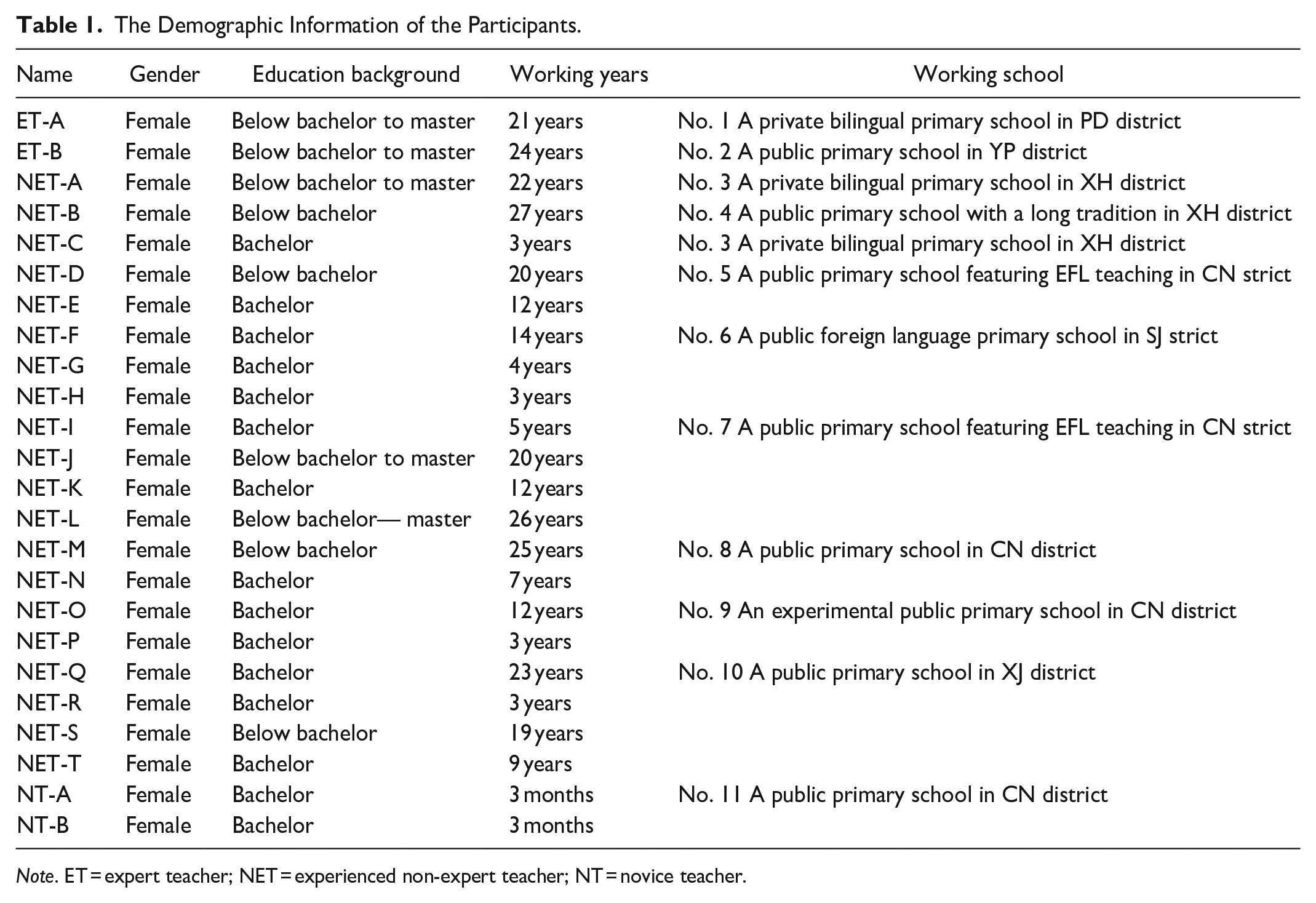
Note. ET = expert teacher; NET = experienced non-expert teacher; NT = novice teacher.
As displayed in Table 1, the two expert teachers had been working in the field of EFL teaching in primary schools for 21 and 24 years respectively; they took academic leadership positions in the English section in their own schools; and enjoyed an extensive reputation as the most competent and popular teachers among their colleagues, students, and the students’ parents. They nicely met the criteria set by Palmer et al. (2005) in terms of experience, social recognition, and professional and social group membership. The 20 experienced non-expert EFL teachers had working-experience as EFL primary school teachers for between 3 and 27 years. They were backbone teachers and some were also leaders responsible for their English sections in their own schools. The two novice teachers had just graduated from university and had worked as EFL teachers in the same primary school for only 3 months when they took part in the research.
Data Collection
The data of each participant was collected via a procedure of interview, classroom observations, and stimulated recalls. The classroom observations were the major sources of data used to examine the participants’ performances of scaffolding. Furthermore, since a teacher’s performance is always regulated by their beliefs and knowledge about teaching (Borg, 2003), we conducted interviews and stimulated recalls to gain more in-depth understanding and interpretation of the observed performance.
Interviews
We conducted interviews as the first step gaining an initial understanding of the participants’ educational backgrounds, working experience, beliefs about teaching, and understandings of EFL teaching and learning. The interview questions were sent to participants 2 days before the interviews and the interviews were recorded with the consent of the interviewees. The time of the interviews varied from about one-half to 1 hour.
Classroom observations
We observed two classes of each participant. One was a regular class, and the other with the usage of prescribed material (focus task). All the classes were videotaped by the researchers, who were allowed to work at the back of the classrooms with the consent of the participants.
The prescribed material (Houses in the World) (see Appendix) used in the focus-tasked classroom observations were purposefully designed to make the teaching performances of the three groups of participants easy to compare. Before using the material, it was assessed by local teachers confirming that the material was original and the content suitable for students of grades three to five. Each participant received the prescribed material and prepared a lesson based on it within 2 days.
Stimulated recalls
After each class, stimulated recalls were conducted for confirmation purposes regarding the teachers’ performances and having to do with the teachers’ evaluation of the class and parts of which the researchers felt confused.
The process of data collection lasted for half a year, during which it finally gelled into a rich pool of data with 48 classroom observations (24 regular ones and 24 task-focused ones), and more than 1,300 minutes of audio recordings from the interviews and stimulated recalls. The focus-tasked classroom observations were the major resource for analysis with the regular ones being used for triangulation. Others were further used to explain teaching performance.
Data Analysis
The data was initially reviewed by the first researcher. The classroom videos were watched repeatedly for identification of instances of scaffolding during teacher-student interactions. Since scaffolding occurs in “real interactions” (Bliss et al., 1996, p. 45), the identification involved first distinguishing classroom activities involving authentic communicative interactions (van Lier, 1996) from the large quantity of “pseudo-interactions” (Bliss et al., 1996, p. 45) occurring in text-based reading and reciting activities, text-focused lectures, and mechanical teacher-student drills for language practice and involving no real communication (Hammond & Gibbons, 2005). Then, these episodes were clipped, edited, and transcribed into texts. Finally, the scaffolding episodes were classified based on two features of whole-class scaffolding: diagnosis, and responsiveness (Smit et al., 2013)—in that there had to have been a signal in the episode with students showing difficulty in comprehending content or in communicatively using language, with the teacher offering assistance in some way.
The data analysis was “grounded” at first in order to find scaffolding features unique to the present research and to avoid preconception; we compared the scaffolding strategies to those in previous studies and borrowed a priori codes via the work of Ohta (2001) and Hammond and Gibbons (2005) when coding. Finally, seven interactional scaffolding strategies were defined and coded based on the data (see Table 2).
Interactional Scaffolding Strategies and Their Descriptions.

The seven interactional scaffolding strategies were classified into three general types, that is, implicit scaffolding, implicit and explicit scaffolding, and explicit scaffolding—based on their degrees of explicitness: that is, the quantity of information provided by the teachers to assist learners during interactions (Ellis & Barkhuizen, 2012; Ohta, 2001).
Finally, the codes of different scaffolding strategies observed were counted, registered, and added for a quantitative analysis (Johnson, 2003). Furthermore, episodes of classroom scaffolding were analyzed to discover patterns of scaffolding discourse.
Validity, Reliability and Ethical Issues
As validity and reliability are decisive in determining the credibility of an inquiry (Nunan & Bailey, 2009), we employed multiple strategies to ensure quality.
The validity was ensured through a double-screening procedure of recommendation plus expert observation of performance in the selection of expert teachers. In doing so, we further ascertained the expertise of the expert teachers than via the sole usage of an external criterion of, for example, working experience, social recognition, etc. Furthermore, we employed a focus task in a naturalistic teaching context to more easily compare the performance of the three types of teachers.
To guarantee reliability, we adopted multiple triangulation techniques. The reliability of data analysis was examined through intra-rater reliability and inter-rater reliability. For the intra-rater reliability, the first researcher coded the data twice at an interval of approximately 1 month, leading to a high consistency of results. The inter-rater reliability was established by inviting another peer researcher to code scaffolding strategies. The first researcher randomly selected 30 video clips of classroom interactions, which included six from the expert teachers and 24 from the non-expert teachers, so that the peer researcher could identify the episodes of real communication and those including scaffolding. There was complete congruence of results. Then the peer researcher was asked to code 60% of the episodes of scaffolding, and the independent coding resulted in an 88.25% congruence between the codes by the two raters. The final incongruence was resolved via negotiation.
Ethical issues were seriously addressed. All participants were properly compensated for their time and informed of the research purpose and procedures. The researchers obtained proper consent from all of them before entering their classrooms to observe and videotape their lessons. To protect the participants’ privacy, all the participants and their institutes remained anonymous, and any of the information about their identities, schools, and teaching has been used solely for research purposes.
Results
Data analysis of the observations in the focus-tasked classroom revealed three characteristics differentiating expert EFL teachers from non-expert teachers in using scaffolding strategies: (1) higher frequency of both total scaffolding and implicit strategies; (2) more balanced use of different types of scaffolding strategies, and (3) a scaffolding pattern with more contingency.
Difference in the Frequency of Scaffolding Strategies
Identified scaffolding strategies from the three groups of EFL teachers are displayed in this section in terms of total frequency, the frequency of the three types of scaffolding strategies, and that of the specific strategies used by the participants.
Figure 1 shows the total frequency of scaffolding strategies identified in the three groups of teachers. It identifies two general differences. First, of the 24 participants, only 16 applied scaffolding, including the two expert teachers (ETS), 12 experienced non-expert teachers (NETS) and the 2 novice teachers (NTS), while the other 8 NETS’ classrooms were devoid of it. Secondly, there was a greater difference between the frequency in the total number of scaffolding strategies employed by the ETS and the NETS, but less difference between those of the ETS and the NTS, and NT-B in particular. The ETS applied 38 and 31 scaffolding strategies respectively, while the total frequency of strategies by the NETS varied from 0 to 17, and the NTS employed 8 and 26, respectively. The highest frequency of NT-B approximates that of the ETS (26 vs. 31 and 38), and there was greater difference between the highest of the NETS and those of the ETS (17 vs. 31 and 38).

The comparison of the total number of scaffolding strategies.
As shown in Table 3, the distribution of the three types of scaffolding strategies by the 16 teachers, who applied scaffolding, demonstrates more features differentiating the three groups.
Frequency of the Three Types of Scaffolding Strategies.

Note. Different groups of teachers are marked by different color shades.
Each group demonstrated uniqueness in applying scaffolding strategies. The expert teachers (ETS) most frequently used implicit strategies and explicit strategies. Specifically, expert teacher ET-A used 18 explicit scaffolding strategies and ET-B applied 16 implicit scaffolding strategies. However, the highest frequency of scaffolding strategies used by the experienced non-experts (NETS) were the most explicit. Differing from them, the novice teachers (NTS) shared a feature with the experts, with novice teacher NT-A using the most explicit strategies and novice teacher NT-B the most implicit strategies.
Given the similarities, the total number of the occurrences of scaffolding strategies of type 1 and type 2 in the last column shows that, compared with all experienced non-expert teachers (NETS) and novice teachers (NTS), expert teachers (ETS) generally used much more scaffolding strategies with less explicitness than the non-expert ones (with the exception of the novice teacher NT-B).
Difference in the use of Specific Scaffolding Strategies
The frequencies of the specific scaffolding strategies used by the 16 teachers indicate some further differences regarding aspects appearing to be similar among the three groups of teachers.
Table 4 displays frequencies of specific strategies employed by the three groups and shows the differences among them. Firstly, the expert teachers ET-A and ET-B used all seven categories of scaffolding strategies, while the non-expert teachers used only two to five. The numbers of specific strategies show more variance in aspects that are indistinguishable in terms of explicitness shown in Table 3. For example, the table shows that when using implicit strategies, the expert teachers applied both elicitation and prompting, but the novice teacher NT-B applied only elicitation, which accounts for the approximate frequency of the implicit strategies between the expert teachers and the novice teacher NT-B. Furthermore, the explicit strategy of recasting by the expert teachers (ETS) dominated the other two strategies, that is, direct repair and instruction, with the opposite occurring with the experienced non-expert teachers (NETS)—a significant difference regarding how expert teachers differ from non-expert teachers in addressing errors with regards to meaning and form. The application of recasting takes place in situations focusing on the combination of form and meaning together, while the deployment of direct repair and instruction focuses mainly on form by reducing attention to meaning to a minimum.
Frequency of Specific Scaffolding Strategies in 16 Teachers’ Classrooms.

Note. Different groups of teachers are marked by different color shades.
Difference in the Patterns of Scaffolding
A discourse analysis of scaffolding processes resulted in the delineation of three patterns of discourse structures: Structures A, B, and C (see Table 5). The structures were not necessarily used by only one group of teachers; however, preferences were shown by different groups toward one or more of them. Specifically, Structure A was the ETS’ major preference of scaffolding; Structure B, the NETS’; and Structure C, the NTS’.
The Discourse Structures of Scaffolding.

ETS use mostly Structure A but a few Structure B
In most cases, the expert teachers showed a tendency to scaffold students’ language output by administering implicit scaffolding first and then gradually increasing the explicitness once diagnosing a need for assistance. Either an implicit strategy was solely used to assist with the problem or was combined with a more explicit one (see Episode 1).
128. S19: They are built of. . .woods. These houses are home for the farmers and their animals. 129. T: Actually they are not built of woods. What, do you know, means woods? 130. Ss: . . . 131. T: Woods means forest. Understand? So we just say. . .? 132. Ss: Wood
Episode 1 represents an interactional process between ET-B and students in describing a picture. The student, S19, misused “woods” in turn 128. Noticing the mistake, the teacher explicitly pointed out that “they are not built of woods” (turn 129), but without making a direct correction. Instead, she integrated the mistakenly used word into her discourse and asked the students about the meaning of “woods” (turn 129). In this way, the teacher attempted to offer some linguistic cues in pointing out the problem, thus allowing the students to work out the meaning of the word (turn 129) by means of questioning, which is actually an impromptu assessment of the students’ current knowledge about “wood” and “woods” as well as scaffolding for the learning of the word “wood.” The result of the assessment demonstrated students were ignorant of the meaning of “woods,” indicated by silence in turn 130. The silence—indicating students needed further assistance — brought about the explicit instruction of the word, “woods,” via defining the word as “forest” in turn 130. However, the teacher’s verbal paraphrasing of the misused word by S19 was only treated as a linguistic cue to elicit the correct form of “wood.” It was at that moment that the teacher asked another question to invite the students’ efforts to utter the word by themselves, which students were able to do, demonstrating an actualization within the ZPD with regards to the knowledge of the word “wood” based on actual interactional performance.
Observation revealed that it was the individual student, S19, that initiated the teacher’s scaffolding, which was then targeted toward the collective ZPD. Elicitation—one of the most powerful scaffolding strategies (Tharp & Gallimore, 1988)—was promoted via questioning.
Prompting can initiate a scaffolding process leading to students’ independent corrections and/or self-regulation of the targeted language items, and/or in the teacher’s provision of further scaffolding. The following is one of the examples.
222. T: What do you call the::se houses? 223. Ss: Farm/farms. 224. T: Farm? 225. Ss: Farmhouse. 226. T: Yes, farmhouses.
In Episode 2, the expert teacher ET-A was trying to elicit the name of the farmers’ houses in the picture in turn 222, leading to the students’ shouting out “farm/farms” in turn 223. The teacher then questioned the students’ quick answers by repeating the answer in a rising tone, indicating a problem. The prompting led to students’ reflection-in-action and utterance of “farmhouse” in its singular form in turn 225. The teacher acknowledged it and recast it in the plural, which was compatible with the initial question in turn 222 and the picture’s content.
The conversation represents scaffolded feedback—encompassing diagnosis and scaffolding. The initial question functioned to diagnose whether the students had “farmhouse” in their lexicon. The students’ answers indicated that they might not, yet the teacher did not hurry to offer the answer. Instead, she questioned what they said in turn 224 to attempt further diagnosis via confirmation, also constituting teacher support, indicating another option and that something was missing in the present contribution. This led to the utterance of “farmhouse” in its singular form (turn 225), which was not completely accurate, allowing the teacher to recast the correct form as a second scaffolding act. The corrected form of the language provided worked as a model (Tharp & Gallimore, 1988), that is, “offering behavior for imitation,” constituting “the fundamental tendency” (p. 47) to initiate a new development. It took place as the teacher attended to students’ previous discourse, that is, in an interpersonal process, which was essential to realize “the internalization of the strategy of adducing evidence” (Tharp & Gallimore, 1988, p. 51).
The expert teachers provided scaffolding efficiently by recasting and direct repair.
3. T: Who is the bigger one? 4. S1: Bird mother 5. T: Yes, it’s mother bird. How about the smaller one? 6. Ss: Little bird. 7. T: Yes, it is a baby bird. They are talking now. What are they talking about? Guess?
As is shown in Episode 3, recasting occurred when the teacher was rephrasing S1′s contribution of “bird mother” with “mother bird” and other students’ “little bird” with “baby bird,” incorporating corrections naturally as a model of more idiomatic English.
Structure A, as the most frequently observed pattern in expert teachers’ classroom, complies with graduation (Aljaafreh & Lantolf, 1994) and contingency principles (van de Pol et al., 2010). It suggests that expert teachers have an awareness to create space for learners to speak for themselves (van Lier, 1996; Walqui, 2006) so as to demonstrate their self-regulation, and they come to help only when there is a signal suggesting learners need other-regulation (Ellis & Barkhuizen, 2012). With the constant use of Structure A, expert teachers are likely to make teaching an interactive process reciprocal to learning involving the dynamic assessment of learner ZPD (Poehner, 2009), where the contingent offer of scaffolding and a timely handover of regulation are likely to happen.
NETS mostly use Structure B and least use Structure A
The 12 NETS performing scaffolding least applied Structure A, and mostly Structure B, where the teachers tended to offer the most explicit scaffolding immediately after identifying a need for help—achieved by performing large numbers of direct repairs and giving of instructions. Below is an example from NET-C.
90. S7: They bui::ld. . . 91. T: Build. 92. S7: They build the house on the tree. 93. T: Houses. 94. S7: Houses on the tree because. . .other animal. . . 95. T: Other animals. 96. S7: Other animals can’t climb trees easily. 97. T: Oh. 98. S7: And they can’t climb the trees and ate them. 99. T: Eat them. 100. S7: Eat them.
In Episode 4, a student was talking about the houses built in a tree and the reasons why these houses were built there. The student’s presentation involved only one sentence, but the teacher made one explicit instruction (turn 91) and three direct repairs (turn 93, 95, and 99). The conversation shows the student was engaged in communication, but the teacher was too focused on the student’s language, with frequent corrections becoming highly interruptive. The student simply imitated of the models (Tharp & Gallimore, 1988), at a foundation level in the ZPD (Vygotsky, 1978). With NET-C frequently using direct repair, one of the most explicit scaffolding strategies, she promoted efficiency of feedback, but lost opportunities to assess whether S7 had gained self-regulation of the corrected words.
Episode 5 presents the same problem.
61. T: A rock house? This house is made of bricks. Yeah. And? 62. Ss: . . . 63. T: CEment (/7sIment/) 64. Ss: CEment (/7sIment/)
An elicitation of the words bricks and cement was attempted via questioning, constituting an assessment process, and demonstrating that the students were not able to utter the words. This led to the teacher’s explanation in turn 61 and modeled reading in turn 63 with the stress misplaced on the first syllable /sI/ which may have been due to the teacher’s lack of phonological knowledge and the failure to have a check before class. The teacher-fronted modeling took 20 turns of talk.
The NETS also used limited Structure A as in Episode 6.
151. S15: I have a new word. I can spell it, but I can’t read it. W-E-E-D-S. 152. T: This one? O::kay. Is it new actually? 153. Ss: NO. 154. T: Remember in grade two, we learned a story. Sea::? 155. Ss & S15: Weeds
Episode 6 shows a conversation using elicitation leading to student success. The brief example of elicitation as the most implicit scaffolding technique used here shows the complementary relationship between teacher and learner regulation demonstrated on Aljaafreh and Lantolf’s (1994) regulatory scale. This scale suggests starting scaffolding using the least explicit scaffolding technique to detect the degree of a learner’s regulation over an item and increase scaffolding gradually as needed. The implicit scaffolding here also works as a brief assessment of learners’ regulation over the word “weeds.” This kind of process differs greatly from the use of direct repair and instruction, where learners are mainly under other-regulation with little room for a learner’s self-regulation.
NTS uniquely applied Structure C
While the NETS used both Structure B and C like the ETS and the NETS, Structure C was unique to the NTS, especially NT-B. This kept the teacher eliciting answers from the students by repeatedly asking questions and making gestures as cues.
T: Let’s think. Who will live on this boat? S5: Sailors. 345. T: Sailors? No, this is a river. Maybe sailors are in the sea, in the sea, right? 这个是什么?(What is this?) What’s this? 346. Ss: Stick/stick. 347. T: OK, I will do an action. (Holding up her right arm, and throwing it away like casting a fishing-net) 348. Ss: 矛/渔网啊. (Spear./Fishing-net, you know.) 349. T: . . . (Rolling her arms showing taking back the fishing line) 350. Ss: 渔民 (Fisherman). 351. T: What’s this? (Pointing to the fishing rod in the picture) 352. Ss: 钓鱼竿 (Fishing rod). 353. T: You please. 354. S23: This is stick. 355. T: Stick, yes. So how about he? 356. S18: 他是海盗 (He is a pirate.) 357. T: 海盗?(A pirate?) 358. S23: 他是渔民 (He is a fisherman.) 359. T: 渔民 (Fisherman), right? OK, how to say渔民啊? (Fisherman, em?) 360. S5: Fisherman.
In Episode 8, the teacher tried to help the students work out the word “fisherman” via a step-by-step elicitation process. She first asked the students to guess who the person on a boat was (turn 343), then narrowed it down to the tool he used (turn 345, 351), offered cues with gestures (turn 347, 349), and concentrated on the man again (turn 355). The students actively responded with “sailor” (turn 344), “矛/渔网啊 (spear. / fishing-net, you know)” (turn 348), “渔民 (fisherman)” (turn 350), “钓鱼竿(fishing rod)” (turn 352), “stick” (turn 352), “海盗(pirate)” (turn 356), but their responses were either rejected or ignored by the teacher. The elicitation didn’t end until a student spoke out the word “fisherman” in turn 360.
Actually, Episode 8 was preceded by two other similar episodes of conversation. The frequent use of elicitation as scaffolding through questioning (Tharp & Gallimore, 1988), cues (Hammond & Gibbons, 2005), and the students’ first language across this episode focusing on the word, “fisherman,” took up more than half of the elicitation in NT-B’s classroom, but the details reveal that the elicitation was ineffective due to the violation of the principle of contingency (van de Pol et al., 2010). In this case, students’ responses in Chinese showed their urgent needs for English to express ideas demonstrating exact signs calling for scaffolding on the part of the teacher. However, instead of being responsive and offering assistance contingently, NT-B showed ignorance of this with her blindly trying to elicit an expected language form. The elicitation process ended up being a difficult task for the students.
Discussion
The results show that expert EFL teachers performed quantitatively and qualitatively better than non-expert ones in applying scaffolded feedback: they scaffolded students’ learning more frequently using more scaffolding strategies, especially the less explicit ones; they showed a greater tendency to scaffold in a graduated manner by first attempting implicit strategies in most cases. These results are indicative of expert teacher’s stronger readiness to involve learners, and an awareness to offer scaffolding contingently and withdraw it timely. According to the theory of teaching as scaffolding, expert teachers teach more effectively than the non-expert ones. The findings not only confirm, as in previous literature, that expert teachers are more effective than non-experts (Borko & Livingston, 1989; Chen & Rovegno, 2000; Li & Zou, 2017; Li et al., 2011; Traianou, 2006; Tsui, 2003; Westerman, 1991), but it also enriches the theory of teacher expertise from the particular perspective of interactional scaffolding in the field of primary school EFL education. The present study, for the first time, to the best of our knowledge, highlights the role of interactional scaffolding and its effective use by comparing expert and non-expert teachers’ scaffolding performances in primary EFL classrooms, where younger EFL learners depend greatly on teacher-learner interaction due to their inadequate ability to use independent peer interaction (Butler & Zeng, 2013). The study captures the features of what conditions are needed and how expert EFL teachers perform scaffolding effectively.
Features of EFL Teacher Expertise in Interactional Scaffolding
The higher frequency of interactional scaffolding strategies and the more balanced use of scaffolding strategies, especially those with less explicitness, account for much of what is described as expert teaching in this study. The frequency of scaffolding has seldom been addressed in previous literature focusing on qualitative analysis of conversation only (Aljaafreh & Lantolf, 1994; Hammond & Gibbons, 2005; Smit et al., 2013). The higher frequency of interactional scaffolding strategies by the expert teachers suggests expert teachers do more “teaching” according to the concept of teaching as assisted performance (Tharp & Gallimore, 1988), which entails the offering of assistance as scaffolding during the progression of learning as the core element defining teaching. The high frequency of scaffolding alone is not a decisive factor in effective teaching, yet it is predictive. For example, take the novice NT-B and the experienced NET-C: NT-B scaffolded almost as much as the expert teachers did, but demonstrated ineffectiveness in using scaffolding. Similarly, NET-C’s frequent use of direct repair deprived students of opportunities to demonstrate self-regulation of targeted language structures, leading to non-contingent teaching (Volman & Beishuizen, 2011).
The balanced use of scaffolding strategies, especially less explicit ones, is a vital determinant in the effectiveness of interactional scaffolding in that it is conducive to the occurrence of more scaffolded conversational structures (e.g., Structure A) during teacher-student interactions. Less explicit strategies entail a larger space for both the teacher and the learners to co-regulate a task where the former “assists” the latter and the latter “performs” with “assistance” (Tharp & Gallimore, 1988). This further exposed students’ needs for assistance or the struggle for self-regulation (Ellis & Barkhuizen, 2012). The ET-preferred scaffolding structure (Structure A), a result of the balanced use of scaffolding strategies, tends to be more favorable for learning by following principles of graduation (Aljaafreh & Lantolf, 1994) and contingency (van de Pol et al., 2010) so as to create a constant dynamic assessment (Poehner & Lantolf, 2005). It allows for the emergence of learners’ needs, opportunities to be responsive to them via scaffolding, and a readiness to hand over regulation by withdrawal of control (Smit et al., 2013; van de Pol et al., 2010). Nevertheless, the NET-favored structure of scaffolding (Structure B) prevented the emergence of the students’ further needs of learning and the occurrence of handover. While Structure C, on the other hand, exclusive to NT-B, suggests that the novice teachers are less responsive to learners’ needs, and furthermore demonstrates their lack of awareness of when to hand over and when to offer scaffolding. This is most likely due to their limited practical experience and knowledge about learners (Westerman, 1991). The distinction between the three types of scaffolding structures extends our understanding of effective scaffolding from the naturalistic teaching of younger language learners in the EFL context, adding to previous literature centering on classifying and defining of scaffolding strategies (Hammond & Gibbons, 2005; Tharp & Gallimore, 1988; van de Pol et al., 2010; van Lier, 1996; Volman & Beishuizen, 2011; Walqui, 2006).
Factors Contributing to the Effectiveness of Interactional Scaffolding
Classroom observations and interviews reveal several important factors causing differences between expert teacher and non-expert teacher interactional-scaffolding implementation.
The most direct factor was found in the openness of classroom activities. The comparison of the expert and non-expert teachers’ classrooms reveals that more open-ended classroom activities are more conducive to effective interactional scaffolding by increasing the degree of learner participation (van Lier, 1996), and finally opportunities for diagnosis and scaffolding. The classroom observations have demonstrated that there were more open and semi-open activities in the ETS’ classrooms, with the NETS’ classrooms dominated by closed activities. NETS seemingly favored closed activities (chorus, reading aloud, Q&A, etc.) due to the benefits (i.e., the ease in which they can be organized and implemented) they conferred with regards to classroom management in whole-class teaching contexts. As NET-T stated in the stimulated recall, “The students like chorus and reading aloud. We often do this, it is easier to control.” (NET-T-F2). It can be seen that when doing whole-class teaching, classroom management techniques take priority over other factors and the non-expert teachers rely more on designed-in scaffolding (Hammond & Gibbons, 2005) and off-line handover after class (Smit et al., 2013).
A deeper factor of accountability lies in teachers’ beliefs about EFL teaching. The interviews in the study show that the teachers’ personal beliefs about teaching EFL to younger children shaped their selection of classroom activities and scaffolding performances. Expert teachers reported that they preferred more meaningful communicative activities because they deemed a more effective way to “learn a language is to use it to express one’s ideas unconsciously and promote thinking” (ET-A-F1) and that “language knowledge is not fed to the learners, but is acquired naturally and unconsciously when they keep speaking and talking” (ET-B-F1). Such beliefs about language learning and teaching were actualized in more open-ended activities, which created larger space for teacher-student and student-student interaction, thus allowing for the occurrence of contingent scaffolding (Hammond & Gibbons, 2005). On the other hand, the non-expert teachers found it important to teach English based on deep analysis of the text. The idea was formalized into the “step-by-step text development (wen ben tui jin)” (NET-P-F1) procedures in class, where students were organized to listen to and repeatedly read the text first as a whole and then part by part. The text-based activities mostly involved children doing memory-based learning as closed activities rather than offering them the opportunity to exchange ideas, which led to recitation of scripts (Tharp & Gallimore, 1988) far removed from the concepts of effective teaching according to the Vygotskian theory.
Conclusions
This comparative study in Chinese primary schools has illustrated the features of EFL teaching in expert teacher and non-expert teacher classrooms from the perspective of interactional scaffolding—expert teachers demonstrated more tentativeness to the handover of the regulation of learning via the graduated offering of scaffolding (Aljaafreh & Lantolf, 1994), and were moreover able to shift flexibly between different scaffolding strategies. Hence, we believe that this offers several implications for EFL classroom teaching and teacher-training programs.
Pedagogical Implications
Firstly, the study suggests that an appropriate and well-mixed use of implicit and explicit scaffolding strategies are beneficial for the interaction between teaching and learning. The balanced use of scaffolding strategies with different degrees of explicitness makes it more likely to create scaffolded structures in T-S interactions, where teachers diagnose, respond, and gradually hand over the responsibility thus making teaching more effective.
Secondly, an examination of expert teaching advocates for the use of more open-ended activities in EFL classrooms due to the fact that open-ended activities allow for the occurrence of interactional-contingent scaffolding. More open-ended teaching activities are more conducive to the dynamic assessment and actualization of learners’ ZPD on the condition that teachers are aware and willing to scaffold. They allow for teacher-student interaction, which in turn exposes to the teacher a learner’s ZPD allowing the teacher to offer assistance, both alternately and dynamically. This finally leads to scaffolding processes and promotes learning from co-regulation to the self-regulation of language learning.
Finally, the fact that large numbers of non-expert EFL teachers in the study showed little awareness and poor skills at scaffolding suggests a necessity for both pre-service and in-service ESL/EFL teacher education programs to develop EFL teacher awareness of scaffolding. One way to implement this is to acquaint teachers with scaffolding theories and principles, while equipping them with scaffolding skills via the use of demos, group-based case studies, and tutor-guided practices etc. Another way is to engage them in reflective scaffolding practices in everyday teaching practices.
Limitations and Future Studies
The present research has several methodological limitations. Firstly, the sample size of expert and novice teachers in the present research was small. Furthermore, it is possible that the genre of the prescribed material (i.e., the short non-fictional teaching material as shown in Appendix) may have had a differing effect on each participant’s personal teaching style and scaffolding frequency. Moreover, while expert teachers were found to teach better in terms of applying scaffolding processes, there are limits in our research with respect to the defining of effective teaching in accordance with Vygotsky’s sociocultural theory (1978) and we were further unable to make observations of the learners’ self-regulation of target language due to limited amount of observation time in each classroom, and lack of attention to focused language forms. Hence, we suggest future research is needed which (1) applies other genres (such as short stories and fables) as stimuli in examining scaffolding skills in expert teachers’ classrooms, on the one hand; and on the other, (2) which employs an experimental design focusing on the teaching of specific language forms in order to observe the development from other-regulation to self-regulation via a longer tracking time, and also the examination of scaffolding from a learner perspective (Koole & Elbers, 2014). Another limitation was that student-learning outcomes weren’t incorporated in the present research, which challenges our knowledge of the differences in teaching effect of the expert and non-expert teachers. Future longitudinal studies can examine this link between student learning achievement and level of teacher expertise. Such information may help identify support that students need and inform better teaching.
Footnotes
Appendix
Acknowledgements
We would like to thank the participants for their cooperation and time devoted to the research, and Paul Raymond Doyon for his careful and thoughtful editing. We would also like to extend our thanks to the reviewers who have provided us with insightful and helpful feedback on this paper.
Declaration of Conflicting Interests
The author(s) declared no potential conflicts of interest with respect to the research, authorship, and/or publication of this article.
Funding
The author(s) disclosed receipt of the following financial support for the research, authorship, and/or publication of this article: This work was supported by the China’s MOE Foundation of Humanities and Social Sciences [20YJA740026]; Shanxi Higher Education Research of Philosophy and Social Sciences [2019W173]; and Shanghai Educational Commission Funding for EFL School Teaching Survey [2016-2020].
