




Abstract
Following the abolition of China’s one-child policy and the rise of multi-child families, sibling relationships in Chinese households have emerged as a critical area of study. This study examines the correlation between parental differential treatment and sibling relationships, and investigates whether trait empathy and sibling empathy mediate this relationship among Chinese second-born children. Data were collected from 353 second-born children (aged 3–6 years; 53.30% male, 46.70% female; Mage = 56.76 months, SD = 10.46) from Chinese two-child families, who completed situational story-based self-reports, while their mothers completed questionnaires. The results showed that parental differential treatment and sibling relationship were mediated by trait empathy and sibling empathy in both parallel and sequential ways. These findings advance our understanding of how parental differential treatment shapes sibling relationships, offering insights to improve sibling dynamics in Chinese two-child families.
Plain Language Summary
This study explored the relationship between parental differential treatment and sibling relationship among second-born children in Chinese two-child families. Trait empathy served as a crucial explanatory mechanism in the relationship between parental differential treatment and sibling relationship. Sibling empathy was another important mechanism through which parental differential treatment was related to sibling relationship. The findings indicated that this relationship between parental differential treatment and sibling relationship was mediated by trait empathy and sibling empathy in sequential ways. This study provided insights that can help improve sibling dynamics in Chinese two-child families.
Keywords
Introduction
Sibling relationships encompass physical, verbal, and nonverbal interactions between individuals who share mutual knowledge, perceptions, attitudes, beliefs, and emotions, beginning from the moment they recognize each other (Bin-Bin et al., 2017). Sibling relationship significantly predict problematic behavior, cognitive development, socialemotional abilities on children (Howe et al., 2022; Jensen et al., 2020). Chinese parents of two-child families attach great importance to the development of sibling relationship. China’s one-child policy, implemented in 1979 as a population control measure, restricted most urban families to a single child. This unprecedented policy not only profoundly shaped China’s demographic structure, family dynamics, and social norms (as evidenced by its eventual relaxation in 2013 and replacement with the two-child policy in 2016), but also had enduring effects on sibling relationships — a key aspect of family systems that persists in subsequent generations. After 40 years of the one-child policy, many current parents in China are themselves only children and thus lack firsthand experience in sibling interactions. This generational shift has resulted in fewer role models for parenting multiple children, leading to unique challenges in fostering sibling relationships (Bin-Bin et al., 2017; Hong & Liu, 2021; Yang et al., 2022). As such, how to treat two children and effectively promote sibling relationship has become a vital issue for parents of two-child families in China (Hong & Liu, 2021).
Differences in sibling relationship due to parental differential treatment have been widely recognized (Jensen et al., 2013; Jensen & McHale, 2017). On average, fair treatment of each child by parents is conducive to warm sibling relationship (Updegraff et al., 2005; Volling, 2003). One crucial factor that significantly affects the relationship between parental differential treatment and sibling relationship is empathy (Lam et al., 2012). However, the correlation between parental differential treatment, empathy, and sibling relationship has primarily been studied in Western countries (Ferencz et al., 2023), resulting in limited evidence from other regions (Bin-Bin et al., 2017). Specifically, few studies have investigated the mediating role of empathy in the relationship between parental differential treatment and sibling relationship in mainland China (Bin-Bin et al., 2017).
Therefore, our objective is to investigate the relationship between parental differential treatment, trait empathy, sibling empathy, and sibling relationship in Chinese two-child families. Drawing on Hoffman’s empathy development theory, empathy is considered a psychosocial mechanism primarily shaped by early parental caregiving practices (Eisenberg & Eggum, 2009). Specifically, parental differential treatment—such as differential affection and discipline—directly influence children’s trait empathy and sibling empathy. In line with Hoffman’s theoretical framework, these early parent-child interactions serve as a proximal mechanism, mediating the development of empathy, which in turn shapes the quality of sibling relationship. Therefore, the integrated multiple mediation model offers a comprehensive understanding of how parental differential treatment links to sibling relationship, forming a foundation for interventions aimed at improving sibling relationship among second-born children in China.
Parental Differential Treatment And Sibling Relationship
Parental differential treatment is when parents prioritize one child over another in terms of emotion, involvement, or discipline (Bin-Bin et al., 2017; Jensen & Whiteman, 2014). Over the past decades, numerous studies have shown a negative correlation between parental differential treatment and sibling relationship (Jensen & McHale, 2017; Shanahan et al., 2008). The critical role of equitable parental treatment in fostering warm sibling relationship has been consistently demonstrated among elementary school children and adolescents (Bin-Bin et al., 2017). For example, Jensen and Whiteman (2014) found that family conflict positively moderated the relationship between parental differential treatment and adolescents’ substance use and delinquent behavior. Similarly, Xinxin (2022) demonstrated a negative correlation between parental differential treatment and sibling empathy among Chinese adolescents. Therefore, the general consensus is that sibling relationship can be worsened by receiving more differential parental treatment (Buist et al., 2013).
Although parental differential treatment is directly related to sibling relationship, recent meta study has indicated that parental differential treatment does not necessarily lead to negative sibling relationship because of age and gender difference between siblings (Rolan & Marceau, 2018). Moreover, there is a lack of consensus among measurements of parental differential treatment which affect the conclusion of the relationship between parental differential treatment and sibling relationship. For example, children’s perceived differential treatment has stronger links with sibling relationship than parent’s perceived differential treatment (Bouffard & Armstrong, 2021; Ford & McCoy, 2022). Besides, affection and discipline in parental differential treatment need to be taken into consideration (Kowal et al., 2002; Shi et al., 2022). Parents’ overt emotional favoritism, particularly for the less favored child, can have an impact on sibling relationship (Stocker et al., 1989; Shi et al., 2022). Parenting strategies that involve disciplining and controlling more mature children can be beneficial for strengthening sibling relationship, as suggested by Feinberg et al. (2019). To understand the discrepancies in previous research, it is necessary to examine the mechanisms and conditions under which parental differential treatment influences sibling relationship. Drawing on Festinger’s (1954) social comparison theory, children tend to evaluate their social standing through upward comparisons with siblings who exhibit higher achievement or share similar characteristics. In Chinese family contexts, empirical evidence suggests a dual mechanism: parental affection strengthens sibling warmth, while parental discipline tends to exacerbate sibling conflict (Shi et al., 2022; Yang et al., 2022). Building on this foundation, this study hypothesizes that more affection and less discipline translate into more parental differential treatment, which would positively predict sibling relationship for second-born children based on Chinese second-born children are basically in the preschool stage.
Trait Empathy As A Mediator
Trait empathy is defined as the ability of individuals to perceive or imagine others’ emotions and experience their feelings (Pan et al., 2013). It is a stable personality trait comprising two main characteristics: other-oriented focus, which is an intuitive response to others’ emotional states or needs (Huang et al., 2024), and emotional consistency, which involves experiencing the same or similar emotions as others (Li et al., 2017). Trait empathy can directly trigger prosocial behaviors, which can make us feel the pain of others (Klimecki & Singer, 2017), positively understand the care and support of others (Betzler, 2020), feeling supported by others (Hu et al., 2020) and promote our social relationships (Morelli, 2012).
Hoffman’s theory of empathy development (Hoffman, 1996) and empathy-altruism hypothesis (Batson, 2017) posit that, although trait empathy has a biological component, psychosocial mechanisms are also important for it. Especially in the early years of family life, family relationship is the basis for individuals to develop trait empathy such as parent-child relationship (Eisenberg & Eggum, 2009). Meanwhile trait empathy further promotes the benign development of family relationships, such as sibling relationship (Uzefovsky & Knafo-Noam, 2016). Thus, based on the theory about Hoffman’s theory of empathy development and empathy-altruism hypothesis, trait empathy may be a mediator that links parental differential treatment and sibling relationship.
Furthermore, prior research suggests that trait empathy acts as a mediator between parental differential treatment and sibling relationship. On one hand, a strong positive association has been well-established between parenting and children’s trait empathy. Western studies have demonstrated a significant correlation between parenting and children’s trait empathy (Meidan & Uzefovsky, 2020; Soenens et al., 2007), and Chinese studies have also highlighted the positive impact of parenting on children’s trait empathy (Zhao & Liao, 2020; Zhang et al., 2021). On the other hand, previous research indicates that trait empathy is correlated with sibling relationship. Not only cross-sectional studies have demonstrated that trait empathy were linked to sibling relationship quality among adolescents and adults (Barata et al., 2024; Gungordu & Hernandez-Reif, 2022; Su-Russell & Russell, 2023), but the longitudinal study have also demonstrated that trait empathy can affect sibling warmth stronger over time among aged 7–14 children (Lam et al., 2012). In contrast, trait empathy of second-born siblings are able to enhance sibling warmth than the one of first-born siblings (Crouter et al., 1999). In addition, Yang (2023) found that trait empathy among Chinese high school students mediated parental differential treatment and sibling relationship. Given this evidence, it is logical to speculate that trait empathy acts as a mediator between parental differential treatment and sibling relationship between second-born children in Chinese two-child families.
Sibling Empathy As A Mediator
Sibling empathy is a psychological phenomenon in early childhood, where siblings (who share genes and biological parents) empathize with each other’s emotions (Jambon et al., 2019; Qian et al., 2021; Walęcka-Matyja, 2017). Sibling empathy, as a unique manifestation of group empathy, stems from social-cognitive mechanisms tied to group membership (Takamatsu, 2022), which are distinct from trait empathy—a stable individual difference in empathetic responding (Davis et al., 1994). Unlike trait empathy, which operates at the individual level, group empathy is context-dependent and exhibits systematic biases toward members of one’s own social groups. The cognitive ability of sibling empathy is paired with a social category and people typically automatically have more empathy for inter-group members over out-group members (Forgiarini et al., 2011; Kaseweter et al., 2012; Tarrant et al., 2009).
Previous evidence suggests that sibling empathy may mediate the relationship between parental differential treatment and sibling relationship. On the one hand, there are always discussions about the correlation between different treatment, parenting and group empathy. For example, differential treatment is a strong stimulation for individuals under group identification and a competitive context, which can lead to be less empathetic and facilitate schadenfreude for group members (Chen et al., 2021). Additionally, parents’ emotional expression and parent-child interaction affect the development of sibling empathy (Qian et al., 2021). On the other hand, previous studies have suggested a correlation between group empathy and group relationships. For instance, expressing empathy for the group is an important precondition for reconciliation, when there is a conflict group (Čehajić-Clancy et al., 2016). There is also evidence that sibling empathy is the strongest predictor of maintaining close relationships (Kardos et al., 2017). Additionally, as children reach preschool and middle childhood, those with warm sibling relationship exhibit greater empathy and an enhanced ability to consider others’ perspectives (Zhang et al., 2019). Sibling empathy is a factor that mediates the connection between parental differential treatment and sibling dynamics among second-born children in Chinese two-child families, as evidenced by this evidence.
Trait Empathy And Sibling Empathy As Sequential Mediators
The connection between parental differential treatment and sibling relationship was investigated through the study of both trait empathy and sibling empathy. In contrast to a basic mediation model, this integrated multiple mediation model allows for the exploration of several mechanisms simultaneously, including parental differential treatment of sibling relationship (Hayes & Watson, 2013). Consequently, it provides deeper insights into how parental differential treatment influences sibling relationship among second-born children in Chinese two-child families, which holds significant implications for refining theories and promoting more positive sibling relationship within the Chinese context.
However, the limited number of empirical studies has limited our understanding of how these two mediators interact. Hayes and Watson (2013) suggests that three mediation models can be utilized: parallel, sequential, and mixed mediation. In the parallel model, trait empathy and sibling empathy independently explain the link between parental differential treatment and sibling relationship. To put it succinctly, both trait empathy and sibling empathy take place at the same time. The relationship between parental differential treatment and sibling relationship in sequence may be mediated by trait empathy and sibling empathy in the sequential model. This means that the increased affection and reduced discipline of parental differential treatment first result in heightened trait empathy, which subsequently enhances sibling empathy, ultimately leading to a more positive sibling relationship. Although not extensively explored, emerging research tentatively supports trait empathy as a predictor of sibling empathy (Eisenberg et al., 2014; Lam et al., 2012). Cross-sectional studies have shown that younger siblings who exhibit greater empathy and care can foster similar tendencies in older siblings (Dunn et al., 1994). Additionally, longitudinal studies have found that siblings’ observed empathetic concern is a unique predictor of each other’s empathy (Eisenberg et al., 2014; Jambon et al., 2019). In addition, Chinese scholars have also argued that individual intrinsic factors, such as trait empathy, influence sibling empathy in Chinese context (Qian et al., 2021). As a result, it’s possible that trait empathy and sibling empathy operate sequentially. Alternatively, in the third scenario, trait empathy and sibling empathy could serve as mediators between parental differential treatment and sibling relationship in both parallel and sequential ways. We refrain from putting forward specific hypotheses about how these two mediators interact due to the exploratory nature of this study. Instead, we hypothesize that trait empathy is a significant positive predictor of sibling empathy, and trait empathy and sibling empathy play multiple mediating role in parental differential treatment and sibling relationship.
The Current Study
In summary, the existing research provides a preliminary understanding of the relationships among parental differential treatment, trait empathy, sibling empathy and sibling relationship. Due to the particularity of China’s birth policy, the sibling relationship would have its own uniqueness (Lu et al., 2024). In recent years, the Chinese studies of parental differential treatment and sibling relationship in recent years mostly focused on first-born children rather than second-born children (Liu & Jiang, 2021; Yang et al., 2022). Thus, we aim to ascertain whether the association between parental differential treatment and sibling relationship among second-born children in two-child families in China is influenced by the intermediary roles of trait empathy and sibling empathy. Additionally, we seek to determine whether the sequential mediation involving trait empathy and sibling empathy serves as a significant mechanism through which parental differential treatment influences sibling relationship among second-born children in two-child families in China. Based on prior research, variables such as age, age difference, gender, and gender composition are likely to influence the model (Buist et al., 2013; Gaspar & Esteves, 2022; Her et al., 2021; Uzefovsky & Knafo-Noam, 2016). Therefore, they are included as covariates to control for potential confounding effects. As shown in Figure 1, hypotheses are as follows:
The conceptual sequential mediating model was shown in Figure 1.

The sequential mediation model. The link between parental differential treatment and sibling relationship is mediated by trait empathy and sibling empathy.
Method
Participants
The participants were recruited from Zhejiang Province, China, through a process where kindergartens were approached, and the second-born children and their mothers from two-child families were invited to participate. Recruitment Criteria is (1) Families must consist of two children living together with both parents; (2) The first child must be ≤ 8 years old, due to age requirements for the sibling relationship scale; (3) The second child must be a 3–6-year-old preschooler. While every effort was made to ensure a diverse and representative sample, the recruitment process was not strictly random. A total of 353 Chinese second-born children with their mothers were recruited from Zhejiang Province, China. Among them, 53.30 % were males and 46.70 % females. Second-born children’ age ranged from 36 to 82 months, with a meanage of 56.76 ± 10.46 months. Moreover, their elder siblings’ age (the first-born children in two-child families) ranged from 51 to 96 months, with a mean age of 74.87± 12.80 months. The university’s ethics committee gave their approval to this study.
Measures
Parental Differential Treatment
Parental differential treatment was measured by The Parental Differential Treatment Scale (Chinese Version) (Yang et al., 2022), which was extracted from Sibling Inventory of Differential Experience (SIDE) (Daniels & Plomin, 1985). Mothers used a 5-point scale to fill the scale. After that, the average score of all items was calculated, which indicated parental rate their differential affection (5 items, e.g., “Which child make you more proud of ?”) and discipline (4 items e.g., “ Which child do you punish more?”) toward their two children: 5 (second-born much more), 4 (second-born a little more), 3 (both the same), 2 (first-born a little more), 1 (first-born much more). In this study, discipline dimension reversed scoring (e.g., score of 1 counted as 5, score of 5 counted as 1). differential treatment level. When average score was higher, the parental differential treatment level was higher for second-born children. This measure had been demonstrated good reliability and validity in Chinese study (Shi et al., 2022). In this study, the total Cronbach’s α was .85.
Sibling Relationship
Sibling relationship was measured by Questionnaire of Children’s Sibling Relationship Quality in early children (Aged 0–8) (Li et al, 2019), which consists of 18 items. It measures children’s sibling relationship in different situations in daily life. Mothers used a 5-point scale to rate warmth (9 items, e.g., “Playing or working together”), conflict (4 items, e.g., “Fighting for toys or other objects”) and jealousy (5 items, e.g., “Getting jealous because parents praised the siblings”) toward sibling relationship: 1 (never), 2 (seldom), 3 (sometime), 4 (often), 5 (always). Conflict and jealousy dimension reversed scoring (e.g., score of 1 counted as 5, score of 5 counted as 1. After that, all items together took their average score; when the score was higher, so was the positive sibling relationship level. This measure had been widely used in Chinese children (Li et al., 2019). In this study, the total Cronbach’s α was .83.
Trait Empathy
The Situational Story Test on Trait Empathy for 3–6-year-olds (Zhai, 2018) was used to assess trait empathy. During this test, children were given a series of narratives that depicted situations that evoke emotions, and they were instructed to express how they felt after each narrative. Here are the specifics:
The researchers recorded four audio narratives that depict situations involving four emotions (happiness, sadness, fear, and anger) for a total of around 15 s per narrative. Each of the four emotions was represented by one of the following themes: (1) Happiness (Birthday Party): “Xiao Ming’s birthday is coming. How he/she is looking forward to this day! At his/her birthday party, his/her family and friends come to celebrate his birthday and give him/her lots of toys”; (2) Sadness (Dog Lost): “Xiao Ming had a puppy. Wherever he/she went, the puppy always followed him/her. The puppy is Xiao Ming’s good friend. Today, however, the puppy doesn’t know where it is and he/she can’t find it. Xiao Ming felt that he/she had lost his/her puppy forever”; (3) Fear (Child Lost): “Xiao Ming came home to find his/her parents not at home, so he/she went out to look for them. He/she walked a long way but could not find them. It’s getting dark and he/she wants to go home, but he/she doesn’t know how to get home”; (4) Anger (Toy Snatcher): “Xiao Ming brought a new toy and liked it very much. A nearby child saw his/her toy and comes over to grab it from him/her. During the robbery, the toy was damaged by the child.”
Four pictures depicting facial expressions (happiness, sadness, fear, and anger) were given to preschool children, taking into account their limited expressive language skills (See Supplemental Appendices 1 & 2). Children were aided in conveying their comprehension of the emotions depicted in the narrative through the use of images. The Empathy Continuum (EC) Scoring Manual (Strayer et al., 1992) was used to score (See Supplemental Appendix 3). Four scores from 4 situations were averaged, with higher scores indicating higher tendency to trait empathy. In this study, the total Cronbach’s α was .76.
Sibling Empathy
Due to lack professional sibling empathy test to measure sibling empathy, this study compiled Situational Story Test on Trait Empathy of 3–6 years old with reference to the self-report method from Situational Story Test on Trait Empathy of 3–6 years old (Zhai, 2018) and empathy scoring method from The Empathy Continuum (EC) Scoring Manual (Strayer et al., 1992), which based on the concept of sibling empathy and the theory of inter-group empathy. Here are the specifics:
The researchers captured 4 audio narratives that present situations that involve 4 emotions (happiness, sadness, fear, and anger) and last approximately 15 s each. Each of the four emotions was represented by the following themes: (1) Happiness (Birthday Party): “Your sibling’s birthday is coming up. How he/she has been looking forward to this day! At his/her birthday party, family members and friends come to celebrate his/her birthday and give him/her many toys”; (2) Sadness (Toy Lost): “Your sibling has a favourite toy. Wherever he/she goes, he/she always takes it with him/her. Today, however, he/she can’t find the toy if he/ she doesn’t know where it is. Your sibling feels he/she has lost his/her toy forever”; (3) Fear (Sibling Lost): “When your sibling wakes up and finds no one at home, he/she goes out to look for family. He/she walked a long way but did not find them. It’s getting dark and he/she wants to go home, but he/she doesn’t know how to get home”; (4) Anger (Lollipop Snatcher): “Your sibling brought a delicious lollipop that he/she absolutely loves. A kid in the neighborhood saw his/her lollipop, then came over and took his/her lollipop and ate it all.”
In addition to the different content of the test, the test process and scoring method are the same as trait empathy. In this study, the total Cronbach’s α was .72.
Procedure
Data collection took place in December 2023 at kindergartens located in Zhejiang Province, China. Before carrying out the measures, Child participants provided verbal assent (as they were too young for written consent), while their mothers provided written informed consent on their behalf. Additionally, mothers participating in the study also provided their own written informed consent, in compliance with international ethical standards (e.g., Declaration of Helsinki). Participants were confident that their privacy would be protected, and they could quit the study at any time. Additionally, the principle of confidentiality was stressed before the start of data collection. The measures were conducted in two separate rooms of kindergartens. Second-born children self-reported trait empathy and sibling empathy under situational stories with well-trained teachers, and their mothers completed questionnaires regarding demographics, parental differential treatment and sibling relationship in another room. It took about 20 min to complete all measures.
Statistical Analysis
The skewness and kurtosis values of parental differential treatment, trait empathy, sibling empathy, and sibling relationship fell within the acceptable range (with a skewness cutoff of 2.0 and a kurtosis cutoff of 7.0). Two stages were involved in the data analysis process. IBM SPSS 27.0 was used to conduct descriptive statistics, reliability, and correlation analyses among the variables for initial data processing. The multiple mediation model was examined using the PROCESS macro (Model 6) in the second step. The covariates were the age and gender of second-born children, along with the age gap and gender combination between the two children in two-child families. The significance of the mediating effect was assessed using bootstrap confidence intervals (CIs). The absence of zero in the CI resulted in a significant mediating effect.
Results
Common Method Bias
The Harman single factor test was used in the study to assess the likelihood of common method deviation or systematic measurement error. All items in the four variables: parental differential treatment, trait empathy, sibling empathy, and sibling relationship were analyzed using exploratory factor analysis. According to the analysis, there are seven factors that have eigenvalues greater than 1. The first factor contributed 29.33% of the total variance, which was lower than the 40% threshold criterion. These findings suggest the absence of common method bias.
Preliminary Analysis
Table 1 contains descriptive statistics and a correlation matrix for the variables. The correlation analysis results revealed that parental differential treatment is positively associated with sibling relationship (r = .33, p < .01). Trait empathy is also positively associated with sibling relationship (r = .34, p < .01). Furthermore, sibling empathy shows a positive association with sibling relationship (r = .38, p < .01). Additionally, parental differential treatment is positively related to both trait empathy (r = .38, p < .01) and sibling empathy (r = .30, p < .01). Finally, trait empathy is positively associated with sibling empathy (r = .46, p < .01).
Descriptive Statistics And Correlations For All Variables.
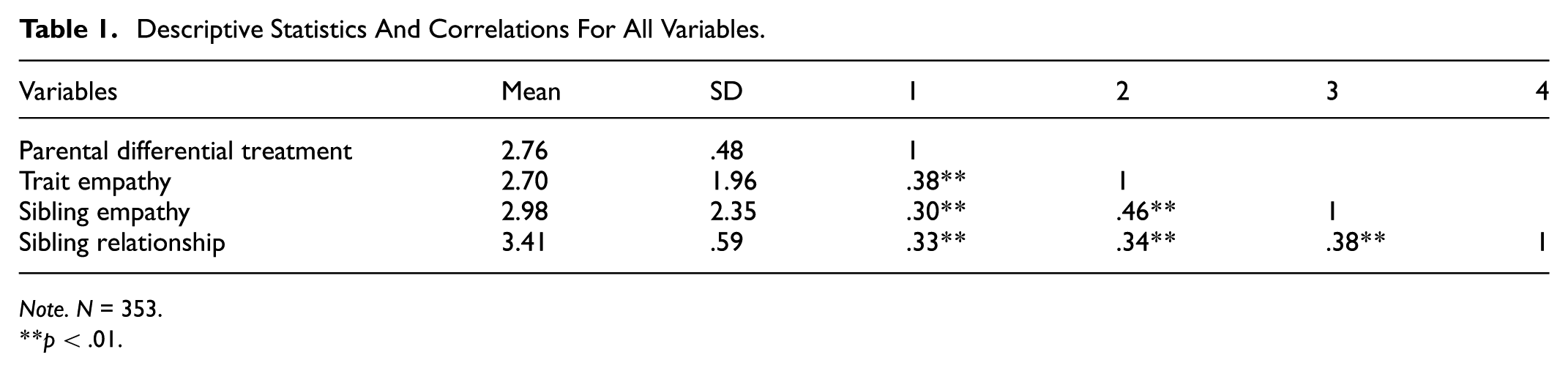
Note. N = 353.
p < .01.
The Multiple Mediation Model
Parental differential treatment, trait empathy, sibling empathy, and sibling relationship exhibited significant correlations, fulfilling the statistical prerequisites for the subsequent analysis of the mediating effects of trait empathy and sibling empathy. Age, age gap, gender, and gender combination were controlled. But in the regression analysis, neither gender nor sibling gender combination demonstrated predictive validity for sibling empathy or sibling relationship. Model 6 from the SPSS macro program (http://www.afhayes.com) was utilized to analyze the mediating effects of trait empathy and sibling empathy on the relationship between parental differential treatment and sibling relationship.
Table 2 presents the regression analysis results examining the relationship between parental differential treatment and sibling relationship, with age and age gap as control variables. The results indicate that parental differential treatment has a significant positive predictive effect on sibling relationship (B = .324, p < .001), thereby supporting Hypothesis 1. When trait empathy and sibling empathy were included in the regression equation, parental differential treatment significantly predicted trait empathy (B = .357, p < .001) and sibling empathy (B = .159, p < .01). Additionally, trait empathy significantly predicted both sibling empathy (B = .348, p < .001) and sibling relationship (B = .163, p < .01). Sibling empathy also emerged as a significant positive predictor of sibling relationship (B = .248, p < .001). Consequently, the direct effect of parental differential treatment on sibling relationship was notably reduced (B = .195, p < .001). These findings indicate that trait empathy, sibling empathy, and the mediating pathway from trait empathy to sibling empathy significantly influence the relationship between parental differential treatment and sibling relationship.
Regression Analysis Of The Relationship Between Parental Differential Treatment And Sibling Relationship.

N = 353.
p < .01, ***p < .001. The model had all the variables standardized. The study used age and age gap as control variables, while the independent variable was parental differential treatment and the dependent variable was sibling relationship. This table showcases the outcomes of the multiple hierarchical regression analysis that examined the connections between parental differential treatment, trait empathy, sibling empathy, and sibling relationship.
The mediating effect value of trait empathy and sibling empathy between parental differential treatment and sibling relationship is illustrated in Table 3, Figure 2 and Table 3 depicted the sequential mediating roles of trait empathy and sibling empathy in the relationship between parental differential treatment and sibling relationship, with a total standardized mediating effect value of 0.16. In other words, there were three indirect effects that made up the mediating effect, including path 1: parental differential treatment→ trait empathy→ sibling relationship (.07); Path 2: parental differential treatment→ sibling empathy→ sibling relationship (.05); and path 3: parental differential treatment→ trait empathy→ sibling empathy→ sibling relationship (.04). Path 1, 2, and 3 had a ratio of 9.48%, 17.96%, 12.47%, and 9.48% for the three indirect effects to the total effect, respectively. The fact that all three indirect effects were significant is confirmed by the 95% confidence intervals for these indirect effects, which did not include zero. In comparison 1, it was shown that the bootstrap 95% confidence interval for the difference between indirect effects 1 and 2 included zero, which indicates there was no significant difference between them. Similarly, there were no significant distinctions observed between indirect effects 1 and 3 or between indirect effects 2 and 3. These findings indicate that parental differential treatment can indirectly predict sibling relationship through both the individual mediating effects of trait empathy and sibling empathy, as well as through the combined mediating effect of trait empathy and sibling empathy. Among these, the single mediating effect of trait empathy accounted for the largest proportion of the total effect (17.96%).
Testing The Pathways Of The Multiple Mediation Model.

Note. Sibling relationship is affected by parental differential treatment in both direct and indirect ways, as indicated by this table. “Boot SE,” “Boot LLCI,” and “Boot ULCI” refer to the standard error and the lower and upper limits of the 95% confidence interval, respectively, for the indirect effects estimated using the percentile bootstrap method with bias correction. Indirect effect 1: parental differential treatment → trait empathy → sibling relationship; indirect effect 2: parental differential treatment → sibling empathy → sibling relationship; indirect effect 3: parental differential treatment → trait empathy → sibling empathy → sibling relationship.
N = 353. The beta values are standardized coefficients.
p < .01; ***p < .001.

The multiple mediation model. The multiple mediation model shows the effects of parental differential treatment, trait empathy, and sibling empathy on sibling relationship.
Discussion
Building on insights from previous reviews, our understanding of the association between parental differential treatment and sibling relationship is limited by a lack of participant diversity and unexplained mechanisms. To address these gaps, this study examined the relationship between parental differential treatment and sibling relationship among second-born children in Chinese two-child families. Additionally, drawing from theories such as the social competition theory (Festinger, 1954), Hoffman’s theory of empathy development, the empathy-altruism hypothesis, and group empathy theory, we developed a comprehensive model to elucidate the underlying mechanisms of this presumed relationship. As expected, trait empathy and sibling empathy sequentially mediated the relationship between parental differential treatment and sibling relationship. These findings significantly enhance our understanding of how parental differential treatment affects sibling relationship among second-born children in Chinese two-child families.
Parental Differential Treatment And Sibling Relationship
Consistent with our Hypothesis 1, parental differential treatment is positively related to sibling relationship among second-born children in Chinese two-child families. In the present study, the indicator of parental differential treatment is composited by affection and discipline. As a result, we find that more affection and less discipline of parental differential treatment is directly linked to positive sibling relationship, that is, more sibling warmth, less sibling conflict and jealousy, which is consistent with the result of prior research (Yang et al., 2022). However, this result is inconsistent with some studies (Jensen et al., 2013; Lu et al., 2024; Yang, 2023). It is found that there are differences in measurements (such as more favoritism and more control, or more affection and less discipline), the reporter (such as children’s perceived or parent’s perceived) and age gap of siblings. First, these studies, those studies define more favoritism and more control as more parental differential treatment, while this study suggests that parental differential treatment is more affection and less discipline (Blake et al., 2023; Lu et al., 2024; Yang, 2023). Existing studies have found differences between parental affection and parental discipline in sibling relationship, that is, parental affection is positively correlated with sibling warmth, while more discipline leads to more sibling conflict (Liu & Jiang, 2021). Second, unlike this study, parental differential treatment of these studies was reported by children who are almost adolescents (Lu et al., 2024; Yang, 2023). Adolescents are more likely to perceive parental differential treatment and feel a greater sense of injustice, likely due to their cognitive development and heightened emotional sensitivity at this stage (Jensen & McHale, 2017). Third, the multilevel meta-analysis revealed that greater differences in parental treatment when siblings were further apart in age (Jensen et al., 2023). In this study, the sibling age gap is small, which can rule out excessive parental differential treatment caused by age gap. Moreover, consistent with social comparison theory, positive sibling relationship from more parental affection and less parental discipline may reduce negative comparison with siblings (Jensen et al., 2015). Therefore, parental differential treatment is a crucial and relevant protective factor for positive sibling relationship among second-born children in two-child families.
Trait Empathy As A Mediator
Our research supports Hypothesis 2 by demonstrating that trait empathy serves as a crucial explanatory mechanism in the relationship between parental differential treatment and sibling relationship. Specifically, second-born children in Chinese two-child families who experience high levels of affective preference and low levels of disciplinary control from parents tend to exhibit higher trait empathy. This heightened empathy, in turn, is associated with better sibling relationship. These findings align with previous research indicating that empathy mediates the relationship between parenting practices and children’s prosocial behavior (Lin et al., 2023; Padilla-Walker & Christensen, 2011). High trait empathy is not merely a consequence of parental differential treatment but also an intrinsic factor in fostering positive sibling relationship. This study extends prior research by elucidating the connection between parental differential treatment and sibling relationship among second-born children in Chinese two-child families.
Besides the overall mediation outcome, each individual link is significant. In the first phase of the mediation process (i.e., parental differential treatment → sibling relationship), our finding suggested that parental differential treatment is positively related to trait empathy among second-born children in Chinese two-child families. The development of empathy in children is influenced by parenting style, as suggested by previous research (Eisenberg et al., 2006). The development of empathy in children could be aided by increased parental affection and less parental discipline (Abdullah & Salim, 2020). Specifically, children shape the socialization and caring behavior to motivate cognitive empathy mainly through interactions with their parents (Solfema, 2013). In the second phase of the mediation process, trait empathy was found to be positively associated with sibling relationship. Batson (2017) suggests that the empathy-altruism hypothesis states that empathy is crucial in motivating prosocial behavior, which can promote social relationships. Trait empathy and sibling relationship are reliably associated, according to robust evidence (Gungordu & Hernandez-Reif, 2022; Lam et al., 2012). Moreover, trait empathy of the second-born children is more crucial to the sibling relationship than that of the first-born child (Crouter et al., 1999). Second-born children can increase their attention to their siblings’ needs and feelings, which can lead to warmer sibling relationship as a foundation of human social experience.
Notably, the present study found that trait empathy in second-born children only partially mediated the relationship between parental differential treatment and sibling relationship, and the indirect effect was not particularly strong. It’s possible that this is due to the complexity of sibling relationship in reality. It is not necessary for trait empathy to elicit all forms of sibling relationship (Bin-Bin et al., 2017). In addition, unlike only-child families that only involve a binary relationship between parents and only-children, sibling relationship in two-child families in a pluralistic relationship situation which involves parents and two children, is much more complicated (Schrodt & Phillips, 2016). Other factors, such as sibling empathy, may have a more significant link to sibling relationship, potentially overshadowing the influence of trait empathy (Jambon et al., 2019; Qian et al., 2021). Nevertheless, it should be noted that, albeit the weak mediating effect, trait empathy of second-born children is admittedly an important mechanism liking parental differential treatment and sibling relationship, which deserves our special attention.
Sibling Empathy As Mediator
In line with Hypothesis 3, our results illustrated that sibling empathy is another important mechanism through which parental differential treatment is related to sibling relationship among second-born children in two-child families. In detail, parental differential treatment is related to positive sibling relationship via increased feeling and understanding the emotions to siblings. This finding supports previous studies that emotional understanding and emotion regulation to siblings is a critical role in the link between parenting and sibling interaction (Kramer, 2014; Yaremych & Volling, 2020).
The importance of each individual link in this mediation model is also evident. For the first part of the mediation process (i.e., parental differential treatment → sibling empathy), our finding can also be explained by prior empathy research that empathy as a mediator between parenting and prosociality (Lin et al., 2023; Padilla-Walker & Christensen, 2011). Another possible explanation is that children with less parental affection and more discipline would think that their siblings are stealing their parents’ affection with hostility towards their siblings (Dirks et al., 2015; Hashim & Ahmad, 2016), based on social comparison theory (Festinger, 1954). Thus, a competitive context affects group identification and reduces group empathy, and children have no expectation of positive empathy for a rival (Smith-Flores et al., 2023). Nevertheless, more parenting affection and less parenting discipline alleviate negative comparison of second-born children towards first-born children in two-child families, which in turn impedes the development of sibling empathy. For the second part of our mediation model (i.e., sibling empathy → sibling relationship), we found that high levels of sibling empathy can build and strengthen sibling relationship, which is consistent with the conclusion that empathy promotes the development of social relationships (Uzefovsky & Knafo-Noam, 2016), based on empathy-altruism hypothesis (Batson, 2017). Moreover, Chinese scholars have also concluded that higher sibling empathy had better sibling relationship based on existing research on sibling relationship among Chinese children (Zhang et al., 2019).
The current study showed that sibling empathy partially mediated the correlation between parental differential treatment and sibling relationship, and the model accounted for 20.66% of the variance in sibling relationship. While the primary data revealed significant correlations among these variables in second-born children from two-child families, the cross-sectional design precludes definitive causal inferences about the directionality of these relationships. Previous studies have acknowledged that sibling factors affect the relationship between parental factors and sibling relationship, but the study of sibling factors mainly focuses on the structural characteristics of siblings (age gap, gender combination) and temperament of siblings (Bin-Bin et al., 2017; Buist et al., 2013). This study found a new mechanism of sibling relationship from the perspective of sibling factor.
Trait Empathy And Sibling Empathy As Sequential Mediators
Sequentially, both trait empathy and sibling empathy influenced the relationship between parental differential treatment and sibling relationship between second-born children in two-child families, which was found during this study. Thus, Hypothesis 4 was validated. On one hand, parental differential treatment is associated with increased levels of trait empathy and sibling empathy among second-born children in Chinese two-child families, both of which are positively linked to sibling relationship (Lam et al., 2012; Qian et al., 2021; Zhang et al., 2019; Zhang et al., 2021). Parental differential treatment on sibling relationship is mediated by trait empathy and sibling empathy sequentially. It is also noteworthy that trait empathy positively correlates with sibling empathy (Eisenberg et al., 2014; Lam et al., 2012). Children who have a high level of trait empathy can accurately recognize other people’s emotions. Consequently, they have a higher chance of recognizing emotions from members of different groups, such as siblings (Sirin et al., 2016).
While previous studies have explored the impact of empathy on sibling relationship (Gungordu & Hernandez-Reif, 2022; Lam et al., 2012), very few, if any, have differentiated between trait empathy and sibling empathy, and examined these two constructs concurrently. The present study demonstrates the simultaneous role of trait empathy and sibling empathy by integrating social competition theory, group empathy theory, and empathy-altruism hypothesis. Therefore, this integrated sequential mediation model offers a more comprehensive understanding of the processes by the relationship between parental differential treatment and sibling relationship among second-born children in Chinese two-child families.
Limitations and Future Directions
As with any research, the current study should be considered with several caveats in mind. First, although our mediation model is grounded in theoretical foundations and supported by empirical studies, the cross-sectional design limits our ability to infer causality. To more thoroughly validate this multiple mediation model, further longitudinal studies or intervention experiments are necessary. Secondly, the data we collected primarily focused on parental differential treatment and sibling relationship, with the majority of it derived from mother self-report measures. Children’s perceived differential treatment, although widely used, is more closely associated with sibling relationship than parents’ perceived differential treatment (Ford & McCoy, 2022). Additionally, previous research has demonstrated that methods for assessing sibling relationship vary significantly among young siblings, with each method revealing distinct positive and negative dimensions of the relationship (Dunn & Plomin, 1990). Future studies would benefit from observing children and measuring parent self-reported behavior. It’s worth noting that the current study only gathered data from second-born Chinese children. The cultural understandings are strongly influenced by both parental differential treatment and sibling relationship. In different cultural contexts, Solmeyer & McHale (2017) discusses assumptions about family support, loyalty, and interdependence among family members (familism). Consequently, the outcomes may not be generalizable. To study this issue from a cross-cultural perspective, it is important to select different samples for future studies. Finally, since the primary objective of this study is to explore the mediating mechanisms between parental differential treatment and sibling relationship, we present the results directly from the perspectives of second-born children and mothers. Family systems theory suggests that families with multiple children create relationships through the interaction of various subsystems (Yan, 2023). Therefore, future research should delve deeper into the effects of parental differential treatment on sibling relationship by considering the perspectives of various family roles, including fathers, mothers, first-born children, and second-born children in families with two children. In terms of operational details, we acknowledge that the fixed order of tasks may have introduced an unintended bias, and we recommend that future studies incorporate a counterbalanced design to mitigate potential order effects. Additionally, future analyses should more rigorously account for key covariates—such as socioeconomic status (SES)—to ensure robustness in model estimation and interpretation.
Conclusions
To summarize, this study investigates the chain mediation model that links parental differential treatment to sibling relationship, utilizing a sample of second-born children in China. The findings indicate that this relationship is mediated by trait empathy and sibling empathy in sequential ways. Our understanding of how parental differential treatment affects sibling relationship is enhanced by this research, which provides insights that can help improve sibling dynamics in Chinese two-child families.
Supplemental Material
sj-docx-1-asm-10.1177_21582440251374524 – Supplemental material for Parental Differential Treatment and Sibling Relationship in Chinese Second-Born Children: Trait Empathy and Sibling Empathy Matter
Supplemental material, sj-docx-1-asm-10.1177_21582440251374524 for Parental Differential Treatment and Sibling Relationship in Chinese Second-Born Children: Trait Empathy and Sibling Empathy Matter by Xiaolu Ye, Chuanjing Liao, Qi Chen and Lijun Wu in SAGE Open
Footnotes

Author Contributions
Conceptualization, Xiaolu Ye; methodology, Xiaolu Ye; software, Xiaolu Ye; validation, Xiaolu Ye and Lijun Wu; formal analysis, Qi Chen; investigation, Xiaolu Ye, Qi Chen and Lijun Wu; resources, Xiaolu Ye and Chuanjing Liao; data curation, Xiaolu Ye; writing—original draft preparation, Xiaolu Ye; writing—review and editing, Xiaolu Ye and Chuanjing Liao; visualization, Xiaolu Ye; supervision, Chuanjing Liao; project administration, Xiaolu Ye; funding acquisition, Xiaolu Ye and Chuanjing Liao. All authors have read and agreed to the published version of the manuscript.
Funding
The authors disclosed receipt of the following financial support for the research, authorship, and/or publication of this article:
This article is supported by Zhejiang Provincial Philosophy and Social Sciences Planning Project (24NDJC127YB) and Zhejiang Provincial Philosophy and Social Sciences Planning Project (22NDJC142YB).
Declaration of Conflicting Interests
The authors declared no potential conflicts of interest with respect to the research, authorship, and/or publication of this article.
Declarations Informed Consent
Oral and written consent was obtained from all children and their mothers involved in this study.
Institutional Review Board Statement
The study received ethical clearance from the Office of the Deputy Vice Chancellor (Research and Innovation) Universiti Putra Malaysia, with reference numbers UPM. TNCPL 800-2/1/7 and JKEUPM Ref No. JKEUPM-2023-436. Consequently, the need for an ethical review was considered fulfilled, aligning with the principles outlined in the Declaration of Helsinki. The research was conducted using an anonymous questionnaire, ensuring that no personal data were collected.
Data Availability Statement
The manuscript has data included as electronic supplementary material. This data will be used for longitudinal study, so it can’t be shared publicly yet.
Supplemental Material
Supplemental material for this article is available online.
References
Supplementary Material
Please find the following supplemental material available below.
For Open Access articles published under a Creative Commons License, all supplemental material carries the same license as the article it is associated with.
For non-Open Access articles published, all supplemental material carries a non-exclusive license, and permission requests for re-use of supplemental material or any part of supplemental material shall be sent directly to the copyright owner as specified in the copyright notice associated with the article.
