




Abstract
Many decisions to help others are made in emotionally associated circumstances. Empathy is known to motivate prosocial behavior. However, no studies have investigated the interaction between empathy and emotion in deciding to help others. In total, 151 students scoring either high or low in empathy viewed three types of emotional clips (anger vs. sadness vs. neutrality) and completed the “Help for Another Study” task. Analysis of variance showed that participants chose to invest more time in helping others when they felt sadness than anger. Participants with high empathy chose to spend more time helping others than those with low empathy. Pearson’s correlation revealed a significant positive correlation between perspective-taking, empathic concern, and willingness to invest time in assistance under anger state; perspective-taking and fantasy were significantly correlated with willingness to invest time under sadness state. The results suggest that both emotion (i.e., sadness) and empathy (i.e., high trait empathy) are vital motivators that exert impact on prosocial helping decisions.
Introduction
Prosocial behavior is characterized by voluntary and intentional actions that aim to benefit others (Padilla-Walker & Carlo, 2015), with rewards regarded or disregarded (Eagly & Crowley, 1986; Oswald, 2002). Previous studies discussing the influence of prosocial helping behavior mainly focused on emotions and motives (Aknin et al., 2013; Batson, 2010). Previous studies have shown that prosocial helping behaviors may play an essential role in helping social entities function smoothly (Baldner et al., 2020; Lebowitz & Dovidio, 2015). It is, hence, vital to explore the factors that influence prosocial helping decisions or behaviors.
Emotion and Prosocial Helping
The dual-process model posits that positive emotions make individuals focus on social interaction and other positive activities, which increase the possibility of prosocial helping decisions. In contrast, negative emotions motivate individuals to focus attention on themselves, resulting in their inability to pay attention to others’ needs, and reducing the possibility of prosocial helping decisions (Cunningham et al., 1986). Based on this theoretical hypothesis, social psychology research has focused on the impact of different emotional valence on prosocial helping decisions (Gustavo et al., 2010; Mesurado et al., 2018; Roberts et al., 2014).
The results of the existing empirical researches which focused on the negative emotions and prosocial helping decision are not consistent. For instance, certain studies have shown that negative emotions are not associated with prosocial helping intentions and that they reduce the likelihood of helping (Carlo et al., 2010; Guo et al., 2019; Laible et al., 2010; Lamy et al., 2012; Liew et al., 2011). More specifically, Guo et al. (2019) investigated how external negative emotional stimuli influenced 5- to 6-year-old children’s (N = 98) sharing behavior. The results indicated that sadness increased boys’ tendency to defend their own interest (reticent to share the toys). However, other studies have indicated that negative emotions increase prosocial helping decisions (Panfile & Laible, 2012; van Doorn et al., 2014). For example, van Doorn et al. (2014) examined how emotional expressions shaped prosocial behavior. They found that participants were more willing to offer help and donations to charity when a request was accompanied by disappointment rather than anger or no emotion.
Based on the appraisal-tendency framework (ATF), it is proposed that specific emotions with same valence have different effects on behavior and judgment (Lerner & Keltner, 2000; Lerner & Tiedens, 2006). Yang and his colleagues (2017) have put forward a possible explanation for these inconsistent findings. The studies, described above, manipulated different specific negative emotions (i.e., anger, disgust, and sadness) in their experiments, but these emotions, defined as negative, may have been mixed emotions. To provide empirical evidence for this conjecture, Yang and his colleagues conducted experiments by manipulating specific negative emotions (i.e., sadness and anger) and measuring participants’ prosocial helping decisions. Their results revealed that compared with participants in anger and neutral emotional states, participants in a sad emotional state decided to spend more time, or donate more money to, those who needed help (Yang et al., 2017). The results of Yang’s study supported the ATF hypothesis and explained the inconsistent results of previous studies from the perspective of specific emotions.
According to the person-context interaction theory (PCIT), the combined effect of external situational factors and individual-level factors will affect an individual’s judgment and behavior (Jiang, 2013; Magnusson & Stattin, 1998). Hence, whether individual-level factors (i.e., personal traits) are another potential explanation for the varying findings of previous studies is an open question worthy of exploration.
Empathy and Prosocial Helping
Empathy is typically seen as a crucial dispositional trait and is thought to be a motivating factor for helping behavior (Batson, 1990; Singer & Lamm, 2009; Stocks et al., 2009). Empathy consists of cognitive and affective components, with cognitive empathy primarily refers to an individual’s ability to understand another’s emotions, and affective empathy, which refers to an individual’s capacity to share another’s emotions, to put him or herself in another’s shoes, and care for another’s welfare (Decety, 2015). Empathy and helping behavior are, therefore, conceptually and empirically linked.
The empathy-altruism hypothesis (EAH) proposed by Batson and his colleague, which claims that the ultimate goal of prosocial behavior evoked by empathy is to increase the welfare of the person in need (Batson et al., 1981; Batson et al., 2015). Empathy facilitates everyday social interactions and is often associated with prosocial behavior in the literature. Robust evidence showed that there was a positive relationship between experiencing empathy and behaving prosaically. Hence, the altruistic motivations induced by empathy may lead a person to help another person in need appropriately. The EAH states that empathy-generated altruism is a noninstrumental desire that benefits another person (Batson & Shaw, 1991). The EAH has conducted some studies that offers responses to important questions about why people help, and fail to help, and offers insights into the roles played by different types of motivations in human social behavior (McAuliffe et al., 2018; Persson & Kajonius, 2016). For instance, a recent meta-analysis has found that empathy was significantly associated with prosocial behavior (r = 0.38, p < .001; Ding & Lu, 2016).
Empirical studies in social, personality, and developmental psychology have proven the role of empathy in helping people in need. For instance, research has found that affective and cognitive empathy can predict self-reported prosocial tendencies (Lockwood et al., 2014). In addition, evidence from laboratory studies have also shown that empathy motivates prosocial helping decision and behavior. For example, Kawamichi et al. (2016) combined a virtual ball-toss task with functional magnetic resonance imaging to examine the effect of empathy on helping behaviors. They found that participants in an empathic state increased their chances of tossing a ball at an isolated player (defined as helping behavior), which was associated with activation of the right temporoparietal junction and the dorsal striatum, which are part of the brain’s reward system.
As described above, on one hand, empirical studies have demonstrated the link among prosocial helping decision, emotion, and trait empathy (Lockwood et al., 2014; Yang et al., 2017). On the other hand, we can reasonably speculate that trait empathy and various emotions may exert interactional impact on the prosocial helping decision based on the PCIT and EAH, which emphasized that the individual and situational factors may have an influence on individuals’ behavior. Hence, in the current study, we would like to examine this interactional impact on the prosocial helping decision and provide empirical evidence for another potential explanation of the varying findings of previous studies.
The Current Study
The main objective of this study was to explore whether individual and situational factors influence people’s prosocial helping decisions. Based on theoretical and empirical literature, we hypothesized that participants with different dispositional empathy would be willing to invest different amounts of time in helping others in need. It was assumed that participants with high levels of empathy would devote more time to provide help others in need than those with low levels of empathy. Moreover, based on a previous study (Yang et al., 2017), we presumed that participants experiencing sadness, would spend more time helping others in need, than those experiencing angry or neutral emotions. Furthermore, based on the PCIT, and the EAH, we hypothesized that an interactional effect between trait empathy and type of emotion would be observed. This study aims to provide empirical evidence for another potential explanation of the varying findings of previous studies.
Method and Materials
Participants
Recruiting participants
A 400-student participant pool was built to recruit suitable participants. Students were asked to complete the interpersonal reactivity index of Chinese version (IRI-C, Rong et al., 2010). After screening, 368 valid questionnaires were obtained. The screening criteria were as follows: (a) questionnaires with missing data constituting more than one third of the whole scale were excluded and (b) questionnaires with missing demographic information, especially contact information, were excluded. Then, the 368 valid questionnaires were sorted from high to low, based on the average score obtained for empathy. Next, the participants who ranked in the upper 27% were demarcated as high in empathy and invited to take part in the experiment. Participants who ranked in the lower 27% were demarcated as low in empathy and also asked to take part in the experiment.
The experimental participants
One hundred and fifty-six healthy individuals were invited as volunteers. All participants met the following criteria: they were (a) right-handed; (b) had a normal or corrected-to-normal vision, and normal auditory function; (c) no history of neurological or psychiatric disorders; and (d) did not participate in any similar studies. Three male and two female participants were excluded from the initial experimental sample because they did not pass the manipulation check, which controls for false or random responses to questions. The final experimental group consisted of 151 undergraduate students (89 males, M = 18.89 years, SD = 1.43, aged from 17 to 23 years), including 76 participants with high empathy ability (45 males) and 75 participants with low empathy ability (44 males).
Furthermore, 52 participants were randomly assigned to the anger subgroup (27 participants with high empathy scores), 49 participants were randomly assigned to the sadness subgroup (25 participants with high empathy scores) and 50 participants were randomly assigned to the neutrality subgroup (24 participants with high empathy scores). The ethics committee of the local university approved the study, and the study protocol conformed to the ethical guidelines of the 1975 Declaration of Helsinki (as revised in Tokyo in 2004). All participants provided written informed consent to regard to participating, after the experimental procedures had been fully explained, and acknowledged their right to withdraw at any time during the study.
Materials
Interpersonal Reactivity Index
The IRI is a published measurement tool for the multidimensional assessment of empathy (Davis, 1983). Four subscales: perspective-taking (PT), empathic concern (EC), fantasy (FN), and personal distress (PD), comprise seven items each. The IRI is a self-report measure in which responses are scored in terms of a 5-point Likert-type scale, ranging from “Does not describe me well” to “Describes me very well.” Participants were asked to complete the Chinese version of this scale (IRI-C) (Rong et al., 2010) and those with high or low empathy were recruited to take part in the experiment. Cronbach’s α coefficient for this scale was 0.85.
Self-assessment manikins
According to previous literature (Fernández-Aguilar et al., 2018; Watson et al., 1988), self-assessment manikins (SAMs) can be used to record the valence, arousal, dominance, and sense of control associated with different emotions (Bradley & Lang, 1994) before and after the participants watched the emotional clips. In this study, we focused mainly on the valence and arousal dimensions of emotion. The participants were asked to report their emotional state before and after watching the clips, using the SAM scale. This scale uses realistic figures to represent different emotional states. Participants were asked to report “how pleasant or unpleasant” and “how aroused or relaxed” they felt on a 9-point Likert-type scale, where 1 represented the worst and 9 represented the best. Cronbach’s α coefficient for this scale was 0.70.
Emotional clips
Six emotional film clips were extracted from the Chinese Emotional Visual Stimulus (CEVS) database (for more psychometric information regarding this database, see Xu et al., 2010). These included clips which evoked anger, sadness, or neutrality. The selection criteria for the clips were as follows: (a) the film-induced only one target emotion, (b) the thematic content was understandable without additional explanation, and (c) the level and strength of the targeted emotion was ranked in the top three of the CEVS database. The length of the six clips ranged from 68 seconds to 163 seconds and averaged 107.67s (SD = 44.22 seconds). The detailed information of each emotional clip was shown in Table 1.
The Details of Each Emotional Clip.

Note. Discreteness refers to the purity of the target emotion induced by the emotional clip. This study’s operational definition was defined as the hit rate, which is the percentage of people who report that the emotional clip’s intensity is higher than any nontarget emotion. Strength refers to the intensity of the emotion induced by the emotional clip. The operational definition in this study was defined as the average strength score of each clip. IDE = Integrated-Drive-Electronics.
The task of help for another study
When the participants watched the emotional clips, the computer presented a scenario to measure the helping behavior intentions of the participants. The scenario named “Help for Another Study” was adapted from previous studies (Nelson & Norton, 2005; Yang et al., 2017). The participants were informed that an experimenter in the next room wished to invite them as volunteers to take part in one of her three experiments. The participants were then asked, “How much time are you willing to spend on the experiment?”
We assessed prosocial helping intention by the length of time that the participants were willing to invest in the “Help for Another Study.” The length ranged from 0 to 100 (unit: minutes), where 0 indicated unwillingness to help, and a larger number indicated a more robust desire, on the part of the participant, to help. The researcher informed the participants that the experimenter in the next room would arrange the experiment according to their decision to enhance the authenticity of the study, and ensured that they did not guess the true purpose of the request.
Procedure
The experimental process was divided into two stages. In the first stage, based on the scores obtained on the IRI-C scale, participants were categorized into two sets: a high-empathy group, and a low-empathy group. In the second stage, participants who met the inclusion criteria were invited to complete the formal experimental task.
The experimental procedure started with a fixation cross in the center of the screen. Subsequently, participants completed the SAM questionnaire to obtain a baseline evaluation of their emotional state. Next, the emotional clips (i.e., anger, sadness, or neutrality) were shown to the participants. After viewing the films, participants were asked to respond to the SAM scale again as the manipulation check. Then, participants were then asked to finish the “Help for Another” task. Finally, a manipulation check was performed to exclude participants who had not completed the experiment carefully.
The experimental procedure was programmed using E-prime 2.0 Professional (Psychology Software Tools, Inc., United States of America). The experimental procedure was shown in Figure 1. The experiment’s instructions can be found in the Supplementary Materials.

Experimental procedure. Time course of events in the experiment (A) Fixation cross. (B) Completion of the self-assessment manikin (SAM) questionnaire in valence and arousal dimensions as the baseline. (C) Exposure to the target emotional clips. (D) Completion of the self-assessment manikin (SAM) questionnaire to assess emotion type. (E) The decision task was named “Help for Another Study.” (F) Manipulation check for emotion induction.
Data Analysis
All data analyses were performed using the Statistical Package for the Social Sciences 25.0 for Windows (SPSS, IBM Corp). The level of statistical significance was set at p < .05 (two-tailed). Effect sizes for t-tests (Cohen’s d with 0.2, 0.5, and 0.8 as small-, medium- and large-sized effects) and analysis of variance (ANOVA; ηp2 with 0.1, 0.25, and 0.4 as small, medium, and large effects) were calculated. Initially, a series of Pearson correlation analyses was conducted to examine the relationship between trait empathy and helping intent. A simple effect analysis was performed when an interaction effect was observed. Bonferroni correction was used to account for post hoc multiple comparisons of the observed means in the ANOVA. Then, the two-way ANOVA with Group (high trait empathy vs. low trait empathy) and Emotion Type (anger vs. sadness vs. neutrality) was performed with regard to the time that the participants decided to devote to giving assistance.
Results
Correlation Between Empathy and Prosocial Helping Intention
A series of Pearson correlation analysis was performed between the scores of trait empathy (i.e., IRI, PT, EC, FN, PD) and the time volunteered by the participants in the “Help for Another Study.” The results revealed that empathy and time are significantly correlated (r = .18, p = .028, 95% CI = [0.020, 0.329]). Moreover, the results revealed that the scores of the participants on the perspective-taking dimension (r = .26, p = .001, 95% CI = [0.106, 0.404]), and the EC dimension (r = .23, p = .004, 95% CI = [0.074, 0.377]) were significantly correlated with time. However, there was no significant correlation with regard to the FN (r = .13, p = .103, 95% CI = [−0.027, 0.287]) and PD (r = −.07, p = .388, 95% CI = [−0.228, 0.090]) dimensions.
In addition, a Pearson’s correlation analysis was applied with regard to the dimensions of empathy (i.e., PT, EC, FN, and PD), time, and different emotion types. In the anger state, results indicated that only the perspective-taking (r = .33, p = .016, 95% CI = [0.065, 0.554]) and EC dimensions (r = .34, p = .013, 95% CI = [0.078, 0.564]) were significantly correlated with time. In the sadness state, the results showed that only the perspective-taking (r = .30, p = .035, 95% CI = [0.023, 0.538]) and FN dimensions (r = .28, p = .048, 95% CI = [0.003, 0.523]) were significantly correlated with time. In the neutrality state, the results revealed that only the EC dimension was significantly correlated with time (r = .37, p = .009, 95% CI = [0.100, 0.586]).
The Effect of Trait Empathy and Emotion Type on Prosocial Helping Intention
A two-way ANOVA with the emotion type (anger vs. sadness vs. neutrality) and the group (high trait empathy vs. low trait empathy) as the between factors was conducted with time as the dependent variable. The results showed a significant main effect of emotion type with time, F (2, 145) = 7.55, p = .001, ηp2 = 0.09, and a significant main effect of group with time, F (1, 145) = 4.90, p = .028, ηp2 = 0.04. No interaction effect between emotion types and group with time was observed, F (2, 145) = 0.04, p = .961. Post hoc tests showed that the time reported by the participants in the anger state (M = 34.42, SD = 22.72) was significantly less than the time reported in both the sadness state (M = 53.80, SD = 29.83, p = .001) and the neutrality state (M = 48.80, SD = 26.58, p = .016). However, no difference was detected between sadness (M = 53.80, SD = 29.83) and neutrality state (M = 48.80, SD = 26.58) with regard to the time offered by the participants, p = .381. The result of the two-way ANOVA was shown in Figure 2.
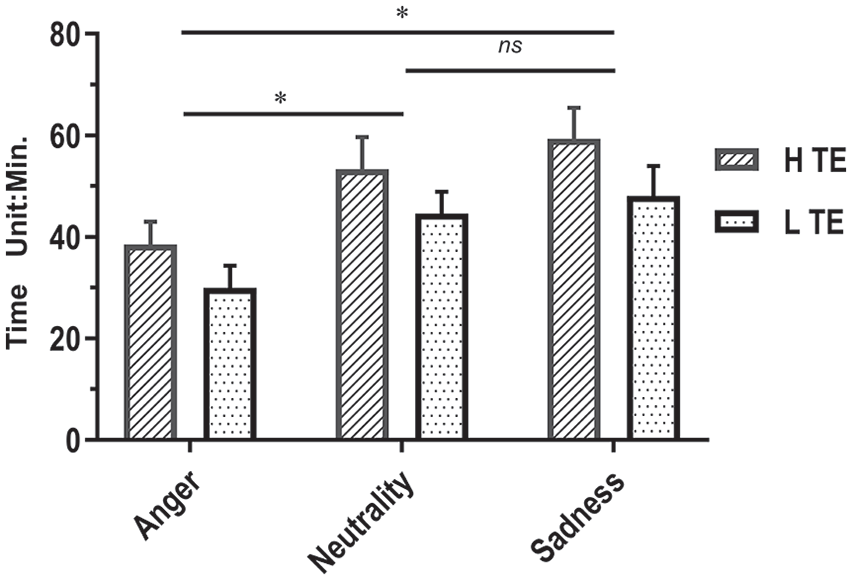
Comparisons of the helping behavior decision under different emotion types.
Discussion
This study investigated whether trait empathy (high vs. low) and emotion types (anger vs. sadness vs. neutrality) had an interactional effect on prosocial helping intentions. We found that specific emotions with the same valence (i.e., anger vs. sadness) influenced the participants’ preferences in decision-making. Specifically, compared with the angry state, individuals experiencing sadness decided to spend more time helping others. In addition, we found that different dimensions of the trait empathy had different correlations with prosocial helping decisions under different emotional conditions. Based on these findings, we found that these hypotheses were partly supported, and evidence related to the external situational factors, and individual-level factors that affect prosocial helping decisions was provided. Our understanding of specific negative emotions and trait empathy on human prosocial helping decisions was also being further advanced.
The Effect of Emotion and Empathy on Prosocial Helping Decisions
In this study, we did not find that trait empathy and emotion type have an interactional effect on prosocial helping intention. Hence, in this part, we discussed the results from an integrated view to enhance the understanding of the results of this study.
First, the results showed that individuals experiencing sadness were likely to decide to spend more time helping people in need than those who were angry. This result was consistent with the results of previous studies (Lerner et al., 2015; Small & Lerner, 2008; Yang et al., 2017; Zhang & Ke, 2019). For example, Small and Lerner (2008) found that in the simulation of welfare assistance experiments, participants in a sad mood suggested that the rescuers should increase the amount of welfare. This was in contrast with those in either angry or neutral moods. Yang and his colleagues reported similar results that individuals in a state of sadness were likely to spend more time helping others, than those in a state of anger (Yang et al., 2017). Although the specific emotions (anger and sadness) are in the same valence, they have different effects on individual behavior. This result partly supports the ATF, which proposes that specific emotions with the same valence have different effects on behavior and judgment (Lerner & Keltner, 2000; Lerner & Tiedens, 2006).
However, it should to be noted that the level of prosocial behavior of the participants in sad emotional states is not significantly higher than the level in neutral state. The discreteness of the emotional clips might provide the potential explanation to this result. Discreteness indicates the purity of the target emotion induced by the emotional clip, which means the percentage of people who report that the emotional clip’s intensity is higher than that of any nontarget emotion. The participants in the sadness and neutrality groups might perspective the same intensity that evoke the valence and arousal. Moreover, the emotional state of sadness might make the participants afraid of feeling more sadness. Hence, we did not observe the higher prosocial behavior in the sad emotional states compared to the neutrality state. Future studies may select emotional clips of same intensity and combine the subjective report to clarify this issue.
Second, we also found that individuals in the high trait empathy group decided to spend more time helping a person in need than those in the low trait empathy group. This finding was in line with the previous studies, which suggested that empathy is a crucial motivating factor for prosocial behavior (Eisenberg et al., 2010; Lockwood et al., 2014; Pelligra & Vásquez, 2020). For instance, Pelligra and Vásquez (2020) study by means of a laboratory experiment the role of individuals’ empathy in the Vote-with-the-Wallet Game. The main purpose was to analyze the impact of the ability to empathize on participants’ behavior when asked to choose between two specific types of product. They find that all the manipulations increase the rate of contribution to the public good compared with baseline treatment, and that the effects were stronger among participants who showed higher levels of empathy. This result partly supports the EAH, which claims that the ultimate goal of prosocial behavior evoked by empathy is to increase the welfare of the person in need (Batson et al., 1981).
Finally, we did not observe an interactional effect between empathy (high vs. low) and emotion type (anger vs. sadness vs. neutrality) on prosocial helping decisions. The task used in this study might provide an explanation for why the interactional effect was not significant. As described in the materials section, the task was used to measure prosocial decision-making. A possible confounding variable may be the effect of the task causing participants to be uncertain about their choices. Past researches have suggested that uncertainty has a negative effect on prosocial behavior (Brennan et al., 2008; de Kwaadsteniet et al., 2007), in that it enables people to adopt self-serving narratives about their actions. The participants in this study were worried about the results of their decisions, and whether they could effectively help someone in need. The interactional effect of empathy and emotion type might be neutralized by uncertainty in decision-making. Hence, in future, researchers need to measure prosocial helping decision-making via behavior rather than intention, to reduce the impact of uncertainty.
The Dimensions of Trait Empathy Have a Different Correlation With Prosocial Helping Decisions Under Different Emotional Conditions
Although empathy is generally assumed to have a significant positive correlation with prosocial behavior (Spinrad & Gal, 2018; Van der Graaff et al., 2018), this may not be the case for all empathic dimensions in different emotional states. In this study, we found that the dimensions of perspective-taking and EC had a significant correlation with the index of prosocial behavior (i.e., time). However, we did not observe a significant correlation between FN and PD dimensions. These results indicate that perspective-taking and EC play a more important role in the helping decision-making process than other dimensions of empathy. According to the results of the previous study (Guo & Wu, 2021), it is possible that participants have to assess whether to help someone in need. During the evaluation process, the participants had to comprehend the situation of the recipient, perceive the recipient’s emotions, and estimate the impact on the recipient if they refused to help. It seems that FN and PD were not involved in this assessment route from the viewpoint of psychological processing. This may be a possible explanation for why the correlation between these two dimensions and prosocial behavior was not observed.
Furthermore, it was found that the dimensions of perspective-taking and EC had a significant positive correlation with readiness to invest time in assistance and anger. In the condition of sadness, the results revealed that the perspective-taking dimension and FN dimension had a significant positive correlation with time. According to previous studies (Baumann et al., 1981; van Doorn et al., 2015), one explanation for these results is that the participants might speculate on the situation of the protagonist, when the protagonist was being rejected, under sad condition. They might want to know, for example, whether the protagonist could complete the experiment on time and whether he could graduate successfully. However, under the condition of anger, the participants who decided to provide help just wanted to eliminate or alleviate negative emotional experiences. Therefore, we considered that different dimensions of empathy had a positive correlation with the index of prosocial behavior under conditions of sadness and anger, for different reasons.
In addition, it should also be noted that the values of the significant Pearson’s correlations were reduced between the time and the trait empathy and subdimensions in this study. Although Silver’s z test did not reveal a significant difference between these correlations. We found that the r value between trait empathy and time is the minimum value, but the dimension of EC and time in the neutrality state is maximum values. The structural components of empathy and the features of the “Help for Another Study” task may explain this variation trend. The questionnaire that we used to measure the trait empathy contains cognitive empathy and affective empathy. However, the “Help for Another Study” task is a decision task that more cognitive resources are needed. Hence, we observe the r reduced when we calculated the correlation in a whole and part way, respectively. Future studies can explore which dimension of empathy is more important for prosocial behavior (such as perspective-taking and EC) under different emotional states to clarify this issue.
Practical Implications and Limitations
Practical implications
The findings of this study have vital implications for practice. First, this study found that empathy is a motivator for prosocial behavior. Specifically, participants with high trait empathy spend more time helping than those with low trait empathy. Moreover, a meta-analysis showed that empathy training programs are effective in empathy teaching with a medium effect (g = 0.63) (Teding van Berkhout & Malouff, 2016). These findings implied that the school’s curriculum or the local community could aim to teach adolescents or the citizens some empathy concepts or skills to improve the citizens’ altruistic intention or behaviors. Second, this study also found that the participants who experienced sadness chose to invest more time in helping than those who experienced anger. This result implied that the practitioners or the government administrators could create an atmosphere of sadness when holding a donation to enhance the donation intention or behavior. Generally, this study provides guidance to practitioners or the government administrators who seek to identify useful way to enhance the prosocial helping decisions and behavior eventually.
Limitations and future directions
Several limitations of this study should be noted. First, it only focuses on one individual variable (trait empathy). In future studies, other individual variables (i.e., personality and thinking styles) should be taken into account. For instance, a recent meta-analysis research reveals that meta-analytic correlations ranged between −0.18 ≤ p ≤ 0.26 with regard to the finding that most personality traits yielded a significant relation to prosocial behavior (Thielmann et al., 2020). Second, this study only examines two negative emotions (anger and sadness). The extent to which other negative or positive emotions affect helping decisions needs to be further investigated. For example, Vitaglione and Barnett (2003) demonstrated that another internalized negative emotion (fear) is related to prosocial behavior, whereas irritable negative emotion (discomfort) is related to antisocial behavior. Third, it should be noted that participants’ subjectively perceived the importance of their participation might also moderate the results to some extent. Future studies could employ objective measurements or formal subjective ratings to clarify this issue. Fourth, this study did not examine whether the induced negative emotion (e.g., angry) act as a demotivate factor (i.e., the participants be afraid to participate in a new experiment that could make them feel bad again) for the participation. Future studies could combine subjective reports and physiological measure (i.e., heart rate and rate response interval) to clarify this issue.
Supplemental Material
sj-pdf-1-sgo-10.1177_21582440211014513 – Supplemental material for The Influence of Emotion and Empathy on Decisions to Help Others
Supplemental material, sj-pdf-1-sgo-10.1177_21582440211014513 for The Influence of Emotion and Empathy on Decisions to Help Others by Weilong Xiao, Xue Lin, Xinwei Li, Xiaofei Xu, Huanen Guo, Binghai Sun and Huaibin Jiang in SAGE Open
Footnotes
Acknowledgements
The authors thank Sitong Jiang and Hanxiao Xu for their help in data collection. In addition, they thank the participants who participated in this experiment voluntarily.
Declaration of Conflicting Interests
The author(s) declared no potential conflicts of interest with respect to the research, authorship, and/or publication of this article.
Funding
The author(s) disclosed receipt of the following financial support for the research, authorship, and/or publication of this article: This work was supported by the Major Support Projects for Emerging (Interdisciplinary) Disciplines of Philosophy and Social Sciences in Zhejiang Province of China (grant no. 19XXJC04ZD).

Supplemental Material
Supplemental material for this article is available online.
References
Supplementary Material
Please find the following supplemental material available below.
For Open Access articles published under a Creative Commons License, all supplemental material carries the same license as the article it is associated with.
For non-Open Access articles published, all supplemental material carries a non-exclusive license, and permission requests for re-use of supplemental material or any part of supplemental material shall be sent directly to the copyright owner as specified in the copyright notice associated with the article.
