




Abstract
The objective of the current research was to test the hypotheses arising from the epigenetic view of social development and from the wider perspective offered by the social network model with three interactional systems, that is, child–parent, child–sibling, and child–peer. They were tested in two prospective longitudinal studies using a multi-informant and multi-method strategy. Study 1 was conducted among 83 children and their parents and Study 2 among 190 children. Attachment security with parents was assessed when the children were 4 years of age, relationships with siblings at 5 years of age, and relationships with peers at 6 years of age. Attachment to parent was found to explain a limited part of variations in later social relationships with siblings and peers. The sibling interactional system had a consistent and enduring effect on later peer relationships. With regard to the two theoretical backgrounds under consideration, neither was able to account for equivocal findings displayed in the two studies as well as in previous research. The wonderful story of social development seems to be a very complex process for which new models are needed.
Keywords
Introduction
Over the past few decades, a large number of studies have been devoted to examining the ontogeny of children’s social development, that is, the associated risk or protective factors and the processes leading to positive social relationships (Caspi & Shiner, 2006). One of the most important theoretically driven hypotheses is the epigenetic view that the quality of children’s relationships with their primary caregiver, and in particular their attachment security, lays the groundwork for their involvement in subsequent familial and extra-familial relationships (Cassidy, 2008; Rubin, Bukowski, & Parker, 2006; Thompson, 2006). Another theoretical perspective is the social network model, which offers a wider perspective in which child–parent attachment is seen as a subset of a larger social system that shapes social development. This model recognizes the influence of the primary caregiver figure on later development, but at the same time, it predicts a certain independence between child–parent relationships and subsequent child–sibling and child–peer relationships (Lewis, 2005). The epigenetic view and the social network model, therefore, differ from each other in the extent to which early childhood experiences of social relationships with the primary caregiver constrain subsequent development and consequently, in the extent to which other interactional systems are held to have an enduring impact on social development (Takahashi, 2005).
The current study empirically examines these two models by testing the direct and indirect effects resulting from preschoolers’ attachment security with parents on both relationships with siblings and peers. These effects were tested in two 3-wave, longitudinal prospective, multi-informant, and multi-method studies in which attachment security with parents was assessed at 4 years of age, relationships with siblings at 5 years of age, and relationships with peers at 6 years of age.
The Epigenetic Hypothesis
The epigenetic view of social development relies on the attachment theory (Bowlby, 1969) and on psychoanalytic assumptions that the early relationship between mothers and children is the prototype for all future relationships (Hay, 1985). In this view, social development is considered to operate through children’s earliest social experiences, in particular, the relationships between children and their primary caregiver (Cassidy, 2008; Hay, 1985). In this sense, the model argues for a linear relation between the mother–child relationship and all subsequent ones (Lewis, 2005). In such a view, early attachment relationships constrain subsequent social relationships with, for example, siblings and peers. The epigenetic model recognizes that simultaneous attachments and relationships occur, but attachment theory favors a hierarchical model in which the most important attachment bond is the primary caregiver–child relationship (Cassidy, 2008).
The theoretically based arguments in favor of the central role of the attachment with primary caregivers in the development of social relationships are threefold (Cassidy, 2008; Rubin et al., 2006). First, from birth, the responsiveness of the primary caregivers guides their interactions with the child, who gains opportunities to develop a large panel of competences relevant in an interpersonal context (Caspi & Shiner, 2006). Second, because of the balance between the two antagonistic systems of attachment and exploration, a secure attachment involves safety to examine the social world and hence to practice and improve social interactions with various partners (Rose-Krasnor, Rubin, Booth, & Coplan, 1996). Young children with a secure base confidently enlarge their social worlds and cope with diverse social situations (Rubin et al., 2006). Third, the security gained in the child–parent relationship leads to the formation of an internalized model of the self that is worthy of positive response from others (Cassidy, 2008). Thanks to such positive expectations, secure children are confident and enthusiastic about taking an active role in diverse social situations involving various partners (Rose-Krasnor et al., 1996; Thompson, 2006).
In line with these arguments, securely attached children should be more sociable and effective in their peer relationships. The contrary assumption is made that without an adequate parent–child relationship, other social relationships could be markedly impaired. For decades, empirical findings have given some support to the theoretical assumptions that young children’s relationships with peers, including siblings, benefit from attachment security with the parents. The set of relevant studies considering child–parent and child–sibling relationships is still limited, whereas those focusing on child–parent and child–peer relationships are more numerous. In both cases, these relevant studies have mainly been conducted with mothers. Sibling relationships are defined as interactions between two or more individuals sharing biological, adoptive, or step-parents (Boer, Dunn, & Cicirelli, 1992; Volling, 2003). Sibling relationships include behavioral as well as affective and cognitive components. They have been empirically appraised on the basis of positive dimensions such as warmth, affection, empathy, and companionship and negative ones such as conflict, hostility, rivalry, aggression, and avoidance (Boer, Westenberg, McHale, Updegraff, & Stocker, 1997; Schaefer & Edgerton, 1981). Concurrent relations have been found between child–mother attachment and sibling bonds. The frequency of hostile behavior was found to be lower among securely attached siblings than among insecurely attached siblings (Teti & Ablard, 1989). Insecure infant–mother attachment of the firstborn at 11 months of age was also found to have an enduring effect on conflict and aggression among siblings when the firstborn was 6 years old. Firstborns with insecure attachment were more likely to interact in a conflictual manner with their siblings 5 years later (Volling & Belsky, 1992).
Peer relationships consist of positive and negative interactions with same-age mates (Rubin et al., 2006). Like sibling relationships, peer relationships include behavioral as well as affective and cognitive components. They have been empirically appraised on the basis of positive dimensions such as social engagement, defined as a child’s participation in activities with peers; peer acceptance, defined as the degree to which a child is accepted by peers (Putallaz, Heflin, Gottman, & Parker, 1986); and prosocial behavior, defined as a type of voluntary behavior designed to help others (Knafo & Plomin, 2006), and of negative dimensions such as peer victimization, aggression, and withdrawal (Lamarche, Brendgen, Vitaro, Pérusse, & Dionne, 2006). Significant correlation has been found among 4-year-old children between attachment security in the child–mother dyad and positive social engagement with peers (Rose-Krasnor et al., 1996). Similar findings were displayed for 4-year-olds, whose attachment security with the parents was the strongest predictor of social engagement at age 8 (Booth, Rose-Krasnor, McKinnon, & Rubin, 1994). Preschoolers’ attachment security also made a unique contribution to peer acceptance among preschoolers (Szewczyk-Sokolowski, Bost, & Wainwright, 2005). Similarly, a significant correlation was displayed between attachment security with the mother and concurrent prosocial behavior (Laible, 2006).
Alongside empirical findings that support the epigenetic view, it cannot be ignored that other research has failed to display significant associations between attachment and subsequent relationships with siblings or peers. This was the case for preschoolers whose peer relationships were observed in nursery school as well as for toddlers’ sociability toward another child in semi-structured naturalistic settings, where there was no correlation with attachment and mother–child interaction variables (Clarke-Stewart, Vander-Stoep, & Killian, 1979; Maccoby & Feldman, 1972). More recently, in a meta-analysis focusing on child–parent attachment and children’s peer relations, only a modest combined effect size of .20 was found for the association between the two variables (Schneider, Atkinson, & Tardif, 2001). A recent longitudinal study which measured attachment security with the mother at 2 years of age and social competences with peers at entry into kindergarten failed to find a direct association between the two constructs (Rispoli, McGoey, Koziol, & Schreiber, 2013). In a longitudinal study considering attachment with mothers, relationships with siblings and social outcomes, very modest findings were displayed for relationships at school at age 5 to 8 years according to attachment classification at 12 months of age. These equivocal findings suggest that the potential influence of the mother–child attachment on subsequent relationships with siblings and peers may have been misinterpreted and exaggerated. By giving the central role to attachment with the primary caregiver, the epigenetic view may have failed to consider important contributions from relationships between the child and significant others to psychosocial outcomes (Levitt, 2005). This suggests that a wider perspective on social development is needed (Lewis, 2005).
The Social Network Model
Such a wider perspective is provided by the social network model (Lewis, 2005). Similar to the epigenetic view, the social network model hypothesizes a certain continuity in social development. However, it also admits that discontinuity can occur from the child’s earliest social experiences (Takahashi, 2005). In this model, attachment is seen as a first network embedded in other networks, and these interactional systems are seen as interconnected (Lewis, 2005). Alongside the primary caregiver–child relationships, children have simultaneous close relationships with multiple significant others who play a crucial role in socializing young children. These significant others assume different roles and positions and are motivated to engage in different types of interactions and activities with the child, resulting in a certain independence between the interactional systems (Degotardi, Sweller, & Pearson, 2013). For example, the child–sibling dyad is characterized by interactions between “relative equals” where the child is more likely to mimic the sibling’s behavior than in the child–parent system or in interaction with an unfamiliar peer (Morgan, Shaw, & Olino, 2012). The child–sibling system also involves a high level of reciprocity, uninhibited play and emotions, and complementary behaviors that make it different from the child–parent or even the child–peer systems (Morgan et al., 2012). Because of age-difference and related social dominance in sibling dyads, sibling relationships are also thought to differ to some extent from those with friends of the same age (Volling, Youngblade, & Belsky, 1997). Finally, it is possible that social skills learned in interaction with a given partner are not directly transferable as a whole to other systems encompassing other specific regulation rules. For example, the management of conflict could be elicited as a core social skill in sibling relationships, yet not be elicited (or only to a lesser extent) in earlier child–parent interactions (Kitzmann, Cohen, & Lockwood, 2002).
In this way, the social network model recognizes the influence of the attachment with the primary caregiver on subsequent social development (Lamb, 2005). However, mother–child and peer–child relationships are regarded as separate parallel systems which may share common elements but are supposed to remain relatively independent because of differences in underlying function (Lewis, 2005). Therefore, social network model accounts for empirical findings that failed to display significant relations between attachment and subsequent peer relationships (Clarke-Stewart et al., 1979; Maccoby & Feldman, 1972; Rispoli et al., 2013; Schneider et al., 2001).
With regard to the association between sibling and peer interactional systems, the social network model suggests that they do exist but are limited, based on the core assumption of relative independence between the interactional systems. Empirical findings are equivocal on this last point. Some studies revealed a modest association between sibling and peer relationships. This was the case in a recent longitudinal study of the correlations between positive or negative sibling relationships at age 5 and social interactions at age 6 and 7 (Morgan et al., 2012). Also, modest longitudinal associations were found between sibling status at age 3 and later relationships at school (Vondra, Shaw, Swearingen, Cohen, & Owens, 1999). However, another set of studies showed that sibling relationships can be considered as the starting ground for coping with social interactions outside the home setting (Kitzmann et al., 2002; Morgan et al., 2012). For example, first and second graders with sibling relationships characterized by warmth and a moderate level of conflict were more likely to display positive interactions with peers than those whose sibling relationships were highly conflictual (Stormshak, Bellanti, & Bierman, 1996). Moreover, positive sibling relationships were seen to provide protection against peer victimization (Lamarche et al., 2006). Finally, compared with children who benefit from interactions with siblings, only children were seen to be more likely to be victimized, aggressive, or withdrawn with peers (Kitzmann et al., 2002).
Current Study
The current study empirically tested the hypotheses arising from the epigenetic view of social development and from the wider perspective proposed by the social network model. In line with this objective, three interactional systems, that is, child–parent, child–sibling, and child–peer, were considered in a longitudinal study. The direct and indirect effects of attachment security with parents at 4 years of age were tested on relationships with siblings at age 5 and with peers at age 6.
The epigenetic model led to the hypothesis that attachment security with parents would be found to have a significant influence on relationships with both siblings and peers. In this view, social development would turn out to be organized as a sequence in which variation in attachment explained a significant element of children’s later social relationships. Moreover, because of the hierarchical assumption between the interactional systems, the association between siblings and peers relationships would not be significant when controlling for the influence of attachment. Actually, that does not mean that relationships with siblings and peers would not be related. But in a model considering the three interactional systems, attachment which is at the top of the hierarchy should explain the main part of the variance in later social relationships. The social network model led to the hypothesis that variations in attachment would explain only a limited part of the variation in children’s later social relationships with both siblings and peers. As early attachment is expected to explain a limited part of the variance in the model, an association between sibling and peer relationships would be found over and above the attachment effect on later peer relationships. However, it was conjectured that this association would remain modest based on the assumption of relative independence between these two interactional systems. These hypotheses are represented in Figures 1 and 2. They were tested in two longitudinal, prospective, multi-informant, and multi-method studies.

Hypotheses arising from the epigenetic view of social development.

Hypotheses arising from the social network model of social development.
The rationale for conducting such studies relied on several considerations. As shown in the literature review through theoretical limits and equivocal empirical findings relating to the two theoretical frameworks, there is a continuing need for empirical research testing the interdependence of early social experiences (Lewis, 2005). Moreover, research focusing on the epigenetic view has been mainly conducted with infants and young children, while research focusing on the social network model has been mainly conducted with adolescents and adults (Takahashi, 2005). It is, therefore, valuable to test the set of hypotheses arising from the epigenetic view and the social network model in the same research. Finally, very few studies to date have considered the three interactional systems, that is, child–parent, child–sibling, and child–peer. These have mainly supported the hypothesis of a sequential transfer between them (Ardelt & Day, 2002). It has, for example, been shown with cross-lagged correlations that the interactional experiences of infants with their mothers at 6 months of age affect subsequent relationships with both siblings and peers (Vandell & Wilson, 1987). In the same study, the quality of interactions of infants with siblings at 6 months of age was found to influence their social exchanges with peers at 9 months of age.
General Method
Overview
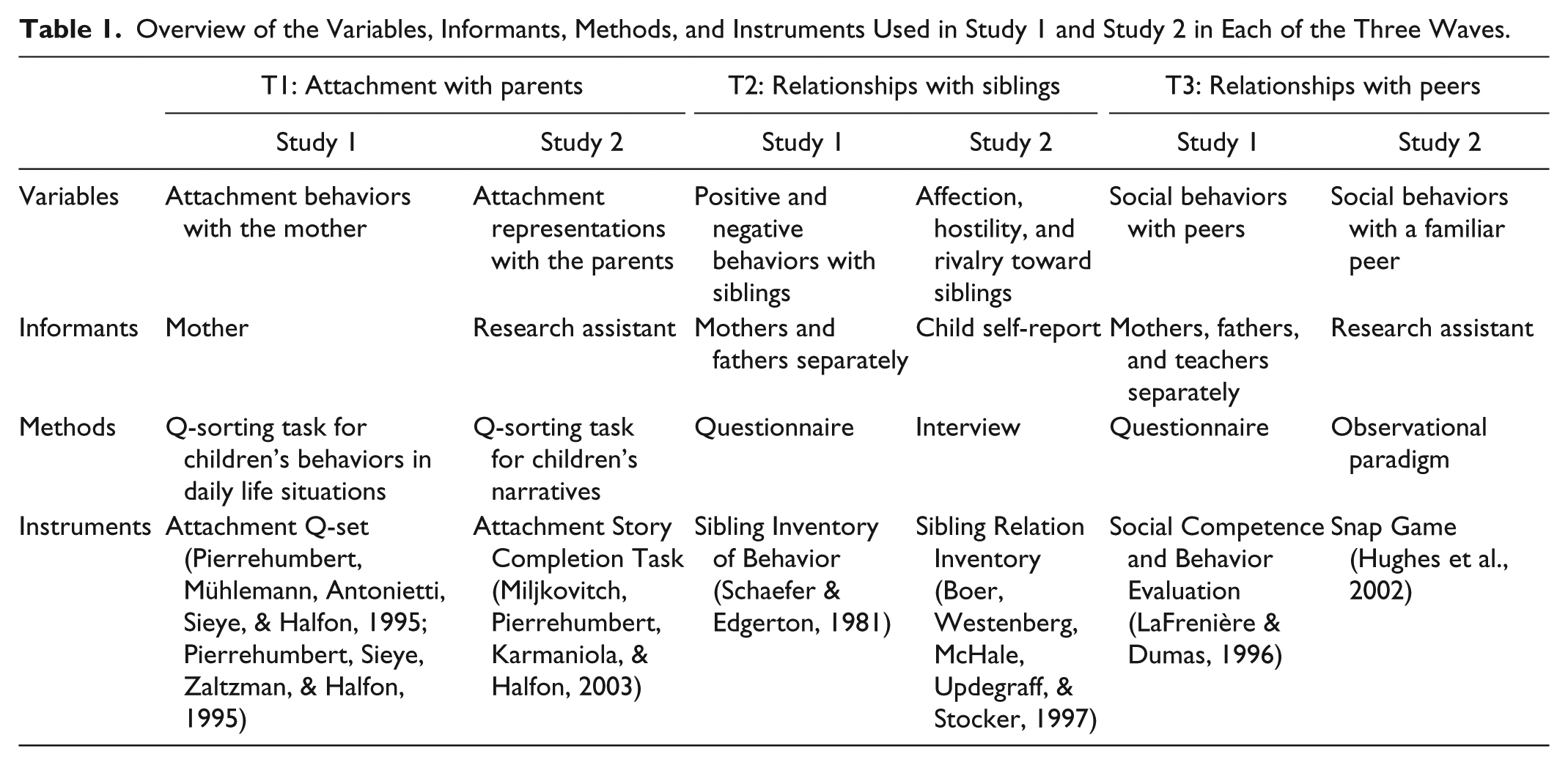
The two studies reported here were part of the H2M (Hard-t(w)o-Manage) Children research program conducted at the University of Louvain in Belgium which received the approval of the Ethics Committee of the Psychological Sciences Research Institute. An overview of the variables, informants, methods, and instruments used in the two studies in each of the three waves of data collection is given in Table 1. Three research assistants, who were all professional clinicians with a master’s degree and professional experience, were involved in the multi-method and multi-informant data collection. They were systematically trained in the procedure to be used.
Overview of the Variables, Informants, Methods, and Instruments Used in Study 1 and Study 2 in Each of the Three Waves.
Data Analysis
Preliminarily, correlations between the variables considered in the two studies were calculated. The main statistical analyses rely on the regression-based approach of Hayes (Hayes, 2013). SPSS 22.0 syntax adapted from the procedure of Edwards and Lambert (2007) and computed by the Statistical Methodology and Computing Service (SMCS) at the University of Louvain was used (Edwards & Lambert, 2007). Direct and indirect effects were estimated between attachment with parents and social competence with siblings and peers, in two longitudinal prospective studies using a multi-informant and multi-method strategy. Several coefficients were provided as follows: (a) the coefficient, confidence interval (CI), and amount of explained variance for the direct effect of attachment with parents on sibling relationships; (b) the coefficient and CI for the direct effect of attachment with parents on peer relationships when controlling for the direct effect of sibling relationships on peer relationships; (c) the coefficient and CI for the direct effect of sibling relationships on peer relationships when controlling for the direct effect of attachment with parents on peer relationships; (d) the amount of explained variance combining the effects of both attachment with parents and sibling relationships on peer relationships; and (e) the coefficient and CI for the indirect (or mediated) effect of attachment with parents on peer relationships. The test of the indirect effect by means of the computation of bootstrap CIs is an interesting alternative to the Sobel test of mediation (Baron & Kenny, 1986). First, because it does not make it necessary to postulate the normality of the product between two coefficients and, second, because it gives higher statistical power (Hayes, 2013). By contrast with a traditional H0 test, no p value is provided by such analysis. The interpretation relies on the two CI bounds. When these are both positive or negative, it can be assumed that in 95% of the cases, the estimated coefficient, that is, the product between two coefficients, is different from zero, in other words that there is an indirect effect of the variable x (attachment with parents) on y (social competences with peers) through the mediator (sibling relationships). In the current study, the number of bootstrap samples for percentile bootstrap CI was 10,000. The level of confidence for all CI was 95%.
Study 1
Sample
Data were collected from a final sample of 83 children (78% boys), their mothers, their fathers, and their teachers. All of them came from the French-speaking part of Belgium. The children were aged 4.10 (SD = .97), 5.21 (SD = 1.00), and 6.21 (SD = 1.03) at Time 1 (T1), T2, and T3, respectively. They were recruited from pediatric units at the Cliniques universitaires saint-Luc inBrussel . Of the 127 children who had been recruited, 29 were only children, and of the remaining 98, 83 (85%) had a complete data set to test the current hypotheses. The parents, who were mainly consulting the pediatric unit in connection with behavioral concerns about their child, were informed about the study and told that their child would be participating in a longitudinal research program. They were assured that the data would remain confidential. We excluded children with overall developmental delay or intellectual disability. This applied to children born prematurely (before 37 weeks), born with autism, dysphasia, or substantial language delay according to an examination by a speech therapist, or born with an IQ below 80 tested using the Wechsler Preschool and Primary Scale of Intelligence–Third Edition (WPPSI-III; Wechsler, 2004). All the children attended normal school. Of the children, 46 (55%) had one sibling, 26 (31%) had two, and 11 (14%) had three or more. Regarding sibling order, 31 (38%) were the oldest, 30 (36%) were the second, and 21(26%) were the third or subsequent child. The data were missing for 1 child. The educational level of the parents was calculated as the number of years of education they had completed, counting from first grade onward. Some had completed 12 years, corresponding to the end of secondary school and to compulsory education in Belgium, 19 mothers (23.75%) and 29 fathers (36.70%); others had completed 3 more years (corresponding to undergraduate studies), 44 mothers (55.00%) and 37 fathers (46.83%); others had gained a 4-year degree or more, 17 mothers (21.25%) and 13 fathers (16.45%). The data were missing for 3 mothers and 4 fathers. For the teachers, the educational level corresponded to a first university degree, as this is how teacher training is organized in Belgium. Note that no data were collected about family incomes. First, this measure is culturally unacceptable to the parents (Peterson, 2000). Second, family incomes are highly correlated to educational level in Belgium (Oakes & Rossi, 2003). Due to the current economic situation in the country, educational level is preferred as a more stable indicator than family incomes, which fluctuate. Of the parents, 75% of the couples were married and 25% were separated.
Procedure
At T1, at the moment of their visit to the pediatric unit, the mothers were asked to assess their child’s attachment behaviors. At T2, the mothers and the fathers were asked to complete separately a questionnaire assessing the relationships between the target child and his or her closest sibling in age. At T3, the mothers, fathers, and teachers completed items evaluating the children’s social behaviors with regard to their relationships with peers. At T2 and T3, the questionnaires were sent to the parents who sent them back to the research institute.
Measures
Children’s attachment behaviors toward their mother were assessed using the French version of the Attachment Q-Set (AQS) (Fr-AQS; Pierrehumbert, Mühlemann, Antonietti, Sieye, & Halfon, 1995; Pierrehumbert, Sieye, Zaltzman, & Halfon, 1995) previously published by Waters and Deane (1985). The items cover a broad range of secure base and exploratory behaviors. Those high in the security criterion sort include, for example, “Child uses mother’s facial expressions as a good source of information when something looks risky or threatening” or “Child is strongly attracted to new activities and new toys.” Because of time and material constraints, the coding was not done by a trained observer, as usually recommended (van Ijzendoorn, Vereijken, Bakermans-Kranenburg, & Riksen-Walraven, 2004). After some systematic information from the clinical research assistants about the content of the Fr-AQS and the method of coding it, the 79 items were sorted by the mothers. Items were sorted into a forced nine-category distribution according to the applicability of each item to their particular child. This distribution led to a continuous score ranging from +1.00 to −1.00, with a lower negative score indicating lower security and a higher positive score indicating greater security. It was obtained by correlating the child’s individual Q-sort description with the criterion sort provided by experts for a prototypically secure infant. The psychometric properties of the AQS have been reported to be good. In a meta-analysis of 139 studies with 13,835 children, van Ijzendoorn et al. (2004) demonstrated moderate convergent validity with the Strange Situation Procedure (r = .31) and moderate predictive validity with maternal sensitivity measures (r = .37). In line with these results, the validation study of the Fr-AQS highlighted convergent validity with the Strange Situation Procedure (Pierrehumbert, Mühlemann, et al., 1995). The Fr-AQS has also successfully been used with 4-year-old children in previous published studies (Roskam, Meunier, & Stievenart, 2011; Stievenart, Meunier, Van de Moortele, & Roskam, 2012).
Children’s relationships with siblings were rated by the mothers and the fathers separately with the Sibling Inventory of Behavior (SIB; Schaefer & Edgerton, 1981). This is a 32-item questionnaire encompassing three positive scales of Empathy, Companionship, and Teaching, and three negative scales of Rivalry, Aggression, and Avoidance. The positive scales comprise items such as “Tries to comfort [name of target child] when (she/he) is unhappy or upset.” The negative scales comprise items such as “Is very competitive against [name of target child].” Five-point Likert-type scales are provided under each item. To reduce the number of variables under consideration in the analyses, a principal component factor analysis was performed. Both the sample size and the moderate correlations among the positive (ranging from r = .37 to r = .71) and among the negative scales (ranging from r = .37 to r = .74) completed by the mothers and the fathers (ranging from r = .35 to r = .59) were considered to be sufficient to perform a factor analysis following the guidelines proposed by Floyd and Widaman (1995). Only the negative avoidance scale completed by the fathers was considered invalid, as it displayed a low correlation not only with the fathers’ aggression (r = .17) and rivalry (r = .11) but also with the mothers’ avoidance score (r = .09). Two factors were produced of positive sibling relationships encompassing mothers’ and fathers’ ratings of empathy, companionship, and teaching, and negative ones encompassing mothers’ and fathers’ ratings of aggression and rivalry plus mothers’ rating of avoidance. These explained 46.72% and 63.22%, respectively, of the variance, with factorial loadings ranging from .62 to .85 and good reliability with α = .76 and .85. The factorial scores were used for the analyses.
Children’s relationships with peers were evaluated with the Social Competence scale of the Social Competence and Behavior Evaluation–30 (SCBE-30) Questionnaire (LaFrenière & Dumas, 1996). The 10 items of the scale were completed by the mothers, the fathers, and the teachers separately. The Social Competence scale comprises items such as “Negotiates solutions to conflicts with other children” or “Is attentive towards younger children.” Six-point Likert-type scales are provided under each item. In our study, the Social Competence scale was reliable, with α = .82 for mothers, .72 for fathers and .91 for teachers. Both the sample size and the moderate correlations between the informants (ranging from r = .20 to r = .35) were considered to be sufficient to perform a factor analysis following the guidelines proposed by Floyd and Widaman (1995) and to enable a multi-informant strategy to be used (Roskam, Meunier, & Stievenart, 2013). A single multi-informant factor, “Social behaviors with peers,” was produced which explained 47.22% of the variance, with factorial loadings ranging from .67 to .71. The factorial scores were used for the analyses.
Results
The correlations between the variables are displayed in Table 2. The pattern shows moderate longitudinal relations between the constructs.
Correlations Between Attachment Behaviors With the Mother, Positive and Negative Relationships With Siblings, and Social Behaviors With Peers in Study 1 (N = 83).

p < .05. **p < .01. ***p < .001.
The direct and indirect effects of attachment behaviors toward the mother on positive behaviors with siblings and social behaviors with peers are presented in Table 3. The direct and indirect effects of attachment behaviors toward the mother on negative behaviors with siblings and social behaviors with peers are presented in Table 4. Very consistent findings emerged from the two models. Attachment security with the mother has a significant positive association with positive behavior toward siblings and a protective effect on negative behaviors with siblings 1 year later. Positive and negative sibling relationships have a direct effect on social behaviors with peers 1 year later when controlling for the effect of attachment. When controlling for the effect of sibling relationships, attachment was not related to social behaviors with peers 2 years later. An indirect effect of attachment security on social behaviors through sibling relationships was displayed.
Direct and Indirect Effects of Attachment Behaviors With Parents (x) on Social Behaviors With Peers (y) Through Positive Relationships With Siblings (Mediator) in Study 1 (N = 83).
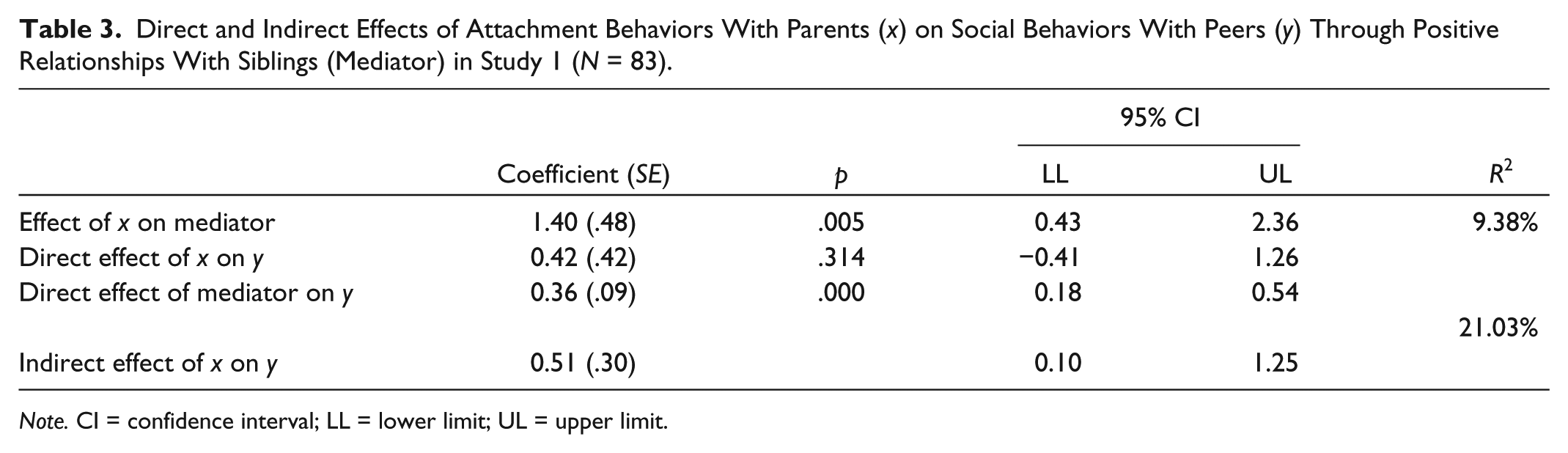
Note. CI = confidence interval; LL = lower limit; UL = upper limit.
Direct and Indirect Effects of Attachment Behaviors With Parents (x) on Social Behaviors With Peers (y) Through Negative Relationships With Siblings (Mediator) in Study 1(N = 83).
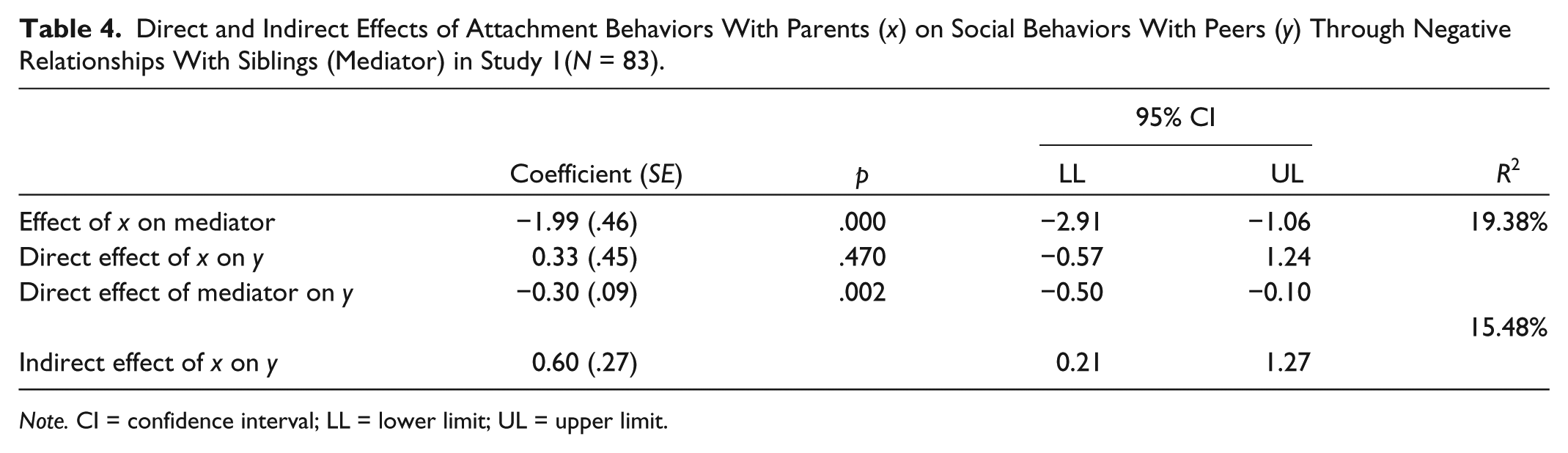
Note. CI = confidence interval; LL = lower limit; UL = upper limit.
Study 2
Sample
Data were collected from a sample of 190 children (45% boys). All of them came from the French-speaking part of Belgium. The children were aged 4.23 (SD = .89), 5.18 (SD = .96), and 6.10 (SD = 1.04) at T1, T2, and T3, respectively. They were recruited when the children were in the first to third kindergarten years in several elementary schools. Of the 318 children who had been recruited, 52 were only children, and of the remaining 266, 190 (72%) had a complete data set to test the current hypotheses.The parents were informed about the study and told that they would be participating in a longitudinal research program . They were assured that the data would remain confidential. Of the children, 121 (64%) had one sibling, 47 (24%) had two, and 22 (12%) had three or more. Regarding sibling order, 67 (35%) were the oldest, 85 (45%) were the second, and 37 (20%) were the third or subsequent child. The data were missing for 1 child. For the educational level of the parents, some had completed 12 years, 39 mothers (21.31%) and 56 fathers (30.27%); others had completed undergraduate studies, 93 mothers (50.81%) and 95 fathers (51.35%); and others had gained a 4-year degree or more, 51 mothers (27.86%) and 34 fathers (18.37%). The data were missing for 7 mothers and 5 fathers. As in Study 1, and for the same reasons, no data were collected about family incomes, and educational level was preferred. Of the parents, 73.6% of the couples were married and 26.4% were separated.
Procedure
At T1, the data collection was completed during a school visit. Children’s attachment representations were rated with a story completion task. At T2, the children were interviewed by the research assistants about their relationships with siblings (Meunier et al., 2012). At T3, the peer relationships were evaluated by means of an observation paradigm.
Measures
Children’s attachment representations with parents were assessed with the Attachment Story Completion Task (ASCT; Bretherton, Ridgeway, & Cassidy, 1990). Les Histoires à compléter, the French version of the ASCT, was used by the research assistants to assess the children’s attachment representations. The administration of the task was video recorded. The stories involved handling materials, and covered themes such as transgression, fear, separation from and reunion with parents, and the loss of a dog. The narratives were coded by the clinician research assistants using the Q-set procedure which was developed and validated among 3-to-5-year-old French-speaking children by Pierrehumbert (Miljkovitch, Pierrehumbert, Karmaniola, & Halfon, 2003). Items focus either on the content (e.g., “the child portrays the parents as available”) or on the formal characteristics of the narrative (e.g., “the child enacts emotions within the story”). The items are presented on cards. The first step of the coding procedure used by the research assistants in the current study is to sort the cards into seven piles (free distribution) from the most to the least characteristic of the child’s narrative. Then, a forced distribution is imposed by allowing only a specific number of cards in each pile. Each item receives a score (range = 1-7). Q-correlations are computed from the scores of the forced distribution, by comparing the children’s individual Q-set description with the criterion sort provided by experts for a prototypical secure child using Main and Cassidy’s pattern (Miljkovitch et al., 2003). These Q-correlations are continuous scores ranging from +1.00 to −1.00, with a higher positive score indicating greater security. Twenty percent of the video-recorded ASCTs were coded separately by two independent coders. The agreement between the two coders for the secure continuous scores of attachment was computed with intraclass correlations. It was .80, which is comparable with good intraclass correlations previously reported with ASCT (Miljkovitch, Pierrehumbert, Bretherton, & Halfon, 2004; Miljkovitch, Pierrehumbert, & Halfon, 2007), and similar to those recently reported with ASCT in a Swiss and a Spanish sample of 68 and 30 cases, respectively, randomly selected with a total of 10 judges. Intraclass coefficients for the secure Q-scores were .94 and .81 for the Swiss and the Spanish samples, respectively (Pierrehumbert et al., 2009). In our study, a K-Cohen coefficient for the coding of attachment security was also computed. This ranged from .62 to 1.00 with a mean of 0.78 (SD = .10).
Children’s relationships with siblings were rated with the Sibling Relation Inventory (SRI) Questionnaire. The three scales of the SRI (Boer et al., 1997), that is, Affection, Hostility, and Rivalry, were used in an interview to assess the children’s perceptions of sibling relationship quality. As has been done in previous research (Meunier et al., 2012), the questions were read to the children, who responded verbally. The children’s questions were completed in the presence of a clinician trained in data mining. There were eight items on the Affection scale, such as “How much do you admire [name of target child], five on the Hostility scale, such as “How often do you feel mad or angry at [name of target child],” and four on the Rivalry scale, such as “How often do you feel sort of jealous about your mother’s attention or affection toward [name of target child].” Whereas hostility items measure aggressive and conflictual behaviors plus negative affect toward siblings, rivalry focuses on children’s perception of favoritism and jealousy. Five-point Likert-type scales are provided under each item. The initial validation on 206 6- to 12-year-old American and 452 5- to 12-year-old Dutch siblings demonstrated good psychometric properties (Boer et al., 1997). The French version of the SRI has successfully been used in a previous published study (Meunier et al., 2011; Meunier et al., 2012). In the current study, reliability was satisfactory with α = .71, .68, and .77 for the Affection, Hostility, and Rivalry scales, respectively. These coefficients were similar to those reported in other validation studies (Touliatos, Perlmutter, Straus, & Holden, 2001). The three scales displayed a low correlation with coefficients of −.15 and .34, so that the scores of the three subscales were considered to assess specific aspects of relationships with siblings. They were, therefore, considered separately in the analyses.
Children’s relationships with peers were evaluated with an observational paradigm, the Snap Game (Hughes et al., 2002). This consists of a rigged competitive card game between two children. The Snap Game has been designed to elicit spontaneous interaction with peer, positive and negative affect, agitation and aggression. This procedure has been shown to be useful and valid in assessing behavior in young children (Hughes et al., 2002). It has successfully been used in several subsequent studies (Bendersky, Bennett, Lewis, Coles, & Black, 2006; Ensor, Hart, Jacobs, & Hughes, 2011; Meunier et al., 2011; Roskam et al., 2013). The children were asked during the school visit to pick one of their familiar classmates to play with. The video-recorded play session took place in a quiet room at school, with the research assistant present. Both children experienced frustration in half of the deals, and their behavioral reactions during these deals were observed. Social interactions, positive affect, negative affect, arousal, and aggression were coded at each losing deal using a 5-point Likert-type scale and taking into account the intensity and frequency of behaviors. For example, the criteria for rating aggression on the 5-point scale were as follows: 1 = no aggression, 2 = verbal assertion or masked aggression (says “it’s not fair” with irritation, hits his or her head.), 3 = explicit verbal aggression or sustained masked aggression (says “you’re cheating” with irritation, pretends to hit the peer.), 4 = excessive verbal aggression or episode of mild physical aggression, and 5 = extreme irritation or episode of explicit physical aggression. Each of the deals was coded separately by two independent coders. Agreement between two independent raters for 20% of the data were high (r = .94- .97). To limit the number of variables under consideration in the analyses, a single variable was computed by averaging the five dimensions of the observation (social interactions + positive affect + negative affect [reverse score] + arousal [reverse score] + aggression [reverse score])—so that a high score means positive behavior with the familiar peer.
Results
The correlations between the variables are displayed in Table 5. The pattern shows a marginal association between attachment representations and hostility in sibling relationships, a low to moderate longitudinal association between sibling relationships and social behaviors with a familiar peer, and a moderate association between attachment representations and social behaviors.
Correlations Between Attachment Representations With Parents, Affection, Hostility, and Rivalry With Siblings, and Social Behaviors With a Familiar Peer in Study 2 (N = 190).

p < .10. *p < .05. **p < .01. ***p < .001.
The direct and indirect effects of attachment representations on affection, hostility, and rivalry in sibling relationships and social behaviors with a familiar peer are presented in Tables 6, 7, and 8. In the three models, the direct effect of attachment representations on sibling relationships 1 year later was not significant. When controlling for the effect of sibling relationships, attachment representations with parents had a significant direct effect on social behaviors with a familiar peer 2 years later. Hostility and rivalry had a significant effect on social behaviors with a familiar peer 1 year later when controlling for attachment effect. This was not the case for affection among siblings. Finally, an indirect effect of attachment on social behaviors through sibling relationships was only found for hostility.
Direct and Indirect Effects of Attachment Representations With Parents (x) on Social Behaviors With a Familiar Peer (y) Through Affection With Siblings (Mediator) in Study 2 (N = 190).
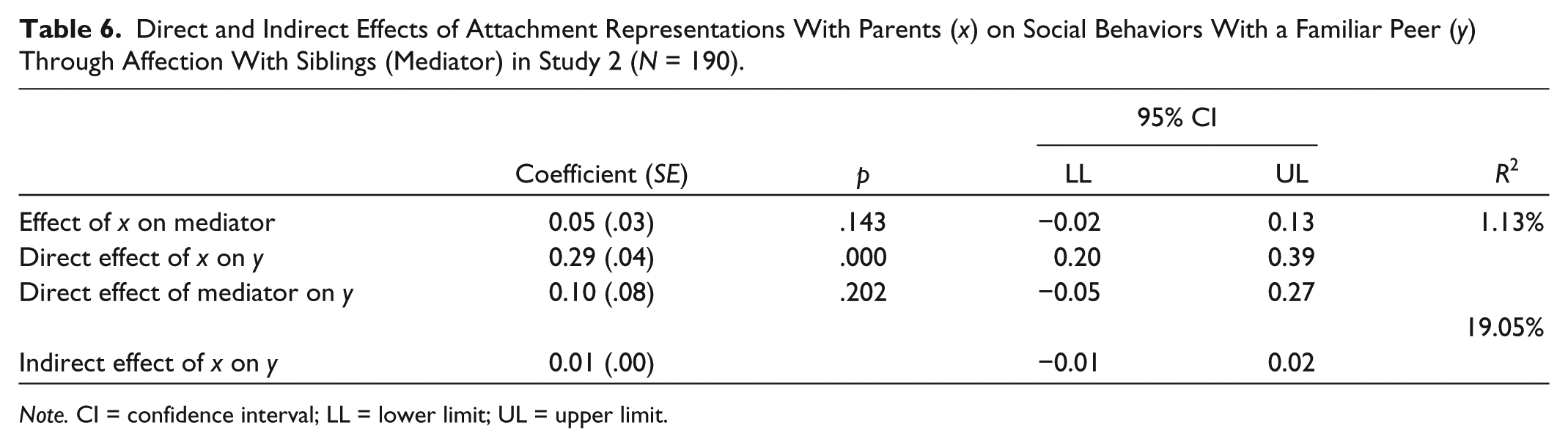
Note. CI = confidence interval; LL = lower limit; UL = upper limit.
Direct and Indirect Effects of Attachment Representations With Parents (x) on Social Behaviors With a Familiar Peer (y) Through Hostility With Siblings (Mediator) in Study 2 (N = 190).
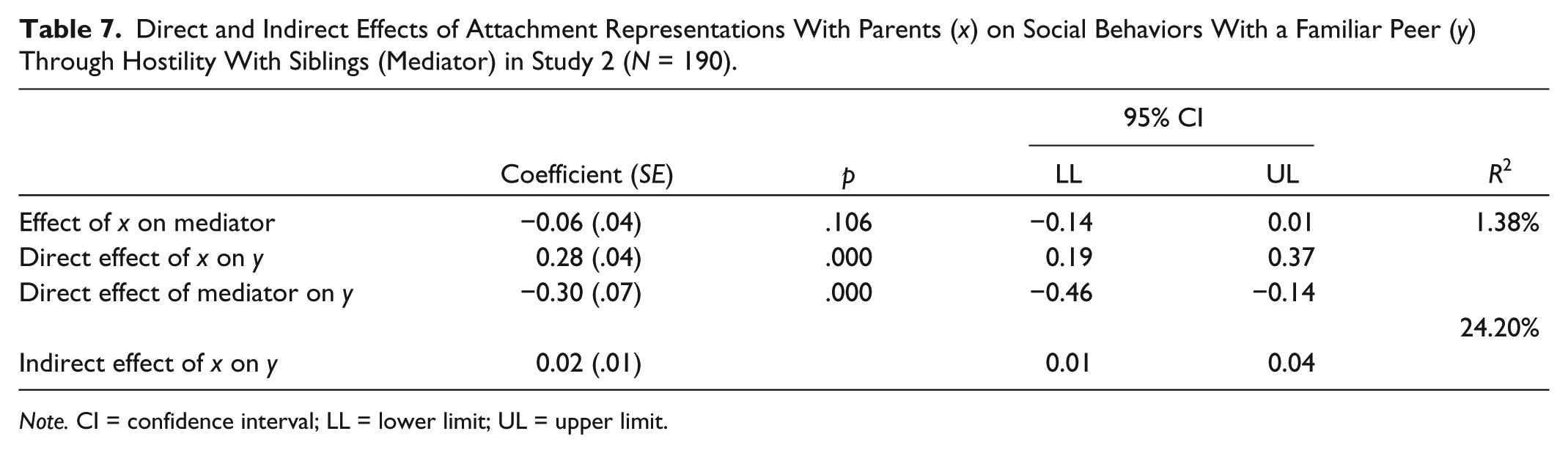
Note. CI = confidence interval; LL = lower limit; UL = upper limit.
Direct and Indirect Effects of Attachment Representations With Parents (x) on Social Behaviors With a Familiar Peer (y) Through Rivalry With Siblings (Mediator) in Study 2 (N = 190).

Note. CI = confidence interval; LL = lower limit; UL = upper limit.
Summary and Concluding Discussion
The objective of the current study was to test the hypotheses arising from the epigenetic view of social development and from the wider perspective offered by the social network model with three interactional systems, that is, child–parent, child–sibling, and child–peer. In line with previous empirical findings related to the two theoretical backgrounds, equivocal results were found in the two studies.
With regard to the epigenetic view, attachment was found to explain a significant part of children’s later social relationships, but this was limited to relationships with siblings in Study 1 and to relationships with peers in Study 2. In line with the assumption of a hierarchy between the interactional systems, no significant relation was expected between sibling and peer relationships when controlling for the influence of attachment. The results were consistent in the two studies. They show that, by contrast with what was expected, relationships with siblings were associated with later relationships with peers over and above attachment effect. The full mediations displayed in the two models from Study 1 suggest that rather earlier attachment playing a central role in subsequent social development, later relationships with siblings also have an enduring impact. However, Study 2 provides only extremely weak support for the one indirect effect with direct effects being much stronger than that effect.
With regard to the social network model, modest relations were expected between the three interactional systems. These were consistently found between relationships with siblings and peers in the two studies, except in the case of affection among siblings in Study 2. In line with the expectations arising from the social network model, they show that relationships with siblings were associated with later relationships with peers over and above attachment effect. However, the results found for attachment effect were less consistent with the predictions of a modest association with both siblings and peers interactional systems. Attachment was seen to be related to sibling relationships in Study 1 and to peer relationships in Study 2. However, bivariate correlations were coherent with the idea that a limited part of variations in children’s social relationships can be explained by variations in attachment.
How could these equivocal results be explained?
First, the two theoretical backgrounds should not be regarded as contradictory. They differ from each other in the extent to which early childhood experiences of attachment with the parent affect subsequent development. Consequently, they differ in the extent to which other interactional systems have an enduring impact on social development. But both recognize the importance of the child’s earliest experiences and they posit a certain continuity in social development. Although the epigenetic view clearly postulates interdependence between attachment and later relationships, the social network model posits a relative independence between the interactional systems. In this sense, the social network model appears to be difficult to investigate or even to contradict. As the different interactional systems may or may not share common elements (Lewis, 2005), both the absence and the presence of significant associations between the variables could be regarded as supporting the theoretical background. It could, therefore, be concluded that the equivocal results displayed in the current research are more in favor of the social network model than of the epigenetic view. But such a conclusion has to be drawn with caution.
Second, although the multi-informant, multi-method design of the current article may be regarded as a strength, it also prevents us from disentangling methodological from conceptual effects. Differences between the two studies could be due to variations in both informants and instruments, or to variations in concepts that have been reliably measured. For attachment, the mothers’ appraisal of their children’s attachment behaviors could be different from the researchers’ evaluation of the children’s representations. From a conceptual point of view, the two instruments considered in the current article, that is, the Fr-AQS and the Fr-ASCT, may not assess the same feature of the attachment concept. On one hand, the Fr-AQS assesses children’s attachment behaviors that are specific to the relationship between mothers and their children in daily situations. On the other hand, the Fr-ASCT assesses the behavioral component of the children’s internal working model (IWM), particularly those aspects involved in the parent–child relationships reflected in the story stems. In this way, they could be considered as non-interchangeable measures of attachment (Stievenart et al., 2012). The instruments used also make it impossible to distinguish between the contributions of mother–child and father–child attachment. For sibling relationships, the parents’ assessment of their offsprings’ behaviors toward each other may differ from the children’s self-perceptions. Low cross-informant agreement has been reported in previous research between parent-reports and self-reports (Achenbach, McConaughy, & Howell, 1987; Gross, Fogg, Garvey, & Julion, 2004). Conceptually, it may also be argued that ambivalence in sibling relationships was present in 5-year-old children’s perceptions because of Oedipus complex concerns (Kaës, 2008). According to this hypothesis, both affection and hostility/rivalry could be simultaneously present for some children, leading to less consistent results in Study 2. Finally, for peer relationships, mothers’, fathers’, and teachers’ assessments could differ from a researcher’s standardized observation. Moreover, the social behaviors evaluated through the checklist were different from those targeted in a specific manipulated context. Conceptually, social behaviors encompass a wide range of attitudes and concepts, as illustrated in the “Introduction” section. It may be that the transfer between the transactional systems is limited to certain social behaviors, especially those which are acquired and trained in earlier interactions. For other behaviors, the model of independence would be more suitable. Unfortunately, the instruments used in the two studies do not allow an accurate distinction to be made between specific concepts. Future research is needed to explore these points of discussion. Despite these uncertainties, multi-informant, multi-method studies remain a relevant strategy to produce nuanced results in the absence of gold standard measures for the concepts under consideration.
Third, the studies’ differing findings may be due to the fact that they included different samples. Whereas Study 1 was conducted with a sample of children referred for behavioral problems, Study 2 was conducted with a community sample. Inter-individual differences could help to explain variations in the results. For example, it may be that differences in temperament between referred and normally developing children explain variations in the associations between the constructs. Children with a difficult temperament (Rothbart & Bates, 2006) could, for example, end up having similar relationships with their mothers, siblings, and peers over time, leading to more interdependence between the interactional systems over time (Muris & Ollendick, 2005; Pierrehumbert, Miljkovitch, Plancherel, Halfon, & Ansermet, 2000). Conversely, children with an easier temperament may experience more diverse interactions with their parents, siblings, and peers over time. Temperament was unfortunately not considered in the current research, and needs to be studied for its potential moderating effect in the two models that were tested.
Fourth, the discrepancy between the results of the two studies leaves room for other factors to play an important role in the ontogeny of social development. Among these factors, the important role played by caregivers other than the parents, such as grandparents or workers at day care centers, should be explored in future studies. If a wide social network is taken into account, it may turn out to be the case that a child who is not very securely attached with his or her parents will not be completely impaired in subsequent relationships, thanks to the sense of security gained in other close relationships. The same appears to be true for children whose sibling relationships were not positive. Their social development could benefit from other protective factors counterbalancing the negative influence of low security and helping them to develop resilience (Lewis, 2005).
Although important from both the clinical and research perspectives, this study is by no means definitive. Several limitations are methodological. First, attachment was rated at age 4, assuming continuity from the earlier years. Second, because of practical concerns, the AQS sorting task was carried out by the mothers rather than by a trained observer as recommended. Third, the assessment of attachment used in the two studies provided a continuous security score for children, preventing us from differentiating between children with positive or negative attachment styles and consequently, from testing the possible reparatory effect of later relationships especially for insecure children. Fourth, we did not control for the number of siblings or for sibling order. Other relevant variables such as child temperament or family adversity were also not taken into account. Fifth, despite the longitudinal prospective design, we cannot be sure that the relations between the three interactional systems are causal. In this respect, cross-lagged analyses would add statistical precision by controlling the stability of the concepts over time as well as by testing the reciprocity between the interactional systems under consideration.
Numerous other research perspectives are also possible. For example, it would be interesting to replicate the longitudinal prospective design with older children and adolescents, as interdependence between the interactional systems could vary according to the developmental period. In the current study, the 1-year interval between the three waves may have led to significant coefficients being displayed which could not be replicated with longer intervals. Another research perspective is the cross-cultural one. Such an approach to analyzing and testing the two hypotheses could be stimulating. In particular, the interdependence of several interactional systems could be studied in cultures varying in their degree of individualism versus collectivism, especially because of their consequences on the number of primary caregivers, on the role of siblings and peers in child development, and, in general, on the function played by each interactional system in which the child participates.
In conclusion, in two prospective longitudinal studies using a multi-informant and multi-method strategy, it was shown that attachment to parents explains a limited part of variations in later social relationships with siblings and peers, and that other interactional systems, in particular the sibling system, have a consistent and enduring effect on later peer relationships. With regard to the two theoretical backgrounds under consideration, neither was able to account for equivocal findings displayed in our two studies as well as in previous research. The wonderful story of social development seems to be a very complex process for which new models are needed.
Footnotes
Declaration of Conflicting Interests
The author(s) declared no potential conflicts of interest with respect to the research, authorship, and/or publication of this article.
Funding
The author(s) received no financial support for the research and/or authorship of this article.