




Abstract
This study investigates the educational and regional determinants, as well as education-related inequalities, in early marriage among women in Türkiye, utilising data from the 2003 to 2018 rounds of the Turkish Demographic and Health Surveys. Logistic and ordinary least squares regressions were applied to explore the factors influencing early marriage. Concentration indices and their normalised and corrected versions were calculated to quantify education-related inequalities, and Oaxaca-Blinder decomposition was conducted to identify the drivers of these inequalities between western and eastern of Türkiye. Findings reveal that women’s and husbands’ education levels, along with regional differences, significantly affect early marriage, while parental education shows no notable influence. The analysis highlights that early marriages are more prevalent among less-educated women, with greater homogeneity observed in eastern regions. Decomposition results indicate that disparities in women’s and husbands’ education are the primary contributors to regional inequalities in early marriage. Addressing these inequalities requires not only ongoing educational interventions but also targeted programmes to reduce regional and developmental disparities, thereby fostering greater equity.
Plain Language Summary
Early marriage has significant social, economic, and health implications, particularly for women. We examined the educational and regional determinants, as well as education-related inequalities in early marriage among women in Türkiye, exploiting the data from the 2003, 2008, 2013, and 2018 rounds of the Turkish Demographic and Health Surveys. We employed logistic and ordinary least squares regressions to address the predictors of early marriage. We calculated concentration indices and their normalized and corrected versions to measure education-related inequalities in early marriages. We also performed Oaxaca-Blinder decomposition to understand the dynamics behind education-related inequalities between the western and the eastern parts of Türkiye. Results indicate that women’s and husbands’ educational levels, and regional differences have significant impacts on early marriage while parental education has no observable impacts. Moreover, the analyses of education-related inequalities suggest that early marriages are more concentrated among less-educated women, with higher homogeneity in the eastern (developing) part of Türkiye. Women’s and husbands’ educational status emerge as the primary factors contributing to the inequalities in early marriage between the western and the eastern of Türkiye. The programs targeting regional disparities and developmental issues are essential to reduce early marriage, early marriage inequalities and the underlying inequalities that contribute to their persistence.
Keywords
Introduction
Early marriage implies the marriages occur before the age of 18 (Hervish & Feldman-Jacobs, 2011). It is problematic since it has important results for public health, social development, human rights, economic development and gender equality (Walker et al., 2013).
In Türkiye, the prevalence of early marriage has shown a declining trend over the past two decades. According to the Advanced Statistical Analysis of Family Structure, the rate of early marriage decreased from 16.7% during 1997 to 2006 to 8% during 2007 to 2016 (Republic of Turkey Ministry of Family, Law and Social Services, 2019). Based on the 2018 Turkish Demographic and Health Survey (TDHS), 15% of women aged 20 to 24 were married before 18, highlighting the continued relevance of this issue (Hacettepe University Institute of Population Studies, 2019). In contrast, official records from the Turkish Statistical Institute (TÜİK) report that only 3.8% of girls aged 16 to 17 entered into legal marriages in 2018 (TUIK, 2018), with the most recent 2024 data showing a further decrease to around 0.7% for the same age group (TUIK & UNICEF, 2025). However, striking disparities exist regionally—early marriage rates reach as high as 13% to 15% in the eastern provinces, while markedly lower in the western provinces, ranging from 0.7% to 1% (TUIK & UNICEF, 2025).
Early marriages are a matter of concern due to their negative effects on women’s physical, mental, and emotional developments and well-being (Mensch et al., 2014). It is often related to early age at first childbirth when the physical growth and physical development of the woman are incomplete (Senderowitz, 1995). It is widely stated that early childbirth can have adverse health consequences for both the woman and the child (Patel & Sen, 2012). In addition, early marriage provokes obstacles to education as women are forced to leave school for caring and childbearing purposes (McCleary-Sills et al., 2015). This obviously leads to negative economic (Parsons et al., 2015), social, and health (UNICEF Staff, 2011) outcomes for them in consequence. The age at the time of marriage, may also have social effects on the relationship (Mensch et al., 2014) since the literature stresses that early married women may have less control, prestige, and autonomy at home (Mason, 1986). In addition to these, studies suggest important consequences for the societies including higher population growth, increased health-related problems, a higher incidence of orphans, and higher rates of women illiteracy (Dahl, 2010; Frost & Rolleston, 2013; Sabbe et al., 2013).
While these foundational studies provide the basis for understanding the negative consequences of early marriage, more recent evidence highlights its ongoing relevance in Türkiye and beyond. Yilmaz et al. (2022) examined the socio-demographic characteristics of girls seeking judicial consent for marriage at ages 16 to 17, showing the continued demand for legal child marriage exemptions. Taplak and Yılmaz (2022) provided qualitative insights into adolescent motherhood, underlining the burdens of early caregiving and the lack of preventive strategies. Baysak et al. (2021) revealed persistent psychosocial and economic challenges among the women who married before 18 in İstanbul. Gülbetekin and Yildirim (2024) demonstrated a strong correlation between attitudes toward child marriage and domestic violence awareness in Iğdır, one of the eastern provinces. From a global perspective, Pourtaheri et al. (2023) conducted a systematic review showing that education, socioeconomic disadvantage, and cultural norms remain central drivers of child marriage, underscoring the need for continued monitoring in middle-income countries like Türkiye.
At the global policy level, Sustainable Development Goal 5.3 mandates the elimination of child marriage, yet UN data indicate progress is far from sufficient, with millions still affected and targets off track (SDG Indicators, 2023; SDG Knowledge Hub, 2025). UNICEF–UNFPA joint programmes reinforce the urgency of multisectoral approaches to accelerate the change (UNICEF & UNFPA, 2023, 2025). In Türkiye, UNICEF has supported the development of national strategies and local interventions to tackle with early marriage, while UNFPA’s 2020 report documented five-decade trends and programmatic guidance (Ergöçmen et al., 2020).
It is well stated that lower educational status of women as well as of their parents are associated with relatively high rates early marriage (Jensen & Thornton, 2003; Wong, 2005). It is also reported that early marriages are higher among the families with lower familial income levels (Nasrullah et al., 2014). Studies indicate that being employed and having a higher level of individual income delay women’s age at first marriage (Gangadharan & Maitra, 2003; Raz-Yurovich, 2010). In addition to these, urbanisation is also associated with the decreases in early marriages (Carmichael, 2011). It is suggested comparatively high probabilities of early marriage in rural areas (Lowe et al., 2019). Türkiye’s eastern and western regions are generally characterised as developing and developed areas, respectively. In this context, comparing the eastern and western parts of Türkiye is crucial for understanding the regional development gap.
Examining the changes in early marriage over time and across regions provides valuable insight into the dynamics of social and family structures in Türkiye. While previous studies have highlighted the determinants of early marriage, comprehensive analyses that cover extended periods and explore education-related inequalities across regions remain limited. This study addresses this gap by analysing early marriages over a longer period (2003–2018). By measuring education-related inequalities using concentration indices and decomposing the regional disparities between eastern (developing) and western (developed) parts of Türkiye, the study provides a deeper understanding of how educational and regional factors shape early marriage patterns. The discrepancy between survey-based and official statistics further underscores the persistent social and regional disparities, highlighting the importance of considering both formal and informal unions. By doing so, this research not only fills a critical gap in the Turkish context but also offers evidence that is relevant for understanding early marriage dynamics in other developing countries, informing policies and programmes aimed at reducing educational and regional inequalities in early marriage.
Methodology
We use the data of the 2003 to 2018 rounds of Turkish Demographic and Health Surveys (TDHS) to examine the determinants and education-related inequalities of early marriage of women living in Türkiye. TDHS, which is the Turkish version of DHS surveys applied worldwide, is a country-wide cross-sectional survey that has been repeated every 5 years. The survey collects the data of the women at reproductive age (15–49) who are married at least once at some point in their lives. It contains a generous bunch of information including social, economic, and demographic features. The survey contains 8.075 individual interviews with the ever-married women at reproductive age in the 2003 round (TDHS, 2003), 7.405 interviews in the 2008 round (TDHS, 2008), 9.746 interviews in the 2013 round (TDHS, 2013), and 13.144 interviews in the 2018 round (Hacettepe University Institute of Population Studies, 2019).
We perform logistic and ordinary least squares estimations to identify the educational determinants of early marriage of women living in Türkiye. The models established contains the educational status of (i) the women of interest, and (ii) of their husbands, and (iii) of their parents. Additionally, some regional factors including place of residence and region where the respondent lives are also controlled in the models. In this study, early marriage was measured using the age at first union variable available in the TDHS dataset. The dependent variable is originally recorded as a continuous measure. For the purposes of our analysis, we recoded it into a binary indicator, assigning a value of 1 if the respondent entered her first union before the age of 18 and 0 if at age 18 or older. All variables were coded as binary indicators (0/1). In this coding structure, the mean values reported in the descriptive statistics table reflect the proportion of respondents who fall into the respective category. For variables with multiple categories, a set of binary indicators was created for each category. In the regression models, one of these indicators was designated as the reference group, and the coefficients of the other categories were interpreted relative to this reference. The summary statistics of the variables used in the models are presented in Table 1.
Descriptive Statistics.

Reference category.
The regression models employed in the study can be illustrated with the following formulas:

where
In addition to OLS, we use the logistic regression design to estimate early marriage determinants. The logistic regression and its marginal effect formulas can be written for our study following:

where

The probability of

Taking the ratio of Equations 2 and 4 gives the odds ratio in favour of early marriage.

Taking the natural logarithm of Equation 5, we obtain the log of odds ratio. In this way, we have the linear function of early marriage.

We used the marginal effects to compare with OLS coefficients. Since the ME and OLS estimations are very close, we take the OLS coefficients to calculate and to decompose the education-related inequalities in early marriage.
Afterwards we calculate concentration indices to measure education-related inequalities of early marriage. The concentration index, originally developed to measure health inequalities, is applied in this study to detect the level of education-related inequalities in early marriage in relation to individuals’ educational attainment (Erreygers, 2009). It was introduced by Kakwani (1980) and Wagstaff (2009). It takes the values between −1 to 1 while positive values of the index imply the state of good health favouring the well-off, and vice versa (Kakwani et al., 1997). The concentration index can be calculated using the convenient regression approach of Kakwani et al. (1997) as shown below:

where

where h is the interest variable, early marriage in this study,
This normalisation (Wagstaff, 2005) was specific to the case of the binary variable of interest (Wagstaff, 2009). However, Erreygers (2009) generalises the normalisation and introduces a corrected concentration index which also facilitates to remedy the bounds issue (Erreygers, 2009). Accordingly, the corrected concentration index can be written as:

where,

where
Subsequently, we performed Oaxaca-Blinder decomposition (1973) to reveal education-related inequalities between western and eastern parts of Türkiye over time. Accordingly, western Türkiye forms the most developed part of the Türkiye while eastern Türkiye reflects the least developed one. Hence, we identify the education-related inequalities in early marriage between the regions with different levels of development and expose the educational characteristics affecting such inequalities. The Oaxaca-Blinder decomposition of the education-related inequalities in early marriage between eastern and western Türkiye can be performed using the formula illustrated below:


where y is the outcome variable, X is a vector of characteristics, β is a vector of slope parameters including intercept, ε is the errror term, Δ denotes the first differences, ηk; is the elasticity of y with respect to k regressor for regarding group (w: west and e: east), C represents the concentration indices for k regressors, GCεt is the generalised concentration index for the error term, and μ is the mean of the outcome variable.
Results
Determinants of Early Marriage
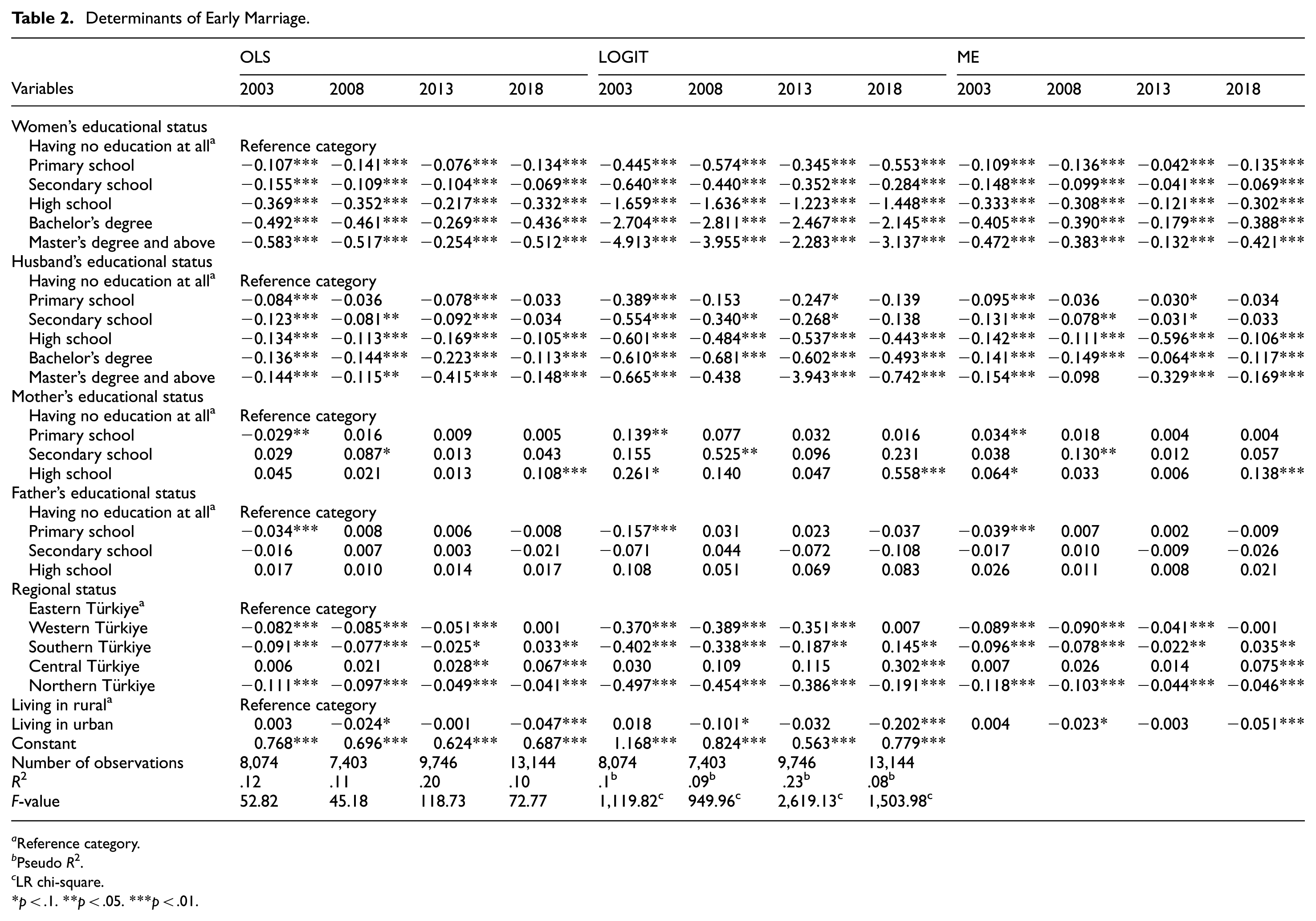
The results of the estimations performed are presented in Table 2. Accordingly, the first column of the Table 2 illustrates the variables employed in the models. The following four columns demonstrate the linear regression estimations for 2003, 2008, 2013, and 2018, respectively. Following sets of four columns depict the logistic regression estimates and the results of their marginal effects for 2003, 2008, 2013, and 2018, respectively.
Determinants of Early Marriage.
Reference category.
Pseudo R2.
LR chi-square.
p < .1. **p < .05. ***p < .01.
It is understood that the findings of logistic and ordinary least squares (OLS) regressions are in line. Besides, the marginal effects obtained after the logistic regression and the OLS coefficients are close to each other. Accordingly, women’s educational status, husbands’ educational status and region have significant influences on early marriage among women living in Türkiye. In contrast, no significant influences of parents’ educational status are observed.
Additionally, the findings indicate a clear trend that early marriage decreases with increasing levels of education of the respondent herself, as expected. In other words, women with primary, secondary, or higher education are less likely to marry early compared to women with no education at all, which serves as the reference category. There seems another trend that early marriage is about to decrease with increasing level of husbands’ education implying that more educated husbands are less likely to marry women under 18 years of age compared to husbands with no education at all. Finally, regional differences are evident. Using eastern Türkiye as the reference category, the coefficients for western, southern, and northern regions are negative, indicating that early marriage is less prevalent in these relatively more developed regions compared to the eastern region.
Education-Related Inequalities in Early Marriages
Measuring Inequalities
We calculate concentration indices Kakwani (1980) and their normalised (Wagstaff, 2005) and corrected versions (Erreygers, 2009) (as the outcome variable is binary) to measure education-related inequalities in early marriages in study period, respectively. The indices are calculated for Türkiye as a whole as well as for its eastern and western parts solely, to understand the distributions of early marriage in different parts of Türkiye with different levels of development. The results of inequality measurements are presented in Table 3.
Concentration Indices.

p < .01.
The findings suggest that education-related inequalities in early marriage are more concentrated among less-educated individuals in Türkiye since the signs of the indices are negative. As for the regional comparison, it seems that education-related inequalities in early marriages are higher in western Türkiye implying that the distribution of early marriage is less homogenous in western Türkiye. For the eastern part, it is observed that the education-related inequalities are decreasing in the 15 years period of interest. In other saying, early marriage becomes more homogenous among the individuals living in eastern Türkiye and ranked according to their educational status.
After examining average early-marriage rates across different educational groups in eastern Türkiye, it is thought that such homogenous distribution of education related early marriage inequalities over time may be related to increasing educational attainment of early-married eastern women after their early marriage. As for western Turkey, it seems that education related inequalities in early marriage tend to decrease in the period between 2003 and 2013. Once the mean values of early-marriage across different educational groups in western Türkiye were analysed, it is understood that such decrease in the inequalities may be related to greater decreases of early-marriage among low-educated western women compared to those among high-educated western ones. As for the sharp rise in education related early marriage inequalities in 2018 for western Turkey, it is believed that such rise stems from the notable increase in early marriage among non-educated women living in western Türkiye.
Taking increasing early marriage rates in eastern Türkiye in 2013 (TDHS, 2013) into the consideration, this finding may be related to increasing early marriage rates of those with relatively high education living in the eastern part.
Decomposition of the Inequalities
We employed Oaxaca-Blinder decomposition (1973) to understand the mechanisms behind education-related inequalities between the most developed (western) and the least developed (eastern) parts of Türkiye. Accordingly, regressors’ contributions can be interpreted as follows: if the distributions of related variable were equal in eastern and western Türkiye, or if the related variable had zero elasticity, the education-related inequalities would be that much higher (or lower if the sign is positive; Table 4).
Decomposition of the Inequalities.
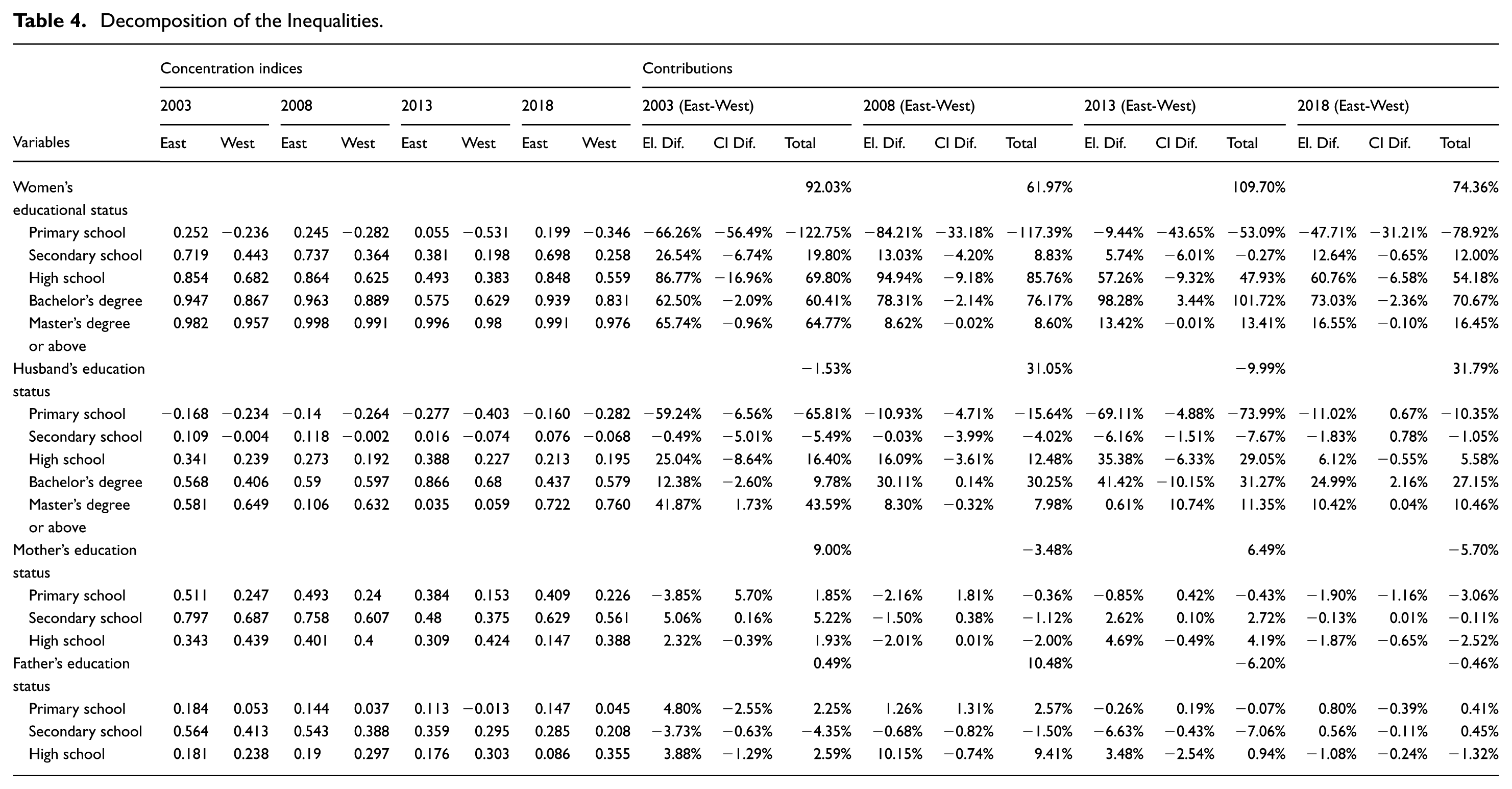
Findings suggest that elasticity differences between eastern and western Türkiye dominate the inequality differences. In other saying, partial associations between the covariates and early marriage are more influential than education related inequalities of the covariates. The inequalities between eastern and western Türkiye predominantly arise from different effects of the covariates in these regions. In addition, the major factor contributing to education-related inequalities in early marriage between these regions with different level of development is the respondent’s own educational status (Table 4).
The close characteristics of non-educated women in the eastern and western Türkiye significantly reduces education-related early marriage inequalities. Such reduction is driven by the partial associations between having no education and early marriage in eastern and western Türkiye. Different effects of higher educational status on early marriage in both regions play roles in increasing education related early marriage inequalities in all years. The similar pattern is also valid for husbands’ education since the similarities in the partial associations between early marriage and husbands’ low educational status between eastern and western Türkiye decrease the inequalities in all rounds. In contrast, different effects of husbands’ higher educational status on early marriage in these regions, increase education related early marriage inequalities. Taking all these contributions into the consideration, it seems clear that the characteristics of lower educated groups (of both respondents and husbands) across the eastern and the western Türkiye are close to each other. On the other hand, the characteristics of higher educated groups (of both respondents and husbands) differ across these regions. The education related inequalities in early marriage between the eastern and western part of Türkiye stem from such differences of higher educated groups (of both respondents and husbands; Table 4).
Discussion
We utilise data from Turkish Demographic and Health Survey rounds (2003–2018) to analyse educational determinants and education-related inequalities in early marriage between western and eastern parts of Türkiye. As a result, we reveal that educational status of women and of husbands, and the region where the family live have significant influences on early marriage among women living in Türkiye. In contrast, no significant influences of parents’ educational status are observed.
It is identified that higher levels of education of women are associated with significant decreases in the probability of early marriage, confirming previous evidence (Belachew et al., 2022; Kuswanto et al., 2024; Rashid et al., 2024). According to Marphatia et al. (2019) women with education are more likely to marry after age 18 than women without education. Fitria (2024), using data from rural Indonesia, confirms that higher educational attainment substantially reduces early marriage risk. This finding is particularly important since women’s educational status is closely linked to empowerment, autonomy, and improved life outcomes, aligning with global commitments including the Sustainable Development Goal 5.3, which aims to eliminate child marriage (SDG Knowledge Hub, 2025). In addition, the findings of this study reveal a trend that early marriage is about to decrease with increasing levels of husbands’ education. Such findings are consistent with previous studies (Bao & Cho, 2024; Khan et al., 2024; Liang & Yu, 2022; Nhampoca & Maritz, 2024). Highlighting the role of husbands’ education provides an additional contribution to the literature, as it underscores how household dynamics and partner characteristics also shape early marriage patterns, beyond women’s own education.
Regarding education-related inequalities in early marriage, our results indicate that early marriage is more concentrated among less-educated women in Türkiye, aligning with global patterns. This finding is also consistent with existing literature (Acar, 2022; Jensen & Thornton, 2003; Lundberg et al., 2016). For instance, Pourtaheri et al. (2023), in a systematic review, reports that enhanced women’s education significantly reduces child marriage prevalence, especially in lower-middle-income contexts. Furthermore, Raj et al. (2019) underscores that promoting girls’ education is a critical strategy for reducing early marriage across diverse settings. While prior studies have largely focused on determinants, this study extends the discussion by quantifying education-driven inequalities in early marriage. This is an important contribution given that long-term analyses of education-based inequalities remain limited in the Turkish context. Furthermore, by examining Türkiye—an upper middle-income country undergoing rapid demographic and social transformation—this study adds valuable comparative insights to the global literature, which is often dominated by either low-income or OECD country cases.
Higher education often leads to greater awareness of the consequences of early marriage, including economic and health implications, which may encourage individuals to delay marriage (Raymo, 2003). Educated women may have greater career ambitions and opportunities, making them less likely to marry early as they focus on their education and professional development (Allen & Kalish, 1984). As education levels rise, societal attitudes towards early marriage may shift, with increased emphasis on the importance of education and personal development (Watson, 2014). While these hypothesised pathways are supported conceptually within the literature, our study contributes by empirically demonstrating these associations within the Turkish context using educational inequality analyses.
Inequality analysis across regions with different levels of development highlights that education-related inequalities in early marriage is higher in western Türkiye implying that the distribution of early marriage is less homogenous in western Türkiye. Additionally, our results show that early marriage is comparatively less prevalent in the more developed (western) parts of Türkiye than in the less developed (eastern) regions, a pattern consistent with earlier Türkiye-specific studies and local qualitative work reporting higher incidences and more permissive attitudes toward early unions in eastern provinces (Baysak et al., 2021; Ertem & Kocturk, 2008; Onen & Ocal, 2022). This geographic gradient is consistent with broader evidence that region and place matter for child-marriage prevalence, reflecting local socioeconomic, cultural and structural differences (Ahinkorah et al., 2024; Marphatia et al., 2019; M. Singh et al., 2024). In addition, our findings suggest that education related inequalities in early marriage tend to decrease over time in eastern Türkiye, which may be related to of educational attainment of early married eastern women after some time of their marriage as (i) the educational opportunities have increased and (ii) the attitude towards women education has changed over time in eastern Türkiye (Çöker, 2020). As for the western Türkiye, the inequalities tend to decrease until 2013 owing to greater decreases in early marriage among lower education groups. There seems a sharp rise in the inequalities in 2018 for the western part of Türkiye, which may be associated with the considerable increase in early marriage among non-educated group living in western Türkiye.
Further, decomposition analysis stresses that the major factor contributing to education-related inequalities in early marriage between the regions is the respondent’s educational status. From regional and/or developmental aspects, such finding is in line with the literature of developmental studies (Asrese, 2014; Lowe et al., 2019; Nasrullah et al., 2014; Pourtaheri et al., 2023). Additionally, our findings indicate that the educational status of husbands also play decisive role in education related inequalities in early marriage. It seems that the inequalities between eastern and western Türkiye predominantly arise from different effects of the covariates in these regions. The similar effects of lower education of the women and of their husbands in these regions considerably reduces education-related early marriage inequalities. On the other hand, different effects of higher education of women and of their husbands on early marriage in eastern and western Türkiye, significantly increase education related early marriage inequalities.
There are several plausible mechanisms that explain these patterns. First, higher female education increases knowledge about the health and economic consequences of early childbearing, raises aspirations for continued schooling and employment, and enhances bargaining power within households; each of these pathways reduces the likelihood of early marriage (Marphatia et al., 2019; Raj et al., 2019). Second, developed regions typically provide greater access to secondary and tertiary education, more diversified labour markets, and stronger social norms that favour delayed marriage and investment in human capital. These structural advantages both lower the prevalence of early marriage and create greater heterogeneity in marriage timing across education groups in developed areas (M. Singh et al., 2024; Torr, 2011). Third, decomposition results from our study indicate that women’s own educational attainment is the main driver of regional disparities in early marriage. This finding suggests that policy efforts focused on increasing educational attainment among girls, particularly by reducing school dropout, are likely to yield the largest reductions in regional inequalities (Marphatia et al., 2019; Pourtaheri et al., 2023).
Furthermore, Türkiye comprises both well-developed western regions and relatively less developed eastern areas with distinct cultural and socio-economic characteristics. Development in western regions is generally associated with higher levels of education, better access to economic opportunities, and stronger social norms that encourage delayed marriage. These areas also offer more resources for personal and professional growth, making early marriage less appealing or necessary for young women and their families (R. Singh & Vennam, 2016; Watson, 2014). Finally, while education is central to reducing early marriage, it is not sufficient on its own, contextual factors such as poverty, family structure, local norms, and the enforcement of legal protections also influence the persistence of early marriage in specific locales (Phiri et al., 2023). Our findings thus support a dual policy strategy, namely expanding equitable access to quality education, with particular emphasis on completing secondary schooling, and complementing educational interventions with region-specific social and economic measures that address poverty and local norms. Such an integrated approach is likely to reduce both the overall prevalence of early marriage and the educationally-driven regional inequalities across Türkiye.
Existing literature suggests the effects of parental education on early marriage (R. Singh & Vennam, 2016; Tahir et al., 2020). However, no significant influences of parental education are observed in this study. This may because the fact that closer educational characteristics of the parents living either in developed or developing parts of the Türkiye.
Conclusion
The analysis of determinants and educational inequalities in early marriage among women in Türkiye provides valuable insights into the socio-economic contributors of this social phenomenon. Using data from the TDHS, this study confirms that both the educational attainment of women and their husbands have significant influences on the probability of early marriage. The region of residence also plays a role, highlighting geographic inequalities in early marriage patterns. In contrast, the educational background of parents constitutes no significant effects for the Turkish case.
It is notable to reveal that early marriages are more concentrated among less-educated women regardless the regional and/or developmental differences. Regional analysis highlights that the distribution of early marriage is more homogeneous in the developing part of Türkiye. The decomposition of education-related inequalities also underscores the importance of focusing on the respondent’s educational status as well as husbands’ educational status, as they appear to be the major driver of early marriage inequalities between different regions with different levels of development.
This study has several strengths. Firstly, the study benefits nationally representative data consists of multiple rounds. Therefore, it allows both temporal and regional comparisons. Secondly, it goes beyond descriptive prevalence by calculating education-related early marriage inequalities and decomposing education-related inequalities into components, thereby providing nuanced insights. Thirdly, the results of the study are highly policy relevant, directly contributing to the discussions on gender equality and child marriage prevention strategies in line with the Sustainable Development Goals (SDG 5.3). On the other hand, the study has some limitations that should also be acknowledged. Firstly, the cross-sectional design prevents causal inference, restricting the analysis to associations. Secondly, the dependent variable, early marriage, is measured based on self-reported age at first marriage, which may be subject to recall misreporting. Thirdly, although TDHS captures informal unions, comparisons with official statistics may still under- or over-estimate true prevalence. Fourthly, contextual and cultural determinants could not be fully incorporated. Finally, while the inclusion of the 2018 DHS round provides the most recent nationally representative data, policy and social changes after 2018 are not reflected in the results.
The findings reveal that education is not solely enough to explain the motivations for early marriage, that regional and developmental effects and even that regional disparities of education are also important in this regard. They highlight the need for targeted social policy interventions aimed at improving educational access and quality, particularly in less-developed areas to tackle with the issue of early marriage. In the light of these findings, policymakers can attempt to reduce early marriage, early marriage disparities, and the underlying inequalities that contribute to their persistence, by enhancing educational opportunities for women.
Additionally, future research could further explore the complex interplay between education, developmental factors, and the regional disparities of educational status of husbands in particular providing a more comprehensive understanding of the motivations behind early marriage and the pathways to reducing its prevalence. Future studies that examine the effects of husbands’ education on early marriage, women’s health, and women’s status by distinguishing between developed and developing countries are likely to make a valuable contribution to the literature.
Footnotes
Authors’ Note
The manuscript has not been published previously and is not currently under consideration for publication elsewhere.

Author Contributions
Funding
The authors disclosed receipt of the following financial support for the research, authorship, and/or publication of this article: This study has been supported by the Recep Tayyip Erdoğan University Development Foundation (Grant number: 02026002004085).
Declaration of Conflicting Interests
The authors declared no potential conflicts of interest with respect to the research, authorship, and/or publication of this article.