



Abstract
Leadership is an age-old phenomenon that coexists with human history, yet constantly transforming in line with the needs of the times. Accordingly, leadership is a subject that needs to be examined in the context of esports, the popular sport of the modern era. In the literature, studies that explore the concepts of esports and leadership together do not directly focus on the leadership of team coaches and the impact of these leadership processes on other concepts. In this context, the study aims to reveal the components of leadership in esports according to players’ perceptions and to test whether a model can be formed along with the concepts of leader-member exchange, organizational loyalty, and task performance. In this direction, research based on a mixed-method approach has been designed. The research predominantly consists of quantitative methods. The qualitative phase serves as a preliminary stage to initiate the quantitative phase. In this regard, it is a study based on an exploratory pattern within mixed methods. The research population consists of professional esports players playing in Turkish teams. Firstly, the Esports Leadership Scale was developed to determine the components of leadership in esports. After that, the validity of the envisaged research model was tested through the structural equation model. As a result of the analyses, it was found that the effect values related to the envisaged model were significant. This result shows that esports leadership can impact leader-member exchange, organizational loyalty, and task performance.
Plain language summary
Leadership is an age-old phenomenon, coexisting with human history, yet always undergoing transformation in line with the needs of the times. Accordingly, leadership is a subject that needs to be examined in the context of e-sports, which is the popular sport of the modern era. In this context, the aim of the research is to reveal the components of leadership in e-sports according to the perceptions of players in Turkey, and to test whether a model can be formed along with the concepts of leader-member exchange, organizational loyalty, and task performance. The population of the research consists of professional e-sports players playing in Turkish teams. In the research, the exploratory sequential design of mixed research method was employed. At first step, qualitative method was applied and content analysis was performed to reach leadership themes in e-sports. After that, in order to determine the components of leadership in e-sports, the E-Sports Leadership Scale was developed based on comprehensive literature review and qualitative findings. Validity and reliability checks of all scales to be used in the main study were conducted within the scope of the pilot study. In the second phase of the study, the validity of the envisaged research model was tested through structural equation modeling. These tests were conducted through exploratory factor analysis, confirmatory factor analysis, and path analysis. As a result of the analyses, it was found that the effect values related to the envisaged model were significant. Consequently, it was determined that the leadership in e-sports, leader-member exchange, organizational loyalty, and task performance components significantly influenced each other, and that the model was valid.
Introduction
Considering that many applications in social life are virtualized, it is seen that the phenomenon of sports cannot stay away from this situation. The inclusion of virtual reality (VR) glasses in human life, the emergence of cryptocurrency exchanges, experiences with augmented reality (AR) images, virtual travels mainly aimed at museums, moving business meetings to virtual environments, online certificate programs, video content websites that have become a business sector, and applications such as metaverse, which have a universe-like quality in the virtual environment, have gained a significant place in societal life. When the development processes of all these phenomena are considered, it is unsurprising that esports emerged as the digital version of the sports world (Magaz-Gonzalez et al., 2024). When these developments are associated with the concept of leadership, it is also expected that leadership will change according to the conditions of the digital era, similar to its evolution in the classical period, neo-classical period, and modern period conditions. In this context, examining which direction the leadership paradigm will evolve under contemporary conditions, especially within the esports framework, is essential for the branch and sports management. Indeed, Qi et al. (2024) state that leadership with digital and online skills can be effective and competitive in the modern era.
Leadership is a topic that needs to be examined in esports, just as it is essential in all other sectors. As the sector grows, the importance of leadership also increases (Surbakti et al., 2023). However, there are relatively few studies on leadership in esports in the literature. The fact that a leadership process exists in esports is known from daily observations, but the limited scientific examination of this phenomenon constitutes the problem of this research. Technological developments and digital transformations indicate that leadership is critically important in virtual teams (Brown et al., 2021; Lilian, 2014; Northouse, 2010). This situation can also be considered applicable to esports teams. This is because even though esports involve gathering physically in the same environment, the competitions occur in a virtual setting. This situation creates a cyber-level interaction among players, coaches, and opponents. In this context, the main aim of the research is to present a model that tests the impact of esports leadership on leader-member exchange, organizational loyalty, and task performance. To achieve this goal, developing a measurement tool related to esports leadership and explaining the factors that constitute esports leadership have been determined as sub-goals. In the literature, studies that examine the concepts of esports and leadership together do not directly focus on the leadership of team coaches and the impact of these leadership processes on concepts like loyalty, performance, etc. The unique aspect of this research lies in its to resolve these uncertainties.
Literature Review
The research model includes the concepts of leadership in esports, leader-member exchange, organizational loyalty, and task performance. These concepts constitute the constructs of the structural equation model tested in the research. Below is a summary of the literature on these concepts.
Leadership in Esports
Although esports was not recognized as a sport in the past, the professionalization of digital games has led to its acceptance as a sports discipline. Indeed, the inclusion of components that constitute traditional sports, such as players, coaches, teams, training sessions, matches, fans, event venues, broadcasting rights, and sponsors in esports organizations, has influenced its recognition as a sports discipline (Cunningham et al., 2017). Electronic sports, cybersports, competitive computer gaming, and virtual sports are all used interchangeably to describe esports. No matter which term is used, esports is recognized as a legitimate sport, and gamers are acknowledged as athletes in society (Jenny et al., 2016). Characteristics such as involving physical and mental activity, being applicable for recreational purposes, containing a competitive element, and having a corporate organizational structure are qualities that can explain the relationship between digital games and sports. As esports gains its place in the sports industry, a need arises to define it, leading to various definitions (Taylor, 2012). According to Hamari and Sjöblom (2017), esports is a form of sport where electronic systems facilitate the fundamental aspects of the sport. The inputs of players and teams and the outputs of the esports system are conveyed through human-computer interfaces. In simpler terms, esports generally refers to competitive video games coordinated by various tournaments and supported by various businesses. Jin (2010) explains esports as the connection of multiple platforms, in contrast to traditional sports. Accordingly, esports is unifying gaming, information technology, media, and sports on a single platform. Wagner (2006) defines esports as a professional and competitive form of digital gaming. Building on previous definitions, a synthesis definition of esports could be stated as “a sports discipline in which digital games played competitively by individual or team-based amateur or professional players encompass all the components of traditional sports.”Adams et al. (2019) also mention that definitions made by academics and practitioners are explanatory. However, they add that esports is “the organized form of competitively playing digital games.”
Social processes and outcomes are often referenced when attempting to explain the phenomenon of leadership. There is curiosity about why individuals deemed as leaders are followed within these processes and outcomes. When seeking to understand what leadership is, one encounters numerous definitions. In this regard, Stogdill’s (1974) view that there are as many definitions of leadership as people attempt to define the concept still holds validity today. Bolden (2004) suggests that the difficulty in defining leadership stems from a complex process that touches many people in organizational and social processes. Therefore, the definition that will be accepted varies depending on individuals’ inclinations, organizational conditions, and beliefs. Yukl (2019) argues that the fundamental variables in the emergence of leadership will always be decisive. These fundamental variables are categorized into leader behaviors, follower characteristics, and situational conditions.
When examining studies on leadership in sports, it is observed that there is a considerable number of research, and the leader role is generally focused on head coaches. These studies, primarily based on leadership theories produced under general management sciences, demonstrate how valid these theories can be in the sports domain. In this research, the multidimensional leadership model proposed by Chelladurai (1990) is primarily taken as the basis. According to the model, three dimensions determine the effectiveness of the leadership process in sports organizations. The first of these dimensions is antecedents. Antecedents consist of situational, leader, and member characteristics, which influence the shaping of leadership behavior. With the influence of these characteristics, the second dimension, leader behaviors, emerges. Leader behaviors are divided into three sub-dimensions: required behavior compelled by rules and organizational culture, actual behavior preferred by the leader, and preferred behavior by the followers. These behaviors lead to the consequences, which constitute the third dimension of the model. The consequences are examined in two sub-dimensions: members’ performance and satisfaction (Chelladurai, 2007).
Being a digital gamer, initially requiring individual action, has evolved with the transition to team-based gameplay, leading to discussions about social gaming and the emergence of informal leaders. Today, the field born out of the digital gaming industry and practiced under esports encompasses individual players. However, it mainly revolves around the competition between teams rather than individuals (even in individual games, players contribute points to their team). In an environment where teams are involved, the necessary ground for a formal leadership process is believed to be formed.
Research shows that leadership in esports can be approached from various perspectives. Table 1 shows research that includes the concepts of esports and leadership together.
Research Involving the Concepts of Esports and Leadership Together.

Although the first studies on leadership in esports do not directly focus on the leadership of team coaches, they highlight different aspects. Drenthe (2016), in his study on esports players, shows that players assume various roles that are not formally defined. Among these roles is the leadership role. Thus, it is possible to mention the existence of leadership in esports, even informally.
Nuangjumnong (2016) suggests that roles in digital games can also have an impact on real social life and can develop leadership skills. The results of his research confirm that the relationship between participants’ roles in games and their leadership styles in real life is significant. Thus, predicting individuals’ potential leadership styles in real life is possible by observing their playing styles in digital games.
In Rajovic’s (2019) study, the leadership skills of esports players are examined through various theories. The quantitative analysis results show a significant relationship between social learning and various aspects of leadership. The qualitative analysis results show that esports effectively develop an individual’s leadership skills in social life.
Chelonis’ (2020) research aims to determine which leadership style motivates esports players in higher education. The research results indicate that autocratic leadership is the coaching style that players least prefer. The most preferred styles are situational, coaching, and instructional leadership. These leadership styles foster players’ motivation to compete and win.
Falkhental and Byrne (2021) address the concept of distributed leadership in university esports teams. The study aims to determine whether universities’ esports teams contribute to the development of distributed leadership. As a result, it is understood that leadership tasks can be distributed among members in team-based communication and behaviors and that esports is effective in this regard.
Tucker’s (2022) study examines leadership behaviors in esports. The central point is that games are highly instructive in developing social skills. Since social skills are essential in professional life, games are a significant phenomenon in human life. Building on this perspective, the study suggests that esports encourage individuals to participate in real-life leadership activities.
Jókai-Szilágyi’s (2022) study provides insights into the leadership traits and behaviors preferred by players in recreational esports teams. The research aims to determine the leadership perceptions of recreational players who have come together randomly in the same team rather than professional players in official esports teams. The results indicate that the preferred leadership style is democratic leadership.
During the Covid-19 pandemic, some mandatory changes occurred in leadership processes in the business world. Machado (2022) conducted a study addressing esports leaders during this transformation. The study suggests that transformational leadership is a suitable style for esports leadership. It is also noted that this leadership style could be an effective strategy for developing e-leadership qualities in virtual teams outside of esports.
Happonen’s (2023) research aims to uncover the understanding of leadership in esports by examining how esports team members experience leadership, who takes on leadership roles, and what leadership is needed to achieve effective results. The findings show that esports team members perceive leadership in different ways. Influential leaders are described as those who facilitate communication, motivate team members, and instill confidence.
Surbakti et al.’s (2023) research aims to reveal how leadership affects the performance of esports teams. The study aims to understand the importance of effective leadership strategies in maximizing team performance and success. The research results show that effective leadership positively impacts team performance in esports.
Piggott and Tjønndal (2023) aim to determine how the gender identities of individuals in leadership roles in esports affect their work experiences and perceptions within esports organizations. In qualitative interviews, female participants expressed perceptions of discrimination based on their experiences, while none of the male participants mentioned these issues. The study’s findings indicate that esports leaders’ experiences are gender-based.
Leader-Member Exchange
The concept of leader-member exchange is one of the main approaches to examining the relationship between leaders and members. The theory that led to the emergence of this concept is the Vertical Dyad Linkage Theory proposed by Dansereau et al. (1973). According to this theory, instead of examining the relationship between the leader and all members collectively, as implied by the theory’s name, the relationship between each member and the leader must be individually addressed. As research progressed, the Vertical Dyad Linkage Theory was developed and evolved into its current form under the Leader-Member Exchange (LMX) Theory. LMX Theory acknowledges that leaders do not interact with each member to the same extent due to limited power, time, and resources. Thus, the individual interaction leaders establish with each follower comes to the forefront, creating an effect distinct from group communication (Graen et al., 1982).
According to Liden and Maslyn (1998), four dimensions of the Leader-Member Exchange Theory are identified: Affect, Loyalty, Contribution, and Professional Respect. In the Affect dimension, mutual positive feelings between the leader and members are emphasized, rather than formal job requirements and procedures. In the Loyalty dimension, the level of mutual commitment between the leader and members is addressed by supporting each other’s efforts. The Contribution dimension involves the support of leaders and members to each other’s goals, task-related behaviors, and their support in completing tasks. Lastly, the Professional Respect dimension expresses the mutual respect for the professional abilities and behaviors demonstrated by the leader and members.
Organizational Loyalty
Organizational loyalty is a concept used to denote situations where organizational members believe in and firmly adhere to the goals and objectives of the organization. Examples of organizational loyalty behavior include individuals being eager to be involved in organizational matters and willing to make efforts and contributions (Chen et al., 2016). Coughlan (2005) indicates that in organizations where organizational loyalty exists, individuals exhibit behaviors such as refraining from harming the organization and their colleagues, taking pride in the organization, defending the organization against criticisms, and acting by ethical values.
Organizational members are critical in achieving goals and establishing a sustainable structure. Members loyal to their organizations tend to contribute more to goal achievement and organizational sustainability. Therefore, maintaining high levels of loyalty among organizational members is crucial for organizations (Matzler & Renzl, 2006).
Task Performance
Individuals desire to be able to showcase themselves and demonstrate their talents within the group they belong to. If they attain such a position, they are ready to invest their energy in the group’s success (Katerberg & Blau, 1983). This situation indicates that individual performances are crucial for organizational performance success. One of the critical conditions for achieving high-performance organizations is working with talented individuals. Talented individuals refer to those who possess performance skills. These individuals generally have a positive outlook, focus on the good, seek ways to improve further, and embrace their work by establishing a partnership between their goals and organizational goals (Amar, 1994).
When examining the concept of performance in the literature, it is observed that individual performance is divided into task and contextual performance. Task performance refers to achievements based on job descriptions and is a concept related to fulfilling essential responsibilities (Goodman & Svyantek, 1999). Contextual performance is a concept related to organizational climate encompassing attitudes and behaviors such as an individual’s willingness to work beyond their responsibilities, openness to collaboration, and support for other group members (Jawahar & Carr, 2007).
Theoretical Model and Hypotheses of the Research
A literature review suggests that the concepts to be assessed in this research are meaningfully related. Based on the results of studies with meaningful relationships, the proposed model and its related hypotheses are explained below.
Studies conducted in various countries and sectors indicate that leadership has a significant relationship with leader-member exchange (Byun et al., 2017; Lee, 2005, 2008; Li et al., 2018; Lo et al., 2010; Yukl, 2009). In the sports sector, Sinclair et al. (2014) demonstrate that the outcomes of leadership behavior in sports occur due to the effect of leader-member exchange. In this context, the hypothesis established for the research model is as follows: H1: Esports leadership will positively affect leader-member exchange.
When examining the relationship between leadership and organizational loyalty; studies by Gouda (2018), Book et al. (2019), Singh et al. (2020), and Ramayani et al. (2022) indicate that these concepts have a significant interaction across various industries. When examined from the perspective of the sports industry, Bang (2015) indicates in their research that leadership in non-profit sports organizations can affect the intention to stay in the organization, in other words, loyalty. Oh et al. (2023) indicate that the concepts of leadership and loyalty can influence each other through the effects of various mediating roles. In this context, the hypothesis established for the research model is as follows: H2: Esports leadership will positively affect organizational loyalty.
The concepts of leadership and task performance form a pair that is considered worth examining in terms of their relational dynamics. Studies across various industries demonstrate a significant relationship between these concepts (Byun et al., 2017; Liang et al., 2011). Performance in sports is a widely researched topic, particularly from the perspective of exercise science. However, leadership can also be examined from a social science standpoint. According to Charbonneau et al. (2001), leadership in sports impacts performance. Rowe et al. (2005) demonstrate that leadership affects the National Hockey League (NHL) task performance. In this context, the hypothesis established for the research model is as follows: H3: Esports leadership will positively affect task performance.
In the literature, some studies explain the effects of leadership on organizational loyalty and task performance, as well as studies that find the impacts of leader-member exchange. Shirley (2003) states that leader-member exchange impacts organizational loyalty. In this context, the hypothesis established for the research model is as follows: H4: Leader-member exchange will positively affect organizational loyalty.
When examining the impact of leader-member exchange on task performance, studies by Wang et al. (2005), Chan and Mak (2012) have demonstrated that this relationship is significant. Looking at the sports industry, Van Breukelen et al. (2011) found evidence in their research on amateur sports teams, and Tian et al. (2015) in their study on National Basketball Association (NBA) athletes, suggesting that leader-member exchange can influence task performance in sports. In this context, the hypothesis established for the research model is as follows: H5: Leader-member exchange will positively affect task performance.
Studies indicating that organizational loyalty is significantly related to task performance have been proposed by Darmawan et al. (2020) and Phuong and Vinh (2020, 2021). In this context, the hypothesis established for the research model is as follows: H6: Organizational loyalty will positively affect task performance.
In the model with six hypotheses, there are four indirect effects. These effects represent the roles of mediating variables. The hypotheses regarding the mediator roles are as follows: H7: Leader-member exchange will mediate esports leadership and organizational loyalty. H8: Leader-member exchange will mediate esports leadership and task performance. H9: Organizational loyalty will mediate between esports leadership and task performance. H10: Organizational loyalty will mediate between leader-member exchange and task performance.
Method
This study attempted to establish a model examining the impact of perceived leadership in esports on leader-member exchange, organizational loyalty, and task performance. In order to measure esports players’ perceptions of leadership, researchers have developed a measurement tool. Creswell and Plano-Clark (2017) suggest that the exploratory sequential design, a mixed research method, is appropriate for situations where no measurement tool is available for the research topic. The purpose of this design is first to address the research problem with qualitative methods and then develop a quantitative data collection tool, testing the appropriateness of the developed data collection tool for use. It is known that there are many designs in mixed methods research (Tashakkori & Teddlie, 2003). Considering that this research primarily consists of quantitative methods and that the qualitative phase is the precursor that initiates the quantitative phase, the exploratory sequential design forms the basis of this research from a methodological perspective.
In this context, the research consists of a pilot and primary studies. Within the scope of the pilot study, a literature review was conducted for scale development, and semi-structured interviews were conducted with esports players. With the information obtained from the literature and the findings from the interviews, a pool of items for the Esports Leadership Scale was created. A sufficient number of participants were reached for the item pool to take the form of a final scale, and validity-reliability tests were applied. In the main study, the final version of the Esports Leadership Scale and the Leader-Member Exchange Scale, Organizational Loyalty Scale, and Task Performance Scale were administered to the research participants to establish a theoretical model.
Population
The study’s population consists of professional esports players competing in Turkish teams. This population refers to individuals officially registered with the Turkish Esports Federation and engaging in esports professionally within a team structure. Additionally, the Declaration of Helsinki was considered in terms of ethics regarding participation in the research (World Medical Association, 2013).
During both the qualitative and quantitative data collection phases of the study, participants were informed of their rights within the scope of the research both in writing and verbally. Before conducting the semi-structured interviews, participants were informed that the conversations would be audio-recorded. They were reminded that they could withdraw from the study at any time. They had the right to request verification of the audio recordings or their transcribed versions. Participants were also informed that code names would be used instead of their real names in the reporting of the study and that the data obtained from them would not be shared with third parties. Similarly, in the quantitative phase, participants who completed the questionnaire were informed that no personal identification information would be required and that their responses would not be shared with any individuals or institutions outside the research team. Additionally, it was explained to the participants that their involvement would make a valuable contribution to the academic literature. Following these explanations, informed consent was obtained, confirming their voluntary participation, and the procedures were carried out in accordance with the ethical principles outlined in the Declaration of Helsinki.
Pilot Study
Four measurement tools are required to test the research hypotheses. The researchers have developed one related to esports leadership. The other three measurement tools, related to leader-member exchange, organizational loyalty, and task performance, must be assessed for suitability to the research population. Therefore, a pilot study must validate the measurement materials before testing the structural equation model.
Qualitative Data Collection
In the qualitative phase of the pilot study, the criterion sampling method was preferred. The fundamental principle of this sampling method is the inclusion of individuals who meet a predefined set of criteria as participants in the research. The reason for choosing this method is to reach players in structures where the leadership process in professional esports organizations strongly influences esports players. Individuals were required to actively engage in team-based games and participate in at least one national tournament to be included in the study group. As a result of the preferred sampling method, 21 players participated in the research as part of the qualitative phase. The data collection process took place between November 2021 and April 2022. The demographic characteristics of the participants involved in the pilot study revealed a diverse profile in terms of age, gender, gaming preferences, and experience. Participants were between 19 and 32 years of age, with a gender distribution of 17 males and 4 females. In terms of gaming activity, the individuals reported engagement with popular titles such as Counter-Strike: Global Offensive (CS:GO), Valorant, League of Legends (LoL), and FIFA. These games represent three major genres First-Person Shooter (FPS), Multiplayer Online Battle Arena (MOBA), and Sports games. The participants also demonstrated platform diversity, actively playing on personal computers (PC), PlayStation, and Xbox consoles. Their digital gaming experience ranged from 10 to 24 years, while their professional involvement in esports varied between 1 and 7 years.
As a result of the literature review, researchers developed a semi-structured interview form. The preparation and use of this form were grounded in phenomenology, one of the qualitative research designs. Chelladurai’s Multidimensional Model of Leadership in Sports was used to prepare the questions for the semi-structured interview form. The form contains eight core questions, each accompanied by some probing questions. Among the eight questions, the first one is designed not to require an open-ended response, aiming to identify the position of the leader within the team. Keçeci and Çelik’s (2024) study provides detailed information regarding this measurement material’s development, validation, reliability, and usage.
Qualitative Data Analysis
In the qualitative phase of the pilot study, sound recordings of semi-structured interviews were transcribed, and content analysis was applied to transform the raw data in these transcripts into findings. During content analysis, categories and themes were identified based on coding conducted by independent coders. The coders consist of two researchers, the article’s authors, one academic expert in qualitative research, and one in leadership. To ensure the reliability of the coding results, the formula “reliability = agreement / (agreement + disagreement) × 100,” proposed by Miles and Huberman (1994), was used. According to this formula, themes with a coefficient greater than .70 are considered reliable. In this study, all themes achieved sufficient reliability coefficients.
Generation of Scale Items
The results of the qualitative analysis provided insights for the scale to be developed. The item pool for the scale was created based on qualitative findings, a literature review, and the first researcher’s esports experiences. The initial version of the scale consisted of 69 items. Following expert opinions, some items were eliminated. The reasons for eliminating items included content that did not fully align with leadership paradigms and the repetition of the same meaning in different questions using varied expressions. Schinka et al. (2013) suggest that items that do not perfectly align with the domain can still be included when designing a scale. However, they also add that the number of questions can be reduced based on the type of response they are meant to elicit, their clarity, and their suitability to the target population’s experience with the domain. As a result, a 52-item form was used in the pilot study.
Quantitative Data Collection
The criterion sampling method was utilized in the quantitative phase of the pilot study, similar to the qualitative phase. The criteria were determined as being actively involved in team-based games and having participated in at least one national tournament. Due to the need for a more significant number of participants in quantitative research compared to qualitative research, in order to reach a sufficient number of individuals, besides criterion sampling, convenience sampling and snowball sampling methods were also utilized. The convenience sampling method allowed everyone to meet the criteria to participate in the research. In contrast, with the snowball sampling method, participants were encouraged to refer another potential participant who meets the criteria to the researcher. Kline (1994) states that the acceptable sample size in factor analyses should be at least 2/1 based on the participant/item ratio, with the ideal ratio being 10/1. Child (2006), on the other hand, suggests that having participants approximately five times the number of items is sufficient. As a result, 225 esports players participated in the study. The data collection process took place between October 2022 and February 2023. The demographic characteristics of the participants included in the exploratory factor analysis indicated a broad representation across age, gender, game genres, and gaming experience. The participants were aged between 18 and 29 years, comprising 163 males and 62 females. Regarding game preferences, 88 participants engaged primarily with First-Person Shooter (FPS) games, 71 with Multiplayer Online Battle Arena (MOBA) games, and 66 with Sports games. In terms of gaming platforms, 136 individuals reported playing on personal computers, while 89 used console systems. The participants had digital gaming experience ranging from 6 to 23 years, and their professional involvement in esports spanned from 1 to 11 years. A pool of 52 items was used as a data collection tool to develop the Esports Leadership Scale. The responses to these items were designed using a 5-point Likert scale format.
Exploratory Factor Analysis (EFA)
The data was stored and analyzed using the SPSS and AMOS software packages. Firstly, the Kaiser-Meyer-Olkin (KMO) measure of sampling adequacy and Bartlett’s test of sphericity were used to evaluate the suitability of the data for factor analysis. The obtained data showed a KMO value of 0.93 and a Bartlett test result of 0.00, indicating suitability for factor analysis. Factors were determined considering specific criteria outlined by Dunteman (1989). One of these criteria is the eigenvalue statistic, where factors with eigenvalues greater than one are considered significant, while those with eigenvalues less than one are disregarded. The second criterion is the screen test, which shows the total variance associated with each factor. Factors were retained until the graph transitioned from a steep decline to a more gradual decline. Another criterion is the Joliffe (1972) criterion, where items with factor loadings below 0.7 were excluded from the model. Varimax rotation was employed for factor rotation. As a result of these processes, a measurement tool consisting of 36 items and 5 factors was developed.
Main Study
Data Collection
Similar to the pilot study, the main study considered the criteria of “being actively involved in team-based games” and “having participated in at least one national tournament.” Convenience and snowball sampling methods were used to reach and include 672 esports players who met the criteria as participants. The data collection process took place between May 2023 and September 2023. The demographic profile of the participants included in the confirmatory factor analysis and structural equation modeling phase demonstrated considerable variation across key characteristics. The participants were aged between 18 and 31 years and consisted of 532 males and 140 females. With respect to game genre preferences, 279 individuals primarily engaged with First-Person Shooter (FPS) games, another 279 with Multiplayer Online Battle Arena (MOBA) games, and 114 with Sports games. In terms of gaming platforms, 421 participants reported playing on personal computers, while 251 used console-based systems. The extent of digital gaming experience ranged from 6 to 24 years, whereas professional esports experience spanned from 1 to 12 years.
Researchers utilized the Esports Leadership Scale to understand participants’ perceptions of leadership in esports. As a result of factor analyses conducted during the pilot study, it was determined that the scale’s 36-item version was valid and reliable, which was subsequently used in the main study. The scale was designed to be answered according to a 5-point Likert scale. It comprises five sub-dimensions: Communication Skills, Interaction with Players, Professional Qualifications, Impact on Games, and Contribution to the Team. The scale’s reduction from 69 to 52 items, then to its final form consisting of 36 items and 5 sub-dimensions, followed the steps outlined by Zhou (2019). These steps are listed as follows: Qualitatively investigating the scale construct, converting qualitative findings to scale items, conducting mixing validation to review items’ content-based validity, administering the scale on the target population, conducting quantitative validation to examine items’ construct-based validity
The Leader-Member Exchange Scale developed by Liden and Maslyn (1998) was employed to obtain participants’ opinions on leader-member exchange. G. Yıldız et al. (2008) conducted the Turkish adaptation of the scale. The scale, consisting of 12 items, was designed to be answered according to a 5-point Likert model. It includes four sub-dimensions: Affect, Loyalty, Contribution, and Professional Respect.
The Organizational Loyalty Scale developed by Homburg and Stock-Homburg (2001) was utilized to gather participants’ opinions on organizational loyalty. The scale, originally in German, was adapted into English by Matzler and Renzl (2006). Dede and Koçoğlu-Sazkaya (2018) conducted their Turkish adaptation. The scale consists of 5 items and was designed to be answered according to a 5-point Likert model. It comprises a single dimension.
The Task Performance Scale developed by Goodman and Svyantek (1999) was used to gather participants’ opinions on task performance. Bağcı (2014) and Şahin (2018) adapted the scale into Turkish. Consisting of 9 items, the scale was designed to be answered using a 5-point Likert model. It comprises a single dimension.
Structural Equation Model
As part of the analysis, skewness, and kurtosis values were examined to determine whether the data exhibited normal distribution. Tabachnick and Fidell (2013) suggest that skewness and kurtosis values should fall within the range of ± 1.5 for data to be considered normally distributed. In this study, minimum and maximum values were accepted within this range.
After verifying the normality of data distribution, model fit indices were considered to assess the suitability of the data set for confirmatory factor analysis and path analysis. After evaluating whether the data fit the model, the effects of scale items on sub-dimensions were determined by examining standardized factor loadings. This process retests the construct validity of the scales. The criterion Joliffe (1972) suggested, which requires factor loadings to be greater than 0.70 to properly represent the sub-dimension to which the scale items belong, was used. The average variance extracted (AVE) and composite reliability (CR) values of sub-dimensions were examined to assess the model’s validity. The criteria proposed by Fornell and Larcker (1981) were used, requiring the AVE value to be at least 0.50 and the CR value to be at least 0.60 for the data to be considered valid and reliable for the model. Additionally, all scales used in the study were subjected to confirmatory factor analysis to test their suitability for the study population. Internal consistency coefficients were examined based on Cronbach’s alpha to determine the reliability of scale sub-dimensions. Sub-dimensions with Cronbach’s alpha values greater than .70 were considered reliable.
After confirmatory factor analysis, relationship analysis was conducted to determine whether the relationships between scale sub-dimensions were significant, and Pearson correlation coefficients were examined. Finally, a model was developed by the research hypotheses, with exogenous and endogenous variables identified, and path analysis was conducted accordingly. The bootstrap method was preferred to identify mediation roles. In the bootstrap method, the value of the mediation effect can be calculated using the formula “variance accounted for (VAF) = indirect effect/total effect.” According to this formula, an effect with a coefficient greater than 0.80 indicates complete mediation, while an effect between 0.80 and 0.20 suggests partial mediation (Preacher & Hayes, 2008).
Results
Pilot Study
Content analysis was applied to the data obtained from semi-structured interviews in the qualitative phase. The findings show that the codes from the qualitative data analysis are grouped into 16 categories. These categories form 5 themes: Physical Characteristics, Personality Traits, Professional Qualifications, Technical Skills, and Management Skills.
In the quantitative phase of the pilot study, skewness and kurtosis values were initially examined to check the data’s suitability for analysis. After determining the suitability of the values for analysis, exploratory factor analysis was conducted on the 52-item form of the Esports Leadership Scale, developed through item pool creation. Initially examined values in the exploratory factor analysis were the Kaiser-Meyer-Olkin (KMO) coefficient and Bartlett’s Test of Sphericity to determine the suitability of the data for factor analysis. For data to be considered suitable for factor analysis, the KMO value should be above 0.80, and the Bartlett value should be less than 0.05. In this study, the calculated KMO value was 0.93, and the result of Bartlett’s sphericity test was 0.00. Therefore, it was determined that the data were suitable for exploratory factor analysis. Specific values must be looked at to determine the number of factors. One is an eigenvalue and only factors with eigenvalues greater than one are considered. In this study, although there were seven factors with eigenvalues greater than 1, due to some factors having factor loadings of less than 0.70 for items and preventing a sufficient number of items from forming a factor, a structure consisting of a total of five factors emerged. Considering the distribution of factor loadings, items with factor loadings below 0.70 were removed from the scale based on the Joliffe (1972) criterion. Items with factor loadings above 0.70 but not connected to a sub-dimension with at least three items were also excluded from the final version of the scale.
As a result of this analysis, a scale consisting of a total of 36 items and 5 sub-dimensions emerged. The factors were named based on the contents of the items gathered under the same factor. Accordingly, the names of the sub-dimensions of the scale were determined as “Communication Skills, Interaction with Players, Professional Qualifications, Impact on Games, and Contribution to the Team.”
Confirmatory factor analyses were conducted to analyze the validity of the Esports Leadership Scale, consisting of 5 factors and 36 items obtained from the exploratory factor analysis, along with other scales. In interpreting the values obtained from the analysis, model fit indices and standardized regression weights were taken into consideration. The analysis results indicated that all the scales included in the research were valid in the population of this study with their existing structures.
Main Study
In this stage of the research, the reliability of the scales used in the study is tested, and a structural equation model is developed and validated. To accomplish this, similar to the pilot study, skewness and kurtosis values of the data were initially examined. It was determined that all the scale items had skewness and kurtosis values within ±1.5, indicating that the data exhibited a normal distribution. Based on these values, it was accepted that the data set was suitable for further analysis.
Additionally, in this stage, the reliability of the scale sub-dimensions was tested by examining Cronbach’s Alpha coefficients to assess the level of reliability of the scales for the population of the study. Table 2 presents the reliability coefficients of the scale sub-dimensions and totals.
Descriptive Statistics and Reliability Coefficients of Scales.

When examining the Table 2, it is observed that reliability coefficients greater than 0.70 were obtained for each sub-dimension in all scales. Therefore, all scales and sub-dimensions are considered reliable. It is observed that the mean values for the scale sub-dimensions vary between 3.33 and 3.69. The standard deviation values range from 0.88 to 0.94.
To provide insights into the anticipated model in the research, correlations between the scale sub-dimensions were examined. When examining the Table 3, it is observed that many sub-dimensions are significantly related to each other, with all relationships being positive in direction. The levels of these relationships vary between low and high levels, with most relationships falling in the moderate range.
Correlations Coefficients Between Scale Sub-Dimensions.

Note. Diagonal values (given in bold) are the square roots of the average variance extracted values. CS = Communication Skills; IwP = Interaction with Players; PQ = Professional Qualifications; IoG = Impact on Games; CtT = Contribution to the Team; A = Affect, L = Loyalty; C = Contribution; PR = Professional Respect; OL = Organizational Loyalty; TP = Task Performance.
p ≤ .05.
In the context of testing the structure proposed as a hypothesis in the structural equation model, findings related to confirmatory factor analysis and path analysis are being reviewed. Table 4 presents the model fit indices obtained from the confirmatory factor analysis.
Confirmatory Factor Analysis Model Fit Indices.
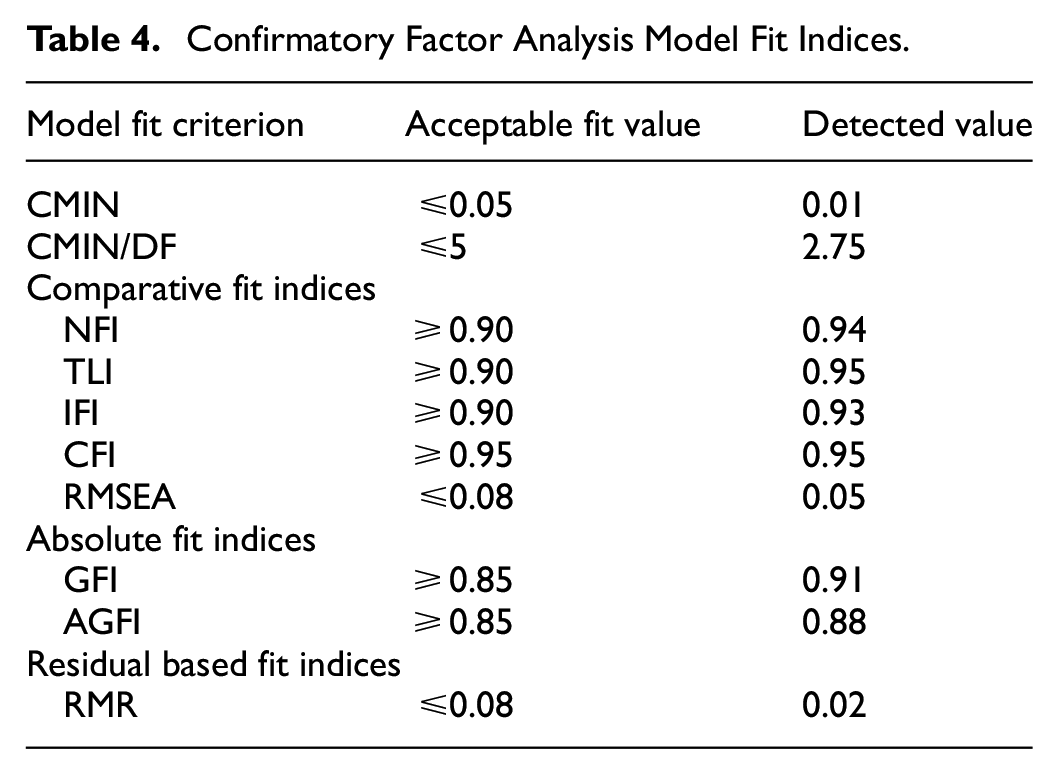
Table 4 indicates whether the data obtained from the confirmatory factor analysis fit the model. It is observed that the obtained values for overall fit, comparative fit, absolute fit, and residual-based fit indices are within acceptable ranges. Thus, it is understood that the dataset is suitable for constructing a structural equation model.
Measurement Values for the Model.

After determining that the model fit indices are at acceptable levels, the measurement values related to the model were examined. When examining the table, it is observed that the standardized factor loadings of the scale items are greater than 0.70, meeting the criterion set by Joliffe (1972), indicating that they accurately represent their respective sub-dimensions. Looking at the t-values of the items, it is seen that they exceed the criterion of 2.56 as stated by Hair et al. (2014). All items having t-values greater than 2.56 imply that the significance level (p-value) is less than .01. Regarding the explained average variance values of the sub-dimensions, they range from 0.54 to 0.74. As for the values related to construct reliability, they vary between .72 and .87. Fornell and Larcker (1981) suggest that for the model to be considered valid and reliable, the explained average variance should be greater than 0.50 and the construct reliability should be greater than .60. Based on these criteria, the data obtained through ESLS, LMX, OLS, and TPS are valid and reliable for the research model.
After testing the validity and reliability of the scales when used together, path analysis was conducted to determine whether the proposed model is significant. The model resulting from path analysis is presented below.
When examining the Figure 1, it is observed which concepts are significantly influential on other concepts by considering the direction of the arrows. Each connection represents accepted research hypotheses. It is understood from the figure that there is a meaningful direction and value of influence among all concepts. The hypothesis results resulting from these meaningful effects are presented in the Table 6.
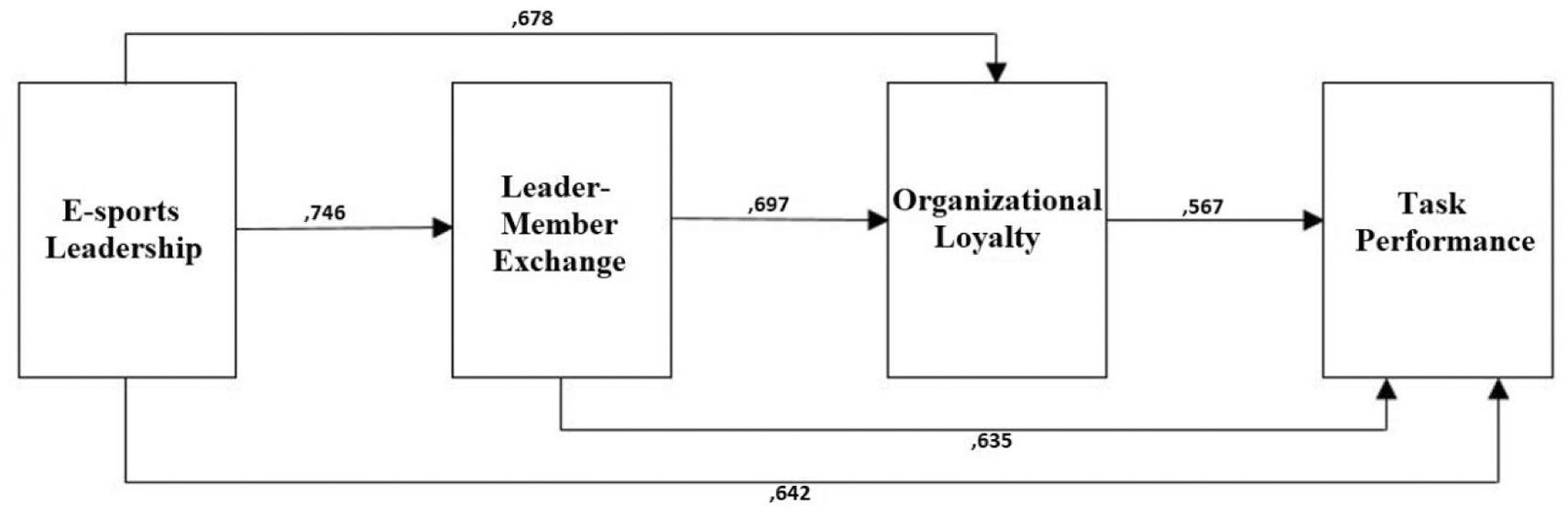
The model consisting of significant effects as a result of path analysis.
Effects and Load Values Resulting from Path Analysis.

When the Table 6 is examined, it is seen that the t-value and effect values resulting from the path analysis are significant. Thus, hypotheses are accepted.
When Table 7 is examined, it can be seen that the dimensions of leader-member exchange and organizational loyalty are the mediator variables among various dependent and independent variables. Looking at the VAF values, it is understood that they all exhibit partial mediation effects. According to these results, hypotheses H7, H8, H9, and H10 are accepted.
Mediating Roles in the Model.
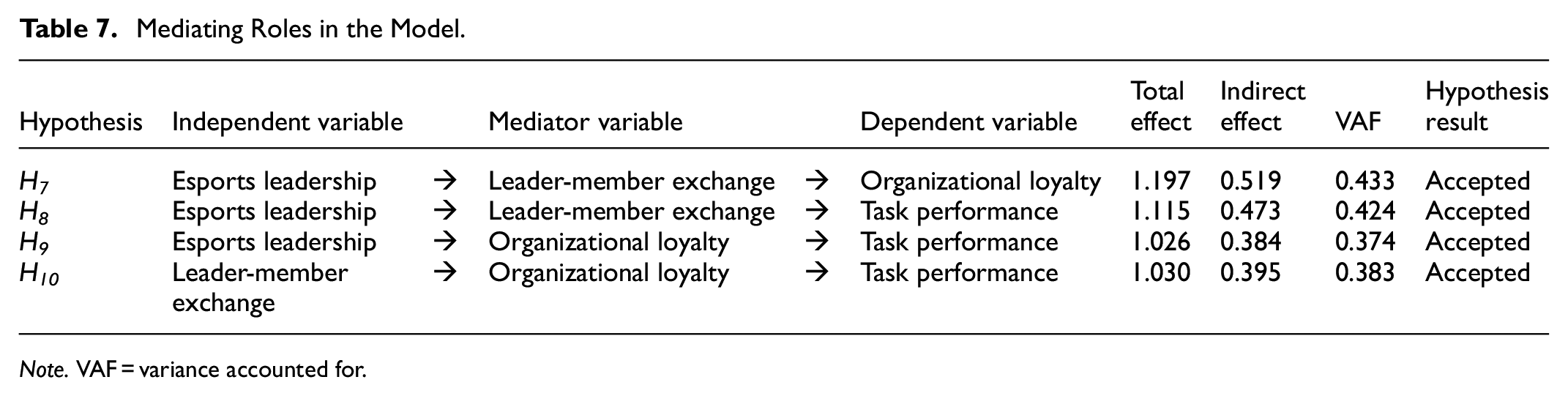
Note. VAF = variance accounted for.
Discussion and Conclusion
The goal of this study is to identify the components that make up esports leadership and to propose a model that addresses the effects of esports leadership on leader-member exchange, organizational loyalty, and task performance. The analyses conducted in this direction have determined that esports leadership consists of components communication skills, interaction with players, professional qualifications, impact on games, and contribution to the team. It has been concluded that the model linking esports leadership with leader-member exchange, organizational loyalty, and task performance forms a meaningful whole.
When the averages of the sub-dimensions of the scales used in the research are examined according to participants’ responses, it is observed that thoughts related to leadership perception in esports are primarily focused on communication skills and interaction with players. Participants mostly agree that professional qualifications involving technical and tactical details, the impact on games, and contribution to the team factors are also important. However, it is concluded that social skills are more important in terms of team coaching for effective leadership in esports. Chelladurai (1990) states that antecedents and leadership behaviors are effective for leadership that yields satisfactory results in terms of athletes’ performance and enjoyment. The factors regarding leadership perception in esports presented in this study are understood to have content compatible with the antecedents and leadership behaviors in Chelladurai’s theory.
When it comes to leadership, one significant difference between esports and traditional sports is that the outcomes related to player performance occur in a digital environment. In order for the team coach to analyze the game and make decisions regarding its progression, players need to focus on the flow happening on the monitor rather than on themselves. The digital representation of player moves serves as the sole indicator of real-time performance. The ability of coaches to demonstrate effective leadership relies on their capability to observe and interpret these video outputs accurately. While numerous innovations have emerged in traditional sports regarding physical training and tactical exercises, the fundamental essence of the sport remains largely unchanged. For instance, although football played in the 1950s may seem very different from modern-day football, skills such as passing, shooting, dribbling, etc., remain fundamentally the same. However, this stability does not apply to esports. While basic digital gaming movements like clicking the mouse or pressing keyboard keys persist, the content of games is constantly updated. The updates introduced by game developers at regular intervals can bring about significant changes to the game, necessitating substantial transformations in gameplay. In this regard, even though coaches may not play the game professionally, their continued engagement in playing the game can be seen as an advantageous factor. This enables them to adapt more quickly to changes resulting from game updates and increases the likelihood of guiding players in the right direction technically and tactically.
Theoretical Implications
Within the scope of the tested model in the research, it is observed that the perception of leadership in esports significantly influences leader-member exchange. Similar findings can be found in previous studies on this topic. Lee (2005, 2008) found in their research conducted at research institutes in Singapore, which included engineers and scientists working in R&D departments, that the interaction between leadership perception of organizational members and leader-member had a significant effect. This interaction positively impacted organizational commitment and innovativeness. Yukl et al. (2009) indicated in their study, which sampled participants from various sectors in the United States, that leadership behavior had a significant effect on leader-member exchange. Lo et al. (2010) highlighted in their study conducted among employees of manufacturing firms in Malaysia that the impact of leader-member exchange was evident in the relationship between leadership and organizational commitment. Byun et al. (2017) examined the South Korean army as their population and incorporated concepts of leader trust, leader-member exchange, competition, and organizational member performance in their model, demonstrating the connection between leadership perception and leader-member exchange. Li et al. (2018) stated in their study, which sampled employees from numerous organizations in China, that leadership identity influenced leader-member exchange, and these two concepts integrated to become meaningful.
When examining the impact of leadership on organizational loyalty, research findings highlight the prominence of the leader’s social skills. This suggests that the level of organizational loyalty among esports players is dependent on the communication skills of team coaches and their interaction with players. Thus, it is understood that organizational members’ perception of leadership affects their level of organizational loyalty. Various studies in the literature across different sectors have shown that leadership influences organizational loyalty. Gouda (2018) concluded in their research in the education sector in Egypt that leadership is effective in influencing organizational loyalty. In a study conducted in the hospitality industry, Book et al. (2019) demonstrated that the level of organizational commitment and loyalty among members of large-scale hotels in the southwestern United States is linked to the satisfaction derived from leadership. Singh et al. (2020) emphasize the importance of leadership in increasing the level of organizational loyalty among members. Ramayani et al. (2022) suggest that leadership is as important as salary and other financial gains in influencing the level of organizational loyalty among individuals working in import-export firms.
When examining the research findings, it is evident that the perception of leadership among esports players directly impacts their task performance in esports. This effect is formed by factors such as professional qualification, influence on competitions, and contribution to the team. It is understood that in esports, the technical and tactical skills of the team coach play a prominent role in task performance. Players believe that their performance outputs in esports are dependent on the specialized skills of the team coach. Studies conducted across various sectors in the literature similarly demonstrate findings regarding the impact of leadership on performance. Liang et al. (2011) mention in their research conducted on engineers and managers in electronic product companies that leadership behavior is effective on task performance through the mediating role of job satisfaction and the moderating role of social distance. Byun et al. (2017) discuss the impact of leadership on performance in the context of leader trust, leader-member exchange, competition, and member performance, in their model constructed with individuals serving in the South Korean army as their population. The extensive examination of performance in the sports field also paves the way for the investigation of its connection with the concept of leadership in sports. Rowe et al. (2005) state in their research conducted in teams of the National Hockey League (NHL) that the success of the leader also leads to positive effects on organizational performance.
The research findings indicate that leader-member exchange is effective in influencing organizational loyalty. In this respect, it is understood that in esports teams where efficiency is achieved in leader-member exchange, players exhibit higher levels of loyalty to the team. Similar to these findings, Shirley (2003) concluded in their study conducted in federal organizations in Washington D.C., the capital of the United States, that leader-member exchange is effective in influencing organizational loyalty.
When the findings are examined, it is observed that leader-member exchange has a direct impact on task performance. Similar findings can be found in various sectors in research conducted on this topic. Wang et al. (2005) present results indicating that leader-member exchange influences task performance in various organizations in major cities in northern China. Chan and Mak (2012) demonstrate in their study conducted among individuals working in nonprofit organizations located in Hong Kong that leader-member exchange has an impact on performance in their model, which incorporates concepts of benevolent leadership, leader-member exchange, and member performance.
In the research model, it is observed that both the perception of leadership and leader-member exchange in esports have a direct impact on task performance, and organizational loyalty also has an effect on task performance. From this, it is understood that the high level of organizational loyalty among esports players positively affects their task performance. Darmawan et al. (2020) state in their research conducted among individuals working in Indonesian state-owned organizations that loyalty has a significant impact on performance and argue that it holds an important place in human resource management. Phuong and Vinh (2020) constructed a model based on job satisfaction, employee loyalty, and job performance within the scope of hospitality establishments in Vietnam. Within this model, loyalty is shown to have an impact on performance. Phuong and Vinh (2021) obtained a similar result to that of employees in hospitality establishments in Vietnam in their study conducted on individuals working in technology companies in Vietnam. These findings observed in different sectors are supported in the field of esports through this research.
The above paragraphs mention findings from previous research indicating that when the concepts of leadership, leader-member exchange, organizational loyalty, and task performance are examined together, they contain meaningful relationships. The results of this study, when considered from the perspective of general leadership, support the findings of previous research. However, there are details that can be discussed specifically in the context of leadership in esports.
It can be stated that two of the factors influencing task performance in sports are technical and tactical skills. In this research, the task performance levels of esports players are influenced by esports leadership. Indeed, the fact that one of the sub-dimensions of the Esports Leadership Scale is “Impact on Competitions” is an indicator of this. In Drenthe’s (2016) study, it was observed that informal leadership emerging within esports teams especially contributed to esports players in technical and tactical matters. Considering that this positively reflects on task performance, it is possible to say that these two studies reveal similar results.
In previous studies, Chelonis (2020) found that autocratic leadership style was not favored by esports players, while Jókai-Szilágyi (2022) revealed that the most preferred style was democratic leadership. In the Esports Leadership Scale used in this study, the sub-dimensions that determine the leadership style of the team coach are “Communication Skills,”“Interaction with Players,” and “Contribution to the Team.” Some items in these sub-dimensions express positive meanings associated with a democratic style. According to the findings, the positive impact of esports leadership on organizational loyalty and task performance indicates that democratic leadership is also preferred by players in the context of esports.
Happonen (2023) emphasizes that strengthening communication between players, instilling confidence in them, and motivating them are crucial behaviors for effective leadership in esports. These same concepts are also reflected in the scale items used in this research. The findings of this study similarly show that these behaviors contribute to effective leadership.
In their research, Surbakti et al. (2023) demonstrated that effective leadership in esports teams positively affects team performance. Similarly, this research shows that esports leadership positively influences players’ task performance. Therefore, the findings of this study support the findings of Surbakti et al. (2023).
In conclusion, it is understood that there are aspects of traditional leadership theories attributed to team coaches in esports, but there is also a need for paradigm shifts that align with the requirements of the modern age. It is evident that the transformations occurring in the digital age are not limited to the context of technology alone. Besides keeping up with the speed of technological innovations, leaders who can also adapt to thought innovation are relatively more likely to succeed. The fact that performance outputs in esports occur in a digital environment implies that effective leadership also involves digital skills. Moreover, the concept of the metaverse, which has entered our lives in the modern era, is an area that could find its place in the near future of sports. While phenomena such as virtual reality, augmented reality, and artificial intelligence are increasingly prevalent in human life, the transfer of sports to the virtual realm known as the metaverse can be considered quite natural. The influence of the metaverse phenomenon on the sports industry is likely in terms of activities such as watching sports, content creation by athletes and fans, selling digital sports products, and conducting marketing activations that bridge the gap between the real and virtual worlds. Therefore, it is an aspect that should not be overlooked. To keep up with modernity, it is essential to approach the concept of leadership in esports from innovative perspectives, which will not only benefit the field but also positively impact various elements beyond interaction, loyalty, and performance.
Practical Implications
Research shows that the concepts of leadership, loyalty, and performance yield significant results in the field of sports. It is known that leader-member exchange has various effects in sports organizations. (Bang, 2011; Hoye, 2003; Sinclair et al., 2014). Loyalty is often addressed in the realm of marketing and focuses on sports consumers. However, there are also studies highlighting the importance of organizational loyalty levels among those working in the sports sector for organizations (Kim et al., 2018; Komskiene et al., 2009). Performance is also a highly valued issue in the field of sports, with numerous scientific studies focusing on athlete performance. Based on the information in the literature, athlete performance is generally influenced by physical, mental, technical, and tactical elements (Cho et al., 2021; Vaughan & Madigan, 2021). Since esports is also a branch of sports, it is believed that the interaction between team coaches and esports players could have an impact on the organizational loyalty levels and task performance of the members. In this study, since a meaningful model comprising these concepts is presented, practical recommendations can be put forward based on the research findings.
It is widely accepted that one of the most important indicators of success in sports is the score. Whether the score is favorable for one side often depends on performance. Based on the results of this study, it is understood that the performance of esports players is influenced by the unique esports leadership skills of the team coach in a leadership role. Also, the vertical dyadic relationships between the leader and the members, and the loyalty levels of the players are important farctors. In this context, it is recommended that team coaches understand the leadership requirements specific to the nature of esports and develop their skills in that direction, while also managing the dyadic relationships they establish with esports players in a positive manner. This approach appears to be a way to increase the loyalty of esports players to the team and, consequently, improve their performance.
Additionally, there are some recommendations for individuals in the esports sector. It is considered beneficial for team coaches to identify the expectations of esports players, who are largely from Generation Z, from their leaders and to evaluate whether their own leadership behaviors are in line with these expectations in order to exhibit effective leadership. Instead of team coaches dealing with marketing, sponsorship, media, etc., activities in esports teams, bringing in professionals for these tasks can lighten the load for team coaches and enable them to work more efficiently. Therefore, it is necessary for team managers to clearly define the boundaries of authority and responsibility within the team roles. Considering from the federations’ perspective, it is thought to be beneficial to include topics related to leadership skills in the curriculum of esports coaching courses to be conducted. From the players’ perspective, determining their leadership orientations and developing leadership skills may be beneficial for them to become good team coaches once their active sports careers end.
Limitations and Future Research
The data collection phase of this study was limited to individuals practicing esports as a profession. The findings do not include results related to recreational video gaming activities and digital gamers. Additionally, the qualitative data collection process spanned a period of 5 months. This period was not predetermined but was terminated when data saturation was deemed to have been reached. When transitioning to the quantitative phase, both the pilot and main study data collection processes were limited to 4 months each. Data subjected to content analysis in the qualitative phase was limited to those obtained from participants who answered the initial question of the data collection tool as team coaches. Data containing responses from individuals other than team coaches were excluded from the study, and the scale forms used in the quantitative phases were designed to measure perceptions of the team coach. Other roles related to leadership may be suitable for different research, but this study focuses on perceptions related to team coaches.
In accordance with the research results, there are some theoretical suggestions for future research for scientists. It is necessary to examine the relationship of leadership in esports with concepts other than leader-member exchange, organizational loyalty, and task performance. Understanding how leadership is perceived in esports and comparing coaches’ own leadership perceptions with those of players can lead to more distinct findings. Examining the leadership orientations of esports players can also be useful in gaining insight into potential team coaches. Given the current situation in the sector, research clarifying the scope of leadership attributed to esports team coaches is also necessary. Additionally, the use of measurement tools developed for modern leadership theories in the field of esports leadership can provide a clearer understanding of this phenomenon.
Finally, the participant group of this study is limited to esports players playing in Turkish teams. This situation poses a problem to the generalizability of the findings. Therefore, testing the structural equation model, which has proven its validity in this study, using the same measurement tools in different countries and cultures would greatly contribute to social sciences.
Footnotes
Acknowledgements
We would like to thank all esports players who contributed to the data collection phase of the research.

Ethical Considerations
This study was approved as ethically appropriate for research by the Scientific Research and Publication Ethics Committee of Social and Human Sciences at Eskişehir Technical University, with the decision dated March 11, 2021 and numbered E-87914409-050.03.04-10603.
During the research process, the Declaration of Helsinki (World Medical Association) was considered in terms of ethics regarding participation in the research.
Author Contributions
All authors contributed in study design, statistical analysis and manuscript preparation.
Funding
The author(s) received no financial support for the research, authorship, and/or publication of this article.
Declaration of Conflicting Interests
The author(s) declared no potential conflicts of interest with respect to the research, authorship, and/or publication of this article.
Data Availability Statement
Data sharing not applicable to this article as no datasets were generated or analyzed during the current study.