



Abstract
Perceiving a calling toward one’s career can provide kindergarten teachers sufficient internal motivation to resist massive job burnout and obtain high-level performance and well-being. Given the important role of leadership on followers’ career calling, the present study takes the multilevel approach to examine the cross-level impact of team-level transformational leadership (TFL) of principals on the individual-level career calling of kindergarten teachers. Moreover, according to the identity-capability-reward (ICR) model, the present study investigates the mediating effects of kindergarten teachers’ organizational identification and leader-member exchange (LMX) from the social identity and social exchange perspectives to explain why TFL could positively predict kindergarten teachers’ career calling. Data were collected from 486 teachers at 57 kindergartens in China. Applying the multilevel analysis, results showed that principals’ TFL could positively predict kindergarten teachers’ sense of career calling, in which teachers’ organizational identification and exchange quality with principals played the full mediating effects. These findings extend previous studies and provide practical implications to enhance kindergarten teachers’ career calling.
Plain Language Summary
Purpose: The present study takes the multilevel approach to examine the cross-level impact of team-level transformational leadership (TFL) of principals on the individual-level career calling of kindergarten teachers. Moreover, according to the identity-capability-reward (ICR) model, the present study investigates the mediating effects of kindergarten teachers’ organizational identification and leader-member exchange (LMX) from the social identity and social exchange perspectives to explain why TFL could positively predict kindergarten teachers’ career calling. Method: The present study collected data from 486 teachers at 57 kindergartens in China and applied the multilevel analysis. Conclusions: Principals’ TFL could positively predict kindergarten teachers’ sense of career calling, in which teachers’ organizational identification and exchange quality with principals played the full mediating effects. Implications: These findings extend previous studies and advise that principals’ leadership, their exchange quality with teachers, and teachers’ organizational identification should be paid attention to while considering teachers’ career calling in kindergarten.
Keywords
Introduction
Excellent kindergarten teachers, whose one core and essential quality is the calling to teach (Korthagen, 2004), are closely associated with the high-quality development of preschool education (Bullough & Hall-Kenyon, 2011). Kindergarten teachers’ sense of career calling refers that they feel called to their career by some external or internal guiding forces (e.g., a higher power, inner interests), align their career with a broader sense of meaning and purpose in life, and intend to help others or advance the greater good via their career (Duffy et al., 2018). As suggested by prior studies (e.g., Duffy et al., 2018), career calling can provide teachers with sufficient internal motivation to resist massive job burnout and intense turnover intentions and enhance their well-being and job performance. Given the intense job burnout and high turnover rates of kindergarten teachers (Guo et al., 2022; He & Wei, 2022), how to help kindergarten teachers perceive a strong career calling needs to be actively explored.
Leaders as the senior authority at work are the unique and salient summon of career calling in Chinese culture (C. Zhang, 2015), whose positive leadership could positively affect followers’ career calling (e.g., L. Zhang & Jin, 2019; L. Zhang et al., 2020). In the era of educational reform, transformational leadership (TFL) has been widely advocated because of its positive effects on teachers’ development and school reform (Jiao & Liu, 2017). Prior studies indicated the positive effect of TFL on teachers’ career calling (e.g., Gong et al., 2013). However, prior studies considered TFL an individual-level variable, ignoring that TFL is a team-level property. Besides, the mediating process by which transformational leaders influence followers’ career calling has not been sufficiently addressed. Some studies suggested the indirect paths between TFL and followers’ effectiveness (e.g., job performance; Ng, 2017). Career calling as an index of effectiveness, there might exist mediating variables between kindergarten principals’ TFL and teachers’ career calling. Thus, the present study explores the multilevel effect of kindergarten principals’ TFL on teachers’ career calling and the mediating mechanism underlying that relationship.
A strong sense of career calling means a high person-environment (P-E) fit (Duffy et al., 2014; Elangovan et al., 2010). According to the identity-capability-reward (ICR) model, P-E fit could be supplementary fit (i.e., the match between an individual and a group of people who comprise an environment) and complementary fit (i.e., the match between an individual’s strengths and the demands or weakness of the environment); the former one is achieved through an identity management process, and the latter one is achieved via intensive social exchanges (Guan et al., 2021). Individuals’ interactions with the environment provide identity-defining information and involve social exchanges of needs and supplies, making themselves match the environment. A meta-analytic review also showed that social exchange and identification mechanisms were two important explanatory mechanisms linking TFL to effectiveness (i.e., performance; Ng, 2017). Thus, the current study further draws from the social identity theory and social exchange theory underpinning the ICR model to explore the multiple parallel mediations of teachers’ organizational identification and leader-member exchange (LMX) between kindergarten principals’ TFL and teachers’ career calling.
TFL and Career Calling
In the original conceptualization (Bass, 1999; Burns, 1978), TFL means that the leader inspires the followers beyond immediate self-interests through four behavioral dimensions. Specifically, idealized influence refers to the leader’s exemplary behavior, which makes followers proud of their group and respect and trust their leader. Inspirational motivation refers to the leader’s articulate visions appealing to and inspiring followers. Intellectual stimulation refers to the leader’s behaviors to encourage followers to think independently and innovatively. Individual consideration means the leader attends to followers’ developmental needs and mentors to coach followers’ development. Given that leadership is considered a variable sensitive to different cultural contexts (Hofstede, 1993), Chinese researchers explored the characteristics of TFL rooted in Chinese culture. Particularly, Li and Shi (2005) conducted a qualitative study to explore how Chinese managers and employees from different occupations describe the behaviors and characteristics of TFL, finding that the Chinese TFL includes moral modeling, charisma, vision, and individualized consideration. Vision is almost consistent with the content of Bass’ TFL. The idealized influence dimension of Bass’ TFL was divided into two parts (i.e., charisma and moral modeling) in Chinese TFL. Charisma is mainly self-oriented, which refers to a leader’s high standard, active engagement, great innovative consciousness, and skilled professional ability in work. Moral modeling reflects the leader’s other-oriented behaviors and intentions to be followers’ role models, such as self-dedication and transcending self-interest, putting others’ interests first, and suiting the action to the word. In addition, individualized consideration of Bass’ TFL has broader content in the Chinese context. It emphasizes the attention to followers’ career development, intellectual stimulation, and problems in family and life. This indigenous TFL in Chinese has been widely used and supported in many Chinese empirical studies (e.g., Tsang et al., 2022; Wang et al., 2019). Accordingly, the present study followed the four characteristics of TFL suggested by Li and Shi (2005).
TFL is the leadership of the entire working unit that forms the work context for followers (e.g., Salanova et al., 2020; Su et al., 2019), which would influence the work experiences of followers. In kindergarten, transformational principals deliver visions and involve teachers in envisioning the shared common goals. This cohesive group with a common vision could encourage teachers to connect their work to the greater good and inspire their awareness of self-significance and social responsibility. Moreover, transformational principals would behave fairly and ethically, make an effort to care for and understand teachers’ personal needs, and encourage teachers to adopt new ideas and approaches at work. As prior studies suggested (e.g., Chang et al., 2021; McCarley et al., 2016), these qualities of transformational principals could create an innovative, supportive, and engaged climate for teachers. In these climates, teachers feel safe to get engaged in work, motivated to realize their potential, and competent in work. According to the interpersonal sensemaking model (Wrzesniewski et al., 2003), when others’ acts at work are discerned to convey positive information (e.g., respect, care, competence, worth, or any attribute that endows employees with some form of significance), these positive clues will benefit employees’ self-meaning construction. As prior studies indicated (e.g., Elangovan et al., 2010), the discernment and development of career calling is a dynamic process of self-meaning construction. Moreover, the awareness of social responsibility, self-significance, and potential realization are the marked characteristics of career calling (C. Zhang, Dik, et al., 2015). Thus, kindergarten principals’ TFL could positively predict teachers’ career calling.
Organizational Identification as Mediator
According to social identity theory, individuals have personal and social identities reflecting their self-worth and self-esteem (Tajfel, 1982; Tse & Chiu, 2014). This theory suggests that leaders are a significant source of followers to define themselves as unique individuals or members of a workgroup. When individuals define their self-concept integrated with the organization’s attributes, a frequently mentioned form of social identification called organizational identification will emerge (Horstmeier et al., 2017). Followers with strong organizational identification will base their self-concept on their belongingness to the organization, view the organization’s successes and failures as theirs, and act following organizational norms, values, and goals (Buil et al., 2019; Mael & Ashforth, 1992).
Team-level TFL of kindergarten principals would benefit teachers’ organizational identification. Based on the conception of TFL (Bass, 1999), one central tenet of transformational principals is to establish a collective identity and group cohesion to shift teachers’ perspectives from an individual “I” to a collective “We.” Moreover, because of the key characteristics of idealized influence and inspirational motivation, principals’ TFL could promote teachers’ identification with the kindergarten goals and internalization of the kindergarten’s beliefs, enhancing teachers’ organizational identification. In line with these theoretical ideas, empirical evidence demonstrated that group-level TFL is positively associated with subordinates’ identification with their group (i.e., organization; Epitropaki, 2013; Hobman et al., 2011).
Given its close relatedness to self-concept, organizational identification positively correlates with career calling (Zhu et al., 2019; Zuo et al., 2017). Moreover, as noted in previous studies, the discovery and development of career calling is a dynamic process of self-meaning construction, accompanied by “knowing why” investments to answer the question of “why am I here” (Hall & Chandler, 2005). This process needs to take much introspection, reflection, mediation, and relational activities, all of which are self-exploration methods and serve to clarify one’s identity and self-concept (Elangovan et al., 2010; Hall & Chandler, 2005). Moreover, the “who am I” question has been considered to be preceded by the “why am I here” question, which describes identity as the path to meaningfulness (Pratt & Ashforth, 2003). Consequently, Elangovan et al. (2010) indicated the growing understanding of the self as necessary for individuals to discover their career calling. Dobrow (2004) even integrated personal and work identities into the experience of having a career calling. Therefore, when kindergarten teachers define themselves with the attributes of their organization, they would be more likely to feel a sense of calling toward the work their organization wants them to do. To summarize, kindergarten teachers’ organizational identification is proposed to mediate the association between kindergarten principals’ TFL and teachers’ career calling.
The Perception of LMX as Mediator
According to the social exchange theory, individuals follow some rules and norms of exchange to develop their social relationships. The reciprocity norm is a universally accepted rule which suggests that a person should reciprocate positively to another person who has done something (e.g., doing a favor) to improve the relationship quality (Cropanzano & Mitchell, 2005; Ng, 2017). Abiding by exchange principles, relationships in the social exchange process will evolve into trusting, loyal, and mutual commitments (Cropanzano & Mitchell, 2005). LMX represents the exchange quality between leaders and followers, the extent to which a leader develops a close or deep relationship with a subordinate (Graen et al., 1982; Ng, 2017). In a high-quality LMX relationship, followers will be invested with great responsibility and ample resources from the leader; Meanwhile, based on the rule of reciprocity, followers will develop an “obligation” to give positive feedback to the leader. On the contrary, in the low-quality LMX relationship, the leader has little contact with followers and only provides followers with basic information necessary for achieving their performance; Correspondingly, followers’ impetus is limited to completing their essential job responsibilities.
Empirical studies have indicated that team-level TFL is a key antecedent to yielding a high exchange quality between leader and follower (e.g., Li et al., 2014). According to the core behaviors of TFL (Li & Shi, 2005), transformational principals in kindergarten would show concern for and satisfy teachers’ needs, provide them with a sense of increased competence to carry out their duties, and express appreciation, pride, and trust to them. Moreover, in the TFL context, kindergarten teachers would likely admire transformational principals because of their extraordinary behavior, charisma, and wisdom. The interaction process of a transformational principal and teacher is filled with respect and trust. As suggested in prior studies (e.g., Vermeulen et al., 2022), TFL conveys to kindergarten teachers that they can develop a productive, mutually beneficial, and trusting relationship with their principals (i.e., high-quality LMX).
Based on the reciprocity rules of LMX, kindergarten teachers who possess high-quality relationships with their principals would view work as a calling to work hard in return. The high-quality LMX is characterized by heightened mutual trust, respect, and a sense of obligation, making kindergarten teachers feel obligated to reciprocate the transformational principals’ high expectations and support. This sense of obligation and leaders’ expectations are considered as summon sources to develop workers’ career calling (C. Zhang, Dik, et al., 2015). Moreover, in the high-quality LMX, kindergarten teachers have many opportunities to undertake significant and challenging work tasks that easily evoke their work passion and meaningfulness. The high-quality LMX also expands kindergarten teachers’ role responsibility breadth to fight for the interests of the community (i.e., organization and society). Prior studies also showed the positive associations linking the high-quality LMX to followers’ meaning-making (e.g., van den Heuvel et al., 2014) and prosocial behaviors (e.g., Runhaar et al., 2013). Experiences of meaning and prosocial orientation are essential to career calling (Dik et al., 2012). Furthermore, direct empirical evidence exists that LMX can positively predict followers’ career calling (L. Zhang, Jin, et al., 2017; L. Zhang, Ma, et al., 2017). To summarize, kindergarten teachers’ perception of LMX is proposed to mediate the association between kindergarten principals’ TFL and teachers’ career calling.
The Current Study
The present study takes a multilevel approach to explore whether and how kindergarten principals’ TFL has a cross-level prediction on teachers’ career calling. Regarding the mediating mechanism, the current study investigates the mediating role of kindergarten teachers’ organizational identification and LMX on the relationship between principals’ TFL and kindergarten teachers’ career calling based on the social identity theory and social exchange theory. The theoretical model of this study is presented in Figure 1, which contains the following three hypotheses: (a) Kindergarten principals’ team-level TFL positively predicts the individual-level career calling of teachers (Hypothesis 1). (b) Individual-level organizational identification of kindergarten teachers mediates the positive effect of principals’ TFL on kindergarten teachers’ career calling (Hypothesis 2). (c) Individual-level LMX mediates the positive effect of principals’ TFL on kindergarten teachers’ career calling (Hypothesis 3).

Theoretical framework of the effect of kindergarten principals’ transformational leadership on teachers’ career calling.
Method
Participants and Procedure
We used a purposive sampling approach to collect data from kindergarten teachers in China. With the help of the Kindergarten Principal Training Center of the Chinese Ministry of Education, we invited some kindergarten principals to help us give out online questionnaire links to their teaching staff. Based on geographical distribution, we purposefully contacted kindergartens from three economic zones, including the eastern (e.g., Hebei Province and Tianjin city), central (e.g., Anhui and Jilin Provinces), and western regions (e.g., Shaanxi and Yunnan Provinces). Finally, from November 2020 to May 2021, 57 kindergarten principals agreed to encourage their teaching staff to participate in our study. There are 19 kindergartens from the eastern regions, 24 from the central regions, and 14 from the western regions. Among the 57 kindergartens, 44 are in the city, and 13 are in country towns and villages. Moreover, it included 48 public kindergartens and 9 private kindergartens.
Before data collection, this survey was approved by an institutional ethics board at the University of the corresponding author. Then with the help of kindergarten principals, we delivered the online questionnaires to teachers. When sending the questionnaire link, all kindergarten teachers received written informed consent and instructions on completing the questionnaire. The participation was anonymous and voluntary, and we did not ask teachers to fill out their kindergarten. So in order to distinguish which kindergartens the teachers come from, we created different questionnaire links for different kindergartens. Only those who voluntarily filled out the questionnaire were enrolled in the data collection and further analysis procedures.
We collected questionnaires from 602 teachers, in which 486 valid data were retained, and 116 data were excluded due to the following reasons: (a) The average response time per item was less than 2 seconds (Huang et al., 2012); (b) Their answer to the validity item was questionable (i.e., Please choose the second choice “somewhat disagree” in this item); (c) They filled the whole questionnaire with the same answer. The valid data of each kindergarten ranged from 5 to 19 teachers, with an average of 9 teachers per kindergarten. According to the power estimating method used by Scherbaum and Ferreter (2009), for a small ICC (1) value of 0.05, the sample-size combinations of 9 (averaged individual-level sample size) and 57 (team-level sample size) could detect a medium effect size (0.30) for a power of 0.82, achieving a power ≧ 0.80. Among the valid sample (see Table 1), the participant teachers’ ages ranged from 19 to 57 years old, and the average age was 31.53 (SD = 8.97). Their average work experience was 10.09 (SD = 9.66), ranging from 1 to 37 years. Regarding the education levels, 196 (40.3%) had completed a junior college degree or below, and 290 (59.7%) had a bachelor’s or above.
The Summary of Sample Characteristics.

Note. Total number of kindergartens are N = 57, and total number of kindergarten teachers are N = 486.
Measures
Transformational Leadership
The Transformational Leadership Questionnaire (TLQ; Li & Shi, 2005) was applied to assess the teachers’ perception of their principal’s TFL. The tool consists of 26 items measuring four dimensions: moral modeling (eight items; i.e., “The principal will not take the fruits of other people’s labor as one’s own”), charisma (six items; i.e., “The principal loves his/her job, has a strong sense of dedication and enterprise”), visionary (six items; i.e., “The principal will explain to employees the long-term significance of the work done”), and individualized consideration (six items; i.e., “The principal is willing to help teachers solve problems in life and family”). All items were rated on a 5-point Likert scale (1 = strongly disagree, 5 = strongly agree). Higher scores mean that teachers perceive stronger TFL performed by their principals. This measure was developed by Li and Shi (2005) in the Chinese context and based on Bass’ four-dimensional structure of TFL. Empirical studies showed that this measure had good reliability and close associations with criteria-related variables, such as job satisfaction and organizational commitment (e.g., Li & Shi, 2005). In the current study, the four-factor CFA result revealed a good model fit, χ2/df = 4.36, SRMR = 0.04, RMSEA = 0.08, CFI = 0.91, and TLI = 0.90. The factor loadings ranged from 0.56 to 0.90. Cronbach’s alphas were .97 for the total scale, 0.91 for moral modeling, 0.89 for charisma, 0.89 for visionary, and 0.89 for individualized consideration.
Leader-Member Exchange
We employed the unidimensional and seven-item version of the leader-member exchange scale (LMX-7) developed by Graen et al. (1982) to assess the exchange quality of principal-teacher relationships. Participants were asked to answer these items on a 5-point Likert scale ranging from 1 (strongly disagree) to 5 (strongly agree). One example item is “My principal understands my problems and needs.” Higher scores indicate that teachers have high exchange quality with their principals. A meta-analytic review showed that the LMX-7 measure has the soundest psychometric properties and largest correlations with its criteria-related variables (e.g., job performance, satisfaction with overall life, organizational commitment) compared with other LMX measures (Gerstner & Day, 1997). Moreover, the LMX-7 measure has been widely used in Chinese samples and found to have good reliability and validity (e.g., L. Zhang, Jin, et al., 2017; J. Zhang & Long, 2013). In the current study, the CFA result revealed a good model fit, χ2/df = 4.27, SRMR = 0.04, RMSEA = 0.08, CFI = 0.97, and TLI = 0.95. The factor loadings ranged from 0.41 to 0.78. Cronbach’s alpha for the total scale was .84.
Organizational Identification
We used a unidimensional and six-item organizational identification scale developed by Mael and Ashforth (1992) to assess teachers’ identification with their kindergartens. An example item is “This kindergarten’s successes are my successes.” Items are rated on a 5-point Likert scale ranging from 1 (totally disagree) to 5 (totally agree). Higher scores indicate teachers’ stronger identification with their kindergarten. This measure has been widely used in Chinese samples and has good reliability and expected associations with some criteria variables (e.g., work engagement and turnover intentions; Ji & Cui, 2021; Zhu et al., 2020). In the current study, the CFA result revealed a good model fit, χ2/df = 3.92, SRMR = 0.03, RMSEA = 0.08, CFI = 0.98, and TLI = 0.95. The factor loadings ranged from 0.47 to 0.77. Cronbach’s alpha for the total scale was .79.
Career Calling
The Brief Calling Scale (BCS; Dik et al., 2012) includes the Presence and Search sub-scales to assess the degree to which individuals search for and perceive a career calling. We applied the Presence sub-scale to measure kindergarten teachers’ perception of career calling. This sub-scale includes “I have a calling to a particular kind of work” and “I have a good understanding of my calling as it applies to my career.” Items are answered on a 5-point Likert scale ranging from 1 (not at all true of me) to 5 (totally true of me). Higher scores reflect teachers’ stronger presence of career calling. In several previous studies, this scale has been widely used and confirmed good reliability and close association with related-criterion variables (e.g., intrinsic work motivation, job satisfaction, and life/work meaning; Dik et al., 2012), also in Chinese samples (e.g., Li et al., 2021; C. Zhang, Herrmann, et al., 2015). The current study found that the two items of BCS-presence correlated at r = 0.66, and Cronbach’s alpha was .80.
Statistical Analysis
Considering that the 486 teachers of this study are nested in 57 kindergartens, a multilevel analysis was conducted to test our model hypotheses using the software R studio 4.0.4. Specifically, this statistical analysis contains the following phases. When applying the software R studio 4.0.4, the bruceR package was used in all analyses, and the lmerTest package was employed in combination for the final two analysis phases. Firstly, preliminary analyses included the multivariate normality test, descriptive statistics and correlations, and common method bias examination.
Secondly, the data aggregation test on the TFL was performed to justify the appropriateness of aggregation. If the value of within-group agreement statistics (rwg) for TFL exceeded the standard of 0.70 (James et al., 1993), the data aggregation test was sufficient to reveal intragroup consistency, showing that it is reasonably valid to aggregate individual-level TFL. Then, we would use the group mean of individual-level TFL to create the corresponding organization-level TFL.
Thirdly, three null models were built to examine whether teachers’ career calling, organizational identification, and exchange quality with principals had significant interclass variance and whether cross-level testing was necessary. If the values of intraclass correlation [ICC (1) = interclass variance / (interclass variance + intraclass variance)] for two mediators (i.e., LMX and organizational identification) and one outcome (career calling) were above the standard of 0.05 (Cohen, 1988), two mediators and career calling were influenced by high-level TFL, indicating the necessity of carrying out multilevel analysis.
Finally, multilevel regression analysis was conducted to test our model hypothesis. Researchers (e.g., Fang et al., 2014; Preacher & Hayes, 2008) indicated that when examining multiple mediators, constructing a multiple mediation model can reduce the parameter estimation deviation caused by ignoring other mediators in the simple mediation model (i.e., one-mediator model). Some demographic variables obtained in the current study were controlled in hypotheses testing, including teachers’ work experience and the kindergarten’s nature and region. Teachers’ age was not controlled because it was highly correlated with teachers’ work experience (r = 0.92, p < .001). Teachers’ education and kindergartens’ location were not controlled because of their non-significant relationship with teachers’ LMX, organizational identification, and career calling.
Results
Preliminary Analysis and Data Aggregation
There were no missing data on all main study variables. No variables had absolute skewness or kurtosis values above 1.00, and all appeared normally distributed on the histogram and P-P diagram. The common method bias test results showed that there was not seriously compromised by common method bias, χ2/df = 5.37, RMSEA = 0.10, SRMR = 0.08, CFI = 0.75, and TLI = 0.74. Descriptive statistics and correlations for all study variables were presented in Table 2. As shown, the four main variables (i.e., TFL, LMX, organizational identification, and career calling) were significantly and positively correlated (p < .001). Teachers’ work experience is positively associated with LMX, organizational identification, and career calling (p < .01). Teachers in public kindergartens reported stronger career calling than teachers in private kindergartens (p < .01). Teachers in western kindergartens reported lower LMX and career calling than those in not western kindergartens (p < .05). Other relationships among demographic variables, the mediators (i.e., LMX and organizational identification), and outcome (career calling) are non-significant.
Descriptive Statistics and Correlations of Study Variables.

Note. N = 486. TFL = transformational leadership; LMX = leader-member exchange; OI = organizational identification. Education: 0 = junior college degree or below; 1 = bachelor degree or above. Location: 0 = kindergartens in city; 1 = kindergartens in country towns and villages. Nature: 0 = public kindergartens; 1 = private kindergartens. Regions were transferred to two dummy variables (i.e., Region 1 and 2) using the eastern region as the reference base. Region 1: 0 = not central regions, 1 = central regions; Region 2: 0 = not western regions, 1 = western regions.
p < .05, **p < .01, ***p < .001.
Like other studies (e.g., Salanova et al., 2020; Su et al., 2019), the principal’s TFL is considered a unified construct affecting all teachers in the principal’s kindergarten. Thus, individual teacher perceptions of TFL should be aggregated at the group level. The result of the aggregation test showed that the average rwg for TFL was 0.99, ranging from 0.98 to 1.00. This rwg value exceeded the acceptability standard of 0.70. The result indicated a high within-school agreement in the principal’s TFL and suggested the appropriateness of aggregating this individual data to the school-level variable.
Hypotheses Testing
Before conducting the multilevel analysis, three null models, in which the outcome variables were LMX, organizational identification, and career calling, were set up to examine the degree of interclass variance in individual-level variables (i.e., LMX, organizational identification, and career calling). The results revealed that teachers’ career calling had an intraclass variance (σ2) of 0.433 and an interclass variance (τ2) of 0.058, indicating the ICC (1) value of 0.118 for career calling. Regarding teachers’ perceptions of LMX, the σ2 value was 0.259, and the τ2 value was 0.042, indicating the ICC (1) value of 0.140 for LMX. Regarding teachers’ organizational identification, the σ2 value was 0.200, and the τ2 value was 0.016, indicating the ICC (1) value of 0.074 for organizational identification. As Cohen (1988) suggested, the ICC (1) values for two mediators and career calling were above 0.05, allowing multilevel analysis to be used.
The multilevel analysis results are represented in Table 3 and Figure 2. Results of Model 1 in Table 3 found the significant and positive effect of principals’ TFL on kindergarten teachers’ career calling in the absence of mediators (B = 0.37, β = .13, p = .025 < .05), supporting Hypothesis 1. Moreover, as seen in Table 3 (Models 2, 3, and 4) and Figure 2, principals’ TFL positively predicted kindergarten teachers’ LMX (B = 0.64, β = .29, p < .001) and organizational identification (B = 0.36, β = .19, p < .001). And kindergarten teachers’ career calling could be positively predicted by LMX (B = 0.38, β = .30, p < .001) and organizational identification (B = 0.32, β = .21, p < .001). Meanwhile, when introducing two mediators, the direct effect of principals’ TFL on kindergarten teachers’ career calling became non-significant (B = 0.016, β = .006, p = .909). These results indicated that kindergarten teachers’ LMX and organizational identification would mediate the relationship between principals’ TFL and kindergarten teachers’ career calling.
The Results Summary of Multilevel Analysis.
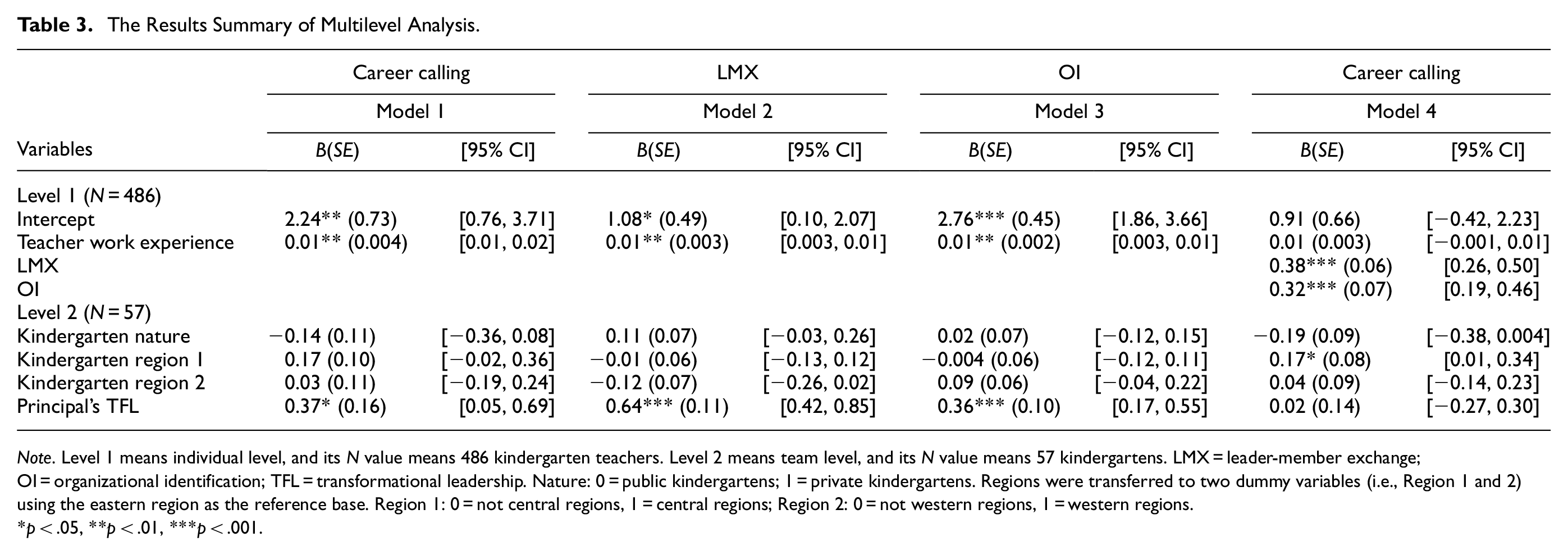
Note. Level 1 means individual level, and its N value means 486 kindergarten teachers. Level 2 means team level, and its N value means 57 kindergartens. LMX = leader-member exchange; OI = organizational identification; TFL = transformational leadership. Nature: 0 = public kindergartens; 1 = private kindergartens. Regions were transferred to two dummy variables (i.e., Region 1 and 2) using the eastern region as the reference base. Region 1: 0 = not central regions, 1 = central regions; Region 2: 0 = not western regions, 1 = western regions.
p < .05, **p < .01, ***p < .001.

Overview of the relationship between kindergarten principals’ transformational leadership and teachers’ career calling.
In order to further test Hypothesis 2 and 3, the mediating strengths of LMX and organizational identification between principals’ TFL and kindergarten teachers’ career calling were tested by the bruceR package. It could provide a Markov Chain Monte Carlo (Quasi-Bayesian) 95% Confidence Interval (MCMC 95% CI) for the multilevel mediating effect. Based on 1000 Monte Carlo samples of bootstrap, the indirect effect of LMX was significant (unstandardized indirect effect = 0.24, SE = 0.05, p < .001, MCMC 95% CI [0.15, 0.35]), and the indirect effect of organizational identification was also significant (unstandardized indirect effect = 0.12, SE = 0.04, p = .005 < .01, MCMC 95% CI [0.05, 0.20]). Hypotheses 2 and 3 were confirmed. It indicated that kindergarten teachers’ exchange with their principal and organizational identification fully mediated the effect of the principal’s TFL on kindergarten teachers’ career calling.
Discussion
This study aimed to explore the cross-level effect of kindergarten principals’ TFL on teachers’ career calling, then further examine its underlying mediating mechanisms from the social identity and social exchange perspectives. The multilevel analysis showed that kindergarten principals’ TFL could positively predict teachers’ sense of career calling. Moreover, kindergarten teachers’ organizational identification and LMX fully mediated the cross-level positive effect of principals’ TFL on teachers’ career calling.
Our study found that kindergarten principals’ TFL could positively predict teachers’ sense of career calling, coinciding with prior empirical studies in other cultures (e.g., Esteves et al., 2018; Gong et al., 2013). Some researchers suggest more efforts to substantiate that career calling has considerable cross-cultural relevance (e.g., Duffy & Dik, 2013). These similar findings provide empirical evidence for career calling’s cross-cultural relevance. Regarding the effect magnitudes, we expected that the positive effect of TFL on career calling in Chinese culture would be stronger than that of Western culture. Compared to Western people, the Chinese people’s career calling would be more closely associated with their leaders’ behaviors because of the traditional Confucian values of hierarchy and subordination. However, our findings showed a small standardized effect size (0.10; e.g., Arend & Schaefer, 2019) of TFL on career calling. In prior studies conducted among the Western teacher sample (e.g., Gong et al., 2013), its standardized effect size was twice as large as ours. Some studies showed that Chinese traditional collectivist values are beginning to infuse more individualist concerns (e.g., Li et al., 2021; C. Zhang, Dik, et al., 2015). Our study’s smaller effect strength between TFL and career calling than that of western culture maybe suggests that possibility. Individuals born in the 1980s, 1990s, and 2000s, who make up most of our sample (81.3%), are more influenced by Western culture than the previous generations due to the Chinese reform and opening-up policy, so they may be less influenced by leaders. This speculation still needs more future research to test.
As expected, our findings revealed that kindergarten teachers’ organizational identification would mediate the effect of principals’ TFL on teachers’ career calling. Consistent with past research, leaders’ TFL would enhance followers’ organizational identification (e.g., Hobman et al., 2011), which in turn leads to a sense of career calling (e.g., Zhu et al., 2019). In kindergartens, as transformational principals exhibit positive behaviors seen as charismatic and moral modeling, teachers are likely to identify with the principal’s values. Moreover, transformational principals would adopt their visionary leadership to set organizational goals which accord with their values and are identified with all teachers. So working with transformational principals, teachers are likely to feel that their values and goals are consistent with the organization, making them identify with their organizations. According to the ICR model (Guan et al., 2021), when working in a unit they identify with, teachers will feel satisfying experiences in several basic psychological needs, such as the need for belonging, self-expression, and continuity. These needs satisfaction is closely associated with individuals’ perception of career calling (e.g., Li et al., 2023; Thompson & Bunderson, 2019).
Moreover, our study found that the exchange quality between principals and teachers would also mediate the effect of principals’ TFL on teachers’ career calling. This result is consistent with prior studies which found the positive effect of principals’ TFL on teachers’ LMX (e.g., Vermeulen et al., 2022) and the positive association between LMX and career calling (e.g., L. Zhang, Jin, et al., 2017; L. Zhang, Ma, et al. 2017). A unique characteristic of TFL rooted in Chinese culture is that leaders care about followers’ career development and family problems (Li & Shi, 2005). Transformational principals’ work and non-work individualized consideration could build high-quality exchange relationships between principals and teachers (e.g., Vermeulen et al., 2022). The Chinese follow the renqing norm, emphasizing affective exchanges in interpersonal relationships (Ling et al., 2019). As a Chinese saying goes, it is impolite not to make a return for what one receives. When kindergarten teachers receive principals’ instrumental (e.g., work support or task arrangement) and affective (e.g., trust, recognition, and encouragement) resource inputs, they will display more work enthusiasm, loyalty, and dedication to the collective interests in return. Great work passion, loyalty, and altruistic devotion to a teaching career are characteristics of teachers’ career calling (Bullough & Hall-Kenyon, 2011). To some extent, our study’s mediating mechanism of LMX aligns with the renqing norm, a key reciprocity principle in relationship-oriented Chinese society (Ling et al., 2019). Moreover, during the social exchange process, teachers are likely to achieve a complementary fit, which is the source of career calling (Duffy et al., 2014). Under transformational principals’ intellectual stimulation and individualized consideration, teachers could develop and utilize relevant capabilities to fulfill their role expectations and receive desired resources from the kindergarten in return (Guan et al., 2021).
Theoretical and Practical Implications
The present study has some theoretical contributions. Our results enrich the research literature on the predictors of career calling in non-Western cultures by helping to identify the multilevel effect of transformational leadership on followers’ career calling and its underlying mechanisms among the Chinese kindergarten teacher sample. There exist individual- and group-focused TFL (e.g., Li et al., 2014). Because prior studies (e.g., Zheng et al., 2017) and our results respectively revealed the effects of individual- and team-level TFL on followers’ career calling, future research can further compare the effects between the two levels of TFL. Moreover, considering TFL as one of the most researched topics in education in recent decades (Jiao & Liu, 2017; Vermeulen et al., 2022), the present study reveals the positive effect of principals’ TFL on teachers’ career calling, broadening our understanding in the benefits of adopting TFL in education. Furthermore, our results provide empirical evidence for the ICR model that organizes different fit forms and addresses how individuals manage their fit experiences in a protean career world (Guan et al., 2021). The present study adopts the identity and social exchange theories, two critical perspectives underpinning the ICR model in guiding individuals to manage the P-E fit, to address the mediating mechanism between TFL and career calling. The full mediation of LMX and organizational identification empirically supports the ICR model.
In addition to the aforementioned theoretical contributions, our findings provide practical implications for kindergartens, government, and educational institution administrators who wish to improve teachers’ career calling. First, the positive effect of principals’ TFL on teachers’ career calling indicates that we can encourage kindergarten principals to use transformational leadership. Principals could use inspirational motivation, moral modeling, charisma, and individualized consideration behaviors to strengthen teachers’ identification with kindergartens and exchange quality with the principal, consequently enhancing teachers’ sense of career calling. Government or educational institution administrators can select or appoint those people with charisma and vision as principals. Given the trainability of transformational leadership (Dvir et al., 2002), principal training institutions can also provide regular training programs to teach principals how to use more transformational leadership behaviors. Second, the mediating effect of LMX suggests the importance of developing a high-quality social exchange between principals and teachers. Principals could be advised to provide teachers with targeted work resources and psychological support; Meanwhile, teachers could improve their skills in getting along with principals. So the two sides can work together to build a high-quality exchange relationship. Third, the mediating effect of organizational identification suggests that principals should pay attention to building teachers’ identification towards kindergartens while considering teachers’ career calling. For example, principals could recruit teachers whose values and beliefs fit with the kindergartens’ vision and values and use the resources in kindergartens (e.g., kindergarten cultural training) to enhance teachers’ identification towards kindergartens.
Limitations and Further Research
This study has some limitations that could provide directions for future research. First, our cross-sectional data would preclude causal inferences, needing future longitudinal research to strengthen the conclusions of this study. Second, the main variables in our study were collected from individual perceptions with subordinates’ self-report data. Future studies could use multiple evaluations to minimize the potential response biases (i.e., social desirability and common-method bias). Third, the present study was conducted during the COVID-19 control phase. Although the kindergarten teachers usually worked during our survey, the COVID-19 pandemic may put teachers constantly on edge and then affect teachers’ work experiences (e.g., career calling). Future research could replicate the present study in the non-pandemic periods and compare to obtain the impact of pandemic events.
Fourth, the present study only examined the parallel mediating effects of LMX and organizational identification. Our results showed that LMX was positively related to organizational identification. There exists a complicated relationship between LMX and organizational identification. Employees who identify more with their organization are more likely to be regarded as insiders by leaders to build high-quality leader-member exchange relations; meanwhile, leaders are more likely to make employees identify with their organization through high-quality social exchange. Moreover, some studies showed that when controlling the association with perceived organizational support, LMX is non-significantly related to workers’ organizational identification (Shen, 2007). In order to deepen the knowledge of how TFL affects followers’ career calling, future research could further explore whether there exists a time series relationship between LMX and organizational identification or whether there are third variables to make them positively related. Fifth, our study only focused on one leadership style’s effect on employees’ career calling. Future research can jointly consider multiple leadership styles to compare which is more effective for employees’ career calling and its underlying mechanism. Finally, our findings are based on Chinese kindergarten teachers, a female-dominated sample and a calling-salient occupation. Interpretation of the mediating mechanisms in other samples should be treated with caution. Future research could test the results’ replicability in other samples, such as culturally diverse samples, male-dominated or gender-balanced samples, and samples with a high challenge to discover a calling (e.g., university custodian; Thompson & Bunderson, 2019).
Conclusion
Our findings suggest that kindergarten principals’ TFL has a positive effect on teachers’ career calling. This effect is achieved through teachers’ organizational identification and high-quality exchange between principals and teachers. So in the period of educational reform, kindergarten principals adopting transformational leadership is effective in building a team of excellent teachers with strong career calling. Moreover, establishing high-quality social exchange relationships with teachers and improving their organizational identification are helpful management strategies for transformational principals to stimulate teachers’ excellent quality (i.e., career calling).
Footnotes
Declaration of Conflicting Interests
The author(s) declared no potential conflicts of interest with respect to the research, authorship, and/or publication of this article.
Funding
The author(s) disclosed receipt of the following financial support for the research, authorship, and/or publication of this article: This study is supported by Zhejiang Provincial Philosophy and Social Sciences Planning Project (grant number 24NDQN144YBM) and the General Program of Humanities and Social Sciences Research, Ministry of Education (grant number 22YJA880029).
Ethics Approval
This study was approved by the Ethics Committee of Wenzhou University.
Informed Consent
Informed consent was obtained from all individual participants included in the study.

Data Availability Statement
Data sharing not applicable to this article as no datasets were generated or analyzed during the current study.