



Abstract
The leader–follower relationship plays an important role in preventing employees from engaging in counterproductive work behavior (CWB). We investigate the interplay among perceived leader–member exchange (LMX), leaders’ motivation to lead (MTL), and CWB, specifically examining the cross-level effect of leaders’ MTL in the relationship between individuals’ LMX and CWB. We tested our hypotheses in two studies: a two-source field study in three large European Union companies (217 employees nested into teams with 31 unique leaders) and an experiment with 106 participants in which we manipulated LMX and MTL using vignette scenarios. Field study results indicated that individuals with higher levels of LMX exhibit lower levels of CWB. This relationship is more negative in cases of low MTL, indicating a trade-off effect of LMX and MTL. The experiment replicated these effects. We additionally tested a moderated-mediation model, which included the explanatory mechanism (mediator) of followers’ MTL. Taken together, this paper proposes and simultaneously tests interplay effects of followers’ dyadic perceptions of their relationships with leaders and leaders’ individual differences in reducing CWB. It develops and tests the role-modeling process of leaders’ MTL translation into followers’ MTL. The paper also shows the multilevel nature of the proposed model with a two-source examination (leader vs. follower perspective).
Plain Language Summary
This study narrowed in on leader–follower relationship, which plays an important role in preventing employees from engaging in counterproductive work behavior. In two (experimental and lab) studies, we found that employees perceiving their relationship with leader better exhibit lower levels of counterproductive work behavior. Motivation to lead alters the studied relationship. When leaders are not motivated to lead, the relationship is more negative. However, leaders with high motivation to lead seem to foster that same motivation in their followers as well, providing evidence of trickle-down role-modeling taking place in leader-follower dyads.
Counterproductive work behavior (CWB) is an ever-present phenomenon leading to negative outcomes in collaborative work. Leadership is important not only to achieve success but also to avoid losses due to CWB (cf., Derue et al., 2011; Liu et al., 2010). To reach these objectives, leadership behaviors such as consideration, initiating structure, contingent rewards, and transformational leadership exert their influence, forming follower perceptions of the leader–member exchange (LMX) relationship, according to a meta-analytical study using several 1,000 studies and involving close to 1,000,000 observations (Gottfredsson & Aguinis, 2017 ). In line with the LMX perspective, leaders develop differentiated exchange relationships with individual followers. More than 50 years (Schriesheim et al., 1999) of research and several reviews and meta-analyses have shown LMX to be a potent predictor of employee outcomes (Dulebohn et al., 2012; Martin et al., 2016; Mumtaz & Rowley, 2020; Premru et al., 2022; Rockstuhl et al., 2012; Thompson et al., 2020).
Nevertheless, employees’ perceptions of their relationships with leaders only reveal one part of the story. A growing body of literature on the concept of motivation to lead (MTL) also convincingly demonstrates that the way leaders perform and exert influence on followers’ behaviors is, among other factors, influenced by their MTL (Hendricks & Payne, 2007; Van Iddekinge et al., 2009). MTL is explained as an individual difference that represents an individual’s internal MTL, social duty, and responsibility, as well as being less calculative of costs and benefits to attain a leadership role (Badura et al., 2020; Chan et al., 2000). Accordingly, we argue for the importance of not only understanding follower perceptions of the leader–follower relationship in the form of LMX but also learning more about the role of leaders’ MTL in the process of achieving success and avoiding detrimental employee outcomes. Understanding MTL can help managers invest in leadership training and development because they can recognize those who will be willing to exert effort and fulfill leadership responsibilities before or during the assessment process (Badura et al., 2020; Jones-Carmack, 2019). Managers can also better understand how MTL relates to follower outcomes.
Our study attempts to learn more about the role of leaders’ MTL in the process of achieving success and avoiding detrimental employee outcomes, specifically CWB (cf., Premru, 2019, 2020). We utilize a field study and an experiment to examine the interaction of LMX and MTL in facilitating or buffering CWBs. In this way, we intend to contribute to the literature on the intersection between leadership and CWB in several ways. Our first intended contribution relates to conceptualizing and examining the interaction between LMX and MTL in predicting CWB. We advance research on leader-specific boundary conditions of LMX, which have primarily focused on the interaction of LMX with other leadership styles or personal leader characteristics in predicting beneficial or detrimental follower outcomes (cf., Gottfredson et al., 2020; McLarty et al., 2021; Nishii & Mayer, 2009). We do so by proposing and testing interplay effects of followers’ dyadic perceptions of their relationships with leaders and leaders’ individual differences in reducing CWB. In this way, we intend to replicate and further validate existing studies showing that LMX reduces employees’ CWB, and we advance them and other research on LMX outcomes by examining an important boundary condition of MTL. This line of research has the potential to contribute to enhancing our understanding of the nuances related to leader–follower relationships in relation to this detrimental outcome at work.
Our second intended contribution narrows further by explaining how leaders’ MTL translates into followers’ behaviors. Values internal to a leader serve as a regulatory guide and they are linked to leaders and followers’ motivational, affective, and cognitive processes (Kark & Van Dijk, 2007; Lord & Brown, 2001). Based on this idea, we develop and test the role-modeling process of leaders’ MTL translating into followers’ MTL. Previous studies on MTL primarily link it with role identity theory, in which individuals have a desire to be perceived as leaders (Waldman et al., 2013), and leader emergence theory, in which the key assumption is that individuals’ MTL is a condition for a leader to evolve others’ leadership potential (Amit et al., 2007; Hong et al., 2011). We advance this stream of research on the outcomes of MTL by explaining the mechanism of how they occur and relating it to the social exchange between leaders and followers (i.e., LMX).
Finally, our third intended contribution is empirical in nature. The last two decades of research on why individuals engage in CWB has made significant progress, and researchers have provided extensive theoretical and empirical analyses of antecedents and outcomes of CWB. However, to a large extent, researchers mainly addressed only individual-level, person-centered variables and their interactions, such as traits and personality (O’Boyle et al., 2011). Because extant empirical findings on the relationship between LMX and CWB are rooted in a single-level analysis, our multilevel and multimethod approach adds significant rigor to this line of study.
Theoretical Background and Hypotheses Development
Leader–Member Exchanges and Counterproductive Work Behavior
Growing concern about misbehavior in the workplace (Ackroyd, 2012) has prompted an eruption of scholarly and practitioner interest. Although ample evidence about the phenomenon of CWB exists, many employees engage in some form of CWB throughout their employment, albeit to varying degrees of frequency and intensity (Vardi & Weitz, 2016). Specifically, CWB is considered an intentional violation of organizational norms or expectations (Gotz et al., 2019, 2020; Robinson & Bennett, 1995). It appears to span the full spectrum from relatively minor to extremely serious—examples include workplace incivility; insulting behaviors; social undermining; theft of company assets; acts of destructiveness, vandalism, and sabotage; substance abuse; and misconduct perpetrated against fellow employees, toward the employer, or toward other organizations (Spector et al., 2006; Vardi & Weitz, 2004).
The increased interest in examining negative aspects of organizational behavior has produced an immense amount of empirical studies testing the relationships between CWB and personality, attitudes, and workplace perceptions (Berry et al., 2007; Mount et al., 2006). Leader behaviors and leadership styles are recognized as important factors of employee behavior (Antonakis & Day, 2017; Effelsberg et al., 2014; Liu et al., 2015). Among those, LMX as a relational approach to leadership is particularly relevant. Its main premise is that social behavior is a consequence of an exchange process between two sides, a process of interactions that results in desired outcomes (Notgrass, 2014; Uhl-Bien, 2006). It is defined as the level of the exchange between leader and follower, where all efforts revolve around interrelations and reciprocity (Gouldner, 1960; Shore et al., 2009). Early work on LMX focused on relationships between dyads (vertical dyad linkage), drawing from the role theory (Bernerth et al., 2007), but it now increasingly relies on social exchange theory (Blau, 1968), where leaders are distinct among followers, so they consequently respond differently to their behavior.
High-quality social exchange relationships evolve through mutual support and care of employees (Cropanzano & Mitchell, 2005); in such cases, employees are motivated to exert effort due to obligation to reciprocate (Kieserling, 2019). Research has shown that LMX is positively related to organizational citizenship behaviors (Walumbwa et al., 2011) and that it prevents deviance and CWB (Gotz et al., 2020), whereas lower levels of LMX are marked by a lack of trust and commitment (Dalal, 2005), possibly causing a tendency toward CWB (Penney et al., 2011).
Given that a leader can label CWB as an unwanted behavior, perceived LMX and the theoretical background of this framework can help explain why some followers would be more inclined to engage in such behaviors. The key premise of the LMX perspective is that leaders develop different relationships with their followers, sorting them into in-group and out-group members. Members’ responses may very well differ due to these distinctions (Cropanzano et al., 2017). Followers who have high levels of responsibility, decision influence, and access to resources characterize a high LMX relationship. This kind of relationship is often referred to as being part of the group or being in-group, whereas a low LMX relationship shows the opposite—low levels of support to the member, and member having low levels of responsibility and decision influence—and reflects not being part of a group (Hooper & Martin, 2008) and being left to feel poorly identified with the leader, the team, and the organization (Gotz et al., 2020). Accordingly, members who benefit experience emotion of gratitude (i.e., in-group or high LMX), but those who feel unfairly disadvantaged could experience anger or contempt toward the leader (i.e., out-group or low LMX; Cropanzano et al., 2017; Henderson et al., 2009). In view of that, individuals will react beneficially to positive actions, resulting in positive reciprocal responses that in turn may encourage employees toward higher levels of organizational commitment, identification, helping behavior, etc. (Cropanzano et al., 2017) and potentially diminish negative behaviors, such as CWB (Premru, 2019, 2020). Thus, we propose that LMX would be negatively related to employee CWB.
The Role of Motivation to Lead
MTL is an inner leadership motivation that relates to leaders’ decisions, intentions, and behaviors. MTL increases leaders’ effort and engagement through leadership training, roles, and responsibilities. Individuals’ MTL can change with leadership experience and training (Chan & Drasgow, 2001). In high-quality social exchanges, members transfer their ethical values, beliefs, knowledge, and experiences in a process that enables the relationship to evolve to a higher level. However, MTL has so far gained scant empirical and theoretical attention of researchers, not only in examining its antecedents (Chan & Drasgow, 2001; Hong, 2005) but also in considering its association with organizational outcomes and leader behavior (Chan & Drasgow, 2001).
Chan and Drasgow (2001) developed and conceptualized the MTL model, which is conveyed through three dimensions: affective identity, social normative, and noncalculative MTL (Chan et al., 2000). The first motivational dimension, high-affective-identity MTL, refers to people who have internal motivation or prefer to lead and see themselves as leaders. They tend to be outgoing and sociable (i.e., extraverts), value competition and achievement (i.e., vertical collectivists), have more past leadership experience than their peers have, have confidence in their leadership abilities (i.e., high self-efficacy; Chan et al., 2000), and are often driven to lead out of a need to satisfy their personal leadership standards (Kark & Van Dijk, 2007). This dimension reflects leadership self-efficacy and experience and represents an individual’s natural tendency to lead others and enjoy doing so (Hong et al., 2011).
Second, individuals high in the social-normative MTL dimension are motivated by a sense of social duty and responsibility and are accepting of social hierarchies yet rejecting of social equality. These individuals also tend to have more past leadership experience and confidence in their leadership abilities (Chan et al., 2000).
Third, individuals with high noncalculative MTL are less calculative about the costs and benefits of leading. Sociocultural values, such as collectivism (i.e., a group or other orientation), play a more important role in noncalculative MTL (Chan et al., 2000). Such individuals are motivated to lead despite considerations of expediency (Amit et al., 2007). This dimension is also associated with an individual’s level of altruism (Hong et al., 2011).
MTL may encourage employees’ decisions to undertake leadership roles (Chan & Drasgow, 2001) as well as predict leader emergence within work groups (Chan & Drasgow, 2001; Hong et al., 2011). The literature has revealed that MTL has been explored in relation to transformational leadership. Specifically, individuals reported higher levels of MTL when they were exposed to transformational leaders (Waldman et al., 2013). Therefore, we can expect that leaders with high MTL will probably identify more with their role as leader, strengthen their exchange relationships, and consequently lower the probability of their followers engaging in CWBs. Therefore, our main theoretical proposition is in proposing that the negative relationship between LMX and CWB should be stronger when leaders possess higher levels of MTL.
In a social exchange relationship (i.e., LMX), employees feel safe to perform their required work, discuss errors and mistakes, share knowledge (Van Den Broeck et al., 2014), and exhibit discretionary behavior (Hackett & Lapierre, 2004; Jiao et al., 2011). Furthermore, LMX as a manifestation of reciprocal obligations increases commitment to leaders (Kuvaas et al., 2012). Leaders in exchange relationships transfer their values and experiences onto their followers, which relate to the followers’ behavior. For example, social exchanges encourage discretionary behaviors, but the extent to which followers will engage in these behaviors depends on a leader’s motivation to develop these relationships.
So far, extensive research has supported the negative link between LMX and CWB in a sense that less CWB can be expected in dyads with perceived higher levels of LMX (Martin et al., 2016, 2018; Townsend et al., 2000). A leader’s MTL can be expected to shape this relationship as an intrinsic factor that encourages leaders’ engagement in leadership roles and predicts followers’ motivation and behavior, therefore reinforcing the relationship between LMX and CWB and ultimately reducing the occurrence of CWB.
These variations of intrinsic MTL among individuals also trigger different levels of work effort and are not necessarily related to high-quality LMX (characterized by social exchange) and low-quality LMX (characterized by economic exchange) in the same way (Buch et al., 2014). Consequently, interest in the leadership activity as a primary motivator determines outcome behavior, which means that contextual factors shaping it become less influential. Therefore, the level of LMX might have less influence on outcome behavior (e.g., preventing burnout or influencing work performance; Dysvik et al., 2010; Fernet et al., 2010) than higher levels of intrinsic motivation have, such as MTL (Buch et al., 2014; Dysvik et al., 2013). This means leaders’ interest in a task prevails and translates to higher levels of work performance (Buch et al., 2014) and discretionary behavior. Therefore, we propose that MTL moderates the relationship between LMX and CWB in a way that the proposed relationship will be more negative at higher levels of MTL than at lower levels of MTL.
Values internal to a leader serve as a regulatory guide and predict not only leaders’, but also followers’ motivational, affective, and cognitive processes (Kark & Van Dijk, 2007; Lord & Brown, 2001). We thus propose that the role-modeling process of leaders’ MTL translating into followers’ MTL occurs when leaders exhibit high levels of MTL and simultaneously exhibit strong social exchange relationships with their followers. We hypothesize that this combination enables followers to identify with their leaders and their leadership role, carry some of that role to themselves, and make them more intrinsically motivated not to engage in deviant behaviors, such as CWB.
Based on these conceptualizations, we thus propose the following hypotheses:
Hypothesis 1: Leader-member exchange is negatively related to counterproductive work behavior.
Hypothesis 2: Motivation to lead moderates the relationship between leader-member exchange and counterproductive work behavior.
Hypothesis 3: Followers’ motivation to lead mediates the relationship between leader-member exchange and counterproductive work behavior, moderated by leaders’ motivation to lead.
We present the research model behind the hypotheses in Figure 1. Field Study 1 tests the direct relationship between followers’ LMX and CWB, moderated by leaders’ MTL. Experimental Study 2 manipulates LMX and leaders’ MTL and helps establish causality in the proposed relationships. It replicates tests of the direct effect of LMX on CWB moderated by leaders’ MTL, and adds a moderated-mediation test by examining the mediating mechanism of followers’ MTL.

Research model with hypotheses.
Study 1
Sample and Procedure
We tested the proposed relationships through a two-source cross-sectional field study conducted among three large international technological organizations with a sample size of 217 employees (based on premises of those organizations in an EU-member state: Slovenia), nested into teams with assigned unique leaders. We informed all employees in advance about the purpose of the study and ensured strict confidentiality. Human resource managers encouraged their employees to participate in the survey within a certain period. The translation and back-translation procedure (Brislin, 1986) was applied to transfer the research instruments (see the Measures section) from originals into the local language (i.e., Slovenian).
The first company is a leading system integrator for industrial and building automation and provider of IT solutions for production management and analysis. Their services and solutions are highly acknowledged in the pharmaceutical industry, food and beverage industry, aeronautics, and defense and security. The majority of respondents were of male gender (90%), mostly with university degrees (44%), and with an average age of 42 years. The second company is one of the leading European home appliance manufacturers that aims for technological perfection, superior design, and to raise the quality of living for users via energy-efficient home appliances. The majority of respondents were male (72%) with an average age of 41, and 38% had a university degree. The third company offers products for efficient energy use, communication systems, data management software, and supportive services. The gender structure here was more balanced (of those that responded, 45% female and 55% male) with an average age of 40, and 31% of the employees held a high school degree. Table 1 shows sample demographics.
Study 1: Sample Structure.

Measures
LMX, CWB, and control variables were captured from the employees, whereas MTL was assessed from the supervisors.
LMX was measured with a seven-item scale developed by Graen and Uhl-Bien (1995; α = .92). Respondents indicated the extent to which they agreed with individual statements (1 = strongly disagree, 7 = strongly agree). Sample items include “How well does your leader understand your job problems and needs?” and “How well does your leader recognize your potential?”
CWB was measured by a 10-item scale developed by Spector et al. (2010; α = .89). Respondents indicated, based on a 7-point Likert-type scale (1 = never to 7 = everyday), how often they performed each behavior at work. Sample items include “Told people outside the job what a lousy place you work for” and “Insulted someone about their job performance.”
MTL was measured using a shortened version of a 27-item original scale (Chan & Drasgow, 2001) with a 7-point Likert-type scale. We adopted three items for each of three dimensions and treated these as a single MTL scale. Items with the highest factor loadings were selected from Chan and Drasgow (2001). Sample items, tackling leaders’ self-perceptions regarding their MTL, include “I usually want to be the leader in the groups that I work in,”“I never expect to get more privileges if I agree to lead a group,” and “I was taught to believe in the value of leading others.”
We controlled for age, gender, education, and employment tenure in the current company. We expected that age and higher level of education would bring more awareness about CWBs, which would in turn result in productive forms of organizational citizenship behavior (Cordery & Sevastos, 1993; Gruys & Sackett, 2003). In addition, we did not find any relationship between gender and CWB (Coleman Gallagher et al., 2008), despite the stereotype that females would be more likely to take care of the organization and other coworkers than men would be. We controlled for employment tenure, which may influence followers’ ratings of LMX (Schyns et al., 2005).
Method
When data, as in our case, are collected from multiple individuals in a group, the individual data are considered nested within that group. The data set for the first study consisted of two hierarchically nested levels: survey responses of 217 employees (Level 1) nested within 31 groups (Level 2). We thus performed a multilevel analysis using hierarchical linear modeling (HLM) to test the suggested model and hypotheses. The key benefit of this approach is that it accounts for variance among variables at different levels, and investigates relationships within and between hierarchical levels of grouped data simultaneously (Woltman et al., 2012). We used the multilevel approach to test the following aspects: (a) the existence of a multilevel structure and the individual-level relationships, (b) the cross-level effect of MTL at the leader level on CWB at the individual level, and (c) the moderating effect of MTL on the relationship between LMX and CWB.
Results
Table 2 presents the means, standard deviations, and correlations. To examine the hypotheses, we developed a multilevel model in HLM, for which Table 3 presents the fixed effects with robust standard errors. We started with an intercept-only model with CWB as the dependent variable (Model 1). Then, we added LMX (Model 2) to examine the hypothesized direct link. Our results supported Hypothesis 1, which stated a direct relationship exists between LMX and CWB (γ = −0.086; p < .01). This model also included the general Level-1 control variables (age, gender, education, and tenure of employment); we found that their connection with CWB was not significant, except for education, which was marginally significant (γ = −0.099, p < .10).
Study 1—Means, Standard Deviations, and Correlations.

Note. n (listwise) = 144. For gender, 1 = male, 2 = female. Coefficient alphas are given on the diagonal in parentheses.
Correlation is significant at the .05 level (two-tailed).
Correlation is significant at the .01 level (two-tailed).
Study 1: Results of the Multilevel Analysis with HLM.
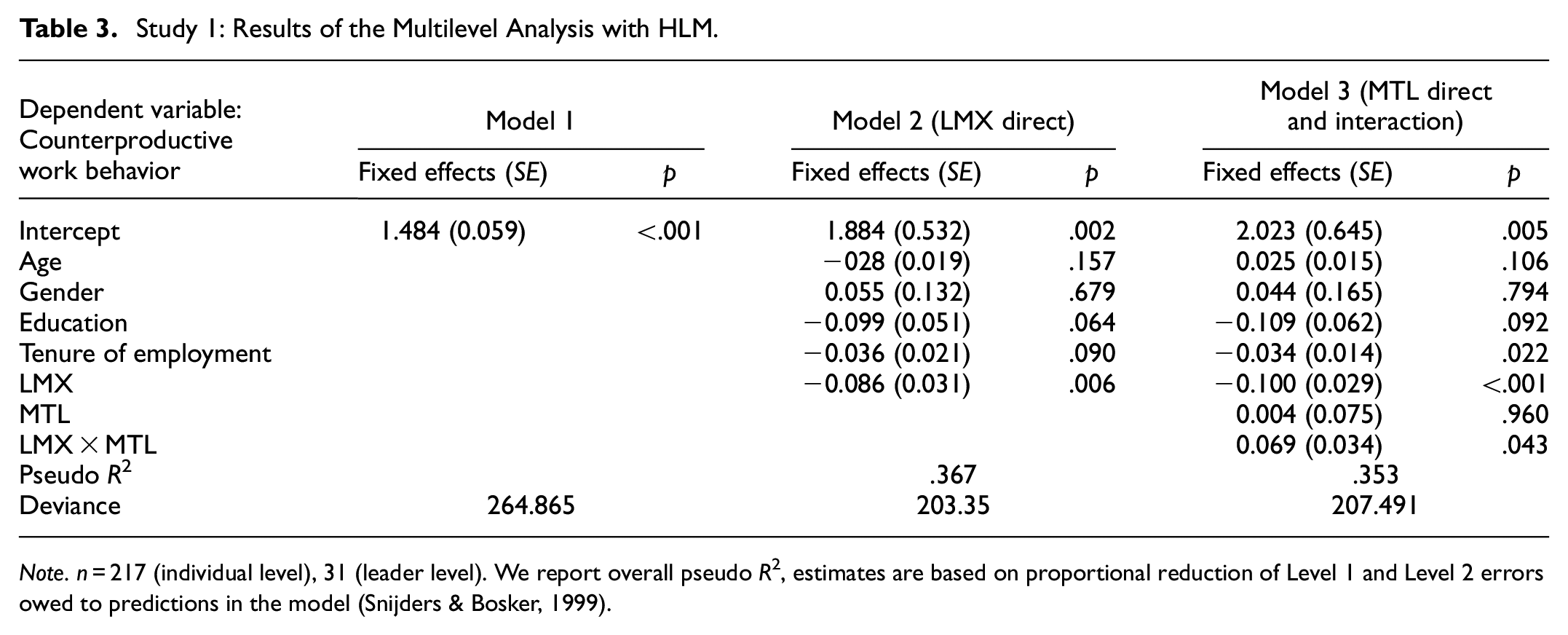
Note. n = 217 (individual level), 31 (leader level). We report overall pseudo R2, estimates are based on proportional reduction of Level 1 and Level 2 errors owed to predictions in the model (Snijders & Bosker, 1999).
In the third step, we included MTL of leaders as a Level-2 predictor in the analysis (Model 3). The main effect of MTL was not significant (γ = 0.004; p = .960). Alternatively, the results show a cross-level interaction effect of MTL and LMX in predicting CWB (interaction effect = 0.069; p = .043): A stronger negative relationship exists between LMX and CWB in cases of low MTL. Therefore, despite the significant interaction effect, we could not support Hypothesis 2. Results also hold when using Kuvaas et al.’s (2012) 8-item measure of LMX that delineates between social and economic LMX. Results for social LMX are similar to those for LMX measured with LMX-7, and they also hold when controlling for economic LMX.
Plotting the two-way interaction (Figure 2) shows that CWB increases under conditions of low MTL and LMX. On the contrary, high MTL and LMX also result in higher levels of CWB, although we expected that there will be lower levels of CWB with high MTL and LMX as proposed in Hypothesis 2.
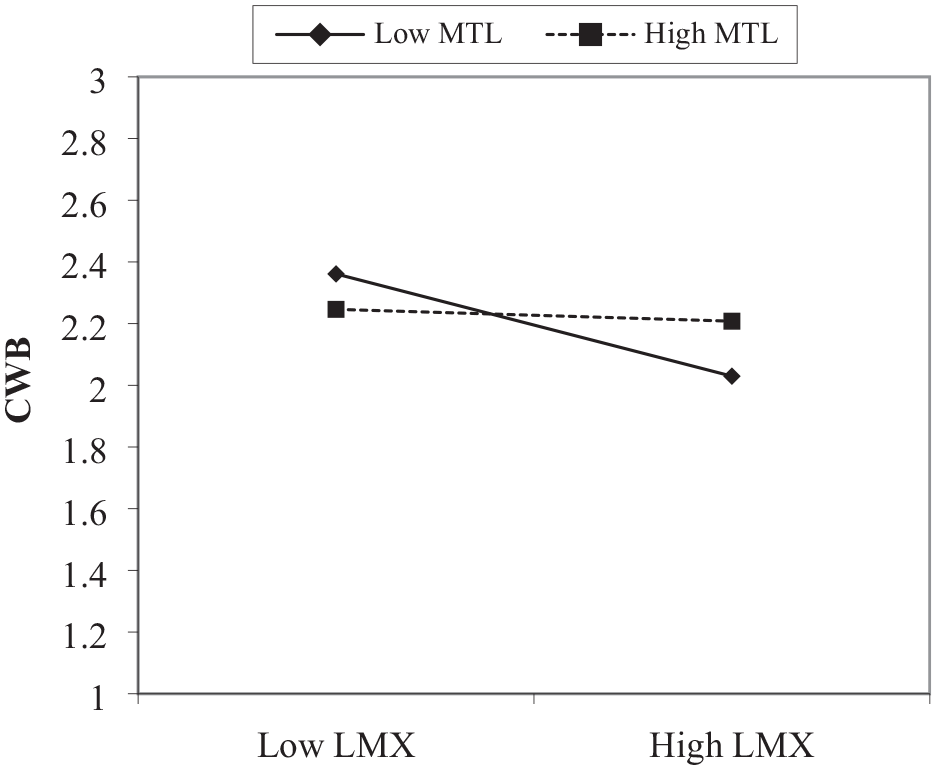
Study 1: Two-way interaction effect of MTL and LMX on counterproductive work behavior.
Study 2
Sample and Experimental Design
We conducted the experiment in spring 2020 using a sample of 106 undergraduate human resource management students at an EU-based (i.e., in Slovenia) university. We informed participants that we would keep all information collected in this study strictly confidential and use it only for research purposes. The age of the participants ranged from 20 to 28, and the mean age was 21.76 years (SD = 1.25). Approximately half of them had at least a year of working experience in terms of holding student jobs. The experiment used a 2 × 2 (LMX: low, high; and MTL: low, high) between-subjects factorial design.
The experiment used and adapted Ashe’s (2005) task-based scenario. We assigned each participant the role of an employee in a marketing department for a large retail company. In the scenario, they were told the company would hire a person to fill the regional marketing director (RMD) position in the central region, which had been vacant for a long time. In the scenario, they performed the duties for their job and the job of the RMD. Therefore, filling the RMD position was going to help lessen their workload. In the scenario, their supervisor, Pat, had made the final decision about who should be hired for the RMD position and he had decided on their team colleague, Tina. The participant knew Tina well, and they believed that she was not an appropriate candidate for the position because she came to work late, took office materials home, and often insulted other colleagues. In fact, each participant was told to think of himself or herself as the most appropriate candidate to fill the RMD position. At the end, participants were offered four different answers on their behavioral intent about filling the RMD position, of which one was an ethical decision (i.e., saying nothing and trusting the supervisor’s decision) and the others (i.e., asking Tina to decline the offer, accidentally mentioning her poor on-the-job presence, and using longer lunch breaks at her expense) represented examples of CWB (Ashe, 2005).
LMX and MTL Manipulations
Prior to engaging in the task and decision-making, we randomly assigned participants to two LMX conditions (with a vignette taken from Babič et al., 2019), interacting (overlapping) with two MTL conditions (applying a vignette that we constructed by adapting Rettinger et al.’s, 2004, general motivation vignettes to prime MTL).
High LMX: You have been working under your present boss, Pat, for about 2 years. You like Pat and enjoy working with him. Pat provides you with enough clarity on what you are supposed to do and how you are supposed to do it, and he contributes to your job both in terms of high-quality solutions and enough time. You can count on Pat to defend you in times of crises and in return, your work for Pat goes beyond what is specified in your job description. Low LMX: You have been working under your present boss, Pat, for about 2 years. You do not like Pat and do not enjoy working with him. Pat does not provide you any clarity on what you are supposed to do and how you are supposed to do it, and he does not contribute at all to your job in terms of either high-quality solutions or enough time. You cannot count on Pat to defend you in times of crises, and in return, you work for Pat only to the extent that is specified in your job descriptions. High MTL: Pat is a born leader and has a tendency to take charge in most groups. Pat agrees to lead others even if there are no special rewards or benefits with that role. Pat agrees to lead whenever he is asked or nominated by the other members; he always volunteers to lead others if he can. Low MTL: Pat is not a born leader and has a tendency not to take charge in most groups. Pat agrees to lead only if he sees benefits from accepting that role. Pat does not agree to lead whenever he is asked or nominated by the other members; he never volunteers to lead others if he can.
Measures
CWB was measured in two ways: with a behavioral intention question already described in the task description and with the same scale that we applied in the field study (Study 1), which was adapted to fit the experimental task context.
LMX and MTL were assessed with the same measurement instruments as in Study 1 and were adapted to fit the experimental task context, focusing on their relationship with imaginary supervisor Pat.
Results
Manipulation Checks
In terms of manipulation checks, a two-way analysis of variance showed the expected primary effects of the MTL manipulation on participants’ perceptions of MTL levels, F(1,104) = 155.77, p < .01, and for LMX manipulation on participants’ perceptions of LMX levels, F(1,104) = 6.60, p = < 0.05. Table 4 presents means and standard deviations of focal variables in different experimental conditions.
Study 2: Means and Standard Deviations by Condition.

Note. Standard deviations are in parentheses.
Hypotheses Tests
We first tested for the direct effect of LMX manipulation on CWB. The direct effect of LMX manipulation was significant, F(1,104) = 14.178, p ≤ .01, and showed that less CWB occurred in the high LMX condition as opposed to the low LMX condition, providing support for Hypothesis 1.
Turning to our moderation Hypothesis 2, ANOVA also revealed a significant interaction effect of the MTL manipulation and LMX manipulation on CWB, F(3,102) = 4.23, p < .01, with a similar pattern of interaction as in Study 1 (see Figure 3 for plot). To test Hypothesis 3, which additionally examined followers’ MTL as an explanatory mechanism in this moderation, moderated-mediation procedures showed that the moderated-mediation index was significant (index = 0.13, confidence interval [CI; 0.0030, 0.4019]) and that at high levels of leaders’ MTL, the indirect effect of LMX on CWB via followers’ MTL was positive (effect size = 0.06). However, for low levels of leaders’ MTL, it was negative (effect size = −0.06).
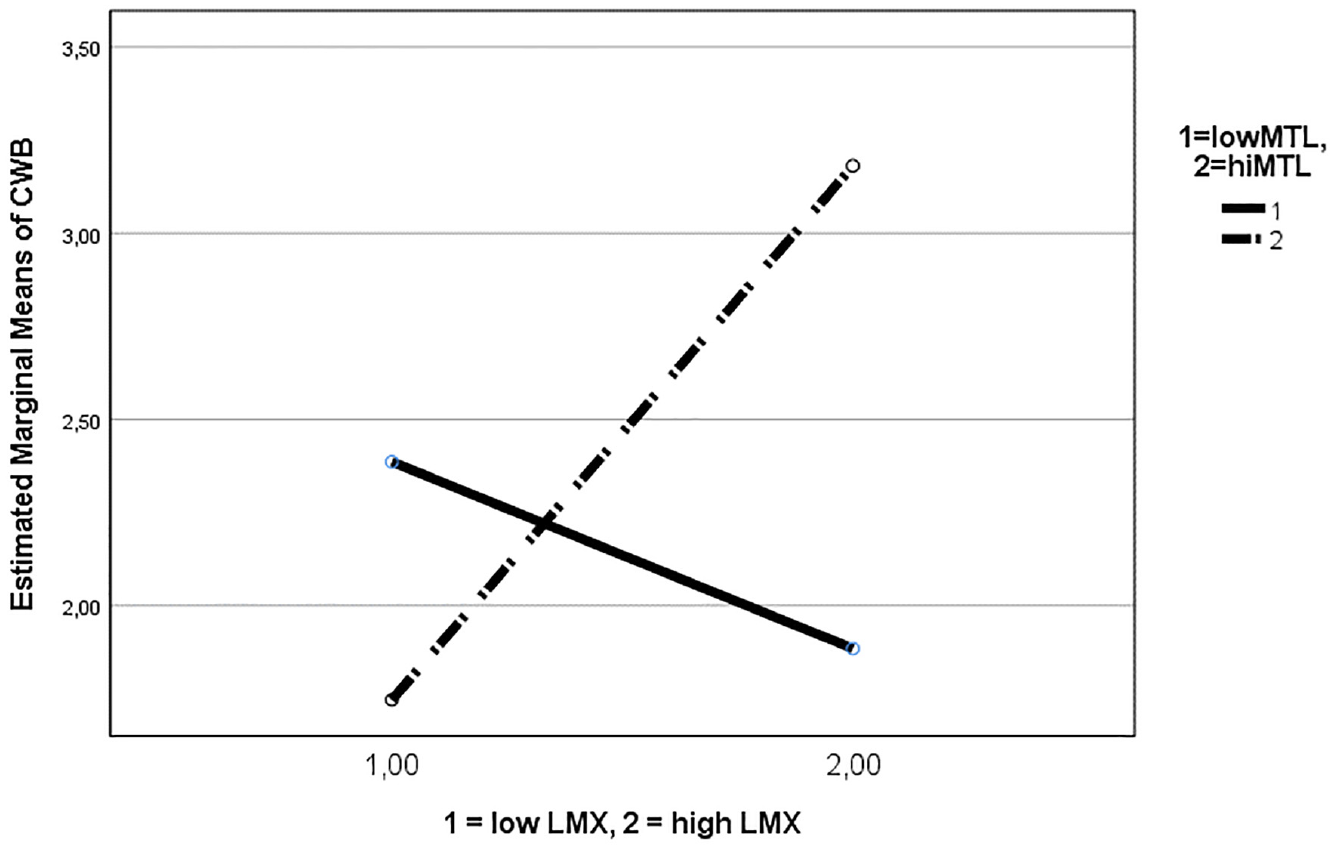
Study 2: CWB means in different experimental conditions.
Discussion
With this study, we attempted to extend knowledge on MTL and its application to the leadership field in relation to CWB. CWBs have important implications for the well-being of organizations and their members (Sackett & DeVore, 2001; Wahyu Ariani, 2013). With the awareness of costs and other negative consequences comes a growing consciousness of CWB. Therefore, it is of great importance for organizations to identify CWB, to examine the underlying reasons why individuals engage in such behavior, and finally, to understand how to prevent such behavior.
First, in line with prior research, we found that a negative relationship exists between LMX and CWB, suggesting LMX is related to higher levels of invested effort, satisfaction with a leader, and mutual trust and respect (Ahmed, 2015; Aryee et al., 2002), thereby preventing CWB. High LMX relationships are likely to encourage employees’ identification with organizational values and to create a relational obligation, which would motivate employees to engage in behaviors with favorable outcomes (Eisenberger et al., 2019; Lavelle et al., 2007) rather than counterproductive ones.
Thus, our study contributes by adding the latest empirical evidence to existing literature while aligning with research showing a negative relationship between more transactional LMX relationships and follower work performance (Buch et al., 2016). It also aligns with recent research explicitly distinguishing between social and economic LMX, showing the former to be detrimental to several employee outcomes (see Andersen et al., 2020 for a review). Indeed, as noted by Eisenberger et al. (2019): “transactional exchange in which employees carry out limited and explicit job responsibilities for specified compensation without consideration by either party of the long-term goals or welfare of the other” (p. 1037). In this respect our study contributes to the larger conversation investigating the relationships and conditions under which more transactional LMX relationships relate to outcomes (e.g., Buch et al., 2016; Mumtaz & Rowley, 2020).
As noted by Buch et al. (2016), leaders favor particular employees over others and only develop social LMX relationships with those, and more transactional LMX relationships with the rest. It is thus theoretically and practically important to examine how to mitigate the negative impact of more transactional LMX. By bringing in individual differences to investigate the boundary conditions under which low quality transactional LMX relates to outcomes, our study complements that of Buch et al. (2019) that showed individual differences in self versus other orientation to be an important moderator of how employees respond to social versus transactional LMX relationships.
Second, we aimed to demonstrate that MTL moderates the relationship between LMX and CWB. Specifically, higher levels of LMX would reduce the occurrence of CWBs and vice versa. We show that MTL is an important mechanism related to outcome behavior. Moreover, we proposed that higher levels of MTL and LMX should exhibit lower levels of CWB. However, in our case, results revealed that for followers with a strong MTL leader, the social exchange relationship between the two is of less importance with respect to reducing CWB. One explanation could be that individuals in social exchange relationships have higher levels of trust, which results in lower levels of control and supervision, even if they possess higher levels of MTL, thus allowing employees to engage in some kind of CWB (e.g., extended lunch break). However, not all individuals react to the quality of exchanges at work in the same way (Fernet et al., 2010). This might be due to the substitutive effect, which suggests that others might reduce a leader’s ability to predict employee behavior and is replaced with the follower’s behavior (Jiang et al., 2015; Kerr & Jermier, 1978; Podsakoff et al., 1996).
Finally, MTL conveys behavioral intentions based on subjective attitudes toward leadership (e.g., taking initiative in a self-managed setting), and it could be a predictor of leader emergence (Bergner et al., 2019; Hong, 2005; Hong et al., 2011). We tested this logic in an experimental study (Study 2), which supported Hypothesis 3 and showed that a follower’s MTL acts as an explanatory mechanism in the interaction effect.
Theoretical Contributions
LMX as an important aspect of relational leadership has garnered much attention. Our study complements, replicates, and validates previous research that found support for the negative relationship between LMX and CWB (Chernyak-Hai & Tziner, 2014; Wahyu Ariani, 2013). The role of LMX in explaining CWB is already well represented, but little research has determined the mechanisms through which LMX predicts CWB.
In general, the consensus in the accumulated literature examining the link between LMX and CWB is quite clear (Chernyak-Hai & Tziner, 2014; Martin et al., 2016; Wahyu Ariani, 2013). In particular, high LMX indicates a positive association with followers’ outcomes, but low LMX or more economic exchanges have less beneficial consequences (Cogliser et al., 2009). Apparently, some leadership theories, such as LMX, are more effective in predicting organizational behavior and performance (i.e., counterproductive behavior).
Because differences exist in individual behavior and personality (Cullen & Sackett, 2003; Davidovitz et al., 2007), a question arises concerning the ways other factors are associated with the relationship between the levels of LMX and outcome behavior. Research has only began to tap into the role of leader orientation and leader-member relationships (cf., Buch et al., 2019), but has yet to explore MTL as a central focus of individuals’ interest in engaging in certain activities that yield beneficial outcomes from the perspective of leaders’ MTL and their link to the relationship between followers’ LMX and CWB.
Although literature suggests that individual differences are important determinants of employee behavior (Spector & Fox, 2002), research on MTL in a workplace setting, especially its role as a mechanism that can help explain outcome behavior, is rather limited. For instance, studies so far have examined MTL in relation to leaders’ emergence (Hong et al., 2011), vocational interests (Chan et al., 2000), work environment, self-identity, and values (Guillén et al., 2015). Predictors of MTL have also been studied, such as personality and even generation-specific antecedents (Barling et al., 2022; Porter et al., 2019). However, investigation of MTL as a construct is relatively insufficient (Badura et al., 2020). Thus, the present study is complementary to a recent research endeavor of Schyns et al. (2020) showing the importance of implicit leadership self-concept for the development of MTL, and represents one step further in gathering empirical evidence.
Our findings also suggest CWB occurs more often when leaders have strong MTL in interactions with higher levels of LMX. However, according to theory, social exchanges between leaders and followers are developed through series of interactions over time (Nahrgang et al., 2009), setting enough opportunities for building mutual trust and respect. In these reciprocal relationships (Gouldner, 1960), both sides recognize the positive benefits of cooperation and likely do not have hidden harmful intentions, which increases the likelihood of engaging in discretionary behavior rather than counterproductive behavior. Additionally, research has found that intrinsic motivation moderates the relationship between LMX and work effort, which suggests that LMX corresponds with extra work effort and manifestations of MTL toward followers (Buch et al., 2014). However, higher LMX might encourage employees to undertake leadership roles, thus engaging in CWBs to overthrow the leader from the current position. MTL has been shown to predict leader emergence (Hong, 2005; Hong et al., 2011; Prundeanu et al., 2021), which might also be due to negative perceptions of their existing leaders. Therefore, employees engage in leader roles using their initiative, which might relate to certain types of CWB enactment, for example, taking over a leadership position.
Finally, this study contributes to methodological approaches used in a leadership domain that relate to the multilevel nature of the proposed model with a two-source examination (leader vs. follower perspective). Leadership and its complexity go beyond leader perspective, and it is necessary to employ a multilevel approach to ensure the growth of a scientific field across leadership domains (Day & Harrison, 2007). However, most leadership domains still continue to conduct studies at the individual level of analysis; only a few have begun to embrace a multilevel approach (e.g., transformational and authentic leadership; Batistič et al., 2017).
We contribute by applying a proposed multilevel model with a two-source examination (leader vs. follower perspective). Thus far, an immense amount of effort has been invested in theorizing about the importance of using level perspectives in the field of management and organization. Particularly in the field of leadership, scholars have witnessed a substantial effort from researchers to understand how leadership and its outcomes unfold across and within levels in an organization (Batistič et al., 2017; Kozlowski & Klein, 2000). The broader understanding of the complexity and multidimensionality of leadership goes beyond an individual leader or follower perspective, and it is necessary to employ a multilevel approach to ensure the growth of a scientific field across leadership domains (Day & Harrison, 2007). Individuals in a dyadic relationship can have different views on the same examined construct, even on different levels of research. Therefore, besides the within-group variance, the between-group variance is present. Due to variations in individual behavior, it is necessary to look from the microperspective (i.e., leader vs. follower) and focus on variations among individual characteristics that relate to individual reactions (Kozlowski & Klein, 2000).
Practical Implications
Findings of this study support previous examinations of the relationship between LMX and CWB. However, past studies have failed to provide practical recommendations on which activities can help develop higher LMX, making its understanding more valuable to organizations. Furthermore, as already empirically supported, the level of an exchange relationship is an important predictor of outcome behavior.
Second, we proposed that the moderating effect of MTL would strengthen the relationship between LMX and CWB. Although results show that moderation exists, the two-way interaction plot reveals unexpected levels of CWB, suggesting that followers engage in much the same levels of CWB because of LMX when they have a leader who is motivated to lead. This suggests two alternative routes to dealing with CWB in organizations could exist: either develop LMX relationships or recruit leaders motivated to lead. In this case, we can consider a wide variety of organizational, individual, and task characteristics that can work as substitutes to enhance or diminish a leader’s influence on employee behavior (Kerr & Jermier, 1978). Because followers react differently to the LMX levels in interpersonal relationships (Fernet et al., 2010), they might substitute a leader’s MTL and intentions to influence employee behavior with their own. Therefore, organizations should consider individuals’ MTL and their fit within their assigned job roles, create environments, and adapt HR systems and practices that enable development through informal events.
Limitations and Future Research Directions
The first limitation of (cross-sectional) Study 1 is the low alpha and composite reliability scores, which are internal consistency reliability measures for convergent validity. This might be due to the multidimensionality of the MTL scale and the fact that the MTL measure is relatively new, but also that it might represent a formative rather than a reflective construct, rendering its testing of reliability with standard tests (e.g., alphas) not optimal anyway. We encourage future researchers to examine and further refine the MTL measure. Additional testing in different settings seems warranted.
Another limitation is that all participating organizations in Study 1 operate in the technological and IT industry. They are constantly under pressure from the changing environment and need to innovate continuously and adapt to market demands. Therefore, certain variations might exist among different industries. For example, in organizations where focus is oriented more toward the customer, we might expect that social exchange relationships are more important in attempts to achieve higher organizational performance. Employees are more engaged in social interactions with their colleagues, suppliers, and customers. On the other hand, in specific environments, where companies rely on accomplishing certain job tasks that are part of certain broader processes, for example the production or manufacturing industry, the need for social exchange might be of less importance.
Regarding the different results between Study 1 and Study 2, in addition to the different research methods (i.e., survey vs. experiment), the way a leader’s MTL was operationalized may have played a role. In Study 1, leaders assessed their MTL, whereas in Study 2, participants (follower role) perceived leaders’ MTL via manipulation. Leaders’ perception of their MTL and followers’ perception of their leader’s MTL can be different. Future research could specifically address these different forms of operationalization and theorize about differences and potential generalizations.
Future studies should attempt to extend research on MTL and the way it relates to the leader–follower relationship, focusing on possible boundary conditions that can be associated with the LMX and CWB relationship (Davidovitz et al., 2007). Applying a multilevel approach also offers great potential for advancement and development of a scientific field (Mathieu & Chen, 2011). In this study, the measurement level of the constructs was the individual level, which we assessed through individual-level data. The proposed cross-level moderator model describes the top-down effect of leaders’ MTL on the relationship between followers’ LMX and CWB. It would be interesting to consider bottom-up emergent processes and the ways characteristics of individuals manifest at higher levels (Kozlowski & Klein, 2000), as well as the way individual differences and behaviors that have been shown to matter in CWB (Chen et al., 2020) or leader–follower similarity (Parent-Rocheleau et al., 2020) interact with contextual conditions.
Conclusion
This study narrowed in on leader–follower relationship, which plays an important role in preventing employees from engaging in CWB. In two (experimental and lab) studies, we found that individuals with higher levels of LMX exhibit lower levels of CWB. MTL plays a moderating role in this studied relationship, rendering it more negative in cases of low MTL, indicating a trade-off effect of LMX and MTL. Leaders with high MTL seem to foster MTL in their followers as well, providing evidence of an important multi-level explanatory mechanism of role-modeling taking place in leader-follower dyads. Taken together, it further behooves us to study both leaders’ and followers’ individual differences and perceptions of their dyadic relationships simultaneously in reducing CWB.
Footnotes
Declaration of Conflicting Interests
The author(s) declared no potential conflicts of interest with respect to the research, authorship, and/or publication of this article.
Funding
The author(s) disclosed receipt of the following financial support for the research, authorship, and/or publication of this article: This research was supported by the Slovenian Research Agency (grant numbers J5-2555, J5-4574, and P5-0441).

Data Availability Statement
Data available upon reasonable request from the first or corresponding author.