




Abstract
The present study focuses on the role of leader–member exchange and relational identification (RI) between transformational leadership and job performance relationship. The model has been tested in higher education sector. All the permanent teachers working in higher education sector were contacted. The data have been duly validated with the help of confirmatory factor analysis (CFA). Reliability has been assessed through Cronbach’s alpha and composite reliability. Structural equation modeling (SEM) has been used for hypotheses testing, and hierarchical regression has been used to test the moderating effect of RI. The results indicated that leader–member exchange acts as a mediator and RI acts as a moderator instead of mediator. The managerial implications and future scope have been discussed.
Keywords
Introduction
Globalization has necessitated the need for sustainable competitive advantage (Sadia, 2011), which requires frequent innovations in product and system management. Human resources are the valuable assets (Pareek & Rao, 2007), which are inimitable and can generate sustainable competitive advantage through innovative ideas (Barney, 1991; Lippman & Rumelt, 1982; Polyani, 1962; Teece, 1982; Ward, Grudnoff, Brooker, & Simpson, 2013; Wernerfelt, 1984). To keep them motivated for new innovations, one requires people, who can manage/lead these human resources efficiently (Certo & Certo, 2006; Liaw, Chi, & Chuang, 2010; Shanker, 2012). Leaders play a great role in this context (Chou, Lin, Chang, & Chuang, 2013). Their leadership ability helps in attaining and retaining the quality workforce (Kwan, 2009; Sharma & Jyoti, 2006). Although literature reveals several styles of leadership, transformational leadership (TL) is one of the most used styles in organizations to manage the change (Kejriwal & Krishnan, 2004; Sarros & Santora, 2001). It helps to bring valuable and positive changes among the followers by exhibiting the role model characteristics, providing intellectual motivation, and showing individual concern for the followers (Shibru & Darshan, 2011; Stewart, 2006). In this style, the leader uses less authority and acts as a guide, mentor, and coach to enhance the vision of the followers. It establishes quality relationships between the two on the lines of social exchange theory (Carter, Jones-Farmer, Armenakis, Field, & Svyantek, 2009; Liden & Maslyn, 1998). As per exchange theory, when a person provides something of value to another person, it becomes obligatory for the recipient to reciprocate (Blau, 1964), which yields beneficial consequences for the followers such as trust (Podsakoff, Mackenzie, Moorman, & Fetter, 1990), career advancement (Dubinsky, Yammarino, & Jolson, 1995), self efficacy (Walumbwa & Hartnell, 2011), identification (Humphrey, 2012; Juan, Malero, Topa, & Nangin, 2011), job satisfaction (Mohammad, Zeaud, & Batayneh, 2011), and job performance (JP) (Geyer & Steyrer, 1998; Koh, Steers, & Terborg, 1995). At organizational level, it results in organizational commitment (Avolio, Zhu, Koh, & Bhatia, 2004; Ramachandran & Krishnan, 2009), organizational citizenship behavior (Humphrey, 2012; Lian & Tui, 2012), and identification (Cavazotte, 2013; Humphrey, 2012; Walumbwa & Hartnell, 2011). Many researchers like Bushra, Usman, and Naveed (2011), Dvir, Eden, Avolio, and Shamir (2002); Geyer and Steyrer (1998); Grant (2012); Wang, Law, Hackett, Wang, and Chen (2005); and Yang, Melien, Chieh, and Yushin (2011) have identified direct impact of TL on JP. But there are other researchers, who viewed that TL affects JP through other variables like trust (Gillespie & Mann, 2000), self efficacy (Cavazotte, 2013; Walumbwa & Hartnell, 2011), collective efficacy (Walumbwa, Wang, Lawler, & Shi, 2004), organizational citizenship behavior (Boerner, Eisenbeiss, & Griesser, 2007), leader–member exchange (LMX; Carter et al., 2009; Wang et al., 2005), and identification (Cavazotte, 2013; Walumbwa & Hartnell, 2011). The second notion is better as leaders create trust and confidence among the followers, which makes them perform better. The present research also focuses on establishing indirect effect of TL on JP of employees through LMX and RI. The present study, therefore, proposes a research framework with the aim at investigating the mediating role of LMX and RI between TL and JP.
Conceptual Framework and Hypotheses Development
The theoretical framework (Figure 1) has been developed on the basis related review of literature. Burns (1978) conceptualized TL, which was further extended by Bass (1985), and Bass and Avolio (1994). They proposed full-range theory of leadership, which consists of transformational, transactional, and laissez-faire. Transformational leaders encourage followers to exert and explore existing as well as new horizons. They are proactive and help followers to attain unexpected goals (Antonakis, Avolio, & Sivasubramaniam, 2003). They move followers beyond immediate self-interest (Bass, 1999). This type of leadership is an important antecedent to construct the collective confidence or strength required by groups to be successful when facing with difficult challenges (Bass & Avolio, 2003). TL can create significant organizational change and act as change agents, foster higher level of intrinsic motivation and loyalty among followers, and introduce a new image or view of the future and create a commitment to this image among followers (Kinicki & Kreitner, 2008).

Theoretical framework.
The LMX theory focuses on the relationship or interaction between both leaders and followers. “The interaction/exchanges, both in content and process are defined as the individual dyadic linkage” (Jensen, Olberding, & Rodgers, 1997, p. 321). Each relationship formed has its own unique characteristics. Leaders not only have individual relationships with each of their followers, but the relationship is unique and viewed as a series of vertical dyads (Stringer, 2006). Furthermore, “the heart of each dyadic relationship is the concept of a role-making process, or role negotiation process” (Carter et al., 2009, p. 2). The role expectations of a leader and the extent to which the subordinates meet those expectations make up the relational context of the exchange process (Dienesch & Liden, 1986; Jackson & Johnson, 2012; Tse & Lam, 2008). LMX depends upon the level of trust, interaction, support, and rewards, which determines the quality of the relationship.
Relational identification is one of three components of the identification theory (self identity, collective identity, and relational identity). “It is the degree to which one includes the role relationship in one’s self-concept” (Aron & Aron, 2000, p. 110). “It refers to a partial definition of oneself in terms of a given role relationship and offers a new way to understand the unique supervisor-subordinate relationship” (Sluss & Ashforth, 2007, p. 11). Furthermore, it is generally argued to be a psychological healthy relational state, fostering empathy, liking, cooperation, and in-role and extra-role performance. However, extreme RI can foster negative outcomes such as co-dependency and collusion in co-operative behavior.
Performance is the function of knowledge, skills, abilities, and motivation directed at role-prescribed behavior, such as a formal job responsibilities. Job performance reflects the completion of the role/task allocated to a particular person/employee. Research has indicated that JP is a multi-dimensional construct consisting of task and contextual performance (Motowidlo & Van Scotter, 1994).
TL, LMX, and Job Performance
Transformational leaders’ behavior is linked to a variety of affective, cognitive, and behavioral outcomes. They help their followers to become future leaders by acting as change agents (Burns, 1978). Wang et al. (2005) reviewed several studies on LMX and found that those studies have focused on social exchange quality in dyad. This phenomenon helps to establish qualitative leader–follower relationship known as LMX (Gerstner & Day, 1997). Furthermore, LMX is interpersonal exchange of relationships between the leader and each follower. According to LMX theory, leader–follower relationship may be of a high or low quality (Graen & Uhl-Bien, 1995). In high-quality LMX, the leader and member will exchange mutual trust, support, loyalty professional respect, work contribution, and understanding. Therefore, followers gain numerous benefits, including effective communication, access to the leader support, trust, approval, consideration, autonomy, and favorable job assignments (Graen & Uhl-Bien, 1995). According to social exchange theory, followers are more likely to exchange these benefits with their leaders and organizations (Liden, Sparrowe, & Wayne, 1997) in the form of efficient JP. Empirical studies have revealed that high quality of LMX enhances organizational commitment (Ansari, Lee, & Aafaqi, 2007), job satisfaction (Fisk & Friesen, 2012), organizational citizenship behavior (Asgari, Silong, Ahmad, & Abu-Sama, 2008), creative behavior (Basu & Green, 1997), and employee performance (Erdogan & Enders, 2007). Furthermore, TL is a process whereby ordinary people can bring forth the best in themselves and others too. Transformational leader is able to motivate and satisfy their followers (Givens, 2008) with their helpful, friendly nature. They act as change agents by using friendly approach frequently (Krishnan, 2004). Transformational leaders establish high-quality relationship with their followers by citing appropriate examples and giving individualized attention, which encourages followers to work in better way to achieve organizational goals (Graen, 1976). Effective leaders express their transformational behaviors within a personal dynamic relational exchange context. Transformational leaders, who are insensitive to the importance of follower’s reciprocity expectations and the relational requirements of a high-quality relationship (e.g., reciprocity, personal development, and social bonding), are likely to be less effective. It is through development of stronger dyadic social bonds (Wang, Law, & Chen, 2008) that transformational leaders make the followers to perform better (Wang et al., 2005). Based on the arguments and evidences above, this study, therefore, proposes that LMX mediates the TL–JP relationship.
TL, Relational Identification With Leader, and Job Performance
TL is a process whereby ordinary people can bring forth the best in themselves and others too. TL exhibits four types of behaviors, that is, behavioral charisma, inspirational motivation, intellectual stimulation, and individualized consideration. Charisma arouses strong follower emotions and leader identification by the follower (Dvir et al., 2002). It has been found that the TL enhances followers’ development. Relational identification occurs when people adopt attitudes and behaviors to be associated with a satisfying, self-defining relationship with another person or group. Transformational leaders develop RI with their followers through their behavioral and idealized charisma, which makes followers to identify with their leader. The personalized relationship between transformational leader and followers’ create an environment in which the followers’ feel happy to work with their leader. The transformational leaders act as an ideal or role model for the follower with whom the follower likes to be identified (Dasborough & Ashkanasy, 2002). The characteristics of transformational leaders make them adorable and their followers like to be identified with them. According to Sluss and Ashforth (2007), Relational identification is a result of interpersonal affairs, which focuses on one’s role relatedness, whereby a follower defines him or herself in terms of a given role relationship. Relational identification (RI) expands the follower’s sense about himself/herself; provide psychological and relational benefits. (p. 12)
People with strong relational identities are motivated to fulfill their partner’s/leader’s role expectations (Broderick, 2006), which enhances their JP. Furthermore, those followers’ who have better understanding of their role relationships will give high-level performance. Hence, better the role relationships better will be the JP (Wang et al., 2008). TL will help subordinate to develop RI with supervisor/leader, because such leaders serve as exemplary role models, articulate a compelling vision and communicate high-performance expectations (Charisma), and provide emotional appeal, meaning, and challenge to their followers (inspirational motivation). They pay specialized attention to their followers’ needs expectations and development (individualized consideration) and guide them to look at issues from different perspectives (intellectual stimulation) too. Moreover, theory and research also suggest that transformational leaders motivate followers to identify with the importance of their work and stress the importance and values associated with desired outcomes in ways that are more easily understood by the followers, while simultaneously setting high-performance standards (Bass, 1985). Hence, identification resulting from associating with such leaders is likely to have a positive effect on follower’s performance (Dumdum, Lowe, & Avolio, 2002; Lowe & Sivasubramaniam, 1996). Thus, it is believed that a transformational leader may play an important role in enhancing followers RI with the leader because the influence of such leaders are based on their success in connecting their follower’s level of self-concept or identity with role relationship (Kark & Shamir, 2002). Further effective leaders express their transformational behaviors within a personal dynamic relational exchange context. By developing stronger social bonds, transformational leaders affect followers’ performance (Wang et al., 2008; Wang et al., 2005). TL increases the emotional connection or identification between the supervisor and the follower in such a way that follower feels more confident to perform beyond expectations. Thus, RI resulting from associating with such leaders is likely to have a positive effect on follower’s performance.
Data Collection
The population comprised the teachers working in Higher education sector (Government Degree Colleges) in Jammu district (J&K, India). Contractual teachers were not contacted because their tenure is not enough to generate association with leader. So, permanent teachers with work experience of more than 1 year were contacted for data generation as Rhodes, Spencer, Keller, Liang, and Noan (2006) viewed that work experience/longevity of relationship helps the followers to better understand their leader and establish mutual relationships. Furthermore, only those departments in the colleges were contacted/covered, which consisted of at least two teachers (one head of department [HOD] and one fellow teacher). Ten degree colleges were contacted, which were found relevant for the study. Eleventh college was excluded as there were no permanent teachers. All the identified teachers (392, that is, 60 HODs and 332 teachers) were contacted. The teachers, who did not respond in the first attempt, were consecutively contacted for second and third time too. Finally out of 392 teachers, 266 (60 HODs and 206 teachers) responded back, yielding a response rate of 67.85%. Questionnaire technique was used for data collection. Two sets of questionnaires were used to collect the data. The information regarding TL, LMX, and RI was procured from the teachers, and HODs provided information regarding the JP of the teachers as well as LMX. The difference in perception regarding LMX of the HODs and teachers was checked with the help of independent t test, and the results revealed insignificant difference (t = 1.40, p > .05).
Performance of more than one teacher was procured from HOD, which can cause the problem of dependence of data (Hofmann, 1997). So to check whether the JP rating by the HODs is independent or not, ANOVA has been applied and results revealed insignificant difference (F = 2.26, p > .05). It reveals that the data do not have dependence problem.
Measures
A 7-point Likert-type scale has been used for the sake of uniformity in measuring the variables. The scales ranged from very strongly disagree (1) to very strongly agree (7). The items were also improvised as per requirement of the sector. The instruments used to measure research variables are described below.
TL
Twenty-five-item scale adapted from Bass and Avolio (1989), cited in Hartog, Muijen, and Koopman (1997), has been used to measure the four aspects of TL, that is, idealized influence, inspirational motivation, intellectual stimulation, and individualized consideration. The idealized influence was measured through 11 items, inspirational motivation and intellectual stimulation through 5 items each, and individualized consideration through 4 items. The sample item from idealized influence was “I feel proud to be associated with my HOD.” A sample item from inspirational motivation was “She or he is a symbol of success and accomplishment.” A sample item from intellectual stimulation was “Suggests new ways of looking at how to complete tasks assigned.” A sample item from individualized consideration was “Appreciates for good job.” Cronbach’s alpha coefficient was .90, which exceeds the recommended level of .70 (Nunnally, 1972).
LMX
It has been measured through 16 items and adapted from Liden and Maslyn (1998). The four dimensions of LMX, namely, affect, loyalty, contribution, and professional respect, have 4 items each. A sample item from affect was “It is fun to work with my HOD.” A sample item for loyalty was “Come to my defense if I were attacked by others.” A sample item from contribution was “I do not mind working my hardest for my HOD.” A sample item from professional respect was “I admire his or her professional skills.” Cronbach’s alpha coefficient was .85.
Relational Identification
Ten-items scale by Walumbwa and Hartnell (2011) has been used to measure RI. A sample item from RI was “When someone criticizes my HOD, it feels like an insult to me.” The value of Cronbach’s alpha was .80.
Job Performance
It has been measured through task and contextual performance. Fourteen items for task performance have been generated from Goodman and Svyantek (1999) and Farh and Cheng (1997). A sample item from task performance was “She or he concentrates and tries her or his best on every assignment.” Motowidlo and Van Scotter’s (1994) 5-items scale was used to measure contextual performance. A sample item from contextual performance was “She or he volunteers to carry out tasks/activities that are not formally part of the job.” Cronbach’s alpha coefficient was .89.
Results
Demographic Profile
The descriptive statistics indicated that out of 206, about 63% are females. Majority of respondents (51%) are in the age group of 41 to 50 years. Most of teachers (29.50%) have experience of 11 to 15 years. About 48% teachers are doctorate of philosophy, 50% are assistant professors followed by associate professors (27%), senior lecturers (16.80%), and lecturers (5.90%). In total, 148 (80%) teachers have an association with HOD as colleague for a period up to 5 years. Whereas, majority of the teachers (63.24%) are associated with HOD as subordinate for a period up to 4 years and 68 (36.75%) had a period of association for more than 3 years (Table 1).
Demographic Profile of Respondents (n = 266).
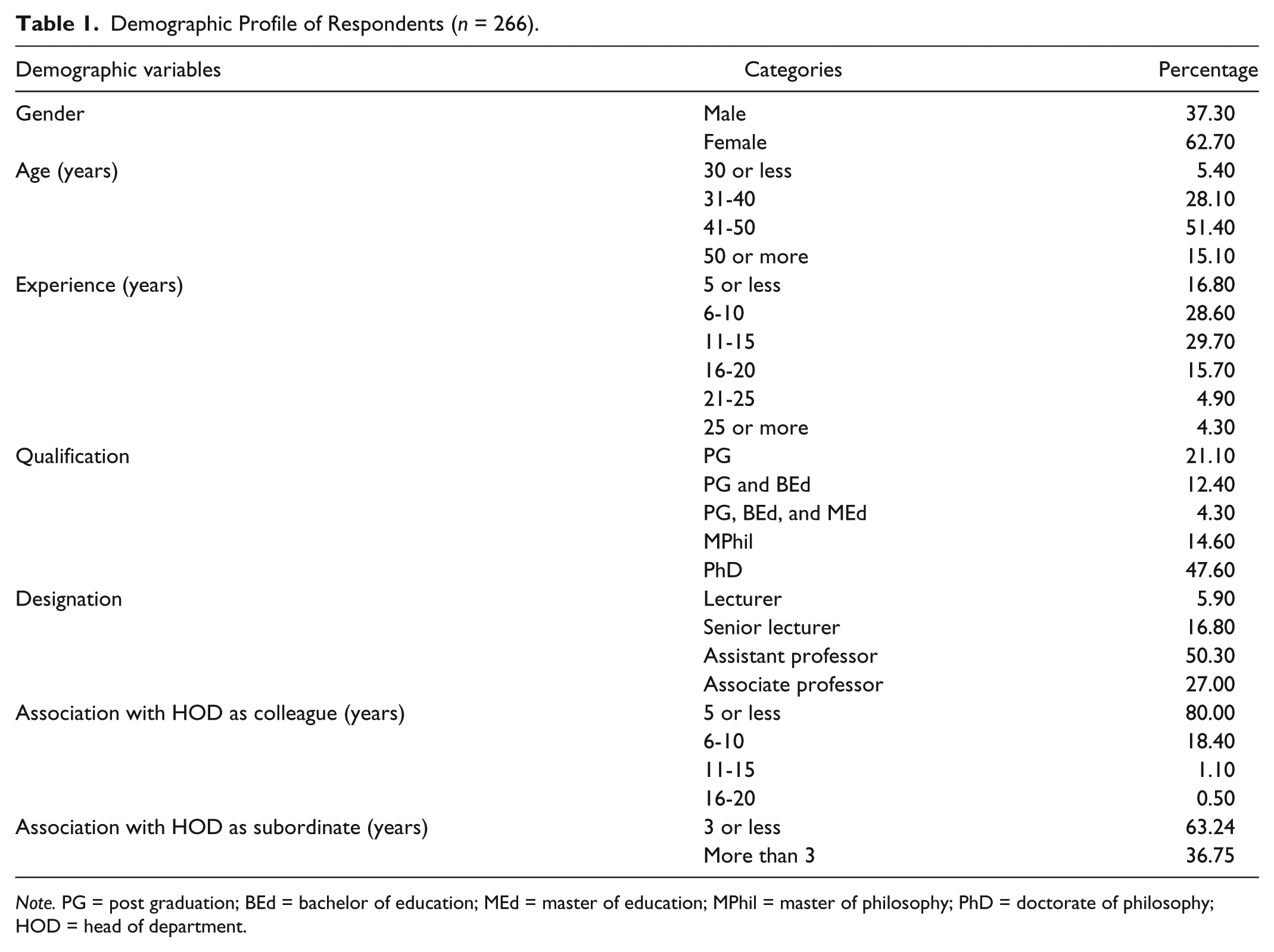
Note. PG = post graduation; BEd = bachelor of education; MEd = master of education; MPhil = master of philosophy; PhD = doctorate of philosophy; HOD = head of department.
Reliability and Validity Analysis
Measurement models have been designed to access the convergent validity. Second order factor models were prepared for multi-dimensional constructs (TL, LMX, and JP), and first order factor model has been designed for RI construct (Table 2). Items with loading less than 0.50 have been deleted (Hair, Black, Babin, & Anderson, 2009). Convergent validity has been established through standardized estimates (standard regression weight [SRW] > 0.5) and average variance extracted (AVE > 0.05; Table 4). To check discriminant validity, four-factor and one-factor models have been designed, and the results revealed that the goodness of fit of four-factor model (χ2/df = 2.37, root mean square residual [RMR] = 0.04, goodness-of-fit index [GFI] = 0.91, adjusted goodness-of-fit index [AGFI] = 0.90, confirmatory fit index [CFI] = 0.93, root mean square error of approximation [RMSEA] = 0.08) is better than one-factor model (χ2/df = 3.18, RMR = 0.58, GFI = 0.85, AGFI = 0.84, CFI = 0.88, RMSEA = 0.10; Hinkin, 1995) thereby establishing discriminant validity. Further discriminant validity has also been established by comparing AVE with squared correlation. The AVE for all constructs is greater than squared correlation thereby establishing discriminant validity (Fornell & Larcker, 1981; Table 3).
Model Summary of CFA.

Note. CFA = confirmatory factor analysis; RMR = root mean square residual; GFI = goodness-of-fit index; AGFI = adjusted goodness-of-fit index; NFI = normed fit index; CFI = confirmatory fit index; RMSEA = root mean square error of approximation.
Correlation Analysis and Discriminant Validity.

Note. Values on the diagonal axis represent average variance extracted, and values in parenthesis represent squared correlation between the constructs. Values of squared correlation are rounded off up to two decimals.
Correlation is significant at the .01 level.
To check the internal consistency, Cronbach’s alpha has been used as it is the indicator of the reliability of the construct (Cronbach, 1951). In the present study, alpha values for all constructs are greater than .70 (Table 4). Composite reliability for all constructs is above .80 (Table 4). Thus, the Cronbach’s alpha and composite construct reliability indicate that the scales are quite reliable.
Scale Reliability and Validity.
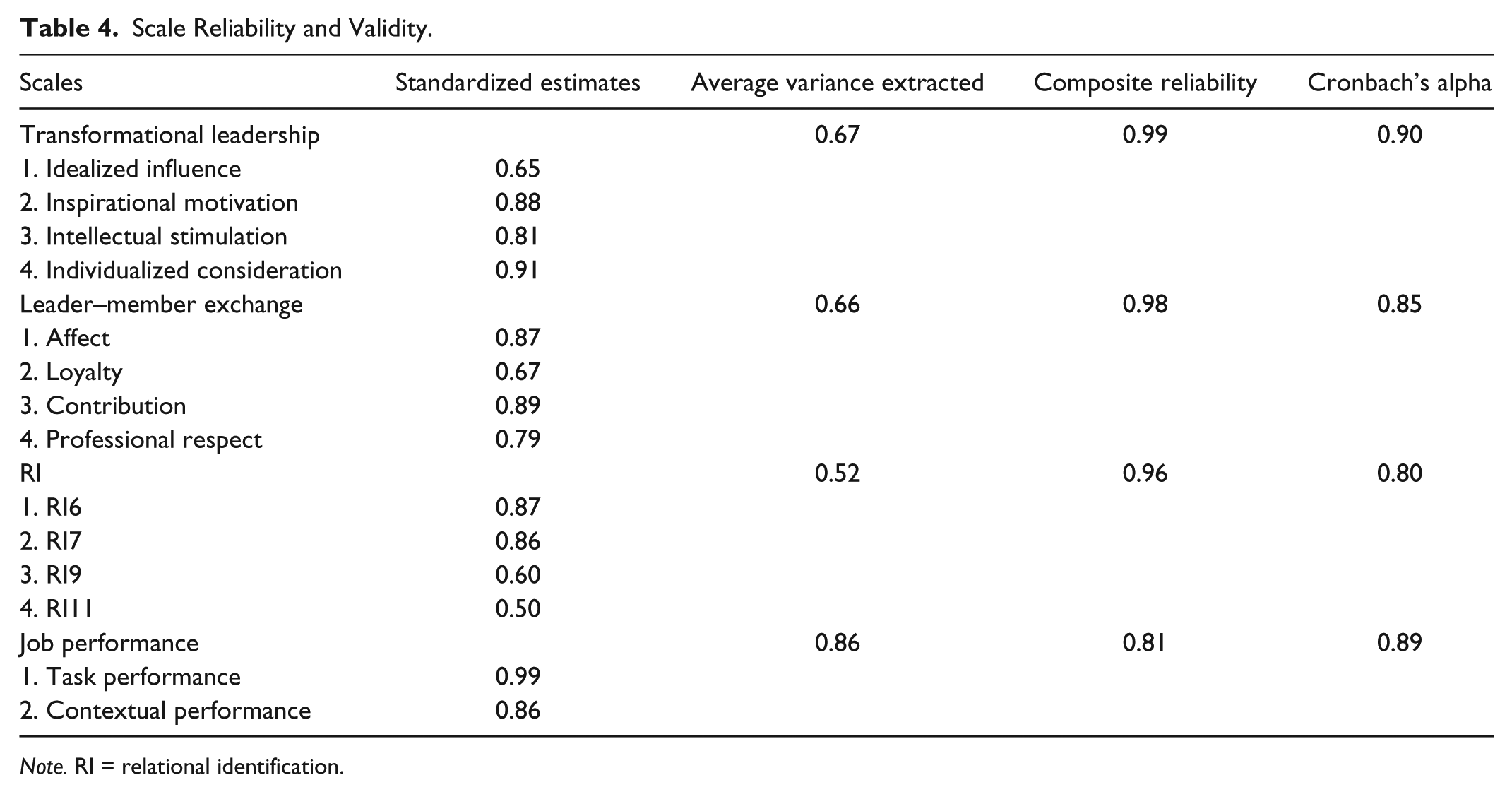
Note. RI = relational identification.
Impact of TL on Job Performance: Mediating Role of LMX
Structural equation modeling (SEM) has been used to check various relations proposed, it is a multivariate technique that seeks to explain the relationship among multiple variables (Kaplan, 2000). In the present study, the relationship between TL, LMX, and JP have been assessed. To test the mediating effect, all the conditions described by Baron and Kenny (1986) were first satisfied. These are as follows: (a) the relationship between independent variable (TL) and dependent variable (JP) should be significant (SRW = 0.40; Figure 2), (b) the relationship between independent (TL) and mediator (LMX) should be significant (SRW = 0.94; Figure 3), (c) the relationship between the mediator (LMX) and outcome (JP) should also be significant (SRW = 0.35; Figure 4), and (d) when the mediator (LMX) is entered into the equation, that is, relationship between independent (TL) and dependent variable (JP) becomes insignificant (SRW = 0.03). All the conditions of mediation as stated were fulfilled. This indicates that LMX act as a mediator between TL and JP.

Impact of TL on JP.

Impact of TL on LMX.

Impact of LMX on JP.
Furthermore, to check the significance of indirect effect, Sobel (1982) test was applied through Sobel software. The value of Sobel statistic was significant (Sobel statistics = 4.03, p < .001), thus providing support that LMX mediates the relationship between TL and JP (Figure 5). Furthermore, control variables were also included in the model, which yielded no change in the previous relationships, so they were not shown in the diagram. The model fitness of full mediation model is better as compared with no mediation and partial mediation model (Table 5). Further application of chi-square delta test revealed significant difference between partial and full mediation model (Δχ2 = 8.15, p < .01).

Full mediation model (LMX).
Summary of Mediation Model (LMX).

Note. LMX = leader–member exchange; RMR = root mean square residual; GFI = goodness-of-fit index; AGFI = adjusted goodness-of-fit index; CFI = confirmatory fit index; RMSEA = root mean square error of approximation.
Impact of TL and Job Performance: Mediating Role of Relational Identification
To test the mediating effect, all the conditions described by Baron and Kenny (1986) were first satisfied. We used four-step procedure through SEM in which we first assessed the impact of predictor, that is, TL on dependent variable, that is, JP, which is significant (SRW = 0.40, p < .001). Hence, first condition of mediation is accepted as TL is positively affecting JP (Figure 2).
In the second step, we studied the impact of TL on RI which is also significant (SRW = 0.71, p < .001; Figure 6).

Impact of TL on RI.
Next, the impact of mediator (RI) on dependent variable (JP) has been assessed, which is significant (SRW = 0.30, p < .001; Figure 7).

Impact of RI on JP.
To test the mediating effect, in the last step, we added the mediating variable, that is, RI between TL and JP. It was found that with the introduction of RI as mediator in TL–JP equation, the relationship between TL and JP significantly increased (SRW = 0.45, p < .001)) instead of becoming insignificant, thereby yielding no support for mediation (Figure 8). Furthermore, the Sobel Test also revealed insignificant indirect effect (Sobel Statistics 1.02, p > .05), so the ultimate condition for mediation is not fulfilled. Hence, the RI does not mediate the TL and JP relationship.

Mediation model of RI.
An increase in the direct relation between TL and JP, after the introduction of RI, gave the clue relating to moderating role of RI. So, the moderation effect has been checked through hierarchical regression. It is a technique which is used to understand a relationship between an outcome variable (also called dependent variable) and the predictor variable (also called independent variable; Uekawa, 2010). To check moderation, hierarchical regression analysis has been used to explore the relationship between the variables. In the first model, two control variables, namely, association with HOD and association with HOD as a colleague, were entered in the regression analysis, which revealed insignificant impact of both the variables (Table 6). In the second model, TL was added as independent variable, which gave significant result. The R2 and f change-statistics were better than the first model. In the third model, along with TL and control variable, RI was also added as independent variable; the result revealed insignificant impact of RI on JP (β = .06, p > .05) fulfilling another condition of moderation. Finally in the last model, the interaction effect of TL and RI was added, which yielded significant result (β = .30, p < .001). This satisfied the last conditions of moderation. Furthermore, the value of R2 increased from .08 to .25. The results derived from final step provided full support for the moderation (Table 6).
Result of Hierarchical Regression.
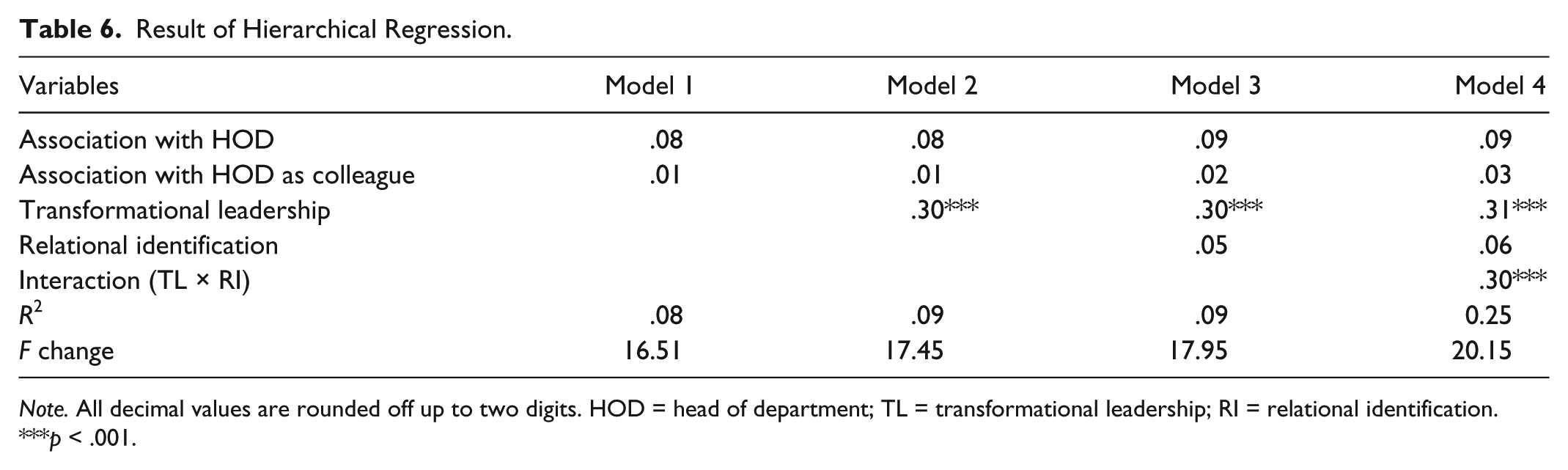
Note. All decimal values are rounded off up to two digits. HOD = head of department; TL = transformational leadership; RI = relational identification.
p < .001.
Furthermore, the effect size of the interaction has also been calculated by using the formula given by Chin, Marcolin, and Newsted (1996):

The R2 of the interaction model is .25 and R2 of the main effect is .09. Thus, the interaction effect size is .10. This effect, as per Chin et al. (1996), is considered to be between small to medium effect size.
Furthermore, the inspection of simple slope revealed that high-RI strengthens the relationship and vice versa (Figure 9).

Moderation of relational identification.
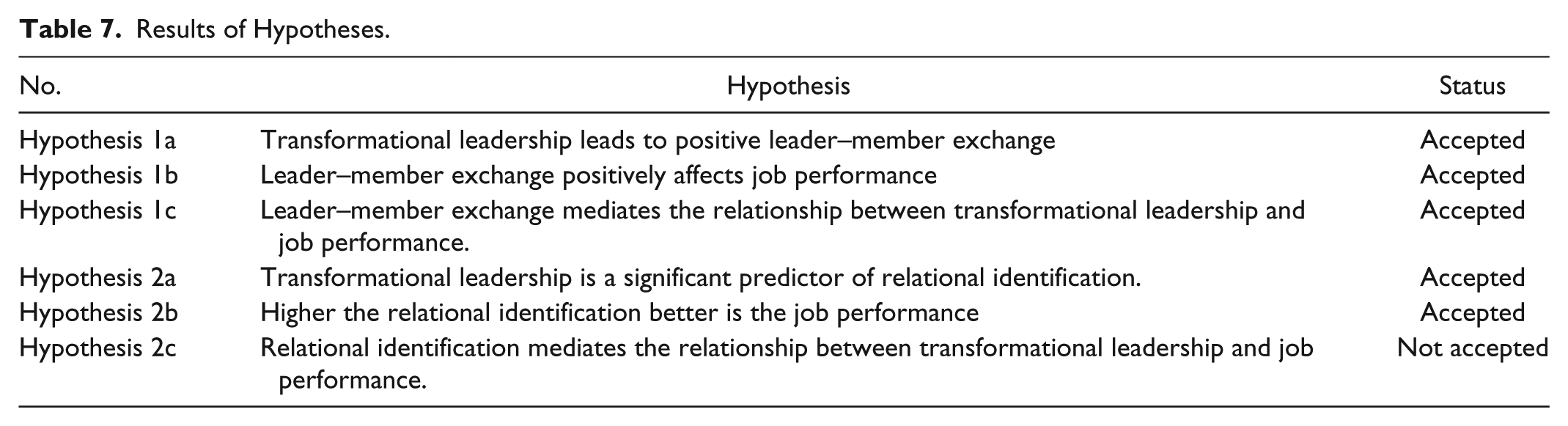
Hence, all the hypotheses proposed in study are accepted, except one, that is, Hypothesis 2c (Table 7).
Results of Hypotheses.
Discussion
The focus of the study is to identify the role of LMX and RI between TL and JP equation. Furthermore, direct relationships between TL, LMX, RI, and JP were also assessed which were found significant. First, the results of the study indicated that TL significantly affects LMX, which is consistent with the previous studies (Dvir et al., 2002; Givens, 2008). Transformational leaders establish high-quality relationships with their followers by providing them friendly and fair treatment. LMX affects the JP of subordinates (Jensen et al., 1997). Because of qualitative exchange of relationships (LMX), the JP of followers is enhanced. It is found that those teachers, who are loyal and ethical (part of LMX) in nature, perform better. They contribute more in terms of achieving the goals of the department and the organization. Furthermore, LMX mediates the TL and JP relationship. Various characteristics of transformational leaders, namely, idealized influence, intellectual stimulation, inspirational motivation, and individualized consideration, help in creating better relationships with the followers, which motivate the employees for better performance (Dubinsky et al., 1995). The idealized influence increases the professional respect for the leader. The followers accept them as their role models and achieve higher goals by exhibiting superior performance. The motivational behavior of leaders also inspires the followers to achieve the organizational goals (Stewart, 2006). Moreover, transformational leaders show individual concern for each of their followers to solve their work- and life-related problems, which helps in developing positive relations, and the followers readily do the work as desired by leader (Bodla & Nawaz, 2010). Under the supervision of such leaders, the subordinates feel happy and are motivated to work hard. The results of mediation are in line with previous researches (Carter et al., 2009; Wang et al., 2005). It is also found that TL is a significant predictor of RI. The results are consistent with previous studies (Dasborough & Ashkanasy, 2002). The working style of transformational leaders (mentoring, guiding, coaching, emotional support, and developing followers to be future leaders) creates a congenial work environment for the followers, and they like to be identified with such leaders. The leader becomes role model for the follower, who is likely to be influenced more by such leader (Sluss & Ashforth, 2007). The leaders, who follow the rules and regulations of the organization, become respectable in eyes of subordinates, and hence, subordinates feel proud in being associated with such kind of leader. Furthermore, while checking mediation model of RI, the relationship between RI and JP became insignificant, which was prior significant when relationships were checked individually proving that RI does not mediate the TL and JP relationship. Instead of mediator, RI act as a moderator (Table 6). It is inferred that in the presence of TL, RI does not influence JP directly, but its interaction with TL significantly affects JP. The RI strengthens the relationship of TL and JP. It helps leaders to establish role clarity and empathy (part of RI) among the followers, which instill confidence and trust in them and they work whole heartedly to meet leaders’ expectations.
Conclusion
This study is an insight into getting a more appropriate model relating to TL in the higher education sector. The role of LMX and RI in between TL and JP has been determined. It has been found that LMX acts as a mediator. It makes the subordinates work more efficiently as it creates better understanding among the followers and the leaders. Furthermore, it leads to clear role relationships between the leader and followers, which ultimately helps both to have a good working relationship. In presence of LMX, leaders would be able to influence the ability of the follower to work efficiently for organization, which ultimately enhances his or her JP. Furthermore, the RI does not act as a mediator between the TL and JP relationship, but it act as a moderator and strengthen the relationship between TL and JP. So the leaders/managers should give due consideration to develop positive LMX with their subordinates and act as role model to develop role identification to make them better performer.
General Implications
Managers need to pay close attention to the opinions and moods engendered within their relationships with subordinates. Managers should focus on creating an environment in which personal work goals of the subordinates are linked with organizational goals with the help of role-person integration. Managers should make their decisions more transparent by exhibiting consistency in their logic and reasoning. Remaining impartial in decision making will help managers to instill trust and respect in the minds of subordinates. Managers should create more enthusiasm and optimism among the employees. The belief in employees that “they can do it” helps them realize their potential with more confidence and inspires them to try harder. Besides maintaining good relationships with subordinates, managers should recognize their contributions either through verbal or written mode, for example, recognition by top management should be given to efficient employees by giving them awards and certificates. Managers should make employees to think out of box to generate new ideas for enhancing JP.
Practical Implications
To make working of teachers effective, the HODs can use following implications. HOD should provide coaching and mentoring to move them on the ladder of development, which will show an increased level of commitment, motivation, satisfaction, and performance among them such as he or she should follow the timetable framed, remain punctual, complete his or her own tasks in time, and take his or her own lecture in time. The HOD must agree with the opinion of the subordinates when they come with sound logic and reasoning, so they can feel confident and transform into future leaders. Participative decision making should be encouraged and the leader should create open atmosphere in the staffroom and meetings so that everybody gets involved in discussions, and a healthy atmosphere leads to increased morale of fellow teachers to work hard for attaining the department goals. HOD should work toward creating good-quality relationships with fellow teachers, which will make them feel better, accomplish more, and help their organization to prosper. Both the HOD and the fellow teachers are required to work in cooperation, which can be possible when both have clarity regarding their roles. Clarity of role relationships will reduce conflicts. The HOD should make proper proposals for the arrangement of workshops for the enhancement of skills, seminars, where subordinates can learn about their career-related growth and development perspectives. The leader should assess about the performance and attitude of followers by having continuous interactions with them after completion of tasks assigned. Through this he would be able to get an idea about the behavior and working ability of the subordinate.
Limitation and Future Research
This study represents a cross sectional investigation as responses were gathered from respondents at a particular point of time. Moreover, the study is confined to government degree colleges operating in Jammu district only. Due to privacy involved, respondents might have been reluctant to share correct information due to their defensive attitude. The element of subjectivity might have not been checked completely as teachers have responded on the basis of their own experience and perceptions regarding the statements in the questionnaire. In future, longitudinal study can be conducted. Comparative study between private and public colleges can be undertaken in future. Furthermore, leadership effectiveness with non-teaching staff can also be measured. More outcomes can be taken into account, for example, cultural differences, other leadership styles, and so on for better understanding of the concept.
Footnotes
Authors’ Note
Both authors have contributed equally.
Declaration of Conflicting Interests
The author(s) declared no potential conflicts of interest with respect to the research, authorship, and/or publication of this article.
Funding
The author(s) received no financial support for the research and/or authorship of this article.