




Abstract
The purpose of this study is to discover and evaluate the feasibility of travel live streaming (TLS) for social media (TikTok). Inspired by the uses and gratifications theory, stimulus-organism-response (S-O-R) model, and the compensatory internet usage model (CIUM), this study develops a theoretical framework of social interaction, telepresence, immersion, user satisfaction, and behavioral intention. The originality of this study is mainly reflected in the innovation of the chosen topic and research results. This is one of the first studies to empirically examine and discuss the immersion and behavioral intentions of users watching travel live streaming. The immersion brings some new meaningful information and extends the application of the ‘S-O-R model’ and ‘the uses and gratifications theory’. This study utilized a quantitative research approach, with data collected online and analyzed from 274 Chinese users. We found that social interaction and telepresence are positively correlated with immersion and user satisfaction. Further, Immersion also positively influences user satisfaction and behavioral intentions. The findings provide valuable insights to users, potential tourists, live streamers, and destination managers. However, there are some limitations to this study. For example, there is a lack of assessment of the anchor persona (looks, personality presentation style, etc.). In addition, there are differences between user-host interactions and user-user interactions, which should be distinguished and studied in more detail in future studies.
Plain language summary
The emergence of travel live streaming has transformed how people live and travel. This study is among the first to empirically examine and discuss the immersion and behavioral intentions of users watching travel live streaming. Immersion offers new and meaningful insights. Uses and Gratifications Theory is an important communication theory that explains the relationship between users’ needs and satisfaction and is now fully integrated into the study of social media. The emergence of the Compensatory Internet Use Model (CIUM) has deepened our understanding of webcasting, vividly explaining why people become immersed in live travel streams. Additionally, the S-O-R model, which explains the relationship between “stimulus, organism, and response,” has informed the derivation of this study’s model and contributed to the development of a theoretical framework encompassing “social interaction, telepresence, immersion, user satisfaction, and behavioral intention.” A quantitative approach was adopted for this study. Data were collected from 274 Chinese users who watched travel live streaming on TikTok and had not yet visited the destinations featured in the live streams. We found that social interaction and telepresence were positively associated with immersion and user satisfaction. Additionally, immersion positively influenced user satisfaction and behavioral intentions. These findings enhance the understanding of related theories and offer valuable insights for users, potential visitors, and destination managers alike.
Keywords
Introduction
Information technology is rapidly advancing and becoming an integral part of everyone’s life, with social media being widely utilized and achieving remarkable milestones (Hua & Shaw, 2020). The burgeoning experience economy has catalyzed the development of service-oriented ideologies and modern consumerist lifestyles (Lei et al., 2020). Within this context, users show a strong preference for personalized and timely services over generic, ‘one-size-fits-all’ products (Chathoth et al., 2013). ‘Network we-media live streaming’, particularly through platforms like TikTok, has emerged as a popular mode of expression (Agistiani et al., 2023), garnering increased attention and becoming a vital tool for the entertainment and travel activities of the youth. The content of live streaming has transitioned from general entertainment to specialized segments such as tourism, food, and music. An increasing number of users are engaging in virtual visits to travel destinations through live streams, with travelers more inclined to share their experiences and scenes using vivid and enriched content formats. TikTok, recognized as one of the most popular social media platforms today (Y. Yang & Ha, 2021), holds substantial significance for both academic research and practical applications due to its extensive influence.
Since the outbreak of the coronavirus disease (COVID-19) pandemic in 2020, stay-at-home policies have curtailed outdoor leisure and tourism activities (Z. Li et al., 2020). Consequently, the era of ‘national live streaming’ began in full force, leading to an unprecedented rise in the market value of online live streaming. Data from the China Internet Network Information Center (2021) indicated that from January to August 2021, nearly 200 million people posted more than 900 million live-streaming and short videos related to travel on TikTok, garnering over 830 billion views and 38 billion interactions. This highlights that high-quality travel content can attract significant attention and enhance user engagement, communication, and connection. ‘See the world with you on TikTok’ has become the consensus of an increasing number of people. Different from traditional social media, webcast users are able to interact with the streamer in real-time, bring a unique ‘social telepresence’ viewing experience, and affect the audience’s behavioral intentions (Wongkitrungrueng et al., 2020). Omar and Dequan (2020) applied the uses and gratification theory to TikTok, discovering that users are driven to utilize it for interaction with others, escape, and archiving. Exploring the integration of new media platforms like TikTok with tourism can substantially enrich and expand the existing knowledge framework.
The originality of this study is significant and noteworthy, particularly in terms of the innovative selection of the topic and the resulting findings. This is one of the first studies to empirically examine and discuss the immersion and behavioral intentions of users watching travel live streaming. With the development of social media, scholars have begun to focus on its interactivity and telepresence. For example, in the tourism industry, a larger number of scholars have focused on the study of virtual reality (VR; C. Chen & Yao, 2022; Cowan & Ketron, 2019; Ongsakul et al., 2021), while ignoring the hot area of the moment, travel live streaming. Zheng et al. (2023) found through S-O-R theory that the interactive, vivid, authentic, and immediate nature of live streaming positively influenced users’ sense of presence and trust, which in turn increased their willingness to travel. Research on immersion is often associated with flow experiences (Cahalane et al., 2012), H. H. Chang (2022) uses interactivity and telepresence to determine the scope of the flow experience, exploring how virtual reality affects the image of tourism and the flow experience. Liu et al. (2023) also expanded on the S-O-R model to examine how short videos affect users’ willingness to travel, and they found that telepresence had a significant effect on both the flow experience and willingness to travel. However, a distinction needs to be made between immersion and flow experience. Although there is a link between the two, and immersion is often seen as part of the flow experience, there are many other aspects of the flow experience, such as a sense of control over the experience (Csikszentmihalyi & Csikszentmihalyi, 2014). There is currently a gap in research on immersion experiences with telepresence, social interaction and satisfaction with social media (TikTok). In this study, targeting immersion experiences that are popular at the moment allows us to focus on and answer the research questions more clearly. It provides new and significant insights related to immersion, effectively filling a gap in the existing research and contributing to the advancement of the field.
It is worth noting that the travel live streaming referred to in this paper are live streamers at tourist attractions, where people who have never been to a tourist attraction are informed and entertained by watching travel live streaming. Additionally, the term ‘users’ in this study specifically refers to the viewers of the live streaming platform, rather than the live streamers themselves.
Literature Review and Hypotheses
Travel Live Streaming
In contemporary times, the integration of tourism with information and communications technology (ICT) has become increasingly prevalent and dynamic. Both enterprises and individuals are actively seeking innovative approaches to embed ICT into their products and services (Guttentag, 2010). Within the travel industry, there has been a notable surge in attention from social media influencers (SMIs), live streamers, marketers, and destination managers toward live streaming. This trend aims to create and disseminate travel experiences and enhance the appeal of destinations, giving rise to the phenomenon of ‘travel live streaming’ (TLS). Through TLS, live streamers broadcast their travel experiences and destination scenery in real time, engaging interactively with their audience.
Live streaming is defined as a form of media that is displayed through live video (X. Wang & Wu, 2019), recorded and displayed by the live anchor in real time, and through which various types of interactions between the live anchor and the user occur (M. Hu et al., 2017). In the live platform, each live streamer has a home page where viewers are free to join the live streaming, post comments, and exit at any point in time (J. Zhou et al., 2019). Through live streaming, ordinary people can create content that is relevant to their interests and reach out to people with similar interests (Lu et al., 2019). By combining users with social media in the context of tourism, potential visitors can gain a new immersive experience (Flavián et al., 2019). The importance of travel live streaming has led to a growing body of literature, with some academics finding that travel live streaming can provide consumers with a more fun, synchronized, and social multi-sensory experience (Deng, 2019; Deng et al., 2019). Compared to traditional travel information, travel live streaming provides users with a more dynamic and comprehensive view of the destination, and the dynamic live streaming mode presents a stronger sense of interaction and participation. The huge travel market and potential tourists are making travel strategies increasingly innovative and travel live streaming is the new trend. According to Economics (2021), travel live streamers have created nearly 30,000 episodes of content, which has been played more than 60 billion times on the entire network, and the number of fans has exceeded 100 million.
Live streaming has risen as a new force especially in China (X. Liu et al., 2022). Lv et al. (2022) found that informativeness, entertainment, and interactivity all had a positive impact on immersion, immersion positively influenced viewers’ interest in tourism products and live streaming. The visuals and interactivity of travel live streaming have a positive impact on tourism consumers’ willingness to engage, with spatial presence and flow experience playing a mediating role (Ye et al., 2022). T.-T. Yang et al. (2023) examine the motivations for virtual travel and the differences between virtual and traditional travel. Laddering interviews with 32 respondents were conducted, and they found that self-satisfaction was the most important value-led motivation. For travel live streamers, F. Li et al. (2022) used interviews to examine the motivations of live streamers to share their travel experiences, their study found that information sharing and entertainment were identified as the most important motivators. The local tour guides (LTGs) used sharing economy platforms to arrange flexible tour guide services (Shang et al., 2023). The impact of the media on the tourism industry exists in a wide range of areas. Some academics have found a high correlation between film-induced tourism and theme park attractions (Florido-Benítez, 2023). The literature on the social interaction, telepresence, immersion, user satisfaction, and behavioral intentions of travel live streaming is still a research gap for the time being.
Theoretical Background
The uses and gratifications theory is one of the most popular and important theories in communication (Rauniar et al., 2013), it is related to social media (Whiting & Williams, 2013). The theory examines the psychological and behavioral utility of mass communication to people by analyzing the audience’s motivations for media exposure and what needs these exposures satisfy. Research has shown that the satisfaction gained is a good predictor of user use and repeated use of media (Kaye & Johnson, 2002; Palmgreen & Rayburn, 1979). Gan and Wang (2015) used the uses and gratifications theory to find that users will have different levels of satisfaction when using different social media. Recent research by Omar and Dequan (2020) has also applied the uses and gratifications theory to better understand the use of TikTok. In this study, to explore the motivations and influences of users watching live travel on TikTok, we draw on the uses and gratifications theory for theoretical support.
Mehrabian and Russell (1974) proposed the stimulus-organism-response (S-O-R) model, it is based on the behaviorist stimulus-response (S-R) model, which evolved as people’s psychological understanding changed and they gradually realized that human information processing starts with a physical stimulus, followed by the absorption of the external stimulus through the senses, which is worked on by the nervous system to make a decision and then produce the output of an action response, that is, the S-O-R model (Mehrabian & Russell, 1974). The key point of the theory is that the individual’s response to environmental stimuli does not directly influence the individual’s behavior, but rather acts as a mediator through emotions to influence the final behavior (Bitner, 1992; S.-B. Kim et al., 2014). In the tourism industry, the S-O-R model can be very effective in explaining the relationship between stimuli, processes, and responses (Jani & Han, 2015). Ying et al. (2022) extended the S-O-R model by including telepresence and social presence as stimuli and elucidating the interplay of these factors in jointly shaping users’ perceptions and willingness to visit. The results found that VR with a higher sense of immediacy more positively influenced visit intention. Han et al. (2023) applied the S-O-R model to discover that telepresence and the consumers’ interactivity is the experience of a new technology, called VR shopping mall environment, which affects enjoyment and behavioral intention. Using the S-O-R model as a theoretical support, this study attempts to contribute to the extension of the S-O-R model by considering social interaction and telepresence as stimuli, immersion and user satisfaction as the organism, and the user’s behavioral intention as the response.
Kardefelt-Winther (2014) proposed the compensatory Internet usage model (CIUM). This theory attempts to clarify people’s psychological characteristics, suggesting that people make up for their unrealized offline needs through specific online activities. The empirical literature documents a wide range of compensatory strategies that facilitate the use of different online activities. For example, self-presentation, belonging, social gratification, entertainment, and information are psychological aspects associated with social media use (G. M. Chen, 2015; Seidman, 2013). In the context of travel, users can compensate for their regret of not having been to the travel destination by watching tourism live-streaming content. Simultaneously, they can create their immersive feelings through the live-streaming content. The internet compensation model can be used to explain the remote presence and immersion of users when watching travel live streaming, and the relationship with user satisfaction.
Effect of Social Interaction on Immersion and User Satisfaction
Social interaction makes users change from passive to active mode. Specifically, users change from being bystanders to becoming participants, and they produce a lot of new user-generated content through interaction and other behaviors (Szolnoki et al., 2018). The fast-growing live-streaming industry has been accepted by the tourism industry, and new forms of interaction and communication have emerged (Xie et al., 2022). Travel live streamer can record their travel activities in live streaming and interact with viewers in real-time (Deng et al., 2021). Interaction mainly refers to the interaction between the audience and live streamers. Audiences interact by chatting, praising, virtually gifting, or guiding anchors. For live streamers, online interaction can pay attention to the audience’s speeches and needs in real time by acknowledging the audience’s existence and responding to the audience in time with their favorite language and behavior (Deng et al., 2022). This opportunity can be utilized in research and education where the public can watch and be involved in real-time conversations about live-streaming events (Battrawi & Muhtaseb, 2014). Different from traditional media, users of new media (such as social media) can interact with netizens on online platforms. Several prior studies have confirmed that one of the biggest motivations for users to use websites is social interaction (C.-Y. Huang et al., 2007; Nardi et al., 2004). Pentina et al. (2008) pointed out that people use information technology to connect with others and establish relationships with people with common interests.
The social interaction theory explains the interactive relationship between users and live streamers (Hou et al., 2019). It clarifies the interactive processes between people and is used to predict interactive behavior in different social settings (Varey, 2008). In the rapidly developing internet market, interactivity is important as it can improve the interflow quality and reduce the uncertainty of consumption (B. Li et al., 2018; Ou et al., 2014).
Users are easily immersed in the internet experience (Gutierrez et al., 2008; Raptis et al., 2018), where they feel that they are communicating with their friends in a real environment (T. H. Jung & tom Dieck, 2017; Mennecke et al., 2011). Choi et al. (2016) study on the impacts of social media marketing in the hotel industry found that social media marketing had no significant influence on interactivity and user satisfaction. However, Ramanathan et al. (2017) argued that when social media is used in retail network operation and marketing, interactive comments on social media greatly affect customer satisfaction. Therefore, the following hypotheses are proposed:
H1. Social interaction positively affects immersion.
H2. Social interaction positively affects user satisfaction.
Effect of Telepresence on Immersion and User Satisfaction
Steuer (1992) stated that telepresence occurs when a person feels transferred to an intermediary environment created by technology (such as computers and television). It can create and display psychological states and interactive feelings within a virtual environment (Sukoco & Wu, 2011). Live streaming, in particular, gives people an immersive feeling (Mueser & Vlachos, 2018), and as this increases, users may feel that they are in a virtual environment. Such ‘immersion’ concerning psychological involvement and the concrete element of behavioral participation (Biocca et al., 2003) can affect users’ satisfaction during media communication. In this study, telepresence is considered different from immersion. As defined by Biocca and Delaney (1995), immersion is ‘the extent to which the virtual environment submerges the user’s perceptual system with computer-generated stimuli’. In other words, immersion is the degree to which all modes of sensory input are manipulated by the medium.
Immersion on the Internet is made possible through various activities (Novak et al., 2000; Pearce, 2009), such as social interaction. Hoffman and Novak (1996) suggest that telepresence increases the subjective intensity of consumers’ immersion. Pelet et al. (2017) studied the influence of immersion on social media. And expanded the richness of the immersion theory by developing a model, they found that telepresence had a positive impact on the five dimensions of immersion, and indicated that the passage of time is forgotten when using social media. Wu and Wang (2014) found that the lasting influence of telepresence on satisfaction is reasonable. Zhu et al. (2023) found that mental imagery and vividness positively predict visitor telepresence and satisfaction. At the same time, VR ads with a higher level of immersion will trigger a stronger intent to (re)visit (Ying et al., 2022). Telepresence and social presence positively influence customer purchase intentions through trust and perceived usefulness (G. Liu et al., 2022). C. Chen and Yao (2022) believe that a highly immersive media experience combined with the in-depth transmission of the narrative enhances the viewer’s positive attitude toward the overall experience. Against this background, we developed the following hypotheses:
H3. Telepresence positively affects immersion.
H4. Telepresence positively affects user satisfaction.
Effect of Immersion on User Satisfaction and Behavioral Intention
Consumers’ participation in enjoyable tasks will make them immersed, thus achieving the best performance (Ilsever et al., 2007). In recent years, immersion has been gradually applied to the research of information systems and the Internet. Webster et al. (1993) opine that immersion should include four components: control, concentration, curiosity, and inner interest. Immersion is an abstract term, a metaphorical expression of the body’s immersion under water. In essence, we have a similar psychological immersion experience after jumping into the ocean or swimming pool, which occupies our sensory organs and concentration. Scholars emphasize that to measure immersion, we must regard it as a psychological state, that is, users’ subjective perception (Witmer & Singer, 1998).
Numerous studies have found that immersion can effectively and significantly predict user satisfaction (C.-C. Chang, 2013; Y. P. Chang & Zhu, 2012; Xin Ding et al., 2010). Immersion has also been proven to be an important predictor of audience satisfaction (D. Kim, 2016; M. Kim, 2011). In addition, immersive video content can enhance emotional participation and attitudes toward environmental behaviors (Fonseca & Kraus, 2016). In their research on VR, T. H. Jung and tom Dieck (2017) found that immersion affected users’ behavior intention repeatedly. Focusing on the leisure and tourism aspects of these studies, most of the results show that immersion has a positive impact on satisfaction and behavioral intention (Hansen & Mossberg, 2017). We thus developed the following hypotheses:
H5. Immersion positively affects user satisfaction.
H6. Immersion positively affects behavioral intention.
User Satisfaction and Behavioral Intention
‘Consumer’s satisfaction response’, which involves judging the function of a product or service or the product or service itself, provides the pleasure level of satisfaction related to consumption (Oliver, 1997). In terms of social media, the feeling of ‘being there’ may have an impact on the formation of consumers’ best online experience and their willingness to re-use digital media (Y. Jung, 2011). When the experience of social media websites matches users’ expectations, it will generate satisfaction, which will satisfy online users and then generate behavioral intentions (Hwang et al., 2018).
Behavioral intention has been widely discussed in research on hotels and tourism (Lim & Ayyagari, 2018), because it is of great significance to identify consumers’ actual purchasing behaviors (Hsu & Huang, 2012; Pelet et al., 2017; L. Wang et al., 2015). In addition, Oliver (2014) described behavioral intention as ‘the established possibility of engaging in behavior’. In this case, behavioral intentions include revisiting intentions and public praise intentions (Jani & Han, 2011). Researchers believe that the reason for behavior intention is customer satisfaction (Baker & Crompton, 2000). H. C. Lee et al. (2019) believed that satisfaction would significantly affect behavioral intention, which was consistent with the results of C.-F. Chen and Chen (2010). Therefore, we propose Hypothesis 7 to illustrate this relationship (Figure 1):
H7. User satisfaction positively affects behavioral intention.

Proposed research model.
Methodology
Participants and Research Method
Quantitative methods are considered to involve objective, formal, and systematic processes in which data are used to quantify or measure the object of study (Teddlie & Tashakkori, 2003), this study employs a quantitative research design. Users watch travel live streaming on TikTok, mostly of destinations that they have never been to. Such users are the participants of this study. This study attempts to divert attention from the promotion methods of tourism videos used in the past (Chua & Chang, 2016; Hogan, 2010; Seidman, 2013) to the novel content and perspectives of ‘travel live streaming’, to understand the relationship between users’ psychology and behavioral intention and to provide insights toward the future development of related industries.
Questionnaire Development and Measurements
First, at the beginning of the questionnaire, an introductory cover letter was provided, which outlined the objectives of the study and assured participants of the confidentiality and anonymity of their responses. Participants were informed that their participation was entirely voluntary, that no personally identifiable information would be collected, and that their responses would be used solely for academic research purposes. By proceeding with the questionnaire, participants were deemed to have given informed consent. Second, the questionnaire used in this study was divided into three parts. The first part, which aimed to determine qualified research participants, comprised a screening question. Only users who have watched at least one travel live stream on TikTok and have never been to the travel destination could continue to fill in the questionnaire. The second part evaluated five aspects of this study, namely, social interaction, telepresence, immersion, user satisfaction, and behavioral intention, and consisted of 20 questions in total. The third part is the demographic section.
In this study, we used scales that provide evidence of their psychometric quality in previous studies. Each item is scored on a 7-point Likert scale, with ‘strongly disagree’ represented by 1 and ‘strongly agree’ represented by 7. The development of the measurement scales for the research constructs was based on relevant literature. The internal consistency reliability coefficients (Cronbach’s α) for the constructs were as follows: social interaction (.838), telepresence (.820), immersion (.884), user satisfaction (.818), and behavioral intention (.858). The overall Cronbach’s α for the tool was .925, indicating high reliability. We measured social interaction using the scale developed by Ko et al. (2005), with a total of four items, an example item is ‘I wonder what other people said’. The scale, although distant, measures consumers’ motivation to use the Internet and fits well with the current study. Telepresence was measured by three items formulated by M. Lee et al. (2020). A sample item is ‘I feel I am in the place’. Immersion was measured using six items developed by Engeser and Rheinberg (2008), an example item is ‘I don’t notice time passing’. User satisfaction was measured using a tool developed by Rauniar et al. (2009) and Rauniar et al. (2013). The behavioral intention was measured using four items developed by Y.-C. Huang et al. (2013, 2016), an example item is ‘I would like to visit the place that I saw in the tourism-related VR activity’.
The last part of the questionnaire included items to collect participants’ demographic information. To facilitate online respondents to understand the questions more clearly and easily, the full questionnaire was adapted and translated into Chinese. To make the original scale more relevant to this study, three experienced translators were first invited to translate the original scale into Chinese independently of each other, and then to discuss and reach a consensus. Then, two translators with good language skills and no knowledge of the original scale were invited to translate the Chinese version of the scale into English. After further discussion, comparison, analysis, and revision between the authors and the five translators, a Chinese scale was finally obtained that was more appropriate to the context and semantics of the study. For example, one item designed for measuring social interaction revising from ‘I wonder what other people said’ to ‘I want to see what other audiences said when watching the travel live streaming in TikTok’. This is more suitable for the travel live streaming, and it is easier for the participants to understand.
Sampling, Data Collection, and Analysis
Sampling Method
We used a convenience sampling method. To improve our questionnaire’s recycling efficiency and prevent the spread of COVID-19, online distribution was adopted and executed through the platform WEN JUAN XING (www.wjx.cn), which is one of the largest online data collection platforms in China, with more than 50 million consumers (M. T. Liu et al., 2021). The data were collected in November 2022. Through the screening question in the first part of the questionnaire, we excluded participants who did not meet the live-streaming criteria mentioned above, further, only participants 18 years or older were included.
Data Screening and Sample Size
For the recovered data set, we then tested the dataset to find missing or incomplete data, because non-random missing data may cause deviations to the statistical results (Hair et al., 2009). All incomplete and invalid questionnaires in this study were deleted from the dataset, and questionnaires that were randomly answered were also regarded as invalid questionnaires. For example, answers that are all the same, or there is an apparent contradiction between the answers before and after. A total of 320 questionnaires were distributed, and the results of 303 successfully recovered questionnaires were screened. After deleting the questionnaires with invalid responses and missing data, 274 valid questionnaires were obtained. The sample size appropriateness was evaluated using the pwrSEM tool, which provides power analysis for parameter estimation in structural equation modeling (Y. A. Wang & Rhemtulla, 2021). The analysis confirmed that a sample size of 274 is sufficient to achieve the necessary statistical power for our model, given its complexity and parameter estimation requirements.
Demographic Information
The results show that the demographic information of the participants is consistent with the content of the ‘China Live Streaming Industry User Distribution Report, Q1 2021’, with the largest proportion of people aged 18 to 35 (iiMediaResearch, 2021). Regarding the age distribution of the participants in this study, 69.7% of users were aged between 18 and 35 years, with individuals aged 26 to 35 years the most in number and accounting for 36.9% of the sample. The sample was largely evenly distributed in terms of gender, educational gender, and marriage, indicating that the sample collected was representative.
Data Testing and Reliability Analysis
The data set was tested for normal distribution using SPSS 27.0. The results revealed that the kurtosis and skewness were within the standard range with absolute values less than 1. The data are approximately normally distributed. We assessed the internal consistency reliability coefficients for the sum scores. The Cronbach’s α of each construct was between .818 and .884, and the Cronbach’s α of the entire tool was .925. Given Cronbach’s alpha values were greater than .80 we can consider that the reliability can be considered good for research purposes (Nunnally, 1978). The corrected item-total correlation (CITC) was higher than .5. Therefore, the reliability of the total scale and its five dimensions have been confirmed. The confirmatory factor analysis (CFA) was then conducted, following Anderson and Gerbing (1988) recommendations on data reliability and validity. Amos 26.0 was used to explore it. The key goodness-of-fit indices showed that the model has adequate fit. Detailed CFA results are presented in the Results section.
Results
Confirmatory Factor Analysis (CFA)
The confirmatory factor analysis (CFA) results indicated good model fit: χ2/df = 1.264, RMSEA = 0.031, GFI = 0.929, AGFI = 0.907, CFI = 0.985, TLI = 0.982, IFI = 0.985, PRATIO = 0.842, PNFI = 0.785, PCFI = 0.829. Therefore, all goodness-of-fit indices—encompassing absolute fit indices, incremental fit indices, and parsimonious fit indices—satisfy the criteria established by the academic community (L. T. Hu & Bentler, 1999). This confirms that the model demonstrates an adequate level of goodness of fit. The standard factor loadings for each item range from 0.665 to 0.890, all of which exceed the academic standard of 0.5 (Byrne, 2010). In addition, the combined reliability (CR) of each dimension was greater than 0.7 and the average variance extracted (AVE) was greater than 0.5 (Nunnally, 1978). The detailed results are presented in Table 1.
Results of the Confirmatory Factor Analysis (N = 274).

Note. SD = standard deviation; Skew = skewness; Kurt = Kurtosis; CR = composite reliability; AVE = average variance extracted.
Discriminant Validity
Table 2 illustrates that the square root of the AVE for each dimension surpasses the correlation coefficients among these variables, thereby confirming the satisfactory correlation and discriminant validity of the study (Hung et al., 2010).
Correlation and Discriminant Validity Results.

Note. SI = social interaction; TP = telepresence; IM = immersion; US = user satisfaction; BI = behavioral intention. The bold diagonal values represent the square root of the AVE for each construct.
Structural Equation Model Results
The overall model demonstrates a good fit with the data according to the model fit criteria outlined by L. T. Hu and Bentler (1999): χ2/df = 1.369, RMSEA = 0.037, GFI = 0.923, AGFI = 0.900, IFI = 0.979, CFI = 0.978, TLI = 0.975, PRATIO = 0.853, PNFI = 0.789, PCFI = 0.834. Furthermore, the test results of the structural equation model and the validation criteria described above provide positive evidence supporting seven hypotheses. Several key hypothesis testing results are presented in Figure 2 and Table 3. For viewers of TikTok travel live streaming, social interaction positively influenced immersion and user satisfaction, telepresence positively influenced immersion and user satisfaction, immersion positively influenced user satisfaction and behavioral intention, and user satisfaction positively influenced behavioral intention.
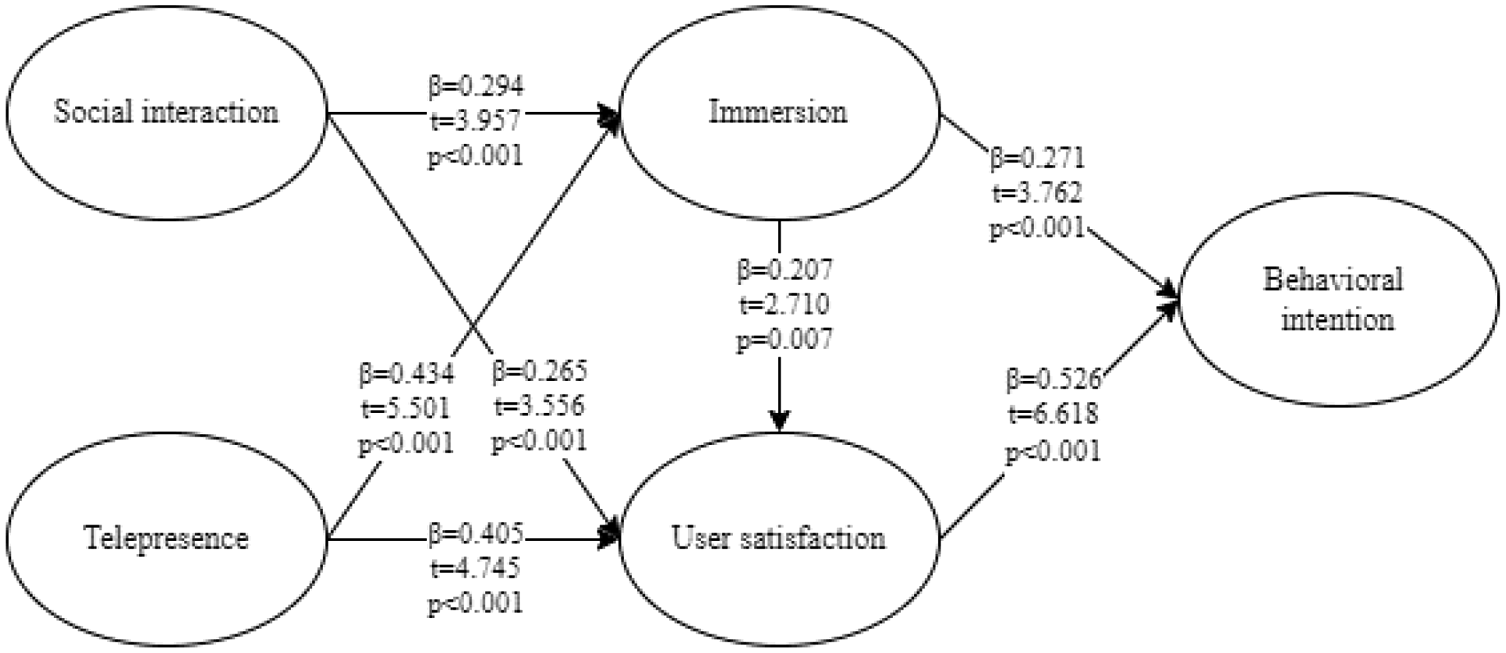
Structure model and path coefficient.
Hypotheses Testing.

Note. SI = social interaction; TP = telepresence; IM = immersion; US = user satisfaction; BI = behavioral intention.
Conclusion and Implications
Conclusion
Based on our results, we found that when users watch travel live streaming, social interaction and telepresence are important factors for user immersion and satisfaction. Users want to interact with anchors and other users on the live-streaming platform, and they believe that such interaction can make the viewing experience more vivid and memorable. The experience is comparable to users taking a journey and returning to the real world at the end of the live stream. When users experienced strong telepresence, they forgot about the passage of time and were more likely to focus and less likely to be completely lost in thought. We propose that such experiences can make users feel good about the functions of the TikTok platform and live streaming and think that such live streaming of travel can meet their individual needs.
In addition, when users are immersed in ‘cloud travel’ with the anchor, they are satisfied with this experience and want to share it with more people, and in the future, they hope they can visit the destination in person. China’s live-streaming industry has received considerable attention and is innovative in many ways (M. Zhou et al., 2021). Parallelly, the live-streaming industry has changed the lifestyle and travel mode of stakeholders and introduced more fashionable content (Lu et al., 2019). With the emergence of live streaming, the tourism industry has entered a new period and mode.
Theoretical Implications
Ledbetter (2014) argues, that since the media era, the association between the media and the information disseminated has become stronger, and its related theories need to be subdivided further and developed in a more detailed manner. Due to the short development history of network streaming, this new form of social media has not received enough attention in academia (Wongkitrungrueng & Assarut, 2020). With the development of the Internet, although research on social media has attracted attention in various fields, travel live streaming has important research implications as a new form of tourism in the face of the loss, stress, and uncertainty associated with the COVID-19, and an increasing number of scholars have begun to study the live streaming of tourism (Zhang et al., 2021).
First, this study extends the application of the S-O-R model in the social and tourism industry. In a previous study, Ying et al. (2022) drew on the S-O-R model to find that the social presence and telepresence of the VR experience creates intent to visit intent, and this study extends the S-O-R model for immersions in the field of travel live streaming. Ming et al. (2021) confirms the correlation between the S-O-R model and enhanced telepresence and consumer trust, with higher levels of remote presence increasing consumer trust when users purchase online via live streaming. This study expands the theoretical value of the field of live tourism in the context of related theories.
Second, on the one hand, this study makes a relevant theoretical contribution to the immersion experience of travel live streaming. In previous studies, some scholars believed that VR experience promoted the formation of positive attitudes and behavioral outcomes (Tussyadiah et al., 2018). VR technology is like quick and easy social media live streaming. However, few studies have examined social media immersion experiences in the context of travel. In this context, some important questions emerge: Why are people keen on live streaming in the media era? Will the immersion of live streaming affect future life? Prior research on live streaming has mostly focused on webcasting services, and the motivation of enterprises’ network streaming and audience participation is discussed from the level of external factors (Cai & Wohn, 2019; C.-C. Chen & Lin, 2018). On the other hand, although immersion has been widely used in today’s research and technology, relatively few studies have examined the immersion process and the factors affecting it (Shafer et al., 2019; Weech et al., 2019). The impact of short-term immersion experiences on the subsequent long-term personal and professional lives of participants is not well known (Zorn, 1996), and although they are important, few studies have investigated social media immersion experiences in the context of travel. In particular, theoretical research that considers social media, user psychology, immersion experience, user satisfaction, and behavioral intention is limited. The current study aims to fill these knowledge gaps in the literature and inform future research in the field.
Finally, this study generates a theoretical contribution to the field of psychological research on TikTok. Despite TikTok being a distinct and highly successful media software in the world and its success in terms of the number of users, psychological research on its users is lacking (Montag et al., 2021; Shao & Lee, 2020). In particular, the psychological changes of TikTok users on certain occasions, this study explores the changes in user immersion experience, satisfaction, and behavioral intention through social interaction and telepresence.
Practical Implications
The tourism industry is currently facing various types of challenges and problems, and in this context, the present study is of practical significance. The emergence of live streaming provides a way for potential tourists to experience scenic spots, museums, and festival activities before making a visit decision. The coexistence and development of social media and tourism is an inevitable trend at present. People are keen on tourism, and they also enjoy watching travel live streaming. Indeed, social media enables audiences access to all kinds of information about the destination without leaving home. The advantages of social media have been evident, across many fields such as marketing, management, medical care, and education (Gikas & Grant, 2013; Latif et al., 2019; Nadaraja & Yazdanifard, 2013; Roebuck et al., 2013; Slovensky & Ross, 2012), and the ways to enhance the value of social media in tourism has already become a popular research topic globally. This study focused on the relationships between users’ experience, satisfaction, and behavior intention in live tourism streaming, and expanded the general definition of live tourism to live streaming with real-time explanation in tourist attractions.
First, this study has a degree of relevance for destination managers, marketers, and stakeholders. It can help them develop more attractive tourism policies and promotional programs. What potential visitors say on the air is noteworthy, and immersive viewing and interaction can easily enhance satisfaction, entice viewers to continue watching, and build trust with the anchor and the destination. It is worth mentioning that social media should not be blindly combined with tourism but should be combined with the actual situation of local users to attract more potential tourists and business opportunities through live travel.
Second, how can this study help users immerse themselves in the live travel experience and enhance their satisfaction when watching live travel? Social interaction is worth mentioning, and its combination with remote proximity will easily happen with immersion and satisfaction enhancement. In addition, this study also provides practical inputs for travel anchors on social media, who should pay attention to strengthening interaction and communication with users and respond to users’ questions in a timely manner. Further, a more colorful and vivid way of explanation should be adopted to immerse the audience in the anchors’ explanations as much as possible. In this way, audience satisfaction can be enhanced, and more users will recognize and appreciate the travel anchor, thereby leading to an increase in exposure and popularity of the account.
Limitations and Future Research
This study attempted to explore a new way of tourism and yielded some novel insights; however, it has some limitations. On the one hand, the influence of cultural characteristics and life background should be discussed in the next study, as different research contexts may affect the final findings. On the other hand, the characteristics of live streamers and their streaming approaches are also worthy of research attention, such as the personal charm of the streamer, his (her) personality, looks, style of broadcasting, etc. In addition, in the current study, we focused on users who watch ‘live travel streaming’, which is both a bright spot and a limitation. Whether the research results of these users can be extended to all potential tourists needs further verification in the future.
Footnotes
Acknowledgements
We would like to thank the Article editor and four anonymous referees for their constructive comments and suggestions. We believe that the quality of the paper has substantially improved after addressing the comments and suggestions. All remaining errors are our own. The usual caveats apply.

Ethical Considerations
This study involved an anonymous online survey and did not include any experiments on humans or animals. The ethical statement does not apply to this article.
Consent to Participate
Before participating in the online survey, all respondents were presented with a detailed informed consent statement outlining the study’s purpose, procedures, estimated duration, and their rights as participants. They were clearly informed that participation was entirely voluntary, they could withdraw at any time without penalty, and that the survey would not collect any personally identifiable information. Participants were assured of full anonymity and confidentiality, and were made aware that there were no foreseeable risks involved. Only those who confirmed their understanding and voluntary agreement to participate were permitted to proceed. Contact information for the researcher was provided to address any questions related to the study or participant rights.
Author Contributions
Huawen Shen contributed to Writing—original draft, Conceptualization, Methodology; Yumeng Zhang contributed to Writing—original draft, Methodology, Supervision, and Investigation; Yilin Hu contributed to Writing—review & editing, as well as conducting Formal analysis.
Funding
The author(s) received no financial support for the research, authorship, and/or publication of this article.
Declaration of Conflicting Interests
The author(s) declared no potential conflicts of interest with respect to the research, authorship, and/or publication of this article.
Data Availability Statement
Data sharing not applicable to this article as no datasets were generated or analyzed during the current study.