




Abstract
This study demonstrates how augmented reality (AR) technology in mobile shopping applications influences users’ purchase intentions from the perspective of telepresence, aiming to uncover the internal pathway through which users’ psychological perceptions translate into consumer behavior under the integration of online convenience and offline immersion. Based on data from 707 valid questionnaires, a structural equation model (SEM) was constructed and validated to systematically analyze the mediating effects of AR technology on purchase intention through telepresence. The findings indicate that AR technology indirectly affects purchase intention by enhancing users’ telepresence, and this effect is driven not by perceived enjoyment but by elevated trust. Specifically, telepresence exhibits a significant positive impact on trust (β = .74, p < .001), which in turn strongly drives purchase intention (β = .64, p < .001). This research elucidates the sequential mediating mechanism of “telepresence - trust - purchase intention,” challenging the direct-effect assumptions of traditional technology acceptance models and offering a novel theoretical framework for AR-enabled consumer behavior. The results provide quantifiable insights for e-commerce platforms to optimize AR feature designs (e.g., enhancing scenario authenticity and interactive immediacy) to foster user trust. Additionally, it offers strategic guidance for digital retailers and AR market players in policy formulation and promotional campaigns, supporting the sustainable innovation of the “technology-experience-consumption” ecosystem.
Plain Language Summary
This study examines how augmented reality (AR) in mobile shopping apps shapes consumers’ desire to purchase products by creating a sense of “being there” (telepresence). Using data from 707 surveys, researchers built a model showing AR doesn’t directly boost buying intent but works indirectly through immersive experiences. Surprisingly, the key driver isn’t fun or enjoyment—it’s trust. When AR makes users feel like they’re physically interacting with products (telepresence), this feeling builds strong trust in the platform (β = 0.74), which then powerfully predicts actual purchases (β = 0.64). Unlike traditional tech adoption theories assuming direct effects, this research reveals a chain reaction: AR → immersive presence → trust → buying behavior. The findings give e-commerce companies practical advice—design AR features that feel real and interactive to foster trust, rather than just focusing on entertainment. This helps retailers and AR developers create better strategies, blending technology with human psychology to build sustainable “tech-experience-purchase” systems. By prioritizing authentic scenarios and instant interaction in AR tools, businesses can turn virtual experiences into tangible sales through enhanced user confidence.
Introduction
It is irrefutable that mobile shopping has become the dominant method of purchasing goods and services in the contemporary digital age. According to relevant data, 30% of the digital population globally shops via mobile phones, which accounts for 1.65 billion mobile shoppers. It’s estimated that mobile commerce will be responsible for 59% of total retail e-Commerce sales, accounting for $4.01 trillion in 2025 (SellersCommerce, 2025). Nevertheless, it is intriguing to note that despite the proliferation of digital and mobile shopping platforms, which have undoubtedly expanded consumers’ choice and access to information, a considerable proportion of consumers still opt to purchase goods in physical stores. The main reason is that when shopping online, users cannot physically interact with the products (Suh & Chang, 2006). Therefore, before making a purchase, consumers have no choice but to rely on the information presented in mobile applications to make decisions (Jaejoo et al., 2012). Conversely, shopping in a physical store provides the opportunity to experience and interact with the product in a way that cannot be replicated in an online setting. Such factors include the quality of the material, the ability to assess the product’s functionality, and the opportunity to engage in social interaction—such as seeking advice from sales personnel, engaging in real-time discussions with companions, or observing others’ reactions to products. The combination of these factors can result in complex and unpredictable decision-making processes during the purchasing phase (Klarna, 2021). Consequently, to combine the benefits of online and offline shopping and provide consumers with the necessary information to support their purchasing decisions, major retailers and brand corporations such as Google, Apple, Alibaba, Amazon, and Facebook have begun to employ AR technology to attract customers and boost sales (Limongi et al., 2024).
In the context of the “Reality–Virtuality (RV) Continuum,” augmented reality (AR) occupies a position that is closer to reality (Azuma, 1997; Milgram et al., 1995). AR establishes the actual environment as its backdrop, incorporating virtual elements in a manner that is consistent with this foundation emphasizes that the perception of users in AR technology is still predominantly shaped by the real environment, with virtual elements (or information) superimposed on the real world, resulting in the coexistence of real and virtual elements within a single space. This AR technology, which enables the coexistence of reality and virtualization, is primarily involved in gaming, furniture, travel, and beauty products (Li et al., 2020; Qin et al., 2021), especially in e-commerce, where numerous mobile shopping applications have introduced AR technology (Nugroho & Wang, 2023). To illustrate, the retail chain GAP has developed an AR-based shopping application that enables users to view themselves wearing selected garments by simply selecting the desired models and items. Similarly, Amazon has launched an AR shopping tool, Room Decorator, which enables users to virtually add and equip multiple products in a room, thereby facilitating a more intuitive understanding of how these items will appear in real surroundings. The IKEA Place application, developed by IKEA, employs AR technology to allow users to visualize the furniture and home décor in their space before making a purchase. The application allows users to preview the dimensions, colors, and styles of furniture, thereby enhancing their ability to make decisions during purchasing. The Sephora Virtual Artist application, released by the cosmetics brand Sephora, enables users to view the makeup results of different products in real time, allowing them to select the most suitable cosmetics for themselves. Eyewear brand Warby Parker integrates AR virtual try-on technology within its app, enabling customers to visualize how different frames appear on their faces. Meanwhile, online fashion retailer ASOS has experimented with AR-driven product visualization across diverse body types and virtual fitting rooms, thereby elevating the digital shopping journey. The research and development activities of Google, Apple, Meta, and other large-scale technical companies have also accelerated the development of AR software and stimulated its market potential (Gyroscope, 2023). The implementation of AR technology provides an alternative to traditional interactions between consumers and service providers (Huang et al., 2023), effectively bridges the experience gap between e-commerce and brick-and-mortar retail.
One of the reasons for the enhanced user immersion and purchasing confidence within mobile shopping applications is the seamless space created by AR technology between the virtual and the authentic. This engenders a unique sensation in the body and mind, named telepresence. Biocca (1997) and Lee (2004) proposed that telepresence is the psychological feeling that being in the virtual environment created by media. This view is shared by Steuer (1992) and Fiore et al. (2005), who defined telepresence as a kind of “experience” or immersive response in which consumers perceive that the artificial environment has provided cognitive and sensorial input that is equivalent to that of a more concrete real environment. About the distinction between presence and telepresence, Steuer (1992) cites multiple cases in academia where presence and telepresence have been used equivalently, with the intention of emphasizing the similarities between presence and telepresence, and Ijsselsteijn et al. (2000) point out that the distinction between telepresence and presence is unnecessary. Therefore, the two terms are seen below as synonymous.
Telepresence is of significant value as an active psychological and experiential sensation. The intriguing immersive experiences associated with telepresence appear to foster an active disposition toward products or suppliers (Mollen & Wilson, 2010). Telepresence has been the subject of research by scholars in several fields, including hotel booking (Ongsakul et al., 2021), online advertising (Hopkins et al., 2004), and brand equity (Nah et al., 2011). A substantial body of research indicates that telepresence can influence purchase intention (Fiore et al., 2005; Song et al., 2007). In virtual reality (VR), three-dimensional (3D) environments, and other virtual shopping environments, telepresence has been demonstrated to influence purchase intention (R. S. Algharabat, 2018; R. Algharabat & Dennis, 2010; J.-H. Kim et al., 2021). These findings have provided a reliable and rational foundation for further research on purchase intention via telepresence in augmented reality (AR)-based mobile applications.
In the context of AR-based mobile applications, Qin et al. (2021) demonstrated that the virtual presence can influence both purchase intention and continuous use intention through the effect of affective state variation. Other scholars have also demonstrated that telepresence can influence reuse intention among users of AR-based mobile applications (H.-C. Kim & Hyun, 2016). They stated that AR developers should work to upgrade system quality and information quality, which affect telepresence, because users perceive telepresence as a determining factor in the intention to reuse AR. Of course, there are also scholars who believe that the relationship between telepresence and user attitudes is one of indirect influence (Saffanah et al., 2023; Y. Sun et al., 2019). C. Sun et al. (2022) investigated the impact of AR functionality on user attitudes and highlighted that the utilization of AR technology may enhance the sense of personal engagement with a given site, thereby alleviating user concerns about product quality and suitability.
However, in many studies, telepresence was considered as one of the variables, and researchers are currently exploring the possibility of combining multiple variables (J.-H. Kim et al., 2021; Mollen & Wilson, 2010; Nah et al., 2011; Saffanah et al., 2023). This is in part due to the fact that augmented reality (AR) can be regarded as a distinctive form of shopping that interacts with users in a manner that is both unique and profound. It can overlay virtual information data onto the real world, possessing multiple characteristics including interactivity, immersion, and real-time capability (Du, 2023) and the explanatory power of a single variable may prove insufficient. A substantial body of research has demonstrated that the various features of AR can exert a significant influence on consumers’ attitudes and behavioral intentions. These features include interactivity, novelty, and vividness (McLean & Wilson, 2019; Park & Yoo, 2020; Yim et al., 2017). In their research, Nikhashemi et al. (2021) demonstrated that the use of AR technology can facilitate consumer interaction throughout the shopping process. Similarly, Dong and Wang (2018) illustrated that AR technology can reduce a product’s uncertainty, reduce the risk level perceived by consumers, and thus foster more positive shopping experiences by providing more real and visible information related to the product.
Furthermore, from the perspective of a comprehensive investigation, the telepresence has the potential to foster trust (Dong et al., 2022; Ming et al., 2021) and perceived enjoyment (Ye et al., 2020). Moreover, it can facilitate a more profound comprehension of a product, and engenders more favorable perceptions of the product among consumers (Suh & Chang, 2006). The positive factors of trust and perceived enjoyment have been demonstrated to influence purchase intention in previous research (Darke et al., 2016; Lu et al., 2016; Song et al., 2007; White Baker et al., 2019; Ye et al., 2019). However, the potential for more complex mechanisms in AR-based mobile applications suggests that these variables should be introduced to explore the effect of telepresence on purchase intention.
For AR mobile applications, telepresence not only serves as an indicator of the technology’s success to a certain extent, but more importantly, it is one of the key factors determining whether AR technology will be used frequently (Huang & Liao, 2015). Nevertheless, despite the abundance of research on AR-based mobile shopping applications, the majority of studies have concentrated on consumers’ attitudes and the impact of these applications. There is a dearth of research examining the decision-making processes employed by users of AR-based mobile shopping applications and the underlying mechanisms of these applications. Accordingly, this research will consider the distinctive characteristics of AR-based mobile shopping applications, including interactivity, visibility, and authenticity. It will adopt a telepresence perspective and focus on consumers’ purchase intention, investigating the impact of augmented reality (AR) technology on this intention in the context of mobile shopping applications. The findings will inform the design of AR functions in mobile shopping applications and provide valuable insights to the digital retail and AR markets.
Research Hypotheses and Theoretical Models
For different research subjects, many scholars have deemed it necessary to adapt the dimensions of AR technology in order to better align it with the demands of the research in question. To illustrate, H.-C. Kim and Hyun (2016) investigated the impact of AR technology based on a smart cell phone via telepresence from a quality perspective. McLean and Wilson (2019) explored how AR technology influences user brand engagement by using the three AR attributes of interactivity, vividness, and novelty. Nikhashemi et al. (2021) also verified the mechanism of AR technology’s quality, novelty, and interactivity on users’ continuous usage intention and payment willingness.
In light of the aforementioned discussions, this research identifies three dimensions that are pertinent to the features of AR-based mobile shopping applications. These dimensions are interaction, visibility, and authenticity. This research also hypothesizes that these dimensions exert an influence on telepresence. Subsequently, the study investigated the path that influences purchase intention via telepresence, perceived enjoyment, and trust. The operational definitions of these seven variables are presented in Table 1. The research hypotheses were formulated, and a structural equation model was constructed to illustrate the inter-relationship between the seven variables, as described in Figure 1. It is worth noting that although the structural equation model can effectively test complex hypotheses, it requires a large sample size, and the assumed model may not fit the actual data well. Therefore, in the following sections, we will carefully verify the model’s adaptability.
Operational Definitions of Dimensions.


Conceptual model.
Interactivity
The concept of interactivity has long been regarded as a distinctive feature of AR applications (Arghashi & Yuksel, 2022). Similarly, it is considered one of the antecedent variables of telepresence (Khalifa & Shen, 2004; Mollen & Wilson, 2010; Shih, 1998; Skadberg & Kimmel, 2004). This perspective was initially proposed by Steuer (1992), and subsequently, Chen and Yen (2004) investigated the path for enhancing the quality of online websites through interactivity. In the field of e-commerce, a substantial body of literature has demonstrated that interactivity can positively influence telepresence (J.-H. Kim et al., 2021; Lim & Ayyagari, 2018). For example, Mollen and Wilson (2010) proposed a conceptual model indicating that interactivity can affect telepresence directly. However, there is a part of the literature that considers interactivity and presence as juxtaposed factors and explores the role of both on purchase intention (Ou et al., 2014; Saffanah et al., 2023). There are also scholars who link interactivity with immersion (Yim et al., 2017). Animesh et al. (2011)Spielmann and Mantonakis (2018), and J.-H. Kim et al. (2023) have conducted research into the impact of interactivity on presence in the context of AR and VR environments. Skadberg and Kimmel (2004) stated that context-based presentation encourages visitors’ engagement and participation. It emphasizes interactivity and attractiveness. This aligns with the core essence of AR technology. Furthermore, users can directly interact with virtual elements in the context of mobile shopping. The real-time feedback facilitates users’ recognition of environmental changes and enhances their experiences of telepresence. In light of the aforementioned evidence, the following hypothesis is put forth for consideration:
Visibility
A substantial body of research indicates that visibility exerts a profound influence on user attitude (Van Slyke et al., 2007). Higher visibility is conducive to a more positive shopping experience for users, whereas lower visibility may result in a sense of detachment from the shopping process. In the context of e-commerce, Dong and Wang (2018) confirm the association between both visibility and interactivity, somewhat justifying the co-occurrence of these two antecedents. In their study of social e-commerce, Y. Sun et al. (2019) demonstrated that visibility in live settings can facilitate the provision of visible product information to customers, which in turn can influence presence. Saffanah et al. (2023) investigated the influence of instant shopping functionality on actual purchasing behavior and the relationship between visibility and presence. This discovery echoes the existing research in the field of AR technology H.-C. Kim and Hyun (2016) once argued that the information quality dimension of AR technology has a direct shaping effect on remote presence. By simulating the product experience in a physical store environment, AR technology places users in a high-information-quality environment, just like viewing products at the seller’s location, thereby generating a positive sense of remote presence among users. In the field of AR mobile shopping, while there is no direct literature supporting the ability of visibility to influence telepresence, AR technology provides customers with detailed and visible product information, which can assist them in visualizing the product appearance and understanding product features in greater detail. Based on the aforementioned content, the following hypothesis is proposed:
Authenticity
Authenticity enables virtual objects to be perceived by the senses as real objects (R. Algharabat & Dennis, 2010). T. Zhang et al. (2019) confirmed in the context of food travel that authenticity affects one’s perception of the physical environment. From the perspective of consumers, authenticity serves as evidence of quality and differentiation for consumers (Eggers et al., 2013; Fritz et al., 2017), authentic experiences determine consumers’ cognitive and emotional responses (M. J. Kim et al., 2020), and can influence consumers’ quality ratings, loyalty, and satisfaction. It has the potential to enhance the consumer shopping experience (T. Zhang et al., 2019). R. S. Algharabat (2018) further noted that the realism of the virtual product can influence telepresence. The significance of telepresence is that the user will not only perceive the “real” environment, but also the environment defined by media (Mollen & Wilson, 2010; Skadberg & Kimmel, 2004). Baek et al. (2019) have identified a correlation between authenticity and telepresence in the context of cross-border online shopping. In the context of augmented reality (AR)-based mobile shopping, the utilization of AR technology has served to reinforce the equivalent cognition and sensorial inputs between virtual commodities and scenarios and their real-world counterparts. This is evident in both the actual characteristics of the commodities themselves and the restoration of the real use environment. Furthermore, this technology has been demonstrated to enhance users’ immersive experience and engender a positive telepresence (Daassi & Debbabi, 2021). Consequently, it is important to investigate authenticity as an antecedent to telepresence. The following hypothesis is proposed for consideration:
Telepresence
Telepresence exerts a significant influence on user purchasing behavior. Firstly, the user may experience greater perceived enjoyment in an environment with a stronger sense of immersion (Tang et al., 2022). In general, an increase in telepresence will increase enjoyment (Weibel et al., 2008). Among the many supporting studies, some researchers have established a link between telepresence and perceived enjoyment, and both fall within the scope of experience (Heeter, 1992; Klimmt & Vorderer, 2003). Moreover, Shafer et al. (2011) identified a positive and predictable relationship between presence and enjoyment. In online shopping, the positive relationship between telepresence and enjoyment has been well supported by numerous studies. For example, Ye et al. (2020) verified that telepresence leads to user enjoyment in the context of online accommodation ordering. Song et al. (2007) concluded that telepresence leads to shopping enjoyment in online clothing shopping. White Baker et al. (2019) found that telepresence can influence enjoyment in virtual shopping worlds. J.-H. Kim et al. (2021) also confirmed that in the field of VR shopping, telepresence can positively influence perceived enjoyment.
Secondly, telepresence is also linked to consumer trust (Ye et al., 2020). A substantial body of research has demonstrated that telepresence can positively influence consumer trust (Baek et al., 2019; Dong et al., 2022; Ming et al., 2021; Ou et al., 2014; White Baker et al., 2019). This phenomenon has been demonstrated in numerous fields of study. For example, in their analysis of news consumption, Kang et al. (2018) shown that telepresence can enhance perceived credibility. Baek et al. (2019) shown that telepresence has a positive impact on consumer trust in retailers in the context of cross-border online shopping. The importance of instilling trust in virtual world environments is reinforced by the fact that trust has a greater impact on e-commerce shopping attitudes in virtual world environments than in web-based environments (White Baker et al., 2019). Specifically in the context of an AR-based online shopping application, AR technology facilitates the creation of experiences that engender telepresence in consumers. These experiences encompass real-time interaction and message transmission, enabling direct observation and participation in remote scenarios by consumers. The transparency, authenticity, and real-time interactivity of information can facilitate the establishment of consumer trust in the services or products provided, as consumers are able to access more comprehensive product information and experience the relevant product scenario and procedure in real time.
Finally, about user behavior, Qin et al. (2021) demonstrated that the virtual presence, as a component of recognition, can influence both purchase intention and continuous use intention using an AR-based mobile application, through the alteration of the affective state. A small number of studies have demonstrated that telepresence can directly influence purchase intention (Fiore et al., 2005). However, the majority of scholars believe that telepresence does not directly affect purchase intention or usage attitude. The perspectives emphasized in research also vary. For instance, Daassi and Debbabi (2021), Huang and Liao (2015), Qin et al. (2021) have discussed the impact of telepresence on purchase intention from a cognitive perspective, focusing on the users themselves. Other scholars have considered the equipment aspect and explored the influence path of telepresence on purchase intention (R. S. Algharabat, 2018; Dong et al., 2022). Other scholars have also shown that telepresence can influence the purchase intention of users of AR-based mobile applications (R. S. Algharabat, 2018; Qin et al., 2021; C. Sun et al., 2022). Based on the aforementioned discussions, the following hypotheses are proposed:
Perceived Enjoyment, Trust, and Purchase Intention
The concept of perceived enjoyment can be defined as an internal status of consumers. M. J. Kim et al. (2020) defined enjoyment as an affective response among consumers, which can be described as enjoyable, pleasure, funny, or happy. A substantial body of empirical evidence has demonstrated that perceived enjoyment can positively influence attitudes and behavioral intentions (Alsaleh et al., 2019; R. Zhou & Feng, 2017). Ye et al. (2020) verified in the context of online accommodation ordering the pathways by which remote presence can make users enjoy and thereby influence purchase intention. In the context of AR-based mobile shopping, the presence of enjoyment can serve to enhance consumer motivation (Weibel et al., 2008), thereby affecting their purchase intention (Nah et al., 2011).
Moreover, a factor that can influence purchase intention that often goes along with enjoyment is trust. Consumer trust in shopping applications encompasses aspects such as security, product quality, after-sales service, and personal privacy protection. Research has shown that trust also affects consumers’ shopping attitudes (Lu et al., 2016; Molinillo et al., 2017; Ou et al., 2014; Ye et al., 2019). For example, White Baker et al. (2019) found that enjoyment and trust can influence user attitudes in both online and virtual environments. Ye et al. (2020) further demonstrated that telepresence in an online shopping situation influences the mechanism of purchase intention through enjoyment and trust. In the context of AR-based mobile shopping, the utilization of AR technology can facilitate the provision of more authentic and tangible product information, thereby establishing a secure and dependable shopping environment through the enhancement of telepresence. Consequently, the level of consumer trust is elevated, resulting in a greater inclination toward undertaking transactions via the AR functionality. Based on this premise, the following hypotheses are proposed:
Research Methods
Scale Development
The questionnaire was divided into two sections. The initial section pertained to fundamental data regarding the subjects, whereas the subsequent section was devised to assess user perception and behavior in relation to augmented reality (AR)-based mobile shopping applications. The questionnaire was designed with the objective of ensuring both authenticity and reliability. This was achieved by basing the latent variables used in the study on validated data from relevant literature. Furthermore, the questionnaire was developed in accordance with the specific thematic characteristics of this study, and the resulting final questionnaire was created through a process of corresponding adjustments and optimization, as illustrated in Table 2. The subjects were able to select options according to their actual experience of use. All latent variables were taken from Licker’s seven-level equal interval scale.
Measurement Scale.

Data Collection
The investigation of this questionnaire spanned a period of 18 months, commencing in April 2023 and concluding in July 2024. The questionnaire was distributed to users in various regions of China with experience of using AR-based shopping applications. The investigation was conducted on the Tencent questionnaire platform. After screening, 707 valid data were obtained, exceeding the required number (18) of items to be analyzed by a factor of 10. The sample size met the requirements for SEM. Obviously, the current research samples are primarily drawn from China, which may lead to certain limitations in the research results. Table 3 provides an overview of the basic information about the subjects.
Basic Information About the Subjects.

Results
Single Dimension Test
In this study, principal component analysis was used with axis rotation conducted in conjunction with the Verimax method to perform exploratory factor analysis on the unity of the various latent variables. In this process, the KMO values and the significance of the Barlett sphericity test were employed as the conditions for the exploratory factor analysis. Specifically, the KMO value was required to exceed 0.60, while the significance of the Barlett sphericity test was set at a level of less than 0.05 (Kaiser, 1974; Norusis, 1992). The results are presented in Table 4. In this data set, a partial correlation was observed between different items. The null hypothesis that the relevant matrix is a unit matrix was rejected, indicating that the data meet the requirements for exploratory factor analysis. Furthermore, to ensure the unity of the data set of the latent variables, an extraction analysis of new factors for all items pertaining to different latent variables was conducted. The findings revealed that only one new factor was extracted, with an eigenvalue exceeding 1 (Harman, 1976). This suggests that each latent variable exhibited satisfactory unity.
The Results of the Single Dimension Test.

Confirmatory Factor Analysis
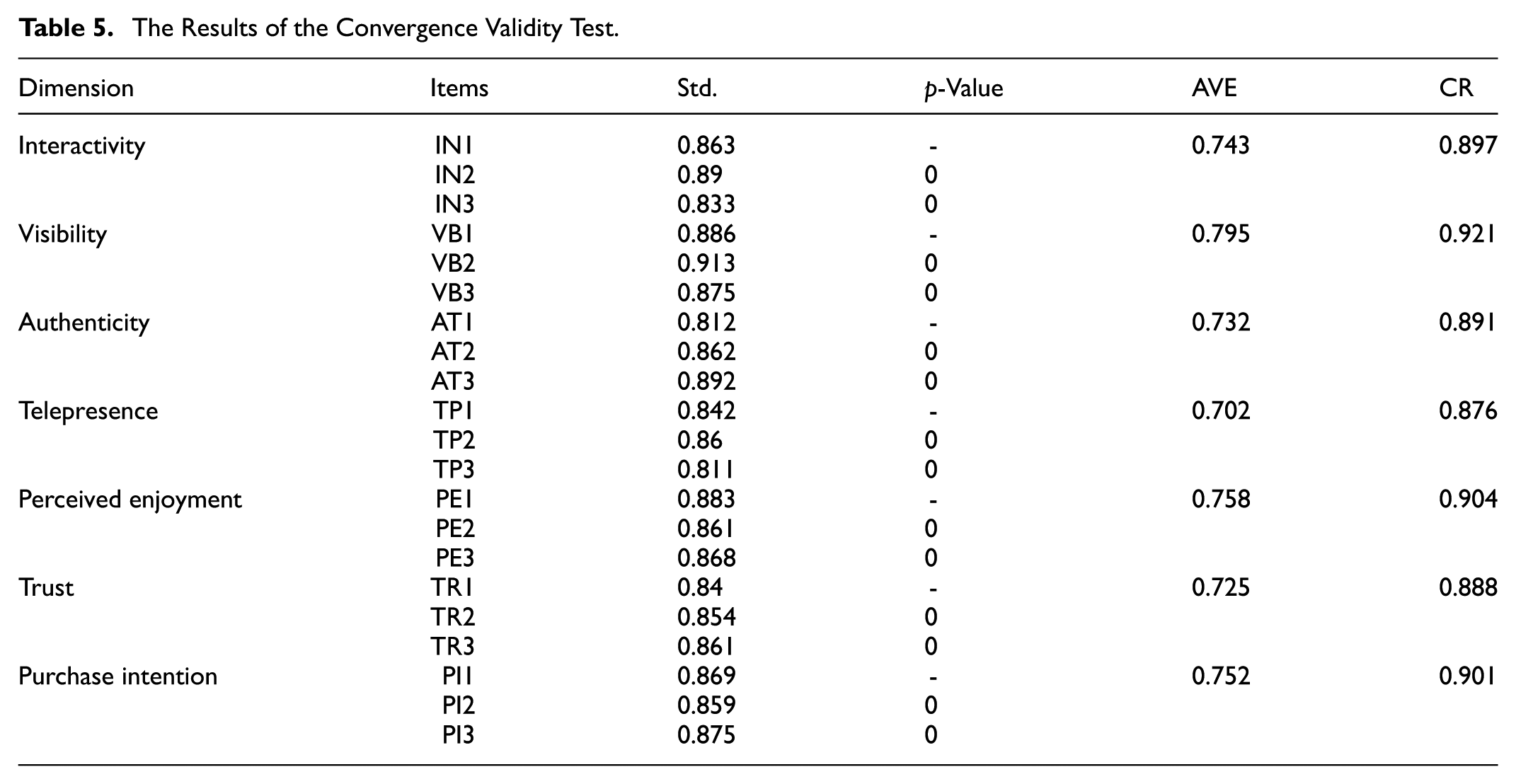
The present study employed a confirmatory factor analysis (CFA) to verify the convergent and discriminant validity of the proposed model. As illustrated in Table 5, the factor load coefficients of the tested items are all greater than 0.5, which aligns with the recommendations set forth by Shevlin and Miles (1998). Furthermore, the average variance extracted (AVE) values for the various factors are not less than 0.36, as outlined by Deng et al. (2023). This indicates that both the latent variables and the test items exhibit the requisite significance, suggesting a robust convergence validity between the factors and the various latent variables. Additionally, the results of the analysis presented in Table 6 demonstrate that the correlation between the square root of the AVE values of the different variables (highlighted in bold in the diagonal) and the corresponding coefficient values meets the criteria for verification, indicating that there is a satisfactory level of discriminant validity among the various latent variables.
The Results of the Convergence Validity Test.
The Results of the Discriminant Validity Test.

Moreover, the heterotrait-monotrait (HTMT) ratio was utilized in this study to evaluate the discriminant validity of the model. The findings of Gold and other scholars suggest that when the HTMT value does not exceed 0.90, the model is deemed to have satisfactory discriminant validity, and it will therefore be regarded as stable, reliable, and suitable for further analysis (Gold et al., 2001). As evidenced in Table 7, all HTMT values remain below the established threshold, thereby substantiating the telepresence of significant discriminant validity across the model’s diverse dimensions.
The Results of the Heterotrait-Monotrait (HTMT) Ratio Analysis.

Model Verification
This research employs AMOS 23.0 to assess the overall fit for the model to determine whether the established theoretical model and research hypotheses align with the data items to be analyzed. The verification of a model’s goodness of fit is not contingent on a single p-value; rather, it necessitates the consideration of a range of indices (Kline, 2015; Whittaker, 2011). The results of the model verification are presented in Table 8. A path analysis of the various latent variables revealed that the multiple indexes of goodness of fit, including χ2/df, GFI, RMSEA, RMR, and CFI, NNFI, TLI, AGFI, and IFI, meet the standards for model fit as proposed (Browne & Cudeck, 1992; Hair et al., 1998). This indicates that the model established in this research has an optimal goodness of fit and is statistically and practically significant, thereby meeting the requirements for research.
The Indices of Goodness of Fit for the Model.

Note. χ2/DF = Normed Chi-square; GFI = Goodness of Fit Index; RMSEA = Root Mean Square Error Approximation; RMR = Root Mean Square Residual; CFI = Comparative Fit Index; NFI = Normative Fit Index; TLI = Tucker-Lewis Index; AGFI = Adjusted Goodness of Fit Index; IFI = Incremental Fit Index.
The results of the path analysis are presented in Table 9 and Figure 2. Of the eight hypotheses formulated in this research, six have been validated, while two remain unconfirmed.
The Summary of the Regression Coefficients Associated With the Model.


The results of the path analysis (*** indicates p < .001 and ** indicates p < .05).
Discussion
The objective of this research is to propose and validate the impact of augmented reality (AR) technology on users’ purchase intention in mobile shopping applications, from the perspective of telepresence. Analysis of the data reveals that within mobile shopping applications, AR technology does indeed influence users’ purchasing intentions through telepresence. However, the telepresence generated by AR technology does not directly affect purchasing intentions; rather, it exerts an indirect influence via trust.
The analysis of structural equations revealed that three factors, namely interactivity, visibility, and authenticity, exert a positive influence on telepresence (
The visibility provided by AR technology diversifies the way product clues are presented in the context of mobile shopping applications. Visibility can affect telepresence, which is consistent with the conclusions of previous literature (Saffanah et al., 2023; Y. Sun et al., 2019). The reason may be that the visual sense is the important channel of spatial perception, and observation is the important method of spatial perception (Bittermann et al., 2006), while lower visibility makes users feel detached from the shopping process. In AR-based mobile shopping applications, AR technology enables the rendering of virtual goods. This visibility encompasses not only the outline and color, but also the proportions and details of light and shadow about the product. The goods are exhibited comprehensively from multiple angles, thereby facilitating the formation of a complete model of the goods in the user’s mind, which gives the impression that the goods are appearing in front of them. Furthermore, the enhanced visibility afforded by AR technology can facilitate the presentation of product information more clearly to users. Visibility affordance will influence the degree of immersion experienced by users during the shopping process (Saffanah et al., 2023). In turn, the sense of immersion will facilitate the generation of telepresence among users (Daassi & Debbabi, 2021).
The concept of authenticity can be attributed to the real-time, multi-angle, multi-channel, and comprehensive presentation of a product through the utilization of augmented reality (AR) technology. The accessibility of information about the goods in question will facilitate the consumer’s internal recognition of the product, thereby instilling a sense of authenticity (Y. Zhou et al., 2021). In other words, authenticity can be said to be a subjective construct (Cuesta-Valiño et al., 2022), whereby the user perceives the goods as having a higher degree of transparency. Such a consideration will deepen the user’s experience of the sense of consumption and contribute to the creation of telepresence among users. Specifically, AR technology can reconstruct the visual characteristics of goods through 3D modeling, thereby facilitating users’ ability to rapidly conceptualize the tangible form of the goods in question at a glance. Furthermore, AR technology is capable of tracking the user’s movements or the camera’s movements in near-realistic proportions. Additionally, AR technology is capable of simulating the real light source and rendering the products in real time, thereby ensuring the visibility of even the minutest details. This engenders the sensation that the products are situated in the same physical space as the user. It is AR technology that can present the goods to the consumer in a realistic manner. This provides the concrete clues that can only be obtained in the actual consumption environment, satisfying consumers’ demand for complete information (B. Z. Zhang et al., 2021). Therefore, it will enhance telepresence. This is, of course, contrary to the findings of Baek et al. (2019), who noted that telepresence affects product authenticity. The reason for these two different findings may be the difference in research contexts. Beak’s study is on cross-border online shopping, where there is a natural geographic disconnect and cultural differences, and consumers’ concerns about product authenticity are the primary issue; whereas this study focuses on AR technology, where the technology itself reconfigures the perception of authenticity. Authenticity in AR technology has an active nature, where the technology creates authenticity and thus gives users telepresence; authenticity in cross-border e-commerce has a passive nature, a consumer-judged authenticity that is affected by telepresence in the shopping environment. Therefore, it will lead to different research results.
Among the three antecedent variables related to telepresence, authenticity has a greater influence compared to visibility and interactivity (0.402 > 0.290 > 0.236). In fact, there are already many visual presentation methods for goods in the context of non-AR-based mobile shopping applications, such as image, text, and video. Therefore, AR technology can only enhance the visibility of mobile shopping applications to a limited extent. The biggest problem with remote shopping is that real goods cannot be touched, and the purpose of AR-based mobile shopping applications is to compensate for this deficiency as much as possible. Through 3D presentation and more intuitive and rich product information, such as material, weight, function, and dimension, both the product experience in a physical store (R. Algharabat & Dennis, 2010) and the effect of the purchased goods in different environments can be simulated, significantly enhancing the user’s perception of authenticity. While AR technology demonstrates clear advantages in enhancing authenticity, significant opportunities remain for advancing its interactive capabilities. Current AR applications tend to interact with virtual objects through specific gestures or instructions from the user, and there is a limited choice of interactable operations and content. This will definitely reduce the experience and feel of interacting with AR-based mobile shopping applications for users.
Second, telepresence will positively affect perceived enjoyment and trust (
In the networked environment, consumers need a higher level of trust because they have relatively less direct contact with sellers (Ou et al., 2014; Ye et al., 2020). Many e-commerce researchers believe that there is a correlation between remote presence and trust. This is because telepresence helps to reduce the differences between online and physical products. More physical clues can lead to the satisfaction of users’ utilitarian shopping motives through better access to products. This creates a higher level of trust. Platforms are considerate of consumers and can establish more contact with users, so that users can feel the goodwill of the seller. In this way, the risk of ambiguity is reduced, the psychological distance between buyer and seller is shortened, and trust and dependency intention (Darke et al., 2016) are increased.
However, contrary to the majority of previous research findings, this study, in the context of mobile application shopping, discovered that the telepresence created by augmented reality technology does not directly influence purchase intention and behavioral intention (
Finally, perceived enjoyment does not have a positive effect on purchase intention (
Conclusion
Research Significance
Theoretical Significance
The research determines the antecedent influencing factors of telepresence in the context of AR-based mobile shopping. Telepresence of AR-based mobile shopping is influenced by three factors—interactivity, visibility, and authenticity. Based on the data results, the strength of the differentiation of the technical features of AR mobile shopping on telepresence (authenticity > visibility > interactivity) is clarified, which is conducive to promoting the research paradigm iteration of human-computer interaction from the “technical function-oriented” to the “user’s psychological perception-oriented.” It is helpful to promote the research paradigm iteration from “technical function-oriented” to “user psychological.”
The research has found that telepresence does not directly affect purchase intention, which enriches the study in the field of AR-based mobile shopping. The research has revealed the path mechanism of “telepresence - trust - purchase intention.” This finding has broadened the scope of current research and provided a more precise explanatory mechanism for immersive shopping research.
This study re-examines the mediating mechanism of telepresence, emphasizes the central role of trust in AR shopping, and reveals the influencing mechanism between technical performance, psychological cognition, and behavioral decision-making, providing empirical support for the cross-level study of “technology-psychology-behavior.”
Practical Significance
This research has not only enhanced the theoretical underpinnings in the field of AR-based mobile shopping but has also furnished robust theoretical support for its practical applications. It offers significant insights into consumer behavior and provides a framework for designing AR-based shopping applications that align with consumer needs. The following are the key design strategies:
As a novel e-commerce platform, the AR-based mobile shopping application will prioritize the promotion of telepresence as its current principal design focus. In terms of interactivity, the use of 3D sound, tactile feedback, and other more abundant interactive methods can be employed to encourage consumers to engage in shopping activities and to stimulate their capacity for fine spatial imagination. In terms of authenticity, based on the conclusion that “authenticity has the highest weight,” it is recommended that companies prioritize investing in high-precision 3D modeling, such as material light and shadow simulation. Use environment fusion algorithms, such as SLAM real-time localization. Instead of over-developing enjoyment features, such as gamification filters, ensure that the technology investment directly enhances the user’s sense of telepresence. With regard to visibility, it is vital to further enrich spatial clues, present commodities in accordance with the scenario, and expand users’ visual perception by means of multimedia to create the impression that commodities are emerging in front of them.
Perceived enjoyment does not currently exert an influence on users’ purchase intention in the context of mobile shopping applications. This may be attributed to the lack of maturity in the adaptation of AR technology to various application scenarios. Although functions such as virtual try-on and dynamic display have created enjoyment value through the creation of telepresence, there are still design gaps in the shopping conversion chain. In the future, it can be considered to embed a discount-triggering mechanism that is strongly associated with the scene in the AR interface, for example, automatically generating a pop-up window with a limited-time discount after completing the virtual try-on. By using a gamification progress bar to display the process of discount accumulation, enjoyment behavior can be naturally transformed into a consumption motivation. Save the user’s operation status, support full-process floating window operations from AR preview to order confirmation, and combine gesture tracking to achieve a smooth interaction of “grabbing items in the air - directly adding to the shopping cart,” reducing cognitive load. When the system detects that the user repeatedly experiences a specific type of AR function (such as repeatedly adjusting the layout of virtual furniture), it can actively push a guidance panel containing size matching suggestions and inventory information, balancing the enjoyment exploration, and purchase requirements through progressive information disclosure.
The role of trust in influencing purchase intention is particularly pronounced in the context of online shopping. In contrast to offline physical stores, the virtual shopping environment of the internet lacks the ability to provide direct observation and physical contact with the products, which can impede access to the real texture and effect of the goods in question. To this end, UGC social proof can be embedded in the AR interface, such as 1,023 people trying on and then purchasing. Develop an AR and blockchain fusion function to realize real-time overlay of commodity traceability information, such as AR visualization of raw material origin. Launch an AR trial protection program, such as a virtual try-on distortion package refund, to transform technological trust into a sense of purchase security.
Limitations and Future Research
Although the research has made several theoretical and practical contributions, it is still subject to certain limitations:
The current research samples are primarily drawn from China, which may raise questions about the universality and representativeness of the research results. To address this, future research should aim to collect samples more extensively and test the model in different cultural contexts. This will help to identify the impact of AR technology on purchase intention.
AR technology is still evolving and undergoing enhancements, which may potentially limit its stability and efficacy in real-world scenarios. Consequently, the outcomes of research may be influenced by the evolving nature of the technology itself, making it challenging to accurately assess the true impact of AR technology.
As an agent variable, telepresence may play a complex role between AR technology and purchase intention. However, the current research does not sufficiently elucidate its internal mechanism. Consequently, future research should investigate the mechanisms and key factors influencing telepresence more deeply.
It would be beneficial to consider the following research directions in the future:
In view of the considerable impact of diverse cultural and regional influences on consumers’ consumption behavior and their purchase intention, future research may gain considerable insight by undertaking a cross-cultural and trans-regional comparison. This would help elucidate the discrepancies in the applicability and efficacy of AR technology across varying consumption contexts. For example, compare the priority of users’ demands for interactivity (such as being more dependent on gestures in high-context cultures), visibility (such as differences in color preferences), and authenticity (such as acceptance of “refined” models) in different cultural backgrounds. Or in cross-border AR shopping, study how cultural differences affect users’ criteria for judging technological trust.
In order to reinforce consumers’ purchase experience and enhance their purchase intention, future research should explore how to optimize and promote telepresence. For example, research should investigate how to enchance consumers’ telepresence experience by improving the interactive methods of AR technology and strengthening the sense of reality of the virtual environment.
In addition to AR, there are numerous other technologies, including VR and MR, which can also be utilized in the context of mobile shopping applications. Future research may consider the impact of integrating these technologies on purchase intention, as well as the potential synergistic and complementary effects among them. Trust enhancement experiments involving multi-technology integration can also be conducted, such as testing whether the integration of AR, VR, and haptic feedback technology enhances trust through multi-sensory immersion, thereby amplifying the effect of increasing purchase intention.
The dynamic formation mechanism of trust can be explored, and it can be studied whether the sensitivity of different user groups (such as high/low risk avoiders) to trust in AR technology affects the path strength. Expand the boundary conditions of technological trust, for example, to explore whether the combination of AR technology and AI will change the mode of action of trust intermediaries. Conduct longitudinal tracking and study the evolution law of users’ trust in AR technology from the short term to the long term through panel data to reveal the dynamic changes of the trust mediating effect.
In conclusion, a significant number of fields have yet to be subjected to thorough investigation with regard to the impact of AR technology on users’ purchase intention in the context of mobile shopping applications. By overcoming the limitations of existing studies and expanding the scope of future research, AR technology can be more effectively accessed and utilized, thereby advancing the development of mobile shopping applications and enhancing consumers’ purchase experience.
Footnotes

Ethical Considerations
The study was conducted in accordance with the Declaration of Helsinki, and approved by the Institutional Review Board (Protocol code No. JNU202409RB0030).
Consent to Participate
Informed consent was obtained from all subjects involved in the study.
Funding
The authors received no financial support for the research, authorship, and/or publication of this article.
Declaration of Conflicting Interests
The authors declared no potential conflicts of interest with respect to the research, authorship, and/or publication of this article.
Data Availability Statement
The data that support the findings of this study are available from the corresponding author upon reasonable request.