



Abstract
This study investigates the development, and integration, of a “Culturally Responsive Self-Regulated Learning (CR-SRL) Framework” to guide teachers in creating supportive classroom environments for culturally diverse learners. Literatures on culturally responsive teaching and self-regulated learning both suggest principles and practices for designing inclusive classrooms; however, from different perspectives. To pull those frameworks together, and building on sociocultural and situative perspectives, I conducted a theoretical analysis to conceptualize an integrated CR-SRL Framework. Using a multiple case study design, I field-tested how the framework might be useful by building practices collaboratively with three elementary classroom teachers. Data included classroom observations, document reviews (i.e., teachers’ lesson plans and assignment instructions), and teacher interviews. The findings from a qualitative analysis suggest that the CR-SRL framework helped the teachers in integrating CR-SRL practices. However, there were variations in the ways the teachers designed and implemented the framework based on their prior practices and learning experiences. Nevertheless, the teachers experienced both benefits and challenges as they were working to design and implement the framework. This paper concludes by discussing how educators might be supported to take up a CR-SRL framework to meet the needs of culturally diverse learners. Implications for theory and research, teacher education, and professional development are discussed.
Keywords
Introduction
In the 21st century, classrooms in the western developed countries are increasingly including heterogenous learners with varied linguistic and cultural backgrounds, different learning experiences and academic needs. In North America for example, Canada has witnessed a great demographic shift through immigration. The recent census indicated that 12.7% of Canada’s population speak a language at home other than English or French. The current population of Canada represents over 250 ethnic or cultural origins. It is projected that by 2041, 50% of the Canadian population will be immigrants and their children, and with two of every five Canadian belonging to a racialized group (Statistics Canada, 2022). Similarly, in the United States, it is projected that by 2060, the population of immigrants will grow from about 14% to 17% of the entire population such that 32% of the American population (i.e., one in three Americans) will be another race other than White (U.S. Census Bureau, 2018). In addition, there is a continuous increase in the population of people with mixed-race and ethnicity in these countries leading to multilevel of diversity. This complex diversity is manifested in the multicultural nature of today’s classrooms.
Currently, racialized and ethnically diverse students whose cultural backgrounds differ from the mainstream culture experience systemic racism resulting to education disparities and achievement gaps (Gay, 2018; Ladson-Billings, 2021a). In this research, I envisioned that all students bring a unique history and socio-culturally rooted identity(ies) to classrooms that shape their learning processes. The presence of students from diverse cultural backgrounds (i.e., culturally diverse learners) creates opportunities and challenges for both students and teachers (Fine & Handelsman, 2010; Kumi-Yeboah et al., 2020). In terms of opportunities, culturally diverse learners bring various enriching histories including values, experiences, knowledge, ideas and skills to classrooms that can expand learning opportunities for all students. Teachers can build on students’ cultural diversity as a resource for teaching and learning by creating opportunities for inter-cultural communication and competence, critical consciousness, peer interaction, small group activities, and sharing of ideas (Gay, 2018; Ladson-billings, 2021b).
Nevertheless, tapping into enriching opportunities in multicultural classrooms can be challenging for both teachers and students. Multicultural classrooms can pose challenges to teachers if teacher education programs do not provide the training, knowledge, and skills for teaching and supporting culturally diverse learners (Gay, 2013; Gay & Howard, 2000; Heineke & Vera, 2022; Ladson-billings, 2021b). Consequently, teachers, especially those who do not share the same cultural backgrounds with their students, tend to struggle with designing a culturally inclusive classroom (Samuels, 2018). Thus, they may instead create classroom environments where activities and practices are disconnected from students’ lived experiences, prior knowledge, aspirations, and interests, leading to students’ lack of engagement (Hockings et al., 2008). Teachers who may be biased or unaware of their cultural hegemony tend to have low academic expectations for culturally diverse learners (Sleeter, 2012). Without effective forms of support, classroom contexts can also be challenging for diverse students who may be facing new or different learning structures and expectations (Butler et al., 2017). Further, a mismatch between diverse learners’ prior knowledge, funds of knowledge, and classroom learning experiences can constrain their motivation, engagement and success (Gay, 2018; Hockings et al., 2008). The question, then, is how can teacher candidates, and/or practicing educators, be supported to design inclusive classroom environments that can better serve the needs of culturally diverse learners?
An Integrated Approach: A Way Forward
Fortunately, research is identifying approaches that educators can access to meet the needs of these students. For example, research describes how culturally inspired pedagogies can help educators in designing supportive contexts for students’ learning process and overall success (Gay, 2018; Ladson-Billings, 2021b). Research findings on student motivation and engagement are also informing understanding about how the interaction between the learner (e.g., their cultural backgrounds, languages, values, learning expectations and experiences) and contexts (e.g., classroom pedagogical practices) shape students’ learning (Hecht et al., 2021; Kumar et al., 2018).
While research findings are converging to uncover promising approaches to culturally responsive/relevant pedagogical practices in relation to students’ motivation and engagement (Aronson & Laughter, 2016; Ladson-Billings, 2021b); it is not yet clear how we can empower learners in taking up the opportunities created by these practices. Simultaneously, a large body of self-regulated learning (SRL) research identifies practices that empower learners to successfully navigate learning environments (Butler et al., 2017; Greene, 2018; Perry, 2013). However, research on SRL is just beginning to apply a cultural lens to inform understanding about practices inclusive of culturally diverse learners (e.g., Anyichie, 2018, 2024a; McInerney, 2011; McInerney & King, 2018). To fully meet the needs of culturally diverse students in classrooms (e.g., establishing interpersonal relationship, effective cross-cultural communications, finding the relevance of learning activities to their lives, learning engagement, and motivation), it might be beneficial to explore the potential of an integrated pedagogy that builds from culturally responsive teaching (CRT) and SRL literatures. Currently, there is no framework that I am aware of that has integrated CRT and SRL practices to support teaching and learning in culturally diverse classrooms.
Thus, the project described here aimed to advance understanding about how the integration of CRT and SRL lenses might inform efforts to help teachers successfully address the needs of culturally diverse learners in their classrooms. To that end, I first conducted a theoretical review of the CRT and SRL literatures. Based on that analysis, I derived an integrated culturally responsive self-regulated learning (CR-SRL) framework with potential for designing supportive contexts for culturally diverse learners. To test the potential productivity of this approach, I worked with three teachers in different classroom contexts to co-construct practices based on this framework; and examined their experiences.
Theoretical Frameworks and Analysis
This section provides the review and analysis of theories, frameworks, principles, and practices provided by the leading researchers in both fields of multicultural education and CRT (e.g., Bank, 1996; Ladson-Billings, 1995, 2001; Gay & Howard, 2000, 2010); and SRL (e.g., Boekaerts, 1997; Zimmerman, 1989, 2008). The analysis started with searching for the foundational literatures. Using socio-cultural (e.g., Vygotsky, 1978, 1987; Wertsch, 2008) and situated (e.g., Lave & Wenger, 1991; Nolen et al., 2015) perspectives to learning, I critically reviewed and analyzed those CRT and SRL literatures with specific attention to their strengths, weaknesses, interconnections, and divergences (see Anyichie, 2018, 2024a; Anyichie & Butler 2017). Also, this section highlights the development of an integrated CR-SRL framework.
Culturally Responsive Teaching (CRT)
Culturally responsive teaching (CRT) is a pedagogical practice developed to address the challenges of students from diverse ethnic, cultural, and linguistic backgrounds (Gay, 2018; Villegas & Lucas, 2002). It is a form of teaching that utilizes ethnically diverse students’ cultural frames of reference, including their background, language, beliefs, values, and prior experiences as the channel of teaching. CRT explicitly considers the impact of sociocultural contexts on individual learning based on the understanding that students’ engagement and motivation is elicited and sustained by connecting classroom practices with students’ cultural backgrounds and lived experiences. For example, in the United States, CRT research with mixed-raced students, such as African American, Latino American, and Native American, has advanced understanding about how to build a culturally caring learning community and design culturally relevant curricula (Gay, 2013, 2018; Heineke & Vera, 2022). But because most writing speaks to what educators are doing to create culturally responsive environments, more attention is needed on how to support learners’ deliberate engagement with these practices.
To inform the theoretical analysis, I built on descriptions of culturally inspired pedagogies. For example, culturally responsive (e.g., Gay, 2010, 2018) and relevant (e.g., Ladson-Billings, 1995, 2021a, 2021b) pedagogies, although from different perspectives, highlight the need to connect classroom activities to students’ cultural backgrounds and lived experiences. Culturally sustaining pedagogy (e.g., Paris, 2012, 2021) emphasizes sustaining students’ languages, literacies, and cultural identities to foster pluralism and drive positive social change. These scholars have developed frameworks that are situated within sociocultural contexts for describing the theories, principles, and pedagogical practices that support culturally diverse learners. Summaries of practices from these frameworks described in this paper as culturally responsive pedagogical practices (CRPPs) include: developing knowledge about cultural diversity, as well as teachers’ and students’ histories; creating safe, caring and supportive learning environments; establishing cross-cultural curricula; designing culturally diverse curriculum content; establishing cultural congruity in classroom teaching and learning; collaborating with cultural experts, parents and students in practice design; and multidimensional feedback and assessment (see Table 1, Column 2; Anyichie, 2018; Anyichie & Butler 2017, Gay, 2018).
A Culturally Responsive Self-Regulated Learning (CR-SRL) Framework.
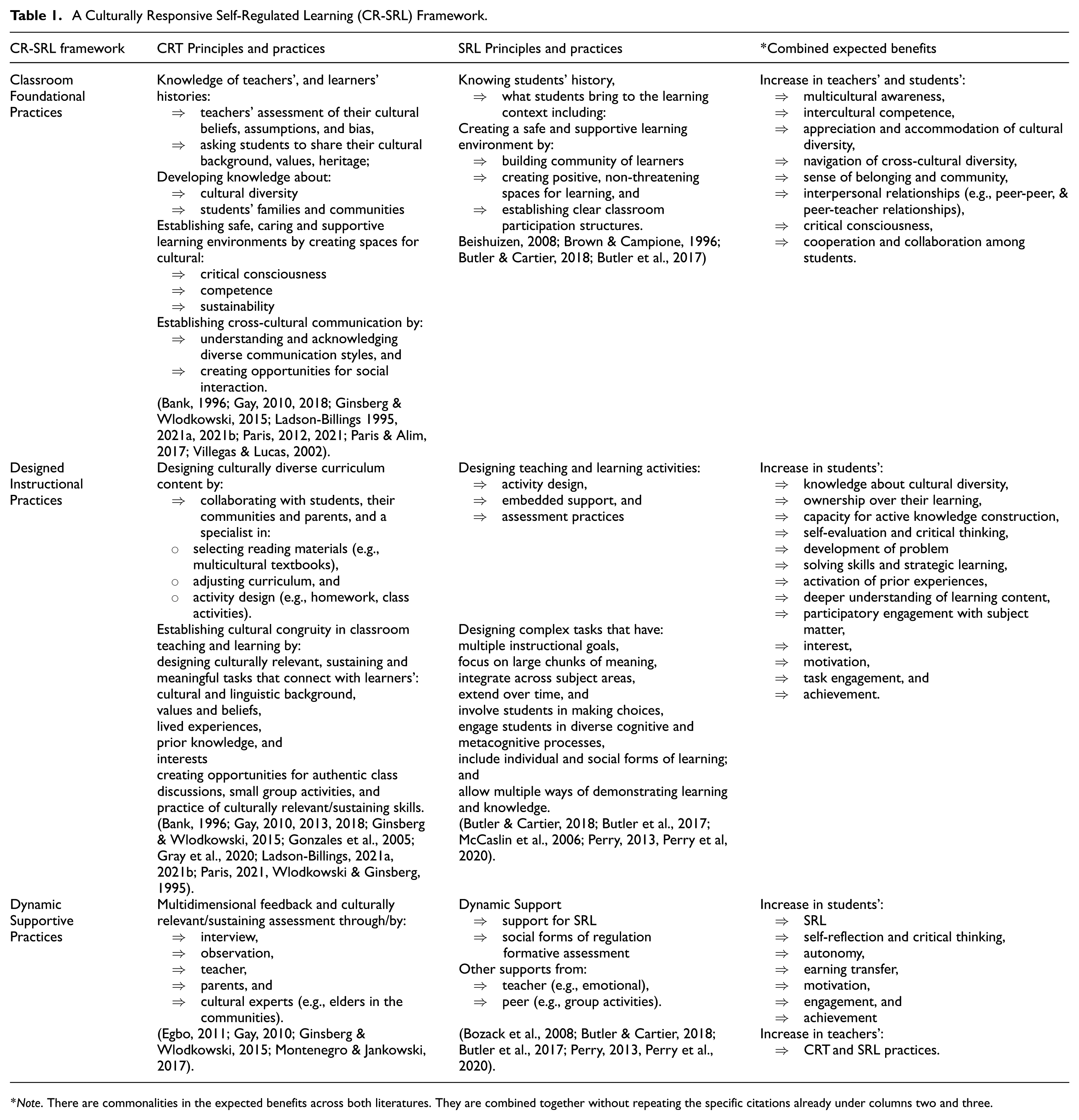
Note. There are commonalities in the expected benefits across both literatures. They are combined together without repeating the specific citations already under columns two and three.
Classroom contexts that integrate CRPPs have been associated with students’ engagement and motivation (Aronson & Laughter, 2016; Anyichie, 2018, 2024a, 2024b; Anyichie et al., 2023; Bui & Fagan, 2013; Gay, 2013, 2018; Gray & Howard, 2020). For example, Gray and Howard (2020) examined the associations between communal learning opportunities that teachers created for racialized Black and Latinx students in a school in the United States during STEM activities, and how these students engaged in those activities. The researchers collaborated with the participating teachers in developing instructional units that reflected ideas about cultural relevance. They observed teacher practices, administered student survey reports on behavioural engagement and communal experiences in the STEM activities, and had follow-up sessions with both teachers and students. Their finding revealed that Black and Latinx students reported experiencing higher levels of engagement in those activities when they perceived it as relevant to their cultural values of communalism (i.e., offering opportunities to serve humanity and one another).
Self-Regulated Learning (SRL)
Self-regulated learning (SRL) encompasses individual and social forms of learning involving students’ transformation of their thoughts, feelings, and actions to achieve personal goals within particular contexts (Zimmerman, 2008). Self-regulated learners are proactive, deliberate, strategic and successful learners who exercise control over their learning processes while deploying diverse strategies for successful outcomes (Greene, 2018; Perry, 2013). SRL research has identified a variety of SRL-promoting practices (SRLPPs). Recent summaries of this literature suggest that SRLPPs include creating a safe and supportive learning environment, designing complex meaningful tasks, providing opportunities for choice and control over challenge, fostering self-evaluation, offering teacher support, providing opportunities for peer-to-peer support, and engagement in cycles of strategic action (e.g., interpreting expectations, setting goals, planning, enacting strategies, self-monitoring and assessing, adjusting strategies) (see Table 1 Column 3; Anyichie, 2018; Anyichie & Butler, 2017). These practices are associated with individuals’ development of approaches for navigating demands and expectations successfully (Anyichie & Butler, 2015; Perry, 2013; Zimmerman & Schunk, 2001). In this respect, research on SRL has identified the importance of social contexts on learning (see Zimmerman, 1989); with much attention currently being invested in studying how individuals’ agency unfolds in relation to sociocultural processes (Anyichie et al., 2018; Hadwin et al., 2018; Martin & McLellan, 2008). Still, SRL research is only now attending to how SRLPPs might support inclusion of culturally diverse learners (e.g., Anyichie, 2018, 2024a; Anyichie et al., 2016, 2023; Perry et al., 2017). To build on this growing focus in the SRL literature, in this project, I conducted a theoretical review to identify how principles and practices derived from the SRL literature might help in extending understanding about how to empower culturally diverse students to take ownership over their learning process.
To inform this analysis, I drew from considerable major research that has shown how supporting SRL development is very important to students’ motivation, engagement, success, and academic achievement (e.g., Boekaerts, 1997; Dent & Koenka, 2016; Perry, 2013; Perry et al., 2020; Schunk & Zimmerman, 2007). For example, Perry et al. (2020) collaborated with classroom teachers to design and implement assessments for learning (e.g., formative assessment) as a way of supporting SRL in authentic classroom writing tasks. They collected data about the classrooms in relation to how they supported SRL (e.g., high vs low), students’ writing processes and products, and self-assessment of SRL. The findings revealed that students in classes with higher levels of SRLPPs exhibited higher level of engagement in self-regulation of their writing task and produced a higher quality of writing when compared with their peers in classrooms with lower support for SRL.
Comparisons of Culturally Responsive Teaching (CRT) and Self-Regulated Learning (SRL) Frameworks
This section presents the theoretical analysis of potential synergies and disconnects between CRT and SRL. The analysis was sensitized by sociocultural and situated perspectives of learning. From a sociocultural perspective, learning is a social and cultural process that involves an individual’s participation in community-based activities (Rogoff, 2003) where the learner is guided by more knowledgeable others (Wertsch, 2008; Vygotsky, 1978). Through this process, the learner builds the skills and knowledge required to be successful in a new learning environment. Understanding how to support culturally-diverse learners requires close attention to how learning can be socially-mediated in context.
Many theoretical lenses have been applied to inform understanding about SRL (e.g., social-cognitive, socio-cultural, socio-constructivist; see Zimmerman & Schunk, 2001). Nevertheless, SRL researchers (e.g., Hadwin et al., 2018; Järvenoja et al., 2015) have consistently sought to advance understanding about learning as socially-influenced. This work was sensitized by a situated model of SRL (see Anyichie et al., 2018; Anyichie et al., 2016). A situated perspective supports understanding individuals’ learning and beliefs as emerging from their participation in sociocultural contexts, including communities, schools, and classrooms (Lave & Wenger, 1991; Nolen et al., 2015). A situated model of SRL captures the interplay between individual agency and sociocultural processes in learners’ engagement and SRL development. This paper is built from this model to consider how practices might empower culturally diverse learners to effectively navigate the kinds of socio-culturally anchored environments in which they are living and learning, as well as sustaining their languages, legacies, cultural histories, and practices (Paris, 2021).
Convergences between the CRT and SRL Literatures
The theoretical comparison of the CRT and SRL literatures, based on sociocultural and situated perspectives, also suggested many theoretical and empirical convergences. Theoretically, SRL aligns well with CRT by deliberately highlighting the dynamic interaction between individuals and learning contexts. These perspectives on both CRT and SRL suggest that learning is inherently a dynamic social process that is situated in context and depends heavily on the kinds of knowledge, experiences, and beliefs that learners bring to school (Anyichie et al., 2018; Gay, 2018; Järvenoja et al., 2015; McInerney & King, 2018).
Empirically speaking, SRL research conducted from many theoretical perspectives (e.g., social cognitive, sociocultural, socio-constructivist, situated) has identified practices that closely link with recommendations from the CRT literature. For example, both Butler & Cartier (2018)’s SRL situated model and Gay’s (2010, 2018) CRPPs recommend attending to the quality of learning environments, recognizing, and building from what learners are bringing to contexts, and utilizing multiple student-centred pedagogical practices. Both fields agree to offering multiple options for students’ demonstration of learning. These shared practices might well combine to achieve goals for SRL and CRT for culturally diverse learners.
More specifically, the analysis suggested that CRT and SRL approaches, while not necessarily the same, might be complementary (see Anyichie, 2018; Anyichie & Bulter, 2017). For example, offering choices (i.e., SRL practice) in classroom learning activities might support culturally diverse students to work on a topic that is personally meaningful and relevant to their lives, beliefs, values, and communities (i.e., CRT practice). Such opportunities can increase their motivation, engagement while sustaining their cultural practices and learning new knowledge.
Divergences between the CRT and SRL Literatures
Building on the overarching theoretical analysis of the principals and practices of both CRT and SRL literatures, especially across different educational contexts (see Anyichie, 2018; Anyichie & Bulter, 2017), I was able to identify important divergences between both literatures. Theoretically speaking, the two perspectives were fundamentally developed to achieve different purposes and so foreground different issues. For example, in addition to challenging issues of social injustice, colonization and power in education, the CRT framework emerged because of researchers’ efforts to bridge the discontinuities between ethnically diverse learners’ backgrounds and classroom instruction (Brown, 2007; Gay, 2018; Ladson-Billings, 2021a). In contrast, SRL researchers have been concerned with understanding and explaining the processes involved in individuals’ learning and knowledge construction while working on their own and/or with others (Winne, 2018; Wolters, 2010). Only recently have SRL researchers been focusing more centrally on cultural and linguistic diversity as important in understanding students’ experiences of learning in school (McInerney & King, 2018). However, more effort is needed in understanding the impact of students’ culture on their regulatory processes.
Empirically speaking, based on sociocultural and situative perspectives across different educational contexts (e.g., K-12 and universities), CRT and SRL emphasize different aspects of teaching and learning processes. Reviewed literatures on CRT tend to pay more attention to teachers’ role in supporting students’ learning by situating instruction within students’ sociocultural contexts (Gay, 2013, 2018), than to empirically investigate its connection with students’ learning processes and achievement within those contexts (Sleeter, 2012). Beyond considering the role of the teacher in supporting students’ ownership of their learning, literatures on SRL empirically investigate learning processes as situated in context (e.g., see Anyichie et al., 2018; 2023).
Culturally Responsive Self-Regulated Learning (CR-SRL) Framework
The analysis of synergies between CRT and SRL literatures suggested that an integrated CR-SRL framework could be constructed to assemble practices around three interdependent themes (see Table 1 and Figure 1) to better support culturally diverse students. These themes include: (1) classroom foundational practices; (2) designed instructional practices; and (3) dynamic supportive practices. By combining across literatures, I identified ways in which CRPPs and SRLPPs could be assembled in each of these areas to create culturally-responsive, empowering activities. Table 1 identifies some of the many principles and practices recommended in CRT and SRL literatures that could be flexibly and adaptively combined, alongside expected benefits from the same literatures. Because many principles and practices in each area are recommended across a range of resources, links to citations where those practices are recommended are provided at the end of each cell in the table.

A culturally responsive self-regulated learning (CR-SRL) framework.
Classroom Foundational Practices
Building on CRT and SRL literatures, educators use classroom foundational practices for setting up the classroom context while setting the stage for effective implementation of teaching and learning activities (see Table 1). Foundational practices reflect teachers’ continuous efforts to: (a) foster knowledge of learners; and (b) create caring, safe, and supportive environments (Anyichie, 2018).
Knowledge of learners describes what teachers can do to get a better understanding of what students are bringing to classroom contexts such as prior knowledge, cultural backgrounds, languages, and daily life experiences, metacognitive knowledge, identities, conceptions, work habits, strengths, and challenges; and support students’ knowledge and understanding of themselves, their cultures and others. Culturally inspired pedagogies highlight the need for teachers to develop knowledge of their students’ histories, ways of knowing and being as well as experiences of colonialism, social injustice (e.g., by assessing their cultural assumptions and bias, asking students to share their cultural background and heritage); and cultural diversity (e.g., by reading and sharing ideas with others) (Gay, 2018; Ginsberg & Wlodkowski, 2015; Ladson-Billing, 2021a, 2021b; Paris 2012; Paris & Alim, 2017; Villegas & Lucas, 2002). Working from an SRL lens, educators also attend to helping learners develop more metacognitive awareness and understanding of their own and others’ backgrounds, perspectives, and experiences, such as sharing students’ histories, previous learning environments, and celebrating their strengths (Butler et al., 2017).
Creating caring, safe, and supportive environments describes activities for creating an atmosphere where all learners feel welcome, safe, belonging and ready to take risks (CRPP and SRLPP). From SRL perspective, creating such an environment involves building a community of learners (e.g., by fostering student cohesion through group work and learning buddies) (Beishuizen, 2008; Brown & Campione, 1996); creating positive, non-threatening spaces for learning (e.g., by co-constructing class guidelines for accountability, emphasizing growth and mistakes as opportunities for learning); and establishing clear classroom participation structures (e.g., by having clear expectations and working instructions such as how students will interact with others, ask questions during class) (Butler et al., 2017). From culturally relevant/responsive perspective, educators can create a safe environment for students’ development of cultural critical consciousness (e.g., by questioning colonialism, inequality, social injustice, facilitating discussions around racism and how they affect students learning experiences), and cultural competence (e.g., by sharing ideas about cultural diversity, and supporting students’ understanding/knowledge of their own, and other students’ cultures) (Gay, 2018; Ladson-Billings, 2021b); and sustainability of students’ cultural ways of being (e.g., by creating space for, and allowing, students languages, values in the classroom setting) (Paris, 2021). In addition, a supportive environment can include establishing cross-cultural communications by understanding and acknowledging diverse communication styles such as discourse participation structures (e.g., active-participatory and passive-receptive patterns), organization of ideas (e.g., topic-centred and topic-chaining techniques), and creating opportunities for social interactions (Gay, 2010, 2018). Educators can build supportive, relevant, sustaining, equitable, and inclusive learning communities by integrating these ideas from CRPPs and SRLPPs. Culturally diverse learners feel welcomed and motivated to learn in classrooms that acknowledge their ways of being, symbols, and artifacts. Schools could display the different national flags and religious symbols of their students in the school compound (Anyichie, 2018).
These foundational practices hold benefits for both students and teachers. It supports a critical consciousness of societal injustice (Gay, 2018; Ladson-Billings, 2021b), which is critical for self-management, regulation of learning and relationships (Butler et al., 2017), and sustainability of students’ cultural heritage (Paris, 2021). It helps teachers and students to become aware of their and others’ backgrounds and learning approaches (Gay, 2018). This metacognitive knowledge of similarities and differences in cultural beliefs, values, and experiences tends to increase multicultural awareness, intercultural competence, and sense of belonging. Further, it reduces cultural tensions, helps students navigate multiple layers of cultural contexts, and increases social interaction, co-operation, as well as diverse learners’ active participation and learning, especially during collaborative learning activities. Culturally diverse learners thrive in a classroom environment that allows co-creation of cultural practices and tools that sustain their community heritage, ways of being, and shape their learning engagement (Anyichie, 2018; Gay, 2018; Paris, 2021).
The emerging knowledge from these foundational practices could provide educators with the required information and examples for designing empowering practices that meaningfully attend to the diverse needs of the students and their communities (Anyichie, 2024a, 2024b; Anyichie et al., 2023).
Designed Instructional Practices
Designed instructional practices describe a strategic integration of CRPPs and SRLPPs within a learning activity (see Table 1). These combined practices are at the hub of this framework and can be enacted powerfully while designing complex and meaningful tasks (Perry, 2013). Perry defines complex tasks as ones that involve multiple instructional goals, extend over time, focus on large chunks of meaning (e.g., designing an animal project that requires students to describe the chosen animal, gather information about the animal such as habitation, survival mechanism, external features), integrate across subject areas (e.g., including hand drawing in geometry task), involve students in making choices (e.g., what topic to work on, where to complete the task, and who to work with in group activities) and engage in diverse cognitive (e.g., attention, thinking) and metacognitive (e.g., engagement in the cycle of strategic actions such as task understanding, planning, strategy implementation, monitoring and adjusting strategies) processes, allow multiple ways of demonstrating learning and knowledge (e.g., oral presentations, drawing, writing) and focus on deeper learning engagement in both personal and social forms of learning (e.g., working alone and in groups). In complex tasks (SRLPPs), students have varied empowering opportunities to make meaningful connections between their prior knowledge and experiences about the topic and to integrate their cultural perspectives (CRPPs) in ways that can advance their knowledge (co)-construction (Anyichie et al., 2023; Wlodkowski & Ginsberg, 1995) and sustain their cultural practices, legacies, and heritages (Paris, 2021).
These combined practices allow for designing culturally diverse curriculum content (e.g., by collaborating with students and their communities in analyzing reading materials, designing class projects and assignments) and establishing cultural congruity in classroom teaching and learning (e.g., by designing meaningful tasks that are connected with learners’ cultural and linguistic background, values and beliefs, lived experiences, prior knowledge and interests (Gay, 2018), and practicing culturally relevant/sustaining skills (e.g., by allowing storytelling, singings and graphic designs as way of demonstrating learning (Paris, 2021). To illustrate, a research project on animal habitation or adaptation could be designed to provide students with choices of which animal to research (e.g., culturally or/and religiously significant animal), whether to collaborate with peers or not, how to consult with someone within their cultural community, and/or about how to demonstrate their knowledge (Gonzáles et al., 2005). The choices built into a complex task can enable culturally diverse learners to exercise control over the level of challenge (SRLPP), access their cultural tools such as language, artifacts, symbols (CRPP), and engage in critical thinking and evaluation as suited to their cultural context (SRLPP & CRPP) (Anyichie, 2018, Anyichie & Butler, 2017; 2023).
The theoretical analysis suggests that integrating CRPPs and SRLPPs can empower all learners to take ownership of their learning by creating opportunities for the integration of students’ interests and voices into their classroom work (Gay, 2018). Students’ motivation and engagement are increased when they feel a sense of having a voice and control of their learning experiences (Anyichie, 2024a; Anyichie et al., 2017; Conner et al., 2022; Toshalis & Nakkula, 2012). Complex task that integrates CRPPs and SRLPPs, as described here, bridges the gaps between learners’ home culture and classroom activities while enhancing their cultural competence, sense of belonging, and learning engagement (Ladson-Billings, 2001, 2021a, 2021b; Lawrence-Pine, 2015). It helps teachers to access and generate sociocultural information about how to offer dynamic support to forestall breakdowns in learning engagement (Anyichie, 2017; Anyichie, 2018).
Dynamic Supportive Practices
In this framework, “dynamic supportive practices” is defined as the multiple kinds of supports that can be offered to students while their learning unfolds. Literatures from both SRL (e.g., Anyichie & Butler, 2017) and CRT (e.g., Gay, 2018; Ginsberg & Wlodkowski, 2015) identify practices in support of learning as it unfolds in context. Dynamic supportive practices include: support for SRL through modelling (e.g., providing an example of how to solve a calculus mathematics problem), scaffolding strategies (e.g., offering guiding questions/hints on solving a learning task), fostering knowledge transfer across contexts (e.g., asking students to provide an example of how a current topic of discussion is related with a subject area, topic or personal experience) and social forms of regulation (e.g., creating opportunities for group project, co-regulation between the teacher and student (s)); emotional support (e.g., showing concern for students’ feelings) (Anyichie & Butler, 2017, 2018; Anyichie & Butler, 2023; Bozack et al., 2008; Perry, 2013); multidimensional, culturally relevant and sustaining assessment (e.g., allowing multiple ways of demonstration of learning) that considers student diversity (Egbo, 2011, 2019; Ladson-Billings, 2021a, 2021b; Montenegro & Jankowski, 2017); formative assessments including feedback from peers, teachers and parents (e.g., pointing out what can be added to improve an on-going project) and evaluations (e.g., completing self and peer assessment forms based on rubrics) (Anyichie et al., 2018; Gay, 2010; Ginsberg & Wlodkowski, 2015; Perry et al., 2020).
Teachers can pull together CRPPs and SRLPPs of these sorts by modelling and scaffolding students’ engagement in SRL (Shih et al., 2010) in ways that also build from and sustain their cultural heritages, backgrounds, daily life experiences, and personal interests (Gay, 2018; Paris, 2021). The application of these dynamic supportive practices relates to learners’ engagement and motivation (Anyichie, 2018; Anyichie & Butler, 2023; Anyichie et al., 2023).
Research Questions
This project was guided by two questions: (a) Did an integrated CR-SRL framework meaningfully guide teachers’ design of supportive classroom contexts, and how? and (b) What were teachers’ perceptions and experiences of designing and implementing an integrated CR-SRL pedagogy?
Methodology
Research Design and Context
This study employed a multiple case study design to investigate how educators built from the integrated CR-SRL framework to support all learners’ engagement in their classrooms. A case study design was chosen because it allowed for the collection and juxtaposing multiple forms of evidence to warrant the conclusions (Merriam 1998; Yin, 2014). By conducing three parallel cases over time, the findings were enriched by observing consistencies and divergences across contexts. Each case study was in a separate elementary multicultural classroom in a different urban school on the West Coast of Canada.
Prior to each study, I had been collaborating with each of the three teachers in supporting culturally diverse learners in their classrooms. The teachers were recruited from the schools/classrooms identified by their School Divisions as having multicultural student populations. I had separate conversations with each volunteer teacher about the content, goal, and implementation of the CR-SRL framework. I explained the study and answered questions they had. After the ethics approvals, I invited them to participate through the consent form. For each case study, each teacher and I collaborated to build from the framework to design and enact practices, considering each teacher’s current practices, experience, and contexts. Note that I had lived experiences of studying and working with people from diverse cultural backgrounds. These experiences shaped my conversations with the teachers about their implementation of the framework and the overall approach to this study. At the same time, while they were supported through our dialogues, all teachers chose how to implement the framework based on their professional experiences and as they considered appropriate to their classroom contexts (see Anyichie, 2018).
Participants
The three classroom teachers including Venus, Joseph, and Matthias (all names are pseudonyms) completed an open-ended background form. Venus’ combined grades 4, 5 & 6 classroom included 22 students in a public school (i.e., Queens Elementary). Joseph and Mathias taught at separate catholic independent elementary schools (i.e., St. Mary’s and St. Victor’s, respectively). Joseph’s grade 4 classroom had 31 students. Joseph had been teaching for 25 years. Matthias’ grade 5 classroom had 31 students. Matthias had been teaching for 8 years. None of the three teachers had any formal knowledge about CRPPs at the time of this study. Only Venus had knowledge of SRLPPs because she was participating in her school’s professional development around supporting students’ SRL. Only Venus and Joseph had experience with designing research or complex tasks for their students. All procedures used in the study received ethical approval from both the university research ethics board and each participating school/district.
Procedure
I co-designed classroom practices with each teacher sometime between September 2016 and December 2017. In each case, I supported the teachers in attending to the quality of the classroom environment overall (i.e., classroom foundational practices) and in designing a single complex task. In each case, educators chose to design a task because it allowed opportunities for the integration of CRPPs and SRLPPs. Nevertheless, each teacher decided on the focus and structure of the task based on their curriculum and students.
Data Collection
To gather evidence about teachers’ practice design and implementation in each context, observations were conducted in Venus’ (10 days), Joseph’s (11 days), and Matthias’ (8 days) classrooms. Each observation lasted between 40 and 70 min. I video-recorded observations (with permission) and took field notes. In addition, I collected and reviewed documents, including teachers’ lesson plans and assignment instructions. To ascertain teachers’ perceptions about the process and outcomes associated with designing practices using the framework, I held debriefing interviews with teachers after each classroom observation. I also interviewed them at the end of the study about their experience of designing/implementing instructional practices based on the framework. Some of the sample questions included: “What do you think about designing these CR-SRL practices?”“What were your experiences of implementing these practices?” Questions were designed deliberately to invite educators to describe both positive and challenging experiences (e.g., “what did you try that didn’t work as you hoped? Why do you think it didn’t work out?”). Apart from the interview, all data collection activities were part of their normal class routine, which reduces potential risks to the participants.
Data Analysis
I conducted qualitative analyses of classroom observations, interviews, and documents to answer the two research questions. Note that student data were excluded from the current analysis due to want of space.
Coding of Teacher Practices
To determine whether and how teachers were able to build from the framework to design practices that reflected the CR-SRL framework (RQ 1), the video-taped classroom observations, debriefings, and semi-structured teacher interviews were transcribed. The instructions for different sections of the complex tasks were reviewed. In two levels of coding, I juxtaposed inductive and deductive analyses to obtain a fuller and complete picture of practices enacted.
At a first level, I built inductively from the data to develop a chronological list of all practices enacted in each classroom. This ensured that all practices (vs. just selecting for CRPPs or SRLPPs) were included. Next, I applied the theoretical lenses to consider how educators might be combining CRPPs and SRLPPs as they shape their classroom environment and learning activities. I started by reviewing the full list of practices to identify any that were consistent with CRPPs (see Table 1, Column 2). Then, I reviewed the full list of practices with an SRL lens, flagging any linked with SRLPPs (see Table 1, Column 3). The result was a chronological list of practices flagged as CRPP, SRLPP, both, and neither. This level of coding is helpful for the visualization and interpretation of data (i.e., teacher practices). I did not expect that every single practice would necessarily reflect both SRLPPs and CRPPs. Instead, the coding and theoretical analysis support the thinking about how teachers’ deliberate integration of instructional practices into classrooms and activities could create an empowering culturally responsive learning environment.
At a second level, after coding all evidence, I categorized the practices identified in the review of observations, debriefings, and interviews in relation to the three main themes of practices identified in the CR-SRL framework (i.e., foundational, instructional, and supportive practices). Table 2 presents a triangulated coding sample from Joseph’s class. Joseph’s class is selected because he designed a complex task that richly integrated across SRLPPs and CRPPs and reflected the three themes/components of the framework in one context. The table helps to show how teacher practices were coded and mapped onto the different components of the CR-SRL framework. This lens enabled the interpretation of how the teachers did/did not combine CRPPs and SRLPPs to inform their development of practices in each of those areas. Finally, documents and fieldnotes were mined for confirming/disconfirming evidence.
Triangulation Coding Approach: Selected Example from Mr. Joseph’s Class.

Note. Joseph’s complex task has three sections. Due to space, the table presents only a section of the complex task to show how I described the complex task, coded teacher practices, and student activities in each context.
Coding of Teacher Perspectives
To uncover teachers’ perspectives/experiences about the integrated CR-SRL pedagogy (RQ 2), transcripts of teacher debriefings and interviews were coded on both benefits and challenges associated with designing/implementing practices based on the framework. Then, across the three teachers, I generated themes that reflected similarities and differences in their experiences.
Results
This report summarizes findings from a series of three different case studies involving the three teachers in which I evaluated how the integrated CR-SRL framework might/or might not be useful for educators seeking to address the cultural diversity of learners in their multicultural classrooms. The details of the specific practices integrated by each teacher are reported in a different context (see also Anyichie, 2018, 2024a; Anyichie & Butler, 2018, 2019, 2023, Anyichie et al., 2023).
Teacher Practices
Findings suggested that each teacher drew on the framework and weaved together SRLPPs and CRPPs in their classroom environments, and into a specific “complex” task context. However, there were differences in the ways they designed/implemented the practices based on their prior practice and learning. The finding shows that teacher practices were reflective of the three dimensions of the framework (see Table 2, Columns 1 & 2). This section describes the findings of how educators built practices in each of these areas (along with differences observed), as well as discussions of the findings.
Classroom Foundational Practices
The findings were that all three teachers enacted classroom foundational practices that included CRPPs and SRLPPs, although in different ways. These practices were combined in ways that enabled them to both gain knowledge about their students (SRLPP and CRPP) and empower their students to learn more about themselves and others (SRLPP and CRPP). For example, at the beginning of the academic year, they each asked students to print/paste their names on their lockers [Observation]. In addition, Joseph asked his students to draw image(s) that could describe their backgrounds and interests on their name tags (CRPP). Venus designed ice breakers, know yourself games, and bioglyphs. The teachers also designed projects to foster a deeper understanding of their students’ histories and among the students. For example, Venus’ activity, “My Family Tree,” helped students trace and share their family backgrounds (SRLPP and CRPP). Joseph’s “My Life in A Wire” project asked students to choose a metaphor (SRLPP) that connected with their personal life (CRPP) and share their metaphor through a combination of artifacts, essay writing, and storytelling (SRLPP) (see Figure 2, Table 2, Row 2). Matthias’“My Story” project asked students to respond to open-ended questions about their backgrounds, personal choices and values, outstanding strengths and weaknesses (SRLPP and CRPP), and share with their friends, through a group discussion, while identifying their similarities and differences. The questions under personal choices and values included: “List 5 things that are important to you/that you value in life”; “Explain why each of them is important to you”; “What do you hope to be in the future, and why?”“How is this hope affected/influenced by your values or your cultural background?” and “If it isn’t, what affects/influences your hope and why?” [Document review]. These activities created opportunities for students’ self-reflection, metacognitive knowledge, and choice of what they are sharing (SRLPPs) while drawing ideas from their personal experiences, communities, and background in ways that could sustain their cultural histories and orientations (CRPPs) (see Anyichie, 2018, 2024a; Anyichie & Butler, 2023; Anyichie et al., 2023).

My life in wire project.
Findings showed that all teachers in this study combined SRLPPs and CRPPs to create a caring, safe, and supportive environment as part of the practices they designed. For example, to co-construct classroom participation structures, Venus facilitated social contract conversations where the students shared their perspectives and decided on their class guiding rules that were posted at a corner of the classroom. Similarly, Joseph posted co-constructed rules on the class entrance door (see Figure 3). To create a community of learners, each of the teachers designed collaborative work and scaffolded students’ caring for one another. Although there were no observations of teachers’ development of cultural critical consciousness among the students, the teachers reported that the enacted activities for the knowledge of learners (e.g., “My life in a Wire,”“My Family Tree,”“My Story”) created opportunities for cultural and intercultural competence. One of the reasons was that through these projects, the students were able to share and learn more about theirs’ and other cultures. Also, the teachers reported advancement of their knowledge of their students’ background since they gained more information about them while they shared their projects in the class [Interviews]. In addition to teachers’ reports, data collected for the fuller case studies suggest that students in their classrooms experienced feeling belonging, valued, and working in safe, caring, and supportive environments (see Anyichie, 2018, 2024a). These students’ experiences could be explained by the teachers’ foundational practices.

Grade 4 class rule.
These reported results extend previous findings that demonstrate how educators can design an inclusive, caring and supportive learning environment that foster students’ sense of belonging, active learning and SRL (Anyichie et al., 2023; Boekaerts, 2011; Woolfolk et al., 2015), and how CRT–SRL literatures combine to suggest that classroom foundational practices are beneficial for both teachers and students (Anyichie, 2018; Anyichie & Butler, 2017; 2023).
Designed Instructional Practices
The findings showed that each of the three teachers designed a complex task that wove together CRPPs and SRLPPs. For example, a cross-case review of all the complex task instructions revealed how the teachers integrated a combination of CRPPs and SRLPPs. That said, cross-examination of the complex tasks also indicated differences in their structures and contextual features. For example, while Matthias’ and Venus’ projects were situated in Social Studies, Joseph’s complex task integrated across Social Studies and science lessons. While Matthias’ complex task involved a series of short/related tasks that required students to respond to open-ended questions, Joseph’s and Venus’ complex tasks involved students in a variety of activities required in conducting research. Additionally, Joseph’s complex task involved a field trip that required cognitive and metacognitive processes, and multiple individual and social forms of learning [Observation, Document review]. Although all three complex tasks included CRPPs and SRLPPs, Joseph’s complex task created the most flexibility and variability for students’ participation and learning about the same topic (see Table 2, Row 3).
Through these complex tasks, the teachers created opportunities for students’ reflective thinking, metacognitive knowledge, independent and collaborative work, and choice of what they are sharing (SRLPP), while also creating opportunities for students to draw ideas from their lived experiences and background (CRPP). At the same time, findings showed that teachers’ development of complex tasks varied as a function of their prior experience. For example, Matthias struggled to incorporate all elements of a complex task since it was his first attempt at designing a complex task, while Joseph was successful in building a fuller range of CRPPs and SRLPPs given his previous experience with complex task design processes. These variations notwithstanding, the result of this current study shows how a complex task creates an opportunity for the integration of CRPPs and SRLPPs, which is not evident in previous studies (Anyichie, 2018; Anyichie & Butler, 2017; Anyichie et al., 2023).
Dynamic Supportive Practices
Findings from classroom observations, document reviews, and interviews showed that, as students’ learning unfolded, all three teachers also enacted dynamic supportive practices that wove together SRLPPs and CRPPs. For example, they each used formative assessment practices including teacher and peer feedback (SRLPPs), although in different formats. For instance, Venus provided individualized feedback on students’ math assignments and plans for completing their projects. Joseph created multiple opportunities for peer constructive feedback on their scientific drawings (i.e., during a science lesson, and the complex task) and writing assignments (i.e., during a Language Arts lesson). Matthias fostered peer feedback through students’ rating of their peers’ participation during a science lesson group activity. In addition, Joseph created an opportunity for parents’ feedback via a class website where parents had opportunities to comment on their children’s online, shared class work (CRPPs and SRLPPs) (see Table 2, Row 4), while Matthias faced challenges with getting parental support on his students’ homework assignments. This research adds to current literature by highlighting the need for teachers to collaboratively work with parents in supporting their children’s learning experiences and possible challenges with such collaboration (Powell et al., 2016).
When the teachers in this study engaged their students in formative assessments (e.g., during the complex tasks), they created opportunities for them to reflect on how their work is meaningful, relevant, and important to their interests, beliefs, home, and community environments (SRLPPs & CRPPs). These findings relate to previous results that assessment approaches that consider learners’ broader context (e.g., sociocultural background and experiences) and local context (e.g., school and classroom practices and activities) can be constructed to include opportunities for students’ reflection about their learning engagement (Anyichie et al., 2018; Rhodes et al., 2005).
Furthermore, the teachers also supported their students’ learning through scaffolding, modelling, technology use, brainstorming activities, creating opportunities for students to participate in different ways of demonstrating learning, and emotional support. Again, consistent with their different years of teaching, levels of experience with SRLPPs, and designing complex tasks, these instructional practices were more frequent in Joseph and Venus’ classrooms than in Matthias’ classroom.
Results from this study are consistent with previous research that associated teachers’ shifts in teaching practices, trying out new instructional practices, improvement, collaborative inquiry, participation in professional development and workshops, and collaboration with researchers (Anyichie 2025; Anyichie & Butler, 2017; Butler & Schnellert, 2012; Mor & Mogilevsky, 2013; Turner et al., 2015).
Teacher Perceptions and Experiences
The second research question considered teachers’ perceptions and experiences of designing and implementing an integrated CR-SRL pedagogy. To address this question, teachers’ responses to post-lesson debriefs and final interviews were analyzed. The findings identified both benefits and challenges they experienced as they were working to design and implement CR-SRL practices.
Benefits of Designed Practices
The findings suggest that the teachers perceived that designing practices based on the framework were beneficial in creating inclusive classrooms, designing a complex task, and supporting culturally diverse students’ learning processes.
Creating Inclusive Classrooms
The teachers perceived the foundational practices they enacted as helpful in gaining knowledge of their students in ways that fostered their capacities to design inclusive classrooms. For example, Venus remarked: “So that project became this piece that got me, gave me a better chance to get to know each student, their family, their background” [Interview]. Consistent with research on both CRPPs and SRLPPs, the teachers perceived themselves as having created inclusive classrooms to address the diversity of student learning needs (Maasum et al., 2014; Montgomery, 2001; Samuels, 2018). However, the teachers utilized different methods to address issues of classroom cultural diversity. On the one hand, Venus and Joseph created many opportunities across various activities for students to connect their cultural background or experience. On the other hand, Matthias felt most comfortable enacting CRPPs when culture was either an obvious impediment to student learning or when the curriculum content facilitated attention to culture (e.g., a unit on Indigenous cultures in Canada). This finding shows how teachers may need support to identify how culture impacts students’ learning during classroom activities, not just those that are culturally-focused.
These results are consistent with previous studies that shows how gaining the knowledge of diverse students’ cultural backgrounds and histories are necessary for addressing the issues of cultural diversity within an inclusive classroom (Rahman et al., 2010); and how teacher beliefs and teaching experiences shape their instructional practices (Devine et al., 2013; Guerra & Wubbena, 2017). They extend previous studies by showing how educators could address the challenges of teaching and learning in culturally diverse classrooms by designing inclusive classrooms that integrate SRLPPs and CRPPs.
Designing an Integrated Complex Task
All three teachers felt prepared to design future complex tasks that integrated CRPPs and SRLPPs based on their experiences of co-constructing a CR-SRL complex task with me. However, they had different plans for improving their complex tasks. Venus planned to integrate weekly class discussions around “big chunks of ideas” in her complex task. Joseph planned to build in more structures for cooperative learning saying: “I definitely will be using all the things that I learned, working hard on cooperative learning structures, building structure into complex task learning processes and planning for it … [Interview]. Matthias planned on creating more opportunities to support students’ understanding of their cultural histories. This finding shows that the teachers were positive about their preparation to design improved complex tasks and could imagine ways of improving their initial attempts at using the framework.
Similar to the impacts of teacher collaboration with researchers and professional development, this study found that teachers were committed to improving their practices beyond the study based on their new experiences and student needs (Anyichie, 2025; Butler & Schnellert, 2012; Deni & Malakolunthu, 2013; Gray & Howard, 2020; Parker et al., 2017; Vescio et al., 2008). Once more, results add to the previous study showing how teachers could build on the CR-SRL framework to design complex tasks that integrated SRLPPs and CRPPs.
Supporting Culturally Diverse Students’ Learning Processes
Consistent with findings from the larger project of gains for students (see Anyichie, 2018; Anyichie & Butler, 2018, 2019, 2023; Anyichie et al., 2023), the teachers in this research perceived that the complex task improved their students’ engagement, motivation and awareness of their cultural backgrounds. They also, specifically, identified how CRPPs and SRLPPs they built into the complex tasks achieved these improvements. For example, Joseph remarked how the complex task created opportunity for him to integrate the SRLPPs and CRPPs and support his students’ learning engagement [Interview]. Since Matthias’ complex task, like Venus’, focused on fostering students’ understanding about their personal and cultural identities (SRLPP and CRPP), he linked the increase in his and his students’ knowledge about themselves to the complex task: “I learned more about my students than I knew before doing the project. We usually don’t go as deep into detail with this type of work as we did with this particular project …” [Interview].
This finding adds to the literature on the benefits of CRT and SRL by highlighting the positive impact of an integrated pedagogy, especially within a complex task, to foster students’ motivation and engagement (Anyichie & Butler, 2017; Anyichie et al., 2023).
Challenges of Enacted Practices
Findings from the teachers’ interviews likewise highlighted ways they found it challenging to design and implement a complex task that integrated CRPPs and SRLPPs, which they attributed to different factors.
Complex Task Design
Each of the teachers experienced challenges in designing the complex tasks. Venus attributed her challenge mainly to the diversity of her class demographics. She explained: “I have seven out of twenty-two students that are on individual plans. They have either need [for] extra time, their curriculum changed, or assignments shortened, or their behaviour is challenging so they are constantly needing intervention. …, it’s been a tiring year … it’s mentally draining…” [Interview]. Joseph attributed his challenge to the difficulties of developing the “complex” design structure of the task. Matthias related his challenge to not being conversant with designing a complex task and time constraints with incorporating the complex task into the school’s new curriculum and programs. These findings elaborate on other research findings that have also identified how teachers can struggle in designing complex tasks, especially integrating curricula and skills to connect with students’ learning (Perry, 2013); and creating culturally responsive classroom contexts (Hyland, 2009). Also, this finding shows how all teachers’ challenges were unique and could be related to where they started in this process (e.g., experience with the complex task) and years of teaching experience.
Implementation of the Complex Task
Teachers also experienced challenges while implementing the co-designed complex task. For instance, like Venus who linked her challenges to the “complex” nature of the task and extending over time, Joseph highlighted the challenge of time constraints in meeting the demands of the complex task with other school commitments: “The time it took to properly do these projects was a difficulty because of deadlines with report cards, interruptions with the provincial FSA [Foundation Skill Assessment] testing, making it a little squeezed for time. But, on the other hand, I have deadlines and commitments … and [that] can be quite stressful” [Interview]. In addition, Joseph and Matthias struggled to support their students’ effective learning through the opportunities their CRPPs and SRLPPs created. While Joseph struggled with empowering student take-up of learning opportunities, Mathias struggled with fostering his students’ attainment of some of the gains he had hoped for. These challenges may be related to students’ lack of experience in managing new learning contexts, such as complex tasks that extend over time (Edelson et al., 1999); and diversities in students’ cultural backgrounds and learning needs as manifested in different approaches and preferred ways of learning (McInerney & King, 2018; Zhu et al., 2008).
Also, Matthias emphasized the difficulty of getting parental support for students’ learning at home (CRPP), which he related to parents’ busy and challenging work responsibilities (Ladson-Billings, 2021a). Research shows that the challenges of getting parental support and involvement could also be due to other factors, such as language and cultural differences, social class and structural barriers, conflicting expectations between school administrators and parents about culturally diverse parent involvement, and relationships between teachers and parents (Lai & Vadeboncoeur, 2013; Gonzales & Gabel, 2017). Matthias’ experience demonstrated how teacher connection and collaboration with students’ families can create a challenge to implementing culturally responsive instruction (Hyland, 2009; Powell et al., 2016). Consistent with this finding, research highlight the need for teachers to establish a trusting relationship with students’ families and communities to be able to share in their cultural knowledge, close the gap between home and school (e.g., González et al., 2005), and negotiate expectations and responsibilities to better support the students (Ladson-Billings, 2021a). This finding highlights the need for pre- and in-service teachers to be supported in understanding how culture can influence their connections with parents, and how to build those connections to effectively support their culturally diverse students.
Implications, Limitations, and Final Thoughts
Implications
Findings from this article have several important implications for theory, research, and practice. First, this research enriches both CRT and SRL theories by suggesting the importance of adding a complementary lens when considering effective practices. For example, the theoretical analysis adds to CRT theory by initiating conversations about how to empower diverse learners’ active engagement with CRPPs. Also, this work adds to the SRL literature by drawing attention to the importance of attending to sociocultural contexts in relation to the development and exercise of SRL. Most critically here, this research also suggests the potential value of an integrated pedagogy that considers SRL and CRT lenses in tandem when developing curriculum content for and with preservice and practicing teachers.
Second, the theoretical and conceptual analysis suggests directions for research that might extend sociocultural and situated perspectives on teaching and learning. For example, the CR-SRL framework can inspire further research around: (a) teachers’ experiences in building from the framework to address the challenges of teaching in multicultural classrooms in their unique contexts, and, in designing practices for motivation, engagement and equity; and (b) inspiring and supporting educators’ iterative development of practices over time. Building on the situated, sustained, and collaborative processes used here, studies can further investigate the promise of a collaborative approach with teachers to support their professional learning and practice development related to CRPPs, SRLPPs, and complex task design (e.g., see Butler & Schnellert, 2012).
Third, the integrated pedagogy has implications for practice by offering educators a culturally proactive, relevant, sustaining, and responsive framework with potential for supporting all learners in their classroom contexts. Specifically, the findings suggest ways in which teachers can design practices that consider the intersection between the learning context and what learners are bringing to the classroom. The diversity of the teachers in this study (e.g., in cultural background, years of teaching experience, levels of knowledge with CRPPs, SRLPPs and complex tasks) draws attention to the potential of this framework in supporting both in-service and practicing teachers who can build on various kinds of experience, knowledge and expertise in building practices in support of culturally diverse learners. This framework might also serve as a resource for facilitating educators’ professional development about the integration of theories into their practices.
Limitations and Future Studies
This study is limited in the small sample size (i.e., three elementary classrooms in an urban Canadian context), which may limit its applicability and generalization to other classrooms and educational settings. Therefore, future study could include larger samples of school (e.g., urban and rural) and diverse teachers (e.g., elementary, high schools, different cultural identities) to advance understanding about how the teachers characteristics and contexts (e.g., subject areas) may be shaping the ways in which they design and implement CR-SRL practices. However, an in-depth parallel case study design and cross-case analysis helped in understanding the teacher practices and experiences in situ while addressing some of the limitations in the data collection. Finally, building on the findings of this research, future study could investigate in a robust manner how diverse teachers are designing and implementing the CR-SRL framework, and how those integration might be empowering diverse (and all) students.
Final Thoughts
Ultimately, I hope that this novel framework both sparks conversations among teacher educators on advancing preservice teachers’ knowledge about an integrated pedagogy and provides inspiration for professional development initiatives designed to support practicing teachers in designing a supportive classroom context for all learners’ success.
Footnotes

Ethical Considerations
This study was approved by the Behavioural Research Ethics Board (BREB) of the University of British Columbia, Vancouver, Canada, with the certificate number H16-03235 on May 24, 2017. All participants provided written informed consent before enrolment in the study.
Funding
The author received no financial support for the research, authorship, and/or publication of this article.
Declaration of Conflicting Interests
The author declared no potential conflicts of interest with respect to the research, authorship, and/or publication of this article.
Data Availability Statement
The datasets for the current study are available from the author on reasonable request.