



Abstract
In flipped learning (FL), the pre-class section plays an important role and determines whether meaningful and deep-level learning can take place in the following in-class section. However, previous studies focus on in-class learning and research little on the pre-class section. In order to explore an interactive mode which can ensure the effect of pre-class learning, a production-oriented peer collaboration FL framework was proposed and applied to the Business English course. Mixed research methods including questionnaire and focus group interview were used to test the effectiveness of the framework and explore effective forms of interaction. Data analysis shows that the FL framework improved significantly social interaction self-efficacy, help-seeking, and self-evaluation in self-regulated learning, thus ensured quality pre-class learning. As to interaction, eight collaboration forms were found through thematic analysis, namely comparison, correction, reaching agreement, supervision, inspiration, complementation, negotiation, and emotional support. Among them, comparison is the most beneficial and frequently mentioned collaborative behavior. This research provides an empirical case for peer interaction based on online learning tasks. It helps enrich interactive research in FL and provides teaching reference for practitioner teachers by offering a feasible framework.
Keywords
Introduction
With the integration of technology into higher education and wide recognition of learning-centered perception, flipped learning (FL) gets increasing popularity as a new and flexible approach. It consists of two stages, pre-class learning and in-class learning (O’Flaherty & Phillips, 2015). During the first stage, learners learn through recorded videos, presentations, and other materials, often online, at their own pace. Then in the in-class learning stage, learners engage in interactive classroom activities, including discussion, presentation, and problem-solving (Long et al., 2017). Previous studies have shown various benefits of flipped learning, including improved learning performance and learner engagement, facilitating knowledge retention, and seamless learning in and outside class (Baepler et al., 2014; Hwang et al., 2015; Mayer, 2002). However, there are various challenges and problems, especially for the pre-class stage. The effective performance of flipped learning relates to a large extent to the deep engagement in the preparatory knowledge acquisition in the pre-class stage (Pardo et al., 2019). Failure in pre-class learning proves to be a major reason for unsuccessful flipped learning (Kim et al., 2014). When learners meet difficulties and cannot understand the content of online resources, they often feel helpless and frustrated (Xu et al., 2021). In order to ensure the positive effects of FL, the pre-learning stage deserves deep and careful exploration. However, previous studies focus on in-class interactive learning activities, and the pre-class section is rarely studied (Robinson et al., 2020; Sun & Xie, 2020).
The pre-class learning in FL usually occurs online. Learners complete the online learning activities independently, less frequently interact with their classmates and instructors, therefore often feeling isolated, less engaged, and lacking reassurance (Chen et al., 2015; Dang et al., 2019). These features of online learning hinder the functioning of FL. In order to tackle this problem, it is suggested to reinforce interaction, both in pre-class and in-class stages. According to the sociocultural theory (Vygotsky, 1978), learning does not occur in isolation. In the process of interaction, learners communicate with each other and exchange ideas, when cognitive change and cognitive conflict occur (Fox & Docherty, 2019). According to Moore (1989), interaction falls into three categories, namely student-to-student, student-to-teacher and student-to-content. When students engage in learning activities and interact with content, teachers and peers, knowledge acquisition and competence improvement take place (Anderson & Garrison, 1998). With the diversification of learning context and increasing technology integration into higher education, interaction modes undergo huge changes. Peer interaction studies in the technology-enhanced context will gain momentum and become trend in the near future (Xu & Zhang, 2019). But Smith and Hill’s (2019) review found little empirical studies were conducted on peer interaction in blended learning context.
In order to address the above research gaps and explore an effective interaction mode which helps ensure the effects of pre-class learning in FL, a production-oriented peer collaboration flipped learning (POPCFL) framework was designed, based on the Production-oriented Approach (POA) (Wen, 2014). The framework was implemented in teaching practice and a mixed method was adopted to test its effects and probe into the interaction features. To be specific, this study aims to address the following research questions:
RQ1. What are the effects of POPCFL framework, in terms of self-regulation, self-efficacy, and workload?
RQ2. What are students’ perceptions of the POPCFL framework?
RQ3. What are the benefits and problems of the POPCFL framework?
RQ4. What are features and patterns of peer interaction in FL pre-class context?
Literature Review
Flipped Learning
Flipped Learning Network defines flipped learning as a pedagogical approach, in which direct instruction transfers from the collective learning space to individual learning space (Flipped Learning Network, 2014). The collective space therefore turns to be a dynamic and interactive learning context, where students, guided by instructors, apply the knowledge they acquired before class and engage actively in the classroom learning. FL embodies a unique combination of two learning theories, constructivism and behaviorism (Alali, 2020). The former relates to active learning occurring during the class and the latter means the learners’ behavior of learning online resources. In essence, basic levels of cognition including knowledge transferring, memorizing, and understanding occur before the class, while the precious in-class time is spared for higher-order activities (Zhao, 2015). Despite the benefits, students hold mixed altitudes toward FL. There are both FL endorsers and resisters (McNally et al., 2017). Students’ resistance often results from their understanding of the process of FL (Chen et al., 2015), which involves students’ being responsible for and regulating their own learning and suits for those who are motivated and competent in managing learning. It takes considerable out-of-class time and appears to be overwhelming for some students (Ryan & Reid, 2016). Therefore, there exists the challenge that instructors can prepare effective online resources for pre-class learning, while students cannot learn effectively because of lack of self-regulation (Lai & Hwang, 2016).
Production Oriented Approach
Wen (2014) proposed the Production Oriented Approach (POA) by revising the “output-driven/input-enabled” model. The ideology and principles of POA match the characteristics of FL (Chen Hsieh et al., 2017), and was proved to improve motivation and learning efficiency, engage learners with production (Illés, 2018; Ren & Wang, 2018). The POA theoretical framework (as shown in Figure 1) consists of three phases, including teaching principle, hypothesis, and procedure (Wen, 2017). Among them, the teaching principles include “learning-centered principle,” “learning-using integration,” and “whole person education,” which are the guiding ideology and overall direction of classroom teaching. The teaching hypotheses include “output-driven,” “input enabled,” and “selective learning.” As to teaching procedure, POA takes task output as the starting point of teaching, and runs output and input through the three specific teaching sections of “motivating,” “enabling,” and “assessing,” and finally takes task output as the end of teaching. The three sections should be mediated by instructors (Deng, 2018). “Motivating” covers three phases, including instructor showing communication context, students trying out output, and instructor presenting learning objectives and output tasks. “Enabling” goes through three phases, namely instructor describing output task, students’ selective learning and output with instructor’s guidance. “Assessing” of output tasks falls into two types, immediate and delayed. POA instructional model meets in ideology with FL well and can be used to guide pedagogical design in FL teaching practice (Chen Hsieh et al., 2017, especially for the pre-class section.).
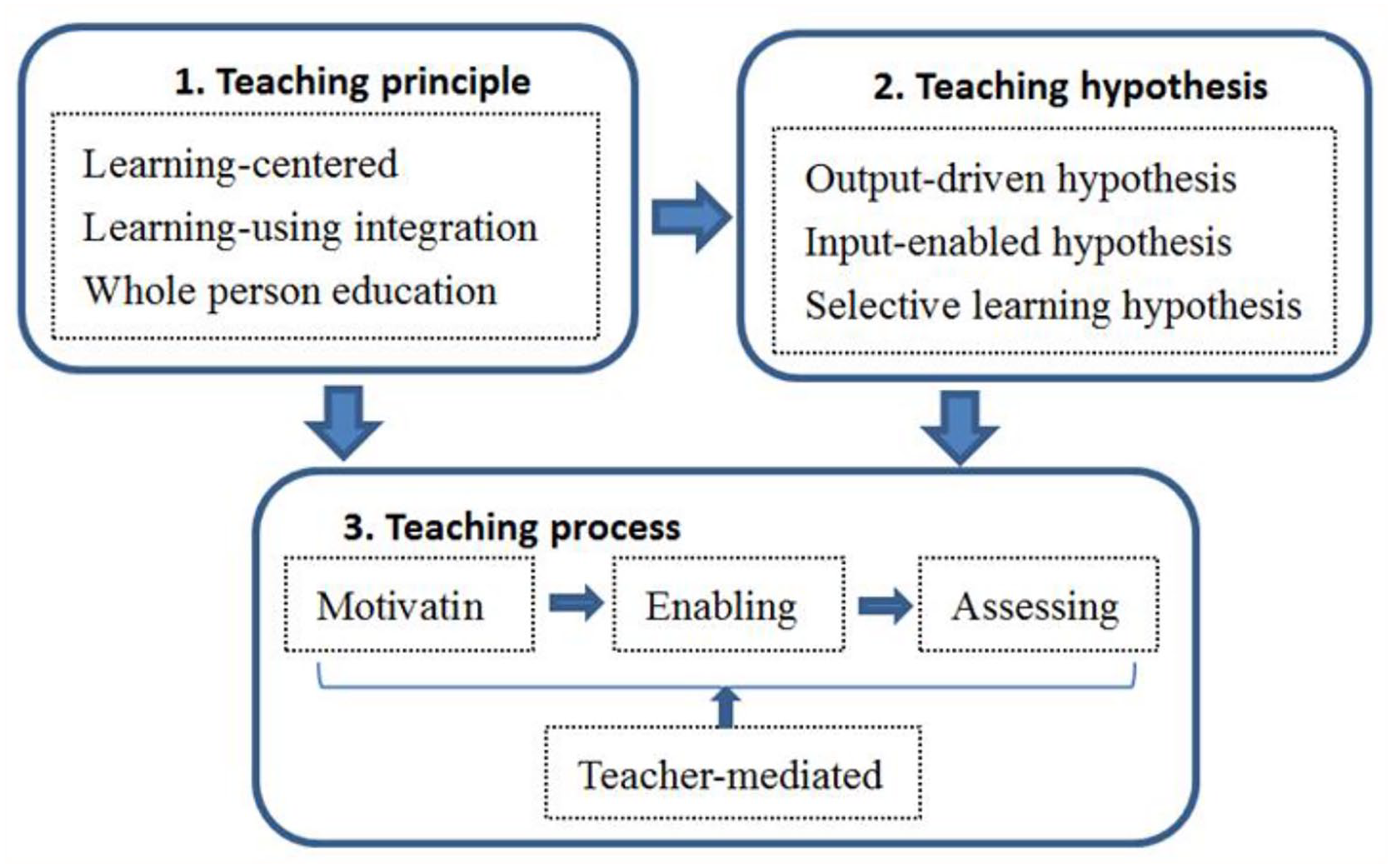
Production oriented approach framework, translated from Wen (2015).
Self-Regulated Learning and Self-Efficacy
According to “Community of Inquiry” framework (Garrison et al., 1999), both social and cognitive presences emphasize the active participation and engagement of learners. To measure them, self-regulated learning (SRL) and self-efficacy are two important indicators (Blooma et al., 2013). Self-efficacy is defined as “people’s judgments of their competences to organize and execute a course of action required to attain designated types of performances” (Bandura, 1986). In FL context, self-efficacy refers to learners’ judgments of their capabilities to complete the online and in-class learning tasks and achieve learning objectives. If a student feels low self-efficacy when fulfilling certain learning task, he or she is unlikely to pay efforts to accomplish this task (Lim et al., 2020). Self-regulated learning is a kind of integrated learning process, in which a set of planned behavioral, cognitive, and meta-cognitive activities are used to support achievement of personal learning goals (Pintrich, 2000). It involves several social cognitive aspects (Lai & Gu, 2011). In the pre-class learning phrase of FL, learners become fully responsible for their own learning. Therefore it calls for high degree of self-regulated learning (Robinson et al., 2020). It is also found that SRL is the key factor determining students’ academic performance in FL context because the pre-class learning influences to large extent the in-class section (Mason et al., 2013). Withthe above nature, self-efficacy and self-regulated learning are adopted as indicators to test the effects of the proposed POPCFL framework.
Research Design
Context
Business English, the course where the proposed framework is implemented, appears to be difficult for students as it calls for both a good command of English language and wide scope of business knowledge. The online resources for flipped learning are a set of pre-recorded videos, with embedded tests. The instructors of the course designed eight task lists (matching the eight chapters of this course) for pre-class learning, each with about 10 question-answering or discussion tasks matching the content of online courses. The task lists have undergone three rounds of adoption and revisions according to previous students’ feedback.
The POPCFL framework was implemented in the Business English course from September 2020 to February 2021. The participants of this course are 48 students of business English major, in their third year of university, with no previous experience of FL. All participants were between 18 and 22 years old, including 45 females and 3 males. The data were collected in strict accordance with the rules and guidelines applicable to ethical research practices involving human participants. Details of the course and participants are shown in Table 1.
Details of the Course and Participants.

Production-Oriented Peer Collaboration FL Framework
The 2-credit business English course runs for 16 weeks in the form of face-to-face classroom sessions. The class time is insufficient to address the learning objectives. In order to achieve effective learning, the instructors adopted a production-oriented peer collaboration FL framework. In the pre-class phrase, the students are required to watch the online course videos, work in pairs to finish the tasks in the pre-class task list and upload the finished lists, as well as the audios or videos of their discussion onto the QQ Homework (an interactive social platform online).
“Production” plays an important role in the POA mode (Wen, 2015). In this study, it appears in two forms, sub-productions and final production. The former refers to the tasks in the pre-class task lists relating closely to the content of online videos. They cover all the key points of a chapter and help the students better understand the knowledge. The latter is the comprehensive task at the end of each chapter. Taking chapter 1 “company profile” as an example, the final production is to draft a company profile. Sub-productions and final production function to urge students to absorb and practice knowledge. Therefore, it ensures quality preparation for in-class learning.
The implementation framework was designed based on the POA mode (Wen, 2015) and interaction types of Moore (1989) and the detailed procedure is shown in Figure 2. The process involves various types of interaction, the key section of which is the peer collaboration in completing pre-class tasks. Students fall in pairs to tackle the questions in the task list. As some students did not do their share of the work and engaged in social loafing and free riding in group works, especially in groups with three or more members (Arnold et al., 2012), this study chooses to organize the collaboration in pairs. Pair work enjoys advantages of significantly increasing the time for each person to speak, enhancing autonomy, and students’ sharing responsibilities, and thus reducing workload and anxiety in organization (Harmer, 2001).

Details of production-oriented peer collaboration FL framework.
Method
To address the four research questions, a mixed method was employed, in order to enable a rich and comprehensive understanding of the issues we plan to explore (Gass & Mackey, 2015). A pre-questionnaire and a post-questionnaire were administered to provide quantitative data, so as to compare participants’ SRL and self-efficacy before and after the implementation of the POPCFL framework. Qualitative data was collected by conducting a focus-group interview. Furthermore, audios/videos recording the process of peer collaboration were collected to triangulate the findings. The match-up of research questions and instruments used is shown in Table 2.
Issues to Be Explored and Instruments to Be Used in This Study.

Questionnaire
Two questionnaires (as shown in Appendix) were administered in the second week and the sixteenth week of the term. Major part of them is identical so that the difference before and after the implementation of the POPCFL framework can be observed. The pre-questionnaire includes demographic information of respondents and 30 statements for them to indicate a level of agreement or disagreement with a 5-point Likert scale (1 = strongly disagree, 2 = disagree, 3 = not sure, 4 = agree, and 5 = strongly agree). The 30 items inquire into the SRL, self-efficacy, and workload of learners. The self-efficacy part, adapted from Shen et al. (2013), includes two dimensions, online learning self-efficacy and social interaction self-efficacy. The SRL part is based on Barnard et al. (2009), modified slightly to better fit the context of our study. It includes five dimensions, namely goal setting, environment structuring, task strategies, help seeking, and self-assessment. The post-questionnaire adopted all the pre-questionnaire items and added 17 items, inquiring about the overall perception of the production-oriented peer collaboration framework (7 items), perception of the task lists (4 items) and of pair collaboration (6 items). Before the actual survey, a pilot study was conducted. Revisions were made accordingly and items with low reliability were deleted. The Cronbach’s α of the two questionnaires was .939 and .898 respectively, and that of each dimension was above .8, which indicates a high degree of internal consistency and reliability. Totally 44 effective pre-questionnaires, 44 post-questionnaires were collected. The data collected were analyzed by SPSS 25.0.
Focus Group Interview
Focus group interview is used to discover the details, personal feelings of the participants and the story behind the questionnaire responses (Al-Husban & Shorman, 2020). All the 48 participants of this study were classified into six groups according to their scores in the previous term, two groups with high scores, two with intermediate, and two with low scores. The classification aims to avoid responses being influenced by others, as students of obvious academic performance gaps may differ greatly with each other in their perceptions.
The interview centers around three questions:
FGQ1. What is your perception of the POPCFL mode (benefits, burden, difference from previous courses, etc.)?
FGQ2. How do you benefit from the POPCFL mode?
FGQ3.What are the disadvantages of the mode? What suggestions would you offer to improve it?
The interview was conducted by two researchers. Interview of each group took about 40 minutes. Minimum guidance was given in the interview, only with additional questions to deepen the topic or to clarify what the interviewees wanted to express. After the interview, one researcher performed the transcription and the other took the responsibility of checking it. Thematic analysis was used to analyze the transcripts, to identify the themes or issues (Creswell, 2007). The process of analysis falls into three stages: initial coding, focus coding, and axial coding (Wang et al., 2019). In the initial coding stage, the transcript was analyzed sentence by sentence to identify themes; the focus coding stage is to revise and abandon some of the original themes; the axial coding stage functions to find the connections between themes. The two researchers analyzed the transcript independently and then discussed different points until reaching a consensus on all issues.
Findings
The Effects of Production-Oriented Peer Collaboration FL Framework
In order to find out the effects of the POPCFL framework, especially on the pre-class section, the researchers compared the data of same items of pre-questionnaire and post-questionnaire, grouped into three dimensions, self-efficacy, SRL, and workload. Paired-samples t test shows that the mean values of online learning self-efficacy, social interaction self-efficacy, self-regulated learning in the post-questionnaire are all higher than those in the pre-questionnaire. The mean value of workload is lower. But remarkable difference is found only in the social interaction efficacy (t = –1.672, p < .05) and SRL (t = –6.572, p < .05; as shown in Table 3). The mean values of them in post-questionnaire are significantly higher than those in the pre-questionnaire. It shows that the 16-week implementation of production-oriented peer collaboration FL framework has improved the students’ social interaction self-efficacy and SRL, but it has no significant effect on online learning self-efficacy and workload.
Comparison of Self-Efficacy, SRL, and Workload Between Pre and Post Questionnaire.

p < .05. **p < .01. N = 44.
The items of SRL in the questionnaire fall into five sub-dimensions: goal setting, environment structuring, task strategy, help seeking, and self-evaluation. The paired-samples t test found that the mean values of the five sub-dimensions of the post-questionnaire were all higher than those of the pre-questionnaire, but significant differences were only found in the sub-dimensions of help-seeking and self-evaluation (as shown in Table 4, p < .05). It indicates that the implementation of the framework brings significant improvement in students’ help-seeking and self-evaluation. This finding is similar to that of previous study, which found that peer collaboration enhances SRL (Lim et al., 2020).
Comparison of five Dimensions of SRL Between Pre- and Post-Questionnaire.

p < .05. N = 44.
Students’ Perceptions of the Production-Oriented Peer Collaboration Framework
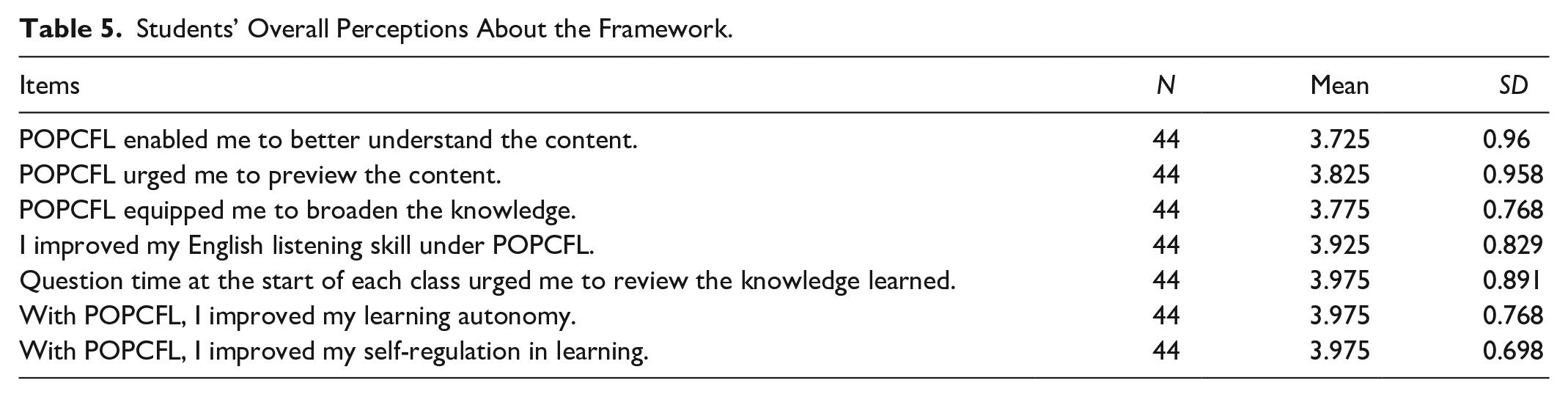
The seven additional items of post-questionnaire compared to the pre-questionnaire inquired students about their overall perceptions of the framework. The result of descriptive analysis (Table 5) shows that the items of urging pre-class preview, enhancing self-regulation, improving autonomy, urging review, and supervising preview get high mean values. Students hold positive attitude toward the effects of POPCFL framework, which ensures deep engagement in the pre-class learning (Pardo et al., 2019).
Students’ Overall Perceptions About the Framework.
There are four items about the pre-class task list in the post-questionnaire, as shown in Table 6. The items of “supervising the completion of learning tasks” and “functioning as online learning guidance” got very high mean value (4.075, 4.025). The mean value of item “the task list needs improvement” is 3.65. Possible reason may be that frequent and on-going usage of task list in pre-class online learning leads to students’ high expectations. It proves from another perspective the important role of task list, the “production” in collaborative learning. Regarding task difficulty, respondents held mixed attitudes.
Feedback On Pre-Class Task List.

The focus group interview also asked respondents about their overall perceptions of the framework. Thematic analysis identified five themes, namely helping online learning, preparing for in-class learning, enhancing SRL, effective assessment, and satisfaction. They fall into 15 sub-themes, including deeper comprehension, offering guidance, indicating emphasis, discovering questions, thinking in advance, knowing in-class focus, urging preview, habit cultivation, setting goals, time planning, environment setting, supervision, finding questions, considerable acquisition, and anticipation. The students believe that they benefited in many ways from the implementation of the new FL mode, and they are satisfied with the result. The details of the thematic analysis are shown in Table 7. Direct quotes are used to provide evidence of both the shared enthusiasm for the interaction process and real concerns of the respondents (Donnelly, 2010).
Theme Analysis on the Overall Perceptions.

Note. TL refers to task list.
Interaction Patterns in the Production-Oriented Peer Collaboration
There are six items about interaction in the post-questionnaire, among which “the cooperation experience is pleasant,” “collaborative task completion works better than independent completion,” “promoting communication,” “complementing each other’ idea,” and “learned a lot from peers” get high mean values, reflecting that the students benefited greatly from different kinds of interaction under this mode, both academically and emotionally, as shown in Table 8.
Students’ Perceptions of Interaction in the POPCFL Mode.

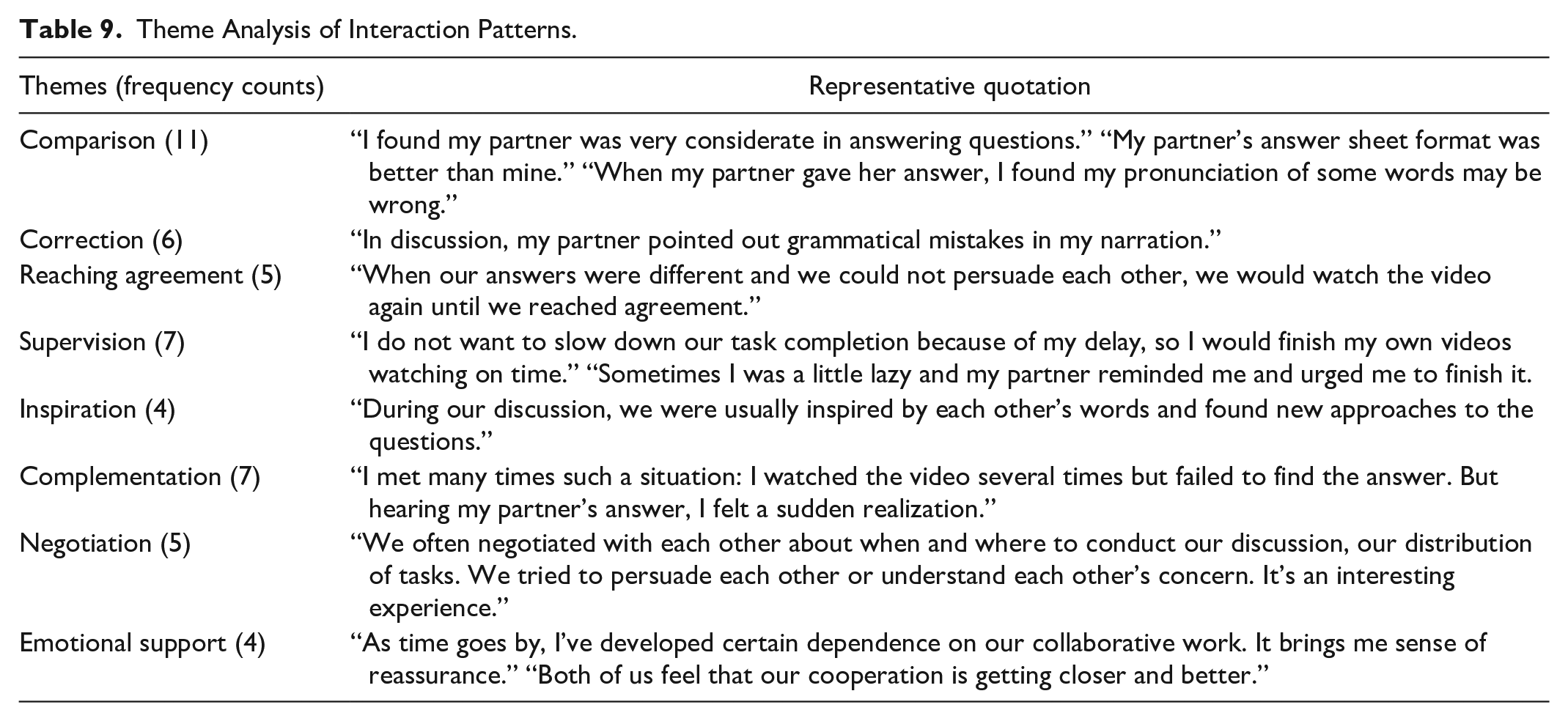
Thematic analysis of focus group interview about interaction identified eight themes, including comparison, correction, reaching agreement, supervision, inspiration, complementation, negotiation, and emotional support (as shown in Table 9). Comparison means that by observing the performance of peers, students see and try to imitate the strengths of others and reflect on their own weaknesses. It should be noted that comparison is the most frequently mentioned collaborative behavior, mentioned by eight respondents. The result is different from previous studies which held that the most frequent behavior was reinforcing feedback (Tseng & Tsai, 2007) and solve the questions arising from their self-study (Hsu, 2018). Correction refers to the mutual correction from students of their partner’s errors, incomplete answers, false pronunciation, and incorrect understanding. Reaching agreement refers to the discussion to eliminate differences and reach consensus. In this process, students may get deep comprehension of the content. Supervision refers to the fact that the two students in each pair supervise each other, reminding their partners of the learning task, urging partners to complete task on time, and speeding up their own progress because they do not want to delay the process. Inspiration means that students stimulate each other’s thoughts, find the correct answer and new problem-solving ideas. Complementation refers to the fact that the two students in the pair usually possess different strengths. They complement each other in accomplishing the task. Negotiation refers to students’ discussing issues, such as pair work schedule. In this process, empathy and cooperation capabilities are strengthened. In addition, collaboration provides emotional support for students and eliminates the sense of isolation of online learning (Richardson et al., 2017). Clips of videos or audios about the collaborative pair work echoed the above-mentioned interactive patterns.
Theme Analysis of Interaction Patterns.
Questions and Suggestions
In the focus group interview, some students in the high scores group pointed out that the tasks were simple, while the group with low scores thought the tasks too difficult. Students with different scores held ambivalent attitudes toward the task list. For this reason, task lists should be graded to meet the individualized needs of students of different levels. Additionally, the students hope to get more guidance on the peer collaboration strategy, or to get the strategy sharing of other groups. Furthermore, they held that the workload was heavy and they spent a lot of time on this course, which is an inherent problem of blended learning or FL. The POPCFL mode did not effectively solve this problem. Detailed thematic analysis of suggestions is shown in Table 10.
Theme Analysis of Questions and Suggestions.

Discussion
About the results and effects of POPCFL framework, data analysis of this study found that it significantly improved the social interaction self-efficacy (t = –1.672, p < .05), help-seeking (t = –2.165, p < .05), and self-evaluation (t = –2.269, p < .05) in SRL, therefore ensured high quality preparation in the pre-class section of flipped learning. The result of descriptive analysis shows that the items of urging pre-class preview, enhancing self-regulation, improving autonomy, urging review, and supervising preview get high mean values (Mean > 3.725). Students hold positive attitude toward the effects of POPCFL framework. In addressing the first and second research question, the analysis proves the effectiveness of the POPCFL framework proposed by this study. Previous studies have found that collaboration in the FL context can improve SRL (Youde, 2020). Peer learning creates more opportunities for interaction, which prompts students to use some SRL skills, such as self-reflection, shared responsibility, and trying to understand what their partner thinks. Compared with the general findings in previous studies, this study furthers a step and offers more detailed self-regulation sub-sections. High workload was proved to be the inherent problem of blended learning (Margolis et al., 2017; Xu et al., 2021). The implementation of the FL framework in this study has not brought significant improvement. Future research on FL design may focus on this problem.
Interaction is a key element for online and blended learning, so it is essential to understand students’ views on interaction (Blaine, 2019). This study found eight collaboration forms through thematic analysis, namely comparison, correction, reaching agreement, supervision, inspiration, complementation, negotiation, and emotional support. The findings about correction and comparison further confirm previous studies. For instance, Xu (2018) found that corrective feedback is an important interactive step, which can induce noticing. Group awareness in peer collaboration can stimulate students to observe and imitate roles demonstrated by partners (Lin et al., 2016). It may involve observing others’ learning plans and results. Social comparison makes students adopt more cognitive and self-regulation strategies. However, different from previous researches, this study found richer and more specific interactive forms. This study discovered four new forms of collaboration in the FL context, namely, reaching agreement, supervision, inspiration, and complementation. Furthermore, as to the major form of interaction, Hsu (2018) found that the main form of peer interaction was the didactic feedback of answering questions as well as messages sent for fun. Tseng and Tsai (2007) considered that the most frequent interaction behavior was enhanced feedback. But this study finds that comparison is the most beneficial and frequently mentioned collaborative behavior of respondents.
As to the improvement of the POPCFL framework and implications for teaching practice, some key issues need to be highlighted. “Production” proves be central in POA model. The research results show that the respondents hold a positive attitude toward the comprehensive tasks of each chapter, that is, the ultimate “product,” and toward the subdivision tasks of each chapter, that is, the tasks in the task list. They believe that these tasks have played an essential role in supervising preview and urging review. The tasks have become clear clues and effective guidance for them to learn online content. Knowing these tasks at the beginning of each chapter urges them to study online videos attentively and to carry out in-class practice and discussion, so as to get competent in completing the ultimate task. In the POA model, the output task plays an important role, acting as both the beginning and result of the approach (Wen, 2015). Therefore, in the process of designing production-oriented teaching models, the design of output tasks turns to be a key step. For this study, the interviewees put forward a variety of suggestions for the task list, especially the degree of difficulty of the tasks, which determine directly the effectiveness of the task (Deng, 2018). In this sense, the production task can be graded and classified as surface task or comprehensive task (Shih & Tsai, 2016).
Furthermore, themes identified in the focus group interview show that students with different scores held ambivalent attitudes toward the task list. Therefore, task lists should be graded to meet the individualized needs of students of different levels. Additionally, the students hope to get more guidance on the peer collaboration strategy, or to get the strategy sharing of other groups. It indicates that it is necessary to offer support in development of collaboration strategy. Lack of guidance in challenging learning units may result in students’ frustration (Strayer, 2012). Development of collaboration can be achieved by teachers’ intervention, when they find unfavorable interaction patterns (Xu, 2020). When students are at sea with interaction or interact in low efficiency, teachers’ guidance or peer experience sharing becomes necessary.
Limitation
It is acknowledged that there are some limitations in this study. Firstly, the relatively small sample size may influence the generalization of research findings. Secondly, because of time limit, this research did not conduct pre-test and post-test on respondents’ academic performance.
Conclusion
In flipped learning, the pre-class learning section is very important and determines whether meaningful and deep-level explorative learning can be realized in the class. But previous studies focus on in-class learning and research little on the pre-class section. The pre-class section is usually carried out online, with problems of learners’ distraction and sense of isolation. In order to address the research gap and explore an interactive mode which can ensure the effect of pre-class learning, this research designed a production-oriented peer collaboration framework and applied it to the 16-week Business English course.
Data analysis shows that the POPCFL framework ensured quality pre-class preparation by urging students to finish various tasks, cultivating self-regulation and tackling problem of sense of isolation in online learning through peer collaboration. It significantly improved the social interaction self-efficacy, help-seeking, and self-evaluation in SRL, but did not bring significant improvement of students’ workload. The respondents hold positive attitude toward the effects of the framework, recognize fully its supervision, and urging functions. Data analysis shows that the “production,” task list and final task of each chapter, played an essential role, acting as clear clues, and effective guidance for students to learn online content and to prepare for in-class activities.
As to interaction, different from previous researches, this study found richer and more specific interactive forms. It found eight collaboration forms through thematic analysis, namely comparison, correction, reaching agreement, supervision, inspiration, complementation, negotiation, and emotional support. Among them, reaching agreement, supervision, inspiration, complementation are new forms of collaboration identified by this study. Comparison is the most beneficial and frequently mentioned collaborative behavior of respondents. Furthermore, according to the feedback from the respondents, it is necessary to cultivate collaboration strategy, which can be achieved by teachers’ intervention, guidance, or peer experience sharing.
Overall, this study proposed a production-oriented peer collaboration framework which insured effective pre-class learning and offered insight into the features of peer collaboration in FL context. Teaching practitioners may adopt the framework in their own lesson plan or teaching design after modification and adaptation to their specific subject matter. On the other hand, although the POPCFL framework ensures high quality preparation in the pre-class section, the problem of high workload was not settled. The researchers hope the findings of this study will pave way for further research on effective peer collaboration for broader disciplines, larger number of participants, and with reduced students’ workload.
Footnotes
Appendix
Pre-Questionnaire and Post-Questionnaire for POPCFL*.

| Items | Sub-dimensions | Dimensions |
|---|---|---|
| I am confident that I can complete the online course with a good grade. | Online learning self-efficacy | Self-efficacy |
| I can understand the complex concepts and content in the online course. | ||
| I am willing to face challenges in my online learning. | ||
| I am confident in completing all the online learning tasks. | ||
| I can keep up with the course schedule. | ||
| I am confident in drawing up plans to finish the learning tasks of this course. | ||
| I am willing to adjust my learning strategy to meet learning requirements of this course. | ||
| I am confident in initiating social interaction with classmates. | Social interaction self-efficacy | |
| I am confident in socially interacting with other students with respect. | ||
| I developed friendship with my classmates. | ||
| I apply different social interaction skills depending on situations. | ||
| I set standards for my assignments in online courses. | Goal setting | Self-regulated learning (SRL) |
| I can finish all the online learning tasks. | ||
| I set short-term (daily or weekly) goals as well as long-term goals. | ||
| I don’t compromise the quality of my work because it is online. | ||
| I usually choose location with little distraction when learning the online courses. | Environment structuring | |
| I usually choose a comfortable place when learning the online courses. | ||
| I know where I can learn the online course most efficiently. | ||
| I usually choose location with little distraction when learning the online courses. | ||
| I try to take more thorough notes when learning the online courses. | Task strategies | |
| I try to overcome the distraction when watching online courses. | ||
| I seek help from classmates when meeting difficulties in learning online courses. | Help seeking | |
| I seek help from instructors when meeting difficulties in learning online courses. | ||
| I discuss with my learning partner and explore a solution together when meeting difficulties in learning online courses. | ||
| I communicate with my classmates to find out the difference between my online learning and theirs. | Self-evaluation | |
| I can achieve the learning objectives of every course. | ||
| I know clearly the overall learning objectives and those of every chapter. | ||
| I spent much time in learning Business English after class. | Workload | Workload |
| It is really challenging for me to complete the online learning tasks. | ||
| It is really difficult for me to complete the tasks in the Pre-class learning task list. | ||
| POPCFL enabled me to better understand the content. | Students’ overall perceptions about the POPCFL framework | Students’ perceptions of POPCFL framework |
| POPCFL urged me to preview the content. | ||
| POPCFL equipped me to broaden the knowledge. | ||
| I improved my English listening skill under POPCFL. | ||
| Question time at the start of each class urged me to review the knowledge learned. | ||
| With POPCFL, I improved my learning autonomy. | ||
| With POPCFL, I improved my self-regulation in learning. | ||
| I enjoy the collaboration experience with my partner. | Students’ perception of interaction | |
| I learned a lot from my partner. | ||
| My partner and I complement each other and complete the learning task together. | ||
| Pair work enhanced my communication with my classmates. | ||
| The experience of cooperating with my partner is pleasant. | ||
| The result of our collaborative task completion is better than that of my independent work. | ||
| The task list urged me to complete the pre-class learning tasks. | Feedback on pre-class task list | |
| The task list needs to be improved. | ||
| The task list has become the guiding thread for learning online videos. | ||
| The tasks in the task list are difficult for me. |
The pre-questionnaire includes items 1 to 30. The post-questionnaire includes items 1 to 47.
Declaration of Conflicting Interests
The author(s) declared no potential conflicts of interest with respect to the research, authorship, and/or publication of this article.
Funding
The author(s) received no financial support for the research, authorship, and/or publication of this article.
