




Abstract
This study compared college students’ multitasking in online courses with their multitasking in face-to-face courses and explored the significance of potential predictors of multitasking in each setting. Students taking both online and face-to-face courses completed surveys assessing multitasking in each setting, self-efficacy for self-regulated learning (SE:SRL), Internet addiction, multitasking tendency, age, and sex. Multitasking was significantly greater in online than face-to-face courses. Internet addiction was positively associated with multitasking in online and face-to-face courses. Multitasking tendency was positively and age was negatively associated with multitasking during online courses only; SE:SRL was negatively associated with multitasking during face-to-face courses only. In conclusion, multitasking was greatest during online courses. Furthermore, there were different sets of predictors for students’ multitasking in online courses compared with face-to-face courses. This implies that multitasking in online and face-to-face courses are different phenomena and therefore may require different pedagogical methods to successfully minimize multitasking behaviors.
Introduction
In Higher Education, opportunities for online learning are increasing and diversifying. Initially, online degrees, certificates, and courses catered to the educational needs of older, nontraditional, fully-employed students (BestColleges.com, 2018). However, as opportunities for online learning continue to expand, younger, more traditional, unemployed (or employed part-time), undergraduate students are enrolling with greater frequency. A Fall 2014 survey found that across the United States, 5.8 million college students took all or some of their courses online. Furthermore, public institutions were reported to be the largest providers of online learning and the majority of their online learners (73%) were undergraduate students (Allen, Seaman, Poulin, & Straut, 2016). In keeping with this trend, the present study was conducted at a large, public university in the Midwestern United States. This traditional “brick and mortar” school (i.e., a school with a physical campus built of permanent material like bricks and concrete) with an enrollment of 29,000 now offers between 600 and 700 online courses annually serving over 16,000 students. Many of these students are undergraduates living on campus. Prior survey research has revealed that undergraduate students, similar to the ones we examine herein, identify flexible scheduling, flexible pacing with which they can review course materials (e.g., lectures, assigned readings), clearly structured course design, and ease of access as benefits of online courses (BestColleges.com, 2018; Paechter & Maier, 2010).
Students’ Multitasking in Educational Settings
While there are certainly benefits to online learning, potential costs should also be considered. Of concern here is that undergraduate college students’ multitasking behavior (i.e., simultaneously engaging in two or more activities) may increase in online courses relative to face-to-face courses. Research has demonstrated that when using the Internet, college students commonly engage in multiple online activities simultaneously (Moreno et al., 2012). In other words, when online, college students tend to multitask. This may be true in online educational settings as well. Research by Manwaring, Larsen, Graham, Henrie, and Halverson (2017) found that in blended university courses (i.e., courses which blend face-to-face and online learning), multitasking increased during the online portion of the course. If multitasking is more prevalent in online courses relative to face-to-face courses, theory and empirical research suggest a resulting cost to primary task performance. This is because our cognitive capacity for completing any task is finite. Thus, if multiple tasks are attempted simultaneously, then our finite cognitive capacity is divided between all tasks. This results in less cognitive capacity devoted to each task and a decrease in task performance (Carrier, Rosen, Cheever, & Lim, 2015; Pashler, 1994).
This idea is closely paralleled by the cognitive load theory and the cognitive theory of multimedia learning, both of which explain how multitasking can interfere with student learning (see Wood & Zivcakova, 2015, for a thorough review). These theories similarly propose that multitasking increases the load placed on a finite cognitive system. When this occurs in a classroom (e.g., when a student is texting a friend during a class lecture), less of the student’s finite cognitive capacity is available for processing the class lecture and learning suffers. There is abundant empirical support for this theoretical concept. For example, many studies have identified a negative relationship between various multitasking behaviors and academic performance as measured by Grade Point Average (e.g., Bellur, Nowak, & Hull, 2015; Burak, 2012; Junco, 2012; Junco & Cotten, 2012; Karpinski, Kirschner, Ozer, Mellott, & Ochwo, 2013; Kirschner & Karpinski, 2010). Furthermore, experimental studies demonstrate that multitasking during educational activities (e.g., listening to class lecture, note taking, completing homework, reading, studying) negatively affects performance across a variety of outcome measures including comprehension, recall, and retention (e.g., Bowman, Levine, Waite, & Gendron, 2010; Cutino & Nees, 2017; Dindar & Akbulut, 2016; Ellis, Daniels, & Jauregui, 2010; Fox, Rosen, & Crawford, 2009; Fried, 2008; Gingerich & Lineweaver, 2014; Hembrooke & Gay, 2003; Kuznekoff & Titsworth, 2013; Lawson & Henderson, 2015; Ravizza, Hambrick, & Fenn, 2014; Sana, Weston, & Cepeda, 2013; Wei, Wang, & Fass, 2014; Wood et al., 2012; Zhang, 2015). Finally, two recent review articles confirm that the negative relationship between multitasking and academic performance is largely consistent from study to study regardless of student sample, academic setting, or research methods (Chen & Yan, 2016; van der Schuur, Baumgartner, Sumter, & Valkenburg, 2015). Therefore, educational settings and methods in which multitasking is more likely to occur should be identified as they may pose unique problems for student learning. Given the current trend of increased online learning opportunities throughout Higher Education, the present study compared undergraduate college students’ multitasking behaviors in 100% online courses with their multitasking behaviors in traditional face-to-face courses. Given college students’ proclivity for online multitasking (Moreno et al., 2012), it is hypothesized that multitasking will be greater in online courses compared with face-to-face courses (Hypothesis 1 [H1]).
Potential Predictors of Students’ Multitasking in Educational Settings
In addition, this study explored the significance of several potential predictors of students’ multitasking behavior in online and face-to-face courses. The first potential predictor was multitasking tendency, or the degree of preference for conducting more than one activity simultaneously (Kaufman-Scarborough & Lindquist, 1999). Although today’s students are generally frequent multitaskers (e.g., Burak, 2012; Calderwood, Ackerman, & Conklin, 2014; Flanigan & Babchuk, 2015; Gehlen-Baum, & Weinberger, 2014; Junco & Cotten, 2012; Kraushaar & Novak, 2010; Moreno et al., 2012; Rosen, Carrier, & Cheever, 2013), multitasking tendency varies from student to student (Lindquist & Kaufman-Scarborough, 2007). This is an important variable to consider as research demonstrates that multitasking tendency predicts frequency of multitasking in free-choice online, offline, and mixed-media contexts (Srivastavan, Nakazawa, & Chen, 2016). This suggests that as perceived freedom is diminished then multitasking tendency may lose significance. Therefore, it is hypothesized that multitasking tendency will predict multitasking in online courses, where students may perceive greater freedom to engage in multitasking. Conversely, it will not predict multitasking in face-to-face courses where physically present instructors and peers may limit perceived freedom to multitask (Hypothesis 2 [H2]).
The second potential predictor that was assessed was Internet addiction. Due to the widespread use of Internet-connected smartphones and similar devices, Carrier et al. (2015) suggest that Internet addiction is likely to be associated with daily multitasking. According to the Pew Research Center (2017), 92% of U.S. adults ages 18 to 29 own an Internet-connected smartphone. For this demographic, which includes the undergraduate college students of interest here, the Internet is now accessible almost anyplace and anywhere. This is certainly true of university classrooms were instructors increasingly compete with smartphones for students’ attention (Tindell & Bohlander, 2012). Clearly, it is also true of online classes which, by definition, require Internet access. Therefore, it is hypothesized that Internet addiction predicts multitasking in both online and face-to-face courses (Hypothesis 3 [H3]).
The third potential predictor explored was self-efficacy for self-regulated learning (SE:SRL). Self-efficacy describes an individual’s belief in their capabilities to organize and execute the behaviors necessary for success (Bandura, 1982). As this construct is domain specific, research has identified self-efficacy beliefs pertinent to academic performance (Pajares, 1996). Of interest here is SE:SRL (Zimmerman, Bandura, & Martinez-Pons, 1992). SE:SRL describes an individual’s belief in their capabilities to proactively regulate their behavior necessary for academic success. This includes belief in one’s ability to concentrate attention and resist distractions in learning situations. Self-regulated learning behaviors may be particularly important in online educational settings where easy access to the Internet presents nearly unlimited opportunities for distraction (Broadbent, 2017; Paechter & Maier, 2010). Likewise, research suggests that developing students’ SE:SRL is important for reducing Internet-related multitasking in face-to-face courses (Zhang, 2015). In the context of this study, it is hypothesized that SE:SRL will be inversely related with multitasking behaviors in both online and face-to-face courses (Hypothesis 4 [H4]).
Finally, age and sex were explored as potential predictors. Research suggests that younger adults are more likely to multitask than older adults (Brasel & Gips, 2011; Carrier, Cheever, Rosen, Benitez, & Chang, 2009). This relationship is true of electronic and nonelectronic multitasking (Zwarun & Hall, 2014). Therefore, it is hypothesized that age will be inversely related with multitasking behaviors in both online and face-to-face courses (Hypothesis 5 [H5]). Research considering sex differences in multitasking among college students has been inconclusive (Duff, Yoon, Wang, & Anghelcev, 2014; Jeong & Fishbein, 2007; Ophir, Nass, & Wagner, 2009). However, males and females do appear to have different behaviors when using the Internet, smartphones, and other new media (Levine, Waite, & Bowman, 2007). Therefore, sex was included in this study. It was hypothesized that there would be no difference between males and females in multitasking behavior in either online or face-to-face courses (Hypothesis 6 [H6]).
In summary, today’s students are frequent multitaskers, particularly when online (Moreno et al., 2012). Keeping students on task and away from off-task activities during class and while studying is a challenge for the modern college educator (Tindell & Bohlander, 2012). Keeping students on task is important as abundant research demonstrates that academic performance suffers as a result of multitasking during academic activities. Given the current trend of increased online learning opportunities throughout Higher Education, the purpose of the present study was twofold: to compare undergraduate college students’ multitasking behaviors in 100% online courses with their multitasking behaviors in traditional face-to-face courses; and to explore the significance of several potential predictors of students’ multitasking behavior in online and face-to-face courses.
Method
Participants and Procedures
For this study, the population of interest was undergraduate college students. Therefore, a convenience sample was formed of undergraduate students enrolled at a large, public university in the Midwestern United States. Participants were recruited during class time from several high-enrollment courses which attract students from a diversity of majors (i.e., Introduction to Sociology, Human Nutrition, Applied Statistics, and Introduction to Gerontology). As such, the principal investigators (PIs) visited each classroom, explained the study methods, read the informed consent document, and invited all students present to participate. After this, a brief paper survey was distributed and completed during class by all students who consented to participate. Using this method, 452 undergraduate students participated in the study. The first item on the survey asked, “Have you ever taken a 100% online college course?” Only the students who answered “yes” were asked to complete the survey. Thus, the final sample was comprised of 296 undergraduate students (n = 193 females), all of whom had taken at least one online college course. The mean number of online courses completed was 2.6 per student (SD = 1.8). The vast majority of students (88%) lived either on campus or within 20 min of campus. The mean age of the sample was 20.6 (SD = 2.8). Finally, students owned an average of 2.8 (SD = 1.1) Internet-enabled devices.
Measures
The paper survey used in this study was completed during class time and was therefore designed to be completed in 10 min or less. First, the survey contained basic demographic items. Second, multitasking tendency was assessed with the Polychronic–Monochronic Tendency Scale (PMTS), which was initially validated using a sample of U.S. adults aged 18 and older (Lindquist & Kaufman-Scarborough, 2007). The scale consists of five items on a 5-point Likert-type scale ranging from 1 (strongly disagree) to 5 (strongly agree). Sample items include, “I prefer to do two or more activities at the same time” and “I typically do two or more activities at the same time.” In the present study, the scale demonstrated high internal consistency (Cronbach’s α = .81). Third, the survey assessed problematic Internet use with the internet addiction test (IAT), which was initially validated using an international sample of adults aged 18 and older (Widyanto & McMurran, 2004; Young, 1996). This scale consists of 20 items on a 5-point Likert-type scale ranging from 1 (never) to 5 (always). Sample items include, “How often do you find that you stay online longer than you intend?” and “How often do your grades or school work suffer because of the amount of time you spend online?” In the present study, the scale demonstrated high internal consistency (Cronbach’s α = .86). Fourth, the survey assessed SE:SRL using an 11-item scale which was initially validated using a sample of U.S. high school students (Zimmerman et al., 1992). Since its development, the scale has been reliably used with a variety of populations including U.S. college students (Pajares, 1996). The scale measures students’ belief in their ability to use a variety of self-regulated learning strategies. For example, items asked students how well they can “study when there are other interesting things to do” and “concentrate on school subjects.” Students responded with a 7-point Likert-type scale ranging from 1 (not too well) to 7 (very well). In this sample, the scale demonstrated high internal consistency (Cronbach’s α = .86).
Finally, the survey assessed students’ multitasking behaviors in 100% online courses and traditional, face-to-face courses. Two scales were developed for this purpose as follows. A small focus group of undergraduate students (N = 17), separate from the study sample, listed common multitasking behaviors not related to school that they had either engaged in or seen others engaged in during class time. Students were asked to consider both face-to-face classes and 100% online classes. After discussion and consensus, the final list included nine behaviors (i.e., sending text messages, email, visiting online social networking sites [e.g., Instagram, Twitter], surfing the Internet for purposes unrelated to class, watching videos, playing video games, listening to music, talking with friends, scribbling absentmindedly). These nine items were used as the basis for two scales. Scale 1 assessed multitasking behavior in 100% online courses. Scale 2 assessed multitasking behavior in face-to-face courses. The instructions for Scale 1 read: “The items below ask about your behavior during a typical
Data Analysis
The Statistical Package for the Social Sciences software (SPSS Version 21) was used for all data analyses. To compare undergraduate college students’ multitasking behaviors in 100% online courses with their multitasking behaviors in traditional face-to-face courses (i.e., Research Purpose 1), their responses to each item in Scale 1 (i.e., multitasking behaviors in online courses) were compared with their responses to the corresponding items from Scale 2 (i.e., multitasking behaviors in face-to-face courses). Each item was an ordinal variable scored on a 5-point Likert-type scale (i.e., nonparametric data). Thus, the Wilcoxon signed-rank test for related samples was used. Following this analysis, the two scales created from these individual items were compared. The first scale assessed multitasking behavior in 100% online courses and the second assessed multitasking behavior in face-to-face courses. Scale means were compared with dependent sample t tests. To test the significance of potential predictors of multitasking behavior in both online and face-to-face courses (i.e., Research Purpose 2), two separate exploratory regression analyses were conducted. The first regression used the nine-item scale assessing students’ multitasking behavior in online classes as the dependent variable and the second used the nine-item scale assessing students’ multitasking behavior in face-to-face classes as the dependent variable. The predictor variables were the same for each regression model and included multitasking tendency (Lindquist & Kaufman-Scarborough, 2007), internet addiction (Widyanto & McMurran, 2004; Young, 1996), SE:SRL (Zimmerman et al., 1992), age, and sex. Mean values, median values, interquartile range, and standard deviations for the continuous variables used in the regression analysis are presented in Table 1. Study results are presented below.
Descriptive Statistics.

Note. IQR = interquartile range.
Assessed on a 7-point Likert-type scale (1 = not very well, 7 = very well).
Assessed on a 5-point Likert-type scale (1 = strongly disagree, 5 = strongly agree).
Assessed on a 5-point Likert-type scale (1 = never, 5 = always).
Results
Students reported significantly greater multitasking behavior in online versus face-to-face courses (Table 2). Specifically, students were more likely to send text messages, email, visit online social networking sites, watch videos, use the Internet for purposes not related to class, play video games, listen to music, and talk with friends in online courses than in face-to-face courses (|Z| ≥ 1.95, p ≤ .05). Only doodling (i.e., scribbling absentmindedly) was a more common multitasking behavior in face-to-face courses than in online courses (|Z| = 5.54, p ≤ .001). After comparing individual items, the total online and face-to-face multitasking scales were compared (Table 2). Again, results demonstrated that students reported greater multitasking behavior in online versus face-to-face courses (t = 16.541, df = 289, p ≤ .001).
Comparison of Multitasking Behaviors in 100% Online Versus Face-to-Face Courses.

Note. Frequency of behavior assessed with 5-point Likert-type scale (1 = never, 5 = always); individual items compared with Wilcoxon signed-rank test for related samples; scales created by summing individual items and dividing by number of items (nine). Scale means compared using dependent sample t tests. IQR = interquartile range.
Following this comparison, potential predictors of multitasking behavior were investigated in each setting (i.e., online versus face-to-face). For the prediction of multitasking in online courses, the regression model was significant (F = 13.554, df = 5, p < .001) and explained 19.7% of the variance (R2 = .197). Sex (β = .036, p = .518) and SE:SRL (β = −.074, p = .203) were not significant. Age (β = −.161, p = .004) was a significant negative predictor, indicating that younger students were more likely to multitask during online courses than older students. Internet addiction (β = .312, p < .001) and multitasking tendency (β = .156, p = .005) were significant positive predictors, indicating that as Internet addiction and multitasking tendency increased so did the likelihood of multitasking in online courses. These results are presented in Table 3.
Regression Table for Students’ Multitasking in Online Courses.

B = the unstandardized coefficient.
SE B = the standard error of the unstandardized coefficient.
β = the standardized coefficient.
For the prediction of multitasking in traditional face-to-face courses, the regression model was also significant (F = 7.020, df = 5, p < .001) and explained 11.3% of the variance (R2 = .113). Sex (β = −.032, p = .586), age (β = −.068, p = .247), and multitasking tendency (β = .071, p = .226) were not significant. SE:SRL was a significant negative predictor (β = −.131, p = .032) indicating that students with greater SE:SRL were less likely to multitask in face-to-face courses. Finally, Internet addiction (β = .248, p < .001) was a significant positive predictor, indicating that as Internet addiction increased so did the likelihood of multitasking in face-to-face courses. These results are presented in Table 4.
Regression Table for Students’ Multitasking in Face-To-Face Courses.
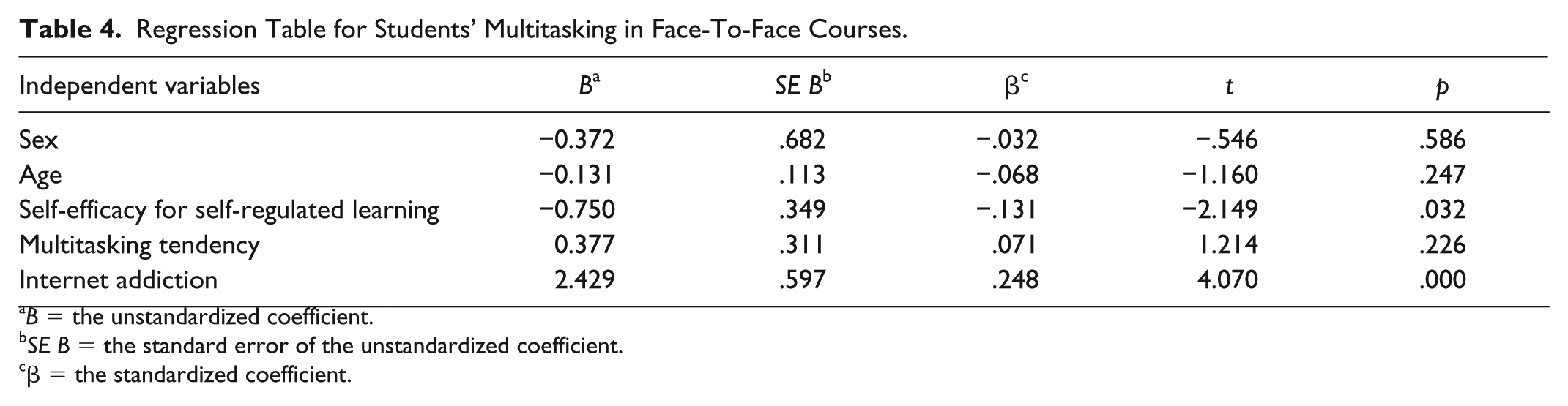
B = the unstandardized coefficient.
SE B = the standard error of the unstandardized coefficient.
β = the standardized coefficient.
Discussion
Today’s undergraduate college students are frequent multitaskers, particularly while online (Moreno et al., 2012). There is ample research to support the theory that multitasking during educational activities negatively affects learning and academic performance (e.g., Chen & Yan, 2016; van der Schuur et al., 2015). Therefore, conditions which favor multitasking during educational activities should be identified and understood in an effort to improve student learning. With this in mind, the present study compared undergraduate college students’ self-reported multitasking behavior in 100% online courses with their multitasking behavior in face-to-face courses. All students surveyed were enrolled in a traditional “brick and mortar,” 4-year, public university in the Midwestern United States. and the vast majority (88%) lived on or near campus. In this sample, and in support of our first hypothesis (H1), the present study found that students reported significantly more multitasking in 100% online courses than in face-to-face courses. However, the potential predictors of multitasking may differ across online and face-to-face courses. Indeed, results from this study’s regression analyses suggest that an explanation of college students’ multitasking in online courses may not be exactly the same as an explanation of college students’ multitasking face-to-face courses. Therefore, future research which further develops this study’s regression model exploring multitasking behavior in these two different educational settings is warranted.
Accordingly, and in support of our second hypothesis (H2), the present study found that multitasking tendency predicted multitasking in online courses, but it did not predict multitasking in face-to-face courses. In other words, students who have positive attitudes about multitasking and prefer to multitask appear to better control this academically disadvantageous behavior in face-to-face courses. To the contrary, they do not appear to control this behavior as well in online courses. Previous research by Srivastavan et al. (2016) found that multitasking tendency predicts multitasking in free-choice online and offline situations. However, in situations where free-choice is constrained due to the enforcement of rules and social norms against multitasking, then multitasking tendency may no longer be a significant predictor of multitasking behavior. This may explain the differences revealed in the present study. Namely, in face-to-face courses there are physically present peers and an instructor who may enforce rules and social norms against multitasking, thereby reducing freedom of choice and making multitasking less likely to occur.
In support of our third hypothesis (H3), the present study found that Internet addiction was a significant and positive predictor of multitasking in both online and face-to-face courses. Internet addiction suggests a lack of control leading to excessive Internet use (Block, 2008). Therefore, even with physically present instructors and peers enforcing rules and social norms against multitasking, it is possible that students with high scores for this trait cannot sufficiently control their behavior. Even in face-to-face courses, they may seek out opportunities for Internet-related multitasking with laptops, smartphones, and similar devices. In this sample, the average student owned 2.8 Internet-enabled devices. It is likely that these devices (e.g., laptops and smartphones) were present during face-to-face and online courses.
In partial support of our fourth hypothesis (H4), the present study found that SE:SRL was inversely related to multitasking in face-to-face courses. In other words, students high in this trait multitasked less in face-to-face courses than students low in this trait. This supports our original hypothesis as well as the work of Zhang (2015). However, in contrast to our hypothesis, SE:SRL was not related to multitasking in online courses. In other words, students high in this trait were just as likely to multitask in online courses as students low in this trait. Thus, it may be that the common strategies which students have developed to self-regulate learning are more effective in traditional educational settings (i.e., face-to-face courses) than in nontraditional educational settings (i.e., online courses). However, Paechter and Maier (2010) found that students may prefer online courses to face-to-face courses when acquiring skills in self-regulated learning is the desired outcome. Taken together, these findings suggest a need to identify and teach self-regulatory strategies specific to online educational settings. This is an area of future research.
Finally, and in partial support of our fifth hypothesis (H5), the present study found that age was inversely related to multitasking in online courses. In other words, younger students were more likely to multitask in online courses than older students. This supports our original hypothesis. In addition, it adds nuance to several recent studies which utilized samples of a much broader age range (i.e., adults 18 to 65) and indicated a negative relationship between age and media multitasking (e.g., Brasel & Gips, 2011; Carrier et al., 2009; Zwarun & Hall, 2014). However, in contrast to our hypothesis, this was not true in face-to-face courses. In other words, younger students were just as likely to multitask in face-to-face courses as older students. Given this result, face-to-face courses may be better suited for younger (e.g., freshman) college students than online courses. Finally, in support of our sixth hypothesis (H6), sex (i.e., male or female) was not a significant predictor of multitasking in either situation. In summary, these two regression analyses demonstrate that there are different sets of predictors for college students’ multitasking in online versus face-to-face courses. This is an important finding as it suggests that multitasking in online and face-to-face courses are different phenomena and therefore may require different methods to successfully minimize multitasking behaviors.
Taken together, the results of this study have immediate implications for postsecondary, undergraduate education. Opportunities for online learning are increasing rapidly and this has tremendous potential to expand access to postsecondary education, particularly among working adults and other populations who have historically faced barriers to higher education. For these individuals, online learning has many benefits. Therefore, in considering the most relevant implications, we will focus on undergraduate students with sufficient access to traditional face-to-face courses—that is, students already enrolled at traditional “brick and mortar” universities and living on or near campus. For such students, the costs of online learning (e.g., increased multitasking compared to face-to-face courses) should be weighed against the benefits (e.g., flexible scheduling and pacing, and ease of access). Nevertheless, online education is here to stay. Therefore, those teaching online courses should place emphasis on discouraging students’ multitasking behavior while recognizing that the methods for doing so may be very different than in face-to-face courses. Furthermore, the developers of online courses should explore technological and pedagogical solutions aimed at keeping online learners focused on their primary task in the absence of a physically present instructor. Such tools should be science based and their development is work for future research.
Finally, this study is not without limitations. First, a convenience sample from a single, public university was used. Although the population of interest was undergraduate college students at 4-year institutions, a random sample taking into account different types of undergraduate institutions (i.e., public, private, for-profit) would be informative. Second, although the present study benefited from a within-subjects comparison, all measures were self-report. Future studies might consider objective measures of multitasking. Third, the self-report multitasking tendency scale (Lindquist & Kaufman-Scarborough, 2007) and the Internet addiction scale (Widyanto & McMurran, 2004; Young, 1996) were previously validated with samples of adults aged 18 years and older which included many nonstudents. In the present study, these scales were used to assess only students. As far as we know, these scales have yet to undergo comprehensive validity testing for this population. Fourth, readers should be cautioned not to extend the study results beyond this article’s stated purpose (i.e., to compare college students’ multitasking in online courses with their multitasking in face-to-face courses; and to explore the significance of potential predictors of multitasking in each setting). Thus, our use of regression analysis was to test relationships between several variables of interest; it was not intended to thoroughly explain the variance within the two multitasking variables. Indeed, the two regressions’ relatively small R-squared values (≤ 0.197) are an indicator that much of the variance in multitasking behavior is left unexplained by this research.
Nevertheless, the findings of this study are novel and timely. As universities devote greater resources to the development, promotion, and provision of online education, to the point where even students living on campus are enrolling in online courses, this research suggests a need to carefully weigh the pros and cons of online learning. This study identified significantly greater multitasking behavior during online versus face-to-face courses. This is of concern as abundant research has linked increased multitasking with decreased learning and academic performance.
Footnotes
Declaration of Conflicting Interests
The author(s) declared no potential conflicts of interest with respect to the research, authorship, and/or publication of this article.
Funding
The author(s) received no financial support for the research, authorship, and/or publication of this article.