




Abstract
Collaboration proves to be an effective way to facilitate students’ engagement and solve the mostly-mentioned problems of blended learning (BL). For collaborative BL, self-regulated learning (SRL), self-efficacy and engagement are frequently referred to in BL studies and represent key elements of effective BL. Furthermore, the interaction of these elements correlates closely with the performance of students. There have been few research attempts to draw synergies and explore the relationship among these key elements. To address this gap, data were collected through a questionnaire and records on LMS from 125 students in a Chinese university. Descriptive analytics show that students fully recognize the positive effects of collaborative BL. Correlation analysis and regression analysis find that self-regulated learning (SRL) is significantly correlated with all factors except workload. It is also a significant predictor of behavioral engagement. Therefore, SRL proves to be central among the essential BL elements. Emotional engagement is significantly correlated to and interact with multiple key BL factors. Specifically, emotional engagement is a significant predictor of behavioral engagement. The findings offer insight into the interactions of key elements of BL and provide practical implications for improving BL learning design.
Keywords
Introduction
Technological advancement and innovation turn to be a catalyst for dramatic change in education, which also gives rise to new approaches to learning (Al-Husban & Shorman, 2020). With this trend, blended learning gains momentum and turns very popular in higher education. Discussion on blended learning (BL) has switched from listing its benefits (Alammary et al., 2014; Mirriahi et al., 2015) to solving various problems in practice, from teachers’ teaching design to learning design and students’ learning behaviors (Al-Husban & Shorman, 2020), which are important components of learning analytics. Collaboration proves to be an effective way to facilitate students’ engagement and solve the mostly-mentioned problems of BL, including isolation in online learning (George et al., 2021; Trespalacios & Lowenthal, 2019), inadequate preparation before face-to-face learning (Kim et al., 2014) and heavy workload (Senn, 2008). Collaboration is crucial to fruitful learning in blended context (Anderson & Garrison, 1998).
In collaborative BL context, motivation, emotion, cognition and meta-cognitive strategies correlates closely with the performance of students (Ramirez-Arellano et al., 2019). Students’ SRL skills and the ability to collaborate with peers in learning have become essential abilities of the post-fourth industrial revolution era, and these abilities may affect students’ academic performance (Lim et al., 2020). Self-efficacy influences online experience, learning status and student satisfaction (Cho & Kim, 2013). Learner engagement has been shown to be related to important educational results, including academic performance, persistence, satisfaction and community (Conrad, 2010). Workload is one of the mostly-mentioned problems of BL (Senn, 2008), leading to unpleasant learning experience. All of these have become focus of discussion in this field. Various studies explored the influence of these key factors on learning achievements (Lim et al., 2020; Lin et al., 2016; Yun et al., 2020). Whereas these advances are recognized in those fields separately, there have been few research attempts to draw synergies from these fields and explore the relationship among these key elements. Even fewer takes emotional experience and emotional engagement of students into interaction with other key elements in BL context (Gao et al., 2021).
In order to address the gap, this study takes SRL, self-efficacy and engagement as major variables, workload (the focus of complaint of BL) as additional variable, and explore their relations and interactions. We constructed a collaborative and blended learning design. After implementing it for a semester, we explore students’ perceptions of the collaborative BL and the relationship among SRL, self-efficacy, engagement and workload through descriptive, correlation and stepwise regression analysis. This study offers an insight as to how the key elements of BL interact with each other. Such data and findings may offer practical implications for learning design for BL.
To be specific, this study aims to address the following three research questions:
RQ1: What are students’ perceptions of collaborative BL?
RQ2: What are the relationships among SRL, self-efficacy and engagement?
RQ3: What are the implications of such relationships for the design and improvement of collaborative BL?
Theoretical Background
Learning Analytics
With the increasing application of technology in education and the generation of various types of learning data, the use of learning analytics to understand and optimize the learning process and its environment has received increasing attention worldwide (Pontual Falcão et al., 2020). Learning analytics refers to the measurement, collection, analysis and reporting of learner data and their environment, with the purpose of understanding and optimizing the environment in which learning occurs (Conole et al., 2011). Based on data from learning analytics, we can reshape support for learning process (Axelsen et al., 2020).
The typical feature of learning analytics is to promote the capability of learning participants to participate actively, rather than making decisions automatically (Clow, 2012; Siemens & Baker, 2012). With this nature, learning analytics is increasingly used in higher education to understand and support student learning (Viberg et al., 2018). In the early time, data of students on the LMS system were analyzed and linked with academic performance, but it was discovered that factors such as self-efficacy and motivation can better predict whether students will achieve satisfactory academic performance (Axelsen et al., 2020). Therefore, recent learning analytics focuses on the improvement of learners’ learning effectiveness and learner support, for example, the cultivation of SRL learning.
SRL and Self-Efficacy
Students’ SRL skills and the ability to collaborate with peers in learning have become essential abilities of the post-fourth industrial revolution era, and these abilities may affect students’ academic performance (Lim et al., 2020). SRL is an integrated learning process, in which students, guided by a set of motivational beliefs, use planned behavioral, cognitive, and meta-cognitive activities to support the achievement of personal goals (Schunk & Zimmerman, 2012). It includes components of goal setting, environment management, task strategy, help seeking and task evaluation (Barnard et al., 2009). SRL is a key factor in achieving a successful learning experience in online learning. Students with SRL behaviors usually have a more positive view of BL (Lim et al., 2020). Due to lack of SRL skills, many students cannot complete pre-class learning tasks, fail to learn and understand what should be learned online, and ultimately fail to prepare for the learning activities in class (Hao, 2016).
Self-efficacy is defined as “people’s judgments of their capabilities to organize and execute a course of action required to attain designated types of performances” (Bandura, 1986). It influences online experience, learning status and student satisfaction (Cho & Kim, 2013). Under the BL context, Shen et al. (2013) believes that self-efficacy covers online learning self-efficacy and social interaction self-efficacy. Previous studies have shown that, self-efficacy, as a student’s intrinsic motivation, will affect online experience, learning status, learning interest and student satisfaction (Artino & Stephens, 2009). It was also found that self-efficacy is a predictor of better academic performance (Shen et al., 2013).
Learner Engagement
Learner engagement is a general concept that focuses on the degree and quality of students’ participation in academically meaningful activities (Coates, 2006). According to Fredricks et al. (2004), in online and blended learning context, engagement falls into three dimensions, namely behavioral engagement, cognitive engagement and emotional engagement. Among them, behavioral engagement refers to a variety of activities, such as paying attention to learning, asking questions and participating in discussions in online learning. Cognitive engagement involves students’ efforts in acquiring knowledge or skills in cognitive aspects during online learning. Emotional engagement is defined as learners’ positive emotions toward teachers, peer learners and online learning (Jung & Lee, 2018). Previous research results have shown that students are highly diversified in their learning strategies, from students who are not engaged at all to those who continuously interact with resources (Pardo et al., 2019). Learner engagement has been shown to be related to important educational results, including academic performance, persistence, satisfaction, and community (Conrad, 2010). A successful BL should improve learner engagement, whether in or out of class (O’Flaherty & Phillips, 2015). Learner engagement is essential in online and blended learning, but low participation has become a serious problem (Gao et al., 2021). It is necessary to explore the factors that affect or predict learner engagement, so as to optimize the learning design and ensure effective online and blended learning.
Collaboration in BL Context
Vygotsky’s theory of social development believes that one cannot achieve acquisition in isolation (Vygotsky, 1978). It is also found that motivation, positive attitudes toward learning and instructor guidance were enhanced with increased level of interaction (Garrison & Kanuka, 2004). Interaction and collaboration bring deeper meaningful learning, better learning results, and attract increasing attention. It makes students believe in their capabilities and be responsible for their own learning. In group work, learners observe other’s learning plan and reflect on and improve their own learning behavior (Chen et al., 2017).
In BL context, previous studies on group activities have shown that peer collaboration is beneficial and successful (Ellis et al., 2021). It is proved that peer collaboration connects online and offline learning activities (Anthony et al., 2019), enhances learners’ motivation and engagement (Sallam et al., 2022). Through peer collaboration, learners know what others are doing and engage more in meaningful communication. So and Brush (2008) constructed a collaborative learning framework guided by Community of Inquiry model, which led to increased overall satisfaction and higher sense of social presence. In a word, collaboration has become one of the essential elements to ensure the effectiveness and quality of BL.
Correlations Among Key Factors of BL
SRL, self-efficacy, collaboration and engagement are popular issues of discussion in BL context. Many researchers and practitioners probe into their interaction patterns and seek implications for learning design. Zimmerman (1989) finds that learning is mostly effective when students learn with their peers and demonstrate high degree of self-efficacy. Lim et al. (2020) proves that peer collaboration acts as an important factor to enhance academic performance and influences remarkably SRL behavior in online learning. J. F. Xu and Zhang (2019) finds that change in emotional state in the process of peer learning will lead to alteration in interaction pattern. Sallam et al. (2022) hold that social learning should be encouraged as it may reinforce student motivation and engagement. Study of Manwaring et al. (2017) on relation between self-efficacy and engagement concludes that low engagement caused by technical issues does not influence negatively learner engagement.
These studies explored the relationships of important BL elements in pairs, and there lacks comprehensive analysis which draws synergies of their relationships in a BL context. In this study, a collaborative BL learning model was designed and implemented for a semester. At the end of the semester, a study of the relationship among the above-mentioned factors was carried out, so as to explore their interaction patterns, and then to put forward relevant learning design suggestions for collaborative BL.
Research Design
Aiming at addressing the three research questions, a survey was conducted and data from learning management system were collected.
Context
Blended learning in this research took place in a Business English course offered by a university in Shandong Province, China. We created a BL model based on the Community of Inquiry model. For the learning of each chapter, the first section is for students to watch online videos and work in pairs to complete tasks that match the knowledge and skills involved in online learning (mostly essay questions). After completion of the relevant tasks, students were asked to upload the completed paper onto the Learning Management System (LMS). The second section is face-to-face learning, during which students participate in various practice activities under the guidance of teachers, usually in groups. The third is the after-class section, where the students complete comprehensive learning tasks in pairs, so as to consolidate and deepen the knowledge and skills learned, and develop cross-cultural communication skills. In this online and offline learning model, collaboration plays a leading role mainly in two periods: one is when students watch the videos before class, and the other occurs when students complete tasks after class. The specific learning arrangements are shown in Table 1.
Characteristics of the Collaborative BL.

The participants in this study are 125 students, of which 31 are of business English majors, and 94 of international economics and trade majors. All participants were between 18 and 22 years old, including 35 males and 90 females. One hundred eleven out of all 125 participants have previous blended learning experiences. The learning management system (LMS) records detailed information on learning behavior of each student, including time and frequency of watching online videos, short videos recording their peer interaction, performance in online tests, their task completion and feedback from teachers. In the 16th week of the term, a questionnaire was conducted to explore students’ perception and relationships among key factors of the collaborative BL.
Instruments
A mixed research method was adopted to address the research questions. Questionnaire usually acts as a main method for investigating students’ SRL, self-efficacy and engagement. In the past decade, various relevant questionnaires have been developed, revised and adopted, but the self-reporting data were argued to be too subjective. On the other hand, the widespread use of learning management systems in higher education institutions generates a large amount of tracking data that can be used for learning analytics. These detailed data provide objective and detailed information about the learning process of students, and may promote the understanding and optimization of the learning and learning environment in which learning occurs (Siemens & Gasevic, 2012). However, relying solely on tracking data may only reveal part of the information, missing the underlying patterns of learning behavior and the interrelationship of BL elements (Pardo et al., 2016). In order to solve the limitations of these two methods, this research combines questionnaire and LMS platform data, which complement each other and offer a more comprehensive understanding of students’ learning experiences in blended learning environments.
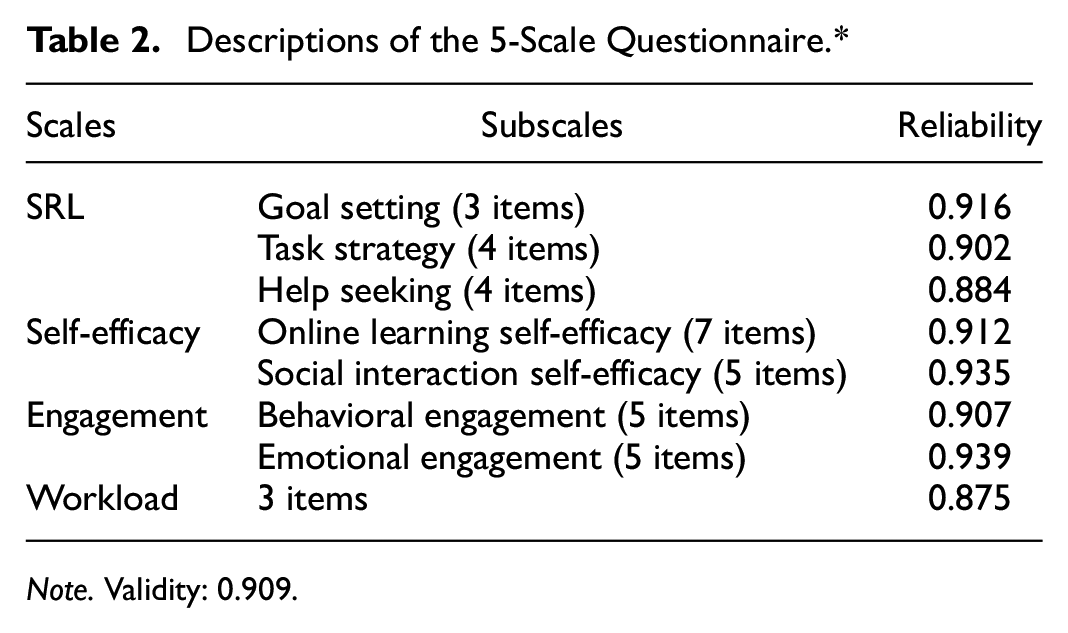
Besides demographic information, the questionnaire includes 1 open-ended question and 36 items of 5-point Likert scale (1 = strongly disagree, 2 = disagree, 3 = not sure, 4 = agree and 5 = strongly agree). For the open-ended question, participants were asked to express their perceptions of the collaborative BL experience in one sentence. Likert scale questions explore the main elements of BL, including 4 dimensions, namely SRL, self-efficacy, engagement and workload. SRL items were adapted from Barnard et al. (2009), including three sub-scales: goal setting (3 items), task strategies (4 items) and help-seeking (4 items). Self-efficacy items were adapted from Shen et al. (2013), covering two sub-scales, namely online learning self-efficacy (7 items) and social interaction self-efficacy (5 items). The engagement section was adapted from Skinner et al. (2008), including behavioral engagement (5 items) and emotional engagement (5 items). Workload section was developed by the instructors of this study. It went through pilot test and revision. Reliability and validity tests proved that this section was highly reliable and credible. Validity of the questionnaire is 0.917, and the reliability of each dimension exceeds 0.875. The details of the questionnaire are shown in Table 2.
Descriptions of the 5-Scale Questionnaire.*
Note. Validity: 0.909.
Data Collection and Analysis
The questionnaire was conducted in the 16th week of the collaborative BL implementation. Consent from all participants was obtained, and totally 125 valid questionnaires were retrieved.
The LMS used in this course is Treenity (Zhihuishu.com), one of the most used online course management platforms for higher education in China. This research uses Treenity to record and identify students’ BL learning behaviors, and obtain specific data about students’ self-regulation, task completion, and behavioral engagement.
SPSS 22.0 was used to analyze the collected data. In order to explore the first research question, a descriptive analysis of the various dimensions of the questionnaire and a word cloud analysis (by inputting all the data into Wordart.com) of the themes of the open-ended question were carried out to obtain students’ perceptions of the collaborative BL. To explore the second question, we first conducted correlation analysis on SRL, self-efficacy and workload After that, a stepwise regression analysis was conducted on the above factors to explore their interaction. Stepwise regression was adopted to avoid multicollinearity, as the variables may correlate with each other. Finally, we put forward learning design suggestions for collaborative BL based on the results of the above data analysis.
Findings
Students’ Perceptions of Collaborative BL and Learning Behavior
Descriptive analysis of the questionnaire data showed that the items of various scales including task strategy, goal setting, help-seeking, online learning self-efficacy, social interaction self-efficacy, behavioral engagement and emotional engagement all got high mean values (all exceed 4). In particular, items of the sub-scale of social interaction self-efficacy got a high mean value of 4.229. It shows that under the collaborative BL scenario created by this study, students show high degree of SRL, self-efficacy, engagement, and collaboration. The mean value of workload is 3.232, which is at a medium level. High workload has always been one of the main complaints of students against BL (Senn, 2008). This result shows that the collaborative BL in this study retained the workload within an acceptable degree. Specific analysis is shown in Table 3.
Descriptive Analysis of the Questionnaire.

An open-ended question in the questionnaire enquires into students’ perceptions of the collaborative BL. All the answers were collected and input into “Worddart” for word frequency analysis, the result of which is shown in Figure 1. Combining word frequency and students’ detailed statements, the following preliminary conclusions can be drawn. “Online” and “courses” are the most frequently mentioned words of students. They expressed from various perspectives their views on online learning and face-to-face learning. They fully recognize the positive influence of the collaborative BL, and made suggestions, such as adding subtitles to the videos. Another word with a very high frequency is “hard work.” In this sense, a considerable number of students thank the teachers for their guidance and the tremendous efforts they have made for the course design. On the other hand, some of them think that they have worked very hard in this course. “Learned a lot” and “acquired a lot” are also frequently mentioned words, which shows that students fully appreciate the positive role of collaborative BL. “Cooperate” was also referred to with high frequency. The participants said that they cooperate smoothly and pleasantly with their partners. Frequently referred-to words like “time,” “busy” also indicate the workload for teachers and students brought by BL.

Frequency of words in students’ perception of the collaborative BL.
Data from the Treenity platform shows that 98.6% of students can complete various tasks (questions on the task list) of each chapter on time. The time when student watch online videos and complete the task list vary on their personal habit. Some chose to complete that just after the last class, and some finished in the middle of the two classes. They rarely completed the tasks just before the next class, as they do not want to delay the progress of their peers in their pair discussion. This proves the supervising role of peer learning. According to data on Treenity, each student watches the video clips 3.21 times on average, which shows that students have devoted sufficient time in online learning, watching videos repeatedly before and after class. A phenomenon worth noting is that despite the high homework completion rate, the LMS platform shows that 15 students’ video viewing progress is less than 100%, between 70% and 90%. This seems unreasonable, because video viewing is the prerequisite for completing the task list, and it is impossible to complete the task list without watching the video. The only explanation is that some students work hard in teams, while others may contribute little or avoid teamwork (Van Den Bossche et al., 2006). The finding is similar to that of Arnold et al. (2012), who named it as social loafing and free riding. In the design of peer collaborative learning, some measures should be adopted to cope with social loafing and free riding, so as to give full play to the positive role of BL.
Relationships Among Key Factors in BL Context
In order to explore the relationships among the key factors in collaborative BL context, the Spearman correlation analysis was conducted. It showed that SRL, behavioral engagement, and emotional engagement have high correlation among one another (p < .01). There is no remarkable correlation between SRL and self-efficacy, between workload and all the positive factors listed in this study. The details of analysis are shown in Table 4.
Spearman Correlation (Detail).

p < .01.
In order to obtain a deeper understanding of the interactions among the above-mentioned factors, we conducted stepwise regression analysis. Before performing the analysis, we are not clear whether there really exists interaction and how strong the interaction is. As such, the analyses were essentially exploratory. As behavioral engagement and emotional engagement are key indicators of successful BL, we assumed respectively behavioral engagement and emotional engagement as dependent variables, and other factors correlated to them as independent variables, and conducted stepwise regression analysis. The method was adopted because the above Spearman correlation analysis shows that there exist correlations among some of the variables. Stepwise regression can be used to screen and remove variables that cause multicollinearity (Jaccard & Turrisi, 2003).
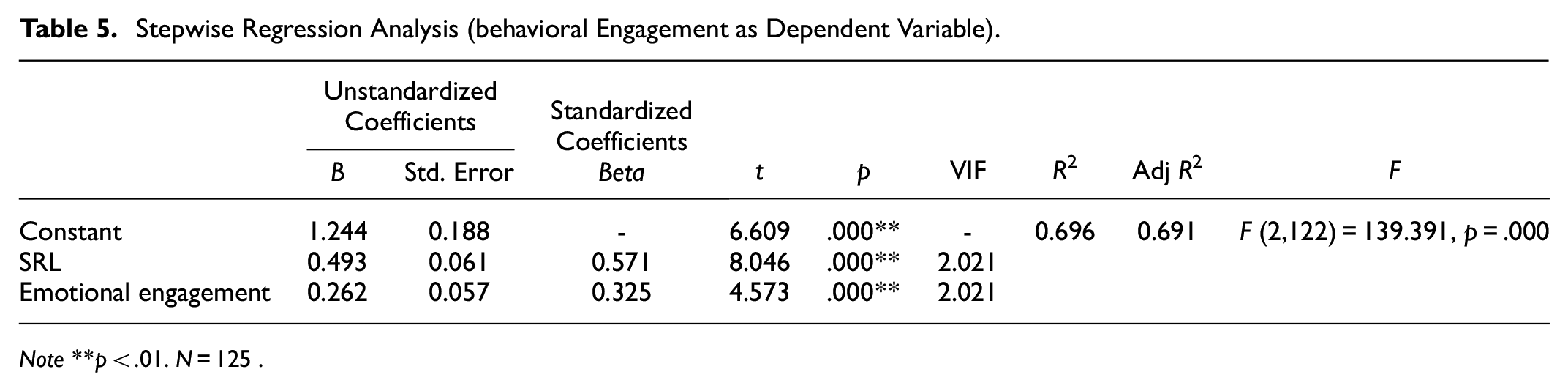
Taking behavioral engagement as dependent variable, and taking SRL, self-efficacy, workload, emotional engagement as independent variables, stepwise regression was performed. After automatic recognition by the model, the remaining two items are SRL and emotional engagement. The model passed the F test (F = 139.391, p = .000 < .05), indicating high degree of validity. In addition, the multicollinearity test of the model shows that the VIF values in the model are all less than 5, which means that there is no collinearity problem. The regression coefficient values of SRL and emotional engagement respectively are 0.493 (t = 8.046, p = .000 < .01) and 0.262 (t = 4.573, p = .000 < .01), which means that SRL and emotional engagement have significant positive impact on behavioral engagement. The independent variables can explain 69.6% change of behavioral engagement (as shown in Table 5).
Stepwise Regression Analysis (behavioral Engagement as Dependent Variable).
Note **p < .01. N = 125 .
When taking emotional engagement as dependent variable, stepwise regression analysis shows the regression coefficient value of SRL is 0.373 (t = 3.544, p = .001 < .01), which means that SRL has a significant positive impact on emotional engagement. The regression coefficient value of behavioral engagement is 0.559 (t = 4.573, p = .000 < .01), which means that behavioral engagement will have a significant positive impact on Emotional engagement. The independent variables can explain 57.8% change of behavioral engagement (as shown in Table 6).
Stepwise Regression Analysis (emotional Engagements as Dependent Variable).

Note.* p<0.05 **p < .01. N = 125.
Discussion and Implications
Optimizing Learning Design and Encouraging True in-depth Collaboration
Through descriptive analysis and word frequency analysis on open-ended questions, it finds that students fully recognize the utility of collaborative BL. Under this learning mode, their SRL, self-efficacy and engagement are all at a high level, and their learning burden remains at moderate level. The recognition of collaboration in BL context coincides with previous research findings. Research of L. J. Xu et al. (2021) shows that peer collaboration improves engagement and extracurricular interaction, which in turn improve students’ academic performance. Lim et al. (2020) argued that the capability of students to learn collaboratively with their peers has a positive and significant impact on academic performance and on SRL. Karabulut-Ilgu et al. (2018) found that group collaboration can reduce cognitive load. Our research further confirms that peer collaboration acts as an essential part in BL design, which deserves prime attention and should be encouraged. On the other hand, it is worth noting that interaction does not necessarily mean the improvement of learning effects. As Bernard et al. (2009) pointed out, the quality of interaction may be more important than quantity. Interaction is not necessarily collaborative. But once they collaborate, it has a positive impact on task completion (Storch, 2001). Under BL context, teachers should figure out the nature of pair or group interaction, that is, whether they are truly collaborative. Teachers should adopt a variety of activity designs, provide opportunities and encourage in-depth collaboration. In addition, modes of collaboration vary according to different situations. Therefore, teachers should encourage learners to participate in collaboration actively. However, when they find a collaborative model which is not conducive to the development of learners, teachers should promptly intervene in and offer guidance (Xu et al., 2019). As discovered in this research, free riding occurs in collaborative activities. Some students contribute little or avoid teamwork. Therefore, teachers need to accurately evaluate interaction or group activities in a BL context, and implement well-designed evaluation methods to avoid false collaboration.
Cultivating SRL Skills
Correlation analysis found that SRL is significantly correlated with all factors except workload. Stepwise regression analysis showed that SRL has significant positive impact on behavioral engagement and emotional engagement. Therefore, SRL proves to be central among the essential BL elements. Increased level of SRL can bring about an overall improvement of collaborative BL, which coincides with the finding of Lai and Hwang (2016). The research result of Narciss et al. (2007) shows that SRL is positively correlated with academic performance in online learning. Students with a high level of SRL will actively engage in learning and try their best to maintain learning motivation and achieve their learning goals. SRL mediates various elements in the collaborative BL context, and they work together on the learning effect. Hence it proves to be very important for the success of BL. However, in BL practice, especially in the online learning session, a considerable number of learners cannot complete pre-class learning tasks due to lack of SRL (Lai & Hwang, 2016), which brings a series of negative impacts. Many learners have weak SRL skills, which makes it increasingly necessary for teachers to fully understand and intervene in the BL environment and cultivate students’ SRL capabilities (Lodge et al., 2018). SRL can be taught and can be learned through training (Lin et al., 2016). In BL implementation, teachers should conduct SRL training for students at the beginning of the course, or even during the preparation stage. Furthermore, in the learning design, teachers should develop mechanisms that are conducive to the promotion of SRL, and provide support in this sense to students as facilitators.
Reducing Workload and Providing Emotional Support for Students
The research findings indicate that emotional engagement is significantly correlated to and interact with multiple key BL factors, and this interaction ultimately determines the quality and effect of BL. Specifically, emotional engagement has significant positive impact on behavioral engagement, that is, the stronger the student’s emotional engagement in learning, the more engaged they are in learning behavior. The finding coincides with that of Weiss (2000), who believes that emotion stimulates students’ attention and in turn boosts learning behavior (memory, problem solving, etc.). Emotion represents not only learning experience, but also the result of student-student interaction, teacher-student interaction. Aa a consequence, under the guidance of learning analytics, emotion-related elements deserve full attention in learning design. Instructors should stimulate positive emotions in students’ learning experience with various attempts. In this respect, the role of teachers cannot be ignored. In the word frequency analysis listed above, the word “teacher” is frequently mentioned. In the BL situation, teachers should act as the curriculum designer and content expert in the pre-class session, the facilitator and monitor in the in-class session, and the researcher in the after-class session. The research of Ma et al. (2015) verifies that teacher preparation and support play an important role in student engagement, especially emotional engagement. Teachers may provide students with emotional support by placing a high value on their constant efforts in completing online learning tasks. They may offer continuous positive feedback on every progress the students have made and encourage more peer scaffolding. As workload represents an inherent problem of blended learning, teachers should reduce the burden of students by encouraging in-depth collaboration and streamlining extracurricular learning, thereby reducing students’ negative feelings about learning.
Limitations
This research explores the interaction among SRL, self-efficacy and engagement in the BL context, enriching the practical perspective of BL optimization. But the limitations of this study should be acknowledged. First, teachers with different backgrounds and different teaching styles may affect participants’ views on collaborative BL. Hence future research should take teacher factors into consideration to better capture their interrelationships. Second, this study uses behavioral engagement and emotional engagement as dependent variables, but failed to include academic performance, an important outcome indicator, into the investigation of interrelationships. The reason is that the questionnaire was answered anonymously. It is impossible to match each person’s score with the answer to the questionnaire. Third, the size of research samples needs to be expanded to better generalize the research results.
Conclusion
In order to make clear the effects of collaborative BL and explore the relationships among hot issues, this study constructed a collaborative BL design and explored students’ perceptions, the relationship among SRL, self-efficacy and engagement through descriptive, correlation and stepwise regression analysis. Descriptive analytics and keyword frequency statistics show that students fully recognize the positive effects of collaborative BL. As to the interactions among key factors, correlation analysis and stepwise regression analysis find that SRL is significantly correlated with all factors except workload. SRL is a significant predictor of behavioral engagement. Therefore, SRL proves to be central among the essential BL elements. Emotional engagement is correlated to and interact with the key BL factors, and this interaction ultimately determines the quality and effect of BL. Specifically, emotional engagement is a significant predictor of behavioral engagement, that is, the stronger the student’s emotional engagement in learning, the more engaged they are in learning behavior. The findings offer insight into the interactions of key elements for BL. Such results of learning analytics also provide practical implications for improving BL learning design. Suggestions were raised including optimizing learning design and encouraging true in-depth collaboration, cultivating SRL skills, reducing workload and providing emotional support for students.
The more we learn about blended learning, the more it appears that such learning contexts are more diverse than imagined. Future study may take teacher factor and academic achievement into consideration, and carry out larger-scale learning experiment, so as to enrich the interrelation research.
Footnotes
Declaration of Conflicting Interests
The author(s) declared no potential conflicts of interest with respect to the research, authorship, and/or publication of this article.
Funding
The author(s) received no financial support for the research, authorship, and/or publication of this article.
