




Abstract
In today’s dynamic academic environment, successful intra-organizational change is not only important but necessary to confront evolving educational needs and technological advancements. The institutions with systemic strategies that also create a supportive environment allow staff to fight through transitions as they persist for the long term and spur innovation. Using social exchange theory, this study investigates how the resources (supervisor support and change information) provided by the institution will influence the academic staff to adopt a positive behavioral attitude toward change. The study employed a survey methodology to gather data from teaching faculty (n = 403) in Telangana, which Smart-PLS version 4.0 then analyzed. Results indicate that supervisor support (SS) influenced employees’ behavioral attitudes toward change and that change information (CI) had no direct effects. However, the effect of change information is fully mediated by affective and cognitive attitudes and partially mediated by supervisor support and behavior. Furthermore, Importance-Performance Map Analysis (IPMA) analysis reveals that change information, the most effective construct for positive behavioral attitudes, receives the least importance in this study context. Likewise, cognitive attitude is the most significant and comparatively effective construct. Therefore, the results of the investigation strongly indicate that supervisory assistance and information regarding change are crucial for fostering positive behavioral attitudes among employees during the transition. Management should also focus their efforts on training, support, and transparent communication to more easily identify potential avenues for exploration. Engaging organizational psychologists is crucial for managing staff emotions and promoting intra-organizational change in a more positive mindset.
Plain language summary
This article explores the impact of change process components, such as change information (CI) and supervisor support (SS), on the behavioral attitudes of academic staff. It achieves this by sequentially linking affective and cognitive attitudes. This research aims to gain insight into how change process factors affect behavior via affective and cognitive attitudes, and it is the first to use the multidimensional construct “attitude toward change” in an academic context. Furthermore, this study focuses on the mediation effects of affective and cognitive attitudes toward intra-organizational change, which helps comprehend the link between change process components and positive behavioral attitudes.
Keywords
Introduction
Every facet of contemporary workplaces is influenced by organizational transformation, which affects cultural dynamics as well as work processes within the organization. Successfully navigating change, however, necessitates not just launching a new initiative but also winning over employees and encouraging them to adapt positively in the way they behave. In order to accomplish this, it is necessary to learn what makes people feel about change. Nevertheless, the measure’s efficacy is dependent on both the change’s characteristics and its execution. Keeping a positive relationship with employees requires anticipating their reactions to change, since this can have both positive and negative impacts on employee commitment (Aujla & Mclarney, 2020). Although efforts to change are prevalent and worthwhile in today’s firms, these transformations do not always provide the desired outcomes. Many contend that employees are the driving force behind the change endeavor and the determinant of the success or failure of any change.
In the education sector, organizational changes have become increasingly significant as institutions face challenges like technological advancements, policy reforms, shifting student demographics, and demands for greater accountability (Betsurmath & Murthy, 2023). Often times, new curriculum, instructional strategies, and digital tools are required to enhance learning. Such changes fit student and society needs, simplify administrative procedures, and enhance education. Reforming education can disturb current academic cultures and practices, therefore creating uncertainty among staff, professors, and students (Honkimäki et al., 2022). Poor administration of change can lead to resistance from employees, job dissatisfaction, and disengagement; thereby, it defeats the very purpose of the institution. We can consider employee problems and involvement to enhance institutional credibility, foster inventiveness, and prepare graduates for the new workforce. Recognizing and addressing appropriately employees’ perceptions of change is the key for effective training program implementation (Wang et al., 2023).
Prior research has focused on the role of people and the failure of organizational change. Despite the many challenges, additional research on the importance of intra-organizational change for the success and longevity of businesses is required. Researching the reactions of different types of companies to organizational change reveals certain patterns (Khaw et al., 2023). CI and SS are two important aspects that have been studied extensively recently. The employees that have difficulty adjusting to novel situations may benefit from one-on-one support and direction from an empathetic supervisor (Oreg et al., 2011). Whether employees assist or hinder organizational development depends on a number of factors, one of which is the organizational setting. All parties concerned, particularly institutions and faculty, confront certain obstacles in adapting to the new environment as a result of the sudden and unanticipated change in the academic sector, such as online learning (Marinoni et al., 2020).
Personal biases and the CI they receive also influence employees (Schulz-Knappe et al., 2019). Information concerning the imminent changes and their possible ramifications for the institution is necessary. Insufficient information can obscure the nature of forthcoming changes, the manner in which they will affect employees and organizations, and the appropriate course of action for individuals (Wanberg & Banas, 2000). Similarly, change-related information diminishes anxiety and uncertainty. Additionally, it elevates the value of work and reduces identity risk (van Zoonen et al., 2022).
Likewise, a study by Neves (2011) found that when employees believe their supervisors are on their side, they are more likely to embrace change. Chen and Wu (2020) assert that supervisors demonstrate exemplary support by striving to improve the morale, comprehension, proficiency, and character of their subordinates. Typically, leaders in educational institutions serve to encourage and inspire followers to take specific actions (Davies et al., 2001). Oreg et al. (2011) define leaders who can motivate individuals to modify their behavior as change agents and opinion leaders. The process of implementing change specifically provides this form of support, fostering an inclusive environment. All pertinent parties must be involved in the transformation, and there must be leadership and support from within the institution (Marinoni et al., 2020). Moreover, when management supports workers through transitions, business effectiveness improves (Jurisch et al., 2016). For this reason, organizations should pay ample attention to the relationship between SS and employee performance (Heyns et al., 2022).
The contemporary business landscape is characterized by persistent disruptions and unprecedented challenges, underscoring the critical importance of organizational transformation. A significant impediment to successful intra-organizational change initiatives frequently manifests in the form of employee resistance, highlighting the imperative to comprehend human responses to organizational change (Li, 2024; Viterouli et al., 2024). As entities strive to cultivate organizational resilience and adaptability, understanding employee perceptions of change becomes paramount to successful implementation.
The literature suggests that organizations navigating transformational periods encounter multifaceted challenges, including but not limited to resistance from the workforce, leadership misalignment, and resource constraints (Armenakis & Harris, 2002). Despite the inexorable nature of change, organizations consistently face substantial obstacles in executing transformational initiatives. A particularly noteworthy phenomenon is change fatigue, which emerges as a consequence of managing concurrent or successive change initiatives, potentially impeding organizational transformation efforts (Armenakis et al., 2007). In the context of educational institutions specifically, addressing these challenges necessitates a strategic emphasis on transformation processes, coupled with the provision of specialized technical development programs for administrative personnel and staff members (Marinoni et al., 2020). This targeted approach is essential for navigating impending intra-organizational changes effectively.
Further, organizational transformation, as perceived by employees, according to the study of Khraim (2023), relates to the interaction of cognitive, emotional, and behavioral responses. This understanding is crucial in an educational context, as only successful implementations of change can positively contribute to institutional effectiveness and educational outcomes. This research is seminal because of its distinctive methodology employed to evaluate perspectives regarding transformation within academic institutions. Previous research has distinguished between attitudes and emotions as distinct constructs; however, this study explores the interactive influences of affective response, cognitive process, and behavioral intention regarding organizational change (Piderit, 2000). An integrated approach is essential in institutions of higher learning, as the responses of faculty and staff to change can heavily impact both the level of education that is imparted to students and the outcomes they achieve.
This study is motivated by the drastic changes that are presently reshaping the education sector, propelled by fast-paced technological advancements, shifting education policy frameworks, and social demands. Open innovation has emerged as a powerful impetus to institutions to embrace new ideas and collaborative approaches. At the same time, universities are facing pressure to be aligned with the global standards, especially considering the dynamism of the accreditation process. Add in the expectations of today’s students - digital natives who are globally-minded and expect more from their instructors, and the pressure has been put on faculty to reconsider how they teach and interact with students. These tremendous changes often result in organizational disruption and resistance from staff due to uncertainty. Motivated by these challenges, the researchers have also gathered expert opinions from educators and administrators, emphasizing the need for a deeper understanding of how supervisor support and clear communication about change can influence employee attitudes. This study, therefore, seeks to explore these critical factors, aiming to help institutions manage change more effectively while minimizing resistance.
Having observed the complexities of change implementation in universities, we recognized that resistance among academicians frequently arises due to insufficient communication and inadequate leadership support. While existing research acknowledges the role of attitudes in shaping change outcomes, the underlying psychological mechanisms, particularly the interplay between affective and cognitive attitudes—remain underexplored. Change is not just a procedural adjustment; it’s an emotional and cognitive journey. Understanding how affective (emotional) and cognitive (rational) attitudes interact to influence behavioral responses became a key focus of my research.
This study also fills a significant gap in the body of research on intra-organizational change by: a) expanding beyond the usual one-dimensional models of change attitudes in academic settings; b) investigating how employees’ responses change over time and how they are related to one another; and c) investigating how CI and supervisory support affect the various components of change attitudes. Based on these findings, the following objectives were determined:
To evaluate the role of supervisor support and change information in shaping employees’ attitudes toward intra-organizational change.
To develop a comprehensive framework for understanding the interconnected nature of employee reactions to change initiatives
To examine the impact of SS and CI through the sequential relationship between cognitive, affective, and behavioral attitudes toward change in educational institutions
To provide evidence-based recommendations for educational administrators managing organizational transformation.
To sum up, while previous research has explored factors influencing organizational change, few studies have examined the serial mediation mechanism of affective and cognitive attitudes in the education sector. This study extends the literature by integrating organizational change process factors (CI and SS) with attitude components, providing a more comprehensive understanding of how attitudinal shifts occur during change.
Literature Review and Hypothesis Development
Social Exchange Theory
Lawler and Thye (2006) posit that emotional connections formed through microsocial interactions with larger macro units (e.g., communities, networks, and groups) serve as a foundation for stability, social order, and solidarity. According to SET, individuals enter social exchanges expecting returns on their investments, in other words, one party’s behavior will cause positive behavior by the other party and create a mutually beneficial relationship (Cropanzano & Mitchell, 2005). Particularly, it impacts several academic disciplines by examining exchange principles, reciprocity, and psychological transactions, prompting more investigation into underexplored aspects and their consequences in social interactions (Ahmad et al., 2023). Using social exchange theory as a framework, we may better understand how SS, CI, and enthusiastic employee behavior toward change are interconnected. SS and information of change are perceived as organizational resources for employees in the context of this research. When employees view these resources positively, for example, emotional support - provided by supervisors and transparent, timely information about changes, they are more likely to engage positively in the change process (SET) (van den Heuvel et al., 2017). Thus, SET offers a clear understanding of the dynamic relationship between management-provided resources and behavior of employees and managers; leader support (Hussain et al., 2025) and information to employees (van den Heuvel et al., 2015) can reduce the resistance and build a positive attitude toward change leading to improved organizational outcomes.
Moreover, SET provides an explanation for how these attitudes are formed, as employees evaluate the costs and benefits that flow from their interactions with the organization that employs them. According to SET, employees’ responses to change reflects their evaluation of organizational resources such as SS and CI. When employees are convinced that these are beneficial, they will likely develop positive attitudes toward the change not just in the affective (emotional), cognitive (thought-based), and behavioral (action-based) dimensions. But if employees perceive the resources offered are insufficient, the cost of doing so - in terms of stress, uncertainty and confusion, may exceed the potential value, leaving them with bad attitudes, fighting back and refusing to cooperate (Dunham, 2010). As such, SET explains that employees’ attitude toward change are not just happenstance, but rather a function of their perception of the reciprocal nature of the interactions, and the degree to which the resources exchanged by the organization have value.
Further, the rationale for the choice SS and CI as parallel drivers of employees’ behavioral attitudes toward change is placed within a SET framework. SS meets employees’ emotional and relational needs, promoting trust and engagement; people need to feel supported and valued by their supervisor during the change. This affects their affective feelings - how they feel about the change. On the other hand, CI addresses employees’ cognitive needs through making them aware and understanding of the change, which shapes their cognitive attitudes—how they think about the change. These two variables are complementary; while SS reduces emotional resistance, information about the change ensures that employees grasp both the rationale behind and the implications of the change. Both of these resources are important for promoting positive behavioral attitudes, as they target two different aspects of the employee experience. By selecting these two variables as parallel drivers during intra-organizational change, this research is consistent with SET’s framework of resource exchange as both emotional and informational support are required to overcome resistance and encourage a favorable attitude toward change (Ford et al., 2008; Yamao, 2024).
Employee Attitude Toward Change
Understanding the affective, cognitive, and behavioral attitudes of employees toward change is crucial in the academic and higher education sectors, where structural, technological, and policy shifts are increasingly common. Employees' emotional responses to change, including feelings of nervousness, irritation, or hope, are closely linked to their affective attitudes. As most academic domains are traditionally set up with professionalism and several professional identities intertwined, negative emotional responses might lead to negative resistance and disengagement. Acknowledging these emotional reactions enables leaders to tackle affective issues, thereby promoting a more nurturing atmosphere throughout periods of change (Kennington & Mather, 2020). Cognitive attitudes reflect the intellectual involvement employees have with the process of change, especially regarding the benefit or disadvantage it would bring to their personal and professional goals. Faculty and staff in a college setting generally evaluate change by reflecting on issues about academic freedom, autonomy, and what changes would mean for teaching, research, and student success. If not clearly communicated, employees might not understand the purpose behind change; then, they are subjected to cognitive dissonance, which leads to skepticism (Lušňáková et al., 2022). The treatment of cognitive attitudes involves transparent communication and ensuring that employees understand how the change fits with institutional goals. Behavioral attitudes encompass the actions that employees take in response to change. In the higher education sector, this may include support, active participation, or, conversely, resistance and avoidance. Behavioral responses are crucial in academia, where collegial cooperation and faculty involvement in decision-making are necessary for enforcing changes about curriculum development, research priorities, or administrative reforms (Louvel, 2013). Understanding these three aspects of employee attitudes toward change, academic leaders are better positioned to design and implement strategies for change that resist less, engage more, and guarantee positive results. In academia, a field primarily characterized by intellectual capital and teamwork, we must address the emotional, cognitive, and behavioral aspects of change to sustain institutional stability and innovation (Albrecht et al., 2022).
Supervisor Support and Behavioral Attitude Toward Change
The present research suggests that supervisorial assistance throughout the transition process can reduce resistance and greatly affect positive behavior. According to Oreg et al. (2011), SS is considered the change antecedent. SS, encompassing aspects like emotional encouragement, instrumental guidance, informational resources, and recognition of achievements, indicates the degree to which subordinates receive assistance and validation from their supervisor (Maertz et al., 2007). Employees are prone to experiencing anxiety and uncertainty in a situation when organizational procedures and job designs are undergoing changes. Workers hoped that their supervisors' support during change initiatives would boost their job engagement (Elias & Mittal, 2011). Rahaman et al. (2024) have confirmed that supervisory support, an organizational component in the service sector, aids in reducing behavioral, mental, and behavioral burnout. Similarly, a supervisor's encouragement during corporate volunteering can go a long way in shaping an employee's behavior and attitude (Brzustewicz et al., 2024). Meagre attention has been devoted by researchers to the role of SS in bringing a positive behavioral attitude toward change within the education sector. Thus the following hypothesis was formulated:
H1: Supervisor support positively influences the behavioral attitude toward change.
Change Information and Behavioral Attitude Toward Change
Effective communication during intra-organizational change is crucial, and one key element is managing “change information.” This refers to the clear, accurate, and timely dissemination of details about the transformation process, including its purpose, impact, and timeline. Providing accessible and consistent CI fosters employee understanding, reduces uncertainty, and ultimately supports a smoother transition to the new state. Concerning the standpoint of specific change (Oreg et al., 2011), the change antecedents include SS, involvement, procedural justice, and ability in managing change. Evidence suggests that failing to effectively communicate is a factor in the change management process. When there is a breakdown in communication, it leaves employees wondering what the impact of the change will be. Prior studies have classified the effects of change communication on employee attitudes as either positive or negative. Researchers have identified a wide range of reactions to change, both positive and negative. Very little research has analyzed workers' reactions to change from a wide range of angles (van den Heuvel et al., 2017). Likewise, the widespread dissemination of misinformation that results from ineffective change communication only serves to heighten resistance to the change (Bordia et al., 2004). Simultaneously, research demonstrates that accurate information about changes increases people's receptiveness and reduces behavioral and cognitive resistance (Oreg, 2006). Van den Heuvel et al.'s (2017) research corroborates this, demonstrating that CI positively impacts people's affective, cognitive, and behavioral attitudes toward modifying their products. Therefore, the study suggests that management's provision of any form of information significantly positively influences behavioral attitudes.
H2: Change information positively influences the behavioral attitude toward change
Affective and Cognitive Attitude toward change as mediators
An organization undergoes change, eliciting a wide range of emotive, cognitive, and behavioral responses. In order to successfully navigate change and encourage a seamless transition, it is crucial to understand these explicit emotions. Researchers tackled the attitude toward change as a multi-faceted concept. In contrast, the present investigation examines these concepts as process variables, such as the ways in which emotional attitude affects one's cognitive attitude, which in turn affects one's behavioral attitude. It is believed that leaders may alleviate their subordinates' fear of change through effective communication during change processes, which in turn influences their emotional commitment to the change (Luo et al., 2016). According to Axtell et al. (2002), there were a number of beneficial responses linked to more transparency and genuine, supportive, and effective communication during change, including increased levels of change acceptance and support. Furthermore, Oreg (2006) found that SS had an effect on both the emotional and behavioral resistance that employees had to an organizational restructure. Using merely two variables—affective and behavioral attitudes—Ferreira et al. (2018) found that ego resilience, a form of supervisorial support, has a favorable effect on both. Conversely, according to Kiefer (2005) and Oreg (2006), affective attitudes can lead to feelings of anxiety, fatigue, and negative emotions. Therefore, positive emotions toward change are guaranteed by change beliefs (Bartunek et al., 2006; Jack Walker et al., 2007). Conversely, an employee who exhibits a negative or hostile emotion toward change may oppose and even undermine the efforts (Lines, 2005). Thus the following hypothesis was developed:
H3: Affective attitude toward change mediates the relationship between supervisor support and behavioral attitude toward change.
H4: Cognitive attitude toward change mediates the relationship between supervisor support and behavioral attitude toward change.
H5: Affective attitude toward change mediates the relationship between change information and behavioral attitude toward change.
H6: Cognitive attitude toward change mediates the relationship between change information and behavioral attitude toward change.
Serial mediation of Affective and Cognitive Attitude Toward Change
In the view of Armenakis et al. (2007), the beliefs of recipients serve as a foundation for their behavior. Furthermore, they emphasized that leaders should influence and assess these beliefs as a way to gauge the change endeavor's success. According to Herscovitch & Meyer (2002), bringing an optimistic "mindset" into a change initiative might increase employees' readiness to work with and adopt it. Employees' cognitive and emotional processes influence their actions; therefore, it should come as expected that their support for change hinges on their shifting perspectives and feelings on the change event (Onyeneke & Abe, 2021). Huy (2002) found that the emotional and affective reactions employees experienced during the change process directly influenced their behavioral responses to change initiatives. To support this, Lines (2005) inferred that an employee who possesses a favorable attitude toward change will exert effort to ensure the success of a change endeavor. In the academic context, this is the first study to propose serial mediation for a multidimensional construct. SS, CI, and behavioral attitude toward change are observed to be sequentially mediated in this initial research. This led to the formation of the subsequent hypotheses:
H7: Affective and cognitive attitudes toward change serially mediate the relationship between supervisor support and behavioral attitudes toward change.
H8: Affective and cognitive attitudes toward change serially mediate the relationship between CI and behavioral attitudes toward change.
Research Framework
This study aimed to examines the influence of SS and CI on employees' Behavioral Attitude toward Change, using SET as the theoretical foundation. The model proposes that SS and CI serve as critical organizational resources that shape employees’ responses to change. Specifically, affective and cognitive attitudes function as serial mediators in these relationships. SS addresses employees’ emotional and relational needs, fostering positive affective attitudes, which subsequently influences cognitive attitudes and, in turn, enhances behavioral attitude toward change. Likewise, CI fulfills employees’ cognitive needs by providing transparency and clarity, reducing uncertainty, and shaping their cognitive attitudes, which ultimately impacts their behavior. This framework suggests that emotional (affective) and cognitive processing sequentially shape behavioral responses to change, emphasizing the importance of managerial support and effective communication in organizational transformation. Thus, the hypothesis employed in the investigation is illustrated in Figure 1 as research framework.

Research framework.
Methods
Sample and Procedures
We conducted a descriptive cross-sectional study to examine the relationship between process variables (supervisor support and change information) and behavioral attitude toward change. The study's population consists of Tier-I faculty members from private engineering and non-engineering colleges in Telangana. The selection of top-tier institutions is based on their preference for new techniques, which makes them excellent for conducting organizational transformation research. This environment is perfect for studying change management, as these institutions are at the forefront of educational changes. Experienced executives at top universities may advise on change efforts (Kalebar Rajiv U, 2024). Specifically, this state is actively undergoing policy reforms during the study time. The data collection period is from 5th July to 25th July 2024. We collected data using Google Forms and personal visits, tailored to the institution's convenience. We explicitly stated the research purpose in the questionnaire and took measures to ensure the confidentiality of the participants. Before participation, the participants gave informed consent.
Research on change communication and SS has primarily focused on the attitude toward change as a second-order construct, encompassing affective, cognitive, and behavioral attitudes. However, this paper aims to enhance the existing literature by quantitatively examining the impact of CI and SS on the respondents' behavioral attitudes, utilizing both affective and cognitive attitude perspectives. Officers from the human resources department introduced the researchers to the respondents. A total of 25 colleges were approached, and only 9 colleges were permitted to collect the data, of which 5 colleges were allowed to collect the data through the circulation of Google Forms and the rest were permitted to collect the data physically. We asked faculties to rate the quality of change communication, their immediate supervisor's support during the change process, and their perception (attitude) about change. Using a purposive sampling strategy, we collected data from the respondents. Only 169 out of 250 distributed questionnaires (67.6%) yielded valid responses. We found only 234 (79.3%) of the 295 responses obtained via Google Forms to be authentic. Thus, the total sample size of the study was 403, with a response rate of 73.9%. Table 1 provides demographic details about the respondents.
Respondent’s Demographic profile (N = 403).

Measurement
Supervisor support is measured using a 4-item scale developed by Rhoades et al. (2001). Change information is measured using a 4-item scale developed by Wanberg and Banas (2000). We adopted an 18-item scale from Dunham et al. (2011) to measure affective, cognitive, and behavioral attitudes toward change. The study measures all the items using a 7-point Likert scale, which ranges from 1 (“strongly disagree”) to 7 (“strongly agree”). We also used the age of the respondents, total work experience, and grade as control variables based on an assumption that these variables may have an impicable effect on the behavioral attitude toward change. The measurement items used in the study are detailed in Appendix 1.
Data Analysis
Following the completion of data collection, we processed and displayed the results using SmartPLS v.4.1.0.0, an application for partial least squares structural equation modeling (PLS-SEM), to evaluate the measurement and structural model and to pinpoint the important and effective constructs through IPMA analysis. For complicated structural models with several constructs, indicators, and model linkages, Smart PLS is preferred (Hair et al., 2019). Furthermore, the causal prediction approach of PLS-SEM can achieve the predictive objective of the current study (Hwang et al., 2020). Additionally, PLS-SEM is capable of producing reliable outcomes with small to moderate sample sizes (Chin, 1998). Further, based on the conceptualization and study objectives, Hair et al. (2013) differentiated between reflective and formative concepts in PLS-SEM. This investigation implemented a reflective measurement model. The study's latent constructs must exhibit reflection within the framework of the reflective paradigm. According to Hair et al. (2011), we need to test the reliability and validity of the reflecting measurement model in PLS-SEM to ensure its effectiveness.
Results
Pearson Correlation
The Pearson correlation determines the degree of direct association between two factors (Bonett & Wright, 2000). A correlation of 0.30 or 0.70 indicates a moderate relationship, while a correlation of 0.70 to 0.1 indicates a strong relationship (Miksza et al., 2023). This indicates that the variables are not entirely independent but rather influence each other to a certain extent. The linear relationship between CI, SS, and attitude toward change components was analyzed using a Pearson correlation coefficient and a significance level of 0.01 (Table 2).
Correlation.

Correlation is significant at the 0.01 level (2-tailed).
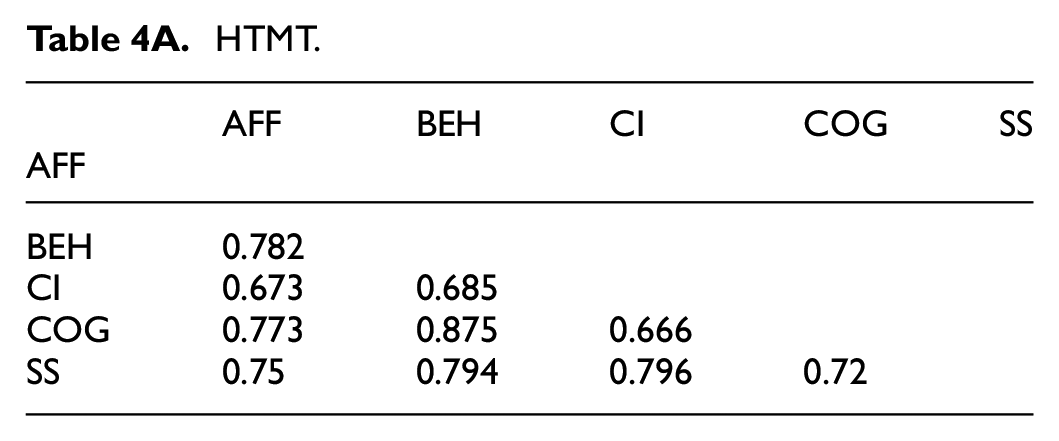
Table 3 represents the results of the measurement model. The constructs' reliability was evaluated through the implementation of internal consistency measure analysis, which yielded satisfactory values for Cronbach's alpha and composite reliability (CR). The necessary conditions for measurement have been satisfied by all indicators and constructs. All outer loadings are greater than 0.612 (Henseler et al., 2009), demonstrating the achievement of indicator reliability, except for BEH_6, which we dropped. Additionally, the AVE is greater than 0.5, and the Chronbach values are greater than 0.7, indicating high convergent validity. The composite reliability ratings also achieved internal consistency, with a threshold limit of 0.7. Hence, the results demonstrate that the present study is valid and consistent with itself (Hair et al., 2014). Figure 2 provides a keen representation of the measurement model. Further, Table 4A displays the discriminant validity results. Discriminant validity illustrates the quantity of indicators that are restricted to different constructs or assessments of specific concepts by delineating the relationships between levels that may overlap. The measure developed by Fornell and Larcker (1981) was employed to assess discriminant validity. It investigates how AVE values correspond to the square roots of latent variables. It is more crucial that each construct's square root stand out than its strongest connection to another construct. Additionally, we employed the HTMT ratio (Table 4B) to assess discriminant validity. All the constructs achieved the HTMT value, which is less than the 0.90 threshold limit (Henseler et al., 2015). Since this study used conceptually similar constructs like affective, cognitive, and behavioral attitudes toward change (Hair et al., 2019).
Measurement Model.
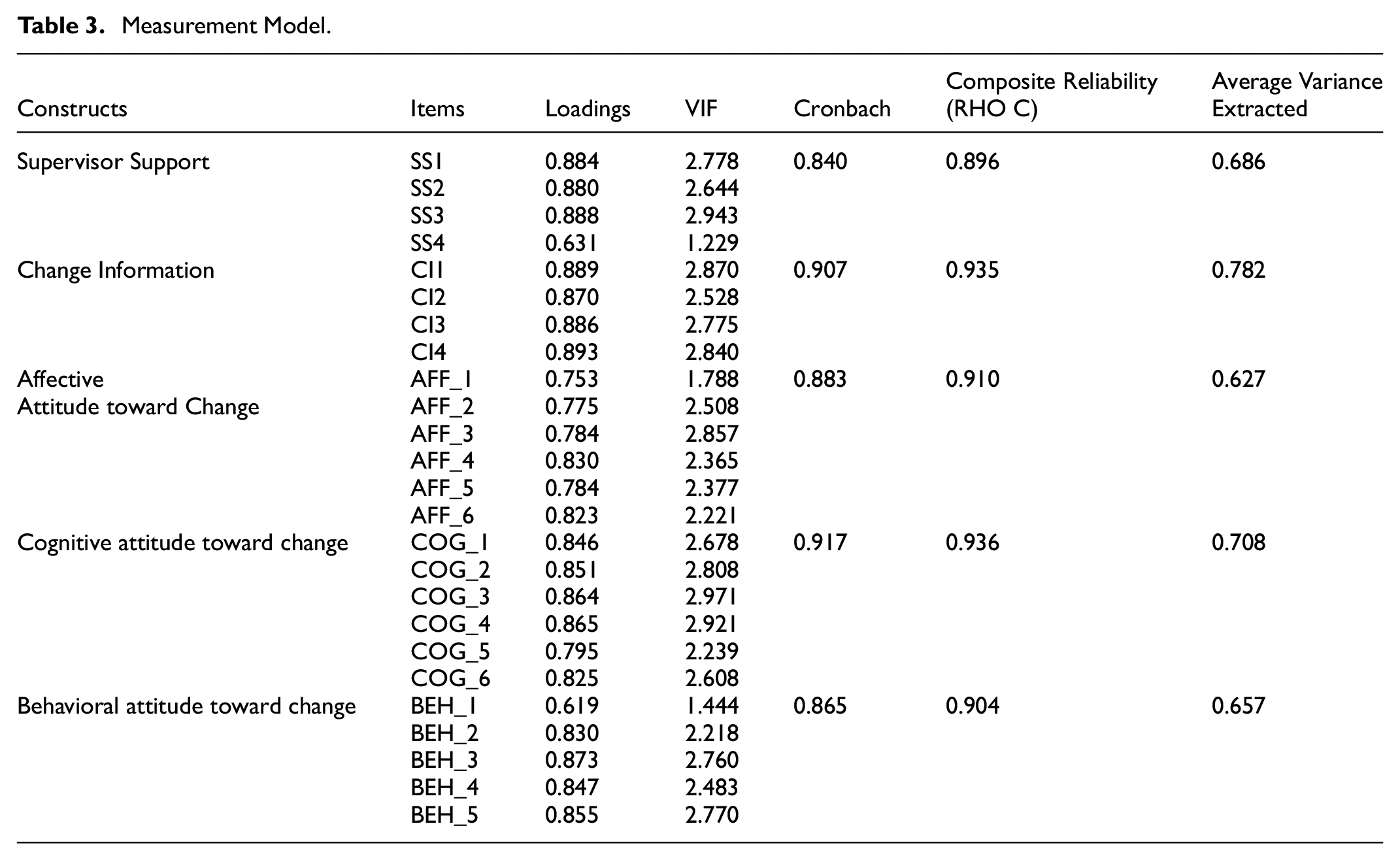

Measurement model.
HTMT.
Fornell–Larcker Criteria.
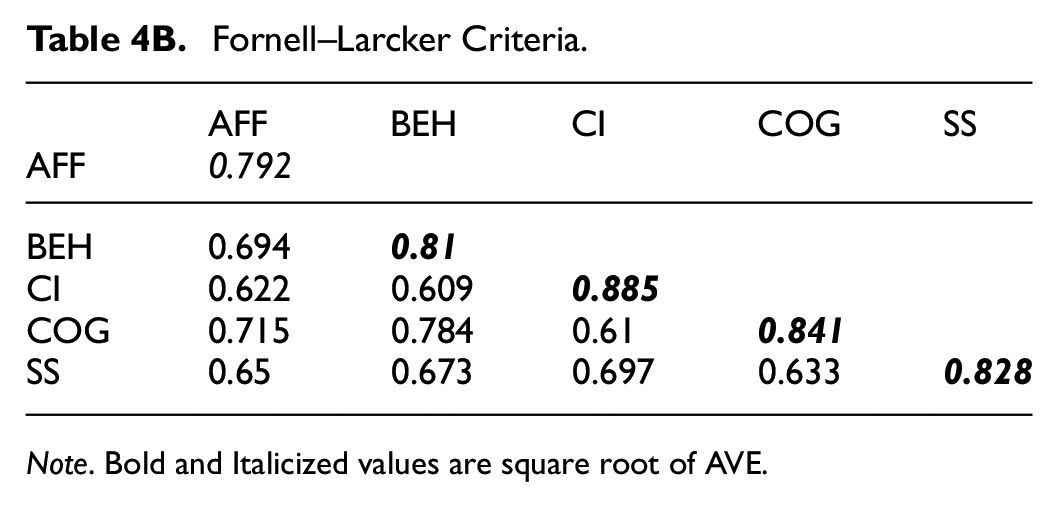
Note. Bold and Italicized values are square root of AVE.
Furthermore, the responses for this study were collected in dual mode, which is through physical questionnaires and through Google Forms; the authors tested its correlation, bias, reliability, and validity for comparing the responses. We found that both forms met the threshold for reliability and validity (Hair et al., 2014). The correlation also exhibits a moderate to strong relationship among the study’s constructs. We employed Harman’s single-factor test to analyze bias, where the variance for Google Forms is 46.168% and for physical forms is 40.895%. Both methods fall below the 50% threshold for Harman's test, indicating no significant common method bias.
The Structural Model
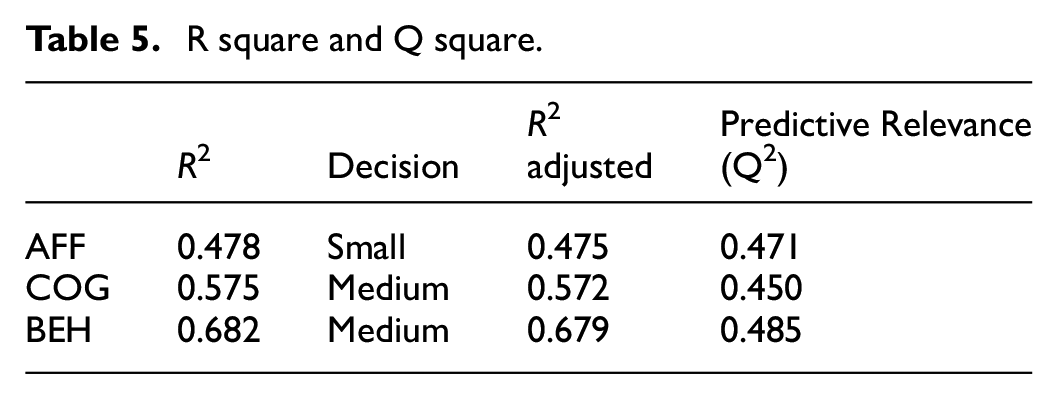
We examined the collinearity of the structural model prior to testing it (Table 3), and it achieved values less than 3. Thus, the result shows that the model is free of common method bias if all VIFs from a full collinearity test are equal to or less than 3.3 (Kock, 2015, 2017). Further, we assess the model's predictive accuracy through the R square (R2). The variance of endogenous constructs is explained by the influence of exogenous variables. The R2 values of 0.75, 0.50, and 0.25 can be categorized as large, medium, and small, respectively. (Henseler et al., 2009). Table 5 mentions the values along with the decision based on R2 variance. Considering all constructs together, the adjusted R2 value of 0.679 indicates that they account for 68.2% of the variance in BEH. We further examined the Q square, which expresses the higher predictive relevance. The constructs AFF, COG, and BEH have Q square values of 0.471, 0.45, and 0.485, respectively, indicating medium relevance (Hair et al., 2019). Also, the goodness of fit was obtained by using SmartPLS through SRMR (“Standardized Root Mean Square Residual”), which scores 0.077 and the NFI (Normal Fit Index) ranges 0.824. The data were well-fit by the model when the SRMR value was less than 0.08 (Henseler et al., 2014) and NFI greater than 0.80 (Baumgartner & Homburg, 1996), which confirms the better fit. As a result, it can be deduced that the model is capable of both prediction and hypothesis testing.
R square and Q square.
Testing of Hypothesis
Previous studies have suggested that the outer model should be executed prior to observing the path coefficient and testing hypotheses. Afterwards, the inner/structural model must be executed (Kraus et al., 2020). To evaluate each hypothesis, we utilized the coefficient parameter and the 95% confidence intervals with bias correction, as illustrated in figure 3. We used Smartpls 4 to check for statistical significance and a bootstrapping method with 5,000 subsamples to evaluate our hypotheses. Table 6 summarizes the outcomes of the hypothesis.

Structural path model.
Hypothesis Results.

Note. Results supported at *p values <.001, **p values <.01.
Source: Author’s work.
H1 was supported by the direct effects, which confirmed that SS influences the behavioral attitude toward change in a positive way (β = .210; p = .000). In contrast, the behavioral attitude toward change is not influenced by CI; therefore, H2 was not supported (β = .055 and p = .244). AFF positively mediates with SS and BEH, which supports H3 (β = .07 and p = .004). Likewise, H4 also supported (β = .102 and p = .000), confirming COG positively mediates with SS and BEH. AFF positively mediates between CI and BEH, supporting H5 (β = .055 and p = .002). Also, COG mediates between CI and BEH, which supports H6 (β = .086 and p = .003). Furthermore, AFF and COG serially mediate the relationship between SS and BEH (β = .10 and p = .000), supporting H7. On top of that, this study shows that the sequential mediation of AFF and COG between CI and BEH (β = .078 and p = .000) supports H8 (but not H2).
IPMA Analysis
In addition to conducting the path coefficient test via PLS-SEM, the research also investigated the performance and importance of each predictor in relation to BEH using importance-performance map analysis (IPMA). Table 7 and Figure 4 present the findings of this investigation. Based on the IPMA results, the only three with significant values above average were SS, COG, and AFF. The construct known as CI surpassed the average performance value at the specified performance level. The results revealed that although CI performed better than the average, its importance value was relatively low. The management should prioritize enhancing the performance of the key construct SS, which exhibited poor performance, while also emphasizing the importance of CI.
IPMA results.

Source: Author’s own creation.Note: The bold value represents most performing and important factors for behavioral attitude toward change.

IPMA analysis.
Results
Results of Direct Effects
This study investigated the role of SS and CI in behavioral attitudes toward change in the academic sector, with affective attitudes toward change and cognitive attitudes toward change serving as mediators. As hypothesized in the existing studies, we expected SS to have a significant and beneficial impact on the behavioral attitude toward change (H1). Consistent with H1 (β = .210, p value = .000), the findings show that supervisor assistance has a beneficial impact on BEH. Whereas CI has no significant influence on behavioral attitudes toward change (i.e., H2: not supported (β = .055, p value = .244)), (Mansoor et al. 2023; Van Praet & Van Leuven, 2022) found that a lack of proper information may have a negative impact on behavioral attitudes toward change. Similarly, in H2, we hypothesized that change knowledge had a favorable influence on behavioral attitudes toward change; nevertheless, H2 contradicts the study. This could be due to the management’s failure to meet the respondents' expectations with the CI.
Results of Mediating Effects
The bootstrapping analysis demonstrates that an affective attitude toward change both positively and partially mediates the relationship between SS and behavioral attitude, thereby supporting H3 (β = .070, p value = .004). Additionally, it fully mediates the relationship between CI and behavioral attitude, thereby supporting H5 (β = .055, p value = .002). This verifies that the process elements employed in this study assist in alleviating adverse emotions, including dread, weariness, annoyance, and anxiety. Cognitive attitude toward change serves as a positive and partial mediator between SS and behavioral attitude toward change (supporting H4 (β = .102, p value = .000)) and as a full mediator between CI and behavioral attitude toward change (supporting H6 (β = .086, p value = .003)). Our findings corroborate other studies on change, indicating that the implementation and perceptions of change recipients affect their emotional and behavioral reactions to change (Oreg et al., 2018). Management's support and information indicate that a favorable perspective on change fosters emotional connection and reduces resistance.
Results of Serial Mediation
The major objective of the study is to ascertain the impact of the process change (SS and CI) on the behavioral attitude of the employees by indulging a multidimensional first-order construct through sequential mediation. As expected, both statistical and practical analysis have shown that there is a partial serial mediation between SS and CI, which supports H7 (β = .10, p value = .000). This shows that support is a key factor in shaping all aspects of an employee’s attitude. However, H8 (β = .210, p value = .000) demonstrates full mediation for serially conceptualized constructs. Altogether, this research confirms that, through affective and cognitive processes, the employee’s behavior is studied.
In conclusion, this research sheds light on the significance of effective communication, comprehensive support, and addressing both emotional and cognitive factors when implementing change. By fostering supportive leadership, ensuring effective communication, and cultivating positive attitudes through appropriate interventions, we can create a more adaptable and resilient society.
Discussions
In this study, we aimed to examine how CC and SS affected employees' behavioral attitudes toward organizational transformation in academic environments. The study was structured to evaluate the impact of SS and CI in determining employees’ attitudes; develop a comprehensive framework that explores the interconnected nature of employee reactions to change initiatives, and examine the sequential relationships between SS, CI, and employees' cognitive, affective, and behavioral attitudes toward change. Furthermore, the study provides evidence-based recommendations for academicians managing the intra-organizational dynamics, as outlined in the research objectives. Table 8 highlights the findings of this research and attempted to provide solutions and recommendations.
Research objectives and major findings and contributions.

Theoretical Contributions
This research examines the influence of CI and SS on behavioral attitude toward change, mediated serially by affective attitude and cognitive attitude. Drawing on social exchange theory, this study offers valuable theoretical implications for understanding employee responses to change. Blau (2017) states that people interact with one another according to the costs and rewards they perceive. When it comes to intra-organizational change, employees weigh the change’s possible benefits and drawbacks. They weigh the pros and cons of the change, taking into account both the information concerning it and the assistance provided by supervisors. These elements impact their mental and emotional assessments of the shift, which in turn shape their intents to act. This research enhances our comprehension of the sequential mediation process, where CI and SS shape behavioral attitudes. It suggests that these factors first affect affective attitudes (emotional evaluations), which then influence cognitive attitudes (rational evaluations), ultimately leading to behavioral intentions. This nuanced understanding of decision-making can influence change management techniques. Thus, this study aligns with social exchange theory, where the perceived benefits (SS and CI) first influence emotional reactions (affective attitude), which then shape cognitive evaluations (cognitive attitude) and ultimately guide behavioral choices (behavioral attitude). Finally, social exchange theory offers a valuable perspective on the intricate relationship between CI, SS, and employee attitudes toward change. Encouraging a positive exchange relationship, academic institutes can enhance the chances of successful change implementation.
Practical and Managerial Implications
This study offers valuable insights for practitioners, highlighting the crucial role of SS in influencing employees' behavioral attitudes toward change, particularly in situations where CI is scarce. The study emphasizes the need for transparent communication of CI to minimize negative emotions during the change process. It also underscores the importance of designing change management initiatives that promote a positive outlook on change, empower employees, and focus on cultivating a positive work environment. Institutions should train supervisors to provide adequate support to employees during times of change. Regular training programs, mentoring, and support groups can achieve this. IPMA analysis identifies CI as an outperforming construct, yet it has not received significant attention during the change process. All employees should receive CI effectively and transparently to prevent any misunderstandings or confusion by integrating the mechanisms as proposed in figure 5 . Management should also provide employees with additional information if needed. The study suggests that affective and cognitive attitudes toward change play a crucial role in shaping employees' behaviors. Therefore, management should prioritize interventions that target these attitudes by creating a positive work environment, cultivating a sense of inclusion, and empowering employees. Serial mediation analysis showed that support plays a crucial role in shaping all dimensions of employee attitudes. Therefore, management needs to prioritize the provision of support to employees during periods of change, as this can have a significant impact on employee behavior and overall institutional outcomes. Finally, the study suggests that recruitment of trained organizational psychologists at times of change management can mitigate negative emotions such as fear, fatigue, irritation, and anxiety. These emotions can lead to resistance to change and negatively impact employee performance. Therefore, management should prioritize interventions that help employees navigate change with a positive outlook. Lastly, based on the discussions section, we provided some tools (Table 9) that can be used by the academicians, and academic management can integrate them for effective intra-organizational change management.

Mechanism/tools for effective CI dessimination.
Evidence-Based Tools and Benefits.

Source: Author’s own creation.
Societal Implications
The findings have a significant impact on society, particularly when it comes to improvements in educational institutions that could potentially impact the community. Supervisor assistance during organizational transitions boosts morale, reduces negative attitudes, and promotes openness. Staff members may be prepared to adjust to technical and social changes under pressure. The research literature claims that the emotional and cognitive aspects of the change process improve the organization's adaptability, mental health, social equity, and integration. Global transformations like rapid globalization require major educational improvements. Educational institutions spread knowledge and foster social change. Thus, these institutions' change-making power boosts societal creativity and worldwide problem-solving.
Limitations and Future Research Directions
Although this paper has yielded encouraging results, we must acknowledge its limitations. This study's geographic scope is limited to Telangana only; our findings on the role of CI and supervisory support in shaping behavioral attitudes toward change have implications for academic institutions worldwide. Research in South African universities found that effective communication and leadership support are crucial for successful change implementation (Msila, 2022). Thus, our results affect academic institutions globally, especially in changing regions. Future research might examine how cultural and institutional elements affect intra-organizational change dynamics in various nations and environments.
This study examined changes in the academic sector and aimed to ascertain the attitude toward change in situations where supervisory support and information are available. Hence, future studies can concentrate on other service-related contextual settings. Given the increasing digital transformations in the service sectors, particularly in the banking, healthcare, and entertainment industries (such as sports and gaming), future researchers should focus on these contexts to enhance the service sector. Additionally, this study included respondents solely from private institutions. Thus, scholars and academicians can compare the responses from private institutions with those from public institutions to analyze the impact on behavioral attitudes among private and public employees. Also, the current study used only two change process components. For robust results, future researchers can consider other components like involvement, instructional supervision, leadership types (such as transformational, coaching, and authoritative), the impact of mentoring, and management attitudes toward change. Finally, future investigators may broaden the inquiry by examining how variables in the organizational change process sequentially impact cognitive and thereafter affective attitudes, and how these attitudes influence respondents' behaviors.
In conclusion, this study will make several significant contributions to the literature on organizational change, particularly in the academic sector. Theoretically, it will advance understanding by introducing a serial mediation model, demonstrating how affective and cognitive attitudes will serially influence behavioral attitudes toward change, an aspect largely overlooked in prior research. Unlike existing studies that examine these attitudes in isolation, this research will provide a more integrated psychological perspective on attitude formation during change. Further, by employing PLS-SEM with SmartPLS, the study will offer robust empirical evidence supporting the hypothesized relationships. Practically, the findings will provide actionable insights for university leaders and policymakers, emphasizing the role of clear change communication and SS in fostering positive change attitudes. By bridging the gap between theory and practice, this research will enhance strategies for managing change in higher education institutions, ensuring smoother transitions and greater academic engagement.
Footnotes
Appendix 1
Acknowledgements
The authors express their gratitude for the support of HR managers in gathering data and providing valuable assistance throughout the research process.

Author Contributions
The entire manuscript was written and conceptualized by Divya. S, the first author, with input from Prabu Christopher B (PCB), the corresponding author; the article's research question was developed through their collaboration; this will allow for future studies. When the article was finished, PCB vetted it before submission.
Funding
The author(s) received no financial support for the research, authorship, and/or publication of this article.
Declaration of Conflicting Interests
The author(s) declared no potential conflicts of interest with respect to the research, authorship, and/or publication of this article.
Data Availability Statement
The author provided no data sets for the following reasons: The data utilized is confidential. Because of the sensitive nature of the questions posed in this study, survey participants were guaranteed that raw data would be kept confidential and not disclosed.