




Abstract
As the workplace continue to attract all the segments of the diverse society, one stark reality organizations grapple with in recent times is the readiness to inculcate inclusive behaviour among all categories of employees. This study evaluates the role of perceived supervisors’ support (PSS) on perceived workplace ostracism (PWO) through psychological ownership (PO) among federal civil servants working in Plateau state. We draw from affective event theory (AET) and organizational support theory (OST)to justify the hypothesized relationship. Five hundred and twenty-six copies of questionnaires were administered while 332 out of the retrieved were usable. Structural equation modeling through SMART-PLS version 4. was used to analyze the data collected. The results suggest that PSS significantly associate with PWO and psychological ownership mediates the relationship between PSS and PWO. From the results, the study offers a modest theoretical contribution through the connection between AET and OST in justifying the role of PSS and PO in the tested model. Some practical implications for managerial practice were also proffered.
Plain language summary
The study seeks to explore factors that explains workplace ostracism among civil servants in Nigeria. We hypothesized that supervisors’ support will mitigate the level of ostracism, also that psychological ownership will explain the extent to which the relationship between supervisors support and workplace ostracism is made possible. The results show that: . Supervisors’ support plays a significant role on remedying the feeling of ostracism . psychological ownership explains the process through supervisors’ support remedies ostracism at work.
Introduction
As the 21st-century workplace continues to attract every segment of the diverse human society, the need to have a workforce that values diversity with the capacity to manage unique human attributes becomes critical. Thus, where there is a gap in social integration among coworkers, diversity management can be an uphill task, resulting in painful experiences of workplace ostracism. Workplace ostracism according to Ferris et al. (2008) is the extent to which someone feels neglected or excluded by others in a social or work setting. It could also occur “when an individual or a group neglect a coworker even when it is socially justifiable to do so” (Robinson et al., 2013, p. 206). These perspectives on ostracism visualize the phenomenon in two foci, the victim and the environmental omission. While the latter is often subtle and hardly noticed by the victim with low social expectations, the former is noticeable and painfully experienced by the victim (Howard et al., 2020), leading to a resentful reaction. Ostracism in the workplace has grown exponentially in recent times, taking the workplace aback against the expectations of proponents of cultural integration and globalization. Research in the organizational context reveals that workplace ostracism is a sad reality and a common phenomenon in our time (Yang &Treadway, 2018; Zhao et al., 2016). For instance, 71% of 1300 US employees reported that they had faced some form of workplace exclusion (O’Reilly et al., 2015). In addition, Mao et al. (2018) reveals that of over 2,000 Americans, 67% said they had expressed ostracism behavior toward others. Similarly, Yang and Wei (2018) reported that 70% of 10,000 employees working in China had experienced workplace exclusion. This workplace hostility has taken a catastrophic dimension globally, hence the need for this study.
Workplace ostracism in the context of this study, is multidimensional due to the multi-ethnic, multi-lingual, multi-religious, and multi-cultural nature of the country (Vem et al., 2024). According to Ojo (2016) and Ogoanah (2012) Nigeria has over 250 indigenous ethnic groups, connected to 400 languages of the Niger-Congo, Nilo-Sahara, and Afro-Asiatic Phyla. In addition, other demographic parameters like gender, marital status, and physical challenge still play a significant role in workplace inclusion. This makes the country’s workplace a melting pot of diversity. It is amid these variegated compositions of cultural, ethnic, and human factors, that the administrators and supervisors in the public service sector are expected to ensure inclusive management of the workforce. However, despite the extant rule in the civil service and constitutional provisions against gender and ethnic discrimination, prejudice still exists which limits women and other minority groups from integrating and occupying certain sensitive positions in some parts of Nigeria (Omiunu, 2014). Other related indicators to this study include all forms of discrimination against persons with disabilities and sexual orientation. Studies have argued that exclusion can lead to mental and emotional health problems (Ideh et al., 2020; Herek, 2010). As such, the marginalized groups must have passed through some form of exclusion at one point or the other in their career progression, hence the need to understand ways of mitigating this social hostility in the workplace.
Research on Workplace ostracism reveals that ostracism impact negatively on the psychological well-being of humans, in the areas of belongingness, control, self-esteem, and meaningful existence (Williams, 2001). Painfully, these psychological factors have been associated with work outcomes, such as low work engagement, among immigrant workers (Williams & Liu, 2022). Worthy of note in the last few decades, is the upsurge of research interest in the consequences of ostracism in the workplace, while only a small stream is concerned with the antecedent (Williams & Liu, 2022). A systematic review conducted by Mao et al. (2018) delineates factors such as victims’ dispositional traits, ability and skills, behavioral features, purposeful motives, and working context as antecedents from the victim’s perspective that predict perceived ostracism at work. Similarly, Howard et al. (2020) attribute PWO to personal characteristics, contextual characteristics, performance, and leadership behaviour toward victims. This study however focuses on the third-party effect on the victim in line with the recommendations of Mao et al. (2018) who advocated that the third party is an important factor in workplace ostracism. In addition, they argued that third parties can either openly prevent, silently endorse, feel empathy for the victims, or join in the ostracism actively or passively. As such we argue in line with affective event theory (AET) that supervisory support to the victim would either prevent or empathize with the victim in reducing the perceived workplace ostracism (PWO). According to affective events theory (AET) (Weiss & Cropanzano, 1996), events at the workplace such as affective disposition influences employees’ experience at work, which in turn relate with their perception and behaviour. Therefore, positive affect, such as supervisor’s support is expected to attenuate negative perception of coworkers’ uncivil behaviour, since studies show that positive affect has a reducing effect on negative work behaviour (Lan et al., 2021; Schicket al., 2023). Hence the research question:
RQ1: To what extent does PSS relate with PWO?
In addition to the third-party effect of the perception of workplace ostracism, we also provide the mechanism through which the positive affect of supervisors’ support (PSS) could reduce perceived negative provocation from coworkers. Psychological ownership and its consequences are an important intermediary expression of positive affect induced by an organization or its representative, however, it is understudied in the domain of PSS and PWO. Therefore, we posit that psychological ownership (PO) is elicited when victims observe that supervisors empathize with them or have put mechanisms in place to prevent further expressions of negative dispositions toward them. The positive impact of PSS on subordinate’s positive work behaviour has been well established in the literature. Al-Mahdy et al. (2023) confirmed that leadership support greatly improves faculty members’ commitment and reduces their intention to leave. Apposite to PO is employee organizational citizenship behavour, which Kao et al. (2023) established as a consequence of supervisors’ support is evident between PSS and PO. Consistent with AET we expect that the positive affect emanating from PSS in the form of empathy or preventive efforts to elicit psychological ownership in the victim thereby reduce PWO.
In sum, this study is significantly tangential to the current debate on workplace ostracism in two ways. First, we explore the third-party effect on perceived ostracism as suggested by Mao et al. (2018) was assessed through the predictive role of PSS to ascertain the extent to which a positive disposition from higher authority could ameliorate the effect of the negative perception of ostracism from colleagues. In addition, we evaluate the intervening role of PO to explain the mechanism that facilitates the role of PSS on PWO. Hence the research question:
RQ2: Does PO significantly mediate the relationship between SS and PWO?
Theoretical Foundation and Hypotheses Development
Fundamental to justifying the hypothesized relationships proposed in this study are the affective event theory (AET) and the organizational support theory (OST). According to Weiss and Cropanzano (1996), AET focuses on the structure, causes, and consequences of affective experiences at work, and posits that workplace events are capable of prompting positive or negative emotional reactions which further determine individual’s and organization’s outcome. The theory believes in the nexus between emotional experience and workplace attitudes and behaviors (Selem et al., 2023). That is while working, people may experience both pleasant and unpleasant circumstances, such as anger, frustration, joy, comfort et cetera, these prompt a different behavioural and attitudinal reaction in favour or against the organization.
OST, on the other hand, posits that employees develop POS in response to socio-emotional needs and the organization’s readiness to reward positive efforts made on its behalf (Rhoades & Eisenberger, 2002). The theory which is highly enshrined in the norm of reciprocity contends that employees’ trade effort and dedication to their organization is not only limited to tangibles but also intangibles obtained in socio-emotional benefits such as esteem, approval, support, and caring (Baran et al., 2012). Again, supervisory support in OST is interpreted in the extent to which a supervisor is perceived or acts in the best interest of the organization either as an agent or representative.
Flowing from AET and OST, we argue in line with Mao et al. (2018) that third-party effect has a remediating effect on PWO such that an affective event (Weiss & Cropanzano 1996) deliberately initiated by the supervisor, who is perceived by the victim as acting in the best interest of the organization either as agent or representative (Rhoades & Eisenberger, 2002) can prompt positive affect, as such the victim perceives the organization as supportive. This perception is expected to enact a healing process and create a positive affect (Weiss & Cropanzano 1996), in response the victim feels accepted by the organization (Baran et al., 2012; Selem et al., 2023), and demonstrates a sense of belonging through psychological ownership (PO). Since PO has been found to mitigate negative decision and work behaviour (Su et al., 2021; Vem et al., 2017). In sum, we propose that PWO is attenuated through the positive affect and sense of reciprocity prompted in PO which emanates from the predictive role of supervisory support.
Perceived Supervisors’ Support
In this study, we propose that employee perception of workplace ostracism can be reduced through the supervisor’s support. According to Charoensukmongkol and Phungsoonthorn (2021) and Ru Hsu (2011), supervisor’s support indicates the degree to which subordinates perceive their supervisor as concerned about their well-being, whether at work or in life generally. This explains the quality of the relationship between the subordinate and the supervisors (Stinglhamber & Vandenberghe, 2003). Scholars have alluded that positive perception creates a positive image of the organization to stakeholders (Akpi et al., 2020; Eisenberger et al., 2002). In addition, supervisor support is instrumental in sustaining positive behaviour and work outcomes, by attenuating the effect of anti-social behaviour such as ostracism at work (Muyidi et al., 2023).
Workplace ostracism/exclusion is seen broadly as, the extent to which an individual (or group) perceived that they are being rejected, ignored, or ostracized by others (or group) within their place of work. According to Hitlan et al. (2014), it is seen as the exclusion, rejection, or ignoring of an individual (or group) by another individual (or group) that hinders one’s ability to establish or maintain positive interpersonal relationships, work-related success, or favorable reputation within one’s place of work. A systematic review conducted by Bedi (2021) identified several antecedents. According to the author, factors such as negative and positive affect (Mao et al., 2017; Zhang & Shi, 2017) deter or enhance ostracism at work. Accordingly, victims who experience negative affect may tend to perceive higher workplace ostracism than those who experience positive affect. In addition, victims with certain personality traits (Mao et al., 2017; Renn et al., 2013), are more prone to experiencing ostracism. Furthermore, political and social skills (Cullen et al., 2014; Zhao et al., 2013) and workplace incivility (Schilpzand & Huang, 2018; Scott et al., 2013) have also been found to significantly predict the perception of workplace ostracism from the victim’s point of view. This study differs from the victims’ perspective in adherence to the call earlier by Mao et al. (2018) made in a systematic review advocating for the assessment of the predictive effect of the third-party on perceived workplace ostracism instigated by coworkers. In this case, PSS is proposed in line with AET and OST to predict the relationship with PWO such that an affective event (Weiss & Cropanzano 1996) is deliberately initiated by the supervisor, who is perceived by the victim as acting in the best interest of the organization either as agent or representative (Rhoades & Eisenberger, 2002) can prompt positive affect, as such the victim perceives the organization as supportive. This perception is expected to lead to a healing process and create a positive affect (Weiss & Cropanzano 1996), in response the victim feels accepted by the organization (Baran et al., 2012; Selem et al., 2023), and experiences less PWO. We therefore hypothesize that:
H1: Perceived Supervisors’ Support Has Significant Impact on Workplace Exclusion of Civil Servants in Plateau State
Psychological Ownership
Psychological ownership (PO), emanates from an individual’s sense of attachment and personalized feeling that something is “mine,” (Pierce et al., 2003). Unlike legal ownership such feeling is expected to prompt a strong sense of ownership, self-identity, belongingness, and efficacy, resulting in positive work behaviours (Peck et al., 2021; Pierce & Peck, 2018). In other words, psychological ownership redefines employees’ viewpoint on what is valuable and important. As such, an individual who experiences high psychological ownership is most likely to attach high value to any endeavour. As desirable as PO is in the organizational literature, its preponderance has been associated with less prosocial behaviour, such as feelings of infringement by others and territorial behaviours, and psychological entitlement (Kirk et al.,2018; Peck & Luangrath, 2023), particularly where trust is low. This is done to protect and maintain what they feel belongs to them (Dawkins et al., 2017).
Studies have intensively dwelled on the antecedents and outcomes of PO in employment relationships. In line with the antecedent of PO, literature has provided an understanding of how PO occurs, these are traceable to three main factors identified by Dawkins et al. (2017, p. 170) as “experienced control over the target of ownership, intimate knowing of the target of ownership, and investment of the self into the target of ownership.” Critical to the antecedent of this study is the control over the target of ownership. Zhang et al. (2021) in a review of antecedents of PO which identify transformational leadership, autonomy, and perceived power as sources through which control over the target could emanate. Consistent with transformational leadership, a supportive supervisor also tends to exert some level of influence, inspiration, and individualized consideration. This could stimulate some level of attachment through PO in line with AET and OST where the perception of positive affect initiated from the supervisor suggests a supportive organization. In response, the victims are prompted to reciprocate the positive affect and the support through PO.
On the flip side, PO has been found to associate positively or attenuate negative individual and organizational-related outcomes (Wang et al., 2019). These could be attitudinal (positive attitudes, organization-based self-esteem, negative attitudes, negative affect, and turnover intentions), performance, and dark side outcomes (Zhang et al., 2021). Consistent with negative attitudinal outcomes PO is expected to attenuate the perception of workplace ostracism among civil servants (Su et al., 2021: Vem et al., 2017). Since PO is concerned with individual’s sense of attachment and personalized feeling of having a stake in an activity or a process (Pierce et al., 2003), it is expected that a strong sense of ownership, self-identity, belongingness, and efficacy, resulting in positive work behaviours (Peck et al., 2021; Pierce & Peck, 2018) prompted by PO mitigate any negative affect emanating either from coworkers or the supervisors. Hence, we hypothesize that:
H2: Psychological Ownership mediates the relationship between supervisors’ support and perceived workplace ostracism of Plateau State Civil Servants
Methodology
Population and the Sample
The study explores the roles of PSS and PO on PWO. We collected data from employees of Federal Ministries and Agencies serving in Plateau State, Nigeria. Plateau state is preferred for this study due to: (a) its central location, making it accessible to all Nigerians, (b) its temperate and clement weather which has attracted investors within and outside of the country, and (c) historically it is known for its tin mining activity. These factors make Jos a melting pot of diversity in Nigeria, hence a sample drawn from it is a reflection of the Nigerian population (Vem et al., 2023). We adopted a purposive sampling technique to obtain data using a self-administered questionnaire. We administered 526 copies of the questionnaire above the sample size of 376 obtained from Krejcie and Morgan’s (1970) sample size determination for a population of 18,700. We increased the sample size by 40% in anticipation of a low response rate (Kotrlik & Higgins, 2001; Salkind, 1997). In all a total of 332 filled questionnaires were found usable indicating a total response rate of 63%. This is considered adequate based on Nulty (2008) who recommends a 60% response rate for an on-paper survey of an easy-to-reach population.
Demographic data presented in Table 1 indicates that, 65% of the respondents were males while 35% were females with various years of experience. Out of the 332 respondents, 16% are newly employed, 27% have 2 to 5 years of experience, 34% have spent more than 6 years and 23% are more 10 years on the job. In terms of their educational background, 32% of the participants possess diploma certificates, 39% have university degrees, 17% have masters and 11% have other educational qualifications.
Demographic Details of Respondents.

Common Method Bias
The study adopted a procedural approach to minimize systematic error variance among the variables measured. In doing so we conducted a pretest of a small sample composed of 15 employees and 10 academics, as recommended in Baumgartner and Weijters (2012), to enable the factoring out and the adjustment of difficult and similar questionnaire items to ensure scale clarity. In addition, we informed the respondents about the intention and benefits of the study to enhance response accuracy and reduce social desirability in line with Podsakoff et al. (2003) suggestion. These approaches have been found to reduce the tendencies of common method bias associated with the self-response questionnaire (Podsakoff et al., 2003).
Measures
Perceived supervisory support was adapted PSS measurement scale from Eisenberger et al. (2002). It is an employee-reporting questionnaire evaluating the perception of the support they receive from their supervisors. The measure was initially developed to assess organizational support, but this study with a Cronbach Alpha of 0.89. We found 8 out of the 12 items on the perceived organizational scale highly connected to the meaning of supervisory support from the context of this study. Psychological Ownership is consistent with Han et al. (2015) where a 4-item scale from Pierce et al. (2001) and Van Dyne and Pierce (2004) was adopted to capture employees’ PO. The scale has a Cronbach’s Alpha of .74. Perceived Workplace Ostracism, was adapted from 10-item measures developed and validated by Ferris et al. (2008), it has a Cronbach Alpha of .89 The details of the questionnaire items for each of the constructs (PSS, PO, and PWO) and their sources are included in Appendix A.
Data Analysis
To perform descriptive analysis (see Table 1) and common method bias we used SPSS version 28, while the Partial Least Squares Structural Equation Modeling (PLS-SEM) technique was used to estimate the conceptual model in Figure 1. We found PLS-SEM the most appropriate instrument because, the proposed model takes an exploratory approach (Hair et al., 2022), it involves the estimation of complex analysis of both latent variables and indicators (Cheah et al., 2021). Hence, SmartPLS version 4 was used to assess both the measurement and structural model.

Conceptual framework.
Result
Assessment of Measurement Model
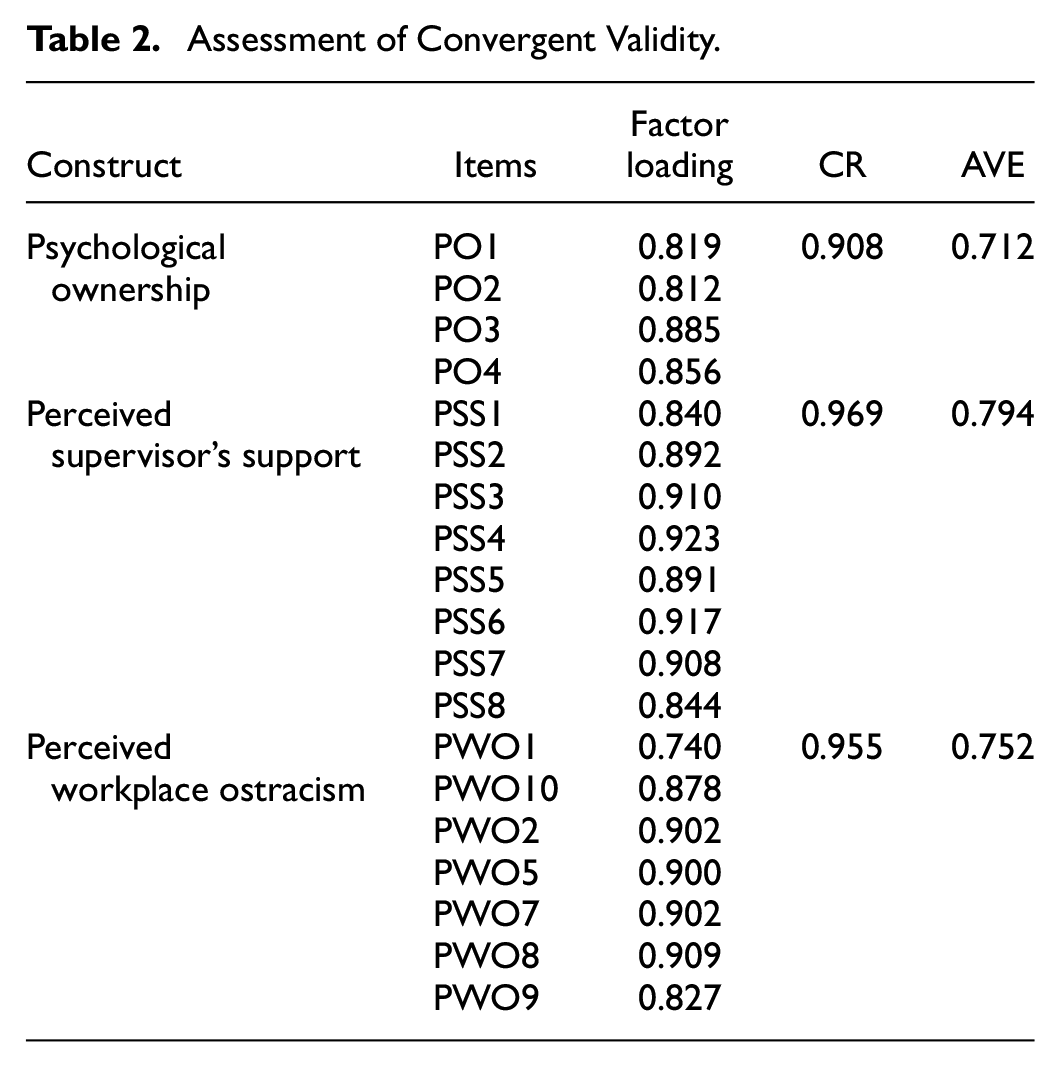
First, we evaluate the measurement model to ascertain its quality through factor loading, internal consistency, and convergent validity (Hair et al., 2017) and the results are presented in Table 2. The factor loading values ranging between 0.7 to 0.9 were considered acceptable, while the composite reliability (CR) values being greater than 0.7 suggest that the internal consistency requirement is not violated. Subsequently, the average variance extracted (AVE) coefficient supports the convergent validity requirement since all the values are above the 0.5 threshold. Accordingly. some items (PWO3, PWO4, PWO8) were removed from the model due to low factor loadings. This is consistent with the criterion by Hair et al. (2017), where items with a factor loading of >0.50 are recommended for removal.
Assessment of Convergent Validity.
We further assessed the discriminant validity output through the Heterotrait-Monotrait (HTMT) criterion (Henseler et al., 2015) and presented in Table 3. Based on the conservative requirement by Henseler et al. (2015) all the HTMT coefficients are lower than the threshold value of 0.85, suggesting that discriminant validity is established among all the constructs. As such, the measurement model does not present any reliability or validity concerns.
Discriminant Validity HTMT Criterion.

Assessment of Structural Model
Furthermore, in assessing the structural model, we examined the output for collinearity through the variance inflation factor (VIF) in Table 4. The outcome suggests that the variance inflated factor (VIF) values which ranged from 1 to a maximum of 1.277, are considered less than the 3.33 optimum coefficient (Diamantopoulos & Sigouw, 2006), suggesting that collinearity was not a problem.
Assessment of Direct and Indirect Path.

The path coefficients were subsequently assessed using bootstrapping estimation with 5,000 sub-samples (Hair et al., 2022) to determine the hypothesized relationships and the results presented in Tables 4 and 5, Figure 2 Consequently, the link between PSS and PWO in H1 is considered significant based on β = .602 (p-value < .001) suggesting a strong association. Subsequently, we estimated the proposed indirect path via the mediating role of PO in line with the recommendation of Nitzl et al. (2016). The results reveal that PO mediates the relationship between PSS and PWO (β = .084; p-value < .001) suggesting a ‘complimentary mediation’ condition (Nitzl et al., 2016). The model’s explanation power as seen in Table 5 ranges from 21.7% to 49.6%. Furthermore, the effect size (f2) was evaluated to determine the substantive significance of the model (Hair et al., 2017). Using Cohen’s (1988) rule of thumb, which classified effect size into three levels: large (0.35), medium (0.15), and small (0.02), this model poses PSS (f2 = 0.563), while PO (f2 = 0.277) effect sizes, which are considered large and medium on PWO respectively.
Assessment of Substantive Strength of Model.


Path Coefficient.
Discussion
A parsimonious model was proposed to understand workplace ostracism among civil servants in federal government establishments via the predictive and mediative roles of PSS and PO respectively. We hypothesized a direct and indirect relationship for the model, through the underpinning and supportive lenses of affective event theory (AET) and the organizational support theory (OST). From the data obtained and analyzed, the discoveries were quite revealing. For H1 hypothesizing a direct link between PSS and PWO was supported. Similarly, H2 which seeks to determine whether PO mediates the relationship between PSS and PWO was also found to be significant.
The first finding which confirms the link between PSS and PWO suggests that the perception of workplace ostracism is highly determined by PSS. This is because of the perception of the actions of the supervisor as representing the unspoken belief and values of the organization. Consistent with OST, Rhoades and Eisenberger (2002) posit that supervisors’ actions and inactions are seen in the best interest of the organization either as agents or representatives. Where the victims perceive that the supervisor as supportive, they might tend to have a different perception of the organization and perhaps consider the perpetration of uncivil behaviour toward them as an isolated phenomenon. Our finding is related to previous studies on the predictive role of PSS, where scholarly findings unanimously converge on how positive perception creates a positive image of the organization to stakeholders (Akpi et al., 2020; Eisenberger et al., 2002). In addition, supervisor’s support was found to significantly sustain positive work outcomes, by attenuating the effect of anti-social behaviour such as ostracism at work (Muyidi et al., 2023).
The significant role of PO as an explanatory variable between PSS and PWO justifies the theoretical integration of AET and OST. While AET prompts positive affect, OST conveys the effect of positive disposition through PO to PWO. Consistent with this theoretical connection, the mediating result suggests that civil servants who perceive third-party support, are psychologically prompted to display a positive intermediary response, such as belongingness, territoriality, self-identity, feeling of self-worth, and accountability (Olckers & Van Zyl, 2019) typically associated with PO. This feeling attenuates negative feelings emanating from uncivil behaviour experienced by a fellow employee. Workplace ostracism is the typical social reality in a diverse workplace like Nigeria which is polarized grossly on differences rather than similarities. Civil servants are expected to cope with acceptance and integration whenever they are deployed to a new place of assignment other than their state of origin. Here PO becomes very critical in reducing the stress associated with PWO.
Implications of Findings
The study made a modest contribution theoretically to the ongoing debate on workplace ostracism, a needless counter-productive workplace behaviour, prompted by uncivil behaviour from coworkers or supervisors. We contended through AET and OST that the toxic effect of this phenomenon can be attenuated when PSS occurs or triggers PO which consequently reduces PWO. Consistently, the study emphasizes the significance of affective events from a third party on subordinates’ response to negative provocations. The model proved that positive affect such as PSS mitigate uncivil dispositions at work. Secondly, PSS was also found to stimulate positive psychological responses, such as belongingness, territoriality, self-identity, feeling of self-worth, and accountability (Olckers & Van Zyl, 2019) through the theoretical lens of organizational support. This is consistent with Rhoades and Eisenberger’s (2002) framing of OST, where supervisors’ actions and inactions are construed as representing the best interest of an organization, which was found to attenuate PWO.
Practically, incorporating PSS into the model allows for a more nuanced discussion, on the critical role of supervisor-subordinate relationship in enhancing subordinates’ work behaviour. The finding reinforces the importance of supervisors and their responsibility for managing employees and ensuring they deliver on their mandates toward achieving organizational success. To be effective supervisors are expected to motivate and support their subordinates to advance their career aspirations (Northup, 2023) despite all odds. In line with the conceptualization of perceived support by Eisenberger et al. (2002). Perceived support is felt when supervisors hold their subordinates in high regard, involve them in making important decisions, give them authority to explore new things, and support the decisions made by them. Other areas where support is experienced according to Eisenberger et al. is in the way subordinates are allowed to participate in making decisions that affect the entire organization. Furthermore, when subordinates are allowed to run their work schedule in a manner that suits their peculiar needs, their positive contributions to the organization are appreciated. These and many supportive supervisory programmes are capable of inculcating and sustaining PSS in the workplace.
Despite the criticism of PO as associated with less prosocial and over-possessive behaviour, such as the feeling of infringement by others resulting in territorial behaviours and psychological entitlement (Kirk et al.,2018; Peck & Luangrath, 2023), in this study, PO has been found to provide a mechanism to convey the affective events generated from PSS to attenuate the negative perceptions of coworkers’ disposition. In addition to developing supportive programmes, we also align our thought with Pickford et al. (2016) on the practical ways to inculcate values that support the thriving of psychological ownership through availing the; (a) opportunities for employees to express autonomy and control over job or aspect of the job, (b) opportunities to know what organization intend to accomplish, the role requires of the employee, team, or organization, through information sharing, (c) enabling environment for employee to express their ability for personal investment of time, unique skills, ideas, etc. This is highly required in a complex job or a new task where creativity and/or autonomy are necessary success factors.
Given the negative affect that are associated with PWO, this study also aligns with Vem et al. (2023) on the role of effective communication in conveying acceptable organizational policies and practices to help develop ethical work culture. They further proposed ways organizations can engender positive work culture, including; training on good work ethics, rewarding best practices in relationship management among employees, and protecting ethical champions who expose provocative practices against victims of ostracism.
Limitations and Suggestions for Further Studies
This study makes modest contribution to the understanding of PWO, though not without some unavoidable limitations. This study is limited to federal government ministries agencies operating in Plateau State, Nigeria, excluding other states and the private sector. This might pose a serious constraint in generalizing the findings of this study. Despite the advantages in terms of its diversity as a miniature of Nigeria and the clement weather of Plateau state, the concentration of government ministries/agencies and the population of civil servants is limited compared to states like Lagos and the Federal Capital Territory Abuja. Furthermore, the private sector experience in the PSS-PWO model is completely missing in this study. As a result of these contextual limitations, the model requires more investigations using different samples in a larger scope to further bolster the generalizability of the findings.
Furthermore, this study has focused on the positive side of PSS and PO on ostracism, we are not unmindful of Machiavellian followers (Gao & Liu, 2023) who are expecting PSS as a right particularly when the supervisor is from a minority and the victim is from a dominant culture. Would they still perceive the supervisor’s benevolence and affective event as worth reciprocating? Could such perception be responsible for the less prosocial and over-possessive behaviour (Kirk et al., 2018; Peck & Luangrath, 2023) expressed in psychological entitlement? Future researchers might wish to evaluate PSS and its effect on PO among dominant and minority ethnic cultures through multigroup analyses to justify the generalizability or otherwise of this model. Finally, we suggest that future researchers consider the role of coworker’s support in conceptualizing their PWO model given the possibility of misconstruing PSS among dominant cultures. This subtle and social coping mechanism has been found in Geldart et al. (2018) as a handy intervention in dealing with workplace hostilities such as incivility and distress at work.
Footnotes
Appendix A
My supervisor holds me in high regard.
My supervisor involves me in making important decisions.
My supervisor gives authority to try new things.
My supervisor supports decisions made by me.
My supervisor allows me to participate in decisions that affect the entire organization.
My supervisor allows me to run things the way I want.
When I decided to quit, the organization my supervisor persuaded me to stay.
My supervisor Always noticed when I did well on an Assignment
Source: (Eisenberger et al.,2002).
I sense this organization is our company
I feel closely involved in the success or failure of the company
I am willing to share pains and pleasures with my organization
I am willing to treat my company as my home.
Source: (Han et al., 2015; Pierce et al., 2001; Van Dyne & Pierce, 2004).
Others ignored me at work.
Others left the area when I entered.
My greetings have gone unanswered at work.
I involuntarily sat alone in a crowded lunchroom at work.
Others avoided me at work.
I noticed others would not look at me at work.
Others at work shut me out of the conversation.
Others refused to talk to me at work.
Others at work treated me as if I weren’t there.
Others at work did not invite me or ask me if I wanted anything when they went out for a coffee break.
Source: (Ferris et al., 2008).
Declaration of Conflicting Interests
The author(s) declared no potential conflicts of interest with respect to the research, authorship, and/or publication of this article.
Funding
The author(s) received no financial support for the research, authorship, and/or publication of this article.

Data Availability Statement
Data sharing not applicable to this article as no datasets were generated or analyzed during the current study.