



Abstract
This research investigates the impact of supportive supervisors on doctoral students’ research productivity, with parallel mediation effects of academic engagement and academic psychological capital as two mediators. Data has been collected through an online survey from international doctoral students (N = 415) studying in six research-oriented universities in mainland China. Confirmatory factor analysis and structural modeling were used in the analysis and mediation analysis conducted by adopting the 04 Model in PROCESS. The results indicated that a supportive supervisor is positively related to research productivity. Student psychological factors—academic engagement and academic psychological capital—partially mediate the relationship between supportive supervisors and research productivity. The findings suggest that the supervisor’s supportive behavior is essential for encouraging students’ academic engagement and academic psychological capital. Furthermore, students are more productive, and their engagement and psychological resources are increased under supportive supervision, which ultimately significantly increases their research productivity.
Keywords
Introduction
Research productivity (RP) through doctoral students’ performance and contribution has recently emphasized research in higher education settings (Brew et al., 2016 ). The scientific literature has identified the numerous factors influencing research performance. However, a doctoral supervisor’s role is essential among various factors (i.e., cultural, personal, contextual) that contribute to the student’s research performance (Bui, 2014; Devine & Hunter, 2017; Peng, 2015). The significance of doctoral supervision is considerably determined by a vast body of concern among scholars (Bui, 2014; Khuram, Wang, Khan, & Khalid, 2021; Khuram et al., 2017). Doctoral supervision plays a crucial role in information sharing, motivating, and helping students to become independent researchers (Halse & Malfroy, 2010), with comprehensive and detailed experience in theory and knowledge to carry out research and achieve the set targets (Peng, 2015). Therefore, Gong et al. (2009) claimed that the supervisor role is getting attention among scholars, especially supervisory styles. Existing literature described that doctoral supervisor plays a crucial role in academic success during doctoral candidature (Gruzdev et al., 2020; Mason, 2018; Yang et al., 2020). Students have recently begun to consider various aspects of supervision styles, such as pastoral and contractual (Gatfield & Alpert, 2002), supportive and directive (Gu et al., 2015), to have a role in student RP in higher education settings. Among such styles, supportive supervisors (SS) may be an essential predictor of research productivity. Although supportiveness is a critical characteristic of a doctoral supervisor (Lindqvist, 2018), the empirical relationship between SS and RP has yet to be explored. SS has been defined as friendly behavior with subordinates and exhibiting concerns for mental/physical preferences and satisfaction, enabling them toward high productivity and performers (Gu et al., 2015).
Prior studies have found that a supportive supervisor significantly influences an individual’s commitment that enables them to perform high and achieve goals (Khuram et al., 2021b; Yang et al., 2020), ultimately leading to productivity in doctoral research. Therefore, this study aims to examine the relationship between SS and research productivity. Assessment of the association between SS and RP shows how the supportive supervisor supports and motivates doctoral students toward successful research objectives with high productivity. We propose academic engagement (AE) and psychological capital (PsyCap) as two parallel mediating mechanisms between SS and research productivity. AE is a psychological state of mind, that is rooted and characterized by vigor, dedication, and absorption that reflects an individual’s connection with their tasks (Bakker et al., 2008). Previous studies have explicitly found an empirical relationship between supervisor-supportive behavior and students’ AE (Ahmed et al., 2017; Kahu et al., 2015). The supervisor’s supporting and guiding behavior is related to doctoral students’ performance (Mainhard et al., 2009), as it intrinsically motivates students to think innovatively in research-related work (Yidong & Xinxin, 2013). Such supervision gave them the confidence that their knowledge and insight could significantly contribute; such appreciation and recognition motivate researchers to continue to work hard, especially in a research-oriented task (González-Ocampo & Castelló, 2019). These research studies indicate that a supportive supervisor is likely to enhance students’ AE by supporting students’ efforts, and strengths, providing feedback, and acknowledging their contribution and knowledge to achieve academic objectives. Therefore, we propose that AE has a mediating role between a supportive supervisor and a student’s research productivity. Another possible intervening mechanism is the student’s academic PsyCap. PsyCap is the developmental psychological state of a person consisting of hope, efficacy, resilience, and optimism (HERO) (F. Luthans & Youssef-Morgan, 2017; K. W. Luthans et al., 2019). Students used their psychological abilities to assess, develop, and manage to improve academic performance during academic tenure (Martínez et al., 2019).
Supervisors supporting and encouraging behavior can enhance supervisees’ confidence and recognize their motivational efforts toward research activities, which give them positive feelings that their work and learnings impact their productivity (Khuram et al., 2021a; Platow, 2012). PsyCap can lead the students to overcome tense situations and resolve research-oriented problems, which becomes an essential component for their academic success. It suggests that doctoral students’ academic PsyCap can mediate the relationship between the supportive supervisor and research productivity. The present study presents a theoretical model based on the previous discussion. The supervisor is, directly and indirectly, related to the RP via AE and academic PsyCap. This research aims to introduce the framework and contribute to the existing research literature. This research would expand the understating of previous research on the supportive behavior of supervisors in supervising doctoral students (Fan et al., 2019); It will increase our awareness of the human aspect that is central to research productivity. This research would also expand the literature on the student’s psychological factors in research-oriented doctoral education (Ahmed et al., 2017).
Moreover, this research enhances the understanding of Hobfoll’s “conservation of resource theory” (COR) by applying the theoretical assumptions in this study. Hobfoll (2001) claimed that the supervisor considered a resource supporting, motivating, and encouraging students to handle their resources. Therefore, we propose that the COR theory model enhances our understanding of how SS is related to resource management strategies representing RP improvement. In particular, this research aims to contribute to the existing literature by introducing a COR theoretical model to show how a supportive supervisor is, directly and indirectly, related to RP through AE and academic psychological capital.
Theoretical Background
This study draws from COR theory (Hobfoll, 1989, 2001) as its theoretical lens to explain the SS-RP relationship and mediating role of AE and psychological capital between SS and RP. COR is a comprehensive motivational and stress theory based on concepts and principles of resources (e.g., loss, gain, and investment) associated with related outcomes.
It describes the effects of stressful/ motivational (supportive) surroundings/ circumstances on individuals’ actions/outcomes. The COR model’s fundamental concept is for individuals to develop, secure, preserve, and maintain their resources (Ali et al., 2020). In this regard, Hobfoll (2001), therefore, suggests that resources could be the objects, positions, characteristics, qualities or potentials, and energy valued by the individuals that can be increased in a conducive environment; however, loss of such resources is most detrimental to a person (Ali, Li, Khan, et al., 2021).
From the standpoint of COR theory, RP is likely to increase when the gain in resources follows the resources investments. In other words, students might feel motivated and perform well when their supervisor supports them in handling academic activities. Supportiveness is an essential interpersonal feature of the supervisor, and it is intended to improve doctoral learning skills, understanding, and trust, which contribute to building a conducive learning and collaboration environment, leading to RP (i.e., resources gain). In fact, the sustained sense of supportiveness increases the motivational and psychological resources of the supervisee, which enhances their productivity. Precisely, SS increases students’ RP by investing their resources (e.g., expertise sharing, guidelines, time) and providing support to increase student engagement and develop their psychological resources to acquire more resources and improve their research productivity.
Literature Review and Hypothesis Development
Supportive Supervisor
A supportive supervisor refers to relations-oriented behavior and expresses concerns for subordinates’ psychological preferences and well-being (Devine & Hunter, 2017; Fan et al., 2019). Accordingly, relation-oriented behavior mainly aims to enhance the relationship through helping, cooperation, and identification (Gruzdev et al., 2020). However, such behavior considers the interpersonal quality of supervisors, which recognize by supervisees during the interaction. The behavioral attributes of a supportive supervisor, such as an emphasis on helping and satisfaction of subordinates, needs, and preferences, caring, welfare, and creating a friendly psychological environment (R. J. House, 1996; Platow, 2012), appreciating the efforts, and contribution (Amabile et al., 2004), recognize their skills and strengths (Dangel & Tanguay, 2014). Moreover, supervisors are open to sharing new ideas, providing constructive feedback, and encouraging and facilitating subordinates in the skill development process by providing support (Khuram & Wang, 2018). Extant literature indicates that a supportive supervisor (leadership) seems to be more influential than a directive leadership approach task-oriented; a supportive supervisor is unique from a directive supervisor in several aspects. For instance, J. S. House (1983) and Gu et al. (2015) comprehensively described how the supportive style of supervision is unique regarding (behavior, support, and outcomes) as compared to the directive style of supervision, which may have adverse effects on students due to its controlling, dominating, and directing supervising style.
Therefore, Devine and Hunter (2017) mentioned that supervision in the academic setting is similar to a non-academic context, whose behaviors significantly influence subordinates’ performance. In the context of higher education, supportive supervision usually entails personal, academic, and autonomy support (Gu et al., 2015) for improving the student’s productivity. Accordingly, doctoral supervisors must be proactive and supportive, clearly understanding research plans to achieve higher productivity and performance (Fan et al., 2019). Doctoral supervisors play different roles (e.g., teacher, guide, coach, mentor, and even critic), so the supervisee’s performance can be improved (Gruzdev et al., 2020; Khuram & Wang, 2018). Thus, research showed that supervisors’ support and appreciation could also increase students’ self-confidence, motivating them to improve their performance (Gu et al., 2015). In a similar vein, a review study (Johansson & Yerrabati, 2017) stated that doctoral students showed satisfaction with the supervisors’ professional and obliging behavior in assisting them and cooperating with research scholars to seek and understand the knowledge and think innovatively. Moreover, they support students in achieving their objectives (Gu et al., 2015) and develop their skills and make them self-sufficient, creative, and innovative contributors (Fan et al., 2019).
In contrast, the directive supervisor in the academic context emphasizes that the supervisee must follow their instructions and commands. Specifically, directive supervisors are inclined to control, dominate, and direct students and compel them to think and behave in specific ways rather than their supervisee’s initiatives and creative opinions during doctoral research (Gu et al., 2015). Therefore, such a supervision style may decrease the supervisee’s knowledge exploration eagerness, and innovative productivity (Fan et al., 2019). Precisely, SS helps improve graduate students’ creativity, and it will increase their exploratory and seeking spirit while continuing to work effectively. These characteristics of a supportive supervisor are assumed to impact doctoral students’ research performance and productivity substantially.
Supportive Supervisor and Research Productivity
Existing research indicates that a supervisor supports significant impacts on doctoral students’ academic outcomes, such as high-grade achievements and academic performances (i.e., creativity and innovations) (Ahmed et al., 2017; Lee et al., 2020). In higher education settings, a supervisor’s supportive behavior develops the supervisee’s knowledge, understanding, research capabilities, encouragement, and engagement in conducting scientific research, enabling students to become professionals and accomplish innovative achievements during an academic tenure (Peng, 2015). High-level supervisors’ support, research competence, communication, and academic guidance cultivate an atmosphere where students and supervisors can both be interconnected and continuously exert efforts to accomplish their set research targets (Peng, 2015). Supervisor support enables their research associates by appreciating their ideas and inputs, increasing their confidence and interaction to frequently discuss their problems with supervisors and actively engage in learning-oriented activities to meet specific objectives (Gruzdev et al., 2020). Past studies on doctoral education have broadly highlighted the significance of supervision in guiding students’ learning, promoting researcher development, and increasing productivity during the doctoral journey (González-Ocampo & Castelló, 2019). However, scholars defined RP as several scholarly publications’ quality, impact factor, and collecting or gathering data of research articles (Abramo & D’Angelo, 2014; Kahn & Scott, 1997; Khuram et al., 2017).
Therefore, since the peer-reviewed journal’s research publication becomes a graduation criterion (Mason, 2018), both supervisor and student are compelled to publish research work during doctoral education. In such situations, supervisors collaborate and share skills to fulfill graduation requirements and develop the doctoral student’s ability to perform scientific research competently. Furthermore, the supervisor’s role in academic (higher education) settings is viewed as a resource that provides more support for the positive growth of subordinate skills (Ahmed et al., 2017; Devine & Hunter, 2017). This phenomenon is known as the conservation of resource (COR) theory (Hobfoll, 1989), and recently this has become important and widely applied in organizational and human psychology studies (Ali et al., 2020). The COR model’s fundamental concept is for individuals to develop, secure, preserve, and maintain their resources (Ali et al., 2020). However, suggest that resources could be the objects, positions, characteristics, qualities or potentials, and energy valued by the individuals that can be increased in a conducive environment; however, loss of such resources is most detrimental to a person (Ali, Li, Khan, et al., 2021). Accordingly, we assume that supportiveness is an essential interpersonal characteristic of a supervisor and devoted to enhancing doctoral students’ learning skills, understandings, and confidence, which helps to format a conducive environment of learning and cooperation, resulting in RP (i.e., resources gain).
The above discussion indicates that the doctoral supervisor’s supportive behavior may increase a doctoral student’s research performance, increasing research productivity. Therefore, it is proposed that:
The Mediating Role of Academic Engagement
Existing educational research studies have shown that supervisor support is positively related to AE (Ahmed et al., 2017). Student engagement in higher education settings is broadly recognized as a significant and essential component of academic success (Hughes & Coplan, 2010; Kahu et al., 2015). However, Schaufeli et al. (2002) and Bakker et al. (2008) defined “engagement as a positive and psychologically fulfilling state of mind that is characterized by vigor, dedication, and absorption.” Vigor refers to high levels of strength and mental endurance in spending effort and resilience in facing difficulties (Schaufeli et al., 2002). Dedication shows the involvement, eagerness, encouragement, pride, challenge, and sense of a person’s importance in their work (Schaufeli et al., 2002). Absorption refers to being entirely focused and delightedly immersed in work as time passes fast and challenging for an individual to disengage from the task (Schaufeli et al., 2002). Therefore, engaged persons are high in energy, enthusiastic, strongly recognized, and connected with their tasks (Bakker et al., 2008). In addition to this, (Swanberg et al., 2011) stated that supervisor support is one of the critical characteristics of cultivating the environment for student engagement.
The supervisor’s guidance and support enrich student engagement (Ahmed et al., 2017). SS gives autonomy in conducting scholarly research, which creates a sense of self-confidence and efficacy in students to alleviate performance levels and encourage them to freely interact with followers (Overall et al., 2011). According to (González-Ocampo & Castelló, 2019), SS views students’ failure as an opportunity to improve and achieve. Thus, doctoral students tend to engage in risk-taking activities (Xu & Grant, 2020). The doctoral supervisor supports such engagement by giving the appropriate award or refusing to penalize if targeted results are not achieved (Lee et al., 2020). Doctoral students feel confident and frequently share matters and ideas with supervisors and get constructive responses (Lindqvist, 2018). The supervisor enhances such confidence by creating a conducive climate where the supervisee feels free to share innovative concepts that motivate individuals to develop innovative skills to solve problems creatively (Gu et al., 2015). Furthermore, the supervisor supports doctoral students through guiding and suggestion, enabling them to follow the experimental approach to doing new things (Devine & Hunter, 2017; Mainhard et al., 2009), which promotes their AE (Ahmed et al., 2017)
Prior studies indicate that engagement is positively related to student achievements, performance, and satisfaction (Hughes & Coplan, 2010; Qureshi et al., 2021). Similarly, in a non-academic study, Swanberg et al. (2011) stated that engaged individuals are highly motivated, energized, and thoroughly involved in their work, positively relating to productivity. Accordingly, a doctoral student’s engagement in scholarly activities is relied upon to enhance research performance and productivity. In a similar vein, O’Keeffe (2020) stated that in doctoral education, individuals actively contribute and fill the knowledge gaps through scholarly research and publishing their academic publications.
Fan et al. (2019) asserted that student engagement in innovative research activities must be appreciated. It is a valuable method to encourage them to explore new knowledge and pursue innovation in a competitive research environment. Students’ engagement in various scholarly activities can provide innovative insights and creative expertise that promote learning and academic work (Nguyen et al., 2018). By engaging themselves in scholarly activities, students valued their efforts and realized that such engagement behavior leads to academic achievements (Hughes & Coplan, 2010).
The previous discussion indicated that a supportive supervisor encourages student engagement (Bakker et al., 2008), and significantly influences performance. Specifically, SS increases students’ RP by facilitating their engagement in research activities. Furthermore, a COR helps understand the mediating role of students’ AE between the supportive supervisor and the research productivity. A supportive supervisor is an essential resource at the workplace that encourages subordinates to devote discretionary behavior (i.e., AE), which eventually supports them in accomplishing desired research productivity. Consequently, the rationality of the philosophy of conversation of resources reveals that people with vast resources can invest resources to gain adequate resources in return (Ali et al., 2020; Hobfoll, 1989).
Therefore, according to the above discussion, we propose that
The Mediating Role of Academic Psychological Capital
Psychological capital describes in an academic context as the study of human resources and abilities to use psychological resources by students to assess positively, develop, and improve performance during academic tenure (K. W. Luthans et al., 2019). A psychological developmental state is characterized by hope, efficacy, resilience, and optimism (F. Luthans et al., 2007). Hope is a “positive motivational state based upon an interactive sense of the successful (a) agency (“willpower”) and (b) the path (“way power”)” (Snyder et al., 2002). Self-efficacy is derived from social cognitive theory (Bandura, 1997) and is defined as individuals with higher (confidence) efficacy tend to carry out activities and stay calm while confronting challenges or problems in performing any task. Optimism refers to the positive attribution of an individual that builds and uses the exploratory style in response to specific situations and events (Seligman, 2006). Resilience “refers to positive adaptation in the light of severe difficulties or harm” resilience ability helps individuals to learn to tackle and overcome setbacks, and failures and keep focusing on performing at a high level (K. W. Luthans et al., 2019).
Supportive behavior of the supervisor can enhance the student’s psychological capital (Ahmed et al., 2017); similarly, in the non-academic study, (Schaufeli et al., 2002) found that coaching has a significant impact on workers’ psychological capital. For example, the supervisor recognizes the supervisee’s motivational efforts toward research activities (Johansen et al., 2019). Providing timely guidelines and support to subordinates with kindness, reverence, and appreciation (Fan et al., 2019) gives them positive feelings. It increases their hope and confidence that their work and learning will impact their productivity (Platow, 2012). The supervisor acknowledges students’ expertise and knowledge to boost their self-belief and efficacy and encourage them to achieve the desired objectives (Johansen et al., 2019; Johansson & Yerrabati, 2017). Therefore, highly confident and efficacious exert more effort to achieve high research performance and compete in every situation (B. C. Luthans et al., 2012). Moreover, the supervisor’s supportive behavior provides an atmosphere where students can gain academic autonomy and get valuable input from supervisors, which will promote students’ productivity (Gu et al., 2015). Scholars have also found that psychological resources positively influence academic performance (Martínez et al., 2019). Previous research studies linked each PsyCap component with positive academic outcomes and students using such resources during their academic tasks (K. W. Luthans et al., 2019).
Moreover, Youssef-Morgan and Youssef-Morgan and Luthans (2013) found that students’ academic PsyCap resources lead them to success in different ways; for example, cognitively evaluating the situation and retaining positivity and self-motivation, self-belief, and trust to assess their academic aim and putting more effort to achieve it. A higher level of PsyCap resources may build various strategies to overcome the challenges and learn from mistakes (Youssef-Morgan & Luthans, 2013). Furthermore, PsyCap students accept and overcome cognitive problems and become resilient and satisfied with their performance (B. C. Luthans et al., 2012). Similarly, doctoral students with a high PsyCap capability will contribute significantly to their research accomplishments by performing well and increasing their research productivity.
The above discussion suggests that academic psychological capital plays a mediating role between SS and RP. Moreover, our arguments for the mediating effects of academic psychological capital can be understood through the COR theory (Ali, Li, Durrani, et al., 2021; Hobfoll, 2001). We believe that SS invests its resources in developing student resources (e.g., academic PsyCap) to acquire more resources and improve its research productivity. Academic psychological capital seems to mediate the effects of SS on the supervisee’s research productivity. Based on the above discussion, we propose the following hypothesis:
Thus, we propose the empirical model, as shown in Figure 1.
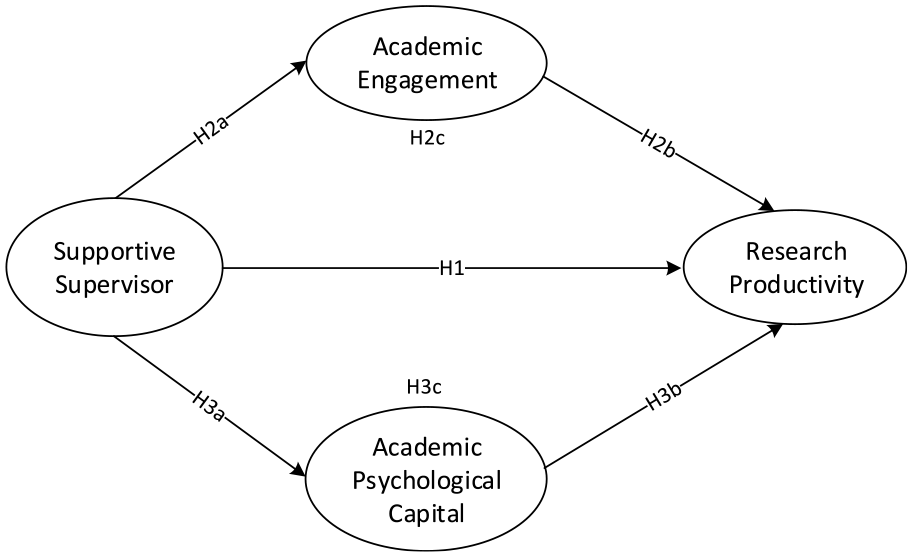
The empirical model of this study.
Method
Research Settings and Participants
According to the Chinese Ministry of Education (2018) report, approximately 492,000 international students are studying all over China in different degree programs offered by Chinese higher education institutions. Therefore, this study has only focused on international doctoral students and targeted populations, as they are pursuing education in research-oriented degree programs. With a few exceptions, most international doctoral students conduct scientific research under a Chinese professor (supervisor), contributing significantly to enhancing new knowledge during their doctoral candidature (Fan et al., 2019), a suitable research population for this study.
Sample and Procedure
An online survey (WeChat) has been conducted from the international doctoral students enrolled in a league of nine Chinese research-oriented universities (C9 League). The C9 League includes Tsinghua University (TU), Peking University (PU), Shanghai Jiao Tong University (SJTU), Fudan University (FU), Zhejiang University (ZU), Nanjing University (NU), Harbin Institute of Technology (HIT), University of Science and Technology (USTC), Xi’an Jiao Tong University (XJTU). We considered drawing a sample from C9 League universities based on their ranks, academic research achievements, and relatively high concentration and enrollment of international students. The questionnaire accompanied a cover letter to assure the anonymity of the respondents. The respondents were assured that their information would be kept confidential and not used for any other purpose other than this research. The respondents were also told that there were no right and wrong answers, and they were free to choose an option to rate a question. It aimed to reduce the evaluation apprehension and social desirability bias of the respondents.
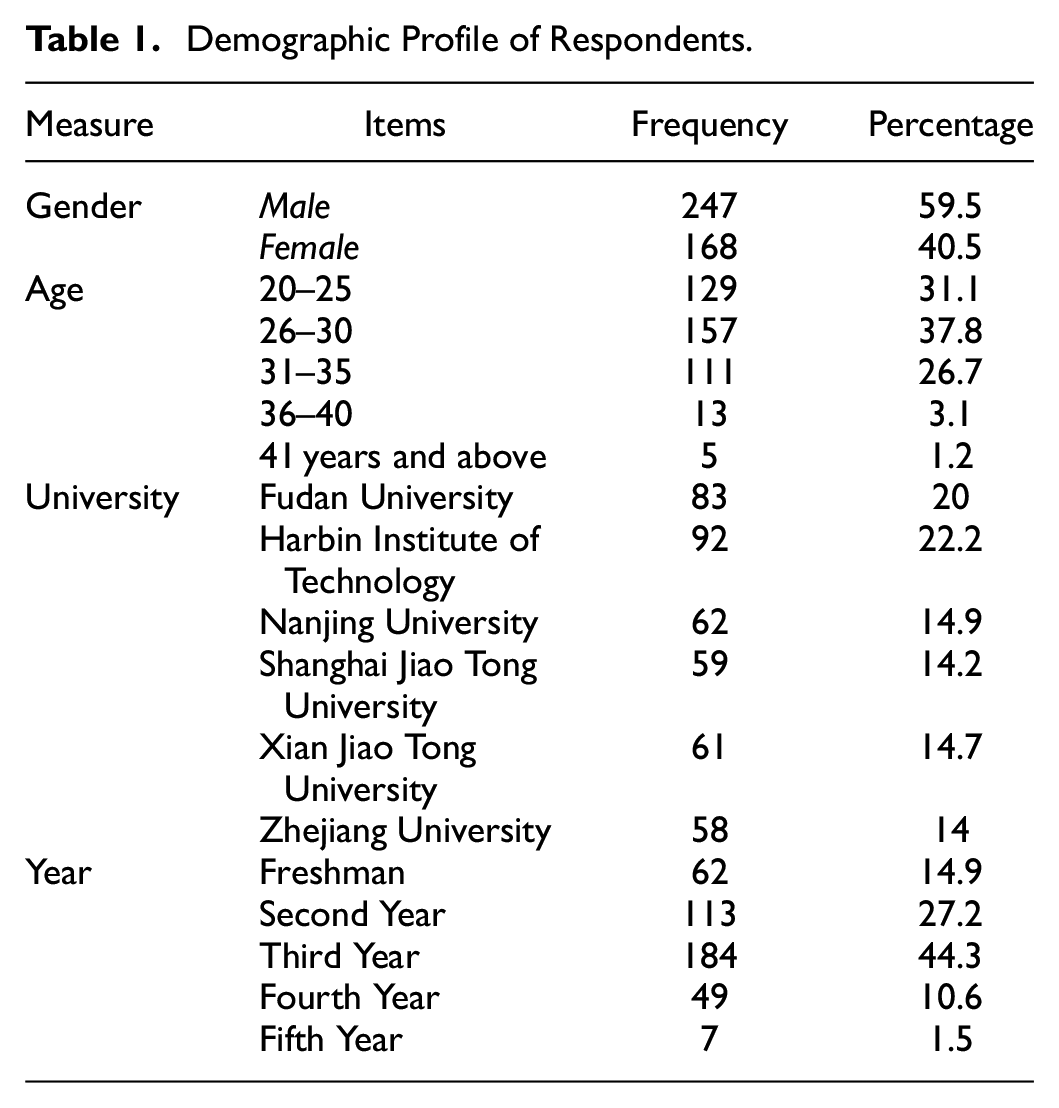
Currently enrolled international doctoral students from only six universities (XJTU, HIT, FU, NU, HIT, ZU) participated in an online survey conducted through social networking application named (WeChat). A total of 470 answers were recorded without data missing; however, 55 of the total responses (470) were deleted because the respondents were careless or inattentive, as is apparent by having the same score on almost all questions in the survey questionnaire. Finally, 415 (88%) out of 470 responses were considered in this study. Detailed demographics of respondents are shown in Table 1.
Demographic Profile of Respondents.
Measure
Supportive Supervisor (SS)
Supportive supervisors were measured with the 4-item scale adopted from (Parker et al., 2006). A sample item is included, “My supervisor encourages us to expect a lot from ourselves,” and “My supervisor encourages us to be aware of our level of performance.” All items were assessed on a seven-point Likert scale, ranging from 0 (strongly disagree) to 6 (strongly agree). The Cronbach’s α for this scale was 0.83.
Academic Engagement (AE)
With its three dimensions (vigor, dedication, and absorption), academic engagement was measured using the 9-items Utrecht Work Engagement Scale (Schaufeli et al., 2006). A sample item included, “When I am doing my work as a student, I feel bursting with energy.,”“My studies inspire me.” and “I am immersed in my studies.” All items were rated on a seven-point Likert scale that ranged from 0 = “strongly disagree” to 6 = “strongly agree.” The Cronbach’s α for this scale was 0.93.
Academic Psychological Capital (APC)
In an academic context, psychological capital was measured with the 12-item scale adapted version of the Psychological Capital Questionnaire (Avey et al., 2011). A sample item is included “I feel confident contributing to discussions about strategies in my studies.”“I can think of many ways to reach my current goals regarding my studies.”“I am optimistic about what will happen to me in the future as it pertains to my studies.” All items were rated on a seven-point Likert scale ranging from 0 (strongly disagree) to 6 (strongly agree). The Cronbach’s α for this scale was 0.94.
Research Productivity (RP)
RP and its operationalization are scholars’ primary concerns, as it has both (tangible and intangible) scientific outcomes (Abramo & D’Angelo, 2014). Instead of pointing to the number of publications using WoS and Scopus, we prefer to use a 9-item scale to assess the RP adapted by (Kozhakhmet et al., 2022), developed by (Kahn & Scott, 1997). The scale covers a wide range of research activities (i.e., publications, conferences, and data gathering). A sample item is included “A total number of published articles as authored or co-authored in refereed journals.”“How many presentations you have made in research conferences or conventions locally, regionally, or internationally.” The Cronbach’s α for this scale was .93.
Control Variable
Age, gender, major, country, and year in current degree programs have been demonstrated to impact research productivity (Khuram et al., 2022; Horta et al., 2018); therefore, these control variables are considered and included in our study.
Data Analysis
SPSS 23 and AMOS 23 have been used to analyze the data in this research study. The analysis was performed in two steps: initially, confirmatory factor analysis (CFA) is performed to measure the scale items underlying hypothesized latent variables (Kline, 2015), and then structural equation modeling (SEM) tests are performed to test the hypothesized relationships.
Measurement Model Assessment
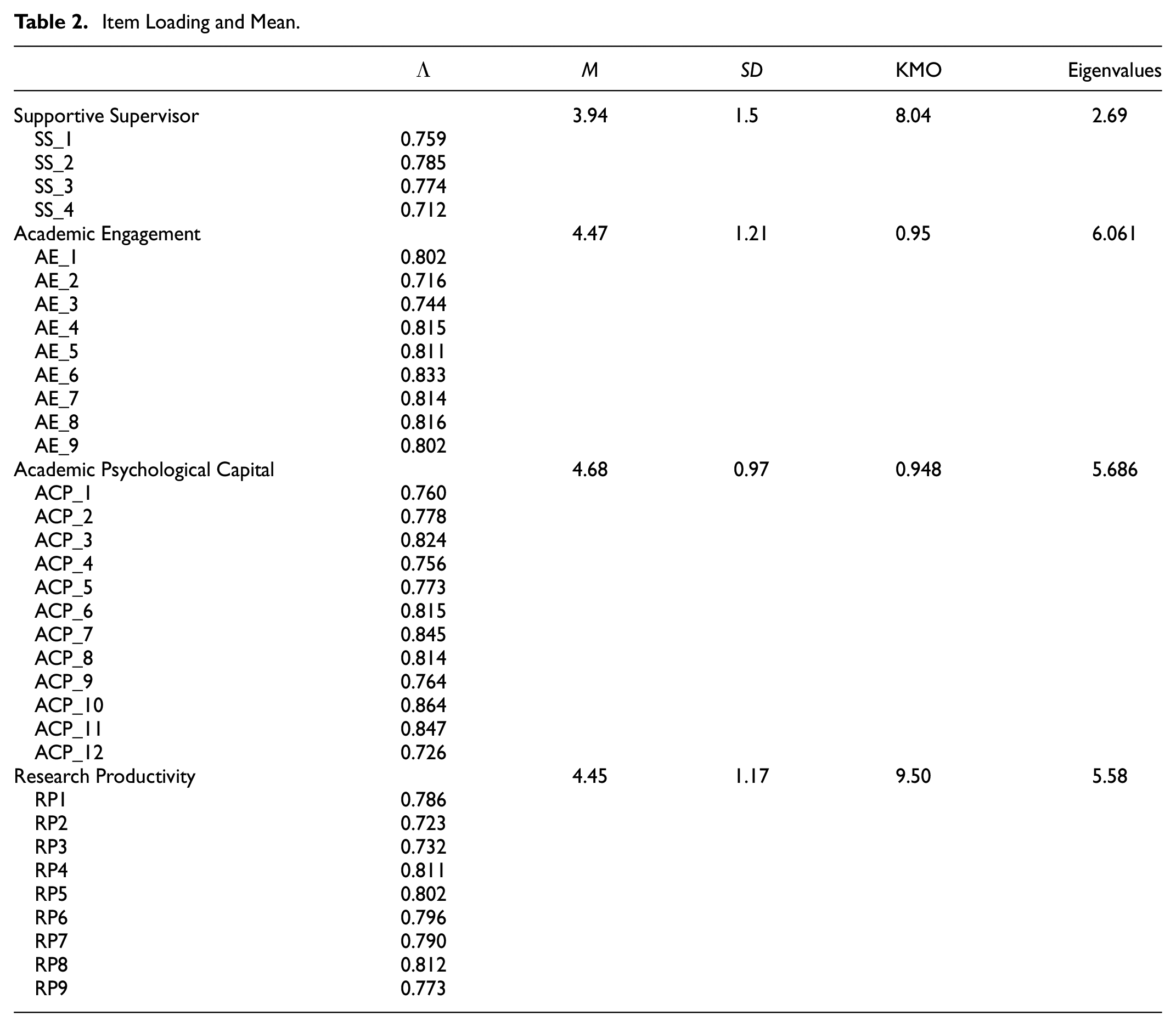
Based on Hair et al. (2006), a model measurement was used to confirm the reliability and validity of constructs. All the 34 indicators of this study were determined to be intact from exclusion, as the factor’s loadings were found greater than recommended 0.60 value. Furthermore, the KMO Kaiser-Meyer-Olkin (KMO) measure of sampling adequacy is 0.944, p < .05; Chi-square = 9795.415, p < .05, while conducting a factor analysis and eigenvalues are reported higher than 1. Table 2 exhibits the factor loadings of constructs with mean, standard deviation, KMO, and eigenvalues.
Item Loading and Mean.
Confirmatory Factor Analysis
The CFA results demonstrate that the hypothesized four-factor model was appropriate for the data. The results of the CFA indicated an excellent model fitness with the results of (X2 = 933.78, df = 521, X2/df = 1.82, p < .001, CFI = 0.96, TLI = 0.95, SRMR = 0.03, RMSEA = 0.04). The standardized factor loadings results were found higher than 0.7. After that, the composite reliability, convergent validity, and discriminant validity were evaluated in four latent variables using Fornell and Larcker (1981). As a result, CR values were found higher than 0.7 for all constructs, indicating a high level of internal consistency (Bagozzi, 1983; Fornell & Larcker, 1981). The convergent validity was confirmed by the average variance extracted (AVE). AVE values for all constructs are higher than 0.5, indicating no convergent validity issues for these constructs. The AVE values of all models have a 0.5 significance (Sarstedt et al., 2016). Average variance extracted (AVE) values confirm the convergent validity. In order to achieve convergent validity among the constructs, the AVE values should be greater than 0.5 (Sarstedt et al., 2016). For all constructs, AVE values were higher than 0.5 and reported no convergent validity issues between constructs of the study. The method by Fornell and Larcker (1981) was used for verifying the discriminant validity. According to standard standards, the AVE square root value must be higher than the correlation value of all the constructs, as demonstrated in Table 3.
Descriptive Statistics and Correlation.

Note. The bold diagonal letters indicate the AVE’s Square root. AVE = average variance extracted; α = Cronbach’s alpha; CR = composite reliability; SS = Supportive Supervisor; AE = Academic Engagement; APC = Academic Psychological Capital; RP = Research Productivity. Variance extracted is on the diagonal: Correlations are off-diagonal.
Model Fit
After confirming the scale’s reliability and validity, we move next to check the model’s fitness. To assess and analyze the adequacy of the structural model, well-known fit statistics four models containing X2, the root mean square error of approximation (RMSEA), the Tucker–Lewis index (TLI), and the comparative fit index (CFI), have been applied as a model fit indicator (Kline, 2015). The model fitness is considered acceptable when the test results indicate that the value of X2 is significant, CFI and TLI values are higher than 0.9, and RMSEA should be less or equal to 0.08 (Kline, 2015). We performed a series of model comparison tests to confirm the hypothesized model based on the indications and methodology used (Ali, Li, Khan, et al., 2021; Ali, Li, Durrani, et al., 2021). The (M0) model values showed a good fitness result (X2 = 881.116, df = 459, RMSEA = 0.047, CFI = 0.953, and TLI = 0.949). We eliminated the direct path between SS and RP in the alternative model (M1); however, this model results also displayed good fit values, which indicate its model fitness (X2 = 881.116, df = 459, RMSEA = 0.047, CFI = 0.953, and TLI = 0.949). Compared to the hypothesized model, X2 increased by 0.006, CFI reduced by 0.003, and TLI reduced by 0.001, whereas the degree of freedom added 1. We have detached the mediating role and have removed the pathways from APC and AE to RP in the second alternative model (M2). The model was also a good fit (X2 = 885.122, df = 461, RMSEA = 0.048, CFI = 0.951, and TLI = 0.948). Compared to the M0 model, the X2 values increased by 13.029, the DF improved by 2, and CFI and TLI reduced by 0.002 and 0.001; this indicates a decreasing trend for CFI and TLI. We have also sequentially regressed all the variables in the third alternative model (M3). The results suggest that the values of this model (M3) were not better fit as a model (M0) M0 (X2 = 873.881, df = 461, RMSEA = 0.047, CFI = 0.954, and TLI = 0.950). Accordingly, the (M0) was observed the better among alternative (M1, M2, M3) models (see Table 4).
Model Comparison.

Note. SS = Supportive Supervisor; APC = Academic Psychological Capital; RP = Research Productivity; AE = Academic Engagement.
Structural Model Testing
The reliability and validity of the measurement model have been established; a structural model testing, the subsequent step was to test the structural model (Hair et al., 2013) to determine the model’s productiveness and its association with proposed structures. Structural model testing in this analysis was conducted on two steps models. Only control variables are entered in Model 1 in the first step; in the second step, main and control variables are entered in Model 2. The main effects analysis results showed that the supportive supervisor was significantly related to RP (β = .13, p < .001), supporting H1 of the study. However, test results of supportive supervisors in H2a, and H3a were shown as a significant predictor of AE (β = .22, p < .001) and academic psychological capital (β = .16, p < .001). The test results of H2b AE (β = .12, p < .001) and H3b academic PsyCap (β = .12, p < .001) also displayed a significant association with research productivity. It is vital to note that the results also indicate that controls were insignificantly linked to research productivity; these findings have not influenced the primary variable’s relationships (see Table 5).
Structural Equation Model Path Analysis Results.

Note. Model 1: Controls were regressed on the dependent Variable (Note: no other variable was added to analysis). Model 2: Complete model was run, and the dependent variable was controlled. SE = Standard error; SS = Supportive Supervisor; APC = Academic Psychological Capital; RP = Research Productivity; AE = Academic Engagement
p < .05. **p < .01. ***p < .001.
Further, the relationship between H2c and H3c analysis is conducted through the bootstrapping method (Preacher & Hayes, 2008); the bootstrapping test helps identify the mediating effects of sample distribution skewed from 0 (Shrout & Bolger, 2002). Besides, Model 4 in PROCESS has been adopted to test the mediation effects (Preacher & Hayes, 2008). It is estimated that 95% of the confidence intervals (CI) are bootstrapped with a sample of 5,000 data. According to the conventional standard of significance, upper and lower bound findings remove 0 for AE and academic PsyCap. The results of the bootstrap, as demonstrated in Table 6, shows a positive mediation effect of AE between the supportive supervisor and the RP (β = .03, SE = 0.01, p < .05, CI 95% [0.007, 0.053]). Additionally, academic PsyCap has significantly and positively mediated the relationship between SS and RP (β = .02, SE = 0.01, p < .05, 95% CI [0.007, 0.087]). These results show the significant direct relationship between supportive supervisor and research productivity, which indicates that mediation effects of AE and academic PsyCap partially affect the supportive supervisor and RP (see Table 6).
Mediation Estimation Effects.

Note. SS = Supportive Supervisor; APC = Academic Psychological Capital; RP = Research Productivity; AE = Academic Engagement.
Discussion
The current study’s findings are consistent with previous studies, as discussed in the literature review section. The current research has examined the relationship between supportive supervisors and RP with the mediating role of academic engagement and academic psychological capital. The data was collected from international students enrolled in doctoral degree programs in China. The results have shown that a supportive supervisor was directly and indirectly (via academic engagement and academic psychological capital) related to research productivity. The present study addresses the significant gaps found in the literature by conducting an empirical study to determine the relationship between the supportive supervisor and research productivity. However, the relationship between other elements (e.g., creativity and innovation persuasion) and supportive supervision has already been explored in the academic context. The current study results suggest that supportiveness should be a vital characteristic of the doctoral supervisor to carry out the research projects successfully, thereby supporting the previous study (Ali et al., 2020; Lindqvist, 2018). Moreover, given the supervisor’s role in international doctoral students’ research productivity, this study advocated the definite link between supervisor-student relationships in research-oriented practices (Franke & Arvidsson, 2011). Furthermore, the study follows a previous research call to investigate the effect of supportive supervisors on international doctoral students’ innovation and research performance (Fan et al., 2019).
The current research also shows that AE partially mediates the relationship between supportive supervisors and research productivity. Apart from the direct effect, a supportive supervisor increases performance and productivity by engaging students in research activities. These findings confirm the main argument of the previous assertion that a supportive supervisor is unlikely to affect doctoral students’ research performance unless they are deeply engaged in research-oriented activities (Ahmed et al., 2017). This finding also shows that when students experience supervisors’ supportive behavior during their interaction, they become intrinsically motivated and enjoy engaging themselves in research activities under supportive supervisors (Yidong & Xinxin, 2013). Thus, Students feel devoted and motivated to the high performance of research projects (Mainhard et al., 2009). Overall, the results obtained in this study indicate that doctoral students’ AE is a significant factor in RP that can be enhanced and achieved by having a highly supportive doctoral supervisor. Similarly, we also found similar mediation effects of academic PsyCap between supportive supervisors and research productivity. Although the mediating effect was partial, indicating that a supportive supervisor could directly and indirectly increase and enhance RP through academic PsyCap.
Accordingly, the present study also contributes to previous research indicating a more substantial impact of supervisors’ supportive behavior on students’ psychological capital (Ahmed et al., 2017). Considering the supportive supervisor’s role in the supervisee’s AE (Kahu et al., 2015) and academic PsyCap (Ahmed et al., 2017), this study takes further steps by integrating the two processes from a single perspective. It suggests that a supportive supervisor may promote AE and academic PsyCap to motivate supervisees toward productivity in research.
Practical Implication
The study has several practical implications. This study’s findings underline the importance of the supervisor’s supportiveness for RP in higher education settings. Supervisors’ supportive behavior is essential in supervision that could be improved and learned (Gu et al., 2015). Therefore, this suggests that higher education institutions, mainly research-oriented ones, should encourage supervisors’ supportive behavior from their surroundings, colleagues, and supervisees by taking specific measures. For example, such research-oriented HEIs should train both (senior and junior) supervisors to promote supportive behavior in supervising international students by designing and organizing different training sessions (Dangel & Tanguay, 2014). Supportiveness is an interpersonal relation-oriented attribute of a person. Therefore, academics can improve social interaction among international students and supervisors to exchange and share knowledge (i.e., scholarly expertise, knowledge) formally and informally. The results also reveal that a supportive supervisor improves students’ AE and ultimately leads to research productivity. The supportive supervisor gives academic freedom to their subordinates, strengthening their self-confidence and self-efficacy to manage their knowledge and engage in tasks that are important for achieving the research objectives. Academic engagement, therefore, plays an essential part in defining the individual’s connectedness with their takes, reflecting a student’s mental endurance, enthusiasm, and strength to overcome difficulties (Bakker et al., 2008). As such, doctoral students are encouraged to be more confident performers. This further implies that higher productivity is achievable when the elements of academic engagement are used appropriately. The literature has suggested a supportive environment cultivated by a supervisor to provide social and psychological resources that influence an individual’s psychological state of engagement, leading to performance and efficiency (Swanberg et al., 2011).
As mentioned earlier, supportive supervisors are friendly and take care of supervisees’ preferences and satisfaction (Ahmed et al., 2017; Fan et al., 2019), enabling them to enhance their skills and performance. A supervisor’s supporting trait encourages supervisees to develop and utilize their psychological resources during learning and conducting research activities. Such supportive behavior enhances the trust and strengthens the relationship between the supervisee and supervisor, essential for developing PsyCap resources (Ahmed et al., 2017). However, psychological resources are used to develop and manage the performance and assess their resilience to control and overcome difficulties. Supervisors and educators should develop a supportive and appreciative learning environment where students feel confident about their innovative ideas or present and share freely. The literature shows that the supervisor and academic support encourage researchers to do maximum work and maintain high-quality values, ultimately resulting in high productivity (Vuong et al., 2019).
Limitations and Future Research
As with every research, this study had some limitations, which we discussed alongside potential future research directions. First, the tested model in this study was theoretically based; however, its scope is narrow. The only outcome for a student’s doctoral journey (i.e., RP) was examined. Although the presence of RP as an outcome indicator is consistent with the rationales, the RP reflects the core outcome of students during their doctoral candidature (Abramo & D’Angelo, 2014) under a supportive supervision style. However, future scholars are urged to investigate another supervising style and its influence on students’ productivity/outcomes. Such future studies will enable them to investigate distinct relationship trends of supervision style and performance components and the mediating role of their psychological factors (i.e., academic engagement and academic psychological capital) (Lindqvist, 2018). Similarly, the mediating role of students’ academic commitment and adjustment with buffering effects of stressors/strains may also need to be examined; such factors are asserted to influence learning significantly. It may be a potential topic for future study since studies investigate students’ perceptions of supervision quality and support. Second, this research is a cross-sectional, designed study that is broadly applied in higher education research. However, given the psychological factors (i.e., academic engagement and PsyCap) may change with time and environment, a longitudinal research design may uncover some interesting findings.
Third, although CFA has identified four different constructs, the potential common method variance cannot be ignored due to the study’s design (cross-sectional). Nevertheless, we attempted to address this issue using Harman’s one-factor test (Podsakoff et al., 2003). The test results indicated the 22.9% variance reported in single-factor tests below 50% of the threshold (Ali et al., 2020). They suggested that the common method bias is not a severe problem. However, future researchers can use longitudinal design and multi-sources for data collection to address the potential biases connected with the data of cross-sectional studies. Fourth, we only choose international doctoral students studying in Chinese universities as a respondent to measure the supervisor’s supportive behavior during doctoral candidature. Doctoral supervisors and supervisees may have different expectations and perceptions regarding doctoral supervision. In this sense, both supervisors and students can be included from other Chinese HEIs in future studies and further improve our understanding.
Moreover, researchers in future studies can replicate the current study from any other (i.e., cultural and organizational) perspectives. In particular, as supporting supervision is a relation-oriented supervision style, more research studies could be done to assess the impact of RP compared with culture to culture from high to low and relation-oriented supervision to the task. It will be interesting to see if supportive supervision contributes to opposite outcomes; Fan et al. (2019) stated that more support could affect students’ independence and performance. Accordingly, the literature indicates that most empirical studies on supportive behavior demonstrate positive effects (Gu et al., 2015). However, it is uncertain whether supportive behavior can cause adverse outcomes, such as slower or underperformance of the followers.
Finally, it is worth noting that the present study’s sample size was not predetermined. As sample size may influence the heftiness of findings and results; therefore, future scholars are urged to use the priori power analysis method for determining an adequate sample.
Conclusion
This study established that a supportive supervisor is significantly influencing the RP of doctoral students. Moreover, the current study’s findings are consistent with previous studies and revealed that SS could develop supervisees’ capabilities by increasing their psychological factors (i.e., AE and PsyCap) (Ahmed et al., 2017). Therefore, individuals become more resilient and engaged in handling academic challenges by taking tasks seriously and performing scholarly activities. The findings encourage HEI’s authorities to design training sessions for supervisors to develop their supervising skills that improve the quality of supervision, doctoral education, and students’ development (Halse & Malfroy, 2010). This research showed that a productive doctoral supervisor is highly supportive through such motivation pushing the students to a high productivity level. It indicates that supporting supervisors’ quality makes them useful as their followers get inspiration, recognition, and appreciation. The research study founds two primary characteristics of students: academic engagement and psychological capital with a substantial impact on research productivity; these attributes thrive under the guidance of a supportive supervisor.
In sum, all the results reported in this study are aligned with COR principles (Hobfoll, 1989, 2001) that expand our understanding of the relationship between supportive supervisor and student research productivity through parallel mediation effects of AE and PsyCap. This research is noteworthy because it widens the supervision-style literature in higher education settings and tests the mediating effects of AE and PsyCap on international doctoral students’ research productivity in China.
Footnotes
Declaration of Conflicting Interests
The author(s) declared no potential conflicts of interest with respect to the research, authorship, and/or publication of this article.
Funding
The author(s) received no financial support for the research, authorship, and/or publication of this article.
Ethical Procedure
• The research meets all applicable standards concerning the ethics of experimentation and research integrity, and the following is being certified/declared true.
• As an expert scientist and co-authors of the concerned field, the paper has been submitted with full responsibility, following the due ethical procedure. There is no duplicate publication, fraud, plagiarism, or concerns about animal or human experimentation.
Data Availability Statement
The datasets collected and analyzed during the current study are available from the corresponding author upon reasonable request.
