




Abstract
The popularity of Mukbang has become a global trend, thus understanding why people watch Mukbang videos can shed light on cultural shifts and consumerism. Therefore, the purpose of this study is to identify the motivation factors that impact Mukbang consumption using the extended Uses and Gratifications (U&G) Theory, with immersion as a moderator. Quantitative research through the online questionnaire was distributed using purposive sampling with 269 valid responses. The results of structural equation modeling revealed that Compensation, Information Seeking, Media Appeal, and Social Presence had a positive and significant impact on Mukbang consumption. However, Enjoyment, Escapism, and Social Interaction were not significantly related. In addition, the moderating role of Immersion was only established between Media Appeal and Mukbang content consumption. The study contributed to the U&G Theory by expanding the new motivation determinants (e.g., Media Appeal, Compensation, Social Presence) and the inclusion of Immersion which is unique in a single framework in emerging markets. The study provided insight to Mukbang content creators and food brand marketers to understand the motivations of the viewers consuming Mukbang content. The findings can help the creators and marketers curate and tailor their content to better engage with the audiences, potentially grow their channels, and improve branding.
Introduction
In recent years, the media industry has undergone a profound transformation with the advent of new media (Yin, 2023), which has reshaped how content is produced, distributed, and consumed. The rise of digital platforms and the proliferation of user-generated content have democratized the media landscape, empowering individuals to create and share content on a global scale (N. Çınar, 2020). This shift has led to the emergence of diverse media genres and formats, catering to the evolving tastes and preferences of media users worldwide.
One phenomenon that has captured the attention of audiences globally is Mukbang, a unique genre of broadcasted eating shows that originated in South Korea (Anjani et al., 2020). The term “Mukbang” is derived from the combination of the Korean words “meok-neun” (eating) and “bang-song” (broadcast) (E. K. Kang et al., 2020). Mukbang first gained popularity in the late 2000s (Yoon, 2023) as a form of online entertainment where hosts, known as “broadcast jockeys” or BJs, consume large quantities of food while interacting with their viewers in their live streams. This interactive and visually stimulating format quickly resonated with audiences, leading to its rapid spread across various digital platforms.
Mukbang’s origins can be traced back to South Korea’s burgeoning online culture, where it emerged as a response to the increasing number of people eating alone (Harris, 2023). The concept offered a sense of companionship and a virtual dining experience, making it particularly appealing to individuals seeking social connections (Fong & Chang, 2024). Over time, Mukbang has evolved beyond its initial premise, incorporating elements of Autonomous Sensory Meridian Response (ASMR), cooking tutorials, and food reviews, further expanding its appeal (Sultana & Das, 2022).
In Malaysia, Mukbang has gained significant traction, with local content creators and viewers embracing the trend (Durai, 2019). The motivations behind Mukbang content consumption in Malaysia are multifaceted, reflecting a blend of cultural influences, social dynamics, and individual preferences (Nur Hasliza, 2022). As Mukbang culture directly reflects societal trends related to food and digital media, understanding why people watch Mukbang videos can shed light on cultural shifts and consumerism.
In recent years, the phenomenon of Mukbang-watching has gained significant popularity among viewers, especially on YouTube (Yoon, 2023). The popularity of this trend raises questions about the underlying factors that motivate viewers to watch Mukbang content. The surge in Mukbang content consumption reflects that users enjoy the interesting content of Mukbang and also seek information related to food and beverages (Song et al., 2023). Considering that millions of views have been recorded on social media platforms such as YouTube, the provision of more mukbang-related information may become a trend in the future (Song et al., 2023). Thus, it indicates the need for systematic research on users’ information behavior and mukbang content. Besides, prior literature demonstrates that escapism can increase the Mukbang-watching behavior of university students, which suggests that viewers tend to engage in such online activity if they perceive that they can successfully escape from their unfavorable reality (Kircaburun et al., 2023). Therefore, based on the literature, the present research seeks to examine the association between escapism as a motive and Mukbang consumption.
Past studies have discussed motivations influencing Mukbang-watching, however, they are focusing on audiences in South Korea (S. Stein & Yeo, 2021), India (Sanskriti et al., 2023), China (Wang, 2020), and Western countries (Ngqangashe et al., 2022). To the best of our knowledge, there is little academic research that touches on motivations influencing Mukbang content consumption among viewers in the Malaysian context. Our research identified only some recent studies on the topic of Mukbang in the Malaysian context, for instance, Tan (2023) mentioned the topic of Mukbang, however, the study focuses more on factors influencing Korean product purchasing behavior among Malaysian youths. On the contrary, other papers that have discussed the motivating factors of Mukbang-watching among viewers (Fong & Chang, 2024; Jenging, & Mohamad, 2022), did not provide an in-depth explanation of the topic.
Although previous studies have utilized U&G theory to assess the motivation to watch various media content, including Mukbang (Jiang et al., 2024; Song et al., 2023), however, the findings were inconsistent. For instance, the study found that social interaction/participation and information seeking were not significantly related to satisfaction (Jin et al., 2023). In addition, Kircaburun et al. (2023) argued that compensation is the determinant that forms the Mukbang watching motives. Besides, social presence (social gratifications) and media appeal (technological gratifications) could be potential motives to expand U&G (Gan & Li, 2018) in the continued usage of WeChat. tom Dieck et al. (2024) study found that immersion (sensual gratifications) is the motive to influence the satisfaction of augmented reality (AR). Based on the arguments above, it urged the authors to include these motives to expand the original U&G in a single framework that is unique. The immersion, despite its role, has been explored in distinct contexts, such as virtual reality, Artificial Intelligence, and live video commerce (Guerra-Tamez, 2023; C. Liu et al., 2024). However, there is a scarcity of investigations looking into its moderating effects across distinct extents in the domain of the Mukbang context consumption (Pavlič et al., 2025). This research void limits the understanding of how immersion in the Mukbang context interacts with influences on content consumption.
In addition, previous studies have mainly applied immersion from the AR technology perspective, and it has usually been applied as an exogenous variable (tom Dieck et al., 2024; Vo et al., 2022). However, there are also arguments that immersion could be a potential moderator (Zha et al., 2018), which has urged the researcher to test it as a potential moderator, where it has been less discussed in the scholarship.
Therefore, by addressing these gaps, the research will contribute to the broader field of media studies and offer practical implications for Malaysian content creators and marketers seeking to enhance their engagement strategies. It is also important to note that most studies have not captured the use of UGT on Mukbang and its theoretical application for the better conceptualization of viewers’ motivations toward Mukbang-watching (Song, 2021).
Hence, the present paper aims to test the UGT rigorously to better visualize how various forms of motivation (namely enjoyment, escapism, information seeking, social interaction, social presence, media appeal, and compensation) can impact Mukbang content consumption, with immersion as the moderator which leads to the research question as below:
RQ: Does immersion act as the moderator between motives of watching Mukbang (e.g., enjoyment, escapism, information seeking, social interaction, social presence, media appeal compensation) and Mukbang content consumption?
Literature Review
Theoretical Foundations
The UGT theory has been acknowledged as an effective theoretical framework that depicts social media consumption in the Mukbang context (Alifu et al., 2025; Kircaburun et al., 2022; Minh et al., 2024). The UGT posits that individuals seek out media based on their psychosocial needs, making the media choice an active process (Katz et al., 1973). Katz et al. (1973) divided the needs into five major categories which consist of cognitive, affective, personal integrative, social integrative, and tension release needs (Glo, 2023). According to G. Li et al. (2022), UGT provides a good reference for identifying the motivators of Mukbang videos to fulfill these needs. In the context of Mukbang content consumption, UGT is used to classify and better understand various types of gratifications—enjoyment (hedonic), information seeking (utilitarian), social interaction, and vicarious experiences.
Past studies have applied UGT to various forms of media and content consumption. For instance, UGT has been used to understand how “Liking” behavior on Facebook influences users’ intentions to continue using the platform (Hossain et al., 2019), adolescents consume food media such as cooking shows and food blogs (Ngqangashe et al., 2022; Xiao et al., 2024), users engage with live streaming platforms (Camilleri & Falzon, 2020), social media use impact individual’s social and well-being (Bhatiasevi, 2024; Chan et al., 2022). Applying the UGT model in the context of Mukbang-watching enables us to explain why individuals engage in social media activities such as watching Mukbang videos. Within the domain of food blogging, the researchers have emphasized the importance of predictive factors, such as information seeking, social interaction, and enjoyment, and their effects in driving social media behavior (Nguyen et al., 2024). Based on the above-described view, this research deems the UGT framework as a robust underpinning ground, looking into the consumption of Mukbang content.
In the present research, the UGT model conceptualizes how varying forms of gratification (e.g., enjoyment, escapism, information seeking, social interaction, social presence, media appeal, and compensation) motivate audiences to interact with Mukbang content (Song, 2021). By examining these drivers in the Malaysian context, this research seeks to pinpoint prominent motivators for local viewers, investigate their perceptions of watching Mukbang, and assess the relationship between these motivators and Mukbang consumption.
Hypothesis Development
Enjoyment refers to the pleasure and satisfaction viewers get from engaging content. Different viewers seek out various types of content based on what brings them the most pleasure and satisfaction (Kircaburun, Harris, et al., 2020). For instance, some viewers may prefer to watch live Mukbang streams where they can interact with the host in real-time. This interaction allows them to make requests, such as asking the host to eat specific foods or try certain eating styles first (Y. Li & Guo, 2021), which enhances their enjoyment and satisfaction through a sense of participation and immediacy.
Meanwhile, other viewers may be drawn to Mukbang videos that focus solely on the sensory aspects of eating (Wan Kamal et al., 2022) such as videos that feature hosts who do not show their faces or speak, allowing the focus to remain on the sounds of eating, such as crunching and slurping. This type of content, commonly known as ASMR (Mahady et al., 2023), appeals to those who find the sensory experience of eating sounds particularly gratifying, triggering a relaxing or stimulating response among viewers (Sultana et al., 2022). Thus, the below hypothesis is postulated:
H1: Enjoyment has a positive impact on Mukbang content consumption.
Escapism refers to the viewer’s innate urge to divert themselves from reality’s trouble through absorbing and captivating material (Halfmann & Reinecke, 2021). Kircaburun, Savci, et al. (2020) found that escapism is a significant motivation for consuming Mukbang videos, allowing viewers to temporarily escape from boredom or minor stress. This correlates with studies by (C. Y. Chen & Chang, 2019; Jouhki et al., 2020) which proved that media users generally turn to media as a cognitive divergent tactic to get away from daily hassles. One’s tendency to escape from life problems through media may eventually lead to excessive binge-watching behavior (Chan et al., 2022; Gabbiadini et al., 2021), which indicates that viewers who are motivated by escapism tend to watch multiple Mukbang content in one sitting (Kircaburun et al., 2022) more often. Thus, the study assumed that:
H2: Escapism has a positive impact on Mukbang content consumption.
Information-seeking is a crucial motivator for consuming Mukbang content where viewers actively engage with videos to learn about the various foods, cooking techniques, and culinary cultures. This aligns with the UGT which suggests that individuals use media based on different needs including the need to obtain information (Kircaburun et al., 2021). Firstly, learning about new dishes and getting to know different cultures through food is one reason people watch Mukbang (Kircaburun et al., 2022). This is supported by Giertz et al. (2022) who contend that the live stream content allows for real-time information sharing, making Mukbang videos an ideal platform for viewers to search for and acquire food-related knowledge (Lee & Wan, 2023). A study by Basaran and Sunnetcioglu (2021) reported on Turkish individuals who consume Japanese media content, specifically anime, showing interest in Japanese cuisine. This exposure offers viewers new knowledge and insight into different cultures. Additionally, viewers are motivated to watch Mukbang because of their desire to seek information related to food recipes and food ingredients (Kim et al., 2022; Ngqangashe et al., 2022). Thus, the study hypothesized that:
H3: Information-seeking has a positive impact on Mukbang content consumption.
Social interaction refers to how individuals engage and communicate with others in a social setting. Mukbang videos offer a space for viewers to engage with creators and other viewers, fostering a shared viewing experience (Styawan & Buwana, 2023), and strengthening community spirit among Mukbang, a requisite for societal connectivity (Kircaburun et al., 2021). Hossain et al. (2019) pointed out in their study that social media engagement through activities like liking and commenting on posts helps in gratifying users’ socio-psychological needs which can intensify their intention. Overall, social interaction plays a vital role in enhancing the appeal of Mukbang videos. The combination of live interaction, community development, and a sense of companionship generates a deeply immersive and socially satisfying watching experience. This communal element not only draws in viewers but also retains their interest. Thus, this study hypothesized that:
H4: Social interaction has a positive impact on Mukbang content consumption.
Social presence is another significant motivator for Mukbang content consumption which refers to the feeling of being socially connected and having a sense of presence with others in a virtual environment, alleviating feelings of isolation (Gutman et al., 2022). Sharing video content on social media platforms allows individuals to impress others, express themselves, and communicate a desired image (Hjetland et al., 2022). Additionally, by participating in discussions and leaving comments on videos and live streams, viewers actively reinforce their presence in the virtual community (You et al., 2023). Real-time interaction cultivates a sense of belonging and allows individuals to communicate their thoughts and preferences (M. Wang & Li, 2020). This perception contributes to their social presence and identity within their social groups, further encouraging viewers’ retention (G. Li et al., 2022). Thus, this study assumed that:
H5: Social presence has a positive impact on Mukbang content consumption.
Anjani et al. (2020) suggested that media appeal in Mukbang videos encompasses several elements, including visual aspects of the food, the creator’s attractiveness and eating style, and the interactive format of the broadcasts such as live stream which allows for instant interaction between viewers and creators. High-quality visuals and engaging audio are critical components that enhance the overall attractiveness of Mukbang videos and capture viewers’ interest (Styawan & Buwana, 2023). Spence et al. (2022) also found that the vibrant and detailed presentation of food, often featuring close-up shots and high-resolution images, makes the content visually appealing and stimulates viewers’ appetites. These factors contribute to the appeal of Mukbang content, and in turn viewer engagement and satisfaction fueling continued media consumption (Stein & Yeo, 2021). Thus, the study postulated that:
H6: Media appeal has positive effects on Mukbang content consumption.
Compensation in media consumption refers to the utilization of media by consumers as an alternative for unsatisfied desires or needs in their actual lives. This understanding is illustrated based on various contexts where individuals turn to the media to fulfill psychological or emotional needs (Xi et al., 2022). Mukbang-watching can bring satisfaction (Kircaburun et al., 2023), specifically when viewers watch Mukbang creators eat food on screen, compensating for their hunger or food cravings, also known as “vicarious eating” (E. K. Kang et al., 2020; Yoon, 2023), whereby individuals satisfy their cravings for food by watching others consume large quantities of food they want to eat.
For instance, individuals on strict diets or those with health issues that limit their food intake may use Mukbang videos as a form of compensation. This statement is also supported by the Kircaburun, Yurdagül, et al. (2020) study which highlights that viewers with dietary restrictions often report feeling less deprived when they watch Mukbang videos, as it helps them manage their cravings in a controlled manner. Thus, the study hypothesized that:
H7: Compensation has a positive impact on Mukbang content consumption.
Yan et al. (2023) examined the role of immersion in short video consumption behavior and found that immersion can influence reuse intention and recommendation. Besides, X. Liu et al. (2023) also find that immersion can mediate between media exposure, perceived severity, and behavioral intention. This aligned with the study that immersive experiences by social media streaming applications highly impact the user’s dependency on the applications (Xu & Tayyab, 2021). In the same vein, on checking the AR applications, it is found that immersive experiences impact attitude and intention to adopt the app significantly (Vo et al., 2022) and also improve engagement and learning styles (tom Dieck et al., 2024). As addressed by Mou et al. (2024), the immersive effects of Virtual Reality can offer social value to users through games and entertainment, thereby promoting their imagination. Such enhancement of their pleasure feelings can improve the user experience. Besides, Jiang et al. (2024) found that immersing in watching Mukbang content can help to satisfy the individual crafting for foods, whereas vicarious gratifications (compensation) through the visual and audio simulation can strengthen the Mukbang ASMR consumption. Zha et al. (2018) found that immersion positively moderates the information quality and informational fit-to-task in the social media literature. Similarly, Tsou and Putra (2023), also found that enjoyment of the gamification attribute impacts customer engagement and brand love, and immersion as the moderator to strengthen those variables. This has been supported by the study of Kiszka et al. (2024), where the immersion moderated between gaming time and its disorders and prominently for male samples. Based on the above discussion, it is postulated that:
H8: Immersion moderates the relationship between the U&G motives: (a) enjoyment, (b) escapism, (c) information seeking, (d) social interaction, (e) social presence, (f) media appeal, (g) compensation and Mukbang content consumption, where immersion strengthen the impact of U&G motives on Mukbang content consumption.
Figure 1 illustrates the conceptual framework of this study.

Proposed conceptual framework.
Methodology
Research Design
This study employed a quantitative research design in the form of an online questionnaire. Quantitative research involves a systematic investigation of a phenomenon through the gathering of numerical data and the utilization of statistical or computational tools and techniques (Pandey et al., 2023). Furthermore, quantitative research aims to quantify the data and generalize findings from a sample of a study from varied perspectives (Ghanad, 2023).
Sampling Procedure
A purposive sampling method was used for this study. Purposive sampling is a non-probability sampling method in which researchers choose respondents based on specific criteria, ensuring that the sample is relevant to the study and able to fulfill the research objectives (Makwana et al., 2023). Hence, the research only focuses on participants who are familiar with and watch Mukbang content by incorporating a screening question, that is, “Have you watched Mukbang videos before?” Researchers utilized G*power analysis to identify the suitable sample size. G*Power is recommended to identify sample size and power calculations for various statistical methods (H. Kang, 2021; Memon et al., 2020). After inputting the necessary data, G*Power 3.1.9.2 software indicated that the minimum sample size for the current study is 166 (effect size: 0.15; power: 0.90; number of predictors: 14). The current study has 269 valid responses which is sufficient.
Measurement
The questionnaire consists of four (4) main sections which are Section A, B, C, and D. Section A consists of respondents’ demographic profiles such as gender, age, education level, ethnicity, and screening questions. Sections B and C include items for the variables. Items for enjoyment were adapted from (Anjani et al., 2020; Kircaburun et al., 2023; Song, 2021). Escapism items were adapted from (Anjani et al., 2020; Kircaburun et al., 2023), information-seeking items were modified from (Anjani et al., 2020; Kim et al., 2022; Song, 2021), social interaction items were adapted from Ajani et al. (2020). Items for media appeal were adapted from (Anjani et al., 2020; Song, 2021; Stein & Yeo, 2021), compensation items were adapted from (Kim et al., 2022; Kircaburun et al., 2023), and social presence items were modified from Botha et al. (2016) and the immersion items were modified from the Hamari et al. (2016). Section D includes items for the Mukbang content consumption that were modified from Styawan and Buwana (2023). The survey items for Sections B, C, and D, are designed as statements measured on a five-point Likert-type scale where 1 represents Strongly Disagree and 5 indicates Strongly Agree. To ensure the reliability and validity of the responses, five (5) social desirability questions are included in the survey. This method helps to control social desirability bias as respondents may provide answers based on what they believe to be socially acceptable instead of based on their actual opinion (Andersen & Mayerl, 2019; Bernardi & Nash, 2022).
Data Collection Procedure
An online Google Forms questionnaire was distributed through various digital platforms including WhatsApp and Instagram, this can be explained that survey research-based social media platforms can improve the efficiency of the data collection (Ibrahim et al., 2019), cost-effective, quicker response, and able to reach wider target samples as compared to the offline survey (Gunter et al., 2002). Participants were conveniently approached and invited to participate voluntarily. Moreover, the use of online surveys can guarantee personal data privacy and confidentiality, and this was indicated on the cover page of the form.
Data Analysis and Statistical Procedure
Partial Least Squares Structural Equation Modeling (PLS-SEM) is a variance-based multivariate statistical analysis used to investigate the complex relationships between variables, particularly in social sciences research (Hair & Alamer, 2022). As suggested by Tian et al. (2024), PLS-SEM is appropriate for addressing complex research models and predictive-orientations associations between exogenous and endogenous variables. Thus, this study framework has nine constructs and has a moderator, which justified PLS-SEM as appropriate to examine the complex framework. Through a PLS-SEM analytical approach, the measurement model and structural model were assessed.
Results
Based on Table 1, the majority (74.7%) were female respondents. Besides, more than half of the respondents were between 21 and 25 years old (62.1%), which indicates the respondents are mostly young adults. About education, the majority have earned a bachelor’s degree (69.5%), which shows that they are educated and able to make wise decisions. For the daily time spent, more than half of the respondents rarely watched Mukbang videos (54.3%).
Profile of Respondents (N = 269).

Common Method Variance
Common Method Variance (CMV) is the same source bias that may arise using self-report measures from a similar sample in the survey method (Jordan & Troth, 2020). Hence, to test the CMV, the researchers used a full collinearity assessment. The cut-off value for the variance inflation factor (VIF) is that it should be less than 5 as suggested by Kock (2015). All variables met this criterion, indicating that there is no same source bias in this study (see Table 2).
Full Collinearity Assessment.

Assessment of Measurement Model
Hair et al. (2021) and Henseler et al. (2009) highlighted that reliability can be measured using factor loadings and composite reliability (CR). As shown in Table 3, the loading of all items is more than 0.708 as suggested by Hair et al. (2019). All Cronbach’s alpha values surpassed the cut-off value of .7 (Hair et al., 2021). Discriminant validity was carried out to test the validity of constructs. Hair et al. (2021) highlighted that the CR should exceed .70, while the Average Variance Extracted (AVE) should be more than 0.50. Thus, the convergent validity is confirmed (see Table 3).
Convergent Validity.

Heterotrait-Monotrait Ratio of Correlations (HTMT) was used to examine the discriminant validity (Henseler et al., 2015). Based on Kline (2015), the value of HTMT should not be more than 0.85. As demonstrated in Table 4, all HTMT values did not surpass 0.85 which ascertained the discriminant validity. The researchers used the variance inflation factor (VIF) to detect the collinearity issue, Hair et al. (2019) mentioned that the VIF value should not be more than 5. Thus, there is no severe collinearity issue.
Discriminant Validity Using HTMT Ratio.

Assessment of Structural Model
Bootstrapping with 5,000 resamples (Preacher & Hayes, 2008) was used to test the structural model. The results depicted in Table 5 show that Information Seeking (β = .091, t-value = 1.831, p < .05), Social Presence (β = .109, t-value = 1.730, p < .05), Media Appeal (β = .233, t-value = 3.662, p < .05) and Compensation (β = .153, t-value = 2.539, p < .05) have a positive and significant impact on the Mukbang content consumption. Thus, H3, H5, H6, and H7 are retained. However, enjoyment, escapism, and social interaction were not significant motives for Mukbang content consumption, thus rejecting H1, H2, and H4.
Direct Effects.

Note. S = Supported; NS = Not supported; LLCI = Lower Limit Confidence Interval; ULCI = Upper Limit Confidence Interval.
1-tailed test.
p-value < .05. **p-value < .01.
Moderation Analysis
Immersion as a moderator was incorporated to test the relationship between the motivational factors and Mukbang content consumption. The empirical findings showed a significant moderating path of immersion on the media appeal and Mukbang content consumption (β = .112, t-value = 2.089, p < .05). Therefore, H8f was confirmed (see Figures 2 and 3; Table 6).
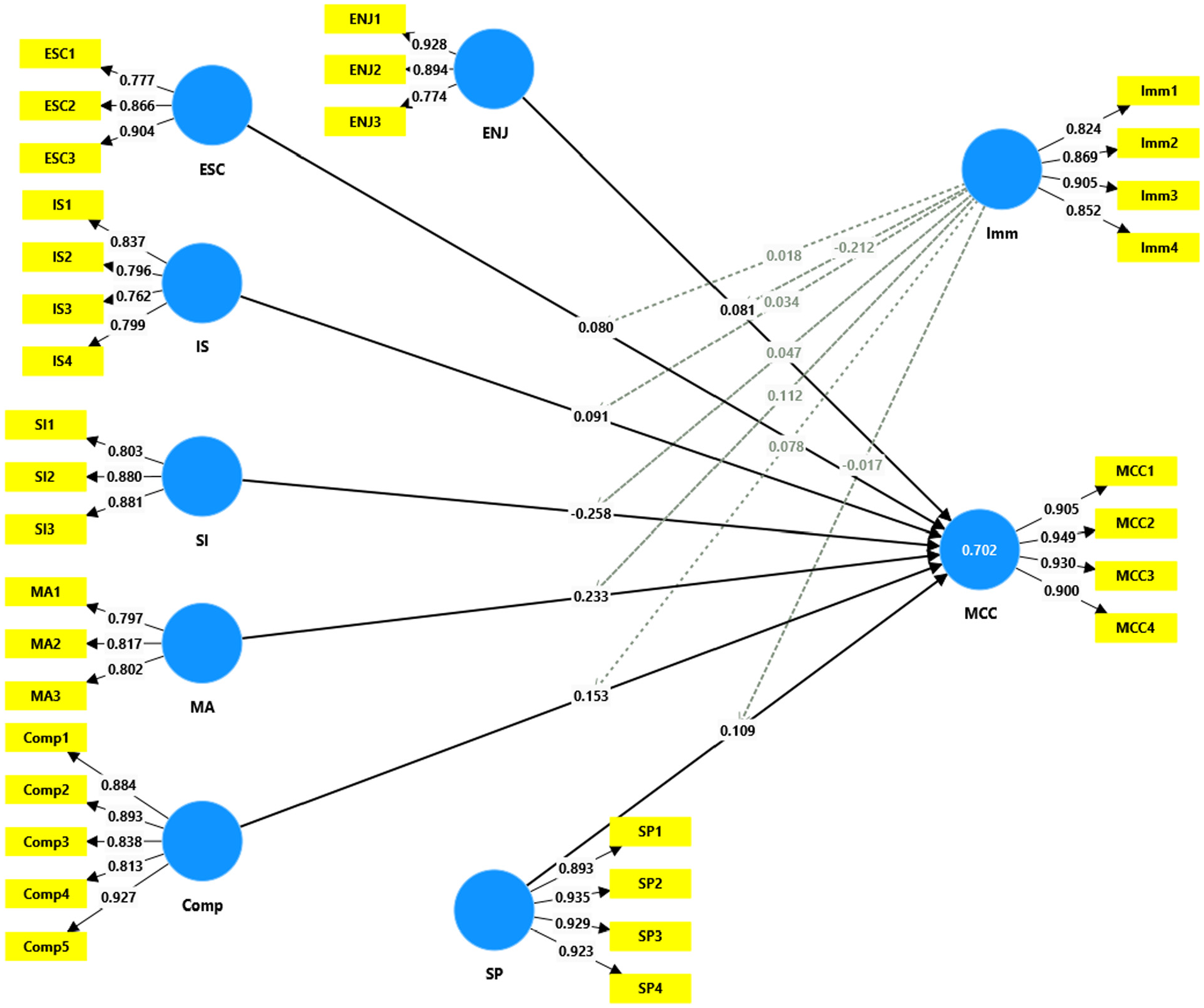
Structural model.

Interaction plot.
Moderation Analysis.

Note. S = Supported; NS = Not supported; D = Decision; LLCI = Lower Limit Confidence Interval; UL = Upper Limit Confidence Interval.
1-tailed test.
p-value < .05.
PLS-predict Analysis
PLS-predict was used to solve the apparent dichotomy between explanation and prediction (Shmueli et al., 2019). Since the results of Q2 predict values were all more than zero (see Table 7), the Q2 predict indicates the model has sufficient predictive relevance. Hence, it indicated that the Mukbang content consumption has a medium predictive power.
PLS Predict.

Discussion
Media appeal was found to be the most prominent motivator of Mukbang content consumption. This corresponds with the findings of numerous past studies (Anjani et al., 2020; Styawan & Buwana, 2023) in which viewers are positively motivated to watch Mukbang because they are drawn to Mukbang visual presentation and the eating style of the streamers (Spence et al., 2022).
The study also found social presence to be a significant motivator of Mukbang content consumption. This result is confirmed by a Song et al. (2023) study on Mukbang-watching which suggests that viewers are motivated by their desire to establish parasocial relationships online, which in turn, influences their continuous consumption of Mukbang content. Kircaburun et al. (2021) also found that social presence is a stronger predictor of Mukbang-watching. This is also supported by a study by Fong and Chang (2024), which found that Malaysians can get addicted to Mukbang videos as they allow viewers to engage in parasocial interactions with Mukbang artists and fellow audience members on social media, and form a virtual marketplace of social interactions that transcends physical distances.
Besides, compensation was found to be a significant motivator of Mukbang consumption. This result confirms the findings of Kircaburun, Harris, et al. (2020) that Mukbang-watching is used to fulfill viewers’ virtual compensation. The result is also congruent with the findings of Song (2021) on Mukbang user’s consuming behavior which found that viewers who obtain vicarious gratifications from watching Mukbang are heavy consumers of Mukbang content (E. K. Kang et al., 2020; Yoon, 2023). Finally, this study’s findings also mirror the results by Jiang et al. (2024) who found that vicarious satisfaction led to increased Mukbang ASMR addiction among Malaysian university students. For those who are addicted to Mukbang ASMR, watching these videos gives them vicarious satisfaction and compensation, as if they are eating the food themselves, consequently leading to satisfying their cravings. For female Mukbangers in Malaysia who are concerned with their body appearance and weight, just watching others eat would offer them the satisfaction of imagining what the food tastes and feels like without actually eating it themselves.
Information seeking was found to be a significant motivator for Mukbang content consumption. This finding is congruent with the results of (Song et al., 2023) which highlighted information seeking as a major factor driving engagement with Mukbang content, where viewers are motivated to watch Mukbang because of their desire to seek information like food recipes and food ingredients (Kim et al., 2022; Ngqangashe et al., 2022). As Malaysia is a food paradise with diverse culinary cultural traditions and influences (Muhammad Reza et al., 2020), sharing information via Mukbang videos allows social media users to learn about different cultural cuisines in Malaysia or inspire them to try new local recipes or cooking methods.
Although social interaction was found to be a significant motive to consume Mukbang content, it negatively influenced Mukbang content consumption among viewers in Malaysia. This result is in contrast with a study by Styawan and Buwana (2023) which found social interaction to be a significant motivator for Mukbang watching intention. However, in a collectivistic culture like Malaysia, particularly for working adults with heavy social commitments, watching Mukbang videos may not fulfill their social interaction needs. Mukbang videos are a largely individualistic activity, which may not appeal to those who use the media for social engagement or group-oriented activities. Additionally, Mukbang videos involve eating large quantities of food, which can be perceived as unhealthy or excessive among those around their social circle. A majority of respondents in this study are Malay Muslims (i.e., 75.1%); Islam does prohibit wasting food or showing off, which may be essential elements in a Mukbang video. Overall, although it may be entertaining, social interaction does appear to be a weak negative predictor of Mukbang content consumption due to these reasons.
Based on the findings, enjoyment was not found to be a significant motivator for Mukbang content consumption. This result is surprisingly in contrast with the findings from past studies of Kircaburun et al. (2023). Similarly, it is possible that since Malaysia is a predominantly Muslim country where being wasteful is frowned upon, perhaps a majority of the respondents in this study, might not find Mukbang videos entertaining, or perceive it as a lowbrow form of entertainment that is considered as less sophisticated and intellectually demanding (Minh et al., 2024). They may even find it vulgar, inappropriate, or even harmful.
Escapism was also found not to be a significant motivator among Mukbang watchers in Malaysia. This result contrasts with the findings of Kircaburun et al. (2022), who identified escapism as a significant factor driving Mukbang content consumption. For this study, it appears that Malaysian viewers are motivated by a different desire other than escape from reality when consuming Mukbang content. For instance, they may be more motivated to connect with Mukhbang artists when watching videos, or cultural curiosity about food and engaging in vicarious eating (i.e., compensation) rather than just a simple desire to escape from everyday life or reality.
Further, the insignificant results may occur due to the different demographic backgrounds of the respondents as previous studies mostly focused on young adults who are most attracted to social media (S. Çınar, 2023), while our study included older users above 30 years old, who are more inclined to consume media for its social influence (H. W. J. Chen et al., 2023; Norhayatimah & Melissa, 2022). Since they are working adults, their personal and work commitments will reduce time spent watching Mukbang content for enjoyment, escape, and social interaction purposes.
Conclusion
In conclusion, this study applied extended UGT to examine the motivators influencing Mukbang content consumption among viewers in Malaysia. This study found that only four (4) motivators, namely social presence, media appeal, compensation, and information seeking have a positive and significant impact on mukbang content consumption among viewers in Malaysia. In addition, the role of immersion as a significant moderator is only established between media appeal and Mukbang content consumption.
Academic Implications
The findings of the study can be applied to the UGT to better understand the motivations of viewers who consume Mukbang content. In addition, this study extends the UGT framework by incorporating three relatively new variables which are compensation, media appeal, and social presence to expand the original U&G. Hence, this expansion contributes to the UGT and broadens the aspect of gratifications. Although research on Mukbang is still in its early stages, previous studies on UGT have made a significant impact in the media context. Furthermore, the study findings can pave the way for future research that explores the evolving landscape of media consumption and media usage behavior of viewer motivations across different types of content. The existing research has primarily disentangled the consequences of Mukbang content-watching behavior, such as users’ satisfaction arising from Mukbang content, whereas the formation of such behavior has obtained limited attention (Song et al., 2023). The present study looked into the fact that viewers experience a technical adoption process and exhibit an inclination to watch Mukbang videos. Moreover, with limited research focusing on the moderating effects of immersion, our results suggested that increasing immersive experiences may facilitate the impact of media appeal on viewers’ Mukbang content consumption. Such exploration contributes to the literature on social media and internet behavior. Also, the moderating effects of immersion on the impacts of enjoyment, escapism, information seeking, social interaction, social presence, and compensation were insignificant. Future scholars are recommended to explore its role from different perspectives, such as Virtual Reality, Artificial Intelligence, and Learning Management Systems, and could also test immersion as the direct predictor among the variables (Chae, 2025; Tu & Jia, 2024).
Practical Implications
The study provided insight to Mukbang content creators and food brand marketers to understand the motivations of the viewers consuming Mukbang content. The findings can help the creators and marketers curate and tailor their content to better engage with the audiences, potentially grow their channels, and improve personal branding. As indicated by our findings, immersion is a facilitator on the impact of media appeal, thus implying that marketers should pay attention to how to enhance the attractiveness of the content and its performers. By identifying social presence as the significant motivator, Mukbang creators can create content that emphasizes building a strong connection with their audience through live streams, and real-time interactions with viewers’ comments. Hence, this can create a sense of community and foster parasocial relationships between the creators and viewers. This study also benefits viewers of Mukbang content. According to Kircaburun et al. (2021), Mukbang content can also lead to negative implications, such as disordered eating behavior and addictive watching behavior. Users should adopt effective strategies to avoid the formation of such behavior upon watching the Mukbang videos. For instance, they are recommended to reduce the intensity and improve their subjective mental health-related knowledge to minimize the adverse consequences.
Limitations and Future Research Avenues
There are several limitations in this study, primarily related to the sample size. Although the number of respondents (n = 269) is sufficient for statistical analysis, the sampling methods used may limit the validity of the results to the broader population of Mukbang viewers. The sample in this study may not adequately represent the general population and viewing habits of the Mukbang audience. Hence, future studies should increase the number of respondents so the results can fairly represent the population of Mukbang viewers and obtain better results.
The second limitation concerns the imbalance of the current demographic data. The study showed that the majority of the respondents were females (74.7%) aged between 21 and 25, and are mainly Malay. This demographic data indicates a lack of representation from male users, and other age groups, and ethnicities. Thus, the future study should focus on collecting a more balanced sample that includes respondents from diverse backgrounds in terms of gender, age, and ethnicity so that multi-group analysis can be performed.
This study only utilized a positivist approach. Hence, future studies could consider carrying out similar research by applying qualitative or mixed-methods designs to further explore the motivations influencing Mukbang content among viewers, which will give deeper insights. Although all the motivators in this study can contribute to the Mukbang content consumption by 70.2%, there are remaining percentages where future studies can include other variables such as parasocial relationship, cultural affinity (Tengku Mohd Azzman Shariffadeen et al., 2025), overconsumption behavior (Lee & Wan, 2023), problematic watching (Kircaburun et al., 2023), and experiential value (Valaei et al., 2022) to further expand the model and pivotally contribute to the media psychology and consumption scholarship.
Footnotes

Consent to Participate
Informed consent was obtained from all subjects involved in the study. Respondents were informed through the survey indicated on the voluntary participation, and confidentiality of the respondent’s information.
Funding
The author(s) received no financial support for the research, authorship, and/or publication of this article.
Declaration of Conflicting Interests
The author(s) declared no potential conflicts of interest with respect to the research, authorship, and/or publication of this article.
Data Availability Statement
The data supporting the study's findings are available from the corresponding author upon reasonable request.