



Abstract
Drawing from the Uses and Gratifications Theory (UGT), this study explores the influences of the gratifications derived from the use of the WeChat on Chinese consumers’ purchase intention for South Korean brands. A total of 2,276 respondents from ten cities in China—Beijing, Shanghai, Guangzhou, Shenzhen, Ji’nan, Nanjing, Zhengzhou, Wuhan, Chengdu, and Xi’an—were part of this study. Structural equation modeling (SEM) and PROCESS analysis was applied to examine the data. Gratifications that Chinese consumers receive from the WeChat, such as functional information, entertaining information, social interaction, brand interaction, and self-concept, positively influence their brand identity. In addition, the identity of South Korean brands positively correlated with consumer’s purchase intention in China. More importantly, by using a moderated mediation model, this research finds that the relationship between SNS (social networking service) content marketing and purchase intention is influenced by consumers’ regulatory focus and CSR performance of South Korean enterprises for COVID-19 in China. This study’s findings could extend the existing theoretical framework on applying the Uses and Gratifications Theory to social media. In addition, results are in line with those authors who suggest that local social media use may positively affect foreign brand promotion. Theoretical and practical implications are also discussed.
Keywords
Introduction
Diversified new media is developing rapidly due to information technology, while the traditional media is losing the impact on consumers. Powerful Internet broadband, can-be-skipped digital advertising, the popularity of smartphones, etc., has made marketing practitioners pay more attention to new media, especially social media. As the traditional content creation and dissemination model has converted dramatically, the content-focused social media communication strategy helps the company strengthen customer relationships and build its brand reputation. With the advantage of low cost and convenience, social media content marketing has become an unreplaceable tool for global brand overseas marketing. According to a survey report of “B2B Content Marketing 2019” issued by Content Marketing Institute (CMI), nearly all of the most successful B2B content marketers (90%) prioritize the audience’s informational needs over their sales/promotional message, compared with 56% of the least successful (Thomson Data, 2019). Consumers actively search for relevant products because they believe that content marketing enterprises can better consider for consumers. China has a vast consumer market. An average monthly active user of the WeChat platform has exceeded 1.1 billion, which has become a base for content marketing by many multinational companies. They hope to achieve more advertising and sustainable development of China’s brand (CINIC, 2019).
Therefore, increasing attention has been paid to the content delivered by enterprises in content marketing, and several issues have been focusing on by both industry and scholars; such as how to improve the closeness between customers and enterprises through content marketing, what kind of content can arouse consumers’ willingness to buy, promote consumers’ identity with their brands, deepen consumers’ emotions and demands for brands and so on. Compared with other marketing methods, the root of content marketing lies in its motivation. At present, most of the relevant researches thinks that content marketing’s motivation mainly includes cultivating the long-term relationship between consumers and brands, strengthening brand loyalty, enhancing brand awareness, etc. (Adjei et al., 2010; Leung, 2009). Larasati and Hananto also believed that content marketing is not for short-term interests. It is hoped that consumer purchase intention’s subtle impact could be achieved by cultivating consumer brand awareness (Larasati & Hananto, 2013). Therefore, content marketing can be achieved when enterprises establish an emotional connection with customers, trigger customers’ brand identity and emotional resonance, and enhance customers’ brand identity and purchase intention (Chou, 2013; Tuskej et al., 2013). However, in the academic field of marketing, content marketing is a relatively new concept that is abstracted from commercial practice. Most of the relevant researches and theories have emerged since 2010, and scholars have not deeply studied and explored it. The articles published in standard magazines such as “Advertising Age” focus only on discussing the conceptual definition of content marketing, but there is still no uniform definition so far. Given the relative ambiguity of the basic theory, the research on the dimension of content marketing and the analysis of its influence path and effect on purchase intention is scarce. Moreover, most current studies focus on consumers in one country (Bumgarner, 2016; Diddi & LaRose, 2006). There is still a gap between transnational studies and studies on the impact of international social media content marketing on consumer behavior. South Korean enterprises represented by Samsung and Hyundai are the first multinational enterprises to enter the Chinese market. These enterprises are very familiar with social media use in China, and Chinese consumers are very familiar with these South Korean brands. Therefore, aiming at the theoretical and management gaps in the current content marketing research, this study takes the five dimensions of content marketing as the research foundation and takes Korean brands using Chinese social media as the research object.
Based on the transformation of enterprise content marketing mode brought about by the development of the Internet and the lack of research on social media content marketing in academia, this study puts forward the following research questions: What is the theoretical foundation of social media content marketing? How do enterprise brand owners interact with users on social media platforms? What mechanism does the South Korean brand use social media to promote Chinese consumers’ purchase intention? Can the UGT (Uses and Gratifications Theory) of communication with the brand theory of marketing be applied to put forward a new analysis framework and establish a theoretical model of the interaction between content marketing, brand identity, and purchase intention? What are the unique features of the content marketing of South Korean multinational brands in China? Can this model be tested by the samples of South Korean enterprises and Chinese consumers? Under the background of COVID-19, what will the performance of foreign enterprises CSR change in China? Based on the above questions, the starting point of this study is confirmed.
The research context for the study is discussed next, with an explanation of its research objectives. Firstly, this paper will clarify the concept and dimensions of SNS (social networking service) content marketing. Secondly, the SNS content marketing affecting Chinese consumers’ purchase behavior in South Korean enterprise brands is investigated by taking WeChat as a research object. In addition, the mediating role of brand identity between SNS content marketing and purchase behavior will be examined in this study. Furthermore, this paper will also determine the moderation of regulatory focus, CSR performance of Korean enterprises for COVID-19 in China, and different economic development levels in China moderator on a relationship between SNS content marketing and consumer’s purchase behavior.
To achieve the research objectives of this study, the necessary procedures of obtaining the effects from multiple indicators of SNS content marketing associations underlying consumers’ perceptions are outlined. Specifically, the procedures include the following: (1) the UGT is used to identify the structural nature of SNS content marketing, to define the concept and dimension of SNS content marketing, and to make the content marketing association the building blocks; (2) the measurement models of SNS content marketing is developed and modified and each model is fitted to the national sample; and (3) the effects for each content marketing dimension are generated based on the measurement models specified in a confirmatory factor analysis by Amos Graphics. Whereas the impact of the dimensions of an SNS content marketing’s functional information, entertaining information, social interaction, brand interaction, and self-concept are specified as independent variables, the dependent variable is operationalized as brand-purchase intention. The moderators include macro-level factors, such as the level of economic development in different cities; realistic level factors, such as CSR performance of South Korean enterprises for COVID-19 in China; and individual-level factors, such as consumer regulatory focus. Finally, the sociodemographic variables, including sex, age, and an average monthly income, and the level of brand awareness and product involvement are incorporated into the model as covariates.
Literature Review and Hypotheses Development
The Uses and Gratifications Theory Applied to SNS
The Uses and Gratifications Theory (UGT) considered that media audience can actively use the media to find information that can meet their own needs. The theory holds that the audience restricts the process of media communication through the active use of media, and points out that the use of media is completely based on personal needs and wishes (Diddi & LaRose, 2006; Kaur et al., 2020).
UGT originated as an analysis of traditional media but has been applied to the new social networking services (SNS) since then (Katz et al., 1973). In particular, many recent studies have explored the appropriateness of social media (such as SNS) in the online environment from the perspective of UGT, because it has the potential explanatory power to predict personal behavior in SNS (Lee & Ma 2012; Leung, 2013). Diddi and LaRose (2006), Dunne et al. (2010) found that, “Social media may have particular gratifications since they offer individuals the possibility to consume media and interact and share personalized media content and information” (Diddi & LaRose, 2006; Dunne et al., 2010). In investigating the cases of MySpace and Facebook, Bonds-Raacke and Raack found that, “the factors of socialization, entertainment, self-seeking, and information-seeking all motivate the use of such friend-networking sites” (Bonds-Raacke & Raacke, 2010). Most subsequent studies have shown that SNS has similar of gratifications. In social media, the goal of a brand is to attract audiences by providing value or gratification through its content. Therefore, the design of content must be able to create value for individual consumers, so as to establish a stronger degree of engagement and facilitate value outcomes (Malthouse et al., 2013). Based on UGT theory, the recent online and social media research discusses its reward needs in terms of social interaction, entertainment, and information search.
Overall, numbers of studies confirm the applicability of the UGT to SNS use and converge on socialization, entertainment, and information seeking as the most relevant gratifications derived from social media usage (Ko et al., 2005; Lee & Ma, 2012; Leung, 2013). Therefore, it is believed that when UGT examines the relationship between media and audience in communication, it is an optimum way to explain their motivations and requests for choosing social media and brand identity from the perspective of consumers; thus, the social media content can be classified into five main groups, namely functional information (Cvijikj et al., 2013; Rubin, 1994), entertainment information (Taylor et al., 2011), social interaction, brand interaction (Nir, 2011; Quan-Haase & Young, 2010), and self-concept (Bumgarner, 2016; Wang & Fesenmaier, 2003).
UGT has been widely recognized and applied in marketing research, and it is also applicable to user needs in the field of the Internet. However, most of the above studies are conducted by communication scholars on content marketing of brand social media from the audience’s perspective, and there is still a gap between the above findings and practice (Lim, 2015; Lim et al., 2021). Moreover, the current research on applying UGT in social media is mainly focused on the Facebook platform; few studies have been conducted by using this theory to analyze the motivation and demand of WeChat users and official account interaction to further explore the brand WeChat content marketing strategy (Luo, 2002; Ruggiero, 2000). Content marketing promotes the interaction between brands and consumers. Therefore, this study hopes to explore the interactive communication between South Korean companies and consumers in China’s WeChat Official Accounts.
Content Marketing
Based on the content analysis on WeChat of the content marketing strategy of South Korean enterprise brands, this research explores the value dimensions of “functional information,” “entertaining information,” “social interaction,” “brand interaction,” and “self-concept” analysis of the consumers’ motivations through the social media to interact with brands. It discusses the relationship between content marketing, brand identity, and purchase intention.
Functional information
The motivations of social media users for functional information include the use of information-related media gratification. Besides the social media has been involved in access to relevant events, seeking advice, risk aversion, etc., consumers can also use social media to get more advanced and convenient means for communication. In studies related to social media, such requirements are referred to as information (Sangwan, 2005). Specifically, scholars describe this kind of motivation as seeking opinions (Wang & Fesenmaier, 2003), snooping (Bumgarner, 2007), and surveillance (Courtois et al., 2009). However, it is worth noting that consumers rely heavily on the convenience of social media technologies to improve their lives (Wei & Lo, 2006). This study believes that consumers have access to information through social media and the multi-faceted gratification of advanced functions brought about by new technologies, so the brands’ social media content marketing strategies also need to take full advantage of new technology to bring consumers more convenient function information, and naming functional information.
Content marketing provides information to consumers from giving answers to consumers (Keller, 2003). For consumers, such information is of high quality, educational significance and help to purchase decisions (Lieb, 2012). Therefore, content marketing can be regarded as an extension of the enterprise service system. The more consumers trust the enterprise’s service system, the more likely they are to make decisions conducive to the enterprise’s strategic health, such as generating brand identity. In other words, content marketing can stimulate consumers’ awareness and attitudes toward products (Oliver & Rust, 1997). Kumar et al. pointed out that if the product placement brand is highly related to the program content, consumers will have a perception of the brand content and thus enhance their attitude toward the brand (Kumar et al., 2013). That is to say, the higher the correlation degree between the content and the brand, the more brand information the content contains, and the easier it is for consumers to generate brand identity. Hence, we hypothesize:
Entertaining information
Social media users’ entertainment needs are motivated by the entertainment and escapism involved in social media and the pursuit of fashion and status. In studies related to social media, this type of demand is entertainment (Papacharissi & Rubin, 2000). Specifically, scholars express this motivation as the need for entertainment, relaxation, and killing time (Huang and Research, 2008; Leung, 2009). People need to use mobile phones to pursue fashion and status (Katz & Sugiyama, 2006), to recognize entertainment (Arnett et al., 1995), and to escape from reality (Courtois et al., 2009). This study believes that consumers obtain satisfaction of entertainment and leisure through social media, so the brand’s social media content marketing strategy also needs to make full use of social media habits to bring more interesting information to consumers, so it is named entertainment information.
De Varies et al. (2012) pointed out in their study of online advertising that compared with other content features, the interesting feature of content has more influence on consumers’ attitude. In studying network content characteristics, Chua et al. (2012) pointed out that interesting content can make people more receptive and understandable. This is also the charm of social media. Online users may participate in the brand before they become customers, affecting their relationship with the brand. The fun of the communication content makes it have a positive image in the minds of consumers and promotes its brand identity to the product. Hence, we hypothesize:
Social interaction and brand interaction
Social media users are motivated by social needs. In addition, social media has also been involved in maintaining social exposure, reducing life stress and anxiety, reducing loneliness, and so on. And consumers can also use social media to engage in media interactions. In social media-related research, this type of demand is called social interaction (Leung, 2009; Leung et al., 2000). Scholars describe this type of motivation as the need to use Facebook and instant messaging software for emotional support, problem sharing, communication, and sharing social information (Quan-Haase & Young, 2010), the need to use mobile phone information (Nir, 2011), and the need to engage in media interaction (Daugherty et al., 2008). Therefore, this study also named this dimension of social interaction. Specifically, social media interactions are divided into interactions between firm-customer and customer-to-customer that complement each other and promote social media marketing communication (Gallaugher & Ransbotham, 2010). With more and more brands investing in social media marketing, this study believes that customers’ social interaction based on social media is further differentiated into social interactions between customers (social interactions) and customer-brand interactions (brand interactions).
Social media also makes brand operations more flexible. Through customer service and consultation, enterprises, and brands can get feedback and suggestions from consumers and fans in real-time, understand their attitudes and views on specific products, and interact with consumers in a timely manner (Nair, 2011). According to previous studies, consumers’ feelings toward brands are directly affected by the interaction between brands and consumers. In addition, the interaction between consumers has a broader and more significant impact on consumers’ brand emotions than the interaction between brands and consumers (Mcafee, 2005). Hence, we hypothesize:
Self-concept
Self-concept is defined as an individual’s view of the self’s relative stability in different situations (Nurmi, 2013). In using social media, people can acquire the gratification of expressing their concept, that is, the gratification of expressing their thoughts and beliefs. In social media-related research, this type of demand is called self-concept (Bumgarner, 2007). For example, participating in Wikipedia editing meets the need for self-improvement (Nov 2007), using Weibo meets the need to achieve self-concept (Papacharissi & Mendelson, 2007), and WeChat is used to get money, career, and self-empowerment (Kaye, 2007; Wang & Fesenmaier, 2003). In this study, self-concept is defined as the overall image of personal real ability and uniqueness.
Previous studies have found that brands also possess personality charm (Aaker et al., 1993). Consumers interact with brands in much the same way that consumers interact with others. This is particularly evident in the consumption of high-involvement brand products (Aaker, 1996). To some extent, the brands selected by consumers reflect consumers’ self-concept. For example, Mercedes Benz owners want to show their unique identity (Swaminathan et al., 2007). According to the research, it is found that when a brand affirms consumers’ self-concept, value, and opinion, it is conducive to the establishment of brand identity (Lau & Lee, 1999). When brand advertising is consistent with consumers’ self-concept and brand personality, consumers’ self-concept is more likely to form brand identity (Hong & Zinkhan, 1995). Thus, social media content marketing involving consumers’ self-concept value can help consumers form a brand identity.
This study extends previous research by examining the role of the self-concept in consumer behavior to ascertain its influence on WeChat social media’s brand identity. In the case of the social media of WeChat, this self-concept is an essential factor of consumers’ brand identity. If both of consumer’s attitude and perception are positive toward the product, the consumer may reveal identity with the brand and finally decide to purchase it. Hence, it is predicted that:
Brand Identity
Brand identity is an association that brand marketers hope to create and maintain and can arouse consumer’s good impression of the brand (Keller, 1993; Wheeler, 2012). Through brand identity can establish a relationship between the customer and a brand (Aaker, 1996). Brand managers develop and manage brand identity, which helps to establish productive relationships with potential customers (Chaves, 2017; Mao et al., 2020; Wang et al., 2019). For example, the image and reputation of brand identity can make more effective use of marketing resources and promote high-level decision-making (Hemsley-Brown et al., 2016).
The relationship between identity and purchase intention has been well studied in the literature, for instance, identity-driven customer engagement exerted a positive impact on purchase intention (Prentice et al., 2019). Initial studies focused on the relationship between brand identity and repeated self-contact, purchase intention, brand loyalty, consumer satisfaction, and brand commitment (Loureiro et al., 2014; Stokburger-Sauer et al., 2012). While later research began to study the relationship between brand identity and WOM (Word of Mouth) communication, brand loyalty (Algesheimer et al., 2005; Tuskej & Golob, 2013), for example, brand identity plays a mediating or regulating role in the influence of “brand personality,” “consumer satisfaction,” and “brand commitment” on consumer behavior (Larasati & Hananto, 2012; Sukortprommee, 2013). According to the three-stage theory of customer behavior in content marketing, brands’ content can indirectly influence consumers’ behavior by influencing their emotions (Berger & Milkman, 2012). According to the Social Cognitive Theory, individuals will classify themselves. When they identify with a brand and classify themselves into the same group, they will automatically engage in beneficial things (Bandura, 1986, 2001). Therefore, when consumers have a sense of belonging and identity to the brand, it will enhance purchase intention. In addition, the dimensions in content marketing will also contribute to the promotion of brand identity, and brand identity will enhance consumers’ purchase intention through the process of social identity (Bumgarner, 2007; Tuskej et al., 2013). Therefore, it is believed that brand identity plays a mediation effect between the relationship of content marketing and consumer purchase intention. Hence, we hypothesize:
Moderating Effects of Individual-, Realistic-, Macro-Level Variables
Individual level: Regulatory focus
“Regulatory focus theory” classifies consumers’ goals as either promotion-focused or prevention-focused (Higgins, 1997). The promotion-focused is concerned with attaining such positive outcomes as achievement and advancement. The prevention-focused focuses on avoiding negative results relating to protection and safety (Micu et al., 2010; Mourali et al., 2005). The promotion focus is related to the orientation of “eagerness” and the prevention focus is associated with the orientation of emphasizing “vigilance” (Lee and Aker, 2004). Regulatory focus behavior will reflect persistent personal orientations and be primed by specific situations (Higgins and Psychology, 2002). Aaker and Lee, and Pham and Avnet found that the regulatory focus is a strong predictor of judgment, cognition, and behavior (Aaker & Lee, 2001; Pham & Avnet, 2004). A basic principle of regulatory focus theory is that individuals pay more attention to information related to product attributes than others (Chernev, 2004; Florack & Scarabis, 2006). Prevention-focused consumers like to be vigilant and avoid mistakes and avoid exclusive products due to limited supply because there is no clue about other consumers’ buying behavior. By contrast, promotion-focused consumers who follow a strategy that desires personal promotion and focus on promotion might be more likely to see a choice of a scarce product as an opportunity to be seized. Hence, we hypothesize:
Realistic level: CSR performance of South Korean enterprises for COVID-19 in China
After Bowen put forward the concept of corporate social responsibility (CSR), it has completed the transformation from theory to practice after more than half a century of development. Recently, the research on CSR has been booming. Its structure has become a hot topic of academic research and has been incorporated into management objectives and business strategies in many enterprises.
According to the “2019 Blue Book of Corporate Social Responsibility” published by the Chinese Academy of Social Sciences, in the top 100 of the 2019 CSR development index, South Korean enterprises ranked first with a score of 85.5 (Huang et al., 2019). Especially in the face of the COVID-19 in China, South Korean enterprises have actively fulfilled their social responsibilities. According to the Chinese Academy of Social Sciences statistics, by February 1, 2020, 15 South Korean enterprises, including Samsung, Hyundai Motor, LG Group, and Amory Pacific, had donated 89.26 million yuan in total. Scholars have identified CSR as a group of factors that influence brand building (Chomvilailuk & Butcher, 2016; Hoeffler & Keller, 2002). Luo and Bhattacharya (2006) found that consumers’ positive attitude toward corporate social activities will affect their perception and behavior. Hence, we hypothesize:
Macro-level: Level of economic development between cities in China
This paper explores the economic development level of 10 representative cities in China based on consumers’ perceptions of South Korean brands by using WeChat brand marketing. Theoretically, the description of demographic variables and social-psychological variables among different cities can profoundly reflect the connotation of differences among variables. By distinguishing different groups in terms of brand identity and purchase intention, this study verifies the differences in South Korean enterprises’ brand marketing preferences in different cities through WeChat.
This paper selected ten representative cities in China and manipulated their conditions to become representative enterprises, covering China’s eastern, central, and western regions. According to the economic development level, four first-tier cities are selected, including Beijing, Shanghai, Guangzhou, and Shenzhen, and six second-tier cities, including Ji’nan, Nanjing, Zhengzhou, Wuhan, Chengdu, and Xi’an. To sum up, this study takes the economic development level between different cities in China as the moderated variable to conduct in-depth research. Hence, we hypothesize:
Control Variables
This study discusses several control variables affecting purchase intention to verify the effectiveness of the research model. It is believed that youths and women would be more likely to use social media and pay attention to the WeChat official account because they may feel more comfortable with social sharing (Nosko et al., 2010). The price of South Korean products is generally higher than that of Chinese products, and people with high incomes tend to buy foreign brands, so the income will also impact the purchase of consumers (Ma & Ruzic, 2020). Therefore, this study controls for such effects by including gender, age, and average monthly income in the model.
Prior literature on purchase intention has indicated that differences in brand awareness and product involvement affect consumer purchase behavior (Aaker, 1991; Novak et al., 2000). Consumers repeatedly contact brand elements, such as name, slogan, logotype, or packaging, to improve awareness. These exposures help to establish brand nodes in consumers’ memory and strengthen the relationship between brand and product category (Aaker, 1991), and to increase brand familiarity (Keller, 2003). A successful brand is one that increases the consumers’ awareness of the brand. This study controls brand awareness because the higher the customer’s perception of brand awareness, the higher the brand evaluation and the higher the purchase intention. Product involvement refers to the importance of a certain product category to the customer (Füller et al., 2009). It is an important construct to study customers’ online behavior (Novak et al., 2000). The current context reflects customers’ intrinsic motivation to participate in interactions with a firm-initiated social media site (Füller et al., 2009). High product involvement means that customers pay more attention to the company’s products, which will encourage them to interact with the firm-initiated social media sites. Therefore, customers with high product-involved will have a stronger desire to buy Korean products.
Thus, the conceptual framework of the undertaken study is shown in Figure 1.

Conceptual research model.
Materials and Methods
Development of Stimuli Materials
A structured questionnaire has tested the model established in this study. Lim et al. encouraged using a diverse sample to mitigate the bias that may arise from purposefully selected samples and believe that using cluster sampling would have provided a more representative sample for demonstrating (Lim et al., 2021). Therefore, the primary survey was conducted in the ten metropolitan cities of Beijing, Shanghai, Guangzhou, Shenzhen, Ji’nan, Nanjing, Zhengzhou, Wuhan, Chengdu, and Xi’an, the eastern, central, and western regions of China. The main reason for selecting ten metropolitan cities of China was to ensure the sample represented the key China urban cities with diversified socio-economic classes and the awareness and usage of South Korean brands, guaranteeing the research outcome’s generalizability (Devers & Frankel, 2000). In this study, Chinese social media is used as the platform for brand promotion of South Korean enterprises. WeChat is the most active app in China, with 1.1 billion users per month (CINIC, 2019). Moreover, WeChat official accounts and various small programs provide a platform for corporate brand promotion, which has attracted wide attention from enterprises. And WeChat has a high awareness of South Korea. Therefore, WeChat was selected as a typical representative of Chinese social media for research. To ensure the external validity of the scale, no specific brand was selected for the questionnaire.
The responses were collected online and in-person for the pilot study conducted in Ji’nan with a sample of 300 respondents. A pilot study has enhanced the precision of the survey instrument. A sample size of 300 was deemed appropriate since 50 scale items, and exploratory factor analysis require a minimum of 5:1 ratio of respondents to items (Hair et al., 2019). To run the factor analysis, a sample size smaller than 100 considered “dangerous,” and sample sizes larger than 200 are considered safe for adequate conclusions. The final survey was conducted among 2,500 respondents through in-person and online survey organizations. In a survey conducted from February 2020 to March 2020, respondents were asked to choose a South Korean brand they knew well. Before inputting the data, the questionnaires were checked for any missing data. Finally, 2,276 responses were used for subsequent analyses after 224 incomplete and invalid responses were dropped. Hence, the response rate was 91.04%. Table 1 summarizes the information of the ten metropolitan cities as the final sample. By reviewing the residuals, the data normality seems reasonable, and the skewness and kurtosis values were near zero.
Ten Metropolitan Cities Surveyed in China (N = 2,276).

Measurement Scaling for Constructs and Items
The items used to measure functional information by four items were adapted from Algesheimer et al. (2005). Entertaining information was measured by three items adapting from Voss et al. (2003). Social interaction was measured by five items adapting from Barker (2009). Brand interaction was measured by three items adapting from Song and Zinkhan (2008). Self-concept was measured by three items adapting from Sweeney and Soutar (2001). Brand identity was measured by six items adapting the scale developed in Rio et al. (2001). Purchase intention was measured by six items adapting the scale developed in Ajzen (1991), as shown in Table 2. The regulatory focus was measured by Regulatory Focus Questionnaire (RFQ) 11 scales developed in Higgins et al. (2001). All constructs were measured on a 7-Likert-scale from “strongly disagree” to “strongly agree.”
Questionnaire Items.

Sociodemographic measures include marital sex, age, average monthly income, and occupation. Sex was measured dichotomously. The age range was measured by using an ordinal scale. The occupation was also measured using an ordinal scale, and average monthly income was measured in the local currency and subsequently converted into U.S. dollars.
Data Analysis and Results
Analysis of Sample Characteristics
The survey forms were distributed to 2,500 respondents from ten cities of Beijing, Shanghai, Guangzhou, Shenzhen, Ji’nan, Nanjing, Zhengzhou, Wuhan, Chengdu, and Xi’an, the eastern, central, and western regions of China. A sample of 2,276 individuals consisting of students, corporate employees, civil servants, freelancers responded to the survey, which presented a response rate of 91.04%. This study’s main demographic variables are gender, age, average monthly income, occupation, and frequency of use WeChat. Table 3 exhibits the frequencies and corresponding percentages of each demographic variable.
Demographics of the Survey Respondents (N = 2,276).

As Table 3 indicates, of the 2,276 respondents, 706 were male, and 1,570 were females. The age group of 21 to 40 was the largest, with over half of the respondents accounting for 78.3%. About 33.5% of the respondents had a monthly income between RMB 4,000 and 6,000 (equivalent to the US $567–850). Concerning occupation, 796 participants were corporate employees, accounting for 35% of the valid samples. When asking the question of “the frequency of using WeChat in the past week,” 1,630 participants answered “used WeChat every day,” accounting for 71.6% of the valid samples.
Reliability and Validity
Following the two-step approach recommended by Anderson and Gerbing (1988), the measurement model was first examined to verify the instrument’s reliability and validity. Then, the structural model was assessed.
AMOS (version 24.0) was used to estimate both the measurement and structural models. While AMOS has challenging conditions, such as strict assumptions about data and maintaining proper sample size using ML analysis, partial least squares structural equation modeling has relatively low data distribution and sample size constraints, and focus on theory testing over factor prediction. Therefore, these characteristics of partial least squares structural equation modeling are suitable for this study (Hair et al., 2019). As the normality of samples is an essential assumption for covariance-based AMOS estimation (Chin, 1998), the skewness and kurtosis of the data were first examined to assess samples’ normality. The skewness values for the sample ranged from −1.335 to −0.555, which were within the threshold of 3.0 for acceptable skewness (Kline, 1998). The kurtosis values of items for the two samples were between −0.383 and 2.300, below Kline’s standard of 8. These two samples were therefore accepted as fulfilling the assumption of normality.
The Kaiser–Meyer–Olkin (KMO) statistics for the sample was .938, indicating that the data was amenable for factor analysis (Kaiser, 1974). All indicators loaded on the expected factors and were higher than .6, while loadings on other factors for all indicators were lower than .4, suggesting good convergent and discriminant validity (Chin et al., 1997).
According to the CFA approach, a 7-factor measurement model was set up to further assess construct reliability and validity. In Table 4, the Cronbach’s α and composite reliability (CR) value of each construct ranged from .849 to .936, which were above the suggested threshold of .7. Convergent validity confirmed both the average variance extracted (AVE) and indicator loadings. As shown in Table 5, all AVE values were higher than the recommended level of .5. The standard loadings of all items were above the desired threshold of .7 and significant at .001. This showed good convergent validity (Chin et al., 1997).
Results of Confirmatory Factor Analysis.
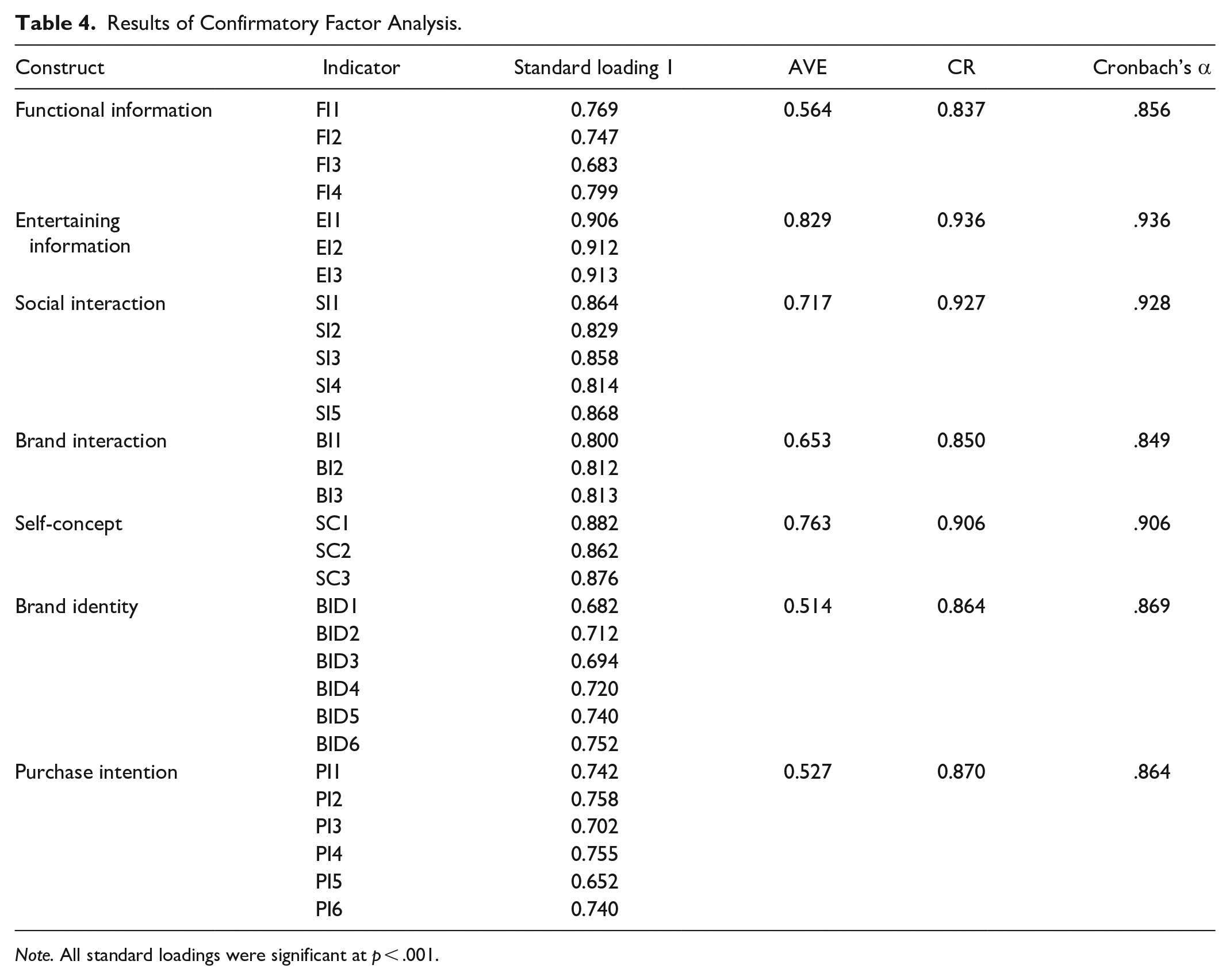
Note. All standard loadings were significant at p < .001.
Correlation Matrix.
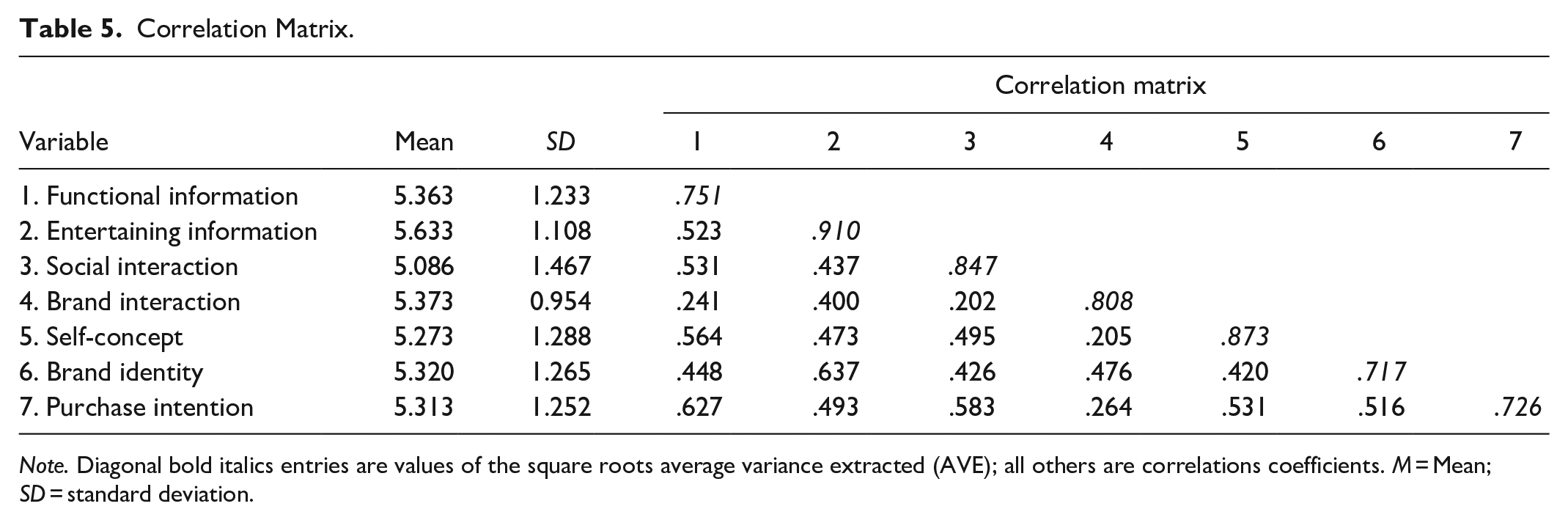
Note. Diagonal bold italics entries are values of the square roots average variance extracted (AVE); all others are correlations coefficients. M = Mean; SD = standard deviation.
The discriminant validity is supported when the AVE’s square root for each construct is greater than the correlations between that construct and other constructs (Fornell, 1981). In Table 5, the square roots of the AVEs for both datasets were all greater than the inter-construct correlations depicted in the off-diagonal entries, thus demonstrating discriminant validity.
As the data collected was self-reported from a single source, the data were tested for common method bias using Harman’s single factor test. Seven factors were extracted from the data. The factors extracted from the sample explained a 71.605% variance in the collected data. However, these samples’ most significant factors accounted for only 36.463% (<40%). The results showed no single factor dominated the total variance, indicating a lack of common method bias.
After examining the measurement validity and reliability, the proposed hypotheses were tested with AMOS. After modifying the original model, the model fit indices’ actual and recommended values are listed in Table 6. The fit indices of the model were better than the recommended thresholds, demonstrating a good fit between the model and data.
Measures of the Model Fit.

Note. RMSEA = root mean square error of approximation; GFI = the goodness of fit index; CFI = comparative fit index; NFI = normed fit index; TLI = non-normed fit index.
According to Bentler and Bonett (1980) and Lee et al. (2012).
According to Browne and Cudeck (1989) and Lee et al. (2012).
Hypotheses Testing
Using structural model with maximum likelihood method, all hypotheses are found to be significant. Figure 2 indicates that functional information (β = .073, p < .001), entertaining information (β = .330, p < .001), social interaction (β = .095, p < .001), brand interaction (β = .265, p < .001), and self-concept (β = .065, p < .001) significantly affect brand identity, thus H1, H2, H3, H4, and H5 are supported.

Path analysis results.
The study next investigated the relationship between brand identity and consumer purchase intention. The quantitative data results illustrate a positive association between brand identity (β = .605, p < .001) and consumer purchase intention. Hence, the empirical analysis results supported H6, and the improved brand identity from consumers leads to positive and confident consumer behavior about Korean brands, as shown in Table 7.
Structural Model Results.

***p < .001.
H7 proposes the moderation effects of consumers’ regulatory focus on the relationships between content marketing, brand identity, and purchase intention. The result shows that the consumers’ regulatory focus significantly moderates the relationship between content marketing and brand identity (β = .295, p < .05). Specifically, content marketing has a stronger effect on brand identity who promotion-focused consumers than prevention-focused consumers. The consumers’ regulatory focus also significantly moderates the relationship between brand identity and purchase intention (β = .097, p < .05). Brand identity has a stronger effect on purchase intention who promotion-focused consumers than prevention-focused consumers. Accordingly, H7a and H7b are supported. The moderation effect exerted by consumers’ regulatory focus is shown in Figure 3.
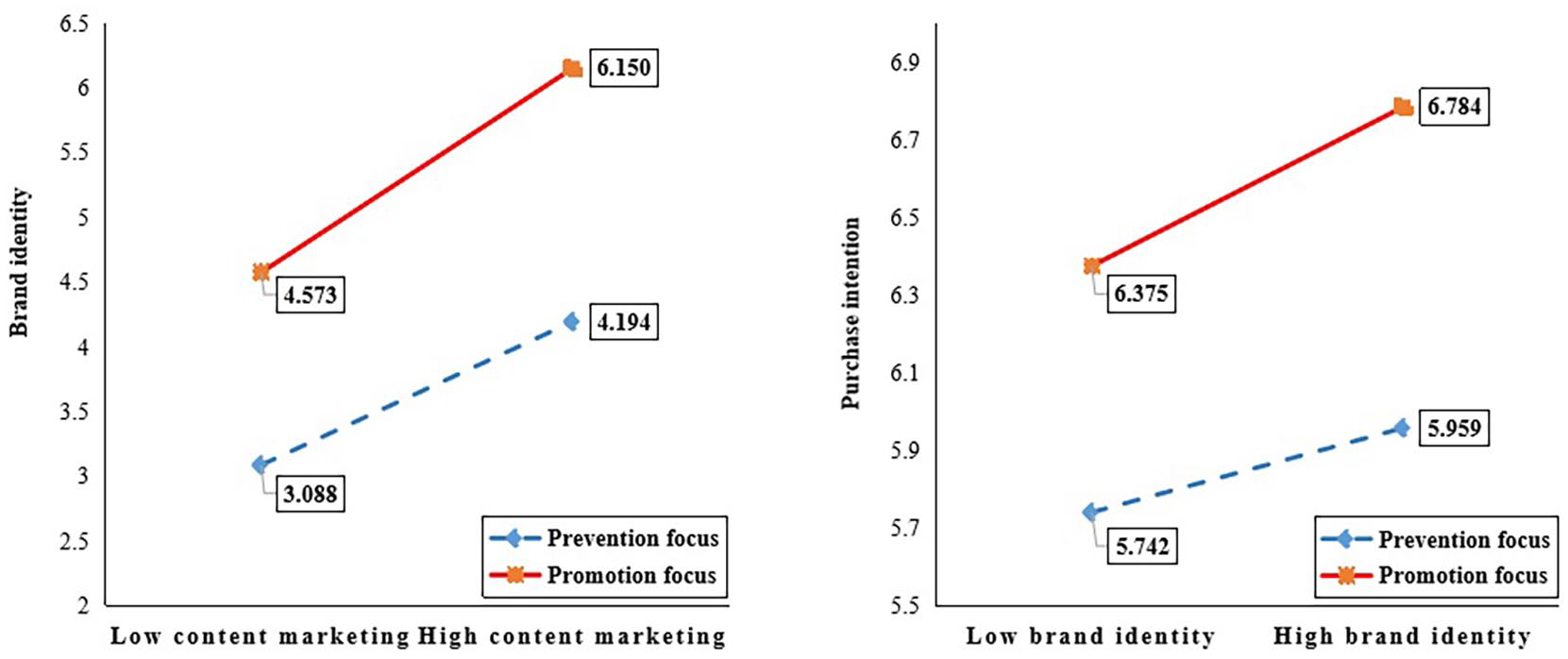
The moderation effect of regulatory focus.
H8 proposes the moderation effects of South Korean enterprises’ CSR performance for COVID-19 in China on the relationships between content marketing, brand identity, and purchase intention. The result shows that South Korean enterprises’ CSR performance for COVID-19 in China significantly moderates the relationship between content marketing and brand identity (β = .223, p < .05). Specifically, content marketing has a stronger effect on brand identity when the CSR performance of South Korean enterprises for COVID-19 in China is high. The CSR performance of South Korean enterprises for COVID-19 in China also significantly moderates the relationship between brand identity and purchase intention (β = .167, p < .05). Brand identity has a stronger effect on purchase intention when the CSR performance of South Korean enterprises for COVID-19 in China is high. Accordingly, H8a and H8b are supported. The moderation effect exerted by consumers’ regulatory focus is shown in Figure 4.

The moderation effect of CSR performance of South Korean enterprises for COVID-19 in China.
H9 proposes the moderation effects of economic development in different cities on the relationships between content marketing, brand identity, and purchase intention. The results show that the economic development level in different cities has significantly moderated the relationship between content marketing and brand identity (β = .153, p < .001). Specifically, content marketing has a stronger effect on brand identity which the first-tier cities than second-tier cities. The CSR performance of South Korean enterprises for COVID-19 in China also significantly moderates the relationship between brand identity and purchase intention (β = .097, p < .05). Brand identity has a stronger effect on purchase intention which first-tier cities than second-tier cities. Accordingly, H9a and H9b are supported. The moderation effect exerted by the level of city economic development is shown in Figure 5.

The moderation effect of the city’s economic development in China.
Lastly, bootstrapping was conducted to test the moderated mediating effect presented in the model of the study. Bootstrapping was implemented by using the PROCESS 3.3 from Hayes (Hayes, 2013). The indirect effects are significantly different from zero (i.e., the mediating effects are significant) when zero is not in the confidence intervals. According to Table 8, bias-corrected 95% confidence intervals were computed, and zero was not contained in these intervals. Such results confirmed the findings that brand identity mediated the relationships between content marketing and purchase intention under different levels of consumers’ regulatory focus and CSR performance of South Korean enterprises for COVID-19 in China.
Moderated Mediation Analysis With Bootstrap.

Control Variable Results
Finally, to provide a more robust test of this study’s results, control variables (gender, age, average monthly income, brand awareness, product involvement) were included as direct antecedents of purchase intention.
According to the research results, gender has no significant effect on latent variables. It shows that men and women have no difference in South Korean brand identity and purchase intention. Age had a significant effect on brand identity (β = .067, p < .05), but not on other latent variables. South Korean brands are more attractive to young people, so age significantly impacts brand identity. The average monthly income had a significant effect on brand identity (β = .032, p < .01) and purchase intention (β = .035, p < .01). Due to tariff and other reasons, the price of foreign brands is slightly higher than that of Chinese brands, and high-income consumers tend to buy foreign brands. Therefore, income has a significant impact on the purchase intention of South Korean brands.
In addition, brand awareness has a significant impact on brand identity (β = .026, p < .001), but not on other potential variables. It shows that high-profile brands will directly affect consumers’ purchase intention. The influence of product involvement on potential variables was significant. Consumers have a high degree of involvement in products, which has a positive impact on brand identity (β = .077, p < .001) and purchase intention (β = .498, p < .001).
Discussion and Conclusions
General Discussion
In this study, consumers in ten cities in China were investigated to analyze the influences of the gratifications derived from the use of the WeChat on their purchase intention for South Korean brands. The empirical results show that social media content marketing promotes Chinese consumers’ recognition of the South Korean brand, and it also enhances consumers’ purchase intention with the increase of brand investment in social media. Dimensions of content marketing, including functional information value content, entertainment information value content, social interaction, brand interaction, and self-concept, are positively correlated with brand identity. These results are in line with studies in the extant literature, such as Barker, who suggested that information content, entertainment content, and emotional content are the main factors influencing consumer purchase intention in marketing content (Barker, 2009). The next relationship investigated was between brand identity and consumer purchase intention. The quantitative data results illustrate a positive association between brand identity and consumer purchase intention, which aligned with the past literature (Keller, 1993; Wang et al., 2019). Prentice et al. (2019) reported that the more consumers identify with the brand, the more significant the purchase intention will be. Stokburger-Sauer et al. (2012), for instance, reported that brand identity had a substantial influence on consumer purchase intention.
Different from previous studies, this study set three levels of moderator variables: regulatory focus, CSR performance, and level of economic development between cities from individual, realistic, and macro level (Aaker & Lee, 2001; Chomvilailuk & Butcher, 2016; Pham & Avnet, 2004). The study results on moderating variables show that content marketing has a stronger effect on brand identity for promotion-focused consumers than those prevention-focused consumers. In addition, Brand identity has a stronger impact on purchase intention for promotion-focused consumers than prevention-focused consumers. In the face of COVID-19 in China, South Korean enterprises actively fulfill their social responsibilities. Specifically, content marketing has a stronger effect on brand identity when the CSR performance of South Korean enterprises for COVID-19 in China is high. And brand identity has a stronger impact on purchase intention when the level of the CSR performance of South Korean enterprises for COVID-19 in China is high. Therefore, South Korean brands with a higher sense of enterprise social responsibility can obtain greater value and are considered more attractive. Finally, this study took the economic development level between different cities in China as the moderated variable to conduct in-depth research. Specifically, content marketing has a stronger effect on which first-tier cities than the second-tier cities. And brand identity has a stronger impact on purchase intention which first-tier cities than second-tier cities. However, when the economic development level among different cities in China regulates content marketing, brand identity, and purchase intention, the intermediary role of brand identity in content marketing and purchase intention is not significant in the second-tier cities. This shows that content marketing can directly affect consumers’ purchase intentions in second-tier cities. For different products, consumers have different understandings of them. Consumers who don’t know the product well can use more entertainment information to increase their interest in the product and stimulate their purchase intention.
Theoretical Implications
With the rapid development of mobile Internet technology and the emergence of social media platforms, brand promotion investment in social media is becoming more and more critical. With the help of social media platforms, it has become a new international marketing strategy for South Korean brands in the complex global business environment to publish original content and interact with consumers in real-time in a geographical area across national boundaries.
Based on the content analysis on WeChat of the content marketing strategy of South Korean enterprise brands, this research explored the value dimensionality of “functional information,” “entertaining information,” “social interaction,” “brand interaction,” and “self-concept,” analyzed the motivations of consumers interacting with brands through the social media, and discussed the relationships among content marketing, brand identity, and purchase intention. Notably, this study’s findings are also in line with literature highlighting positive influences of SNS content marketing (Keller, 2003; Leung, 2009; Quan-Haase & Young, 2010). In terms of the academic research contribution, this study successfully confirmed the suitability of the UGT in explaining the influence of SNS content marketing on brand identity and consumers’ purchase intention in China.
First, few studies have empirically examined the foreign enterprises advantage of WeChat for content marketing, which makes WeChat content marketing a new research field. This study explores the role of brand identity in influencing customers’ purchase intention in SNS content marketing based on UGT, which enriches the research in content marketing and provides a new thinking direction for future research.
Second, based on the verification of the relationship between content marketing, brand identity, and purchase intention, a moderated mediation model is proposed in this study. In this study, the moderating variables were proposed from the individual level—regulatory focus, the realistic level—CSR performance of South Korean enterprises for COVID-19 in China, and the macro-level—the level of cities economic development in China. Moreover, the study uses the PROCESS 3.3 to make an empirical analysis for the moderated mediation model. This can be an essential breakthrough and development for the knowledge system of content marketing.
Third, all theoretical developments in this study are based on the UGT. On the premise of summarizing the content marketing dimensions and drawing lessons from previous research, the influencing factors of purchase intention are studied in multiple dimensions. The establishment and verification of this research model can provide references for future research. Therefore, this study expanded the application field of the UGT and improved the body of knowledge about content marketing.
Practical Implications
With the rapid development of social networks and new media and the fast improvement of the social economy and people’s living standards, consumers’ demand and understanding of products are also changing. Consumers’ demand for products is not only an attribute but also a spiritual demand. Therefore, when consumers understand a product, they are limited to the understanding of its attributes and functions and need to understand the feelings of the brand (such as the culture and image of the brand) to meet their own differentiated needs.
Social media platform brings more opportunities for South Korean enterprises to brand marketing in China. Through this study’s conclusion, there are some suggestions for the marketing department of South Korean enterprise as follows.
First, compared with non-content marketing, all content marketing dimensions can stimulate consumers’ purchase decision or purchase intention, which is powerful for marketers. Thus South Korean enterprises need to meet their corresponding needs according to different consumers. The brand’s unique characteristics and innovative information can make consumers feel the unique charm of the brand. The diversity and diversification of consumer value demand make content marketing pay more attention to brand content’s personality. The brand should recognize the value of content personality and combine it with the brand to release and spread the personalized content that can bring added value to consumers. In this way, consumers can feel the enterprise’s intention and have the will to understand and identify the brand, and further the enterprise can establish a long-term and stable relationship with the consumers.
Second, content marketing will affect consumers’ purchase intention through their brand identity. Consumers will generate different brand identities according to the brand’s information, and brand identity will be transformed into consumers’ purchase intention. Therefore, South Korean brands should not only focus on making profits but should be more concerned about consumers’ feelings. When providing entertainment information, the enterprise should pay more attention to what kind of brand identity information needs to arouse consumers, which requires different content marketing programs for different product positioning.
Third, to meet the needs of consumers for brand interaction and social interaction, the South Korean enterprise marketing department can strengthen the interaction with consumers through certain means (e.g., using multiple interaction methods such as pictures, lottery, games, etc.), encourage and even reasonably induce consumers to share and spread in their social circle, and help enterprises show their achievements.
Finally, to meet the needs of consumers in terms of self-concept, South Korean enterprise are expected to actively launch activities with cross-border brands, create the scarcity of goods or services using limited or limited time, emphasize the value of content, and make consumers feel the exclusive sense of belonging through “special supply.”
Limitations and Future Research
The generalizability of results for users other than South Korean brands, Chinese consumers, and SNSs other than WeChat, particularly Western SNS such as Facebook or Twitter, maybe rather limited. According to previous studies, there is significant differences in Western users of Western (mostly American based) SNSs and Chinese users of local SNS (Chu & Choi, 2010; Rains & Brunner, 2015).
Future research could address the proposed theoretical framework for other SNSs and in different cultural environments. It is also probable that the described effects will be observed among consumers in other countries, rather than exclusively among Chinese consumers for South Korean brands. Furthermore, the measurement of variables has some limitations which may compromise the validity of results. In particular, this study proposes the effect of moderating variables from three levels, but there may be other factors in the mechanism of social media content marketing. The use of a self-administered questionnaire may also jeopardize the validity of data. In addition, it is worth noting that social media is constantly developing, and the latest technology development trend is the application of online live broadcast and virtual reality technology. Using multiple data collection methods in future studies may also improve the validity of construct measures.
Footnotes
Acknowledgements
The authors would like to acknowledge the anonymous reviewers who provided insightful suggestions and comments on improving the quality of this manuscript.
Declaration of Conflicting Interests
The author(s) declared no potential conflicts of interest with respect to the research, authorship, and/or publication of this article.
Funding
The author(s) disclosed receipt of the following financial support for the research, authorship, and/or publication of this article: The research was funded by the Philosophy and Social Science Research of Jiangsu Higher Education Institutions of China (Grant No. 2018SJZDI044) and the Philosophy and Social Science Research of Jiangsu Higher Education Institutions of China (Grant No. 2020SJA1408).
Ethical Statement
The authors of this paper have carefully studied the international research ethics, and this paper does not involve animal and human studies.