




Abstract
One of the heated debates around media use is whether it is good or bad for psychological wellbeing. The debate deepened with the dramatic rise of social networking services (SNS) as it was recognized that too much information from SNS could be problematic. In this sense, many studies have been conducted on the media fatigue phenomenon. However, most have focused on what causes media fatigue, whereas the relationship between media fatigue and psychological wellbeing remains underdeveloped. Thus, this study examined whether media usage was associated with psychological wellbeing. We also examined the mediating effect of user participation as a media platform developed from one-way to two-way and further to a multi-directional process. To examine the effect of various media on the change in users’ psychological wellbeing index over 5 years, the data from the Korean Media Panel Survey conducted by the Korean Information Society Development Institute in 2013 to 2017 (N = 6,715) were used for constructing the longitudinal data for cross-sectional analysis. We found a significant relationship between media usage and psychological wellbeing and a significant mediating effect of user participation. The results show that traditional and new media have distinct roles in users’ psychological wellbeing and work differently based on the mediating effect of users’ participation.
Plain Language Summary
Purpose: This study examined whether media usage was associated with psychological wellbeing. We also examined the mediating effect of user participation as a media platform developed from one-way to two-way and further to a multi-directional process. Method: Through the statistical estimation method, we examine the effect of various media on the change in users’ psychological well-being index over five years, 2013–2017. The data from the Korean Media Panel Survey conducted by the Korean Information Society Development Institute was used for the analysis (N = 6,715). Conclusion: We found a significant relationship between media usage and psychological well-being, as well as a significant mediating effect of user participation. Implication: Traditional media and new media have distinct roles in users’ psychological well-being and work differently based on the mediating effect of users’ participation.
Introduction
The advancement and spread of smart devices worldwide and the development of network technology have caused expeditious changes in the media environment around users. In particular, the way media content is produced, distributed, and consumed nowadays has seen a vast change (McGill et al., 2015; Obrist et al., 2015). Traditional media, represented by TV, radio, and newspapers, unilaterally delivers media content created in advance to users. However, the development of new network technologies such as the Internet and 4G and 5G network connectivity speed, is increasing user participation and interactivity in the media environment. In particular, the concept of Web 2.0, which appeared in the 2000s, emphasized that users are the most important contributors to the media environment (Constantinides & Fountain, 2008).
This means that, nowadays, a user is not only a consumer but also a content producer in the highly interactive and participatory media landscape. This wave of change in user roles has led to a boom in the social media landscape. Social media is now more interactive, dialogic, and faster in fostering relationships between people than traditional media (Seltzer & Mitrook, 2007). Social media services allow people to not only create their own content but also communicate and interact with each other (Bright et al., 2015). As a result, the number of social media platforms has grown rapidly over the last few years (C. C. Lee et al., 2014).
However, as active media participation and interaction between users deepened, it was argued that they could not take a break in the current media environment, which would lead to psychological and behavioral stress. Studies claimed that users are experiencing mental exhaustion due to various technological, communicative, and informative overloads resulting from their participation and interaction in media (Bright et al., 2015; Dhir et al., 2018; Fabris et al., 2020; A. R. Lee et al., 2016). Studies define this phenomenon as media fatigue and claim that users can feel media fatigue, especially when using interactive new media. Nevertheless, previous research on media fatigue was fragmentary, and only examined how each media and user characteristic affected fatigue in individuals when they used specific media such as social networking sites (SNS) or the Internet (Baker & Algorta, 2016; Frost, & Rickwood, 2017; Pantic, 2014; Tsai et al., 2019). Still, it is important to see multiple media usage patterns to examine the effect of media considering new media environments in which people consume multiple media types simultaneously (e.g., watching television while using a laptop or smartphone to look up information or communicate with others; Brasel & Gips, 2011).
Therefore, this study aimed to determine how various media affect people’s depression and psychological wellbeing. In this study, the degree of user participation in the media environment, particularly, was utilized as a mediating effect to examine the direct and indirect effects of usage of various media on the psychological wellbeing and depression of users. By utilizing the mediating effect of user participation level, the different effects of new and traditional media in the media environment were examined. New media includes SNS, instant messenger, User-Generated Content (UGC), and internet search, while traditional media includes pay and unpaid TV, radio, and newspapers. We sourced five years’ data for this study, which enabled us to examine the cumulative effect rather than the fragmentary effect of media use. Through the results of this study, it is possible to confirm not only the effect of new media, such as SNS on users’ psychological wellbeing and depression, but also the effect of the media environment (composed of various traditional and new media) on users’ wellbeing in the long run. In addition, this study differs in that it proposes a perspective to understand the impact of media on users from an ecological perspective through analysis results.
Literature Review and Hypotheses
Media Usage and Depression
Among the factors related to people’s psychological wellbeing, depression has been a major concern as it can cause psychological problems and other health-related symptoms, such as emotional and behavioral regulation. Depression is a state of mind, where positive emotions are low or negative emotions are high (Sapolsky, 2004). Studies examining the relationship between depression and new media usage are based on online communication (Wagner et al., 2014), social networking sites (Banjanin et al., 2015; Błachnio et al., 2015; Lin et al., 2016; Woods & Scott, 2016), etc. Wagner et al. (2014) argued that face-to-face and online communication had the same positive effect on the reduction of depression in people. They pointed out the positive role of internet-based communication by describing that online communication maintains the positive effect of depression reduction for more than 3 months. Conversely, Lin et al. (2016) found that social media use had a strong and significant association with increasing depression among young adults in the United States. However, simultaneously, they pointed out the limitations of cross-sectional data, arguing that people with depression were more likely to utilize social media (e.g., depressed individuals with a diminished sense of self-worth may turn to social media-based interactions for validation). This implies the need for further research in this regard. Banjanin et al. (2015) found that internet use was associated with indicators related to depression, but social media-related indicators (number of Facebook friends and self-portraits) were not related to depression symptoms. Therefore, to examine the effects of various media use and depression, the following hypothesis was developed.
H1: Media usage has a direct effect on a users’ depression.
Media Usage and Psychological Wellbeing
In most media usage studies, it has been reported that technological, informative, and communicative overload caused by user interaction and participation induces mental exhaustion, defined as media fatigue (Bright et al., 2015; A. R. Lee et al., 2016; Zhang et al., 2016). This research flow focuses on the negative effects of media on users’ psychological wellbeing after the emergence of new media that constantly communicates with other users and shares their daily lives through smartphones such as SNS and Instant Messenger (Baker, & Algorta, 2016; Frost & Rickwood, 2017; Pantic, 2014). Media fatigue is a critical issue for both users and businesses. For users, it is directly related to their mental health, while for service operators, the user’s mental health is directly related to the business outcome. There have been many academic explorations based on this media fatigue phenomenon (Bright et al., 2015; Dhir et al., 2018; A. R. Lee et al., 2016; Logan et al., 2018; McDool et al., 2016). Some existing research has focused on the reasons for media fatigue based on theories such as the Technology Acceptance Model (TAM), Unified Theory of Acceptance and Use of Technology (UTAUT), and Theory of Rational Choice (TRC), and identified perceived usefulness, ease of use, self-efficacy, etc. (Bright et al., 2015; Logan et al., 2018). In a different way, some scholars have tried to focus on identifying the consequences of social media fatigue and found that users who feel higher social media fatigue are more likely to shift platforms, break or reduce temporary usage, etc. (Dhir et al., 2018). However, Dhir et al. (2018) claimed that the relationship between media fatigue and psychological wellbeing is underdeveloped despite its importance. In addition, McDool et al. (2016) claimed that several theories are applicable in explaining the relationship between media usage and users’ psychological wellbeing, such as social comparison, finite resources, and cyberbullying. In particular, social comparison theory understands that social media use causes more frequent social comparisons with others, and it is more likely to be negative because people tend to present a selectively ideal version of their daily life (Mendelson & Papacharissi, 2010).
However, these media effects often appear differently depending on the characteristics of media users (age, gender, etc.) and the type of service they use. Cotten (2008) argued that young adults’ use of media such as the Internet and mobile phones has significant impacts on psychological wellbeing such as stress, loneliness, self-esteem, and social support, and also states that further research is needed. In the same manner, Shaw and Gant (2002) observed the impact of Internet use on psychological wellbeing, such as reducing loneliness and increasing self-esteem and social support through small-scale experiments. Especially for teenagers and adolescents, the network that forms with friends is an important foundation for social support (Bokhorst et al., 2010), so new media such as SNS provides them with important resources. In fact, studies show that active media use has a positive effect on young users by providing them with supportive interaction and social capital that could enhance psychological (Hampton et al., 2011; Liu & Yu, 2013). Accordingly, various studies have concluded that it is difficult to make definitive conclusions about the relationship between SNS use and psychological wellbeing, and that further studies are needed (Baker & Algorta, 2016; Blease, 2015). Hence, based on previous research on relationships between media usage and psychological wellbeing, we developed the following test hypothesis for the current study.
H2: Media usage has a direct effect on a users’ psychological wellbeing.
User Participation
As media platforms developed from one-way to two-way and further to multi-directional, media users changed from simple receivers to participants. Studies on the influence of media use on user behavior have been conducted for a long time. Most studies have particularly dealt with the users’ political participation. Studies have shown that news and public affairs television programming increases political participation (Norris, 2000; Rojas et al., 2005), and new media such as SNS are also positively associated with political participation (Boulianne, 2015; C. Lee et al., 2018; Valenzuela et al., 2016). However, as research began to focus on users’ active media selection (uses and gratification theory), studies that looked at the effects of media characteristics, and the purpose of media use and participation emerged. Media play a conditional role, which, depending on the type of genre, affects civic engagement and social trust (Moy & Scheufele, 2000). Some research has shown that informational uses of media are related to increased civic engagement, and entertainment or diversion uses can be related to its decline (Shah et al., 2001). Chang and Hwang (2020) examined how the use of various media affected the degree of participation of users in the media environment. As a result of the study, it was confirmed that different types of media affect the degree of participation depending on the characteristics of users. According to these previous studies, the following hypothesis was established in this study.
H3: Media usage has a direct positive effect on a users’ participation level.
Furthermore, there have been many studies on the effects of user participation, that is, social participation and interaction, on psychological wellbeing. In particular, most of the existing research claimed that a high level of interactivity and participation has a positive effect on psychological wellbeing, presenting that offline participation such as religious activities, political groups, clubs, and volunteer work leads to better mental health or reduces the level of depressive symptoms (Berkman et al., 2000; Chiao et al., 2011; Glass et al., 2006). However, as technology advanced, many communities have gone online, making engaging in social participation and interaction easier. Accordingly, studies on the effect of participation in online communities on psychological wellbeing have emerged. Tandoc et al. (2015) revealed that participation activities on Facebook, such as updating statuses, posting photos, and commenting, are related to Facebook users’ depression. In particular, it was confirmed that there was a significant indirect effect through another variable, envy, rather than a direct effect. In addition, Valkenburg and Peter (2007) revealed that Internet use has a negative effect on the wellbeing of adolescent users, but it can have a positive effect if participation activities in communication with others are mediated. In this regard, the following hypotheses had been proposed. The overall research model with hypotheses is described in Figure 1 below.
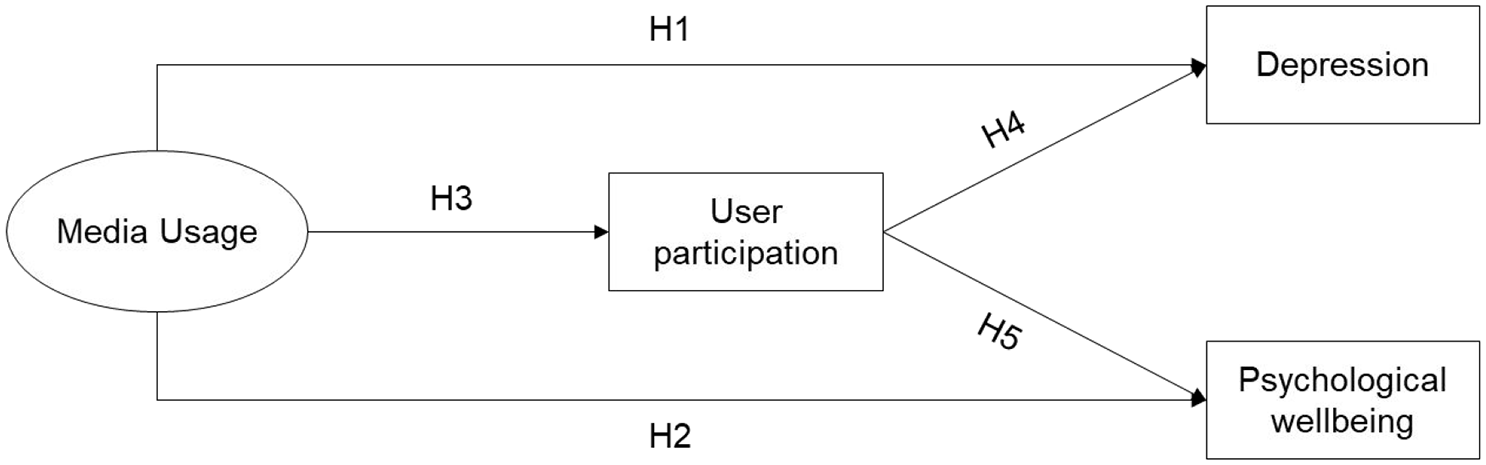
Research model with hypotheses.
H4: User participation has a mediating effect on an effect of media usage on a users’ depression.
H5: User participation has a mediating effect on an effect of media usage on a users’ psychological wellbeing.
Research Framework
Data
This study used data from the Korean Media Panel (KMP) Survey conducted by the Korean Information Society Development Institute (KISDI), a national research institute in Korea. Therefore, a questionnaire was conducted in Korean, and in this study, we translated the questionnaire into English for the paper. Since 2010, the KMP has collected media-related information on 9,000 people each year using stratified random sampling by age, region, and sex. As a result, this has become a set of longitudinal data that track the same individuals. Media diary data record respondents’ media activities and the device usage time for 3 days, providing useful information on the duration and frequency of using various media. The survey questions included not only the degree of respondents’ participation in activities such as knowledge production, content sharing and liking, writing comments, and voting in the online space, but also the degree of respondents’ psychological wellbeing (depression and psychological wellbeing). For this study, we used media panel data collected between 2013 and 2017. The final sample consisted of 6,715 individuals. Table 1 presents the descriptive statistics for the variables in this study. The total number of individuals utilized in the analysis was 6,715. The individual characteristics, media usage, user participation, depression, and psychological wellbeing value of the participants are listed in the table.
Descriptive Statistics of the Variables Used in This Study (N = 6,715).
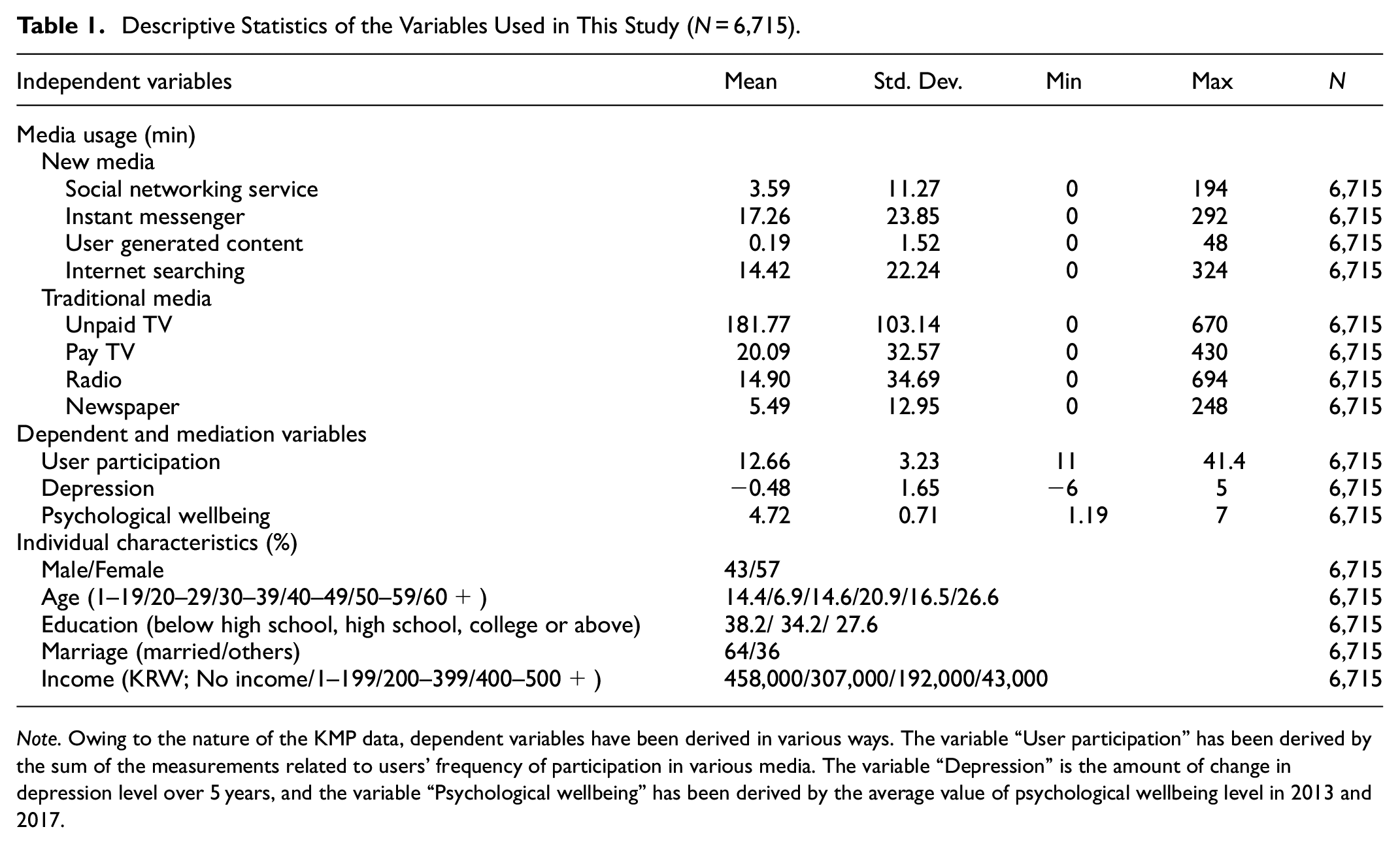
Note. Owing to the nature of the KMP data, dependent variables have been derived in various ways. The variable “User participation” has been derived by the sum of the measurements related to users’ frequency of participation in various media. The variable “Depression” is the amount of change in depression level over 5 years, and the variable “Psychological wellbeing” has been derived by the average value of psychological wellbeing level in 2013 and 2017.
Key Variables
The KMP survey measures respondents’ frequency of participation (writing, leaving comments, sharing, and scraping) in online communities or clubs, news or debate boards on the Internet, online votes or recommendations, and online knowledge production for each year. While previous studies saw user participation as political.
Media Usage
In each year (2013 and 2017), the respondents recorded their time spent with media devices, activities, and spaces over 3 days in the KMP media diary survey. This study extracted data on three-day media usage time from 2013 to 2017 and again obtained the 5-year average usage time per day by media activity. In other words, we calculated the average time spent with eight media activities (social networking services, instant messenger, user-generated content, internet searching, unpaid TV, pay TV, radio, and newspaper) per day from 15 days (3 days × 5 years). The usage time of new media (SNS, instant messenger, user-generated content, and internet searching) and traditional media activities (Pay and Unpaid TV, radio, and newspapers) were used in the analysis.
User Participation
The KMP survey measures respondents’ frequency of participation (writing, leaving comments, sharing, and scraping) in online communities or clubs, news or debate boards on the Internet, online votes or recommendations, and online knowledge production for every year. While previous studies saw user participation as political participation or civic engagement (Boulianne, 2015; C. Lee et al., 2018; Moy & Scheufele, 2000; Norris, 2000; Rojas et al., 2005; Shah et al., 2001; Valenzuela et al., 2016), this study focuses on users’ participation in knowledge activity. Since the advent of the concept of Web2.0, media has been more actively used in industries, companies, and universities as a venue for knowledge creation and sharing (Roblek et al., 2013). In this stream, securing and exploiting a large amount of knowledge is essential for an organization to be in a superior position (Murray & Peyrefitte, 2007). The main source and reason for generating knowledge in media is its users; knowledge is created, shared, reproduced, and spread only through user participation, an important variable across many media domains (Chang & Hwang, 2020). Therefore, this study attempted to examine the effect of users’ participation in knowledge behavior in line with this trend.
To determine how well users can use diverse media, KMP analyzed the frequency of various knowledge behaviors during their media usage. The KMP survey questionnaire is described in the Appendix. Every question was evaluated with responding numbers: estimated by “1 = none” to “6 = almost every day.” In this study, the average values of the following items during the 5-year period from 2013 to 2017 were derived and used for the analysis.
Depression and Psychological Wellbeing
In this study, depression and psychological wellbeing were selected as dependent variables. The variables were measured using a 7-point Likert scale in 2013 and 2017, respectively.
The Hospital Anxiety and Depression Scale (HADS; Zigmond & Snaith, 1983) is a representative questionnaire that measures depression with high validity, and there are four questions developed by the Patient-Reported Outcomes Measurement Information System (PROMIS). What these two measures have in common is that they measure whether the respondents feel lethargy and negative emotions. In particular, the depression measurement question developed by PROMIS is similar to the content of the questions in which the KMP used in this study measured depression in that it measures the frequency of lethargy and negative emotions for 7 days (Lin et al., 2016).
In the KMP survey, Depression was measured by the frequency with which users felt irritated/negative/lethargic: (a) I felt irritated often during the past 1 month; (b) I felt negative often during the past 1 month; (c) I felt lethargic often during past 1 month. Respondents answered each of the three questions on a Likert 7-point scale according to the frequency level they felt.
Based on the data in 2017, the Cronbach’s alpha coefficient was .885 and .894 in 2013, indicating that it was suitable for the analysis. In this study, the average frequency of these three elements is derived as a depression variable, and the subtracted average values of 2013 and 2017 were used to identify the effect of media usage on the change of emotion of depression.
In the KMP survey, psychological wellbeing was measured by how the respondents evaluated themselves. It is measured using the following eight questions: (a) I am living a life of purpose and meaning; (b) My social relations helped me; (c) I enjoy everyday life and do my best; (d) I actively contribute to the happiness of others; (e) I can skillfully carry out activities that are important to me; (f) I am a good person, and I live a good life; (g) I am optimistic about my future; and (h) I am respected. These survey questions contain similar contents in State Optimism Measure (SOM; Millstein et al., 2019) and Rosenberg’s (1965) self-esteem scale measurement questions (Tinakon et al., 2012). The Cronbach’s alpha coefficient of those eight items was .921 based on the data in 2017 and .913 based on those in 2013, which is an appropriate level for the analysis. In this study, the average level of these eight elements was derived as a psychological wellbeing variable, and the average values of these variables in 2013 and 2017 were used.
Models
Structural equation modeling (SEM) was used to examine the direct effect of media usage comprising various media activities and the mediation effect of user participation on people’s psychological wellbeing. SEM has been widely used to verify the direct and indirect effects, or mediating effects of variables in research models (Prabhu et al., 2008; Stolle et al., 2008). The model used in this study consists of four equations (Equations 1–4). STATA 17 was used to analyze the derived research model.


Media usage is a latent variable consisting of four types of new media activities and four types of traditional media activities (Equation 1). New media comprises SNS, instant messenger, UGC, and Internet searching. Traditional media refers to Pay and unpaid TV, radio, and newspapers. In addition, the predicted use of media, that is, the latent variable, affects user participation (Equation 2).

Direct/Indirect effect of media use on depression and psychological wellbeing.
Results
Figure 2 shows the coefficient and statistical significance level of media usage’s direct and indirect effects on people’s psychological wellbeing. The latent variable, described by the use of four new media and four traditional media, was confirmed to have a negative or insignificant effect on psychological wellbeing. First, the direct effect of media use on the increase in the frequency of five years of depression has been shown to have a positive effect (β = .206). This means that if the media is heavily utilized for 5 years, depression will be felt more frequently. However, Table 2 and Figure 2 show that the effect of pay and unpaid TV is the latent variable “media usage.” Unpaid TV viewing negatively affects the latent variable, media usage. It can be interpreted that watching TV helped to ease the emotion of depression. This means that there is a direct association between media usage and users’ depression level, even though there are different effects according to the type of media (Traditional/New media). Thus, our second hypothesis (H1) was accepted.
Details for the Coefficients and Standard Errors of the Structural Equation Model.

Significant at the 10% level, **5% level, ***1% level.
Conversely, when looking at the impact of media on psychological wellbeing, the use of media over 5 years has been shown to have an insignificant impact on the average value of the level of psychological wellbeing by 2013 and 2017. This means there is no direct association between media usage and users’ psychological wellbeing. Thus, we confirmed that the first hypothesis (H2) was not accepted.
H1: Media usage has a direct effect on a user’s depression. (accepted)
H2: Media usage has a direct effect on a user’s psychological wellbeing. (not accepted)
To see the indirect effect of media usage on psychological wellbeing and depression, it is necessary to examine the effect of media usage on user participation. The analysis shows that the indirect effects of media are mediated through user participation. The use of media has been shown to positively affect the average value of user participation for 5 years (β = .61), which means the third hypothesis was accepted.
H3: Media usage has a direct positive effect on a user’s participation level. (accepted)
Induced users’ participation has been shown to have a significant effect on users’ depression, and psychological wellbeing. First, it was shown that user participation had a significant negative effect on depression. This means that the higher the 5-year average participation by users, the lower the depression observed from 2013 to 2017. Thus, it can be said that user participation has a mediating effect on lowering people’s depression levels caused by media usage. In particular, pay and unpaid TVs have negative effects on latent variables and media usage, as depicted in Table 2 and Figure 2, indicating that they have an indirect and positive effect on depression. Second, it was shown that user participation had a significant positive effect on psychological wellbeing, which means that the higher the 5-year average participation by users, the higher their satisfaction with themselves from 2013 to 2017. In particular, it can be interpreted that user participation has a mediating effect on increasing user psychological wellbeing caused by media usage, as media use has a significant positive effect on user participation. Furthermore, user participation across the media platforms also has a positive effect on their psychological wellbeing. Thus, we confirmed that the fourth and fifth hypotheses (H4 and H5) were accepted.
H4: User participation has a mediating effect on an effect of media usage on a user’s depression. (accepted)
H5: User participation has a mediating effect on an effect of media usage on a user’s psychological wellbeing. (accepted)
Discussion
This study examined the effects of media usage on people’s psychological health by dividing them into direct and indirect influences. Furthermore, by dividing the latent variable of media use into four new media and four traditional media, it could be observed how various kinds of media affect psychological wellbeing differently.
First, we could see that the impacts of new media and traditional media on users’ wellbeing and participation are different. The direct effect of media use was identified as having a positive effect on depression and an insignificant effect on psychological wellbeing. In particular, as reflected in prior studies, SNS, instant messenger, UGC, and internet browsing (new media) have been found to cause mental stress and media fatigue in users based on their interactivity (Banjanin et al., 2015; Błachnio et al., 2015; Scott & Woods, 2018; Woods & Scott, 2016). Contrastingly, traditional media were divided into TV and newspapers, each having a different effect on depression. Pay and unpaid TV were found to have negative effects on depression, while newspapers were found to have positive effects. This is explained by the results of Potts and Sanchez (1994), who explained that the reason people watch television is to avoid depression. They resort to watching television to escape unpleasant feelings and stimuli that could potentially exacerbate these feelings. However, they explained that people fall back into depression when they watch news content while watching television. This finding of Potts and Sanchez (1994) explains the result of this study that people who consume newspaper content are more depressed. Alternatively, it can also be inferred that the KMP survey did not distinguish between traditional printed newspapers, digital newspapers, or newspaper subscriptions via smartphones when collecting the newspaper usage time data.
Second, looking at the indirect impact of media usage, it was shown that media usage has a positive effect on user participation. It is shown that 5 years of media usage had a significant effect on the participation level of users across this period, indicating that the effects of media use would accumulate over time. The use of new media usage and newspapers has been confirmed to have a particularly positive impact on users’ participation. These results are in line with previous studies that confirmed that SNS had a positive effect on users’ participation in diverse activities (Boulianne, 2015; C. Lee et al., 2018; Valenzuela et al., 2016). However, traditional media has been found to have negative effects on user participation, which differs from prior research in that television public broadcasting has positive effects on users’ actual participation in political activities (Norris, 2000; Rojas et al., 2005). It can be inferred that the user participation discussed in this study was mainly focused on knowledge creation, resulting in different outcomes. This is because participation in politics is a different kind of participation as compared to knowledge creation.
Finally, user participation has been shown to have a positive effect on users’ psychological wellbeing and depression. This was examined as a reduction effect on users’ depression and an enhancement effect on their psychological wellbeing. In the past, studies have shown that offline participation has a positive effect on users’ mental health (Berkman et al., 2000; Chiao et al., 2011; Glass et al., 2006). However, very few studies have examined the cause-and-effect relationship between online participation and users’ mental health, but some studies have seen relationships or correlations between them, such as Valenzuela et al. (2009). They argued that the use of SNS, such as Facebook, is positively linked to social capital, satisfaction, social trust, civic engagement, and the political partitioning of users. The novelty of this study is that it identifies causality by observing the mediating effect of participation in knowledge creation on people’s psychological wellbeing. Some studies have shown the relationships between SNS and mental health like psychological wellbeing or depression (Gangadharbatla, 2008; Saiphoo et al., 2020; Valkenburg et al., 2017). Nevertheless, there are limitations in that they only have confirmed the effect of specific media usage, like SNS.
Conclusion and Limitations
It was confirmed that the use of media, especially the use of media that allows users to participate in knowledge activities, makes them more likely to be in a healthier state of mind. This is a different view from previous studies that reported that interactivity causes fatigue for users on SNS or instant messengers. If users actively participate and engage with media content, rather than just passively accessing and enjoying it or fragmentarily using communication services, media use could eventually help users’ psychological health. This is linked to pay and unpaid TV viewing, where non-participation had negative coefficients. With these results, this study proposes the role of new media in digital culture, which is constructed in a media convergence environment. New media should provide media environments that enable users to engage in diverse participation (political, social, and knowledge production). In addition, media policymakers should focus on these roles of new media to maintain a media environment that can further promote user participation to positively impact users’ psychological wellbeing in the media environment.
This study has several limitations. Owing to the limitations of KMP data, the variables measuring users’ psychological wellbeing and depression were restricted only to 2013 and 2017. To address this, the study utilized average values over a period of 5 years, with the exception of the individual characteristic variables. If all the data of all variables between 2013 and 2017 were available in the study and panel data could be used, more robust conclusions could be obtained. The failure to use various variables for psychological wellbeing other than depression and psychological wellbeing also limits the richness of interpretation of the results. In addition, owing to the large number of data (N = 6,715), there is the possibility that the significance level would be over-reported. Since the Korea Media Panel (KMP) data are open, public data, there are some limitations in that it cannot perfectly explain the research model. However, our research still has novelty in that it shows the direct and indirect effect of time spent on diverse media by Korean media users over 5 years.
Footnotes
Appendix
Survey Questionnaire About Users’ Participation by the Korean Media Panel.

| Contents | Questionnaire |
|---|---|
| Online community/club | • Have you read any articles written by other members in online communities/clubs in the last 3 months? |
| • Have you commented on posts posted on online communities/clubs in the last 3 months? | |
| • Have you scrapped posts on online communities/clubs in the last 3 months? | |
| • Have you uploaded posts on online communities/clubs in the last 3 months? | |
| Internet news/discussion services | • Have you posted or written comments on Internet news/discussion boards in the last 3 months? |
| • Have you ever scrapped posts on internet news/discussion boards, to your own blog/twitter in the last 3 months? | |
| Online participation | • Have you participated in online surveys/poles/voting in the last 3 months? |
| •Have you used online recommendation and rating systems in the last three months? | |
| Online knowledge production | • Have you posted a question on Internet knowledge services a in the last 3 months? |
| • Have you posted responses to Internet knowledge services in the last 3 months? | |
| • Have you posted useful information content b online for providing information purposes in the past 3 months? |
Internet knowledge services: Wikipedia, Naver (Korean domestic search engine), Knowledge-in, Q&A boards from diverse online platforms, etc.
Useful information content: papers or reports, providing travel-related, restaurant, and expert information on a personal blog/home page.
Acknowledgements
We gratefully acknowledge our colleague Dr. Namjun Cha for his invaluable insights and feedback during the research process.

Funding
The author(s) received no financial support for the research, authorship, and/or publication of this article.
Declaration of Conflicting Interests
The author(s) declared no potential conflicts of interest with respect to the research, authorship, and/or publication of this article.