




Abstract
Recent research on language teacher factors has focused on the construct of teacher immunity. This construct was introduced into the field of language teaching to delineate language teachers’ psychological state. Productive teacher immunity is defined as language teachers’ psychological shield that safeguards them against diverse stress-inducing factors. Nonetheless, maladaptive teacher immunity refers to the psychological barrier that turns teachers into cynical individuals who oppose innovative approaches and ideas. This study aimed to determine the extent to which English teachers’ affective factors including their teaching enjoyment, psychological well-being at work, emotion regulation, teacher reflection, work engagement, and self-compassion predicted their productive and maladaptive types of teacher immunity in the contexts of Iran, France, and the United States. To this end, the researchers selected 319 Iranian, 391 French, and 545 American English teachers in different cities in the aforementioned contexts using convenience sampling. Moreover, they used seven reliable and valid questionnaires to examine these teachers’ affective factors. Lastly, they utilized Binary Logistic Regression and Chi-Square tests to analyze the data. The results indicated that similar factors including emotion regulation and teacher reflection significantly predicted French and American teachers’ teacher immunity. Nonetheless, Iranian teachers’ teacher immunity was significantly predicted by a different set of factors including their teaching enjoyment, psychological well-being at work, and work engagement. Furthermore, French and American teachers’ teacher immunity was more productive than that of Iranian teachers. The results may provide guidelines on the development of teacher-factor-informed education courses for English teachers in both second and foreign language contexts.
Keywords
Introduction
The close perusal of the related literature (e.g., Heng & Chu, 2023; Khalili et al., 2024; M. Li et al., 2022; Xiyun et al., 2022; Yang et al., 2022; Zohrabi & Khalili, 2023) accentuates the fact that language teacher factors have been recurrent lines of research in recent years. In a general definition, Proietti Ergün and Dewaele (2021) stated that these factors encompass all of the teacher-internal characteristics that are likely to affect teachers’ psychological composure and health along with the process of language instruction. Yang et al. (2022) classified teacher-internal variables into the cognitive and affective factors. As they noted, cognitive factors encompass certain variables such as critical thinking that expound on teachers’ information processing capacity in the process of language instruction. On the other hand, they pointed out that, affective factors comprise the variables that have a major effect on teachers’ composure and mental health.
The above-mentioned definition of affective teacher factors indicates their affinity with the main variables that constitute the pillars of positive psychology (C. Li & Li, 2023; Zeng et al., 2019). This branch of psychology focuses on the factors that predict individuals’ growth and flourishment in the educational and occupational fields (Stavraki & Karagianni, 2020; Tandler et al., 2019). The scrutiny of the positive psychology factors highlights the fact that a number of them such as teacher self-efficacy (e.g., Soodmand Afshar & Moradifar, 2021), teacher self-compassion (e.g., Moè & Katz, 2020), teacher grit (e.g., Liu et al., 2023), teacher mindfulness (e.g., S. Li, 2022) and resilience (e.g., Heng & Chu, 2023) have been recurrently examined in the field of language instruction. Notwithstanding, as J. M. Dewaele and Li (2022) pointed out, none of these factors reflects the totality of language teachers’ mental health.
The above-mentioned issue in the characterization of language teachers’ psychological health motivated a number of researchers to search for the factors that specifically reflected on language teachers’ emotional states in the context of the classroom (J. Dewaele et al., 2019). To this end, Hiver (2015) introduced the concept of Teacher Immunity (TI) into the field of language instruction in an attempt to provide a better understanding of language teachers’ emotional and psychological well-being in their pertinent academic settings. The label of this construct shows that Hiver (2015) borrowed the metaphor of immunity from the field of biology and extended it to draw a comparison between the physiological immune system of human body and psychological immune system of language teachers. Accordingly, he defined, TI as the protective psychological shield that safeguards the language teachers against numerous sources of stress and tension in the process of instruction. As Hiver (2015) concluded, TI is likely to be affected by language teachers’ affective factors including their Teaching Enjoyment (TE; e.g., Proietti Ergün & Dewaele, 2021; Proietti Ergün & Ersoz Demirdag, 2022). Psychological Well-Being at Work (PWBW; e.g., Dagenais-Desmarais & Savoie, 2012; Deng et al., 2022), Emotion Regulation (ER; e.g., Fathi & Derakhshan, 2019; Greenier et al., 2021), Teacher Reflection (TR; e.g., Akbari, 2007), Work Engagement (WE; e.g., Burić & Macuka, 2018; Han & Wang, 2021) and Self-Compassion (SC; e.g., Neff, 2003) among the others.
Review of the Related Literature
TI
The existence of numerous stressors in educational settings has motivated the researchers to investigate the individuals’ inner resources that empower them to relieve their psychological distress in the relevant settings (Southwick et al., 2014). A number of researchers (e.g., Robertson et al., 2015) have focused on the construct of resilience and have highlighted its role in the establishment of emotional equilibrium. Zautra et al. (2010) defined resilience as the individuals’ ability to deal with psychological stress and to recover emotional balance in a satisfactory way. Fletcher and Sarkar (2013) strived to determine the main factors in individuals’ resilience and itemized five factors that significantly influenced this construct. As they noted, the first factor in resilience is self-esteem. As a result, individuals’ higher self-esteem ameliorates their resilience. The second factor in resilience is emotion regulation. More specifically, individuals’ ability to repress their negative emotions improves their resilience. Problem-solving ability constitutes the third factor in resilience. In other words, the development of problem-solving skills is likely to have a beneficial effect on individuals’ resilience. Self-confidence constitutes the fourth main factor in resilience and improves it in various contexts. Finally, the fifth factor in individuals’ resilience is planning. More specifically, the individuals’ capability to develop and implement effective plans for achieving their objectives has an adventitious impact on their resilience.
The construct of resilience is closely associated with coping strategies (Ben-Zur, 2009). These strategies encompass the strategies that are consciously or unconsciously developed and implemented by individuals in diverse contexts and settings in order to stifle their negative emotions (Washburn-Ormachea et al., 2004). Carver (2011) stated that most of the individuals are likely to take advantage of five main emotion-focused coping strategies in order to deal with the stress-inducing factors in their settings. As he explained, the first coping strategy is distancing that helps the individuals to psychologically distance themselves from emotionally charged situations. The second strategy is re-evaluation of stressors that helps the individuals to determine the positive aspects of stress-inducing situations. Asking for social support is the third coping strategy that enables the individuals to deal with sources of stress using the other individuals’ support and guidance in their settings. Taking advantage of avoidance constitutes the fourth strategy that enables the individuals to determine and avoid the situations that increase their stress. Finally, the fifth coping strategy is acceptance of responsibility that helps the individuals to accept their role in the relevant problems and encourages them to resolve them in an effective way.
The significant roles of resilience and coping constructs in individuals’ psychological health have motivated a number of researchers to search for the constructs that encompass both resilience and coping and account for the totality of people’s psychological profile in various settings including the occupational settings. In this regard, Hiver (2015) developed the construct of TI in order to provide a more accurate and vivid picture of the totality of language teachers’ psychological status in their workplace. In his later work, Hiver (2017) delved more deeply into the nature of this construct and itemized its seven sub-components including attitudes toward language teaching, burnout, coping, affectivity, openness to change, teaching self-efficacy, and resilience. As he explained, attitudes toward teaching encompass the teachers’ perceptions of the significance of their profession in their relevant culture. Moreover, burnout encompasses the language teachers’ emotional and mental exhaustion that stems from chronic sources of stress in their workplace. Furthermore, coping refers to the teachers’ capability to develop and implement diverse affective strategies in order to suppress their negative emotions and to resolve their psychological tension. In addition, affectivity involves teachers’ ability to capitalize on their positive emotions in order to stifle their negative emotions that constitute barriers to their language teaching. Additionally, openness to change determines the degree to which language teachers accept the innovations in their profession and make an effort to take advantage of them in the process of language instruction. Besides, teaching self-efficacy specifies teachers’ perceptions of their language teaching capabilities and strengths. Lastly, resilience determines the teachers’ ability to recover from psychological crises without being unduly affected by them in their workplace.
In addition to the specification of the sub-components of TI, Hiver collaborated with his colleagues to expound on its realizations in language instruction. In this regard, Hiver and Dörnyei (2017) distinguished productive TI from maladaptive TI based on their impacts on teachers’ mental health. They explained that productive TI is akin to an efficient immune system of the body and encourages the teachers’ to utilize their inner resources including their self-efficacy and self-esteem to resolve their psychological tension and to deal with the stress-inducing factors. On the other hand, maladaptive TI is comparable to an overactive immune system due mainly to the fact that it reacts to harmless factors such as innovative ideas and turns teachers into cynical individuals and results in their inflexibility. As they concluded, productive and maladaptive TI can be affected by different affective factors.
Teachers’ Affective Factors
Bandura (1997) developed the social cognitive theory as an extension of social learning theory and argued that it accounted for the impacts of individuals’ perceptions on their behavior and outcomes. As he explained, in this theory, individuals are not passive recipients of information in their pertinent settings and environments and constitute active agents whose attitudes toward various concepts shapes the measures that they take to deal with their challenges. More specifically, individuals’ interpretations of the outcomes of their behavior directly influences their actions and indirectly modifies their personal factors that are likely to alternate their subsequent behaviors.
The theoretical framework of the present study was informed by Bandura’s (1997) social cognitive theory. That is, the researchers hypothesized that language teachers’ various perceptions that are reflected in their personal factors such as their TE are likely to affect the measures that they take to deal with stressors in their settings and to shape the totality of their psychological profile that is their TI. Moreover, Hiver (2015) stated that TI can be affected by the teacher-internal factors. Lastly, J. M. Dewaele and Li (2022) and Xiyun et al. (2022) pointed out that teachers’ TE, PWBW, ER, TR, WE, and SC constitute a number of their major internal factors in different academic settings. As a result, the researchers aimed to determine the extent to which language teachers’ TE, PWBW, ER, TR, WE, and SC are likely to predict their productive and maladaptive TI in three different contexts including the contexts of Iran, France, and the United States. The following section expounds on the relevant teacher factors:
J. M. Dewaele and MacIntyre (2014) averred that TE is considered to be an affective factor that can greatly influence teachers’ instructional efficacy. They defined TE as the satisfaction that language teachers’ derive from teaching the target language and their learners’ progress in the context of the classroom. Considering this definition, Proietti Ergün and Dewaele (2021) particularized three main sub-components of TE including personal enjoyment, social enjoyment, and learner appreciation. According to them, personal enjoyment determines the degree to which language teachers derive satisfaction from performing their roles as instructors. Moreover, social enjoyment encompasses teachers’ enjoyment in the process of their social interactions in their workplace. Lastly, learner appreciation involves the satisfaction that teachers derive from their learners’ gratefulness in the process of language learning.
Moreover, Deng et al. (2022) pointed out that language teachers’ PWBW specifies their subjective views on the pleasantness of their occupation-related experiences in their academic settings. As they noted PWBW involves five main subcomponents including perceived recognition at work, thriving at work, interpersonal fit at work, desire for involvement at work, and feeling of competency at work. They explained that, perceived recognition at work determines the extent to which teachers believe that their peers and students are aware of their vital role in their workplace. Moreover, thriving at work refers to teachers’ ability to develop their skills and to improve their performance in their settings. Furthermore, interpersonal fit at work specifies the degree to which teachers are able to establish working relationships with their colleagues and students. In addition, desire for involvement at work comprises teacher’s’ tendency to engage in their instructional activities using their internal resources. Lastly, feeling of competency at work involves teachers’ perspectives on their pedagogical efficacy in the process of language instruction.
Furthermore Greenier et al. (2021) pointed out that language teacher’s’ ER specifies the extent to which they are capable to capitalize on their positive feelings (e.g., self-efficacy) in order to stifle and repress the negative emotions that increase their tension and interfere with their effective language teaching. Likewise, Gross and John (2003) stated that teachers’ ER determine their capability to exert control over their negative emotions to ameliorate their psychological composure. They noted that ER involves two main sub-components including cognitive reappraisal and expressive suppression. As they explained, cognitive reappraisal determines the extent to which teachers are able to take advantage of their cognitive resources to redefine and reinterpret diverse stimuli to control their emotions. Moreover, expressive suppression refers to teachers’ capability to inhibit their behaviors that stem from their negative emotions.
In addition, Akbari (2007) pointed out that language teachers’ TR refers to their efforts to consciously evaluate their teaching practices, strategies, and techniques along with their underlying associated principles in order to determine their strengths and weaknesses and to redress their teaching processes based on their reflections. Accordingly, Akbari et al. (2010) itemized five subcomponents of TR including the cognitive, metacognitive, critical, practical, and affective sub-components. They noted that the cognitive and metacognitive sub-components of TR reflectively determine teachers’ reflections on their cogitation processes and language teaching philosophy and beliefs. Moreover, the critical and practical sub-components respectively refer to teachers’ reflections on their attempts to improve their learners’ critical thinking and their strategies for improving their instructional efficacy. Lastly, the affective sub-component determines the teachers’ reflections on the role of their language learners’ emotions in their language learning.
Additionally, Han and Wang (2021) noted that language teachers’ WE specifies their inclination to dedicate themselves to their profession and to use their energy and resources to perform their academic tasks in an effective way. Similarly, Klassen et al. (2013) noted that teachers’ WE comprises the totality of their attitudes toward their profession. Accordingly, they particularized three main sub-components of WE including emotional engagement, cognitive engagement, and social engagement with colleagues. As they explained, emotional engagement refers to the teachers’ feelings about their profession that determine their emotional reactions to its various aspects. Moreover, cognitive engagement specifies teachers’ attention to their academic tasks and their cognitive investment in them. Lastly, social engagement with colleagues refers to teachers’ ability to establish and maintain working relationships with their peers in their pertinent academic settings.
Finally, Neff (2003) pointed out that SC specifies language teachers’ proclivity to take account of their tension and suffering and to address their negative feelings directly instead of disregarding them in their relevant contexts. In light of this definition, Neff (2003) itemized six main components of SC including mindfulness, self-judgment, self-kindness, isolation, common humanity, and over-identification. As she explained, mindfulness component refers to teachers’ ability to identify their leaners’ difficulties and their support that helps the learners to deal with the relevant challenges. Moreover, self-judgment and self-kindness sub-components respectively refer to teachers’ ability to suppress self-criticism and to appreciate the value of their own capabilities. Furthermore, isolation specifies the degree to which teachers are able to recognize that their mistakes and imperfections are not unique to them. In addition, common humanity comprises the teachers’ capability to consider their suffering as a part of human experience that relates them to the other individuals. Lastly, teachers’ over-identification refers to their ability to examine their suffering in a mindful way without dramatizing their situations.
The Present Study
The scrutiny of the theoretical and empirical studies of TI shows that the research on this concept is still in its infancy. That is, the relevant studies of TI have highlighted certain aspects of this construct to the exclusion of its other dimensions. For instance, a number of studies (e.g., Aliakbari & Fadaeian, 2023) have tried to determine the links between teachers’ TI and their pedagogical practices such as using translanguaging in their classes. Another group of studies (e.g., Dobakhti & Khalili, 2024; Haseli Songhori et al., 2018; Hiver & Dörnyei, 2017; Maghsoudi, 2021) have strived to determine teachers’ dominant TI types (i.e., productive & maladaptive) in different academic settings. Moreover, certain studies (e.g., Khalili et al., 2024; Khazaeenezhad & Davoudinasab, 2022) have endeavored to determine the links between teachers’ personality traits and their TI. Furthermore, a few studies (e.g., Dobakhti et al., 2022; Rahmati et al., 2019) have investigated the difference between teachers’ TI in school and language institute settings. Lastly, few studies (e.g., Zohrabi & Khalili, 2023) have focused on language teachers’ perceptions of their TI.
Notwithstanding, the above-mentioned studies have disregarded certain issues in the research on the fledgling concept of TI. First, they have not examined the predictive role of teachers’ affective factors in their TI. Second, they have focused on one language context without dealing with the other contexts. Lastly, they have not examined the probable differences between language teachers’ TI in different contexts. The present study endeavored to address these inadequacies by examining the affective predictors of English teachers’ productive and maladaptive TI in the contexts of Iran, France, and the United States that are respectively located in three continents including Asia, Europe, and North America respectively. Accordingly, the study strived to answer the following questions:
Do Iranian English teachers’ TE, PWBW, ER, TR, WE, and SC significantly predict their productive and maladaptive TI?
Do French English teachers’ TE, PWBW, ER, TR, WE, and SC significantly predict their productive and maladaptive TI?
Do American English teachers’ TE, PWBW, ER, TR, WE, and SC significantly predict their productive and maladaptive TI?
Are there significant differences between Iranian, French, and American English teachers’ productive and maladaptive TI?
Materials and Methods
Research Framework
The theoretical framework of the present study drew from Bandura’s (1997) social cognitive theory that states that individuals’ beliefs, contentions, and perspectives on a specific skill may have major influences on their behavior and performance. In line with this framework, the present study made an effort to determine the role of six independent or predictive interval variables including Iranian, French, and American English teachers’ TE, PWBW, ER, TR, WE, and SC in the prediction of one dependent or criterion categorical variable that was the TI of these teacher groups with productive and maladaptive values. Accordingly, the researchers used the predictive correlational design (Creswell, 2009) to conduct the present study. Figure 1 shows the theoretical framework of the present study:

Theoretical framework of the study.
Participants
Given the main objectives, the researchers used convenience sampling to select Iranian, French, and American participates. To this end, first, they contacted the management departments of diverse reputable language institutes in 15 cities in Iran and informed their managers about the aims of the study. These cities involved Tehran, Ardabil, Zanjan, Shiraz, Kerman, Yasuj, Kermanshah, Ahvaz, Yazd, Urmia, Tabriz, Karaj, Rasht, Qazvin, and Mashhad. After obtaining the managers’ consent to the study, the researchers contacted 529 language teachers (i.e., 245 male & 284 female) at the institutes to invite them to take part in the study. In this round of participant selection, 142 (i.e., 57 male & 85 female) teachers did not respond to the researchers’ calls and 68 teachers (i.e., 31 male & 37 female) refused to participate in the study owing to different reasons. Therefore, 319 Iranian EFL teachers (i.e., 157 male & 162 female) were selected as the participants in the context of Iran and were asked to fill out the written informed consent forms. The sampling and data collection of the study in the context of Iran took about 2 months.
Moreover, the researchers scrutinized the websites of various English language institutes in 13 cities in France including Paris, Marseille, Lyon, Nantes, Strasbourg, Mulhouse, Amiens, Bordeaux, Nantes, Toulouse, Montpellier, Lille, and Saint-Étienne. The initial search provided the researchers with the email address of 488 EFL teachers (i.e., 237 male & 251 female). The researchers sent emails to these teachers and asked them to take part in the study. In this participant selection round, 45 teachers (i.e., 21 male & 24 female) did not answer the researchers’ emails and 52 teachers (i.e., 34 male & 18 female) stated that they could not take part in the study due to certain issues including their busy schedule among others. Consequently, 391 (i.e., 182 male & 209 female) teachers constituted the participants in the context of France and agreed to fill out the consent forms of the study. The researchers selected the sample in the context of France and gathered the data on the participants’ teacher factors in a 2-month period.
Lastly, the researchers selected the American participants according to the same procedure that was followed for selecting the French participants. More specifically, first, they scrutinized the websites of diverse language institutes in 15 cities in the United Stated including New York City, Chicago, San Francisco, Los Angeles, Seattle, Philadelphia, Seattle, Dallas, Austin, Houston, Detroit, Charleston, Nashville, Kansas City, and Boston. In this round of participant selection, the researchers identified 522 (i.e., 225 male & 297 female) teachers and sent emails to them to make them cognizant of the objectives of the study and to invite them to take part in it. Forty-five (i.e., 23 male & 22 female) teachers did not answer the researchers’ emails. Moreover, 23 (i.e., 17 male & 6 female) teachers did not agree to participate in the study owing to their heavy workload. Therefore, 454 (i.e., 185 male & 269 female) constituted the participants in the context of the United States and completed the consent forms. The selection of the participants in the context of the United States and the collection of data on their teacher factors took about 3 months.
The participants in the context of Iran ranged in age from 24 to 64 and were native speakers of Farsi, Kurdish, Azeri, Gilaki, Mazandarani, Balochi, or Arabic. Moreover, French participants were in the age range of 28 to 59 and were native speakers of French, Arabic, Portuguese, Spanish, or English. Lastly, the American participants ranged in age from 26 to 61 and were native speakers of English, Spanish, Chinese, Arabic, Italian, or Bengali. All of the participants in the context of Iran, France, and the United States were B.A., M.A., or Ph.D. graduates of English Language Teaching.
Instruments
The researchers utilized eight questionnaires to gather the data on the examined teacher factors. Moreover, they used Cronbach’s alpha (CA) measure in order to ensure the reliability of these questionnaires in the a pilot study that involved 59 Iranian, 61 French, and 64 American English teachers whose characteristics were similar to the characteristics of the selected participants in these contexts. The following sections provide detailed information about these instruments:
TI Questionnaire
Hiver (2015) introduced TI into the field of language teaching and argued that it constituted the overarching construct that accounted for language teachers’ psychological health. More specifically, he borrowed the metaphor of immunity from the field of biology and argued that TI was similar to a biological immune system that could either function efficiently and protect teachers against diverse stressors or malfunction and overreact to innocuous factors in language teaching settings. In his later work, Hiver (2017) delved more deeply into the construct of TI and made an effort to indicate that it acted similar to a double-edged sword. Accordingly, he gathered data on various aspects of EFL teachers’ psychological health and used them to itemize both positive sub-components (e.g., teaching self-efficacy) and negative sub-components (e.g., burnout) of TI. As he stated, the positive sub-components of TI facilitated teachers’ acclimatization to their teaching conditions. On the other hand, the negative sub-components of this construct resulted in teachers’ cynical views on language teaching innovations. Based on the particularized sub-components of TI, Hiver (2017) developed the TI questionnaire and argued that it constituted a viable instrument for determining language teachers’ TI.
Given the main aims, the researchers used Hiver’s (2017) TI questionnaire to examine Iranian, French, and American participants’ productive and maladaptive TI. The researchers used this questionnaire in this study since it was developed by Hiver himself based on the original idea of TI and reflected its double-edged impact on teachers’ psychological health. That is, it made the researchers cognizant of the productive or maladaptive nature of the teachers’ TI. Furthermore, as Hiver (2017) noted, the validity and reliability indices of this instrument were satisfactory.
Hiver’s (2017) questionnaire encompasses 39 seven-point Likert-scale items that address the seven main sub-components of TI including affectivity, openness to change, attitudes toward teaching, coping, resilience, burnout, and teaching self-efficacy. The cut-off point of Hiver’s (2017) TI questionnaire was 156, and accordingly, TI scores that were below 156 were categorized as maladaptive TI and TI scores above 156 were categorized as productive TI. Moreover, Hiver’s (2017) analyses showed that this questionnaire is satisfactorily reliable and valid. Likewise, CA results indicated that its reliability was acceptable in Iranian (.84), French (.89), and American (.81) contexts.
Demographic Information Questionnaire
The researchers used a demographic information questionnaire to obtain information on Iranian, French, and American participants’ gender, age, academic degree, and first language.
TE Questionnaire
In this study, the researchers used Proietti Ergün and Dewaele’s (2021) TE questionnaire to examine the participants’ TE in the contexts of Iran, France, and the United States. This questionnaire comprises nine five-point Likert-scale item that focus on three main sub-components of TE including personal enjoyment, social enjoyment, and learner appreciation. CA results indicated that the reliability indices of the questionnaire were satisfactory in the contexts of Iran (.87), France (.81), and the United States (.85).
PWBW Questionnaire
In light of the main objectives, the researchers utilized Dagenais-Desmarais and Savoie’s (2012) PWBW questionnaire to investigate Iranian, French, and American language teachers’ PWBW. This instrument involves 25 Likert-scale items that are rated on a six-point scale. These items examine five main sub-opponents of PWBW including perceived recognition at work, thriving at work, interpersonal fit at work, desire for involvement at work, and feeling of competency at work. The results of CA analysis indicated that the questionnaire was satisfactorily reliable in Iranian (.82), French (.83), and American (.89) contexts.
ER Questionnaire
The researchers used Gross and John’s (2003) ER questionnaire to determine English teachers’ ER in the contexts of Iran, France, and the United States. This questionnaire encompasses 10 Likert-scale items that are rated on a seven-point scale. The items examine two main sub-components of ER including cognitive reappraisal and expressive suppression. Based on the results of CA analysis, the reliability indices of the questionnaire were respectively .89, .82, and .87 in the contexts of Iran, France, and the United States.
TR Questionnaire
In the present study, the researchers took advantage of Akbari et al.’s (2010) TR questionnaire to investigate Iranian, French, and American English teachers’ TR. This instrument involves 29 Likert-scale items that are rated on a five-point scale. The items focus on five main aspects of TR including its cognitive, metacognitive, critical, practical, and affective aspects. The results of the CA analysis indicated that the reliability indices of this instrument were respectively .88, .86, and .89 in the contexts of Iran, France, and the United States.
WE Questionnaire
In order to examine Iranian, French, and American English teachers’ WE, the researchers used the WE questionnaire that was developed by Klassen et al. (2013). This instrument involves 16 seven-point Likert-scale items. These items examine four main sub-components of WE including emotional engagement, cognitive engagement, social engagement with colleagues, and social engagement with learners. Based on the results of CA, the reliability indices of this questionnaire were acceptable in the contexts of Iran (.82), France (.88), and the United States (.85).
SC Questionnaire
To examine English teachers’ SC in the contexts of Iran, France, and the United States, the researchers utilized Neff’s (2003) SC questionnaire. This instrument involves 26 items that are rated on a five-point Likert-scale. The items examine six-main sub-components of SC including mindfulness, self-judgment, self-kindness, isolation, common humanity, and over-identification. CA analysis results indicated that the reliability indices of this instrument were acceptable in Iranian (.85), French (.87), and American (.83) contexts.
Procedure
In the present study, first, the researchers used convenience sampling to select 319 Iranian EFL teachers (i.e., 157 male & 162 female) in 15 cities in Iran, 391 (i.e., 182 male & 209 female) French teachers in 13 cities in France, and 454 (i.e., 185 male & 269 female) American teachers in 15 cities in the United Stated as the participants. Second, they used Google Forms to administer the written informed consent form along with TI questionnaire, demographic information questionnaire, TE questionnaire, PWBW questionnaire, ER questionnaire, TR questionnaire, WE questionnaire, and SC questionnaire of the study to the participants in the contexts of Iran, France, and the United States. The researchers were provided with the completed questionnaires in about 7 months in these contexts. Lastly, the researchers used SPSS 25 to perform the data analysis of the study.
Design
The researchers used the predictive correlational design to conduct the present study and to answer the raised questions. Creswell (2009) noted that this design empowers the researchers to determine the role of one or more independent or predictor factors in the prediction of a certain dependent or criterion variable. Accordingly, in the present study, the researchers used this design to determine the extent to which Iranian, French, and American teachers’ TE, PWBW, ER, TR, WE, and SC predicted the variance in their productive and maladaptive TI.
Data Analysis
In light of the objectives of the study, the researchers used Binary Logistic Regression (BLR) and Chi-square test for independence to analyze the obtained data on SPSS 25. Pallant (2007) pointed out that BLR empowers the researchers to specify the interval independent variables that significantly predict the variance in a categorical dependent variable. Accordingly, the researchers endeavored to determine the degree to which Iranian, French, and American teachers’ TE, PWBW, ER, TR, WE, and SC (i.e., interval independent variables) significantly predicted their productive and maladaptive TI (i.e., categorical dependent variable). Moreover, as Pallant (2007) stated, Chi-square test for independence enables the researchers to determine the significance of the differences between the frequencies of the categories of categorical variables. Therefore, the researchers used this test to examine the significant differences between Iranian, French, and American English teachers’ productive and maladaptive TI.
In addition, the researchers used measurement invariance tests to determine if the instruments were equally valid across the relevant cultural contexts in the present study. That is, they made an effort to ensure that the scales measured the same constructs in the same way across the three teacher groups. To this end, the researchers used Multi-Group Analysis and took advantage of SmartPLS software to examine measurement invariance using Path Coefficient (PC) and p-values of this analysis. Based on the results, TI (PC = 0.033; p = .651), TE (PC = 0.037; p = .642), PWBW (PC = 0.026; p = .822), ER (PC = 0.046; p = .459), TR (PC = 0.041; p = .466), WE (PC = 0.031; p = .689), and SC (PC = 0.038; p = .624) questionnaires measured the same constructs in all of the examined contexts since all of the p-values of Multi-Group Analysis were larger than .05.
Results
Question one endeavored to specify the main predictors of Iranian English teachers’ productive and maladaptive TI. Consequently, the researchers used BLR to determine the predictors of these participants’ TI. As Pallant (2007) noted, the main assumption of BLR is the multicollinearity assumption. The preliminary analysis indicated that all of the Tolerance values were larger than 0.1. As a result, the multicollinearity assumption was not violated and the researchers could examine the tests of the model coefficients in order to determine the goodness of fit of the relevant model. Table 1 shows these results:
Omnibus Tests of Model Coefficients of Iranian Teachers’ Productive and Maladaptive TI.

As shown in Table 1, the results were significant (p < .05) and the researchers had to scrutinize goodness of fit. The analysis showed that goodness of fit result was not significant (χ2 = 12.544, df = 8, p = .171). Consequently, summary of model was scrutinized (Pallant, 2007). Table 2 shows these results:
Model Summary of Iranian Teachers’ Productive and Maladaptive TI.

The values in Table 2 indicated that the model explained between 39.2% and 42.6% (i.e., R Square values multiplied by 100) of the variance in Iranian teachers’ productive and maladaptive TI. Based on these results, contributions of predictor factors to these participants’ productive and maladaptive TI were examined. Table 3 provides the results:
Factors in Equation on Iranian Teachers’ Productive and Maladaptive TI.

The perusal of the Wald scores and their pertinent probability values in Table 3 highlighted the fact that Iranian teachers’ PWBW (14.126), TE (6.322), and WE (4.855) were respectively the first, the second, and the third variables that made the strongest significant contribution to explaining their productive and maladaptive TI.
Research question two examined the predictor factors in French teachers’ productive and maladaptive TI. Preliminary analysis of Tolerance values showed that were larger than .1 and the multicollinearity assumption was not violated. Therefore, the researchers examined the tests of the model coefficients. Table 4 provides the relevant results:
Omnibus Tests of Model Coefficients of French Teachers’ Productive and Maladaptive TI.
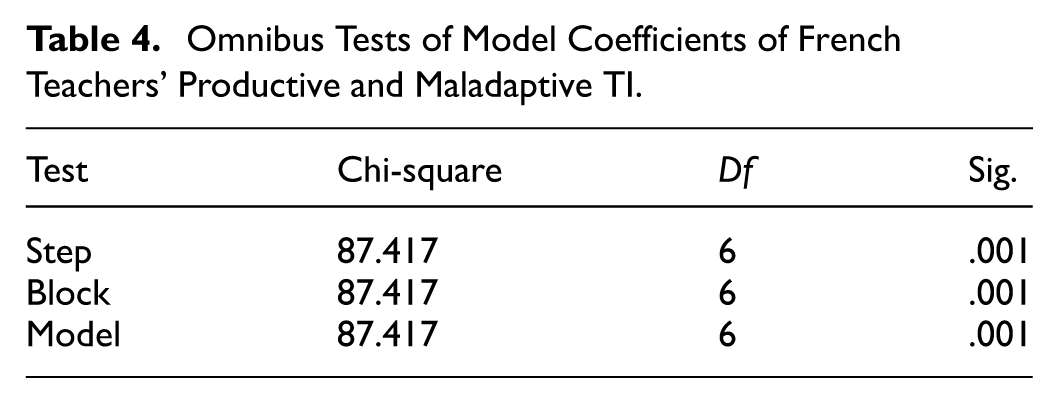
As shown in Table 4, the results were significant (p < .05) and the researchers examined goodness of fit. The analysis indicated that the result of goodness of fit was not significant (χ2 = 11.981, df = 8, p = .255).Therefore, summary of model was scrutinized (Pallant, 2007). Table 5 provides the pertinent results:
Model Summary of French Teachers’ Productive and Maladaptive TI.

The values in Table 5 indicated that the model explained between 43.5% and 46.8% (i.e., R Square values multiplied by 100) of the variance in French teachers’ productive and maladaptive TI. Considering these results, contributions of predictor factors to these participants’ productive and maladaptive TI were scrutinized. Table 6 shows these results:
Factors in Equation on French Teachers’ Productive and Maladaptive TI.
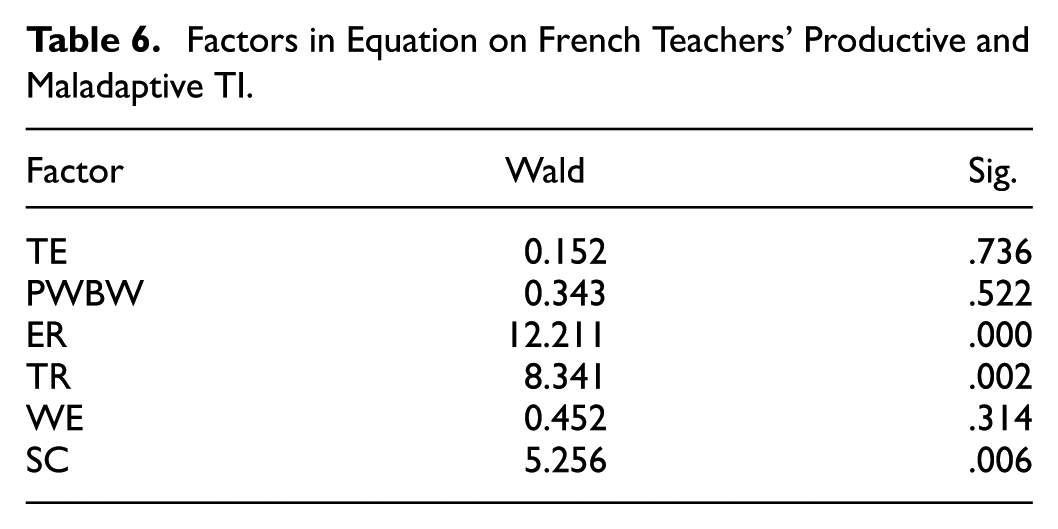
The examination of the Wald scores and their relevant probability values in Table 6 indicated that French teachers’ ER (12.211), TR (8.341), and SC (5.256) were respectively the first, the second, and the third variables that made the strongest significant contribution to explaining their productive and maladaptive TI.
Research question three focused on the factors that significantly predicted American teachers’ productive and maladaptive TI. Preliminary analysis of Tolerance values indicated that they were larger than .1. As Pallant (2007) noted, Tolerance values that are “less than .1” (p. 156) suggest the possibility of multicollinearity. Therefore, the multicollinearity assumption was not violated in the present study. Consequently, the researchers examined the tests of the model coefficients. Table 7 shows these results:
Omnibus Tests of Model Coefficients of American Teachers’ Productive and Maladaptive TI.
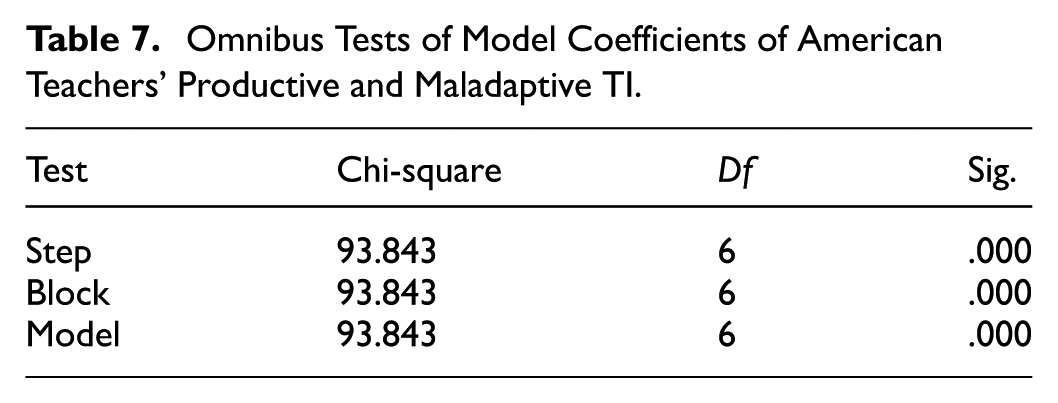
As shown in Table 7, the results were significant (p < .05) and the researchers examined goodness of fit. The analysis indicated that the goodness of fit result was not significant (χ2 = 13.942, df = 8, p = .122).Therefore, summary of model was scrutinized (Pallant, 2007). Table 8 shows these results:
Model Summary of American Teachers’ Productive and Maladaptive TI.

The values in Table 2 indicated that the model explained between 52.7% and 55.9% (i.e., R Square values multiplied by 100) of the variance in American teachers’ productive and maladaptive TI. Based on these results, contributions of predictor factors to these participants’ productive and maladaptive TI were investigated. Table 9 provides the relevant results:
Factors in Equation on American Teachers’ Productive and Maladaptive TI.
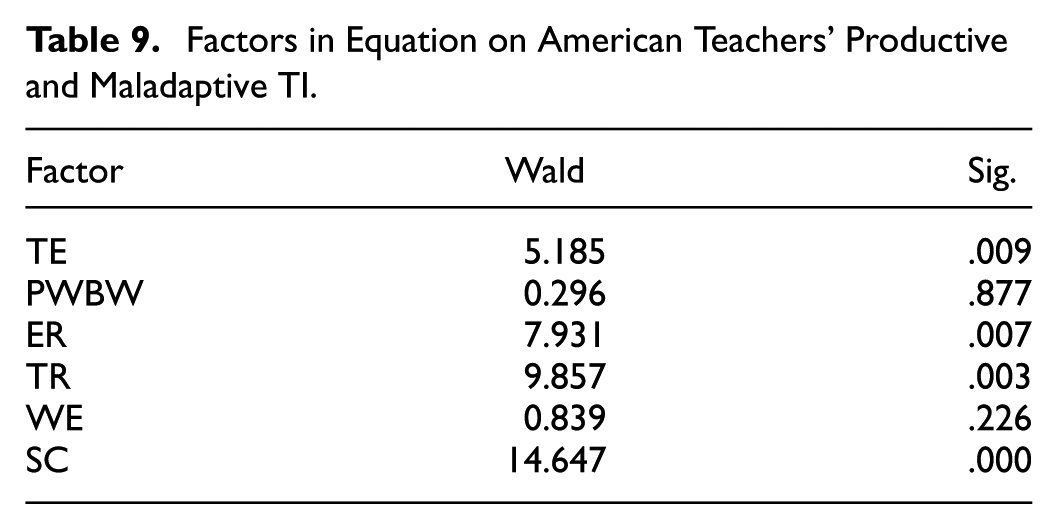
The examination of the Wald scores and their relevant probability values in Table 9 indicated that American teachers’ SC (14.647), TR (9.857), ER (7.931), and TE (5.185) were respectively the first, the second, the third, and the fourth variables that made the strongest significant contribution to explaining their productive and maladaptive TI.
Lastly, research question four examined the significant differences between Iranian, French, and American teachers’ productive and maladaptive TI. Given this objective, the researchers used the chi-square test for independence to perform the data analysis. Pallant (2007) noted that in 2 by 2 Chi-square tables, the Continuity Correction value has to be checked instead of the Pearson Chi-Square value. Considering this issue, first, the researchers examined the frequency and percentage of productive and maladaptive TI of Iranian, French, and American teachers. Table 10 shows the relevant results:
Frequency of Iranian, French, and American Teachers’ Productive and Maladaptive TI.
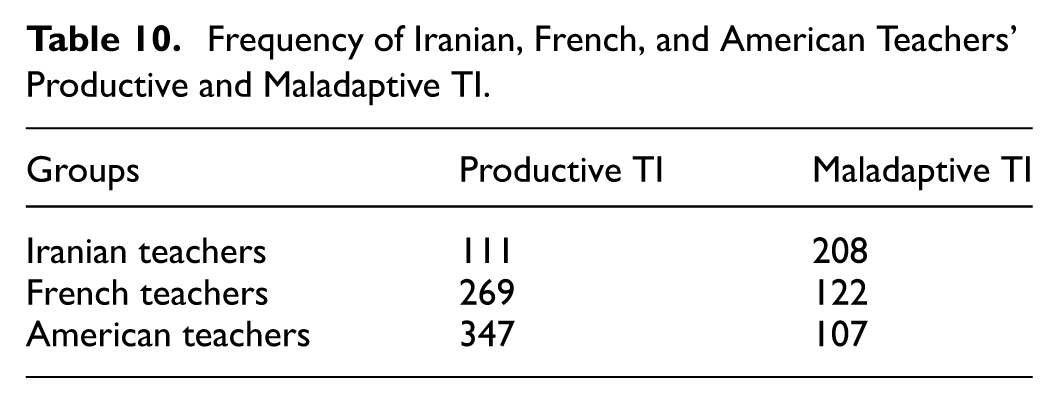
Second, in order to determine the significance of the differences between productive and maladaptive TI types of these groups of English teachers, the researchers ran three chi-square test for independence test and checked Continuity Correction value instead of the Pearson Chi-Square value. The results of the analyses indicated that there were significant differences between Iranian and French teachers’ TI types (χ2 = 80.284, df = 1, p = .000). Moreover, French teachers’ TI was more productive than that of Iranian teachers. Figure 2 shows these results:

Frequencies of Iranian and French teachers’ productive and maladaptive TI.
Likewise, Iranian teachers’ TI types significantly differed from American teachers’ TI types (χ2 = 132.798, df = 1, p = .000). Furthermore, American teachers’ TI was more productive than Iranian teachers’ TI. Figure 3 shows the relevant results:

Frequencies of Iranian and American teachers’ productive and maladaptive TI.
Nonetheless, there were not any significant differences between French and American teachers’ TI types (χ2 = 5.816, df = 1, p = .016). In other words, French and American teachers’ TI was equally productive. Figure 4 shows these results:

Frequencies of French and American teachers’ productive and maladaptive TI.
Discussion
Research question one endeavored to itemize the main predictors of English teachers’ productive and maladaptive TI in the context of Iran. The results underlined the fact that Iranian teachers’ PWBW, TE, and WE were the most significant predictors of their TI categories. In general, these results are in line with the results of the studies that were conducted by Burić and Macuka (2018), Song et al. (2018), Addimando (2019), R. Li et al. (2022), Zeng et al. (2019), Greenier et al. (2021), Han and Wang (2021), Proietti Ergün and Dewaele (2021), Proietti Ergün and Ersöz Demirdağ (2022), Deng et al. (2022), Shu (2022), Xiao et al. (2022), Xiyun et al. (2022), Yang et al. (2022), and Fathi et al. (2023). These studies reported that English teachers’ PWBW, TE, and WE significantly predicted their mental health in their pertinent academic settings.
Garg and Rastogi (2009) stated that language teachers’ PWBW specifies the extent to which they are satisfied with diverse aspects of their profession including their instruction procedure, relationships with learners and colleagues, attitudes toward methodological innovations, language-teaching-related events such as seminars, webinars, and conferences, and teacher-education courses among others. Moreover, as Stapleton et al. (2020) explained, teachers with higher levels of PWBW believe in their occupational competence and are likely to ameliorate their working relationships with their peers and learners. Moreover, they feel a strong desire to engage with the process of language instruction and make an attempt to thrive on their capabilities in the context of the classroom.
Furthermore, C. Li and Li (2023) pointed out that language teachers TE encompasses their positive feelings that empower them to allocate their time and resources to target language instruction. As they explained, teachers with higher levels of TE derive satisfaction from expediting their learners’ language acquisition and tend to adopt positive attitudes toward their instructional efficacy. Likewise, J. M. Dewaele and Li (2022) stated that teachers’ higher TE motivates them to evaluate novel ideas and instructional techniques and makes them more open-minded concerning the changes in their workplace and profession. Lastly, Proietti Ergün and Dewaele (2021) stated that TE prevents teachers from suffering from burnout and ameliorates their self-confidence and self-esteem.
Additionally, da Silva Júnior et al. (2020) stated that teachers WE has an advantageous effect on their commitment to their profession, involvement in occupation-oriented events and activities, and job-related empowerment. They noted that, teachers with a high level of WE have strong positive feelings toward their profession, invest their cognitive resources in its related activities, and make an effort to carry out its pertinent tasks in an appropriate way. According to them, teachers’ emotional and cognitive dedication to their job empowers them to capitalize on their positive emotions in order to stifle their negative feelings that interfere with their efficacious second language instruction in their classes.
Finally, Rahmati et al. (2019) pointed out that Iranian language teachers’ TI tends to be unduly influenced by their academic settings. As they explained, Iranians are generally sociable people who enjoy the company of their friends and colleagues and tend to derive enormous satisfaction from interacting with them. According to them, the nature of the relationships that Iranians develop with the other individuals may noticeably influence their psychological health and performance efficacy. In this study, Iranian language teachers’ PWBW, TE, and WE significantly predicted their TI. These factors are influenced by the teachers’ relationships with their peers and learners. Therefore, these factors predicted Iranian teachers’ TI because these teachers’ TI was extremely context-sensitive.
Considering the above-mentioned discussions, it can be stated that, in this study, Iranian teachers’ PWBW constituted a significant predictor of their TI since it ameliorated their attitudes toward various aspects of their profession and had an advantageous effect on their perceptions of their teaching competence. Moreover, it enabled them to establish constructive relationships with their peers and learners and facilitated their ability to take advantage of their language instruction capabilities. Furthermore, Iranian teachers’ TE significantly predicted their productive and maladaptive TI owing to the fact that it prompted them to spend more energy for teaching the target language and to adopt positive attitudes toward it. Additionally, it helped them to derive satisfaction from improvement in learners’ language acquisition, made them more open to innovations in teaching, helped them to exploit their inner resources, and prevented them from suffering from burnout. In addition, Iranian teachers’ WE was a significant factor in their TI due mainly to the fact that it expedited the investment of their cognitive and emotional resources in their teaching process and assisted them to stifle the negative feelings that constituted impediments to their effective instruction. Finally, the significant role of Iranian teachers’ PWBW, TE, and WE in their TI stemmed from the context-sensitive nature of their TI.
Research question two investigated the main factors in French teachers’ productive and maladaptive TI. Based on the results, these teachers’ ER, TR and SC were the significant predictors of their TI categories. Generally, these results corroborate the results of the studies that were conducted by Breines and Chen (2012), Diedrich et al. (2014), Moradkhani et al. (2017), Chishima et al. (2018), Fathi and Derakhshan (2019), Shavit and Moshe (2019), Tandler et al. (2019), Burić et al. (2020), Moè and Katz (2020). Ayoobiyan and Rashidi (2021), Chang and Taxer (2021), Fathi et al. (2021), Heydarnejad et al. (2021), Kharlay et al. (2022), and M. Li et al. (2022). These studies reported that language teachers’ ER, TR, and SC were significant predictors of their mental well-being in their relevant academic settings.
Xiyun et al. (2022) pointed out that language teachers’ ER empowers them to deal with the stress-inducing factors in the context of their classes. As they explained, teachers with higher ER levels are capable to take account of their diverse feelings in the process of language instruction and determine the negative emotions that interfere with their efficacious instruction. Moreover, they are able to rely on their positive feelings to stifle and suppress the negative emotions that impede their effective teaching. Likewise, M. Li et al. (2022) stated that teachers’ higher ER levels make them cognizant of the stressful teaching situations and encourages them to take advantage of diverse affective strategies in order to acclimatize themselves to the relevant situations in the process of language instruction.
Furthermore, Akbari (2007) stated that language teachers’ TR is likely to ameliorates their academic self-confidence since it empowers them to deal with the stress-inducing factors in an effective way. As he explained, teachers with higher levels of TR are able to determine their educational strengths, weaknesses, and needs and can acclimatize themselves to numerous teaching situations. Similarly, Farrell (2016) pointed out that teachers’ TR can have a beneficial effect on their mental well-being since it enables them to develop working relationships with their learners, makes them more confident about the utility of their instructional practices, and helps them to take advantage of innovative language teaching and assessment techniques and strategies in their classes.
In addition, Chishima et al. (2018) pointed out that language teachers’ SC encompasses their proclivity to take account of their tension and suffering and to be responsive to these negative emotions instead of avoiding them. As they explained, teachers’ higher SC levels enable them to develop and implement efficacious stress-coping strategies to ameliorate their satisfaction with the different aspects of their profession. Moreover, Tandler et al. (2019) argued that teachers’ higher SC protects them against their tendency to criticize their educational choices and preferences and increases their professional self-efficacy.
Lastly, Mikucka (2014) pointed out that individualism constitutes a cultural characteristic of people in Europe and highlights the significance of individual achievement in life. According to Mikucka (2014), this characteristic increases European people’s focus on their ideas despite diverse types of challenges. Consequently, self-reliance constitutes a main feature of European people’s individualism. In this study, ER, TR, and SC significantly predicted teachers’ TI in the context of France. All of these factors are influenced by self-reliance dimension of teachers’ individualism. Therefore, the role of French teachers’ ER, TR, and SC in the prediction of their TI may be related to the culture-sensitive nature of TI.
In light of these discussions, it can be averred that, in the present study, French teachers’ ER was a significant factor in their productive and maladaptive TI since it made them aware of their negative emotions and their effects on their instruction and helped them to use efficacious affective strategies to suppress them. Furthermore, French teachers’ TR was a significant predictor of their TI categories due mainly to the fact that it made them cognizant of their weaknesses and motivated them to substitute their ineffective teaching and assessment techniques and strategies with more innovative and effective ones. Moreover, it helped the teachers to develop and maintain strong working relationships with their language learners. In addition, French teachers’ SC was a significant predictor of their TI types owing to the fact that it enabled them to use effective stress management strategies and improved their academic self-efficacy by preventing them from criticizing their pedagogical preferences. Lastly, the role of French teachers’ ER, TR, and SC in the prediction of their TI may be related to the fact that the individualism characteristic of their culture prompted them to rely on their own capabilities to deal with the stressors in their academic settings.
Research question three focused on the main predictors of American teachers’ productive and maladaptive TI. The results indicated that these teachers’ SC, TR, ER, and TE significantly predicted their TI categories. In general, these results underpin the results of the studies that were carried out by Raes (2010), Baker and McNulty (2011), Neff (2011), Jazaieri et al. (2013), J. M. Dewaele and MacIntyre (2014), J. M. Dewaele et al. (2018), Gheith and Aljaberi (2018), J. Dewaele et al. (2019), Shirazizadeh et al. (2019), Yalcin Arslan (2019), Soodmand Afshar and Moradifar (2021), Bing et al. (2022), Xiaojing et al. (2022), Heng and Chu (2023), and Liu et al. (2023). These studies stated that language teachers’ SC, TR, ER, and TE constituted significant predictors of their mental health.
Neff (2011) pointed out that language teachers’ SC can have a beneficial effect on their attitudes toward their teaching efficacy. She stated that, teachers’ higher levels of SC prompt them to take account of their imperfections, to determine their causes, and to implement affective strategies to redress them. Moreover, Baker and McNulty (2011) noted that teachers’ SC increases their self-improvement motivation and enables them to regulate their negative emotions by taking advantage of their positive feelings that facilitate their language instruction.
Moreover, Heng and Chu (2023) noted that language teachers’ TR is likely to improve their instructional self-efficacy by encouraging them to take advantage of new ideas, teaching strategies, and instructional materials. As they explained, TR provides teachers with a better understanding of their futile practices and helps them to overhaul their pedagogical decision-making and educational alternatives.
Furthermore, M. Li et al. (2022) averred that language teachers’ ER enables them to modify their attentional resources in order to divert their attention from their negative emotions to their positive feelings. According to them, this ability helps the teachers to defuse their psychological tension by capitalizing on their positive feelings in the process of instruction.
In addition, Liu et al. (2023) pointed out that TE can have a positive effect on language teachers’ mental well-being since it makes them aware of the fact that they are recognized as a capable academic in their workplace. As they explained, teachers’ perceptions of academic recognition ameliorate their attitudes toward their instructional efficacy and improve their work engagement in their pertinent academic settings.
Finally, Lamb et al. (2020) pointed out that individualism that highlights self-reliance constitutes the main aspect of American culture. As they noted, American people take great pride in their personal achievements and believe that their success is mainly associated with their reliance on their capabilities and skills. In the present study, American teachers’ SC, TR, ER, and TE were significant predictors of their TI. These factors are mainly influenced by teachers’ self-reliance. As a result, their role in the production of teachers’ TI may be related to the culture-sensitive nature of their TI.
In view of these discussions, it can be stated that, in the present study, American teachers SC and TR were significant predictors of their TI categories since they respectively enabled them to take advantage of affective strategies for regulating their negative emotions and empowered them to overhaul their pedagogical decision-making by evaluating innovative teaching principles. Moreover, ER significantly predicted American teachers’ productive and maladaptive TI since it helped them to modify their attentional resources and to take advantage of their positive feelings to deal with stress-inducing factors. In addition, American teachers’ TE was a significant factor in their TI owing to the fact that it made them cognizant of their academic recognition and ameliorated their language teaching self-efficacy. Lastly, the significant role of SC, TR, ER, and TE in the prediction of America teachers’ TI may be related to the fact that these teachers predominantly depended on their own inner resources for dealing with the stress-inducing factors in the context of the classroom.
Finally, research question four examined the significant differences between Iranian, French, and American teachers’ productive and maladaptive TI. Based on the obtained results, there were significant differences between Iranian and French teachers’ TI types. Likewise, Iranian teachers’ TI types significantly differed from American teachers’ TI categories. Notwithstanding, there were not significant differences between French and American teachers’ productive and maladaptive TI. More specifically, French and American teachers’ TI was more productive than that of Iranian teachers. In general, these results corroborate the results of the studies that were carried out by Haseli Songhori et al. (2018) and Maghsoudi (2021). These studies showed that Iranian teachers’ maladaptive TI was the dominant TI type in different academic settings. Moreover, the results are in line with the results of the studies that were conducted by Stavraki and Karagianni (2020) and S. Li (2022). These studies highlighted the context-sensitive nature of teachers’ TI.
Hiver (2017) pointed out that TI is mainly a context-sensitive construct owing to the nature of its sub-components that may be affected by numerous contextual, learner-related, affective, and cognitive factors. As he explained, the affectivity and attitudes toward teaching sub-components of TI are likely to be greatly influenced by the value that is placed on the language instruction in the teachers’ native culture. Furthermore, the instructional self-efficacy and burnout sub-components of TI may be affected by the comments and feedback that are provided by teachers’ peers or supervisors in their relevant academic settings. Moreover, the openness to change and coping sub-components of TI may be under the influence of teachers’ opportunities to take part in different national or international teacher education courses and educational events such as conferences, seminars, and webinars among others. Finally, the resilience sub-component of TI may be affected by the professional counseling services in the language teachers’ pertinent academic contexts and settings.
In light of these discussions, it can be argued that in the present study, French and American teachers TI was more productive than that of Iranian teachers since their profession was valued in their society and they received favorable and formative feedback from their colleagues and supervisors. Moreover, they were able to take part in numerous constructive teacher education courses and international events. Finally, these teachers were provided with appropriate counseling and were able to resolve their psychological tension in their workplace.
Conclusion
The present study strived to determine the significant predictors of Iranian, French, and American English teachers’ productive and maladaptive TI. The results indicated that PWBW, TE, and WE were the significant factors in Iranian teachers’ TI. Moreover, ER, TR and SC significantly predicted French teachers’ TI. In addition, SC, TR, ER, and TE were the main predictors of American teachers’ TI categories. Lastly, Iranian teachers’ TI was mainly maladaptive and differed from French and American teachers’ TI which was predominantly productive.
A number of conclusions can be drawn from these results. First, it is recommended that the current teacher education courses be redressed in most of foreign language contexts including the context of Iran. The overhaul process of these courses has to focus on their educators and content. More specifically, most of these teacher educators are experienced language teachers who have obtained multiple local and international teacher training certificates. As a result, they are mainly concerned with the practical language instruction considerations and tend to disregard the vast differences among individuals teachers. Consequently, it is suggested that these educators be re-educated to become cognizant of the diverse teacher factors (e.g., TI) that are likely to have a notable effect on their pedagogical efficacy. The knowledge of teacher factors can prompt the educators to prepare the language teachers for dealing with the contextual stress-inducing factors and their psychological tension in an effective way. In addition, it is recommended that a teacher factor module be included in the current teacher education courses. This module has to provide teachers with sufficient information on their factors including their TI, TE, PWBW, ER, TR, WE, and SC. Moreover, it should empower the teachers to use certain affective strategies for ameliorating their factors and for stifling the negative emotions that interfere with their effective instruction.
Second, the results suggest the teachers’ need for guidelines on psychological tension management in their workplace. Therefore, it is proposed that syllabus designers should revise the current teacher manuals in the foreign language contexts by including a teacher factor section in them. This section has to provide the teachers with information on the theoretical aspects of these teacher factors (e.g., TI). Moreover, it should help them to take appropriate measures to deal with the factors such as maladaptive TI that negatively affect their composure and constitute barriers to their effective language teaching.
Third, the results showed that maladaptive TI was Iranian teachers’ dominant TI category. Considering this result, it is suggested that, teachers in foreign language contexts, including Iranian context, develop a satisfactory understanding of productive and maladaptive TI and the impacts of these TI categories on their instructional efficacy. To this end, they can examine the results of the relevant studies of TI (e.g., the present study) to determine its predictors and the affective strategies that can be developed and implemented for changing their maladaptive TI into productive TI in their academic settings.
Lastly, based on the results, it is recommended that program developers revise the supervisor education courses in foreign language contexts. The scrutiny of the content of the current supervisor education courses shows that they highlight the summative assessment of teachers’ performance and disregard their formative assessment that can make them aware of their strengths and weaknesses and can ameliorate their TI and psychological well-being. Consequently, it is suggested that a teacher counseling section be included in the supervisor education courses in order to make the prospective supervisors cognizant of the fact that they constitute teachers’ main psychological supporters who can enable them to deal with sources of psychological tension by providing them with constructive counseling.
The present study suffered from a number of limitations since it was not able to use random sampling and took advantage of convenience sampling that is likely to have a negative impact on the external validity of the study and the generalizability of the obtained results. Furthermore, the study relied on the participants’ voluntary participation in the study that is likely to threaten the generalizability of results to the other contexts and settings. In addition, the researchers could not control the effect of the bias of the participants’ institutional affiliations on the results of the study. Additionally, the researchers exclusively used questionnaires in data collection that are subject to social desirability and self-report biases. Besides, the study did not control the impacts of teachers’ personal characteristics including their age, gender, teaching experience, educational background, and institutional type on the obtained results. Moreover, the researchers delimited the study by focusing on a certain number of affective factors (i.e., TE, PWBW, ER, TR, WE, & SC) as the predictors of English teachers’ TI in the examined contexts. The future studies need to deal with these issues. Furthermore, these studies should specify the predictors of teachers TI in different foreign and second language contexts and academic settings including school and university settings.
The present study adopted the quantitative approach and used the predictive correlational design to determine the main factors in English teachers’ TI in the contexts of Iran, France, and the United States. The results of the study added to the literature on TI since they indicated that different factors predicted language teachers’ TI in the above-mentioned contexts. Moreover, based on the results, teachers’ contexts had a significant impact on the productive or maladaptive nature of their TI. Nonetheless, data triangulation is likely to provide a better understanding of the context-sensitive nature of TI. As a result, the future studies should use mixed-methods designs and need to take advantage of qualitative interviews and classroom observations to provide a better understanding of the factors in teachers’ TI in various contexts.
Footnotes
Acknowledgements
The authors express their gratitude to all of the individuals who participated in the present study.

Ethical Considerations
This study was conducted in accordance with the Academic Integrity Code of University of Tabriz.
Consent to Participate
Written informed consent was obtained from all of the participants before the beginning of the study.
Author Contributions
Conceptualization, Methodology, Data collection, Data analysis, Writing original draft [Abdolreza Khalili], Data collection, Resources, Reviewing, Editing [Mohammad Zohrabi], Data collection, Reviewing, Editing [Leila Dobakhti].
Funding
The authors received no financial support for the research, authorship, and/or publication of this article.
Declaration of Conflicting Interests
The authors declared no potential conflicts of interest with respect to the research, authorship, and/or publication of this article.
Data Availability Statement
The data that support the findings of this study are available on request from the corresponding author.