



Abstract
This study explored the factors affecting teacher motivation with recommendations given by the 68 published research studies. The 68 research studies were conducted across the world that is, in the U.S., Indonesia, Pakistan, Turkey, Malaysia, and Tanzania. This study was conducted to review the recruited published literature based on their results and the way of researching to understand teacher motivation. Furthermore, it was studied from some immense perspectives to highlight the factors affecting teacher motivation contextually to recommend a particular way of coping with the hindering faces of teachers. All the selected studies were conducted with diverse approaches and different contexts providing similar and dissimilar insights as the findings. The core factors of positive and effective teacher motivation include the high salary, financial incentives, the feeling of autonomy, self-motivation, professional development, job design, content knowledge, effective working conditions, performance management system, students’ willingness to learn, positive responses from students and using diverse approaches. On the other hand, unfavorable policies regarding teaching, low salaries, lack of resources, and a heavy workload were found the main factors affecting negatively teacher motivation, whose continuity affects the psychological conditions of teachers.
Plain Language Summary
Teacher motivation is considered an important phenomenon throughout the world. Its importance can be seen through the published studies on it every year. This study provides a comprehensive understanding of teacher motivation, as it is extracted and derived from the literature review of sixty-seven studies conducted throughout the world. The high salary, financial incentives, autonomy, self-motivation, professional development, content knowledge, conducive working environment and conditions, effective performance management system, students’ readiness towards learning, etc. were found the prime factors of effective teacher motivation. While, unfavourable and non-friendly policies, low salaries, lack of basic needed resources, and a heavy workload were found the key factors of teacher demotivation.
Keywords
Introduction
Education is the development and the key to success (Fatimah et al., 2024) specially connected with the competencies of Gen Z (Rachmad, 2025) directly connected with the existing technological and scientific development (Chen et al., 2024) can be affiliated with Education (Bregman & Muhammad, 1998; Jia et al., 2024). Indeed, countries with high achievements in the field of education lead the world (Hoque et al., 2023). Because education is the social instrument by which any nation can be shaped, changed, and upgraded for future developments to maintain sustainability (Maki, 2023). Whereas, in the 21st century, education is considered the fundamental factor and critical role in economics. In the competitive world, the quality of education with advancement is required. Quality education cannot be separated from the quality of good teaching and staff management. It means that the staff members have essential roles in functioning the education system effectively to improve the quality of the learning process. Undoubtedly, teaching as a profession goes beyond teaching and the classroom. It is very complex and multi-dimensional. For enhancing the quality of education through teachers, two key characteristics are prominent that is, motivation and performance of teachers. It works well for teachers’ motivation in reaching any measurable definite goal. Teacher motivation has value in promoting teaching and learning in any country. It plays an important role in making the education system better. A motivated teacher feels satisfied with his or her job. Motivated teachers are more likely to motivate their students to learn in class, to have a sense of educational reform, and feelings of satisfaction and fulfilment (Nyakundi, 2012; Shishigu, 2015). On the other hand, demotivation, low status of teachers, inadequate salaries, entering poor standard of teachers are some of the factors that cause a lack of quality in the education system of Ethiopia (Abebe & Woldehanna, 2013; Mpokosa et al., 2008). Low teacher motivation impacts negatively on educational outcomes. The study of Kayuni and Tambulasi (2007) claimed that a lack of motivation and commitment of teachers could lead to a negative impact on students’ learning as well as outcomes.
Overall, this study contributes to promoting quality education indirectly by improving the quality of teachers through identifying the hindrances faced by in-service teachers of private and government schools of Sukkur particularly and the rest of the areas of the globe generally. Sukkur is situated on the western bank of the Indus River, in the northern area of the Sindh, province of Pakistan (Pal et al., 2023). It is the third largest city in Sindh and the fourteenth largest city in Pakistan. It is a culturally rich city connecting the people of the Punjab and Baluchistan through business activities. It is a hilly area with some river islands such as Bukkur, a famous place for Hindu worshipers for hundreds of years. It is a center of people belonging to different religions, casts, creeds, and languages (Shaikh et al., 2023). The results of the study will be of great benefit to the schools’ management, which help administrators to understand the invisible environment and initiate accordingly to improve their schooling with the support of teachers. Along with that, the findings of this study will direct the teacher trainers to come up with motivation and modern teaching strategies to work effectively in their contexts to achieve the predetermined goals through scientific solutions to the issues and problems.
The quality of teachers in Pakistan is weak (Hussain et al., 2023; Majeed, 2023), and the prime reason is the low level of academic qualification(s) required for the appointment of a primary school teacher (Majeed, 2023), that is, metric or intermediate. The quality of education is considered as a key factor in any education system to produce effective human resources (Acevedo-Duque et al., 2023; Leal Filho et al., 2023) to work for the achievement of sustainable development goals (Adhikari & Shrestha, 2023; Saini et al., 2023). The findings of various researchers have demonstrated a strong correlation between teacher education and student accomplishment (Hemi et al., 2023; Kong & Lai, 2023). As a result, students taught by teachers with a minimum educational qualification perform weakly due to low motivation associated with different factors (Almusharaf et al., 2023; Schunk, 2023). The second certificate/diploma of teaching education program(s) is to join as a teacher, which is ineffective and low in learning. The lack of qualified master’s trainers and the non-existence of a proper support/monitoring system for teachers hinder providing a quality-based learning environment to the teachers (Bergold & Steinmayr, 2023). On the other hand, most elite private schools hire teachers who are well-qualified in academic minimum with intermediate (12 years of school) or BA level (14 years of education). However, the salary is very low for qualified teachers as compared to government teachers, and they have no job security (Camacho et al., 2023; Gumasing & Castro, 2023). Mostly they do not require any additional degree such as BEd or MEd. Mostly they have the space and flexibility to establish their teacher training programs or have access to subject specialists from private schools and higher education institutions.
Additionally, local interest organizations who want to hire teachers in their preferred areas can interfere with teacher appointments in schools. Due to the system being exposed to graft and rent-seeking, there are significant rates of teacher absenteeism, which is made worse by the lack of an efficient supervisory mechanism. Particularly in primary schools, the appointment of teachers is influenced by politics or the payment of large sums of money. For government teacher appointments, there is some visible process to appoint any teacher under considering flaws and ineffectiveness in the education system. Different policies have been proposed by the government of Pakistan, such as the National Education Policy, especially in 2009 (Khan, 2015).
Purpose of the Study and the Research Synthesis Process
This study is conducted to review the published literature to explore the understanding of Teacher Motivation (TM) from an immense perspective and highlight the factors that affect TM contextually by Literature review (LR) and research synthesis (RS) to recommend better solutions of the particular problem. LR is the process of reviewing the literature or conducting surveys of published knowledge or materials, “not based primarily on new facts and findings but on publications containing such primary information, whereby consists of the digested, sifted, classified, simplified, and synthesized processes” (Manten, 1973, p. 75). LR has stages including problem formulation, literature search, data evaluation, data analysis, interpretation of results, and summary (Hedges & Cooper, 1994). Similarly, the following steps must be taken to compare similar conclusions reached by several authors who belong to the same group: The methodological features should be criticized, areas of dispute amongst authors on the same subject should be examined, exemplary studies and research gaps should be highlighted, and the current study’s relationship to earlier studies and the body of literature should be compared and at the last, discussed conclusion and summarize what the researchers say and their research results.
Therefore, the contribution of the study in the field is to identify the role of different stakeholders. As in the educational institutions, the main stakeholders are students, teachers, management, and parent, who wanted progress toward the sustainability of society. Where the role of the teacher is very much important and crucial. Therefore, this study was conducted to explore the phenomenon of teacher motivation. The findings of this study would be an authentic addition to the existing literature that is purely dependent on the published research throughout the world about teacher motivation. The main identified areas were the positive and negative factors of teachers’ motivation; teacher motivation towards professional development before and after; connection and relationship between teachers’ and students’ motivation and their outcomes; connection and relationship between teachers’ motivation and their heads, that is, principal leadership styles; connection and the relationship between teachers’ motivation and teachers’ performance; and connection and the relationship between teachers’ motivation and school culture. For the conduction of this study the six research questions were designed, that is, (a) What are the factors of teachers’ motivation; (b) What is the connection of teachers’ motivation and their professional development; (c) What is the connection between teachers’ and students’ motivation and their outcomes; (d) What is the connection between teachers’ motivation and principal leadership; (e) What is the connection between teachers’ motivation and their performance; and (f) What is the connection between teachers’ motivation and school culture?
Literature Gaps
After extensive search of literature on the area of TM, the contextual, leadership, wellbeing and mental health, policy, and practices gaps were identified. Afterwards, the recruited research papers were examined to pinpoint the lacking areas to reach the conclusion through highlighting the areas fully focused and have not been fully explored and adequately addressed. Contextual gaps are found as the lacking areas, which are not researched and explored that how TM differs across the cultures, countries, and educational systems, public vs. private, urban versus rural, traditional versus progressive, teacher motivation versus leadership styles, school governance, or the influence of educational policies like performance-based pay packages, standardized testing, technology, modern pedagogies, time management and investment, etc., which are still needed to be researched and explored. Through this study the factors, professional development, relationship between teachers’ and students’ motivation and their outcomes, principal leadership, teachers’ performance, and school culture have been explored, but still few more areas are remaining, which can be researched through empirical studies. Because the scope of literature review study is limited to the published materials.
Methods
Procedure and Sources of the Study
The literature was searched under the keywords, that is, motivation, teacher motivation, and factors of teacher motivation; teacher motivation and professional development; outcomes of teacher motivation; teacher motivation and principal leadership; teacher motivation and teacher performance, and teacher motivation and school culture. About 65 articles and 5 theses were included through different platforms and databases for review. For that, the used sources included Google, Google Scholar, Springer, BIRCI Journal, Asian Scholars Network, Science Direct (Elsevier), Tesl-Ej, RMLE online, and EURASIA Journal. While, only 65 papers were finalized for the study.
Selecting Studies and Countries
The selection criteria for the inclusion of the papers and theses were consists of the (a) the searching through different keywords and (b) the customized searching through year(s), that is, first cycle from 2016 to onwards (latest); and second cycle from 2010 to 2015. The selected papers were arranged and merged by keywords sequence and year of publication. In the first cycle, 207 studies were recruited, in the second cycle 101, and in the final (third) cycle only 65 studies were finalized for inclusion. These 65 studies were finalized based on above mentioned criteria; the details are given in the PRISMA flow diagram. The main characteristic(s) of the included studies was that they were conducted in different backgrounds and countries, that is, USA 10, Indonesia 9, Pakistan 7, Turkey 6, Tanzania 4, Germany 3, Israel 3, Malaysia 3, Ethiopia 2, Saudi Arabia 1, Bangladesh 1, Thailand 1, China 1, Ireland 1, Netherland 1, Vietnam 1, Columbia 1, Russia 1, Nigeria 1, Romania 1, Kosovo 1, Virginia 1, Jordan 1, Cyprus 1, Uganda 1, South Korea 1, and South Africa 1 respectively. The step-by-step process and procedure of inclusion and exclusion can be understanding through Figure 1 with the heading of the PRISMA flow diagram.

PRISMA flow diagram.
Characteristics of the Studies
From the 65 studies, a total of 6 themes were generated based on their similar factors and relationship with TM. Each theme contained various studies, that is, theme one (16), theme two (11), theme three (6), theme four (14), and themes five and six contained (9) each, respectively, available in the Tables 1 and 2.
Literature Searched Keywords.

Themes of the Study.

Results and Discussion
The finding of the study was conducted through a thematic process which consists of 65 studies. A total of six themes were identified through synthesizing the variables of the study.
Factors of Teachers’ Motivation
The first theme was combined into 16 studies of different countries; Pakistan three, Tanzania two, Turkey two, and other countries, including each article such as the USA, Ethiopia, Bangladesh, Malaysia, Jordan, Thailand, and China. The methodology components of these studies were found multi-directional, that is, eight studies were conducted quantitatively, four qualitatively, and three by mix-methods respectively. It provided comprehensive results of the studies, that is, the data collection tools were semi-structured interviews, field observation, self-reflection, documentation, and diary writing were used in qualitative studies. Different questionnaires were used in quantitative and Mixed-method studies carried out in both interviews and questionnaires respectively. In qualitative, the researcher took 1 to 35 sample sizes, for quantitative 70 to 510, and for Mix-method 40 to 340 participants were found the sample sizes respectively (Table 3).
Factors of Teachers’ Motivation.

Low salary or pay, delays in promotion, poor working conditions, support and reporting implementation, curriculum management aspects, unfavorable policies on education regarding teachers, and the community’s negative perception of teaching were identified as factors that demotivated teachers (Ariffin et al., 2015; Mark, 2015). Likewise, low-salary persons are given low emphasis by the society. The main reason of low salaries and benefits is the lack of resources in terms of knowledge, management, and leadership skills among teachers, which are not supported by the school management and administration (Shishigu, 2015). Meanwhile, the study by Daniels (2017) pointed out that content knowledge and feelings of autonomy were the main factors to motivate teachers in terms of developing their skills and improving their competence. Another study supported that effective working conditions, students’ willingness to learn, using diverse approaches, and being more autonomous teachers are more successful and motivated (Börü, 2018). Self-motivation highlighted the major causes of being demotivated in the teaching field. Along with that, external factors such as curriculum and course books, lack of resources for teachers, and school administration negatively affected the motivation of teachers (Barin, 2018). According to Rasheed et al. (2014), salary and financial incentives are key factors for T.M. Other factors identified in their studies include job design, working environment, performance management system, and professional development. Another study argued that teachers were not satisfied with their socioeconomic status, behaviors of students, examination stress, and choice of profession, and as a result, teachers felt demotivation (Alam & Farid, 2011). Another study from that same context said that most teachers are motivated when they earn more money, have positive responses from students, and enjoy long vacations (Khan, 2014).
The analyzed studies between external and internal factors revealed that external factors have a strong effect on the other factors. Also, the findings of other studies supported intrinsic motivation rather than extrinsic motivation. The findings of the study by Syamananda (2017) supported the above arguments and said that teachers are demotivated by extrinsic factors due to the heavy workload for teachers and low salaries. On the other hand, another study supported intrinsic motivation and explained that teachers in Jordan like teaching and choose by their choices. They consider teaching a sustainable future for the people in Jordan, according to Dweik and Awajan (2013) 6. By MANOVA, the study showed that intrinsically motivated teachers are more satisfied with their jobs. Due to socioeconomic background, lack of professional training and development factors were identified as demotivation of teachers (Khan et al., 2016; Liu, 2014). Furthermore, it was revealed that teachers’ motivation level was not advanced, with a mean (M) was 3.47 and a Standard derivative is .988 (Kumar & Hossain, 2017). The findings on Commitment to the teaching profession were found very thin on the ground as one of the studies claimed that low levels of Commitment were found in the teaching profession of the teachers of Tanzania (Mkumbo, 2013). Studies mainly focused on policies and their revision by the governments and personal and professional development training programs which should be in the secondary education system (Daniels, 2017; Mark, 2015). The work environment motivates teachers positively (Kuncoro & Dardiri, 2017), while paying good salaries according to their qualifications, experiences, and abilities (Ariffin et al., 2015; Daniels, 2017) plays a vital role in the motivation of the teachers.
Teacher Motivation and Professional Development
This theme contains eleven different contextual research studies for the theme, including four from the USA and one from Ethiopia, Ireland, Germany, Netherlands, Saudi Arabia, Serbia, South Africa, and Vietnam. About 14 studies are included for this theme. Five studies were conducted qualitatively under Semi-stricture interviews and focus group discussion tools. Other researchers used the quantitative Study method, and different questionnaires were used as tools for quantitative studies. For a sample, the data was collected between 1 and 19 range participants in the qualitative method. On the other hand, between 36 and 1162, a range of students participated in the data collection. All the studies were published in reputed journals, that is, Springer, Routledge (Taylor & Francis Group), Research Gate, TESL-EJ, and HU Journal of Education (Table 4).
Teacher Motivation and Professional Development.

Several studies found diverse answers on the relationship between TM and Professional Development (PD). One of the studies found that teachers having associate degrees like BEd or MEd and Training like CPD were more likely to respond negatively to children’s emotional displays. Courses like Child Development or Early Child Education were not associated more negatively with social guidance (Lang et al., 2017). On the other hand, studies between the teacher's competency and the teacher-related courses positively influenced teachers’ professional development as the study found significant results in terms of the positive relationship between the course of the teaching program and preschool teachers’ competency, specifically science-specific pedagogical content knowledge (Barenthien et al., 2020).
Similarly, the findings of Lang et al. (2017) study revealed PD as a supporting tool to make teaching updates, peer-supportive and learning processes for teachers. For that, faculty must be internally motivated to attend training and courses regarding teaching PD, as a study suggested these findings (Bouwma-Gearhart, 2012). One of the studies supported the above findings and claimed that intrinsically motivated teachers to develop their skills and engage in developmental activities, as the principal support was found prime factor in supporting teachers’ motivation, which makes them passionate about their learning through different activities (Heystek & Terhoven, 2015). As a result, personal motivation for achievement increased, growth and advancement in the teaching and learning process of teachers, and other contingent factors such as relations among schools and their policies, according to the study by McMillan et al. (2016). Other factors were highlighted and divided into two levels; School level, such as work and effective pressure, peer support, and leadership of the school head.
Teacher levels such as teaching experience, teachers’ previous experience with learning activities, concepts of learning, and self-efficacy were found to motivate to participate in PD (Zhang et al., 2021). The study of Gemeda and Tynjälä (2015) revealed other contextual factors, including low pay, devaluing their work and shifting to better professions than teaching. Further, the participants argued that the current system of teaching and teachers’ policies are unfair and discouraged their effects from participating in PD, as suggested by Appova and Arbaugh (2018) that student learning is another factor to motivate professionally.
Additionally, the study conducted in a diverse context found a relationship between technology as a driving force and motivating teachers to take part in PD (Buladaco et al., 2020; Truong & Murray, 2019). Contrastingly, another study found a relationship weak between the use of technology and motivation. It was revealed from their perception that teachers were avoided taking online courses and demotivated by Computer literacy (Albrkhi, 2013; Sharma & Srivastava, 2019) whereas, others found a significant relationship between the use of technology and teachers’ motivation (Li & Lee, 2016; Paudel, 2020). Studies between PD and school status have found relationships and consideration. One of those suggested that schools should conduct PD. Needs assessments for all teachers and ensure their strengths and weaknesses through the process (Lang et al., 2017; Postholm, 2018). Promoting principals to motivate teachers because studies suggested that principals influence the teacher's motivational level of PD (Eyal & Roth, 2011; Sowell, 2018). There should be acknowledgment and kinds of rewards by the principal and the government to engage in PD (Gemeda & Tynjälä, 2015; Heystek & Terhoven, 2015). Policies by the government should be re-consideration, which motivates teachers' engagement (McMillan et al., 2016).
Teachers’ and Students’ Motivation and Their Outcomes
In this theme, six studies were reviewed by the researcher to analyze the relationship between TM, student’s motivation, and their outcomes. One study included the USA, Turkey, Pakistan, Iran, and Hong Kong, and only two from Germany. Mainly, four journals, including Elsevier, International Journal of Progressive Education, and Eurasia, were added. Out of six, five studies were conducted quantitatively, and only one was conducted qualitatively. For quantitative, a questionnaire was used as a tool, and semi-structured interviews along with videotaped recordings were used to collect data for qualitative. For sampling, the ratio of participants was from 60 to 732 in the quantitative and 10 participants in the qualitative study (Table 5).
Teachers’ and Students’ Motivation and their Outcomes.

Studies support the relationship between TM and students’ outcomes. Teachers’ interest in the academically increased subject mastery of students and their interests. As a result, teachers' interest in education has a direct relation to students’ motivation (Kalyar et al., 2018; Schiefele, 2017). Similarly, the study correlated between Iran and Russian contexts based on gender, and nationality differences, the impact of teachers, and academic achievement in science education. It was revealed that gender difference was not significant but nationality impacted positively on teachers’ self-efficacy and motivation to increase academic achievement (Bal-Taştan et al., 2018).
Additionally, there was found to be a positive relationship between teachers and students’ autonomous motivation under student-perceived need-supportive practices, and student competence, and autonomy as mediators (Ahn et al., 2021). On the other hand, the study didn’t support the above findings and found that neither teachers’ pedagogical content knowledge increased the interest of students nor the motivation of teachers to increase students’ achievement (Keller et al., 2017). Findings of the mathematics teachers on TM also found no relationship between teachers’ motivation and students’ achievement (Hayden, 2011). Interestingly, the study by Engin (2020) supported the relationship between TM and students’ motivation with a democratic parental attitude. Several studies claimed that TM impacted positively on students’ motivation and outcomes (Johnson, 2017; Singh et al., 2021). Along with that, students’ motivation increases outcomes of academics and develops students’ cognitive as well as affective domains of learning (Keller et al., 2017).
Teachers’ Motivation and Principal Leadership
The theme TM and Principal Leadership were based on fourteen studies, including USA (five), Israel (three), Kosovo (one), Malaysia (one), South Korea (one), Romania (one), Nigeria (one), and Turkey (one) having published on different journals include Emerald, Journal of Educational and Social Research, Red fame, David Publishing, Australian Journal of Teacher Education, Frontiers in Education, Routledge, MDPI, Journal of Research in Education, UMI publishing and July Press. Among fourteen studies, two studies were conducted qualitatively through semi-structured interviews with 30 to 39 participants and one by the mixed method through survey and interviews. Similarly, other studies were conducted in quantitative methods with from 55 participants to 786 through the Motivation Scale for Teachers (Questionnaire) and the Multi-Factor Leadership Questionnaire (Table 6).
Teachers’ Motivation and Principal Leadership.

The findings of the study based on structural equation modeling supported the hypothesis of the study and revealed that the principal has a crucial role in TM (Eyal & Roth, 2011). Principals’ previous experience in instructional and supervisory roles and teachers’ motivation were found to have a very significant relationship (Oyewole & Alonge, 2013). Likewise, the study of Hyseni Duraku and Hoxha (2021) found positive results in the relationship between principals’ leadership attitudes, idealized influence, inspirational motivation, and motivation of teachers. The study of Abdullah et al. (2018) also supported the relationship between transformational leadership and teachers’ motivation and further claimed that transformational leadership is the best predictor of TM.
The results revealed that Transformational School leadership behaviors were mediated by emotional re-framing of teachers’ autonomous motivation (Berkovich & Eyal, 2017). The relationship between autonomous principal support and teachers’ self-efficacy and intrinsic motivation was found to be positive for effective teaching experience (Corkin et al., 2018). Another study supports principals as transformational leaders for better quality professional development, workshop, teachers’ motivation, and their professional development (Paul, 2015). Principals’ expertise in ICT skills and enthusiasm motivated teachers’ contributions to the school where Cohen (2019) findings suggested a very positive relationship between school administrations and the motivation of teachers. Particularly, the findings established under the regression model examined that leadership of school administration affected teachers’ internal motivation (Kalkan et al., 2021). Similarly, the study of Gilbar (2015) and Williams (2018) showed transformational leadership to be an important predictor of teachers’ motivation. Teachers’ autonomy, relatedness, competence and social isolation were correlated with principals’ leadership, according to Shepherd-Jones and Salisbury-Glennon (2018). On the other hand, some studies argued and showed no significant relationship between the above two variables, such as TM and School principal. According to Um et al. (2018), there was no correlation between TM and school principals and the hypothesis that expected a positive relationship between transactional leadership and TM also found no relationship in the findings of Alasad (2017).
Many studies have supported the relationship of TM with the principal of the school. Certainly, if the power to change in school is delegated to the principal. The improvement of educational staff professionally and in school may occur promptly (Berkovich & Eyal, 2017). For that, the principal should be competent in transformational leadership to apply in school to improve the quality of education. Indeed, the quality of education is directly correlated with the motivation of teachers (Abdullah et al., 2018). Further, there should be various programs, seminars, conferences, and workshops arranged for school principals by the government to help with professional development (Oyewole & Alonge, 2013).
Teachers’ Motivation and Teachers’ Performance
This theme was found from ten studies for review from different journals such as IOSR-JHSS, Asian Scholar Network, Turkish Journal of Computer and Mathematics Education, Canadian Centre of Science and Education, BIRCI Journal, IJEVS, and Journal of Educational Science and Research. Out of 10 studies, 8 studies were conducted in the quantitative method from Indonesia (6), Pakistan (1), and Uganda (1), and on the other hand, other studies were conducted in a mixed-method approach from Tanzania (1). For the data collection, a questionnaire was used in quantitative whereas a semi-structured interview, focused group, direct observation, and questionnaire were used in a mix-method approach. From 60 participants to 2,738 in quantitative and 38 to 109 participants were included by researchers (Table 7).
Teachers’ Motivation and Teachers’ Performance.

Studies suggested a significant relationship between TM, and their performance. One of the studies found a very positive relationship among TM variables. Principals’ leadership style influences the performance of teachers, the influence of principals’ leadership style on TM and the influence of TM on the performance of teachers (Mashari & Umami, 2019). Similarly, the study by Arifin (2015) and Akhtar and Iqbal (2017) supported the relationship between TM and their performance positively. According to the study, the performance of teachers was good rather than motivated to teach. Observations promoted performances in terms of teaching through activities as evidence of regulation of teachers and attending school meetings. The studies also well found a positive relationship between the intrinsic and extrinsic motivation of teachers with their performance. Findings confirmed that TM, teachers’ commitment, school climate and job satisfaction found key variables to increase the performance of teachers in secondary school teachers (Fei & Han, 2020).
Statically, the study showed a high score (79.4%) as Teachers’ motivation contributed significantly to teachers’ performance. The overall finding of this study found two predictor variables which are characteristics of teachers and motivation, and in this study, they contributed meaningfully and positively to teachers’ performance (Siahaan et al., 2020). Likewise, another study showed results in statistics that 89.3% of TM was influenced by the performance of Teachers, and the same 89.3% influenced Principals’ managerial competence and Teachers’ work motivation on the teachers’ performance. On the other hand, only 76.6% of SMA Banyuasin showed an influential rate between principals’ managerial competence and teachers’ performance (Hamdani et al., 2018). Many studies in different as well as similar contexts found dissimilarity in terms of results. One of the studies found that teachers’ performance was insufficiently influenced by the teachers’ job motivation and job motivation. Rather the relationship between competence and job satisfaction positively affected teachers’ performance (Arifin, 2015). Another study showed poor motivation for teachers, and the results found a negative effect on academic and job performance (Hango, 2016). According to Erlangga et al. (2021), the ability was found as a factor that affected teachers’ performance, whereas TM did not find any significant results in teachers’ performance (Erlangga et al., 2021).
Certainly, there is a very important relationship between teachers’ motivation with different variables and teachers’ performance correlated closely. There should be an encouragement to motivate teachers to increase their performance of teachers. For that, principals or school heads need to engage teachers in professional development and encourage them by giving incentives (Karacabey, 2021; Rowland, 2017; Siahaan et al., 2020). In terms of incentives, the literature highlighted salary, provision of accommodation, strengthening of supervision, and awards as incentives to motivate and for good performance (Aacha, 2010). Further, the government needs to set priorities and initiate new policies regarding teacher educators to sustain quality education through motivated teachers (Hango, 2016).
Teachers’ Motivation and School Culture
The theme TM and school culture were derived from 10 antithetic studies such as Indonesia (5), Turkey (3), USA (1), and Malaysia (1) with journals including ELSEVIER, ATLANTA’S, RedFame publishing, SPORTIF, NWSA-Education Sciences, Journal Innovasi Pendidikan (IPA), Canadian Centre of Science and Education, Asian Scholar Network, and Jurnal Scientia. There were about 8 quantitative studies under the 28 to 2,738 sample range through a questionnaire. Only a single study was conducted qualitatively with fourteen participants ranging through documentation, semi-structured interviews, focus group discussion, and one mixed-method approach (Table 8).
Teachers’ Motivation and School Culture.
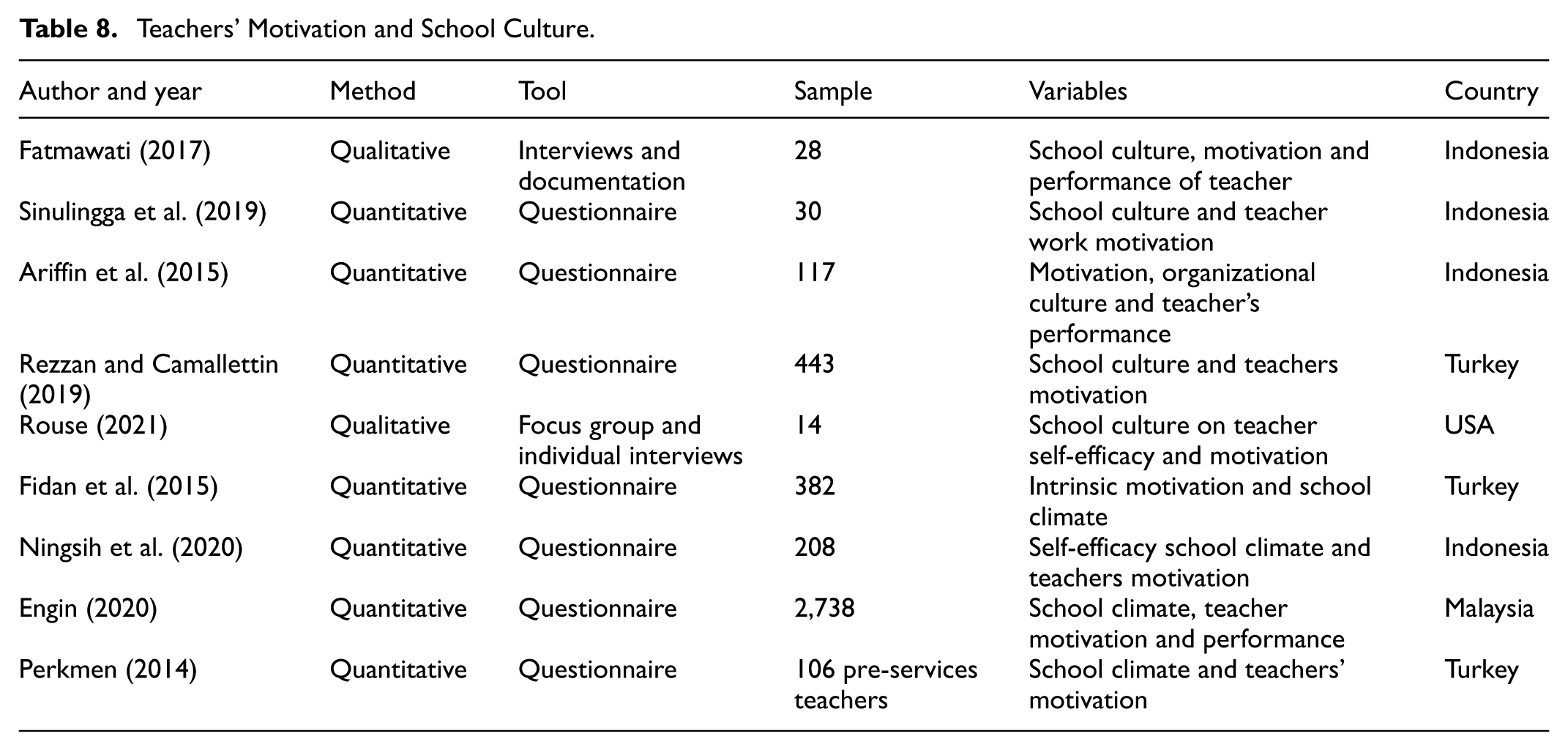
The findings confirmed that there was a significant relationship between TM, School climate, and the performance of teachers. School culture and motivation worked positively to encourage teachers’ performance (Fatmawati, 2017). Another study found positive effects of competence and organizational/School culture on teachers’ job satisfaction (Arifin, 2015). An in-depth study by Uçar and İpek (2019) suggested the favor of cultural power statistically varied according to gender, and marital status, and in terms of teaching experience, and supported culture to promote motivation. Rouse (2021), in his study, found crucial factors that perceived teachers’ ownership and empowerment, which were correlated to school climate, teachers’ motivation, and self-efficacy. On the other hand, self-efficacy was found to be a low category, whereas school climate and teachers’ work motivation were in the medium. The study also confirmed a positive relationship between self-efficacy, school culture and teachers’ work motivation (Ningsih et al., 2020).
In contrast study, private school teachers were to be more intrinsically motivated and creative than public teachers and the intrinsic motivation variable was predicted as positively related to teachers’ creativity. On the other hand, climate culture had no positive relationship with the intrinsic motivation of teachers (Fidan & Oztürk, 2015). However, the study by Fei and Han (2020) supported and stated that school climate was the key factor to increase teachers’ performance. The result of Perkmen’s (2014) study found a relationship between school climate and motivational variables such as personality. On the other hand, healthy school culture, high teacher motivation, and principals’ good leadership are highlighted as important factors of low and high teacher professionalism (Sinulingga et al., 2019). Indeed, the school culture has been a factor that influences teachers’ motivation. There should be a need for improvement in school culture to increase motivation and a sense of self-efficacy (Rouse, 2021).
Recommendations and Suggestions Given by Recruited Studies for the Enhancement of Teacher Motivation
The current study was summarized into 65 articles included 6 themes. Each theme carried recommendations and suggestions. In theme one, researchers recommended revision of policies on secondary education, professional development training, and teachers’ compensation, and suggested increasing salaries, and working conditions of secondary school teachers as well as having criteria for recruitment (Mark, 2015; Syamananda, 2017), which can be done through some need analysis types of studies to focus on the real time and situation problems with their scientific solutions. Considering the importance of teacher training, work environment, support, and recognition to teachers were recommended to stakeholders, and management by researchers (Ariffin et al., 2015). It was also recommended to provide teachers with training and give respect; teachers should be paid according to their academic qualifications, and experiences (Alam & Farid, 2011; Dweik & Awajan, 2013; Khan et al., 2016) supported by competency-based teacher recruitment and selection systems, which is the need and requirement of the emerging time to compete with world. The authority should be focused on internal and external motivational contextual factors to maintain the motivation of teachers, as well as focusing on both extrinsic and intrinsic factors and their relationship (Kumar & Hossain, 2017). Broadly, it was suggested to the authority and management that teachers’ evaluation should be based on objective measurements rather than the subjective ones of the supervisor (Rasheed et al., 2016). The findings of the study by Dweik and Awajan (2013) suggested that the Jordan Ministry of Education needed to increase the salaries of teachers according to their years of experience, their academic degrees and specialization, and depending on the age of students whom teachers teach. Further, it was recommended that the Ministry of Education needed to arrange workshops and teacher training programs for language teachers for their transformation and professional identity.
The two studies recommended the TM and professional development, which demanded special attention to the school management and school climate to conduct continuous professional development for teachers (Barenthien et al., 2020). Undoubtedly, investments in professional development by the management require teachers’ willingness to participate, commitment, and motivation to develop themselves. This study highlighted more spending on professional development training. School leaders and administrators needed to prioritize initially and find ways to increase TM (Gemeda & Tynjälä, 2015). Similarly, the study suggested that all preschool teachers needed to provide opportunities for professional development in the science field (Barenthien et al., 2020). For the KSA Ministry of Education, the study suggested that they should review the technological policies of the public school system to improve the proper integration of ICT in education at different school levels and teaching methodologies. Additionally, courses needed to be introduced for computer training and other courses through hybrid modes such as computer skills, programming and effective use of the internet, Classroom management and lesson planning, and English language courses were suggested by researchers. Professional development programs focus on diverse modules, including academic training, personal training, and teacher learning, and leadership training (Albrkhi, 2013).
The findings of three studies were interlinked with teachers’ and students’ motivation and students’ outcomes and also suggested accordingly. Policies regarding teachers’ motivation could not result in positive between students’ and teachers’ autonomous motivation. Rather, similar policies regarding teachers’ psychological needs and motivation might be effective for learners’ achievement (Ahn et al., 2021). The research recommended that educational interest needed to be highlighted for improvement because it is as motivational characteristics are directly related to the teachers’ content mastery and teachers’ classroom management. Additionally, these interests are also indirectly related to students’ adaptive motivations and mastery (Schiefele, 2017). Teachers’ motivation with students’ motivation and outcomes were highlighted in future recommendations in the studies, and stakeholders, including school districts and administrators, suggested increasing the motivation of teachers towards teaching through innovative strategies to accomplish students’ learning outcomes (Hayden, 2011).
In the four studies, researchers recommended principal and his instructional and supervisory roles were dominated and needed to be more attention which was found very significant factor to increase the motivation of teaching staff. Conferences, seminars, and workshops should be conducted by the State Teaching Service Commission and the State Ministry of Education collaboratively for the principal (Oyewole & Alonge, 2013). All related stakeholders need to be more attentive in developing effective systems especially principals, who can create a positive environment for teachers. The suggested researchers should focus on principals’ autonomy support, particularly low-performing school teachers (Corkin et al., 2018). Supporting the above studies, the study of Cohen (2019) also claimed that school heads impacted teachers’ motivation, commitment, and development of their problem-solving skills. Further, highlighted stakeholders, including policymakers and Politicians, needed to look into the management of public schools and their principals through the lenses of partners and leaders. School principals should be involved in policy-making and development sectors. Along with that, the authority should be given to the principals to promote the involvement of local leaders. Administrators of schools needed to fulfil the basic needs of teachers. They have to initiate team-building among teachers and motivate them. Managers and principals need to provide effective leadership to motivate and energize educating students effectively (Kalkan et al., 2021). Principals’ competence in transformational leadership should be developed to improve teachers’ motivation (Abdullah et al., 2018).
Between the performance and motivation of teachers, the fifth theme of this study recommended increasing the remuneration and salary packages of teachers, according to Akhtar and Iqbal (2017). Additionally, the Government needed to take steps toward awarding teachers for better performance in schools. The Higher Education Commission (HEC) should conduct training, seminars, and workshops for principals and teachers to develop professionally. To increase the motivation and Performance of teachers, researchers recommended increasing the salary of primary teachers as compared to their living costs and awarding for good Performance (Aacha, 2010). For high-performance teachers, it should encourage, grant, and give opportunities to extend teachers’ careers to motivate (Arifin, 2015). In the last theme, administrators as school culture needed to create a flexible environment to increase teachers’ motivation and sense of self-efficacy (Rouse, 2021).
Conclusion and Implication
Reaching the conclusion, the recruited studies were reviewed under different contextual circumstances with similar and dissimilar insights from the findings. The core factors found effective to influence positively on TM include high-salary, financial incentives, feeling of autonomy, self-motivation, professional development, job design, content-knowledge, effective working conditions, performance management system, students’ willingness to learn, positive responses from students, and using diverse approaches, which were highlighted as positive forces of motivation. On the other hand, unfavorable policies regarding teaching, low salary/pay, lack of resources, and heavy workload are included as factors that down the motivation of teachers. Similarly, the majority of studies found a correlation between students’ motivation, interest, outcomes, and teachers’ motivation. Apart from that, some other contextual studies found no relationship between them. Concerning the school head and TM, various kinds of the leadership of principals’ relationship with teachers’ motivation were found; transformational leadership influenced the motivation of teachers, and autonomous principals’ leadership also had a positive impact on teachers’ motivation. Along with that, professional development is well highlighted in the environment of transformational leadership. Additionally, principals’ experience and expertise contributed to the motivation of teachers toward professional development. Regarding performance and motivation, teachers’ motivation had a crucial role in improving their performance of teachers. School climate, and intrinsic and extrinsic motivation of teachers found significant results for good performance. Contrastingly, few studies found no relationship between them. Teachers’ job motivation and academic success were found irrelevant, and no sense of relationship. School climate and motivation of teachers worked positively together; the majority of the researchers claimed. It was suggested that in favor of cultural power, statistically varied according to gender and marital status and in terms of teaching experience supported culture to promote motivation.
The theoretical implications of the findings of the study on TM are to identify the key factors of the intrinsic and extrinsic motivation that influence the willingness of teachers to engage themselves in different professional activities, which bridge the gaps in the available literature specially in theories through incorporation of lived experiences of teachers regarding cultural, institutional, organizational, and socio-economic inspirations on their motivation. The findings also support the developmental items of conceptual frameworks to understand the link of TM with their outcomes, achievement, professional growth, policy designing, and its compliances for better results. Furthermore, the practical implications of the study can be the supportive to design the professional development training and programs to enhance the TM, their autonomy, integrity, recognition, engagement, and available opportunities for better future development through maintaining conducive working environment, fostering teacher satisfaction, retention, collaboration, innovation, caring and sharing of best practices of teaching and learning processes. Finally, the policy implications of the findings of the study are to design the transparent, competent, and supportive system to address the challenges of TM, that is, fair and transparent compensation, reduced and normal workload, and recognition programs to sustain the engagement of teacher for better productivity through different internal and external incentives. For further developments, the teacher voices must be heard and placed in the policy making processes through scientific mechanisms of decision-making processes.
It is recommended to all the stakeholders, including policymakers, politicians, and other educators to review the diverse findings, conclusions, and suggestions given by different contextual studies under this systematic review to fulfil the gaps in education, correlated with teachers’ motivation to make the processes and procedures healthy in your organizations.
Limitations
The limitations of the study are, that is, (a) it focuses on the literature review to produce available data to explore the conceptualization of background and foundations of the phenomenon and their methodologies; (b) it focuses on the understanding of the phenomenon of teacher motivation; (c) it exploring the factors of teachers’ motivation; (d) it represents and connecting teachers’ motivation with their professional development, students’ motivation and outcomes, principal leadership, teachers’ performance, and school culture, which were explored well by the recruited studies. Therefore, the unexplored remaining areas are suggested to study in future research.
Future Research
Empirical studies are highly suggested to conduct on unresearched and unexplored or less researched and less explored areas of TM, which differs across the cultures, countries, and educational systems, that is, public versus private, urban versus rural, traditional versus progressive, teacher motivation versus leadership styles, and school governance, or the influence of educational policies on performance-based pay packages, standardized testing, technology, modern pedagogies, time management, and investment.
Footnotes

Funding
The authors received no financial support for the research, authorship, and/or publication of this article.
Declaration of Conflicting Interests
The authors declared no potential conflicts of interest with respect to the research, authorship, and/or publication of this article.
Data Availability Statement
Data sharing not applicable to this article as no datasets were generated or analyzed during the current study.