




Abstract
This study attempts to validate an integrative Teacher Commitment scale using rigorous scale validation procedures. An adapted questionnaire with 17 items was administered to 600 primary school teachers in Penang, Malaysia. Data were analyzed using exploratory factor analysis (EFA) and confirmatory factor analysis (CFA) with SPSS 19.0 and AMOS 19.0, respectively. The results support Teacher Commitment as a multidimensional construct with its four underlying dimensions: Commitment to Student, Commitment to Teaching, Commitment to School, and Commitment to Profession. A validated Teacher Commitment scale with 13 items measured can be proposed to be used as an evaluative tool to assess the level to which teachers are committed to their students’ learning, teaching, school, and profession. The Teacher Commitment scale would also facilitate the identifications of factors that influence teachers’ quality of work life and school effectiveness. The practical implications, school cultural influence, and methodological limitations are discussed.
Introduction
The influence of teachers on student outcomes is evident through a broad spectrum of literature. Teachers are found to be the influential factor on student achievement (Ackerman, Heafner, & Bartz, 2006), the implementation of regulatory educational policies (Tsui & Cheng, 1999), and student non-cognitive outcomes such as students’ quality of school life (Malin & Linnakylä, 2001). However, to date, teaching in schools is not an easy task. Teachers need to face continuous changes of educational needs such as pedagogy, curriculum, and regulatory educational policies. In relation to this, teachers are facing challenges with the higher demand of knowledge and skills in handling students from diverse backgrounds and abilities, different levels of motivation, and behavior that are not easily identified (Louis & Smith, 1990). As a result, teachers should invest more effort and involvement in promoting high quality of teaching to optimize student outcomes (Darling-Hammond & McLaughlin, 1995). Interestingly, the level of effort and involvement exerted by the teachers in promoting high quality of teaching are reflected by their commitment to work, school, students, and to profession as separately pointed out in literature (e.g., Firestone, 1996; Tsui & Cheng, 1999). Imperatively, this point of view directs the primary interest of this study to explore the construct of Teacher Commitment. However, previous studies on Teacher Commitment scale are found mostly relied on Western samples (e.g., Dumay & Galand, 2012; Louis, 1998; Nir, 2002; Park, 2005; Somech & Bogler, 2002). In addressing this limitation, this study attempts to synthesize Teacher Commitment as a multidimensional construct, followed by the validation of Teacher Commitment scale with a sample of Malaysian primary school teachers. The measures of Teacher Commitment are validated using exploratory factor analysis (EFA) and confirmatory factor analysis (CFA) techniques. The significance of this empirical study hinges upon the fact that it especially contributes knowledge in Teacher Commitment literature in Malaysian educational settings.
Literature Review
Teacher Commitment
Commitment has gained substantial interest in organizational research. It is believed that committed employees demonstrate differing degrees of organizational and individual outcomes such as employee turnover, performance, and their intention to stay or leave an organization (Meyer & Allen, 1997). A similar scenario also occurs in the educational setting especially in schools. Having a highly committed teacher is regarded as an asset in any school. Reyes (1989) identified that a committed teacher is likely (a) to be more hard working, less tardy, and less inclined to leave the workplace; (b) to devote more time to extracurricular activities to accomplish the goals of the organization; (c) to outperform; (d) to influence student achievement; (e) to believe and act upon the goals of the school; (f) to exert more efforts beyond personal interest; and (g) to intend to remain a member of the school system. In relation to this, understanding the teachers’ level of commitment is crucial because it reflects the teachers’ involvement in school and the degree to which the teachers agree with the decision and make a great effort to achieve the decision goal (Ibrahim, Ghavifekr, Ling, Siraj, & Azeez, 2013; Yukl, 2010). Considering this, commitment has become an important aspect to be developed and nurtured among schoolteachers. Literature ascertains growing interest in exploring Teacher Commitment due to its strong psychological ties to school, students, and subject areas (Firestone & Pennell, 1993). At school level, Teacher Commitment is empirically supported as one of the influential factors on school effectiveness, teacher satisfaction, and teacher retention (Fresko, Kfir, & Nasser, 1997; Nir, 2002; Singh & Billingsley, 1998); job performance (Tsui & Cheng, 1999); absenteeism and staff turnover (Ware & Kitsantas, 2011), and their ability to innovate and to integrate new ideas into their own practice (Park, 2005); and future success of education and schooling (Huberman, Grounauer, & Marti, 1993). Meanwhile, at the student level, Teacher Commitment is found to have an impact on students’ achievement and attitudes toward school (Firestone, 1996; Graham, 1996; Louis, 1998; Tsui & Cheng, 1999) as well as students’ commitment (Bryk & Driscoll, 1988). Due to the importance of Teacher Commitment on educational outcome, a better understanding related to its conceptualization is needed.
Teacher Commitment as a Multidimensional Construct
Teachers might have several forms of commitment that are related to the strength of psychological attachment or the identification with the focus of commitment. The focus refers to school as an organization, students, teaching profession, or their classroom teaching related to teacher attitude and behavior (Ibrahim et al., 2013). Teachers’ behavior might vary depending on the types of commitment they emphasized (Cohen, 2000; Firestone & Pennell, 1993; Somech & Bogler, 2002). The earlier study by Singh and Billingsley (1998) suggested that there are multiple forms of Teacher Commitment. Teacher Commitment could be referred as Commitment to Teaching, School, and Students (Firestone & Rosenblum, 1988) and Commitment to Teaching field (Billingsley, 1993). More concisely, researchers such as Somech and Bogler (2002) operationalized Teacher Commitment into Commitment to Organization and Commitment to Profession. Specifically, Louis (1998) explained four types of Teacher Commitment based on the research work done by Firestone and Rosenblum (1988) as well as Louis and Smith (1990). Louis highlighted the dimension of Commitment to School, viewing from the sociological perspective by creating a sense of community and personal caring among school individuals; Commitment to Academic Goals by exerting more efforts for nurturing high expectations on student achievement; Commitment to Students by understanding and awareness of adolescent development as unique whole individuals; and Commitment to the Body of Knowledge to achieve effective teaching. However, Nir (2002) emphasized three types of Teacher Commitment. First, Commitment to Teaching reflects a high degree of psychological attachment with teachers’ duty in their classroom (Coladarci, 1992). Commitment to Teaching is fostered by the degree to which the teaching profession provided teachers that promotes their professional development and growth. Second, Commitment to Students refers to the degree of teacher dedication to helping students learn regardless of their academic difficulties and social background (Kushman, 1992), and to promoting their social integration in the classroom. Teachers are likely to exhibit high commitment to students’ achievement, especially if they perceive a link between the achievement of their students and the symbolic rewards they received from students, parents, principal, and district officials. Third, Commitment to Organization refers to employees’ commitment to the organizational context within which the service is provided. In public schools, Commitment to Organization is indicated by teachers’ sense of loyalty to school as a workplace and identification with its values and goals (Mowday, Porter, & Steers, 1982).
In reflection, literature shows Teacher Commitment as a multidimensional construct. In addition, the conceptualization of Teacher Commitment as a multidimensional construct is also supported by Tyree (1996). Tyree claimed that even though the different dimensions of Teacher Commitment are to some degree correlated, a multidimensional solution is warranted. This is because two or more commitment dimensions might better reflect distinct commitments to subjects and students. Consistently, Firestone and Rosenblum (1988) argued that the distinctions among the different dimensions of commitment are important. This is because teachers’ behavior patterns might vary depending on which focus of commitments are operating. Moreover, Firestone and Pennell (1993) acknowledged the need of the different forms of Teacher Commitment. These authors stated that the multidimensional perspective of Teacher Commitment is vital because teachers have the motivation to professionalize and pursue changes in teaching practice. In sum, the idea of multidimensionality of Teacher Commitment is worth exploring because a multiple commitment approach is more precise and meaningful (Reichers, 1985). Considering the literature discussed, the conceptualization of Teacher Commitment can be synthesized as a multidimensional construct that is reflected in four dimensions. The dimensions are Commitment to Students, Commitment to Teaching, Commitment to School, and Commitment to Profession.
Teacher Commitment to Students
According to Kushman (1992), Commitment to Students is grounded in the ideas of teachers’ high efficacy and expectations. Kushman also claimed that Commitment to Students is not only focused on students but also includes teaching and student achievement mission of schools. According to Louis (1998), Commitment to Students motivates teachers to deal with students undergoing personal crises, or to be more sensitive and aware of student development and their achievement. Low levels of Commitment to Students might affect student achievement, less sympathy toward students, and lower tolerance for frustration in the classroom (Firestone & Pennell, 1993; Louis, 1998). Rosenholtz (1989) asserted that teachers who are committed to their students will be positively engaged with their students, work harder to make classroom activities more meaningful, and introduce new ways of learning. As such, Teacher Commitment to Students is conceptualized as teachers’ involvement or responsibility in student learning.
Teacher Commitment to Teaching
Commitment to Work is referred as the degree to which a person wants to be engaged in work (Warr, Cook, & Wall, 1979). Meanwhile, Lodahl and Kejner (1965) defined Commitment to Work as the extent to which a person identifies his or her work psychologically. It could be inferred that a person with strong work commitment would have more positive feelings toward occupation than those with weak work commitment. Comparable with this study in the education context, Teacher Commitment to Teaching is conceptualized as the psychological link between teachers and their teaching. It is reflected through teachers’ willingness to exert their effort in providing effective teaching, to show greater enthusiasm in teaching the subject matter, and willingness to devote extra time to students (Tyree, 1996). In fact, Teacher Commitment to Teaching plays an important role in determining how long the teacher remains in the teaching profession (McCracken & Etuk, 1986). In relation to this, Teacher Commitment to Teaching is conceptualized as teachers’ willingness to be engaged in teaching work.
Teacher Commitment to School
Teacher Commitment to School has been defined, measured, and researched rigorously (Yousef, 2000) compared with other dimensions of Teacher Commitment. Teacher Commitment to School has been studied to examine both its nature and effects by a number of researchers (e.g., Somech & Bogler, 2002). These authors found that elementary school teachers had significantly higher levels of organizational commitment than high school teachers. Teachers who are highly committed to their school are expected to engage in school activities to achieve the school goals, exert considerable effort beyond minimal expectations, and remain working within the organization. In this study, Teacher Commitment to School is conceptualized as teachers’ belief and acceptance of the goals and values of the school, teachers’ efforts for actualization of these goals and values, and the teachers’ strong desires to keep up membership in the school.
Teacher Commitment to Profession
Blau (1985) defined professional commitment as “one’s attitude towards one’s profession or vocation.” Colarelli and Bishop (1990) defined Commitment to Profession as the advancement of individual vocational goals and the drive and commitment associated with completing these goals. In addition, Somech and Bogler (2002) stated that Teacher Commitment to Profession involves an affective attachment to the profession or occupation, which is associated with the personal identification and satisfaction as a teacher. Teacher Commitment to Profession is important because it enables an individual to develop the needed skills and relationships to have a successful career regardless of the organization within which he or she is employed (Colarelli & Bishop, 1990). According to Meyer, Allen, and Topolnytsky (1998), individuals might choose to redirect their emotional energies toward the profession to which they belong. There are at least two implications of this. First, such individuals might be more likely to participate in the work of their professional associations. Second, a focus on the profession might increase the likelihood that employees would improve their professional skills, knowledge, and abilities. As such, Teacher Commitment to Profession is conceptualized as the strength of teacher motivation and involvement to work and to improve professional skills, knowledge, and teaching abilities.
Overall, these four dimensions are important in the educational settings and are necessary to accomplish the school objectives, improve teachers’ professionalism, and pursue changes in teachers’ practice. In this study, these four dimensions of Teacher Commitment are used as a foundation to develop a measure of Teacher Commitment scale. The conceptualization and operationalization of each dimension are summarized in Table 1.
Conceptualization and Operationalization of Teacher Commitment.

Method
Sample
The target population is Malaysian primary school teachers who are working in three types of primary school: National Primary School (NPS), National Type Chinese Primary School (NTCPS), and National Type Tamil Primary School (NTTPS) in the state of Penang. The teacher sample was selected randomly using multistage cluster stratified sampling technique to ensure data representativeness and generalizability (de Vaus, 2001). The multistage cluster stratified sampling technique involved two levels of sample selection. At the school level, a sample was selected from NPS (25), NTCPS (10), and NTTPS (5) using quota sampling procedure. At the teacher level, a consensus number of 15 teachers were selected from each school of NPS, NTCPS, and NTTPS due to the limited number of teachers in NTTPS. In sum, a total of 600 teacher sample were selected with the first half of 300 for EFA and the second half of 300 for CFA.
Instrumentation
Items were developed to measure each dimension of Teacher Commitment based on its operationalization and existing questionnaires as stated in Tables 1 and 2, respectively.
Initial-Item Pool and Sources.

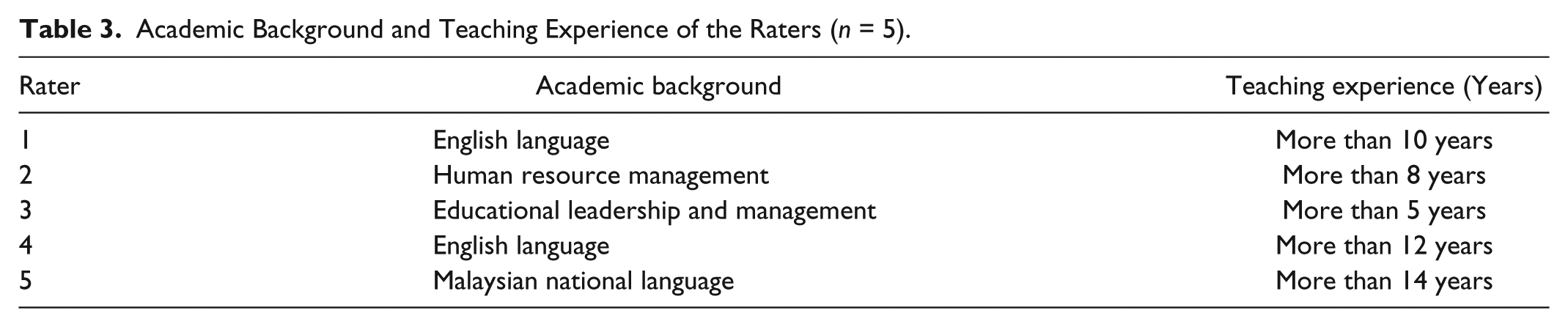
Five raters were invited to review the suitability of the items that captured the underlying dimension for Teacher Commitment. The purpose is to ensure the readability and comprehensibility. The first three raters were lecturers from different disciplines in the local higher education institutions, and the latter two raters were Malaysian primary school language teachers. The academic background and teaching experience of the raters are listed in Table 3.
Academic Background and Teaching Experience of the Raters (n = 5).
Several items were found inappropriate in terms of the problems of item structure, grammar, and their generalizability to the broader context based on the comments from the raters. For instance, “I always try to help my students” was improved as “I try to do my best for the unsuccessful students.” The problematic items according to the comments given by the raters were refined, and no items were excluded. Overall, the initial 17 items were retained and Teacher Commitment scale was formed.
Prior to designing the questionnaire, a preliminarily test was conducted on four primary school teachers to ensure the appropriateness of question content, wording, sequence, format, layout, and instruction. This sample was excluded from the study. Following this, a set of Malaysian National language version questionnaire with a 6-point Likert-type scale, ranging from 1 (high strongly disagree), 2 (strongly disagree), 3 (disagree), 4 (agree), 5 (strongly agree), to 6 (high strongly agree), without a neutral category was administered in the pilot study.
Data Collection Procedures
This study emphasized the ethical issues in maintaining privacy, guaranteeing anonymity, and guaranteeing confidentiality in line with the guidelines provided by Stanley and Wise (2010). The reason is to reduce the risk of potential psychological harm, discomfort, or stress to the participants. Therefore, the participation was strictly on a voluntary basis. Comprehensive information about the study was given to the participants to ensure the participants understand the choice they are making. Importantly, the informed consent from the Malaysian educational authorities was sought to administer the study in the selected primary schools. The researcher secured permission from the respective authorities: (a) education directors of the states of Penang and Perak, (b) principals of the sampled schools in Penang, and (c) participants. The completed questionnaires were returned within 2 months using the given addressed stamped envelope.
Sample Demographic Characteristics
Table 4 shows the profile of the respondents. The sample was then split into two subsamples with each for EFA and CFA with the equal number of 300. The sample size selected for EFA lies within the range of sample size recommendation by Tojib, Sugianto, and Sendijaya (2008). Table 5 shows that more than half of the teachers were randomly selected from the NPS. Similarly, almost half of the teacher sample consisted of Malays compared with Chinese, Indians, and Others. Female teacher is the dominant group compared with male teachers.
Sample Demographic Characteristics.
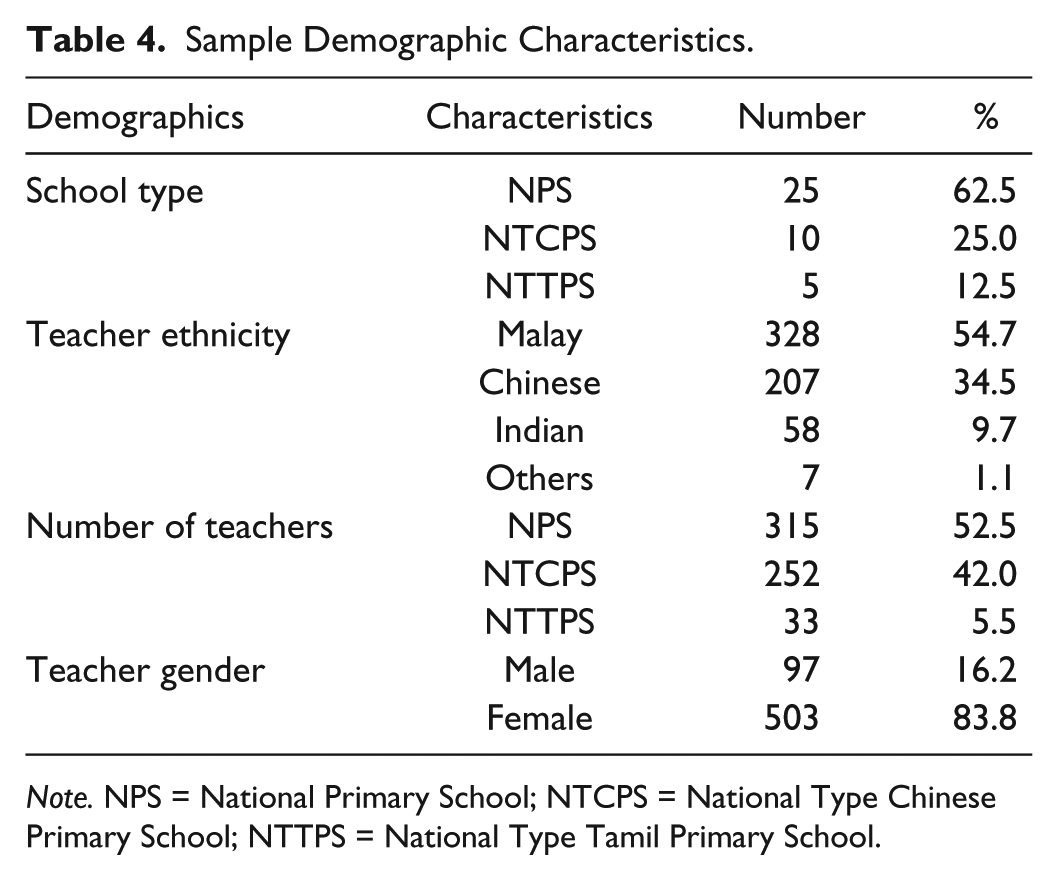
Note. NPS = National Primary School; NTCPS = National Type Chinese Primary School; NTTPS = National Type Tamil Primary School.
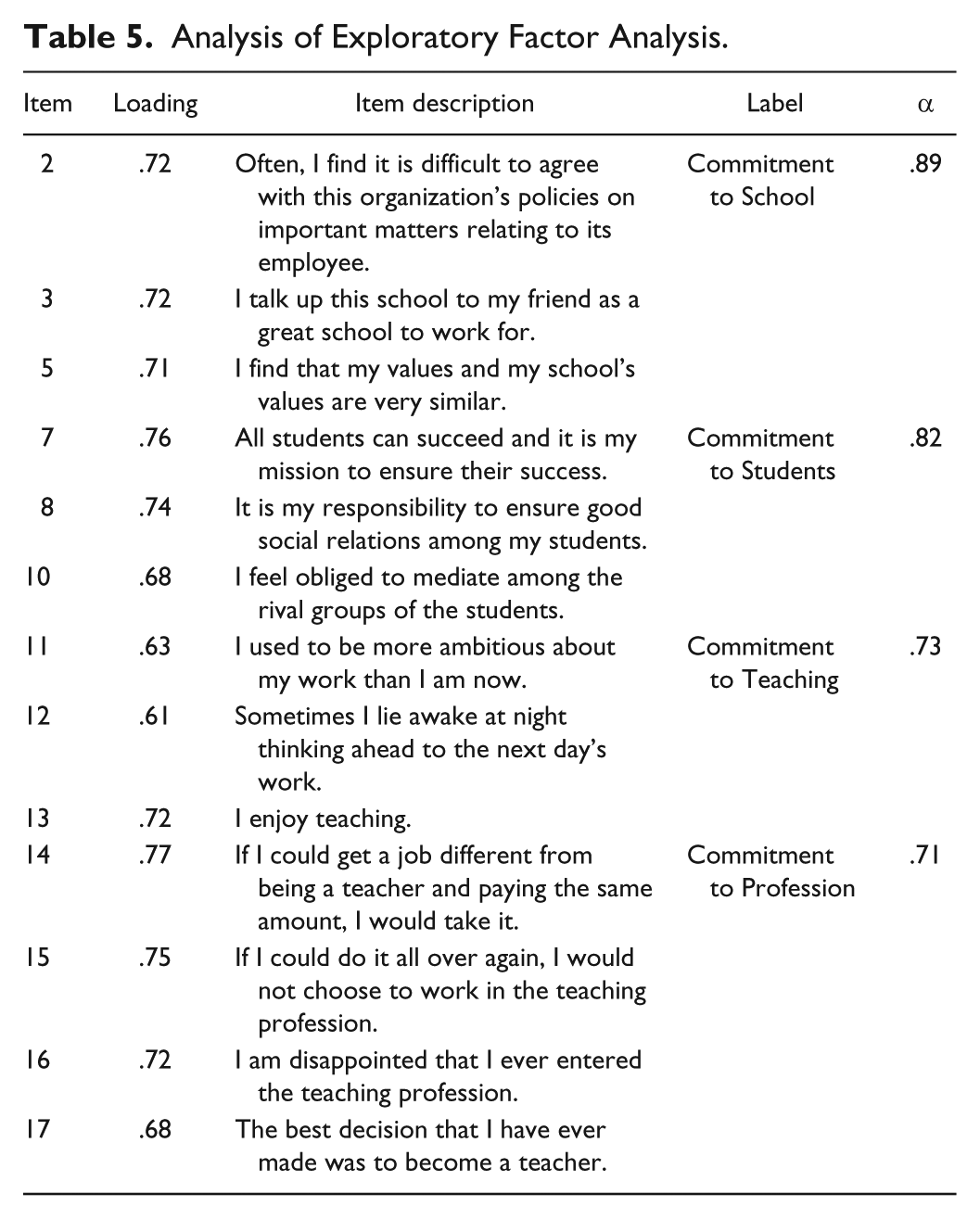
Analysis of Exploratory Factor Analysis.
Data Analysis Techniques
The responses to the questionnaire were initially entered into the SPSS Version 19.0. There were two stages of analysis: (a) EFA and (b) CFA. The analyses were conducted using software of SPSS Version 19.0 and AMOS 19.0, respectively.
Stage 1
The goal of EFA is to identify a smaller set of factor structures of Teacher Commitment that is best explained by its underlying items. Principal components extraction method and varimax orthogonal rotation were used to produce the uncorrelated extracted factors with the eigenvalues greater than 1.0 using SPSS Version 16.0. The initial label of each underlying dimension of Teacher Commitment was reinterpreted to ensure the consistency of conceptual meaning indicated by the corresponding items. There are two statistical measures to examine the underlying items for the extracted factor structure of each variable: standardized factor loadings and Cronbach’s alpha. The adopted cutoff value of standardized factor loading (λ) is .50 and above (Hair, Black, Babin, & Anderson, 2010) whereas Cronbach’s alpha is .70 and above (Nunnally, 1978).
Stage 2
CFA is used to validate Teacher Commitment scale in terms of convergent and discriminant validity after EFA (Worthington & Whittaker, 2006). Convergent validity measures the extent to which indicators of a specific construct share a high proportion of variance in common (Hair et al., 2010). According to Hair et al. (2010), there are three statistical measures in determining the convergent validity: (a) standardized factor loadings, (b) average variance extracted (AVE), and (c) construct reliability (CR). Standardized factor loading denotes the correlation between the variables and the factors. Meanwhile, AVE is a measure of convergence among a set of items representing a latent construct in Structural Equation Modeling (SEM). It is computed as an average percentage of variance explained among the items of a construct (Hair et al., 2010). CR refers to a measure of reliability and internal consistency of the items that represent a latent construct in SEM. The adopted cutoff values of these three statistical measures are as follows: (a) Standardized factor loading (λ) is .50 and above, AVE is .50 and above, and composite validity is .60 and above. All the cutoff values are recommended by Hair et al.
Discriminant validity measures the degree to which a construct and its indicator are different from another construct and its respective indicator (Bagozzi, Yi, & Philips, 1991). The discriminant validity is fundamentally justified based on the existence or non-existence of cross-loading between the constructs, between- and within-construct error variance (Hair et al., 2010). The absence of cross-loading indicates that the discriminant validity is warranted. Alternatively, a more rigorous way to examine the discriminant validity can be referred to the Fornell and Larcker (1981) criterion. Fornell and Larcker’s criterion ascertains if the square root of AVE of a particular variable is greater than the correlation between a variable with other variables, then the discriminant validity is guaranteed.
Model fit evaluation aims to examine whether the CFA model fits to the data (Kline, 2011). In this study, the justification of the model fit of CFA model was based on several fit indices. The fit indices and their cutoff values include chi-square statistics, χ2; normed chi-square, χ2/df (3.0 ≤ χ2/df ≤ 5.0; Schumacker & Lomax, 2004); root mean square error of approximation (0.05 ≤ RMSEA ≤ 0.10; Browne & Cudeck, 1993); comparative fit index (CFI ≥ 0.90; Hu & Bentler, 1999); and Tucker–Lewis index (TLI ≥ 0.90; Hu & Bentler, 1999).
Results
Teacher Commitment questionnaire initially consisted of 17 items used to measure four dimensions, namely, (a) Commitment to Students, (b) Commitment to Teaching, (c) Commitment to School, and (d) Commitment to Profession.
EFA
The Kaiser–Meyer–Olkin measure of sampling adequacy index was .84. Bartlett’s test of Sphericitywas significant with χ2(136, N = 300) = 1,948.96, p < .001. This indicates the data were appropriate for factor analysis. Table 5 shows four orthogonal factors with eigenvalues greater than 1.0 were extracted with a total of 17 items. The four factors extracted from EFA represented four dimensions of the Teacher Commitment: Commitment to School, Commitment to Students, Commitment to Teaching, and Commitment to Profession. The loadings of the items ranged from .61 to .77, above the cutoff value of .50 as recommended by Hair et al. (2010). Meanwhile, Item 1 (“There is not too much to be gained by sticking with this organization indefinitely”), Item 4 (“For me, this is the best of all possible schools for which to work”), Item 6 (“I can face my students if I don’t pull all my efforts into increasing their knowledge and skills”), and Item 9 (“I try to do my best for the unsuccessful students”) were excluded because the loadings were below the cutoff value of .50.
The first factor comprised Items 7, 8, and 10. These items mainly described about Teacher Commitment to Students. The second factor that described Teacher Commitment to School consisted of three items, namely, Items 2, 3, and 5. The third factor described Teacher Commitment to Profession. Four items, namely, Items 14, 15, 16, and 17, were found to provide a meaningful relationship to this factor. The fourth factor that described Teacher Commitment to Teaching was constructed with only three items, namely, Items 11, 12, and 13. Notably, Cronbach’s alpha ranged from .71 to .89. This revealed that the internal consistency estimation appeared adequate and above the cutoff value of .70. The analysis continued with the examination of CFA.
CFA
Table 6 shows that all the standardized factor loading estimates ranged from .51 to .95, exceeding the cutoff value of .50. The AVE estimates for Commitment to School, Commitment to Students, Commitment to Teaching, and Commitment to Profession are above the cutoff value of .50. This indicated more than half of the variance in these four dimensions was shared with Teacher Commitment. Notwithstanding this, CR estimates for the three dimensions were found above the cutoff value of .60. In fact, the CR estimates for Commitment to School, Commitment to Students, Commitment to Teaching, and Commitment to Profession were considered high with .81, .74, .77, and .86, respectively. Overall, the results presented good reliability of the scale measured and signified the convergent validity of Teacher Commitment.
Parameter Estimates.

Note. AVE = average variance extracted; CR = construct reliability.
Table 7 shows that all the square root values of AVE were found to be greater than the corresponding correlation between dimensions of Teacher Commitment. Therefore, Fornell and Larcker’s (1981) criterion signifies the discriminant validity of Teacher Commitment. In other words, the dimensions of Commitment to School, Commitment to Students, Commitment to Teaching, and Commitment to Profession were truly distinct from one another.
Examining Discriminant Validity.

Note. Square value of AVE (in bold). Off diagonal represents the correlation between dimensions. AVE = average variance extracted.
Model Fit Evaluation
The four-factor correlated CFA model was found to have the goodness-of-fit indices that fulfilled the cutoff values. This includes the CFI = 0.93 and RMSEA = 0.08 with the corresponding 90% confidence interval (CI) = [0.07, 0.10]. Even the chi-square statistics, χ2(59, N = 300) = 171.11 is significant at .05 level. The alternative index, namely, normed chi-square, χ2/df = 2.90, was found below the cutoff value of 5.0 as suggested by Schumacker and Lomax (2004). This showed that the overall model fit was acceptable. Based on the findings, it can be concluded that a set of 13 self-developed items were statistically valid in measuring Teacher Commitment.
Discussion and Conclusion
The findings support Teacher Commitment as a multidimensional construct with its four underlying dimensions: (a) Commitment to Students, (b) Commitment to Teaching, (c) Commitment to School, and (d) Commitment to Profession. The valid results of four dimensional measures of Teacher Commitment are ensured with the poor initial items having been eliminated using the rigorous statistical techniques. The findings subsequently convince the proposed integration based on the existing conceptualizations of Teacher Commitment such as Billingsley (1993), Firestone and Rosenblum (1988), and Louis (1998) in a more comprehensive manner reflected in the four dimensions mentioned. Interestingly, the results show the consistency of Malaysian and Western sample. As such, it can be drawn that the proposed integrated conceptualization of Teacher Commitment transforms the new knowledge in Teacher Commitment literature based on the present empirical findings.
Remarkably, the practical implication of this study is the validated self-developed Teacher Commitment questionnaire, which is likely applicable in the Malaysian school context. The validated questionnaire can be suggested to be used as an evaluative tool to assess the level to which teachers are committed to their career covering students’ learning, teaching, school, and profession. Importantly, knowing the level of these four aspects of Teacher Commitment would facilitate the school administrators to identify the factors that influence teachers’ quality of work life and school effectiveness.
However, the value preference of Malaysian ethnic groups will inevitably be influenced by the school cultural environment as claimed by Fontaine, Richardson, and Foong (2002) even though cultural influence in terms of school types, gender, and ethnicity has been minimized at the stage of preliminarily analysis statistically. In addressing this limitation, a cross-cultural comparative study of Teacher Commitment is strongly suggested. This indicates that a more credible result would be obtained by comparing the available teacher sample following the types of Malaysian primary schools: NPS, NTCPS, and NTTPS; teacher gender; and ethnic. Apart from that, the use of self-developed questionnaire is restricted to the Malaysian primary school teachers. Therefore, a cross-validation of the psychometric properties of Teacher Commitment scale is strongly recommended. In doing so, similar questionnaire can be administered to the other set of samples such as secondary teachers for scale refinement and improvement purposes. This suggestion is supported by MacKenzie, Podsakoff, and Podsakoff (2011) with regard to the importance of cross-validation using a new sample data. Furthermore, the type of validity is constrained to construct validity in terms of convergent validity and discriminant validity. Therefore, the types of validity can be diversified to another type of validity, namely, nomological validity as suggested by Edwards (2001). According to Edwards, nomological validity represented in the form of nomological network is considered much more credible in examining the adequacy of the multidimensional structure of a construct. In fact, a more comprehensive scale development and validation can be achieved by extending the procedures to norms development (MacKenzie et al., 2011). The purpose of norms development is to interpret the meaning of scores based on its distribution on the scale (Spector, 1992). This can be done by comparing the individual scores relatively with the distribution of scores. Details can be referred to MacKenzie et al.
As a conclusion, with the recognition of Teacher Commitment as vital on education outcomes, this study has advanced a Malaysian version of Teacher Commitment scale measured by 13 reliable and validated self-developed items. Although much more research remains to be done either conceptually or statistically, the present Teacher Commitment scale deserves to be a foundation from which to compare findings across studies and research settings. More imperatively, the findings make the present Teacher Commitment scale possible to apprehend the value-added of Teacher Commitment as a construct.
Footnotes
Declaration of Conflicting Interests
The author(s) declared no potential conflicts of interest with respect to the research, authorship, and/or publication of this article.
Funding
The author(s) received no financial support for the research and/or authorship of this article.