




Abstract
As potential mismatches between teachers’ and students’ perceptions can have negative effects on students’ satisfaction with the language class and even on their ultimate achievement, many researchers have attempted to identify and examine possible sources of such mismatches. In line with those investigations, the present study intended to compare the perceptions held by Iranian English as a Foreign Language (EFL) public school teachers with those of their students. To this aim, a convenient sample of teachers (N = 75) and students (N = 202) from different cities of Iran was recruited to participate in the study. Using a 50-item Likert-type questionnaire and running between-groups independent-samples t tests and a two-way ANOVA, the researchers found that students’ perceptions were completely different from those of their teachers. Contrary to expectations, while students preferred a communicative approach to learning English, their teachers tended to favor a more traditional approach. Also, although high- and low-achieving students’ perceptions were not statistically different, they were significantly different from those of their teachers. Moreover, male teachers held different perceptions from their female students, and female teachers’ perceptions were also different from those of their male students. Findings of the study along with their implications for the practice of English teaching are also discussed.
Introduction
Uncovering teachers’ and students’ perceptions of effective language teaching practices can be a potentially fruitful area of inquiry as effective teaching can possibly result in more satisfactory learning outcomes. English teachers’ belief systems about effective teaching might have gradually been constructed by not only their own previous experiences as language learners but also by the courses they have studied at university as well as their experiences in the teaching practicum (Richardson, 1996). English learners, especially high school students, however, may have quite different ideas, given their limited knowledge of the target language and their immature life experiences. This discrepancy between these two groups’ opinions might lead to some unanticipated mismatches in the actual practice of language teaching, which might, in turn, result in either students’ dissatisfaction or less than satisfactory learning outcomes.
Different researchers have attempted to define the construct of effective language teaching and identify the factors contributing to it. Vadillio (1999), for instance, considers effective language teachers as those having not only a profound competence in the target language but also personal qualities such as sensitivity, warmth, and tolerance. While some researchers have attempted to investigate teacher effectiveness from teachers’ point of view (e.g., Arıkan, 2010; Demiroz & Yesilyurt, 2015; Korkmaz & Korkmaz, 2013; Sandholtz, 2011), some others have examined the issue from students’ perspective (e.g., Çelik, Arıkan, & Caner, 2013; Ekin & Damar, 2013; Ghasemi & Hashemi, 2011; Kourieos & Evripidou, 2013; Lee, 2010) and still, some were more interested in uncovering the differences between these two groups’ viewpoints (e.g., Babai Shishavan & Sadeghi, 2009; Brosh, 1996; A. V. Brown, 2009; Moradi & Sabeti, 2014; Park & Lee, 2006; Ramazani, 2014). For instance, investigating this issue, A. V. Brown (2009) examined teachers’ and their students’ perceptions about effective English teachers’ characteristics by administering a Likert-type questionnaire consisting of 24 items, which covered different areas of Foreign Language (FL) pedagogy. Results of his study revealed significant differences observed in areas such as target language use, error correction, and group work, which highlighted the fact that although the students tended to favor a grammar-based approach, their teachers preferred a more communicative classroom environment.
Considering the same issue from another perspective, some researchers tried to identify and extract the factors perceived to be characteristics of effective language teachers from university students’ and teachers’ points of view (e.g., A. V. Brown, 2009; Çelik et al., 2013; Ghasemi & Hashemi, 2011; Kourieos & Evripidou, 2013; Ramazani, 2014), whereas some other scholars studied high school students’ and teachers’ viewpoints. From the former group, Kourieos and Evripidou (2013), for instance, examined the perceptions held by 110 freshman English as a Foreign Language (EFL) undergraduate students in two private universities in Cyprus who were studying four different university majors (business, accounting and finance, primary education, and maritime studies). Results of their study indicated that a more learner-centered approach to language learning and teaching as well as a more assisting and mediating role for the language teacher supports effective language teaching practices. The participants also emphasized that language teachers need to be skillful enough in using technology and try to engage students in meaningful classroom interactions through employing tasks and group work activities.
As an example for the latter group, Park and Lee (2006) examined the characteristics of effective English teachers from both high school teachers’ and students’ points of view in Korea. To collect the necessary data, they utilized a self-report questionnaire consisting of three categories: English proficiency, pedagogical knowledge, and socio-affective skills. Results of their study revealed that, overall, the teachers held different perceptions from those of the students in all three categories. Hence, whereas the teachers perceived English proficiency as the most important characteristic, the students considered pedagogical knowledge as the main one.
In the context of Iran, Babai Shishavan and Sadeghi (2009) investigated the qualities of an effective English language teacher perceived by English language teachers and learners from three diverse contexts of universities, high schools, and language institutes. Their findings showed significant differences between teachers’ and learners’ views, such that teachers considered assigning homework and integrating group activities into the classroom as the most important characteristics. For students, however, using the mother tongue as the medium of instruction was the most prominent factor. While teachers thought that mastery of the foreign language, sufficient knowledge of pedagogy, the use of particular techniques, and a good personality constituted the characteristics of effective language teachers, learners perceived teachers’ personality as well as their behavior toward their students as the most significant features.
In a more recent study in the context of Iran, Moradi and Sabeti (2014) compared students’ and teachers’ perceptions of effective language teaching. They recruited the participants of their study from two different contexts of language institutes and universities. Findings demonstrated that although teachers’ responses reflected their knowledge and expertise on theories and methodology of language teaching leading them to define effective teachers from a professional viewpoint, the students’ perspectives seemed more realistic. What is worthy of notice, however, is that Babai Shishavan and Sadeghi’s (2009) and Moradi and Sabeti’s (2014) studies suffer from the major drawback of recruiting the participants from largely diverse contexts of universities, high schools, and private language institutes. Given the point that university students may, in principle, be considered cognitively and metacognitively more mature than high school and institute learners, it seems unjustified to treat them as a homogeneous group of participants. Furthermore, their findings may be contaminated because the university students might have already been familiar with effective language teaching principles and theories due to studying related courses at university. These assumptions might have already shaped and influenced their perceptions of the characteristics of effective language teachers, which offer them an unfair advantage in comparison with the student samples chosen from high schools and institutes. Moreover, in comparison with high school students who have to study English as a compulsory subject at school, institute learners can be envisaged to be more motivated to learn English as they themselves choose to attend the institutes voluntarily, which might lead to their different perceptions as well as diverse preferred learning practices in real classroom situations. These concerns cast doubts on the results of such studies leading other researchers to try to fill the perceived gap in the literature.
However, given the fact that perceptions are dynamic and flexible (A. V. Brown, 2009), ongoing research from different angles can enlighten teachers’ minds on their own underlying assumptions about effective language teaching practices. Moreover, the results of such studies from different teaching contexts can provide English language teaching (ELT) experts and researchers with a broader picture of teachers’ and students’ perceptions all over the world. Also, to examine whether such mismatches may negatively affect students’ ultimate achievement (Williams & Burden, 1997), high- and low-achieving students’ perceptions can be compared and contrasted with those of their teachers. The assumption underlying this is that high-achieving students might have similar perceptions to their teachers, which have led to more satisfactory learning outcomes. Furthermore, the role of teachers’ and students’ gender is studied to see whether their gender can be considered as a determining factor influencing their perceptions. Therefore, aiming at shedding more light on the issue of effective teaching, the present study intends to make a comparison between high school teachers’ and students’ ideas to illuminate if there are any discrepancies between their perceptions.
Significance of the Study and Research Questions
As Williams and Burden (1997) rightly put it, although learners’ perceptions can have the greatest influence on their achievement, sometimes their perceptions do not correspond with the teachers’ intentions. These mismatches between students’ and teachers’ expectations can have negative effects on L2 students’ satisfaction with the language class (Horwitz, 1990; Kern, 1995; Schulz, 1996), which points to the need to identify and alleviate some of these mismatches to the extent possible. Attempting to highlight the importance of examining teachers’ and learners’ perceptions, Schulz (1996) draws our attention to the need for the fit between learner and teacher beliefs. Opinions alone may not necessarily be a reflection of the actual cognitive processes happening in language acquisition; however, perceptions do affect reality. If the instructional expectations of students are not met, they may consciously or subconsciously call the credibility of the teacher or that of the instructional approach into question. Such a situation may raise doubts about pedagogical face validity, which can negatively affect students’ motivation (Schulz, 1996).
However, A. V. Brown (2009) believes that even if these mismatches do not have adverse effects on students’ achievement, they merit further investigation and examination by experts as they may result in disillusionment on the part of the students. In line with these viewpoints, the present study is an attempt to investigate whether Iranian high school English teachers and their students hold disparate or similar views toward effective English teachers’ characteristics. To achieve this goal, the study seeks answers to the following research questions:
Method
Participants
Two major groups of high school teachers and students constituted the participants of this study. Overall, 277 high school teachers and students took part in this study, of whom 202 were students and 75 were teachers. They were chosen to participate in this study based on a convenient sampling procedure as it was not practically possible for the researchers to choose them randomly. As for the teachers group, 47 male and 28 female teachers whose teaching experience ranged from 2 to 34 years from different schools agreed to participate in the present study. In fact, each school had two or three English teachers, which made up the whole teacher sample of the current study. With respect to the students group, of 202 students, 107 of them were male and the rest were female (N = 95). Their grade-point average (GPA) and English scores ranged from 14.5 to 20 and from 15 to 20, respectively. Eighteen of these students were junior high school students (one class, one school), while the remaining ones were (N = 184) from senior high schools (eight schools). As one of the purposes of this study was to compare high- and low-achieving students’ perceptions with those of their teachers, the whole students sample was supposed to be classified into two groups of high- and low achieving on the basis of their English scores. However, after gathering the necessary data, the researchers found that this specific sample of the students’ English scores was not that divergent (minimum = 15, maximum = 20, M = 18.58, SD = 1.16). Nevertheless, to meet the objectives of the study, they had to divide them into two groups. Therefore, those whose scores were equal to or above 18 (of 20) were considered high achieving, and the ones who had got less than 18 constituted the low-achieving group. The perceptions held by these two groups were further compared.
Instrument
This study compared the perceptions held by Iranian high school EFL teachers and their students concerning the characteristics of effective English teachers. The main instrument utilized to collect the necessary data was a 50-item Likert-type questionnaire; the items of which were chosen from existing instruments on teacher effectiveness (Babai Shishavan, 2010; Babai Shishavan & Sadeghi, 2009; A. V. Brown, 2009; Moradi & Sabeti, 2014) and adapted in line with the purposes of the present study. The questionnaire consisted of two major parts: a demographic part requesting the participants to provide some information regarding their age, gender, and GPA as well as English score (for students) and teaching experience (for teachers), and the main section consisting of 50 Likert-type items on teacher effectiveness.
The items of the questionnaire were randomly ordered, and the participants were supposed to rate the importance of each statement as a characteristic of an effective English teacher in a Likert-type scale format, ranging from strongly agree to strongly disagree. While strongly agree received 5, strongly disagree was coded 1. As a single questionnaire was supposed to be used for both students’ and teachers’ samples, the researchers had to anticipate and overcome beforehand some potential constraints. One of these problems was the fact that the majority of Iranian high school students are not that proficient in English to be able to understand English sentences well; therefore, the researchers decided to translate the questionnaire into the students’ native language (Persian) and ask a proficient English learner to back translate it into English for them to ensure the validity of translation. Moreover, comparing teachers’ and students’ perceptions by using one single questionnaire imposed some further constraints on the instrumentation. Hence, to make the questions comprehensible to both low-proficient young learners and their more proficient, experienced teachers, the researchers had to avoid the use of any technical jargon and category titles in the questionnaire. In addition, considering the students’ lack of academic knowledge of effective teaching practices, they had to focus mainly on the concrete practical aspects of teaching rather than the abstract theoretical ones. Using Cronbach’s alpha formula, the researchers also estimated the reliability of the questionnaire, which was .71 and could be considered acceptable (Pallant, 2011) for the purposes of the current study.
Data Collection and Analysis Procedures
At the outset of the study, the second researcher went to different English classes and explained the purpose of the study to high school teachers as well as their students. The participants were also assured that their responses would be kept confidential and they would never encounter any problems because of participating in this survey. After encouraging their reliance on the researcher, he asked them to answer the questions as honestly as possible and avoid leaving any question unanswered. Then, he administered the questionnaire to both the teachers and their students in the classroom context. This researcher was present to elaborate on and give further explanations about the items of the questionnaire, which might have been vague or confusing to the participants. The participants were also allowed to spend as much time as they needed on filling it in, so that they might not have felt anxious or stressed. Moreover, teachers who were in charge of more than one class completed just one questionnaire as the questions were general and applicable to any English teaching context.
To analyze the gathered data, descriptive and inferential statistics were used. For comparing teachers’ and students’ viewpoints, 50 two-sample independent t tests were run. Also, t tests were utilized to compare high- and low-achieving students’ perceptions with those of their teachers. Finally, to answer the third research question, a two-way ANOVA, along with follow-up analyses, was performed.
Results
This study was mainly concerned with a detailed comparison between Iranian high school teachers’ and their students’ perceptions on effective English teachers’ characteristics. To achieve this goal, independent-samples t tests and a two-way between-groups ANOVA were used to answer the three research questions posed at the outset of the study. The following sections present the results of these analyses in detail:
A Comparison of High School English Teachers’ and Their Students’ Perceptions on Effective English Teachers’ Characteristics
To compare the perceptions held by Iranian EFL teachers with those of their students on each of the items of the questionnaire, 50 independent-samples t tests were run. As multiple t tests were simultaneously run and to avoid making Type 1 error, it was vital to use a Bonferroni adjustment through which the traditional alpha level (i.e., .05) was divided by 50, which resulted in an adjusted alpha level of .001. Hence, alpha values lower than .001 were considered statistically significant in this part of the study. After making this adjustment, the researchers observed that just 13 of 50 questionnaire items showed statistically significant differences between teachers’ and students’ viewpoints. These results are presented in Table 1. It is worth mentioning that to save space, only those results showing significant differences are reported.
Comparison of Teachers’ and Students’ Means by Questionnaire Item.

Significant at a Bonferroni-adjusted alpha level of .001.
As Table 1 reveals, the students believed that effective English teachers should not correct students immediately after making a mistake in speaking, should not grade their speaking or writing productions primarily for grammatical accuracy, should require them to speak in the foreign language from the first day of the class, and base at least some part of their grades on their ability to interact with classmates successfully in the foreign language. All these items point to the importance of developing students’ oral proficiency, which is supported by recent trends in language teaching pedagogy, which emphasize a focus on meaningful interactions in real-life situations. Moreover, they wanted their teachers to let them respond to commands physically, use real-life materials in the classroom, and not to simplify or alter native speakers’ utterances for the sake of students’ understanding. These latter items are guided by the principles of communicative language teaching (CLT), which highlight the significance of using body language as well as real-life materials for teaching English. The last one, too, supports the focus on the use of authentic language in English classes, which has widely been recommended by ELT scholars (Larsen-Freeman & Anderson, 2011). However, unlike their teachers, the students were not much concerned about their teachers’ behavior; rather, they thought that effective English teachers should strictly follow administrative rules and regulations. From the teachers’ point of view, just four of these 13 items were considered more significant, namely, letting students answer test questions in listening and reading via their native language (Persian), being knowledgeable about native English speakers’ culture, being friendly to students, and paying attention to their personal needs. Oddly, unlike their students, the teachers’ perceptions on effective English teachers’ characteristics do not seem to be compatible with the dominant trends in language teaching pedagogy.
A Comparison of High- and Low-Achieving Students’ Perceptions on Effective English Teachers’ Characteristics With Those of Their Teachers
It has been claimed in the literature that discrepancies between teachers’ and students’ perceptions can adversely affect students’ ultimate achievement (Williams & Burden, 1997). To examine to what extent this claim might be supported, high- and low-achieving students’ perceptions were also compared with those of their teachers. To this aim and in response to the second research question of the study, three more between-groups independent-samples t tests were run. Running three t tests simultaneously made it vital to set a more stringent significance level than the traditional one (i.e., Sig. = .05) through making a Bonferroni adjustment (i.e., Sig = .016). Table 2 shows the descriptive statistics related to this part.
Descriptive Statistics of High- and Low-Achieving Students’ and Their Teachers’ Perceptions.
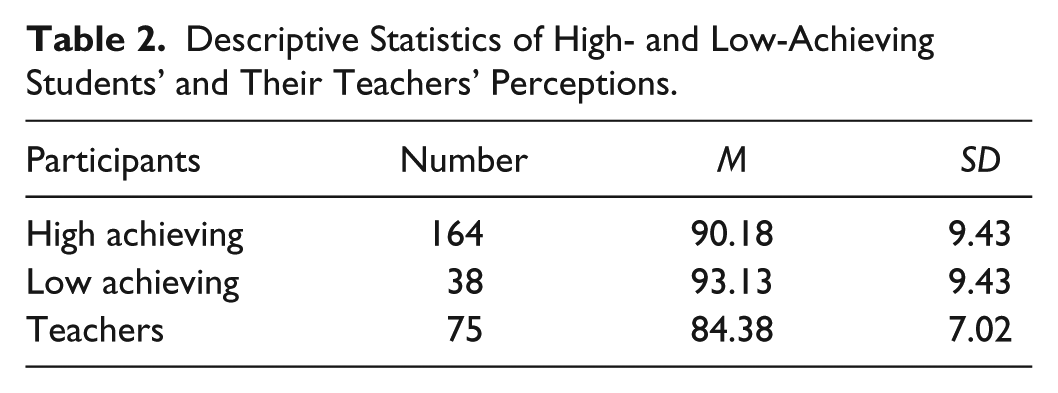
As shown in the above table, both high- and low-achieving students’ perceptions were different from those of their teachers (i.e., high achieving: M = 90.18, SD = 9.43; low achieving: M = 93.13, SD = 9.43; teachers: M = 84.38, SD = 7.02). To find out whether these differences were statistically significant, three between-groups independent-samples t tests were run, the results of which are reported in Table 3.
Comparison of Teachers’ and High- and Low-Achieving Students’ Overall Means.

Significant at a Bonferroni-adjusted alpha level of .016.
As is obviously observed in Table 3, both groups of students held diverse perceptions regarding effective English teachers’ characteristics compared with those of their teachers (high achieving: t = 5.295, Sig. = .000; low achieving: t = 5.553, Sig. = .000). That is, neither group had similar ideas to those of their teachers, although the difference between high- and low-achieving students’ perceptions was not statistically significant (t = −1.732, Sig. = .085), indicating that both groups held almost similar perceptions about the issue under investigation. This finding shows that, overall, neither group of the students’ perceptions were in agreement with their teachers’ ideas, although the two groups held almost similar perceptions.
A Comparison of Male and Female Teachers’ Perceptions on Effective English Teachers’ Characteristics With Those of Their Male and Female Students
As the last part of the study, a two-way ANOVA was performed to compare the perceptions held by male and female teachers with those of the male and female students. Table 4 shows the descriptive statistics related to this section of the study.
Descriptive Statistics of Male and Female Teachers’ and Students’ Perceptions.

As the above table shows, male teachers’ perceptions were different from those of both male and female students; that is, while the mean of male teachers’ perception scores was 83.20 (SD = 7.68), those of their male and female students were 91.92 (SD = 8.64) and 89.44 (SD = 9.77), respectively. In a similar manner, female teachers’ overall perception scores were also different from those of their male and female students. Hence, the mean of female teachers’ perception was 86.70 (SD = 4.96), whereas those of both their male and female students were higher. All in all, the means of both groups of students were higher than those of male and female teachers. To see which of these differences were statistically significant, we refer to the results of the two-way ANOVA.
A close inspection of the results of Levene’s test of equality of error variances (Sig. = .034) made it clear that there was a need to set the significance value at a more stringent level (i.e., p < .01) than the conventional one (p < .05) when interpreting the findings. Therefore, the results were considered statistically significant if they were equal to or less than .01 (i.e., p < .01). These results are displayed in Table 5.
Tests of Between-Subjects Effects.

Note. Dependent variable: Perceptions.
R2 = .114 (adjusted R2 = .104).
As observed in Table 5, while the main effect of occupation, teacher versus student, F(1, 276) = 21.781, p < .001, as well as the interaction effect of occupation–gender, F(1, 276) = 5.688, p < .01, was statistically significant, the main effect of gender did not show any significant effect on these participants’ perceptions, F(1, 276) = .140, p > .05. Considering the effect size statistics, one can come to the conclusion that the effect size for occupation is medium (
Comparison of Teachers’ and Students’ Overall Means Across Different Genders.

p < .001.
As the results suggest, male teachers’ perceptions showed statistically significant differences from those of female students (t = −3.883, p < .001). Female teachers also held perceptions on effective English teachers’ characteristics, which were significantly different from those of their male students (t = −4.038, p < .001).
Discussion
Surprisingly, high school students in this study tended to favor a more communicative approach to teaching English in contrast to their teachers who appeared to value a more traditional English teaching practice. This finding is, conspicuously, unexpected, given the limited familiarity of high school students with the principles of CLT approaches. Nevertheless, it may be justified on the grounds that the majority of Iranian high school students simultaneously attend private language institutes at which English is mainly taught through CLT practices. As Alimorad (2013) appropriately puts it, some of the students’ expectations of how English should be taught have already been constructed by attending private language institutes where English is primarily taught using multimedia, games, songs, and films and where the focus is predominantly on developing and improving students’ oral proficiency. What makes this finding worthy of notice is the fact that in contrast to what teachers thought, their students preferred to learn English through meaningful information exchange practices in which meaning is taking precedence over the form of the language. Although such an odd diversity of teachers’ and students’ beliefs may be justified in the context of Iran, it contradicts the findings of Schulz (1996, 2001) and A. V. Brown (2009) who found that teachers valued a communicative approach, while their students preferred discrete-point grammar practices. The same finding, however, corroborates the results of Kern’s (1995) study, which demonstrated that the students were more in favor of CLT. It is also in line with the findings of Kourieos and Evripidou’s (2013) research, which showed that Cypriot students wanted EFL teachers to move beyond the traditional focus-on-form approaches to language teaching to the adoption of the communicative approach, which attends to meaningful interactions.
In contrast to what one might expect, the student sample in this study was more amenable to the practices that are mainly considered to be guided by the CLT principles. That is, they did not expect their teachers to correct their mistakes immediately by providing them with the correct forms or grammatical explanations; they wanted their teachers to require them to speak English as early as possible; they expected the teachers to focus on their oral proficiency in the classroom and also make use of realia. Surprisingly, however, although the teachers thought that effective English teachers should be friendly to students and pay attention to their personal needs, the students were mainly concerned with teachers’ following administrative rules and regulations strictly with less interest in the teachers’ friendliness and their attention to students’ personal needs. This finding does not enjoy the support of CLT principles though. Recent trends in language teaching underscore the importance of paying attention to the cognitive as well as the affective dimensions of language teaching according to which students’ affective and emotional states should be considered along with their cognitive skills. As H. D. Brown (2007) convincingly argues, “If we were to devise theories of second language acquisition or teaching methodologies that were based only on cognitive considerations, we would be omitting the most fundamental side of human behavior” (p. 152). The reason for this discrepancy might be the fact that the majority of Iranian students take teachers’ friendliness and concern for students’ personal needs for granted, thereby thinking that such kind of behavior is an indispensible part of every teacher’s identity, including English teachers.
Results of the second part of this study, however, showed that there were no statistically significant differences between high- and low-achieving students’ overall perception scores. This finding contradicts Ghasemi and Hashemi’s (2011) and Ramazani’s (2014) findings as the researchers in both studies found significant differences between these two groups of students’ ideas. It is worth mentioning that unlike the current study, which was prominently concerned with high school students, those two studies investigated university students’ perceptions. Therefore, this discrepancy between the results might well be justified considering the characteristics of these two different groups of participants. Another reason for this diversity of findings might be the fact that in contrast to the present study, which compared overall perception scores of the two groups of students, the former studies compared the two groups on each of the items of the questionnaire, thereby yielding more subtle and detailed results.
Nonetheless, both high achievers and low achievers held different perceptions from those of their teachers. This finding may indicate that the diversity of teachers’ and students’ perceptions might not result in detrimental and destructive effects on the students’ final achievement. Although this finding contradicts the findings of Williams and Burden (1997) who found that learners’ perceptions could have adverse effects on their achievement, the present researchers strongly concur with A. V. Brown’s (2009), in that even if they do not negatively affect learners’ achievement or grades, such mismatches can be the cause of disillusionment on the part of language learners and, hence, need to be identified and removed to the extent possible.
The last part of the study indicated that overall, male and female teachers did not have different ideas on effective English teachers’ characteristics. This finding partially corroborates the results of Shahvand and Rezvani’s study (2016), which showed no significant difference between male and female teachers regarding their effectiveness. Although their questionnaire was slightly different asking the teachers to rate the frequency with which they used different teaching strategies and practices, it can convincingly be argued that teachers’ beliefs and perceptions underlie what they actually do in their classrooms (Williams & Burden, 1997). Hence, it can safely be suggested that the results of the present study concur with those of Shahvand and Rezvani in the sense that the two studies support similar conclusions.
However, in the same way that male teachers held different ideas about characteristics of effective English teachers from those of their female students, female teachers’ perceptions, too, were different from those of their male students. Since, to the best of the present researchers’ knowledge, no previous studies compared the perceptions held by male and female teachers and students on this issue, further research is needed to shed more light on the differences between these groups’ ideas. Nevertheless, what seems to be quite obvious is that in whatever way we divide public high school teachers and students into different groups, their ideas seem to be completely different. Obviously, as mentioned by different scholars, this diversity of ideas might bring about disastrous impacts on foreign language teaching pedagogy. As a result, in the light of the findings of this study, public high school teachers need to be made aware of their students’ perceptions on effective English teaching practices since as Horwitz (1990), Kern (1995), and Schulz (1996) convincingly argue, such mismatches between students’ and teachers’ expectations can have negative effects on L2 students’ satisfaction with the language class and even “students whose instructional expectations are not met may consciously or subconsciously question the credibility of the teacher and/or the instructional approach. . . . Such lack of pedagogical face validity could affect learners’ motivation” (Schulz, 1996, p. 349).
Conclusion
Being considered as an endless endeavor, investigating teachers’ and students’ perceptions is worth constant examination as perceptions are dynamic and changing and never stable (Barcelos & Kalaja, 2003; A. V. Brown, 2009). Attempts also need to be made to reconcile diverse perspectives and bridge the gap between these two groups’ ideas by alleviating at least some of the existing discrepancies. In line with these views, this study served as a small step that compared the perceptions held by Iranian public high school teachers on effective English teachers’ characteristics with those of their students. Results of the study demonstrated that while the students tended to favor a more communicative approach to learning English, their teachers preferred a more traditional approach to teaching it. Furthermore, while high- and low-achieving students held almost similar perceptions, both groups’ ideas were different from those of their teachers. Results of the two-way ANOVA also showed that while gender of the participants did not show any statistically significant effect on their overall perceptions, their being teachers or students as well as the interaction between their occupation and gender did have a significant effect on their perception scores. Further follow-up analyses also made it clear that like male teachers who held different ideas from those of their female students, female teachers’ perceptions, too, were divergent from those of their male students. All in all, considering Iranian public high school teachers’ and students’ perceptions from different angles, one can come to the conclusion that they held completely different perceptions that can, in practice, have detrimental effects on English teaching pedagogy.
Implications
Results of the present study, conspicuously, do not suggest that teachers conform to all students’ wants and preferences in the classroom context. They, however, elucidate some of the important points that need to be borne in mind. First, given the fact that current trends in English language pedagogy support the effectiveness of implementing CLT approaches in developing and enhancing students’ language proficiency, which was also mentioned by the student sample in this study, Iranian public schools’ EFL teachers might need to reflect upon and reconsider their own perceptions on effective English teachers, which most likely constitute the underlying rationale for what they actually do in the classroom context (Williams & Burden, 1997).
Second, considering these two groups’ diverse perspectives, teachers might, in practice, employ teaching techniques and strategies they perceive as the most suitable and useful ones and highly compatible with their learners’ needs, although these practices might bring about some unanticipated results for their practice of English teaching, which can hardly, if ever, be compensated for. Such mismatches between teachers’ and students’ perceptions can at least have detrimental effects on students’ motivation for language learning as well as their involvement in the learning activities. Even though results of this study indicated that these discrepancies between teachers’ and students’ perceptions might not have any destructive effects on students’ ultimate achievement as evaluated by their English scores, the mere lack of face validity of the educational practices experienced by learners may lead to their dissatisfaction with the language class as well as their skepticism about the best route to success in language learning (Horwitz, 1990; Kern, 1995; Schulz, 1996). Consequently, it seems urgent that teachers be made aware of such mismatches, so that they can make themselves prepared to either justify and explicate to the students the rationale behind their own practices, or adapt and change them on the basis of what is considered to be effective based on the principles of language teaching and learning.
Third, these teachers’ preference for traditional teaching strategies might be indicative of either their lack of knowledge of recent developments in language teaching practicum or lack of necessary resources to implement those newly introduced and developed techniques. Both these problems, being potentially serious, need to be examined and investigated in depth. Regarding the former, pre-service and in-service teacher training courses can be held in which pre- and in-service teachers are informed of the most up-to-date and effective teaching tips. As for the latter, environmental analyses might prove useful for uncovering the constraints imposed on English teaching in different parts of the world. In addition to these, teachers’ demotivation and burnout could be possible reasons for their reluctance to keep up with the most recent developments in the field of English teaching.
Limitations and Suggestions for Further Studies
This study, like most other studies, suffers from a number of limitations and shortcomings which restrict the generalizability of its findings. The first and foremost problem is the lack of random sampling procedures. Despite the fact that the participants were recruited from different cities and schools, they were chosen based on availability and accessibility rather than randomly. This, of course, makes us approach the findings of this study more cautiously. The second limitation concerns the instrumentation where we just made use of a questionnaire to gather teachers’ and students’ ideas. Although great care was taken to examine the items carefully, still, some items might have been vague and unclear to some participants. Furthermore, the participants might have had some other viewpoints which were neglected in the questionnaire. Therefore, considering these shortcomings, further studies seem to be needed, which, employing random sampling procedures and using other more sophisticated and robust data gathering tools, can help us have a thorough understanding of teachers’ and students’ perceptions on the characteristics of effective English teachers.
It is worth mentioning that although we divided the students into high- and low-achieving groups based on their English scores, their English scores were not that divergent from each other ranging from 15 to 20. It can appropriately be argued that all these students were high achievers; nevertheless, as one of the objectives of this study, the researchers had to divide them into two groups to be able to compare their perceptions. Future research can compare and contrast the perceptions held by thoroughly distinguishable high- and low-achievers with really distinctive achievement scores to either confirm or refute the findings of this study.
Other studies can also delve into the way teachers’ and students’ perceptions are gradually constructed during different periods of their lives. As a suggestion, the perceptions held by those students who have previously attended private language institutes can be compared and contrasted with those of students who have never attended such institutes. Enrolling at private institutes per se may be a determining factor in shaping and constructing students’ perceptions, which definitely merits further attention and investigation in the future. Also, public school and private institute teachers’ and students’ perceptions can be compared to find out how the constraints and requirements of the teaching situation might affect the perceptions held by individuals. The role of the macro-social, economic, and political milieus in constructing, deconstructing, and reconstructing people’s perceptions, too, warrants in-depth investigation and analysis.
Footnotes
Declaration of Conflicting Interests
The author(s) declared no potential conflicts of interest with respect to the research, authorship, and/or publication of this article.
Funding
The author(s) received no financial support for the research and/or authorship of this article.