



Abstract
In tandem with the social constructionist turn in identity studies, the pragmatic identity of EFL teachers is an emerging topic of interest, particularly in light of the discursive view of identity. However, relatively little attention has been paid to the deviational pragmatic identity of EFL teachers. Drawing upon the Pragmatic Identity Theory, this corpus-based study examines how salesperson identity is constructed through the discursive practices at macro and micro levels by teacher contestants in shuoke contests. Shuoke is a teaching and research activity in which a teacher articulates the teaching process and explains the rationale of the teaching design to colleagues or experts for feedback. Data reveal that salesperson identity is constructed through four moves at macro level including greeting, introducing the teaching design, making positive evaluations, and ending, with six steps in the second move; and through three types of discursive practices at micro level, including speech acts, grammar, and lexical features, with assertives, adverbials, and meta-discourse appearing most frequently in each type. The research explores how the deviational pragmatic identity of EFL teacher contestants is discursively constructed in shuoke contests, seeks linguistic models for the shuoke practices of EFL teachers, and provides implications for the improvement of EFL teachers’ discursive competence in their professional development.
Introduction
The last few years have witnessed a shift in the understanding of identity from essentialism to social constructionism, where it is perceived as contextualized, constructed, and dynamic (Chen, 2021). As Varghese et al. (2005) note, “identity is constructed, maintained, and negotiated to a significant extent through language and discourse” (p. 23). In tandem with the social constructionist turn of identity, Chen (2018), based on the Framework of Linguistic Adaptability in Verschueren (1999) and Tracy’s (2002) view of identity, proposed the Pragmatic Identity Theory to refer to a certain identity or identities communicators construct through a set of linguistic choices for different communication needs. In this respect, identity is regarded as a communication strategy that is contextually situated, discursively constructed, and dynamically selected in the discipline of pragmatics. Pragmatic identity can be classified into default identity and deviational identity (Chen, 2018, p.75), the former referring to the conventional identity generally recognized and expected by other people in the interactional context, and the latter referring to non-conventional and temporary identity derived from other interactional contexts. For instance, a teacher’s default identity when instructing in the classroom is a teacher and his deviational identity may be the moderator when moderating debates in the classroom. According to Chen (2018), pragmatic identity is constructed through “discursive practices” referring to “talk activities that people do” (Tracy, 2002, p. 21) and emphasizing discourse as an activity having “many different parts and kinds” (Tracy, 2002, p. 21).
Studies on pragmatic identities focus on context related to daily talk (e.g., Liu, 2023; Sierra, 2019; Yu & Wu, 2021), media discourse (e.g., Bi & Marsden, 2020; Sinkeviciute, 2019), business discourse (e.g., Orthaber, 2019; Vöge, 2010), classroom discourse (e.g., Huang, 2014; Zhang & Hwang 2023), and so forth. Simultaneously, the number of studies on teachers’ pragmatic identities grows rapidly, concerned with teacher’s default identity in basic education (e.g., Guo & Jiang, 2020; Wu, 2021; Wu & Guo, 2019) and higher education (e.g., Wang & Chen, 2020; Xu & Chen, 2015; Zhang, 2022) in instructional context and further diverted to teacher’s default pragmatic identity in shuoke (Chen & Qiu, 2025), a teaching and research activity addressing the issue “why to teach in this way” (Peng & Zheng, 2019, p. 90). The common goal of these studies is to explore the types of EFL teacher’s default pragmatic identities and the discursive practices employed to construct these identities.
Since teachers need to explain the rationale behind their teaching design during the shuoke process, shuoke provides an instant and concise way for audiences to quickly understand the teaching content and provides teachers with a valuable opportunity for deep reflection on their instructional planning. Furthermore, whether shuoke can be effective is, to a large extent, dependent on the quality of teacher’s presentation. The quality of teacher’s presentation is achieved with effective discursive strategies, which facilitates the audience to recognize the messages the presenter intends to convey. What’s more, discursive competence in shuoke is an essential dimension of teacher’s professional development. Therefore, the investigation of teacher’s choice in discursive practices while conducting shuoke can contribute to the realization of its goal, set linguistic models for shuoke practices and facilitate teachers’ professional development. However, relevant issues were rarely touched upon in earlier literature. The attempt (Chen & Qiu, 2025) was about the discursive practices for the construction of EFL teachers’ default identity.
In shuoke contests, teachers construct a type of deviational identity, salesperson to be specific. Salespersons are “the company’s personal link to its customers” (Kotler & Keller, 2019, p. 644) and their ultimate goal is to persuade customers to buy the products. Teachers serve as salespersons of the teaching design to the evaluators in accordance with their evaluation criteria in terms of teaching objectives, materials, methods, design, and assessment and convince them of the high quality of the teaching design.
According to Hyon (1996), genre scholarship has taken three paths: English for specific purposes (ESP), North American New Rhetoric studies, and Australian systemic functional linguistics. In this study, the ESP path is taken. Moves and steps proposed by Swales (1990) are selected as the starting point for discourse analysis. Sales presentations, sales letters, and advertisements with persuasive intention all belong to promotional super-genre based on Bhatia’s (2001) clarification of super-genres, genres, and sub-genres. Discourse structure at macro level and discourse strategies at micro level interact simultaneously to achieve communicative ends in promotional genres (Cheung, 2010). Therefore, the discourse of shuoke contest could be seen as a kind of promotional genre in which teacher contestants persuade the audience to buy their products as the salesperson.
Therefore, this study aims to investigate the types and frequencies of the discursive practices at macro and micro level utilized by teacher contestants in shuoke contests to construct the salesperson identity in light of the Pragmatic Identity Theory in Chen (2018) with a corpus comprised of the transcripts extracted from the First National Contest on Integrating Moral and Political Education into College Foreign Language Teaching, the first national shuoke contest for Chinese college EFL teachers. The specific research questions are presented as follows:
(1) What discursive practices do teacher contestants adopt at macro level to construct the salesperson identity in shuoke contests and how are they distributed?
(2) What discursive practices do teacher contestants adopt at micro level to construct the salesperson identity in shuoke contests and how are they distributed?
Previous Studies on Teacher’s Pragmatic Identity Construction
Varghese et al. (2005) articulate that the social constructionist view of identity “is particularly appropriate for the study of identity in language teachers” (p. 23). Cheung et al. (2015) also claim: It is now accepted that a teacher’s identity cannot be viewed as the aggregation of a set of innate, acquired or ascribed attributes, but should be conceptualized as a socially constructed, contextually situated and continually emerging (and changing) sense of self that is influenced by myriad factors. (p. 12).
Therefore, teacher's identity is viewed as a pragmatic resource from the social constructionist view. Different pragmatic identities are constructed to achieve certain communicative goals. In instructional context, relevant studies focus on EFL teachers’ default pragmatic identities in higher education (e.g., Qiu & Wang, 2024; Wang & Chen, 2020; Xu & Chen, 2015; Zhang, 2022) and basic education (e.g., Guo & Jiang, 2020; Wu & Guo, 2019; Wu, 2021). The teacher’s default pragmatic identity in the instructional context is related to the professional attributes of a teacher. For instance, Xu and Chen (2015) find four types of default pragmatic identities constructed by college English teachers in a teaching contest, including knowledgeable teachers, authoritative teachers, benign teachers and peer teachers. Guo and Jiang (2020) discover four types of default pragmatic identities constructed through linguistic strategies, namely authoritative teacher, knowledgeable teacher, modest teacher and amiable teacher. Qiu & Wang (2024) investigate the pragmatic identity construction of college English teachers in the teaching context for specific teaching purposes. Qiu & Wang (2024) discover five pragmatic identities namely initiator, guide, organizer, evaluator, and resource provider.
The studies of teachers’ pragmatic identity have recently extended to shuoke. In shuoke, teachers “systematically present their teaching design and theoretical basis” (Ren & Chen, 2009, p. 69), after which evaluations are given from the audience. The ultimate goal of shuoke is to “enhance mutual communication and collaborative improvement” for teachers (Ren & Chen, 2009, p. 69). Previous studies on shuoke mainly focus on its content (Zhang, 2006), strategies (Luo, 2005), and evaluation (Yin, 2012). As regards the strategies applied in shuoke, discursive strategy is included. For instance, Peng and Zheng (2019, p. 113) propose four maxims observed in shuoke: politeness, faithfulness, concreteness, and appropriateness. Constructive as these four maxims, they do not further investigate the specific discursive strategies for high-quality shuoke. Although Qiu & Wang (2024) and Chen & Qiu (2025) demonstrate specific discursive practices at micro level such as speech acts and grammar to construct five default pragmatic identities in shuoke including information deliverer, creator, researcher, value guider and reflector, their findings of these specific language strategies answer the question “how to create these default identities” but not “how to convey the meaning of shuoke effectively and persuasively.”
In conclusion, the pragmatic identity construction of teachers in shuoke is an emerging topic in recent studies. More attention has been paid to teacher’s default pragmatic identity construction in these studies with qualitative methods. However, quantitative studies revolving around teacher contestants’ deviational pragmatic identity in shuoke contests for EFL teachers still remain under investigated. Chen (2018) articulates that communicators could construct single or multiple pragmatic identities by employing various discursive practices. Therefore, this corpus-based study centers on a deviational pragmatic identity of teacher contestants in shuoke contests and aims to fill the lacuna by investigating the types and frequencies of discursive practices teachers adopted in constructing a deviational identity—salesperson.
Theoretical Foundation
With reference to the Framework of Linguistic Adaptability in Verschueren (1999) and the work on identity of Tracy (2002), Chen (2018) proposes the Pragmatic Identity Theory. Pragmatic identity, in a specific context, is not a pre-fixed but a dynamic resource communicators possess during the process of interaction and it is constructed through a set of linguistic choices, changing in the wake of communication needs and furthermore generating various communicative effects, either positive or negative. Therefore, pragmatic identity implies that one identity of the communicator, either default or deviational, is more saliently constructed than any other identities during such a process of interaction (Figure 1).

Dynamic process of pragmatic identity construction (Chen, 2018, p. 92).
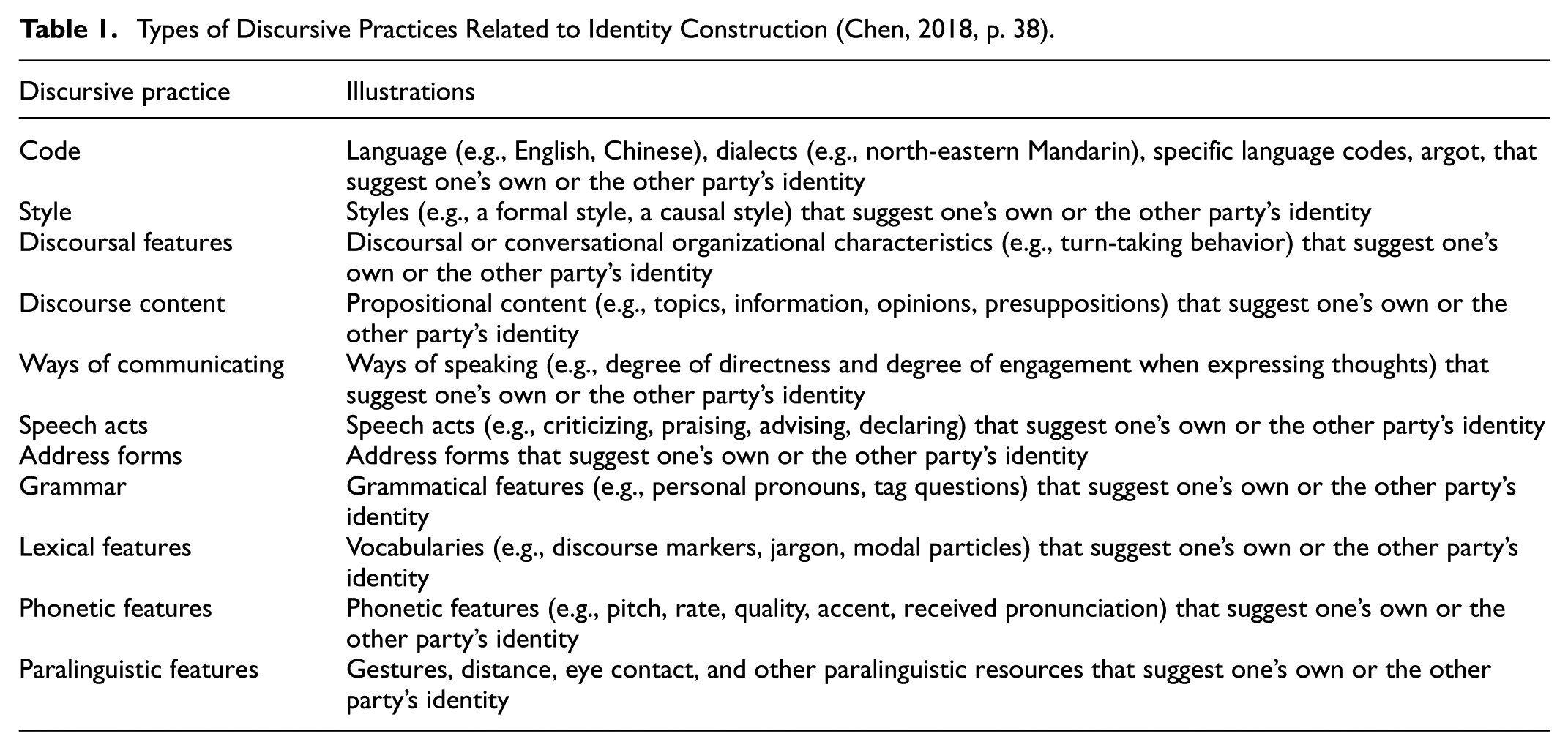
Pragmatic identity is constructed through discursive practices which refer to “talk activities that people do” (Tracy, 2002, p. 21). Discourse is perceived as an activity having “different parts and kinds” in this respect (Tracy, 2002. p. 21). In Chen (2018), the discursive practices of pragmatic identity construction happen both at macro level including code, style, discoursal features, discourse content, and ways of communication and at micro level such as speech acts, address forms of grammar, lexical features, phonetic features, and paralinguistic features (Table 1).
Types of Discursive Practices Related to Identity Construction (Chen, 2018, p. 38).
Based on the research objectives, the dynamic process of pragmatic identity construction and the discursive practices of pragmatic identity construction (Chen, 2018), the analytic framework of this study is shown in Figure 2.

The analytic framework of this study.
In shuoke contests, in order to achieve the goal of winning the contest, teachers construct the deviational pragmatic identity of salesperson to “sell” their teaching designs to the evaluators by adopting discursive practices at macro and micro level. It is vital for salespersons to say and do “the right thing for the right person at the right time” (Kotler & Keller 2019, p. 635). Therefore, discourse structure namely moves and steps and discourse strategy at lexico-grammatical level become the research focus in promotional genres in order to analyze the right things salespersons say (e.g., Bhatia, 2001; Cheung, 2010). Besides, discoursal feature is also the most salient discursive practices at macro level to construct salesperson identity in shuoke texts. Therefore, this article mainly analyzes discoursal features at macro level. Moreover, phonetic features and paralinguistic features at micro level are not taken into account in this study because its focus is on utterances.
Data Collection and Analysis
Qualitative and quantitative methods are combined in this study with the former utilized to identify the types of discursive practices at macro and micro levels and the latter for calculating the frequency and percentage of each type of discursive practices. This study adopts Feishu for transcribing, BFSU Qualitative Coder for annotating, and AntConc 4.2.4 for retrieving.
Corpus
Aiming to investigate the ways in which teacher contestants construct salesperson identity in shuoke contests, the corpus in this study consists of the data collected from undergraduate English major Group in the First National Contest on Integrating Moral and Political Education into College Foreign Language Teaching from 2020 to 2022, a national shuoke contest for Chinese college EFL teachers. As the first and the only specialized shuoke contest held from 2020 nationwide, the contest is suitable for this research because of its high authority and typicality. In this study, the top prize winners in the group of English major or equivalent are selected as the research objects because they are the models of shuoke contestants.
The corpus comprises 18 annotated shuoke transcripts obtained through four steps in terms of: downloading, transcribing, annotating and importing. First, all of the 18 publicly available recorded videos from 2020 to 2022 were downloaded directly from the official website requiring no membership subscription (https://icontest.hep.com.cn/Highlights/StaticShow2020) and renamed according to the year and ranking of the video. For instance, the second place in 2022 is named 202202. Second, these 18 downloaded shuoke videos were transcribed by Feishu, a transcription software, after which manual proofreading transcribed documents were adopted to make transcripts cleaner and more accurate. Third, the 18 transcripts were annotated following an annotation framework. Last, all these annotated transcripts were imported into AntConc 4.2.4 for retrieval, a professional corpus tool developed by Laurence Anthony who is a professor at Waseda University. The total tokens of the corpus reach 28,527.
Annotation of the Transcripts
The 18 transcripts were annotated in terms of moves and steps as well as the micro discursive practices utilized to construct salesperson identity. Three people were engaged in the annotation phase including one professor and two annotators, whose research interests all focus on pragmatics. The annotators are familiar with the annotation software owing to their relevant study experiences. During the annotation, the professor was responsible for generating a preliminary annotation framework and introducing it to the two annotators and the two annotators were accountable for annotating. The annotation phase followed three steps: introducing, training, and annotating.
During the introducing session, a preliminary annotation framework was generated by the professor and introduced to the two annotators. Initially, the professor carefully analyzed the transcripts to generate a tentative list of discursive practices utilized by teacher contestants to construct salesperson identity in shuoke contests. The classification of discursive practices was made “on the basis of linguistic evidence” and “comprehension of the text” (Dudley-Evans, 1994, p. 226). Next, the concept of moves and steps as well as the preliminary annotation framework were introduced with examples to the two annotators.
During the training session, the two annotators independently and simultaneously annotated the same 2 shuoke transcripts selected randomly from the shuoke transcripts in Chen (2023) immediately after the introducing session with the annotation software BFSU Qualitative Coder. Every text was read twice. For the first time, moves and steps were annotated by finding keywords. For the second time, the discursive practices at micro level were annotated with sentence as the annotated unit.
During the annotating session, the two annotators initially annotated 7 shuoke transcripts in 2020 independently by using the framework for consistency-checking. Raw agreement and Gwet’s AC1 are two measures of checking consistency. Raw agreement “provides the proportion of agreement cases in all cases” and Gwet’s AC1 is more sophisticated by subtracting agreement by chance from the raw agreement(Brezina, 2020, p. 89). Cross-check revealed that raw agreement and Gwet’s AC1 reached at 93.61% and 0.93% (p < .001) respectively in terms of moves and steps and 87.40% and 0.87% (p < .001) respectively concerning the micro discursive practices which are all greater than 80%, suggesting their results are nearly consistent. Discrepancies between the annotations found in the phase of cross-check and issues concerning the preliminary lists were discussed with the help of the professor in pragmatics in order to refine the lists regarding their validity, applicability, and interpretability. The remaining eleven shuoke transcripts were also annotated by the two annotators, with one annotating first and the other following to check. Resort to the professor was employed in cases where no consensus was reached between the two annotators. Once upon the completion of annotation, these annotated transcripts were imported into AntConc for retrieving.
Results
Discursive Practices at Macro Level for Salesperson Identity Construction
Shuoke in contests, as a kind of genre, tends to serve a set of communicative purposes including eliciting a positive response from the evaluators, providing relevant and favorable descriptions of the teaching design, and presenting the uniqueness of the teaching design. Teacher contestants adopt moves and steps at macro level to construct the identity of salesperson in the shuoke contest in this study.
Moves and steps are two important semantic, functional, and rhetorical units for analyzing genre. Moves are defined by Bhatia (2001, p. 84) as “rhetorical instruments that realize a sub-set of specific communicative purposes associated with a genre.” In other words, a move is subservient to the overall communicative purposes of the genre and simultaneously marks boundaries and functions of the text. This study suggests four moves utilized to construct salesperson identity in the shuoke contest after annotation: greeting, introducing the teaching design, making positive evaluations, and ending.
Moves are communicative events that can be further realized by steps. Among the four moves found in this study, only the move of introducing the teaching design is found to be further realized by six steps, namely introducing the teaching materials, introducing the teaching targets, introducing the teaching objectives, introducing the teaching methods, introducing the teaching procedures, and introducing the teaching assessment, in line with evaluation criteria (Table 2).
Descriptive Statistics of Macro Discursive Practices of Salesperson Identity Construction.

Frequency refers to the number of moves and steps occurring in all the 18 shuoke transcripts. Results show that the similarity of all the 18 shuoke transcripts is the co-occurrence of the step of introducing the teaching design, the teaching targets, and the teaching procedures. Besides, it is noted that some teacher contestants disperse and embed the introduction about the teaching assessment in the step of introducing the teaching procedures, intended to satisfy evaluators’ needs of formative assessment, as shown in Example 6 of this article.
Tokens refer to different word forms in the corpus. The total tokens of the four moves utilized to construct salesperson identity are 28,527, among which the tokens of introducing the teaching design are 24,363 accounting for 85.40%. The tokens of the move of making positive evaluations are 2,729 which occupy 9.57%. Teacher contestants in shuoke contests construct salesperson identity by making a reasonably detailed and concise analysis of the teaching design at length out of the consideration that the evaluators are unfamiliar with the teaching design. Among all the steps in the second move, teacher contestants spend much more time introducing the teaching procedures which account for 54.50% but limited time introducing the teaching methods whose proportion is only 3.91%. Given one major task for shuoke is to introduce the teaching content, this arrangement aims to make the teaching procedures the main focus. At the same time, it sustains the interest of the evaluators by assuming that they are already familiar with these teaching methods. Teacher contestants in shuoke contests also made positive evaluations towards the teaching design with the purpose of convincing the evaluators of the advantages and uniqueness of the teaching design and eventually persuading them to “buy.”
The following are typical examples of each move extracted from the same transcript.
Example 1 Move A: Greeting Honorable judges, ladies and gentlemen. Good morning. It’s a great honor to present our teaching design analysis.
In the move of greeting, the teacher contestant extends greetings and respect to the evaluators and the audience with the purpose of showing politeness as well as leaving a good impression. The outline of the presentation content would also be introduced by some teacher contestants briefly through a single sentence, aiming to give the audience a clear mind map of the sales presentation.
Example 2 Move B: Introducing the teaching design Step B1: Introducing the teaching materials The teaching materials come from Unit 4, “Human-Animal Bond,” Book 4. Text A Hummingbird Winter depicts the harmonious relationship between humans and animals. Text B is a parody of the conventional tale, The Tortoise and The Hare, full of twists and turns. It provokes us to further think about harmony and fairness living on this planet…
In the step of introducing the teaching materials, teacher contestants provide background information about the chosen materials for the evaluators. Analysis about the teaching materials is also introduced during this phase to further generate the teaching theme based on the analysis. In Example 2, the teaching theme is harmony and fairness. In this respect, teacher contestants as salespersons dedicate to convincing the evaluators that their teaching design is not cloud-built but hardheaded.
Example 3 Move B: Introducing the teaching design Step B2: Introducing the teaching targets Our target students are sophomore English majors whose competence fitting well with the descriptions of Level 5 to 6 CSE… With bits of information flooding in, they sometimes lack sensible judgments.
In the step of introducing the teaching targets, basic information about the target students of the designed class, especially their room for improvement, is given to the evaluators by the teacher contestant. In Example 3, the target students lack sensible judgments. Teacher contestants as salespersons clearly identify the rationale for the teaching objectives so that the whole teaching design is logical.
Example 4 Move B: Introducing the teaching design Step B3: Introducing the teaching objectives Our knowledge objective is to acquire animal-related expressions, accumulate ecology terms and identify rhetorical device—simile, further consolidate—inversion. Skill objective: Learn to express opinions with the help of the given functional devices… Moral objective: Understand the relationship between human and animals, harmony and fairness…
In the step of introducing the teaching objectives, the introduction about the teaching objectives built on the analysis of the target students and the cultivating objectives of English majors is a crucial and indispensable section of shuoke. In this section, three aspects of objectives centered around knowledge, skill and value are set, acting as the guiding principle to choose appropriate teaching methods, suitable teaching activities, and reasonable teaching procedures.
Example 5 Move B: Introducing the teaching design Step B4: Introducing the teaching methods With this in mind, we designed our teaching. The methodology. We adopted blended teaching and learning holistic approach towards foreign language teaching as our major teaching method.
In the step of introducing the teaching methods, teaching methods are selected based on the teaching objectives and briefly mentioned to the evaluators since they are familiar with various teaching methods. Teaching methods serve as the theoretical framework to the teaching design. In Example 5, the whole teaching design is based on blended teaching and learning holistic approach.
Example 6 Move B: Introducing the teaching design Step B5: Introducing the teaching procedures With this in mind, we designed our teaching… Implement. Here’s a mind map of the 3 sessions for this unit… Section one. Students are invited to play an online ESL game about bird vocabulary, matching names of birds with appearances using short-term memory. Students’ curiosity will be raised in this part and then the curiosity naturally leads them to the micro lecture, facts about hummingbirds, followed by an automatic instant score of a quiz… Another engaging activity deals with the weak points revealed in online learning. This is supposed to be the delayed assessment of the micro lecture. Previously we had the instant one…
In the step of introducing the teaching procedures, the salesperson identity is constructed through the combination of impersonal introduction and persuasive communication. Teaching activities before class, in class and after class in different sessions and the purposes of these teaching activities are introduced. In Example 6, almost each teaching activity is followed by a detailed explanation about this design. For instance, after introducing the teaching activity about playing an online ESL game about bird’s vocabulary, the teacher contestant explains that students’ curiosity would be raised through this activity.
Move B: Introducing the teaching design Step B6: Introducing the teaching assessment
In the step of introducing the teaching assessment, how students are assessed is presented by two means. One is to make it a separable part, and the other is to embed and weave it during the process of introducing the teaching procedures. In Example 6, the teacher contestant points out the online game about bird vocabulary before class is “followed by an automatic instant score of a quiz” as well as “an instant one.” After introducing the in-class teaching activity of story telling, the teacher contestant summarizes the teaching assessment as “the delayed assessment of the micro lecture.” Therefore, the teacher contestant constructs salesperson identity by continually reminding the evaluators of their formative assessment through weaving teaching assessment in teaching procedures.
Example 7 Move C: Making positive evaluations Evaluation: TSCA and multi-dimensional assessment focus on formative assessment, both instant and delayed, implicit and explicit. Here’s a full picture of this assessment. And this is the full picture of our ADDIE teaching design model. Highlights and reflection. This ideological and virtual education is integrated in the texts, exercises, micro lectures and summer activities, and achieved on 3 levels: interpret, internalize and implement. And this design actually of the summer activity fits in well with the supportive system in the outer circle of moral education, proposed by professor Wen Qiufang.
In the move of making positive evaluations, teacher contestants are attempting to convince the evaluators of benefits and uniqueness of the teaching design to achieve the ultimate goal of winning. Advantages about teaching assessment, teaching design, and teaching activities are listed in Example 7, each of which accords with evaluators’ evaluation criteria and is therefore very persuasive.
Example 8 Move D: Ending Thank you. This is the bigger goal. Thank you.
In the move of ending, teacher contestants would express gratitude to the evaluators and the audience in order to show politeness. The move of ending is an indispensable part to mark the completion of the presentation and to show respect to the evaluators.
In conclusion, teacher contestants in shuoke contests construct the identity of salesperson mainly through four moves: greeting, introducing the teaching design, making positive evaluations, and ending, which is a common “telling-and-selling” pattern. (Fairclough, 1992, p. 117)
Discursive Practices at Micro Level for Salesperson Identity Construction
Teacher contestants adopt speech acts, grammar, and lexical features at micro level to indicate the consistency between their teaching design and evaluators’ evaluation criteria and construct salesperson identity. The total frequency of these discursive practices at micro level reaches 1,679. In general, the most prevalent type is lexical features, which appears 856 times and accounts for 50.98%. The second widely distributed is the type of speech acts occurring 677 times and occupying 40.32%. The least is grammar with a frequency of 146 and a proportion of 8.70%.
These discursive practices at micro level are further divided. As regards speech acts, assertives, commissives and expressives are three major types utilized by teacher contestants to construct salesperson identity, among which assertives including stating, describing, explaining, and concluding has the highest proportion, 34.60%. As regards grammar, adverbial is the only means found in this shuoke contest when salesperson identity is constructed. As regards lexical features, interactive meta-discourse including code glosses, frame markers, and transition markers as well as interactional meta-discourse containing attitude markers, boosters, self mentions, and engagement markers are utilized with the former accounting for 33.89% and the latter 17.09%. Specifically, frame markers and stating make up the top two highest proportion in interactive meta-discourse and in assertives, 22.63% and 20.73% respectively.
Each type in Table 3 is described and analyzed with examples in the following section. The underlined words, phrases, or sentences are examples of these types.
Descriptive Statistics of Micro Discursive Practices for Salesperson Identity Construction.

Speech Acts
As regards speech acts, to construct salesperson identity, teacher contestants adopt a large proportion of assertives to introduce the teaching design in detail by stating, to introduce the content of teaching materials by describing, and to introduce the rationale and purpose of the design by explaining and concluding. Teacher contestants also adopt commissives and expressives to explain the strong logic of the design and to make the design meaningful and reasonable. The following are examples of speech acts utilized by teacher contestants to construct salesperson identity.
Assertives
Assertives commit the speaker to “something’s being the case” and “to the truth of a proposition” (Searle, 1979, p. 12), with the intention of getting the hearer to believe something. Example 9 integrates stating, describing, explaining, and concluding together to introduce the teaching materials by a teacher contestant.
Example 9 There are 2 passages in this unit. Text one, The Two Roads, is about an old man’s regrets and remorse because of taking the wrong path when he was young. He has taken 60 stages in his life and now in front of him is a dark cave… Text 2, A Glimpse of the Future, opens a window for us to see the outlaws of the young generation, who still stand at the entrance of their life journey. They do want to choose a bright road with flowers. But how can they walk there? So, the unit is sending us a message. Life is a journey from the entrance to the end. Every stage, every step and every choice counts… However, the two texts don’t have a compelling example. So, we added a material, the video Youth Choices for the students to learn from the power of the idols. (202105)
Evaluators’ expectations of the teaching content are that it needs to be comprehended thoroughly, selected carefully and arranged extraordinarily. The teacher contestant in Example 9 refers to the teaching materials by stating, and proceeds with a detailed presentation about the content of the teaching materials by describing, after which the teaching theme is drawn through concluding, aiming at meeting the evaluators’ requirements for an in-depth understanding of the teaching materials. The teacher contestant subsequently states that one supplementary material is added because the other two texts don’t have compelling examples, which is completed by the speech act of explaining. Therefore, the teacher indicates to the evaluators that the teaching materials are carefully selected. With various assertives adopted, the salesperson identity is constructed.
Commissives
Commissives are “illocutionary acts whose point is to commit the speaker to some future course of action” (Searle, 1979, p. 14).
Example 10 Students are invited to play an online ESL game about bird vocabulary, matching names of birds with appearances using short term memory. Students’ curiosity will be raised in this part and then the curiosity naturally leads them to the micro lecture, facts about hummingbirds, followed by an automatic instant score of a quiz. (202202)
Example 10 is an excerpt from the introduction about the teaching procedures. Before class, students are required to play an online game about bird vocabulary. After the introduction about the content and implementation of the online game activity, the teacher contestant promises to the evaluators that students’ curiosity would be raised through this activity, laying foundation for further micro lecture learning. By using commissives, the teacher contestant attempts to convince the evaluators of the benefits of designing such an activity and to make each part logical.
Expressives
Expressives are “to express the psychological state specified in the sincerity condition about a state of affairs specified in the propositional content” (Searle, 1979, p. 15).
Example 11 After that, in detailed reading they will be exploring and discussing the important dimensions of human animal bond, such as love, care and sacrifice. And more importantly, I want them to understand the temporary development of human animal bond from strangeness to companionship, and then to dependence. (202203)
The teacher contestant in Example 11 expresses wishes to students once upon their completion of detailed reading and discussing. The wishes are consistent with the teaching objectives. Through expressives, the teacher contestant tells the evaluators that the teaching design is reasonable and purposeful, satisfying evaluators’ evaluation criteria. The salesperson identity is therefore constructed.
Grammar
As regards grammar, teacher contestants mainly adopt adverbials to indicate that the teaching objectives are achieved through a set of teaching activities and to explain the rationale of designing the procedure or setting up the objective, satisfying one of evaluators’ criteria, that is, the whole teaching design has a strong logic.
Example 12 And based on these analyses, I set up my teaching objectives from 3 aspects. (202102)
Example 12 is followed by the introduction of target students and teaching materials, which justifies the teaching objectives. This corresponds with evaluators’ requirement for teaching objectives, that is, they should be set up according to the analysis of the teaching context. Therefore, the teacher contestant constructs salesperson identity by using adverbials to give the evaluators a hint.
Lexical Features
As regards lexical features, teacher contestants adopt interactive meta-discourse to combine different elements in shuoke texts by either rephrasing, contrasting, or labeling stages. Teacher contestants also adopt interactional meta-discourse to make the teacher identity salient, including boosters and attitude markers which are used to evaluate positively and persuade powerfully.
Code Glosses
Code glosses “supply additional information, by rephrasing, explaining or elaborating what has been said, to ensure the reader is able to recover the writer’s intended meaning” (Hyland, 2005, p. 52). In shuoke contests, code glosses interpret the positive evaluation of the teaching design into more specific instances with the purpose of informing the evaluators about the full achievement of teaching objectives.
Example 13 And then we have the advanced, innovative, challenging course activities. For example, we talked about hyponymy and vocalization instead of present tense or the words of certainty suggested by the reference book. (202002)
Example 13 is extracted from the move of making positive evaluations. Initially, the teacher contestant summarizes that the advanced, innovative, challenging course activities are part of the highlights of the teaching design. Subsequently, two examples are then provided utilizing code glosses “for example” to support the merit previously mentioned, boosting the argument’s level of persuasiveness.
Transition Markers
Transition markers “are mainly conjunctions and adverbial phrases which help readers interpret pragmatic connections between steps in an argument” (Hyland, 2005, p. 50). Transition markers signal additive, causative and contrastive relations. Transition markers are utilized in shuoke contests to demonstrate connections between different elements and deviations from other possible alternatives. Since in a contest, stressing the unique points in the teaching design is crucial. Contrastive relations utilized to indicate the special highlight of the teaching design are mainly analyzed in this article.
Example 14 And we ask students to do the plant-visiting instead of just searching the information online. (202002)
The teacher contestant highlights how thoughtfully the educational activities are designed with transitive markers “instead of” to indicate contrastive relations. By comparing the two teaching activities, the teacher guides the evaluators to acknowledge the distinctiveness of the teaching activity “doing the plant-visiting.”
Frame Markers
Frame markers are a kind of interactive meta-discourse operated within text signaling “text boundaries or elements of schematic text structure” (Hyland, 2005, p. 51), performing the function of sequencing parts, labeling stages, announcing discourse goals and shifting topic like “next,” “in sum,” “I argue here,” and “let us return to.”
In this study, the position of frame markers is either in the beginning part of each move or weaving through each move with different functions performed. Example 15 is an instance of frame markers appearing in the first sentence of each move and Example 16 is an instance of frame markers embedded in the move.
Example 15 Now, teaching objectives of Session One… Now, teaching procedure of Session One… Now, the assessing phase. (202205)
The teacher contestant in Example 15 organizes the presentation text by using the frame marker “now” in the first sentence of each move, with the purpose of drawing the evaluators’ attention to the current discourse content, telling the evaluators of the part to be introduced next, and informing them that all elements of the teaching design such as the teaching objectives are included. This facilitates the evaluators to compare the evaluation criteria with the teaching design, telling the evaluators overtly that the teaching design satisfies their evaluation criteria one by one.
Example 16 For morality cultivation, my students will have a constant, should have a constant thirst for knowledge… For language competence, concrete details and rhetorical devices are going to be introduced… (202201)
Example 16 is obtained from the move of introducing the teaching design. Setting learning objectives based on knowledge, competence, and value is one of the evaluators’ criteria. In Example 16, the teacher contestant constructs salesperson identity through frame markers to label the stage of “knowledge,” “competence,” and “value” in the step of introducing the teaching objectives, which not only makes coherent the text but more importantly shows the evaluators that the teaching objectives are set as required.
Engagement Markers
Engagement markers, as a kind of interactional meta-discourse, highlights audiences’ presence in the discourse by either addressing them explicitly like personal pronouns “you” and inclusive “we” or engaging them with questions or imperative sentences. Functions of engagement markers in shuoke texts are manifested in two folds: one is to inform evaluators the stage where the discourse is going and the other is to engage the evaluators with the teacher contestants’ opinion, thereby affecting their reasoning process. Example 17 exemplifies the first fold and Example 18 the second.
Example 17 How do we achieve these objectives? Let’s come to the teaching procedures. (202105)
After introducing the teaching objectives of the design, the teacher throws a question at the evaluators, inviting engagement but expecting no response. The rhetorical question is served as a link between two different moves and an invitation to audience to keep up with the teacher’s pace. Moreover, the phrase “let’s” which involves the evaluators in the dialogue also plays the same function as the preceding question. Since the evaluators are unfamiliar with the teaching design initially, using an interrogative sentence as the starting point of introduction about teaching procedures may be an effective way of arousing evaluators’ interest, keeping them involved, and laying foundations for further detailed introduction with the expectation of gaining a higher score.
Example 18 What does it mean? It means that overseas experiences are not necessarily beneficial if you fail to preserve your native culture and have become somewhat a “fake foreigner.” (202101)
After describing the content of the teaching materials, the teacher in Example 18 proposes a rhetorical question namely “what does it mean? It means that…” to seize resonance with the evaluators. This is a key strategy utilized by the teacher to construct salesperson identity by guiding the evaluators to the teacher’s viewpoint of teaching content so that the evaluators would believe that the teaching content is worth teaching and thinking.
Attitude Markers
Attitude markers indicate the speaker’s affective attitude towards a set of affairs. Hyland (2005) admits, “attitude and engagement markers are often difficult to distinguish in practice.” (p. 54). In order to have a better understanding of the functions interactional meta-discourse performs, the commentary words are classified into attitude markers in this article. In shuoke contests, attitude markers are usually bound with engagement markers to persuade others more powerfully, as it is shown in Example 19.
Example 19 So, as you can see here, we have a very good combination of different teaching method, which can help us to form a considerably systematic teaching. (202006)
Attitude markers are commonly used in the move of making positive evaluations. They not only summarize the teacher’s positive evaluations but also play key roles in strengthening the persuasiveness of the propositional content, co-occurring with engagement markers and boosters. For instance, in Example 19, by addressing the evaluators directly with “you,” the teacher makes an attempt to drag evaluators’ reasoning processes into the positive evaluation of their teaching design indicated by a series of positive attitude markers like “good” and “different.” By doing this, teachers attempt to arouse evaluators’“purchasing” desire.
Boosters
Boosters express the speaker’s certainty and confidence toward conflicting views by emphasizing the mutual experiences needed to draw the same conclusions (Hyland, 2005, p. 53). Teachers construct salesperson identity in shuoke contests by using boosters to demonstrate their absolute commitment to the propositional content.
Example 20 And certainly, students will be engaged in critical thinking and reading to justify the necessity of restoring family virtues… (202102)
In Example 20, the teacher contestant constructs salesperson identity through the booster “certainly,” which manifests certainty and confidence in the following propositional content which is engaging students into critical thinking through rational persuasion. It heads off possible objections put forward by the evaluators and undoubtedly makes them believe the speakers’ views.
Self Mentions
Self mentions are the “degree of explicitly author presence in the text” (Hyland, 2005, p. 53). A teacher has multiple social identities. But in shuoke contests, to make the salesperson identity salient, teachers may choose the word “teacher” instead of “I” to downplay their other identities.
Example 21 Then, the teacher will introduce a strategy for students to question the text, search for deeper meanings, and make connections between the text and their lives. (202003)
One of evaluators’ criteria in choosing the best teaching cases is to see whether teacher contestants combine teaching and learning activities together. In Example 21, the teacher contestant tells the evaluators that students would do jigsaw reading first with the purpose of arousing students’ enthusiasm of analyzing the text. And after that, the teacher chooses the phrase “the teacher” rather than “I” to emphasize teacher identity instead of other social identities in the class. It is an indicator to hint the evaluators that their teaching design has combined the teaching and learning activities.
Discussion
The discussion is to be approached from the discursive practices at macro level and micro level.
As regards the discursive practices at macro level, four moves are found in constructing the salesperson identity, with six steps in the second move. Among the four moves, the second move introduces the teaching design and the third move makes positive evaluations. These findings suggest the same describing-and-evaluating discursive pattern as promotional genres (Ahangar & Dastuyi, 2017; Bhatia, 2004; Fairclough, 1992; Labrador et al., 2014; Zhou, 2012), further validating the promotional and rhetorical function of pragmatic identity in shuoke. The interconnection between pragmatic identity and rhetoric has been discussed from the theoretical basis by some scholars (Lyu, 2022; Qin & Yao, 2019). They acknowledge the rhetorical functions of pragmatic identity. Chen (2018, p. 6) also admits that the study of pragmatic identity encapsulates the study of “strategic” or “rhetorical” identity construction. Although their connection is observed to be theoretically feasible, empirical investigations of the rhetorical functions of pragmatic identity remain minimal. The findings of this study, to some extent, provide empirical support in this regard. Besides, the study is different from previous studies on teachers’ pragmatic identity because it makes a lengthy analysis of moves and steps as a type of discursive practices at macro level for identity construction.
As regards the discursive practices at micro level, speech acts, grammar and lexical features are three major means to construct the salesperson identity of teacher contestants. The study approaches a new topic on shuoke studies by systematically investigating the specific language strategies that maximize the communicative effects of shuoke. Implications of such findings not only provide an inspiration for teachers to make appropriate linguistic choices in shuoke but also assist teachers in articulating thoughts more appropriately and persuasively. Only when evaluators truly understand the theoretical logic of individual teaching designs can they give constructive feedback, thereby facilitating teachers’ professional development. Besides, this study reveals that interactive metadiscourse constitutes a significantly high proportion in the construction of the deviational pragmatic identity, namely the salesperson identity. Hyland (2005) acknowledges that one major function of interactive metadiscourse is to render the propositional information “coherent and convincing” (p.50) for the intended audience. This finding aligns perfectly with the communicative effects of the salesperson identity construction. Through the manipulation of interactive metadiscourse, the teacher’s arguments are not simply organized but deployed based on the teacher’s assessment of the evaluators’ assumed knowledge, thereby maximize the persuasive effects. Interactional metadiscourse also performs a vital role in constructing the salesperson identity. Interactional metadiscourse serves not merely as a vehicle for expressing the teachers’ views but as a strategy of guiding and suppressing potentially opposite opinions, thereby achieving persuasive effects. Among these interactional metadiscourse, attitude markers explicitly demonstrate the teachers’ positive attitude towards the proposition. Boosters silence potential counterarguments and intensify the persuasive tone. Engagement markers engage evaluators and align their reasoning with the teachers’ arguments. These discursive practices work in concert to construct the salesperson identity and to ultimately achieve the communicative goal.
Conclusion
The present study investigates the types and frequencies of the discursive practices at macro and micro levels utilized by teachers to construct salesperson identity in shuoke contests. Results suggest that teacher contestants construct the salesperson identity through four moves at macro level: greeting, introducing the teaching design, making positive evaluations, and ending, namely a “telling-and-selling” pattern (Fairclough, 1992, p. 117). Persuasive content about the teaching design not only appears in the move of making positive evaluations, but is also woven in the introduction part. The study reveals that speech acts, grammar, and lexical features are the discursive practices at micro level teacher contestants adopt to construct salesperson identity, with assertives, adverbials, and meta-discourse appearing most frequently in each type.
Footnotes
Acknowledgements
The authors would like to thank Doctor Zhang Shu and Doctor Liu Lixin in the School of Foreign Languages of Northeast Normal University for their assistance in providing constructive suggestions.
Note
In order to make the article concise, presenter’s remarks unrelated to the analytical content were replaced with ellipses in the illustrative examples.

Ethical Considerations
Not applicable.
Funding
The authors disclosed receipt of the following financial support for the research, authorship, and/or publication of this article: This article is supported by the Humanities and Social Science Research Project of the Ministry of Education, China (Grant Number 21YJC740008).
Declaration of Conflicting Interests
The authors declared no potential conflicts of interest with respect to the research, authorship, and/or publication of this article.