




Abstract
This study was conducted to develop and evaluate the effectiveness of the Fermi problem approach in enhancing measurement estimation skills in mathematics. Employing an action research design, 24 seventh-grade students (13 girls and 11 boys) from a southern Turkish middle school were selected using criterion sampling. Quantitative data were gathered through a Measurement Estimation Skill Readiness Test and tasks based on the Fermi problem approach, complemented by qualitative insights from student reflective diaries. The 10-week action research study consisted of three cycles, each focusing on different aspects of measurement estimation: length, area, and volume in the first cycle; liquid measurement and volume in the second cycle; and weight estimation with Fermi problems in the third cycle. The findings highlighted the effectiveness of the Fermi problem approach in enhancing the measurement estimation skills of seventh-grade students. The research findings suggest that incorporating Fermi problems into the problem-solving process in instructional programs may offer significant contributions in providing a different perspective on the development of students’ measurement estimation skills.
Introduction
Estimation and problem-solving skills are vital in daily life and key to fostering students’ mathematical thinking. These abilities enhance conceptual understanding, critical thinking, and practical use of mathematical knowledge. Estimation aids mathematical thought by helping individuals make rational judgments about quantities and calculations, especially in real-world situations where exact answers are not required (Amalia et al., 2024; Szabó et al., 2020; Sumartini, 2018). The Turkish mathematics curriculum integrates estimation and mental computation skills with entrepreneurship to develop these competencies (MoNE, 2018). Estimation promotes mathematical reasoning and critical thinking by allowing individuals to evaluate the validity of their conclusions (Reys & Reys, 1998; Star et al., 2009). It also encourages exploring various problem-solving methods and applying them wisely (Adams et al., 2005).
Fermi problems serve as a key approach in enhancing estimation skills. They require forming estimates based on limited information and using them to create solution strategies (Ärlebäck, 2009). These open-ended problems, with no single correct answer, encourage various approaches and solutions, fostering students’ creative and critical thinking. Moreover, Fermi problems help students develop flexibility in problem-solving by promoting sequential reasoning and hypothesis formation (Segura & Fernando, 2023).
Problem-solving skills are crucial for deepening students’ understanding of mathematical concepts, enhancing their logical, analytical, and critical thinking (Surya et al., 2016). This process helps students organize information, generate solutions, and create strategies. In math education, problem-solving is not just a technical skill but a key process for critical thinking, reasoning, and applying math in daily life (Siagian et al., 2019). Polya’s (1957) four-stage model—understanding the problem, planning, executing, and reviewing—supports students’ systematic approach to problem-solving and fosters metacognitive skills (Khofifah et al., 2024). In contrast, Schoenfeld’s (1985) broader view of problem-solving includes mathematical knowledge, strategy use, metacognitive awareness, and contextual factors.
These theoretical approaches are consistent with Fermi problem approach, which have been demonstrated to be particularly effective in problem-solving situations that are estimative and relevant to real-life contexts (Szabó et al., 2020). Fermi problem approach have been shown to encourage students to develop creative solution strategies by making logical assumptions and to strengthen mathematical reasoning processes in accordance with Polya and Schoenfeld’s frameworks (Tambunan, 2019). Estimation and problem-solving skills are closely interrelated and, as such, must be addressed together for effective mathematics education. Szabó et al. (2020) contend that problem-solving skills cannot be taught in isolation but must be integrated with estimation skills. This integration, they argue, contributes not only to the development of mathematical depth but also to increasing students’ confidence in solving complex problems. Addressing estimation and problem-solving skills with a holistic approach in mathematics education, therefore, contributes to the development of students’ mathematical flexibility and helps them grow as individuals who can think more creatively and critically.
The focus of this study is the effectiveness of the Fermi problem approach in developing seventh-grade students’ measurement estimation skills. It addresses the integration of estimation and problem-solving skills, which are critical components of mathematical thinking. The study evaluates the effectiveness of incorporating the Fermi problem approach into the problem-solving process to develop seventh-grade students’ mathematical thinking skills and enhance their measurement estimation skills.
Literature Review
Estimation and Measurement Estimation
Estimation is defined as the process of determining the most appropriate approximate value that can represent an exact number in a given context (Segovia & Castro, 2009). This process is often employed when an exact value is unknown or unnecessary, as it provides numerical precision and facilitates calculations when precision is not a primary concern. The literature offers several definitions of estimation. Micklo (1999) defines estimation as the rapid determination of the quantity or size of an object without the need for actual measurement or counting. In contrast, Segovia and Castro (2009) describe estimation as the predetermination of a desired measurement or process result. While Levine (1982) underscores the significance of estimation, Van den Heuvel-Panhuizen (2008) notes that it is a concept frequently employed in daily mathematical tasks. Dehaene (1997) posits that individuals are born with an innate sense of quantity, which develops through environmental stimuli and experiences. Three main types of estimation have been identified in the literature: calculation estimation, quantification estimation, and measurement estimation (Hanson & Hogan, 2000; LeFevre et al., 1993; Sowder, 1992).
Computational estimation involves finding the approximate result of a calculation, while numerosity estimation is a skill for estimating the numerical value of items in a collection (Segovia & Castro, 2009). Measurement estimation, on the other hand, involves estimating a measurement without obtaining an exact number; for example, estimating the length of a room or the weight of an object (Van De Walle et al., 2016). The distinction between numerosity estimation and measurement estimation hinges on whether the attribute being estimated is continuous or discrete. To illustrate, estimating the number of oranges in a bag constitutes numerosity estimation, while estimating the weight of oranges falls under measurement estimation (Segovia & Castro, 2009). Measurement estimation is not solely associated with mathematical competencies but also with spatial abilities (Hogan & Brezinski, 2003). The acquisition of measurement estimation skills necessitates the attainment of visual experience through interaction with physical objects (Markovits & Hershkowitz, 1997).In measurement estimation, students should experience approximate measurement, also known as rough physical measurement, prior to engaging in mental measurement of objects. This process enables students to utilize familiar objects as reference points. The process of measurement estimation entails the determination of a mental measurement for a property of an object without the utilization of measurement tools. Reference points play a significant role in this mental measurement process (Hoth et al., 2023).
The development of measurement estimation skills is crucial for students to navigate and solve problems in real-life settings effectively (Hoth et al., 2023). These skills evolve through distinct phases, requiring students to develop the capacity to make estimations by engaging in mental comparisons of objects (Hildreth, 1983).The application of measurement estimation skills is evident in scenarios such as working on Fermi problems approach. Fermi problems approach, characterized by an absence of data, necessitate the estimation of the quantities involved and the formulation of assumptions regarding the problem scenario prior to the execution of any calculations (Ärlebäck, 2009). Consequently, measurement estimation skills assume great importance in the context of Fermi problems approach (Meyer & Greefrath, 2023).
Fermi Problems: Definition, Historical Process, and Role in Mathematics Education
Fermi problems are instrumental in the structuring of problem-solving processes, and they are so designated because of their origins in the work of the Italian physicist Enrico Fermi, who won the Nobel Prize in Physics in 1938. Fermi developed original approaches to problems involving uncertainty and lacking a single definitive solution. Questions such as “How many railroad cars are there in the USA?” and “How many piano tuners are there in the USA?” are examples of Fermi problems. Fermi’s theoretical framework posits that the inherent uncertainties in such problems tend to cancel each other out, thereby leading to a consensus answer through a process of approximation.
Fermi’s problem-solving approach, which was introduced in 1934 to explain radioactive decay processes, has since become widespread in the fields of physics and engineering (Jones, 2022). Such problems are also called order-of-magnitude problems and are often used to teach dimensional analysis or approximation techniques (Smith, 2022). Fermi problems require individuals to make reasoned estimations about quantities, determine ranges of variation, and reason about probabilities (Brown et al., 2021). In this context, they are directly related to mathematical modeling and estimative thinking (von Baeyer, 1988).
Within the domain of mathematics education, Fermi problem approach has emerged as valuable instruments in fostering students’ mathematical thinking skills. Fermi problems are distinguished by their open-ended nature and non-standard characteristics, necessitating the formulation of hypotheses and the establishment of systematic assumptions during the process of solution. According to Ärlebäck (2009), Fermi problems are defined as mathematical tasks that require students to make assumptions and estimate critical quantities prior to the initiation of the solution process. Carlson (1997) asserts that Fermi problem approach promote the development of creative and coherent solutions among students. Efthimiou and Llewellyn (2007) emphasize the potential of these problems to cultivate critical thinking and reasoning skills in education.
Fermi problem approach is addressed from two primary viewpoints: mathematical modeling and estimation processes. Recent studies demonstrate the efficacy of these problems in developing students’ critical thinking, problem-solving, and modeling skills (Sriraman & Lesh, 2006; Sriraman & Knott, 2009). Through engagement with Fermi problems, students develop the capacity to formulate reasonable estimations about real-life scenarios. For instance, inquiries such as “How much paper is consumed in a month at your school?” or “How many books does an individual read in a lifetime?” exemplify students’ creative and coherent problem-solving abilities.
In a study by Hıdıroğlu and Hıdıroğlu (2017), it was examined how 6th-grade students handle real-life problems in the context of mathematical modeling. Students worked on problems related to height estimations, water consumption calculations, and parking lot capacity. The findings of the study show that students have difficulties in making assumptions in the problem-solving process, make mistakes in the modeling phase, and need to improve their estimation skills. This emphasizes the importance of Fermi problem approach as a tool to support estimation and modeling skills in education.
One of the critical benefits of Fermi problem approach is their capacity to facilitate interdisciplinary connections, particularly within the domain of mathematics education. These approach can be integrated with various fields, including physics, engineering, economics, and environmental sciences (Sriraman & Lesh, 2006). Additionally, Fermi problem approach can be adapted to address social issues, contributing to a more comprehensive and interconnected educational experience. Estimates of water consumption and waste, calculations of energy use, or estimates of recycling processes can help students develop not only mathematical thinking skills but also skills such as environmental awareness, sustainability, and data literacy (Sriraman & Knott, 2009).
Fermi problem approach is defined as activities that can be used in interdisciplinary learning environments (Sriraman & Lesh, 2006).In relation to mathematics education; this approach teaches students not only to think mathematically but also to make connections with real life. For example, environmental awareness can be promoted in students by associating them with social sciences and environmental sciences. A substantial body of research in the relevant literature indicates that Fermi problem approach is being subjected to increased scrutiny in the domain of mathematics education research, with notable contributions being made to the field of modeling processes (Abay & Gökbulut, 2017; Albarracín & Gorgorió, 2014; Ferrando et al., 2017; Peter-Koop, 2005).
In conclusion, Fermi problems approach represents a significant category of problems that play a crucial role in the estimation and modeling processes within the domain of mathematics education and other disciplines. These problems have been identified as a valuable instrument to enhance students’ estimation skills, structure problem-solving processes, and cultivate their critical thinking competencies. However, given the current limited integration of Fermi problem approach in mathematics education, further research is necessary to promote the broader implementation of these problems in the future.
Relevant Research
Many studies have been conducted on measurement estimation and problem-solving strategies. Hogan and Brezinski (2003), in a study conducted with 53 undergraduate students enrolled in the Foundations of Psychology course at a university in the Northeastern United States, examined the relationship between numerical ability and quantitative reasoning tests. They demonstrated the link between these two tests using principal component analysis. Joram et al. (1998) investigated the relationship between measurement estimation strategies and the accuracy of students’ representations of standard units of measurement and estimation accuracy among 22 American students. In this study, the use of the reference point strategy led students to obtain more accurate results in length estimation.
Metacognitive awareness in metacognitive estimation and problem-solving processes is critical for students to recognize their thinking processes and use their strategies more effectively (Schoenfeld, 2016). According to Schoenfeld (2016), metacognitive awareness facilitates the application of problem-solving strategies and increases the accuracy of quantitative estimation. Ärlebäck (2009) employed the Modeling Activity Diagram (MAD) framework, which was based on Schoenfeld’s (1985) decoding protocol coding scheme, to introduce mathematical modeling processes to higher-level students. The study examined the relationship between Fermi problem approach and this process. The results indicated that Fermi problem-solving processes were richly represented in the framework, emphasizing the significant role of social interactions during problem-solving.
Hartono et al. (2015) developed a series of five classroom activities within the framework of the Realistic Mathematics Education (RME) approach in Indonesia. These activities involved the development of strategies for utilizing reference points in length estimation, with observations indicating that students created new reference points by establishing connections with body parts and external objects. Similarly, Budak and Şengül (2021) conducted a study with 5th and 6th-grade students in Istanbul, finding that concept cartoons positively influenced students’ measurement estimation skills. While the students initially made random estimates, they subsequently adopted strategies requiring flexible thinking after the implementation of the concept cartoons.
Meyer and Greefrath (2023) examined sixth-grade students’ measurement estimation skills and performance on Fermi problems related to length and weight measurements. In contrast, Bani-Hamad and Al-Kalbani (2024) used Fermi problem-based learning approach and Artificial Intelligence (FPBL-AI) model to develop 21st-century skills in the United Arab Emirates. The findings of these studies indicated the efficacy of Fermi problem-based learning approach in enhancing students’ competencies. Additionally, numerous studies have investigated the correlation between measurement estimation skills and students’ mathematical achievement (Bulut, 2019; Çilingir & Türnüklü, 2009; Hildreth, 1983; Kılıç & Olkun, 2013). A range of studies have examined estimation skills in various measurement domains, including length, area, and volume (Hoth et al., 2023; Gooya et al., 2011). Notably, Sowder (1992) observed that students frequently encountered challenges in employing estimation strategies, leading them to resort to random estimation as a means to overcome these difficulties.
In the Turkish mathematics curriculum, while measurement estimation is more emphasized at the primary school level, it is seen that these skills are not emphasized enough in secondary education (MoNE, 2018). Studies (Kılıç & Olkun, 2013; Sowder, 1992) have revealed that students have difficulties in questions requiring estimation skills and often make random estimation. These studies emphasize the importance of developing measurement estimation skills.
Study Objective and Questions
In light of the aforementioned literature, the study aimed to enhance seventh-grade students’ problem-solving skills by integrating the Fermi problem approach, which emphasizes estimation and assumptions, into mathematics education. Unfortunately, the current curriculum in Turkey does not incorporate Fermi problem approach into mathematics lessons, and accordingly, there is a need to cover this gap in mathematics education.
In Turkey, seventh-grade students’ measurement estimation skills are insufficiently developed due to deficiencies in analytical thinking, problem-solving, and critical thinking skills. The limited pedagogical competencies and professional development opportunities of teachers reduce the effectiveness of the learning process (Mete, 2021). Additionally, the curriculum’s emphasis on rote learning and exam-oriented structure hinders students from developing practical and in-depth thinking skills (Kılınç & Baş, 2023). Moreover, the insufficient involvement of families in the education process negatively affects students’ motivation, academic achievement, and consequently, their measurement estimation skills (Türkben, 2021). These multidimensional challenges highlight the necessity for comprehensive and multifaceted approaches to improve measurement estimation skills in Turkey. Furthermore, there is a notable lack of studies examining the measurement estimation skills in length, area, volume, liquid, and weight measurement in mathematics education classes together.
Therefore, this research endeavors to contribute meaningfully to the field of education by integrating and evaluating the Fermi problem approach to foster the development of measurement estimation skills in mathematics education among secondary school students in Turkey. Subsequently, with this purpose, the following three questions were proposed.
What is the effect of Fermi problems approach on students’ measurement estimation skills based on their pre-test and post-test scores, on the Measurement Estimation Skill Readiness Test (MESRT)?
What is the performance level that the students attained in solving Fermi problems as measured by the three levels of Performance (1. Need to be improved; 2. Intermediate Level, and 3. Good Level) throughout the three cycles of implementing the Fermi problem approach?
What are the positive, negative thoughts, and the challenges they encountered regarding the Fermi problem approach, as revealed through the content of the reflective diaries across the three cycles?
Method
Research Model
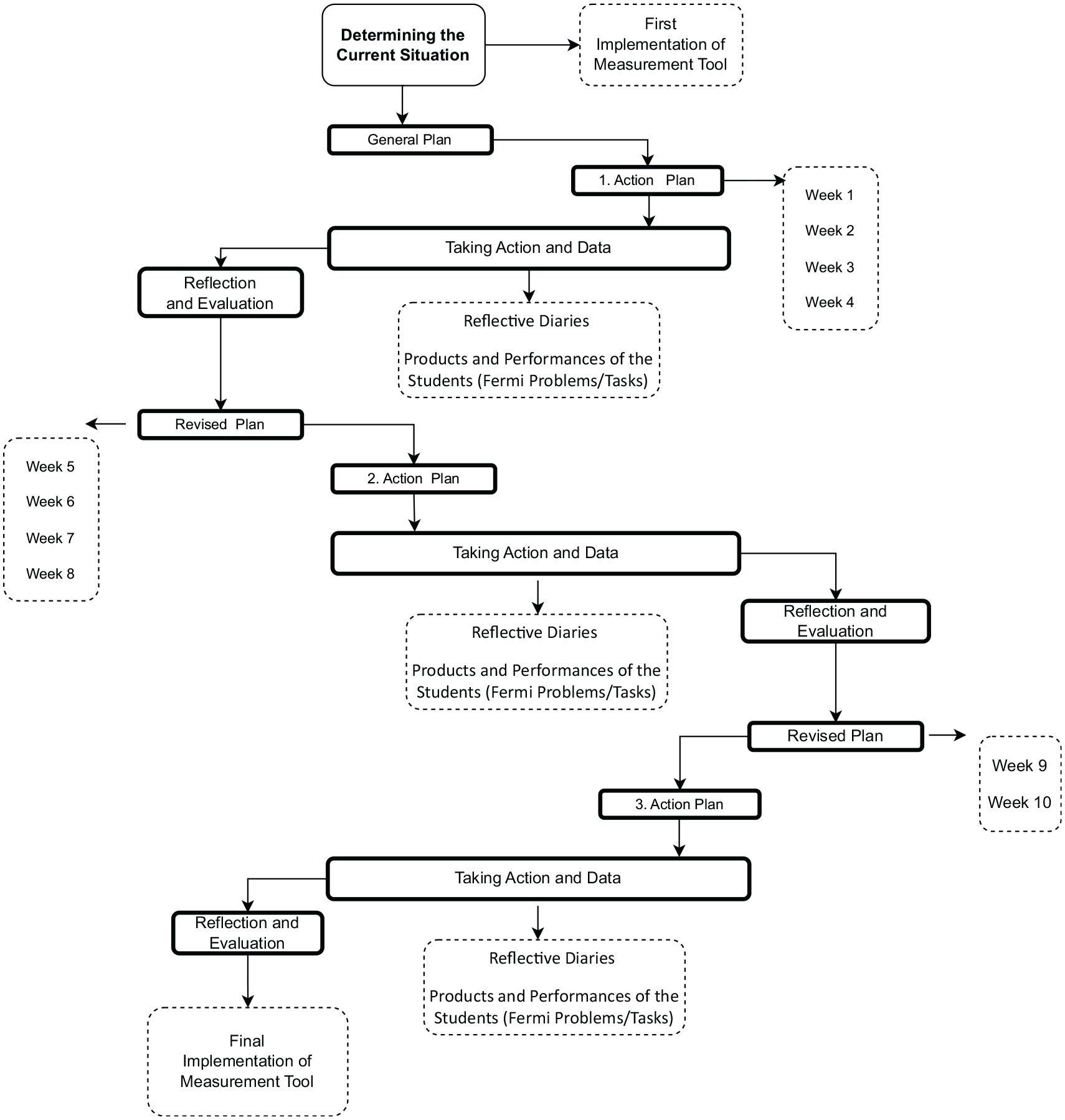
The model of this research is action research, which is one of the qualitative research designs. According to Johnson (2012), action research is a systematic approach to investigating and improving the quality of teaching within a real classroom setting. It involves planning, organizing, and sharing research with relevant stakeholders. In action research, the researcher identifies deficiencies or areas requiring change, frames them as problems, and conducts studies to address them. This process includes analyzing identified issues, reviewing relevant literature, and implementing strategies designed to resolve the problem or improve the existing situation. As a result of these practices and studies, an evaluation is carried out, and the functionality of action research is also evaluated (Çelikkol, 2016). The action research process followed in this research is shown in Figure 1.
The process of action research.
Action research, as defined by Kemmis and Wilkinson (2002), is a research approach that develops through a collaborative, reflective process to find solutions to problems faced by individuals and communities. This process works in cycles of planning, action, observation, and reflection, and the information gained in each cycle is used to plan, implement, and observe the next step (see Figure 1). The objective of action research is to facilitate learning through action and to promote personal or professional growth (Nelson, 2013). It is participatory in nature, encouraging the active involvement of all stakeholders in the design, implementation, and evaluation of the outcomes of the processes. It enables educators to enhance their pedagogical practices and facilitates a process of deliberate and critical reflection, thereby refining their expertise within the dynamic and uncertain milieu of the classroom (Clark et al., 2020).In this context, as illustrated in Figure 1, the action research process involved the formulation of action plans for each cycle, implementation, reflection, and evaluation. The outcomes of the evaluation process were then incorporated into the subsequent cycle’s action plan. The action plans created at the end of the first and second cycles (problems encountered in the process and the situations that are considered in the next cycle to be solved) are presented separately in Figures 4 and 6.
Within the framework of this action research, the primary research group was first identified. To determine the research group, the Measurement Estimation Skill Readiness Test (MESRT) was administered to all seventh-grade students in the school. Additionally, after obtaining the necessary permissions, the mathematics teachers of the seventh-grade classes were asked to provide the average mathematics course grades of their students. The analysis revealed that the group with the lowest MESRT scores also had the lowest grade point averages in mathematics. Before the implementation phase, the research group was informed about the research process. The weekly duration of practice was a totally of 60 min, along with 2 lesson sessions (30 + 30). Each practice was performed during a totally of 20 lesson sessions over10 weeks. These sessions were carried out within the routine mathematics lesson sessions. In this context, an enriched instructional process was implemented by applying Fermi problems designed to support estimation skills in length, area, volume, liquid, and weight. Students’ reflections on the process were collected weekly through reflective diaries. Detailed information about the action research process is provided below.
Participants
In this study, the participants were selected using the criterion sampling method, with individuals meeting specific criteria being selected (Büyüköztürk et al., 2015). These criteria included the observation of problematic situations in the classroom and the results of the Measurement Estimation Skills Readiness Test (MESRT). Participants were selected from among students with low grade point averages (GPA) at the end of the school year and the lowest scores on the MESRT. This selection was made considering the students’ difficulties in estimation skills and the potential benefit of enriched instructional activities. The study’s sample included 24 students, 13 female and 11 male, in the 7th grade. The selection process enabled a more profound examination of problem-solving processes by creating a sample group suitable for the study’s purposes. Despite the restriction imposed by the criterion sampling method, which limited the academic diversity of the sample, this limitation was counterbalanced by the employment of multiple data collection tools, including pre-test, post-test, worksheets, and reflective diaries. This methodological approach facilitated a more reliable evaluation of the participants’ developmental processes.
Tools
Measurement Estimation Skill Readiness Test
High-level thinking skills can be measured effectively with open-ended questions (Bahar et al., 2006). We used the Measurement Estimation Skills Readiness Test (MESRT), for students in the 7th grade level. MESRT consists of 25 open-ended items attached to Fermi problems, representing the five sub-learning areas of length, area, liquid, geometric objects (volume measurement), and weighing (weight measurement). In this test, students are asked to come up with their own solutions. The solution time for the skill test is 100 min, with 4 min for each question. Given that the development of students’ skills may require a considerable amount of time, the test was administered in two separate sessions. This approach aimed to allow students to fully comprehend the problems without time constraints and to solve them at their own pace. Table 1 presents examples of test items that assess estimation skills in length, area, liquid, volume, and weight measurement.
Measurement Estimation Skill Readiness Test (MESRT) Sub-Scales, Number of Items, and Example items.

The scoring method for the MESRT was as follows: If a given answer fell within a ±30% estimation range, it was awarded 1 point; answers within a ±20% range received 2 points, and those within a ±10% range were given 3 points. The test consisted of 25 items, with a maximum possible score of 75. Based on this scoring system, MESRT levels were categorized into five groups: (1) an unacceptably low estimation level for a score of 0; (2) an acceptably low estimation level for scores between 0 and 24; (3) an acceptably medium estimation level for scores between 25 and 49; (4) a good estimation level for scores between 50 and 74; and (5) a very good estimation level for a perfect score of 75.
In order to assess the Reliability and Validity properties of the Measurement Estimation Skill Readiness Test (MESRT), a rubric form was used, following Johnson et al. (2000), who emphasized that the mean score derived from three raters tends to be more reliable compared to that from two raters when utilizing a rubric-based scoring approach. Therefore, two additional raters were used along with the researcher to increase the reliability of the data obtained from the Measurement Estimation Skills Readiness Test (MESRT) using the scoring rubric. Kendall’s correlation coefficient was calculated to assess the inter-rater reliability among the raters. Apart from the researcher, the two additional raters included a mathematics teacher with a master’s degree in mathematics education and another mathematics teacher pursuing a doctorate in mathematics education. High consistency was observed in the scoring before the application of the Measurement Estimation Skills Readiness Test (MESRT) (W = .998, p < .05) and after the application (W = .996, p < .05).
The Fermi Problem-Solving Worksheet (FPSW)
The Fermi Problem-Solving Worksheet was used as a data collection tool. During the implementation process, students were informed that they were expected to make the first solution to the Fermi problem that came to their minds and that they had 20 min. In the analysis phase, students’ solutions for Fermi problems were scored first. These ratings are reflected in the findings. The sub-problems related to the scoring of Fermi problems were handled separately according to the levels of forming and solving and were classified as the level to improve (0 ≤ point < 2), intermediate level (2 ≤ point < 3), and good level (3 ≤ point ≤ 4). Since there is only one problem in the data collection tool, the maximum score that can be obtained is determined as 4. Fermi problems are open-ended problems that are solved by making a series of estimations.
In this study, the scoring method suggested by Van de Walle et al. (2016) was preferred for scoring Fermi problems due to its inherent nature involving multiple estimation scenarios. To ensure the validity and reliability of the quantitative data on students’ performance in solving Fermi problems, a rubric was developed and is presented in Figure 2 (Author, 2022; Author, 2023b).

Scoring the solution of the Fermi problem.
A rubric form was used throughout the study to evaluate the reliability and validity properties of the Fermi problem. The rubric was consistently employed to ensure reliability in scoring both the solutions to Fermi problems during weekly teaching activities and direct student responses. The use of rubrics, which provide explicit and standardized guidelines for scoring, helps mitigate biases in the scoring process, thereby enhancing both the validity and reliability of the assessments (Büyüköztürk et al., 2015). To further ensure scoring reliability, an additional mathematics educator, independent of the researcher, participated in the scoring process. The Pearson correlation coefficient for the total scores in determining reliability among raters was calculated to be .92.
Reflective Diary
Reflective thinking skill is expressed as the ability to evaluate oneself, as well as providing the awareness of learning and thinking process in the individual (Ersözlü & Kazu, 2011). Thanks to the reflective diaries used in this study, the views of students related to the practices and their suggestions about the implementation process were identified. In the reflection diary form, “What are your thoughts about today’s practice? What were your positive thoughts about this practice? Why? What were your negative thoughts about this practice? Why? What were the difficulties you experienced in this practice? Why? in practice, Can you explain situations that you find boring, (b) amusing, (c) useful, (d) that you think would be better if they were?
Reflective diary data were obtained from all participating students at the end of each activity, and content analysis was performed. While descriptive analysis is employed in the determination of previously determined structures, content analysis is utilized in the determination of non-obvious structures (Braun & Clarke, 2013; Yıldırım & Şimşek, 2018). Students’ reflective diary data were categorized into three themes: “positive aspects of the activity,”“negative aspects of the activity,” and “difficulties encountered in the activity.” Reflective diary findings were analyzed collectively at the end of each cycle: the first cycle (4 weeks), the second cycle (4 weeks), and the third cycle (2 weeks). The data were coded independently by two researchers. To ensure the accuracy of the emerging codes within each theme, the consensus criterion proposed by Miles and Huberman (1994) was applied during the content analysis process. The identified themes and subthemes are presented in the findings section. The reliability of the coding agreement was calculated at .93. In qualitative data analysis, presenting data through direct quotations from participants enhances the originality and validity of the findings (Baltacı, 2019). Accordingly, validity was further supported by incorporating direct quotations from student statements.
Data Analyses
We computed the descriptive statistics, including the mean (M) and standard deviation (SD), for the Measurement Estimation Skill Readiness Test (MESRT) both before and after the implementation process. To examine the pre-post differences in MESRT scores and address the first research question, we employed the Wilcoxon signed-rank test, a non-parametric statistical method. To answer the second research question, we calculated the mean (M) and standard deviation (SD) of students’ performance levels in solving Fermi problems. For the third research question, the content of students’ reflective diaries was analyzed and coded using the thematic analysis approach proposed by Braun and Clarke (2013). In this process, relevant themes were identified, described, and illustrated with direct quotations from participants.
Data analyses were conducted at a significant level (alpha .05) and power of 95% confidence. The data processing and analysis were done using IBM Statistical Package for Social Science (SPSS) version 24.
Pilot Implementation Process
The pilot implementation process was conducted by the researcher herself 1 year prior to the actual study. During this preliminary phase, the researcher gained experience specifically in applying the Fermi problem approach within mathematics education classes. Following the pilot application process, the data collection tools and plans for the enriched teaching activities were finalized. The pilot implementation began with the selection of action research participants, specifically those with the lowest scores on both their GPA at the end of the school year and the Measurement Estimation Skills Readiness Test (MESRT). The pilot study was then conducted over a 10-week period. Based on the findings, it was decided to remove the reinforcement assignments from the teaching activities. This decision was made because students did not consistently return these assignments to the researcher, primarily due to the impact of the COVID-19 pandemic, which posed a risk of data loss.
In the first week, and as an example of The Fermi problems that we used, we asked students, “What is the total distance that Ayla, who lives on the upper floor of the Toprak Market, walks in 1 week? Noting that Ayla does have school classes on weekends.” This problem was modified to be a new problem: “If you walked to school on weekdays, what would be the average distance you would walk in a month?” The reason for this modification is that we realized that the student who does not know the location of the Toprak market may pose a risk of unfamiliarity. In addition, the Fermi problem “If you walked to school on weekdays, how many steps would you take on average in a month?” was added to the first cycle. This is because it was realized that when students spend more time on problems that require length estimation, they could lay the foundation for solving Fermi problems in the teaching activities of the next cycles. In addition, with the decision taken by the Ministry of National Education (MoNE, 2018) due to the pandemic restrictions, the duration of a course time length (1hr-40 min) was changed to 30 min. With this new period, the duration of the activities carried out to boost the preliminary information contained in the implementation plans has been reduced. The implementation process started, as mentioned previously, with the determination of the participant class with the lowest average score on the GPA and the Measurement Estimation Skills Readiness Test (MESRT). Then, implementation activities were applied for 10 weeks, and the MESRT was applied again after completing the teaching course.
Enriched Implementation Process
The action research was carried out in three cycles. The first and second cycles lasted 4 weeks each, focusing on measurement and estimation of length, area, volume, and later liquid volume and weight. The third cycle lasted 2 weeks and covered weight measurement and estimation. In each cycle, students solved Fermi problems, kept reflective journals, and emerging issues were addressed in the next phase. Participation was voluntary.
During the lesson, students first reviewed measurement units relevant to the topic, such as the meter for length and its conversions. A physical object (e.g., pencil, string, toothpick) was introduced for students to estimate its length. Students were then given Fermi problem worksheets to solve independently for 20 min, promoting individual problem-solving and thinking skills. Afterward, they compared solutions with peers, fostering collaboration and the exchange of ideas. This interaction enriched their problem-solving strategies. The teacher circulated, answering questions and addressing challenges. In the following stage, a class discussion allowed students to share and refine their strategies, enhancing the learning experience. Reflective journals were distributed at the end of each lesson, enabling students to assess their learning and identify areas for improvement. This process was repeated weekly, providing ongoing feedback and monitoring students’ progress.
Procedures
Reflective diary data were collected daily and coded systematically. At the beginning and end of the 10-week implementation period, the Measurement Estimation Skills Readiness Test (MESRT) was administered. Each week, Fermi Problem Task Performances and Reflective Journals were evaluated during the implementation of the enriched mathematics lesson.
Role of the Researcher
This study was conducted within the framework of action research, a methodological approach that can also be considered as teacher research (Köklü, 2001). In action research, the primary role of the researcher is to identify the problem encountered accurately and to develop solutions to improve the situation (Zuber-Skerritt, 2001). In this process, the researcher managed the implementation of learning activities based on the Fermi problem approach and collected and analyzed the data. The researcher was also responsible for the preparation of action plans and served as a “teacher-researcher” in this study (O’Brien, 2001).In the researchers’ previous studies, independent of this study, estimation skills (Er & Artut, 2021) and Fermi problems (Author, 2023b) were addressed in depth. These studies, supported by the researcher’s 12 years of teaching experience, ensured that the process was carried out efficiently.
Findings
In order to answer the first study question “ What is the effect of Fermi problems approach on students’ measurement estimation skills based on their pre-test and post-test scores, on the Measurement Estimation Skill Readiness Test (MESRT)?” we computed the Mean (M), and standard deviation (SD), for the Measurement Estimation Skills Readiness Test (MESRT), before and after the implementation process, and the non-parametric test of Wilcoxon signed-rank test was used for examining the pre-post difference on the MESRT; accordingly, these results are presented in Tables 2 and 3, respectively.
Descriptive Statistical Findings.

Wilcoxon Signed-Rank Test Analysis Pre-Post MESRT Results.

p < .00.
According to Table 2, before the implementation process, students’ scores on the Measurement Estimation Skills Readiness Test (MESRT) ranged from 19.25 to 69.00, with a mean score of M = 13.20 (SD = 7.96), indicating an “acceptable low level” of measurement estimation skills. After the implementation process, the mean MESRT score increased to M = 52.20 (SD = 16.64), reflecting an “acceptable good estimation level.” The results of the Wilcoxon signed-rank test, which examined the significance of the difference in students’ MESRT performance before and after the implementation, are presented in Table 3.
As shown in Table 3, results indicate that there was a significant difference between the pre- and post-implementation test scores of the students in the Measurement Estimation Skills Readiness Test (MESRT), (z = 4.285, p < .00). Considering the mean rank and totals of the difference scores, it was observed that the difference was in favor of positive ranks and, thus, in favor of post-implementation test scores (Table 3). According to these results, it can be said that the implementation has an important effect on the development of students’ measurement estimation skills.
To answer the second study question, “What is the performance level that the students attained in solving Fermi problems as measured by the three levels of Performance (1. Need to be improved; 2. Intermediate Level, and 3. Good Level), throughout the three cycles of implementing the Fermi problem approach? the Mean (M) and standard deviation (SD) for the performance level that the students attained in solving Fermi problems were calculated. The results were obtained during the implementation process throughout the first, second, and third cycles.
To answer the third study question, the content of the reflective diaries data received from students was analyzed and coded by using the thematic approach as suggested by Braun and Clarke (2013), whereby suitable themes were identified, described, and illustrated by the quotes of participants.
In this context, since the students were tasked with solving Fermi problems during the implementation process and recording their feedback in reflective diaries, the results will be presented in response to the second research question (see Tables 4, 6, and 8) and the third research question (see Tables 5, 7, and 9). These results will be organized according to the three cycles of implementation.
First Cycle
In the process of teaching, students encountered different Fermi problems. In this cycle, the first and second Fermi problems contain the length estimation, the third Fermi problem contains the field estimation, and the fourth Fermi problem contains more volume estimation. During the teaching process, students were reminded of the preliminary information, easy estimating activities were done, and students were given enough time to solve the Fermi problem. During this cycle, the information showing the change in the mean of the scores gained by the students for the solutions of Fermi problems according to the implementation process and the statements of the students in their reflective diaries were given. In addition, the problems arising in the first cycle and the solution proposals produced to be introduced into practice in the next cycle were discussed. The relationship between the mean scores of the students in the first cycle considering solving Fermi problems is given in Table 4.
Findings Regarding the Task of Solving Fermi Problems in the First Cycle.

Note. FP = Fermi problem.
According to Table 4, FP2 and FP4 were the problems with the highest average scores obtained by students in solving the Fermi problems. Additionally, in the first cycle, it was observed that the average score achieved by students for solving Fermi problems increased as a result of the implementations, compared to the first round of implementation. Notably, the mean score for the solution of the fourth Fermi problem, which involved volume estimation, was higher than the averages obtained for the other problems requiring length and area estimation. Fermi problems that involve volume estimation require estimating three different dimensions. This result indicates that the interaction throughout the process had a positive impact on students’ problem-solving abilities over the course of the cycle. The answers provided by the students to the Fermi problem are displayed in Figure 3.
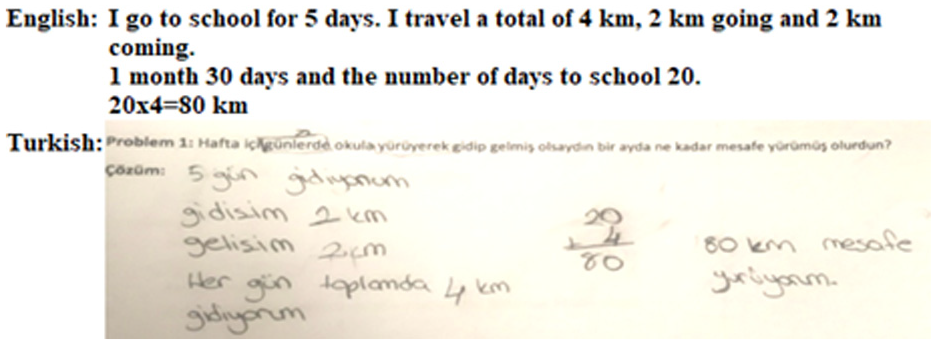
Solution of S14 for the first Fermi problem.
S14 determined and solved the sub-problems necessary for the solution of the problem and made estimations and assumptions (Figure 3). It can be said that S14 calculated an acceptable distance since the estimated distance from home and school was very close to the real value. Here, S14 got full points (4 points) for the solution of the problem.
In all implementations of the first cycle, the data obtained from the reflective diaries were collected under three themes: positive, negative, and difficulties experienced in the lesson. Findings from reflective diaries for 4 weeks in the first cycle are presented in Table 5.
Findings from Reflective Diaries During the First Cycle.

Note. f = frequency; fw
In the reflective diaries of the implementations performed in the first cycle, positive opinions of the students about the implementations centered on the ideas that implementations were useful (fw1:18, fw2:18, fw3:15, fw4:19), the implementations were funny and instructive, the problems and estimation questions were interesting (fw1:7, fw2: 10, fw3:10, fw4:12), the subject was better understood and development was achieved. The negative opinions of the students towards the implementations were concentrated on the ideas that the problems were difficult (fw3:2) and that the lesson was sometimes boring (fw2:2, fw3:1, fw4:2). The difficulties stated by the students under the theme of difficulties experienced in the lesson during the practices were the difficulties faced in solving the problem and difficulties in making estimations. In the first cycle, it was observed that there was an increase in positive opinions about the course, a partial increase in negative opinions about the lesson, and a partial decrease in opinions about the difficulties encountered in the lesson during the 4 weeks of practice. Some student (S) opinions are given below.
S11: I did not really understand the subject of length measurement. But here I was able to make accurate estimations, and I was intrigued by the problems (week 1).
S17: Making consecutive estimations can sometimes be boring, I get overwhelmed (week 2)
S20: The fact that there were no numbers in the problem is sometimes challenging. It was a good lesson; it is both educational, and improving. We are improving in area estimation; we can estimate closer to the real result (week 3).
S4: It was nice, but it could be a little more fun. The question was interesting and difficult. Very difficult things can happen. I could not figure them out a little bit. So, I did not quite understand (week 4).
The problems which emerged in the first cycle and the suggested solutions are presented in Figure 4.

Problems emerged in the first cycle and solutions.
Second Cycle
The fifth, seventh, and eighth Fermi problems involve volume estimation, as well as fluid estimation. The sixth Fermi problem involves an estimate of liquid, volume, and weight. The relationship between the mean scores of the students in the second cycle from solving Fermi problems is given in Table 6.
Findings Regarding the Task of Solving Fermi Problems in the Second Cycle.

Note. FP = Fermi problem.
Table 6 shows that the Fermi problem from which the students got the highest average score was FP8. In addition, during the second cycle, it was seen that the average score of the students from the solutions of Fermi problems has increased continuously. From the increasing score averages, it can be said that students improved in estimating close to the real value during the second cycle. In addition, it can be said that the studies carried out to examine the relationship between liquid measurement units and volume and weight measurement units have a positive contribution to the success of students in fluid estimation. A close estimation (Figure 5) made by the students regarding the Fermi problem is given below.

The solution of S14 for the seventh Fermi problem.
S14 determined and solved the sub-problems necessary for the solution of the problem and made estimations and assumptions. S14 estimated the solution of the problem closely to its true value. With this answer, S14 got full points.
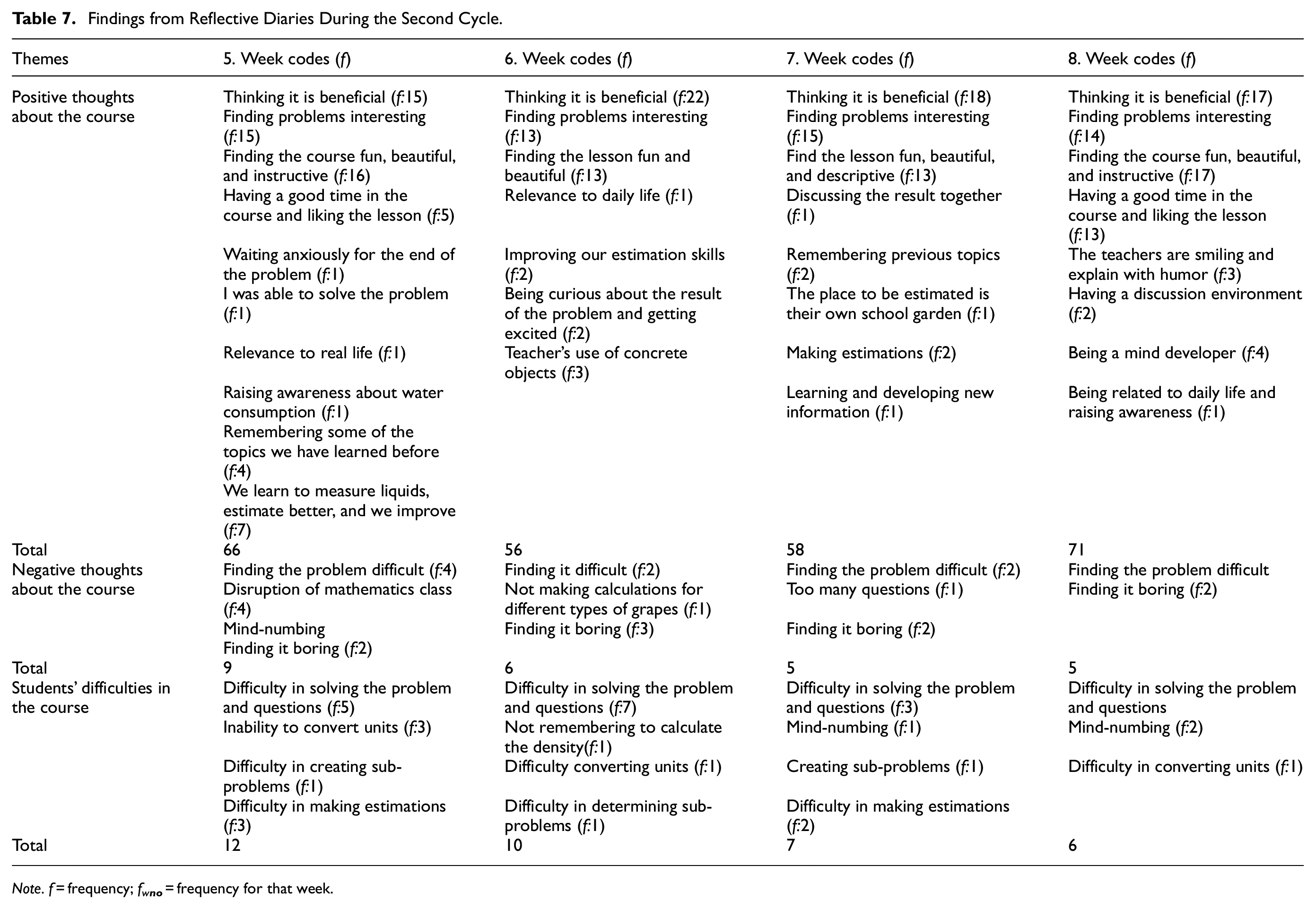
In all implementations of the second cycle, the data obtained from the reflective diaries were collected under three themes: positive, negative, and difficulties experienced in the lesson. Findings from reflective diaries for 4 weeks in the second cycle are presented in Table 7.
Findings from Reflective Diaries During the Second Cycle.
Note. f = frequency; fw
In the reflective diaries of the implementations made in the second cycle, the positive opinions of the students towards the implementations concentrated on ideas that the implementations were useful (fw5:15, fw6:22, fw7:18, fw8:17), the implementations were funny and instructive (fw5:16, fw8:17), the problems and estimation questions were interesting, the lesson was good and that they liked the lesson (fw5:5, fw8:13). Although students’ negative opinions about the exercises were very rare, they focused on the fact that the problems were difficult and the lesson was sometimes boring. It was observed that the students concentrated on the ideas of having difficulty in solving the problem and difficulty in making estimations regarding the difficulties experienced in the lesson during the practices (fw5:5, fw6:7, fw7:3, fw8:3). In the second cycle, it was observed that during the 4 weeks of practice, there was an increase in positive opinions about the course and a decrease in negative opinions about the lesson and the difficulties encountered in the lesson. Some student opinions were presented below.
S12: Trying to calculate the amount of water a family of 4 uses in 1 month, after estimating whether it is too much or too little, I wondered how close I am to the real value (week 6).
S5: Over time, I realized that I could solve the Fermi problem better (week 7).
S12: The Fermi problem is mind-blowing, interesting and developing (week 8).
The problems that emerged in the second cycle and the proposed solutions were presented in Figure 6.
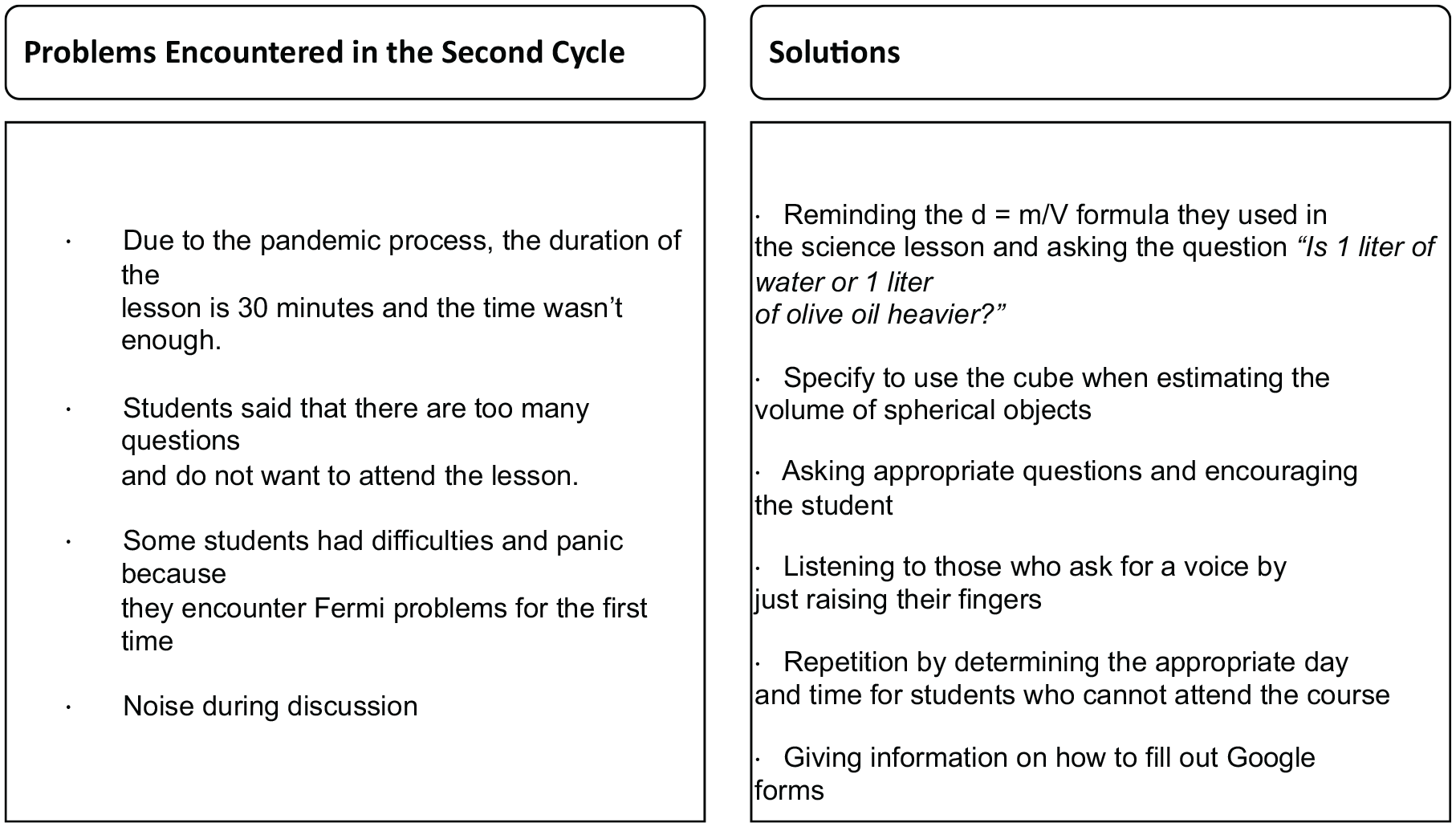
Problems emerging in the second cycle and solutions.
Third Cycle
The ninth and tenth Fermi problems involve weight estimation. The relationship between the mean scores of the students in the third cycle from solving Fermi problems is shown in Table 8.
Findings Regarding the Task of Solving Fermi Problems in the Third Cycle.

Note. FP = Fermi problem.
Table 8 shows that for the Fermi problem, the students gained the highest average score by the solution, which was FP10. In addition, it was observed that the average score of students in solving Fermi problems increased during the third cycle (Table 8). This suggests that students improved in estimating values closer to the real ones during the third cycle. Furthermore, it was found that students’ averages for Fermi problems involving weight estimation were higher than those for problems involving length, area, volume, and fluid estimation in the other cycles. In other words, students’ weight estimates were closer to the real value. The answer of a student who made a close estimation of the Fermi problem is given below (Figure 7).

The solution of S23 for the ninth Fermi problem.
S23 determined and solved the sub-problems necessary for the solution of the problem and made estimations and assumptions (Figure 7). Since S23 estimated the solution of the problem close to its true value, he got full points from this question.
In all implementations of the third cycle, the data obtained from the reflective diaries were collected under three themes: positive, negative, and difficulties experienced in the lesson. Findings from reflective diaries for 4 weeks in the third cycle are presented in Table 9.
Findings from Reflective Diaries During the Third Cycle.

Note. f = frequency; fw
In the reflective diaries of the implementations stated in the third cycle, the positive opinions of the students towards the implementations concentrated on ideas that the implementations were useful (fw9:18, fw10:19), the implementations were funny and instructive, the problems and estimation questions were interesting (fw9:14, fw10:18), the lesson was good and they liked the lesson. Although the negative opinions of the students about the practices are very rare, they are focused on the problems of difficult ideas (fw9:2, fw10:1). It was observed that the views of the students about the difficulties experienced in the lesson during the practices focused on the idea of difficulty due to the fact that the lesson was online (fw10:4). In the third cycle, it was observed that there was an increase in positive opinions about the lesson and a decrease in negative opinions about the lesson and the difficulties encountered in the lesson during the practices made for 4 weeks. Some student opinions were given below:
S23: I found this course very productive because we learned new information. I do not have any negative thoughts because I think it was a very funny and educational lesson. I had no difficulties in this lesson because I think the questions were easy. I just thought about the number of teachers in the Fermi problem (week 9).
S24: We have not been able to hold the last practices face-to-face due to the pandemic. Sometimes, I have trouble connecting to the lesson (week 10).
The problems emerged for the third cycle were the difficulties experienced in attending the course because implementations 9 and 10 were online. In the findings obtained from the reflective diaries in the implementations that took place in all cycles (Tables 5, 7, and 9), it is seen that there is an increase in the positive views of the students towards the lesson, while there is a decrease in their negative views towards the lesson and their views on the difficulties encountered in the lesson. It is considered important to give Fermi problems, including length, area, volume, liquid amount, and weight estimation, in this order during the implementations. The benefits obtained regarding the solution to each problem facilitated finding out the correct solution to the problem in the next stage. These benefits also made it easier to see the relationship between different measurement skills.
Discussion
In this study, students’ test scores were analyzed to assess their measurement estimation skills. It was found that their average scores were “acceptably low” before the implementation, aligning with previous research. For instance, Corle (1960) found that both fifth and sixth graders had inadequate estimation skills, though sixth graders performed better. Similarly, Clayton (1988) reported only a 20% accuracy rate in students’ measurement and collective estimation. Sezer et al. (2021) emphasized the role of individual differences, particularly spatial ability, in estimation skills. Studies such as Kumandaş and Gündüz (2014) showed that measurement estimation skills remained generally insufficient across different educational levels. Hoth et al. (2023) also found that students tended to underestimate lengths and had low performance before training. Supporting this, Moritz and Youn (2022) highlighted the influence of spatial skills on estimation processes.
Another significant finding was that students’ average test scores reached an “acceptable good estimation level” after the implementation. This suggests that the Fermi problem approach positively impacted students’ measurement estimation skills, with notable improvement also observed in multiplicity estimation from pre- to post-test. This result supports previous findings by Reys (1985) and Artut and Aslan (2014), who highlighted that estimation skills can improve with appropriate instructional support. Similarly, Schneider et al.’s (2018) meta-analysis confirmed that while measurement estimation skills are often weak, they can be developed through training. In line with Corle’s (1960) earlier work, Swan and Jones (1980) also reported that students’ estimation abilities improved over time. Arslan and Dazkir (2017) showed that strengthening technical drawing and visualization enhances spatial perception, leading to better estimation accuracy. Moritz and Youn (2022) found that spatial skills training in clothing design education improved students’ measurement estimation. Moreover, Brydges et al. (2015) emphasized that supporting self-regulated learning helps students use estimation strategies more effectively. Overall, the findings indicate that instruction enriched with Fermi problems supports the development of measurement estimation skills, especially in appropriate learning environments.
In this study, students solved 10 different Fermi problems, making multiple estimations in each. A supportive learning environment was created to help them express ideas freely and manage their estimation processes. Research shows that measurement estimation skills improve with age and experience (Budak & Şengül, 2017; Case & Sowder, 1990). However, Reys (1985) and Meyer and Greefrath (2023) argue these skills don’t develop naturally and require mental comparison training. Thus, structured activities are essential. After ten weeks of instruction, students’ estimation skills improved from low to good, consistent with previous findings (Budak & Şengül, 2017; Case & Sowder, 1990; Reys, 1985). Instructional studies emphasize the role of estimation in math learning. For example, conceptual cartoon-based instruction helped students shift from random to more deliberate estimations (Budak & Şengül, 2021; Baran-Kaya & Demirci-Çelik, 2022). These results highlight the value of structured learning environments for developing estimation skills.
In the process of teaching, students encountered different Fermi problems. The first and second Fermi problems include length estimation, the third Fermi problem includes length and area estimation, and the fourth Fermi problem includes more volume estimates, as well as length and area estimates. The fifth, seventh, and eighth Fermi problems include volume estimation, but rather fluid estimation, while the ninth and tenth Fermi problems include weight estimation. It has been observed that students have developed throughout all cycles in the teaching process. It can be said that working with Fermi problems that require length estimation in the first cycle contributes to the success of Fermi problems that require area and volume estimation. In the second cycle, it can be said that the studies carried out to examine the relationship between liquid measurement units, volume measurement units, and weight measurement units have a positive contribution to the success of students in fluid estimation. In the third cycle, it can be said that the students’ weight estimation answers were closer to the actual value than the results of the length, area, volume, and liquid estimation. Estimation is a skill that can be developed with experience. The reason why students make more accurate estimations about weight estimation may be because they are more confronted with the subject of weight in daily life. In the beginning, the problems and difficulties experienced by the students during the practice process indicated that they had difficulties in solving Fermi problems. The reason for this situation may be that the students have not encountered Fermi problems before. It was stated during problem-solving that students were expected to express their own thoughts to see the deficiencies or gaps in the answers of others and to use their estimation and mental processing skills effectively. The students stated that it was difficult to solve the Fermi problem; however, it was funny because they were curious about the result, and Fermi problems were mentally tiring. In addition, the answers given by the students in reflective diaries throughout the process showed that their positive thoughts increased. At the same time, their negative and difficult points decreased. This may result from the fact that students faced Fermi problems during the process, made a series of estimations, and found solutions to the problems identified during the cycles. In addition, it can be added that the knowledge deficiencies of the students were gradually eliminated more effectively over time. Van De Walle et al. (2016) have stated that the experiences offered to students in the classroom should be designed in a way that provides the highest level of learning opportunities for students in order to develop problem-solving skills. In this study, the Fermi problem approach was employed to support the development of both problem-solving and estimation skills, providing students with enriched learning experiences. Hıdıroğlu and Hıdıroğlu (2017) also used Fermi problems with real-life problem situations created by 6th-grade students in mathematical modeling in their study. As a result of the research, it was observed that the students mixed the concepts of weight and length and could not obtain a model since they made false estimations. Abay and Filiz (2020) used Fermi problems in their study. Because of their research, they have monitored that the use of this problem type in teaching increased the interest and motivation of the students toward the lesson. In the present study, it was found that using the Fermi problem approach was effective in the development of students’ measurement estimation skills. Thus, the research results are consistent with the literature.
Theoretical and Practical Implications
This study demonstrates that integrating the Fermi problem approach into instruction effectively enhances students’ measurement estimation skills. Theoretically, this approach underscores the significance of structured learning environments and problem-solving strategies in the development of measurement estimation skills. Fermi problems approach is particularly noteworthy in their efficacy in enhancing students’ problem-solving abilities by fortifying their mental modeling and estimation strategies.
In practical terms, Fermi problems approach allow students to make more informed estimations by developing their abstract thinking, spatial perception and problem-solving skills. Incorporating this approach into teachers’ lesson plans can improve students’ overall academic achievement and support their cognitive development.
Limitations and Suggestions for Future Research
This research has demonstrated the potential of teaching enriched with Fermi problem approach to improve students’ measurement estimation skills. However, the study has some limitations. Its short duration made it difficult to evaluate the lasting effects of the teaching methods. The measurement tools used only examined certain aspects of estimation skills, and no comparison was made with different teaching strategies.
Future studies can analyze the effects of teaching methods with longer-term studies, evaluate estimation skills multi dimensionally using more comprehensive measurement tools, and increase the generalizability of the findings with larger samples. In addition, the most effective strategies can be determined by comparing different teaching methods.
Conclusion
The present study concluded that incorporating the Fermi problem approach significantly enhanced students’ measurement estimation skills. While the students’ measurement estimation skills were previously determined to be “acceptably low,” it was observed that these skills reached an “acceptable good estimation level” by the conclusion of the process. This finding is consistent with similar studies in the literature and reveals that Fermi problems approach make a significant contribution to the development of students’ measurement estimation skills. Furthermore, it was observed that the accuracy of students’ estimations of length, area, volume, liquid, and weight increased significantly during the implementation process.
Footnotes
Author Note
This study is derived from a doctoral thesis.

Ethical Considerations
This study was conducted in accordance with the ethical principles outlined in the Declaration of Helsinki. The questionnaire and methodology for this study were approved by the Human Research Ethics Committee of Çukurova University (Approval No: 98258552-604.01.01-E.16707832, dated 13/11/2020). All necessary institutional permissions were obtained before data collection. This study was carried out in accordance with the ethical standards of a university’s Institutional Review Board (IRB) and received formal approval from the ethics committee (approval details have been omitted to preserve anonymity during the peer review process). Prior to data collection, all required permissions were obtained from the relevant university authorities and affiliated institutions. The confidentiality of participant data was strictly maintained, and anonymity was ensured throughout the research process.
Consent to Participate
Prior to participation, the necessary information about the study was provided to all participants. In the case of children under the age of 16, informed consent was obtained from their parents or legal guardians. Participation was voluntary, and confidentiality and anonymity of the participants were ensured throughout the research process. Necessary information was given to the participants (or, in the case of children under 16 years of age, from their parents or legal guardians) to participate in the study, and their consent was obtained.
Author Contributions
Zübeyde ER: Conceptualization, Data collection and editing process, Analysis, Writing – original draft, Writing – review and editing. Seniye Renan Sezer: Editing process, Analysis.
Funding
The authors received no financial support for the research, authorship, and/or publication of this article.
Declaration of Conflicting Interests
The authors declared no potential conflicts of interest with respect to the research, authorship, and/or publication of this article.
Data Availability Statement
Data are available from the author.