




Abstract
This study examines and explores the challenges, issues, and problems with their solutions regarding Science, Technology, Engineering, and Mathematics (STEM) education along with the awareness enjoyed by science teachers. The selection of papers for this study was done through systematic literature review techniques. The 11 themes were generated through the thematic analysis of the papers that is, STEM education and its awareness; its challenges, issues, and problems; its curriculum; inquiry and learning environment; technologies; learning and models of integration; a blended learning approach; students’ problem-solving abilities and skills; its implementation and evaluation; it’s research and current trends; and interdisciplinary collaboration and intervention. Policy and planning, infrastructure, and the state of society were found the main factors of the poor conditions of STEM education. STEM research studies suggest that a curriculum with a blended learning approach has to be integrated by interventions of models depicting technological and inquiry-based environments to bring awareness among teachers, which strengthens the students’ problem-solving abilities and skills.
Introduction
Science, Technology, Engineering, and Mathematics (STEM) education is an interdisciplinary teaching approach (Kurup et al., 2021; Mayes & Rittschof, 2021) that comprises all four subjects in an integrated form . The STEM acronym was first used nearly two decades ago by the National Science Foundation in the mid-1900s (Jolly, 2017). Traditionally, all four subjects are taught in schools where (S) stands for science, (T) for technology, (E) for engineering and (M) stands for mathematics (Gonzalez & Kuenzi, 2012). It is a better way of developing productivity in economic competitiveness, and societal well-being (Atkinson & Mayo, 2010). Its existence has grown everywhere in the form of artificial intelligence, robotics, automation, and 3D animation (Freeman et al., 2019). This new educational paradigm in the 21st century enhances and explores science’s skills, attitudes, interests, and possibilities (Kong & Huo, 2014), including biology, physics, and chemistry in STEM. Students connect and apply the principles and knowledge of science, technology, engineering, and mathematics together to find the scientific solution of the day to day life problems. People think about computers and digital things as technology, which is an innovation or device created by people for human needs through engineering. Where engineering in STEM is like a glue that integrates and forces the subjects together in an orderly way to design to reach the solutions to the problems (Jolly, 2017). Because STEM provides ground for students to apply mathematical skills for the solution of their problems.
Why a Review Study on STEM Education?
STEM is an emerging field of attraction (Kennedy & Tunnicliffe, 2022; Takeuchi et al., 2020) depending on the interdisciplinary, multidisciplinary, and transdisciplinary approaches (Aslam et al., 2022; Roehrig et al., 2021), which has the capacity to provide a suitable and authentic platform to design the scientific system of education in the 21st century (Kennedy & Sundberg, 2020) to fulfill the needs in the shape of achieving the goals (Leung, 2020) of Industry 4.0 and the Society 5.0 for insurance of the sustainability (Abad-Segura & González-Zamar, 2021). Whereas, Industry 4.0 and Society 5.0 purely considered the systems of Economic Smart and People Smart systems, which have the capacity to resolve the matters of humanity throughout the globe. It is the system that has the capacity and capability to create millions of jobs annually (Aslam et al., 2022) and ideally, graduates can be able well to learn, relearn, and finally earn a living to support themselves, their families, and the community and society (Ashraf & Hafiza, 2016) through direct and indirect participation (Ahmad, 2018) to support the efficient workforce through effective teaching theories and practices (Hack, 2017) of STEM. Whereas, literature shows that STEM education research in Asia started in 2013, which is appealing to the scientific investigation of the phenomenon (Jayarajah et al., 2014; Lee et al., 2019) more especially in English (Wahono et al., 2020). Therefore, it is domineering to study more about STEM in different directions as the growing importance of STEM education (Wahono et al., 2020) through a literature review to know the current status of the phenomenon (Li et al., 2020). Whereas, very few literature review papers are available online with different directions, which encouraged the researchers to conduct more studies on the phenomenon with the exploration of teachers’ awareness, the issues, and problems with their solutions. Therefore, this review paper would be a good addition to the literature that provides a good understanding of the research title.
Method, Purpose, and the Process of Study
The study method entails two main factors, purpose and the research synthesis process of the study. This study aims to explore the understanding and awareness of the teachers and students about STEM education; the challenges faced by them and their solutions in the light of literature review and research amalgamation and the abilities and skills to overcome these challenges. The literature was searched using keywords, such as STEM Awareness, Problems and Solutions in STEM education, Research Trends, Curriculum, and STEM integration in secondary schools in different countries on Google and Google Scholar. Where the papers of different publishers were found that is, Emerald, Eric, Elsevier/Science Direct, Google Scholar, Sage, Springer, Taylor & Francis, and Wiley.
Initially, a total of 193 articles and 17 dissertations and reports were found. After the search process reports and dissertations were excluded from the count without any intervention and the remaining articles were entertained based on STEM education that is, the articles collected from 2010 and onward were categorized into two folders, one folder containing the articles from 2010 to 2014 and second folder contained from 2015 up-to-date, respectively. The first folder consisted of 84 and the second consisted of 109 articles respectively. In the first cycle, the second folder was entertained to recruit the articles through inclusion, consisting of 109 articles and finally, 78 articles were selected for this study and the remaining folder was not entertained due to having some old and non-relevant articles. The selected articles were divided into 11 themes according to the nature and title of their research. Furthermore, to make the review process easier the number of articles was minimized and the articles were selected from 2015 onward that is, till (2022). The detailed process of inclusion can be understood through Figure 1. The Prisma Flow Diagram

Prisma flow diagram.
Characteristics of the Studies
All 78 studies were selected by searching the related terms and keywords. All (n = 78) articles have been conducted in different countries that is, Australia (n = 04), Bangladesh (n = 1), Bulgaria (n = 1), Canada (n = 2), China (n = 4), Finland (n = 1), Greece (n = 3), Hong Kong (n = 3), Indonesia (n = 5), Ireland (n = 2), Malaysia (n = 3), Pakistan (n = 5), Philippines – Filipino (n = 1), Portugal (n = 1), Russia (n = 3), Scotland (n = 1), South Africa (n = 2), Sweden (n = 2), Taiwan (n = 2), Thailand (n = 4), Turkey (n = 12), Ukraine (n = 1), and USA (n = 15). Whereas, the qualitative (n = 41), quantitative (n = 30), and mixed method (n = 7) were recruited as the sample of study. After rigorous study, 78 studies (n = 78) were recruited as the sample of the study. The inductive thematic analysis of the research titles was done to generate the themes for further in-depth analysis to reach a conclusion. After the thematic analysis process the 11 (n = 11) comprehensive scientific themes were generated, which are given in Table 1.
Divisions of Articles as Per Themes and Area of the Study.

The detailed description of all themes is as under that are settled down into main areas that is, STEM Education awareness, issues and challenges, problems and their solutions, trends, and interdisciplinary collaborations.
Results and Discussion
After the rigorous study of the recruited research papers, 11 themes were finalized and the analysis was processed to conclude. The finalized themes and their detailed description is as under:
STEM Education and Its Awareness
For the analysis of the first theme of the study, five (n = 5) research studies were recruited that are given in Table 2 belonging to different countries, that is, three from Turkey, one from Thailand, and one from Indonesia. Out of five, two were found quantitative and qualitative respectively and one was a mixed-method study that provided comprehensive and practical results with suitable recommendations. Qualitative studies were conducted through semi-structured, structured, and in-depth interviews, while quantitative studies were led by survey questionnaire(s), document analysis, meta-synthesis, and review papers. The range of the participants in qualitative studies was 7 and for quantitative studies 107 and 289, and mixed-method research studies was 39 to 186 participants.
STEM Education and Its Awareness.

STEM Education, Its Challenges, Issues and Problems.

It was found that inquiry-based learning (IBL) and its awareness among the teachers, students, and other stakeholders have strong affirmative views that the IBL proved beneficial in improving self-confidence, creative thinking, and problem-solving skills, which increase their interest in the science class. The different skills used by the scientists in their designs like in engineering design involve creativity, collaboration, communication, and problem-solving known as 21st Century skills. The workshops were conducted consisting of the five-step inquiry cycle that is, Ask, Plan, Explore, Construct, and Reflect in which students did their experiments on STEM. Students learn different concepts during their engineering experiments, especially the earthquake and their safeguards. The explored ideas facilitate the students to overcome their difficulties and search the solutions to real-life problems through an interdisciplinary approach in the Turkish education context (Ugur et al., 2020).
The attitudes and perceptions of the teachers, students, parents, and other stakeholders have positive effects on STEM’s interdisciplinary integrated practices. In the USA, STEM inclusive schools are launched to increase awareness of different groups of people, whereas, most of the European countries focused on Women’s Interest in STEM science including minorities but their curriculum programs hurt STEM practices (Korucu & Kabak, 2021). The beliefs of the educators about the theoretical framework for STEM strategies are declared as a real problem-solving consisting of seven stages of inquiry approach started from the context-based to provide project-based teachings in their schools; and teachers may start thinking around their social issues (Sutaphan & Yuenyong, 2019). A survey study conducted in Turkey showed that the student’s problem-solving skills and STEM careers interest increased through inquiry-based approaches to develop computational skills through the guidance and counseling schemas provided by teachers and the learning environment (Hava & Koyunlu Ünlü, 2021). The PISA results showed the lower performance of the Indonesian students in Chemistry, which is a result of lacking interest in IBL practices in their classrooms; caused by the overcrowded classrooms, the inappropriateness of scientific material and facilities, workshops, training, and educational support to the teachers to implement IBL (Effendi-Hasibuan et al., 2019).
STEM Education, Its Challenges, Issues and Problems
For the analysis of the second theme of this study, 11 (n = 11) studies were selected from different countries that is, one each from Australia, Bangladesh, China, Filipino, Indonesia, and the USA respectively; three from Pakistan, and two from Thailand. A detailed description of each study is available in a table (03). The 11 research studies were followed by different research methods that is, two quantitative, seven qualitative, and two mixed methods. These all research studies provided the real picture and practical results of the studies along with appropriate recommendations. Semi-structured, structured, and in-depth interviews, document analysis, classroom observation, focus group discussion (FGD), and pre-designed and adopted questionnaires were used as data collection tools in these studies. The sample size ranges from 10 to 20, 100 to 202, and 100 to 1,500 for qualitative, quantitative, and mixed-method studies respectively.
Inappropriate working conditions, poor planning, unavailability of required materials, poor conditions of science laboratories, no or least co-operation of administrative staff and heads of the institutions, non-clear directions of duties and responsibilities, lack of concerning training and workshops; overcrowded classes, and shortage of trained teachers and experts were found the main challenges, issues, and problems in the majority of the schools (Kiazai et al., 2020). The restricted awareness among the organizers, lack of funding, lack of time management, lower wages, shortage of staff, and less focus on innovation and active learning were found key challenges and issues at junior schools .
Most of the teachers were found unfamiliar with the STEM phenomena depending of the less operational and low students’ motivation; lack of interest of the administrators and heads of schools and universities; bad condition of schools and professional development training (Susilo & Sudrajat, 2020). Interventions have yielded results that are increased study performance, student retention, course enrollment, productivity, and effectiveness in the learning and teaching process. The challenges cover a variety of parts, including resizing scope, implementation conditions for interventions, the extent of channels for delivering interventions, and estimating the effectiveness of interventions, which have the potential to expand the scope of the exercise to meet broader objectives (B. T. M. Wong & Li, 2020).
It was suggested that the positive attitudes held by the participants toward STEM education give a road map for the professional development of teachers to develop skills and attitudes (Landicho, 2020). Poor working conditions, infrastructure, lack of well-equipped laboratories, trained teachers, relevant textbooks, no financial support, size of the class, cooperation among staff, an adverse approach toward STEM subjects, societal involvement, and lack of parental responsibility and gender disparity were the major issues and challenges in the integration of STEM in Bangladesh (Chowdhury et al., 2020). Students were found interested in developing their concepts through practice but remained scolded due to experimental skills because of the unavailability of laboratory material and reliance upon the rote memorization of textbooks. The problems such as the unsuitable provision of material, worst-conditioned laboratories, no lab manuals, substandard textbooks, shortage of trained science teachers, and the size of classes also affect the teaching-learning process of science (Mateen, 2019).
The design and addition of STEM in curriculum, conceptions, and perceptions of teachers, parents, community members, and educators found strong cooperation about STEM education and its integration. Teachers’ knowledge, training, and school administration’s cooperation found strong challenges in the implementation of STEM education in Thailand’s education system (Yuenyong, 2019). In Pakistan, High school education is categorized into two categories 1 to 10 and other grades 11 to 12 the intermediate certificates are awarded based on the examination conducted by multiple boards and students choose either medical or engineering as a future career. Where teachers focus on the science subjects for better exam scores students rely on rote memorization and teachers do not have any freedom in their classes and are bound to teach and focus on the instructions given by the heads of the departments for higher scores rather than transfer of the knowledge (Malik, 2017).
STEM education provides better opportunities in life to play a vital role by teachers to be successful through the implementation of STEM programs at the secondary level being an interdisciplinary approach. Teachers are facing many challenges, issues, and problems in its implementation like knowledge of STEM discipline, intrinsic challenges, grade level, teaching experience, seniority, and teacher training (Dong et al., 2020). Pedagogical content knowledge of teachers, their self-efficacy, technological skills, interdisciplinary subject knowledge, administration, and colleague support, material resources and curricular and co-curricular activities, advanced technology, and engineering design were found the prime challenges faced by the education sector in countries like China, Thailand, Hong Kong, USA and other many countries of the world (Dong et al., 2020; Lee et al., 2019).
STEM Education and Its Curriculum and Teaching
For the analysis of the third theme, eight (n = 8) studies were finalized, which were conducted in different countries that is, one in Australia, Indonesia, and Malaysia each respectively; three in Turkey, and two in the USA. The details of all studies are available in Table 4. Four studies were followed by quantitative and qualitative research methods each respectively that provide real and practical results with suitable recommendations. Different types of questionnaires, experimental studies, documentary reviews, and interviews were used for data collection.
STEM Education and Its Curriculum and Teaching.
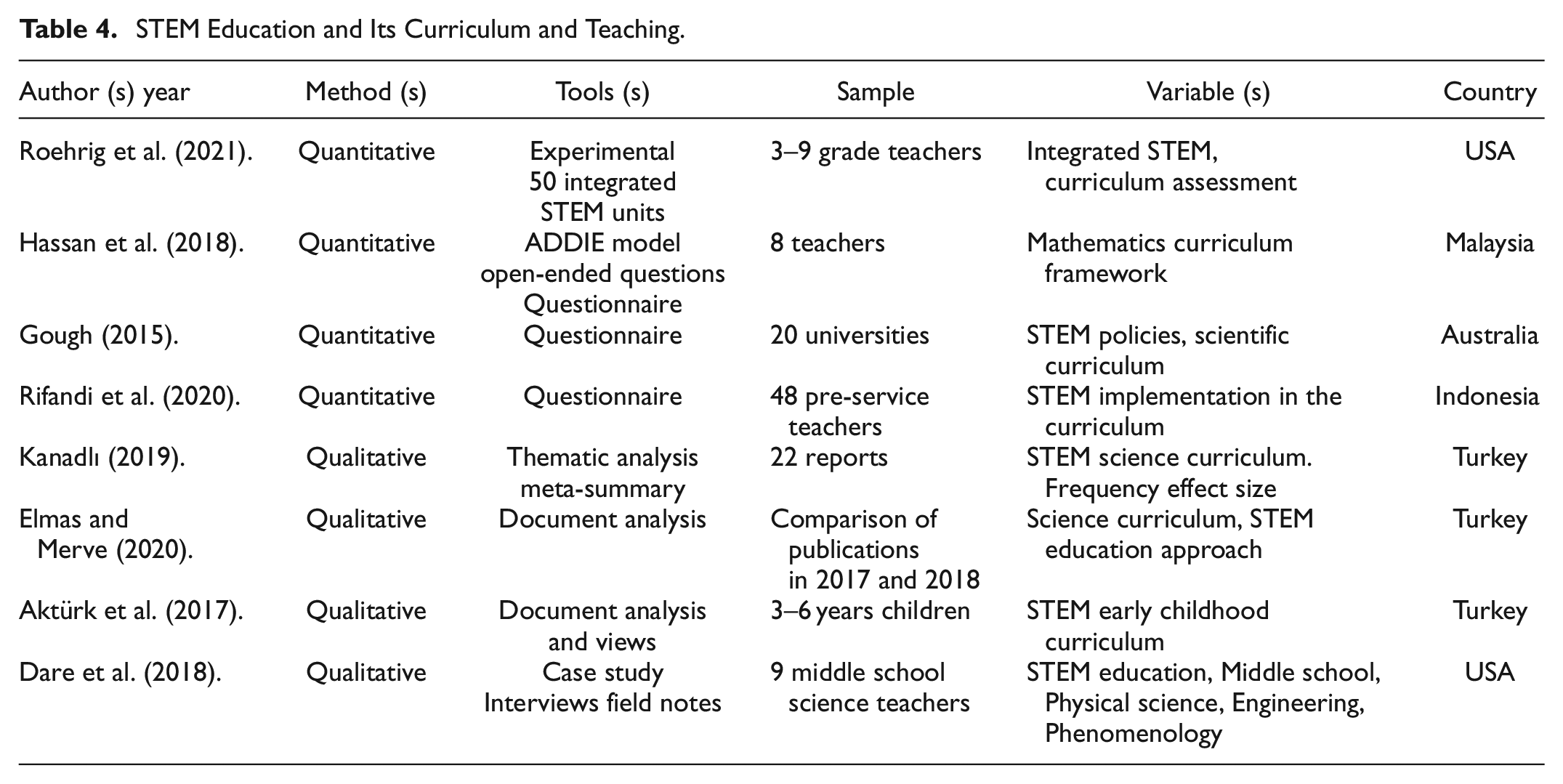
STEM education contributes in different ways, especially through physics subjects in the development of 21st-century skills known as life skills that is, collaboration, decision-making, creative thinking, communication, and teamwork. These skills concentrate on students’ learning by involving digital games and making career awareness (Kanadli, 2019). Degree of the STEM integration is related directly to the ability of teachers to link the different disciplines. The educators, teachers, and policymakers may face different challenges during the implementation of a new educational approach for the first time. The degree of implementation is related to the teachers’ awareness, if they find it valued they continue bringing multiple disciplines into classrooms (Dare et al., 2018). The study found that the science curriculum in 2017 relates to the STEM theoretical framework set out in 2018. The science curriculum does not integrate the disciplines because every subject has its separate exploration and experimentation, which was a clear drawback that the current program could not achieve the required objectives covering engineering design in smooth order (Elmas & Merve, 2020).
In Turkey, a STEM curriculum booklet was set by the educationalists for early childhood classes, and a group of limited activities were included in it. The teacher book provided opportunities for implementation, which shows the activities related to STEM that integrate engineering with other disciplines that is, science, technology, and mathematics. The findings showed that for the implementation of the curriculum in early classes teachers’ professional development remained on priority (Aktürk et al., 2017). The standardization in the curriculum in early childhood education in Malaysia is still limited and needs improvement in the mathematics curriculum. However, positive feedback was received on the mathematical activities in the STEM-based curriculum, which will be useful for future planning, promotion, and development of education (Hassan et al., 2018).
The government and industry policy focus more on the research in science, technology, engineering, and mathematics in schools and universities are declining the interest of students in STEM subjects like Australian students are taking an interest in Nanoscience but Australia is more focused on STEM education (Gough, 2015). The study in the USA found that coherence occurred in curriculum and engineering design challenges that have engaged the students in various STEM disciplinary subjects connecting through real-world problems and their solutions through practice. The integrated STEM curriculum including science and mathematics cultivates solutions for the EDC to engage students (Roehrig et al., 2021) through a positive attitude among in-service and preservice to bridge the school lesson and around the world by providing problem-solving skills and awareness about the future jobs choice (Rifandi et al., 2020).
STEM Education, Inquiry, and Learning Environment
For the descriptive analysis of the fourth theme, six (n = 6) research studies were selected, which are available in n Table 5 conducted in different developing countries that is, one each in Athens, Australia, China, Malaysia, South Africa, and Turkey. Out of six studies, two were mixed methods and four were quantitative research methods, providing the complete picture of studies with suitable recommendations. The studies were followed by self-designed, pre-designed, and adopted questionnaire(s), interviews, document reviews, and observations for data collection procedures. The sample range in mixed methods from 18 to 26, while in quantitative studies from 75 to 646 participants.
STEM Education, Inquiry and Learning Environment.

It is found that students feel a helpful, excited, and friendly atmosphere during STEM inquiry-based learning, which supports them to take part in different activities actively in such a way that builds metacognitive skills and become experts in their fields, proving effective and harmonious for the students in Greece (Chrysovalantis & Drigas, 2020). In Australia, a local rural knowledge model was used to determine the engagement of the students in STEM learning. The implementation of this theoretical model was used academically through research, which found that the rural students were engaged more along with their friends, families, and parents in their learning through school experiences to improve their learning with science teacher educators . The knowledge of the teacher in inquiry-based science teaching is categorized into four scales that is, conceptualization, investigation, conclusion, and discussion, which have a strong relationship with IBL and its skills. IBL improves the student’s 21st-century learning skills which would be possible through the involvement of trained and skilled teachers (Ibrahim & Mahmud, 2020). The awareness among the teachers about STEM education showed dual results that is, the senior teachers showed negative awareness and had the content knowledge about their respective subjects; whereas the teachers who graduated in education with STEM had positive awareness that is explored in Turkey that the STEM education approach is popular nowadays because of it students develop their expertise in 21st-century skills .
Students cannot focus on their studies and improve their learning abilities through traditional teaching methods (Zhai, 2019). STEM-IBL played an important role in the development of teaching and learning activities to promote their interest in English in China because IBL gave them the freedom to solve their problems through the teacher-student relationship without any fear (Zhai, 2019). In the African education system, a positive attitude and awareness among teachers using IBL were found who remained less active in implementation due to difficulties faced by them (Ramnarain & Hlatswayo, 2018).
STEM Education and Technologies
For the analysis of the fifth theme, five (n = 5) research studies were finalized and available in Table 6. These studies were conducted in developed and developing countries that is, one each in China, Greece, Sweden, Turkey, and Ukraine. Out of five research studies, three were quantitative and two were qualitative, providing the complete picture of studies with suitable recommendations. The studies were followed by self-designed, pre-designed, and adopted questionnaires, interviews, document reviews, and observations for the data collection procedure. The sample in quantitative studies ranged from 149 to 300 and the qualitative sample found one school with different activities. The use of technology that is, cloud robotics is not fully used in education but only limited specialists use it due to its advantages like access to big data, an open environment, and system development. The majority of teachers support STEM as a worthwhile method of knowledge, which was integrated based on extending capabilities in the modern world for the solution of their problems through students’ engagement (Valko et al., 2020).
STEM Education and Technologies.

The research conducted on Swedish in-service and pre-service early childhood and primary school teachers through implementing STEM teaching materials and robotics-based approaches to find the sustainability of the teaching materials, pedagogy, and content knowledge through IBL design in engineering and mathematics, which revealed that it is difficult to find the material for lower classes because many pre-school teachers were untrained in technology-based activities (Greca Dufranc et al., 2020). A study conducted in Greece explored that interactive technology has paved great attention to the improvement of the learning skills of children. Where children use different apps and new digital technologies in different areas like robotics, mathematics, and literacy in general which have remarkable results and effects on learning in early childhood. Because devices like mobile phones, tablets, and iPad allow touch screens as comfortable and easier to use than traditional desktop computers (Dorouka et al., 2020).
Different digital games for the students in Turkish schools were found fruitful for boys who participated more than girls with the help of female instructors who have a positive relationship with the child’s psychology, as the children used the different concrete materials and gave more importance to educational games. It was also found that the children who used the different weapons and fighting games remained very aggressive, which supports technology-oriented STEM education that is, digital games promote the students’ thinking abilities and skills (Donmez et al., 2020). STEM pedagogical knowledge and skills of teachers are key factors in integrating the two disciplines, especially teachers’ content knowledge about the technology is essential for the delivery and transformation to improve the higher thinking order among children (Chai et al., 2020).
STEM Education, Learning and Models of Integration
For the analysis of the sixth theme, 10 (n = 09) research studies were recruited Table 7. These studies were conducted in both developed and developing countries such as one each in Bulgaria, Ireland, Malaysia, Russia, and Sweden; while two in Hong Kong and three in the USA. All nine studies were conducted through qualitative research methods, providing a complete picture of the studies and proposed suitable recommendations. The research studies used interviews, observations, and document analysis for data collection. The sample of the studies ranged from 3 to 18 participants.
STEM Education, Learning and Models of Integration.

Teaching practices were not aligned with the perceptions and ideas of the teachers regarding the integration of STEM teaching, their actions and claims that is, teachers agreed and quoted the STEM practices well but their classroom practice was found different (Bunyamin et al., 2020). Malaysian teachers believed in a student-centered approach but their classroom practice was found aligned with a teacher-centered approach (Bunyamin et al., 2020). The research described that STEM education emphasizes the connection of the different disciplines, where conceptual models are used by teachers from simple resources to commercial products to teach their students in the institutions of Hong Kong where students acquire knowledge from scientific inquiry and increase their learning skills (G. K. Wong & Huen, 2017). STEM integration is categorized into three areas that are, content, pedagogical, and learner integration, which is further sub-categorized into six categories that is, subject, domain, method, cognitive, SEN, and diverse ability integration to provide a framework for the conceptualization of the different sorts of STEM learning in the school curriculum. These all initiatives of STEM learning were found unclear at STEM learning schools in Hong Kong (Cheng & So, 2020). Enhancing Learning in Teaching via the e-inquiry Model (ELIT) was used for the determination of STEM competencies that were found adjustable, fruitful, and adaptable for course designers, teachers, demonstrators, and trainers. The competency-based course supports the learner in understanding and achievement of the learning objectives (Stefanova et al., 2019).
The research found that the development of models in STEM education increases knowledge and interest through an interdisciplinary approach and enables the students’ skills. The Critical Integrated Skills and Activities (CISA) model remained feasible for science teachers to encourage them to integrate STEM activities, even if one doesn’t have a specialization in a particular subject like Mathematics or Engineering (Walshe et al., 2014). The models and modeling in science education have great importance and authenticity for STEM education practices. Because Model-based STEM activities bridge integrated STEM and STEM literacy implementation as model-based authentic educational activities to support the evidence-based frameworks and recommendations for teaching practice (Hallström & Schönborn, 2019).
Mathematics teachers have not focused on STEM due to their unsureness about its proper and authentic implementation in the classroom, but after the integration of the three disciplines with each other, teachers facilitated and encouraged students to construct their ideas such as knowledge, persuasion, decision, implementation and confirmation through mathematics learning models (Stohlmann, 2019). The different prototype activities based on STEM integration models encourage instructional leadership and promote the readiness of the citizens toward STEM professional development and career, needed for broader engagement of STEM teachers’ classroom orientation to face the challenges and solve them through their advanced skills (Baker & Galanti, 2017).
The outdoor STEM activities like field trips benefited the students and teacher educators to enhance their skills. The global trends in higher education like digitalization resulted in a reduction in field, training in STEM education in Russia and Common Wealth Independent states (Nepeina et al., 2020). However, a gap was found in executive functioning skills and integration of technology tools for the students with disabilities in post-secondary schools, which can be integrated with Android applications and research-based instructional practices for benefit and help in difficult learning milieus (Xie et al., 2020).
STEM Education and Blended Learning Approach
For an in-depth analysis of the seventh theme, nine (n = 9) studies were recruited, which are available in Table 8 with their detailed description. The recruited studies have been conducted in developed and developing countries that is, one each in Canada, Ireland, Pakistan, Russia, Scotland, South Africa, and three in the USA. Out of nine studies, six studies were followed by quantitative, two qualitative, and one mixed method, which provided comprehensive facts and figures about the studies. Questionnaires, semi-structured interviews, observations, and document analysis were used in studies for data collection. The range of samples for quantitative studies ranged from 40 to 150, for qualitative studies from 9 and 23, and 40 participants for mixed-method studies.
STEM Education and Blended Learning Approach.

A summer science outreach program was held in deprived schools where the voluntary efforts of university teachers and students were focused on what they were going to teach. The STEM program engaged the students in inquiry-based discussion and experiments in science subjects to learn computer skills, coding, games, and design-based modules in public primary schools in Pakistan (Imaad et al., 2016). To enhance technology learning in Europe, a 12-week program was arranged for the students using a blended learning methodology through a flipped STEM online model to engage students in attending the lecture and then involve them in lab activities. It was found that the students enhanced their learning skills and overcame their difficulties in STEM subjects. Moreover, young and mature students found themselves more engaged and showed interest and inspiration in technology (Zhao et al., 2018). Blended learning remained more effective than traditional learning in engineering college, where two learning modes were found highly effective in the performance of the students, which brought a conceptual change with better performance compared to traditional lecture method in the implementation of well-designed blended classrooms that learning is highly effective on the quality of students’ outcomes (Bazelais & Doleck, 2018).
The study involved two licensure programs of 6 months’ teacher preparation and 1-year residency programs to determine the impact on the pedagogical approaches in the classroom and found that the teacher preparation program showed higher results in practical versus theoretical approach, while residential possessed adequate knowledge of theory and its implementation through using more inquiry-based teaching methods (Mentzer et al., 2019). The blended learning approaches remained flexible and adaptable to foster the required needs of children in their life span with synchronous communication benefits in a webinar or other STEM programs rather than asynchronous programs (Herman et al., 2019). Blended learning creates new ways the use digital technology in engineering education to increase the effectiveness and competence in training and projects for future engineers to enhance their knowledge, skills, abilities, expertise, and personal qualities to satisfy the needs of modern engineering education (Galustyan et al., 2020).
The students of low socioeconomic ground were engaged in STEM blended learning compared with those learning in traditional methods, where the STEM blended learning approach increased learning skills, bridged the learning gaps, self-motivated learning, improved thinking abilities, and achieved higher scores (Seage & Türegün, 2019). Blended learning has a great influence on the learning of the students but is hindered due to inappropriate provision of facilities like technology tools, well-designed classrooms, lack of professional training, teachers centered training and material, coordination, and collaboration in the South African context (Naidoo & Singh-Pillay, 2020). Blended learning accelerates cognitive skills, aware students of individualized learning, 21st-century technology skills, success in life, and academic understanding, draws out the hidden qualities and patients of students, activates prior knowledge, helps informative and self-assessment (Nickels & Gartner, 2018).
STEM Education and Students’ Problem-Solving Abilities and Skills
For the analysis of the eighth theme, eight (n = 7) studies were recruited are available in Table 9. All selected studies were conducted in different developed and developing countries that is, one each in Canada, Finland, Russia, Taiwan, Turkey, and three in Ireland. Five studies were followed by quantitative and two by qualitative research methods provided comprehensive facts and figures. Different questionnaires were used for quantitative, while semi-structured interviews, observations, and document analysis for qualitative data collection. The range of samples for quantitative studies ranged from 32 to 241 and from 14 to 21 participants for qualitative studies.
STEM Education and Students’ Problem Solving Abilities and Skills.

The solution to issues is enlisted through the integration of STEM education that is, improvement of problem-solving skills, critical thinking skills, construction of new knowledge, high motivation, encouragement, and coherent and creative thinking, which are considered the multidisciplinary solutions to the problems through giving them mastery over technology (Astuti et al., 2021). Every country has its image and strategies through which reforms are brought to their educational system that is, teachers must be trained, skilled, and experts in their fields to solve the problems faced by the students as they become creative, innovators, thinkers, and problem solvers. Finland brought reforms to their education system and has attained the top position in the education system of the world (Su et al., 2017).
In Turkey, the constructive integrated STEM education does not have a significant result on success, and reflective thinking skills but it increases problem-solving abilities and has a difference in their score and academic achievement. Where STEM is considered an integrated approach that blends science and mathematics with engineering and technology to create interest and potential project-based learning through inquiry (Sarican & Akgunduz, 2018). A study conducted in an Indonesian coffee plantation area where the students used their problem-solving abilities found that the STEM-integrated approach has a positive effect on the student’s problem-solving skills, abilities, and learning achievements; where the mixed problem-solving skills increase the intrinsic and extrinsic motivation with the better problem-solving skills as a result for better learning outcomes (Wahono et al., 2020).
STEM inquiry-based learning is different from traditional inquiry-based learning, which finds STEM inquiry practices as well-awarding solving skills and processes for students who possess high scientific literacy and make scientific decisions in their lives (Yuliati et al., 2018). Virtual web-based learning with the guidance of teachers has better results than in a physical environment classroom without the guidance of a teacher, which is the result of the teachers’ facilitation done through coaching in a problem-based learning environment. Where, students inquire about the difficulties and challenges faced by them during their projects and try their level best to solve them properly through collaborative learning with or without the guidance of a teacher in a better way among junior high schools in Taiwan (Lin et al., 2020).
A pedagogical model has been developed in Russia to increase the interest of teachers in designing and implementing educational activities in different subjects to transform theoretical knowledge into practice. This model proved to be effective in improving the managerial, personal, and professional development of the teachers and students in preschool institutional activities (Vaganova et al., 2019). There is no need for full autonomy for the secondary level students but needed guidance where students think deeply and critically in group work and pair work to remain better than groups because the students learn better by inquiring about the challenges faced by them during the STEM integrated projects (Callaghan et al., 2021).
STEM Education, Its Implementation and Evaluation
For the analysis of the ninth theme, five (n = 6) studies were selected, whose details are available in Table 10, which have been conducted in different developed and developing countries that is, one each in Australia, Pakistan, Turkey, and two in the USA. Five studies were followed by qualitative and one quantitative research method that provided inclusive facts and figures with practical results. Different questionnaires were used for quantitative, whereas, semi-structured interviews, observations, and document analysis were used for qualitative data collection. The range of samples for qualitative studies ranged from 5 to 170 and for quantitative 22 participants.
STEM Education, Its Implementation and Evaluation.

Teachers’ pedagogical implementation and understanding in STEM-PBL observed in the classes that the professional development sessions did not give fruitful and operative results in different concepts about STEM, that’s why teachers did not comprehend the ways of implementation properly (Han et al., 2015).
The need for practice was found for the teachers in STEM integration, pedagogical knowledge, competencies, and content knowledge. The teachers do not know about the acronym of STEM initially, but after engaging them in STEM activities they became familiar with but still possess limited abilities in transferring the knowledge into STEM, as effective STEM education is vital for the future success of students (Aydin, 2020). The action research was conducted in Australia where students engaged in different projects in STEM education, which finds that STEM enhances students’ lifelong problem-solving skills and allows them to work cooperatively and collaboratively to learn technical knowledge through careful study of tasks and constructive methods of learning. Moreover, the students worked together on different models and improved their quality and efficiency with the involvement and guidance of teachers (Trevallion & Trevallion, 2020). The study showed that collaborative learning in middle schools fosters the engagement of the teachers and students using STEM-based strategies in different subjects that is, physics, math, teacher training, communication, engineering, and applied sciences. The teachers who are involved in technological modeling and important PBL-based STEM concepts support conceptual lifelong learning for educators and students (B. Sterrett et al., 2020). The iTALL model was used for the determination of teachers’ lesson plan delivery in their classes, where the pre-principals responded and gave feedback to the teachers remained very useful for all stakeholders where the teachers and principals worked collaboratively to share and support each other like the learning community to quickly access the needs of the learner (B. Sterrett et al., 2020).
For planning and implementing STEM education–based activities and their challenges and solutions, a study was conducted in Istanbul, Turkey on the pre-service ECCE teachers. The data was gathered through an open-ended questionnaire and focus group interviews and was analyzed through qualitative methods and approaches to find out the main themes. In the end, Five themes were generated from the data about planning and Six themes about the implementation of the STEM activities. The main and important contribution of this study is the implementation activities of STEM in ECCE classed early childhood classes with their identified challenges and solutions (for details see: Çiftçi & Topçu, 2022).
STEM Education, Its Research, and Current Trends
For the analysis of the tenth theme, nine (n = 8) studies were finalized whose details are available in Table 11, which were conducted in different developed and developing countries that is, one each in Athens Greece, China, Ireland, Taiwan, Turkey and three in the USA. Six studies were followed by qualitative and two quantitative methods that provided inclusive facts and figures with practical results. Different questionnaires were used for quantitative, while semi-structured interviews, observations, and document reviews for qualitative and for mixed methods questionnaires and semi-structured interviews were used for data collection. The range of samples for qualitative studies ranged from 4 to 150 and for quantitative 2,250 and 35 participants for mixed methods.
STEM Education, It’s Research and Current Trends.
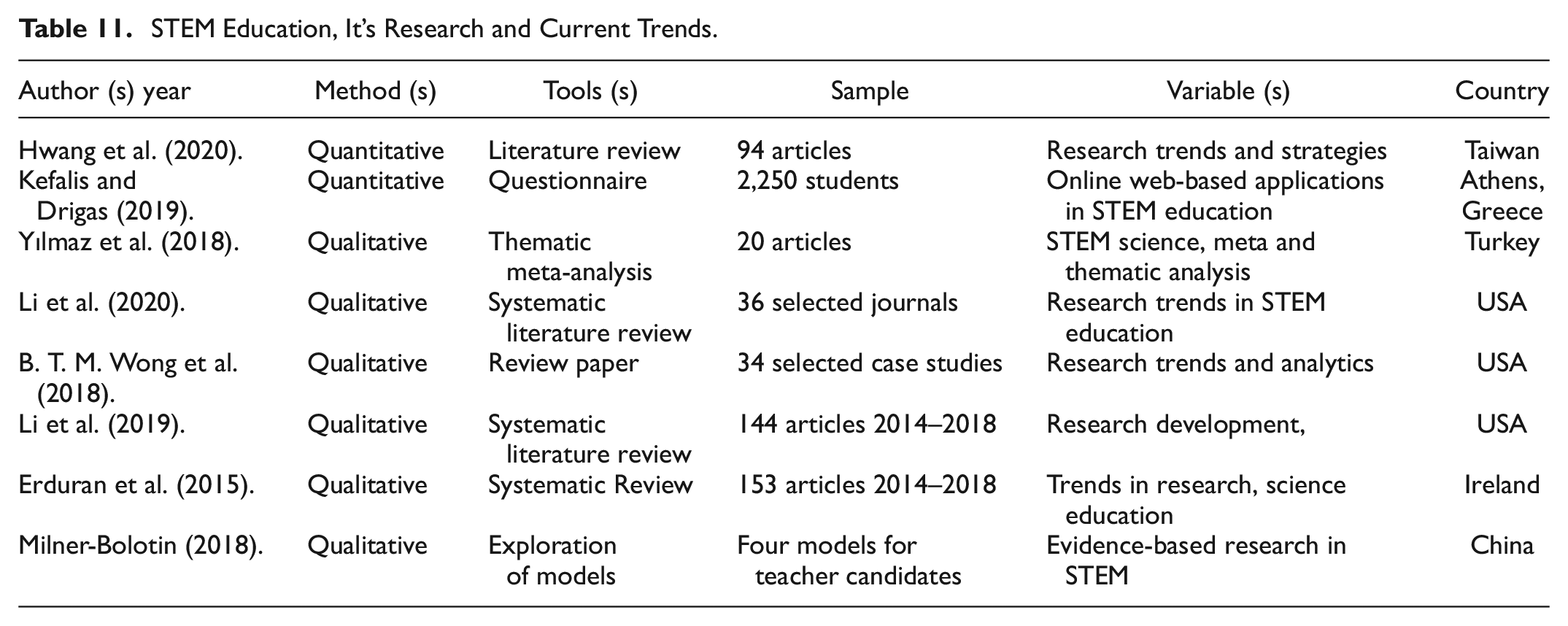
STEM education is the need of the growing world, its clarity and identification is a necessity of the future generation, which acquired more attention recently with an increase in publications by different journals. A vast number of researchers contributed from the pioneer country of STEM education USA, followed by Canada in recent years, which is on the top of the list in STEM education. Besides the USA and Canada, Taiwan, Australia, and Asia were becoming very interesting over the past several years (Li et al., 2020). The recent trends in STEM education are problem-based learning, project-based learning, course level, online courses and their outcomes and effects on learner background; gender issues, and higher thinking order through watching videos either in the classroom, field, or at home. Teachers arrange the activities concerned with technology like a game to complete the activities with technology that plays an important role in learning giving a new vision by engaging the teachers and learners using 21st-century skills to gain the multiple discipline knowledge for the development of STEM education (Hwang et al., 2020). STEM education supports and benefits the knowledge of economics, geography, and other disciplines overview the trends in quality education; more than 60% of institutions recognized and accepted the benefits of STEM, which is supported by many students who are attracted to STEM integration in Bosnia and Herzegovina (Nurkovic, 2020).
The diversified practices were found in the USA to understand and enhance the learning practices of STEM education. A study was conducted and the data was collected on the specific indicators to know the progress of students that is, individual activities and feedback, support, and their needs. In addition, academic performance, demographic data, learning experiences, learning process, variables, sample size, and limitations revealed the need for STEM in the USA and Europe . Several studies were carried out showing that STEM as an interdisciplinary study had gotten less attention in Turkey where science, mathematics, chemistry, biology, and pedagogy were considered separate subjects as the majority of the studies focus on ideas and feelings rather than integrated education, material and academic achievements (Yilmaz et al., 2018).
STEM is a multidisciplinary integrated approach to teaching solutions to students’ real-life problems involving online applications or web-based STEM education that is categorized based on its implementation to support the students through the online or virtual schooling systems. In this regard, the massive open online courses (MOOCs) and other tools play an important role in the enhancement of education through cooperation and collaboration among the different peoples of the world by saving time and money. It increases the interest among students and teachers in advanced STEM-related knowledge (Kefalis & Drigas, 2019). In Canada, a candidate possessed a B.Sc. degree then a B.Ed, and after that, got enrolled in a STEM program, but later, these criteria changed due to the low content knowledge of the candidates. Because the professional development program and collaborative technologies are responsible for the growth of STEM, especially evidence-based educational research and inquiry-based learning (Milner-Bolotin, 2018). Being a most important discipline, research on STEM education is increasing day by day and in the last 10 years’ different journals are publishing STEM-related articles frequently. STEM and STEAM difference is a matter of discussion in different countries like the USA, Australia, Canada, Taiwan, China, and Asia, which are participating actively in the research race and are separated from traditional education (Li et al., 2019). The studies on argumentation over science education have been conducted and published in different international journals of repute purely focused on STEM education (Erduran et al., 2015).
STEM as Interdisciplinary Collaboration and Intervention
For the analysis of the eleventh theme, four (n = 4) studies were finalized, whose details are available in Table 12, have been conducted in different developed and developing countries that is, one each in Hong Kong, Portugal, Thailand, and the USA. Out of four studies, two were followed by qualitative, one quantitative, and one mixed method that provided inclusive facts and figures. Different questionnaires, semi-structured interviews, observations, and document analysis were used for quantitative, qualitative, and mixed methods respectively for data collection. The range of samples for qualitative studies ranged from 4 to 19, for quantitative 224, and mixed-method 8 to 224 participants.
STEM as Interdisciplinary Collaboration and Intervention.
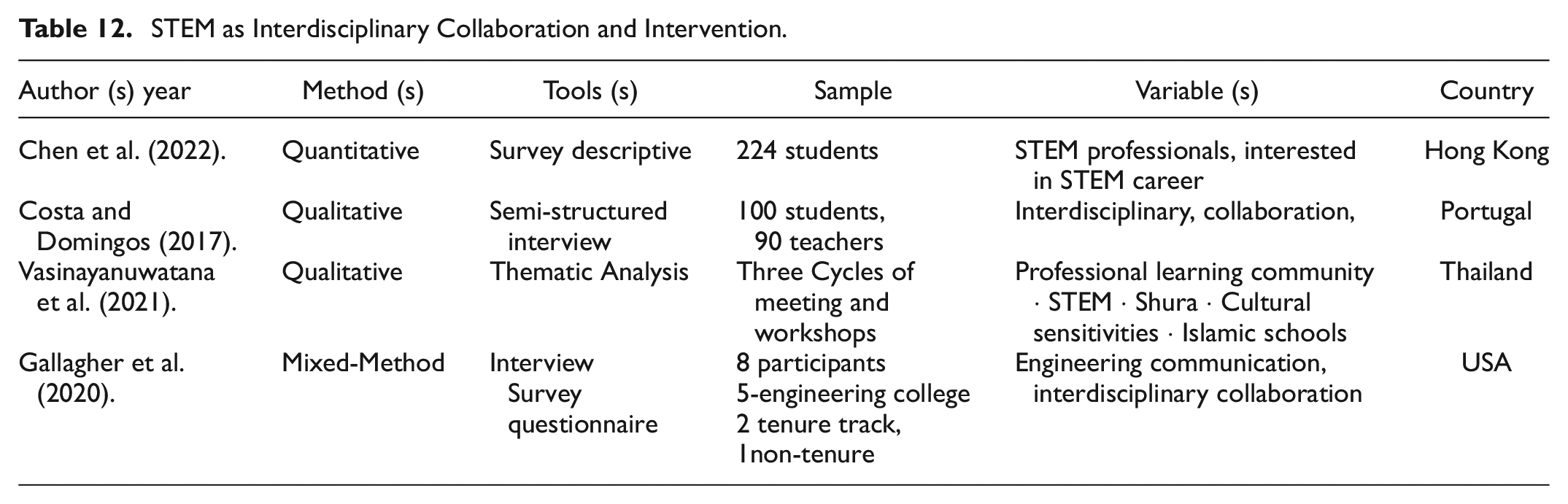
Teachers participated in different professional development programs in Hong Kong for the promotion of students’ careers in STEM education. After the instructions, a positive perception of STEM in students was found with high interest among females . The collaborative work in writing pedagogy involved all the faculty members with valued additions and teaching writing, which was advocated by researchers for sustained interdisciplinary collaboration to promote contextualized implementation and adaptation of best practices and approaches (Gallagher et al., 2020). Because the intervention is a necessary factor in grooming the students’ skills for pedagogical promotion. The professional development of teachers and pedagogical intervention approaches were found efficient in catching the students’ attention toward STEM, and the best way of collaboration took place among all stakeholders (Costa & Domingos, 2017). STEM Professional Learning Community brought a change in science teachers’ beliefs and understanding like Shura helped the science teachers in the enhancement of teaching abilities in Islamic schools .
Challenges, Issues, and Problems in STEM Education With Their Solutions
A total of 10 challenges, issues, and problems were explored with their solution through this study, which are explained in detail as The first challenges, issues, and problems were found, the overcrowded class, lack of scientific material and laboratory facilities, which were solved to have the provision of a suitable building with basic facilities, workshops, training, and support to teachers for the implementation of new strategies to keep teachers’ professional development on priority (Aktürk et al., 2017). The second challenges, issues, and Problems were poor planning, no or least cooperation of administrative staff, shortage of trained teachers, lack of training opportunities, lower wages, and shortage of staff (Kiazai et al., 2020; Wilson, 2021), which were solved that the planning or administrative lapse can be overwhelmed by an alternative plan that is, implementation of economic and efficient immediate interventions (B. T. M. Wong & Li, 2020). The third challenge is issues and Problems where students rely upon rote memorization and teachers do not have freedom in their classroom to follow the given instructions (Malik, 2017), which were solved by increasing students’ problem-solving skills and interest in STEM careers through inquiry approaches, computational skills, proper guidance and counseling, and maintaining teaching-learning environment to improve the problem-solving skills (Hava & Koyunlu Ünlü, 2021) such as technology-oriented STEM education like digital games promotes the students’ thinking abilities and skills (Donmez et al., 2020). The fourth challenges, issues, and problems were found in the knowledge and skills regarding STEM, intrinsic motivation, grade level, teaching experiences, pedagogical content knowledge, administrative staff, parental support, seniority and teacher training (Dong et al., 2020; Lee et al., 2019), which were solved through the development of 21st-century skills, life skills such as collaboration, decision making, creative thinking, communication and teamwork (Kanadli, 2019). Local rural knowledge models determine the engagement of students, teachers, families, and parents in their learning through school experiences improved with the help of science teacher educators (Morris et al., 2019). The fifth challenge, issues, and problems were the delivery and transformation of knowledge and skills, which were solved through the skilled development of teachers who can play a pivotal role in fostering knowledge of technological tools to improve the higher thinking order (Chai et al., 2020). The sixth challenge, issues, and problems were found in the old-fashioned teaching methods like lecture method teacher-centered teaching methodologies, teachers or book-centered curricula, and lack of interest among the students, which were solved through the implementation of Inquiry-based teaching, where STEM blended learning approach increased learning skills, bridged the learning gap to make learners self-motivated, improved the thinking abilities and achieved the higher scores (Seage & Türegün, 2019). During this process, the young and mature students were found more engaged and showed high interest and inspiration in technology (Zhao et al., 2018). The seventh challenge, issue, and problem was found a lack of students’ counseling and guidance, which were solved through the implementation of a proper counseling and guidance system at the secondary level where students think deeply and critically in group work, and pair work because the students learn better by inquiring the challenges faced by them during the STEM integrated projects (Callaghan et al., 2021). The eighth type of challenge, issue, and problem was found that teachers do not have knowledge and awareness about STEM (Han et al., 2015), which was solved through collaborative learning to support the teachers and students in conceptual learning (B. Sterrett et al., 2020). The ninth type of challenge, issue, and problems were found the lack of field trips, game-based learning, technological tools, and their applications (Xie et al., 2020), which was solved through outdoor STEM activities, integrated android applications with research-based instructional practices that have been proved beneficial and helpful in difficult learning milieus (Xie et al., 2020). The tenth type of challenge, issue, and problem was found the lack of web-based learning, the guidance of a teacher (Lin et al., 2020), which was solved through the guidance of teachers to refine the skills of students, collaborative learning with or without the guidance of a teacher is better than classroom-based activities in junior high schools (Lin et al., 2020).
Conclusion
The study concludes that to understand STEM and its importance in the present time and plan through building some platforms for future educational reforms through the perceptions and awareness of secondary school teachers. The perception and awareness of teachers about STEM education are found the best way to explore the challenges, issues, and problems with their solutions. Because the teachers’ awareness is used as an authentic tool to collect firsthand knowledge. Furthermore, it is concluded that a big difference was found in the awareness levels about STEM education among the teachers of primary, secondary, and higher secondary school levels.
There is a need for an updated curriculum that fulfills the common core standards and next-generation science standards (NGSS), and the training opportunities for teachers in the specific fields that will enhance their 21st-century skills. The professional development and pedagogical interventions of teachers will make them proficient in seeking the concentration of the students toward the promotion of an interdisciplinary approach because STEM is an opportunity to illuminate the ways for teachers to overcome the challenges and problems faced by their students to provide a comprehensive understanding with collaboration and hands-on pedagogy (Costa & Domingos, 2017). STEM is not easy work for many educators to set its curriculum, but one must think about a few things like its alienation from school(s), and how it will be easily implemented. A professional learning community is necessary to bring a change in teachers’ beliefs and abilities (Lowrie et al., 2017; Vasinayanuwatana et al., 2021). A school culture scaffolds the teachers’ capabilities, active engagement of learners, multidimensional assessment, an increase in socio-economic conditions, funding, and staffing resources to sustain the quality of the institution. Problem-based and inquiry-based learning is the best strategy to best fit STEM, which helps the participants to hold a positive attitude toward its research and view it as a roadmap for professional development by developing the skills, attitudes, learning experience, and intrinsic and extrinsic motivation for all stakeholders. Lack of experience, workload, time constraints, and financial support were found the main challenges and problems faced by the researchers (Landicho, 2020), which can be supported by conducting more research in similar educational settings for the identification of problems and their long life solutions (Wilson, 2021). The confidence level and external factors like insufficient material and poor infrastructure must be improved and up-gradation of facilities and adaptation of best practices must be done for the promotion of STEM education. Research and its dissemination must be done on a priority basis to accelerate the speed of getting knowledge, understanding, and skill development of all stakeholders through an increase in research projects and funding.
Footnotes
Declaration of Conflicting Interests
The author(s) declared no potential conflicts of interest with respect to the research, authorship, and/or publication of this article.
Funding
The author(s) received no financial support for the research, authorship, and/or publication of this article.

Data Availability Statement
Data sharing is not applicable to this article as no datasets were generated or analyzed during the current study.