




Abstract
The purpose of this research was to determine the extent of student teachers’ willingness to engage in troubleshooting activities and their technological problem-solving self-appraised ability. The study used a cross-sectional descriptive correlational design to collect data from 310 purposively random sampled students from three universities in Northern Nigeria. Results of data analyses indicated that student teachers from the universities surveyed reported a moderate willingness to engage in troubleshooting activities as well as a moderately positive self-appraisal of their problem-solving ability. The student teachers’ willingness to engage in troubleshooting activities was also significantly related to the pattern of their self-appraised problem-solving ability. It was therefore concluded that the findings from this research do not support the pedestrian view that students from Nigerian universities are reluctant to engage in problem-solving activities.
Introduction
A number of writers (Abassah, 2011; Adedokun, 2011; Akinyemi, Ofem, & Ikuenomore, 2012; Dabalen, Oni, & Adekola, 2000; Nwagwu, 2007; Oyesiku, 2008; Umunadi, 2011; Uwaifo, 2010; Uwaifo & Uwaifo, 2009) have suggested that school leavers from Nigerian schools especially lack problem-solving abilities. Although it is not generally clear the sort of problem-solving ability most of the aforementioned writers refer to, Oyesiku (2008) at least alludes to the fact that graduates from Nigerian schools lack troubleshooting skills. This is in spite of the importance of such problem-solving competence among the citizenry (Custer, Valesey, & Burke, 2001; Dugger, 2001). According to Oyesiku (2008), the youths in Nigeria are so badly educated that majority of them grossly lack even the most basic do-it-yourself technical skills to do minor repairs and maintenance jobs like changing motor oil, replacing electric bulbs, fixing of furniture, and so on. The situation is so pathetic according to Oyesiku (2008) that a third party is always called to do the most basic troubleshooting.
Although not every member of society would normally function as expert at solving technological problems, Dugger (2001) summarized the importance of citizens generally becoming technologically savvy when he wrote, It is particularly important in this technological world that people understand and are comfortable with the concepts and workings of modern technology. From a personal standpoint, people benefit both at work and at home by being able to choose the best products for their purposes, to operate the products properly, and to troubleshoot them when something goes wrong. From a societal standpoint, an informed citizenry improves the chances that decisions about the use of technology will be made rationally and responsibly. (p. 2)
Troubleshooting is especially one of the most common problem-solving abilities required of today’s citizens for everyday functioning. Morris and Rouse (1986) described the task of troubleshooting simply as “Given a system that is not functioning properly, the trouble-shooter must attempt to locate the reason for the malfunction and must then repair or replace the faulty component” (p. 503). Prochaska, DiClemente, and Norcross (1992) observed that individuals in their everyday lives engage in personal troubleshooting to effect self-change, especially when related to addictive behaviors. In technical fields, troubleshooting is normally associated with the repair of physical, chemical, biological, electronic, or social systems among others. In the words of Johnson, Flesher, and Chung (1995), “Troubleshooting requires that technicians use their knowledge and skill to effectively interact with a complex technical system that is behaving in some unusual way” (p. 1). Jonassen and Hung (2006) noted that people in the technological disciplines (e.g., automotive mechanics, electricians, refrigeration service men) and professionals (physician, therapists, ombudspersons) do troubleshooting every day, diagnosing faulty systems and taking direct, corrective action to eliminate any faults to return systems to their normal states.
Teachers of any technical discipline must first be technicians in that domain, before they could be effectively disposed to teach the subject matter. Fernandes (cited in Boser, 1993) made the point that to teach problem solving (which includes technical troubleshooting), teachers must themselves be competent problem solvers who are aware of the methods and processes that they use. Parr (2006) also stressed that engaging personally in activities, similar to those we arrange for our students, “supports the principles that we should never ask our students to do something we are not willing to do ourselves or have not previously engaged in, and that we should know more than we teach” (p. 35). Parr further explained that personally engaging in activities similar to those they would expect of their students allows teachers to develop the willingness to participate without hesitation, somewhat automatically and freely, because the teachers themselves have, in fact, been there before. It is only through participation and engagement that teachers truly come to acknowledge the challenges faced by their students and the demands (instructional and otherwise) that they place on their students (Parr, 2006). Thus, if the picture painted by Oyesiku (2008) and others speaks true of the technology teachers in Nigerian schools, then there is certainly cause for concern.
The most popular reason given for Nigerian school graduates’ poor technological problem-solving ability (and by extension, troubleshooting ability as observed by Oyesiku, 2008) is that, as students, they do not get opportunities to develop their capabilities while in school. Plagued by lack of essential resources like equipment, facilities, materials, and funds (Abassah, 2011; Adedokun, 2011; Umunadi, 2011; Uwaifo, 2010), the predominant teaching approach, even in technical education programs, is the lecture method (Uwaifo, 2010). Some authors (Adedokun, 2011; Adigwe, 1991) are of the view that the teachers sometimes teach only theoretical content because they are themselves not properly trained. This presupposes that as the graduates could not accumulate enough problem-solving experiences while in school, they cannot be expected to do well on such tasks out of school. Of course, past experiences from which to draw ideas, are key to successful problem solving (scientific, technological or general), the most enduring of such experiences are often acquired tacitly “on the job” rather than explicitly in formal instructional settings. Given this reality, it is essential we recognize the importance of individuals’ willingness to engage in problem solving tasks as deliberate practice (Ericsson, 2006; Ericsson, Krampe, & Tesch-Romer, 1993) to intentionally cultivate their expertise both inside and outside of classrooms.
However, there is intuitively an obvious link between how individuals perceive themselves as problem solvers and their willingness to engage in problem-solving tasks. A student who is not sure of his or her problem-solving capabilities would obviously also not be comfortable with investing and exerting effort in work that could challenge their problem-solving skills. In the context of learning, this could adversely affect students’ development of their problem-solving capabilities.
There are strong indications that individuals’ self-appraisal of their problem-solving capabilities could influence their willingness to approach or avoid problem situations. Within the school setting, Charles and Lester (1982) had pointed out, “A willingness to engage in problem solving and self-confidence in one’s ability to succeed [are] probably the most important characteristics a student can bring to the problem-solving situation” (p. 16). In this study, the definition of willingness to engage in a problem-solving activity is adopted from Adelman, MacDonald, Nelson, Smith, and Taylor (1990) who pointed out that willingness is indicated by (a) how much the individual wanted to engage in an activity and (b) how much the individual expected to influence a course of action. VanDenmark (1991) informed that, all too often, many students are simply afraid of their ability to solve problems, or problem-solving activities go wrong simply because the students got frustrated, apathetic, or embarrassed. McCroskey (1992) linked self-perception of ability to willingness to perform a task (e.g., to communicate). Brophy (1999) also observed that if the students do not have the willingness to engage in problem-solving activities, they are likely to show reluctance or even resistance to engage in such tasks. When the willingness exists, the individual is primed to action (such as actively seeking solution to encountered problems), resistance is reduced (Bouckenooghe & Devos, 2008), and there could be sustained cognitive, emotional, and behavioral involvement with the problem-solving task.
Thus, to intelligently understand the problem of Nigerian students and school graduates’ reluctance to engage in technological problem-solving activities, it is necessary to acquire information regarding (a) whether or not the students perceived themselves as having the personal resources to deal with technological problems, and (b) whether this perception influences their willingness to tackle technological problem. The study used individuals’ willingness to engage in technical troubleshooting activities as a context for investigation.
This study focused on prospective teachers of technology who are still in training because, sometimes, students’ lack of willingness to engage in problem-solving activities while in school might be a function of how well their teachers are acting as role models. Research in mathematics education for instance indicates that, teachers’ beliefs about subject matter have a powerful impact on the practice of teaching. Akinsola (2008) cited several studies where it has been suggested that teachers with negative beliefs about a particular domain could influence a learned helplessness response from students. Thus, what goes on in the technological education classroom with respect to technological problem-solving disposition may be directly related to the beliefs teachers hold about technology and its processes.
The purpose of this research therefore was to
determine the extent of teacher trainees’ willingness to engage in technological problem-solving activities;
determine teacher trainees’ self-appraisal of their technological problem-solving ability;
determine the relationship between teacher trainees’ willingness to engage in technological problem-solving activities and self-appraisal of their technological problem-solving ability;
determine whether there are significant differences among the teacher trainees in their willingness to engage in technological problem-solving activities on the basis of gender, number of years spent in the university, and program of study; and
ascertain whether technical area of specialization, year of study, gender, or self-appraised technological problem-solving ability is a significant predictor of teacher trainees’ willingness to engage in technological problem-solving activity.
Research Questions
The following research questions guided the study:
Hypotheses
Method
The study used a cross-sectional descriptive correlational design. Respondents’ self-report of their thoughts was collected through a structured questionnaire and used to describe the student teachers’ self-appraised problem-solving ability, willingness to engage in troubleshooting activities, as well as to explore relationships and variations among these variables.
The area of the study was Northern Nigeria and covered all the universities that provide technical teacher training. According to figures obtained from the Research and Statistics unit of the National Universities Commission (NUC; 2012), Northern Nigeria has 38 universities, four of which offer teacher training in industrial technology education.
Sample
All the students surveyed in this study were enrolled in either a 4- or 5-year Industrial Technical/Technology Teacher Training leading to award of a first degree. Purposive random sampling was adopted to survey all the students enrolled into the last 2 to 3 years of study in the Industrial Technology/Technical Education program of the universities. This gave a sample size of 310 students. The sample was chosen because they would have undertaken at least one practical technical problem-solving task during the course of their enrollment into the technical teacher training program at the current institution.
Instruments for Data Collection
Data for the following variables were collected in this study using the following measures:
The Survey of Willingness to Engage in Trouble-shooting Activity (SWETA) was used to assess students’ willingness to engage in technological problem-solving activities. The SWETA is a 24-item researcher-developed survey and was administered as part of a 45-item instrument. The SWETA asks the participants to indicate the extent to which a given statement is true of what they do or think, or how they feel about having to work on the task that requires them to find solution to problems with things such as lights that would not light, an automobile or electric motor that will not start, doors that stick and make noise, or a computer or some other equipment that would not work at all or not work properly. Responses are indexed on a scale of 1 = not at all true to 6 = completely true.
The Problem-Solving Inventory–Technological (PSI-TECH)–Form B (Heppner, 1988; Wu, Custer, & Dyrenfurth, 1996) was used to assess students’ appraisal of their technological problem-solving ability. The PSI-TECH is a self-report measure that assesses respondents’ perceptions of their technological problem-solving confidence, approach/avoidance styles, and personal control over emotions during a technological problem-solving activity. Written on a fifth-grade reading level, Form B of the PSI-TECH is usually completed on a 6-point scale: 1 = really agree, 2 = mostly agree, 3 = agree, a little, 4 = disagree, a little, 5 = mostly disagree, 6 = really disagree.
The researcher-developed SWETA was face validated on the bases of clarity and appropriateness for the study by a professor of industrial education at the Illinois State University who has established research interest in technological problem solving. These scales were also face validated by a senior lecturer in counseling psychology and another senior lecturer in technical teacher training both at the Benue State University. Following suggestions made by these three reviewers, the researcher made modifications to the questionnaires.
Prior to analyses for the purpose of describing the re-spondents’ willingness to engage in troubleshooting activities, the SWETA was subjected to principal component analysis (PCA) with varimax orthogonal rotation (Kaiser–Meyer–Olkin measure = .676, Bartlett’s test of sphericity value < .000) as part of a 45-item survey. Although the PCA initially produced an eight-component solution by eigenvalue, the scree criteria suggested that a two-factor solution was more appropriate fit for the data collected. A two-factor solution was subsequently forced, with the level of significance set to .03 to accommodate the sample size (Tabechnick & Fidell, cited in Casey, Day, Howells, & Ward, 2007). The two components accounted for 33.16% of the common variance in scale items. However, on close scrutiny of the two components, it was realized that they could just be two dimensions of the same construct, willingness. Component 1, which consisted of 17 items, indicated the reluctance to engage in the troubleshooting activity. Component 2, however, consisted of 7 items indicating the individuals’ eagerness to engage in the activity.
The various scales comprising the measure of the SWETA were tested for internal consistency using Cronbach’s alpha. Analysis of the internal consistency statistic was performed using IBM SPSS 21 statistics® software. This analysis indicated a Cronbach’s α = .742, for the total scale of 24 items. The 17 items in Component 1 (reluctance to engage in the troubleshooting activity) together indicated Cronbach’s α = .795, while the 7 items comprising Component 2 measuring eagerness to engage in the activity indicated Cronbach’s α = .772.
The PSI-TECH (Heppner, 1988; Wu et al., 1996) that was used in this study is a published survey that has been validated in a number of studies. For instance, Wu et al. (1996) informed that “previous conceptual and empirical studies of personal problem solving . . . have validated the three dimensions of the PSI” (p. 57). Heppner, Witty, and Dixon (2004) also documented a range of studies that provide a wealth of data supporting the validity of the PSI. In the present study, the total PSI scores indicated a Cronbach’s α = .77.
Analysis of Data
In line with the purposes of study, descriptive and inferential data analysis procedures were used. Data that provided answers to Research Questions 1 and 2 were analyzed using means and standard deviations. Data that provided answers to Hypothesis 1 were analyzed using Pearson’s product-moment correlation coefficients. Data that yielded results for Hypothesis 2 were analyzed using one-way analysis of variance (ANOVA). Data that provided results for Hypothesis 3 were analyzed using simultaneous linear multiple regression analysis.
Willingness was assessed with 24 items that the respondents rated on a 6-point scale. For the purpose of analysis and reporting, these 24 items were combined into an index with total willingness scores ranging from 24 to 144 with a median score of 84. This was done by multiplying each point on the rating scale by the total number of items in the questionnaire relating to the construct willingness to engage in troubleshooting activity. Subsequently, the willingness scores were divided into three categories using a quartile split. The lower quartile split at the score of 54, the middle quartile split at the score of 84, and the upper quartile split at the score of 114 (i.e., Q1 = 54, Q2 = 84, Q3 = 114). Those scores that fell within the lower quartile split were placed in the low-willingness category, those scores that fell within the middle quartile split were placed in the moderate-willingness category, and those scores that fell within the upper quartile split were placed in the high-willingness category. In other words, 24 to 54 = low willingness, 55 to 113 = moderate willingness, and 114 to 144 = high willingness.
The PSI total scale, however, ranges from a score of 32 to a score of 192. Custer et al. (2001) informed that the PSI-TECH scale scores are usually inversely related to the trait, with high scores representing a reduced presence of a given trait. For example, a high numerical overall PSI-TECH score would indicate low levels of the self-appraised problem-solving ability. In this study, the PSI scores were divided into three categories using a quartile split. The lower quartile split at the score of 72, the middle quartile split at the score of 112, and the upper quartile split at the score of 152 (i.e., Q1 = 72, Q2 = 112, Q3 = 152). Following the suggestions of Custer et al. (2001), those scores that were within the lower quartile split were placed in the high self-appraised technological problem-solving ability category, those scores that fell within the upper quartile split were placed in the low self-appraised technological problem-solving ability category, and those scores that fell in the middle quartile split were placed in the moderate self-appraised technological problem-solving ability category. The PSI scores were then indexed as follows: 32 to 72 = high self-appraised technological problem-solving ability, 73 to 151 = moderate self-appraised technological problem-solving ability, and 152 to 192 = low self-appraised technological problem-solving ability.
Results and Discussion
The data collected and analyzed are presented in the order of the research questions and the hypotheses.
The results in Table 1 indicate that student teachers in this survey show a moderate willingness to engage in troubleshooting activities as their mean scores on the willingness scale fall within the predefined middle quartile (M = 84.26, SD = 12.94). Note that the willingness total scale score ranges from 24 to 144. The willingness scores are indexed as follows: 24 to 54 = low willingness, 55 to 113 = moderate willingness, 114 to 144 = high willingness.
Mean Values of the Respondents’ Willingness and Technological Problem-Solving Self-Appraisal.

Note. N = 310.
Data obtained from this study (see Table 1) show that the student teachers appraised themselves as having moderate technological problem-solving ability (M = 92.65, SD = 15.83). Further analysis (see Table 1) indicated that the student teachers showed moderate confidence (M = 28.13, SD = 7.82) in themselves as technological problem solvers. They also appraised themselves as capable of exercising moderate control (M = 17.85, SD = 5.37) over themselves in the problem-solving situation. The results from this study indicate that the student teachers showed a moderate tendency toward approaching technological problems (M = 46.80, SD = 9.24).
Results of a Pearson product-moment correlation (see Table 2) indicated a statistically significant positive correlation between the mean score of the student teachers’ willingness to engage in problem-solving activities and their mean score for the self-appraised problem-solving ability (r = −0.297, p = .000). Note that scores on the PSI are inversely related to the trait. Thus, a negative correlation indicates a positive relationship as higher PSI-TECH scores indicate lower levels of the self-appraised problem-solving ability.
Relationship Between Willingness to Engage in Troubleshooting Activities and Self-Appraised Technological Problem-Solving Ability.

Note. N = 310.
Correlation is significant at the .01 level (two-tailed).
Results of a one-way ANOVA (see Table 3) indicated that there are no significant differences at the p < .05 level among the student teachers, on the basis of gender, in their willingness to engage in troubleshooting activities, F(58, 251) = 1.156, p = .225. There were also no significant differences at the p < .05 level among the student teachers from different technical areas of specialization in their willingness to engage in the troubleshooting activity, F(58, 251) = 1.309, p = .083. Also, no significant differences were indicated at the p < .05 level among the student teachers at different levels of study (years of study) in their willingness to engage in troubleshooting activities, F(58, 251) = 1.111, p = .289.
One-Way Analysis of Variance of Gender, Technical Area of Specialization, and Year of Study by Willingness to Engage in Troubleshooting Activities.

To determine whether the willingness to engage in problem-solving activities could be predicted from any of the independent variables, multiple regression analysis was performed. As this study is exploratory and we do not have any strong theoretical forecast of the predictive power of any of the independent variables over the other, a simultaneous linear multiple regression analysis was done. The regression model summary is shown in Table 4.
Multiple Regression Model of the Willingness Data.
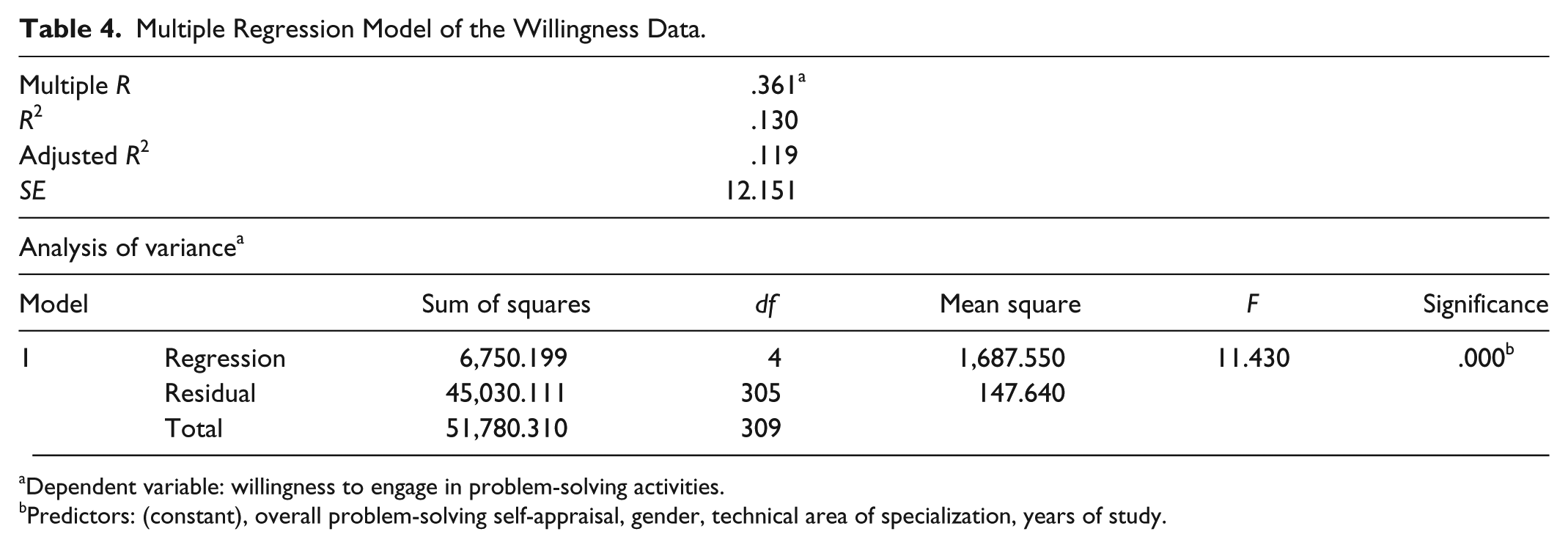
Dependent variable: willingness to engage in problem-solving activities.
Predictors: (constant), overall problem-solving self-appraisal, gender, technical area of specialization, years of study.
Table 4 shows that using the simultaneous multiple regression method to examine the impact of the predictor variables (technical area of specialization, years of study, gender, and problem-solving self-appraised ability) on the criterion variable (student teachers’ willingness to engage in troubleshooting activities) yielded a significant model, F(4, 305) = 11.430, p = .00. The regressing model yielded an adjusted R-square of 0.119. This indicates that only 11.90% of the total variance in the student teachers’ willingness to engage in troubleshooting activities is accounted for by the linear combination of these variables (technical area of specialization, year of study, gender, and problem-solving self-appraised ability).
The multiple regression model also tested the contribution of each predictor to the model. Table 5 also shows the beta weights and t values to illustrate the contributions of the separate factors to the prediction. The results obtained from this study indicate that the student teachers’ year of study (B = 4.383, t = 2.751, p = .006) and self-appraised problem-solving ability (B = −0.234, t = −5.346, p = .00) made significant contribution to the prediction of the student teachers’ willingness to engage in technological problem-solving activities. For every unit change in the student teachers’ year of study, we expect a 4.383 change in their willingness to engage in troubleshooting activity, holding the other predictors constant. For every unit change in the student teachers’ self-appraised problem-solving ability, we expect a 0.234 change in their willingness to engage in troubleshooting activities, holding the other predictors constant. The contribution of the technical area of specialization (B = 1.481, t = 2.480, p = .014) and gender (β = .387, t = 0.219, p = 0) was, however, not statistically significant.
Coefficients a of the Predictor Variables.

Dependent variable: willingness to engage in troubleshooting activities.
Discussion of Findings
The results of this study indicate that, the teacher trainees surveyed in the universities reported a reasonable willingness to engage in technical troubleshooting activities. This finding appears contrary to the claim by Oyesiku (2008) and others that graduates from Nigerian schools are generally not willing to engage in technological problem-solving activities such as troubleshooting and repairs. One curious observation, however, that was made by this study is that these same teacher trainees who reported a willingness to engage in technical troubleshooting activities also indicated a slight tendency toward avoiding technological problem-solving situations in general as measured by the PSI. This finding seems to contradict the respondents’ self-appraisal of their willingness to engage in troubleshooting activities as a sub-set of technological problem solving. Individuals’ problem-solving approach–avoidance style (AAS) seems to be particularly relevant to the construct of willingness to engage in problem-solving activities. AAS is defined as a general tendency to approach or avoid different problem-solving activities (Heppner & Lee, 2002). Although willingness indicates how much the individual wanted to engage in an activity (Adelman et al., 1990), a tendency to approach problems is conceptualized to be especially critical in the initiation of active problem solving (Heppner & Krauskopf, 1987). Thus, it is curious why the students would indicate a willingness to engage in technical troubleshooting, yet at the same time report a tendency toward problem-solving avoidance. A probable explanation is to remember that research and theory have indicated work avoidance as a goal of some students in academic achievement contexts.
Work avoidance has been defined as the desire to do as little as possible in achievement situations (Brophy, 1983). From the findings of this study, it might seem likely that in non-achievement contexts too, some students might adopt work avoidance goals. Students with work avoidance motivation are said to be motivated to avoid doing their work (assigned or unassigned, in-school or out of school) rather than engage in it (Meece & Holt in Guthrie, Coddington, & Wigfield, 2009). Dowson and McInerney (2001) informed that students with work avoidance orientation may act as if they are incompetent so that they will have an excuse to disengage from the tasks.
In line with the general belief expressed in certain circles (Abassah, 2011; Adedokun, 2011; Umunadi, 2011; Uwaifo, 2010; Uwaifo & Uwaifo, 2009), one would have expected that the teacher trainees being students would express low self-ability beliefs that in turn manifested in their apparent reluctance to engage in technological problem-solving activities. However, the evidence from this study does not support such speculation. The findings regarding self-capability beliefs with respect to engaging in technological problem solving indicate that the teacher trainees generally appraise themselves as effective problem solvers. In addition, their appraisal of own problem-solving ability is generally correlated with self-reports of their willingness to engage in problem-solving activities.
The finding that the technological problem-solving self-appraisal variable, as measured by the PSI-TECH, was a significant predictor of willingness to engage in problem activities also contrasts with the findings by MacPherson (1998) where the technological problem-solving self-appraisal variable, as measured by the PSI-TECH, was not found to be a significant predictor of near-transfer technical troubleshooting. The findings however are in line with research on achievement motivation that established the role of self-efficacy in individuals’ activity choices and performance (Eccles & Wigfield, 1995).
Part of the purposes of this study was to investigate whether there were differences among the teacher trainees in their willingness to engage in technological problem-solving activities. More specifically, the study set out to learn whether the willingness of university-level technology teachers in training to engage in technological problem-solving activities differed by characteristics such as technical area of specialization, years of university experience, and/or gender.
Results of a one-way ANOVA indicated that there are no significant differences at the p < .05 level on the basis of gender, years of study, and the teacher trainees’ technical areas of specialization in their willingness to engage in troubleshooting activities. However, the results of a simultaneous linear regression analysis indicated that gender was the only non-statistically significant predictor of the teacher trainees’ technical area of specialization, and years of study were indicated as statistically significant predictors of the teacher trainees’ willingness to engage in troubleshooting activities. A possible explanation for why the teacher trainees’ areas of specialization could be used as significant predictors of their willingness to engage in troubleshooting activities might perhaps be found within the differences in how the features of the technological problem-solving domain or activity (in this case technical troubleshooting) line up with the students’ prior knowledge and experience (Brophy, 1999). It is possible that the students’ prior experience in the sort of problems they are called on to solve might perhaps be inadequate. Or perhaps some of the students’ prior experience with technological problem solving had been unrewarding (Brophy, 1999). There is a need for further research to examine these possibilities as they were not explored in this study.
The results of a one-way ANOVA also indicated no significant difference in the teacher trainees’ willingness to engage in problem-solving activities by year of study (years of university experience). Nonetheless, the results of a simultaneous linear regression analysis indicated that the academic year of study was a statistically significant predictor of the teacher trainees’ willingness to engage in troubleshooting activities. This finding is in line with MacPherson (1998) who found that years of experience were significantly related to technical troubleshooting performance.
The results of a one-way ANOVA also indicated no statistically significant difference between the male and female teacher trainees in their mean score on willingness to engage in problem-solving activities. In addition, gender was not indicated as a statistically significant predictor of willingness to engage in technological problem-solving activities. The finding of this study concurs with those of Mokhtar (2000), Effandi and Normah (2009), Hyde, Fennema, Ryan, Frost, and Hopp (1990), Popoola (2002), and Mohd, Mahmood, and Ismail (2011). These findings may perhaps be an indication that the gender gap is closing (Goold & Rimmer, 2000; Rountree, Rountree, & Robins, 2002), perhaps because equal attention is given to students, regardless of their gender (Effandi & Normah, 2009).
Overall, though the research examined in this article focuses on troubleshooting as a context for technological problem solving, the findings have provided information that enriches an understanding of the disposition of students in Nigerian schools toward engaging in technological problem-solving activities. In addition, the study serves as a valuable contribution to the literature on the assessment of willingness to engage in problem solving, especially given the expectation that problem solving preparedness/willingness research is likely to continue flourishing.
From the findings from this study, we conclude that there is a need to critically appraise factors that influence individuals’ willingness to engage in problem solving and not rely on the pedestrian view that students and even school graduates from Nigerian schools are not ready to engage in problem solving. Following the finding that the student teachers in the study indicated problem-solving avoidance as measured by the PSI, the researcher also recommends that whenever educators observe reluctance among students, they should endeavor to provide support by way of explanation, modeling, coaching, and other forms of assistance, and a suitable environment that helps students develop self-esteem solving technological problems.
Footnotes
Declaration of Conflicting Interests
The author(s) declared no potential conflicts of interest with respect to the research, authorship, and/or publication of this article.
Funding
The author(s) received no financial support for the research and/or authorship of this article.